
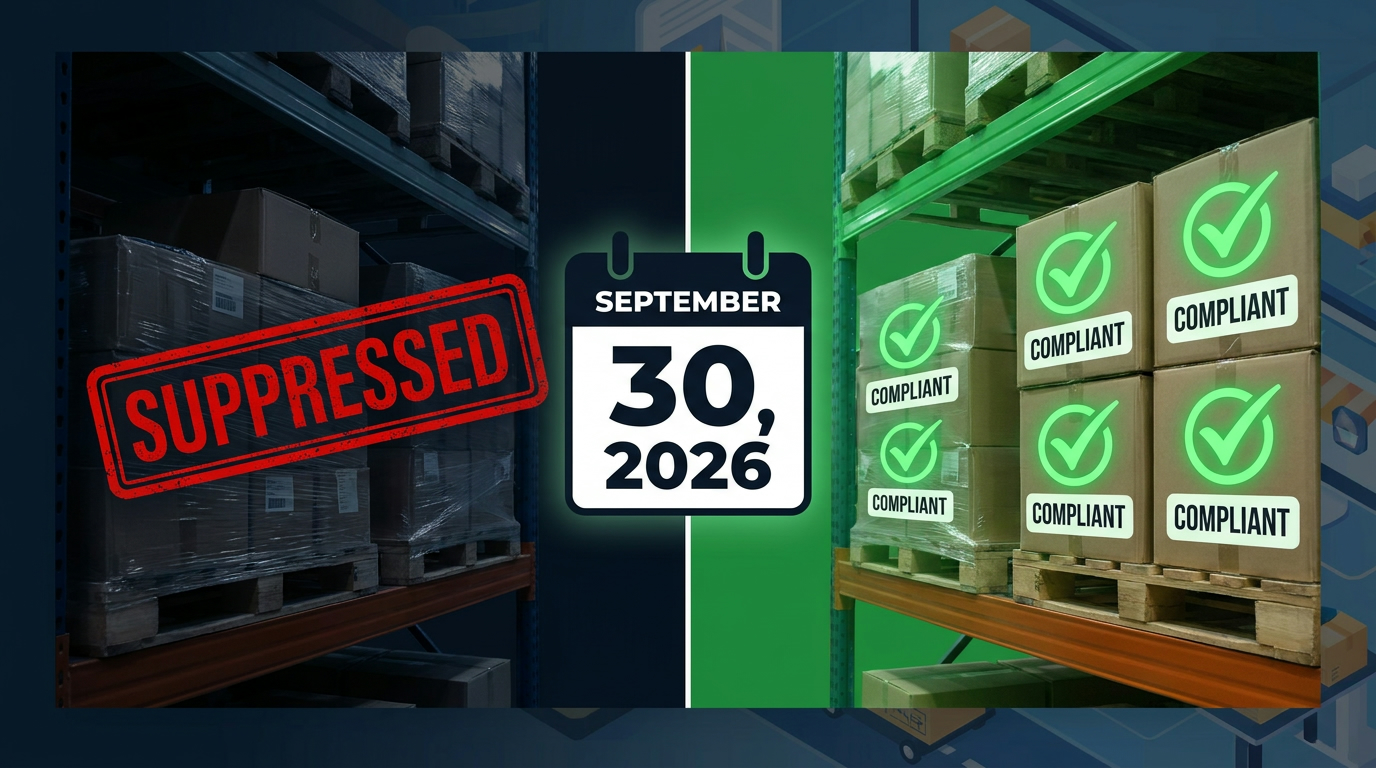

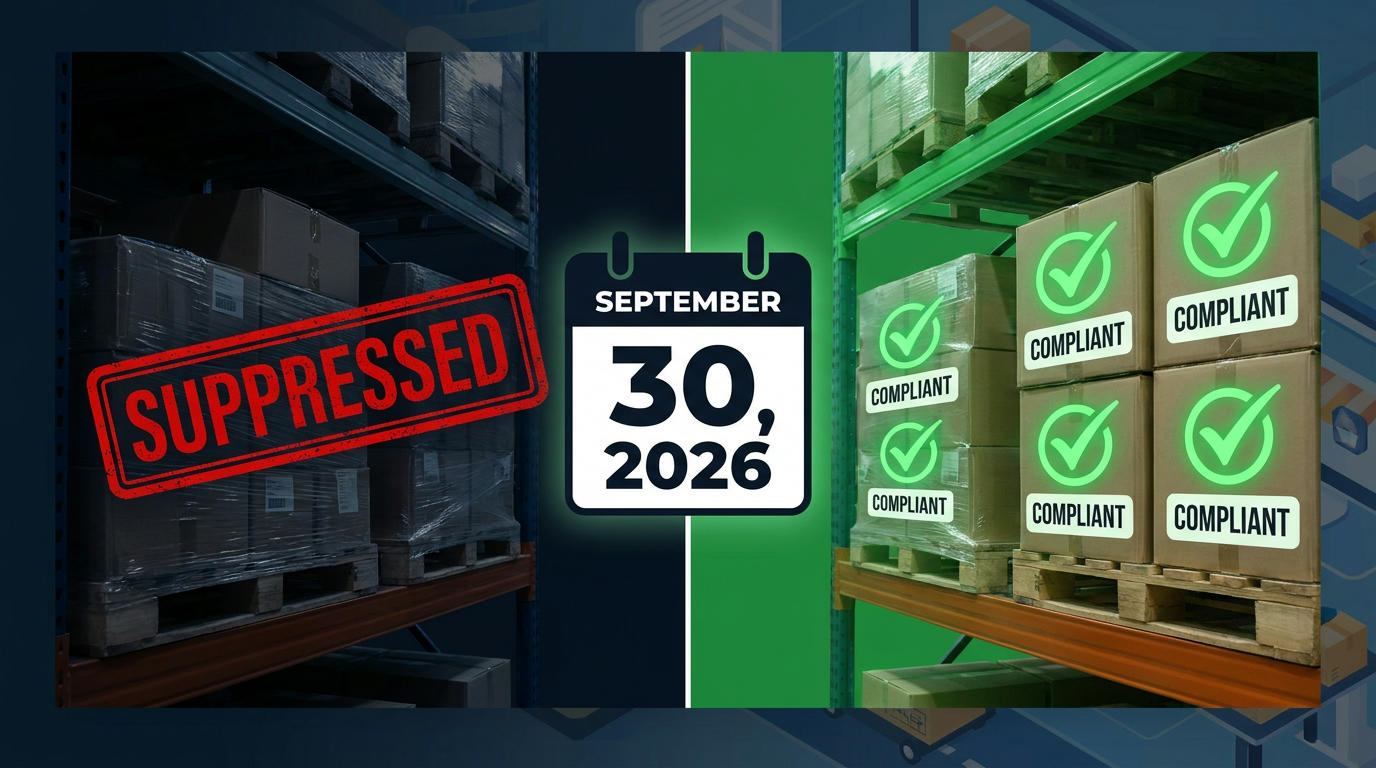
There is a hard cutoff on the Amazon calendar that is not getting nearly enough attention. On September 30, 2026, Amazon’s expanded product bundling policy goes into full enforcement across most product categories — and sellers who have not audited their bundle catalog by then face something they cannot easily reverse: listing suppression that lands directly in Account Health.
This is not a grace-period announcement. Amazon has already proven it can and will act on this class of violation. The consumables version of this same rule went live in October 2024 and saw enforcement of existing bundles begin by January 2025 — with little leniency for sellers who missed the window. What happens in September is simply the same mechanism applied at marketplace scale, covering virtually every category that was previously exempt.
The problem is that most sellers treating this as a future concern are underestimating how long it actually takes to run the compliance sprint. Auditing your bundle ASINs, identifying which qualify for exceptions, securing Letters of Authorization from brand owners, and making inventory decisions about non-qualifying stock — none of this happens in a week. The sellers who will navigate September without disruption are the ones who started this work in June and July.
This guide walks through exactly what the policy requires, what the exceptions actually cover, how to conduct a proper catalog audit, what a valid Letter of Authorization must contain to pass Amazon’s review, how suppression works when it hits, and how to rebuild a bundle strategy that holds up under the new rules long-term. If you sell bundles on Amazon in any category, this is the sprint you need to run now.
What Amazon’s Bundle Policy Actually Says — and What It Doesn’t
The core rule, stated plainly, is this: bundle listings in most product categories must be product configurations packaged by the original manufacturer or brand. That sentence is doing a lot of work, and it is worth unpacking each phrase carefully before assuming what it means for your catalog.
What “original manufacturer or brand” means in practice
“Packaged by the original manufacturer or brand” means the bundle must have been assembled, packaged, and brought to market by the company that made or owns the brand of the primary product — not by a third-party seller who purchased two complementary products and put them in a poly bag. The key question Amazon is effectively asking for every bundle listing is: Did the brand or manufacturer itself decide these items belong together and package them that way?
If the answer is yes — because you are an authorized distributor selling a gift set that the brand already assembles, or you are the brand itself and you manufacture the bundle — you are in compliance. If the answer is no — because you sourced two different products from a distributor, combined them under your seller account, and created a new ASIN — you are not, regardless of how logical or complementary the combination seems.
What the policy does not prohibit
It is equally important to understand what the policy does not say. Amazon is not banning bundles. It is not ending the concept of value-add packaging. It is not even saying that every multi-item listing is presumptively non-compliant. What it is doing is raising the bar on who can create a bundle listing and under what documented authority. Sellers who own their brand, manufacture their own products, and create bundles from their own inventory are not facing a compliance problem — they are the manufacturer. The policy is specifically aimed at the practice of third-party sellers mixing products from different brands or repackaging others’ products into novel configurations without authorization.
The scope of “most categories”
Amazon has deliberately avoided publishing a precise list of affected categories, using the phrase “most product categories” throughout its policy documentation. The safest assumption — and the one that will protect your account — is that every category you sell in is affected unless Amazon explicitly identifies it as an exception or your bundle qualifies under one of the three documented exception types. Assuming your category is exempt without verification is the mistake that creates suppression risk.
How We Got Here: From Consumables Crackdown (2024) to Universal Enforcement (2026)
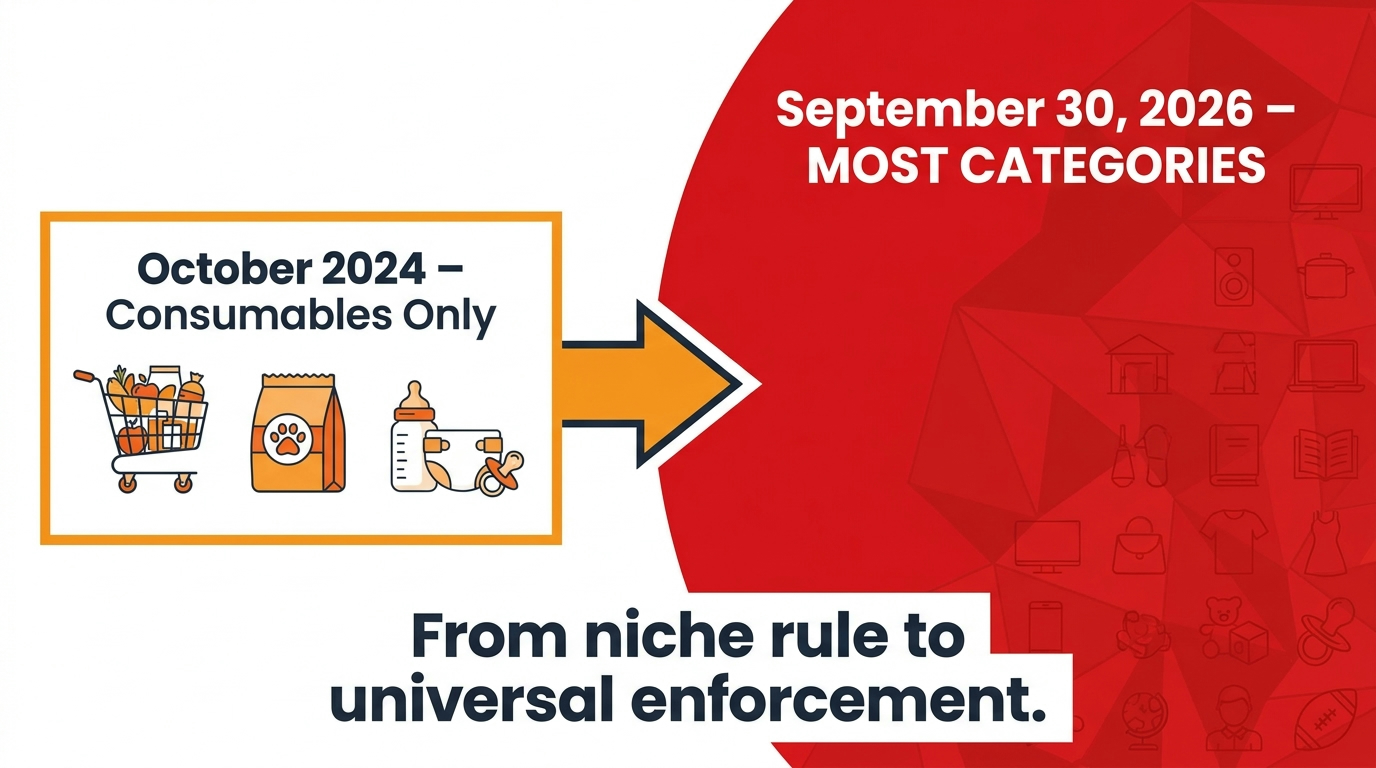
To understand where Amazon is going with this, you need to understand where it came from — and why the 2024 consumables policy was not a one-time adjustment but the opening phase of a broader enforcement strategy.
October 2024: The consumables pilot
In October 2024, Amazon tightened bundling rules specifically for consumables categories — grocery, pet food, baby products, health and beauty, and related segments. The reasoning Amazon gave at the time centered on safety and customer confidence: these are products that people ingest, apply to skin, or use for vulnerable populations like infants. Mixed-brand bundles in consumables created authenticity and traceability risks that Amazon decided it could not accept.
The practical effect was significant. Sellers who had built bundle listings combining, say, a shampoo from one brand with a conditioner from another could no longer list those under “Generic” or under their own seller brand. The bundle had to be original-manufacturer packaged. Enforcement of existing consumables bundles began phasing in by January 2025.
What happened in those three months between announcement and enforcement was instructive: sellers who audited immediately, cleared non-compliant stock, and either secured manufacturer partnerships or pivoted to virtual bundles came through intact. Sellers who waited, assuming the enforcement would be soft, found themselves dealing with Account Health violations on multiple ASINs simultaneously.
The 2026 expansion: same rule, all categories
The September 30, 2026 deadline is Amazon applying exactly the same logic to the rest of the marketplace. The stated rationale is consistency: if the bundle authenticity standard makes sense for consumables, it makes sense for electronics accessories, sporting goods, toys, home goods, and every other category where third-party seller-assembled bundles have proliferated.
There is a secondary commercial motivation worth acknowledging. Amazon’s marketplace is crowded with ASINs that exist primarily as bundle arbitrage plays — combinations designed to reduce price comparison pressure and capture higher average order values without genuine product differentiation. Tightening bundle creation requirements reduces this dynamic and pushes sellers toward either genuine brand ownership or direct manufacturer relationships — both of which align with Amazon’s broader vendor relationship strategy.
Why this is a bigger disruption than 2024
The 2024 consumables rule affected a defined set of categories that, while commercially significant, represented a subset of Amazon’s catalog. The 2026 expansion touches everything. Sellers in electronics, tools, fitness, home décor, clothing accessories, office supplies — categories that had never previously worried about bundle policy compliance — are now inside the scope. Many of these sellers built their bundle strategies over years without ever reviewing the policy’s applicability, because until now, the policy largely did not apply to them.
The scale of non-compliant bundles across these categories is almost certainly larger than what existed in consumables in 2024, which means the enforcement volume in September and October 2026 could be substantial.
The Three Exceptions That Can Save Your Bundle Listings
Amazon has documented three specific exception categories that allow bundle listings to survive the new policy even when they are not original-manufacturer-packaged configurations. Understanding exactly what qualifies under each exception — and, more importantly, what disqualifies — is the most practically valuable exercise a multi-bundle seller can do right now.
Exception 1: Gift baskets in gifting browse nodes
Gift baskets are explicitly carved out of the manufacturer-packaging requirement, but only when listed in Amazon’s gifting browse node structure. This is a narrower exception than it sounds. The bundle needs to be the kind of curated assortment that Amazon’s category system recognizes as a gift basket — typically a collection of complementary items presented as a gift-giving product.
The practical implication: if you sell what functions as a gift basket but have listed it in a non-gifting category, this exception may not apply. Category placement matters. Sellers who have gift-style bundles in non-gifting nodes should review whether recategorizing is both appropriate for the product and sufficient to establish exception eligibility. Do not reclassify products solely to exploit this exception without genuine product-category fit — that creates a separate compliance problem.
Exception 2: Camera bundles in camera product types
Camera bundles — typically a camera body sold with manufacturer-complementary accessories such as lenses, memory cards, cases, or battery grips — retain an exception for bundles listed within Amazon’s camera product type framework. This reflects the longstanding retail convention of camera kits and the complexity of photography equipment configurations.
This exception is category-specific and somewhat narrow. It applies to camera product types, not broadly to electronics or technology accessories. A seller bundling a camera body with a generic tripod and calling it a “photography starter kit” should not assume the camera bundle exception covers them without reviewing Amazon’s category type definitions carefully.
Exception 3: Valid Letter of Authorization from the brand owner or manufacturer
This is the most commercially significant exception — and the most complex to obtain and document correctly. If a brand owner or manufacturer grants written authorization to a specific seller to create and sell a bundle configuration using their products, that bundle can survive the policy even if the seller, not the manufacturer, assembled it.
The LOA exception is powerful because it creates a pathway for distributors, authorized resellers, and co-brand partners to continue building value-add bundles — but it requires actual written authorization from the right party. We will cover exactly what must be in a valid LOA in a dedicated section below, because the documentation requirements are specific enough that an incorrectly structured letter will not save a listing from suppression.
One critical detail: the LOA exception cannot be used preemptively by creating a letter yourself and treating it as self-authorization. The letter must come from the brand owner or manufacturer — not from your own company about your own bundle configuration.
Physical Bundles vs. Virtual Bundles: Different Rules, Different Risks
One of the most consequential distinctions in the new policy environment — and one that many sellers conflate — is the difference between a physical bundle and a virtual bundle. These are fundamentally different products with different compliance footprints, different operational requirements, and very different risk profiles under the September 2026 rules.
Physical bundles: what they are and why they’re in scope
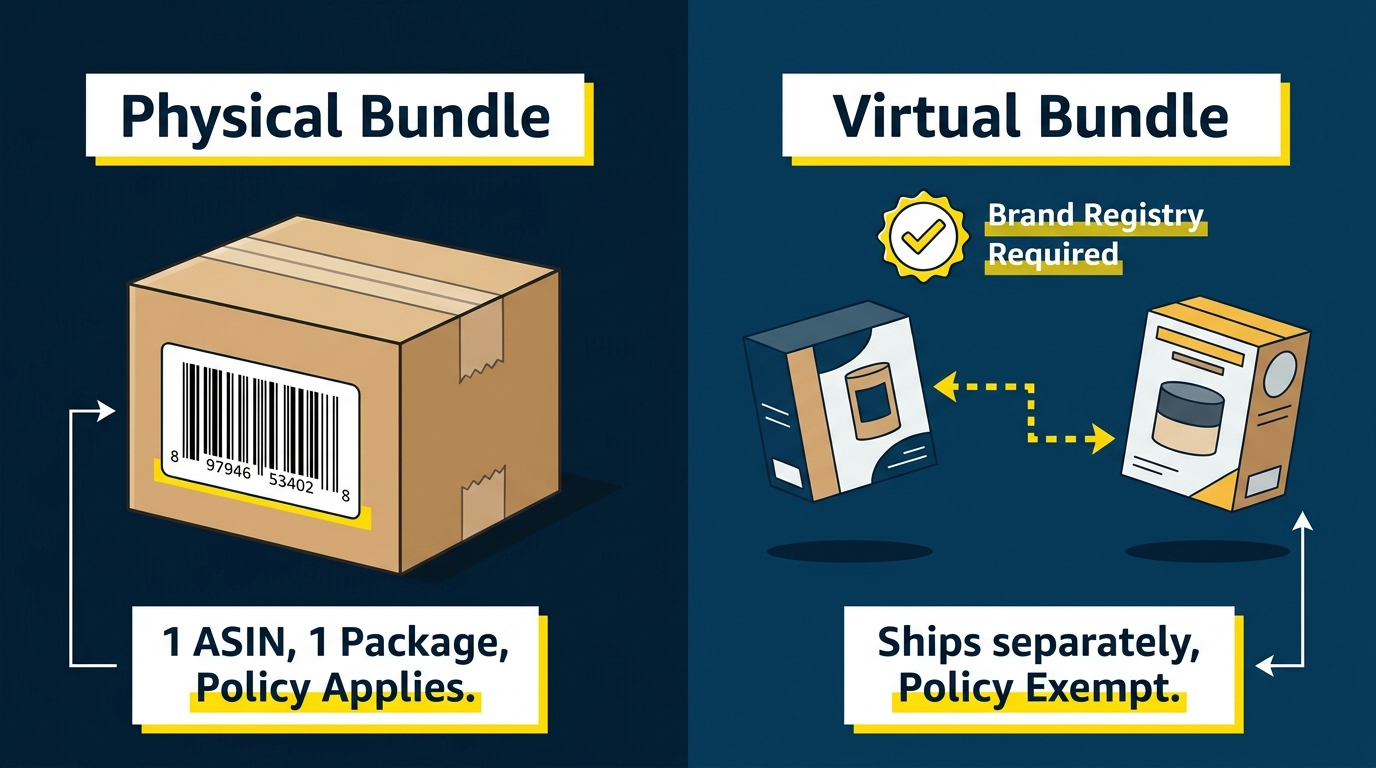
A physical bundle is a pre-packaged product that combines two or more individual items into a single, unified unit. It has its own UPC or FNSKU. It ships as one item from one FBA slot. It is sold as a single ASIN. When a customer orders a physical bundle, they receive a box or package that contains all the bundled components together — because that box was assembled before it ever entered Amazon’s fulfillment network.
Physical bundles are fully governed by Amazon’s product bundling policy. Every compliance requirement in the September 2026 update applies to physical bundles. If a physical bundle is assembled by a third-party seller from products they sourced separately, without manufacturer packaging and without an LOA, it does not comply.
Physical bundles also carry a higher operational burden. They require dedicated inventory, separate prep and packaging workflows, their own ASIN management, and often their own photography. The compliance bar and the operational investment are both higher.
Virtual bundles: the Brand Registry pathway that sidesteps the new rules
A virtual bundle is a listing-level construct available exclusively to sellers enrolled in Amazon Brand Registry who sell via FBA. It allows a brand to group 2–5 existing ASINs into a single customer-facing listing without physically repackaging anything. When a customer purchases a virtual bundle, Amazon ships the individual components separately from their individual FBA inventory locations.
Amazon’s product bundling policy explicitly does not apply to virtual bundles. Virtual bundles are a separate program with their own eligibility requirements, and because they are brand-native — you can only bundle your own brand’s ASINs — the authenticity and authorization concerns that the physical bundle policy addresses simply do not arise.
The strategic implication is significant. Sellers who own their brand, are enrolled in Brand Registry, and sell via FBA have a clear compliance-safe path that does not require manufacturer packaging or LOAs. Virtual bundles are not always the right commercial choice — they do not allow you to bundle complementary products from different brands, and they lack the unified unboxing experience of a physical kit — but for brand-owning sellers who have been running physical cross-brand bundles, the pivot to virtual bundles is often faster and lower-risk than pursuing LOAs.
Choosing between physical and virtual under the new rules
The decision framework here is relatively clean:
- If you own the brand and manufacture the products: Physical bundles are compliant as long as your packaging process reflects manufacturer origination. Virtual bundles also work and offer more listing flexibility.
- If you are a Brand Registry seller using FBA with your own ASINs: Virtual bundles are the lower-friction path. No manufacturer packaging requirement, no LOA needed.
- If you are a third-party seller who assembles bundles from other brands’ products: You need an LOA from each brand whose products appear in the bundle, or you need to exit those bundle configurations before September 30.
- If you are a distributor or authorized reseller: Your existing purchase agreements and distribution relationships may or may not constitute a valid LOA under Amazon’s definition — you will need to review Amazon’s documentation requirements and potentially secure a separate written authorization.
How to Audit Your Entire Bundle Catalog Before the Deadline
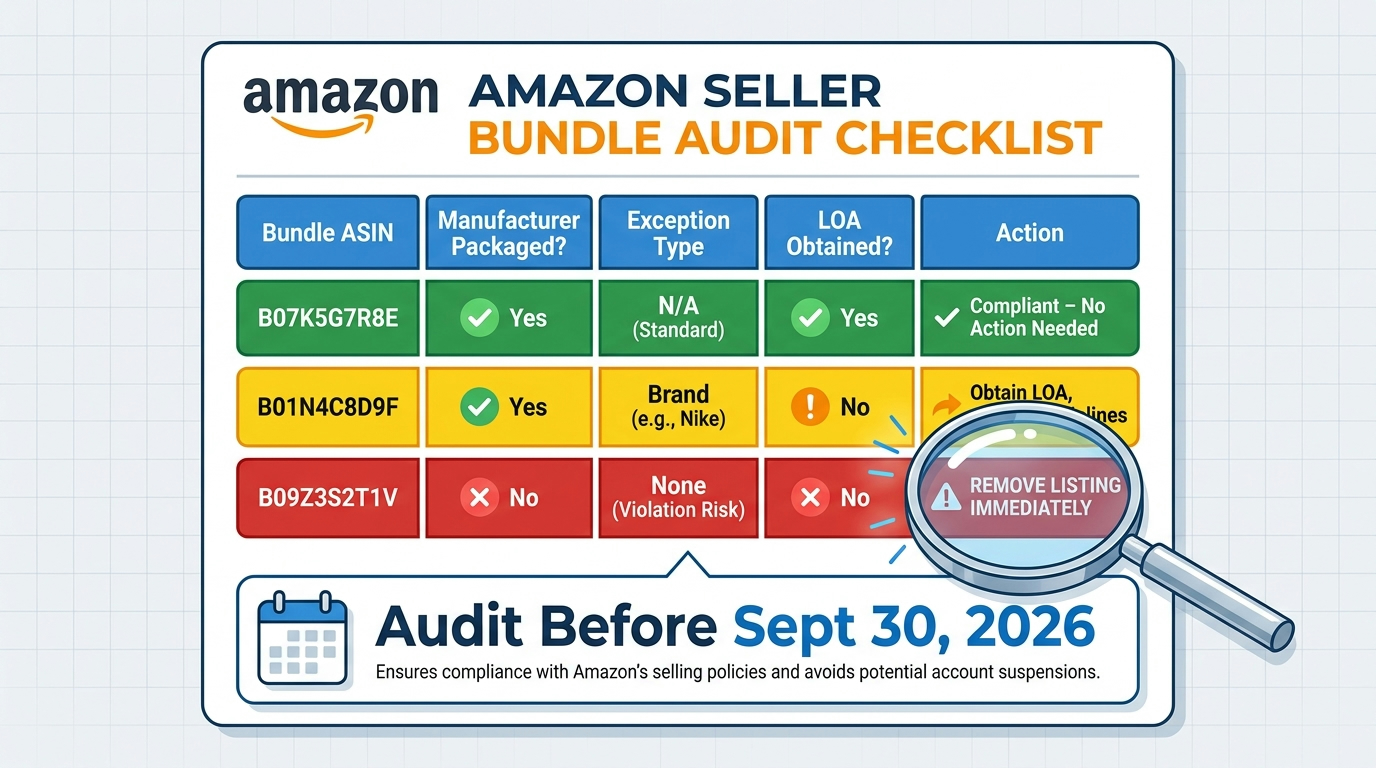
The compliance sprint starts with knowing what you have. Most sellers with catalogs of any meaningful size do not have instant visibility into which of their ASINs are bundle listings, which of those are physically assembled versus manufacturer-original, and which — if any — have documentation that would survive Amazon’s scrutiny. Building that visibility is step one, and it needs to happen systematically.
Step 1: Pull your full active catalog and tag bundle ASINs
Start in Seller Central. Go to Inventory → Manage All Inventory and export your full catalog. The bundle ASINs will typically be identifiable by specific signals in the listing data — multi-item quantity fields, bundle keywords in the title or description, or bundle-specific product types. If your catalog is large, filtering for ASINs with “bundle,” “kit,” “set,” or “pack” in the title is a reasonable starting point, though it will produce both true positives (actual bundle listings) and false positives (products sold in multi-packs that may not be bundles under Amazon’s definition).
The distinction between a bundle and a multi-pack matters here. Amazon’s bundling policy applies to combinations of different products. A listing for a 3-pack of the same item is a multi-pack, not a bundle, and is governed by different rules. Your audit should separate these clearly.
Step 2: For each bundle ASIN, answer four questions
Once you have your bundle ASIN list, each one needs to pass through a four-question compliance filter:
- Was this bundle packaged by the original manufacturer or brand? Yes means compliant. No requires further review.
- Does this bundle qualify for one of the three named exceptions? Gift basket in a gifting node, camera bundle in a camera product type, or covered by a valid LOA?
- If an LOA exception applies, do you have the LOA? Not “could you get one” — do you have it now, and does it meet Amazon’s documentation requirements?
- What is the inventory and revenue impact if this listing is suppressed on September 30? This is the business triage question that determines how urgently each non-compliant ASIN needs to be resolved.
Step 3: Categorize each ASIN into one of four action buckets
Based on your answers, every bundle ASIN falls into one of four action buckets:
- Green – Compliant, no action needed. Manufacturer-packaged or brand-owned virtual bundle. Document the basis for compliance and move on.
- Yellow – LOA needed. The bundle could qualify under the LOA exception if you secure the right documentation from the brand owner. Priority: contact the brand owner now and begin the documentation process.
- Orange – Strategic pivot required. The bundle is non-compliant but could be rebuilt as a virtual bundle if you own the brand and are Brand Registry enrolled. Priority: assess whether the virtual bundle format preserves enough commercial value to be worth relaunching.
- Red – Sell through and close. The bundle cannot be made compliant, there is no viable exception, and you need to sell through existing inventory before September 30 or initiate an FBA removal order for inventory that will not clear in time.
Step 4: Model the inventory math for red-bucket ASINs
For every ASIN in the red bucket, you need to run the sell-through math now. Take your current FBA inventory level, divide it by your average daily sales rate, and add a 7-10 day buffer for FBA processing and removal order lead times. If your projected sell-through date is after September 30, you need to either accelerate sales (through discounts, promotions, or ads) or submit a removal order before the deadline. Suppressed bundles do not sell. Inventory sitting in a suppressed listing’s FBA allotment continues to accrue storage fees while generating zero revenue.
The Letter of Authorization (LOA): What It Must Contain and How to Get It
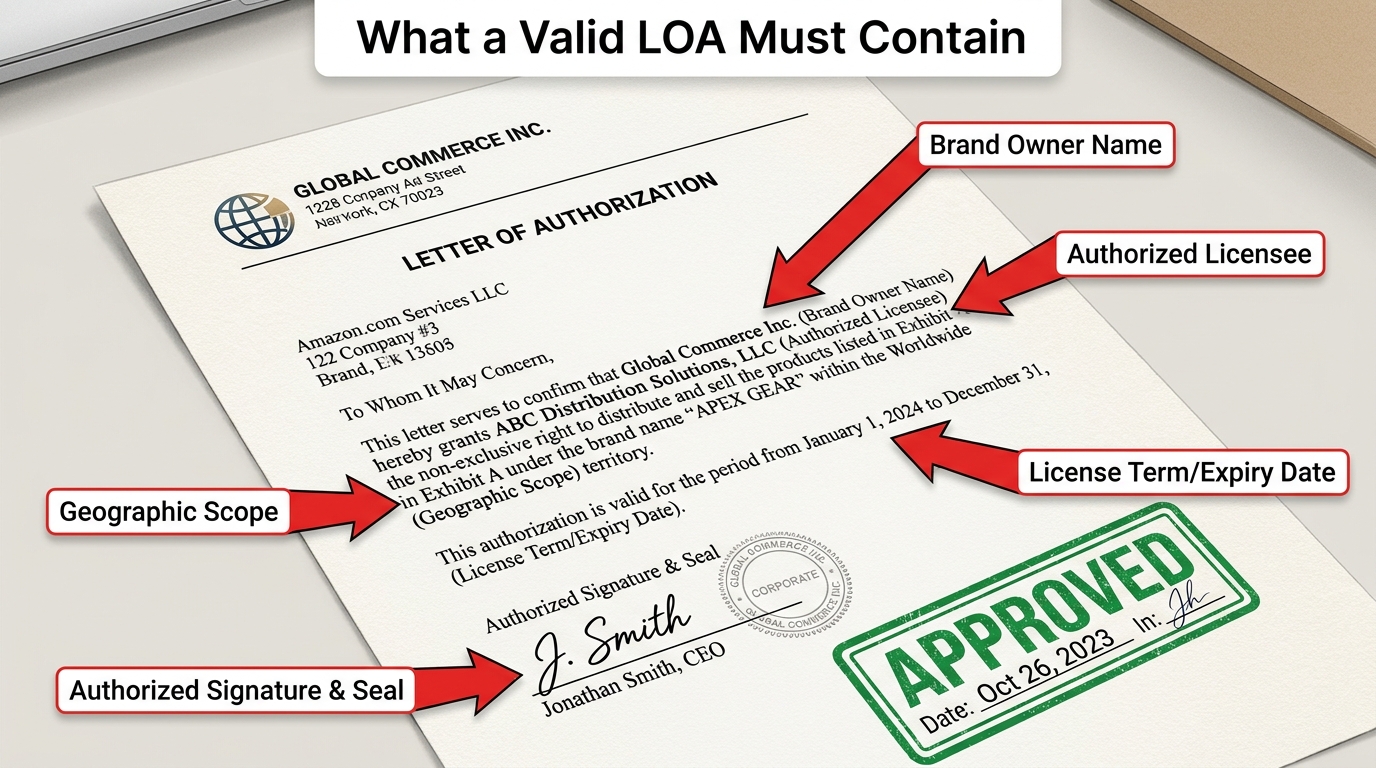
For sellers with yellow-bucket bundle ASINs — those that could survive the policy if properly documented — the Letter of Authorization is the most time-sensitive piece of the compliance sprint. Getting this right matters enormously, because a poorly structured LOA will not prevent suppression, and you may not discover it failed until the September 30 enforcement date has already passed.
What Amazon actually requires in a valid LOA
Amazon does not publish a fill-in-the-blank LOA template. What it does publish is a set of required components and acceptable formats. Based on Amazon’s current policy documentation and seller-reported enforcement outcomes, a valid LOA for a bundle exception must contain the following elements:
- The licensor (brand owner or manufacturer): Clearly identified by company name and address, on their official letterhead.
- The licensee (your company): Clearly identified — this must be your legal business entity, not just your Amazon seller name.
- The grant of authorization: An explicit statement that the brand owner authorizes the licensee to create and sell a bundle configuration including their products. Vague language like “authorized reseller” is not sufficient — the authorization must specifically cover bundle creation.
- Geographic scope: The authorization must specify the marketplace(s) or territories in which the bundle may be sold. An LOA that does not specify scope may be rejected as incomplete.
- Term: The duration of the authorization must be stated. Open-ended authorization language (“for as long as the business relationship exists”) may not satisfy Amazon’s review criteria. A specific expiration date or renewal clause is more defensible.
- Authorized signature: The document must be signed by an authorized representative of the brand owner or manufacturer — not a sales rep or regional manager unless they have documented signing authority. A company stamp or seal adds credibility but is not universally required.
Acceptable formats
Amazon accepts LOAs in PDF format, scanned PDF images, or Word documents (for self-declarations by IP owners only). A screenshot of an email from the brand owner’s official corporate domain can also be acceptable if it contains all the required terms — but this is a riskier submission format and more likely to be questioned during review. If there is any chance of needing to use an LOA in an appeal situation post-suppression, a formal signed letter on company letterhead is strongly preferable to an email screenshot.
What Amazon explicitly will not accept as an LOA substitute: invoices, purchase orders, reseller agreements, receipts, or distribution contracts — even those that grant the seller authorization to sell the brand’s products. The language of general resale authorization is different from the specific authorization to create bundle listings, and Amazon distinguishes between them.
How to approach brand owners for LOAs
This is often the most practically difficult part of the process. Brand owners — especially larger manufacturers — may not have an established process for issuing bundle LOAs, may route your request through a legal or compliance team, and may take weeks to respond. A few practical approaches:
Go through your brand contact, not cold outreach. If you have an existing relationship with a brand’s sales rep or account manager, use it. Frame the request as a compliance requirement rather than a special favor — you are not asking for new permissions, you are asking for documentation of an arrangement that likely already exists in practice.
Provide a draft for their review. Most brand owners are not familiar with Amazon’s LOA documentation requirements. Drafting a letter that meets Amazon’s criteria and asking the brand owner to review, modify as needed, and sign it on their letterhead dramatically accelerates the process compared to asking them to produce a document from scratch.
Document the request even if the LOA is delayed. If you have submitted an LOA request to a brand owner and are awaiting their response, keep records of your outreach. This does not guarantee it will be accepted in an appeal, but it demonstrates good-faith compliance effort.
What Happens When a Bundle Gets Suppressed — and How to Appeal
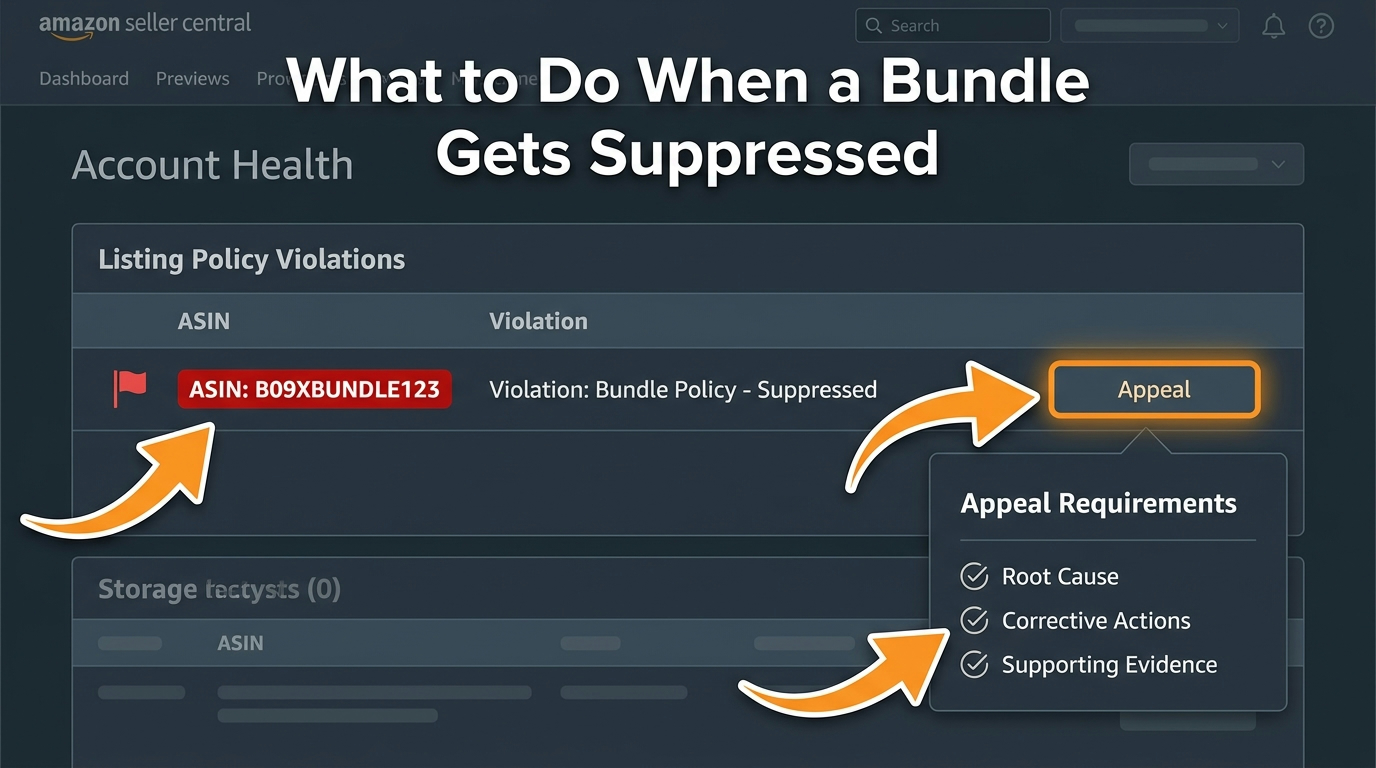
Despite your best audit efforts, some sellers will arrive at October 2026 with suppressed bundle ASINs. Understanding exactly what suppression triggers, how it appears in your account, and what the appeal pathway looks like is critical for managing the situation quickly when it happens.
How suppression works and where you’ll see it
When Amazon determines a bundle listing is non-compliant with the September 2026 policy, the listing status changes to suppressed. A suppressed listing means the ASIN is no longer buyable — it does not appear in search results, the Buy Box is gone, and customers who navigate to the product detail page directly see a dead end. The listing is not deleted, but it is functionally invisible to buyers.
Amazon notifies affected sellers in two places: by email to the registered account email address, and within Seller Central → Performance → Account Health → Listing policy violations. Both notifications should appear around the same time, though email delivery can lag slightly. The Account Health dashboard is the authoritative location for the violation record.
One detail that catches sellers off guard: violations remain visible in Account Health for 180 days. Simply closing or deleting the listing after suppression does not automatically remove the violation from Account Health. The violation record persists independently of the listing status, which means a pile of suppressed bundle violations from September could weigh on your Account Health score for six months.
The appeal process: what it looks like and what it requires
From the Account Health dashboard, select the specific violation, and look for the appeal or compliance submission option. Amazon’s appeal interface for policy violations typically asks for three elements in a Plan of Action format:
- Root cause: A clear, factual explanation of why the violation occurred. This is not a place for general explanations — Amazon expects specific identification of the non-compliant bundle ASIN(s) and the reason the listing did not meet the manufacturer-packaging requirement.
- Corrective actions already taken: What have you done since the violation was identified? For bundle violations, this could mean removing the non-compliant listing, submitting a removal order for FBA inventory, securing an LOA, or restructuring the listing to qualify for an exception.
- Preventive measures: How will you ensure this does not happen again? A credible answer here involves describing your catalog audit process, your new compliance review step for bundle ASINs, or your switch to manufacturer-packaged bundles going forward.
For bundle violations specifically, the strongest appeal also includes the relevant supporting documentation: the LOA if you are claiming the exception, the manufacturer’s packaging documentation if you are asserting the bundle was manufacturer-created, or the gift basket / camera bundle category evidence if you are claiming one of those exceptions.
What “removing the listing” actually resolves
If you cannot make the bundle compliant and do not have grounds for an exception, the practical resolution is to remove the listing and submit a removal order for the FBA inventory. But — and this is important — removing the listing removes the product from sale, it does not remove the violation from Account Health. You still need to submit the appeal explaining the corrective action you took (removing the non-compliant listing) and confirming the inventory has been dealt with. Appeals that simply say “the listing has been removed” without addressing the root cause and preventive measures are routinely rejected by Amazon’s review teams.
Rebuilding Your Bundle Strategy Under the New Rules
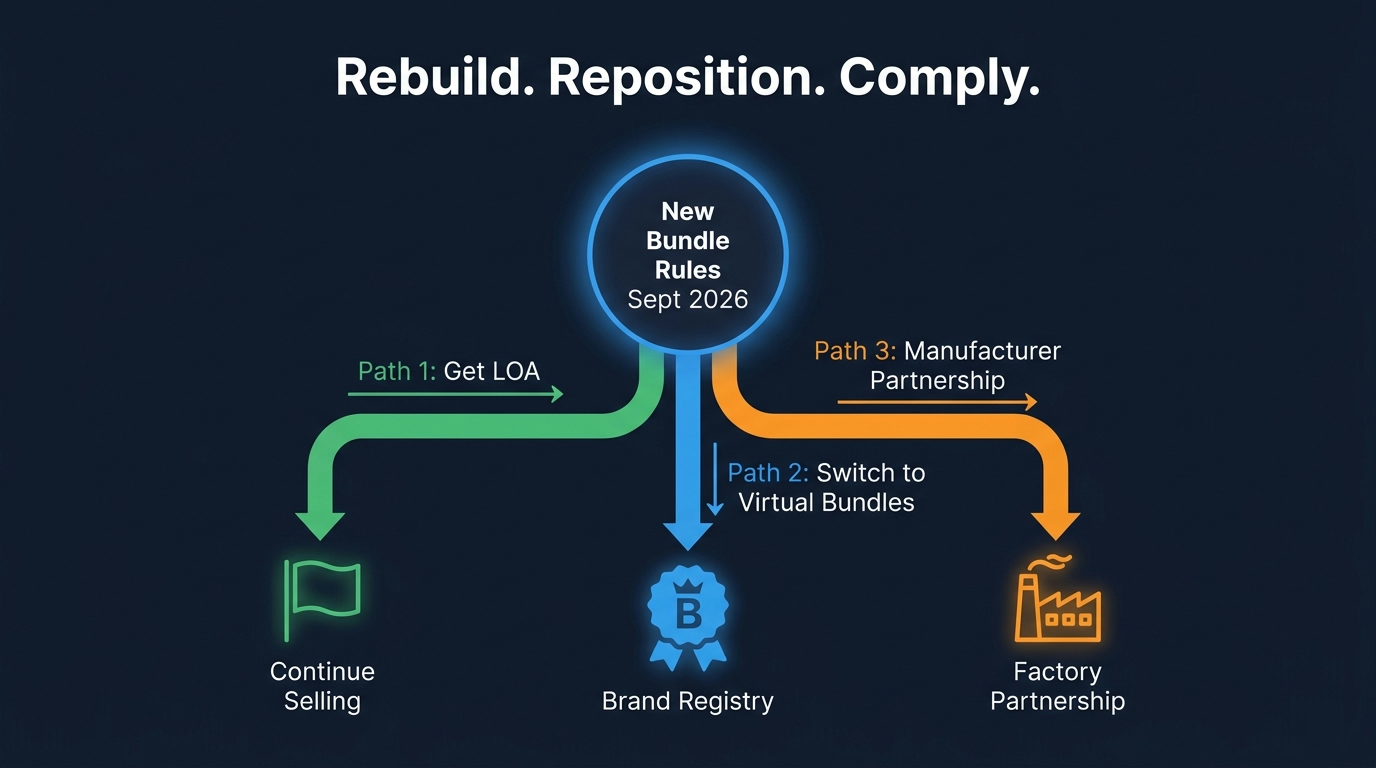
The compliance sprint is about protecting what you have. But once you have cleared the September deadline — with compliant ASINs surviving and non-compliant ones resolved — the more strategic question is what your bundle program looks like going forward.
The new policy actually creates competitive opportunities for sellers who position correctly. Because the barrier to creating bundle listings just got significantly higher, the sellers who can legitimately create and document bundles will face less competition from low-investment bundle arbitrage plays. The key is understanding which of the three forward-looking bundle pathways makes sense for your business model.
Path 1: Brand ownership and manufacturer-created bundles
If you own your brand and manufacture or source products exclusively under that brand, the cleanest long-term path is to formalize your bundling process as part of your product development workflow. That means designing bundles at the product development stage — deciding that a specific configuration of your products will be offered as a manufacturer-packaged unit — rather than creating bundles as a post-inventory tactic.
Manufacturer-designed bundles built around genuine product complementarity tend to perform better commercially too. They have clearer value propositions, more natural visual packaging, and stronger review bases because the customer experience is more intentional. The policy alignment and the commercial outcome point the same direction here.
Path 2: Virtual bundles for Brand Registry sellers
For Brand Registry-enrolled sellers using FBA, expanding your virtual bundle program is one of the most compliance-efficient moves available. Virtual bundles require no repackaging, no new UPCs, no inventory duplication, and no LOAs. They exist entirely as listing constructs built from your existing ASIN catalog.
The limitations of virtual bundles are real and worth acknowledging. You can only bundle your own brand’s ASINs — no cross-brand configurations. You can only bundle 2–5 items. The items must all be FBA-eligible. The customer receives separate shipments rather than a unified kit experience. These limitations mean virtual bundles are not a perfect substitute for physical bundles in every use case, but for a significant portion of bundle SKUs, they are a faster, more agile alternative that exists entirely outside the new policy’s compliance requirements.
Path 3: Manufacturer partnerships with proper LOAs
For sellers who operate as distributors, authorized resellers, or co-brand partners — and who have genuine relationships with brand owners — the LOA pathway creates an opportunity to differentiate from the broader seller pool. If you can secure bundle creation authorization from brands that are either unwilling or too slow to do it themselves, you gain the ability to offer curated configurations that competitors cannot easily replicate.
This is a relationship-intensive strategy, not a catalog-spray approach. The brands most likely to grant LOAs are those where you have existing account standing, purchase volume that makes the relationship commercially meaningful, and a track record of listing quality on their products. One well-executed LOA-backed bundle with a strong brand can outperform a dozen generic bundles that required no authorization — and under the new rules, the generic bundles are going away anyway.
Rethinking bundle economics under tighter supply
It is also worth revisiting the economic model for bundles under the new rules. Bundle margins work when the combined unit can command a meaningful price premium over the component products sold separately, and when that premium exceeds the additional operational cost of bundling. In the old environment, competition from seller-created bundles compressed that premium. As non-compliant bundles exit the market post-September, the remaining compliant bundles should, over time, face less price compression — provided they offer genuine complementarity that customers value.
That means the best long-term bundles are not the ones that are easiest to assemble — they are the ones that solve a coherent customer task in a way that the individual components, sold separately, do not. A photography kit designed around a specific shooting scenario, a gift basket built around a specific occasion, a tool kit assembled around a specific repair job — these bundles have inherent justification that a random product pairing never had.
The Broader Marketplace Signal: Why Amazon Is Doing This
It is worth stepping back from the operational details and asking the larger question: what is Amazon signaling with this policy, and what does it tell us about where the marketplace is headed?
Catalog quality as a competitive advantage for Amazon
Amazon has been on a multi-year effort to improve catalog quality — reducing duplicate listings, improving data accuracy, tightening brand protection, and making the search and discovery experience more reliable. The bundle policy expansion is part of that broader effort. When third-party sellers create bundle ASINs by combining any two products they happen to have available, they generate catalog clutter: listings with inconsistent data, unclear product ownership, authenticity risk, and poor returns experiences.
Amazon’s catalog improvement initiatives have consistently moved in the direction of raising the bar for who can create listings and under what authority. The consumables bundle rules in 2024, the ASIN deactivation patterns that have emerged in 2026, and now the bundle policy expansion are all expressions of the same underlying strategy: tighter quality control at the listing creation layer, with enforcement through Account Health consequences that create ongoing compliance incentives.
Brand protection as the underlying driver
The LOA requirement is also a brand protection mechanism. When a seller assembles a bundle featuring a well-known brand’s products alongside a lower-quality item from another brand, the customer experience failure — if there is one — reflects on the prominent brand, not on the anonymous seller who created the bundle. Brands that have invested in their Amazon presence have been quietly pressuring Amazon to give them more control over how their products appear in bundle configurations, and the LOA requirement is the mechanism through which that control is formalized.
From a brand owner’s perspective, the ability to withhold LOA authorization is now a meaningful enforcement tool. A brand that discovers an unauthorized seller has been bundling their products with low-quality complements can simply decline to issue an LOA, causing that bundle to fail compliance on September 30 without requiring the brand to pursue any other enforcement action. That is a simpler, faster brand protection mechanism than IP complaints or counterfeit reports, and it is available to brand owners across every product category.
What this means for the seller competitive landscape
The sellers who will emerge from the September 2026 bundle policy transition in the strongest position are those who were already operating closest to the way Amazon’s policy now requires: brand owners with manufacturer-created configurations, Brand Registry sellers with active virtual bundle programs, and authorized resellers with documented brand relationships. These sellers face minimal disruption and inherit the competitive space vacated by the seller-assembled bundle economy.
The sellers most exposed are those who built their catalog strategy around the flexibility of creating bundles from third-party sourced products — a strategy that was never explicitly blessed by Amazon’s policy but was tolerated as long as enforcement was light. That tolerance is ending, and the September 30 date is real.
Your 90-Day Compliance Sprint: A Week-by-Week Action Plan
With the context and detail established, here is the practical week-by-week sprint framework for sellers who need to get compliant before the September 30 deadline. If you are reading this in June or July, you have enough runway to execute all four phases without pressure. If you are reading this closer to the deadline, compress the phases accordingly and prioritize red-bucket ASINs above everything else.
Weeks 1–2: Complete your catalog audit
Export your full active catalog. Identify every bundle ASIN. Separate true bundles from multi-packs. For each bundle ASIN, work through the four compliance questions outlined in the audit section: manufacturer-packaged, exception eligibility, LOA status, and business impact. Produce a categorized spreadsheet with every bundle in a green, yellow, orange, or red bucket. This document is your compliance sprint master tracker.
Weeks 3–5: LOA outreach and virtual bundle setup
Contact every brand owner for yellow-bucket ASINs and initiate the LOA process. Use the draft-for-signature approach to accelerate their response. Simultaneously, assess your orange-bucket ASINs for virtual bundle viability: confirm Brand Registry enrollment and FBA eligibility, and begin creating virtual bundle listings for any that qualify. Remove orange-bucket physical bundles from active listing as you replace them with virtual alternatives.
Weeks 6–10: Inventory management for red-bucket ASINs
Run sell-through projections for all red-bucket ASINs. For inventory that will not sell through by September 30 at current velocity, launch clearance promotions, increase ad spend to accelerate sales, or submit FBA removal orders. Monitor the sell-through rate weekly and adjust removal order timing if needed. Create an internal audit trail of every removal order, every promotion, and every LOA received or requested.
Weeks 11–13: Final compliance verification and documentation
Conduct a second pass through your bundle catalog. Verify that green-bucket compliance documentation is filed (even if Amazon never asks, you want to be able to produce it quickly if a violation notice arrives). Confirm all LOAs have been received, reviewed for completeness, and are ready to submit if needed. Verify that all red-bucket inventory is either sold, being actively sold, or in a removal order queue. Confirm that any new bundles added to your catalog during the sprint comply with the new rules before listing.
Conclusion: The Window Is Open, But Not for Long
Amazon’s September 30, 2026 bundle policy expansion is not a soft guideline or a vague future intention. It is a documented enforcement deadline with a clear suppression mechanism, Account Health consequences that persist for six months, and a track record — established in consumables in 2024 — of Amazon actually following through.
The sellers who treat this as a compliance sprint that needs to be run now — not in August, not in late September — will arrive at the deadline with a clean catalog, a documented exception strategy, and a forward-looking bundle program that is positioned to benefit from the competitive space the policy clears. The sellers who wait will face suppressed listings, Account Health pressure, and inventory stranded in FBA on stock that cannot be sold in its current configuration.
The core takeaways for your compliance sprint are these:
- Audit first, act second. You cannot prioritize compliance efforts without knowing what your actual exposure is. The catalog audit is the non-negotiable first step.
- LOAs take longer than you expect. Brand owners are not sitting waiting for authorization requests. Start those conversations now, provide a draft, and follow up persistently.
- Virtual bundles are underutilized by Brand Registry sellers. If you have not explored this program as a compliant alternative path, the window between now and September is the time to do it.
- Suppression is not deletion, and removal is not closure. Understanding how violations persist in Account Health is critical for managing the post-September situation if any ASINs slip through.
- The policy creates commercial opportunity for compliant sellers. As non-compliant bundles exit the market, the supply of legitimate bundle configurations tightens. Sellers who are properly positioned inherit that space.
The sprint is 90 days. The deadline is September 30. Start your audit this week.