


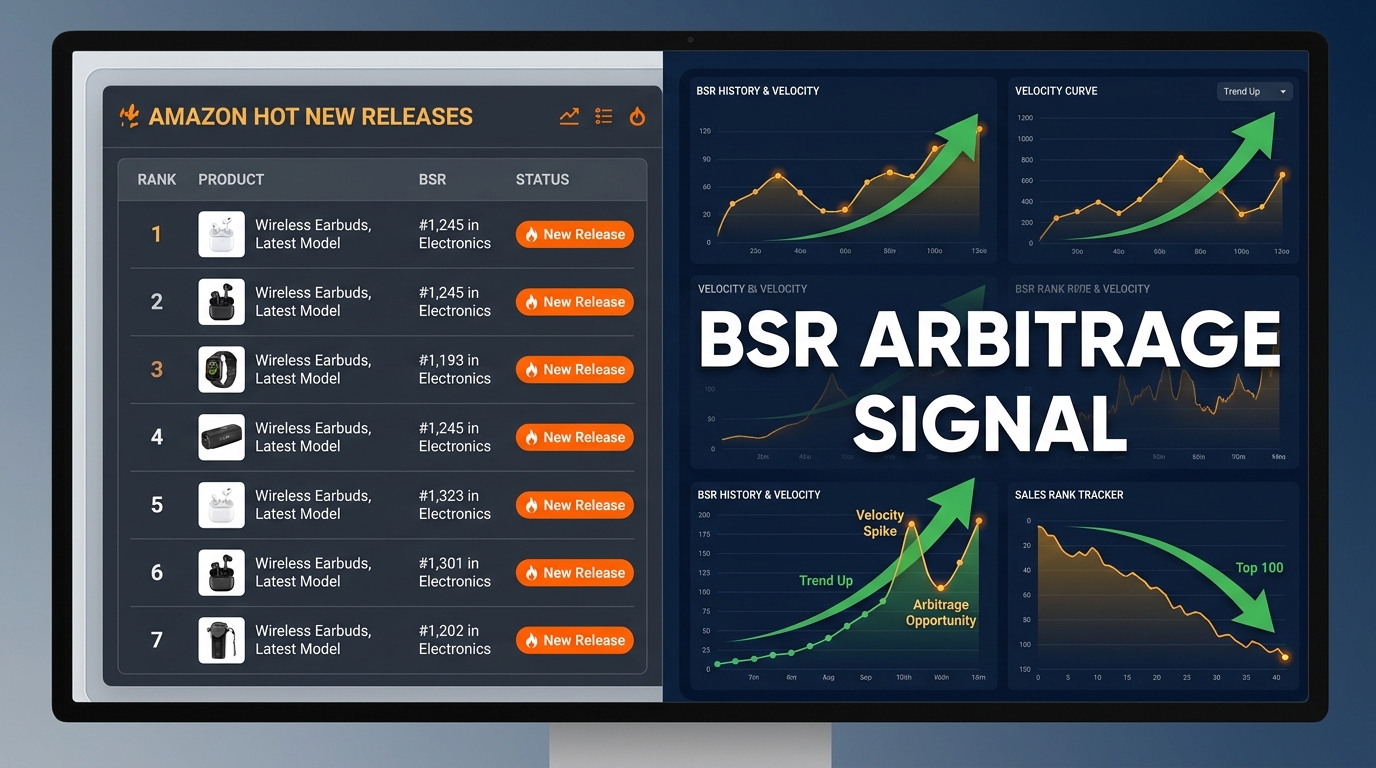

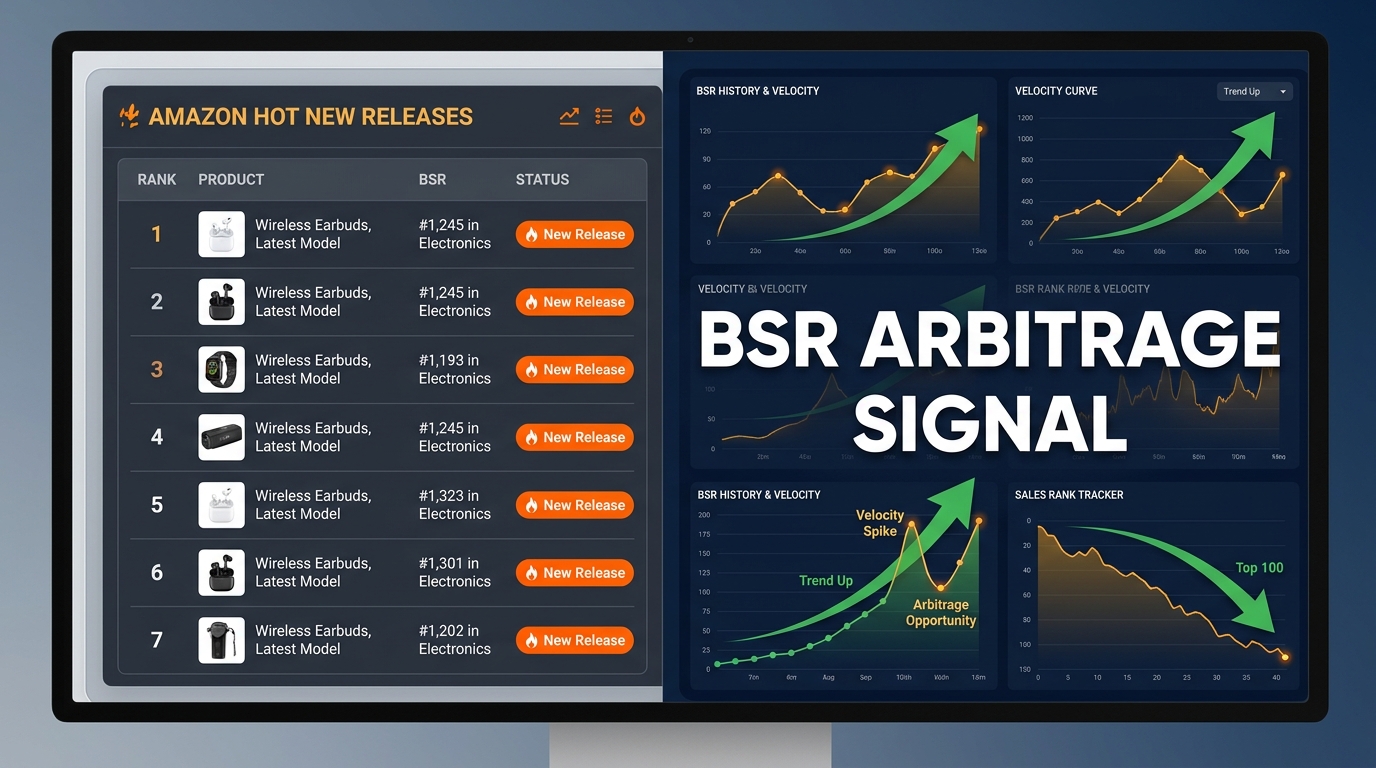
There’s a list on Amazon that most sellers check the same way they check their social media feed — they scroll, they glance, they move on. The Hot New Releases section gets treated like a curated collection of products someone else is already selling, and sellers who browse it that way are missing the entire point.
The Hot New Releases list is not a shopping destination. It’s a real-time demand signal. Every product that appears on it is broadcasting something specific about consumer behavior, category velocity, and the presence of a pricing window that may or may not still be open. The difference between sellers who profit from this list and sellers who just look at it comes down to understanding what the data is actually saying.
BSR arbitrage — buying products where you can identify a gap between a product’s current market price and its true demand potential — is one of the few arbitrage strategies where Amazon’s own data does a significant portion of the sourcing work for you. But the Hot New Releases list is a tool with a very specific operating window, a set of mechanics that most guides get wrong or skip entirely, and a series of traps that catch underprepared sellers at exactly the worst moment.
This is not a list of categories to browse on a Sunday afternoon. This is a methodology for reading velocity signals, validating demand before committing capital, timing entry and exit with precision, and building a sourcing workflow that catches opportunities early — before they’re gone or overrun. If you’ve been treating Hot New Releases as a starting point for product ideas, this guide is going to reframe it as something considerably more useful: a market intelligence feed.
What the Hot New Releases List Actually Measures
Before you can use the Hot New Releases list strategically, you need to understand what it’s measuring — and more importantly, what it isn’t measuring. Most sellers assume the list showcases products that Amazon has hand-picked or promoted. That’s not how it works.
BSR Is a Relative, Not Absolute, Measure
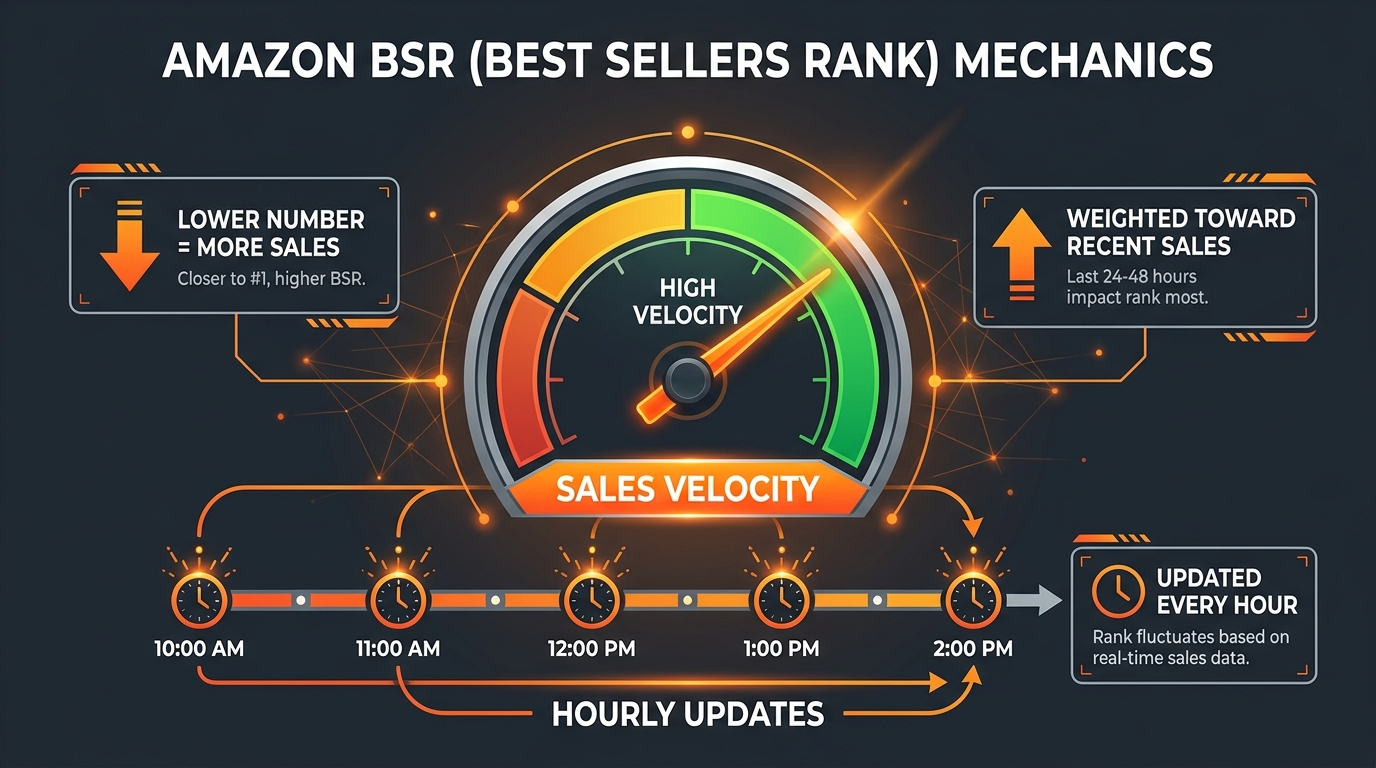
Amazon’s Best Sellers Rank is a measure of how quickly a product is selling relative to other products in the same category or subcategory. A BSR of #500 in Electronics means something entirely different than a BSR of #500 in Musical Instruments — the latter requires a fraction of the unit sales to achieve the same rank number. This relative nature is what makes BSR useful for arbitrage, but it’s also what creates the most common misinterpretation errors.
The algorithm that produces BSR is weighted heavily toward recent sales velocity. Amazon gives exponentially more weight to sales from the last few hours than it does to cumulative lifetime sales. This means a product that sold 200 units yesterday but zero the day before will have a dramatically better BSR than a product that sold 10 units steadily every day for a month — even if total units are similar. For arbitrage purposes, this creates both opportunity and risk: velocity spikes can inflate BSR beyond what the sustained demand actually supports.
Hot New Releases Is a Filtered Subset of BSR
The Hot New Releases list takes the BSR framework and applies it specifically to recently launched products — those within a defined eligibility window. The list updates on an hourly basis, pulling in whichever new products are demonstrating the strongest sales velocity in their category at that moment. It is not a static list. A product can appear on the Hot New Releases list in the morning and fall off it by the afternoon if its sales velocity drops relative to competing new products.
This hourly refresh is one of the most underappreciated features of the list. It means that if you check Hot New Releases at 9 AM and again at 3 PM, you may be looking at materially different data. Products that maintain consistent positions across multiple checks are signaling something much more durable than a single-snapshot spike. Products that appear once and vanish may be experiencing artificial velocity from promotions, launch giveaways, or other tactics that don’t represent organic demand.
What the BSR Number Tells You About Unit Sales
Amazon does not publish the exact conversion table between BSR and units sold per day, and it varies significantly by category. However, research and third-party tool data provide useful benchmarks. In a highly competitive category like Home & Kitchen, a BSR of #5,000 typically corresponds to roughly 50–100+ daily unit sales. In a niche category like Manual Coffee Grinders, a BSR of #5,000 might represent just 5–15 daily units. These category-specific differences are fundamental to understanding whether an apparent velocity signal represents genuine volume or simply a thin market where minor movement produces dramatic rank changes.
For BSR arbitrage purposes, the practical implication is clear: you cannot evaluate a Hot New Release product’s commercial viability by BSR number alone. The category context is inseparable from the signal. A product sitting at BSR #8,000 in Kitchen Storage is a stronger indicator of demand than the same rank in Pipe & Fittings — not because the rank is different, but because the unit sales required to achieve that rank are vastly different.
The 90-Day Window: Understanding the Eligibility Clock
One of the most persistent myths in the Amazon selling community is that the Hot New Releases badge only lasts 30 days. This misunderstanding causes sellers to either ignore products that still have significant eligibility runway, or to mistime their entry because they’ve miscalculated how much time remains on the clock.
The Actual Eligibility Window Is 90 Days
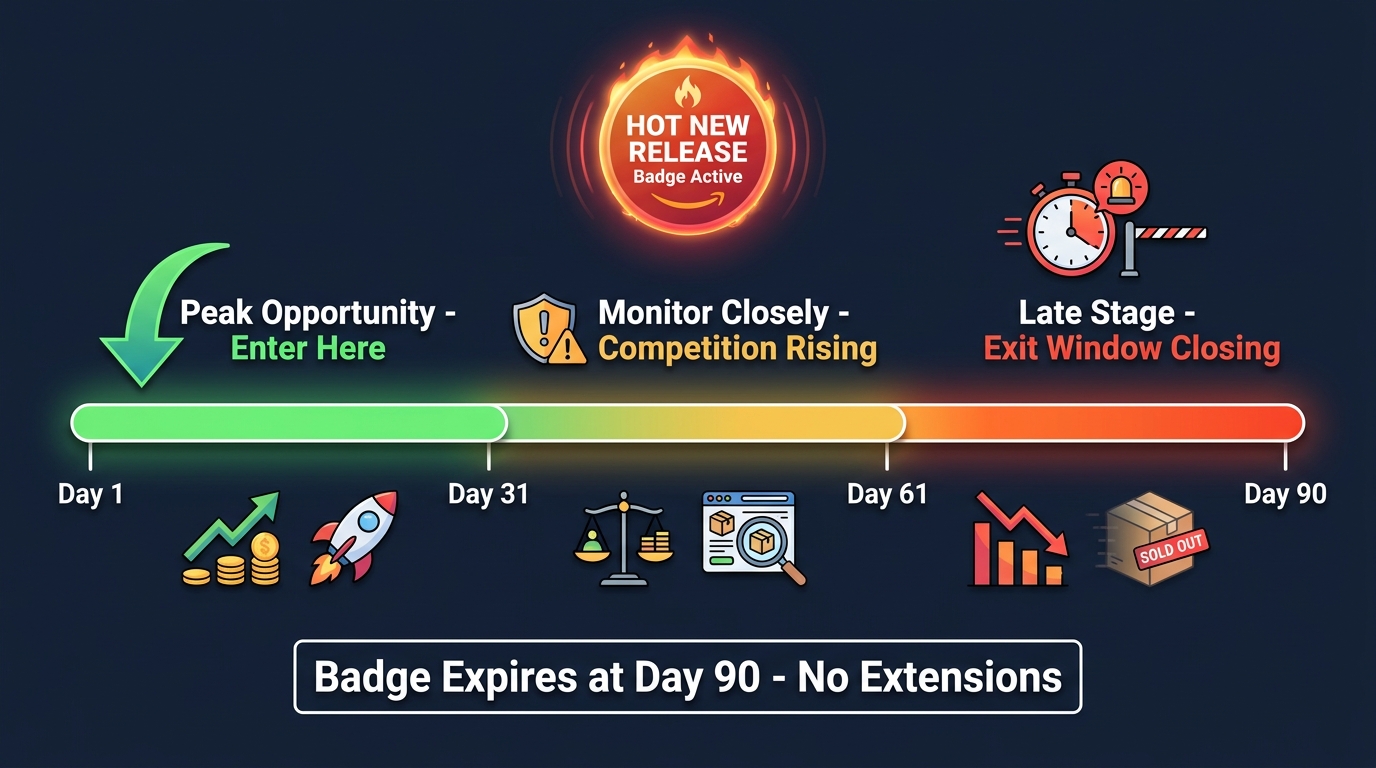
A product is eligible to appear on the Hot New Releases list for 90 days from its listing launch date — the date it first becomes available for purchase on Amazon. During this window, the product competes hourly against all other newly launched products in its category for placement on the list. The badge is awarded to whichever products are demonstrating the strongest sales velocity among eligible new releases at the time of each hourly update.
There are no extensions. The clock starts when the product goes live, and it stops at day 90 regardless of whether the product ever actually appeared on the list. A product that launches to significant fanfare and earns the Hot New Releases badge on day one faces exactly the same deadline as a product that quietly launches and never achieves sufficient velocity for placement.
Why the 90-Day Myth Matters for Arbitrage Strategy
For sellers using Hot New Releases as a sourcing and demand-validation tool, the 90-day reality creates a tiered opportunity structure that the 30-day myth completely misses. Consider what each phase of the eligibility window actually means:
Days 1–30: This is the highest uncertainty, highest potential phase. Products appearing on Hot New Releases during their first 30 days may be riding genuine consumer demand, or they may be benefiting from launch promotions, discounted giveaways, or PPC campaigns. The price is often more stable during this phase because the brand or original seller has not yet dealt with significant competition. For arbitrage sellers, this period represents the earliest entry point — with the highest reward and the highest risk of chasing a manufactured velocity spike.
Days 31–60: Products that are still appearing on Hot New Releases through the middle of their eligibility window have cleared a significant filter. Promotional launch tactics typically run for two to four weeks; products still ranking after that period are more likely to be sustaining velocity through organic demand. This is often the most actionable window for arbitrage sellers because the demand signal is more validated, competition from other RA sellers may not have fully saturated the opportunity, and there is still significant eligibility runway remaining on the badge.
Days 61–90: The late-stage window is where most unsophisticated sellers enter — because the product has now been visible enough that blog posts, YouTube videos, and sourcing list compilations have flagged it. By day 60 or later, the most attractive opportunities in a given Hot New Release window are typically overcrowded. This doesn’t mean there are zero opportunities in this phase, but the probability of finding an advantageous margin without meaningful competition is substantially lower.
Practical Application: Tracking Launch Dates
Most arbitrage analysis tools, including Keepa, display a product’s listing date. Before evaluating any Hot New Release product for arbitrage, checking the listing date and calculating how many days remain in the eligibility window should be a non-negotiable step. If a product is on day 75 of its 90-day window and you’re just discovering it now, that’s important context. If a product is on day 22 and demonstrating consistent multi-day velocity, the math looks materially different.
Main Category vs. Subcategory BSR — Why the Difference Changes Everything
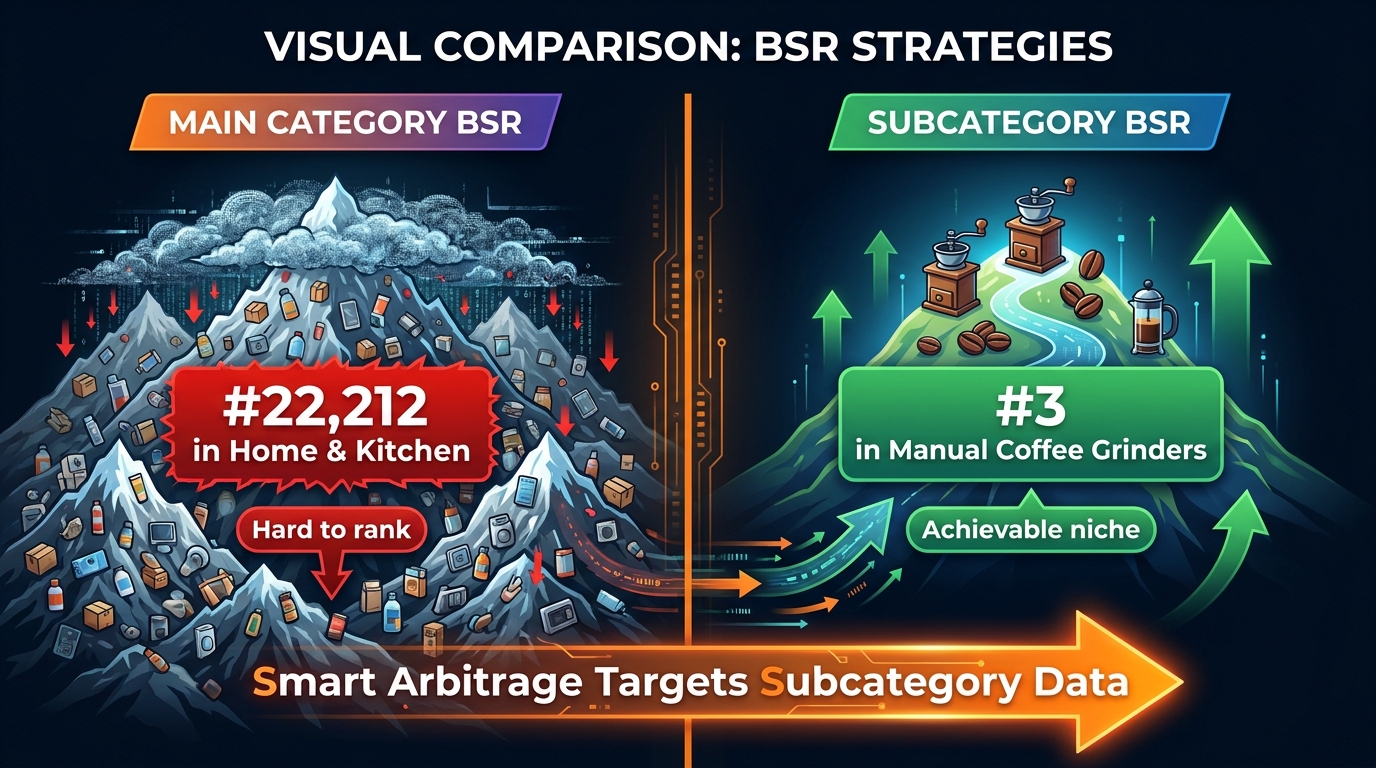
Every Amazon product can hold multiple BSR rankings simultaneously — one for its main category, and one for each subcategory it’s been assigned to. This creates a structural situation where the same product can appear dramatically stronger or weaker depending on which BSR number you’re looking at. Misreading this can lead to either dismissing viable opportunities or over-investing in products with far less demand than their most visible rank suggests.
The Competitive Gap Between Main and Sub
A main category like Home & Kitchen contains millions of products. A subcategory like Manual Coffee Grinders contains a few hundred or a few thousand. The unit sales required to achieve, say, a top-50 rank in Manual Coffee Grinders are a small fraction of what’s needed to achieve top-50 in Home & Kitchen. This arithmetic is obvious when stated plainly, but its implications for reading Hot New Releases are frequently ignored.
Here’s the practical risk: a product can appear in the Hot New Releases list for a subcategory with a BSR like “#4 in Manual Coffee Grinders” — which sounds impressive — while its main category rank sits at #85,000 in Home & Kitchen. The subcategory badge makes the product look like a velocity monster. The main category rank reveals it’s actually a slow mover relative to the broader market. For an arbitrage seller, these two pieces of information tell completely different stories, and conflating them is one of the most common errors in Hot New Release evaluation.
How to Use Both Numbers Together
The correct approach is to use subcategory BSR and main category BSR as complementary data points rather than treating either in isolation. The combination reveals the size of the addressable market and the intensity of competition within the specific niche you’d be entering.
- Low subcategory BSR + Low main category BSR: Strong signal. The product is selling well within its niche AND relative to the broader category. This is the tier where arbitrage margins are most likely to hold up because genuine volume demand supports pricing.
- Low subcategory BSR + High main category BSR: Moderate signal. The product leads a small niche, but the overall market volume may be limited. These opportunities can still be profitable, but unit quantities need to reflect the reality that you’re working in a thin market.
- High subcategory BSR + Low main category BSR: Requires careful scrutiny. This pattern is unusual and may indicate the product is assigned to a subcategory where it faces weak competition relative to its actual sales — which can be an opportunity, but warrants deeper investigation into category assignment.
- High subcategory BSR + High main category BSR: Weak signal across the board. Unless the main category is enormous and a high-number rank still represents meaningful volume, these products likely don’t have the velocity to support arbitrage timelines.
The Subcategory Arbitrage Niche Strategy
Some experienced arbitrage sellers specifically target subcategory Hot New Releases in narrow niches where the product count is small and competition from other RA sellers is minimal. In categories with fewer than 1,000 total products, even modest sales can produce impressive-looking subcategory BSR numbers — and the thinness of competition can create price stability that larger categories rarely sustain. The risk, of course, is limited demand ceiling: a very thin niche means you can source fewer units before exhausting the addressable market.
How to Use Hot New Releases as a Demand Validation Signal
The most common mistake sellers make with Hot New Releases is treating it as a sourcing list: you see a product on the list, you find it in a retail store or on an online retailer, you buy it, and you send it to FBA. That sequence misunderstands where the list’s value actually lies.
Hot New Releases is most powerful not as a direct sourcing feed, but as a demand validation engine. The products appearing on it are telling you something about what consumers are actively buying right now — which means you can use that signal to inform your sourcing decisions across a wider set of products, not just the ones on the list itself.
Reverse Engineering the Demand Signal
When a product category begins surfacing multiple Hot New Releases consistently — multiple products from the same niche appearing on the list over a two- to four-week span — that’s a signal that the category itself is in a demand expansion phase. This is actionable information beyond any single product. If you see five different kitchen organizer products appearing on Hot New Releases in a two-week window, you’re not just looking at five individual opportunities. You’re observing a category-level demand spike that could inform sourcing across dozens of SKUs you’d previously overlooked.
The strategic move here is to use the Hot New Releases signal to identify demand-active niches, then run your standard sourcing workflow across related products in those niches — not just the specific items that happened to surface on the list. Many profitable arbitrage finds exist one degree of separation from the actual Hot New Release product.
Using the List for Market Structure Intelligence
Products appearing on Hot New Releases in your target categories reveal important structural data about that market: what price points are generating velocity, what product attributes are resonating with buyers, and what review counts new entrants are achieving early traction despite. This is competitive intelligence that would otherwise require significant time to gather manually. The Hot New Releases list surfaces it in one organized view.
Pay attention to the review counts of products on the list. A product generating Hot New Release velocity with fewer than 50 reviews is demonstrating organic demand that hasn’t required significant social proof accumulation. That’s a different consumer dynamic than a product that has 400 reviews and is running heavily discounted launch deals. The former is a more durable signal; the latter is likely a launch-phase artifact.
Cross-Referencing With Retail Availability
Once you’ve identified a product or category niche generating Hot New Release velocity, the demand validation step is to cross-reference that product or similar products against retail availability. Is the same product available at Target, Walmart, or a major online retailer at a price that would generate acceptable margins after FBA fees? If a closely related product is seeing Hot New Release traction and you can source a near-equivalent at clearance pricing, the validated category demand provides meaningful confidence that your inventory will move within an acceptable timeframe.
The Timing Equation: When to Enter, When to Walk Away
Timing is the dimension of BSR arbitrage that separates sellers who consistently extract value from Hot New Releases from those who consistently arrive too late, too early, or at the wrong inventory depth. Getting this right requires combining several signals — none of which are individually sufficient — into a holistic read of where an opportunity sits in its lifecycle.
The Three Conditions for a Viable Entry
Before committing capital to any Hot New Release arbitrage opportunity, three conditions should be satisfied simultaneously:
1. Consistent multi-day BSR performance. A single hourly BSR snapshot is nearly meaningless. A product’s BSR needs to demonstrate consistency across at least 3–7 days to distinguish genuine demand from a promotional spike. If a product’s BSR has been under 50,000 in its main category consistently for five or more days, that’s a credibly different signal than a product that hit BSR #5,000 for one day and then retreated to #200,000. Keepa’s 90-day BSR history chart makes this evaluation straightforward.
2. Price stability in the Buy Box. Products experiencing genuine organic demand typically maintain more stable Buy Box pricing than products riding launch promotions. Before entry, examine the 30-day price history. If the price has been relatively stable (within 10–15% variance) for two weeks or more, that’s a positive indicator. If the price has been fluctuating wildly or trending sharply downward, other sellers are likely already repricing competitively — a sign that margins are compressing.
3. Acceptable seller count trajectory. The number of sellers offering a product is a leading indicator of future margin compression. A product with 3 sellers on day 20 of its Hot New Releases window may have 15 sellers by day 45. Keepa tracks seller count history alongside BSR and price. If seller count has been relatively stable over the past few weeks, the opportunity hasn’t yet been fully discovered by the RA seller community. If seller count has tripled in the past 10 days, the margin compression is already underway.
Entry Size Decisions
Even when all three conditions are met, position sizing matters. The Hot New Releases window has a natural expiration — 90 days — and after that, the product competes as a standard listing without the elevated visibility the badge generates. This means your inventory needs to move primarily within the active window for maximum margin capture. Buying 200 units of a product when you’re entering on day 50 of its window creates significant sell-through pressure in the remaining 40 days.
A conservative approach is to calculate your expected sell-through rate based on Keepa’s estimated monthly sales data, then size your position to move within 30–45 days. This provides buffer against velocity slowdowns and price compression while protecting you from being left holding inventory past the badge’s active period.
The Exit Trigger Checklist
Knowing when to stop pursuing an opportunity is as valuable as knowing when to enter. Clear exit triggers include:
- Buy Box price drops below your minimum margin threshold (typically 30% ROI after all fees)
- Seller count spikes by more than 50% within a 7-day window
- BSR deteriorates significantly and consistently for more than 5 days
- Amazon itself enters as a seller (Amazon as a seller typically dominates the Buy Box and compresses third-party pricing)
- IP complaints or brand gating alerts surface in SellerAmp or similar tools
Tools That Make Hot New Releases Arbitrage Actually Work
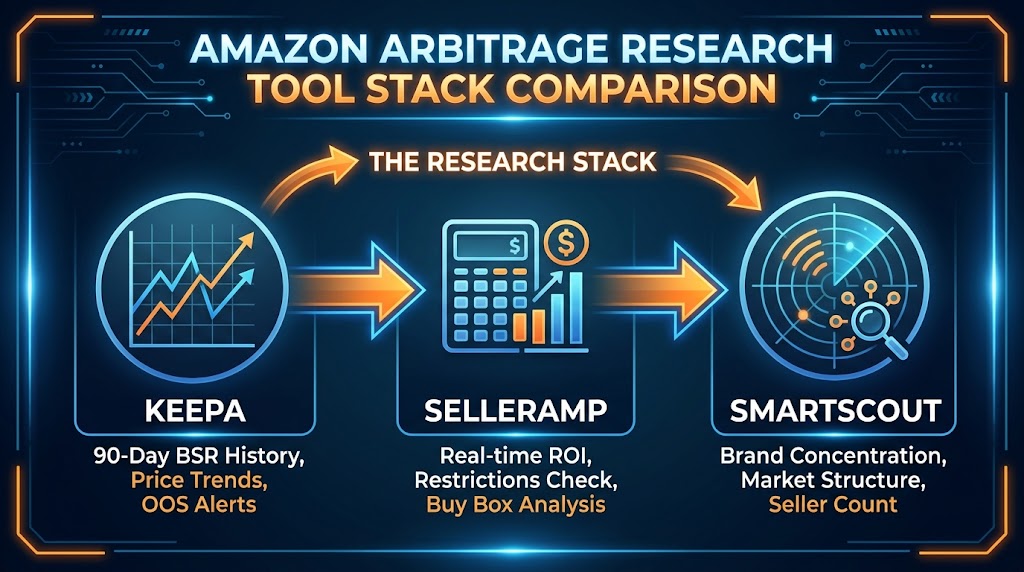
Attempting Hot New Releases BSR arbitrage without proper tools is like trying to navigate a market with your eyes closed. The hourly updating nature of the list, combined with the depth of historical data required to validate opportunities, makes manual evaluation at any meaningful scale nearly impossible. The tool stack that serious arbitrage sellers have converged on in 2026 reflects years of market testing and workflow refinement.
Keepa: The Foundation of BSR History Research
Keepa tracks price and BSR history across billions of Amazon products in 11 marketplaces, updating frequently and storing historical data that spans years in some cases. For Hot New Releases arbitrage, the most critical Keepa capabilities are:
- BSR history charts: Visual representation of rank over time, showing spikes, plateaus, and deterioration patterns. The 90-day BSR average (available as a data point in Keepa’s Product Finder) is more reliable than any current BSR snapshot for evaluating sustained velocity.
- Seller count tracking: One of Keepa’s most underused features for arbitrage. The seller count overlay on price/BSR charts reveals the relationship between competition entry and price compression — allowing you to see what happened to margins historically when other sellers entered.
- Amazon stock tracking: Keepa displays when Amazon (as a seller) has been in and out of stock. If Amazon regularly sells out and takes weeks to restock, that creates a reliable window for third-party sellers to capture Buy Box and maintain pricing power.
- Product Finder: Keepa’s catalog-level filter tool lets you search for products matching BSR thresholds, launch dates, price ranges, and category filters simultaneously — making it possible to systematically scan for new products meeting your opportunity criteria rather than manually browsing the Hot New Releases list.
SellerAmp: Real-Time Eligibility and ROI
SellerAmp (also known as SAS — SellerAmp SaaS) operates primarily as a browser extension that evaluates products in real-time as you browse Amazon or retail websites. For Hot New Releases research, its critical functions are:
- Instant ROI calculation: Input your cost and SellerAmp calculates net profit after Amazon referral fees, FBA fulfillment fees, and prep costs, accounting for category-specific fee structures.
- Restrictions and eligibility check: Before spending a minute analyzing margins, SellerAmp checks whether you’re actually approved to sell the product. This catches brand gating, category restrictions, and hazmat classifications that would otherwise waste your research time.
- IP alert flags: SellerAmp’s IP alert integration highlights products with a history of intellectual property complaints — a risk that is disproportionately elevated for newly launched products whose brands are actively protecting market share in the early stages of their sales lifecycle.
SmartScout: Market Structure and Brand Concentration
Where Keepa and SellerAmp operate at the individual product level, SmartScout provides category and market-level intelligence that is particularly valuable for Hot New Releases strategy. Its brand concentration analysis reveals what percentage of a category’s sales are controlled by a small number of sellers or brands — a key variable for assessing how quickly an RA seller can be crowded out of a viable margin position.
SmartScout’s storefront research feature also enables what practitioners call “storefront stalking” — identifying what successful arbitrage sellers are carrying and reverse-engineering their sourcing logic. If a high-performing FBA seller is stocking a product that recently appeared on Hot New Releases, that’s independent validation of an opportunity you may have identified through your own monitoring.
Tactical Arbitrage and SourceMogul: Automated Scanning
For online arbitrage specifically, tools like Tactical Arbitrage and SourceMogul automate the cross-referencing of retailer prices against Amazon’s current Buy Box pricing. These tools can be configured to flag products meeting your BSR and ROI thresholds automatically — meaning opportunities that align with Hot New Releases velocity patterns surface without requiring you to manually check every candidate. This automation layer is what makes Hot New Releases arbitrage scalable beyond a handful of products per week.
Category-by-Category Breakdown: Where Hot New Releases Arbitrage Wins and Loses
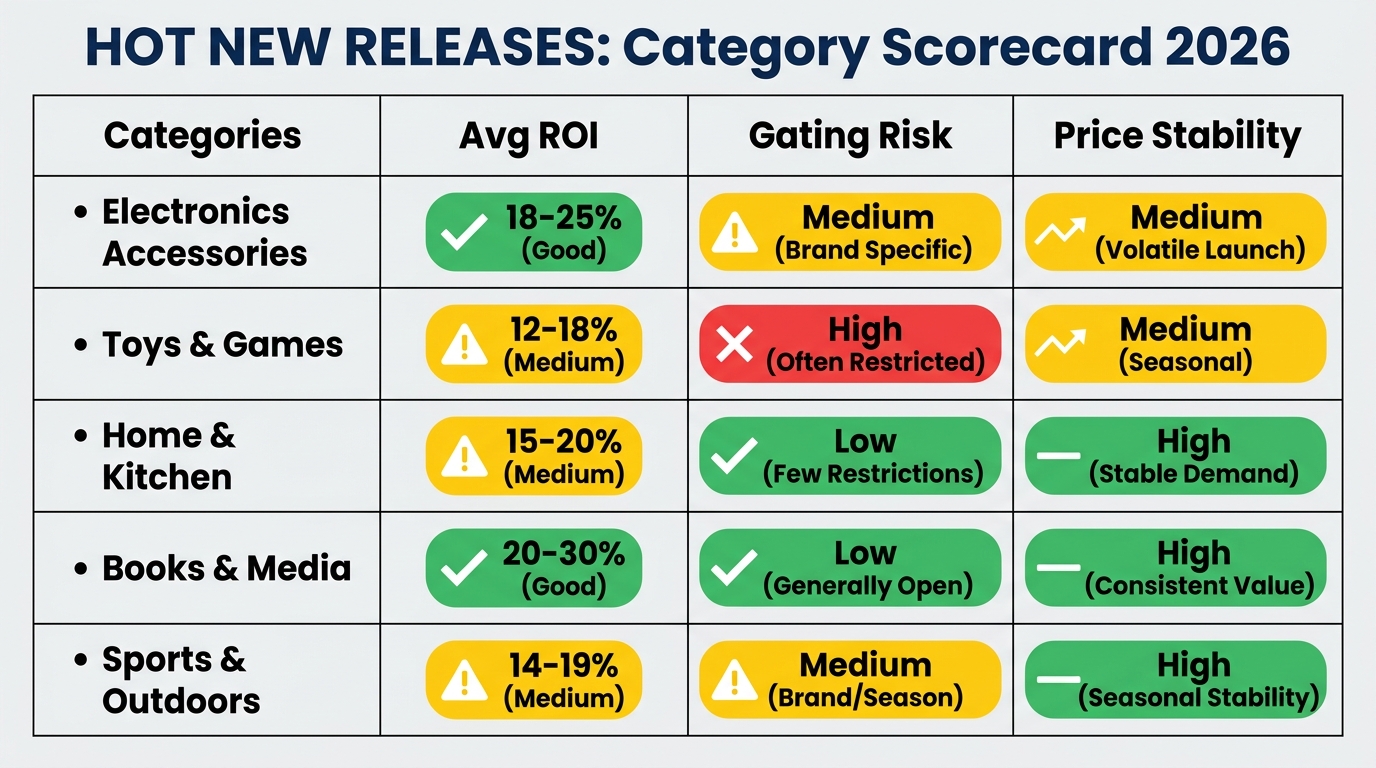
Not all Amazon categories offer the same arbitrage dynamics, and Hot New Releases amplifies these differences. Understanding which categories tend to produce viable arbitrage windows — and which ones create more traps than opportunities — is foundational to efficient sourcing decisions.
Electronics Accessories: High Reward, High Complexity
Electronics accessories — wireless earbuds, chargers, power banks, smart home accessories, and similar products — consistently appear on Hot New Releases lists and generate significant consumer interest. The velocity signals can be impressive: products in this space sometimes achieve BSRs under 5,000 in their subcategory within days of launch.
However, electronics categories carry complexity that other categories don’t. Amazon frequently requires invoices from authorized distributors before allowing third-party sellers to list in electronics subcategories. The return rate for electronics runs 10–15% — meaningfully higher than most other categories — which erodes margins that might look attractive on paper. And newly launched electronics products are often specifically designed to generate early velocity, meaning the BSR spike during the Hot New Releases window may not represent sustained organic demand. The price points in electronics accessories ($15–55 for many strong-selling products) also mean that per-unit profit margins are relatively thin after fees, requiring volume to generate meaningful income.
Electronics arbitrage works, but it requires tighter qualification criteria and a more disciplined approach to invoice verification and return risk modeling.
Toys and Games: Seasonal Velocity With Real Windows
Toys and Games is a category where Hot New Releases arbitrage can be genuinely lucrative, particularly during the period between mid-October and late December when the category’s seasonal demand spike dramatically amplifies BSR velocity signals. Products appearing on Toys Hot New Releases in October may be flagging genuine gifting demand that will sustain through the holiday season — an extended window that allows for multiple sourcing rounds from the same opportunity.
The post-holiday period also creates inverse opportunities. Products that were on Toys Hot New Releases in Q4 often appear as clearance at retail chains in January and February at dramatically reduced prices. If Keepa data shows consistent historical velocity for these products outside the holiday period, clearance arbitrage can generate strong ROI (50%+ is achievable in well-timed scenarios) by sourcing post-season inventory for the subsequent demand cycle.
The primary risk in Toys is brand gating. Several major toy brands have established tight controls over third-party selling, and the increased visibility of Hot New Releases products makes them more likely to trigger brand protection responses. Running every Toys opportunity through SellerAmp’s IP and restriction checks is non-negotiable.
Home and Kitchen: The Highest Volume Category for Retail Arbitrage
Home and Kitchen is the most popular category for retail arbitrage, and its Hot New Releases section is among the most active on Amazon. The advantage here is product variety: the category spans everything from kitchen gadgets to storage solutions to home décor, giving arbitrage sellers hundreds of subcategories to monitor and source from.
The volume of the category is both its strength and its challenge. Because so many RA sellers monitor Home and Kitchen Hot New Releases, opportunity windows can be shorter than in smaller categories. A product that appears on the list today may have three or four RA sellers competing for the Buy Box within a week. Price stability timelines are shorter, and sourcing needs to be executed quickly once an opportunity is identified.
However, products in this category can also sustain longer demand cycles than electronics — a useful kitchen organizer or an in-trend home item doesn’t become obsolete the way a charger design might. Post-Hot New Releases, products that demonstrated genuine velocity during their 90-day window often continue selling at acceptable rates, giving RA sellers a longer tail to work with.
Books and Media: A Different Kind of BSR Arbitrage
Books are among the few Amazon categories where Hot New Releases operates somewhat differently for arbitrage purposes. Pre-orders drive BSR before a book is even available, which means books can appear on Hot New Releases lists weeks before they’re shippable. For book arbitrage specifically — which is a legitimate and active subset of the broader RA community — Hot New Releases signals upcoming titles generating pre-order velocity, allowing sellers to source at pre-publication prices and benefit from early post-publication demand.
The margins in book arbitrage are typically narrower than in physical products, but the research process is more straightforward (no invoices required, lower return rates, simple eligibility). For sellers early in their arbitrage journey, Books Hot New Releases can be a useful training ground for developing the BSR pattern-reading skills that translate to more complex categories.
Sports and Outdoors: Undermonitored and Often Overlooked
Sports and Outdoors is one of the most consistently underserved categories in the Hot New Releases arbitrage space. Fewer RA sellers actively monitor it, which means opportunity windows tend to be longer and competition takes more time to develop. Seasonal demand signals are also more predictable — fitness equipment trends in January, outdoor gear in spring, water sports in summer — making it possible to anticipate which subcategories will produce Hot New Releases velocity before that velocity materializes.
The trade-off is sourcing complexity. Sports and Outdoors products tend to have higher average selling prices but also higher FBA fees due to size and weight. Calculating net margins requires careful attention to dimensional weight fees, especially for bulkier items.
The Hard Truths: Gating, Price Crashes, and IP Risks Nobody Talks About
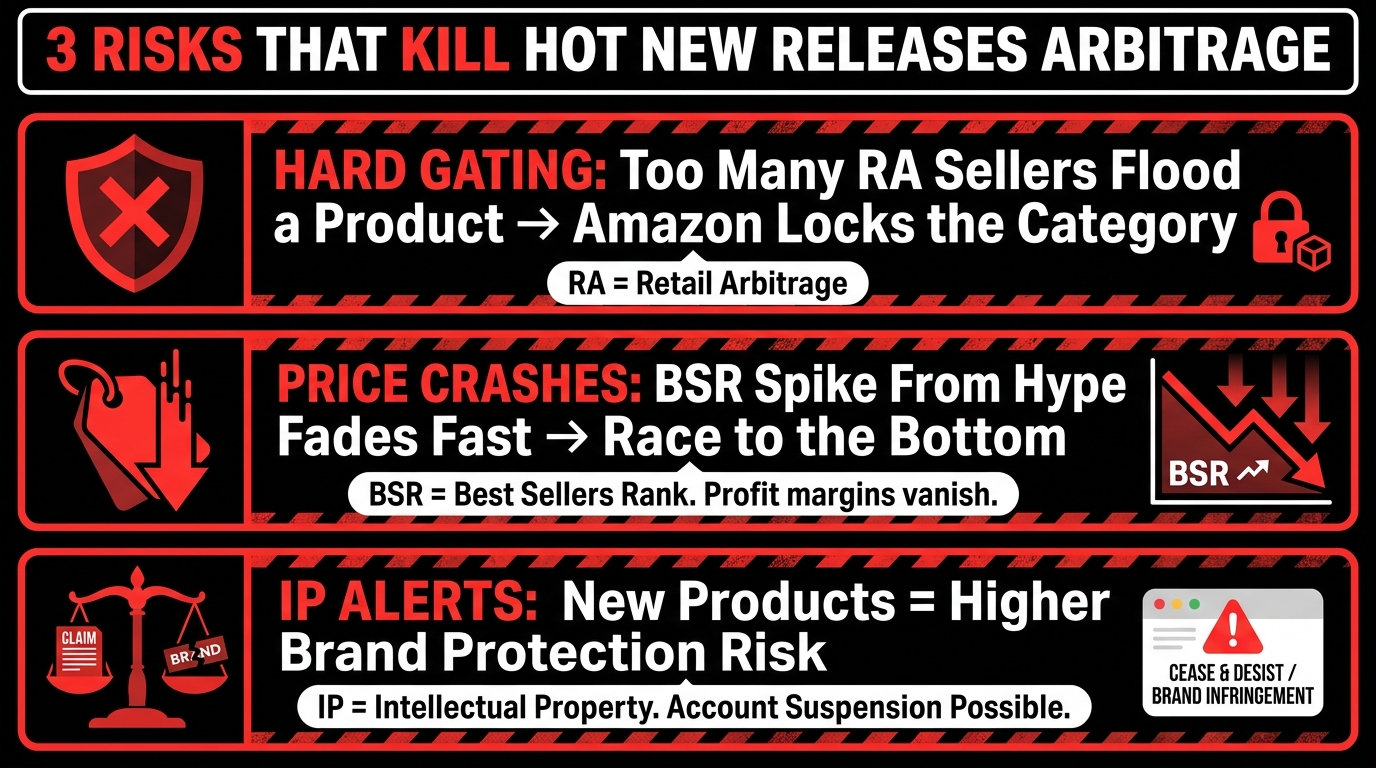
Every guide on Hot New Releases arbitrage covers how to find opportunities. Fewer address what actually goes wrong — and why some sellers who follow all the sourcing steps still end up with stranded inventory and compressed margins. Three structural risks are responsible for a disproportionate share of Hot New Releases arbitrage failures.
Hard Gating: When Success Kills the Opportunity
Amazon can restrict who is eligible to sell a given product at any time, and one of the most reliable triggers for hard gating is an influx of retail arbitrage sellers flooding a single ASIN. When a product becomes widely visible on Hot New Releases and dozens of RA sellers attempt to create listings simultaneously, Amazon’s systems can detect the pattern and impose gating — requiring brand authorization, invoices from approved distributors, or other documentation that casual RA sellers typically cannot provide.
This creates a perverse dynamic: the most successful Hot New Releases products, the ones generating enough velocity to draw significant RA attention, are often the ones most likely to become gated before latecomers can enter the opportunity. Sellers who find an opportunity early, confirm their eligibility immediately, and act quickly may capture the window. Sellers who research for a week before ordering often arrive to find they can no longer create a listing.
The solution is to make eligibility confirmation step one — not step three or four — of your evaluation process. Before checking Keepa, before calculating ROI, confirm through SellerAmp or directly in Seller Central that you can actually sell the product. If you can’t, no amount of favorable BSR data matters.
Price Crashes: The Lag Between Visibility and Saturation
There is typically a lag of days to a couple of weeks between when a product achieves Hot New Releases visibility and when the seller count begins to spike. During this lag, prices are often stable. After the spike begins, repricing competition among multiple sellers creates downward price pressure that can eliminate margins rapidly.
The sellers who profit most reliably from Hot New Releases BSR arbitrage are those who can source and ship to FBA quickly enough to be selling before this saturation occurs. If your sourcing-to-FBA cycle takes three weeks — typical for slower workflows — you may be selling at compressed margins by the time your inventory is receivable. Accelerating your inbound logistics, using FBA prep centers strategically, or supplementing with FBM listings for fast-moving inventory can all reduce your exposure to the saturation lag.
Monitoring the Buy Box price over time using Keepa alerts is also an underused protective measure. Setting a Keepa price alert on a product you have inbound gives you early warning of price compression before your inventory arrives — allowing you to adjust expectations or explore liquidation alternatives rather than discovering the problem only when your stock lands in the warehouse.
IP Alerts: The Disproportionate Risk of New Products
Intellectual property complaints — from brand registry complaints to trademark infringement claims to counterfeit allegations — are a risk for all arbitrage sellers, but they fall disproportionately on sellers of new products. Brands that are actively launching on Amazon and investing in Hot New Releases velocity often have active brand protection programs that flag third-party resellers, especially those without verifiable supply chain documentation.
This doesn’t mean avoiding Hot New Releases products entirely — it means being selective about which brands you work with. Brands with long Amazon histories, established reseller networks, and track records of working with the RA community are generally safer targets than brands that launched recently, have never had third-party sellers, or are aggressively protecting their pricing through MAP (Minimum Advertised Price) policies.
Running every candidate product through SellerAmp’s IP alert database, checking the brand’s Amazon storefronts for signs of direct selling, and reviewing their brand registry status in Seller Central are the minimum due diligence steps before committing capital to a Hot New Releases arbitrage position.
Building a Hot New Releases Monitoring Workflow That Doesn’t Eat Your Week
The practical challenge for most arbitrage sellers isn’t that they don’t understand the strategy — it’s that Hot New Releases monitoring, done without structure, can consume hours of unfocused browsing without producing actionable results. Building a repeatable, time-bounded workflow is what converts the theory in this article into consistent sourcing output.
Define Your Category Focus Before You Monitor
Trying to monitor Hot New Releases across all Amazon categories simultaneously is not a viable strategy. The categories you monitor should be determined by two factors: the categories you’re already approved and ungated to sell in, and the categories where you have established retail sourcing relationships or online arbitrage channels. Monitoring categories you can’t sell in generates information that has no actionable outlet.
For most sellers, a focused watchlist of five to eight subcategories — monitored consistently — produces better results than a scattered approach across dozens of categories. Depth of understanding of a specific niche’s BSR dynamics, pricing history, and competitor behavior is more valuable than breadth of monitoring across categories you only superficially understand.
The Daily Check Routine
A structured Hot New Releases monitoring session should take no more than 30–45 minutes per day. The sequence that experienced arbitrage sellers have found most efficient is:
- Open each tracked subcategory’s Hot New Releases list and note which products are appearing that weren’t appearing in the previous session.
- For any new arrivals that appear on multiple consecutive checks, pull the Keepa chart immediately — check listing date, BSR history depth, seller count trend, and Buy Box price stability.
- For products passing the Keepa filter, run SellerAmp to confirm eligibility, estimate ROI at current sourcing prices, and check IP flags.
- For products passing SellerAmp review, add them to a short-list and check retail availability through your standard sourcing channels.
- For any confirmed sourcing opportunities, place the order. Time between identification and sourcing action should be measured in hours, not days.
Using Keepa Product Finder for Systematic Scanning
Rather than relying entirely on manual Hot New Releases browsing, Keepa’s Product Finder can be configured to systematically surface new products meeting your criteria. Set filters for listing date (within 90 days), BSR below your category-specific threshold, minimum estimated monthly sales, and seller count below a competitive saturation point. Running this filter daily or every few days surfaces qualified candidates systematically — without requiring you to manually browse category lists page by page.
This systematic approach also catches products that have achieved Hot New Releases velocity without appearing on the most visible sections of the list. Not every product demonstrating strong sales velocity during its 90-day window will surface prominently in the Hot New Releases UI — subcategory positioning and competitive density affect visibility. Keepa’s Product Finder evaluates the underlying BSR data directly, bypassing the display layer that filters what you see when browsing.
Tracking and Iteration
Maintaining a simple tracking spreadsheet of every opportunity you evaluate — and recording the outcome — is the discipline that separates sellers who improve at Hot New Releases arbitrage from those who repeat the same analysis errors. Track: the product ASIN, the date you identified it, the BSR and seller count at identification, your sourcing decision (yes/no and why), and the actual sell-through outcome if you sourced it.
After 60–90 days of consistent tracking, patterns emerge: certain categories consistently produce better outcomes, certain BSR thresholds predict faster sell-through, and certain types of brand or product profile generate more friction. This retrospective data is more valuable than any generic sourcing framework, because it reflects the specific dynamics of your seller account, your approval categories, and your sourcing channels.
Conclusion: From Signal Reader to Profit Taker
Amazon’s Hot New Releases list is one of the platform’s most transparent windows into real-time consumer demand. It shows you, with hourly granularity, which newly launched products are generating sustained purchasing activity in categories across the entire marketplace. That is genuinely useful intelligence — if you know how to read it.
The sellers who consistently profit from Hot New Releases BSR arbitrage aren’t the ones with the best product radar or the most aggressive sourcing schedules. They’re the ones who understand what the list is measuring and what it isn’t. They check eligibility before they check margins. They verify multi-day BSR consistency before they trust a velocity signal. They size positions to the eligibility window, not their optimistic sales projection. They build workflow into their monitoring, so the discipline of checking is systematic rather than sporadic.
Most importantly, they understand that the Hot New Releases list is telling them something about the market — and they use that market intelligence to make better decisions across their entire sourcing workflow, not just when a product happens to appear on the list itself.
The 90-day window is finite. The demand signals it broadcasts are real. The question is whether you’re positioned to act on them before the window closes, the competition saturates, or the margins compress. Building the workflow, tooling, and evaluation discipline to consistently answer “yes” to that question is what Hot New Releases BSR arbitrage actually looks like in practice.
Key Takeaways for Hot New Releases BSR Arbitrage:
- The eligibility window is 90 days from listing launch — not 30. Days 31–60 are often the most actionable entry window.
- Always use both main category and subcategory BSR together. A strong subcategory rank with a weak main category rank tells a very different story than both being strong.
- Confirm eligibility and IP status before running ROI calculations. There’s no point analyzing margins on a product you can’t sell.
- Multi-day BSR consistency is far more valuable than a single impressive snapshot. Use Keepa’s 90-day BSR average, not the current rank.
- Monitor seller count trajectories. A rising seller count is a leading indicator of future price compression — act before it accelerates.
- Set Keepa price alerts on inbound inventory so you catch price compression before your stock arrives, not after.
- Build a repeatable 30–45 minute daily workflow. Sporadic monitoring produces sporadic results.