





There are roughly 2.5 million active Amazon sellers in the world as of 2026. Nearly a million new ones joined in the previous 12 months alone. That number sounds like opportunity — and it is — but it also tells a more uncomfortable story: most of those sellers are invisible. They list products, run a few Sponsored Products campaigns, check their sales dashboard, and wonder why growth feels like pushing a boulder uphill.
The sellers who are actually winning in 2026 aren’t thinking about Amazon the same way. They aren’t asking “how do I get more clicks on my listing?” They are asking “how do I build something that Amazon — and every other platform — can’t take away from me?” That shift in mindset is the difference between a seller and a brand owner, and it changes every decision you make on the platform.
This guide is not another listing checklist or PPC tutorial. It is a comprehensive look at what it actually takes to build genuine Amazon authority in 2026: choosing the right business model from the start, protecting your account with the same discipline you apply to marketing, understanding how Amazon’s algorithm now rewards brand signals over pure keyword tricks, taking your brand international, and constructing the kind of off-platform moat that gives you pricing power and customer loyalty regardless of what Amazon changes next.
Whether you are launching your first product or managing a seven-figure catalog, this blueprint is designed to help you think and operate at the level that separates sustainable businesses from temporary income streams.
Choosing Your Business Model: The Decision That Defines Everything
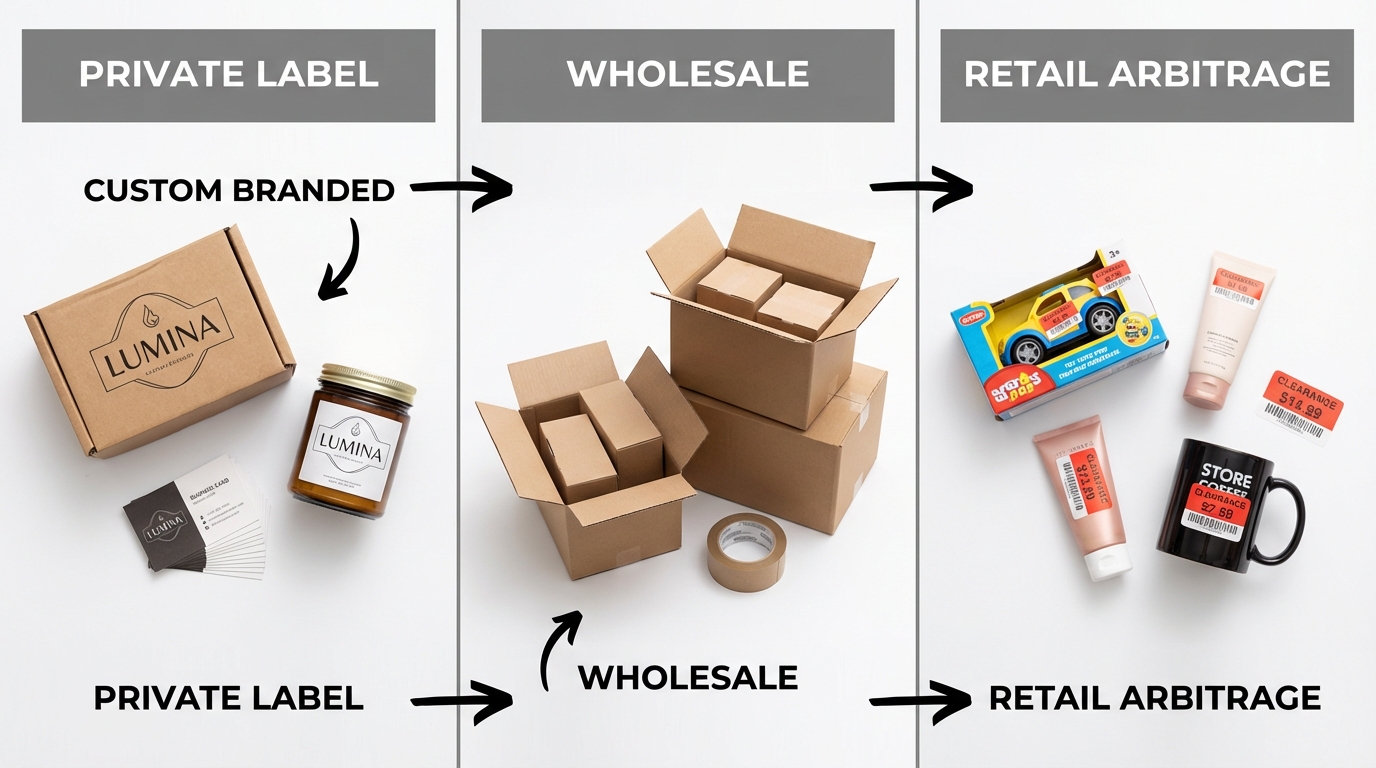
Before you place a single unit order or create a Seller Central account, the most consequential decision you will make is which business model to operate. In 2026, the three dominant structures — private label, wholesale, and arbitrage — remain viable, but they carry dramatically different risk profiles, capital requirements, and long-term trajectories. The data is clearer than ever on this.
Private Label: High Ceiling, High Commitment
Private label involves sourcing a product from a manufacturer — typically overseas — and selling it under your own brand name. You control the packaging, the listing, the price, and the customer experience. According to data from multiple 2026 seller surveys, private label margins typically range from 18% to 50% net, depending on category and how efficiently you manage advertising spend.
The appeal is obvious: brand control, pricing power, and a business that can be valued at three to five times annual revenue at exit. The risk is equally real. You are betting capital on inventory before you have confirmed market demand. PPC costs in competitive categories have risen significantly, and without strong organic rank, your advertising-to-sales ratio can quietly erode your margins before you notice.
Private label is best suited to sellers who can commit to a six-to-twelve-month product validation and launch runway, have capital to invest in initial inventory and launch advertising, and are building toward an exit or a multi-SKU brand, not a quick income stream.
Wholesale: Lower Ceiling, Lower Risk
Wholesale selling means buying established branded products directly from authorized distributors or manufacturers and reselling them on Amazon. Margins sit lower — typically 8% to 20% net — but the model has structural advantages that are often underrated.
Because you are selling established products with existing demand and review history, you skip the painful and expensive product launch phase. The Buy Box algorithm becomes your primary competitive battleground, and winning it consistently requires strong metrics, competitive pricing, and inventory availability — all of which are controllable. Wholesale is also significantly less dependent on paid advertising, which matters in a marketplace where CPC costs have climbed year over year.
Wholesale does not build the same kind of equity as private label. You are not creating a brand — you are participating in someone else’s. But it is a legitimate, often underestimated path for sellers who want predictable cash flow without the all-in commitment of a private label launch.
Arbitrage: Fastest Start, Shortest Shelf Life
Retail and online arbitrage — buying discounted products from retail stores or other online platforms and reselling them on Amazon — offers the lowest barrier to entry and can generate returns of 10% to 30% on invested capital. For a beginner learning how Amazon’s systems work, it is a genuinely useful starting point.
The problem is scalability. Arbitrage is inherently time-intensive and dependent on finding deals that exist only temporarily. It does not build a brand, it does not build a supplier relationship, and it does not build a business that anyone will pay a multiple for when you want to exit. Many experienced sellers treat arbitrage as a cash flow tool while they build toward private label, which is a reasonable strategy — but it should be recognized for what it is: a job, not a business.
The Model Matching Framework
The best model is not the one with the highest margins — it is the one you can execute at your current level of capital, time, and risk tolerance. A seller with $5,000 in starting capital attempting private label in a competitive category is likely to run out of cash before they run out of lessons. A seller with $200,000 doing arbitrage is leaving serious enterprise value on the table. Matching your model to your resources is not cautious — it is smart.
Account Health: The Foundation Everything Else Is Built On

If your business model is the foundation, your account health is the ground it sits on. In 2026, Amazon’s enforcement has become faster, more automated, and less forgiving than at any point in the platform’s history. Safety investigations have increased 40% year over year. AI-powered policy monitoring means that violations which previously took weeks to surface can now trigger listing removals or account warnings within hours.
Over 22% of Amazon sellers have experienced at least one account suspension. That is not a fringe statistic — it represents one in five active sellers losing access to their revenue, often with little warning and no immediate recourse. Understanding how account health works — and building systems to protect it — is not optional operational detail. It is survival infrastructure.
The Four Metrics That Define Your Health Score
Amazon’s Account Health Rating (AHR) is a composite metric, but it is driven primarily by four categories of performance data. Your Order Defect Rate (ODR) must stay below 1%. This encompasses negative feedback, A-to-Z guarantee claims, and chargebacks. Your Late Shipment Rate must stay below 4% for seller-fulfilled orders. Your Pre-Fulfillment Cancellation Rate must stay below 2.5%. And your Valid Tracking Rate for seller-fulfilled shipments must stay above 95%.
FBA sellers have a structural advantage here — Amazon handles fulfillment, so several of these metrics are Amazon’s responsibility rather than yours. But FBA does not protect you from the categories that matter most: listing policy violations, intellectual property complaints, and product safety issues. Those land equally on FBA and FBM sellers.
The Most Common Violation Categories in 2026
Policy violations in 2026 cluster into several distinct categories. Listing inaccuracies — unsupported product claims, misleading bullet points, restricted keywords embedded in copy — remain the most common trigger for listing removals. Amazon’s AI content scanning systems flag these automatically, and sellers who wrote bullet points three years ago and never revisited them are being caught by rules they didn’t know had changed.
Intellectual property complaints are the second major category. If you are selling a product that uses a brand name in your listing without authorization, or if your product packaging resembles another brand’s trade dress, complaints can come from rights owners directly — and Amazon’s default response is to remove your listing first and ask questions later.
Authenticity complaints — claims that your product is counterfeit or not as described — are particularly dangerous because they often trigger safety investigations rather than simple listing removals. These take longer to resolve, can freeze your disbursements, and are the most likely to result in full account suspension.
Building a Compliance System, Not Just a Complaint Response
The sellers who rarely face account health problems are not luckier — they have compliance systems that catch problems before Amazon does. A practical compliance system involves a quarterly listing audit to check bullet points and description copy against current policy, a supplier invoice filing system that makes authenticity documentation available within 24 hours if requested, a weekly Account Health dashboard review to catch metric drift before it becomes a threshold breach, and a clear escalation protocol if a warning does arrive — including who writes the Plan of Action (POA) and what evidence they will gather.
When a suspension or warning does occur, the POA is your primary tool. Amazon expects a specific structure: what went wrong (root cause), what you did to fix it immediately (corrective actions), and what permanent process changes you have made to prevent recurrence (prevention steps). Generic templates fail. Specific, evidenced, credible responses succeed. First-submission appeal success rates are significantly higher when sellers provide supply chain documentation, match invoices to specific ASINs, and demonstrate they have already implemented changes — not that they plan to.
The A10 Algorithm: How Amazon Decides Who Wins
Amazon’s search algorithm — commonly called A9 by sellers and now increasingly referred to as A10 given documented behavioral changes — determines which products appear at the top of search results for any given query. Understanding what it rewards in 2026 is essential for building visibility that doesn’t require spending ever-increasing amounts on PPC to maintain.
What A10 Prioritizes That A9 Did Not
The clearest evolution in Amazon’s algorithm over the past two to three years is the increased weight given to what could be called brand authority signals. Where the previous version of the algorithm weighted keyword relevance and conversion rate most heavily, A10 places measurably higher value on external traffic, seller authority (based on account age, performance history, and product catalog breadth), and sales velocity from non-Amazon sources.
This shift is not arbitrary — it reflects Amazon’s strategic interest in being the destination for demand that originates elsewhere. When a customer sees a product on TikTok, searches for it on Google, and ends up purchasing it on Amazon, that sale tells Amazon’s algorithm that this product has genuine cultural pull. It ranks the product higher not because the seller paid for placement, but because the product demonstrated demand independently. This is a significant change in how organic ranking can be earned.
Internal Signals Still Matter Enormously
The internal signals that drove the original algorithm have not disappeared — they have been joined by the external ones. Your listing’s click-through rate from search results, your conversion rate once shoppers reach your page, your review velocity and recency, your inventory availability (stockouts are heavily penalized), and your keyword relevance across title, bullets, and backend search terms all remain critical inputs.
The practical implication is that sellers who rely exclusively on internal optimization — perfect listings, aggressive backend keywords, heavy PPC — are competing on an increasingly crowded field. Sellers who add external traffic to the equation are accessing a ranking lever that most of their competitors are not using. That asymmetry is one of the most underexploited advantages available in the marketplace right now.
The Role of Listing Quality in Algorithm Performance
Amazon has introduced a Listing Quality Score in many categories — a visible metric that assesses how complete and accurate your product detail page is. Listings with high quality scores benefit from preferential placement in some category contexts. This means that the fundamentals — high-resolution images, complete attribute data, accurate categorization, answered customer questions — have become ranking variables, not just conversion variables.
A listing that converts well but scores poorly on completeness can be outranked by a listing that scores better structurally, even if its conversion rate is lower. This is a subtle but important change for sellers who optimized their listings under the older model and haven’t revisited them recently.
Brand Registry and the A+ Content Advantage
Amazon Brand Registry has been around long enough that some sellers treat it as a checkbox rather than a strategic asset. That is a mistake. In 2026, Brand Registry is the gateway to a set of tools that meaningfully separate protected, investable brands from commodity listings — and the data behind those tools is compelling.
What Brand Registry Actually Gives You
The most immediate benefit of Brand Registry is listing control. Once your trademark is linked to your products, other sellers cannot edit your listing detail pages, cannot change your images, and cannot add themselves to your listing in ways that dilute your brand presentation. For sellers who have experienced listing hijackers or unauthorized changes, this protection alone is worth the trademark registration cost.
Beyond protection, Brand Registry unlocks A+ Content — enhanced product descriptions that replace the standard text block with rich media modules: comparison charts, lifestyle images, brand story modules, and feature callouts. The data on A+ Content’s impact on conversion rates is consistent across multiple sources: optimized A+ Content increases conversion rates by 5% to 20%, with well-executed implementations reaching the 15% to 20% improvement range.
Brand Stores — the custom Amazon storefronts available to registered brands — go further. They provide a multi-page, SEO-indexable storefront with a unique Amazon URL that ranks in Google search results. This creates external discoverability for your brand that operates independently of any individual product listing. A customer searching for your brand name in Google can land directly on your curated storefront, browse your full catalog, and purchase — with Amazon handling everything.
Brand Analytics: The Intelligence Layer Most Sellers Ignore
One of the most underused features within Brand Registry is Brand Analytics. This dashboard gives brand owners access to search frequency rank data (showing which keywords are most searched in your category during any given time period), demographic data about your actual customers, market basket analysis (what else customers buy alongside your products), and repeat purchase rates.
The search frequency rank data is particularly valuable for product development decisions. Rather than guessing which new SKUs to develop based on intuition or third-party tool estimates, Brand Analytics lets you see directly what Amazon shoppers are searching for and failing to find a satisfying result on — which is essentially a demand signal with the noise filtered out.
Sponsored Brands and Video: The Advertising Tier Most Sellers Don’t Reach
Brand Registry also unlocks Sponsored Brands ads — the banner-style placements at the top of search results that feature your brand logo, a custom headline, and multiple products. These placements drive brand awareness in addition to direct click-through, which compounds over time as your brand name becomes recognizable to repeat shoppers. Sponsored Brands Video — autoplay video ads in search results — have consistently outperformed static ads in terms of engagement rate in category after category since their broad rollout.
For sellers still running only Sponsored Products campaigns, the gap between what they are doing and what is possible is significant. Sponsored Brands placements occupy premium real estate that generic sellers simply cannot access, creating a visibility asymmetry that compounds over time in favor of registered brands.
Building an Off-Amazon Traffic Moat
The sellers who will be most resilient in 2026 and beyond are not the ones with the best listings — they are the ones who have built demand for their products that exists independently of Amazon. External traffic is both an algorithm signal and a business moat, and it is one of the most strategically important investments an Amazon brand can make right now.
Why External Traffic Has Become Non-Negotiable
Nearly one million new sellers entered the Amazon marketplace in the past year. Category-level competition is intensifying across nearly every product vertical. In that environment, competing purely on internal Amazon metrics — reviews, listings, and PPC — is competing on a field that keeps getting more crowded. External traffic creates demand that doesn’t originate on Amazon, which means it reaches shoppers who were never going to find your product through a keyword search.
Amazon’s Brand Referral Bonus program makes external traffic financially advantageous in addition to strategically important. Brands driving traffic from external sources via Amazon Attribution links earn back approximately 10% of attributed sales as a bonus credit against selling fees. That effectively means you are being paid by Amazon to bring them new customers — a rarely framed but real financial incentive.
The Channels That Are Working in 2026
Influencer partnerships remain the highest-leverage external traffic source for most consumer product categories. Research indicates that influencers drive approximately 37% of Amazon’s external traffic. The mechanics have become more structured: Amazon’s Creator Connections program allows brands to set commission rates and connect with content creators who promote Amazon products directly through affiliate-style arrangements.
Meta advertising (Facebook and Instagram) continues to be effective for building retargeting audiences, particularly for higher-consideration purchases. The strategy most sophisticated Amazon sellers use here is not driving traffic directly to Amazon but rather to a landing page that captures a pixel or email address first, then redirects to the Amazon listing. This builds a first-party data asset — an email list or retargeting audience — that exists entirely outside Amazon’s ecosystem.
TikTok and Pinterest drive significant top-of-funnel discovery for visually oriented product categories. The key discipline is using Amazon Attribution links consistently across all external channels so you can measure which sources actually convert, not just which sources drive clicks.
Building an Email List as a Brand Asset
Amazon does not share customer email data with sellers. You cannot email people who bought from you on Amazon unless they explicitly opted in through a separate channel. This is a structural limitation that external traffic strategies directly address.
A seller driving traffic through a landing page before redirecting to Amazon can capture email opt-ins by offering something of value — a product guide, a discount code, early access to new products. Over time, this email list becomes one of the most valuable assets in the business: a direct relationship with customers that does not depend on Amazon’s algorithm, Amazon’s ad auction, or Amazon’s policies. It is also an asset that adds tangible value at business exit, something that a pure Amazon-dependent business cannot offer.
International Expansion: The Growth Lever Most Sellers Overlook

The single most underused growth strategy among established Amazon sellers is international expansion — and in 2026, the barriers have dropped substantially. Amazon has made a coordinated push to reduce the friction and cost of selling in European and other international markets, and the financial opportunity for sellers who act on this is significant.
The European Opportunity in Numbers
The EU marketplace is valued at over €150 billion with access to more than 500 million potential customers across 14+ countries. Amazon’s European sales grew 12% year over year going into 2026, making it one of the fastest-growing regions in the global Amazon ecosystem. New marketplace launches in Poland, Sweden, the Netherlands, Belgium, and Ireland have expanded the addressable market for sellers using Pan-European FBA beyond what was available even two years ago.
Pan-European FBA allows sellers to send inventory to one or two Amazon fulfillment centers and have Amazon automatically redistribute that inventory across its European network to minimize delivery times. The result for customers is faster delivery; the result for sellers is lower fulfillment costs — the program can reduce per-unit shipping costs by up to 53% compared to individually shipping to each country’s fulfillment centers.
Fee Reductions Making Expansion More Accessible
Amazon has introduced meaningful fee incentives for sellers expanding to European stores in 2026. FBA fulfillment fees have been cut by up to 50% for new sellers entering expansion stores. A six-month referral fee waiver applies to qualifying expansion categories. The European Expansion Accelerator (EEA) provides a two-click setup process that extends your existing European presence to additional country-specific stores without rebuilding listings from scratch.
For a seller doing $500,000 annually in the US marketplace, a conservative 20% revenue add from European expansion represents $100,000 in new annual revenue. Even accounting for the costs of compliance (VAT registration, product labeling requirements), the economics of European expansion are compelling for most established sellers — particularly those in categories where European demand closely mirrors US purchasing patterns.
What Sellers Need to Know Before Expanding
International expansion is not without its complexities. VAT registration is mandatory in each EU country where you store inventory — Amazon’s Pan-European FBA program means inventory can be stored in multiple countries automatically, which triggers VAT obligations in each of them. Amazon’s VAT Services program handles this for sellers in supported countries, which significantly reduces the administrative burden.
Product compliance varies by country and category. Electronics must comply with CE marking requirements. Products sold in the UK post-Brexit face UKCA marking requirements. Hazardous materials categories (batteries, certain chemicals) face additional documentation requirements under REACH and other EU frameworks. These are solvable problems — but they are real ones, and sellers who expand without addressing them face the same compliance risk in Europe that careless sellers face in the US marketplace.
Language and localization matter more than many US sellers expect. Auto-translated listings underperform native-language listings in every major European market. For high-volume ASINs, investing in professional German, French, Italian, and Spanish translations of your listing copy is one of the highest-ROI localization investments you can make.
Supply Chain Resilience and Inventory Strategy

If the past several years have taught Amazon sellers anything, it is that supply chains can break in ways that no individual seller can predict or control. Port disruptions, supplier capacity constraints, shipping cost volatility, and inbound compliance changes at Amazon fulfillment centers have all created situations where sellers ran out of inventory at the worst possible moment — losing rank, losing revenue, and watching competitors capture market share they had spent months and real money to build.
Resilient inventory management in 2026 is not about having more inventory — it is about having smarter systems around your inventory.
ABC Classification: Treating Your SKUs Differently
Not all products in your catalog deserve the same level of inventory attention. ABC classification — a standard inventory management approach — divides your SKUs into three tiers based on sales velocity and revenue contribution. A-tier SKUs (typically the top 20% of products that generate 80% of revenue) warrant rigorous reorder planning, larger safety stock buffers, and supplier redundancy. B-tier SKUs warrant standard reorder protocols. C-tier SKUs (slow-movers) warrant careful evaluation of whether they belong in the catalog at all, given Amazon’s long-term storage fees.
Many Amazon sellers manage all their products the same way — the same reorder lead time assumptions, the same safety stock formulas. This approach guarantees that you will have too much of products that don’t sell and too little of products that do. ABC classification forces a discipline that prevents both outcomes.
Supplier Diversification: Not a Luxury
Single-source supplier dependency is one of the most common and most expensive supply chain risks in Amazon selling. When your sole supplier faces a capacity issue, a quality control problem, or a geopolitical disruption, you have no options and no leverage. Building relationships with at least one backup supplier — even if you never use them in normal operations — is insurance that is cheap relative to the cost of a stockout during peak season.
In practice, supplier diversification can mean qualifying a second factory for your primary SKUs, developing relationships with domestic suppliers who can fulfill smaller emergency orders at higher cost, or joining purchasing cooperatives that give smaller sellers access to a broader supplier network. None of these are free, but all of them are cheaper than the lost rank and revenue that follows a prolonged stockout.
Using Predictive Reorder Systems
Manual reorder management — checking inventory levels periodically and placing orders based on gut feel — scales poorly and creates stockout risk even for experienced sellers. Automated or semi-automated reorder systems that calculate reorder points based on actual sales velocity, inbound shipping lead times, and seasonal demand curves produce significantly more reliable inventory coverage.
Amazon’s own restock recommendation tool provides a baseline, but most sophisticated sellers layer third-party inventory management software on top of it. Tools that integrate with Seller Central can pull real-time sales data, calculate days of inventory remaining, and trigger reorder alerts based on custom rules. The investment in this kind of system pays for itself after a single avoided stockout at peak season.
The Review Ecosystem: Psychology, Policy Changes, and Conversion

Customer reviews remain one of the most psychologically powerful conversion signals in e-commerce, and their management on Amazon has become both more complex and more consequential in 2026. Two major forces are reshaping the review landscape: Amazon’s algorithm changes that weight review recency and sentiment more heavily than sheer volume, and Amazon’s May 2026 review pooling policy change that is upending how variation listings display social proof.
The Psychology Driving Amazon Purchase Decisions
Research on Amazon buyer behavior consistently shows that 92% of shoppers trust peer reviews over brand claims. This is not a new finding, but the granularity of what drives trust has become clearer. Shoppers are not just looking at star ratings — they are scanning review recency (how recently did someone buy and review this?), photo and video reviews (user-generated content raises conversion rates by approximately 74% in some category studies), and the ratio of one- and two-star reviews relative to positive ones.
The psychological mechanism at play is risk reduction. Amazon is a high-trust purchase environment generally, but individual products within it carry perceived risk based on the quality signals the listing provides. Reviews are the most credible quality signal available because they come from people who have no financial incentive to be positive — and increasingly, shoppers know how to read them for authenticity markers like verified purchase status and detailed, specific feedback.
The May 2026 Review Pooling Change: What It Means
Amazon began rolling out a significant policy change in early 2026 that is affecting sellers with variation listings — products listed with multiple sizes, colors, or configurations under a single parent ASIN. Under the previous system, reviews from all variations pooled under the parent listing, meaning a product with ten variations would display the combined review count from all of them. Under the new system, variations that serve “functionally different” use cases — a 3-pack versus a 12-pack, for example — will display separate review counts.
For sellers whose review count appeared high because of pooled variations, this change can cut visible review counts by 50% or more overnight — with a 30-day warning period from Amazon before the change takes effect. The conversion rate impact is real and immediate. A listing that showed 2,400 reviews might now show 600 for the most-viewed variation, which is a dramatically different social proof signal to a first-time shopper evaluating the product.
The sellers best positioned for this change are those who have been building reviews on each variation consistently, rather than relying on pooling to amplify a handful of star variations. Going forward, variation architecture decisions need to consider not just listing organization but review accumulation strategy.
Ethical Review Accumulation in 2026
Amazon’s tools for requesting reviews remain available and effective when used correctly. The “Request a Review” button in Seller Central — which sends a standardized Amazon-branded review request to verified purchasers — is the safest and most compliant method. Amazon’s Vine program, which provides free products to a pool of trusted reviewers in exchange for honest feedback, remains available to Brand Registry participants and is particularly valuable for new product launches.
What has changed is the enforcement environment around anything that could be construed as incentivizing or manipulating reviews. Amazon’s AI monitoring systems in 2026 are sophisticated enough to detect coordinated review patterns, velocity anomalies, and IP overlaps between reviewer accounts and seller accounts. The risk of review manipulation is not just the removal of those reviews — it is an account health strike that can cascade into suspension. The ethical path is not just the compliant path — in 2026, it is also the safer one.
Protecting Your Account: Policy Violations and Suspension Prevention
Earlier in this guide we covered account health metrics. Here, we go deeper into the operational disciplines that keep your account clean over the long term — particularly as Amazon’s enforcement continues to accelerate and the consequences of violations become more severe.
The Listing Audit Discipline
Amazon’s product policies are not static. They update regularly — sometimes with advance notice, sometimes without. A listing written under 2023’s policy guidelines may violate 2026’s rules around specific claims (health claims, comparative claims, environmental claims) even though nothing about the listing was changed. This is how sellers get caught: not because they did something new and wrong, but because the rules moved around what they had already done.
A quarterly listing audit — reviewing every active ASIN’s title, bullet points, description, and images against current category-specific guidelines — is a basic discipline that eliminates this category of risk. It is time-consuming but far less time-consuming than responding to a suspension while your inventory sits frozen in an Amazon fulfillment center.
Intellectual Property: Both Protection and Risk
Brand Registry, as discussed above, helps protect your listings from others infringing on your IP. But sellers also face the risk of inadvertently infringing on others’ IP — particularly in categories with complex patent landscapes or where product designs are closely imitated across multiple manufacturers from the same country.
Before launching any new product, a basic IP clearance check — searching Amazon’s IP Accelerator database, the USPTO trademark database, and Google Patents for design patents related to your product — is a worthwhile investment. A single infringement complaint from a patent holder can result in listing removal, and a pattern of complaints triggers account-level risk that is much harder to resolve.
The Plan of Action: What Works in 2026
If you receive a suspension notice, the quality of your Plan of Action determines whether your appeal succeeds on the first try or enters a protracted back-and-forth with Amazon’s Seller Performance team. First-submission success rates are meaningfully higher for appeals that include specific documentary evidence — supplier invoices matched to the specific ASINs at issue, internal process documentation showing corrective actions already taken, and precise language that mirrors the violation category Amazon cited rather than generic reassurances.
What Amazon’s review system consistently rejects is ambiguity and deflection. An appeal that says “we believe there may have been a misunderstanding” is an appeal that fails. An appeal that says “we have identified that the following specific process failure led to this outcome, we have already taken the following specific corrective actions, and we have implemented the following permanent monitoring protocols” is one that succeeds. The difference is preparation, discipline, and specificity.
Building a Sellable Business, Not Just an Amazon Store
The ultimate measure of an Amazon brand is not its monthly revenue — it is its enterprise value. A business generating $1 million in annual revenue with strong profit margins, brand registry, consistent review velocity, diversified traffic sources, and clean account history can sell for three to five times annual revenue. A business generating the same revenue with heavy PPC dependency, no brand registration, no external traffic, and a history of account warnings might sell for one times revenue — or find no buyer at all.
What Acquirers Look For in 2026
The Amazon aggregator market that boomed in 2021 and 2022 has matured significantly. Aggregators today are more selective and more disciplined in their due diligence. The checklist they run through has not fundamentally changed, but the thresholds have tightened. They want businesses with at least two to three years of consistent performance history, strong margin profiles that don’t rely on advertising spend that a new owner couldn’t replicate, defensible differentiation (patents, proprietary formulations, exclusive supplier relationships), and clean account health records with no history of serious violations.
Brand registry, A+ Content, a Brand Store, an external email list, and international marketplace presence all contribute positively to a business’s attractiveness to buyers — both aggregators and strategic acquirers who might want to add your brand to their existing product ecosystem. Building with exit optionality in mind does not mean planning to sell — it means building a business good enough that you could.
The Documentation Habit
One of the most practical things a seller can do to increase their business’s value — and reduce the operational chaos of scaling — is maintaining thorough operational documentation. Standard operating procedures (SOPs) for product research, supplier communication, listing creation, inventory management, and customer service response mean that the business can operate without being entirely dependent on the founder’s personal knowledge.
Buyers pay premiums for businesses that can be transferred. Businesses where all the operational knowledge lives in the founder’s head are harder to sell, take longer to close, and command lower multiples. Documentation is not just good practice — it is equity.
Diversification Beyond Amazon
Building your brand’s presence on channels beyond Amazon — whether that is a Shopify store, a wholesale relationship with brick-and-mortar retailers, or a presence on other marketplaces — reduces the single-platform dependency risk that makes pure Amazon businesses less attractive to acquirers and more vulnerable to platform changes.
A brand that drives 70% of its revenue from Amazon and 30% from its own DTC site, with an email list of 20,000 opted-in customers, is a fundamentally different asset than a brand that does 100% of its revenue through Amazon. The multi-channel seller has pricing power, customer relationships, and data assets that the Amazon-only seller does not. Both can be successful businesses — but only one is a business a sophisticated buyer will pay a significant premium for.
Conclusion: The Authority Blueprint in Practice
Amazon is not getting easier. The platform is more competitive, more automated, more policy-intensive, and more fee-laden than at any point in its history. Sellers who approach it with a pure transaction mindset — listing products, running ads, hoping for clicks — are fighting the same battle with diminishing returns every quarter.
The sellers building genuine authority on Amazon in 2026 are doing something different. They started by choosing a business model that matched their actual resources and risk tolerance. They built account health systems that catch problems before Amazon does. They enrolled in Brand Registry and put A+ Content and Brand Stores to work. They began driving external traffic — not just to improve their algorithm rankings, but to build customer relationships and data assets that exist outside Amazon’s control.
They thought seriously about international expansion and recognized that Europe represents an accessible, high-growth opportunity that most US-based sellers still aren’t pursuing. They built supply chain redundancy so a single supplier problem doesn’t wipe out three months of rank-building. They managed their review ecosystems proactively — particularly in light of the May 2026 pooling changes — and stayed current on policy changes through consistent listing audits.
And they built with exit optionality in mind: documentation, diversification, and the kind of brand assets that make a business worth buying, even if they have no current intention to sell.
None of this is complicated in principle. All of it requires discipline, consistency, and a willingness to think about the business at a level beyond the next sales day. That is what separates sellers who have a revenue number from sellers who have built something.
Key Takeaways for Amazon Sellers in 2026:
- Match your business model (private label, wholesale, arbitrage) to your actual capital and risk tolerance — not to what sounds most appealing.
- Treat account health as core business infrastructure, not a reactive problem to solve only when something goes wrong.
- Enroll in Brand Registry, publish A+ Content, and launch a Brand Store — these tools compound in value over time and create competitive barriers generic sellers cannot access.
- Build at least one external traffic channel that drives qualified buyers to your listings and builds a first-party data asset.
- Evaluate European expansion through Pan-European FBA — the fee reductions and accelerator tools in 2026 have made this more accessible than ever.
- Implement ABC inventory classification and build supplier redundancy before you need it, not after a stockout has already cost you rank.
- Audit your listings quarterly against current Amazon policies — rules change without announcements, and compliance is a continuous practice.
- Document your operations and diversify your revenue channels to build enterprise value, not just monthly revenue.