


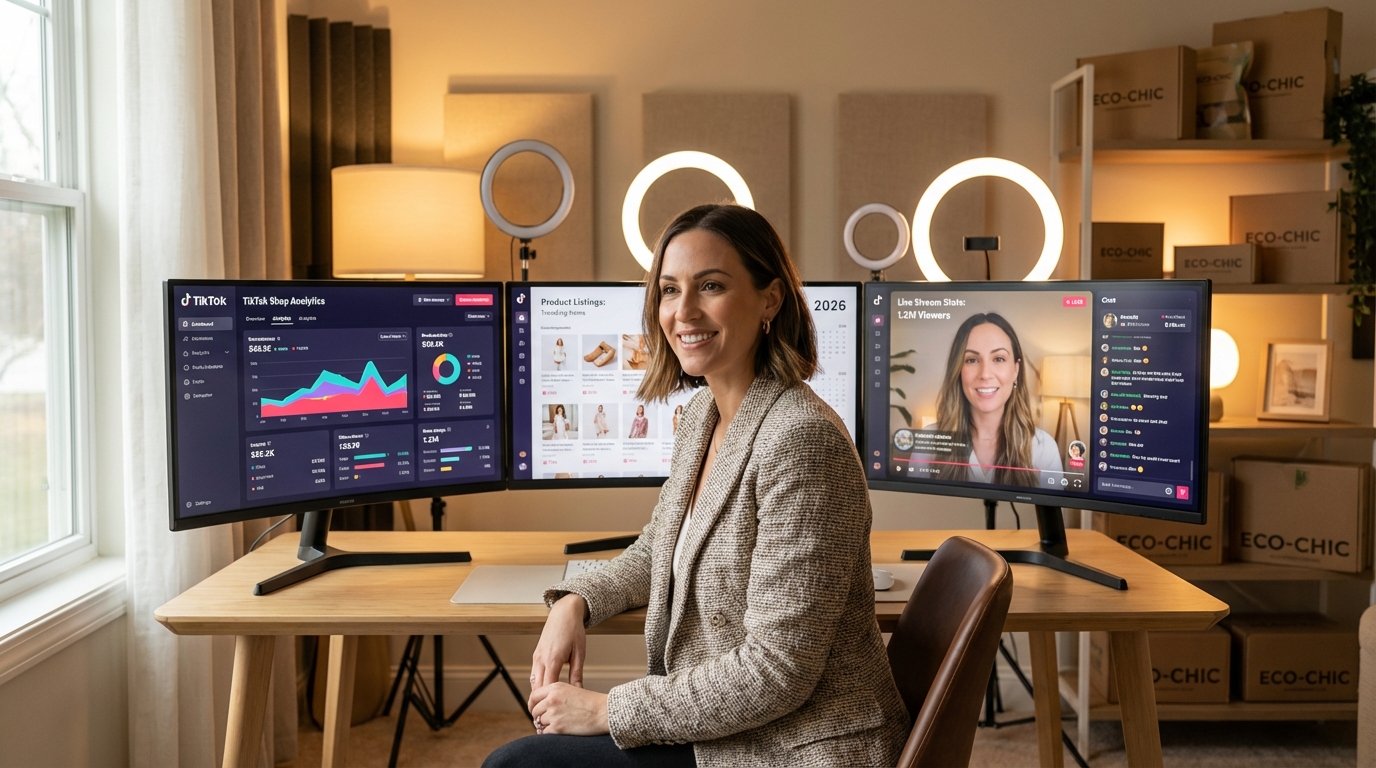

TikTok Shop crossed $33.8 billion in US gross merchandise value in 2024 and entered 2026 with over 200 million monthly active buyers. Those numbers are cited constantly — in pitch decks, in onboarding videos, in seller community threads where everyone seems to be making money. What gets discussed far less is the underlying architecture that separates sellers who build durable, profitable businesses from those who chase a viral moment and quietly fold six months later.
This is not a guide about how to set up your first listing or why TikTok Shop is a large opportunity. You already know both of those things. This is a guide about the mechanics beneath the surface: the true cost structure that catches sellers off guard, the fulfillment policy shifts that upended operations in early 2026, the account health system that can quietly hollow out a business, and the retention infrastructure that the most profitable brands have quietly built while everyone else keeps chasing new customers.
The sellers thriving on TikTok Shop in 2026 have stopped thinking of it as a channel and started treating it as an ecosystem — one with its own rules of physics, its own risk profile, and its own compounding advantages for those who understand how it actually works. This guide breaks down every layer of that ecosystem, with data, frameworks, and the specific decisions that determine long-term outcomes.
The Three-Pillar Architecture That Drives TikTok Shop Revenue
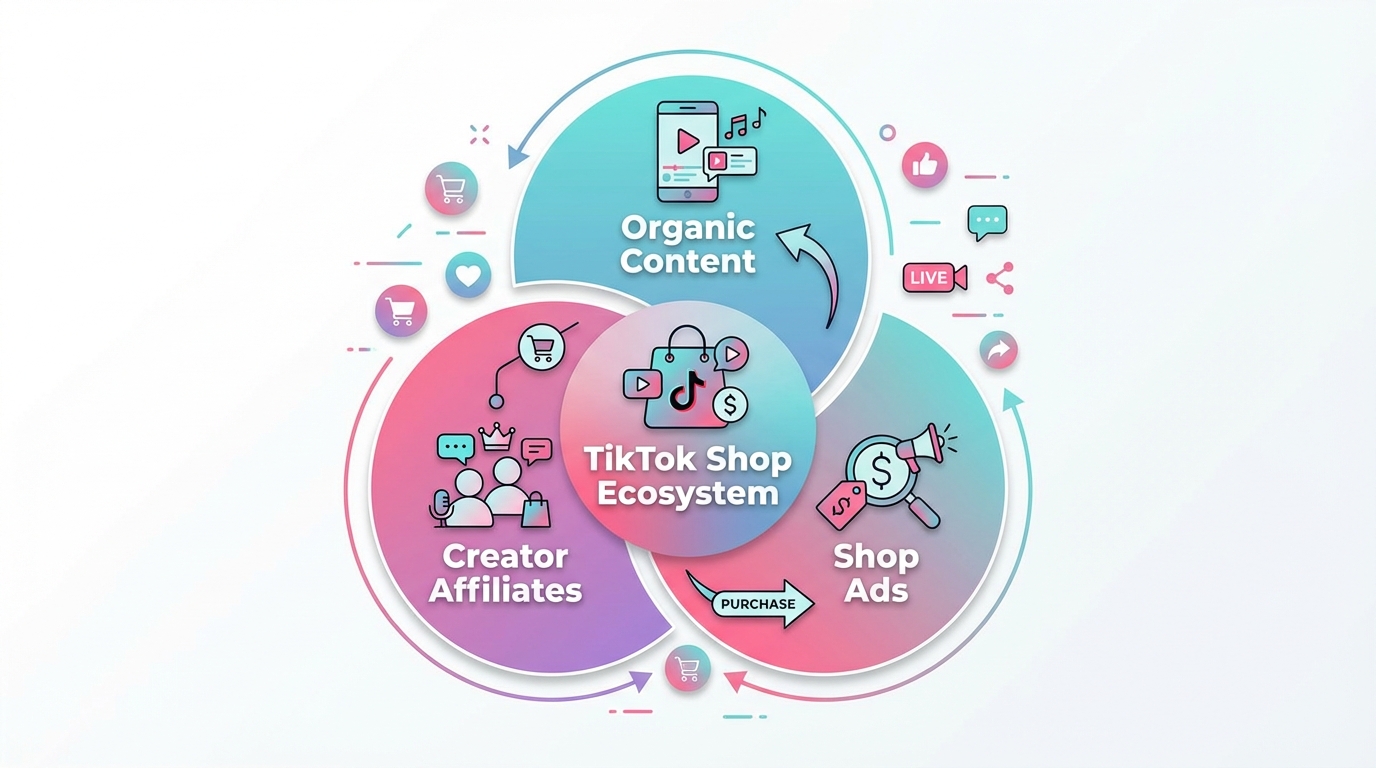
Every serious TikTok Shop business is built on three interdependent pillars: organic Shop content, creator affiliate programs, and Shop Ads. Most sellers start with one, add a second when they’re struggling, and never properly integrate all three. That fragmented approach is one of the most consistent predictors of stalled growth.
Pillar One: Organic Shop Content (The Foundation)
Approximately 85% of TikTok Shop discovery happens through organic content — not paid ads, not affiliate videos, but the algorithmic distribution of content tied directly to your store. This means the quality, structure, and cadence of your own TikTok account’s output is effectively your primary marketing channel.
Organic Shop content works because the algorithm doesn’t distinguish between a video that entertains and one that sells. When a product demo, tutorial, or before-and-after clip performs well, TikTok surfaces it to an expanding audience. The product tag embedded in that video turns viewers into buyers without them ever leaving the app. For sellers who consistently produce content that genuinely serves the algorithm — meaning it earns watch time, comments, and shares — organic reach is effectively free customer acquisition at scale.
The trap many sellers fall into is treating their TikTok account like a product catalog: posting individual listings with no narrative context, no hook, and no reason for a stranger to care. High-performing organic content almost always centers on a transformation, a demonstration, or a problem being solved. The product is the solution, not the subject.
Pillar Two: Creator Affiliates (The Amplification Layer)
Creator affiliates function as the paid growth layer for TikTok Shop, but they operate on performance — sellers pay commission only on confirmed sales, not on impressions or clicks. This makes the affiliate program structurally different from traditional influencer marketing and far more capital-efficient at the early stages.
The data on creator size is counterintuitive. Micro and nano-influencers — those with between 1,000 and 100,000 followers — deliver 8.2% engagement rates compared to 5.3% for macro-influencers on TikTok. Brands that run category-targeted outreach to smaller creators consistently see 5 to 10 times higher affiliate acceptance rates than those blasting cold proposals to large accounts. The combination of higher engagement, lower commission expectations, and authentic content output makes micro-creator networks the backbone of most top-performing TikTok Shop affiliate programs.
Pillar Three: Shop Ads (The Accelerant)
Shop Ads are the paid amplification layer — but the most common mistake sellers make is activating them too early. Spending on Shop Ads before you have organic proof points and a working affiliate operation is equivalent to paying for traffic before you know your conversion rate. The math rarely works.
The effective sequencing is: establish organic content cadence first, build an affiliate base that generates consistent sales and social proof, and then introduce Shop Ads to amplify what is already converting. Benchmarks suggest sellers should be targeting a minimum 2.5x ROAS before scaling ad spend, with 15 to 25 percent of revenue allocated to ads only after the 60-day mark in a structured scaling program.
Category Intelligence: Where Margin and Momentum Intersect
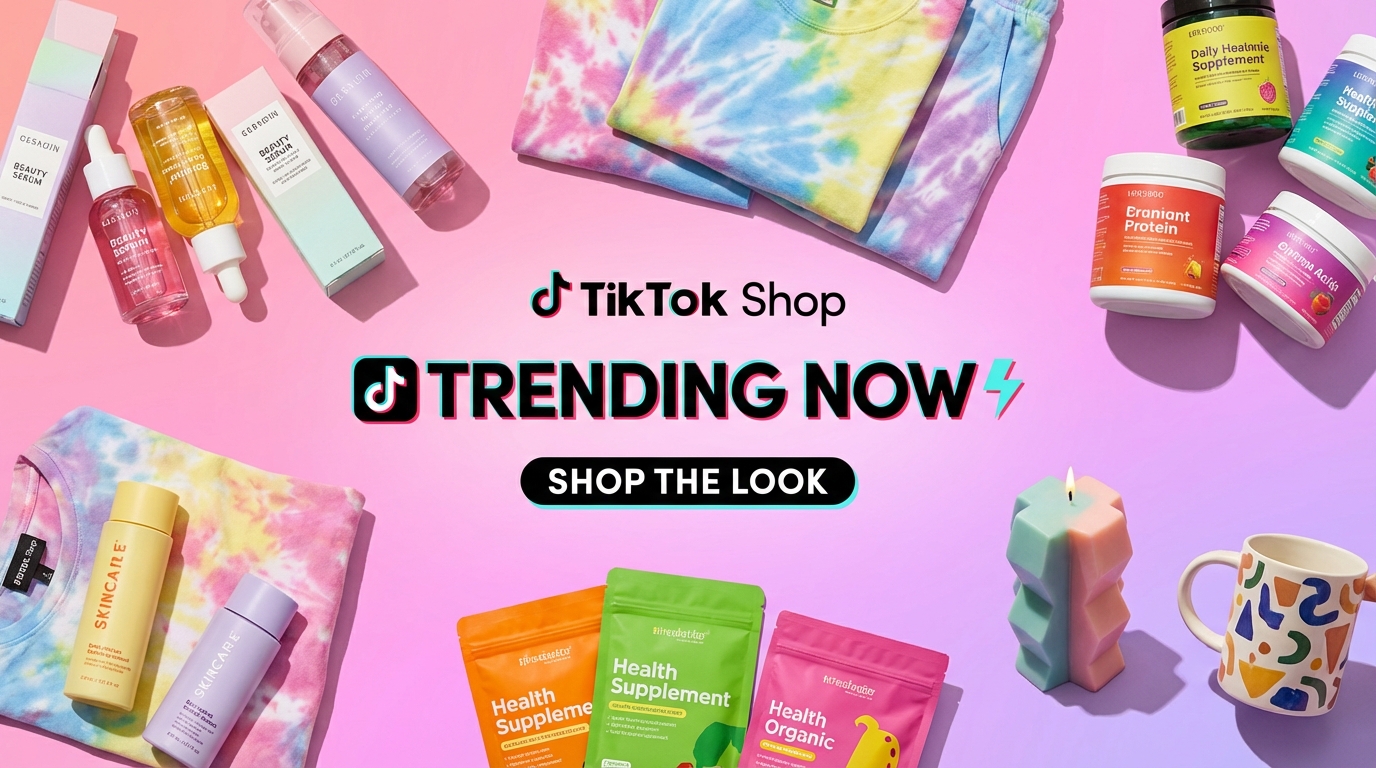
Not all product categories perform equally on TikTok Shop, and the gap between the top-performing categories and the rest isn’t marginal — it’s structural. Understanding which categories have built-in advantages on this platform is fundamental to making good sourcing and positioning decisions.
Beauty and Skincare: The Dominant Force
Beauty commands 22.5% of TikTok Shop’s total GMV, equivalent to approximately $2.49 billion. The structural reason for this dominance is simple: skincare and cosmetics are among the most visually demonstrable product categories that exist. Before-and-after transformations, GRWM (Get Ready With Me) videos, ingredient breakdowns, and application tutorials all generate the kind of engaged watch time that the TikTok algorithm rewards.
Beauty products also tend to be consumable, which has downstream implications for customer lifetime value and repeat purchase rates. A customer who buys a serum that works will reorder in 30 to 60 days. That predictable replenishment cycle is one of the reasons beauty brands on TikTok Shop consistently achieve net margins between 25% and 40% — among the highest of any category on the platform.
Health and Wellness: The Growth Category
Health and wellness grew 78% year-over-year, making it the fastest-expanding category on TikTok Shop by a significant margin. The $600 million GMV figure significantly understates the category’s trajectory. Supplements, fitness accessories, sleep aids, and wellness devices all share the same algorithmic advantage as beauty — they solve visible problems and can be demonstrated compellingly in under 60 seconds.
The opportunity in health and wellness is partly a function of timing. Beauty is already competitive and increasingly consolidated around established brands. Health and wellness still has room for new entrants with strong product positioning and content strategies that connect with specific communities — fitness, gut health, mental wellness, longevity — before those niches become as crowded as skincare.
Categories That Look Attractive but Aren’t
Electronics ($430 million GMV, 3.9% of total) look significant in absolute terms but carry structural disadvantages on TikTok Shop. Return rates tend to be higher, demonstration requires more time than a short-form video naturally provides, and margins are thin enough that commission payments to affiliates and ad spend can quickly eliminate profitability. Electronics also carry higher product compliance risk, which has account health implications discussed later in this guide.
The framework for evaluating any product category on TikTok Shop comes down to four variables: visual demonstrability (can the product’s benefit be shown in under 30 seconds?), repeat purchase potential (will buyers come back?), margin tolerance (can the product absorb 35-55% total platform costs and still leave profit?), and return rate risk (will buyers regret the purchase?). Products that score well on all four are structurally suited to TikTok Shop. Products that fail on two or more should be re-evaluated before significant investment.
The Pricing Sweet Spot
Average product prices on TikTok Shop cluster between $25 and $35. This isn’t arbitrary — it’s a function of the impulse-buy dynamics the platform generates. Prices below $15 rarely generate enough margin to survive the cost structure. Prices above $75 create enough friction that conversion rates drop substantially, though premium categories like LED skincare devices or high-end supplements can work at higher price points when the content story justifies the cost.
The True Cost Structure: What Actually Eats Your Margin
TikTok Shop’s platform commission — 5% to 6% in the US market, plus 1.5% to 2.2% in payment processing — is among the lowest of any major marketplace. This is the number sellers tend to lead with when comparing TikTok Shop favorably to Amazon (15-30%) or other platforms. What the comparison usually leaves out is everything that comes after the platform fee.
Building the Full Cost Stack
A realistic cost model for a TikTok Shop seller looks like this: platform commission and payment processing absorbs 7-8% of revenue. Fulfillment — whether self-managed, through a third-party logistics provider (3PL), or via TikTok’s Fulfilled by TikTok (FBT) program — costs between $3.50 and $7.00 per unit depending on product size and weight. For a $30 product, that’s 12-23% of revenue before you’ve touched marketing.
Creator affiliate commissions typically run 10-20% for competitive categories, and that number has been trending up as creators have become more sophisticated about their value and more selective about the brands they partner with. Add a 15-25% allocation for Shop Ads for sellers past the 60-day mark, and total variable costs land between 35% and 55% of revenue — before cost of goods.
Category-Specific Margin Reality
Where sellers end up on that 35-55% range depends heavily on category. Beauty sellers with strong organic content can run affiliate commissions as low as 8-10% and spend minimally on ads, landing closer to the 35% total cost end with net margins of 25-40% on products with 60-70% gross margins. Fashion sellers face higher return rates and often need to offer larger affiliate commissions to compete for creator attention, pushing net margins down to 15-25% in many cases.
Electronics and home goods with lower gross margins — 30-40% — face a structural problem: the fixed costs of the TikTok Shop stack consume too large a share of the available margin, leaving sellers with 5-15% net or less. This isn’t a reason to avoid these categories entirely, but it is a reason to have a clear-eyed view of your numbers before scaling.
The Cash Flow Timing Problem
TikTok Shop operates on a payout cycle that typically runs 2 to 5 business days after order delivery. For sellers scaling quickly — particularly those running live commerce events that can generate hundreds of orders in a single session — the gap between when inventory and creator commissions are paid out and when platform revenue arrives creates real cash flow pressure. Sellers who don’t model this explicitly often find themselves cash-constrained precisely when they have the most momentum. Building a working capital buffer equal to at least 30 days of operating costs is not optional for sellers running at scale.
Live Commerce: The Conversion Engine Most Sellers Underuse
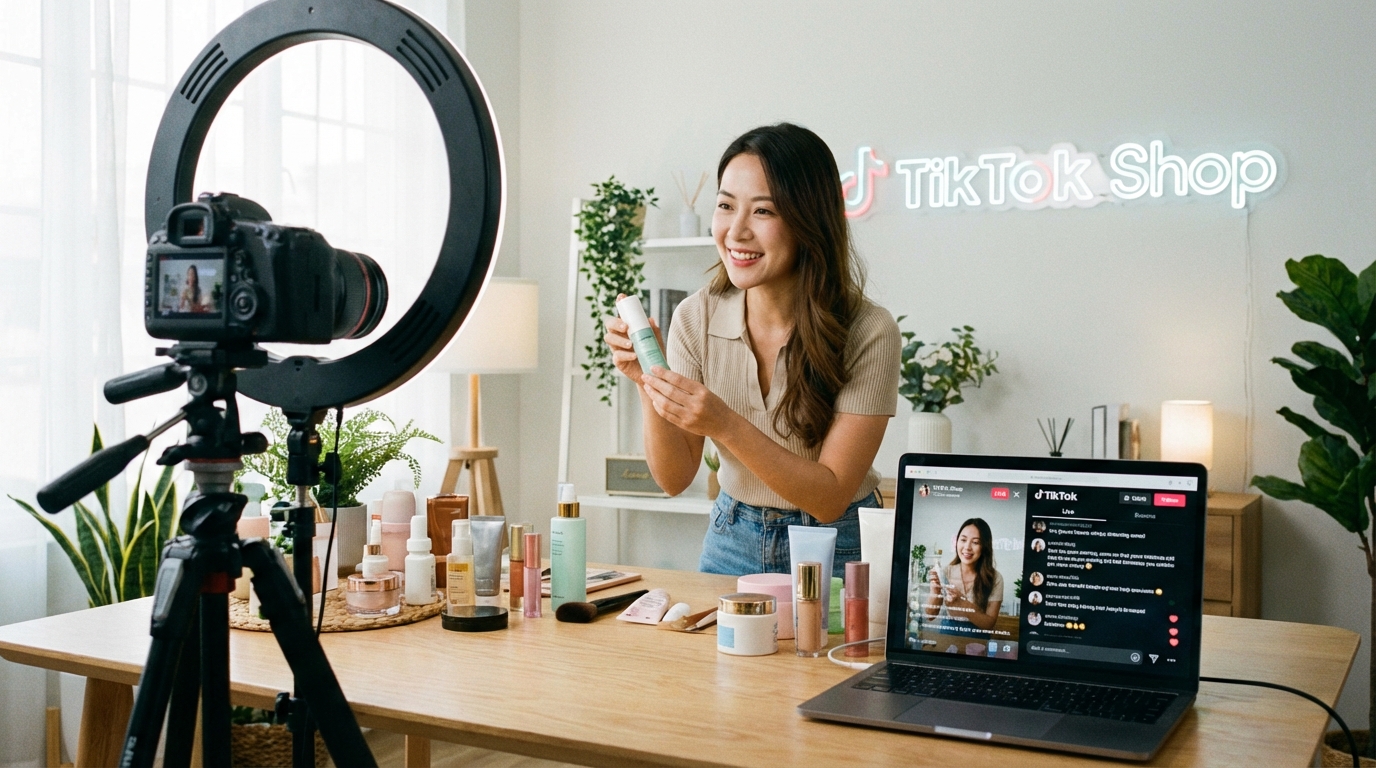
Live selling on TikTok Shop converts at rates that are structurally higher than every other content format on the platform. The numbers are not close: live events generate conversion rates of 8-12%, compared to 3.5-5.2% for shoppable videos and 0.46-2.4% for standard ad formats. That’s not a marginal edge — it’s a different category of sales performance.
Why Live Commerce Works at a Mechanical Level
Live commerce achieves high conversion through a specific combination of psychological and technical factors that short-form video cannot replicate. Real-time social proof — visible viewer counts, live comment activity, and purchase notifications appearing on screen — creates a feedback loop that validates buying decisions in the moment. Urgency tactics like countdown timers, live stock counters showing remaining units, and time-limited bundle pricing compress the decision window in ways that recorded content cannot.
The host’s ability to answer questions live eliminates the most common objection at the moment it arises. A viewer who sees a product they’re curious about and has a question answered in real time faces far less resistance to purchasing than one who watches a video and has to go find information elsewhere. That friction reduction is largely responsible for the 10x conversion advantage live commerce has over traditional e-commerce baselines (2-3%).
TikTok’s algorithm also treats live streams differently from recorded content, applying more aggressive distribution to sessions that are actively generating engagement, purchases, and comments. High-performing live sessions become self-amplifying — more viewers generate more activity, which draws more viewers from the algorithm.
The Pre-Live Framework That Drives Results
Sellers who run consistently profitable live sessions share a common set of preparation practices. The product selection phase is non-negotiable: identifying 3-5 hero products (not the full catalog), testing tech setup (lighting, audio, and connectivity are table stakes), and promoting the session 48-72 hours ahead through both organic posts and notification tools drives substantially higher peak viewership.
The first 60 seconds of a live session are disproportionately important. How the session opens determines whether TikTok’s algorithm continues distributing it broadly or narrows its reach. High-energy openings that introduce an exclusive deal immediately, acknowledge arriving viewers, and create momentum through early comments tend to unlock broader distribution than passive introductions.
The cadence within a live session matters too. “Doorbuster” drops — limited-time offers introduced roughly every 90 minutes — maintain engagement across longer sessions by giving viewers a reason to keep watching and a specific moment to act. Pop Mart, one of TikTok Shop’s most cited live commerce case studies, attributed 85% of its TikTok Shop sales to livestreams in mid-2025, demonstrating what a fully committed live commerce program can produce at scale.
Post-Live Optimization
The live session itself is only part of the strategy. High-performing clips from live sessions can be repurposed as short-form content and amplified through Spark Ads, extending the conversion life of content generated during the live. Sellers who systematically review session recordings to identify peak engagement moments — the specific product demos, price reveals, or comment interactions that caused spikes in purchases — build a feedback loop that makes each subsequent session more effective than the last.
Building a Creator Affiliate Infrastructure That Scales
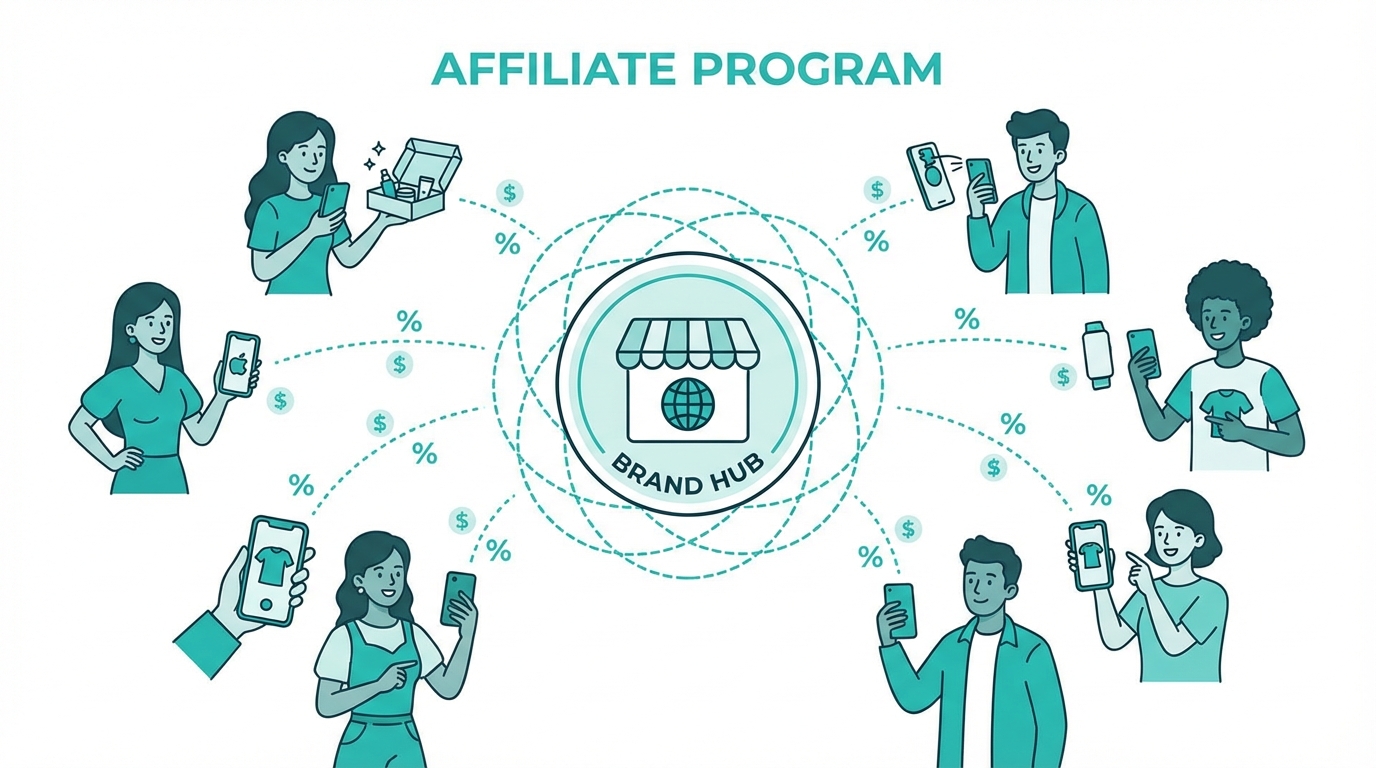
Creator affiliates are the most capital-efficient growth mechanism available to TikTok Shop sellers, but only if the program is built as an infrastructure rather than a series of one-off deals. The difference between a well-run affiliate program and a poorly run one is largely operational — it’s not about finding better creators, it’s about building better systems for finding, activating, and retaining them.
The Right Targeting Logic for Creator Outreach
The most common mistake in creator outreach is targeting by follower count. Follower count is a poor predictor of TikTok Shop performance. The more useful targeting variables are category engagement (does the creator’s audience genuinely engage with the product category you’re selling in?), content format compatibility (does the creator make content that naturally accommodates product demonstrations?), and audience-to-buyer correlation (do their followers behave like buyers or purely like entertainment consumers?).
Creators who regularly post in your category — searching for competitor product mentions and category hashtags is the most direct path to finding them — have audiences that have already self-selected around that interest. These creators generate 5 to 10 times higher affiliate acceptance rates and, critically, produce content that converts rather than content that merely generates views.
Commission Structure and the Tiering Approach
A flat-commission approach to affiliate programs is a missed opportunity. The most effective programs run a tiered structure: lower base commissions (8-10%) for standard affiliates, mid-tier commissions (12-15%) for active partners who have generated at least one confirmed sale, and premium commissions (18-25%) reserved for creators whose content has demonstrated strong conversion performance for the brand specifically.
The tiering creates a natural incentive structure — creators who perform earn more, which encourages sustained effort rather than a single content piece followed by abandonment. It also concentrates higher commission spend where it generates the most return, rather than distributing it evenly across active and inactive partners.
Exclusive product launches for top-tier affiliates are among the most effective retention tools available. Giving a creator early access to a new product, before it goes live to the general catalog, creates content that is genuinely novel rather than one of many competing reviews — a compelling dynamic for both the creator and their audience.
Program Management and Creator Relationships
At the early stages, most sellers manage their affiliate program through TikTok’s built-in creator marketplace and direct outreach. As programs scale beyond 20-30 active creators, the operational complexity of tracking performance, sending product samples, managing commission disputes, and communicating new opportunities typically requires a dedicated resource — whether that’s a team member or an agency with TikTok Shop affiliate expertise.
Sellers who invest in genuine creator relationships — providing feedback on content, sharing performance data, offering bonuses for high-converting posts, and communicating consistently — see substantially lower churn in their creator networks than those who treat affiliates as interchangeable transaction partners. In a program where 40-50% of revenue uplift comes through affiliate content, creator retention is a direct financial priority.
Shop Ads Mastery: The Spark Ads Advantage and Scaling Discipline
TikTok Shop Ads operate on a fundamentally different premise than most paid advertising formats sellers may have run elsewhere. The in-app checkout capability means that a viewer who clicks a Shop Ad product link faces zero additional friction to purchase — no external landing page, no cart abandonment opportunity. This is why TikTok Shop campaigns achieve conversion rates above 10%, compared to 0.46-2.4% for standard TikTok ads that direct traffic elsewhere.
Spark Ads vs. Non-Spark: The Performance Gap
Spark Ads — paid promotion applied to existing organic content or creator-generated content — consistently outperform non-Spark ad creative. The margin is significant: Spark Ads deliver up to 96% higher ROAS than equivalent non-Spark campaigns, according to available benchmark data. The mechanism is straightforward: Spark Ads inherit the social proof (likes, comments, shares) of the underlying organic post, and the content reads as authentic rather than manufactured for advertising purposes.
This has a direct implication for content strategy. Every piece of organic content your brand produces and every affiliate video that performs well becomes a potential paid amplification asset. Sellers who identify high-performing organic clips and apply Spark Ads within 24-48 hours of strong organic performance — when the content is already generating momentum — see the best results from this format.
ROAS Benchmarks and Budget Allocation
Industry ROAS benchmarks for TikTok Shop campaigns (not standard TikTok ads) average 4.7x for optimized DTC brands, with top performers in beauty and fashion hitting 6x-8x. The minimum viable threshold — below which ad spend typically destroys margin — is generally considered to be 2.5x ROAS for products with standard margins and 3.5x for lower-margin categories.
Budget allocation discipline is one of the clearest separators between sellers who scale successfully and those who develop an expensive ad habit. The recommended framework is: no more than 15-25% of revenue allocated to ads, with spend concentrated on products that have already demonstrated organic conversion. Spreading ad budget across a broad catalog without first validating organic performance is a common and expensive mistake.
Campaign Structure and Optimization Cadence
For most TikTok Shop sellers, the most effective campaign structure involves a small number of ad sets (3-5) focused on different product lines or audience segments, rather than a large number of granular campaigns. TikTok’s algorithm needs sufficient conversion volume per ad set to optimize effectively — fragmenting spend across too many campaigns prevents any single campaign from accumulating enough signal to improve.
Optimization cadence matters too. Making significant bid or budget adjustments more frequently than every 3-5 days typically resets the algorithm’s learning phase, preventing campaigns from reaching stable performance. Patience during the learning phase — when costs may be elevated and ROAS may be below target — is counterintuitive but operationally important.
Account Health: The Risk Framework Every Seller Must Understand
TikTok Shop’s Account Health Rating (AHR) is a 0-1000 point scoring system that determines what restrictions, if any, are applied to a seller account. Most sellers know it exists but few actively manage it as the operational risk variable it actually is. Account health violations are one of the fastest ways a growing business can find itself unable to run campaigns, list new products, or — at the extreme end — continue selling at all.
The Violation Cascade and Its Thresholds
The AHR operates on a tiered enforcement system with escalating consequences at specific point thresholds. A seller at 150 points faces a 7-day ban on campaign and listing activity. Dropping to 100 points triggers a 14-day restriction. At 50 points, the seller faces 28 days of enforced dormancy. At zero, the account is permanently deactivated — with no appeals pathway in most cases.
Violation points reset after 180 days, which means the system has a memory window of roughly six months. A seller who accumulates multiple violations in a short period compounds their risk significantly, because violations don’t reset in time to clear before thresholds are breached. Managing the pace of policy risk — not just avoiding individual violations — is the relevant frame of reference.
The Most Common Violation Categories
Product compliance violations are the most frequently cited category of account health issues. This includes prohibited items, products that don’t match their category classification, incomplete product information, and recalled items that weren’t promptly removed. Sellers managing large catalogs (50+ SKUs) are particularly vulnerable here, because compliance risk scales with catalog size and a single non-compliant listing can trigger a review of the entire account.
Fulfillment metrics — On-Time Delivery Rate (OTDR) and Seller Fault Cancellation Rate (SFCR) — are the second major risk area. The platform requires an OTDR of at least 80% (measured over the prior 30 days) and a SFCR of no more than 5%. Sellers who experience viral demand spikes without adequate inventory buffers routinely miss both thresholds simultaneously, which is a compounding problem: the viral moment that should be a financial windfall becomes an account health crisis.
Intellectual property violations — selling products that infringe on trademarks or using brand imagery without authorization — are the third major risk category and among the most difficult to reverse once flagged. Sellers in fashion, beauty, and electronics need documented supplier authorization letters before listing any branded products, regardless of how the product was sourced.
Managing Account Health Proactively
The most effective approach to account health is systematic monitoring rather than reactive responses to alerts. Reviewing the AHR dashboard weekly — not just when a violation notification arrives — allows sellers to identify trending metrics (particularly OTDR and SFCR) before they breach thresholds. Maintaining inventory buffers specifically calibrated to absorb demand spikes is the most direct mitigation for fulfillment-related account health risk.
Fulfillment Realities in 2026: The Policy Turbulence and What It Means
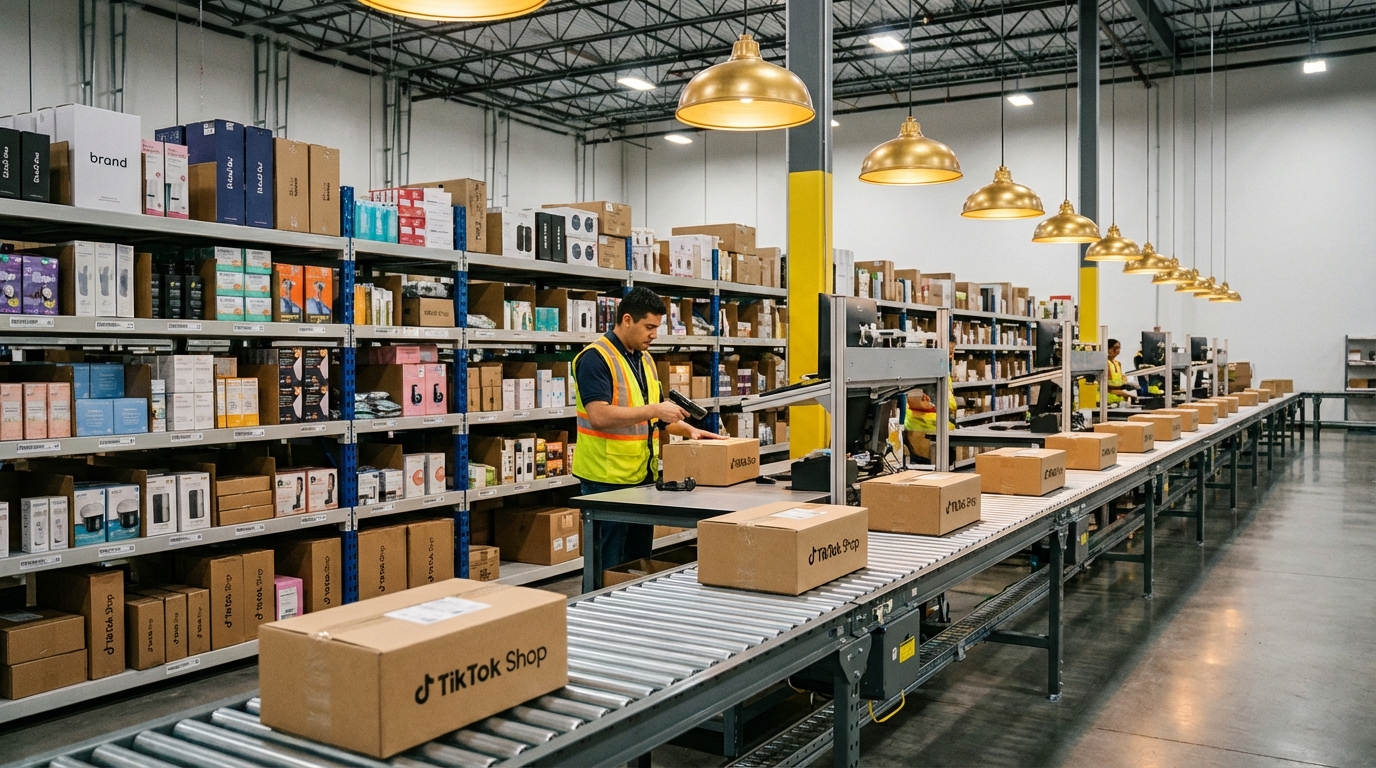
Early 2026 produced the most significant operational disruption in TikTok Shop’s US seller history. In January 2026, TikTok announced it would end independent seller-fulfilled shipping by February 25, requiring all US sellers to use centralized logistics options: Fulfilled by TikTok (FBT), Upgraded TikTok Shipping, or Collections by TikTok (CBT). The announcement immediately created widespread concern about cost increases, loss of carrier flexibility, and the incompatibility of TikTok’s mandatory USPS labels with Amazon Multi-Channel Fulfillment workflows.
The Policy Reversal and Its Implications
On February 17, 2026 — less than 30 days before the announced enforcement date — TikTok reversed the policy following substantial merchant backlash. Independent seller shipping was permitted to continue. The reversal was welcome, but it exposed a structural reality that every TikTok Shop seller needs to internalize: the platform’s fulfillment policies are subject to rapid, material changes with short notice windows.
This isn’t a reason to abandon TikTok Shop. It is a reason to build fulfillment operations with optionality — supply chain structures that can adapt to policy changes without requiring complete operational rebuilds. Sellers who had already invested exclusively in Fulfilled by TikTok workflows fared better than those scrambling to map entirely new logistics setups in a 30-day window. The lesson is that fulfillment flexibility, not optimization to a single method, is the appropriate goal in an environment where platform policies are still maturing.
Fulfilled by TikTok (FBT): The Tradeoffs
FBT’s core value proposition is convenience and algorithm favorability — TikTok’s own data suggests FBT-fulfilled products receive preferential visibility in some contexts, and the 48-hour maximum dispatch requirement (with same-day preferred) is most reliably met through centralized fulfillment. FBT per-unit costs average $3.50 to $4.70 for standard-size items, which is competitive with many regional 3PLs for sellers without the volume to negotiate favorable rates.
The tradeoffs are real. FBT eliminates carrier choice and the ability to use negotiated carrier rates for sellers with existing logistics relationships. For sellers running multi-channel operations — fulfilling both TikTok Shop and Amazon orders from shared inventory — the label conflict between FBT and Amazon MCF creates complexity that requires deliberate architectural decisions about inventory pooling.
Building a Resilient Fulfillment Stack
The most resilient fulfillment approaches for TikTok Shop sellers in 2026 share a common characteristic: they maintain US-based inventory (avoiding the delivery timeline risk of international dropshipping), they have at least two viable fulfillment pathways (so a policy change doesn’t create a single point of failure), and they size safety stock buffers to accommodate demand spikes that live commerce and viral content can generate without warning.
Viral demand spikes are particularly dangerous from a fulfillment standpoint because they’re asymmetric in timing — the demand arrives faster than any restocking cycle can respond. Sellers who pre-position inventory specifically for their top 3-5 hero products — the ones featured in live sessions, pushed through affiliate programs, and targeted by Shop Ads — protect themselves against the account health consequences of stockouts at the worst possible moment.
Customer Retention and the Repeat Purchase Infrastructure
One of the most significant data points in the TikTok Shop landscape is the repeat buyer rate: 89.7% of sales come from returning customers, who average 6.4 purchases per month and spend 73% more per transaction than first-time buyers. This statistic is striking enough to warrant scrutiny, but even if the precise figure varies by category, the directional reality is clear: the economics of TikTok Shop improve dramatically when brands invest in retention rather than treating every sale as a standalone acquisition.
Post-Purchase Sequences and Lifecycle Automation
Post-purchase engagement on TikTok Shop is an area where most sellers underinvest, leaving meaningful lifetime value on the table. The most effective lifecycle sequences follow a predictable structure: a 24-48 hour follow-up focused on product use confirmation and initial satisfaction, a 7-14 day check-in that encourages review generation and addresses any issues, and a 30-day replenishment reminder for consumable products timed to when first-time buyers are likely running low.
Review generation deserves specific attention. Products with 100+ reviews and ratings of 4.5 stars or higher are significantly more likely to be picked up by creators for affiliate content, perform better in algorithmic distribution, and convert at higher rates across all formats. The post-purchase sequence is one of the most direct ways to accelerate this review accumulation early in a product’s lifecycle.
Building Brand Identity Beyond the Algorithm
One of TikTok Shop’s structural vulnerabilities as a business foundation is its algorithmic dependency. A brand that lives entirely within TikTok’s discovery ecosystem has no control over what happens when the algorithm shifts, when the platform faces regulatory pressure (as it did repeatedly through 2024 and 2025), or when a competitor with a larger content budget crowds out organic reach.
Sellers who are building defensible businesses are using TikTok Shop as the revenue engine while simultaneously building assets that exist outside TikTok’s control: email lists captured through post-purchase flows, branded Shopify stores that collect direct traffic from brand-aware buyers, and social proof equity (reviews, case studies, before-and-after documentation) that transfers to other channels. These off-platform assets are not an alternative to TikTok Shop — they’re the hedge that makes TikTok Shop a sustainable foundation rather than a single point of dependency.
Loyalty Mechanics and Subscription Models
TikTok launched a Creator Loyalty Rewards program in Q4 2025 that has contributed measurably to platform repeat purchase rates. Sellers who integrate complementary loyalty mechanics — point systems, exclusive member pricing, early access to new products — see repeat purchase rates that substantially exceed platform averages. Loyalty program participants show a 50% repeat purchase rate compared to 10.7% for non-participants in available benchmark data.
For consumable product categories, subscription or auto-replenishment models represent the highest-value retention mechanic available. A beauty or supplement brand that converts 15-20% of its first-time buyers into monthly subscribers builds predictable recurring revenue that is structurally insulated from algorithmic volatility and creator attrition. The infrastructure required to build this on TikTok Shop is more limited than on owned DTC channels, which is another argument for maintaining a parallel Shopify presence.
Multi-Channel Integration: Building a Coherent Operating Architecture
The most common question sellers reach once TikTok Shop is working is whether — and how — to integrate it with existing Amazon and Shopify operations. The answer is almost always “yes, integrate,” but the mechanics of how to do it well are more nuanced than most integration guides suggest.
TikTok Shop and Shopify: The Natural Pairing
Shopify’s native TikTok sales channel enables two-way catalog, inventory, order, fulfillment, and refund synchronization. Products listed on Shopify can be mapped to TikTok Shop listings in minutes, inventory levels update in real time to prevent overselling, and order data flows back into Shopify’s reporting infrastructure. For sellers already running a Shopify store, this integration is the most operationally straightforward path to multi-channel management.
The integration also creates a meaningful customer data advantage. Shopify captures buyer information that TikTok’s in-app purchase flow does not pass to sellers. Running a parallel Shopify channel — even a secondary one that captures a fraction of total volume — gives sellers email and purchase history data they can use for segmentation, retargeting, and lifecycle automation outside TikTok’s ecosystem.
Amazon and TikTok Shop: The Shared Inventory Question
Running TikTok Shop alongside an active Amazon business raises the shared inventory question: can you fulfill TikTok Shop orders from the same inventory pool that serves Amazon? In principle, yes. In practice, the answer depends heavily on which fulfillment method each channel uses.
Amazon Multi-Channel Fulfillment (MCF) can fulfill TikTok Shop orders — apps like WebBee and AfterShip support this workflow — but the mandatory USPS label requirement that TikTok has periodically enforced conflicts with MCF’s labeling system. The February 2026 policy reversal temporarily resolved this conflict, but the underlying tension hasn’t been fully addressed. Sellers running this integration need to monitor fulfillment policy announcements as a standing operational priority.
TikTok also launched a “List with a URL” tool in early 2026 that allows sellers to paste Amazon product URLs into TikTok Shop and auto-populate listings with existing images, titles, descriptions, and category data. This significantly reduces the listing creation burden for sellers bringing an existing Amazon catalog to TikTok Shop, though pricing and inventory are still managed independently.
Inventory Architecture for Multi-Channel Sellers
The most operationally clean approach to multi-channel inventory is maintaining separate inventory buffers for each channel rather than a single shared pool. This sacrifices some efficiency but eliminates the risk of an Amazon stockout caused by a TikTok Shop demand spike, or vice versa. For high-velocity SKUs that perform strongly on both channels, purpose-built safety stock sized to each channel’s demand volatility is worth the carrying cost.
For lower-volume SKUs, a shared pool managed through real-time inventory sync tools is viable, provided the sync frequency is high enough to catch rapid depletion events. Inventory sync tools that update every 15-30 minutes are generally insufficient for products that can sell dozens of units in minutes during a live session. Near-real-time sync (1-5 minute intervals) is the practical requirement for sellers running live commerce at scale.
From Channel to Ecosystem: Building Something That Compounds
The framing that runs through every section of this guide is the distinction between using TikTok Shop as a channel and building a business that operates within TikTok’s ecosystem. That distinction matters more than any specific tactic or metric, because it determines what decisions get made at every stage of growth.
What Channel Thinking Produces
Sellers who approach TikTok Shop as a channel tend to optimize for the metrics immediately in front of them: video views, affiliate activation counts, daily sales. These are important indicators, but optimizing for them in isolation produces a business that is entirely platform-dependent — one that owns no customer relationships, has no inventory positioning for demand volatility, runs no post-purchase infrastructure, and has no assets that would retain value if TikTok’s algorithm, policy environment, or competitive landscape shifted materially.
Channel-thinking sellers are also the most likely to be blindsided by account health deterioration. Because they’re focused on growth metrics rather than operational fundamentals, the first indication they have of a compliance issue is often a significant point deduction — at a moment when they’re already under the threshold that triggers restrictions.
What Ecosystem Thinking Produces
Sellers who think in terms of ecosystem build differently from the start. They invest in post-purchase infrastructure before they feel the need for it. They maintain account health scores as a standard weekly metric rather than an emergency-response indicator. They build affiliate networks with enough depth that losing two or three creators doesn’t materially impact revenue. They maintain Shopify operations that capture brand equity and customer data outside TikTok’s control. They size inventory to absorb viral demand, not just to meet average weekly velocity.
The result is a business that compounds rather than one that cycles through growth and disruption. Each cohort of customers generates repeat purchases. Each affiliate relationship strengthens over time. Each live session produces repurposable content that funds the next. The 89.7% repeat buyer rate that represents a platform-wide benchmark becomes a business-level reality rather than an industry average that doesn’t apply to any specific seller.
Actionable Takeaways for Sellers at Every Stage
- If you’re in the first 30 days: Focus entirely on organic content quality and catalog optimization. Get your top 50-100 high-velocity SKUs listed with complete, keyword-rich content before activating any paid channels. Establish your account health monitoring routine from week one.
- If you’re at 30-60 days: Begin structured creator affiliate outreach, targeting category-engaged micro-creators. Build your tiered commission structure before you need it. Ensure your fulfillment operation can sustain 80%+ OTDR at 2x your current order volume.
- If you’re past 60 days: Introduce Shop Ads only on products with demonstrated organic conversion. Set a hard ROAS floor (2.5x minimum) below which you pause spend. Launch live commerce sessions at least twice per week and track conversion rates by session to build institutional knowledge.
- At every stage: Build post-purchase sequences, monitor account health weekly, maintain US-based inventory buffers, and invest in at least one off-platform asset (email list, Shopify store) that retains value independent of TikTok’s platform decisions.
TikTok Shop’s $33.8 billion GMV and 117% year-over-year growth through 2026 represent a genuine market opportunity. The sellers who convert that opportunity into durable, profitable businesses are the ones who understand not just how to get started, but how the platform’s economics, risk systems, and growth mechanics actually work — and who build their operations around that understanding from day one.
The brands that will look back on 2026 as the year they built something lasting are the ones treating TikTok Shop as an ecosystem that rewards operational discipline — not just a channel that rewards early mover advantage.