



The GMV Number Is Not the Number That Matters
Every TikTok Shop seller knows the dopamine hit: a creator posts, the video takes off, and the orders roll in. The Seller Center dashboard lights up with green numbers. GMV is climbing. Sales are moving. Life is good.
Then the settlement lands in your account and it’s a fraction of what you expected.
This is the moment most sellers realize that TikTok Shop has a cost structure that the platform’s marketing doesn’t lead with — and that affiliate commissions sit at the center of it. By mid-2026, that cost structure has become materially more complicated. Platform-level commission cap cuts took effect in June 2026 with no meaningful transition window. Category-by-category benchmarks have shifted. Creator behavior is responding. And sellers who built their pricing around the economics of 18 months ago are now routinely selling their way into losses.
This article is about the margin math — specifically, how to build a unit economics model that tells you exactly how much of every dollar a TikTok Shop sale actually produces, what commission rate you can afford to offer creators without going underwater, and how to structure your affiliate program so that growth in GMV actually correlates with growth in profit. There is no single “right” commission rate. There is only the rate that works for your specific product, your specific cost stack, and your specific creator mix.
Let’s build that number from the ground up.
The Full Cost Stack: What Comes Out Before You See a Cent
The first step in any honest TikTok Shop margin analysis is listing every deduction that happens before net profit. Most sellers can name two or three. The complete list is longer — and the interaction between items is where the real damage happens.
The Platform Referral Fee
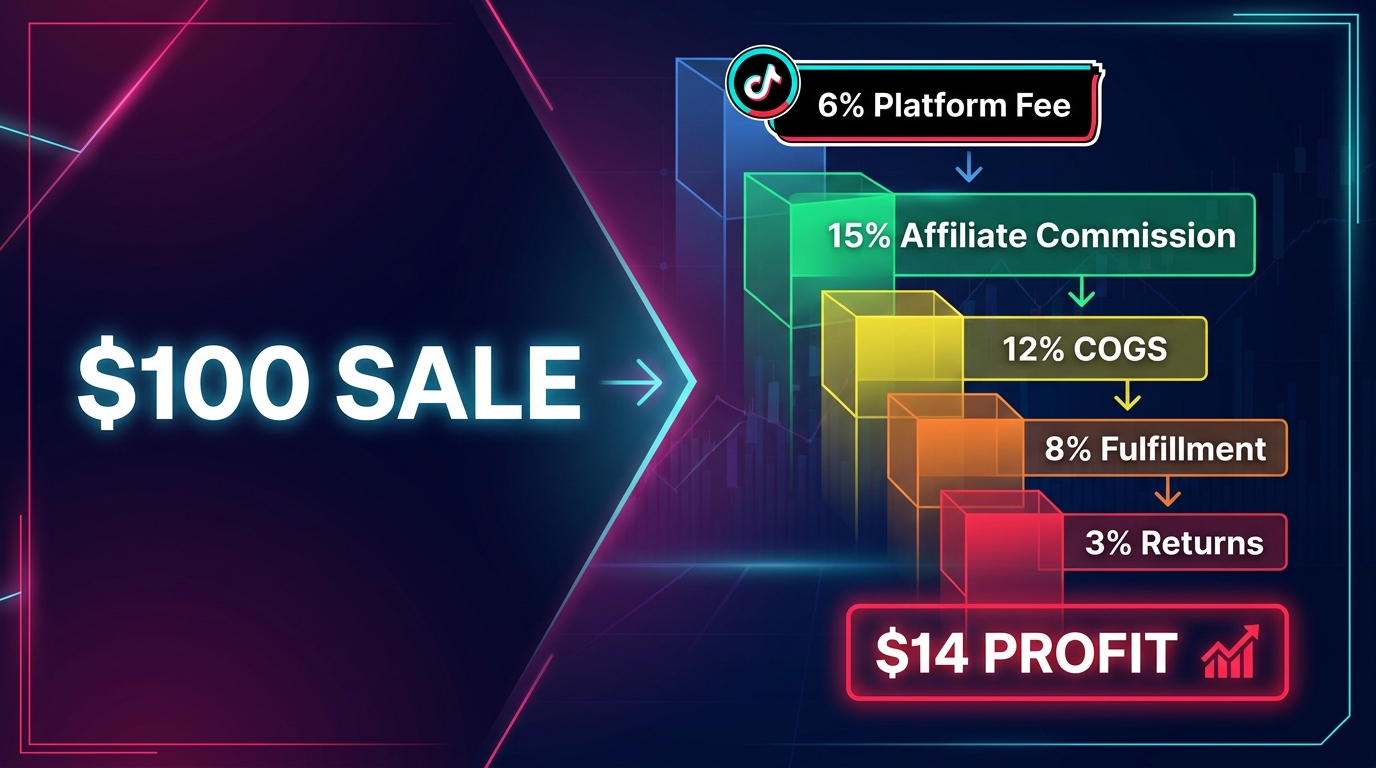
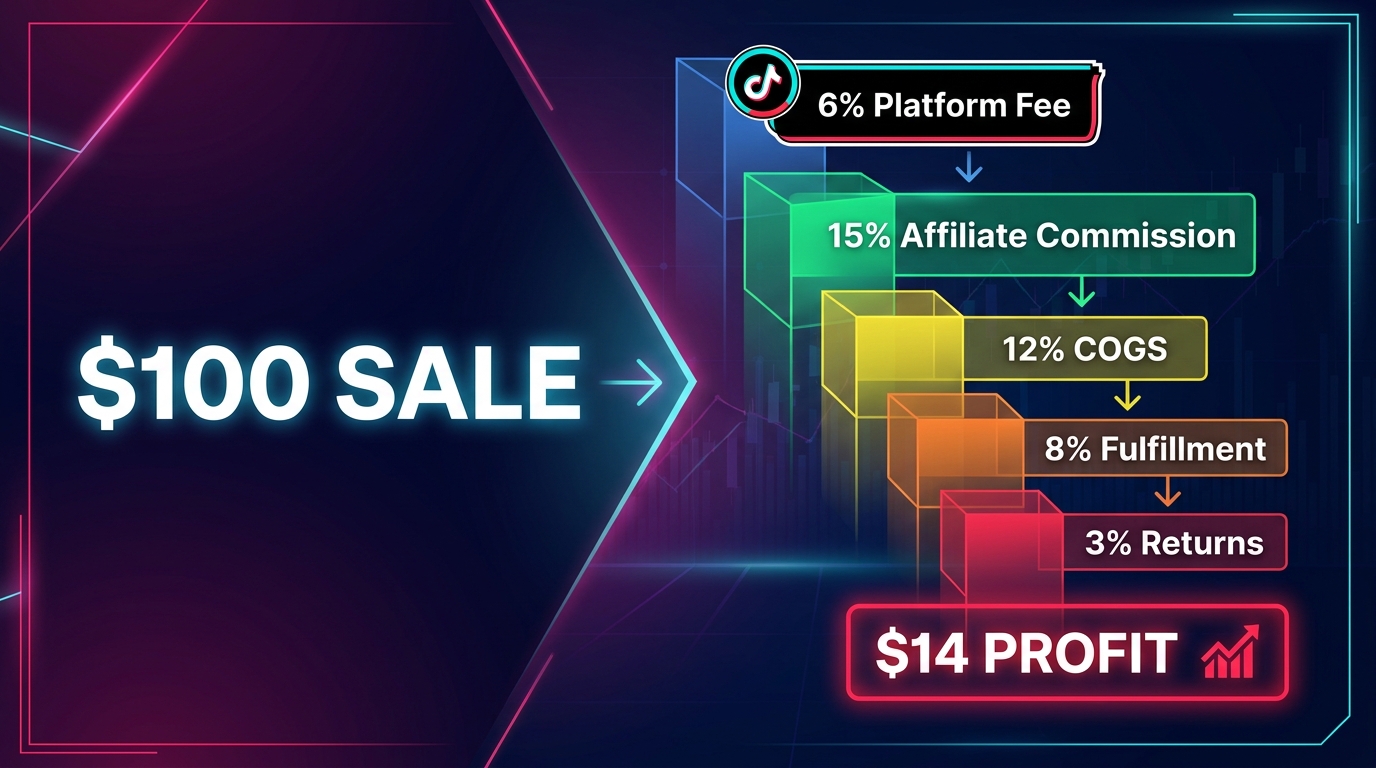
TikTok Shop charges sellers a referral fee on every completed transaction. In the US market as of 2026, the standard rate is 6% of the order value for most product categories. Some jewelry and pre-owned categories carry a lower rate of around 5%, and certain promotional windows for new sellers may apply rates as low as 3% for a limited period. Critically, TikTok’s US fee structure appears to include payment processing within this referral fee rather than stacking it separately — though third-party accounting tools occasionally model an additional processing charge, so it’s worth confirming your specific category treatment in Seller Center.
At 6%, this fee is lower than Amazon’s average referral fee and lower than most traditional marketplace take-rates. That’s part of TikTok Shop’s pitch to sellers. But it’s also the foundation upon which all other costs are layered, and those additional costs are where things get steep.
Affiliate Commission
This is the largest variable in your unit economics and the one with the widest range. Sellers can technically set affiliate commissions anywhere from 1% to 80% of order value, though no competitively viable program operates at either extreme. The US market average across all categories sits at approximately 13.02%, but that average masks significant variance by category, creator tier, and collaboration type.
The commission is calculated on actual revenue after refunds — meaning returns reduce the commission payout, but don’t eliminate other costs you’ve already incurred on the transaction. This matters more than most sellers realize. A 10% return rate on a 15% commission product creates a return cost that’s partially but not fully offset by the reduced commission on returned units.
Cost of Goods Sold (COGS)
COGS is the starting constraint that most sellers know well. But on TikTok Shop, where pricing pressure can be intense and creators sometimes drive traffic to discounted products, it’s worth modeling COGS not just as a fixed number but as a percentage of the actual selling price — which may be lower than your list price after any promotional pricing or creator-specific discount codes.
Fulfillment and Shipping
Unless you’re using TikTok’s own fulfillment service, this is an entirely separate cost layer. Standard fulfillment for lightweight consumer goods typically runs 6–10% of order value for US domestic shipping at typical TikTok Shop price points. For heavier products or those sold at lower price points, fulfillment as a percentage of revenue can spike well above 10%.
Returns and Dispute Reserves
TikTok Shop ties affiliate commission payout timing to order settlement and dispute resolution, which means sellers need to hold a reserve for return-related costs. Realistic return rates vary by category — beauty and apparel tend to run higher — and a 5–8% returns reserve is not conservative for most categories.
Advertising and Sampling Spend
Many sellers provide product samples to creators before any content goes live. This isn’t a platform fee, but it’s a real cost that should be allocated to affiliate-driven revenue. If you send 20 units to creators at $15 COGS each and only 10 of them post converting content, that $300 in sampling cost needs to be amortized against your affiliate-channel revenue. At $1,000 in affiliate GMV, that’s a 30% additional hidden cost before commissions even start.
The Compounding Effect
Here is what the full stack looks like on a simple $50 product with typical cost assumptions:
- Selling price: $50.00
- COGS (38%): −$19.00
- Platform referral fee (6%): −$3.00
- Affiliate commission (15%): −$7.50
- Fulfillment/shipping (8%): −$4.00
- Returns reserve (4%): −$2.00
- Net contribution per unit: $14.50 (29% margin)
That 29% contribution margin is before any overhead, advertising, or sampling costs. If the product’s COGS is slightly higher, or if the commission rate moves from 15% to 20%, that contribution drops to $12.00 — a 17% margin. Add any meaningful sampling or overhead allocation and you’re in single digits.
The math isn’t catastrophic for a well-priced, high-margin product. For anything with COGS above 50%, the math gets punishing very fast.
Category-by-Category Commission Benchmarks: What the Market Actually Pays
Setting your affiliate commission rate without knowing what’s competitive in your category is one of the most common and costly mistakes on TikTok Shop. Set it too low and creators won’t promote your product — they’ll move to a competitor offering better economics. Set it too high and you’re bleeding margin that doesn’t need to be spent. The target is the lowest rate that still attracts the creator quality and posting volume your product needs to perform.
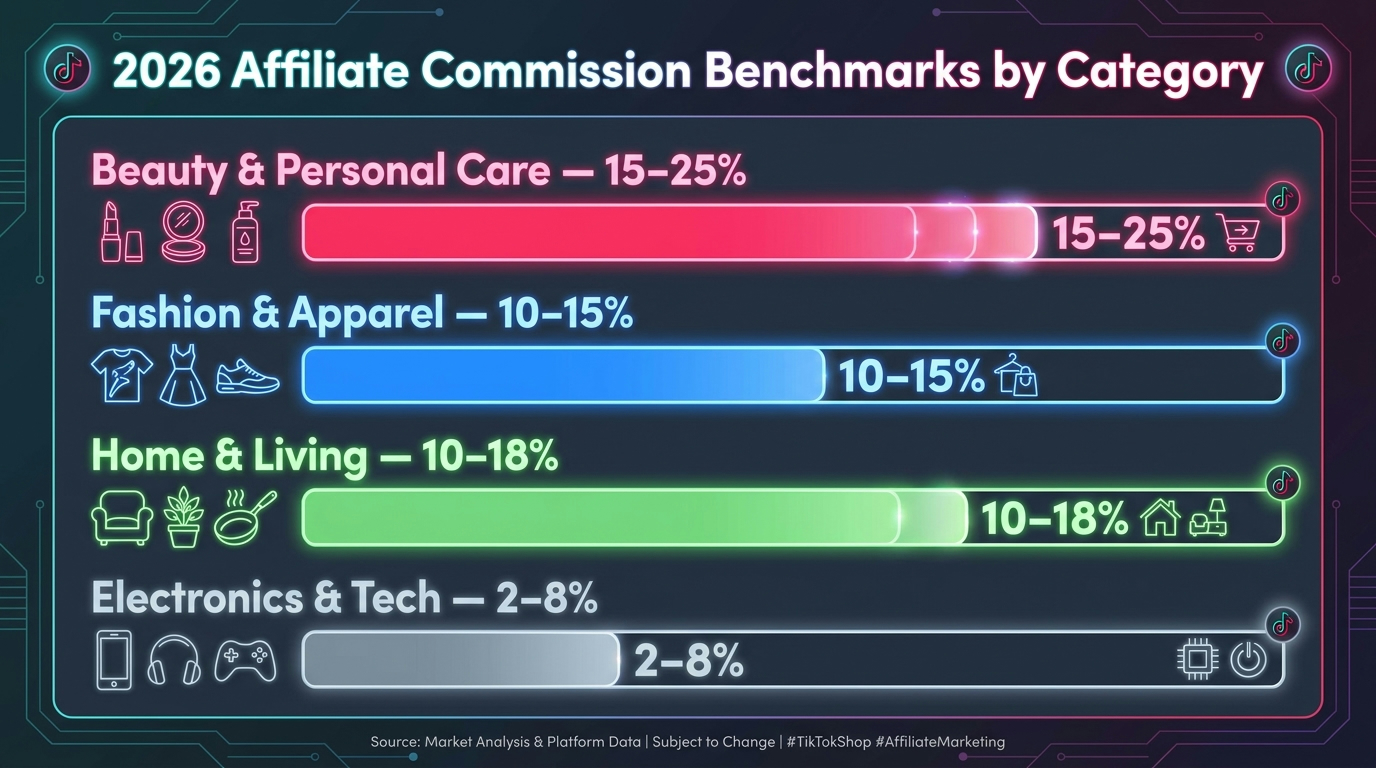
Beauty and Personal Care: 15–25% (with High-Tier Outliers)
Beauty is TikTok Shop’s highest-volume category and also its most creator-competitive. Standard open-plan commissions typically need to be at least 15% to appear in creator feeds at a credible volume, with most serious programs running 18–22%. For targeted collaborations with creators who have demonstrated conversion in the category — typically those with 100K+ engaged followers and existing beauty content — rates of 25–30% are not unusual as invitation-based offers.
The reason beauty tolerates these rates is gross margin. Beauty products with strong branding often carry COGS in the 20–35% range, giving sellers the structural room to offer higher commissions. The risk is that beauty also has higher return rates than most categories, so the returns reserve needs to be modeled conservatively.
Fashion and Apparel: 10–15%
Fashion sits in the mid-range on commission, but it’s a category where the math is often more deceptive than it appears. Fast-fashion products with thin gross margins (COGS at 50%+) struggle to support even 12% commissions after platform fees and fulfillment. Higher-margin fashion items — accessory lines, branded apparel, specialty footwear — have more room to work with. The category also has some of the highest return rates on the platform, which erodes net revenue on a completed-sale basis.
Most competitive fashion programs in the US market run open-plan rates of 10–12% and reserve targeted collaboration budgets for 15–18% offers to proven fashion creators.
Home and Living: 10–18%
Home is a broad category with significant sub-category variance. Kitchen gadgets and trending home accessories — the TikTok-viral segment — often command commissions in the 15–18% range because the content format works so well on the platform and conversion rates can be high. Furniture and larger-ticket home items typically run lower rates (8–12%) because the product margin is thinner relative to shipping and fulfillment costs at higher price points.
Home also benefits from a relatively lower return rate than beauty and fashion, which means the effective commission cost per retained sale is closer to the nominal rate.
Electronics and Tech: 2–8%
Electronics is the category where TikTok Shop affiliate economics are most constrained. Manufacturing costs are high, price competition is intense, and typical product margins simply don’t support double-digit creator commissions. Most sellers in this category structure their affiliate programs at 3–6% for open plans, with only flagship or high-margin accessory products going to 8%.
The consequence is lower creator participation. Electronics content does perform on TikTok, but not through the affiliate channel at the volume seen in beauty or home — which is why many electronics sellers on TikTok Shop are more reliant on paid traffic than affiliate-driven organic discovery.
The June 2026 Cap Cuts: What Actually Changed
On June 22, 2026, TikTok Shop implemented commission cap reductions across several high-volume categories with no meaningful advance notice to creators already running promotions. The most impactful changes hit beauty, personal care, supplements, and home — the categories where creator-driven affiliate volume was highest.
Reported changes saw commission ceilings fall from approximately 20% to 10–15% in affected categories. Subsequent updates in late July 2026 pushed default floors lower in some non-beauty categories as well. The practical effect on creators who were running active promotions at the higher rates was significant: earnings per sale dropped materially, mid-campaign.
What the 30-Day Protection Rule Actually Does
TikTok Shop’s seller policy includes a 30-day protection rule for existing creators when commission rates are lowered. The mechanics work as follows: if a seller reduces the commission rate on a product that a creator is already actively promoting, that creator retains the old, higher rate for 30 days. TikTok Seller University documentation also indicates that creators receive a two-day notice before the 30-day protection window expires.
Critically, rate increases apply immediately with no delay. This asymmetry is designed to protect creators from sudden income drops on their existing promotional content, but it has a meaningful implication for sellers: you cannot immediately “reset” commission costs downward for creators who are already in your ecosystem. You need to plan rate changes with at least a 30-day runway for cost modelling purposes.
The No-Transition-Window Problem
The June 2026 cap reductions were platform-imposed, not seller-initiated — which creates an ambiguity around the protection rule. While the 30-day rule clearly applies when sellers lower their own rates, the application of that protection to platform-level cap changes has been less clear. Multiple seller accounts have reported that the June cuts were effectively immediate for open-plan programs, with creators in protected windows under the old seller-set rates still subject to the new category ceilings.
This distinction matters for how you structure your affiliate agreements going forward. Targeted collaborations — where rates are negotiated directly — appear to have more stability than open-plan rates subject to category caps. Sellers who have shifted their best creator relationships into targeted collaboration structures have reported more predictable commission costs through the 2026 changes.
Open Plan vs. Targeted Collaboration: The Structural Commission Difference
TikTok Shop’s affiliate structure isn’t a single lever — it’s two distinct systems operating simultaneously, and understanding the difference between them is essential for managing your commission costs with any precision.
Open Collaboration: The Public Pool
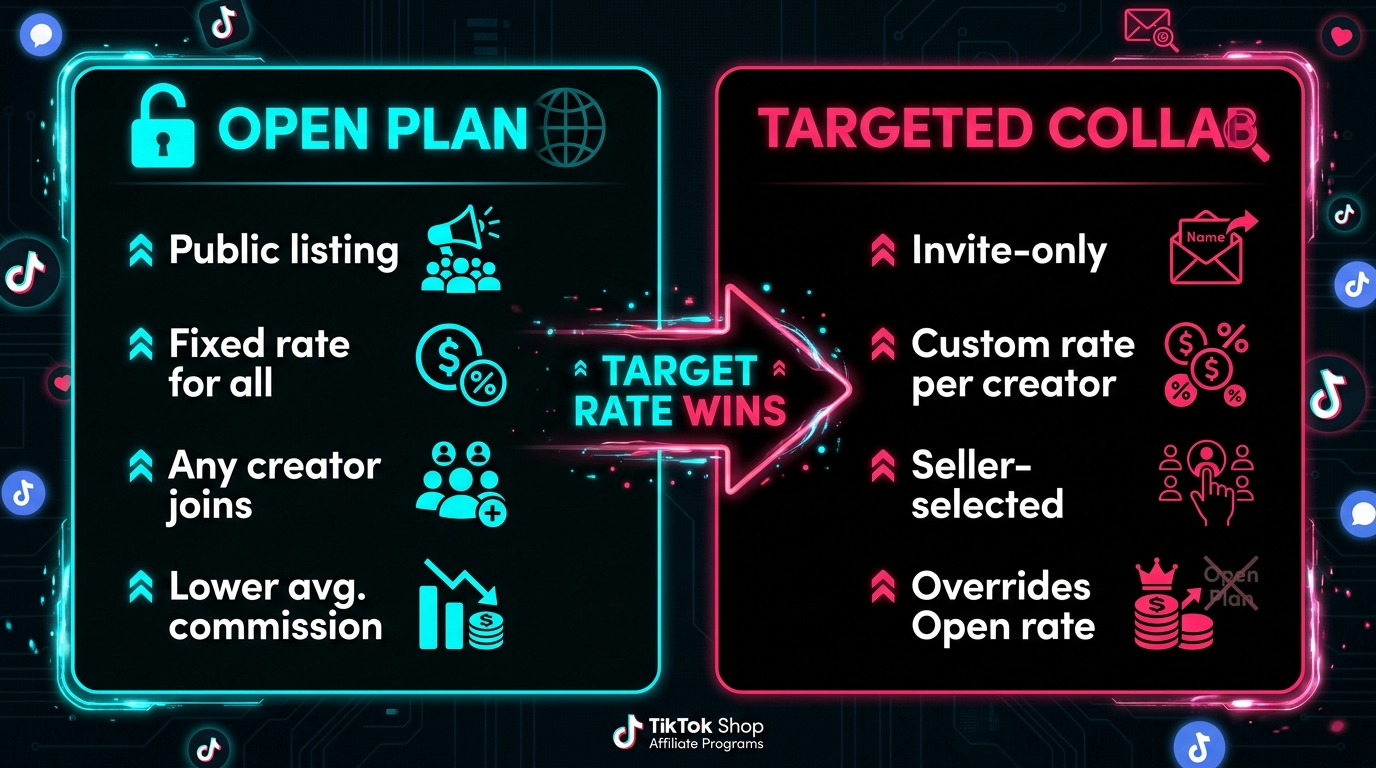
Open Collaboration is the self-serve, public-facing affiliate layer. When you create an open plan, you set a single commission rate that applies to any eligible creator who chooses to promote your product. Your listing appears in the creator marketplace, and creators can pick up your product without any direct contact with you as a seller.
This is the most common entry point for brands new to TikTok Shop affiliate marketing, and it scales well in terms of creator reach. The trade-off is control: you’re offering the same rate to every creator regardless of their audience size, content quality, or conversion history. A creator with 500 followers gets the same percentage as one with 2 million. The rate you set is also fully visible to all creators in the marketplace, which creates competitive pressure to offer rates that look attractive relative to comparable products.
Open Collaboration commissions are subject to category caps, which is why the June 2026 changes hit this channel hardest. If TikTok lowers the cap below your current open rate, your program automatically reprices.
Targeted Collaboration: The Invite-Only Layer
Targeted Collaboration is the invite-only channel. You identify specific creators you want to work with and send them personalized collaboration requests with a custom commission rate set for that creator-product pairing. The targeted rate overrides the open-plan rate — if a creator you’ve invited is also eligible for your open-plan commission, they receive only the targeted rate, not both.
This structure gives you the ability to pay higher commissions to high-performing creators without raising your open-plan rate for everyone. A beauty seller might run an open-plan rate at 12% while offering a specific macro-creator with a proven conversion history 25% through a targeted deal. The blended commission cost across all affiliate-driven sales stays lower than if the 25% rate were applied universally.
Targeted Collaboration is also where the most durable creator relationships are built. Direct negotiation, clear expectations, and custom rates create a collaborative dynamic that open-plan economics — which feel transactional by design — can’t replicate.
The Strategic Interplay
The most effective TikTok Shop affiliate structures use both channels in deliberate combination. Open Collaboration provides broad discovery and a steady pipeline of new creator relationships. Targeted Collaboration is used to lock in the creators who actually drive meaningful conversion volume. The commission cost of each channel is tracked separately, and the blended rate across both channels is what gets modeled against your unit economics.
A useful discipline: calculate your blended affiliate commission rate monthly. Divide total commissions paid by total affiliate-driven GMV. If that rate is creeping above your ceiling (which we’ll calculate in the next section), the issue is usually that your open-plan rate is too high or that you’re not moving enough volume through targeted deals to bring the blend down.
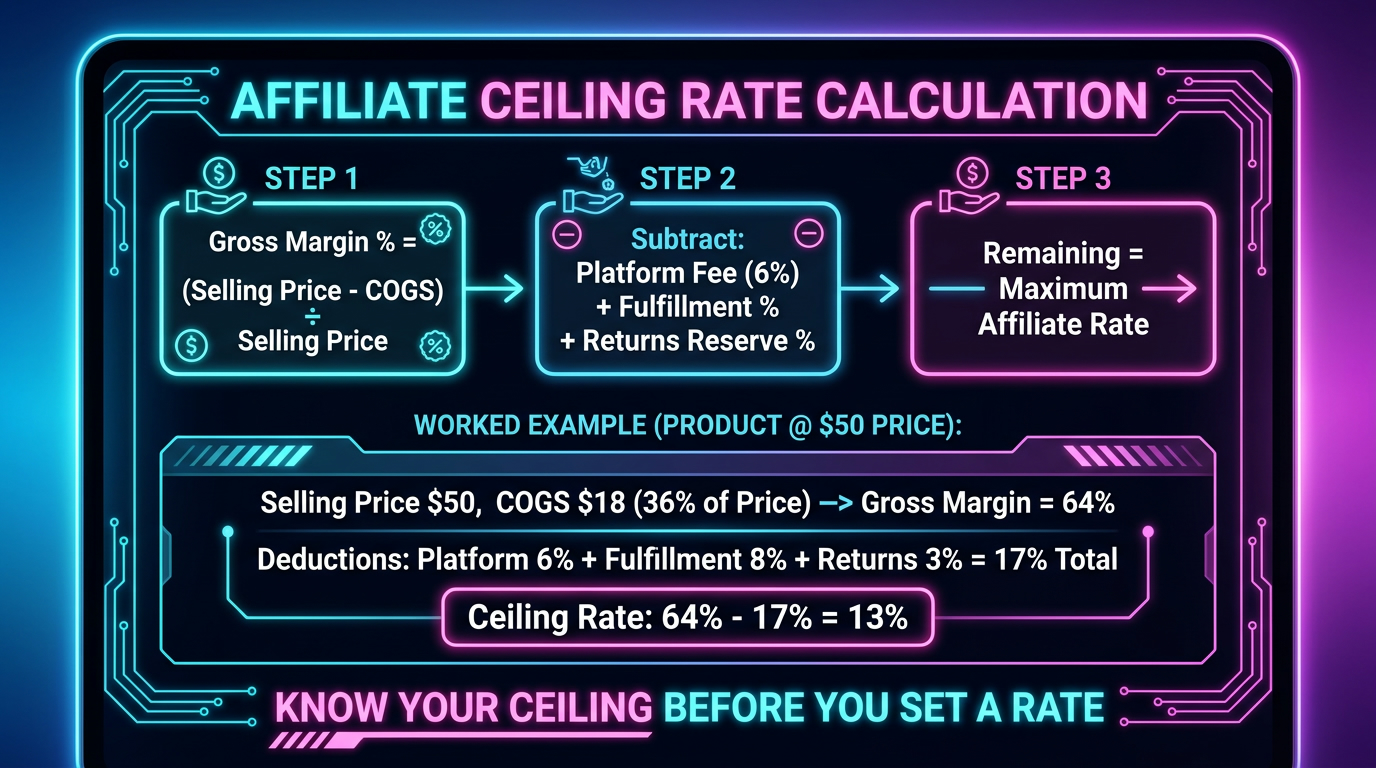
Calculating Your Affiliate Ceiling Rate: The Backward Math Method
Most sellers approach commission-setting from the wrong direction. They look at what competitors are offering, or what creators are asking for, and try to match it. That approach optimizes for creator satisfaction, not for business viability. The correct starting point is your product’s unit economics — specifically, the maximum commission rate you can offer while still hitting your target contribution margin.
This is the affiliate ceiling rate, and it’s a product-specific calculation, not a category average.
Step 1: Establish Your Gross Margin
Gross margin is your selling price minus COGS, expressed as a percentage of selling price.
Gross Margin % = (Selling Price − COGS) ÷ Selling Price × 100
For a product selling at $45 with COGS of $16, that’s ($45 − $16) ÷ $45 × 100 = 64.4% gross margin.
Step 2: Deduct Fixed Platform and Operational Costs
From your gross margin percentage, subtract the costs that apply to every sale regardless of whether an affiliate is involved:
- Platform referral fee: 6% (standard US)
- Fulfillment and shipping: typically 6–10% depending on product weight and price point
- Returns reserve: 3–6% depending on category return rates
- Overhead allocation: seller-specific, often 3–8% for small-to-mid sellers
Using conservative estimates: 6% + 8% + 4% + 5% = 23% in non-commission deductions.
Step 3: Define Your Target Contribution Margin
Before paying any affiliate commission, what’s the minimum net contribution margin you need to make this product viable as a SKU? For most brands, a contribution margin floor of 10–15% is the minimum that makes sense after overhead allocation. Some categories can tolerate less; most cannot.
Let’s say your target is 12% contribution margin.
Step 4: Calculate the Ceiling
Affiliate Ceiling Rate = Gross Margin % − Fixed Cost % − Target Contribution Margin %
64.4% − 23% − 12% = 29.4% maximum affiliate commission.
That’s the theoretical ceiling. In practice, you’d target rates at least 5–8 percentage points below the ceiling to build in a buffer for cost fluctuations and return rate variance.
Why This Matters More After the Cap Cuts
Before the June 2026 cap reductions, sellers in beauty and supplements could sometimes offer 20–25% commissions and still make the numbers work because gross margins in those categories are often 65–75%. After the cap cuts, the conversation changed not because sellers couldn’t support high commissions mathematically, but because the platform changed what rates were permissible. For sellers with strong margin, the cuts reduced their competitive differentiation — they could no longer offer the 25% targeted rates that would attract top creators. For sellers with weaker margin who were previously forced to offer 18–20% to compete and were operating near their ceiling, the cuts actually provided some relief.
The ceiling calculation helps you understand which scenario you’re in before any external change occurs.
Affiliate vs. Paid Ads: The Real Cost-Per-Sale Comparison
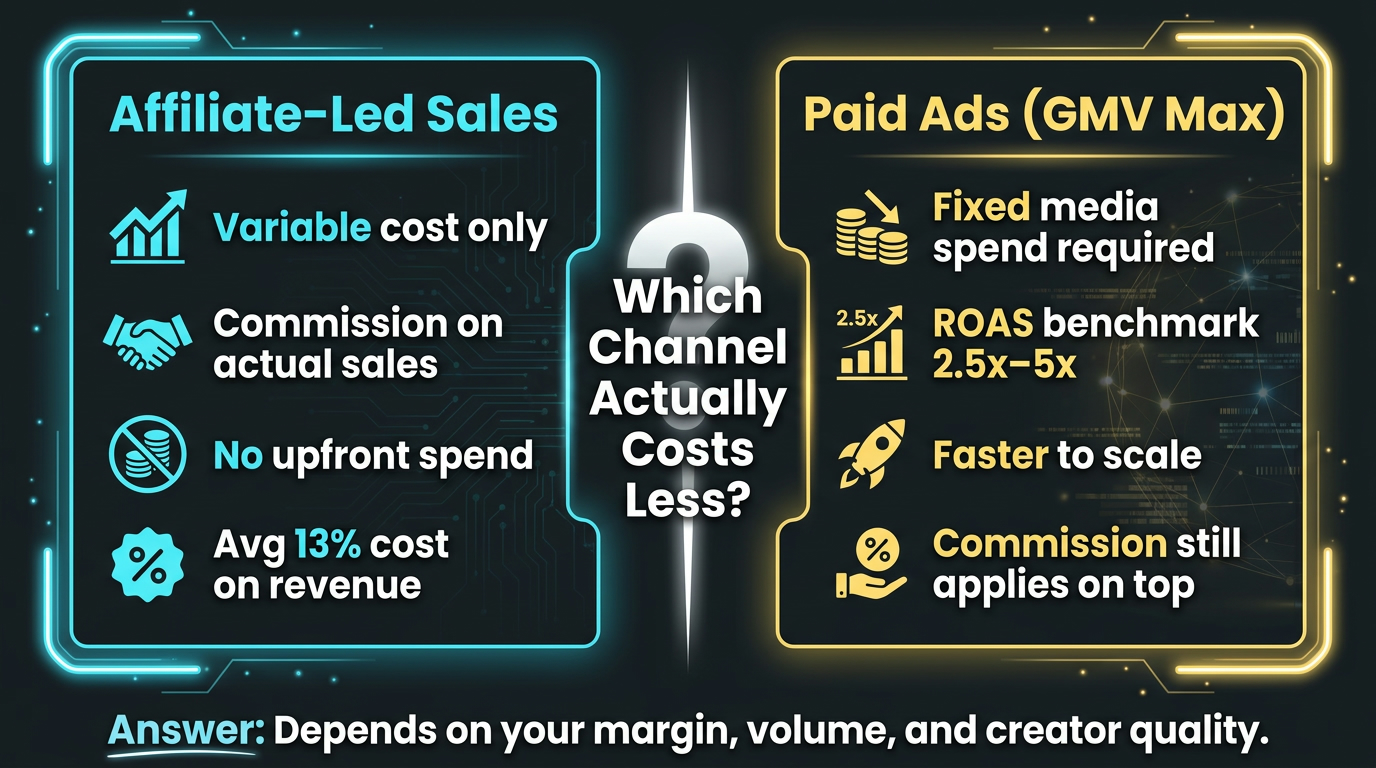
One of the most common questions among TikTok Shop sellers is whether affiliate-driven traffic is actually cheaper than paid advertising — and whether the two are even comparable. The answer is more nuanced than most comparison guides suggest, and it depends heavily on your margin profile, product price point, and current stage of growth.
The Case for Affiliate Economics
On a pure variable-cost basis, affiliate marketing wins the cost efficiency argument for most established products. You pay only when a sale is made. There is no media spend going out the door when a creator posts content that doesn’t convert. The commission is a clean percentage of revenue already earned, not a pre-paid bet on whether traffic will produce sales.
At the US average commission of approximately 13%, a seller is effectively paying $13 in creator cost for every $100 in revenue. That’s a customer acquisition cost that most paid advertising channels struggle to match at meaningful scale, particularly for DTC brands in competitive categories.
The added benefit is content creation value. Every piece of creator content that performs generates organic reach that continues delivering impressions beyond the initial post window. Unlike a paid ad that stops running when the budget stops, a high-performing creator video may generate sales weeks or months after the initial promotional period — with no incremental commission cost during that organic tail.
The Case for Paid Ads
TikTok Shop’s primary paid format in 2026 is GMV Max, which has become the default new campaign structure. GMV Max automates targeting and bid optimization toward sales, and experienced sellers report ROAS benchmarks ranging from 2.5x to 5x for established products, with top performers in beauty and health reporting 6x to 12x ROAS in best-case scenarios.
At a 3x ROAS, the effective media cost is approximately 33% of revenue — significantly higher than the affiliate commission on most products. But paid ads offer something affiliate traffic cannot: control and speed. You can dial a campaign up or down within hours. You can target specific demographics, geographies, and interest clusters. You can test creative systematically. And you get results in days rather than the weeks it can take to recruit, onboard, and activate a meaningful affiliate creator base.
Paid ads also don’t require you to share your product with creators before you’ve validated it. A new product launch tested via paid ads produces conversion data that can then be used to brief creators more effectively once the affiliate program launches.
The Important Caveat: They’re Not Mutually Exclusive
Here is where most comparisons mislead: many TikTok Shop paid ad campaigns use affiliate-created content as their ad creative. When you boost a creator’s video through Shop Ads, you’re often paying both the media cost and the affiliate commission on any resulting sales. The combined cost can be 25–35% of revenue on converted paid traffic, which is well above the pure affiliate model but may still be viable if the creative is high-converting.
The sharpest sellers are modeling blended MER (media efficiency ratio) — total marketing cost (affiliate commissions plus ad spend) divided by total revenue — rather than comparing channels in isolation. A blended MER of 20–25% is generally considered healthy for TikTok Shop brands in most categories, though margin constraints vary by product.
Which Channel Should Dominate at Each Stage?
Early-stage products (under $50K monthly GMV) typically benefit from leaning on affiliate first. The capital efficiency of commission-only acquisition is critical when cash flow is limited, and organic creator content builds the social proof that makes paid ads more effective later. As the product establishes market velocity and conversion rate data accumulates, paid ads become more valuable as a scaling tool — amplifying what’s already working rather than discovering what works.
What Commission Compression Means for Creator Behavior
When commission rates decline, creators don’t simply accept less money for the same effort. They make rational economic decisions — and understanding those decisions is important for sellers trying to maintain their affiliate program quality through a period of compression.
Category Migration
Creators with audiences that span multiple categories will shift their promotional focus toward the products that earn them the most per sale. A lifestyle creator who promotes both beauty and home goods will naturally shift toward whichever category offers better commission economics. After the June 2026 cuts, some beauty-adjacent creators began promoting supplements and wellness products from brands offering competitive rates outside the newly capped categories.
For sellers in compressed categories, this represents a real supply problem: the pool of actively motivated creators promoting your category shrinks, which increases competition for the creators who remain. Counter-intuitively, the commission cuts may have made it harder, not easier, to attract talent in the short term.
A Shift Toward Higher-Value Products
When commission rates are flat or declining, creators have an incentive to promote higher-priced products — because the same percentage yields more dollars per sale on a $90 item than on a $25 item. This dynamic is reshaping which products get natural creator attention on TikTok Shop. Mid-priced products ($30–$60) are increasingly overlooked in categories where creators can earn similar commission rates on higher-ticket items with similar promotional effort.
For sellers of mid-priced products in commission-compressed categories, this creates pressure to either raise prices (to increase the absolute dollar commission per sale), raise commission rates (if margin allows), or shift to targeted deals where you can structure more attractive terms without raising your open-plan ceiling.
The Quality Signal Effect
As commission rates compress, creators become more selective about which products they promote — and product quality becomes a stronger differentiator. A 12% commission on a product with strong reviews, clear visual appeal, and high conversion rates is more attractive to an experienced creator than a 15% commission on a product with mediocre reviews and weak product content. The economics of creator time mean that conversion rate matters as much as commission rate when creators are choosing what to promote.
This is actually a healthy pressure for the platform overall. It incentivizes sellers to invest in product quality, listing content, and review programs — not just commission rate competition.
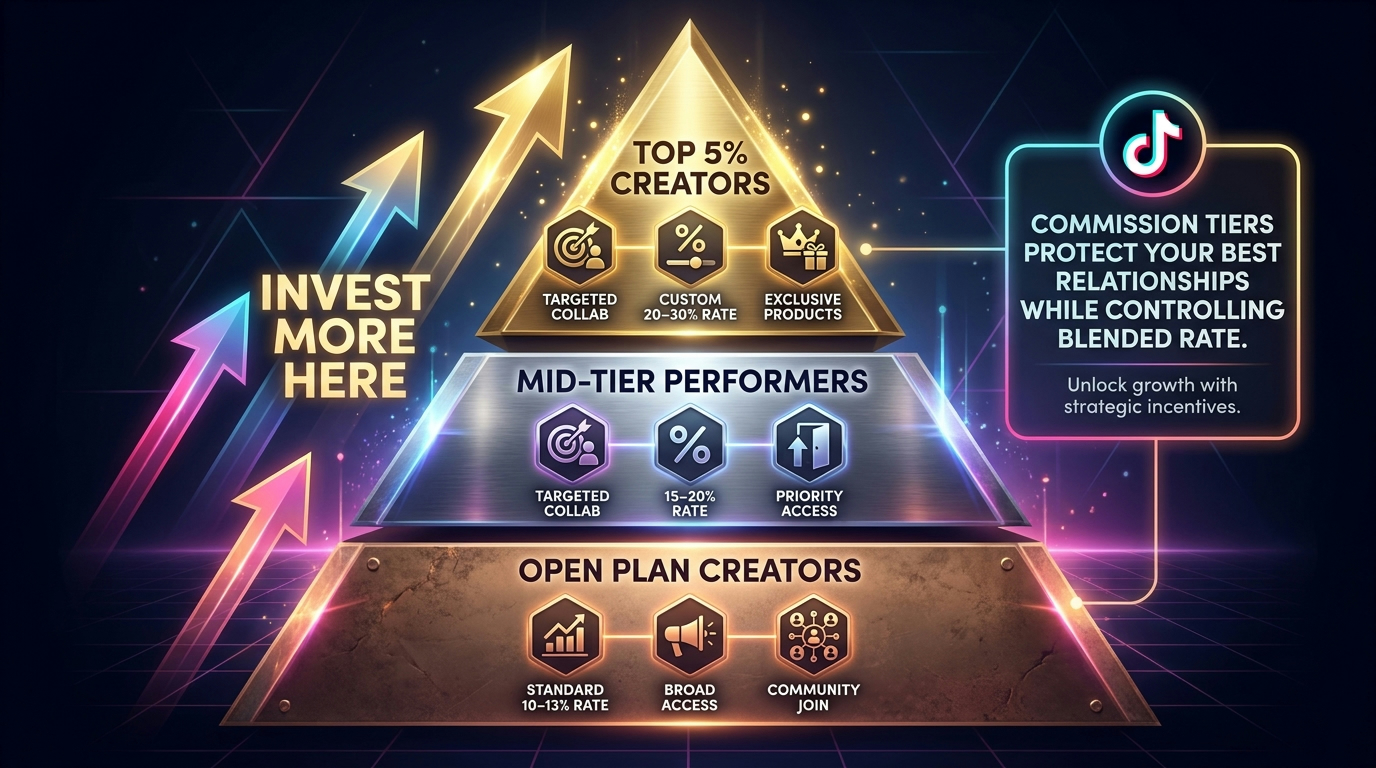
Tiered Commission Architecture: Protecting Margin Without Losing Your Best Creators
The most effective response to a period of commission compression isn’t to cut rates across the board — that destroys creator relationships and can tank GMV before the savings ever materialize. The better approach is to build a tiered commission architecture that concentrates spending on the creators who actually produce results, while pulling back on the wide-base open-plan costs that generate marginal return.
Tier 1: Open Plan (The Discovery Layer)
The open-plan rate should be set at the floor of competitiveness for your category — not the maximum you can afford, but the minimum that makes your product visible and attractive to creators browsing the marketplace. In most categories post-June 2026, this means:
- Beauty: 12–15% open rate
- Fashion: 8–12% open rate
- Home: 10–13% open rate
- Electronics: 3–6% open rate
The open plan is your creator recruitment funnel. You’re not trying to maximize earnings per creator at this tier — you’re trying to generate a flow of content that lets you identify which creators actually convert. Treat the open plan as auditions, not partnerships.
Tier 2: Targeted Mid-Tier (The Performance Layer)
Creators who generate meaningful affiliate-driven sales (even a handful of orders) from your open plan should be identified and moved into targeted collaboration deals with higher custom rates. This is your performance layer. These creators have demonstrated that their audience is responsive to your product — that signal is worth paying for.
Targeted rates for mid-tier performers typically run 3–8 percentage points above your open-plan rate, depending on category and creator volume. The key metric to optimize here is earnings per GMV dollar generated — you’re looking for creators whose conversion rate justifies the higher rate, not just those who post frequently.
Tier 3: Targeted Top-Tier (The Partner Layer)
Your highest-converting creators — those consistently driving significant sales volume — should be treated as genuine business partners, not just commission earners. At this tier, you have room to offer your maximum viable rate (approaching but not exceeding your ceiling calculation), provide early product access, co-develop content briefs, and structure multi-product collaboration arrangements.
The goal at the top tier is retention and exclusivity. A creator who drives $30,000 per month in GMV for your brand is worth a significantly higher commission rate than a creator driving $1,000 — not just because of the volume, but because losing that relationship has an outsized negative impact on your revenue.
Tracking Blended Commission Rate by Tier
With a tiered structure in place, you can track your blended commission rate with precision. A typical well-managed TikTok Shop affiliate program might have:
- 60% of GMV through the open plan at 12% commission
- 30% of GMV through mid-tier targeted deals at 17% commission
- 10% of GMV through top-tier partner deals at 22% commission
- Blended commission rate: approximately 13.9%
That blended rate is what gets modeled in your unit economics. It’s also the number you use to evaluate whether changes in your tier distribution (more top-tier volume, fewer open-plan sales) are improving or degrading your overall margin profile.
When to Walk Away: Products That Can’t Survive Affiliate Economics
Not every product belongs on TikTok Shop’s affiliate channel. Some products have cost structures that are fundamentally incompatible with viable commission rates, and continuing to push them through the affiliate model is a way to generate impressive GMV while systematically destroying cash.
The Red Flag Indicators
Several product characteristics signal that affiliate-driven economics may not work without significant changes:
High COGS relative to price point. If your cost of goods represents more than 55–60% of your selling price, the remaining margin has to absorb platform fees, fulfillment, returns, and overhead before a single point of commission can be offered. At 60% COGS, a 6% platform fee, and 8% fulfillment, you’ve already consumed 74% of revenue before commission. There is no viable commission rate that makes this work without raising prices or reducing costs.
Category-mandated high rates with thin margins. Some product categories — particularly in beauty — have market-set commission expectations of 18–20% that most established creators won’t work below. If your product’s gross margin doesn’t support those rates alongside platform fees and fulfillment, you can’t compete for creator attention at viable economics. The answer is either a price increase, a COGS reduction, or moving to a channel (paid ads, direct DTC) where the cost structure is different.
High return rate categories with narrow margin. Fashion products with 15–20% return rates can appear to have adequate margin at the gross level but turn negative quickly once returns costs are fully modeled. If you’re in a high-return category with margins below 50%, the returns reserve alone may consume 5–8% of revenue — leaving almost nothing for commission.
Low price points with flat fulfillment costs. Products priced under $20 face a structural problem: fulfillment costs are not proportional to price. A $3.50 shipping cost on a $40 product is 8.75% of revenue. On a $12 product, that same shipping cost is 29% of revenue. Low-ticket products either need to be sold in multi-unit bundles (to raise the order value) or through a fulfillment model that dramatically reduces per-unit shipping cost.
What to Do Instead
Products that can’t support viable affiliate economics on their own have several constructive paths forward:
- Bundle them with higher-margin products to raise order value and dilute the fixed costs.
- Price-engineer them upward — TikTok Shop has demonstrated that perceived value and creator-driven positioning can support significantly higher price points than traditional marketplace listings.
- Run them exclusively through paid ads, where the cost structure is different and scale is achievable without creator commissions layered on top.
- Treat them as sampling products for larger baskets — products designed to be added to carts alongside higher-margin items rather than to drive standalone conversions.
None of these alternatives are admissions of failure. They’re margin-rational decisions that the best TikTok Shop operators make deliberately rather than discovering accidentally through months of below-breakeven sales.
Building a Real-Time Margin Dashboard for Your TikTok Shop Program
All the margin math described in this article is only as useful as the frequency with which you actually run the numbers. The operational reality for most TikTok Shop sellers is that commission costs, fulfillment rates, and return rates are all in constant motion — and a snapshot unit economics calculation from three months ago may be materially wrong today.
The Metrics That Need Weekly Visibility
These numbers should be in front of you at least once per week, ideally in a simple spreadsheet or dashboard that auto-pulls from Seller Center data:
- Blended affiliate commission rate (total commissions ÷ affiliate GMV)
- Return rate by product and category
- Fulfillment cost per order (actual, not estimated)
- Net contribution margin by SKU (after all deductions)
- Creator conversion rate (sales generated ÷ clicks or views, by creator)
The Creator-Level P&L
For your targeted collaboration partners, run a simple creator-level P&L monthly. Take the GMV they generated, apply your full cost stack, and calculate the net contribution from their channel. Compare it against the commission cost at their specific rate. If a creator is driving $20,000 in GMV at 22% commission but your product’s net contribution after all other costs is only 18%, you’re paying out more than you’re making on their channel — and a rate renegotiation needs to happen before the next billing cycle.
This level of creator-level financial visibility is rare among TikTok Shop sellers. It’s also the single most effective way to identify both the creators who are genuinely profitable to work with and the ones who look good on the surface but are eroding your margin.
Responding to Platform Changes in Real Time
When TikTok makes unannounced changes to commission caps or category structures — as happened in June 2026 — sellers with a live margin dashboard can assess the impact within 24–48 hours. Those without one often discover the impact only when their bank account stops growing the way it used to.
Build the dashboard before you need it. The time investment is modest; the cost of not having it when rates change is not.
Conclusion: The Margin-First Mindset Is Now Non-Negotiable
TikTok Shop’s affiliate channel remains one of the most capital-efficient customer acquisition mechanisms available to consumer product brands in 2026. The platform’s reach, the content format’s persuasive power, and the commission-only cost structure still represent a genuinely compelling economics case — but only if the seller understands and manages the full cost stack, not just the GMV headline.
The June 2026 commission cap cuts accelerated a reality that was already emerging: the era of setting a competitive-looking rate and hoping the economics work out has passed. What’s replaced it is a more disciplined, more analytical approach to affiliate management — one where commission rates are derived from unit economics rather than competitor benchmarks, where creator relationships are tiered by genuine performance rather than follower count, and where the 30-day protection rule, category caps, and return rate dynamics are baked into planning rather than discovered as surprises.
The sellers who will build durable TikTok Shop businesses are the ones who see their affiliate program not as a marketing channel but as a financial instrument — one with a clear cost structure, a calculable ceiling rate, and a set of performance metrics that get reviewed on the same cadence as their bank statements.
Key Takeaways
- Map your full cost stack first. Platform fee (6%), affiliate commission, fulfillment, COGS, and returns reserve must all be modeled before you set any commission rate.
- Calculate your ceiling rate per SKU using the backward math method: gross margin minus fixed costs minus target contribution margin.
- Track blended commission rate monthly — total commissions paid divided by total affiliate GMV — not just the nominal rate on your open plan.
- Build a three-tier affiliate structure: open plan at competitive-minimum rates, mid-tier targeted deals for proven converters, top-tier partner rates for your highest-volume creators.
- Understand the 30-day protection rule and model rate changes with at least a 30-day runway for cost impact.
- Identify products that can’t support affiliate economics and route them to paid ads, bundles, or pricing recalibration before they drain margin.
- Build a real-time margin dashboard so platform changes like the June 2026 cap cuts don’t catch you three months later in your bank account.
The GMV number will always look better than the margin number. That’s fine — as long as you’re watching both.