



Here is the mistake a significant portion of AI-adopting organisations made in early 2026: they scheduled their compliance work for “before the deadline.” Then the deadline arrived — and the compliance work wasn’t finished. Or it had focused on the wrong layer of the regulation. Or the team discovered that several systems already deployed were quietly violating rules that had been in force since February 2025.
We are now in September 2026. The EU AI Act is not a countdown timer ticking toward some future event. It is an active legal framework with live enforcement powers. The AI Office and Member State authorities have been exercising those powers since 2 August 2026. The question at this point is not “are we ready for regulation?” It is: “what is our current exposure, and what do we close first?”
This field guide is written from inside that reality. It covers every material deadline cluster active or approaching before the end of 2026, the specific obligations already in force, the enforcement architecture that makes those obligations real, the U.S. state-level patchwork that runs alongside EU rules, and a full 40-point readiness checklist across eight compliance domains. It also addresses the high-risk deadline extension — and why the organisations treating the December 2027 deferral as breathing room are making a calculation they will regret.
Whether you are an AI provider shipping models, a deployer integrating third-party AI into your products, or a compliance and legal team doing a gap assessment of what your automation stack actually looks like today, this is a working document, not a policy overview.
What Actually Kicked In on 2 August 2026
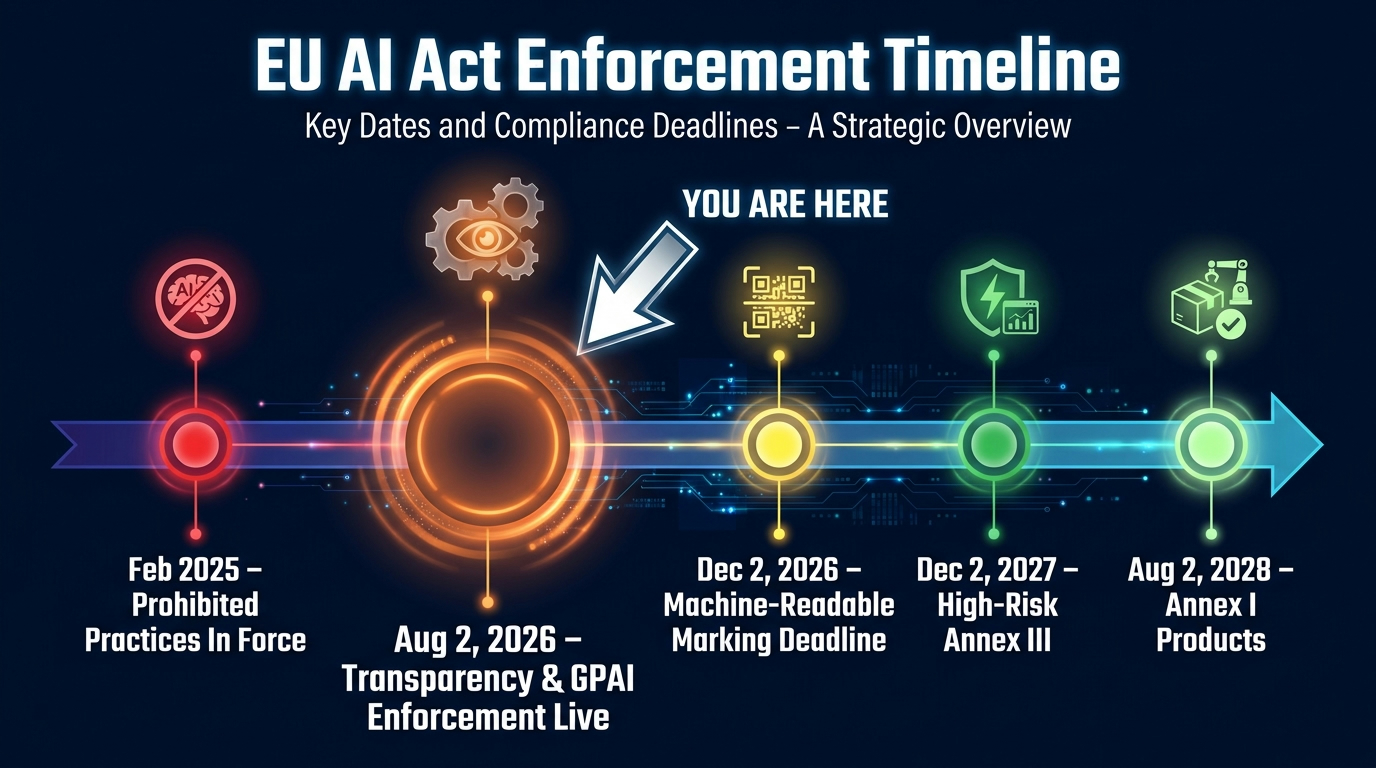
The EU AI Act became fully operative in stages, and the stage that matters most for organisations operating in September 2026 is the one that went live on 2 August 2026. That date was not a soft launch or a grace period endpoint — it was when enforcement began.
Several things happened simultaneously on that date. First, the European Commission’s AI Office — the body responsible for overseeing general-purpose AI (GPAI) models — gained active enforcement and supervisory powers. Until 2 August 2026, the AI Office could monitor and investigate; from that date forward, it could act, impose penalties, and require corrective measures. Second, Article 50 transparency obligations — covering chatbots, synthetic content, emotion recognition systems, and biometric categorisation — became enforceable. Third, AI literacy obligations under Article 4, which require providers and deployers to ensure their staff working with AI systems have an adequate level of understanding, became operative.
What This Means for Providers vs. Deployers
The EU AI Act draws a hard distinction between providers — organisations that develop or place AI systems on the market — and deployers — organisations that use AI systems under their authority in the course of their business. Most enterprises in September 2026 are both. They consume third-party AI products (making them deployers) and may build internal tools or customer-facing AI features on top of those models (potentially making them providers).
This dual role is where compliance complexity spikes. A business using a commercial LLM API to build a customer service chatbot is a provider of that chatbot from a regulatory standpoint, even though it did not train the underlying model. The transparency obligations from Article 50 apply to the business building the customer experience, not just to the model vendor. Contracts with AI vendors that attempt to push all compliance obligations downstream to the API provider are not legally effective for this purpose — regulators look at the deployer’s product as the system the user actually interacts with.
GPAI Enforcement: What the AI Office Actually Looks For
For GPAI providers — organisations that train and distribute general-purpose models, including large language models — obligations under Articles 53 and 55 of the AI Act were already in force from 2 August 2025. What changed on 2 August 2026 is that the Commission gained enforcement authority and can now impose fines of up to €15 million or 3% of global annual turnover for violations of GPAI obligations, and up to €35 million or 7% of global annual turnover for prohibited practices.
The GPAI obligations themselves cover: maintaining up-to-date technical documentation, producing training data summaries, publishing summaries of copyrighted training content, implementing policies to comply with copyright law, and drawing up and publishing model cards and usage policies. For systemic-risk GPAI models — those trained with computing power above 10^25 FLOPs — additional duties apply, including adversarial testing, incident reporting to the AI Office, and cybersecurity measures.
The Article 50 Transparency Test: Five Obligations Your Systems Must Pass Right Now
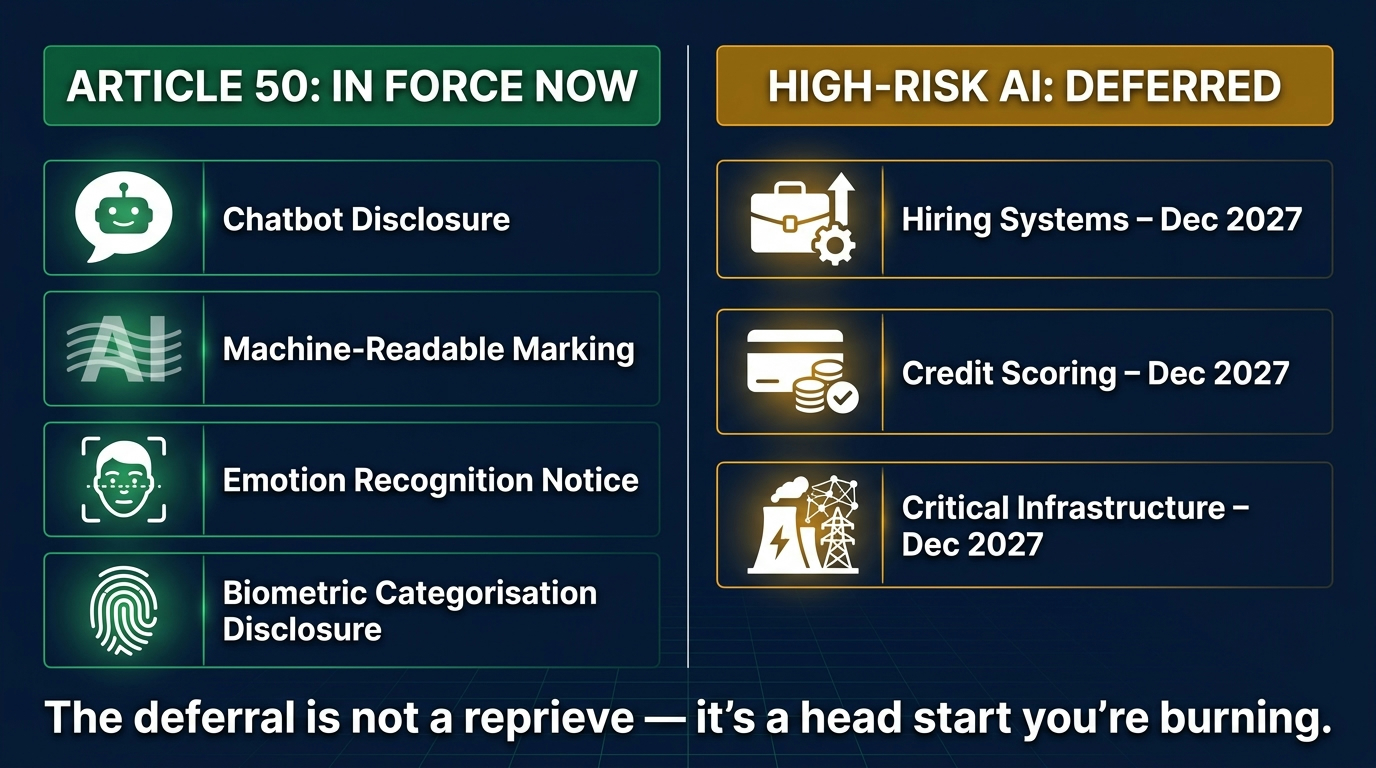
Article 50 of the EU AI Act is the section most directly relevant to the broadest range of businesses in September 2026. Unlike the high-risk provisions (whose deadlines have been extended), Article 50 is live and enforceable today. It covers four distinct categories of AI system, and each has its own disclosure architecture.
Obligation 1: AI-to-Human Interaction Disclosure
Under Article 50(1), providers of AI systems designed to interact directly with natural persons must ensure that users are informed they are interacting with an AI system. This is the chatbot disclosure requirement, and it applies unless “this is obvious from the point of view of a natural person who is reasonably well-informed, observant and circumspect.” The “obvious” exception is narrower than it sounds. A chatbot named “Aria” or “Max” on your website is not self-evidently AI to all users. Regulators will apply the reasonable-person test from the user’s perspective, not the company’s.
The practical implementation requirement is a first-interaction disclosure — a message, label, or notice visible before or at the moment the user first engages that makes the AI nature of the system clear. This must be present in the UI, not buried in a terms-of-service document.
Obligation 2: Machine-Readable Content Marking
Under Article 50(2), providers of AI systems generating synthetic audio, image, video, or text content must ensure that outputs are marked in a machine-readable format so they are detectable as artificially generated or manipulated. This is the provenance and watermarking requirement. The technical standard referenced is interoperability with detection systems — the marking must be effective, robust, and interoperable, not just a metadata field that can be stripped in two seconds.
A limited transition applies: systems placed on the market before 2 August 2026 have until 2 December 2026 to comply with the marking requirement. Systems launched after that date must comply immediately. This transition window is closing in fewer than 90 days from the time of writing.
Obligation 3: Deepfake Disclosure
Under Article 50(4), deployers using AI to generate or manipulate images, audio, or video that produces deepfakes — realistic-seeming content depicting real persons, places, or events that did not occur — must disclose that the content is artificially generated. Exceptions exist for art, satire, and creative works where disclosure would impair the artistic purpose, provided appropriate warnings are still included. This obligation covers not just entertainment and media companies but any business creating realistic AI-generated promotional content, training materials, or product demonstrations featuring real-looking people.
Obligation 4: Emotion Recognition System Notice
Deployers of emotion recognition systems — AI that infers a user’s emotional state from facial expressions, voice patterns, body language, or biometric signals — must inform the natural persons exposed to those systems. This applies even if the emotion recognition is a secondary or background function of a larger platform. Many customer service and HR analytics tools acquired in 2023–2025 contain emotion inference features that were marketed as engagement analytics. Those features now carry disclosure obligations their buyers may not have accounted for.
Obligation 5: Biometric Categorisation System Disclosure
Deployers of biometric categorisation systems — AI systems that categorise people based on biometric data into groups such as gender, ethnicity, or other attributes — must inform the individuals concerned. This is separate from the outright prohibition on biometric categorisation that infers sensitive characteristics like political views, religious beliefs, or sexual orientation (which is banned entirely under Article 5). The Article 50(5) disclosure obligation applies to systems that categorise on permissible biometric grounds but still need to be transparent about that processing.
Prohibited Practices: The Bans That Were Already Supposed to Be Fixed
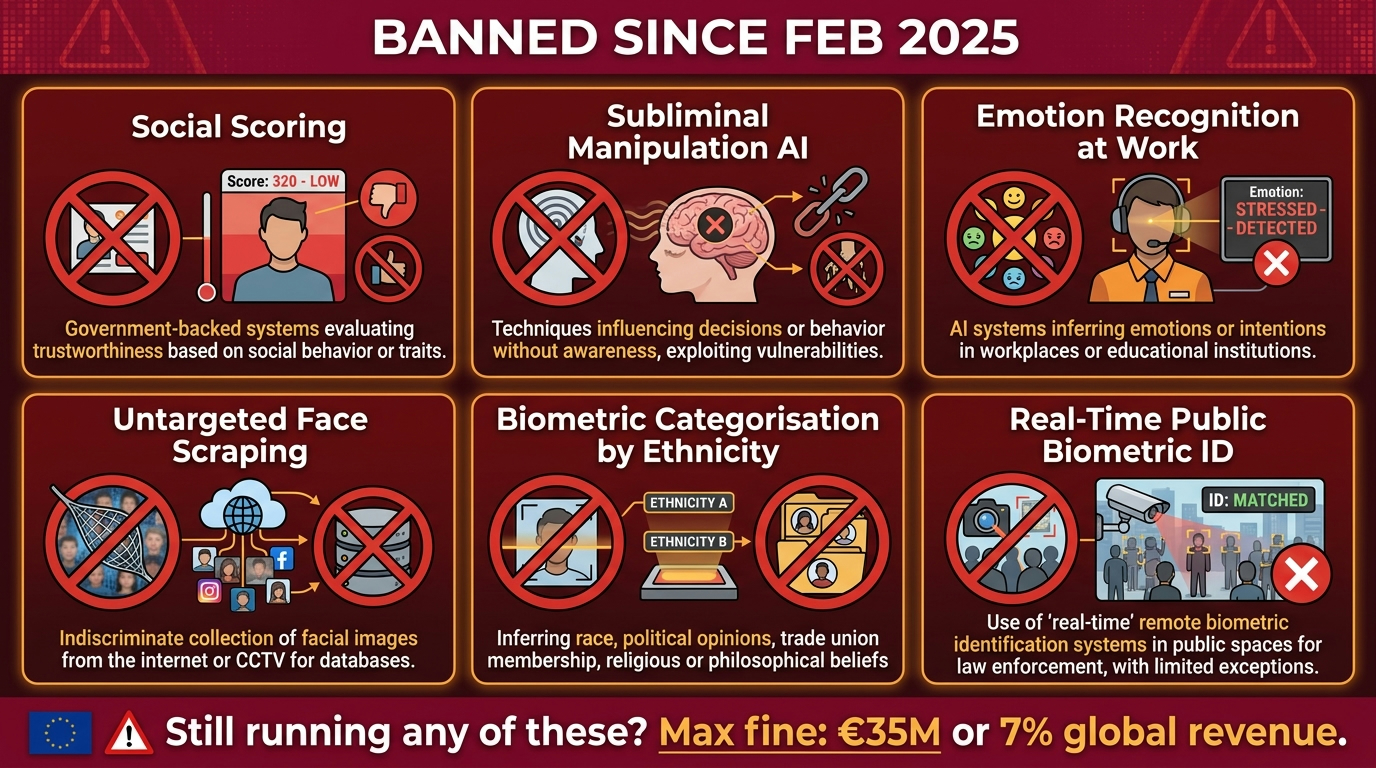
Article 5 of the EU AI Act lists practices so harmful that the EU banned them outright, with no risk-classification, conformity assessment, or grace period available. These prohibitions entered force on 2 February 2025 — nineteen months before the time of writing. If your organisation is still running any of the following, you are not dealing with a future compliance problem. You are dealing with an active enforcement exposure.
The Eight Prohibited Categories
1. Social scoring systems: AI systems that evaluate or classify natural persons based on their social behaviour or personal characteristics and produce scores that lead to detrimental or unfavourable treatment. This is a broad category that can catch certain credit-adjacent, employment screening, or customer segmentation tools that accumulate behavioural scores without declared criteria.
2. Subliminal manipulation AI: Systems that deploy techniques operating below a person’s conscious awareness to materially distort behaviour in a way that causes or is likely to cause harm. The line between persuasive interface design and subliminal manipulation is a legal question that enforcement will define over time, but systems explicitly optimised to override rational decision-making fall clearly within scope.
3. Exploitation of vulnerability: Systems that exploit the vulnerabilities of specific groups — including children, elderly persons, or persons with disabilities — to distort their behaviour in a way that causes or is likely to cause harm to them or others.
4. Biometric categorisation to infer sensitive characteristics: Systems that categorise individuals based on biometric data to infer protected characteristics including race, political opinions, trade union membership, religious or philosophical beliefs, or sexual orientation. This prohibition is near-absolute and is separate from the Article 50 disclosure obligation for permissible biometric categorisation.
5. Emotion recognition in workplaces and educational institutions: Deploying AI to infer the emotional state of natural persons in the context of employment or education. Productivity analytics, attention tracking in e-learning platforms, and engagement scoring tools used in HR contexts are directly in scope. Many widely-deployed SaaS tools contain these features.
6. Untargeted facial image scraping: Compiling or expanding facial recognition databases by scraping images from the internet or CCTV footage without consent or purpose limitation. This is relevant not just for security companies but for any business using publicly-scraped image datasets to train models.
7. Real-time remote biometric identification in public spaces for law enforcement: Using AI to identify individuals in real time in publicly accessible spaces for law enforcement purposes. This is primarily a government constraint, but private organisations operating CCTV-integrated AI in shared spaces should assess scope carefully.
8. Non-consensual intimate image generation (from December 2026): A ninth prohibition on AI systems used to generate or manipulate sexual imagery without consent — including CSAM — takes effect on 2 December 2026. Consumer AI platforms and any service offering image or video generation should audit output capabilities and implement guardrails before that date.
The penalty tier for prohibited practice violations is the Act’s maximum: up to €35 million or 7% of global annual turnover, whichever is higher. For a company with €500 million in revenue, that is a potential €35 million fine. For a company with €5 billion in revenue, it is €350 million.
The December 2026 Cliff: Machine-Readable Marking and the Content Provenance Problem
The 2 December 2026 deadline deserves its own section because it is the most immediately time-pressured technical requirement that many organisations are under-resourced to meet. The Article 50(2) marking obligation — requiring AI-generated content to carry machine-readable provenance signals — has a transitional grace period only for systems that were on the market before 2 August 2026. Those systems must be compliant by December 2.
The technical challenge is significant. “Machine-readable marking” is not a simple metadata tag. The regulation specifies that marks must be effective, interoperable, robust, and reliable as far as technically feasible. In practice, this means watermarks or cryptographic provenance signals embedded in content that survive common transformations like compression, cropping, and format conversion.
What Technical Compliance Actually Requires
The EU AI Act references “relevant technical standards” as a benchmark — these are emerging ISO and CEN/CENELEC standards in development, alongside the Coalition for Content Provenance and Authenticity (C2PA) specification, which has become the de facto industry standard for content provenance. C2PA allows content creators to attach cryptographic manifests to images, audio, and video that survive downstream processing and can be verified by detection tools.
For businesses generating AI content at scale — marketing imagery, product photography, synthetic voice, AI-written copy — the December 2 deadline means having a C2PA-compatible workflow in production, not in proof-of-concept. That means updating generation pipelines, ensuring downstream export and CDN processes preserve manifest integrity, and verifying that your content management system handles provenance metadata correctly.
The Vendor Dimension
Most businesses generating AI content do so through commercial APIs — image generation from providers like Midjourney, Adobe Firefly, or DALL-E 3, voice synthesis from ElevenLabs or similar, video from Runway or Pika. Some of these providers are building C2PA support into their outputs; others are not yet compliant. As a deployer, you cannot fully delegate the marking obligation to your API vendor — if the end product reaching your users is not marked, the regulatory exposure sits with you.
This means auditing your generative AI vendors for C2PA compliance before December 2, confirming which output formats preserve marking (JPEG and PNG behave differently; web-optimised formats can strip metadata), and building internal verification into your content QA process.
Why the High-Risk Deadline Extension Is a Trap
The Digital Omnibus — a package of EU legislative amendments that moved through the European Parliament and Council in mid-2026 — extended the compliance deadline for high-risk AI systems. Stand-alone high-risk systems under Annex III (covering applications in hiring, credit scoring, education assessment, biometric identification, critical infrastructure, law enforcement, migration, and administration of justice) moved from 2 August 2026 to 2 December 2027. High-risk AI embedded in regulated products under Annex I moved to 2 August 2028.
For many compliance teams, this extension landed as good news. It was not. Here is why.
The Implementation Timeline for High-Risk Systems Is Long
High-risk AI compliance under the EU AI Act is not a documentation exercise. It requires a conformity assessment process, the production of technical documentation under Article 11, a quality management system under Article 17, a human oversight system under Article 14, post-market monitoring under Article 72, and registration in the EU database under Article 71 before placing the system on the market. For Annex III systems not covered by harmonised standards, this requires self-assessment; for systems subject to third-party conformity assessment, it requires engagement with a notified body.
That process takes 9 to 18 months for a well-prepared organisation. For an organisation just starting, it takes longer. The gap between December 2027 and September 2026 is 15 months. That is not generous — that is tight, assuming you start now.
The Deferral Is Not a Rollback
The most important thing to understand about the Digital Omnibus changes is that they deferred a deadline, they did not repeal the obligations. Every high-risk AI system currently deployed or under development still needs to meet the full Article 9–17 requirement stack. The deferral simply moved the date by which compliance must be achieved. Organisations that treat December 2027 as the point at which work begins — rather than the point at which it must be complete — are effectively compressing a two-year implementation program into whatever time remains.
Additionally, many organisations operate in both EU and non-EU jurisdictions and are also subject to U.S. state laws, UK AI regulations, and sector-specific federal requirements that do not provide the same extension. Building your compliance program entirely around the AI Act’s Annex III deadline while ignoring Colorado’s ADMT requirements or Illinois BIPA obligations means partial readiness that will not hold.
The U.S. Side of the Ledger: The Patchwork Reality of State Regulation
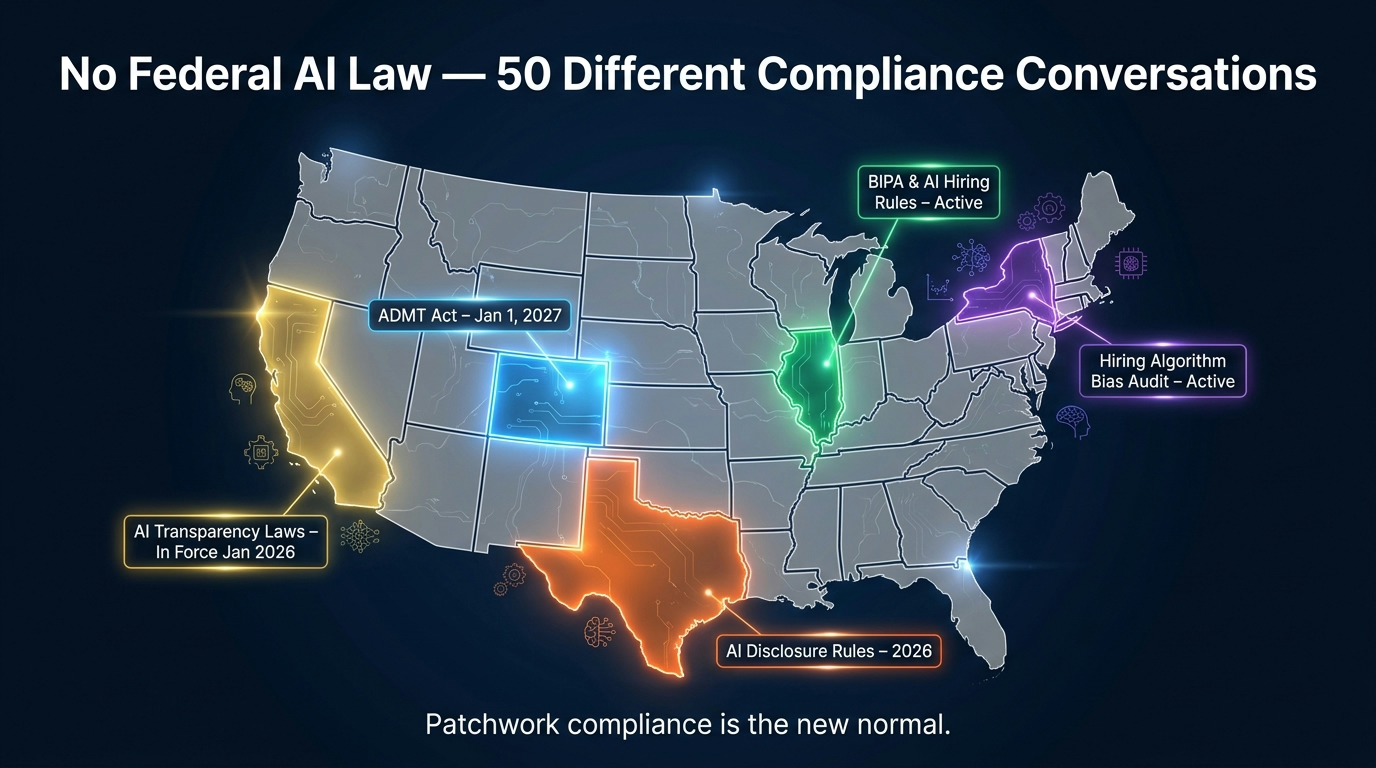
There is no comprehensive federal AI statute in the United States. The TAKE IT DOWN Act — signed into law in early 2026 — established a federal notice-and-removal framework for non-consensual intimate imagery including AI-generated deepfakes, with platforms required to remove flagged content within 48 hours. Beyond that specific instrument, U.S. AI compliance in September 2026 is a jurisdiction-by-jurisdiction analysis.
Colorado: The ADMT Act
Colorado had the most ambitious state-level AI framework on the near-term horizon, but that framework underwent a significant revision. The original Colorado AI Act (SB24-205), scheduled to take effect 30 June 2026, was replaced by SB26-189 — the Automated Decision-Making Technology Act — which shifts the operative compliance date to 1 January 2027 and narrows the scope considerably.
The ADMT Act focuses on AI systems that make or substantially influence “consequential decisions” — including employment, housing, credit, education, and healthcare access. For covered systems, it requires: pre-use notice to affected individuals, disclosure of the general purpose and logic of the ADMT, the right to appeal adverse decisions to a human reviewer, human reconsideration processes, developer-to-deployer documentation about intended uses and known limitations, and three years of recordkeeping on ADMT use. Organisations with operations in Colorado should be in active implementation now — January 1 is fewer than four months away.
California: Multiple Active Instruments
California entered 2026 with several AI-related laws already in force. AI transparency and disclosure requirements for automated decision-making in employment, housing, and financial services entered effect on 1 January 2026. The California Algorithmic Accountability Act established consumer rights around automated decisions affecting access to services. And the California Consumer Privacy Act (CCPA) has long had implications for profiling and automated decision-making that many businesses have still not fully addressed.
California’s approach is not a single framework — it is a layered stack of sector-specific and rights-based obligations that collectively create significant compliance surface for any large-scale automated decision-making system operating in the state.
Illinois: BIPA and Expanding Biometric Risk
Illinois remains the most consequential U.S. jurisdiction for biometric data. The Biometric Information Privacy Act (BIPA) — which applies to biometric identifiers including voiceprints, facial geometry, and retina scans — has generated billions of dollars in class-action settlements and continues to be actively litigated. Any AI system that processes biometric data in Illinois operations must have a written retention policy, have obtained informed written consent, and not have sold or profited from that data. Illinois also has expanding employment AI rules affecting hiring screening tools.
New York City: Automated Employment Decision Tool Law
New York City’s Local Law 144 — the Automated Employment Decision Tool (AEDT) law — requires employers using AI-assisted hiring or promotion tools to conduct annual bias audits, publish results, and provide notices to candidates. The law has been in force since 2023 but enforcement has been gradually strengthening, and the audit requirements have become more detailed. Businesses using AI resume screening, video interview analysis, or automated candidate ranking in NYC hiring are subject to this law regardless of where the software vendor is headquartered.
Texas and Other States
Texas enacted disclosure requirements for AI-generated content and chatbot interactions in 2026, following the broad pattern set by states addressing consumer-facing AI transparency. Tennessee has protections around AI-generated voice and likeness. The practical compliance implication is that for businesses with national reach, a minimum-viable compliance program needs to be calibrated to the most demanding state in scope — which typically means building to Colorado ADMT, California, Illinois BIPA, and NYC AEDT standards, and treating that as the national baseline.
The Automation-Specific Readiness Checklist: 8 Domains, 40 Controls
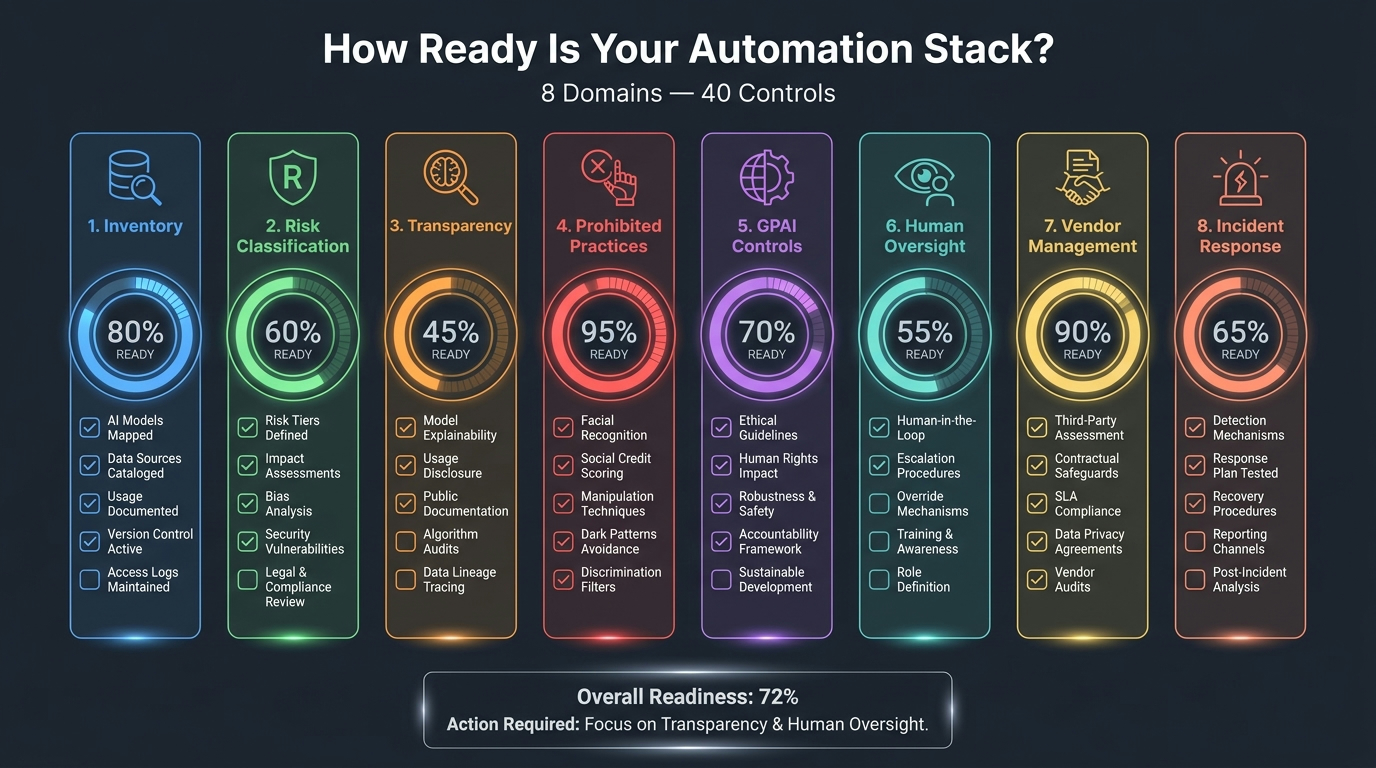
The following checklist is designed for compliance, legal, and technology teams conducting a September 2026 gap assessment of their AI and automation stack. It is organised into eight domains and covers the controls most commonly cited across the EU AI Act, NIST AI Risk Management Framework, ISO/IEC 42001, and active U.S. state laws. Work through each domain and mark controls as Complete, In Progress, or Not Started.
Domain 1: AI System Inventory (5 Controls)
- Maintain a complete register of every AI and automation system in use, including commercial SaaS tools with embedded AI features, internal builds, API integrations, and third-party automation workflows. Many organisations discover their actual inventory is 2–3x larger than expected once SaaS and embedded AI are included.
- Record system metadata for each entry: system name, vendor, version or model identifier, deployment date, business process it supports, data types processed, user population affected, geographic scope, and named business owner.
- Identify provider vs. deployer role for each system. Where you are the deployer of a third-party AI, document the upstream provider and the contractual allocation of compliance obligations.
- Flag shadow AI usage. Employees using personal ChatGPT, Gemini, or other consumer AI tools in work contexts represent an ungoverned compliance surface. A usage policy and periodic self-reporting mechanism is required to surface this.
- Update the inventory on a defined cadence — at minimum quarterly, and within 30 days of any new AI system deployment or significant change to an existing one.
Domain 2: Risk Classification (5 Controls)
- Apply EU AI Act risk tiers to every system in inventory: prohibited, high-risk (Annex I or III), limited-risk (Article 50 scope), or minimal-risk. Document the classification rationale for each system.
- Screen for prohibited practices against the Article 5 list. Any system performing social scoring, emotion recognition in workplace/education, untargeted biometric scraping, or biometric categorisation for sensitive characteristics must be decommissioned or redesigned immediately.
- Map Annex III applicability for systems used in hiring, credit assessment, education evaluation, biometric identification, critical infrastructure management, or law enforcement support. Even with the December 2027 deadline extension, these systems need immediate documentation and oversight assessment.
- Cross-reference U.S. state laws for each system’s geographic deployment. Systems operating in Colorado, California, Illinois, or New York City need additional compliance mapping beyond EU AI Act.
- Reassess classification annually or when there is a material change in system purpose, data inputs, or regulatory scope. A system that was minimal-risk under one use case may become high-risk if the business purpose changes.
Domain 3: Transparency and Disclosure (5 Controls)
- Audit every user-facing AI interface for Article 50(1) compliance. Does each chatbot, AI assistant, or automated interaction surface include a clear, first-contact disclosure that the user is interacting with an AI system? Test this from a new user perspective, not an admin view.
- Verify machine-readable content marking for all AI-generated image, audio, video, and text outputs distributed publicly or to users. Confirm C2PA or equivalent provenance signals are embedded and survive the delivery pipeline.
- Check deepfake disclosure coverage. Any AI-generated or AI-manipulated audiovisual content depicting real people must carry disclosure labelling. Audit your marketing content, training videos, and product imagery libraries.
- Review emotion recognition deployments. If any tool in your stack — customer service analytics, HR platforms, meeting intelligence tools — uses emotion inference, the relevant users or subjects must be notified.
- Document disclosure mechanisms and maintain evidence that disclosures are actually reaching users. Screenshot archives, UI audit logs, and version-controlled UI component records are the evidence layer that regulators will request.
Domain 4: Prohibited Practice Screening (4 Controls)
- Conduct a formal prohibited practice review against Article 5’s eight categories for every AI system in inventory. Document the review, who conducted it, and the conclusion reached for each system.
- Audit third-party SaaS and API tools for features that may constitute prohibited practices. Vendor assurances are not sufficient — request documentation of how emotion inference, biometric processing, and behavioural scoring features are implemented.
- Implement contractual prohibitions preventing vendors from using your data to develop or train systems that fall within prohibited categories.
- Establish a process for reporting potential prohibited practice discoveries internally, with defined escalation paths to legal/compliance and a documented remediation timeline.
Domain 5: GPAI-Specific Controls (5 Controls)
- Determine GPAI provider status. If your organisation trains, fine-tunes and distributes a general-purpose AI model — even for internal use — assess whether this triggers GPAI provider obligations under Article 53.
- Maintain technical documentation covering model architecture, training methodology, training data categories, evaluation results, and known limitations. This documentation must be kept current and available to the AI Office on request.
- Publish model transparency information sufficient for downstream deployers to understand capabilities, limitations, and intended uses. API documentation, model cards, and system cards are the primary vehicles.
- Implement a copyright compliance policy covering training data sourcing and the Article 53(1)(c) requirement to publish summaries of training data used, with adequate protection for confidential business information.
- Assess systemic-risk threshold. Models trained with computing power exceeding 10^25 FLOPs are subject to additional obligations including adversarial testing, incident reporting, and cybersecurity measures. Know where your models sit relative to this threshold.
Domain 6: Human Oversight and Accountability (6 Controls)
- Define human oversight requirements for every AI system making or substantially influencing consequential decisions. Document who is accountable for each system, what decisions they can override, and how they are notified of AI outputs requiring review.
- Implement override mechanisms. Systems should be technically capable of being overridden, corrected, or shut down by designated human operators. Document that these capabilities exist and test them periodically.
- Ensure AI literacy compliance under Article 4. Staff deploying or managing AI systems must have sufficient understanding of those systems’ capabilities and limitations to exercise meaningful oversight. This requires structured training programs, not just awareness communications.
- Assign named ownership for every AI system in inventory. Each system should have a designated accountable owner who is responsible for compliance, performance monitoring, and incident escalation.
- Document human review decisions. When humans override, confirm, or reject AI outputs in consequential decision processes, those interventions should be logged with date, reviewer identity, and rationale.
- Establish reconsideration rights where required by Colorado ADMT Act, California AI laws, and similar frameworks. Users subject to adverse AI-influenced decisions must have a process to request human reconsideration.
Domain 7: Vendor and Third-Party Management (5 Controls)
- Audit AI vendor contracts for appropriate compliance obligation allocation. Contracts should specify which party is responsible for which EU AI Act obligations, contain representations about compliance status, and include audit rights and notification requirements for material changes.
- Require vendor compliance documentation. For high-risk AI vendors, obtain evidence of their conformity assessment process, technical documentation, or equivalent compliance evidence. Do not rely solely on vendor self-certification.
- Map supply chain AI exposure. AI is embedded in an expanding range of B2B software tools. Procurement processes should include AI disclosure requirements — vendors should declare any AI features in the tools they sell and provide relevant compliance documentation.
- Monitor vendor regulatory status. If a vendor’s AI system receives regulatory scrutiny or is found non-compliant by EU or U.S. authorities, that has direct implications for your compliance position as a deployer. Set up monitoring for AI regulatory enforcement actions affecting your vendor landscape.
- Establish vendor offboarding procedures that address AI-related data — what happens to data processed by vendor AI systems when contracts end, how training data deletion requests are handled, and how documentation is preserved.
Domain 8: Incident Response and Monitoring (5 Controls)
- Define AI-specific incident categories. What constitutes an AI incident requiring escalation? Categories should include: discriminatory outputs, safety-relevant errors, prohibited practice violations, data breaches involving AI-processed data, and model behaviour that significantly deviates from documented purpose.
- Establish logging and audit trail requirements for AI systems making or influencing consequential decisions. Logs should capture inputs, outputs, model version, timestamp, and any human review interventions. Retention periods should be defined and compliant with applicable data retention rules.
- Build a post-deployment monitoring process. AI systems drift. Models perform differently on live data than on evaluation datasets. A defined monitoring cadence — checking for output quality, bias drift, and anomalous behaviour — is required for ongoing compliance, not just at launch.
- Test incident response readiness. Conduct tabletop exercises simulating an AI incident: a chatbot producing harmful outputs, an automated decision system flagged for discriminatory patterns, or a regulatory inquiry. Document response time and remediation paths.
- Maintain an incident log and report serious incidents to relevant authorities where required. For GPAI providers with systemic-risk models, incident reporting to the AI Office is mandatory. For high-risk AI systems, post-market monitoring and serious incident reporting to national authorities applies from the applicable deadline.
Governance Infrastructure: What “Ready” Actually Looks Like at the Org Level
Running through a 40-point checklist is a useful diagnostic. But compliance is not primarily a checklist activity — it is an organisational capability. What distinguishes organisations that will navigate the post-August 2026 enforcement environment from those that will not is less about which tools they are using and more about the governance architecture supporting those tools.
The AI Governance Function
The organisations furthest ahead in September 2026 have established a formal AI governance function — either as a dedicated team or as a structured accountability layer within existing legal, privacy, or risk functions. The minimum viable version of this includes: a named AI compliance owner with board-level visibility, a cross-functional steering group that includes legal, technology, product, and business operations, a documented AI governance policy, and a defined review cadence for that policy.
The AI Office and national regulators, in their early enforcement actions, are looking not just at whether specific obligations are met but at whether there is a credible governance system in place. An organisation with documented processes, evidence of ongoing monitoring, and demonstrated human accountability is in a fundamentally different position than one that can show technical implementation but cannot demonstrate who owns it.
Documentation as a Regulatory Asset
Under the EU AI Act, documentation is not administrative overhead — it is the primary evidence of compliance. For high-risk systems, technical documentation under Article 11 must be kept updated and available to regulators. For GPAI providers, documentation must be sufficient for the AI Office to assess compliance without conducting its own technical audit. For deployers, records of conformity assessment, vendor compliance evidence, and human oversight logs are the materials that determine the outcome of an enforcement inquiry.
A practical standard for documentation readiness is the “regulator walk-in” test: if a national market surveillance authority or the AI Office contacted you today requesting documentation on a specific AI system in your portfolio, how long would it take to produce a complete, current, accurate package? If the honest answer is weeks or months, documentation is a gap that needs closing before December 2026.
The AI Literacy Requirement — Taking Article 4 Seriously
Article 4 of the EU AI Act requires providers and deployers to take measures to ensure sufficient AI literacy among their staff. This is not a box-ticking exercise with a single e-learning module. Regulators interpret this as requiring that personnel who interact with, manage, or make decisions based on AI system outputs have genuine understanding of the system’s capabilities, limitations, and error modes.
In practice, this means role-differentiated training: engineers and data scientists need technical literacy about model behaviour and failure modes; managers making decisions informed by AI outputs need enough literacy to identify when AI outputs should be questioned or overridden; compliance and legal staff need regulatory literacy. All three groups need training records that demonstrate training actually occurred.
The AI Governance Technology Stack: What Enterprises Are Deploying Now
The AI governance platform market is projected to reach approximately $492 million in 2026, growing at a 36–38% compound annual rate toward an estimated $1 billion by 2030. That growth is being driven by organisations that tried to manage AI compliance through spreadsheets and email and discovered that approach does not scale when the AI portfolio reaches 50+ systems.
The Four Platform Categories
GRC Automation Platforms: Tools like Drata, Vanta, and Sprinto automate evidence collection and continuous control monitoring across multiple compliance frameworks simultaneously — EU AI Act, GDPR, SOC 2, ISO 27001, and HIPAA in a single workflow. These platforms are most valuable for organisations that need to manage multiple regulatory frameworks rather than the AI Act alone. Their core advantage is automated evidence collection: instead of manually gathering screenshots and audit logs, the platform continuously monitors connected systems and populates evidence libraries.
Enterprise AI Governance Platforms: Tools like Credo AI, Holistic AI, and IBM watsonx.governance are purpose-built for AI model lifecycle governance — risk assessment, bias testing, model documentation, deployment monitoring, and regulatory alignment. These platforms sit at the model layer, not the business process layer. They are most useful for organisations with significant internal AI development or large-scale model deployment.
LLM and AI Observability Tools: Platforms like Arize AI, Weights & Biases, and similar tools provide runtime monitoring of AI model performance — tracking output quality, detecting drift, logging inputs and outputs for audit purposes. As enforcement of logging and post-market monitoring requirements intensifies, observability tooling transitions from an MLOps nice-to-have to a compliance necessity.
Runtime Control Planes: Emerging tools that enforce governance policies at the point of AI execution — controlling what data a model can access, filtering outputs against defined criteria, enforcing disclosure requirements programmatically. These tools address the gap between documented policies and actual system behaviour by making compliance controls part of the technical execution path rather than the audit trail.
What the Market Is Not Providing Yet
Despite the growth in AI governance tooling, there are gaps that most platforms do not yet address well. Cross-jurisdictional compliance mapping — automatically applying the correct rules to a system based on where it operates and who it affects — remains largely manual. Vendor compliance verification — independently confirming that a third-party AI vendor is actually compliant rather than taking their word for it — is not yet automated. And real-time prohibited practice detection — automatically flagging when a deployed system begins behaving in ways that approach prohibited categories — is still largely aspirational.
These gaps mean that tooling is a complement to governance capability, not a replacement. Platforms accelerate evidence collection and reduce manual work, but the judgement layer — classifying systems, interpreting obligations, making decisions about borderline cases — remains a human function that requires genuine expertise.
Three Common Mistakes Organisations Are Making Right Now
Based on the pattern of enforcement concerns and compliance gaps that have emerged in the months since August 2026, three failure modes stand out as most common among organisations that believed they were ahead of the regulation but have since discovered otherwise.
Mistake 1: Treating the High-Risk Deferral as a Pause Button
The extension of Annex III and Annex I high-risk deadlines — to December 2027 and August 2028 respectively — has led many compliance programs to de-prioritise high-risk work. The teams that made this decision are now realising that the 15-month runway to December 2027 is actually a 6–9 month procurement, planning, and implementation cycle followed by a conformity assessment that takes months to complete. Starting high-risk compliance work in Q3 2026 for a December 2027 deadline is roughly equivalent to starting in Q3 2025 for an August 2026 deadline — it was always going to be tight.
Mistake 2: Focusing Only on New AI Systems
A second common mistake is applying compliance rigor to new AI deployments while leaving legacy automation systems unreviewed. The EU AI Act applies to AI systems already deployed, not just new ones. Business process automation tools, decision-support systems, and customer-facing AI features built in 2022 or 2023 are subject to the same obligations as systems launched in 2026. The prohibited practice bans in particular applied retroactively from February 2025 — an automation tool built in 2021 that performs emotion recognition in an employment context has been non-compliant for nineteen months.
Mistake 3: Siloing Compliance from Product and Engineering
The third and most structurally damaging mistake is treating AI compliance as a legal and compliance function that operates independently of product and engineering teams. Compliance cannot audit its way to conformity without access to the technical layer where AI systems actually live. The most effective compliance programs in September 2026 are those where legal and compliance own the policy framework but engineering and product teams own the implementation controls — and both groups have shared accountability for outcomes. Compliance teams that have no visibility into model changes, API integrations, or feature rollouts will consistently be operating on outdated information.
Conclusion: Deadlines Are Not Finish Lines — They Are Accountability Moments
The framing of AI regulation as a series of deadlines is useful for creating urgency, but it also creates a specific failure mode: organisations that build toward a deadline, cross it, and stop. Real AI compliance is an ongoing operational discipline, not a one-time certification event. Regulations will be updated — the AI Act already has its first significant amendment via the Digital Omnibus, and further guidance, delegated acts, and technical standards will emerge continuously through 2028 and beyond. The enforcement environment will evolve as national authorities and the AI Office develop enforcement priorities through early cases.
What September 2026 requires from most organisations is not heroic last-minute effort. It requires an honest assessment of where the current compliance posture actually stands — starting with the Article 50 obligations that are already in force and the prohibited practices that have been banned since February 2025. It requires closing the gaps that are most likely to generate enforcement exposure in the near term. And it requires building the governance infrastructure that makes compliance a continuous capability rather than a recurring scramble.
Immediate Action Items for September 2026
- By end of September: Complete AI system inventory. Know every AI system in your stack, who owns it, and what data it processes.
- By end of September: Screen all systems against Article 5 prohibited practices. Any non-compliance here is current legal exposure.
- By end of October: Audit all user-facing AI interfaces for Article 50(1) chatbot disclosure compliance. This is already enforceable.
- By 2 December 2026: Implement machine-readable marking (C2PA or equivalent) for all AI-generated content in your delivery pipeline, including systems placed on market before 2 August 2026.
- By 2 December 2026: Confirm no systems in your portfolio generate non-consensual intimate imagery — the ninth prohibited practice takes effect on this date.
- By 1 January 2027: Colorado ADMT Act compliance for automated decision-making affecting Colorado residents — pre-use notices, adverse decision disclosures, human review processes, and recordkeeping.
- Rolling: Begin high-risk AI conformity assessment groundwork now. December 2027 is tighter than it looks.
The enforcement window is open. The most valuable thing organisations can do in September 2026 is treat that fact as the operational reality it is — and act accordingly.