



On March 9, 2026, Amazon announced something that sent a wave of relief through the third-party seller software ecosystem: all planned SP-API fees were being paused — indefinitely. The $1,400 annual developer subscription and the usage-based GET call charges that had been looming over solution providers since November 2025 were put on hold, with no new implementation date set until at least fall 2026.
For many Amazon sellers, this announcement raised more questions than it answered. What exactly is the SP-API? Who were these fees actually targeting? And if they were paused — not cancelled — what does that mean for the tools you rely on every day to manage your listings, reprice your products, and track your inventory?
The short answer: this pause buys everyone time, but it does not make the fees go away. Understanding what Amazon originally planned, why it backtracked, and what is likely coming next is essential for any seller who depends on third-party software to run their Amazon business. These fees, once implemented, will not be absorbed quietly by developers — they will almost certainly flow downstream to sellers in the form of higher subscription costs.
This article walks through everything you need to know: the full fee structure, the exemptions that protect private sellers, the tools most likely to raise prices when fees do arrive, and concrete steps you can take right now to prepare — so you are not caught flat-footed when Amazon shares its fall 2026 timeline.
What Is the Amazon SP-API — And Why Should Sellers Care?
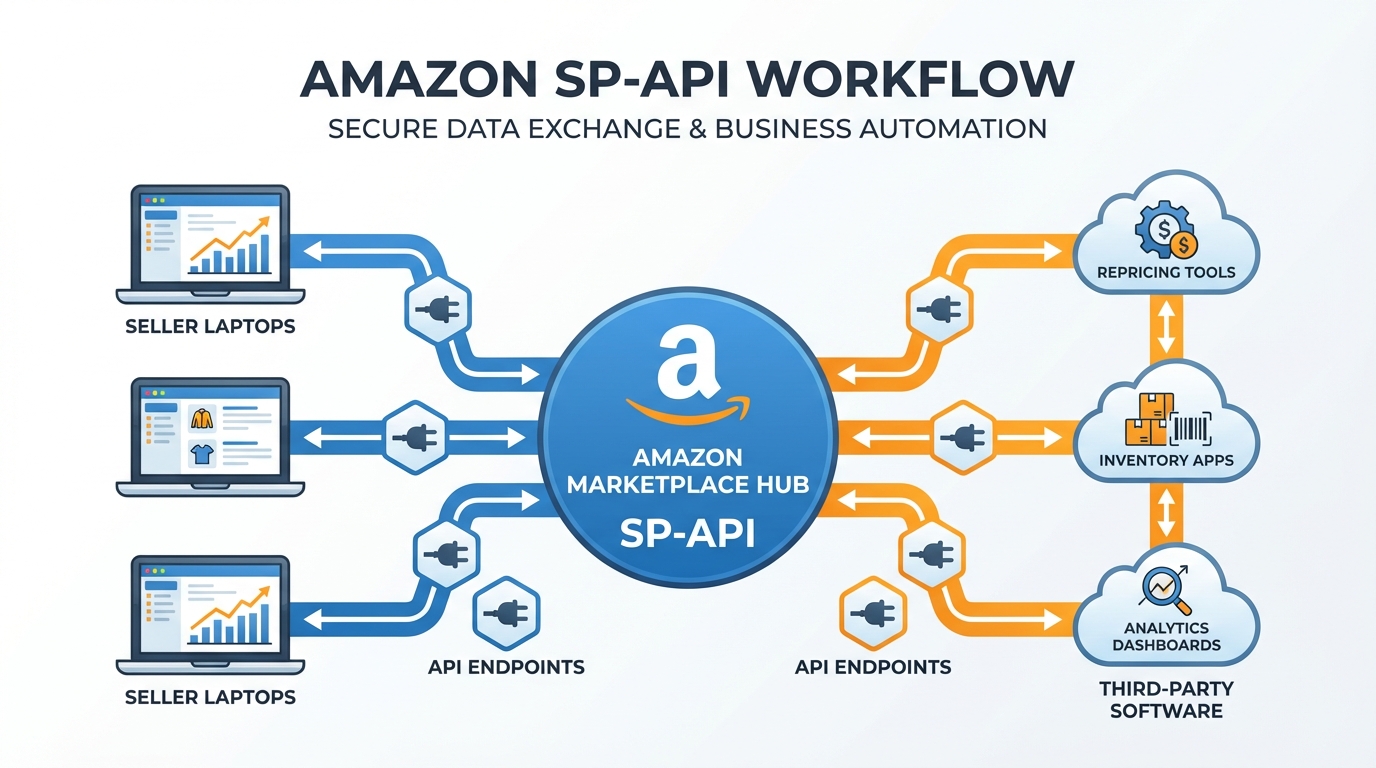
The Selling Partner API (SP-API) is Amazon’s modern, REST-based application programming interface that allows sellers, vendors, and third-party developers to programmatically interact with Amazon’s marketplace data. Through a series of API endpoints, authorized applications can retrieve and manage data on orders, shipments, payments, inventory levels, product listings, advertising performance, financial reports, and much more.
In practical terms, the SP-API is the technical backbone that makes most of the Amazon seller software ecosystem possible. When your repricing tool automatically adjusts your Buy Box price at 2 a.m., it is calling the SP-API. When your inventory management platform sends you a restock alert, it is pulling data from the SP-API. When your analytics dashboard shows you last week’s sales trends broken down by ASIN, that data is flowing through the SP-API.
From MWS to SP-API: A Brief History
The SP-API replaced Amazon’s older Marketplace Web Service (MWS), which had been the primary developer interface since 2009. For well over a decade, both MWS and later SP-API access were entirely free for all authorized users — a model that supported a thriving ecosystem of third-party tools without any usage-based costs passed along the chain.
Amazon began the formal deprecation of MWS in 2023, with key sections going dark on August 31 of that year. The SP-API had already been positioned as the successor, and developers were migrated across. At that point, access remained free — which made the November 2025 fee announcement all the more significant. It represented the first time in the platform’s history that Amazon moved to charge for API access at all.
Why the SP-API Matters Even If You Never Touch Code
Here is the critical point many sellers miss: you do not need to understand a single line of code for this to affect your business. If you subscribe to any third-party Amazon tool — a repricing platform, an inventory planner, a keyword research tool, a review request automation service, or an order management system — that tool almost certainly uses the SP-API. The developers who built it pay for access, and those costs have always factored into how they price their subscriptions to you.
Until 2025, API access was free, so that cost was zero. Once Amazon’s fee structure goes live, it will no longer be zero. Understanding the mechanics of that transition is the first step to protecting your margins.
The Original Fee Structure: What Amazon Had Planned
Amazon’s fee announcement on November 3, 2025 introduced two distinct cost components for third-party developers. These were not vague proposals — they came with specific dollar amounts, dates, and tier structures. Understanding the original plan is crucial context for evaluating what the pause actually means.
Component 1: The Annual Subscription Fee
Every third-party developer using the SP-API in a production environment (meaning their app serves other sellers, not just themselves) would be required to pay a $1,400 USD annual subscription fee. This fee was originally scheduled to begin on January 31, 2026, and was later adjusted to March 2, 2026 during the rollout confusion.
The annual subscription was designed to cover access to the Solution Provider Portal, production-level API use, and technical support services from Amazon. Think of it as a base entry ticket to legally operate a commercial application on top of the SP-API infrastructure.
For a solo developer building a small-scale tool, $1,400 a year is a meaningful baseline cost that must be recouped through subscriptions. For larger software companies serving thousands of sellers, the $1,400 annual fee itself is relatively minor — the real cost pressure comes from the second component.
Component 2: Usage-Based GET Call Charges
Starting April 30, 2026, Amazon planned to charge for API usage based on the volume of GET calls an application makes. GET calls are the most common type of API request — they are how applications retrieve data (pulling an order list, fetching inventory levels, querying product details).
The original pricing for GET call overages was set at $0.40 per 1,000 calls beyond whatever the developer’s monthly tier included. PUT, PATCH, and POST calls (used to write or update data) were to remain free.
To put the overage rate in perspective: a developer with a high-usage repricing tool that makes 28 million GET calls per month — a realistic volume for a tool serving hundreds of active sellers — could face roughly $2,200 per month in usage fees alone on the Basic tier, in addition to the annual subscription. That is more than $26,000 per year in API costs on top of all other operating expenses.
The Full Tier Breakdown: Basic, Pro, Advanced, Plus, and Enterprise
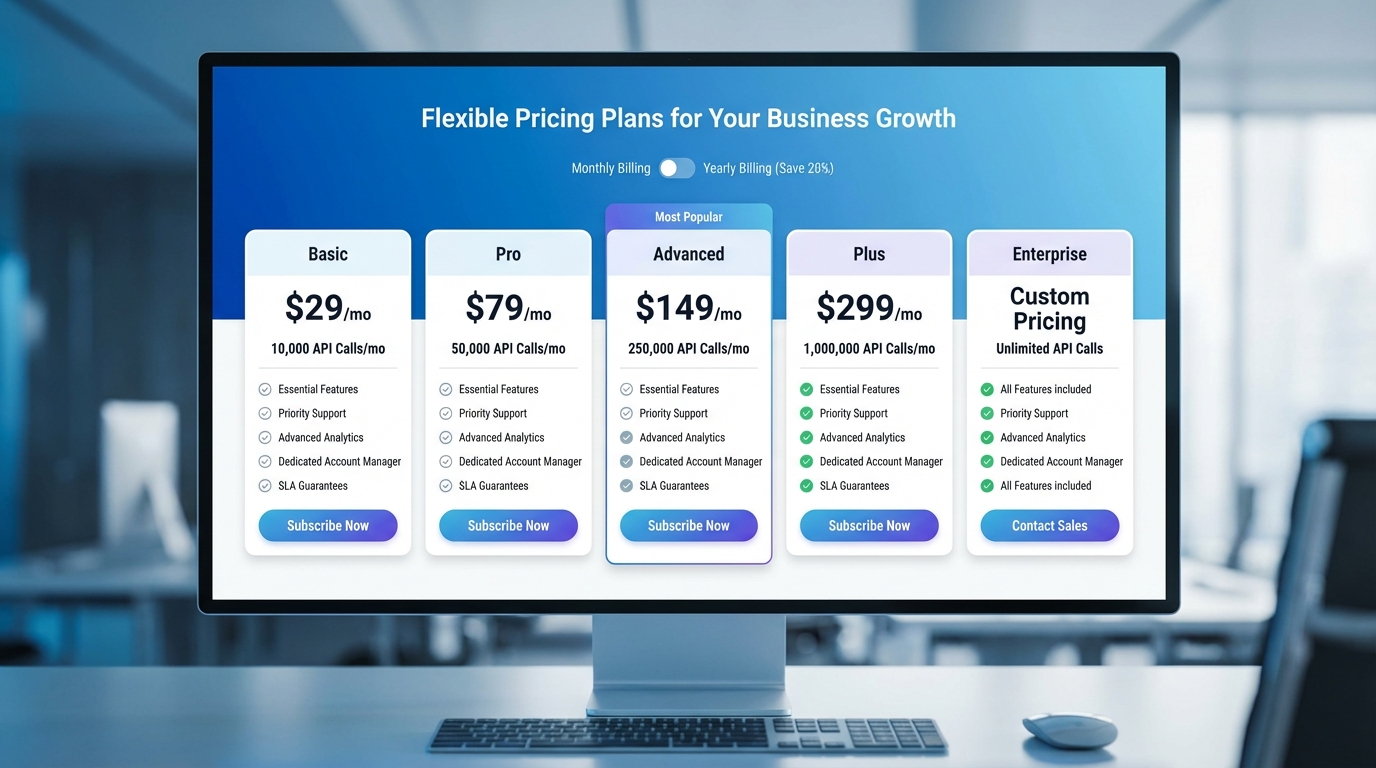
Amazon structured the usage-based portion of its fee model around five tiers, each offering a monthly bundle of included GET calls in exchange for a monthly platform fee. All tiers still require the $1,400 annual subscription on top. Calls beyond each tier’s included volume are charged at the $0.40 per 1,000 overage rate.
Basic Tier (Default)
The Basic tier costs $0 per month beyond the annual subscription. It includes 2.5 million GET calls per month at no additional charge. This is the default tier for all developers who do not proactively upgrade. For small tools with light API usage, 2.5 million calls per month may be sufficient. However, for any application that makes frequent data pulls on behalf of many sellers simultaneously, this ceiling is extremely easy to exceed.
Pro Tier
The Pro tier charges $1,000 per month and includes 25 million GET calls per month. The significant jump in included call volume makes the Pro tier relevant for mid-size tool providers who would otherwise constantly be paying $0.40-per-1,000 overages under the Basic tier. At $12,000 per year in platform fees (plus the $1,400 annual subscription), the Pro tier represents a serious cost line that software companies must either absorb or pass on.
Advanced Tier
The Advanced tier was added to the fee structure on February 11, 2026 — nearly four months after the initial announcement — at $5,000 per month with 125 million GET calls included. Its late addition to the pricing structure was one of the factors cited by solution providers as evidence of the plan’s lack of clarity. Developers who had already begun financial modeling for the original three-tier structure suddenly had to recalculate when a new middle tier appeared with just weeks until the original deadline.
Plus Tier
The Plus tier is designed for high-volume enterprise-adjacent applications, charging $10,000 per month in exchange for 250 million GET calls per month. At $120,000 per year in platform fees alone, this tier targets the largest players in the seller software space — companies operating at scale with massive seller bases generating enormous API activity.
Enterprise Tier
The Enterprise tier offers custom pricing negotiated directly with Amazon, intended for companies whose API usage exceeds even the Plus tier or who require specialized support arrangements. No public pricing was disclosed for this tier, as it is handled on a case-by-case basis.
Understanding the Math
To visualize the cost pressure: a developer sitting on the Basic tier making 5 million GET calls in a given month would owe the $1,400 annual fee (amortized) plus overage on 2.5 million calls at $0.40 per 1,000 — a total overage charge of $1,000 for that month alone. At that usage level, upgrading to the Pro tier at $1,000/month would actually be cheaper. These tier-switching calculations are exactly the kind of complexity that solution providers said made reliable business planning nearly impossible.
March 9, 2026: Why Amazon Hit the Pause Button
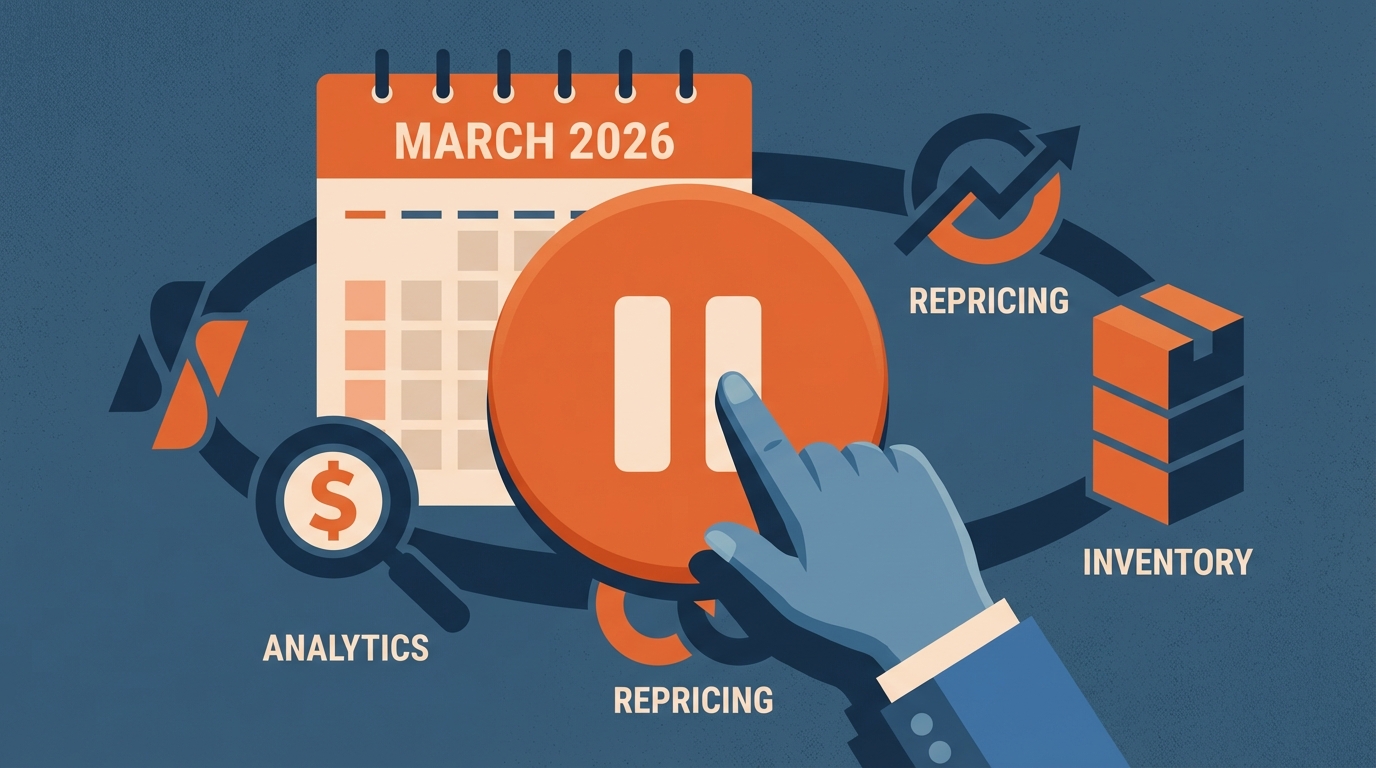
The decision to pause all SP-API fees on March 9, 2026, was the direct result of sustained, significant pushback from the solution provider community. Amazon acknowledged that it had received feedback from developers about the complexity of the fee structure and the challenges it created for forward business planning.
What “Complexity” Actually Meant
When solution providers cited “complexity,” they were pointing to several concrete problems. First, the original announcement in November 2025 did not include the Advanced tier — which only appeared in February 2026. That meant developers spent months modeling their costs under a three-tier structure, only to have the math change weeks before the supposed deadline. For companies that needed to plan budget cycles, set new subscription pricing, and communicate cost changes to their customers, this kind of mid-stream revision was genuinely destabilizing.
Second, the variable nature of GET call volumes created forecasting nightmares. Unlike a flat SaaS cost, API usage fluctuates based on how many sellers a tool is serving, how frequently it polls for data, and seasonal volume swings during peak periods like Q4. Building a predictable pricing model on top of a variable cost that shifts month to month — and carries significant overage risk — is a legitimate challenge for any software business.
The Timeline Chaos
The rollout itself was handled inconsistently. The annual subscription was originally set for January 31, 2026, then quietly shifted to March 2, 2026 for some developers. Usage fees remained targeted for April 30, 2026. Some developers reported confusion about whether their accounts were being grandfathered, whether existing integrations needed to be re-registered, and when exactly access would be cut off for non-compliant apps. The phrase “apps without payment lose access” was circulating in developer forums, creating significant anxiety in the ecosystem.
Amazon’s Response: A Full Pause
Rather than make incremental adjustments — tweaking a tier here, extending a deadline there — Amazon made the more decisive call to pause the entire fee structure indefinitely. All planned charges, including the annual subscription and all usage-based fees, were suspended. Amazon committed to sharing updated timelines no sooner than fall 2026, giving the solution provider community at minimum several more months to prepare under the existing free-access model.
This was not a cancellation of the fee plans. Amazon did not reverse course on the principle of charging for API access. The pause is best understood as a reset — a signal that the implementation needed more work before it could be rolled out fairly. The fees are coming. The question is when, and in what form.
Who Is Actually Exempt? Understanding the Private vs. Third-Party App Distinction
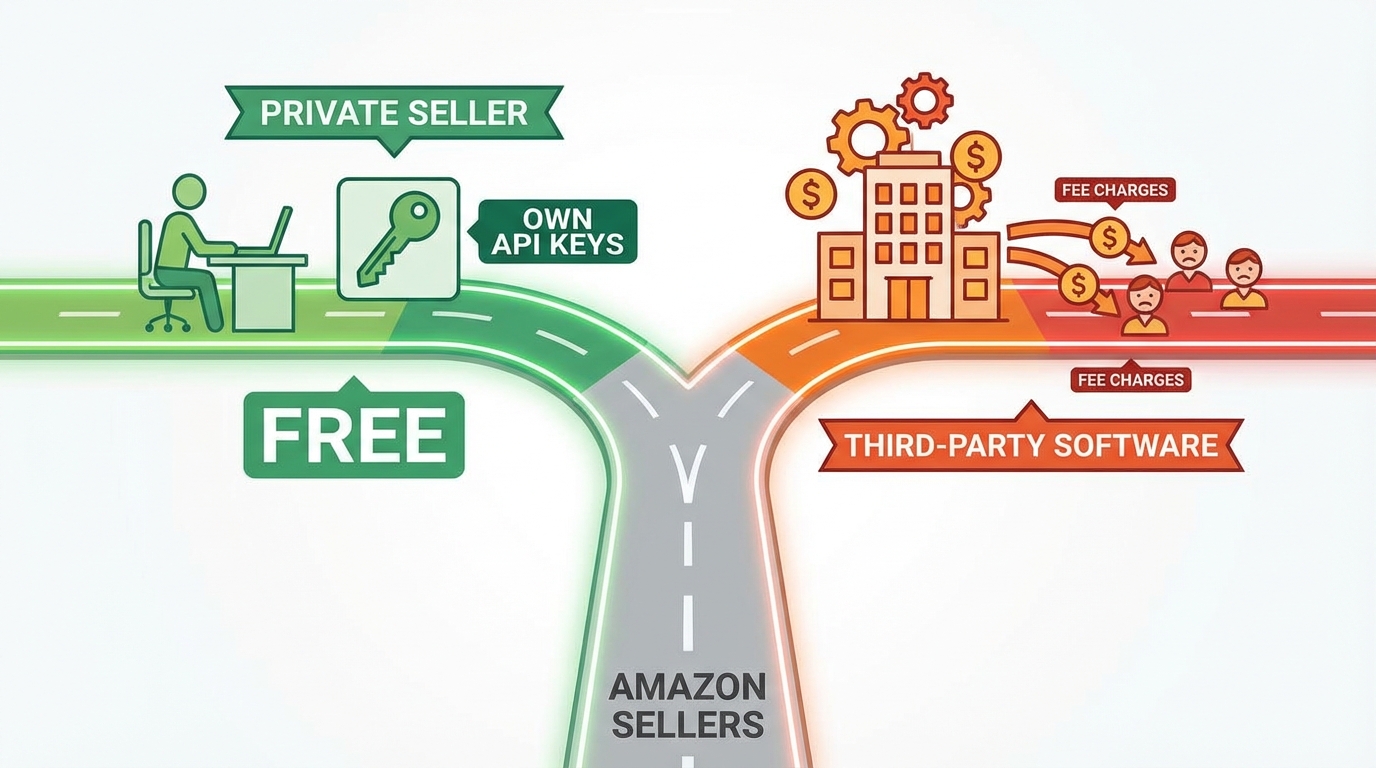
One of the most important — and most misunderstood — aspects of the SP-API fee structure is the clear line Amazon drew between two categories of API users. Getting this distinction right determines whether you are directly affected by the fees or entirely shielded from them.
Private App Users: Fully Exempt
Sellers who use the SP-API exclusively for their own business operations are not subject to any fees under the planned structure. This exemption applies to what Amazon classifies as “private apps” — integrations that a seller builds (or has built) for their own use, authorized against their own seller account, and not made available to other sellers.
Concretely, this means: if you have a developer on your team who built a custom inventory synchronization tool that only touches your ASINs, your orders, and your reports — and that tool uses SP-API keys tied to your private developer account — you owe Amazon nothing under the new fee structure. This private use exemption applies regardless of how many GET calls that internal tool makes. There are no usage caps and no overage charges for private applications.
To qualify, sellers must register as a private developer through Amazon’s Solution Provider Portal (or Seller Central’s developer console), generate their own SP-API credentials, and ensure the app is authorized only against their own account (Amazon permits up to 10 self-authorizations for private apps). The key requirement is that the app not be listed in the Selling Partner Appstore or made available to third parties through OAuth.
Third-Party Developers: Fully Subject to Fees
Developers building applications that serve other sellers’ accounts — the companies behind the tools and platforms that populate the Amazon Selling Partner Appstore — fall squarely in the fee-liable category. These are the businesses whose products you subscribe to monthly or annually: your repricing software, your FBA fee calculator, your keyword tracker, your review management tool.
These developers register as public app developers, publish their applications through official Amazon channels, and use OAuth authorization flows to connect to each of their customers’ seller accounts. That public, multi-seller model is what triggers the fee obligation under Amazon’s framework.
The Grey Zone: Managed Service Providers
There is a category of businesses that sits between these two clean extremes: agencies and managed service providers who build custom integrations for their clients but do not distribute a self-service software product. Amazon’s fee framework was not entirely clear on how these arrangements would be classified, and this ambiguity was another source of frustration cited during the consultation period. Clarification on this grey zone is expected to be part of whatever revised fee structure Amazon announces in fall 2026.
How These Fees Would Have Reached Your Wallet
If you are an Amazon seller who subscribes to third-party tools, you need to understand the financial chain that connects Amazon’s API pricing decisions to your monthly software bill. The mechanism is straightforward, but the magnitude matters.
The Cost Pass-Through Model
Third-party software companies operate on subscription revenue. Their costs include engineering, customer support, cloud infrastructure, marketing — and API access. When API access was free, it was simply not a line item in their cost of goods. Once Amazon’s fee structure takes effect, it becomes a real, recurring, variable cost that has to be covered somewhere.
Software companies have three options: absorb the cost entirely (compressing their margins), raise prices across the board (shifting the cost to sellers), or build tiered pricing based on API usage that passes the variable cost more precisely to high-volume users. Most analysts and industry observers expect the dominant response to be a combination of across-the-board price increases of 10 to 25 percent for the majority of third-party tools, with additional usage-based surcharges for the heaviest API consumers.
Why Repricers and Real-Time Tools Are Most Exposed
Not all seller tools are equally exposed to GET call volume costs. The tools most at risk of significant cost increases are those that rely on frequent, real-time data polling — because every data request is a GET call that counts toward usage totals.
Repricing tools, for example, may poll competitor prices and Buy Box status across hundreds or thousands of ASINs on short intervals — sometimes every few minutes. At scale, a repricing tool serving 500 sellers each with 200 active ASINs could generate hundreds of millions of GET calls per month. That puts the developer squarely in Plus tier territory at $10,000 per month in platform fees, which must ultimately be recouped from subscribers.
Compare this to a keyword research tool that pulls data infrequently on demand — perhaps a user does a research session once a week. That tool’s GET call volume may comfortably sit in the Basic tier, meaning its cost exposure is limited to the $1,400 annual subscription, which works out to just $117 per month amortized. The price impact on users of that kind of tool would be minimal.
The Math for a Typical Seller
Imagine you currently pay $99 per month for a repricing tool. That tool’s developer faces, post-fees, an estimated $2,200 per month in API costs at their usage level. If they have 10,000 subscribers at $99/month, their revenue is $990,000/month and the $2,200 API cost is manageable without a meaningful price increase. But if they only have 500 subscribers? That same $2,200 per month in API costs represents a significant percentage of their revenue, and they will need to raise prices to maintain viability.
This is why the impact will not be uniform across the software ecosystem. Tools with large user bases can spread API costs thinly. Tools with smaller, more specialized audiences — particularly those serving a niche with high API usage — may face the sharpest price increases.
Which Seller Tools Are Most at Risk of Price Increases
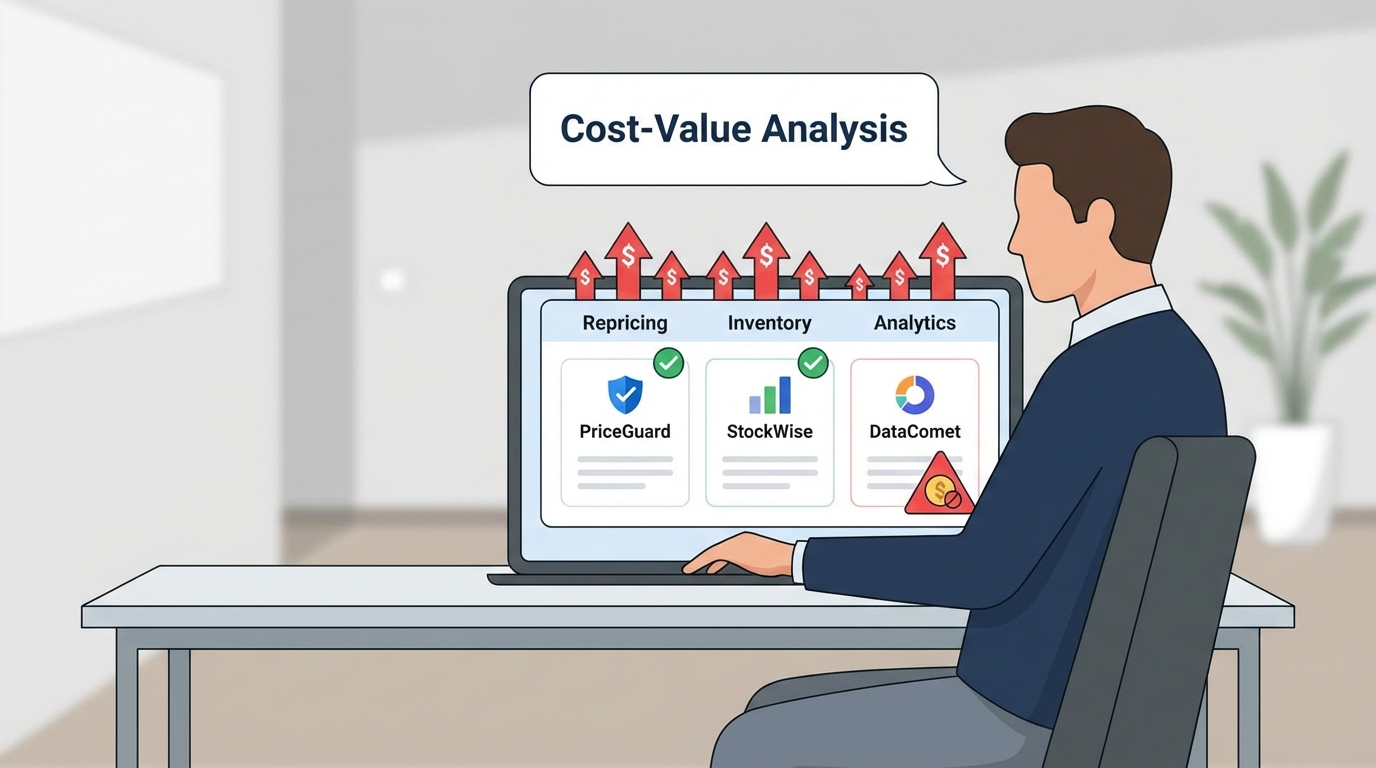
Understanding which categories of tools face the highest API cost exposure helps sellers anticipate where subscription price increases are most likely to originate. Here is a breakdown by tool type, from highest to lowest risk of significant cost pass-through.
Repricing Tools — Highest Risk
Automated repricing platforms are the most GET-call-intensive category in the seller software ecosystem. To function effectively, a repricer must continuously poll the Buy Box status, competitive pricing data, and sales rank for every ASIN in every seller’s catalog it manages. Even at moderate polling intervals, this generates enormous API call volumes. Tools like algorithmic repricers operating at scale will face some of the highest absolute API cost increases of any software category. Sellers who rely on repricing automation should expect pricing conversations with their providers within months of the fees going live.
Inventory Management and FBA Tools — High Risk
Inventory management platforms that track stock levels across multiple warehouses, monitor FBA inbound shipments, and generate reorder alerts also generate substantial GET call activity. These tools continuously poll inventory data endpoints, and any seller managing a catalog of several hundred SKUs will generate significant API traffic through their inventory management tool. The frequency of data refresh is a key variable — tools that update inventory data in near-real-time are far more exposed than those that run nightly batch updates.
Order Management and Multichannel Tools — Medium-High Risk
Order management systems that pull order data, update order statuses, and sync across channels make regular GET calls to Amazon’s Orders API. The volume depends heavily on order frequency — a high-volume seller running thousands of orders per day through a multichannel management tool will generate far more API activity than a small seller running the same software at lower volume. For multichannel tools serving many large sellers, API costs could be a significant new expense.
Analytics and Reporting Platforms — Medium Risk
Analytics dashboards that pull sales data, advertising performance, and financial reports also rely on GET calls, but these are typically not as frequent as operational tools like repricers. Most analytics tools run scheduled report pulls — daily, weekly, or on-demand — rather than continuous polling. This makes their GET call volumes far more predictable and generally lower. The larger platforms in this space (which may also include keyword research features) will likely face modest cost increases, but not the sharp escalation seen in always-on operational tools.
Keyword Research and Listing Optimization Tools — Lower Risk
Keyword and listing tools that help sellers build product listings, research search terms, and analyze competitor content tend to be the least API-intensive category. While they do use the SP-API for catalog and listing data, many of their core functions draw on proprietary datasets and third-party data sources rather than live API calls per user session. The cost exposure for this category is generally the lowest, and price increases for sellers using these tools are expected to be modest — primarily reflecting the $1,400 annual subscription baseline.
The Fall 2026 Timeline: What to Expect Next

Amazon has committed to sharing a revised timeline for SP-API fees no earlier than fall 2026. Beyond that broad window, no specific dates have been confirmed. Here is what the available signals suggest about what to expect from that announcement and the rollout that follows.
A Revised Tier Structure Is Likely
Given that one of the primary complaints was the late addition of the Advanced tier and the resulting forecasting confusion, it is reasonable to expect Amazon to present a more complete and stable tier structure in its fall announcement. The final fee structure may differ in some specifics from what was originally published — different tier breakpoints, adjusted overage rates, or modified included call volumes — but the fundamental architecture of an annual subscription plus usage-based GET call charges is unlikely to change dramatically.
Longer Lead Times for Developers
The original plan gave developers roughly 12 weeks from announcement to first deadline. The community’s feedback made clear that this was insufficient for meaningful financial planning and subscriber communication. The revised rollout will almost certainly include a longer runway — potentially six months or more between the announcement of a final fee structure and the first billing date. This lead time is important for sellers, because it determines how much notice your software providers will have to adjust their pricing before the costs hit their bottom lines.
Greater Clarity on Edge Cases
The grey zones around agencies, managed service providers, and hybrid app models that were unclear in the original announcement will likely be addressed more explicitly in the revised framework. Amazon has an incentive to reduce the number of developers who attempt to reclassify their apps as private (fee-exempt) to avoid charges — so expect more precise definitions of what qualifies as a private versus third-party application.
Potential Structural Adjustments
Some industry observers have speculated that Amazon may adjust the overage rate from $0.40 per 1,000 calls, or raise the Basic tier’s free call allowance above 2.5 million per month. Others have suggested Amazon could introduce a transitional pricing period with reduced rates in year one to ease the transition. None of these adjustments have been confirmed, and sellers should treat them as speculative until Amazon makes a formal announcement.
What Sellers Should Do Right Now
The current pause is a window of opportunity, not a reason to stop paying attention. Here is a practical checklist of steps sellers should take before fall 2026 to be prepared for when the new fee structure is confirmed.
1. Audit Every Tool You Currently Pay For
Make a complete list of every third-party tool in your Amazon tech stack. For each tool, note the category (repricing, inventory, analytics, etc.), the monthly cost, and how central it is to your daily operations. This inventory becomes the foundation for your cost impact analysis when prices eventually change.
2. Identify Which Tools Are Most API-Intensive
Based on the category analysis above, flag which tools in your stack are likely to face the highest cost pressure. Repricing tools and real-time inventory platforms are your highest-risk categories. This helps you prioritize which vendor relationships to monitor most closely and which subscription renewals to negotiate carefully before fees go live.
3. Ask Your Software Providers Directly
Reach out to the customer success teams at your key tool providers and ask them directly: How are you planning to handle the SP-API fee implementation? Will there be price increases? If so, what magnitude, and when? The fact that Amazon has paused the fees does not mean providers are no longer planning for them — responsible software companies are doing cost modeling right now. The vendors who are transparent about their planning are the ones worth keeping in your stack long-term.
4. Evaluate Whether Private API Keys Make Sense for Your Business
If your business has internal technical resources — a developer on staff or a contracted developer you work with regularly — it is worth evaluating whether some of your current third-party tool subscriptions could be replaced or supplemented with private SP-API integrations that are permanently fee-exempt. This is not the right path for every seller, and it requires upfront investment in development and maintenance. But for sellers with specific, well-defined data needs, a private integration can deliver permanent cost advantages compared to escalating third-party subscription costs.
5. Review Contracts and Annual Subscription Terms
If you are about to sign a multi-year contract with any Amazon tool provider, consider whether you want to lock in current pricing for an extended term — which could protect you from price increases — or whether you prefer flexibility to switch if your provider’s pricing becomes uncompetitive after the API fees land. Month-to-month arrangements offer more flexibility; annual prepays often come with discounts that could be worth locking in before prices rise.
6. Monitor Amazon Developer News Channels
Amazon communicates SP-API policy changes through its official developer blog and the Solution Provider Portal. As a seller, you may not have direct access to these channels, but the major seller-focused publications and communities (Seller Central forums, industry newsletters, and e-commerce blogs) typically cover significant API policy updates quickly. Setting up a Google Alert for “Amazon SP-API” is a simple way to stay informed without actively monitoring developer documentation.
7. Build SP-API Fee Costs Into Your Business Planning
Even before Amazon announces a final timeline, you can build a conservative estimate of potential software cost increases into your 2026 and 2027 financial projections. A reasonable assumption of 10 to 15 percent higher costs across your API-dependent tool subscriptions is a defensible planning estimate. Sellers who account for this proactively will be better positioned to adjust pricing, margins, or tool choices when the actual numbers land.
The Bigger Picture: Amazon’s API Monetization Strategy
The SP-API fee structure does not exist in a vacuum. It is part of a broader pattern in how Amazon approaches its third-party ecosystem — and understanding that context helps sellers anticipate what may come next beyond this particular issue.
Monetizing the Ecosystem Layer
For years, the economics of building on Amazon’s platform favored third-party developers. Free API access meant that a small team could build and operate a profitable seller tool with relatively low infrastructure overhead. Amazon, meanwhile, benefited from a rich ecosystem of tools that improved seller performance and retention on the platform — effectively subsidizing the developer ecosystem through indirect marketplace benefits.
The SP-API fee structure represents a shift toward more direct monetization of that infrastructure layer. Amazon spent significant resources building and maintaining the SP-API platform — and the company now appears to view that investment as a cost center that should generate direct revenue, rather than purely an indirect enabler of marketplace health.
Parallels With Other Platform Ecosystems
This is not a pattern unique to Amazon. Other major platform companies have gone through similar transitions when monetizing their API access. In 2023, Reddit dramatically increased API pricing, forcing many third-party apps to shut down or raise prices significantly. Twitter/X introduced tiered API pricing that effectively priced out many independent developers. Apple and Google charge meaningful fees for app store access that ultimately flow through to app developers’ pricing decisions.
The difference in Amazon’s case is the B2B nature of the ecosystem. Amazon’s API users are primarily businesses serving other businesses — and the downstream effect on sellers is more direct and more visible than a consumer feeling the effects of a developer cost change. This visibility is part of what made the pushback from solution providers so effective.
What This Means for the Long Term
The SP-API fee structure, in some form, is coming. Amazon has invested too much in that framing to abandon it entirely. What the March 2026 pause demonstrated is that the company is willing to move more carefully when the implementation risks destabilizing a large portion of the third-party ecosystem it depends on for marketplace health.
Long-term, sellers should expect API access costs to become a permanent part of the software industry’s cost structure in the Amazon ecosystem. The companies that build the best tools and can spread those costs most efficiently across large user bases will be best positioned to compete. Smaller, niche tools may consolidate or pivot. And sellers who rely on many discrete specialized tools may find themselves gravitating toward broader all-in-one platforms that can absorb API costs more efficiently across a wider product surface.
Conclusion: Relief Now, Preparation Later
The indefinite pause of Amazon’s SP-API fees announced on March 9, 2026 is genuinely good news for the short term. Solution providers have more time to model their costs accurately. Sellers have more time before any software price increases arrive. And Amazon has time to redesign a fee structure that is more predictable, more clearly defined, and more fairly communicated to the developer community.
But “paused” is not “cancelled.” When fall 2026 arrives and Amazon shares its revised timeline, the implementation process will begin again. Every seller who relies on third-party tools — and that means virtually every active Amazon seller with any meaningful scale — should expect their software landscape to become somewhat more expensive as a direct downstream consequence of Amazon monetizing its API infrastructure.
The sellers who navigate this most successfully will be the ones who understand what is coming, ask the right questions of their tool providers, build realistic cost assumptions into their planning, and make informed decisions about which tools genuinely deliver value worth a higher price point. The SP-API fee structure is not a reason to panic — it is a reason to pay attention.
Key Takeaways for Amazon Sellers:
- Amazon indefinitely paused all SP-API fees on March 9, 2026, after solution providers cited complexity in business planning. A revised timeline will be shared no earlier than fall 2026.
- The original fee structure included a $1,400 annual developer subscription and $0.40 per 1,000 GET calls beyond each tier’s monthly allowance, starting April 30, 2026.
- Sellers using private SP-API keys for their own internal business tools are fully exempt from all fees — now and in the revised structure.
- Third-party tool providers will face real cost increases, which industry estimates suggest will be passed to sellers as price hikes of 10 to 25 percent for many subscriptions.
- Repricing tools and real-time inventory platforms carry the highest cost exposure due to their high GET call volumes.
- Use the current pause window to audit your tool stack, communicate with your providers, and build conservative cost estimates into your 2026–2027 financial planning.