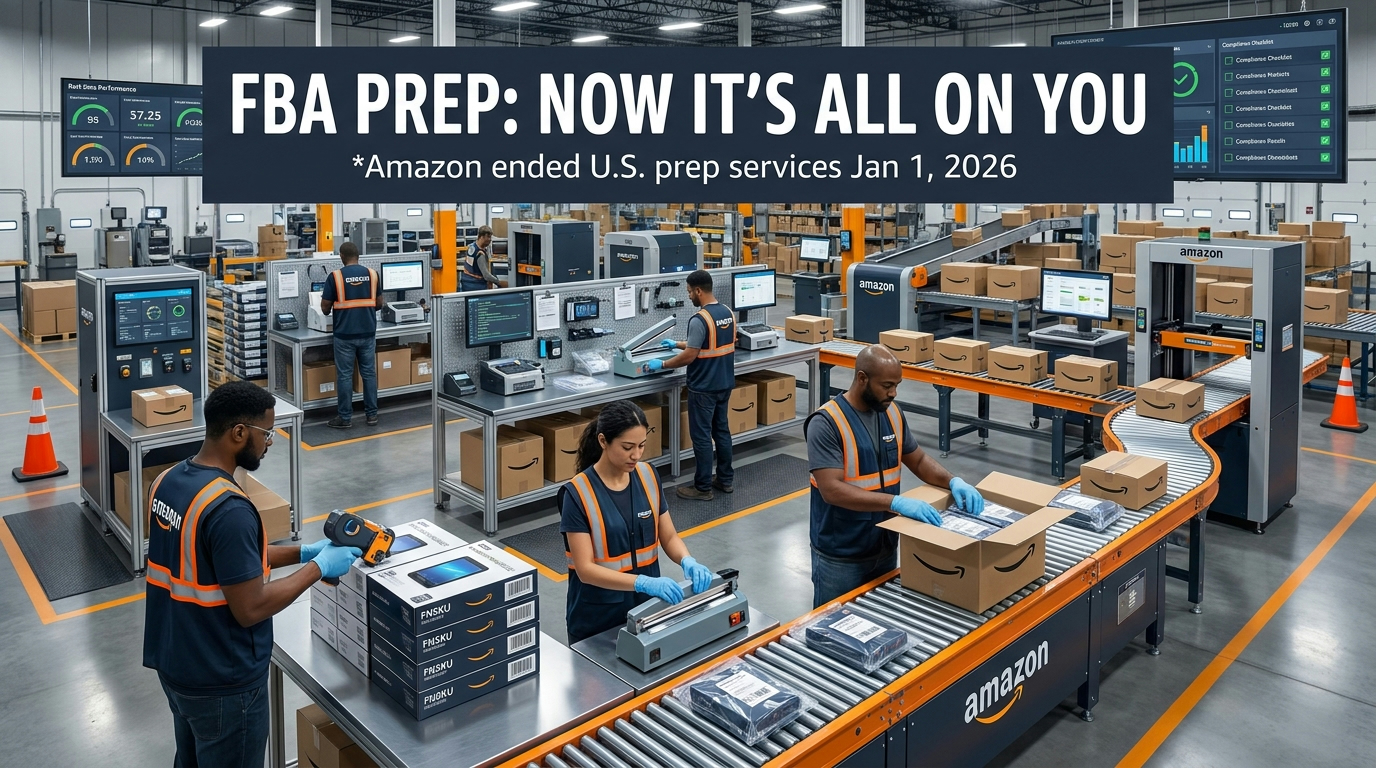

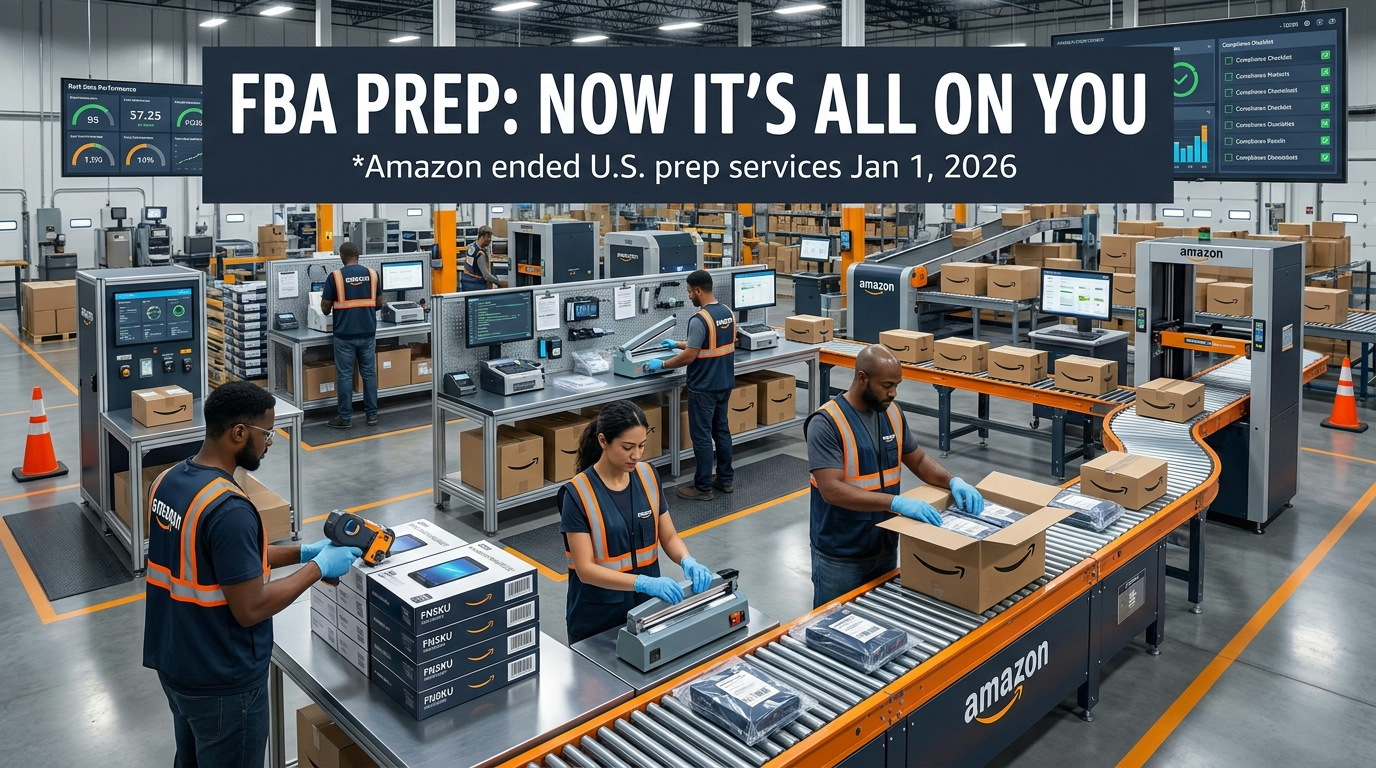
For years, Amazon’s in-house prep and labeling service existed as a quiet safety net. If a seller forgot to polybag a unit, mislabeled a carton, or shipped unprocessed inventory straight from a manufacturer, Amazon could—for a fee—absorb some of that operational sloppiness at the fulfillment center. It wasn’t ideal. It cost money and added receiving time. But it existed, and a surprising number of sellers had quietly built their workflows around it.
That safety net is gone.
On January 1, 2026, Amazon formally discontinued its U.S. FBA prep and item-labeling services. No more Amazon-side polybagging. No more FNSKU application at the FC. No more using AMAZON as a valid prepOwner or labelOwner value in the SP-API inbound flows. Whatever prep your inventory needs, it now has to be done before that inventory arrives — whether by you, your supplier, or a third-party prep center.
The practical consequences are still rippling through seller operations. Inbound defect fees have been restructured and increased. Non-Brand Registry resellers face tighter FNSKU requirements than ever. And shipment-splitting decisions — previously a logistics consideration — now carry real per-unit cost implications depending on how you route inventory.
This post isn’t about the policy announcement. That news has been covered extensively. This is about what comes next: how to build a prep workflow that can absorb the change, stay compliant at scale, and not quietly hemorrhage money through errors, rework, and defect fees. Whether you’re running prep in-house, outsourcing it to a partner, or pushing it upstream to a factory, the framework matters. Here’s how to build it right.
What Amazon Actually Turned Off — And What Stayed the Same
There’s been enough noise around the January 2026 change that it’s worth being precise about what actually changed versus what sellers may have assumed changed. The scope is narrower than some sellers feared, but the operational impact is larger than it first appears.
What was discontinued
Amazon’s U.S. FBA prep service — the in-fulfillment-center service where Amazon would polybag, bubble wrap, apply FNSKU labels, or otherwise prep units after receiving — is no longer available for new inbound shipments. This includes item-level labeling. If you were previously selecting Amazon as your label owner or prep owner in the Send to Amazon workflow, that option is no longer valid in the U.S. store.
At the API level, AMAZON is no longer an accepted value for prepOwner or labelOwner in U.S. inbound shipment flows. Sellers integrating through the SP-API needed to update their integration logic accordingly — and those who haven’t will find shipments failing validation.
What didn’t change
Amazon’s prep guidance — the part of the Send to Amazon flow that tells you what prep category applies to your product — is still there. Amazon will still tell you whether a product needs polybagging, bubble wrapping, taping, or another prep type. It just won’t perform that prep for you. The guidance remains; the execution is now entirely your responsibility.
Complicating things further, Amazon also updated FNSKU requirements for non-Brand Registry resellers on March 31, 2026. Under the new policy, manufacturer barcodes are no longer sufficient as the sole identifier on FBA units for this seller segment. Every unit needs a scannable FNSKU — which means prep workflows that previously relied on passthrough with manufacturer barcodes intact now need a labeling step that didn’t exist before.
The compounding effect
These two changes — prep service removal and tightened FNSKU rules — don’t just add tasks. They change where compliance responsibility lives in your supply chain. Previously, a missed label or a unit that arrived in unsuitable packaging could be caught and corrected inside the FC. Now it triggers a non-compliance event, and non-compliance has a fee structure attached to it that gets more expensive the further downstream the problem is caught.
The New Compliance Baseline — What Every Unit Now Needs Before It Leaves Your Hands
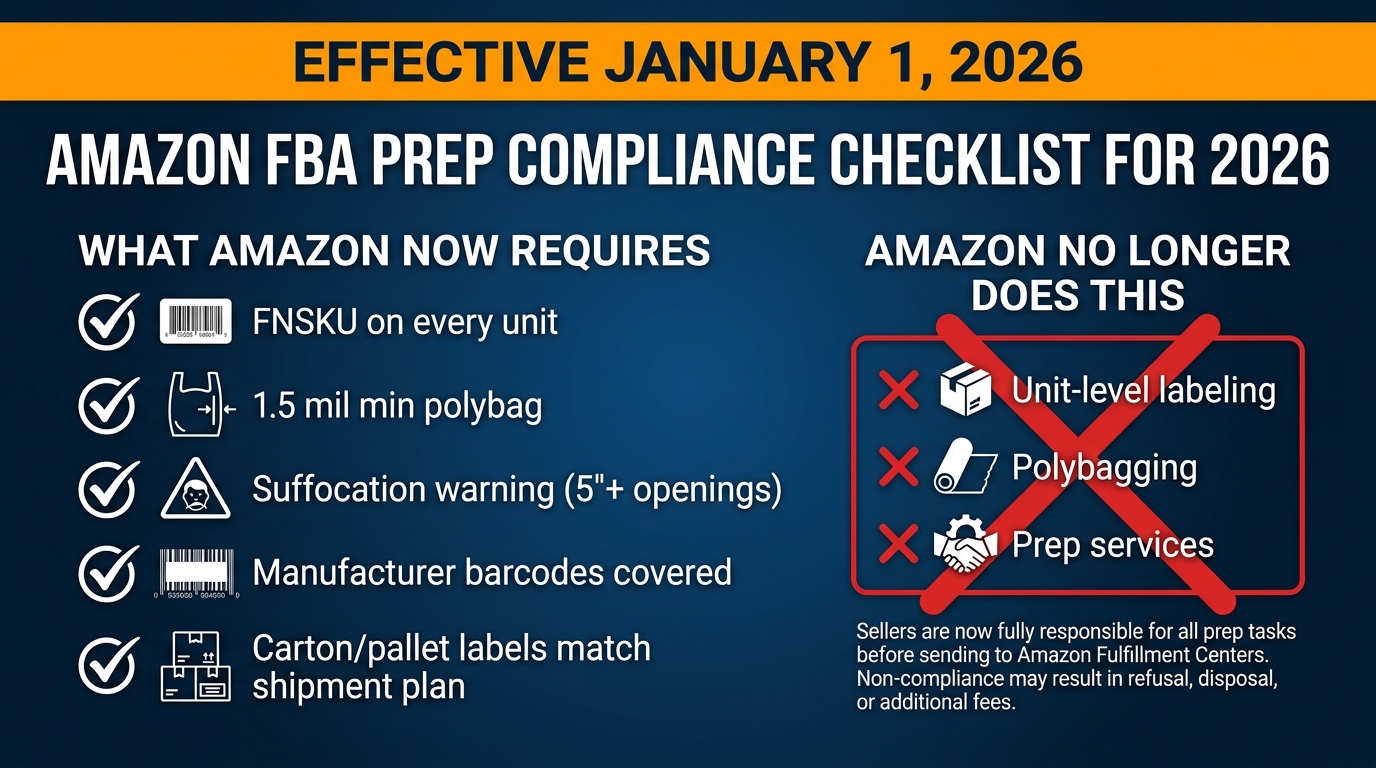
With prep responsibility now sitting entirely with sellers and their partners, understanding the current compliance requirements isn’t optional background knowledge — it’s the operational foundation every shipment has to be built on. Here’s where the bar sits in 2026.
FNSKU labeling
Every sellable unit needs exactly one scannable FNSKU label on the outermost surface of the product or its packaging. The label must be flat, unobstructed, and readable — not placed on a curved surface, folded edge, or across a seam. High contrast matters: Amazon’s scanning equipment at FCs reads labels at speed, and anything that reduces contrast or readability risks a receiving failure.
Where a product has a manufacturer barcode (UPC, EAN, ISBN) visible on the packaging, that barcode must be covered unless the FNSKU itself is sufficient and no separate manufacturer barcode masking is required. For most non-Brand Registry sellers, covering the manufacturer barcode is now a mandatory step, not an optional best practice.
Polybagging requirements
When polybagging is the required prep type (and Amazon’s prep guidance tool will tell you whether it is), the polybag must be at least 1.5 mil thick — this is non-negotiable. The bag must be fully transparent unless the product category specifically calls for opaque packaging, must be completely sealed, and must display a suffocation warning if the bag opening is 5 inches or larger in diameter. That warning needs to be either printed directly on the bag or affixed as a label visible from outside.
One of the most common errors prep centers and in-house operations make is using polybags that technically meet thickness requirements but fail on sealing — either because the seal is inconsistent or because the bag was closed but not heat-sealed where heat-sealing is the expected method for the product type. An improperly sealed polybag at FC receiving is treated as a prep failure.
Carton and pallet labeling
Each carton in your shipment needs a carton label that matches the shipment plan exactly — the right shipment ID, box ID, and ASIN breakdown. Any mismatch between what the shipment plan says is in a box and what physically arrives in that box creates a reconciliation event at the FC, which at minimum delays receiving and at worst triggers a defect flag. Pallet labels, when applicable, follow their own layout and placement requirements that vary by shipment type and destination.
Category-specific prep
Amazon’s prep guidance covers more than just polybagging. Depending on product type, units may require bubble wrap with a minimum number of inches of coverage on all sides, bagging with specific closure types, taping with specific tape widths, or assembly into bundles that must ship and scan as a single unit. Category-specific requirements — particularly for fragile items, sharp items, products with liquid, and items sold as sets — have their own specifications within Amazon’s prep guidance. These need to be documented at the SKU level within your own workflow, not looked up on an ad hoc basis.
The Upstream Shift — Why Your Factory or Supplier Is Now Your First Line of Defense
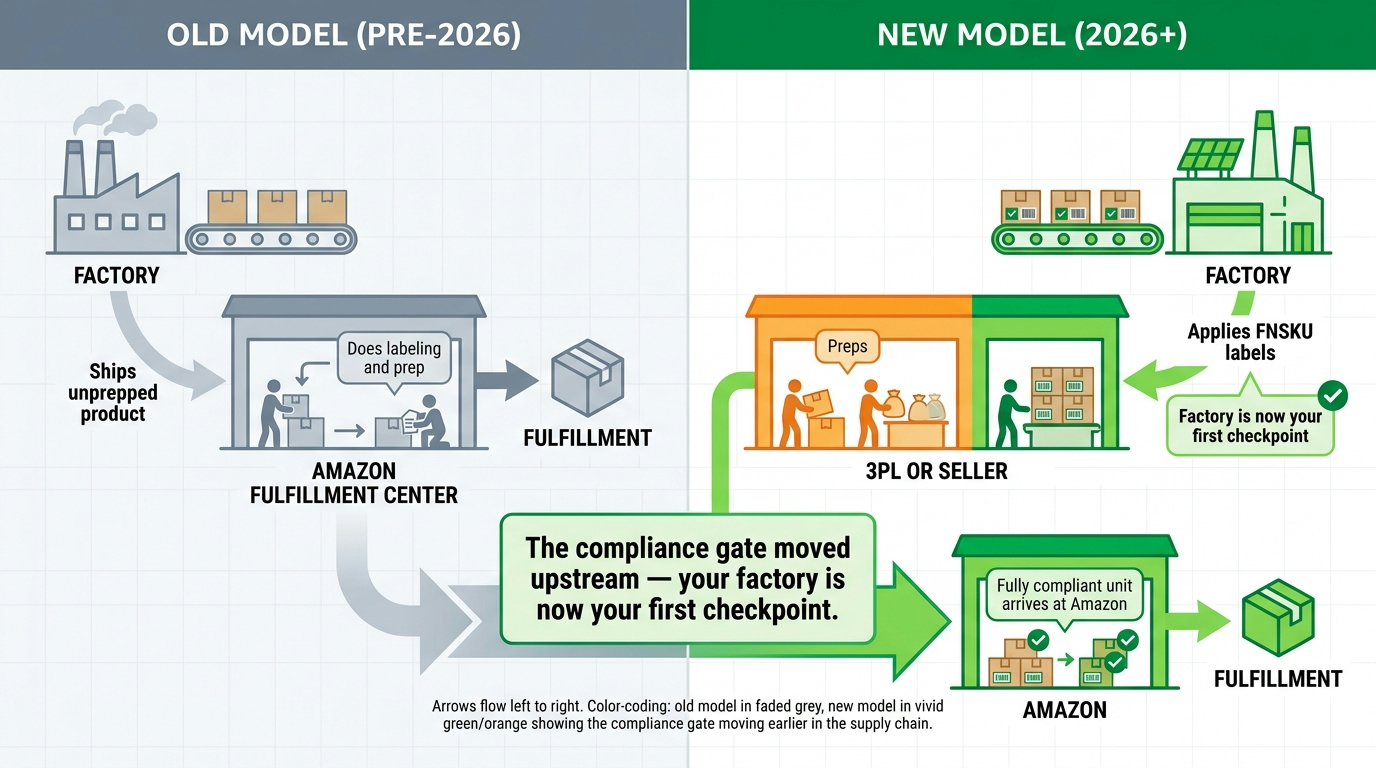
The operational model that’s gaining the most traction among experienced sellers isn’t just “do your own prep” or “use a prep center.” It’s the concept of moving the compliance gate upstream — closer to the origin of the inventory, whether that’s a domestic manufacturer, a domestic supplier, or an overseas factory. The further back in the supply chain you catch and prevent prep problems, the less they cost you.
Why factory-level prep changes the economics
When a FNSKU label is applied incorrectly at a prep center, you have a rework cost. When the same error makes it past the prep center and gets caught at Amazon’s FC, you have a defect fee on top of the rework cost — plus potential delays to receiving time that affect your restock velocity. When that same error is caught at the factory before the goods even ship, the cost is almost zero: a reprint and a re-application during the same production run.
The math compounds over volume. At 5,000 units per shipment with a 1% labeling error rate and a $0.60 inbound defect fee per affected unit, that’s 50 units triggering fees — $30 per shipment, maybe $90–120 per quarter. Preventable, but only if the error is caught before Amazon’s receiving scanners see it.
Supplier training and specification documents
Moving compliance upstream requires turning your prep requirements into supplier-facing documentation that’s specific, unambiguous, and version-controlled. This isn’t a verbal briefing. It’s a written prep specification that tells your factory or supplier exactly what goes on every unit, in what position, with what label dimensions, in what order, with what packaging around it.
The most effective spec documents include physical mockups or annotated photos showing correct label placement. A factory in Guangdong or Shenzhen may have never prepared an Amazon FBA shipment before — a text description of “FNSKU on outermost surface, flat and scannable” means something different to a production floor manager than an annotated image showing exactly where the label goes and what it looks like when applied correctly.
Pre-shipment inspection as the upstream QC gate
A formal pre-shipment inspection — either through a third-party inspection service or your own QC team if you have in-country resources — is the most reliable way to catch prep errors before goods ship. A solid pre-shipment inspection for FBA-bound inventory should include label verification (scan each FNSKU to confirm it’s the correct one for the ASIN), polybag integrity check, suffocation warning verification where required, carton content count against the packing list, and photo documentation of a representative sample.
Photo evidence from pre-shipment inspection serves a dual purpose: it catches problems before they ship, and it creates the documentation record you need if a shipment discrepancy occurs at the FC and you need to dispute a reconciliation outcome. That documentation chain — factory photos, inspection report, packing list, BOL — is what separates sellers who win inbound disputes from those who absorb losses with no recourse.
QC gate checkpoints in a robust upstream workflow
A well-designed upstream workflow doesn’t rely on a single inspection point. It runs a series of gates: a production-line check (is the correct FNSKU being applied to the correct SKU?), a packing check (is each unit going into the correct carton with the correct carton label?), a pre-shipment audit (does the physical count match the packing list and shipment plan?), and a photo archive step. Each gate has a documented pass/fail criterion, and nothing moves to the next stage without passing the previous one.
Building an In-House Prep Workflow That Doesn’t Fall Apart at Volume
Not every seller has the supplier relationships or the production-scale relationships that make factory-level prep viable. For domestic sourcing, retail arbitrage, or smaller-volume private label operations, in-house prep is often the only practical option. The challenge is that in-house prep tends to work fine at low volume and fall apart as SKU count and unit count grow — because it was built informally and never hardened into a real operating system.
The SOP layer: why informal isn’t sustainable
The single most common in-house prep failure mode isn’t a lack of equipment or space — it’s a lack of documented standard operating procedures at the SKU level. When prep knowledge lives in one person’s head, two things inevitably happen: errors go up when that person is absent, and onboarding new prep staff becomes expensive and error-prone. A written SOP for each product category — ideally with annotated photos showing correct vs. incorrect prep — is the foundation every in-house operation needs before it can scale.
Your SOP structure should cover, at minimum: receiving verification (check quantity and condition against PO), SKU/ASIN matching (confirm the product matches the FNSKU before anything is applied), prep sequence (what goes on first, second, last), label placement (exact position, with photographic reference), carton packing (how units are arranged, maximum carton weight, carton label placement), and final QC step (who signs off and on what criteria).
Physical setup: the stations that prevent errors
An in-house prep operation that runs well is usually organized into discrete stations rather than having each worker handle every step for every unit. A receiving station handles inbound count and condition check. A labeling station has FNSKU label rolls loaded and organized by ASIN, with a label verification scanner. A packaging station handles polybagging, bubble wrapping, or other prep types. A QC station does a final pass before units go into cartons. A packing station builds cartons and applies carton labels against the shipment plan.
The separation matters because it creates accountability checkpoints. If a mislabeled unit makes it through a dedicated labeling station with a verification scanner, that’s an auditable event. If each worker is doing all steps end-to-end, the error trail disappears.
Technology for in-house prep
The minimum viable technology stack for in-house FBA prep includes a thermal label printer (for FNSKU labels — laser and inkjet labels fail Amazon’s durability standards at receiving), a barcode scanner capable of verifying FNSKUs before and after application, a shipment management system that syncs with your Send to Amazon workflow, and some form of inventory tracking that connects your physical receive to your Seller Central shipment plan. Spreadsheets can handle part of this at low volume, but they don’t scale — errors multiply as SKU count grows and multiple people touch the same shipment plan.
Managing peak volume without breaking compliance
In-house prep operations are disproportionately vulnerable to Q4 volume spikes and promotional periods. When throughput doubles, the pressure to cut corners — skipping the QC step, combining station roles, processing cartons without a final scan — goes up sharply. Building your SOPs with a documented peak protocol — including explicit rules about what steps can never be skipped regardless of volume pressure — is what separates in-house operations that hold compliance at peak from those that show up in defect reports in November and December.
The True Cost of In-House Prep vs. Outsourcing — The Math Most Sellers Get Wrong
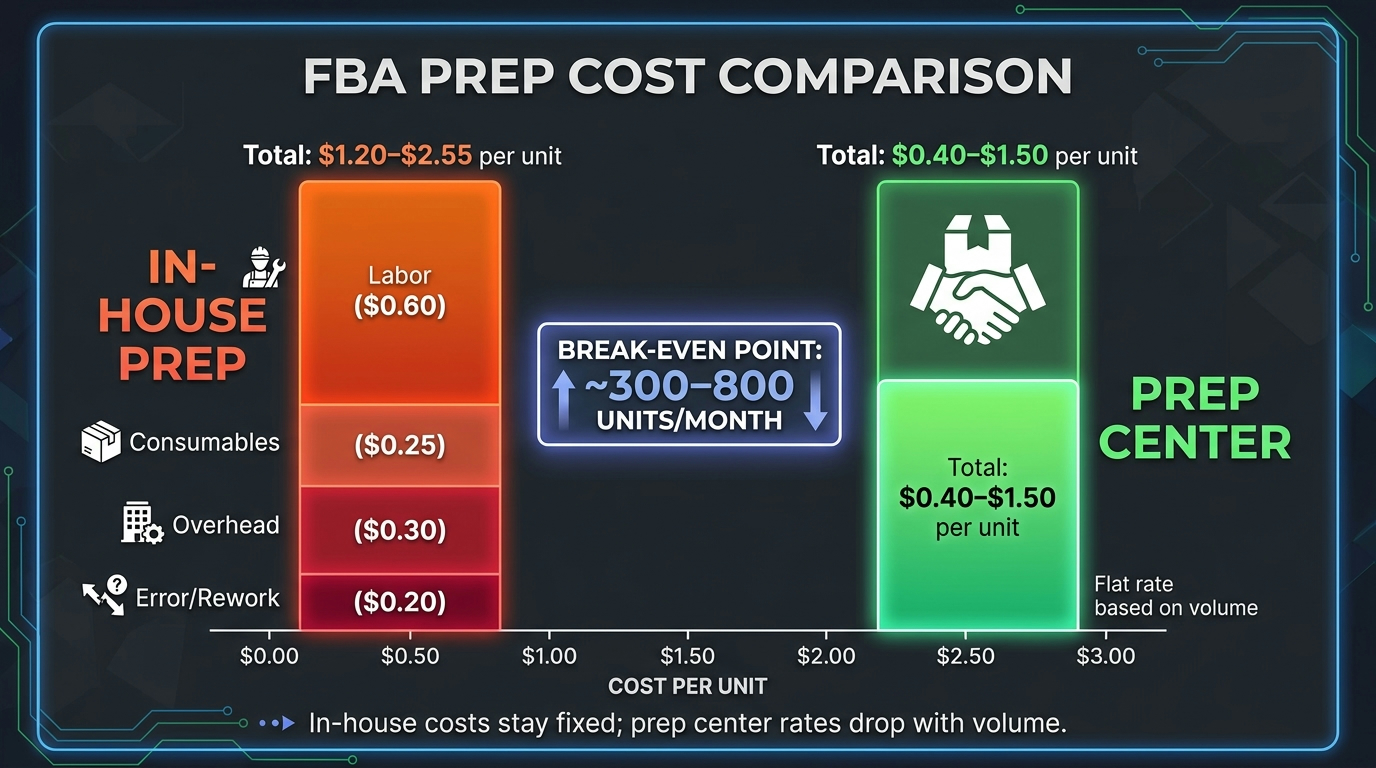
The make-vs-buy question in FBA prep is one of the most consistently miscalculated decisions in Amazon operations. The reason is that sellers typically compare their visible in-house labor costs to a prep center’s quoted per-unit rate — and the comparison looks favorable to in-house because the quote misses most of the real cost picture on both sides.
What in-house prep actually costs when you load it fully
Current 2026 industry estimates place fully-loaded in-house prep cost at $1.20–$2.55 per unit for most standard products, depending on the complexity of prep required and your local labor rate. That range includes:
- Direct labor: The hourly labor cost per unit, including time for receiving, labeling, packaging, QC, and carton packing — typically 2–5 minutes per unit for standard prep when done correctly
- Consumables: FNSKU label rolls, thermal printer ribbon, polybags, bubble wrap, tape, carton materials — often $0.15–$0.30 per unit when totaled
- Overhead allocation: Warehouse space for the prep operation, utilities, equipment depreciation (printer, scanner, shelving), and management time — frequently omitted entirely from seller cost estimates
- Error and rework cost: The per-unit cost of mistakes — relabeling, rebagging, reworking cartons, and the defect fees from errors that make it through to Amazon — which adds $0.05–$0.20 per unit even in well-run operations
- Opportunity cost: The most invisible cost — the management bandwidth spent on prep operations that could be deployed to sourcing, listing optimization, or advertising
When sellers calculate in-house prep cost using only their hourly wage and a rough consumables estimate, they typically undercount by 40–60%. The decision to keep prep in-house isn’t wrong — but it needs to be made with honest numbers.
What outsourced prep actually costs
Current 2026 third-party prep center pricing clusters around $0.40–$1.50 per unit for standard prep (polybagging, labeling, inspection), with the rate varying based on volume commitments, product complexity, and which additional services (kitting, bundling, returns processing, palletizing) are included. At higher volumes — typically 2,000+ units per month — many prep centers offer tiered pricing that can bring the standard rate below $0.40 per unit.
The honest costs to layer in on the outsourced side include: receiving fees (often $10–$25 per shipment or per pallet received), storage fees when inventory sits at the prep center before processing, surcharges for oversized or heavy items, handling fees for returns or rework, and the cost of your own time managing the prep center relationship, reviewing invoices, and resolving discrepancies.
Where the break-even actually falls
Published 2026 analysis suggests the volume crossover point — where in-house prep becomes genuinely cheaper than outsourcing — sits around 300–800 units per month at the low end and 2,500+ units per month at the high end, depending heavily on labor rate, overhead assumptions, and prep complexity. Below roughly 300 units per month, outsourcing is almost always cheaper when costs are fully loaded. Above 2,500 units per month of consistent, predictable volume, in-house prep can pencil out — but only if the operation is systematized well enough to hold the error rate below the threshold where defect fees eat the savings.
The number most sellers miss: at 1,000 units per month with a 2% inbound defect rate (20 units), the $0.60 average defect fee generates $12 in fees per shipment cycle. At $0.32–$5.72 per unit depending on product size and defect type, a few shipments with elevated error rates can turn a competitive in-house cost structure into a more expensive one than outsourcing would have been.
Selecting a Third-Party Prep Center — A Due Diligence Framework
With Amazon’s in-house service gone, the prep center market has grown — and that growth hasn’t been uniform in quality. Choosing the wrong prep partner in 2026 means trusting your inbound compliance to a provider who may not keep pace with Amazon’s current requirements. Here’s how to evaluate prep centers with the rigor the decision now demands.
Compliance capability verification
The first filter is whether the prep center is current on Amazon’s 2026 requirements. Ask specific questions: Do they apply FNSKUs using thermal printing (not inkjet or laser)? Do they verify FNSKU scan quality before bagging? Do they know the polybag thickness requirement (1.5 mil minimum)? Do they understand the suffocation warning trigger (5-inch bag opening)? If answers are vague or rely on “we follow Amazon’s guidelines” without specifics, move on. The specifics are the guideline.
Ask for documentation of their inbound defect rate history. A reputable prep center should be able to show you that statistic. If they can’t, or won’t, that’s a signal about how they think about error accountability.
Turnaround time with service level agreements
Turnaround time — from when inventory arrives at the prep center to when the shipment is sent to Amazon — directly affects your restock velocity and IPI score. Ask for a written SLA, not a verbal estimate. The SLA should specify: standard processing time (typically 24–72 hours for standard prep), what happens during peak season, what penalty or remedy applies if SLA is missed, and how expedite requests are handled.
A prep center that won’t commit to written SLAs is telling you something about how they manage operational accountability.
Pricing transparency
Ask for a sample invoice, not just a rate card. The difference between what a prep center advertises and what you actually pay is often substantial once you add receiving fees, storage fees, per-ASIN setup fees, special project surcharges, minimum monthly fees, and outbound shipment fees. The only way to know the true cost is to see what a real invoice looks like for a shipment similar to yours.
Itemized pricing — where you can see exactly what you’re being charged for each service type — is the standard you should expect. Bundled or opaque pricing makes it impossible to audit whether you’re being charged correctly and makes cost comparisons meaningless.
Inventory visibility and reporting
You should be able to see, in real time or near-real time, exactly what inventory is at the prep center, in what stage of processing, and what shipments have been sent and when. Prep centers that offer a client portal or integration with your own inventory management software eliminate a significant source of operational friction and error. Prep centers that manage inventory on spreadsheets and communicate via email introduce reconciliation risk at every step.
Trial shipment before full commitment
Before routing significant volume to any prep center, send a small trial shipment — 100–200 units of a manageable SKU — and evaluate the result against specific criteria: Were all FNSKUs correctly applied and scannable? Was the polybag thickness and seal correct? Did the carton labels match the shipment plan exactly? Was the receiving-to-ship time within the stated SLA? Was the invoice itemized and accurate? A trial shipment is the most reliable signal you’ll get about a prep center’s actual operational quality versus their sales pitch.
The Inbound Placement Fee Puzzle — How Your Prep Strategy Affects What You Pay Amazon
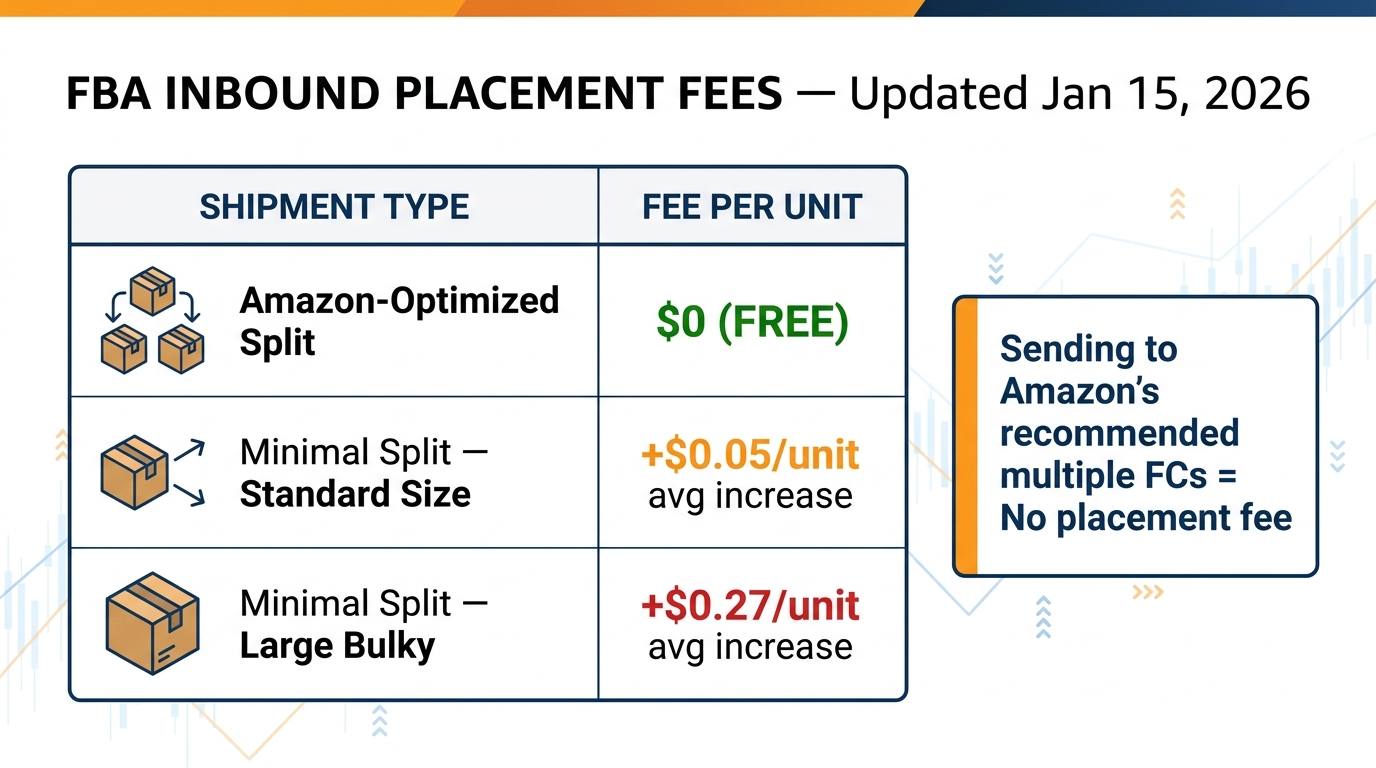
FBA prep decisions don’t exist in isolation. Where you prep your inventory, how you structure your shipments, and how you route your cartons to Amazon’s fulfillment centers directly interact with the inbound placement fee structure that was updated in January 2026. The combination of prep changes and placement fee changes creates a connected optimization problem that most sellers are still solving independently when they should be solving together.
What the fee structure looks like in 2026
Amazon’s inbound placement service fee is a per-unit charge that applies when you choose fewer fulfillment center destinations than Amazon’s algorithm recommends. The fee structure updated on January 15, 2026 with the following changes:
- Amazon-optimized shipment splits: $0.00 per unit. Send inventory to Amazon’s recommended multiple fulfillment center locations, and no placement fee applies. This remains the cheapest option.
- Minimal shipment splits — standard size: Average increase of approximately $0.05 per unit above 2025 rates. The fee now varies by weight band rather than a single flat rate per size tier.
- Minimal shipment splits — Large Bulky: Average increase of approximately $0.27 per unit above 2025 rates — a more material increase that makes consolidated shipping for bulky items significantly more expensive.
How prep strategy connects to placement fees
The connection is operational. To qualify for the Amazon-optimized split (and avoid placement fees entirely), Amazon requires at least five identical cartons or pallets per item being shipped to each destination. That requirement has prep implications: your carton content needs to be consistent and standardized across the shipment, which is harder to achieve with informal prep workflows and mixed carton content. A well-structured prep SOP — where carton sizes are standardized and carton content is consistent — makes it easier to meet Amazon’s split requirements reliably.
Prep centers that manage shipment plan creation within their workflow can often build the Amazon-optimized split into their standard service. If your prep center is creating shipment plans on your behalf and defaulting to minimal splits without discussing placement fees with you, that’s worth a conversation — the difference in fees can be material, particularly for large-format or high-volume SKUs.
The bulky SKU problem
For sellers whose catalog includes Large Bulky or oversized items, the January 2026 fee increase for minimal splits is particularly significant. At $0.27+ per unit average increase for Large Bulky, a 500-unit shipment that previously cost $X for a minimal split now costs roughly $135 more per shipment cycle in placement fees alone. Over a year with multiple shipments, that compounds quickly. If your catalog has a meaningful share of Large Bulky SKUs, your prep and shipping strategy needs to be built around qualifying for optimized splits — which means working with your prep center or logistics provider to structure cartons and pallets accordingly.
Documentation, Reconciliation, and Dispute-Proofing Your Shipments
Even in well-run operations, inventory discrepancies happen. Units get miscounted at the FC. Cartons get separated from shipments. Receiving errors occur. The difference between sellers who recover these losses and those who absorb them is almost always documentation — and the discipline to build documentation into the prep workflow before it’s needed, not after a problem has already occurred.
The documentation chain that wins disputes
A complete documentation chain for an FBA shipment includes, at minimum: the purchase order or supplier invoice (proof of inventory ownership), the packing list from prep (unit count and carton breakdown), the shipment plan exported from Seller Central (the authoritative record of what Amazon should receive), photos of pallets and cartons as loaded (timestamped), the BOL from the freight carrier with proof of pickup, and the delivery confirmation or POD from the destination FC.
Amazon’s reconciliation workflow — accessible through the Contents tab in Seller Central — asks for both proof of inventory ownership and proof of delivery when you open a research request on missing units. Sellers who have these documents ready at shipment time resolve disputes faster and with better outcomes than those scrambling to reconstruct documentation weeks after the fact.
Reconciliation timelines and what to do while you wait
Amazon states that shipment reconciliation typically takes 2 to 30 days, though it can extend to 60 days in some cases. During the reconciliation window, the key operational discipline is not to create a new shipment plan to replace missing units until the reconciliation is either resolved or formally denied — creating a duplicate shipment before reconciliation closes creates a compounding inventory accounting problem that’s difficult to unravel.
Monitor the Contents tab in Seller Central for each open shipment. When the status shows “Units expected” vs. “Units located” with a discrepancy, use the “Action required” options to file a research request as soon as the shipment is marked received. The faster you open the research request, the easier it is for Amazon to investigate while the receiving records are fresh.
Photo evidence as standard operating procedure
The prep centers and in-house operations that resolve the fewest disputes are the ones that treat photo documentation as a standard part of every shipment — not something they do when they suspect a problem. A short photo protocol — photos of opened cartons showing unit count and prep quality, photos of sealed cartons with carton labels visible, photos of the full pallet load before shrink wrap — takes minutes and creates a verifiable record that’s worth multiples of that time investment if a dispute arises.
Common Prep Mistakes That Are Still Getting Sellers Hit With Defect Fees
The inbound defect fee structure updated for shipments created on or after January 15, 2026 applies to misrouted, deleted, abandoned, and incomplete shipments, with average fees around $0.60 per unit and ranges from $0.32 to over $5.72 per unit depending on product size and the nature of the defect. Here are the patterns that are generating the most defect fees in 2026.
Deleting or abandoning shipment plans mid-process
One of the most consistently expensive mistakes in the post-January 2026 environment is creating a shipment plan in Send to Amazon and then deleting or abandoning it after inventory is in transit. This triggers an inbound defect fee even if the inventory itself was correctly prepped. The fix is upstream: don’t create the shipment plan until prep is complete and the shipment is confirmed for pickup. Creating plans speculatively and then abandoning them when logistics change is a fee-generating habit that many sellers haven’t broken yet.
Misrouted shipments
Routing inventory to the wrong fulfillment center — sending a shipment to a different FC than the one specified in the shipment plan — triggers a misrouted shipment defect fee. This happens most often when a prep center or logistics provider manually overrides the shipment routing without updating the plan in Seller Central, or when a carrier delivers to the wrong facility. The prevention is carrier instructions that explicitly reference the destination FC address from the shipment plan, and a confirmation step that the pickup and delivery address on the BOL match the shipment plan.
FNSKU on the wrong surface
A surprisingly common error is applying the FNSKU to the correct unit but on a surface that doesn’t scan reliably at FC receiving: placed on a curved bottle, affixed across a seam, applied over a glossy surface that causes glare, or placed where it’s partially obscured by the polybag seal. Each of these results in a scan failure at receiving that either delays processing or triggers a compliance flag. The solution is a label placement mockup for every unique product format, included in the SKU-level prep SOP.
Carton content mismatch
A carton with 24 units that the shipment plan says contains 25 units — or a carton where mixed SKUs are packed in a box designated for a single SKU — creates a receiving discrepancy that either delays reconciliation or generates a defect flag. This is an error that’s almost entirely preventable through a final carton count and contents verification before carton sealing. The cost of one person spending 30 seconds counting and verifying before taping a carton is trivially small compared to the cost of a reconciliation event or defect fee.
Non-compliant polybag thickness
Using polybags below the 1.5 mil minimum is one of the compliance issues that’s hardest to catch without deliberate QC — because a non-compliant polybag looks and functions identically to a compliant one. Amazon’s FC receiving process includes polybag compliance checks, and substandard polybags can result in prep failure flags. The solution is to source polybags only from suppliers who certify mil thickness, verify thickness with a gauge on new bag stock, and reject any polybag stock that can’t be verified against specification.
The Metrics That Tell You Your Prep Workflow Is Working — Or Quietly Failing
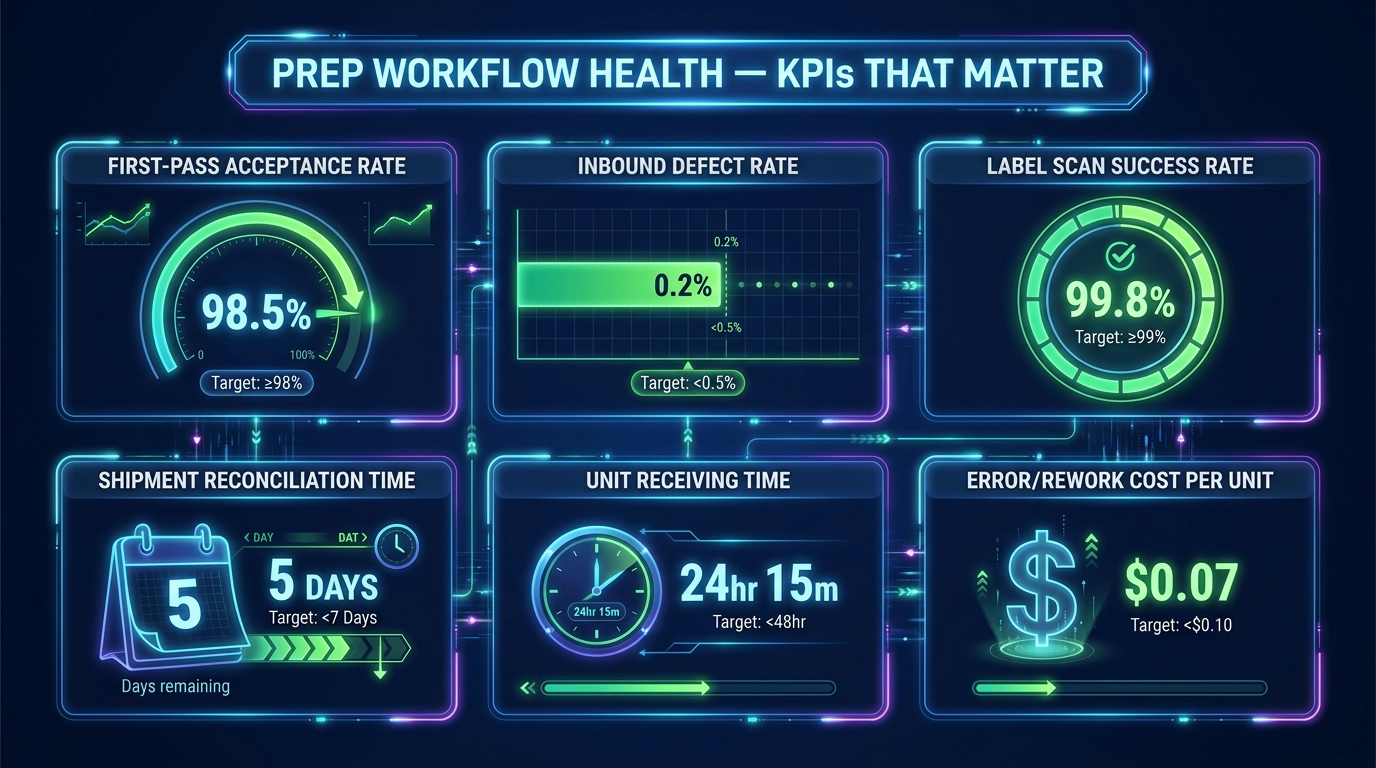
A prep workflow that’s running well should be provable with data — not assumed to be fine because no one has complained recently. These are the metrics that tell you whether your compliance is holding or slowly eroding.
First-pass acceptance rate
The percentage of units that are received by Amazon without requiring any rework, reprocessing, or follow-up action. This is the primary indicator of prep quality. A well-run operation should target a first-pass acceptance rate of 98% or higher. Below 95% is a signal that something systematic is wrong — not just random variation — and deserves a root cause investigation. If you’re using a prep center, ask them to report this metric to you monthly. If they don’t track it, that’s itself a finding.
Inbound defect rate
The percentage of shipments or units that trigger an inbound defect fee. Amazon reports this in your inbound performance dashboard in Seller Central. Your target should be as close to 0% as possible; anything above 0.5% at steady state warrants a workflow review. Track this over time — a slowly rising trend is more actionable than a single spike, because a trend signals a process drift rather than an isolated incident.
Label scan success rate
For in-house operations with a label verification scanner (and prep centers should be reporting this too), the label scan success rate measures the percentage of FNSKUs that scan correctly on the first attempt after application. A rate below 99% suggests a labeling process problem — wrong surface selection, label quality issues, printer calibration drift, or placement errors. This is best caught before units are bagged or packed into cartons, where correction is cheapest.
Receiving-to-available time
The elapsed time from when Amazon marks your shipment as received to when inventory shows as available for sale in your FBA inventory. Extended receiving times — beyond the typical 24–72 hours for standard shipments — can signal prep compliance issues that are holding units in secondary inspection. Monitoring this metric by shipment and flagging outliers gives you early warning that a prep quality issue is causing delays before it shows up in your defect rate.
Shipment reconciliation cycle time
How long does it take, from shipment creation to final reconciliation in Seller Central, to close your shipment records? For compliant shipments, this should typically be under 7 days. Shipments that stay open in reconciliation for weeks or months are either the product of documentation gaps, content mismatches, or receiving errors that weren’t caught early. Tracking average reconciliation cycle time gives you visibility into the downstream cost of prep and documentation errors, even when no defect fee was charged.
Building Prep Compliance as a Durable Competitive Advantage
It’s tempting to think about FBA prep compliance as a hygiene function — something you do to avoid fees and rejections, not something that differentiates your business. That framing undersells what operational excellence in prep actually produces for sellers who take it seriously.
Restock velocity and IPI score
Sellers with consistently compliant, fast-turnaround prep workflows maintain higher restock velocity — they can replenish FBA inventory faster, with fewer delays, and with more predictable lead times. That velocity compounds into better IPI scores (Amazon’s Inventory Performance Index), which in turn affects storage limits and access to certain FBA programs. Prep compliance isn’t disconnected from these outcomes. It’s part of the supply chain that determines whether your inventory is in stock when customers are searching for it.
The capacity to scale without operational debt
In-house prep operations and prep center relationships that are built on documented SOPs, verified metrics, and clear SLAs can scale with your business without accumulating what engineers call “technical debt” — in this context, the operational debt of undocumented processes, unresolved error patterns, and informal workarounds that make scaling expensive. Sellers who invest in compliance infrastructure when volume is manageable can grow without repeatedly rebuilding their prep operation from scratch.
The supplier relationship as a compliance asset
Factories and suppliers that are trained to apply FNSKUs correctly, pack cartons to spec, and generate accurate packing lists are operational assets — they reduce your prep cost, reduce your error rate, and give you more flexibility in how you design your domestic logistics. That relationship takes time and documentation investment to build, but the return compounds over every subsequent shipment those suppliers handle.
Actionable next steps
If you’re building or rebuilding your prep workflow in the wake of Amazon’s 2026 changes, here’s the priority sequence:
- Audit your current inbound defect rate and first-pass acceptance rate — establish a baseline so you know what you’re solving for
- Document prep SOPs at the SKU level for your top 20 ASINs, including annotated label placement photos
- Run the fully-loaded cost math on in-house vs. outsourced prep with real numbers — not just quoted rates
- If using a prep center, send a trial shipment and evaluate against the due diligence criteria above before routing significant volume
- Build a shipment documentation protocol that creates photo evidence and a document chain for every shipment, before you need it for a dispute
- Review your inbound placement fee strategy — if you’re on minimal splits for Large Bulky or standard items, calculate whether optimized splits are feasible and cost-effective for your volume
- Establish supplier or factory prep specs in writing for any inventory that’s prepped at origin, with physical or photographic reference standards
The sellers who treat prep compliance as an operational system — rather than a task list — are the ones who will absorb the 2026 changes without absorbing the costs. The shift in responsibility from Amazon to sellers isn’t going to reverse. The question is whether your workflow is built to own that responsibility, or just hoping it doesn’t become a problem.
FBA prep used to be something Amazon could partially backstop. In 2026, the backstop is gone. The sellers who will absorb this change most cleanly are the ones who build their compliance process upstream, document it thoroughly, measure it honestly, and treat it as a core operational function — not an afterthought.