



Why Department-Level Thinking Changes Everything About AI Automation
Most businesses approach AI automation the same way they once approached cloud migration: as a company-wide initiative with a sweeping mandate, a large vendor contract, and a timeline that quietly slips every quarter. The results, more often than not, are underwhelming. Not because the technology doesn’t work, but because the question being asked is wrong.
Asking “How do we automate our business with AI?” is a bit like asking “How do we improve our building with construction?” The answer depends entirely on which room you’re standing in, what’s broken, and what materials are actually available. The same principle applies here. AI automation doesn’t land the same way across Finance as it does in Customer Service. The dynamics in HR are fundamentally different from those in Legal. And what works brilliantly inside an Operations team can stall completely inside a Sales org — not because the technology changes, but because the data structures, process variability, and human judgment requirements are completely different.
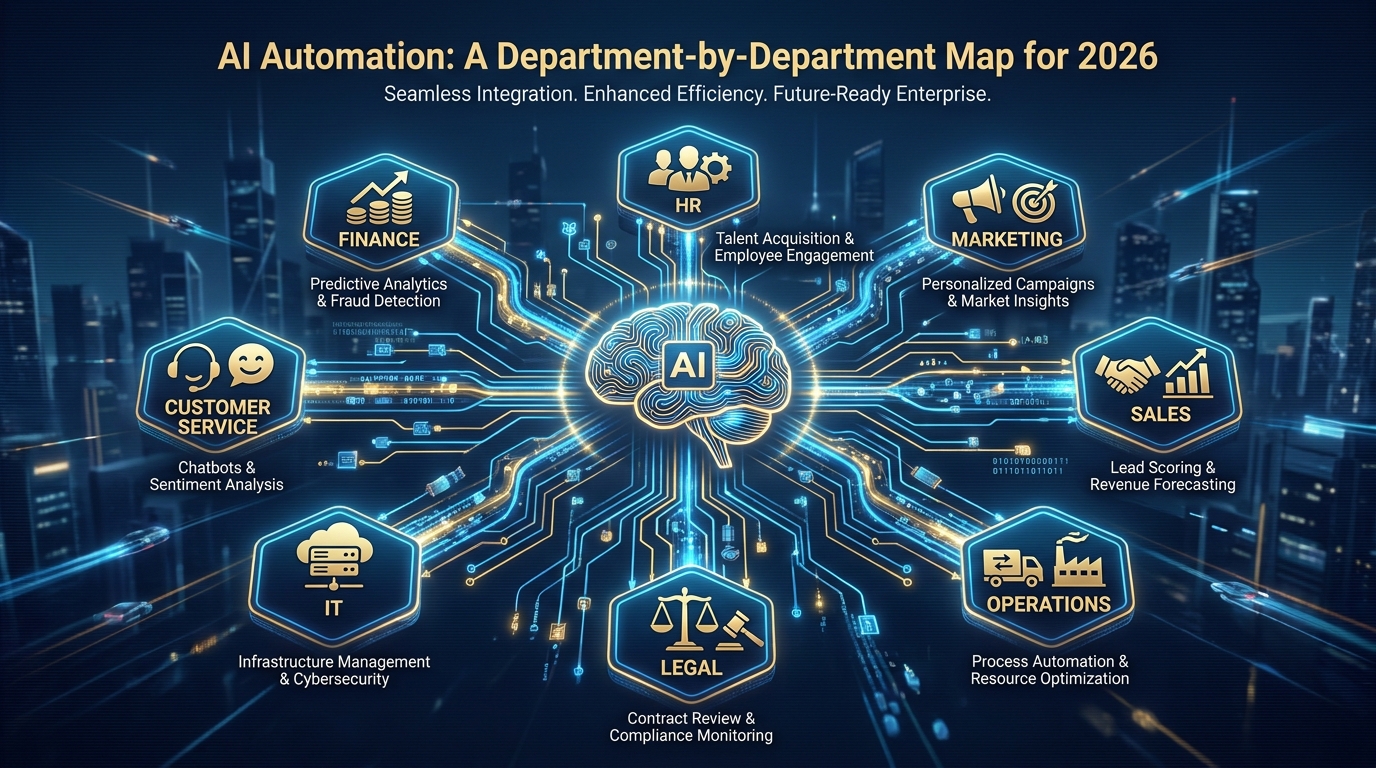
In 2026, the businesses pulling measurable value from AI automation are the ones that stopped thinking about it as a monolithic initiative and started treating it as a department-by-department decision framework. They asked sharper questions: Which processes in this specific function are structured enough for automation? Where is the data clean enough to trust AI outputs? Where does human judgment matter so much that automation adds risk rather than reducing it?
This guide answers those questions across nine core business functions. For each department, we examine what’s genuinely working, what tends to disappoint, the tools seeing the most real-world adoption, and the warning signs that an automation play is likely to fail before it starts. At the end, we’ll walk through a prioritization framework you can use to map your own organization’s best starting points.
This isn’t theory. It’s a map built from what’s actually happening inside businesses right now.
Finance and Accounting: The Highest-Confidence Automation Zone
If you’re looking for the safest, most validated entry point into AI automation, Finance and Accounting is it. Of all business functions, this department has the clearest combination of attributes that make automation successful: highly structured data, well-defined rules, low tolerance for ambiguity, and measurable output quality.
Where AI Automation Delivers in Finance
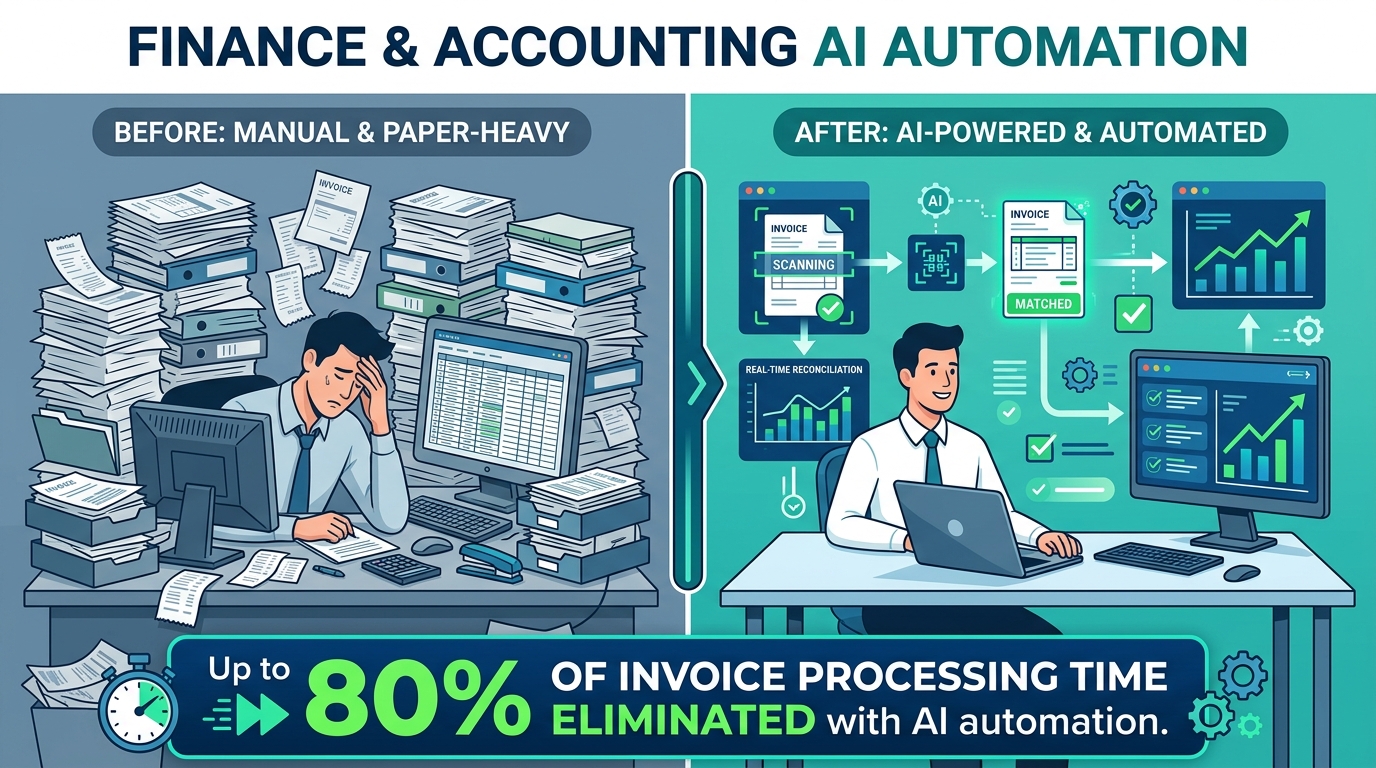
Accounts payable and invoice processing is the canonical finance automation use case — and for good reason. AI-powered document processing tools can extract data from invoices in virtually any format, match them against purchase orders, flag discrepancies, and route approvals automatically. Organizations that have deployed this at scale report processing time reductions of 70–80%, alongside meaningful drops in error rates compared to manual keying. The ROI case is straightforward to build because the inputs (volume of invoices, hours per invoice, error cost) are measurable before you start.
Bank reconciliation and transaction categorization are equally strong candidates. Modern AI models can classify thousands of transactions per hour with accuracy rates that meet or exceed careful human review — a task that often consumed dozens of analyst hours per month in mid-sized organizations. The key requirement is clean, consistent bank data feeds; where those exist, automation payback periods can be measured in weeks rather than quarters.
Financial close processes have seen significant AI impact at larger organizations. Automated journal entries, intercompany reconciliation, and variance analysis reporting now run with minimal human intervention in companies that have invested in structured data pipelines. McKinsey’s research has found that the financial close process — traditionally one of the most labor-intensive monthly cycles — can be compressed substantially when AI handles the data assembly and initial analysis layers.
Expense management and fraud detection represent another high-confidence zone. AI models trained on historical expense patterns can flag out-of-policy submissions, identify duplicate claims, and surface anomalous spending patterns that human reviewers would almost certainly miss at volume.
Where Finance Automation Tends to Disappoint
Automating financial forecasting is the area where expectations most frequently outrun reality. AI can significantly improve forecast accuracy in stable, data-rich environments — but many finance teams operate with inconsistent historical data, frequent model changes, and business context that purely quantitative systems can’t adequately weight. AI-assisted forecasting tends to work best as an input layer for human analysts rather than a replacement for the judgment layer.
Complex tax and regulatory compliance is another zone where automation should be approached carefully. Rule-based automation for straightforward compliance tasks works well. But the interpretive, jurisdiction-specific complexity of tax law means that AI remains most useful as a research and flagging tool rather than a final decision-maker.
What to Actually Do First
Start with accounts payable automation — it’s the clearest path to fast, measurable ROI in Finance. Run a two-week baseline study counting invoice volume, hours spent, and error rates. That baseline becomes your business case. Tools like BILL, Tipalti, Stampli, and enterprise-grade options like SAP Concur AI modules all have mature AP automation capabilities. The selection decision should be driven by your ERP compatibility first, vendor pricing second.
“The businesses that win in financial automation aren’t chasing the most sophisticated AI — they’re automating the most repetitive, highest-volume processes with the cleanest data first. That discipline compounds.”
Customer Service: Real Gains Hidden Behind Inflated Expectations
Customer service is probably the department with the widest gap between AI automation hype and real-world outcomes. The pitch is seductive: deploy AI chatbots, deflect 80% of tickets automatically, dramatically reduce headcount. The reality is messier — but there’s still genuine value here for businesses willing to be clear-eyed about what automation can and cannot own.
What AI Customer Service Automation Actually Does Well
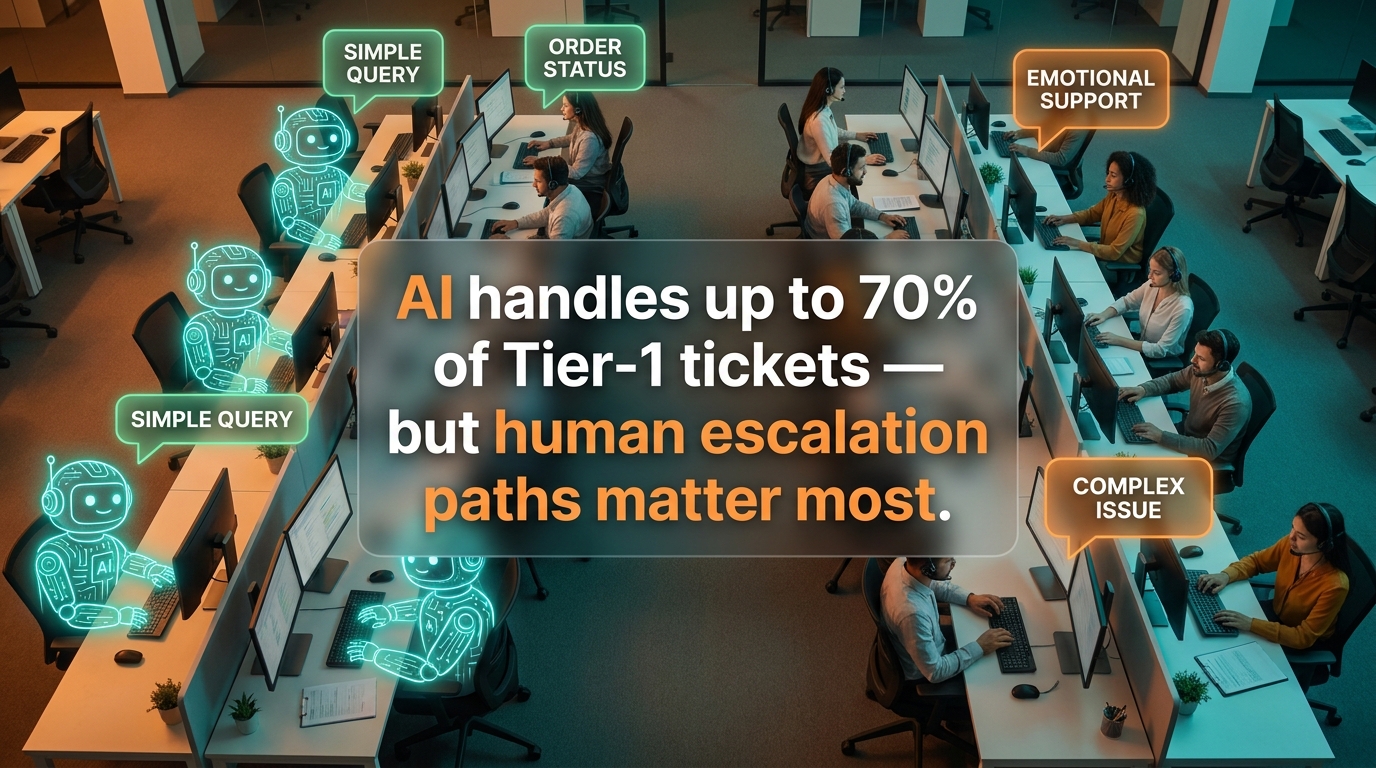
Tier-1 ticket resolution — covering password resets, order status inquiries, returns initiation, account balance checks, and FAQ-type questions — is where AI chatbots and virtual agents consistently deliver. These are queries with structured answers, low emotional stakes, and high volume. When companies deploy well-trained AI agents on this layer, deflection rates of 50–70% are realistic without sacrificing customer satisfaction — provided the bot has a clean handoff path to a human when it reaches its limits.
That “clean handoff” caveat is not a footnote. It is the entire ballgame. The customer service automations that generate negative outcomes are almost always ones that fail to route complex or emotionally charged interactions to a human promptly. When a frustrated customer who just received a damaged product, or a worried parent asking about a children’s product recall, hits a chatbot loop that can’t escalate cleanly — the damage to brand loyalty is measurable and lasting.
Agent assist tools represent perhaps the most underrated AI application in customer service. Rather than replacing agents, these tools surface relevant knowledge base articles, previous interaction history, and suggested responses in real time as a human agent works through a conversation. Call handling times drop, first-contact resolution rates improve, and onboarding time for new agents compresses significantly. This is AI in an augmentation role — and the evidence consistently shows it outperforms pure replacement strategies on customer satisfaction metrics.
Post-interaction analysis at scale is another strong use case. AI can analyze thousands of customer service transcripts per day to identify recurring complaint themes, measure agent performance, detect sentiment trends, and surface product issues before they become crises. Doing this at the volume modern businesses require is simply not possible with manual review.
Where Customer Service Automation Genuinely Struggles
Anything involving complex emotional situations — disputes, complaints involving personal distress, escalated billing conflicts — requires human empathy that current AI systems cannot reliably replicate. The technology can detect negative sentiment, but detecting it and responding appropriately to it are very different challenges. Businesses that automate these interactions often see significant drops in resolution rates and customer retention.
Multilingual, dialect-sensitive, or highly idiomatic customer bases still present real challenges. AI models perform better in standard English than in regional dialects, code-switching communications, or complex grammatical structures common in many global markets. This is improving, but it’s a genuine limitation to account for in deployment planning.
The Right Framing for Customer Service Automation
Think in tiers. Map your ticket types by volume and complexity. Identify the tier-1 slice that is high-volume, low-complexity, and structured — that’s your automation target. Protect your high-empathy, high-complexity interactions for human agents. And invest seriously in agent assist tools as a parallel track, because the ROI evidence there is consistently strong regardless of company size.
Sales and CRM: Automation That Helps Reps vs. Automation That Replaces Judgment
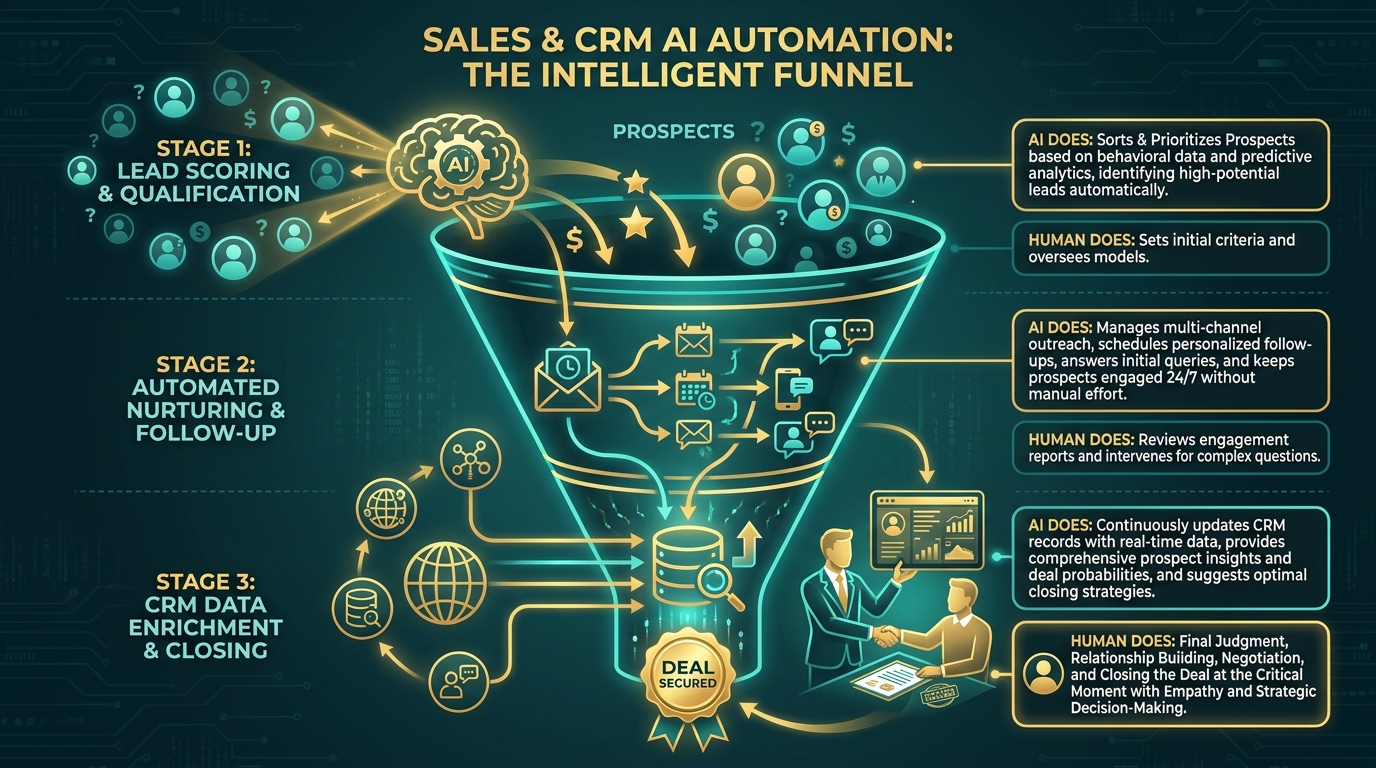
The sales department is where AI automation generates some of the strongest results — and some of the most spectacular failures — depending entirely on whether the automation is supporting human judgment or trying to replace it. Understanding that distinction is more important than any specific tool selection.
Where AI Automation Earns Its Keep in Sales
Lead scoring and prioritization is the highest-ROI application in most sales environments. AI models trained on historical win/loss data, engagement signals, firmographic data, and CRM activity can rank incoming leads with dramatically more accuracy than static rule-based scoring systems. Sales teams using AI-driven lead scoring consistently report that their reps spend less time on low-probability accounts and more time on deals with genuine close potential. The conversion rate improvements from this reallocation of rep time are often more significant than any improvement in individual deal performance.
Automated CRM data entry and enrichment addresses one of the most consistent complaints in every sales org: reps don’t update the CRM. AI tools that listen to calls, parse emails, and auto-populate activity fields remove this friction almost entirely. Tools like Gong, Chorus, and Salesforce Einstein now handle post-call logging, contact data enrichment, and opportunity stage updates with minimal rep input. The secondary benefit — cleaner CRM data — compounds over time by making forecasting and pipeline analysis more reliable.
Outbound sequence automation has been a standard tool in sales for years, but AI has substantially improved it. Rather than static cadences sent to everyone on a list, AI-driven outbound tools now personalize send times, message variants, and follow-up intervals based on individual engagement patterns. The result is a measurable improvement in reply rates without a proportional increase in rep effort.
Sales forecasting is another genuine strength. AI models that incorporate pipeline data, historical close rates by rep and deal size, seasonal patterns, and market signals produce forecasts that are consistently more accurate than spreadsheet-based approaches — especially as deal volume scales beyond what any individual manager can intuitively track.
Where Sales Automation Destroys Value
Any automation that removes human judgment from the relationship layer tends to backfire. Automated email sequences that send generic messages to enterprise decision-makers, AI-generated proposals lacking genuine personalization, or chatbot-driven qualification flows for high-value prospects — these approaches consistently produce lower conversion rates and occasionally damage relationships that took months to build.
The principle is clear: automate the administrative and analytical layers of sales aggressively. Protect the relationship and judgment layers from automation entirely.
There’s also a risk with over-relying on AI scoring in early-stage markets. If the training data reflects historical patterns in established verticals, the model can systematically under-score genuinely high-potential accounts in new segments — creating a self-fulfilling prophecy where reps deprioritize the exact prospects the business most needs to convert.
Practical Starting Points for Sales AI
Begin with call recording and AI analysis — it’s the fastest path to visible ROI and the least disruptive to existing workflows. Deploy CRM auto-enrichment in parallel. Then tackle lead scoring once you have six months of clean CRM data to train against. Save outbound sequence AI for after reps are comfortable with the tool ecosystem — resistance from the sales team is the single most common reason these deployments stall.
Marketing Operations: Where AI Automation Compounds Over Time
Marketing is unique among business functions in that AI automation delivers on two distinct timescales: fast tactical wins in content and campaign execution, and slower but larger compounding returns in personalization and predictive analytics. Understanding both timescales matters for setting the right expectations with stakeholders.
The Fast-Win Layer: Content, Campaigns, and Reporting
Content generation at scale is where most marketing teams start — and it’s a legitimate starting point. AI writing assistants can generate first-draft blog posts, social media captions, email subject line variants, product description copy, and ad headlines at a pace that no human content team can match. The critical operational discipline here is treating AI output as a first draft requiring human editorial review, not a final product. Teams that deploy AI content generation without a review layer frequently see quality and brand voice consistency issues that create downstream problems with audience trust.
Email marketing automation has been around for decades, but AI has substantially elevated it. Modern AI-driven email platforms can personalize send time, content block selection, subject lines, and even offer sequencing at the individual subscriber level based on behavioral history. The lift in open rates and click-through rates from this level of personalization is well-documented — typically 15–30% improvement over non-personalized campaigns in comparable tests.
Marketing reporting and attribution is a function that most marketing teams dramatically underinvest in automating. Manual report compilation from multiple platforms — paid social, organic search, email, direct — consumes significant analyst hours every week. AI-powered BI tools and native platform integrations can collapse this to near-zero, freeing analysts to spend time on insight generation rather than data assembly.
The Compounding Layer: Personalization and Predictive Analytics
Audience segmentation and predictive modeling are where AI automation delivers returns that scale with data volume. The more behavioral data a marketing system accumulates, the more accurately AI can predict which message, offer, and channel combination will drive conversion for each individual. This isn’t a Day 1 capability — it requires data infrastructure, integration work, and model training — but organizations that invest in building it see conversion efficiency gains that compound year over year.
SEO and content strategy automation is emerging as a significant efficiency driver. AI tools can now analyze search intent across thousands of keywords, identify content gap opportunities, flag technical SEO issues, and prioritize content investments based on traffic potential — replacing what used to be weeks of manual analyst work with hours of AI-assisted research.
Paid media optimization sits in an interesting middle ground. Platform-native AI bidding has improved significantly, but it requires careful configuration and ongoing monitoring. The discipline is in knowing what signals to feed the AI, not in setting it to fully automated and walking away.
The Marketing Automation Trap to Avoid
The most common failure mode in marketing AI automation is automating volume without automating quality control. Brands that use AI to publish twenty blog posts a month but don’t establish editorial standards, accuracy checks, and brand voice reviews quickly erode the credibility they spent years building. More output is only valuable if the output meets the quality bar. Build the review process before you scale the generation.
HR and Talent: The Quiet Department Getting Real Results
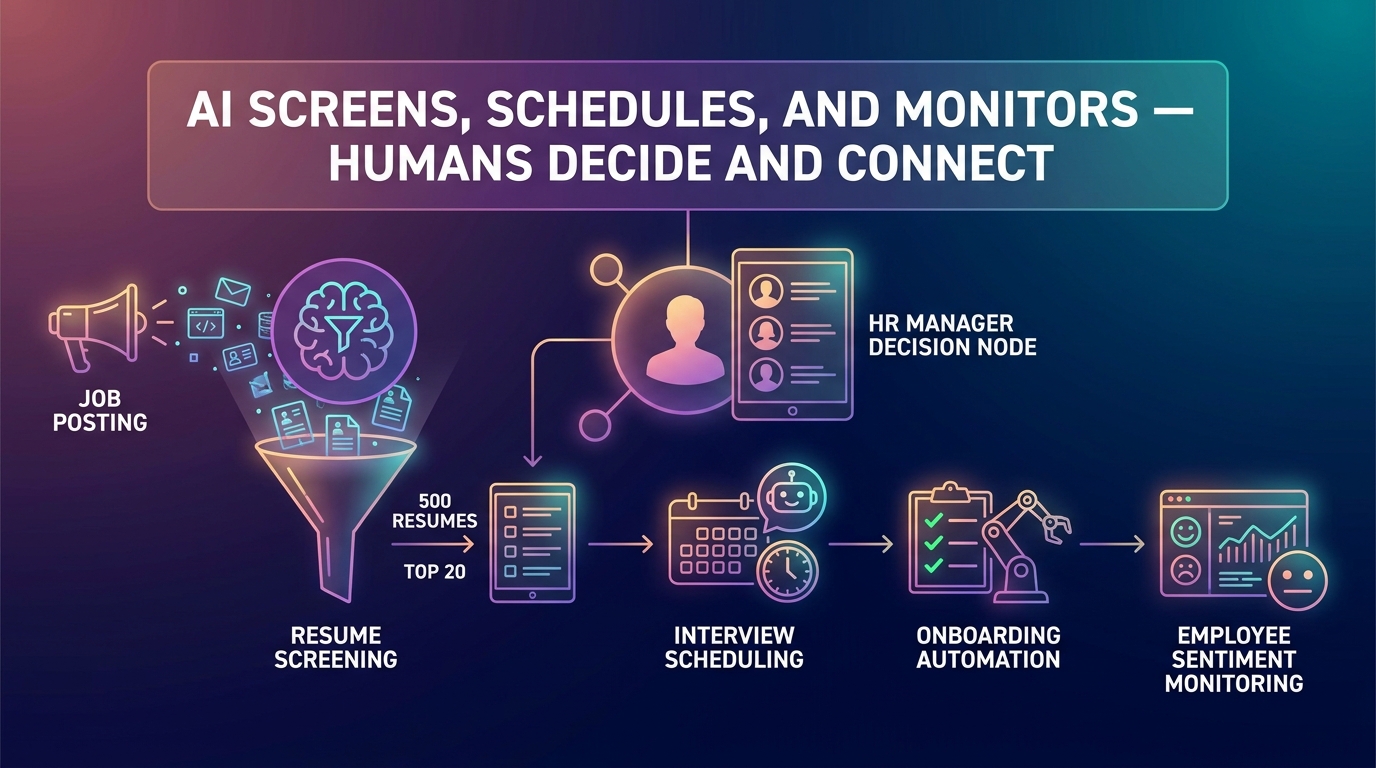
HR and People Operations rarely leads the conversation about AI automation, but the actual adoption data tells a different story. This department has quietly become one of the more successful adopters — precisely because much of its work involves high-volume, repeatable administrative processes wrapped around deeply human decisions. That combination is ideal territory for AI augmentation.
Recruitment and Talent Acquisition
Resume screening and initial candidate ranking is the most widely deployed HR automation use case. At organizations receiving hundreds or thousands of applications per role, AI screening tools can reduce the initial review load by 60–80%, surfacing candidates who match defined criteria for human recruiter review. The important caveat: these systems must be regularly audited for bias. AI trained on historical hiring data can inadvertently encode historical patterns in who got hired, including patterns that reflect inequitable hiring practices. Responsible deployment requires ongoing bias testing and clear documentation of the criteria the model is applying.
Interview scheduling automation is a lower-stakes but high-value use case. Coordinating availability between candidates and multiple interviewers across time zones is genuinely time-consuming and mentally taxing. AI scheduling assistants handle this at near-zero marginal cost per interaction, improving candidate experience and freeing recruiter time for the actual human work of interviewing.
Candidate sourcing has been significantly enhanced by AI tools that can scan LinkedIn, GitHub, industry databases, and job boards to identify passive candidates matching role criteria. This fundamentally changes the sourcing model from “wait for inbound applications” to “proactively find people who aren’t looking” — a significant competitive advantage in tight labor markets.
Onboarding and Employee Experience
Automated onboarding workflows reduce the administrative burden on both HR teams and new employees significantly. AI-driven onboarding platforms can deliver personalized document checklists, training assignments, compliance acknowledgments, and first-week schedules based on role, location, and department — without requiring HR to manually configure each new hire’s experience. The result is faster time-to-productivity and meaningfully better new employee experience scores.
HR helpdesk automation — handling common employee questions about benefits, leave policies, payroll, and compliance requirements — follows the same logic as customer service automation. AI-powered HR bots resolve the straightforward, policy-based queries and escalate the complex or sensitive ones to human HR partners. Organizations deploying these tools typically see 40–60% of routine HR queries handled without human agent involvement.
Performance and Workforce Analytics
Employee sentiment analysis through AI processing of engagement survey data, exit interview transcripts, and in some cases communication platform signals gives HR leaders early warning signals on retention risk, team dynamics issues, and management effectiveness that would be difficult to surface through periodic manual review. This is a sensitive area requiring careful data governance and transparent communication with employees, but the organizations doing it well report meaningful improvements in early intervention on retention risk.
Workforce planning and skills gap analysis is an emerging but genuinely valuable application. AI tools that map current workforce skills against projected role needs — based on business growth plans and market signals — help HR and executive teams make more informed hiring, reskilling, and organizational design decisions. This is a longer-horizon value proposition but one that compounds as data quality improves.
Supply Chain and Operations: The Data-Rich, Results-Rich Opportunity
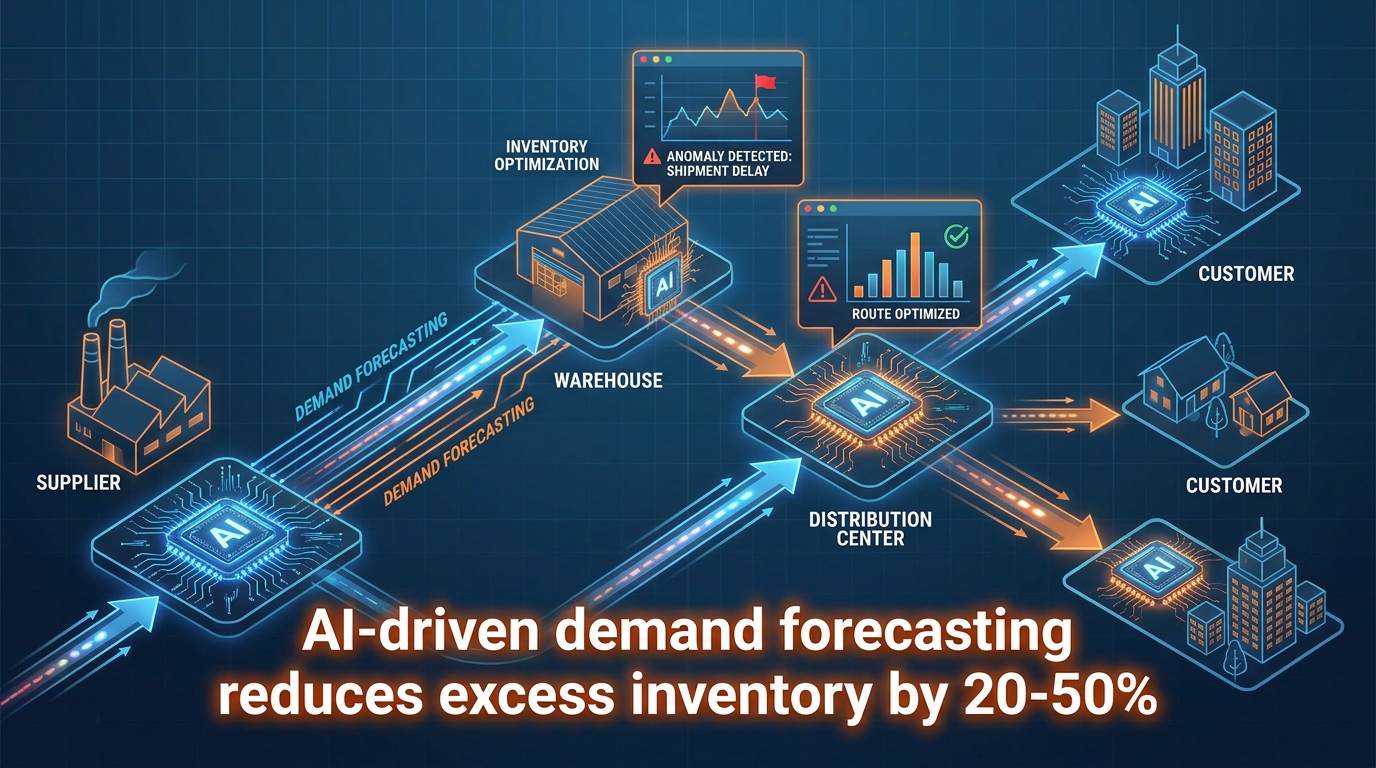
If Finance is the highest-confidence zone for AI automation, Operations and Supply Chain is arguably the highest-ceiling zone — the place where AI delivers the largest absolute dollar impact in organizations with complex logistics, inventory, or manufacturing footprints. The data richness of operational environments is the key driver: sensors, ERP systems, IoT devices, and logistics platforms generate continuous structured data streams that AI models can process in real time.
Demand Forecasting: The Foundational Use Case
AI-driven demand forecasting is the application that anchors most supply chain automation journeys. Traditional statistical forecasting models — moving averages, ARIMA variants, seasonal decomposition — are outperformed by machine learning approaches when the relevant signals include external variables like weather patterns, regional economic indicators, competitive pricing changes, and social trends alongside historical sales data.
The impact is real and measurable. Research across supply chain deployments consistently finds that AI demand forecasting reduces excess inventory by 20–50% while simultaneously reducing stockout frequency. For businesses where inventory carrying costs are significant, this combination can represent millions of dollars in annual savings. For businesses where stockouts translate directly to lost sales or customer defection, the revenue impact is equally significant.
Procurement and Supplier Management
Automated procurement processes — including supplier selection analysis, purchase order generation, contract compliance monitoring, and spend analytics — are well-suited to AI automation because they involve large structured datasets and rule-defined decision criteria. AI tools can analyze thousands of supplier bids against multi-dimensional criteria simultaneously, identify spend optimization opportunities across category patterns, and flag contract terms approaching renewal — tasks that take procurement teams weeks to do manually at comparable quality.
Supplier risk monitoring is an emerging but high-value use case. AI tools that continuously monitor financial health signals, news sentiment, geopolitical risk indicators, and delivery performance metrics for supplier networks can surface concentration risks and disruption warning signs weeks or months before they become operational crises. The supply chain shocks of recent years have made this capability increasingly valued by procurement and operations leaders.
Warehouse and Logistics Optimization
Warehouse management AI covers route optimization within fulfillment centers, pick-path efficiency, slotting optimization (positioning inventory based on velocity and relationship), and predictive maintenance for equipment. For high-throughput operations, these optimizations compound significantly — a 10% improvement in pick efficiency across a million-unit-per-week operation translates to substantial headcount and cost savings.
Last-mile delivery optimization has seen significant AI investment across logistics players. Route optimization AI that incorporates real-time traffic data, delivery time-window constraints, vehicle capacity, and driver availability can reduce delivery costs materially while improving on-time performance. This is now a competitive baseline capability for any business operating at meaningful delivery scale.
Predictive Maintenance in Manufacturing
For businesses with manufacturing or heavy equipment operations, AI-driven predictive maintenance — using sensor data to forecast equipment failure before it occurs — is one of the most compelling automation investments available. Unplanned downtime in manufacturing environments is extraordinarily costly; shifting from reactive or scheduled maintenance to predictive maintenance can reduce downtime by 30–50% and extend equipment life meaningfully. The data infrastructure requirement is non-trivial, but the ROI case is among the strongest in the automation landscape.
IT and Internal Support: Automating the Automators
IT departments occupy a unique position in the AI automation landscape: they are simultaneously the team most capable of implementing automation and one of the teams most in need of it. Internal IT support generates enormous volumes of repetitive, rule-based tickets that consume skilled engineer time on tasks that rarely require genuine technical expertise.
IT Service Management Automation
Tier-1 IT helpdesk automation is one of the most successful AI applications in the enterprise. Password resets, software access requests, VPN troubleshooting, printer configuration, and account unlocks make up the majority of ticket volume in most IT environments — and all of them follow predictable resolution paths. AI-powered service management platforms can resolve these automatically without human involvement, typically deflecting 40–60% of total ticket volume.
The impact on IT engineers is significant. When Tier-1 ticket deflection is high, skilled engineers spend their time on genuine problem-solving, security incidents, infrastructure architecture, and the system improvements that actually advance the business — rather than resetting passwords for the hundredth time that week. Talent retention in IT teams often improves alongside automation deployment, because engineers find the work more substantive and engaging.
Incident detection and response automation is where AI delivers outsized value relative to human capacity. AI monitoring systems can process log data, performance metrics, and security signals across thousands of endpoints simultaneously — something no human team can do at equivalent coverage and speed. Anomaly detection, alert triage, and even initial response actions can be automated, compressing mean-time-to-detection and mean-time-to-resolution on infrastructure incidents.
IT Operations and Infrastructure Management
AIOps — AI applied to IT operations — has matured considerably in recent years. Modern AIOps platforms correlate signals across infrastructure components, identify root cause candidates in complex multi-system incidents, predict capacity constraints before they become service-impacting events, and automate routine infrastructure maintenance tasks. For organizations operating at significant infrastructure scale, this represents a meaningful force multiplier for engineering teams.
Software development assistance through AI coding tools has become a baseline productivity expectation in engineering teams. Studies tracking developer productivity with AI code assistants consistently show efficiency gains in the 20–40% range on tasks involving code generation, test writing, documentation, and debugging. The key discipline is code review: AI-generated code requires the same quality review process as human-written code, and teams that skip this step accumulate technical debt faster than the productivity gains justify.
Legal and Compliance: The Cautious Case for AI Automation
Legal and Compliance is the department where AI automation delivers genuine value but also carries the most significant risk if deployed without adequate governance. The stakes of errors in legal contexts — contracts with binding terms, compliance filings with regulatory consequences, litigation-related documents — mean that the human review layer is non-negotiable. That said, the volume of legal work in growing businesses consistently outpaces legal team capacity, making automation a genuine strategic priority rather than a nice-to-have.
Contract Review and Management
Contract analysis and risk flagging is the most mature AI application in legal operations. AI tools trained on contract language can review agreements for non-standard terms, missing clauses, unusual indemnification provisions, data privacy compliance requirements, and renewal obligations — at a pace that dramatically exceeds manual review. A document that takes a paralegal or junior associate several hours to review thoroughly can be analyzed by AI in minutes, with risk flags surfaced for human attorney review.
The critical operational model is AI as a first-pass reviewer, not a final approver. Organizations that have deployed contract AI well report significant reduction in the time their attorneys spend on routine contract review, freeing legal team capacity for higher-value strategic and advisory work. The technology is not replacing legal judgment — it’s eliminating the administrative and mechanical review layers that consumed attorney time without requiring genuine legal expertise.
Contract lifecycle management automation covers the administrative management of executed contracts: tracking renewal dates, monitoring performance obligations, flagging compliance deadlines, and maintaining version history. This is pure administrative work that AI systems handle reliably, and the cost of missing a contract renewal or compliance deadline can be substantial.
Compliance Monitoring and Reporting
Regulatory compliance monitoring has become an increasingly compelling AI use case as the volume of regulations affecting businesses has grown. AI tools that continuously monitor regulatory databases, identify changes relevant to specific business operations, and flag compliance gaps can give compliance teams meaningful advance warning on regulatory changes rather than requiring them to manually track dozens of regulatory sources.
Compliance reporting automation — assembling the data, formatting reports, and completing standard regulatory filings — follows the same logic as financial reporting automation. Where the underlying data is structured and the reporting format is consistent, AI can dramatically accelerate completion and reduce human error rates.
What Legal Should Never Fully Automate
Strategic legal advice, litigation strategy, complex negotiation, and any decision with material legal consequence for the business should remain firmly in human attorney hands. AI is a powerful research, analysis, and document management tool in legal contexts — it is not a substitute for legal judgment, and businesses that treat it as such expose themselves to significant liability. The governance principle in legal AI is clear: AI narrows the field and flags the issues; humans make the calls.
The Prioritization Matrix: How to Rank Your Automation Opportunities Across Departments
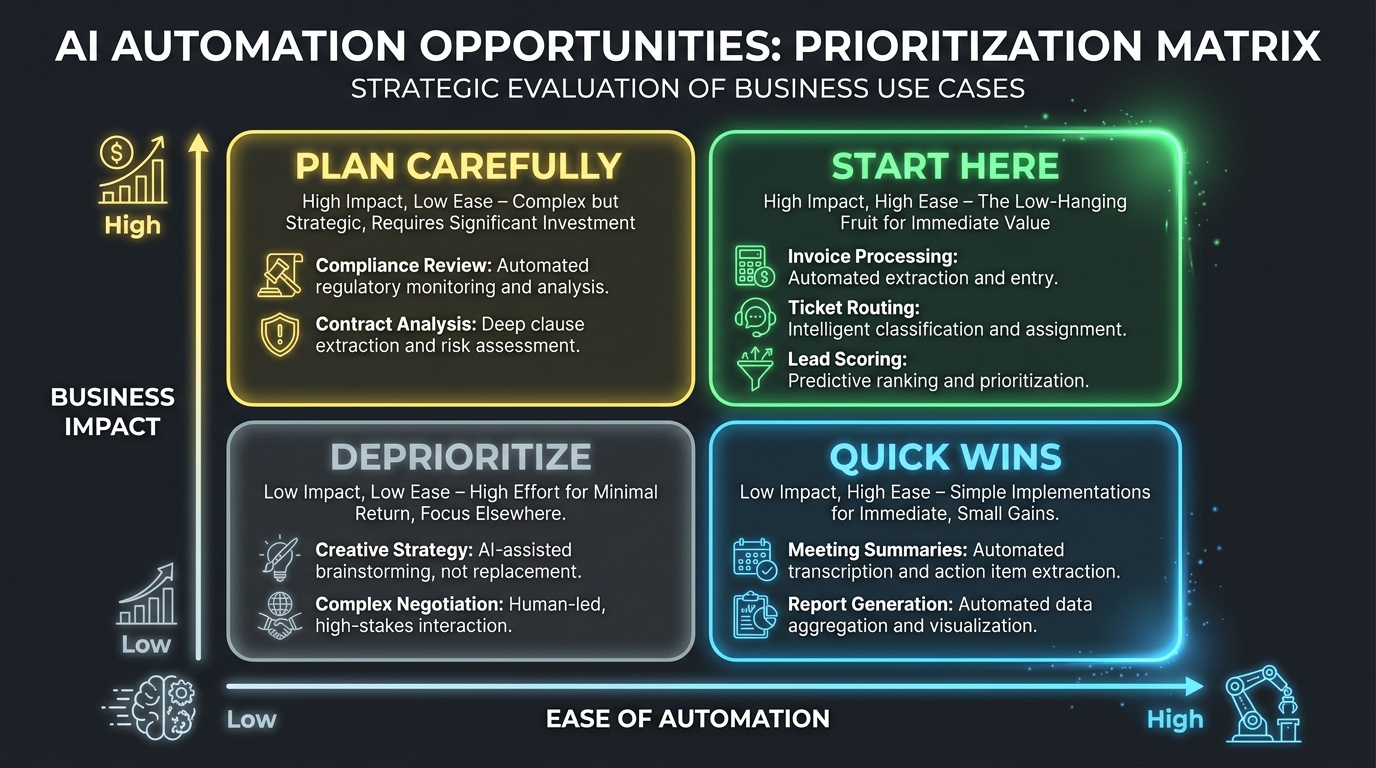
With nine departments analyzed, the practical question becomes: where does your specific organization start? The answer depends on a four-dimensional assessment of each candidate process — and mapping those dimensions gives you a defensible prioritization framework that you can present to leadership and act on systematically.
The Four Dimensions to Score
1. Process Repeatability. How consistently does this process follow the same steps? Processes with high repeatability — invoice processing, password resets, ticket routing, resume screening — are strong candidates. Processes requiring significant judgment variation per instance are weaker candidates for full automation.
2. Data Availability and Quality. What data does this process rely on, and is that data structured, complete, and accessible? AI automation fails most often not because the algorithm is wrong, but because the underlying data is messy, siloed, or incomplete. Before selecting a tool, audit the data reality. If the data isn’t ready, the automation won’t be either.
3. Error Consequence. What happens if the automated system makes a mistake? In invoice processing, an error is typically caught in reconciliation. In legal compliance, an error can have regulatory consequences. In customer service, an error can damage a relationship. The higher the error consequence, the more robust the human oversight layer needs to be — and the more careful the initial deployment scope should be.
4. Volume and Frequency. How often does this process occur, and at what scale? Automation investment is most justified for high-frequency, high-volume processes. A process that happens twice a year with five steps doesn’t need AI automation. A process that happens two thousand times a day with fifteen steps does.
The Resulting Prioritization Buckets
“Start Here” — High repeatability, good data, high volume, manageable error consequence: Invoice processing, IT helpdesk Tier-1 tickets, customer service Tier-1 queries, CRM data enrichment, resume screening, bank reconciliation, email marketing automation, HR scheduling. These are your first-wave candidates.
“Plan Carefully” — High impact potential, but data or governance complexity requires longer preparation: Contract analysis, compliance monitoring, demand forecasting, financial close automation, employee sentiment analytics. These warrant investment in data readiness before automation deployment.
“Quick Wins” — Lower complexity, fast to implement, visible to stakeholders: Meeting summary generation, automated report compilation, content draft generation, social media scheduling, call transcription and logging. These build organizational confidence in AI automation without requiring significant infrastructure investment.
“Deprioritize for Now” — High judgment requirement, low repeatability, or significant error consequence: Complex negotiation support, strategic legal advice, creative strategy, executive decision support, relationship-critical customer interactions. Not everything should be automated, and recognizing those boundaries is as important as finding the right applications.
Building Your Organization’s First Roadmap
Once you’ve scored your candidate processes across the four dimensions, sequence your first wave by combining ease of implementation with visibility to leadership. Early wins matter — not just for ROI, but for building the organizational belief that AI automation is worth investing in. A successful invoice automation rollout creates the political capital to fund the more complex demand forecasting project six months later.
Assign clear ownership to each automation initiative. The single most reliable predictor of automation success is having a named individual — not a committee — who is accountable for the outcome. Define success metrics before launch, not after. And plan for a four-to-six week stabilization period after initial deployment during which the system runs in parallel with existing processes before full cutover.
Cross-Department Pitfalls That Derail Even Well-Planned Rollouts
Department-level thinking gets you further than company-wide mandates — but there are cross-cutting failure modes that appear regardless of which department is automating. Understanding these patterns upfront prevents the most common and expensive mistakes.
The Integration Underestimation Problem
Nearly every AI automation deployment requires connecting the new tool to existing systems: ERPs, CRMs, HRMS platforms, databases, and communication tools. The time and complexity of these integrations are almost universally underestimated in initial project scoping. A tool that demos beautifully in isolation can take three to four months to integrate cleanly with a legacy ERP running on a version that predates the AI platform’s API documentation.
Before selecting any AI automation tool, conduct a technical integration audit. Map exactly which systems the tool needs to connect to, what data formats those systems use, and whether native connectors exist or custom integration work is required. This single step can save months of project delay and scope creep.
The Change Management Gap
The most technically sound AI automation deployment can fail because of human resistance — and that resistance is almost always predictable and preventable with adequate change management investment. Employees who feel that AI is being deployed to eliminate their roles will find ways — consciously or unconsciously — to undermine the systems or work around them. This is not irrational; it’s a rational response to perceived threat.
The communications framing matters enormously. Deployments positioned as “AI is handling the repetitive work so you can do more valuable work” tend to generate significantly less resistance than deployments that arrive without explanation or are announced in the context of headcount discussions. Involve the teams being affected in the design and testing process. Their process knowledge will improve the deployment, and their involvement builds the ownership that drives adoption.
The Data Governance Gap
AI systems learn from and operate on data. When that data contains errors, historical biases, or inconsistencies, the AI system amplifies those problems at scale — producing decisions that are systematically wrong in ways that are harder to detect than obvious manual errors. Before deploying AI automation in any department, audit the data that system will use. Establish clear data ownership, data quality standards, and a process for flagging and correcting data errors post-deployment.
The Measurement Drift Problem
One of the less-discussed failure modes in AI automation is measurement drift: the gradual divergence between what the automated system is actually doing and what the business thinks it’s doing, because no one is actively monitoring the system’s performance over time. AI models degrade when the real-world patterns they encounter shift away from the patterns in their training data. Market conditions change, customer behaviors evolve, and business processes adapt — often faster than automated systems are updated.
Build a monitoring cadence into every automation deployment from Day 1. Define the key performance metrics, set minimum acceptable thresholds, and assign someone the responsibility of reviewing those metrics monthly. Automation is not a set-and-forget exercise; it requires the same ongoing stewardship as any other business system.
The Vendor Lock-In Trap
In the rush to deploy AI automation quickly, many organizations select tools that create deep dependencies without adequate consideration of the long-term implications. When a vendor raises prices significantly, discontinues a feature, or fails to keep pace with the market, the cost of switching can be prohibitive — especially if data, workflows, and integrations have been built deeply into a proprietary platform.
When evaluating AI automation vendors, assess data portability (can you export your data in standard formats?), API openness (can the tool connect to alternatives in your stack?), and contract terms (are there exit clauses that protect you?). The tool that offers the fastest demo win sometimes creates the most expensive long-term dependency.
Building Department-Level Momentum That Actually Compounds
The goal isn’t to automate everything. It’s to build a systematic capability — a repeatable organizational muscle — for identifying, deploying, and managing AI automation in ways that deliver consistent, measurable value. That muscle compounds over time in ways that individual one-off deployments never do.
What the Businesses Getting This Right Have in Common
Organizations consistently extracting value from AI automation share a handful of operational characteristics that distinguish them from those running in place.
They have a named automation function. Not necessarily a large team — sometimes a single business analyst or operations manager — but someone whose explicit job includes identifying automation opportunities, managing vendor relationships, overseeing implementations, and tracking performance. Without this ownership, automation initiatives tend to drift after launch.
They run tight pilots before scaling. Before deploying any automation across a full department, they test it on a controlled subset — a specific invoice category, a defined set of ticket types, a single geographic market. The pilot generates real performance data, surfaces integration issues, and identifies change management needs before they become company-wide problems.
They treat automation as a continuous process, not a project. The businesses winning at AI automation have reframed it from “we deployed an AI tool” to “we have a standing practice of evaluating and improving automated processes.” That cultural reframe is what makes the capability compound.
They measure labor-hours redirected, not just costs reduced. The most complete picture of automation ROI includes not just direct cost savings but the value of the human capacity that was freed up and redirected to higher-value work. A finance team that automates invoice processing and redirects those analyst hours to financial modeling and business partnering isn’t just saving money on repetitive tasks — it’s increasing the strategic contribution of the finance function.
The Honest Assessment: How Long Does This Take?
A realistic timeline for a department-level AI automation initiative — from initial process identification through stable, full-scale deployment — is typically four to nine months. Organizations that claim to have done it meaningfully faster have usually either scoped very narrowly (one simple process), accepted significant technical debt in the integration layer, or overstated their results to internal stakeholders.
That timeline is not a reason to delay. It’s a reason to start with a clear-eyed assessment of what you’re building, sequence your investments thoughtfully, and set stakeholder expectations accurately. The organizations that have been building this capability for eighteen months are already seeing the compounding returns. The right time to start was last year. The second-best time is now.
A Final Word on Keeping Humans in the Loop
Across every department covered in this guide, the most consistent predictor of automation success is not the sophistication of the AI model or the size of the implementation budget. It’s the quality of the human-AI collaboration model — specifically, how clearly the organization has defined which decisions AI informs, which it recommends, and which it makes autonomously.
The best-performing automation deployments in 2026 are not the ones where AI has replaced the most humans. They’re the ones where AI handles the high-volume, structured, repeatable work that consumes human capacity without leveraging human capability — freeing those humans to do the complex, relational, creative, and judgment-intensive work that AI genuinely cannot do well.
That division of labor, mapped clearly across your specific departments, built with good data governance, and managed with ongoing discipline, is what AI automation for business actually looks like when it works.
Key Takeaways
- Finance and Accounting is the safest first-mover department — start with accounts payable and reconciliation where data is structured and ROI is measurable within weeks.
- Customer Service automation pays off strongly on Tier-1 tickets but requires clean escalation paths to humans for complex or emotional interactions.
- Sales AI earns its keep on administrative and analytical layers — lead scoring, CRM enrichment, call analysis — but should never replace human judgment in relationship-critical moments.
- Marketing automation compounds over time through personalization and predictive analytics, but quality control on AI-generated content is non-negotiable.
- HR delivers quiet, consistent value through recruitment screening, scheduling, and onboarding automation — with bias auditing as a required governance practice.
- Operations and Supply Chain represent the highest ceiling for automation ROI in data-rich environments, anchored by demand forecasting and predictive maintenance.
- IT benefits immediately from helpdesk automation and AIOps, with coding assistance delivering consistent productivity gains for engineering teams.
- Legal and Compliance automation is genuinely valuable for contract review and compliance monitoring — but human attorney oversight is mandatory on any consequential decision.
- Score every automation candidate on repeatability, data quality, error consequence, and volume before committing resources.
- Change management, integration planning, and ongoing performance monitoring are not optional additions to an automation project — they are the project.