


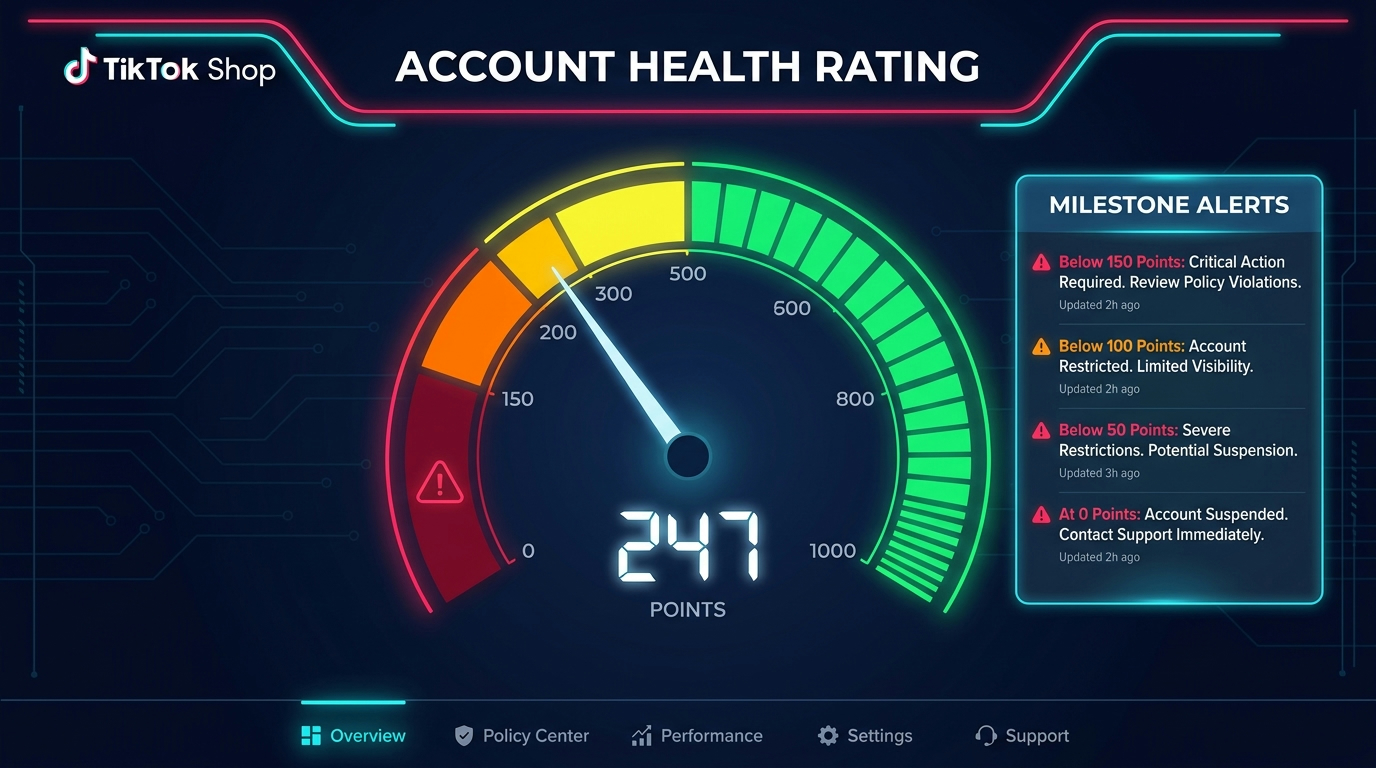

Most TikTok Shop sellers only hear about the Account Health Rating when something goes wrong. A listing gets pulled. A campaign won’t launch. A payout disappears into a “pending review” limbo that customer support can’t explain. By the time they find the Shop Health tab and stare at a number sitting dangerously close to 150 points, the damage is already done.
That’s the core problem with how the AHR system gets discussed. Most coverage frames it as a penalty system — a set of rules to avoid breaking. That framing is useful but incomplete. The Account Health Rating isn’t just a compliance scorecard. It’s a dynamic, rolling composite score that actively controls which features you can access, how much organic traffic your products receive, whether affiliates can partner with your shop, and ultimately, whether your business is allowed to operate on TikTok Shop at all.
Understanding it at that level — not just “don’t get violations” but truly understanding how the score is calculated, what moves it up, what moves it down, and how TikTok’s enforcement engine responds to different thresholds — is the difference between a seller who reacts to crises and one who never has them in the first place.
This guide covers the AHR system as it operates from July 2026 onward, when TikTok Shop fully replaced its older Violation Points framework with the current composite model. Whether you’re a new seller trying to understand what you’re working with, or an established operator who just took an unexpected hit, here’s the complete picture.
Why TikTok Replaced Violation Points With the AHR — and What That Actually Means
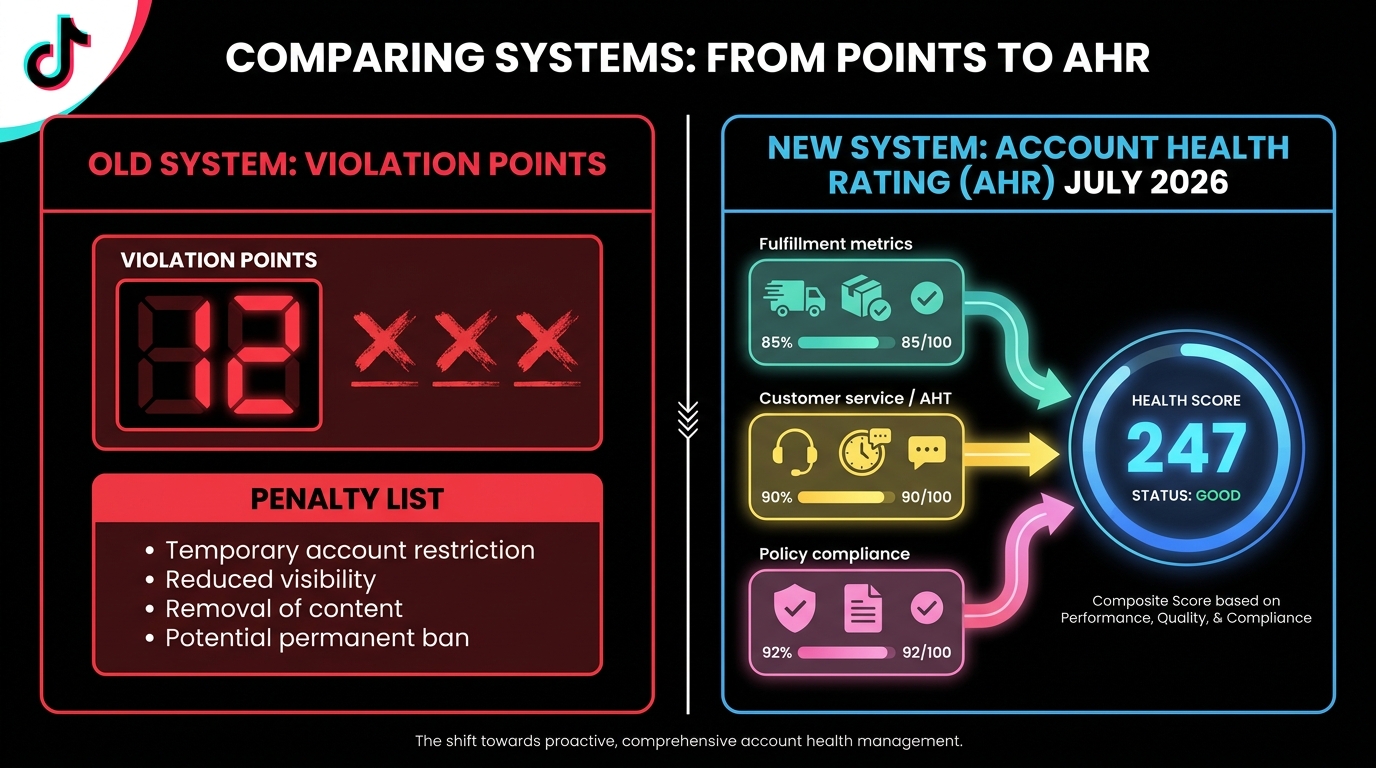
The old Violation Points system was relatively blunt. Sellers accumulated penalty points for specific policy breaches, and enough points within a set window led to account restrictions or suspension. The problem was that it only measured what you did wrong. A seller who shipped late on every third order but never crossed a formal violation threshold could skate along indefinitely. A seller who had one listing flagged incorrectly could take the same penalty as someone running a systematic counterfeiting operation.
TikTok’s shift to the Account Health Rating — previewed in May 2026 and fully live as of July 2026 — addresses both of those limitations.
From Punishment-Only to Composite Health
The AHR is no longer purely a punishment ledger. It’s a composite score that includes both positive inputs (things you do well) and negative inputs (things you do poorly or violate). That’s a meaningful structural change. Under the old Violation Points model, the only way to “improve” your standing was to stop getting violations — there was no active mechanism to earn goodwill. Under AHR, you can take concrete actions that add points to your score, which gives sellers a genuine recovery path after a dip.
It also means that sellers who are merely passive — not violating policies, but not actively running a high-volume, well-managed shop — will see their score naturally stabilize at lower levels than active, high-performing sellers. The system is designed to reflect actual operational quality, not just compliance history.
Category Benchmarking Replaces Flat Averages
One of the most significant but least-discussed changes in the July 2026 update is that TikTok now benchmarks certain AHR metrics against same-category sellers, not a single platform-wide standard. What’s considered a healthy after-sales handling time in the electronics category may differ from what’s expected in fashion or beauty. This means sellers can’t simply look at industry-average benchmarks and assume they apply to their situation. Your competitive set is your category, and TikTok is measuring your operational performance against that specific peer group.
The Enforcement Logic Is Now Milestone-Based
The old system had a general “too many violations = suspension” logic. The AHR system is more structured: specific score thresholds trigger specific, documented enforcement actions. This gives sellers more predictability — but it also means there’s no ambiguity once you hit a threshold. The restrictions aren’t discretionary. They’re automatic.
The Score Architecture: How AHR Is Actually Calculated
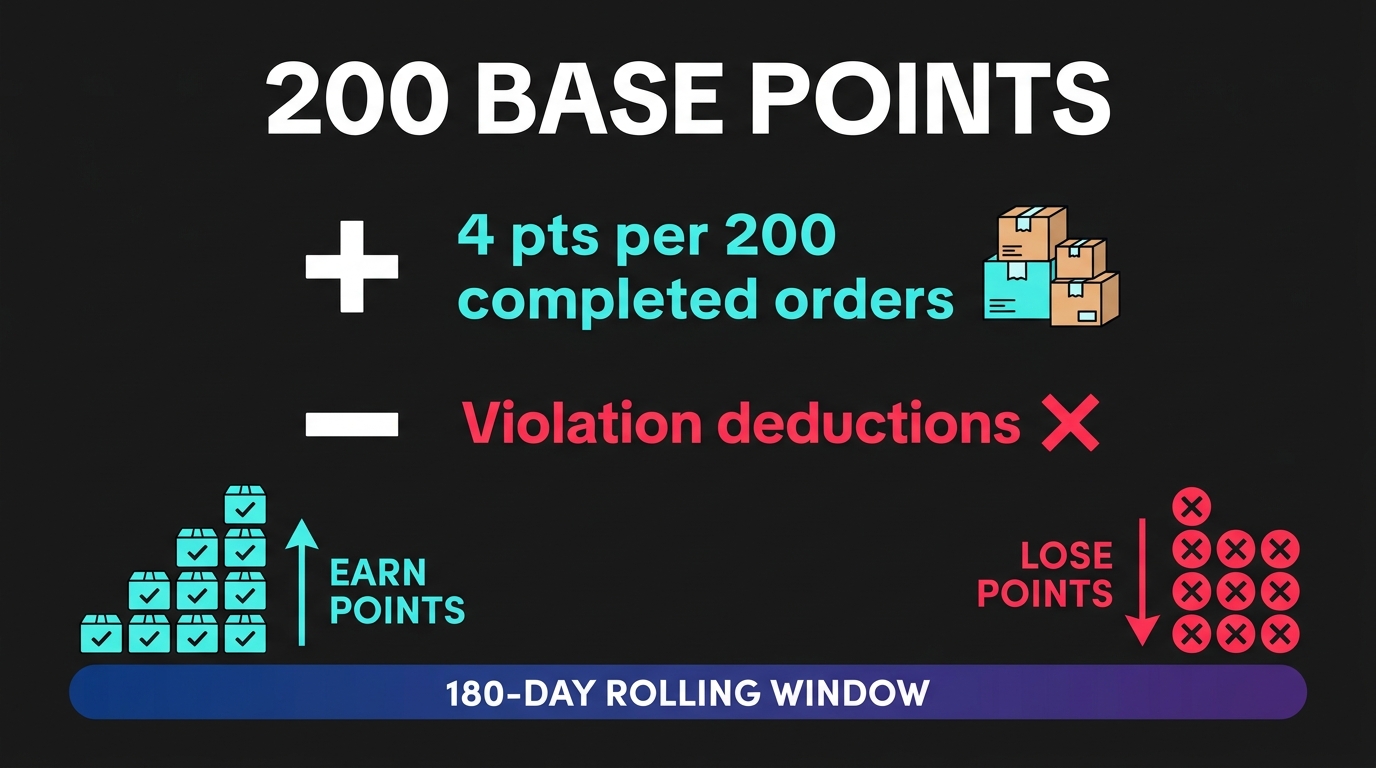
The Account Health Rating runs on a 0–1,000 scale. New sellers begin at 200 points — TikTok’s documented baseline for a shop that has just opened and hasn’t yet built a performance history. From there, the score moves up or down based on a continuous rolling calculation.
TikTok’s official Seller University documentation frames the score as:
AHR = 200 base points + points earned from completed orders and policy activity − points deducted for violations and performance failures
All of this happens within a rolling 180-day window. That time horizon is important: it means both the positive contributions of your order history and the negative weight of your violations have a defined lifespan. A violation from more than 180 days ago no longer factors into your score. Neither do orders completed more than 180 days ago. The score is always a reflection of your most recent six months of operation.
How Points Are Earned: The Order Completion Rate
The primary positive contribution to your AHR score comes from completed, eligible orders. TikTok’s documentation specifies that sellers earn 4 points for every 200 eligible completed orders within the rolling 180-day window. That rate is modest by design — the system is not intended to let high-volume sellers offset serious violations by simply shipping a lot of packages.
Critically, not all completed orders count. The following order types are explicitly excluded from point calculations:
- Sample orders — products sent as samples or test purchases
- Returned orders — any order that has been returned by the customer
- Refunded orders — orders where a refund was issued
- Cancelled orders — whether cancelled by buyer or seller
- Defective orders — orders flagged for product defects
These exclusions are strategically designed. They prevent sellers from using volume as a shield. If a significant portion of your “completed” orders end in returns, refunds, or cancellations, those don’t contribute to your score — and they may actively hurt it through performance-based deductions.
TikTok also notes a weekly cap of 20 points earned from orders. Even at the platform’s highest sales volumes, you can’t accelerate your AHR recovery purely through order volume. This limits how quickly a score can climb, which is why avoiding violations in the first place is far more important than trying to earn your way back.
Policy Quizzes: The Secondary Point Source
When a seller receives a violation, TikTok may make a policy quiz available through the Seller Center. These quizzes are specifically tied to the violation type — a seller who gets flagged for a listing accuracy issue will receive a quiz on listing policies, not general platform rules.
Passing a policy quiz with a perfect score earns the seller approximately 5 AHR points. The quiz window is typically available for 60 calendar days from the date of the first violation ticket. After that window closes, the quiz option expires regardless of whether the seller has taken it.
Five points sounds small, but in a system where order-based earning is capped and violations can deplete significant point values, a policy quiz pass is worth taking seriously. It also signals to TikTok’s enforcement system that the seller has engaged with the relevant policy content — which can matter in subsequent appeal evaluations.
The Four Enforcement Milestones: What Happens at Each Threshold
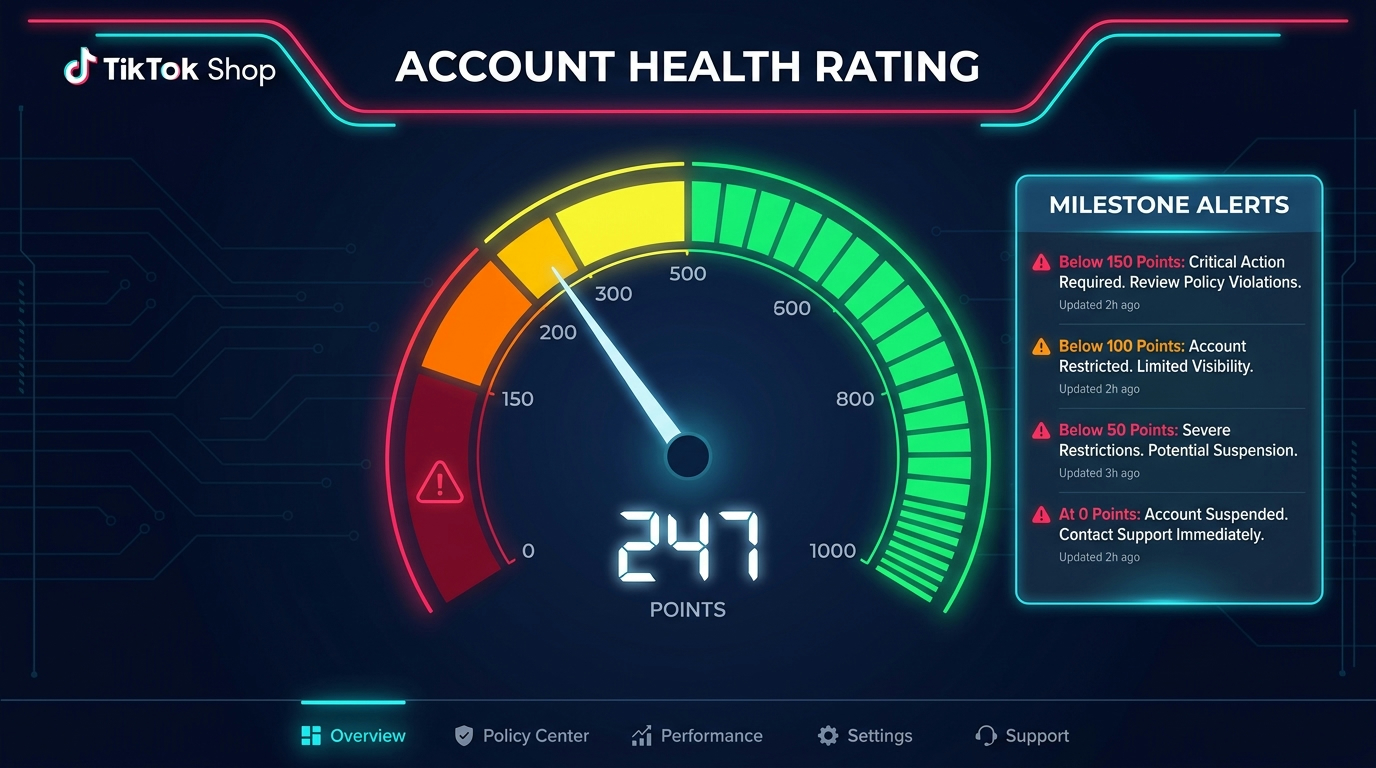
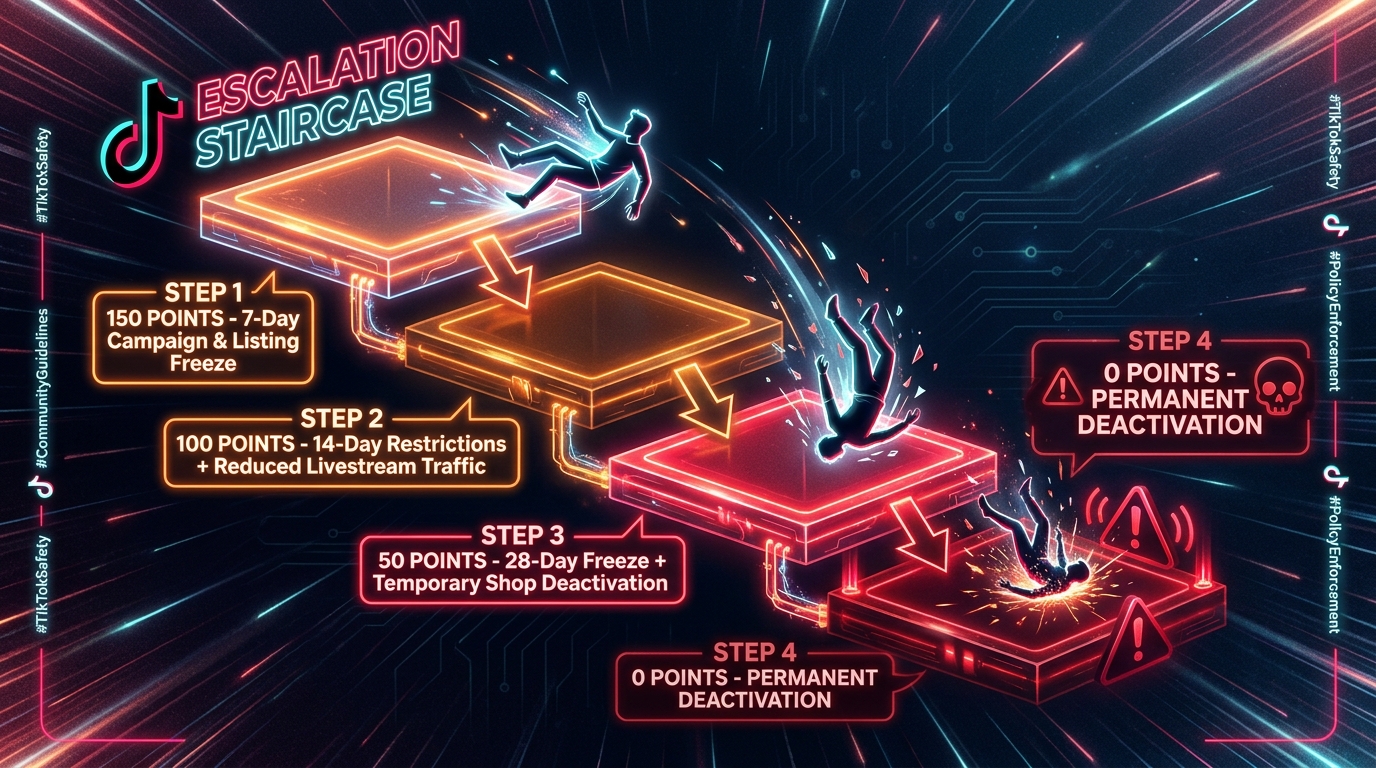
The enforcement structure of the AHR system is organized around four critical score thresholds: 150, 100, 50, and 0 points. These aren’t warning zones — they’re hard triggers for automatic enforcement actions that take effect as soon as your score reaches that level.
150 Points: The First Restriction Layer
Dropping to 150 points is the first formal enforcement event. At this threshold, TikTok imposes a 7-day block on:
- Creating new product listings
- Updating existing listings in certain ways
- Enrolling in new mega campaigns or platform growth programs
- Accessing certain affiliate and creator matching features
Seven days might sound manageable, but the timing matters enormously. If your shop hits 150 during a peak sale period — the week before a major holiday, a flash sale window, or a period when you were planning to launch new SKUs — those seven days can cause material revenue damage. You can’t launch products, can’t join promotional events, and may see reduced visibility in recommendation feeds as the system interprets low AHR as a signal of shop quality.
100 Points: Extended Restrictions and Visibility Pressure
At 100 points, the restriction window extends to 14 days, and the operational impact deepens. Sellers at this threshold may experience:
- Extended listing creation and update blocks
- Reduced livestream traffic allocation from TikTok’s recommendation engine
- Tighter monetization limits, including potential holds on pending commissions
- Stricter review of new listings that do get through
At this level, the compound effect of reduced visibility and operational restrictions begins to affect revenue in ways that are hard to reverse quickly. Sellers who reach 100 points without having addressed the underlying violations are in a precarious position — they’re losing both traffic and the ability to take actions that would normally help compensate for reduced performance.
50 Points: Temporary Shop Deactivation
Reaching 50 points triggers a 28-day restriction window and may result in temporary shop deactivation. At this threshold, TikTok can effectively pause your shop’s operations — products become invisible to buyers, no new orders can be placed, and your shop profile may display as inactive or unavailable. Payouts may also be frozen pending review.
This is the threshold that most sellers experiencing a genuine crisis will hit before taking emergency action. The gap between 100 and 50 points can close faster than many sellers expect, particularly when multiple violations compound on each other or when a high-severity issue (such as an IP infringement finding) carries a large deduction.
0 Points: Permanent Deactivation
A score of 0 is treated as grounds for permanent deactivation. There is no standard recovery path from 0 points under the current system. TikTok’s seller documentation is explicit on this: the shop is deactivated and the standard appeal and point-restoration mechanisms do not apply. This outcome is typically reserved for the most severe and repeated policy breaches — systematic counterfeiting, sustained fraud, or multiple escalating violations without correction.
The practical implication is that sellers approaching 50 points should treat their situation as genuinely urgent. Waiting to address violations in a system where 0 points means permanent closure is not a viable strategy.
The Seven Violation Categories That Drain Your Score
TikTok’s AHR deduction framework is organized around seven broad policy areas. Understanding which categories your violations fall into matters because TikTok weights deductions based on both severity and frequency — and some categories carry intrinsically heavier penalties than others.
1. Product Compliance Violations
This is the broadest and most commonly triggered category. It covers listings of prohibited or unsupported products, products that require qualifications or certifications the seller hasn’t provided, items in restricted categories where additional approval is required, and products that fail platform safety standards.
Many sellers trigger product compliance violations not through deliberate misconduct but through carelessness during listing — failing to check whether a specific product type is permitted in their region, or listing in a category that requires documentation they haven’t submitted. The penalty varies by product type, but violations involving potentially unsafe products tend to carry heavier deductions.
2. Listing Quality and Accuracy Violations
This category covers the gap between what a listing claims and what a product actually is. It includes misleading titles, inaccurate descriptions, misrepresented specifications, misleading images that don’t match the actual product, and incorrect categorization that misrepresents product type.
Listing accuracy violations have become more common under the AHR system because TikTok now uses both buyer reports and automated review to flag discrepancies. A seller who uses AI-generated marketing copy that makes unsubstantiated claims, or who uses lifestyle images that imply product attributes the item doesn’t have, is operating in territory that the platform is actively reviewing. The trend toward more detailed listing-quality enforcement means that sellers who previously operated with looser standards are finding that the new system is less forgiving.
3. IP and Counterfeit Violations
Intellectual property violations — including trademark infringement, copyright infringement, and selling counterfeit or unauthorized replicas — are treated with the highest severity in TikTok’s deduction framework. These violations can carry deductions large enough to push a seller through multiple enforcement milestones in a single event.
Brand authorization documentation is the key safeguard here. Sellers working with third-party brands — particularly those sourcing from wholesale or clearance channels — should have verified brand authorization documents on file before listing. The absence of documentation doesn’t just risk a violation; it’s a structural vulnerability that makes the shop difficult to defend in an appeal.
4. Fair Trading and Fraud Violations
This category covers any behavior that manipulates the platform’s commercial integrity. Review manipulation — whether buying fake reviews, coordinating bulk positive reviews through external channels, or attempting to suppress negative reviews — falls here. So do coordinated fake orders, fraudulent transaction patterns, and attempts to game TikTok’s promotional or commission systems.
The platform’s fraud detection has become increasingly sophisticated, and the enforcement actions under this category can be immediate. Unlike some other violation types where the seller has time to respond before restrictions kick in, fraud-related findings may result in instant feature restriction while TikTok’s review process completes.
5. Fulfillment Performance Failures
This is where operational performance directly affects the AHR score. Key metrics here include:
- Late dispatch rate: the proportion of orders not shipped within the committed dispatch window
- Seller-fault cancellation rate: cancellations initiated because the seller couldn’t fulfill the order (out of stock, pricing errors, operational failures)
- Seller-fault return rate: returns driven by product issues, inaccurate listings, or fulfillment errors
These metrics are assessed on a rolling basis. A seller who has a bad week with fulfillment doesn’t necessarily trigger a violation, but sustained underperformance relative to category benchmarks can trigger automatic deductions. This is why fulfillment SOPs and inventory management discipline aren’t just operational considerations — they’re AHR protection.
6. Account Management and Finance Violations
This category covers issues with the seller’s account setup and financial standing. Account dormancy — a shop that goes inactive without formal communication — can trigger deductions. Issues with payment verification, bank account documentation, tax documentation, or business entity verification also fall here. Sellers who ignore onboarding requirements or allow their account verification documents to lapse are quietly accumulating risk that may not surface until a routine review triggers a deduction.
7. Customer Review Integrity Violations
Separate from the broader fraud category, TikTok specifically tracks behaviors that directly interfere with the review system. This includes offering incentives for positive reviews (discount codes, free gifts conditioned on five-star ratings), threatening buyers who leave negative reviews, and using messaging that discourages genuine feedback. Automated monitoring has made these behaviors easier for TikTok to detect, and the penalties apply regardless of whether the seller believed the incentive was harmless.
After-Sales Handling Time: The New Metric That Replaced Customer Complaint Rate
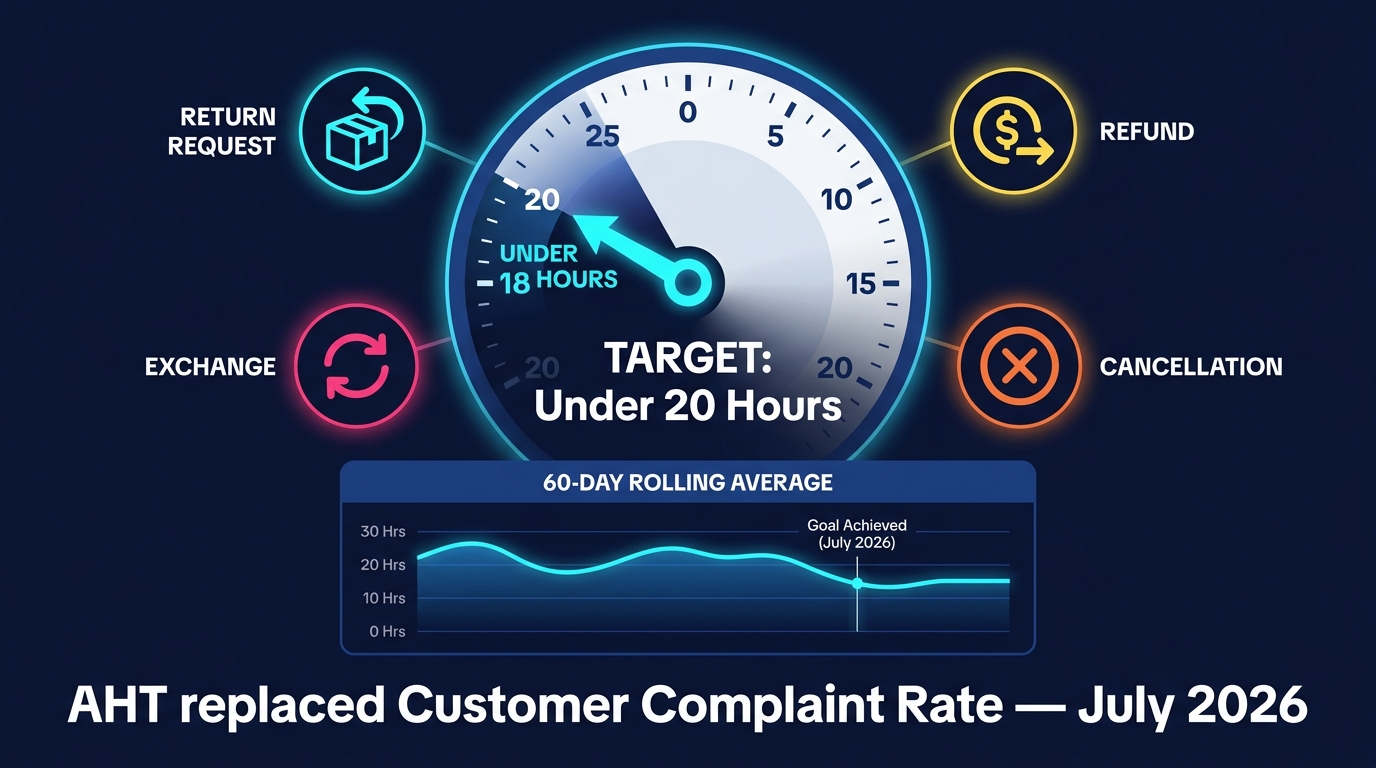
One of the most consequential changes in the July 2026 AHR update is the retirement of Customer Complaint Rate (CCR) as a core AHR input, replaced by After-Sales Handling Time (AHT). This change is significant enough that sellers who built their operational workflows around managing CCR need to recalibrate.
What CCR Measured vs. What AHT Measures
Customer Complaint Rate measured the volume of complaints relative to orders. The problem with this metric was that it rewarded sellers who resolved complaints quickly and those who received fewer complaints for entirely different reasons — including those who sold products where the expectation for after-sales service was inherently low. It also didn’t distinguish between a seller who resolved every complaint within an hour and one who dragged out resolutions for weeks.
After-Sales Handling Time measures something more granular and more operationally meaningful: the average time it takes a seller to take a decisive action on an after-sales request. AHT is calculated as a 60-day rolling average, and the clock starts the moment a customer submits an after-sales request — a return, refund, exchange, or cancellation request — and stops when the seller takes a definitive resolution action.
What Counts as an After-Sales Request Under AHT
The request types that feed into the AHT calculation include:
- Return requests — customer-initiated requests to return a product
- Refund requests — direct requests for monetary refunds, including partial refunds
- Exchange requests — requests to replace a product with a different size, color, or variant
- Order cancellation requests — where applicable, customer requests to cancel before shipping
A “decisive action” that stops the AHT clock includes approving a refund, issuing a return label, denying a request with proper documentation, or otherwise formally resolving the ticket. Leaving a request in an open, unresponsive state — hoping it will expire or that the customer will abandon it — does not stop the clock. Those open tickets continue to accumulate against your AHT average for the full 60 days they remain unresolved.
The Operational Implication
The shift to AHT creates a clear operational imperative: speed of response on after-sales issues now matters more than the volume of issues you receive. A seller who gets 50 return requests but resolves all of them within four hours will perform better under AHT than a seller who gets 10 return requests but takes three days to respond to each one.
For sellers managing after-sales through manual processes — checking the Seller Center inbox once or twice a day, routing requests through a customer service team that works limited hours — the AHT metric is a direct signal that the current operational model may not be sufficient. The benchmark threshold reported by industry monitoring is under 20 hours per request, and TikTok compares your AHT against same-category sellers rather than a flat platform average.
Practically, this means sellers should have:
- Notification alerts enabled for new after-sales requests in Seller Center
- A defined internal SLA for responding to after-sales requests (ideally under 8 hours)
- Pre-built response templates for the most common request types (wrong size, damaged product, didn’t match listing)
- Clear decision trees for when to approve vs. escalate a return request, so no ticket sits in limbo while internal decisions are made
Category Benchmarking: Why Your Score Is Relative, Not Absolute
The introduction of category-relative benchmarking in the July 2026 AHR update is arguably the most sophisticated change to the system — and the one most sellers haven’t fully processed yet.
Under the old Violation Points framework, performance expectations were relatively uniform across the platform. If a metric fell below a certain platform-wide threshold, you got a penalty. Under the new AHR model, some metrics are evaluated relative to what other sellers in your specific category are achieving. Your benchmark is your peer group, not the platform average.
What This Means in Practice
Consider an electronics seller and a fashion accessories seller. Electronics orders have naturally higher return and dispute rates because customers have more technical specifications to verify, more opportunities for expectation mismatches, and often higher purchase prices that make after-sales requests more likely. Fashion accessories have different patterns — potentially higher rates of size-related returns, but lower rates of technical disputes.
Under a flat platform benchmark, both sellers were evaluated against the same standard, which created structural disadvantage for categories with inherently higher friction rates. Under category benchmarking, an electronics seller’s AHT and fulfillment metrics are evaluated against other electronics sellers. If everyone in the electronics category has relatively higher dispute rates, the benchmark adjusts accordingly.
The practical implication is that the only truly relevant benchmark for your AHR performance is what’s achievable by well-run shops in your specific category. General platform-wide seller performance benchmarks that circulate in seller communities may be directionally useful but not directly applicable to your AHR evaluation.
What to Do With This Information
TikTok doesn’t publish category-specific AHR benchmarks publicly. The way sellers can calibrate their understanding is by monitoring their own performance metrics within the Seller Center dashboard and tracking how those metrics correlate with score changes over time. Sellers who operate in multiple categories across different shops (where platform rules permit) have an advantage in this calibration — they can observe how the same operational practices affect AHR differently across categories.
The AHR–Traffic Connection: How Your Score Controls Visibility
The Account Health Rating isn’t only a compliance and enforcement instrument. It functions as a quality signal that feeds into TikTok Shop’s traffic allocation and product recommendation systems. This is the dimension of AHR that has the most direct revenue impact for healthy sellers — not just those who are at risk of suspension.
How Low AHR Reduces Organic Reach
TikTok’s Seller Center documentation confirms that shops with low AHR may experience reduced visibility in the Shop tab, lower placement in search results, and reduced traffic from TikTok’s recommendation engine. The mechanism makes intuitive sense: TikTok is using AHR as a proxy for shop quality, and the platform’s recommendation system is designed to surface products from shops that deliver good customer experiences. A shop with an AHR in the 150–200 range is, by definition, one that has had compliance issues, performance problems, or both — and the algorithm adjusts accordingly.
The inverse is also structurally implied: shops with consistently high AHR scores are more likely to receive favorable traffic allocation from the recommendation engine. This is not explicitly documented in the same level of detail as the enforcement thresholds, but the logic of a quality-signal system points in that direction, and it’s consistent with how similar systems operate on other platforms.
Affiliate and Creator Access
One of the less-discussed consequences of a low AHR is the impact on affiliate and creator partnerships. When a shop’s AHR drops below certain thresholds, the shop may become ineligible for new affiliate enrollments, platform-facilitated creator partnerships, and inclusion in TikTok’s creator matching programs.
For shops that depend heavily on affiliate-driven traffic — which describes a large proportion of successful TikTok Shop operations in the current environment — losing affiliate access is a compounding problem. The shop loses creator traffic at the same time it loses organic visibility, creating a double squeeze on revenue that’s difficult to reverse quickly.
Campaign and Promotional Eligibility
TikTok’s mega campaigns and platform promotional events — the high-traffic sale events that drive outsized GMV for participating sellers — require AHR to be above the 150-point threshold to participate. This means that a shop which is technically still operational at 160 or 170 points is excluded from the platform’s most valuable promotional windows.
The timing risk here is significant. Sellers who allow their AHR to drift downward without actively managing it may find themselves locked out of peak promotional periods (major shopping events, seasonal campaigns) precisely when their competitors are gaining the most visibility. Missing one major campaign event can represent a revenue gap that takes months to recover.
The Appeal Process: How to Fight Enforcement You Believe Is Wrong
Not every AHR deduction is justified. Listing flags can be triggered by automated systems that misclassify compliant products. Fulfillment violations can be recorded against sellers during carrier-caused delays that were outside their control. Policy violations can be applied based on incomplete review of the seller’s documentation. When any of these situations occur, the appeal process is the primary recourse — but using it effectively requires understanding how it works.
Where and How to File an Appeal
All appeals are handled through the Seller Center. The path is:
- Open TikTok Shop Seller Center
- Navigate to Account Health / Shop Health
- Select Violation Records
- Open the specific violation you’re appealing
- Click the Appeal button on that violation’s detail page
Appeals cannot be filed through TikTok’s customer support chat, email, or social media channels. Any appeal submitted outside the formal in-platform flow will not receive a substantive review. This is a common mistake that costs sellers appeal time: thinking they’ve submitted an appeal when they’ve only sent a support message.
Appeal Windows and Timelines
The first appeal must typically be submitted within 30 days of the violation notice. If the first appeal is rejected, a second appeal is generally available, and that second window is typically 15 days from the first rejection. After both windows close without a successful outcome, the standard appeal path is exhausted for that specific violation.
TikTok does not publish specific timelines for appeal review decisions, and review speed can vary significantly based on violation type, evidence quality, and platform review volumes. Sellers should submit appeals as early as possible rather than waiting until the deadline — earlier submission doesn’t guarantee faster review, but late submission guarantees less available time if the initial review requires additional information.
What Makes an Appeal Succeed
The strongest appeals share several characteristics:
- Specificity: The appeal directly addresses the specific violation claimed — not general statements about the shop’s overall compliance practices, but a specific response to the specific allegation.
- New evidence: Appeals that simply restate what TikTok already reviewed rarely succeed. Effective appeals introduce documentation that wasn’t available during the initial review: brand authorization letters, product certification documents, carrier tracking showing on-time departure despite late delivery, corrected listings with documented changes.
- Prior correction: Where the violation reflects a genuine issue the seller has now addressed, documenting the corrective action — showing that the problematic listing has been updated or removed, that the fulfillment process has been changed — supports the appeal by demonstrating that the underlying issue has been resolved.
- Conciseness: Appeal reviewers are evaluating documentation, not narrative. Long explanations that recount the seller’s history and express frustration are less effective than clean documentation with clear labels showing the relevant evidence.
What Happens to Your Score During an Appeal
Filing an appeal does not freeze or reverse AHR deductions while the review is pending. Your score continues to reflect the deduction until and unless the appeal succeeds. This is an important operational reality: if you’re at 165 points and appealing a violation that dropped you from 220, you can’t wait for the appeal outcome before taking other protective actions. You should be simultaneously managing your AHR through other means — completing orders, passing available policy quizzes — while the appeal is under review.
The Recovery Roadmap: Rebuilding Your Score After a Drop
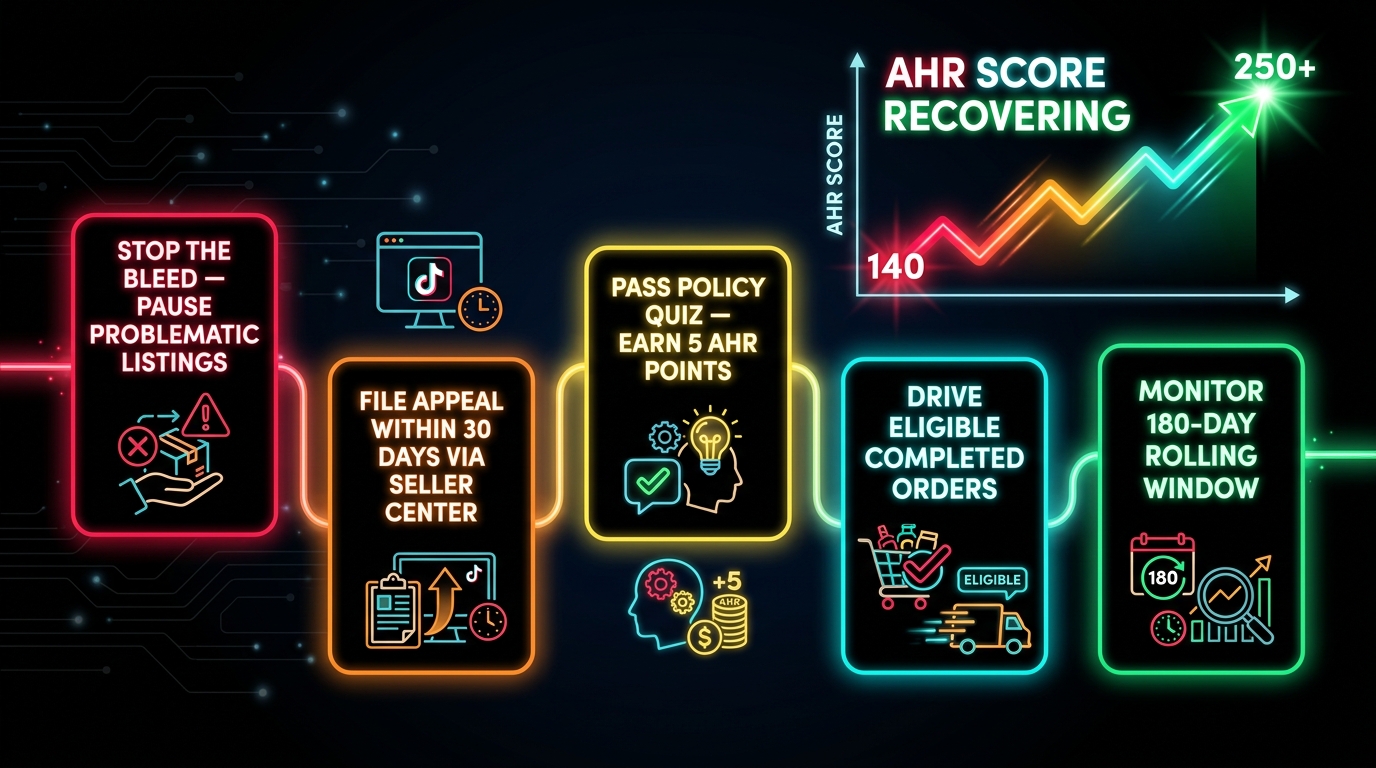
If your AHR has dropped below a level you’re comfortable with — or if you’ve already crossed into enforcement territory — the recovery process follows a predictable pattern. The key constraint to understand upfront is that recovery is slow by design. The system is structured to prevent fast rebounds after serious violations, which means patience and consistency are as important as any specific action.
Step 1: Stop the Bleeding Immediately
Before anything else, identify and address the source of the deductions. If a specific listing triggered the violation, remove or suspend that listing immediately — don’t wait to understand the full situation before taking protective action. If the issue was fulfillment-related, pause new listings until the operational problem is resolved. The priority is preventing additional violations while you work on recovery, because each new violation resets the recovery timeline for that issue.
Step 2: File Appeals for Eligible Violations
Review your Violation Records and identify any violations that you believe were applied incorrectly or that you have evidence to contest. File those appeals promptly, following the process described above. Even if only some appeals succeed, each successful appeal restores the points associated with that violation, which can meaningfully change your trajectory.
Step 3: Complete Every Available Policy Quiz
Check your active violations for associated policy quizzes. Pass each quiz with a perfect score. The 5 points per quiz is modest, but it’s the fastest legitimate point-gain mechanism available when you’re in recovery mode and can’t generate large order volumes quickly. More importantly, completing the quizzes signals engagement with policy content — which matters for the human review components of TikTok’s enforcement system.
Step 4: Drive Eligible Completed Orders
With the order-based earning rate of 4 points per 200 eligible completed orders, building your score through volume requires sustained effort. The 20-point weekly cap means you can earn at most 80 points per month from orders alone — and that’s at very high volume. For most sellers, the practical contribution of order-based earning is 10–20 points per month. It matters, but it won’t rescue a severely depleted score quickly.
Focus on operational excellence that produces eligible completions: accurate listings, reliable dispatch, proactive after-sales handling that prevents returns. Every refunded or returned order is a missed point and a potential negative signal.
Step 5: Understand the 180-Day Expiration Window
Deducted points from violations are restored after approximately 180 days if the violation is not repeated. This is the most powerful long-term recovery mechanism in the system — but it requires patience. A seller who takes a significant AHR hit from a cluster of violations in month one and then operates cleanly for the following six months will see a material score improvement as those old deductions age out of the rolling window.
The implication is that sellers in recovery mode should adopt a 180-day planning horizon. Rather than asking “how do I get back to a healthy score this month,” the question should be “how do I operate cleanly enough that six months from now, the rolling window reflects only compliant behavior?”
Proactive AHR Management: Operating Procedures for Sellers Who Stay in the Green
The most effective approach to AHR management isn’t reactive — it’s building operational practices that keep the score stable without requiring active attention. Sellers who consistently operate above 250 points aren’t necessarily monitoring their score more closely; they’ve built processes that make violations structurally unlikely.
Listing Creation and Audit Protocols
Before any product goes live, run it through a checklist that covers: product category eligibility in your region, required documentation for the product type, title and description accuracy against the actual product, image compliance (actual product, not misleading lifestyle only), and certification or safety requirements where applicable. Build this as a repeatable internal process, not a one-time audit. The sellers who accumulate listing violations most often are those who scale product launches faster than their review process can keep up.
Schedule periodic audits of your existing live listings — at minimum quarterly. Platform policies evolve, and a listing that was compliant when it was published may fall outside updated guidelines six months later. Proactive removal or correction of non-compliant listings before TikTok flags them prevents violations from occurring in the first place.
Fulfillment SLAs and Exception Management
Define internal dispatch SLAs that are more conservative than TikTok’s published requirements. If TikTok requires dispatch within 48 hours, build a process that targets 24-hour dispatch — the buffer protects you against the operational exceptions (supplier delays, warehouse issues, carrier pickup problems) that inevitably occur.
Build an exception management process for situations where on-time dispatch isn’t achievable. Proactive buyer communication — notifying the customer before the dispatch deadline that there will be a delay — won’t prevent the late dispatch from counting operationally, but it reduces the likelihood of a buyer complaint that triggers an additional AHR signal.
After-Sales Response Architecture
Given the shift to AHT as a core metric, after-sales response speed should be treated as a first-class operational priority. Set up Seller Center notifications for new after-sales requests so they’re actioned promptly, even outside standard business hours when feasible. Build pre-approved resolution templates for common scenarios — size return, damaged in shipping, product doesn’t match listing — so the seller can respond with a complete resolution offer rather than an acknowledgment that starts a secondary wait period.
For shops with sufficient volume, consider dedicated after-sales coverage during peak periods. The cost of a few hours of additional customer service during a high-order period is trivial compared to the AHR impact of response times that spike during busy windows.
Documentation Management
Maintain an organized file of all brand authorization letters, product certifications, safety documentation, and supplier agreements for every product in your catalog. When TikTok requests documentation as part of a listing review or violation response, the ability to produce it quickly is the difference between a fast resolution and a drawn-out appeal process. Sellers who can’t locate their own documentation when they need it are operationally vulnerable.
Regular Score Monitoring
Check your AHR dashboard in Seller Center at least weekly. Not because the score typically moves dramatically in short windows, but because early detection of a downward trend allows you to identify and address issues before they become enforcement events. The distance between 200 and 150 is meaningful — catching a drop at 185 and addressing the underlying issue is far easier than trying to recover from 120.
What AHR Signals About TikTok’s Broader Platform Direction
Stepping back from the operational specifics, the Account Health Rating system reflects something important about where TikTok Shop is heading as a commercial platform. The move from violation points to a composite, category-benchmarked, performance-inclusive score is a maturation of the seller governance model — a shift from reactive penalty enforcement to proactive quality management.
Mature e-commerce platforms — the ones that have successfully built buyer trust over time — universally use sophisticated seller health metrics to curate their seller base and control the buyer experience. Amazon’s seller performance standards, Etsy’s Star Seller ratings, and eBay’s seller levels all serve the same fundamental purpose: using operational performance data to stratify seller access and privilege, and using that stratification to protect the buyer experience while creating competitive pressure on sellers to raise their standards.
TikTok Shop is moving in that same direction. The platform’s long-term ambition in Western markets depends on building buyer trust that is currently fragile — early negative experiences with counterfeit products, long shipping times, and poor after-sales service have created a perception problem that TikTok needs to actively manage. The AHR system is one of the primary tools for doing that, by creating structural incentives for sellers to operate at a quality standard that protects the buyer.
For sellers, the implication is straightforward: the threshold for acceptable performance on TikTok Shop will continue to rise. What qualifies as a “healthy” AHR score in terms of operational practices will become more demanding as the platform matures and as category benchmarks improve. The sellers who invest in building genuine operational quality now — not just AHR score optimization, but actual fulfillment reliability, listing accuracy, and after-sales responsiveness — will be better positioned as those standards increase.
The sellers who treat AHR management as a compliance exercise to minimize — doing just enough to stay above 150 — are building on a foundation that becomes less stable over time as the platform’s standards evolve.
Key Takeaways: The Operational Checklist
For sellers who want a concise reference summary of the most important AHR management principles, the following covers the core imperatives:
- Understand your score structure: AHR runs 0–1,000, starts new sellers at 200, and uses a rolling 180-day window. Points come in slowly through orders (4 pts per 200 eligible orders) and policy quizzes (5 pts per perfect quiz). Points go out faster when violations occur.
- Respect the milestones: 150 triggers 7-day restrictions, 100 triggers 14-day restrictions, 50 may trigger temporary deactivation, 0 means permanent closure. Never let operational drift carry you close to 150.
- Optimize for AHT, not CCR: The July 2026 shift from Customer Complaint Rate to After-Sales Handling Time means speed of resolution now matters more than complaint volume. Target after-sales response under 8 hours internally.
- Know your category benchmark: Your AHR is evaluated relative to same-category peers, not a flat platform average. The relevant standard is what well-run shops in your category are achieving.
- Keep documentation current: Brand authorization, product certifications, safety documentation. Have it filed and findable before you need it.
- Appeal with evidence, not narrative: Successful appeals are built on specific documentation, not general statements about your shop’s quality. File within 30 days. Use the platform appeal tool, not support chat.
- Plan recovery on a 180-day horizon: Score deductions from violations expire after 180 days. A clean six months of operation following a violation cluster will significantly improve your score as old deductions roll off the window.
- Monitor weekly: Small score changes caught early are manageable. Score drops caught only when enforcement triggers are not.
Conclusion
The Account Health Rating is TikTok Shop’s most consequential operational system for sellers in 2026, and it’s one that most sellers still encounter reactively rather than proactively. The platform has replaced a blunt violation-counting mechanism with a dynamic composite score that reflects real operational quality — rewarding consistency, penalizing negligence, and structurally tiering seller access based on performance.
The sellers who will navigate this system best are those who internalize what it’s actually measuring: not just the absence of rule-breaking, but the presence of operational quality across fulfillment, after-sales service, listing accuracy, and policy compliance. Those are the same characteristics that build long-term buyer trust, which means managing AHR well isn’t a platform-specific exercise — it’s good business practice with a score attached.
The four milestones — 150, 100, 50, 0 — aren’t just enforcement triggers. They’re signals of how far a shop has drifted from the operating standard the platform requires. Staying comfortably above 200, and building toward higher scores through consistent performance, is the only strategic posture that provides genuine protection against the enforcement risks that the AHR system is designed to enforce.
Know your score. Understand what moves it. Build operations that keep it healthy. That’s the entirety of what AHR management requires — the complexity is in the execution, not the principle.