


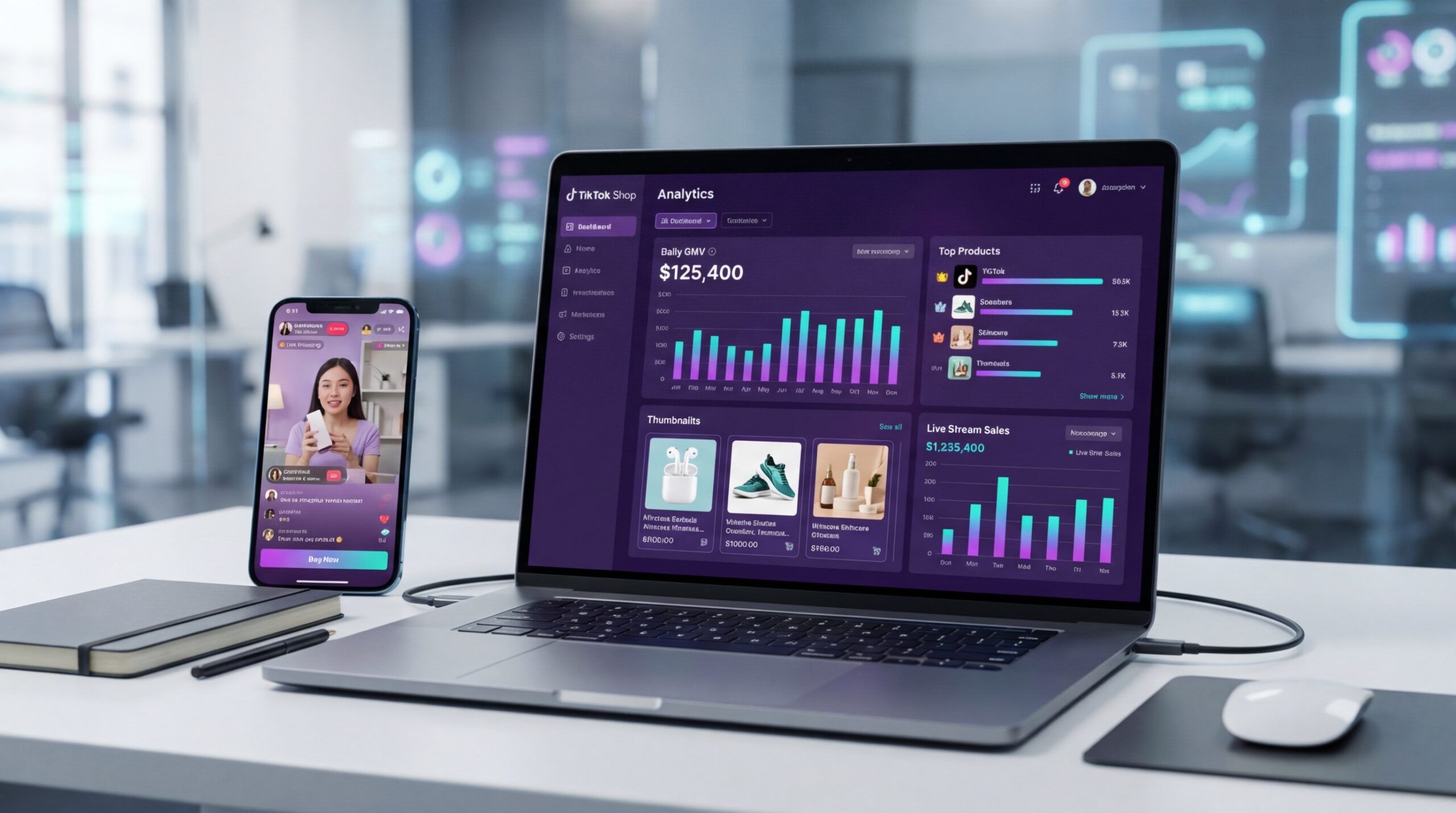

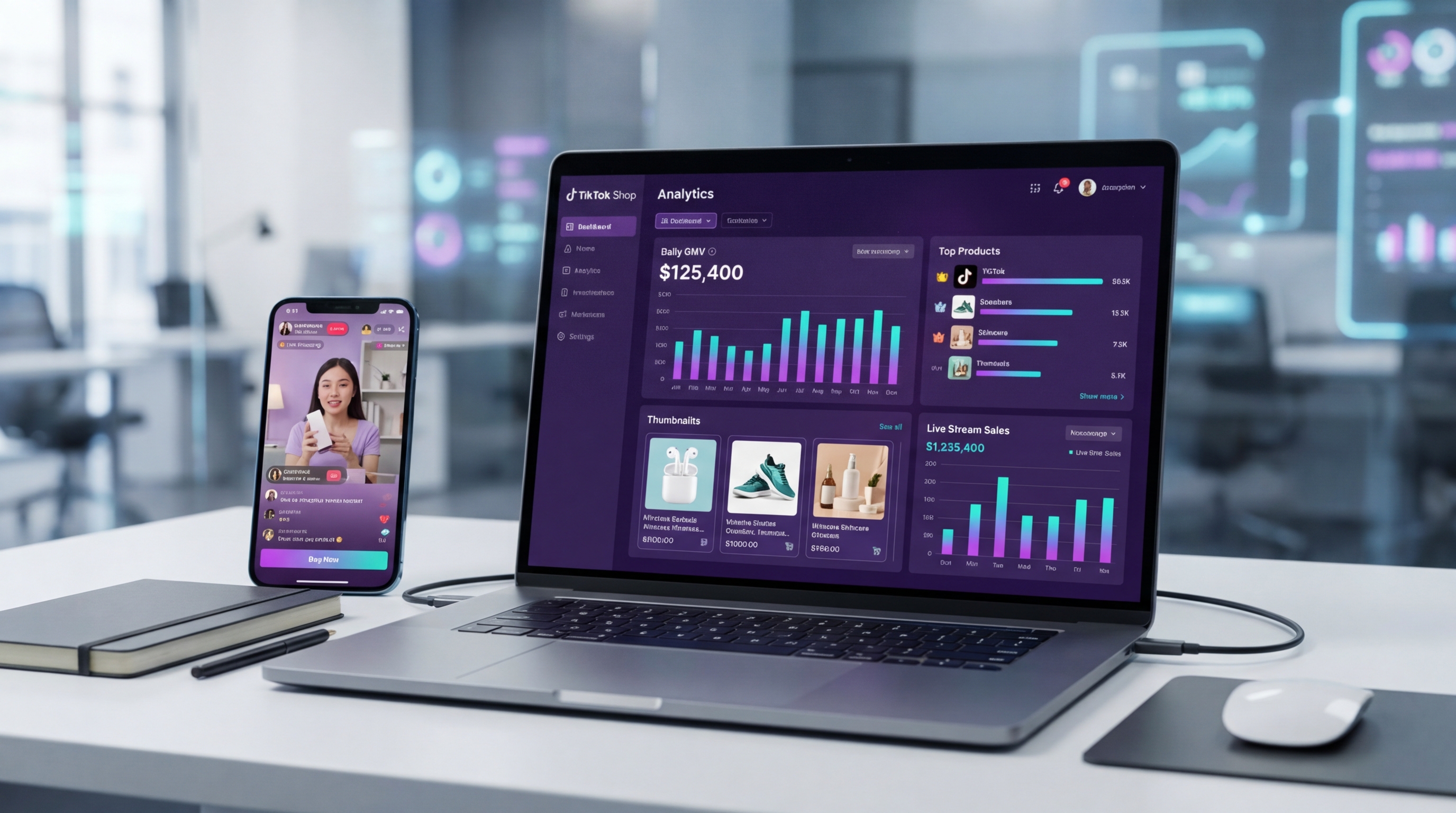
TikTok Shop crossed $33 billion in US gross merchandise value in 2025. It grew more than 200% year over year. It now hosts over 500,000 US merchants and more than 200 million monthly active buyers globally. By any measure, this is no longer an experiment — it is a fully functioning commerce channel that demands to be taken seriously.
But the gap between sellers who are thriving on TikTok Shop and those who are struggling is not a content gap. It is not a product gap. In most cases, it is an understanding gap. Sellers who win on this platform have internalized how the system actually works: how the algorithm ranks products in the Shop tab, how account health scoring affects every metric that matters, how to structure a live session to hit double-digit conversion rates, and how to build an affiliate engine that keeps generating sales long after a campaign ends.
This guide does not cover the basics of opening an account or uploading your first product. It goes deeper. It is built for sellers who are already on TikTok Shop — or who are entering it with serious intent — and need a comprehensive, data-backed framework for making it work at scale. Every section is grounded in 2026 platform data, real seller benchmarks, and the mechanics of how the platform rewards and penalizes behavior.
Whether you sell beauty products, home goods, apparel, or gadgets, the operating principles covered here apply. Let’s get into them.
The TikTok Shop Landscape in 2026: What the Numbers Actually Tell Us
Before building strategy, sellers need an accurate picture of the environment they are operating in. The headline numbers for TikTok Shop are impressive, but the detail underneath them tells an even more useful story.
Scale, Growth, and What It Means for New Entrants
TikTok Shop’s US merchant count grew from just 4,450 in July 2023 to over 231,000 by mid-2025. That is a 50x increase in two years. The platform now claims 15 million global sellers, with active US sellers growing at roughly 35% quarter over quarter as of early 2026. Average monthly revenue for a US TikTok Shop seller sits at $3,750 to $4,200 — but that average masks enormous variance. About 23% of US sellers exceed $5,000 per month, while a large portion generate under $500.
The takeaway is not that competition has made success impossible. It is that undifferentiated sellers — those with generic listings, no content strategy, and weak affiliate networks — are getting lost. Sellers with a deliberate system are still climbing. The platform’s 200%+ year-over-year GMV growth means there is real volume to capture. The question is how.
How TikTok Shop Compares to Amazon (and Why That Matters)
Amazon’s global GMV is roughly 40 times larger than TikTok Shop’s US figure. Amazon controls 37–40% of US ecommerce spend. These facts are not reasons to avoid TikTok Shop — they are reasons to understand what each platform is actually good for.
Amazon is intent-driven commerce. Shoppers arrive knowing what they want to buy. TikTok Shop is discovery-driven commerce. Shoppers arrive to be entertained, and buying happens as a byproduct of engagement. This fundamental difference shapes everything: which products perform well, how listings should be written, how pricing should be structured, and what role creators play.
Amazon charges sellers an average of 15% in fees plus FBA costs of $3–5 per item. TikTok Shop’s commission structure starts at 1.8% for new sellers and rises to approximately 5% at standard rate. That fee difference is significant for margin calculations — but it also means TikTok Shop is a lower-stakes environment in which to test new products before committing to full Amazon infrastructure.
Sellers who treat TikTok Shop as a standalone channel and those who use it as a product validation and demand generation layer for a broader multi-channel business both have viable paths. Understanding which path fits your business model is step one.
The TikTok Shop Algorithm Decoded: How the Shop Tab Actually Ranks Products
Search now drives between 48% and 65% of TikTok Shop sales. That figure — documented in seller data from early 2026 — is one of the most important numbers in the entire platform. It means that the majority of purchases are not happening because a video went viral. They are happening because a buyer typed something into the TikTok search bar, found a listing, and converted.
Products on page one of the Shop tab capture 38–52% of all clicks for their category. Getting there from page two or three is not a minor improvement — it can be a 300–500% traffic increase. This is why TikTok Shop SEO deserves the same rigor that serious Amazon sellers apply to their A9 ranking strategy.
How TikTok’s Algorithm Scores Listings
TikTok’s Shop tab algorithm evaluates listings across several signal categories simultaneously. Keyword relevance is the first and most weighted factor. The algorithm scans product titles for exact and partial keyword matches, with keywords placed in the first three to five words of the title carrying the most ranking weight. A title structured as “Glass Skin Serum — Korean Hydrating Peptide Formula, 30ml” will consistently outperform “Hydrating Korean Serum for Glowing Skin” because the primary search term appears at the front.
Beyond titles, the algorithm reads product descriptions for semantic keyword clusters. If your core product is a gel nail kit, your description should also include related terms — UV nail lamp, at-home nail kit, nail extension system — to signal topical authority to the ranking engine. TikTok’s Creative Center autocomplete tool is the best free source for identifying which variations buyers are actually searching.
Performance Signals That Feed the Ranking Engine
Keyword relevance alone does not keep a product on page one. TikTok’s algorithm continuously weights listings based on live performance signals. Click-through rate from search results is a major factor. A listing with an optimized title that still has a weak thumbnail image will see its CTR suffer, which pulls its ranking down even if keyword placement is excellent.
Conversion rate — the percentage of product page visitors who complete a purchase — is equally important. The algorithm interprets a high conversion rate as strong product-market fit and rewards it with more visibility. This creates a reinforcing loop: better visibility drives more traffic, which gives the algorithm more conversion data, which sustains or improves ranking.
Additional ranking inputs include shop-level metrics like your seller rating, return rate, and shipping speed. A seller with a 4.8-star rating and a sub-2% return rate will rank higher than a seller with an identical product but a 4.1-star rating and a 6% return rate, assuming other variables are equal. The algorithm sees seller trust signals as a proxy for product quality.
OCR and ASR: The Hidden Ranking Layer
One element that surprises many sellers is that TikTok’s algorithm also uses Optical Character Recognition (OCR) and Automatic Speech Recognition (ASR) to analyze the videos associated with your listings. If a creator’s video about your product includes on-screen text or spoken words that match buyer search queries, that video’s performance feeds into the product’s overall “Demand Score.” This score influences Shop tab ranking.
In practical terms, this means briefing your affiliate creators to naturally mention the product’s primary keywords in their voiceover or on-screen text is not just good content advice — it is an SEO tactic with measurable ranking implications.
Product Category Intelligence: What Sells, What Doesn’t, and Why
Not every product belongs on TikTok Shop. The platform’s discovery-driven model strongly favors certain product characteristics, and sellers who choose their categories and SKUs strategically will spend far less time and money achieving meaningful revenue than those who try to force ill-fitting products through the content machine.
The Dominant Categories in 2026
Beauty and Personal Care accounts for approximately 22.5% of TikTok Shop’s total global GMV — the single largest category by a significant margin. Within beauty, the highest-performing sub-categories are perfume, serums and essences, shampoo and conditioner, and concealer and foundation. Perfume alone generates $378,000 in tracked GMV with 127 million views from 17,000 creator videos. Serums and essences generate $223,000 GMV with 112 million views.
Womenswear and Underwear is the second-largest category at 12.5% of GMV, followed by Health and Wellness and Consumer Electronics accessories. Electronics accessories — phone cases, screen protectors, and charging cables — perform strongly as ultra-low-ticket impulse items, often priced under $5, but with volume that can produce meaningful revenue at scale.
Why Beauty Dominates and What It Teaches Every Seller
Beauty products do not dominate TikTok Shop because the platform is primarily used by women. They dominate because beauty products are inherently demonstrable. A 30-second video of a serum being applied, followed by a visible skin improvement, tells a complete purchase story in the format TikTok’s algorithm rewards. Before-and-after content is the highest-converting content type on the platform, and beauty products are built for it.
The lesson for sellers outside beauty is to ask: can my product tell a visible story in under 60 seconds? Home gadgets that solve obvious problems (a garlic press that works in two seconds, a cable organizer that transforms a messy desk) apply the same principle. Products that require detailed explanation, comparison shopping, or prior category knowledge are significantly harder to sell through TikTok’s content-to-purchase flow.
Price Point Strategy: The $15–$75 Sweet Spot
Platform data consistently identifies the $15–$75 price range as the highest-converting zone for TikTok Shop. Products priced below $15 can generate volume but struggle to produce meaningful revenue after platform fees and shipping costs. Products priced above $75 typically require a longer consideration period than TikTok’s impulse-buy dynamic supports — buyers are more likely to open a new browser tab and research alternatives.
Within the sweet spot, charm pricing ($19.99, $34.99, $49.99) outperforms round-number pricing. AOV benchmarks for TikTok Shop average $47–$73, meaning sellers whose individual product pricing falls in this range are well-positioned to generate single-transaction revenue that justifies their fulfillment costs without needing buyers to purchase multiple items.
Account Health Rating: The Metric That Controls Your Entire Business
Many TikTok Shop sellers focus almost exclusively on GMV — gross merchandise value — as their primary success metric. This is understandable but dangerous. GMV tells you how much you are selling. Your Account Health Rating (AHR) determines whether you are allowed to keep selling at all.
How the AHR System Works
TikTok Shop’s AHR is a 0–1,000 point scoring system that evaluates seller compliance and performance across a rolling 180-day window. All new sellers begin with 200 points. The system uses color-coded zones to communicate account status: green (200+ points) indicates a healthy shop in good standing; orange (51–199 points) signals that enforcement actions are either pending or actively occurring; red (50 points or fewer) means your account is at risk of deactivation; and 0 points results in permanent deactivation.
TikTok updated the AHR system in February 2026, making the scoring more transparent and easier to monitor in real time through the Seller Center dashboard. The update also introduced clearer point deduction explanations, so sellers can now see exactly which violation triggered a score reduction and by how many points.
The Violations That Drain Your Score Fastest
Point deductions are not all equal. Policy violations related to prohibited products, intellectual property infringement, and counterfeit goods carry the heaviest deductions — often 100–200 points per violation, which can move a seller from green to orange or red in a single incident. These are absolute lines that every seller must treat as non-negotiable.
Operational violations are more common and more preventable. A Late Shipment Rate (LSR) above 4% will trigger score deductions and reduced listing visibility. A Seller-Fault Cancellation Rate (SFCR) above 2.5% — meaning you cancelled orders because you ran out of stock — carries similar penalties. Customer complaint rates, return rates, and unresolved dispute ratios all feed into the operational scoring component.
The connection between AHR and algorithmic visibility is direct and documented. Sellers whose AHR enters the orange zone report significant drops in organic impressions within the Shop tab, often within 48–72 hours of the score change. Recovering from orange status requires time — point restoration happens gradually as compliant behavior accumulates — making prevention far more effective than remediation.
Protecting Your AHR Proactively
The most effective AHR protection strategy combines accurate inventory management with realistic listing quantities. Overselling — listing more units than you can actually ship — is the primary driver of seller-fault cancellations. Sellers who integrate their inventory management software with TikTok Shop in real time, rather than relying on manual CSV updates, avoid the gap between actual stock levels and listed availability that causes cancellations during viral traffic spikes.
Maintaining a response rate of 90%+ for customer inquiries within 24 hours also protects the AHR. Buyers who receive timely responses are less likely to escalate to formal complaints, which are weighted more heavily against your score than negative reviews alone.
Fulfillment Realities: The Shipping Mistakes That Kill TikTok Shops
Fulfillment is the least glamorous part of TikTok Shop selling, and it is where a disproportionate number of shop suspensions, score drops, and negative reviews originate. The platform has strict service-level agreements, and sellers who underestimate their operational requirements pay for it in both account health and repeat purchase rates.
The Standard That TikTok Shop Enforces
TikTok Shop’s baseline fulfillment requirement is dispatch within two business days of order placement. The On-Time Dispatch Rate (OTDR) — the percentage of orders shipped within this window — must stay at or above 80%. The Late Shipment Rate must stay below 4%. These are not guidelines; they are thresholds with direct consequences for listing visibility and account standing.
A useful data point: each 24-hour delay beyond the dispatch window correlates with a roughly 20% increase in negative review probability. Buyers who receive late shipments without proactive communication are significantly more likely to leave a one-star review than buyers who experience the same delay but receive an update explaining the situation.
The De Minimis Crackdown and Its Implications
A significant operational shift occurred in 2026 with the enforcement changes around de minimis import thresholds. Sellers who were operating direct-from-China dropshipping models — shipping individual orders directly from Chinese suppliers to US buyers under the de minimis exemption — faced major disruption. The removal of de minimis protections for many goods means that this fulfillment model now faces customs delays, duties, and compliance complications that make it unviable for maintaining the shipping speeds TikTok Shop requires.
Sellers who had built their model on this approach were forced to transition. The viable paths are: holding inventory in a US-based third-party logistics (3PL) facility; using TikTok’s Fulfilled by TikTok (FBT) service; or using the Upgraded TikTok Shipping option which uses platform-approved carriers. Each option has different cost structures, but all share the common requirement of having product physically located in the United States before orders are placed.
Inventory Visibility and the Viral Spike Problem
One of the most operationally dangerous scenarios for TikTok Shop sellers is a sudden viral traffic spike. A creator’s video goes unexpectedly viral, drives thousands of buyers to a product listing, and overwhelms available inventory — leading to a surge in seller-fault cancellations that can push the SFCR above the 2.5% threshold in a single day.
The solution is not to carry excess inventory speculatively. It is to implement real-time inventory synchronization between your warehouse or 3PL and TikTok Shop’s listing quantities, with automatic stock quantity updates that reduce listed availability as stock depletes. This does not prevent stockouts, but it prevents the scenario where buyers are placing orders for products that no longer exist in your warehouse.
Live Selling Mastery: The Format Data and Host Techniques That Drive Conversion
TikTok Shop LIVE is the platform’s highest-converting commerce format by a significant margin. Live sessions convert at 8–12% on average, compared to 3.4–5.2% for standard shoppable videos. Top-performing live events have documented conversion rates reaching 22–30% — figures that are genuinely difficult to achieve in any other ecommerce format. Understanding why live selling works this well, and what separates top performers from average ones, is essential for sellers who want to access this channel’s full potential.
Why Live Converts Better: The Psychology
Live shopping combines three psychological drivers that rarely operate simultaneously in other ecommerce formats. Real-time social proof — seeing other viewers comment, react, and ask questions — creates a sense of shared experience that reduces purchase hesitation. Live demonstration allows buyers to see the product in use, which resolves objections that written descriptions cannot. And time-bound urgency — limited stock, exclusive live pricing, countdown timers — activates loss aversion, the cognitive bias that makes people more motivated to avoid losing a deal than to gain a benefit.
None of these drivers operate independently. The combination of them in a structured live format is what produces conversion rates that exceed the platform average by several multiples.
The Structured Live Format That Top Sellers Use
High-converting live sessions are not improvised. They follow a consistent arc that experienced sellers replicate session after session. The structure begins with a warm-up phase of five to ten minutes, during which the host builds rapport, acknowledges existing viewers, and creates anticipation for what is coming. This phase is critical for viewer retention — the TikTok algorithm uses early watch time as a signal to determine how broadly to distribute the live session to non-followers.
The spotlight phase follows: a focused demonstration of a single hero product, with the host addressing common questions, showing before-and-after results where applicable, and verbally reinforcing the product’s core benefit claim. Single-product focus during this phase is intentional — introducing multiple products simultaneously dilutes attention and reduces conversion on each.
The bundle moment comes next: the host introduces a bundle offer that combines the hero product with a complementary item at a total price that increases AOV while maintaining perceived value. A skincare serum bundled with a complimentary toner at 15% off the combined retail price is a classic example. This is followed by an urgency CTA — “only 47 units left at this price,” “this offer closes in 8 minutes” — and a recap segment that acknowledges recent buyers and re-introduces the product for viewers who joined mid-stream.
Algorithm Signals During a Live Session
TikTok’s algorithm evaluates live sessions using three primary signals: viewer retention (how long people stay watching), real-time interaction (comments, questions, reactions), and product actions (product page clicks, cart additions, purchases). Sessions that generate high engagement in all three categories receive broader distribution — the algorithm pushes the live to more non-follower For You pages, which drives additional traffic without paid spend.
Practical tactics for lifting these metrics include direct audience engagement prompts (“Drop a 1 in the comments if you’ve struggled with [problem the product solves]”), live Q&A segments that keep viewers interacting, and real-time stock display that creates visual urgency. Hosts who acknowledge commenters by name during the stream consistently generate higher watch times than those who treat the live as a broadcast rather than a conversation.
Pricing Architecture: How to Engineer Average Order Value on TikTok Shop
Pricing on TikTok Shop is not simply a matter of setting a number and listing a product. It is an active system that, when designed deliberately, can increase average order value by 25–35% above a single-product baseline. The sellers who understand this are structuring their pricing architecture around bundles, flash mechanics, and psychological triggers — not competing on lowest price.
Bundle Strategy: The AOV Engine
Bundles on TikTok Shop outperform discounts in nearly every measured scenario. A bundle that combines a $29 hero product with a $12 complementary item at $37 (approximately 9% off the combined retail) performs better than a 9% discount on the hero product alone. The reason is perceived value: buyers experience the bundle as getting more for their money rather than simply paying less for the same thing.
Effective bundles share a problem-solution relationship between the included products. A face wash bundled with an exfoliating pad addresses the same skincare routine step. A phone case bundled with a screen protector addresses the same device protection need. Bundles that force unrelated products together — driven by inventory considerations rather than buyer logic — consistently underperform purpose-built bundles.
TikTok Shop’s platform mechanics support bundles through the “Buy More, Save More” promotional feature, which allows sellers to configure automatic discount tiers based on quantity. Sellers who tag three to five related products in a single shoppable video — rather than tagging only the hero product — also see higher AOV, as the video interface presents all tagged products to the buyer in a single view.
Flash Sale Mechanics and When to Use Them
Flash sales on TikTok Shop serve a specific purpose: they are acquisition tools, not margin tools. A well-executed flash deal — 30–40% off a single product for a limited time window — can generate enough first-time buyer data, reviews, and social proof to improve the product’s baseline ranking and ongoing conversion rate for weeks after the promotion ends.
Flash sales are most effective when run in conjunction with a live session, where the host can reinforce the time-limited nature of the offer verbally. Running a flash sale purely through a static listing without supporting content generates a fraction of the urgency and conversion benefit that a live-anchored flash sale produces.
The risk with flash sales is margin erosion. Sellers who run frequent flash deals train their audience to wait for discounts rather than purchasing at full price. A structured promotional calendar — two to three flash events per month, tied to live sessions or platform promotional campaigns — captures the acquisition benefit without conditioning buyers to expect perpetual discounts.
Free Shipping as an AOV Lever
TikTok Shop buyers have a higher sensitivity to shipping costs than buyers on platforms where paid shipping is the norm. Free shipping — either built into the product price or offered as a promotional threshold (free shipping on orders over $35) — consistently lifts conversion rates at the listing level. The threshold model is particularly effective at increasing AOV because buyers will add a second item to their cart to qualify for free shipping rather than pay $4.99 to ship a single item.
Paid Advertising on TikTok Shop: Spark Ads, GMV Max, and What the Data Shows
Organic reach on TikTok Shop is genuinely powerful — more so than on most other ecommerce platforms. But sellers who ignore the paid advertising layer are leaving a significant performance multiplier on the table. Understanding the ad formats available, how they interact with organic content, and what ROAS benchmarks are realistic for 2026 is essential for building a complete TikTok Shop growth system.
Spark Ads: Amplifying What Already Works
Spark Ads allow sellers to put paid distribution behind existing organic content — either your own videos or creator affiliate videos (with the creator’s permission). This format consistently outperforms standard In-Feed Ads by 20–40% in key performance metrics, because Spark Ads carry the social proof of organic engagement (likes, comments, shares) that standard ads lack.
The practical implication is straightforward: before running Spark Ads, let videos run organically for 24–48 hours. Videos that demonstrate strong organic engagement signals (high watch time, comment volume, click-through rate) are the ones worth amplifying with paid spend. Running Spark Ads on underperforming organic content does not fix the creative problem — it just spends money on content that was not resonating in the first place.
Creator economy ads on TikTok — which includes Spark Ads built on creator content — achieve 96% higher ROAS than comparable spend on other digital channels and show approximately 2x efficiency compared to television advertising. CPC benchmarks for Spark Ads range from $0.30 to $1.50, with CPM averaging $5–$12 depending on audience targeting and competition within the category.
GMV Max: The AI-Consolidated Campaign Type
TikTok launched GMV Max in 2025 as a consolidation of its various ad formats — Spark Ads, Video Shopping Ads, Product Shopping Ads, and LIVE ads — into a single AI-optimized campaign type. GMV Max uses machine learning to allocate budget across formats and placements automatically, optimizing toward maximum gross merchandise value based on the seller’s target ROI and daily budget inputs.
For sellers who previously needed to manage separate campaigns across multiple TikTok ad formats, GMV Max significantly reduces operational complexity. Early adopters report that the system’s automated budget allocation outperforms manually managed multi-format campaigns in most scenarios, primarily because the AI can respond to real-time performance data faster than a human campaign manager reviewing results daily.
The platform-wide ROAS benchmark for TikTok Shop advertising sits at approximately 3.5x, meaning for every dollar spent on ads, sellers generate $3.50 in GMV. High-performing sellers in beauty and home categories report ROAS of 4–6x when their creative quality is strong and their targeting is well-configured. Low performers often cite CPA of $5–$15 per acquisition, which can be profitable or unprofitable depending entirely on the product’s margin structure.
Video Shopping Ads vs. LIVE Ads
Video Shopping Ads drive buyers to a product listing or checkout page from a short-form video. LIVE ads drive buyers into an ongoing live session. The choice between them should be driven by what the seller is currently running. If a live session is active and performing well (high engagement, visible sales velocity), LIVE ads can dramatically accelerate traffic into that session, compounding the conversion benefits of the live format. If no live session is running, Video Shopping Ads into a well-optimized listing are the appropriate default.
The TikTok Shop Affiliate Ecosystem: Going Beyond Creator Outreach
The affiliate program on TikTok Shop is one of its most structurally distinctive features. It allows brands to recruit creators to make content about their products in exchange for a commission on every sale that content generates. Done well, it creates a performance-based content distribution system that scales without a fixed media spend. Done poorly, it creates a stream of low-quality content that dilutes brand perception and generates no meaningful sales.
Commission Structures That Actually Attract Quality Creators
The commission rate a brand offers determines which creators will accept their collaboration request — and which will ignore it. Standard affiliate commissions on TikTok Shop range from 5% to 20%, with micro-influencers (10,000–100,000 followers) typically requiring 10–15% to commit to creating content. Macro-influencers and established creators with highly engaged audiences command 15–20% or higher.
A common mistake brands make is setting blanket commission rates across all affiliates. A more effective approach is tiered commissions: a base rate (8–10%) available through the Open Collaboration plan for any creator who wants to apply, with a targeted rate (15–18%) offered directly to specific high-performing or highly aligned creators. This structure controls spend while prioritizing relationships with creators whose audiences convert well for your product category.
The Open Plan vs. Targeted Outreach Model
TikTok Shop’s Open Collaboration plan allows any creator on the platform to apply to promote your products. Setting up an Open plan with free product samples available and a competitive commission rate can generate 50–100 creator videos per week without direct outreach effort. Top brands using this model — including Soo Slick, which reached $1 million in sales primarily through open affiliate partnerships — demonstrate that volume of creator content has a compounding effect even when most individual videos underperform.
The Pareto principle applies strongly here: roughly 80% of affiliate revenue typically comes from 20% of creators. The strategy is to use the Open plan to identify which creators are generating strong conversions, then transition those performers into Targeted Collaboration arrangements with higher commissions, exclusive discount codes for their audiences, and early access to new products. This deepens the relationship and incentivizes the creator to prioritize your brand over competitors they are also promoting.
Micro-Influencers vs. Macro: The Engagement Data
Platform data from 2026 shows micro-influencers (5,000–100,000 followers) generating an average engagement rate of 8.2% on TikTok, compared to 5.3% for macro-influencers (100,000+ followers). This gap exists because micro-influencer audiences are typically more tightly aligned around a specific niche or interest — meaning their followers are genuinely interested in the content type, not just following a celebrity persona.
For TikTok Shop, engagement rate is directly correlated with conversion rate, because product clicks and purchases count as engagement signals that the algorithm tracks. A micro-influencer with 25,000 followers and an 8.2% engagement rate will often generate more sales per video than a macro-influencer with 500,000 followers and a 5% engagement rate — while costing significantly less in commission or gifted product value.
Creator Briefing for Maximum Conversion
The quality of creator briefing is one of the most underestimated drivers of affiliate program performance. Creators who receive clear, specific guidance about which product benefits to highlight, which search keywords to mention naturally in their voiceover, and what the intended call to action is, consistently outperform creators who receive generic product samples with no direction.
Effective creator briefs cover: the single primary benefit to lead with, one or two supporting claims with specific metrics where available, the price point and any active promotions, the target audience pain point the product addresses, and a request to include the shop link in the video’s product tag. They do not script the creator’s delivery — that would undermine the authenticity that makes creator content convert — but they ensure that the essential sales information is present in every video.
Building a Defensible TikTok Shop Business for the Long Term
Short-term tactics produce short-term results. Sellers who are building businesses — not just running campaigns — on TikTok Shop need to think about the structural elements that create sustainable competitive advantage. These are the areas that separate shops with staying power from those that spike and disappear.
Review Velocity and Social Proof Infrastructure
Reviews on TikTok Shop function both as conversion drivers and ranking signals. Products with more than 50 reviews consistently outrank products with fewer reviews at equivalent price points and keyword relevance, according to platform ranking documentation. Building review velocity — the rate at which new reviews accumulate — is therefore a strategic priority, not an afterthought.
The most reliable method for building review velocity is post-purchase follow-up messaging within TikTok Shop’s messaging system, sent within 72 hours of confirmed delivery. Messages that ask for honest feedback — not specifically positive reviews, which violates platform policy — and make the review process feel easy generate significantly higher response rates than no communication at all. Packing inserts that direct buyers to leave a review via QR code are also permitted and effective for sellers using their own fulfillment.
Multi-SKU Strategy and Category Expansion
Single-product shops are vulnerable. If that product faces supply chain disruption, loses its viral moment, or is undercut by a competitor, the entire shop’s revenue can collapse. Sellers who build multi-SKU catalogs around a coherent brand identity — a skincare brand, a home organization brand, a wellness brand — create resilience through diversification while maintaining the thematic consistency that makes their affiliate content program coherent.
Category expansion on TikTok Shop should follow data, not aspiration. The right next product is the one that your existing buyers are most likely to want — identifiable through buyer behavior data in Seller Center analytics, through direct customer survey responses, and through observation of what your highest-converting affiliates are also promoting from other brands. These signals consistently identify expansion opportunities with genuine demand rather than speculative product additions.
Platform Dependency Risk and How to Mitigate It
The US TikTok ban threat — which created significant seller anxiety in late 2024 and early 2025 — raised an important strategic question that every TikTok Shop seller needs to answer: what happens to your business if the channel disappears or becomes inaccessible? Sellers who had built email lists, social followings, and direct-to-consumer website infrastructure using TikTok Shop as a demand generation channel were significantly more resilient than those who had built everything on the platform itself.
The practical steps for mitigation are not dramatic. Collecting email addresses from buyers through post-purchase communications, directing high-performing organic content to a branded website or landing page, and building a presence on at least one additional social commerce channel (Instagram Shopping, YouTube Shopping) creates redundancy without requiring a wholesale change to your primary strategy. TikTok Shop remains the primary channel — but it is not the only infrastructure.
The Numbers That Should Guide Every Decision You Make
Before wrapping up, it is worth consolidating the benchmarks that should function as reference points for every TikTok Shop seller evaluating their performance. These are not aspirational targets — they are documented platform averages and thresholds that separate healthy operations from struggling ones.
Key Performance Benchmarks for 2026
- Conversion rate (shoppable video): Platform average 3.4–5.2%; target above 4%
- Conversion rate (LIVE session): Platform average 8–12%; top performers 20–30%
- Average Order Value: Platform benchmark $47–$73
- Late Shipment Rate: Must stay below 4% to avoid penalties
- Seller-Fault Cancellation Rate: Must stay below 2.5%
- On-Time Dispatch Rate: Must stay above 80%
- Account Health Rating: Stay in green zone (200+ points); orange triggers enforcement
- Micro-influencer engagement rate: 8.2% average (benchmark for affiliate selection)
- Spark Ads performance premium: 20–40% above standard in-feed ads
- Platform-wide ad ROAS: 3.5x average; 4–6x for strong creative in beauty/home
- Bundle AOV lift: 25–35% above single-product baseline
- Shop tab search traffic share: 48–65% of total sales
- Page 1 click capture rate: 38–52% of all clicks in a category
Conclusion: Building the System, Not Just the Sales
TikTok Shop in 2026 is a mature, structured commerce environment with real rules, real benchmarks, and real consequences for ignoring them. The sellers who are consistently succeeding are not the ones who got lucky with a viral video or stumbled into a trending product. They are the ones who built a system: optimized listings that rank in Shop tab search, an account health infrastructure that stays green regardless of volume spikes, a live selling format that they repeat and refine week over week, a tiered affiliate program that generates content at scale, and paid advertising that amplifies what already works organically.
None of these elements require a massive budget, a celebrity partnership, or a proprietary product. They require understanding how the platform actually works — which is exactly what separates the 23% of US sellers who exceed $5,000 per month from the majority who do not.
The opportunity on TikTok Shop is real and documented. $33.8 billion in US GMV does not lie. But accessing that opportunity requires treating the platform as a serious commerce channel with its own mechanics, its own algorithm, and its own rules — not as a shortcut to viral sales or a secondary channel that runs on autopilot.
Build the system. Protect your account health. Master the live format. Structure your affiliate program for performance. Optimize your listings for search. Do these things consistently, and TikTok Shop will reward the effort with compounding returns.