


TikTok Shop’s US market hit $5 billion in GMV in Q1 2026 alone. The platform now commands 18.2% of US social commerce share and projects to close the year at over $23 billion. Those are the numbers you see in the headlines — and they are real.
What the headlines don’t show is the quiet failure happening underneath that growth. Sellers pulling $100,000 in monthly revenue who are actually losing money. Stores getting suspended mid-campaign because their account health tanked. Affiliate programs hemorrhaging margin because nobody tracked the true cost of commissions plus returns plus platform fees in a single number.
The platform is growing. But growing platforms attract sellers who don’t understand the operational realities underneath the surface-level buzz. This post is about those realities.
We’re not going to walk you through how to set up a TikTok Shop account step by step. We’re going to go deeper — into the profit math that most sellers get wrong, the account health metrics that can end your business overnight, the affiliate economics that eat margin invisibly, and the operational discipline that separates shops that build real businesses from those that chase GMV and eventually disappear.
If you’re already selling on TikTok Shop or seriously planning to, this is the operational framework you need to run it like a real business in 2026.
The GMV Trap: Why High Revenue Doesn’t Mean a Profitable Business
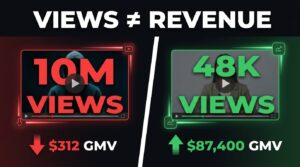
The most dangerous mindset in TikTok Shop selling is optimizing for Gross Merchandise Value. GMV is the headline metric — it’s what TikTok celebrates in its dashboards, what sellers brag about in communities, and what appears impressive on first glance. It is also almost completely useless as a measure of business health.
Here’s a scenario that plays out constantly on the platform: A seller hits $80,000 in monthly GMV. They’re celebrating. They scale their ad spend. They seed more creators. Then, 60 days later, they check their bank account and realize they’re running at a loss.
Where the Money Actually Goes
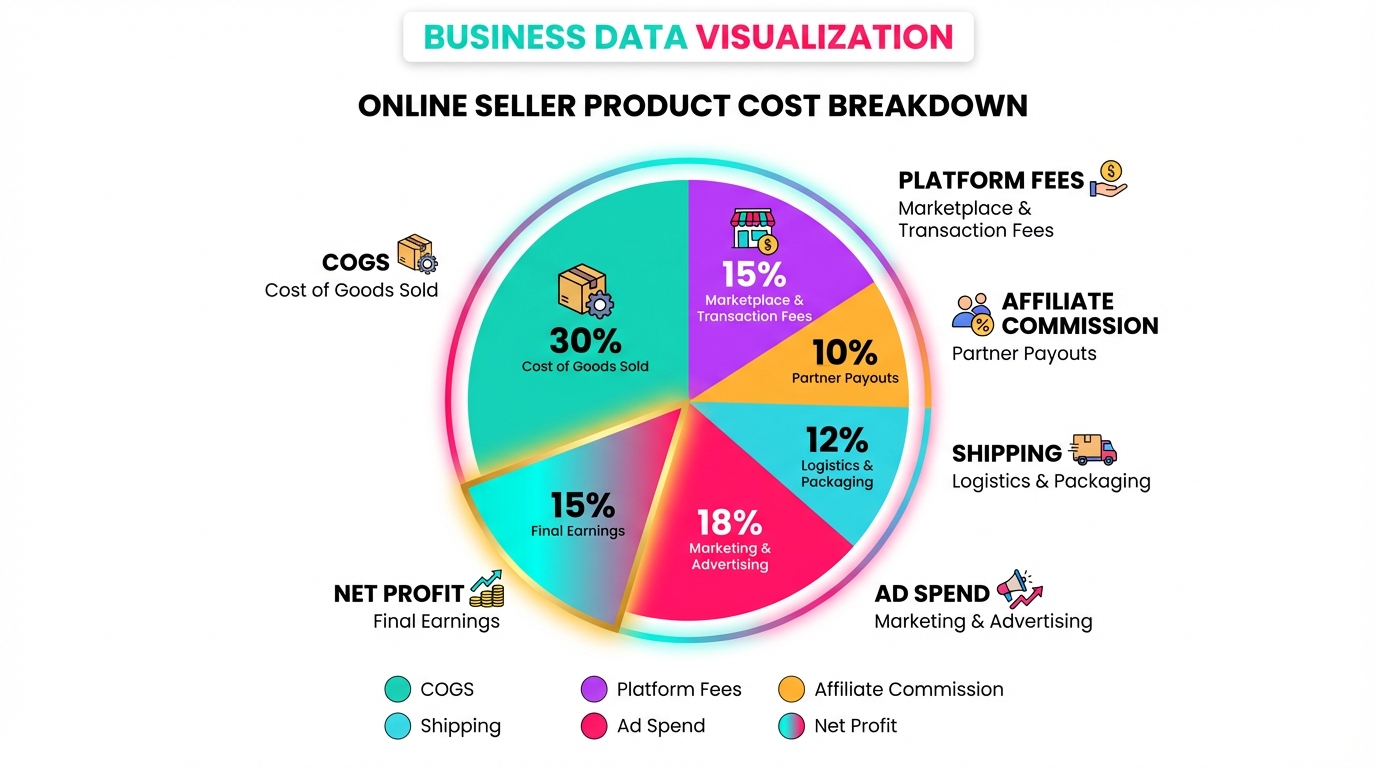
The problem is that cost structures on TikTok Shop are multi-layered and easy to underestimate when you’re looking at revenue numbers in isolation. Let’s build a realistic cost stack for a hypothetical beauty product selling at $25, with a COGS of $7.
- Platform referral fee: 6% of revenue = $1.50
- Transaction/payment processing fee: ~2% = $0.50
- Affiliate commission (average 13%): $3.25
- Shipping cost per order: $4.00 to $5.00
- Packaging: $0.75 to $1.00
- Proportional ad spend (if running Shop Ads): $2.50 to $4.00
- Returns (10% rate, average loss per return): $2.50 blended
Adding it up: on a $25 sale with a $7 COGS, your total costs before profit land somewhere between $21.50 and $24.25 — leaving a net profit of $0.75 to $3.50 per unit. That’s a net margin of 3% to 14% on a product that looks like it should be highly profitable on paper.
Now multiply that by the real complexity: returns don’t happen evenly, affiliate commissions are paid out even on returned orders (and aren’t always clawed back cleanly), and ad spend attribution on TikTok Shop can be murky. The effective affiliate cost — once you factor in the return rate — is often 26% to 32% of revenue when calculated correctly, not the 13% nominal rate you set.
Weekly Profit Review Is Non-Negotiable
Profitable TikTok Shop sellers treat weekly profit review the same way established businesses treat monthly financial statements — as a mandatory operating discipline, not optional homework. This means tracking net profit by SKU, not just store-level revenue. A store can have three products where two are profitable and one is silently destroying the blended margin.
The operational habit is simple: every week, pull your Seller Center data and calculate true net profit per product using actual COGS, actual fees paid, actual affiliate commissions settled, and actual return losses. Not estimates. Actuals. Any product running below a 15% net margin in a mature beauty or health category — or below 20% in the categories where TikTok Shop’s best sellers operate — deserves a pricing review or a discontinuation conversation.
What TikTok Shop Actually Costs: The Full Fee Breakdown
Understanding TikTok Shop’s fee structure is not just useful — it’s a prerequisite for pricing correctly. Sellers who price based on competitor research without accounting for TikTok’s specific cost structure almost always underprice themselves into unprofitability.
Platform Referral Fees by Market
In the US, TikTok Shop charges a referral fee that currently sits at around 6% of the total transaction value. In the UK, that figure climbs to 9%, calculated on the total paid amount including shipping — meaning you’re paying a fee on the shipping cost your customer paid, not just the product price. That’s a detail many UK sellers miss entirely when setting prices.
These fees are taken from the settlement amount automatically. They are not separately invoiced. If you’re not building them into your pricing calculator from day one, you won’t notice the damage until you compare what you expected to receive versus what actually arrived in your account.
The Affiliate Commission Reality
TikTok Shop’s average affiliate commission across US categories is 13.02% as of 2026. That figure sounds manageable until you understand how it interacts with the returns ecosystem.
Here’s the critical mechanic: when a customer returns a product, the affiliate commission is not always automatically clawed back in the same settlement cycle. Settlement windows run 15 to 31 days depending on product category and fulfillment method. If a customer returns after the commission has settled, you may absorb both the loss of the product and the commission you already paid.
Effective affiliate cost — the real number after accounting for return rates — typically runs between 26% and 32% of revenue for sellers in beauty and fashion categories where returns run 15% to 25%. That is not a typo. For every dollar of beauty revenue you generate through affiliate creators, you may be keeping less than 70 cents before COGS and shipping enter the picture.
Fulfillment and Shipping Costs
TikTok Shop offers its own fulfillment service (similar to FBA) — TikTok Shop Fulfilled by TikTok — which carries a 6% Seller Fulfilled Partner fee. For sellers shipping independently, costs run $4 to $5 per order depending on package weight and carrier. Packaging adds another $0.75 to $1.50 depending on your materials.
The right approach for most sellers is to model both fulfillment paths against your specific SKU weight, average order value, and target delivery speed before committing to a single method. Fulfillment cost is one of the largest variable expenses you can influence, and it compounds at scale.
Product Selection: The Criteria That Actually Predict Success
TikTok Shop is not a place to list your existing product catalog and see what sticks. The platform has a distinct content-commerce dynamic that makes certain product characteristics dramatically more likely to succeed than others. Understanding those characteristics before you invest in inventory is the difference between a profitable launch and an expensive experiment.
The Five-Second Demonstrability Test
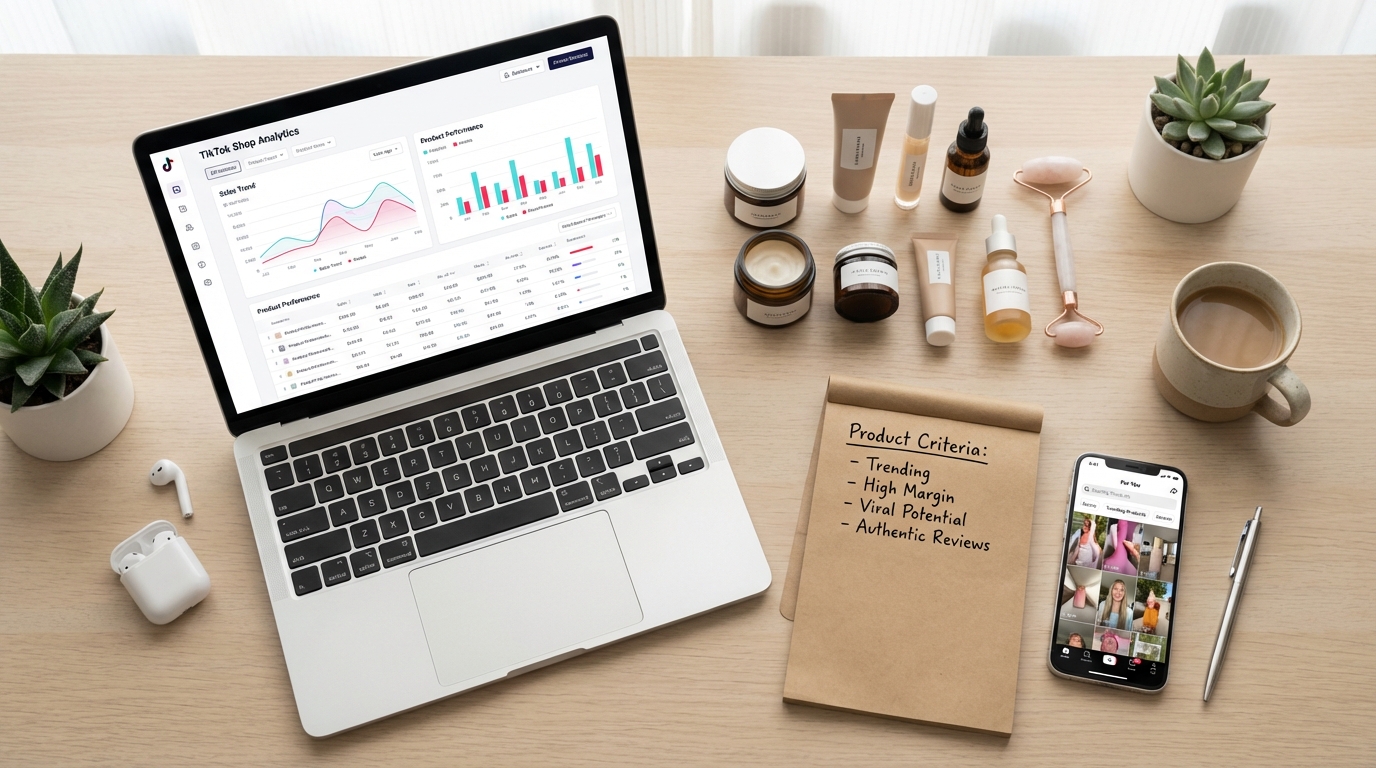
The single most important product characteristic on TikTok Shop is visual demonstrability within the first five seconds of a video. Products that can show a clear transformation, result, or compelling visual within that window get dramatically more organic reach and affiliate creator interest than those that require explanation.
This is why beauty and personal care dominates the platform — accounting for 22.5% of global GMV in 2026 — and why categories like electronics (where the value proposition is complex) struggle to find the same organic traction. Lash serums show results. LED therapy masks have a dramatic visual. Hair tools demonstrate transformation in real time. Explaining the processing speed of a laptop requires a fundamentally different content format that doesn’t align with TikTok’s feed behavior.
When evaluating a product for TikTok Shop, ask: can this be demonstrated compellingly in under five seconds? If the honest answer is no, you either need to rethink the product or plan to invest significantly more in paid distribution to compensate for the organic disadvantage.
Price Point and Impulse Buy Dynamics
The $15 to $35 price range is where TikTok Shop conversion rates are strongest. Products priced in this range hit the impulse buy threshold — they’re low enough that a viewer doesn’t need to deliberate, compare, or save for later. They make a decision in the same session they discovered the product.
Products above $50 can absolutely sell on TikTok Shop, but they require a different strategy: more touchpoints, stronger social proof, longer-format content like LIVE sessions, and more robust review volume. The friction of a higher-priced purchase doesn’t disappear just because you’re on TikTok — it requires you to build more trust before conversion.
Platform Data Benchmarks for Product Viability
Before committing inventory to a product, experienced TikTok Shop sellers validate against specific data benchmarks available in the Seller Center and third-party tools like FastMoss and the TikTok Creative Center:
- Minimum 100,000 video views on existing content for the product keyword — indicating proven content demand
- Conversion rate of 3% or higher on comparable products already listed on the platform
- Return rate below 5% — higher return rates signal product quality issues or expectation mismatches that will destroy margin
- 4.5 stars or higher average rating on comparable products, indicating that customers in this category have high expectations
- 100+ reviews within 30 to 60 days of launch for products in competitive categories
These aren’t arbitrary thresholds. They’re the benchmarks that separate products with genuine platform-market fit from products that might work on other channels but will underperform here.
The Three Sales Channels Inside TikTok Shop: A Realistic Comparison
TikTok Shop gives sellers three distinct channels for driving purchases: shoppable in-feed videos, LIVE shopping sessions, and the product showcase tab on your profile. Most sellers use all three without a clear understanding of how they actually perform differently. That lack of clarity leads to misallocated time and budget.
Shoppable In-Feed Videos: The Volume Driver
Shoppable videos — either organic content you create or affiliate creator content — are the primary volume driver on TikTok Shop. They contribute approximately 50% of total platform GMV and work because they meet shoppers in the native scrolling experience, not in a dedicated shopping context.
Conversion rates on shoppable videos typically land in the 3% to 6% range. The ceiling is lower than LIVE, but the volume potential is dramatically higher because a single video can be seen by millions of people without you being present. This is the channel that scales without your time — through affiliate creator content that continues driving sales weeks or months after posting.
The strategic implication: shoppable video content is where you want most of your affiliate creator budget pointed, because it produces persistent, compounding reach. A creator post that performs well today will still drive sales 90 days from now. LIVE sessions don’t have that persistence.
LIVE Shopping: The Highest Conversion Channel
LIVE selling is where TikTok Shop’s conversion rates get genuinely impressive. Platform data and third-party analyses consistently show LIVE sessions converting at 5% to 12% — approximately 22% higher than shoppable videos in head-to-head comparisons, and up to 10x higher than traditional e-commerce benchmarks of 1% to 2%.
The mechanics driving this are straightforward: LIVE creates real-time urgency through flash deals and limited quantities, allows for interactive demonstration and Q&A that eliminates purchase hesitation, and keeps viewers in a sustained buying mindset for 30 to 90 minutes at a stretch. When someone is watching your LIVE, they are not passively scrolling — they are engaged and already considering a purchase.
The tradeoff is that LIVE is time-intensive and requires skill development. A poorly executed LIVE — low energy, no urgency mechanics, weak product demonstrations — will convert worse than a good affiliate video and waste hours of your time. The channel rewards sellers who invest in learning the format, not those who go live because they feel they should.
Product Showcase Tab: Discovery, Not Conversion
The product showcase tab on your profile is primarily a discovery and trust signal, not a conversion engine. Shoppers who land on your profile and browse your product catalog are typically in a research mindset, not an impulse-buy mindset. Conversion rates here trail the other two channels significantly.
Its real value is as a credibility layer. A well-organized showcase with strong product imagery, clear pricing, and visible review counts tells a potential customer that you’re a legitimate operation. It supports conversion from every other channel by ensuring that when someone who discovered you through a video or LIVE goes to your profile to learn more, they see a professional store.
Spend time making your showcase presentation clean and complete, but don’t prioritize driving traffic directly to it. Let the other two channels do the conversion work and let the showcase support them.
Building an Affiliate Program That Doesn’t Bleed Margin
The TikTok Shop affiliate program — the mechanism through which creators promote your products for a commission — is simultaneously the most powerful growth channel on the platform and one of the most commonly mismanaged. Sellers who get it right build scalable content engines that drive sales around the clock. Sellers who get it wrong bleed margin through untracked commissions and underperforming creator relationships.
Understanding the Collaboration Plan Structure
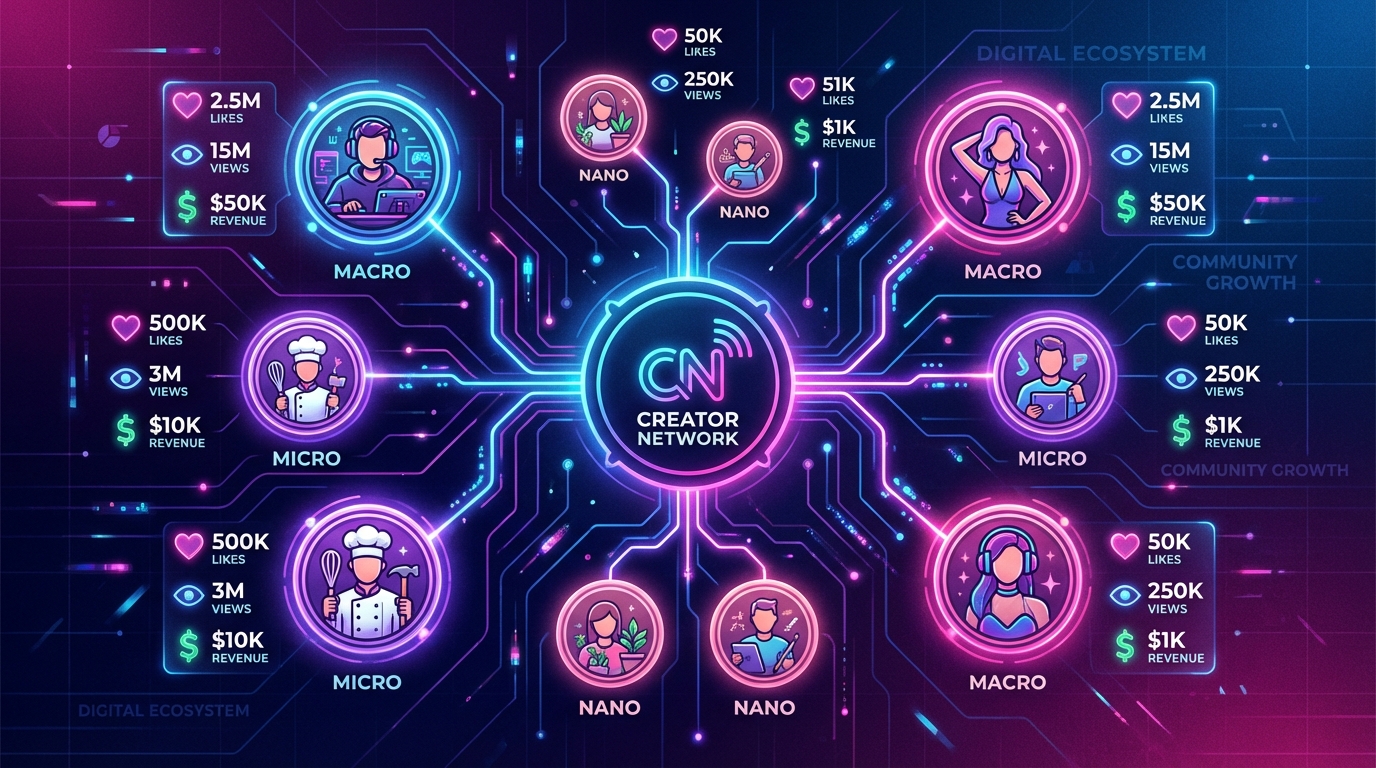
As of 2026, TikTok Shop consolidated its affiliate collaboration plans into two primary structures. The Open Collaboration Plan is a public, store-wide or hero-product rate that any qualifying creator can access. Rates on open plans typically run 10% to 15%, making them accessible to nano and micro creators who drive respectable volume at lower commission costs.
The Targeted Collaboration Plan is where you extend specific, invite-only offers to individual creators — typically offering higher commission rates (often 5% to 10% above open plan rates), product samples, or a combination. This is the mechanism for building relationships with your top-performing creators, and it’s where the real revenue concentration happens. In well-run affiliate programs, the top 5% of creators typically drive 60% to 70% of affiliate-generated revenue.
The critical strategic question is not “how many creators can we recruit?” — it’s “how well are we identifying and investing in the top tier?” Most sellers over-invest in seeding broad creator pools and under-invest in nurturing their proven performers.
The True Cost of Seeding
Product seeding — sending free samples to creators before they produce content — is a standard part of TikTok Shop affiliate strategy, but it comes with costs that need to be tracked meticulously. Budget planning for seeding should account for:
- Sample product cost: Your actual COGS, not retail price
- Shipping cost per sample: $4 to $7 depending on package size
- Administrative time: Vetting creators, managing outreach, tracking who received samples and who posted
- Content that never gets posted: A realistic 30% to 50% of seeded creators will receive product and produce nothing
A seeding budget of $1,000 to $2,000 in product samples for an initial launch of 20 to 50 creators is a commonly cited starting range. But the real cost when you factor in shipping, COGS, and non-posting rate is closer to $1,500 to $3,500 — and the return on that investment is only realized if you have a system for tracking which seeded creators actually converted to sales and at what rate.
Commission Tiers by Creator Size
Setting commission rates without considering creator tier is one of the most common affiliate management mistakes. Here’s the reality of how the market has settled in 2026:
- Nano creators (1K–10K followers): Effective at 10% to 15% commission — they convert their engaged audiences well but at lower volume
- Micro creators (10K–100K followers): Often the best ROI tier — 12% to 18% commission, meaningful volume, and genuine audience trust
- Mid-tier creators (100K–500K followers): Require 18% to 25% commission plus often a sample or flat-fee component
- Macro creators (500K+): Command 25% or higher, often require guaranteed payments, and their conversion rates don’t always justify the cost relative to micro creators
The macro creator bias — the assumption that bigger follower counts equal better ROI — is a real and expensive mistake. A creator with 40,000 engaged followers in a beauty niche will almost always outperform a creator with 2 million general lifestyle followers on a cost-per-sale basis.
LIVE Selling: Building the Skills That Drive Real Conversion
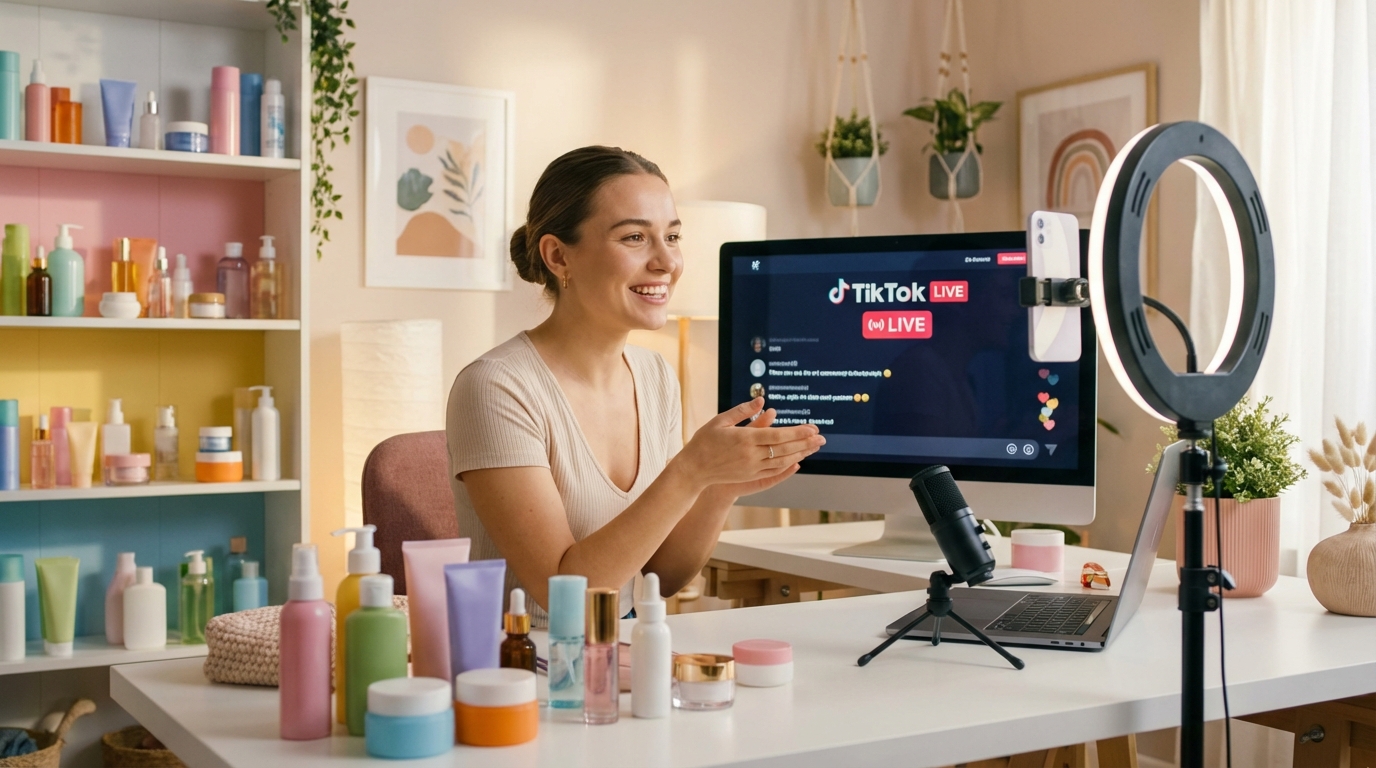
LIVE selling is the highest-conversion channel on TikTok Shop — but it’s also the one that most sellers attempt without adequate preparation and then abandon after poor results. The gap between a LIVE session that generates $500 in sales and one that generates $15,000 is not luck. It’s execution.
The Algorithm’s Signals During a LIVE Session
TikTok’s algorithm amplifies LIVE sessions based on specific engagement signals — and understanding which signals matter most changes how you structure your sessions. The key metrics the algorithm weights are:
- Watch time and viewer retention: How long do people stay in your LIVE? This is the most weighted signal. Engagement that keeps viewers present outweighs isolated spikes of comments or likes.
- Real-time interactions: Comments, questions, likes, and shares — particularly when you respond to them directly, creating a loop of interaction that keeps existing viewers engaged and signals quality to the algorithm.
- Product clicks and add-to-cart actions: These are commerce signals that TikTok specifically rewards with increased distribution because they confirm your LIVE is commercially functional, not just entertaining.
- New viewer join rate: The algorithm watches how many new viewers are entering your LIVE in each window, rewarding sessions that consistently attract fresh viewers rather than only retaining an initial audience.
Structure Your LIVE for Maximum Retention
High-performing LIVE sellers structure their sessions deliberately, not spontaneously. A proven structure for a 60 to 90-minute session looks like this:
- Opening hook (first 5 minutes): Immediately demonstrate a product with a compelling result — not a welcome speech. The first five minutes determine whether new viewers stay or bounce. Start with your strongest visual.
- Warm-up engagement (minutes 5–15): Interactive Q&A, welcome comments by name, poll the audience. Build the room before introducing pricing.
- Product rotation (every 10–15 minutes): Shift between products to prevent fatigue. Each product gets a demonstration, a proof point (review or testimonial), a price reveal, and a limited-time incentive.
- Flash deal windows: Announce a 10-minute reduced price or bundle deal two to three times per session. Urgency mechanics are the single highest-impact conversion tactic in LIVE selling.
- Social proof loop: Read out real review quotes regularly. “Someone just messaged me that they bought this last month and here’s what they said…” keeps hesitant viewers moving toward purchase.
- Close and CTA: In the final 10 minutes, remind viewers of what’s still available, recap the deals, and direct them explicitly to the product links pinned on screen.
LIVE Frequency and Consistency
Consistency matters to TikTok’s LIVE algorithm the same way posting consistency matters to the content algorithm. Sellers who go LIVE at the same times on the same days build an audience that returns — and returning viewers have dramatically higher conversion rates than first-time visitors because the trust and familiarity threshold has already been crossed.
Aiming for three to five LIVE sessions per week in your early scaling phase, each 60 to 90 minutes, gives you enough data to optimize your format while building the algorithmic momentum that increases distribution. Going LIVE once a month and expecting significant results is not a realistic expectation given how the algorithm rewards consistency.
Account Health Metrics: The Invisible Risk Most Sellers Ignore
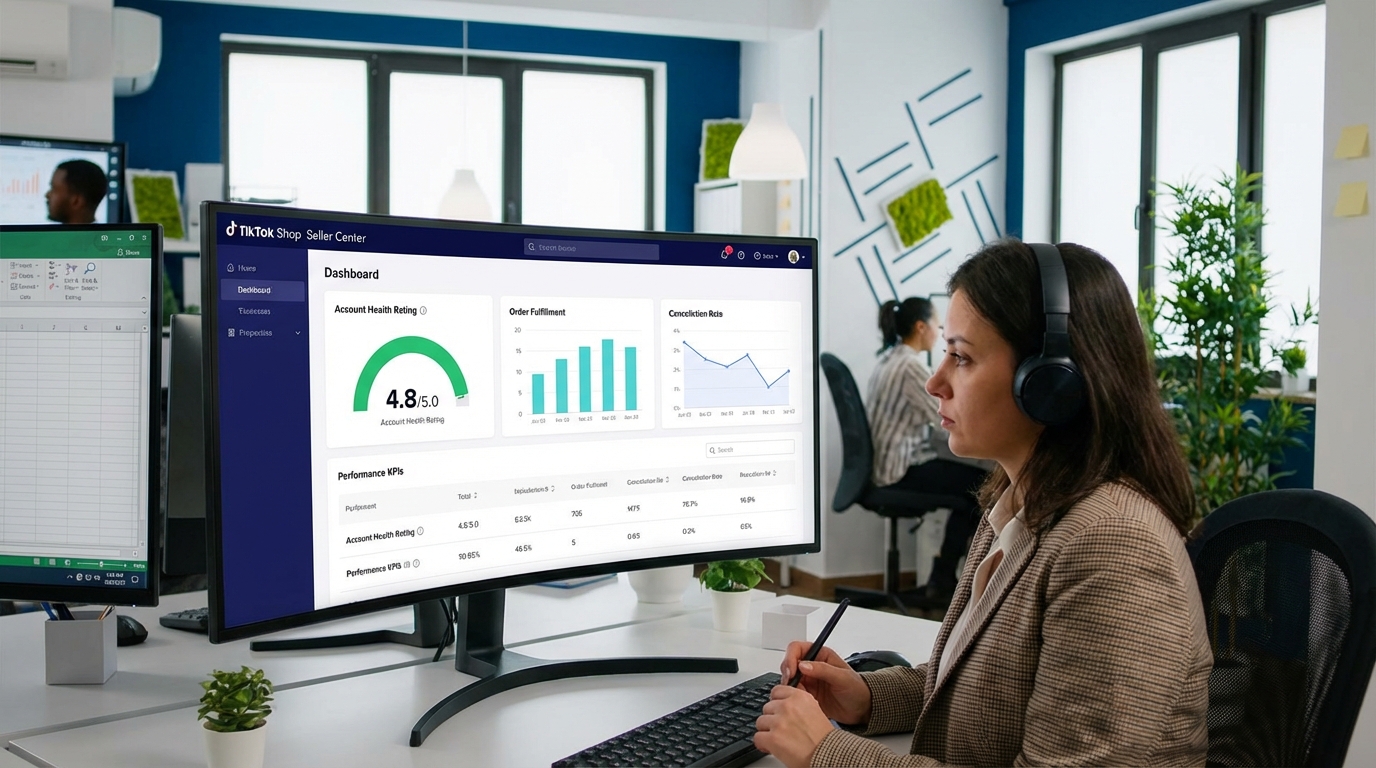
Account health is the unsexy topic that experienced TikTok Shop sellers treat with near-paranoid attention, and new sellers ignore until something goes wrong. “Something going wrong” on TikTok Shop can mean losing access to major campaigns, reduced product visibility, or account suspension — any of which can destroy a business that was otherwise performing well.
The Account Health Rating (AHR) System
TikTok Shop uses an Account Health Rating (AHR) system scored from 0 to 1,000 points. All sellers start at 200 points. Points are deducted for policy violations and performance failures, and enforcement thresholds sit at 150, 100, 50, and 0 points — with escalating consequences at each level including campaign ineligibility, product listing restrictions, and ultimately account suspension.
The AHR is calculated across a rolling 180-day window, which means a bad quarter can haunt your account for six months even after you’ve corrected the underlying problems. This is why proactive account health management matters infinitely more than reactive damage control.
Seller Fault Cancellation Rate (SFCR)
The Seller Fault Cancellation Rate is the metric that catches sellers off guard most frequently. It measures the percentage of orders cancelled due to seller-side failures — stockouts, shipping errors, incorrect listings — rather than customer-initiated cancellations.
The threshold for campaign eligibility is 5% or lower in the last 30 days. That sounds generous until you realize that a single inventory shortage during a viral moment — when your product gets picked up by a creator with large reach and orders spike unexpectedly — can spike your SFCR above this threshold within 48 hours.
The operational defense is inventory buffers calibrated to your affiliate reach. If you have 50 active creators seeded with your product, and any one of them could theoretically drive 500 orders in 24 hours if their video hits, your safety stock needs to account for that scenario. Sellers who run lean inventories on products with active creator programs are taking on risk they often don’t fully appreciate.
On-Time Delivery Rate (OTDR)
TikTok Shop requires an On-Time Delivery Rate of 80% or higher across the last 30 days. This metric is a direct function of your carrier reliability and fulfillment speed. Sellers using standard carriers during peak shipping periods (Q4, major sale events) frequently see their OTDR drop below threshold when carrier capacity tightens.
The mitigation strategy is dual-carrier redundancy — maintaining relationships with at least two carrier options so that if one is experiencing delays, you can reroute shipments. This isn’t a strategy most new sellers build from day one, but it becomes essential as volume grows and the cost of OTDR violations in terms of campaign access increases.
Product Policy Violations
Product listing violations are the most common source of AHR deductions and the most preventable. TikTok Shop’s compliance requirements for product claims — particularly in health, wellness, and beauty categories — are strict and enforced algorithmically. Medical claims, certain ingredient references, and before/after comparisons that imply medical outcomes can all trigger violations.
Sellers in these categories need a listing compliance review process that checks claims against TikTok Shop’s prohibited content guidelines before products go live — not after they’ve been flagged. A violation that costs you AHR points takes 180 days to fully age off the rating window. Prevention is categorically cheaper than remediation.
TikTok Shop Ads: When They Work and When They Waste Budget
TikTok Shop has two primary paid channels: Shop Ads (formerly known as Shopping Ads), which are managed inside the TikTok Ads Manager and promote products directly from your catalog, and Spark Ads, which boost organic or affiliate content. Understanding when each channel earns its budget — and when it doesn’t — is essential for running a profitable paid strategy.
Shop Ads: Useful for Specific Objectives, Not a Default
Shop Ads convert at 1.5% to 3% on average — meaningfully lower than the 3% to 6% you get from strong organic affiliate content. This doesn’t make them useless, but it defines their correct use case: amplifying products that already have proven organic demand, not trying to manufacture demand for products that haven’t found their audience yet.
The pattern that works is this: a product gets traction through affiliate content — you see it converting at 4%+ organically. You then run Shop Ads to increase reach for that specific product while the organic momentum is active. You’re paying for scale, not for discovery. Using Shop Ads to try to force traction on a product with no proven organic performance is one of the most common ways sellers burn budget without results.
Spark Ads: Extending Your Best Affiliate Content
Spark Ads let you put paid distribution behind organic or affiliate creator content — turning a post that’s already working into a reach machine. This is the more capital-efficient ad format for most TikTok Shop sellers because you’re selecting content that has already proven its conversion ability and amplifying it, rather than creating paid content from scratch.
The selection criteria for Spark Ad content should be rigorous: you’re looking for affiliate posts that have demonstrated above-average watch time, strong comment engagement, and click-through rates to the product page. Not every top-performing video in terms of views makes a good Spark Ad candidate — some videos get views through entertainment without driving commerce intent. Watch the product click data before you decide what to amplify.
Ad Spend as a Percentage of Revenue
Healthy TikTok Shop stores typically run ad spend at 8% to 13% of revenue. Sellers running above 15% are usually compensating for a problem somewhere else — weak organic content, low conversion rates, or a product that doesn’t have strong enough platform-market fit to justify continued paid investment. If your ad spend percentage keeps climbing, it’s a signal to fix the fundamentals rather than spend your way through them.
Operational Foundations That Protect Your Margin at Scale
The difference between a TikTok Shop that generates real profit and one that generates impressive revenue numbers is almost always operational. The sellers who build sustainable businesses on this platform do so by treating operational systems — fulfillment, returns management, financial tracking, compliance — with the same seriousness they give to content strategy.
Inventory Management for a Viral Environment
Standard inventory management logic doesn’t fully apply on TikTok Shop because the demand curve is non-linear in a way that most supply chains aren’t designed for. On Amazon or a Shopify store, you can reasonably predict daily sales volume and plan inventory accordingly. On TikTok Shop, a creator video can generate 10,000 orders in 48 hours, followed by essentially zero sales the next week.
The practical response is tiered inventory positioning. Your hero products — the ones actively seeded with creators and supported by ads — need higher safety stock buffers than you’d maintain on a predictable channel. A 45-day safety stock position on hero SKUs is a reasonable minimum. Secondary products that are less actively promoted can run leaner.
Equally important is the velocity monitoring system. Set up alerts in your Seller Center (and in any third-party inventory management tool you use) to notify you when stock levels on promoted products drop below a two-week buffer. That gives you time to reorder and receive inventory before you hit a stockout that spikes your SFCR.
Returns Management as a Margin Defense System
In beauty and fashion categories — the highest-GMV categories on TikTok Shop — return rates of 10% to 20% are common. Left unmanaged, returns are a margin erosion engine that compounds quietly. Managed proactively, they’re a feedback system that tells you where product quality, listing accuracy, or fulfillment is falling short.
Three specific practices reduce return rates meaningfully:
- Accurate product listings: Returns driven by unmet expectations — the product looks different in person, the sizing is off, the color isn’t what was shown — are almost entirely preventable through rigorous listing accuracy. Use accurate imagery, include measurements where relevant, and write descriptions that set correct expectations rather than inflating them.
- Proactive order confirmation: A simple automated message confirming order details and expected delivery timeline reduces “where is my order” cancellations and return-by-disappointment behavior.
- Quality control at the shipment level: Random batch inspections of outgoing orders — checking for defects, incorrect variants, or damage — eliminate a surprising percentage of return drivers before they reach the customer.
Financial Tracking Infrastructure
Running TikTok Shop on spreadsheets is workable at low volume and unsustainable beyond $20,000 in monthly GMV. At that point, the complexity of tracking multiple SKUs, variable affiliate commission rates, return adjustments, and platform fee variations requires either dedicated software or a structured reporting system built in a tool like Google Sheets with specific templates designed for TikTok Shop’s settlement structure.
The minimum viable financial tracking system includes: a weekly SKU-level profit and loss report, a monthly affiliate spend reconciliation that compares nominal commission rates to effective post-return rates, a returns analysis broken down by SKU and return reason, and a cash flow projection that accounts for the 15 to 31-day settlement delay between when sales occur and when funds arrive.
That settlement delay is a real cash flow consideration, particularly for sellers who are also paying affiliates on a different cycle and restocking inventory. Managing it requires maintaining operating cash reserves that cover at least one full settlement cycle — typically 30 to 45 days of operating costs — so that revenue delays don’t create operational disruptions.
Running TikTok Shop Like a Business, Not a Side Project
Perhaps the most consistent observation from analyzing successful TikTok Shop sellers versus those who struggle is not about tactics. It’s about mindset and operating discipline. Sellers who treat TikTok Shop as a side project — checking in occasionally, running campaigns reactively, managing by feel — consistently underperform sellers who apply the same rigor they’d bring to any serious business operation.
The Weekly Operating Rhythm
Successful sellers build a weekly operational rhythm that covers the same ground on a predictable schedule:
- Monday: Review previous week’s financial performance by SKU — revenue, actual margin, returns, affiliate spend. Flag any SKU performing below threshold for action.
- Tuesday: Creator performance review — which affiliate creators drove actual sales last week, what their effective cost per sale was, who should receive targeted collaboration upgrades, who should be de-prioritized.
- Wednesday: Account health check — pull AHR, SFCR, and OTDR from Seller Center. Any metric approaching a threshold triggers an immediate operational response.
- Thursday: Content and LIVE planning — review what content types drove the best product engagement last week, plan LIVE session structure for the coming week, review creator content calendar.
- Friday: Inventory review — compare current stock levels against velocity data, flag reorder needs, confirm safety stock positions on hero SKUs.
This rhythm sounds demanding because it is. It’s also what separates sellers who build growing, profitable businesses from those who get exciting GMV spikes followed by inexplicable plateaus and eventual decline.
Category and Product Evolution
TikTok Shop’s trending categories shift. What’s saturated today in beauty may be an open opportunity in health and wellness or home organization tomorrow. Sellers who treat their product catalog as a fixed asset rather than a living strategy miss the platform’s continuous evolution.
The practice of running weekly trend audits using the TikTok Creative Center and third-party tools like FastMoss — looking for product categories with growing video views but still-thin seller competition — gives operationally disciplined sellers a continuous pipeline of new product opportunities to evaluate and potentially test. The investment in trend monitoring pays for itself when it identifies a product-market fit opportunity 60 to 90 days before it becomes obvious to the broader seller community.
Building For Longevity, Not Virality
The viral moment is seductive — a video blows up, orders flood in, and it feels like you’ve figured something out. But virality is not a business model. It’s a moment. The sellers building durable TikTok Shop businesses are building around fundamentals: strong product margins, reliable fulfillment, clean account health records, a creator network that produces consistent (not just occasional) content, and financial tracking that keeps them honest about profitability at every step.
Platform algorithms change. Creator relationships evolve. Product trends shift. The operational infrastructure you build to run a clean, profitable business is what survives those changes. The sellers who panic every time TikTok adjusts its algorithm are the ones who built their entire strategy on tactics rather than fundamentals. The ones who weather those changes without crisis are the ones who built the business underneath the tactics first.
Conclusion: The Operational Edge Is the Real Competitive Advantage
TikTok Shop in 2026 is a genuinely significant commercial opportunity. A platform generating over $23 billion in projected annual US GMV, converting at 4.7% — more than double Instagram Shopping — and reaching 136 million US users is not a channel you can afford to dismiss or approach carelessly.
But the sellers who build real businesses on TikTok Shop are not the ones who figure out the latest viral content trick. They’re the ones who understand their true cost structure and price accordingly. They’re the ones who track effective affiliate commission rates — not nominal ones — and manage their creator programs as a business function. They’re the ones who monitor account health metrics before problems become crises, run LIVE sessions with deliberate structure rather than hoping energy alone drives sales, and build financial tracking systems that tell them the truth about profitability week by week.
The platform will keep growing. The opportunity will remain real. What will separate the sellers who capture that opportunity from those who participate in the growth without benefiting from it is operational discipline — the unglamorous, systematic work of running a business properly.
That’s the competitive advantage that actually matters. And it’s available to any seller willing to build it.
Key Takeaways
- Always calculate true net margin by SKU — accounting for platform fees (6%+ US), affiliate commissions (effective 26%–32% after returns), shipping, and returns — not just COGS versus revenue
- Products that can be demonstrated visually in under five seconds and priced between $15 and $35 have the strongest platform-market fit on TikTok Shop
- LIVE sessions convert at 5%–12%, making them the highest-conversion channel, but they require deliberate structure and consistent scheduling to work
- Effective affiliate management means tracking top-performing creators by actual cost-per-sale and investing in targeted relationships with your top 5%, not just volume seeding
- Monitor AHR, SFCR (keep below 5%), and OTDR (keep above 80%) weekly — account health issues take 180 days to clear from your rating window
- Build inventory buffers on hero SKUs sufficient to handle viral demand spikes without triggering SFCR violations
- Run Shop Ads to amplify proven organic successes, not to manufacture demand for unvalidated products
- Maintain operating cash reserves covering 30–45 days of expenses to buffer against TikTok Shop’s 15–31 day settlement window