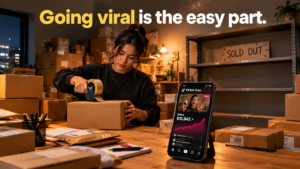


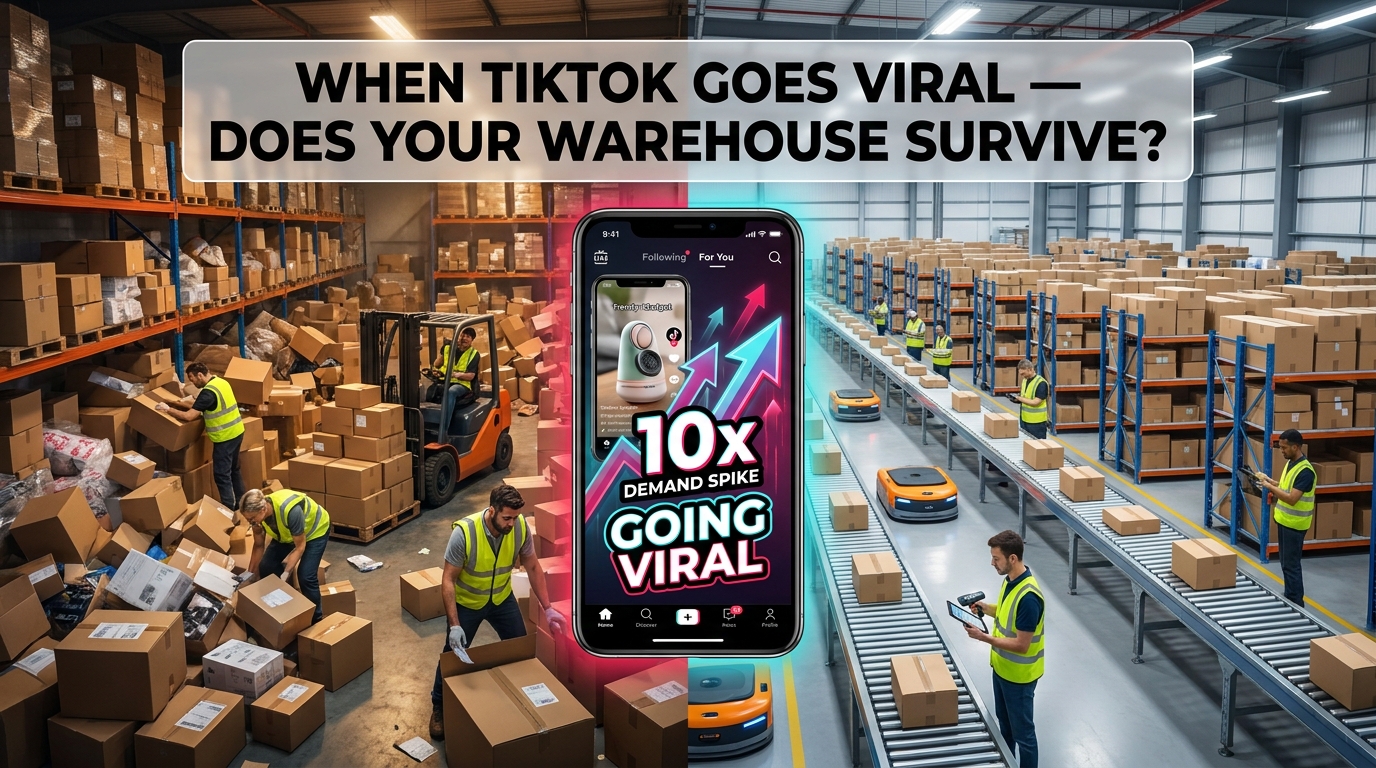

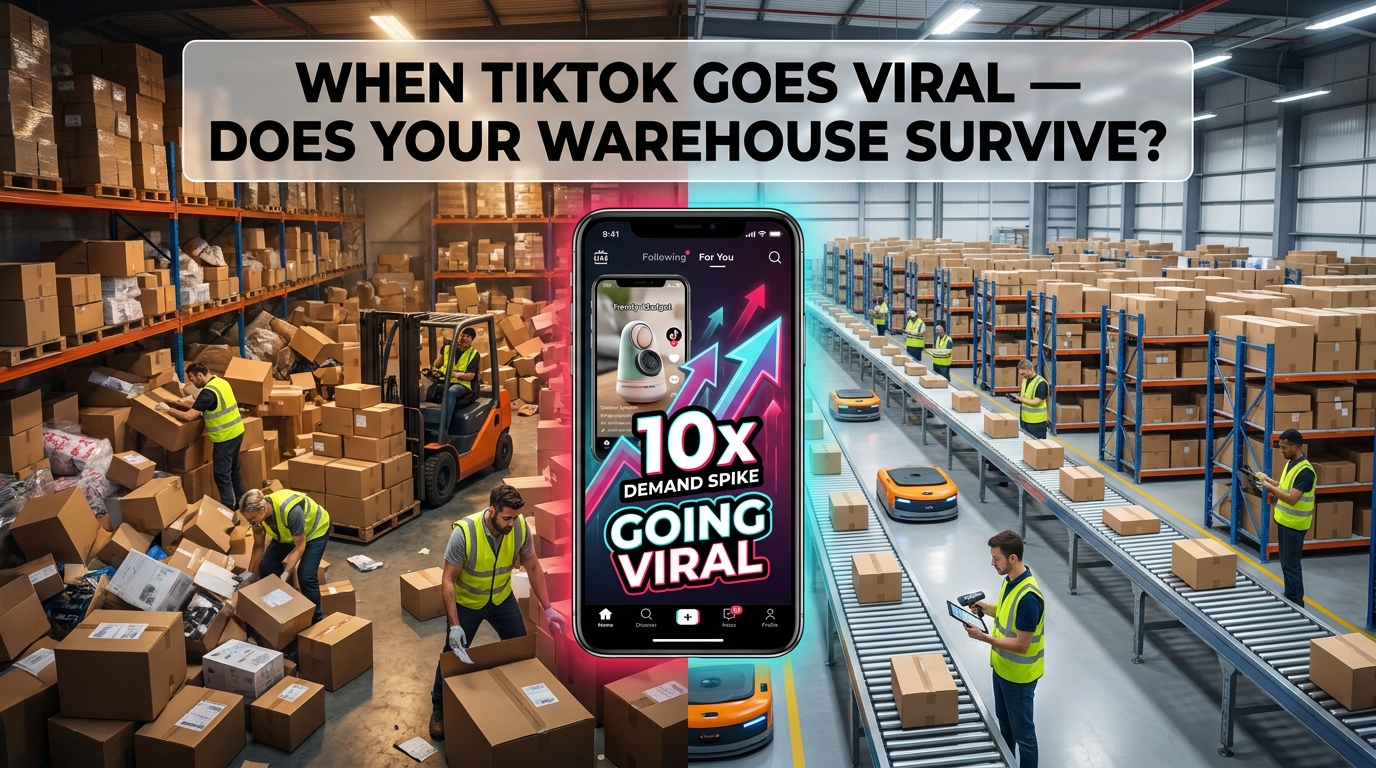
There is a specific kind of operational crisis that only TikTok Shop sellers understand. It does not announce itself with a warning email or a slow build over weeks. It arrives in the form of a product video that a creator posted on a Tuesday afternoon — and by Wednesday morning, you have 3,000 orders you did not have on Monday, a warehouse team that is staring at an impossible pick queue, and a Late Dispatch Rate that is visibly ticking upward in your Seller Center dashboard.
Most fulfillment guides for e-commerce brands assume your demand is predictable. They talk about reorder points, par levels, and lead-time buffers. That advice is fine for a brand running Google Shopping campaigns or ranking organically on Amazon. But TikTok Shop does not run on predictable demand. It runs on discovery commerce — a model where an algorithm decides, without your input, which products to surface to which audiences and when. The result is a demand pattern unlike anything traditional fulfillment ops were designed to handle.
This article is not about getting started on TikTok Shop. It is about what happens after you start working and the growth becomes real — and why so many brands that crack $50,000, $100,000, or even $500,000 per month on the platform eventually hit a wall that is not a marketing wall. It is a fulfillment wall. We will cover the specific breaking points, the platform mechanics that make them worse, and the operational architecture that the brands scaling past seven figures are quietly building behind the scenes.
Why TikTok Shop Fulfillment Breaks Differently Than Any Other Channel
Every e-commerce channel has fulfillment pressure. Amazon penalizes late shipments, Shopify customers leave negative reviews for slow delivery, and eBay has its own performance metrics. But TikTok Shop creates a unique category of operational stress that comes from the structural nature of the platform itself — and understanding that structure is the first step to designing ops that can survive it.
Discovery Commerce vs. Intent Commerce
When a consumer searches for a product on Amazon or Google, there is intent already in the system. That intent acts as a natural throttle on demand spikes. Sales velocity is correlated with your marketing spend, your rank, and your reviews — variables you can observe and influence gradually.
TikTok’s algorithm operates on discovery. Consumers are not searching for your product — they are being served it. This means a single piece of creator content can be distributed to millions of users who did not know your product existed an hour ago. A format that the algorithm happens to favor — a particular hook, a certain product category that is trending, a sound that is surging in use — can catapult a SKU from 20 daily units to 20,000 daily units with no warning and no ramp period.
This is not a hypothetical edge case. Industry 3PL providers working with TikTok Shop sellers report that viral events routinely generate demand spikes of 10x to 50x baseline within a single 24-hour window. Nearly 70% of retailers have reported experiencing stockouts and delivery delays directly tied to TikTok virality. No traditional inventory model accounts for a 50x spike that might last 72 hours and then normalize — and that is the core reason why brands that migrate fulfillment strategies wholesale from Amazon or Shopify into TikTok Shop consistently get burned.
The Live Commerce Compression Problem
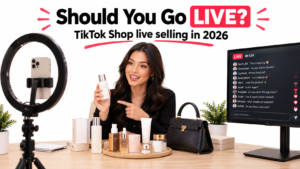
Beyond the viral short-form video spike, there is a second demand-compression mechanism unique to TikTok Shop: live commerce. A TikTok LIVE selling session can compress what would normally be one to two weeks of product demand into a two-hour window. That is not metaphor — it is operational arithmetic.
During a high-performing live stream, orders are processed in real time against inventory that may be shared with your Shopify store, your Amazon listings, and your wholesale accounts. If your inventory management system is not updating in near-real-time, you will oversell. Overselling on a live stream generates a specific type of damage: buyer-fault cancellations turn into seller-fault cancellations when orders cannot be fulfilled, which directly damages your Account Health Rating and can pull you out of promotional eligibility.
The Platform’s Amazon Envy Problem
TikTok Shop’s 2026 operational stance reflects something very clear: the platform wants Amazon-level fulfillment standards, but without the years of logistics infrastructure Amazon built to make those standards achievable. TikTok has tightened its fulfillment benchmarks, enforced dispatch SLAs more aggressively, and briefly attempted to mandate that all U.S. sellers use TikTok-managed logistics. The mandate was reversed after significant seller pushback in February 2026 — but the underlying pressure has not gone away. The expectations are higher, the penalties are stricter, and the operational burden on sellers has grown substantially.
The Four Fulfillment KPIs That Can Actually Shut Your Store Down
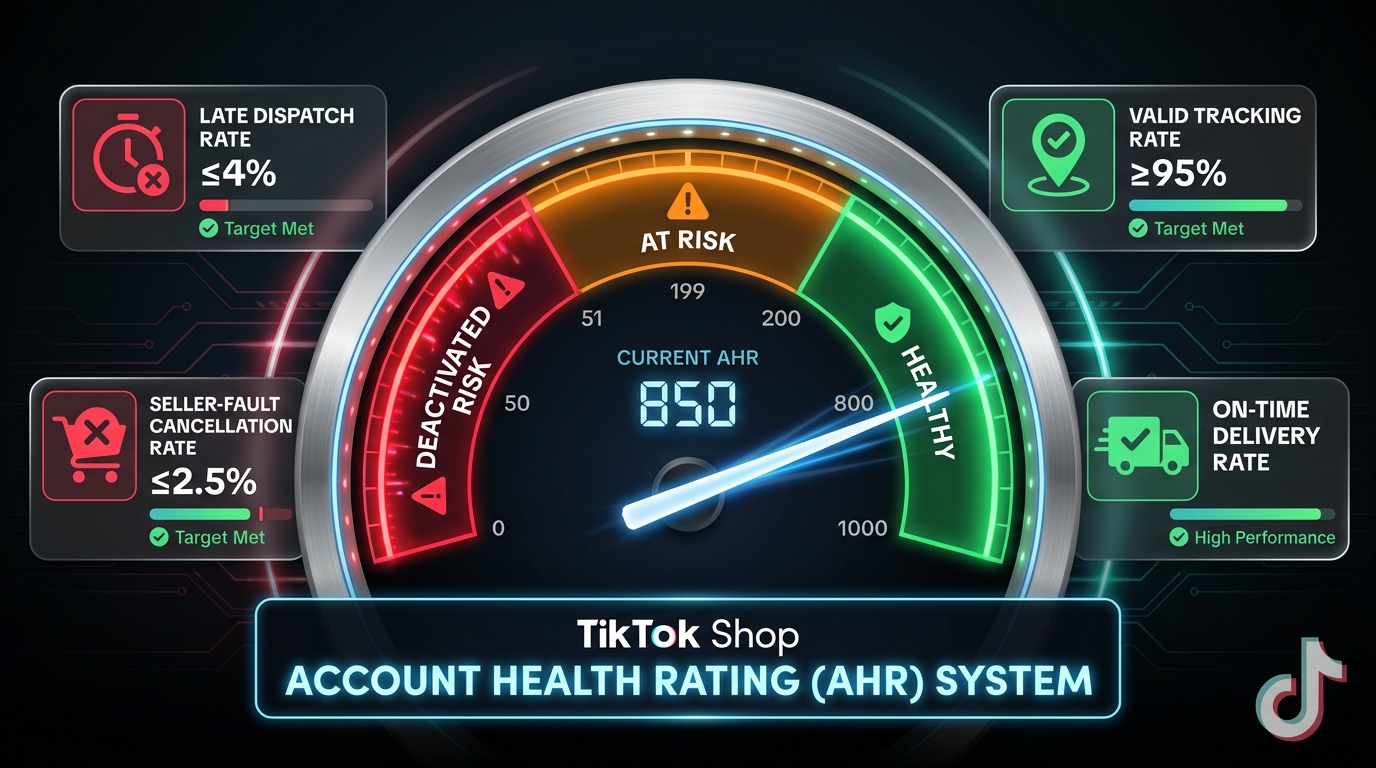
TikTok Shop measures seller performance through an Account Health Rating (AHR), a rolling score between 0 and 1,000 that reflects the last 180 days of your operational history. All sellers begin at a score of 200. The system has three operational zones: green (200 or above), orange (51 to 199), and red (50 or below, where permanent deactivation becomes a live risk). Understanding where points go — and where they get taken away — is not optional for a scaling brand.
Late Dispatch Rate (LDR)
The Late Dispatch Rate measures the percentage of orders you fail to hand off to a carrier within the required handling window. TikTok’s recommended target is at or below 4%. The enforcement threshold — the point at which penalties activate — is 10%. As of April 2026, TikTok re-enabled active enforcement of this metric after a grace period, meaning sellers who had been operating loosely are now facing real consequences.
The danger of the LDR for growing brands is that it is most vulnerable exactly when you need it to be healthy: during high-volume periods. A viral spike, a flash sale, or a major creator activation will flood your order queue — and if your pick-pack-ship workflow is not designed to absorb that volume within the dispatch window, your LDR will spike upward precisely when your store is most visible on the platform. That is the cruellest possible timing.
Valid Tracking Rate (VTR)
The Valid Tracking Rate requires that 95% or more of your shipped orders carry valid, scannable tracking information within a specified window after dispatch. This metric sounds simple to meet, but it creates real operational complexity for sellers who use multiple carriers, manual label generation processes, or fulfillment centers without deep TikTok Shop API integration. A tracking upload failure — even for orders that shipped on time — counts against your VTR.
Seller-Fault Cancellation Rate (SFCR)
The Seller-Fault Cancellation Rate must remain at or below 2.5%. This is the metric most directly damaged by the inventory overselling problem. When you accept an order your system did not know you could not fulfill — because your inventory count on TikTok Shop was still reflecting pre-spike stock levels — and then cancel it, that cancellation becomes a seller-fault event. During a viral spike with inadequate inventory sync, even a brief desynchronization between your actual stock and your TikTok Shop listing can generate a wave of seller-fault cancellations that pushes you into the orange AHR zone within hours.
On-Time Delivery Rate (OTDR)
The On-Time Delivery Rate measures whether packages actually arrive within the customer-facing delivery promise, not just whether you dispatched them on time. This KPI is particularly sensitive to carrier choice and inventory location. A brand fulfilling from a single warehouse on the opposite coast from the majority of its TikTok audience will chronically underperform on OTDR regardless of how efficiently it picks and packs.
The compound risk: These four metrics do not operate in isolation. A viral spike that simultaneously drives up your LDR (warehouse overwhelmed), inflates your SFCR (inventory oversold), and hurts your OTDR (carrier overloaded during peak) can move your AHR from the green zone to the orange zone within a single 48-hour window. And once you drop into orange, the platform reduces your promotional eligibility — which means the same viral moment that boosted your sales can leave you with a suppressed listing just when you want maximum visibility.
The Viral Spike Problem: How to Prepare for Demand You Cannot Predict
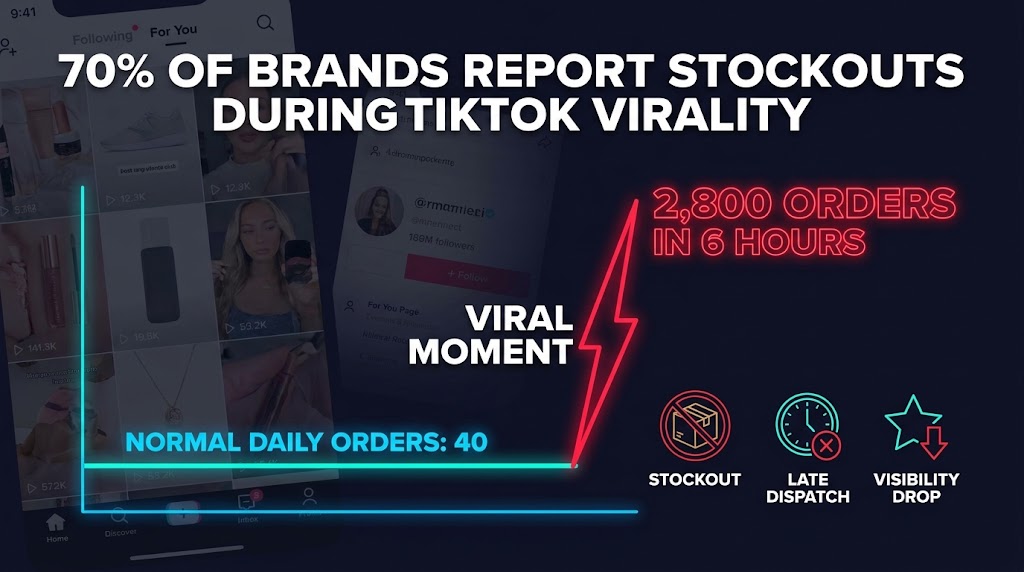
You cannot predict which product will go viral on TikTok or when. The platform’s own recommendation algorithm is too complex and too sensitive to real-time user behavior to forecast with any precision. What you can do is design a fulfillment operation that is structurally capable of absorbing a large and sudden demand spike without failing on the four KPIs above. The brands that do this well are not better at predicting virality — they are better at being ready for it regardless of when it happens.
The Spike Strategy: Inventory Buffers That Account for Volatility
Traditional inventory management uses historical velocity to calculate reorder points and safety stock. That methodology assumes your velocity follows a reasonably predictable distribution. TikTok Shop breaks that assumption completely. A SKU that has been selling 15 units per day for three months can suddenly need 2,000 units in a single day.
The response used by experienced TikTok Shop operators is what some fulfillment specialists call a “Spike Strategy.” Rather than calculating safety stock as a multiple of average daily sales, you define a worst-case spike multiplier for each hero SKU — typically based on the largest demand event your category has seen in the last 12 months — and maintain a physical buffer that can satisfy that spike for at least 48 to 72 hours while emergency replenishment is activated.
Alongside physical buffers, virtual inventory allocation plays an important protective role. If you have 1,000 units on hand, listing 800 on TikTok Shop while reserving 200 as a buffer creates a safety margin that prevents overselling during the initial hours of a spike before your replenishment systems can respond. This is not a complex tactic — but it is one that most newer sellers skip when optimizing for maximum listed availability.
Pre-Activating Your Emergency Replenishment Chain
The other half of spike preparedness is the speed at which you can bring more product online after a spike begins. This requires having a pre-negotiated agreement with your supplier or contract manufacturer that includes a “rush order” clause — a defined protocol for emergency production or allocation that bypasses the normal lead-time queue, at a known cost premium you have already factored into your margin model.
For brands sourcing from overseas, emergency replenishment via sea freight will not arrive in time to help with a three-day viral window. That is why sophisticated operators pre-position buffer stock at domestic 3PLs or bonded warehouses — raw inventory that is physically close to the fulfillment center and can be processed quickly when demand activates. The carrying cost of that buffer stock is the insurance premium you pay for staying in the green AHR zone during a spike.
Demand Sensing Without the Crystal Ball
While you cannot predict the exact moment of virality, you can monitor for the early signals. Brands that scale well on TikTok Shop establish a daily monitoring cadence that watches for the early-stage engagement indicators on their creator content: a video hitting an unusually high save rate, a product mention gaining comment velocity, or an affiliate creator seeing their video performance jump significantly. These are not guarantees of a viral event, but they are leading indicators that warrant alerting your fulfillment team to prepare for elevated volume.
Retailers are increasingly investing in near-real-time analytics dashboards that track TikTok-specific signals — not just sales data, but content performance metrics that tend to precede demand spikes by six to twelve hours. That six-hour window, if you have the systems to detect it, is enough to accelerate pick-queue preparation, brief warehouse teams, and notify your carrier partners of incoming elevated volume.
FBT vs. Seller-Fulfilled vs. 3PL: The Honest Comparison for Scaling Brands
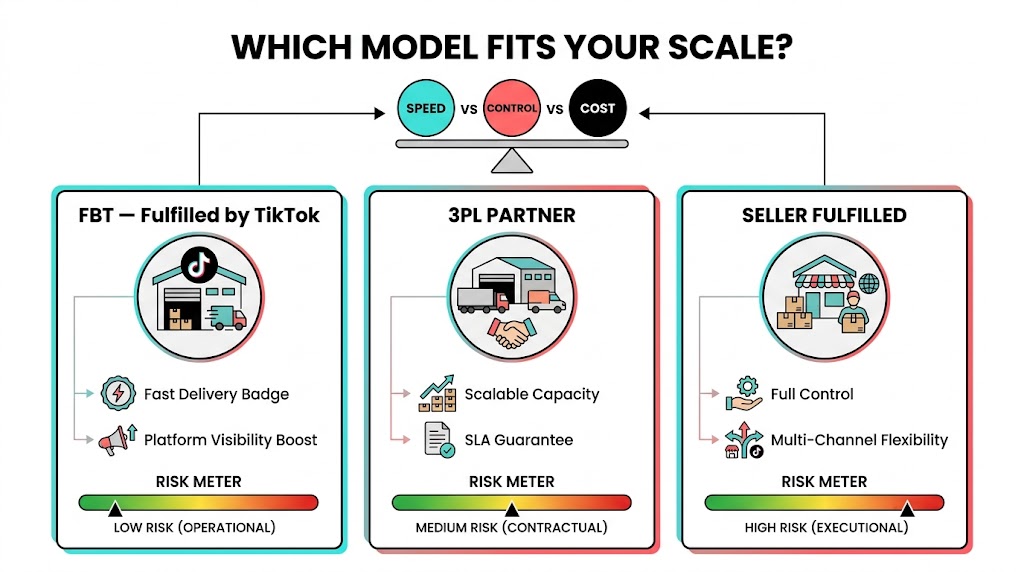
TikTok’s 2026 logistics policy shift has clarified something important: the platform wants to move toward an FBA-style model where it controls more of the fulfillment chain. The February reversal of the seller-shipping mandate was a tactical retreat, not a strategic abandonment of that goal. Sellers should plan their fulfillment architecture with the understanding that FBT’s role in the TikTok ecosystem will likely grow over time. But that does not mean FBT is automatically the right choice for your operation today.
Fulfilled by TikTok (FBT): What It Is and When It Makes Sense
FBT works similarly to Amazon’s FBA: you send inventory to TikTok’s warehouse network, and TikTok handles pick, pack, ship, and in some cases returns. The primary benefits are concrete: FBT listings often receive a delivery speed badge that increases buyer conversion, FBT orders tend to produce stronger on-time delivery metrics because TikTok controls the carrier relationships, and using FBT may provide some degree of algorithmic preference in product ranking.
The limitations are equally concrete. Inventory sent to FBT is siloed — it can only fulfill TikTok Shop orders. If you have a Shopify store, Amazon listings, or wholesale accounts drawing from the same SKU, you cannot use FBT stock to fulfill those channels. This creates the problem of duplicate inventory allocation: you must decide how many units to commit to TikTok’s warehouse versus keeping available for your other channels, and you must make that decision against uncertain and volatile TikTok demand.
FBT makes the most operational sense for hero SKUs — your top five to ten products that generate the majority of your TikTok Shop revenue, that have reasonably consistent (if volatile) velocity, and that are not critical stock for other high-priority channels. Putting long-tail catalog SKUs into FBT typically generates negative economics: storage fees on slow-moving units, the complexity of replenishing FBT across a large SKU range, and inventory lock-in that limits your multi-channel flexibility.
Seller-Fulfilled: Still Viable, But Under Pressure
After TikTok reversed the seller-shipping mandate, independent fulfillment remains officially permitted. For brands with existing warehouse operations and proven ability to meet TikTok’s KPI thresholds, maintaining seller-fulfilled operations for some or all of their catalog remains a reasonable choice. It preserves multi-channel inventory flexibility, allows you to use your existing carrier rates and relationships, and keeps you from splitting your physical stock across TikTok’s network and your own.
The pressure on seller-fulfilled operations in 2026 is real, however. TikTok’s SLA enforcement is stricter than it was in 2023 and 2024. The Late Dispatch Rate enforcement resumption in April 2026 effectively removed the grace period that many sellers had been operating within. Any seller-fulfilled operation that is not consistently meeting a sub-4% LDR, 95%+ VTR, and sub-2.5% SFCR is operating with a degraded AHR that will eventually affect visibility and promo access.
Third-Party Logistics (3PL): The Scaling Bridge
For most brands in the $50,000 to $1,000,000 per month range on TikTok Shop, a qualified 3PL partner is the most practical and operationally sound choice. A good 3PL brings three things that self-fulfillment cannot: scalable labor capacity that can absorb a spike without burning out your team, established carrier integrations that support TikTok’s tracking requirements, and a physical warehouse footprint that can be configured to support geographic distribution of inventory.
Not every 3PL is built for TikTok Shop. The key qualifiers to look for are: native or API-integrated TikTok Shop order management, experience with high-velocity spike periods (look specifically for 3PLs that serve other direct-to-consumer brands with social commerce components), same-day or next-day dispatch SLAs built into their service agreement, and real-time inventory reporting that feeds directly into your inventory management system.
The Inventory Pre-Positioning Framework for TikTok Shop
Geography matters in fulfillment, and it matters more on TikTok Shop than on most other channels — because TikTok’s U.S. audience is concentrated in specific demographic and geographic clusters, not uniformly distributed across the country. A brand that stores all of its inventory in a single New Jersey warehouse will chronically underperform on On-Time Delivery Rate for customers in California, Texas, and the Pacific Northwest.
Zone Analysis: Where Is Your TikTok Audience Actually Located?
The first step in building a sensible pre-positioning strategy is understanding where your actual customers are. TikTok Shop’s Seller Center analytics provide geographic purchase data at the state level. Most brands that do this analysis for the first time are surprised by the concentration: a handful of states often account for 60% to 70% of total order volume, and those states are not always the ones the brand expected.
Once you have that geographic distribution, you can model the impact of single-warehouse versus multi-warehouse fulfillment on transit times and OTDR. There are free shipping zone calculators available that will show you what percentage of your order volume you can reach in two days or fewer from any given warehouse location. For most TikTok Shop brands at scale, two strategically placed distribution points — typically one on the East Coast and one on the West Coast, or one in the central United States and one in the South — can cover the majority of the customer base within two-day ground shipping.
The Hero SKU / Long-Tail Split
Pre-positioning 100% of your catalog in multiple locations is expensive and logistically complex. A practical approach used by scaling brands is to pre-position only the hero SKUs — the products most likely to be featured in creator content and most likely to generate viral spikes — across multiple locations, while keeping the long-tail catalog in a single centralized warehouse.
This means having a clear, actively maintained definition of which SKUs are “hero” at any given time. A TikTok Shop operation that is actively running an affiliate program or commissioning creator content should know in advance which products are being promoted in any given two-week content window, and should ensure that those specific SKUs are fully stocked at all pre-positioned locations before the content goes live.
FBT as One Node in a Multi-Location Network
For brands that do use FBT, the most effective architecture treats TikTok’s warehouse network as one node in a broader multi-location inventory system, not as the single source of truth. You send FBT inventory for your core TikTok SKUs to TikTok’s network, while maintaining buffer stock at a domestic 3PL that can replenish FBT within days when TikTok stock runs low during a spike. This hybrid model was described by multiple 3PLs in 2026 as the emerging standard for well-organized TikTok Shop brands at the $500,000+ monthly revenue range.
Multi-Channel Sync: The Architecture That Prevents Overselling During Live Streams
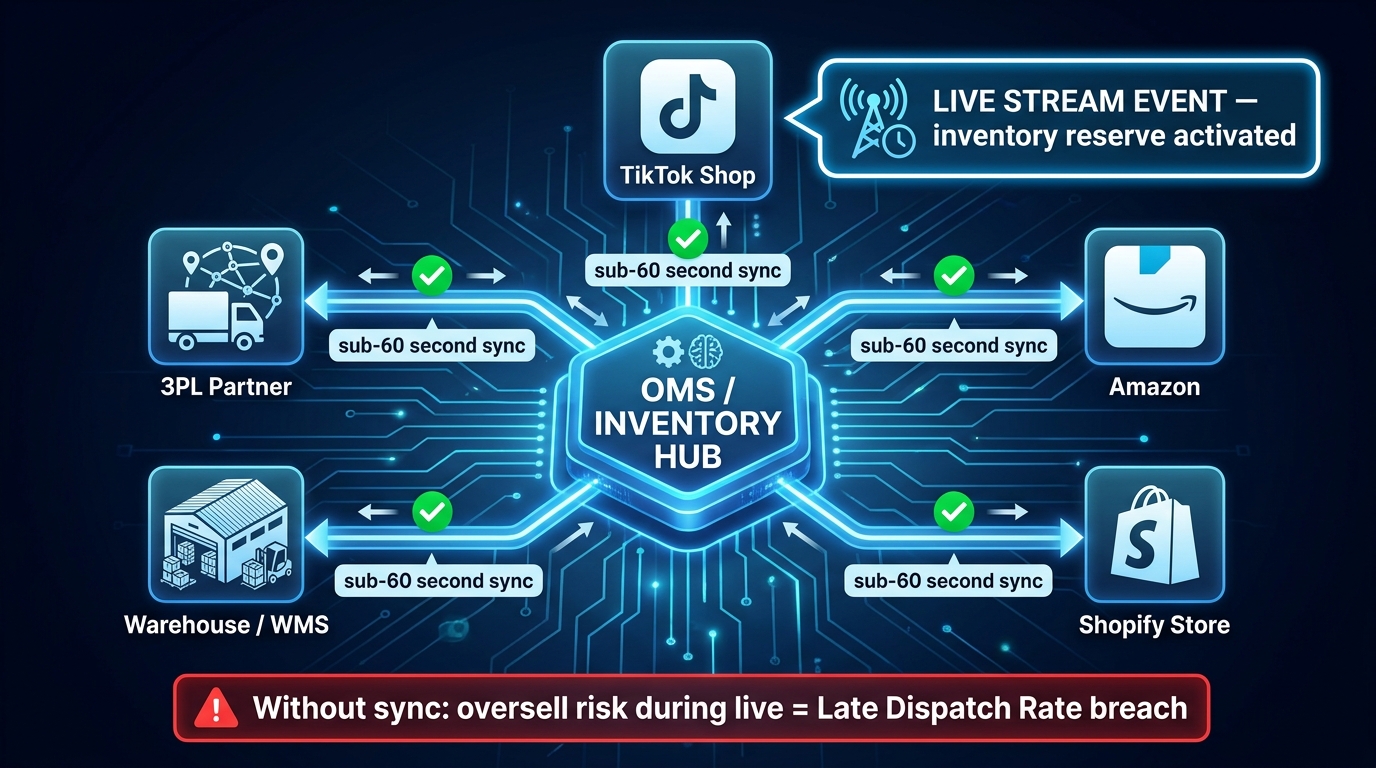
The inventory synchronization problem is one of the most technically underappreciated challenges in TikTok Shop operations. Most brands start by managing TikTok Shop inventory manually, or through a basic spreadsheet-driven process, or through a cheap multi-channel tool that syncs inventory every 15 minutes. That approach works fine at low volume. It becomes catastrophically inadequate during a live stream or a viral spike.
Why Polling-Based Sync Is Not Enough
Traditional multi-channel inventory management tools work on a polling model: they check your inventory levels every five, ten, or fifteen minutes and push updates to each channel. At an order rate of 20 to 30 per day, a 15-minute polling interval creates no meaningful risk. At an order rate of 500 per hour — which a high-performing TikTok LIVE session can generate — a 15-minute polling gap means you could have accepted and committed to hundreds of orders against stock that was already zero.
Industry guidance in 2026 is increasingly clear that TikTok Shop integration requires sub-minute, event-driven inventory sync rather than interval-based polling. This means your inventory management system should be listening for TikTok Shop’s webhook notifications — events that fire in real time when orders are placed — and immediately decrementing available stock across all connected channels as each order arrives, not on a scheduled interval.
Inventory Reservation for Live Events
A specific architectural pattern that experienced TikTok Shop operators use before a planned live commerce event is inventory reservation: the practice of temporarily reducing the available inventory count on your non-TikTok channels before a live stream begins, effectively holding a defined pool of stock exclusively for TikTok Shop orders during the event window.
If you are planning a major live stream and you want to ensure that 500 units are available exclusively for that event, you reduce your Shopify and Amazon available count by 500 units one hour before the live begins, and restore those counts one hour after the live ends. This is a manual process in most systems, but some advanced multi-channel platforms support automated inventory reservation rules tied to scheduled events.
The Single Source of Truth Requirement
All of the above only works if your operation has a single authoritative source for inventory data — a central OMS (Order Management System) or WMS (Warehouse Management System) that is the master record of physical stock, and from which all channel-facing inventory counts are derived and updated. Brands that are working from multiple disconnected systems — where TikTok Shop inventory is managed in one platform, Amazon in another, and Shopify in a third, with no central master — will inevitably encounter moments where those systems fall out of sync, and the consequences during a high-velocity period will be measured in seller-fault cancellations and AHR point deductions.
Building toward a single inventory source of truth is the single highest-leverage technology investment a scaling TikTok Shop brand can make. The specific platform matters less than the architectural principle: one master, multiple channels, real-time sync.
Returns at Scale: The Hidden Ops Tax TikTok Sellers Ignore
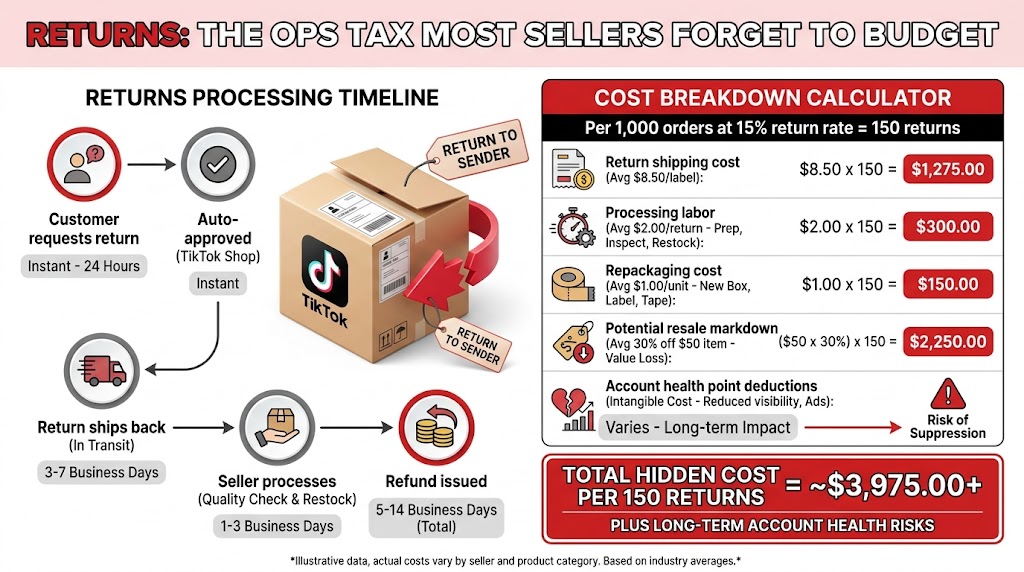
Most operational planning for TikTok Shop focuses on order fulfillment — getting orders out the door. Returns get much less attention, typically because when a brand is still growing rapidly, the absolute return volume does not feel like a problem yet. But returns on TikTok Shop are structurally more costly than on most other channels, and the cost compounds in ways that are not always visible until they are already causing significant margin erosion.
The Auto-Approval Problem
TikTok Shop’s returns process is heavily buyer-friendly by design. Most return requests are auto-approved upon submission, before the seller has had any opportunity to review or dispute them. The seller then receives the returned item and must process a refund. TikTok’s policy explicitly makes sellers responsible for the full refund amount, and the platform may deny compensation claims where refunds were issued under seller-defined policies that conflict with platform rules.
The operational consequence is that you cannot use a manual review and approval process to filter fraudulent or abusive return requests before they impact your cash flow. You receive the inventory, process the return, and then pursue any dispute resolution after the fact. For a brand processing hundreds of returns per month, building a returns triage and inspection workflow — rather than a simple receive-and-refund process — is essential to recovering value from returned goods.
The Math of Return-Rate Economics
Consider a brand doing $300,000 per month on TikTok Shop at an average order value of $35. That is roughly 8,600 orders per month. A 15% return rate — which is below average for fashion, beauty, and apparel categories common on TikTok Shop — generates approximately 1,290 return events per month. At $5 average return shipping cost, $3 inspection and repackaging labor, and 10% of returned units that must be marked down or disposed of due to condition, the monthly returns cost is in the range of $12,000 to $15,000 before you account for the refund amounts themselves.
That returns overhead is a line item that many brands are not explicitly tracking in their unit economics. It comes out of margin invisibly — it looks like cost of goods is slightly higher than expected, or like fulfillment costs are running above model. Surfacing it explicitly forces better decisions about product quality, packaging, and description accuracy (misrepresentation of products in creator content is a leading driver of TikTok Shop returns).
The AHR Impact of Poor Returns Handling
Beyond the direct cost, returns that are handled slowly or incorrectly can generate buyer complaints that affect your AHR. A refund that is delayed beyond TikTok’s required processing window, a return that results in a dispute because the seller did not respond in time, or a pattern of returns in a specific product category that TikTok interprets as a quality signal — all of these feed into your account health metrics. Returns management is not just a cost center; it is an account-health management function.
Building a Returns Workflow That Protects Margin
The most effective returns workflows for TikTok Shop brands at scale include: a dedicated returns processing station in the warehouse (or with your 3PL) with clear grade-and-route rules for each returned item; a refurbish and re-list path for units that are returned in resalable condition; a disposal or liquidation path for units that cannot be resold; and a weekly returns data review that identifies which SKUs, creator campaigns, or product descriptions are generating disproportionate return rates. The last item is the most strategically valuable — a high-return-rate SKU that is also a high-volume TikTok SKU is a margin trap that grows more dangerous as you scale.
Building the Right Fulfillment Tech Stack for TikTok Shop
The technology choices you make for TikTok Shop fulfillment will either accelerate your scaling or create compounding operational debt. The good news is that the category of tools supporting TikTok Shop has matured significantly in 2026. The bad news is that not all integrations are created equal, and the quality difference between a native TikTok Shop API integration and a third-party middleware connection is often only visible during high-stress operational moments — which is precisely when you cannot afford a failure.
The Core Stack Architecture
A mature TikTok Shop fulfillment tech stack in 2026 typically consists of four layers. The first is your inventory source of truth: either a dedicated OMS platform, your ERP (for larger operations), or a multi-channel inventory management tool like Linnworks, Skubana (now Extensiv), or a similar platform. This layer holds the authoritative inventory counts and manages order routing logic.
The second layer is your TikTok Shop integration: ideally a native API connection (not a polling-based webhook emulation) that pushes order data from TikTok into your OMS within seconds of order placement, and pulls inventory updates from your OMS back to TikTok in near real time. The TikTok Shop API supports webhook-based order notifications for sellers using platform-approved integration partners. Prioritizing this architecture over interval-based polling is the single most impactful technical decision for high-volume operations.
The third layer is your WMS or 3PL integration: the system that physically directs warehouse operations, generates pick lists, manages carrier label creation, and uploads tracking data back to TikTok Shop within the VTR window. If you are using a 3PL, their platform must have a direct, certified integration with TikTok Shop — not a generic API connection that requires manual export-import of tracking numbers.
The fourth layer is analytics and monitoring: a dashboard that gives you real-time visibility into your four core KPIs (LDR, VTR, SFCR, OTDR), inventory levels by location and channel, and early-warning alerts when any metric approaches its threshold. Many brands build this in-house using a business intelligence tool connected to their OMS and Seller Center data exports; others use dedicated e-commerce analytics platforms that include TikTok Shop as a native data source.
Key Integrations Worth Evaluating in 2026
Several integration paths have become notable in 2026. Helium 10 released an Order Status page and Profits for TikTok module that bridges TikTok Shop US with Amazon Seller Central and Amazon Multi-Channel Fulfillment (MCF), allowing sellers to use FBA inventory to fulfill TikTok Shop orders — a meaningful option for brands with significant FBA stock and overlapping product catalogs. ShipMonk offers direct TikTok Shop integration with prioritized order handling for TikTok orders. ShipBob’s platform covers pick, pack, and ship with carrier integration for TikTok’s tracking requirements.
For Southeast Asian markets where TikTok Shop operates alongside Shopee and Lazada, platforms like OneCart have emerged as essential multi-channel inventory hubs with sub-minute sync capabilities designed specifically for the tight SLA environment these platforms now require. The principle of sub-minute, event-driven sync rather than polling has become the technical standard across all serious TikTok Shop fulfillment tooling in 2026.
When to Bring in a 3PL — and What to Actually Look For in One
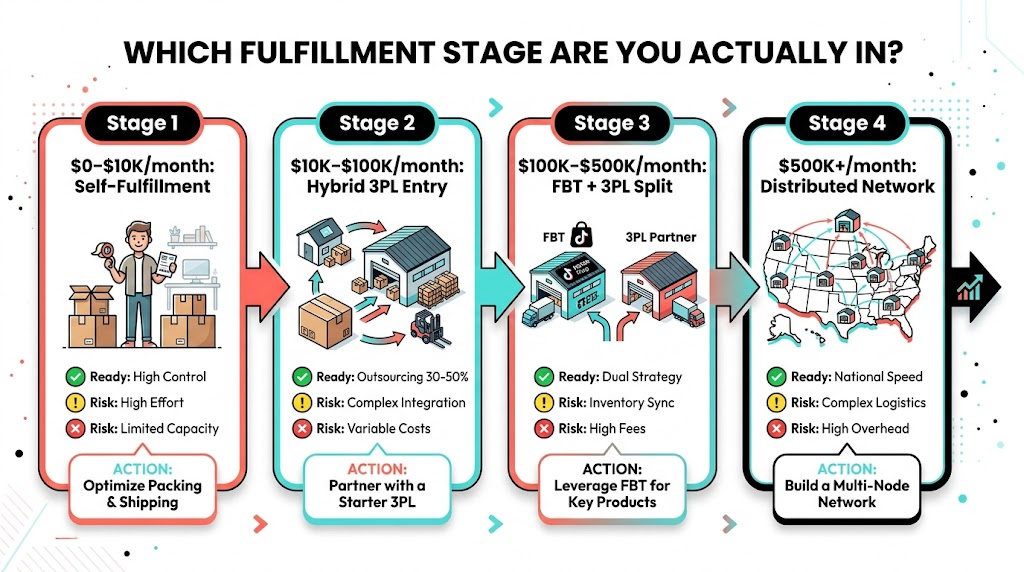
One of the most common strategic mistakes TikTok Shop brands make is waiting too long to bring in a fulfillment partner — and then making the wrong choice when they finally do. The decision to move to a 3PL is typically driven by a crisis: a viral moment that overwhelmed in-house operations, an AHR dip into the orange zone, or a period of rapid growth where the team is burning out trying to hand-pack orders at midnight. Crisis-driven 3PL selection almost always produces suboptimal outcomes.
The Right Trigger Points for 3PL Entry
The practical thresholds where 3PL partnerships start generating positive economics for TikTok Shop operations are broadly as follows. Under $10,000 per month in TikTok Shop revenue, self-fulfillment or a micro-3PL arrangement is typically appropriate — the volume does not justify the minimum fees most quality 3PLs charge. Between $10,000 and $100,000 per month, a 3PL partnership almost always produces better unit economics and operational outcomes than in-house fulfillment, especially if your SKU count is above ten or your order volume is volatile. Above $100,000 per month, the question is no longer whether to use a 3PL but how to configure the 3PL + FBT hybrid model to best serve your scale and channel mix.
Evaluating a 3PL for TikTok Shop Specifically
Not every 3PL can serve TikTok Shop’s specific operational requirements. The evaluation criteria that matter most, beyond standard 3PL considerations like pricing, location, and technology, are: TikTok Shop-specific experience (have they managed viral spike events before? Can they demonstrate metrics for an existing TikTok client?), same-day dispatch capability for orders received before a defined cut-off time, real-time tracking upload capability that meets TikTok’s VTR window requirements, and willingness to include TikTok KPI performance guarantees in the service-level agreement.
That last point is unusual but increasingly important. A 3PL that will commit contractually to maintaining your LDR below 4% and your VTR above 95% as part of a shared-risk arrangement is a more valuable partner than one that charges premium rates but takes no accountability for your platform health metrics. Some of the better TikTok-specialized 3PLs in 2026 are explicitly marketing their services with Seller Center KPI compliance as a feature — look for that signal when evaluating providers.
Negotiating Surge Capacity Into the Contract
Standard 3PL contracts are written for predictable, modestly growing volumes. TikTok Shop’s demand profile is neither predictable nor modestly growing. The most important contract negotiation you can do with a prospective 3PL partner is around surge capacity: what is the maximum order volume they can process in a 24-hour period, what advance notice do they need to mobilize surge labor, and what happens to their dispatch SLA commitment when you trigger a viral spike that puts their entire operation under pressure?
A 3PL that cannot answer these questions specifically and contractually is a 3PL that has not thought carefully about the TikTok Shop client profile. Push for explicit surge language in your contract, including a definition of what constitutes a surge event, the 3PL’s response protocol, and any rate adjustments that apply during surge periods. Knowing the cost of surge fulfillment in advance is far better than discovering it on an invoice after a viral week.
Ops as a Competitive Moat: The Longer Game in TikTok Shop
There is a tendency in TikTok Shop discourse to treat fulfillment as a cost to be minimized — a backend function that matters only when it fails. That framing misses something important about where the platform is heading in 2026 and beyond. As TikTok Shop’s seller base grows, the brands that will sustain and compound their position are not necessarily the ones with the best content or the most creator relationships. They are the ones whose operational infrastructure has been engineered to turn fulfillment into a growth advantage.
Fulfillment Speed as a Conversion Factor
TikTok Shop’s buyer experience is increasingly shaped by delivery speed and reliability signals. A listing that carries a fast-shipping badge because it is FBT-fulfilled or because the seller has consistently maintained excellent OTDR metrics converts at a measurably higher rate than a comparable listing without that signal. The platform is moving in the direction of surfacing seller performance data to buyers in more prominent ways — a trend that mirrors Amazon’s development over the past decade. Investing in operational quality now builds the track record that will matter more as those signals become more visible.
AHR as a Promotional Unlock
Maintaining a consistently healthy AHR is not just about avoiding penalties. A green-zone AHR is the ticket to participation in TikTok Shop’s promotional programs: flash sales, platform-wide campaign inclusion, featured placement in discovery surfaces, and access to advanced tools that are gated by performance history. Brands that have built operationally disciplined fulfillment systems accumulate this access over time, while competitors that have had account health incidents — even temporary ones — face longer recovery windows before they can participate fully in promotional events.
Building the Team and the Culture
None of the operational infrastructure described in this article runs on autopilot. It requires a team that understands both the platform mechanics and the physical logistics — people who can read a Seller Center dashboard as fluently as they can read a warehouse pick-rate report, and who treat those two data sets as parts of a single operational picture rather than separate functions owned by separate teams.
The brands scaling TikTok Shop past $10 million in annual revenue in 2026 typically have someone — a head of operations, a director of supply chain, or an experienced e-commerce ops manager — whose specific mandate includes TikTok Shop platform health, not just general fulfillment efficiency. That organizational structure, simple as it sounds, separates brands that maintain operational excellence at scale from those that manage by crisis.
Practical Takeaways: Your Fulfillment Infrastructure Checklist by Scale
Pulling together the key operational principles from the sections above, here is a practical checklist for brands at different stages of TikTok Shop scale.
For Brands Under $50,000/Month on TikTok Shop
- Know your four AHR KPIs and monitor them weekly: LDR, VTR, SFCR, OTDR.
- Implement a virtual inventory buffer (list only 80% of physical stock) for your top three SKUs.
- Set up real-time inventory sync between TikTok Shop and your primary inventory system, even if it is a simple Shopify store — avoid managing counts manually.
- Define a “spike response protocol” in writing: who does what when orders spike above 3x your daily average.
- Start tracking your return rate by SKU and add returns cost to your unit economics model.
For Brands at $50,000 to $300,000/Month
- Evaluate 3PL options with explicit TikTok Shop experience and negotiate TikTok KPI guarantees into the contract.
- Conduct a shipping zone analysis to determine if multi-location inventory would materially improve your OTDR.
- Build or buy a real-time KPI monitoring dashboard connected to your Seller Center data.
- Implement inventory reservation protocols for planned live stream events.
- Separate hero SKUs from long-tail catalog for pre-positioning decisions — not all inventory needs the same treatment.
For Brands at $300,000+/Month
- Implement a hybrid FBT + 3PL architecture with a defined replenishment protocol between the two nodes.
- Move to sub-minute, event-driven inventory sync across all channels — retire polling-based systems.
- Assign dedicated operational ownership of TikTok Shop platform health as a distinct responsibility from general fulfillment management.
- Negotiate surge capacity provisions explicitly in all 3PL contracts.
- Build a returns triage and grading system with defined economic routes (resell, refurbish, liquidate, dispose) for each return grade.
- Conduct quarterly emergency replenishment drills: test whether your supply chain can actually respond in 48 hours when needed.
The Bottom Line
TikTok Shop’s growth trajectory in 2026 is creating a widening gap between two types of sellers. The first type treats fulfillment as a logistics cost to be minimized and a constraint to be managed reactively. The second type treats fulfillment as a strategic function — the operational foundation on which content performance, creator relationships, and marketing spend can actually compound into durable revenue.
The platform’s direction is clear: it is raising fulfillment standards, tightening SLA enforcement, and increasingly using operational performance as a determinant of algorithmic visibility and promotional access. Sellers who invest in their fulfillment infrastructure now — the right inventory architecture, the right technology stack, the right logistics partners with the right contractual terms — are building an advantage that becomes harder to replicate as the market matures.
The brands that break at $1 million are not usually breaking because they ran out of good products or ran out of creator relationships. They break because they scaled their content and their demand without scaling the operational system underneath. The fulfillment infrastructure is not the exciting part of TikTok Shop. But it is, increasingly, the part that determines who stays and who gets left behind.