

There is a quiet assumption baked into most TikTok Shop media strategies right now: that the creator authorization system works the same way it did 18 months ago. Brands assume that whitelisting a creator — granting ad permissions to run Spark Ads from their handle — is a simple, stable two-step process. Creators assume their account type still qualifies for affiliate permissions the way it always has. Both assumptions are increasingly wrong.
Between April and May 2026, TikTok rolled out a cluster of interconnected policy changes that, taken individually, might look like routine housekeeping. Taken together, they represent a meaningful structural shift in how creator permissions, affiliate access, and paid amplification work on the platform. Official Accounts lost affiliate permissions. A new three-tier creator account taxonomy became enforced policy. The Creator Eligibility Policy, effective May 11, 2026, drew sharper lines between who can do what and under which account type.
The brands and agencies that are already adjusting — auditing their creator rosters, updating authorization workflows, and re-evaluating which collaboration model they’re running — will hold their ground. The ones still operating on last year’s mental model are about to hit friction at exactly the wrong moment: during a period when TikTok Shop’s global GMV trajectory is still sharply upward, having reached $26.2B in H1 2025 alone before accelerating further into 2026.
This article does not rehash TikTok Shop SEO mechanics or the May algorithm changes. It focuses specifically on the operational and structural changes to creator whitelisting and permissions — what changed, why it matters, and what to do about it.
What Creator Whitelisting Actually Means on TikTok Shop
The term “whitelisting” gets used loosely across TikTok Shop conversations, which is part of what makes the current policy changes confusing. In practice, it refers to two different but related things, and conflating them is one of the most common mistakes brands make.
Spark Ads Authorization: The Paid Amplification Layer
The first meaning is Spark Ads authorization — the mechanism by which a brand runs paid ads using a creator’s existing organic TikTok post. The ad appears from the creator’s handle, preserves all social proof (likes, comments, shares, follows), and drives traffic to a landing page or TikTok Shop product page.
According to TikTok’s official Ads Help Center, Spark Ads support every major advertising objective: reach, traffic, video views, conversions, lead generation, and sales. The engagement accrued during a paid Spark Ad campaign is permanently attributed to the original organic post — meaning a successful campaign makes the creator’s content look more popular, which in turn improves the organic performance of that post after the paid period ends. This flywheel dynamic is what makes Spark Ads uniquely valuable compared to standard dark post formats.
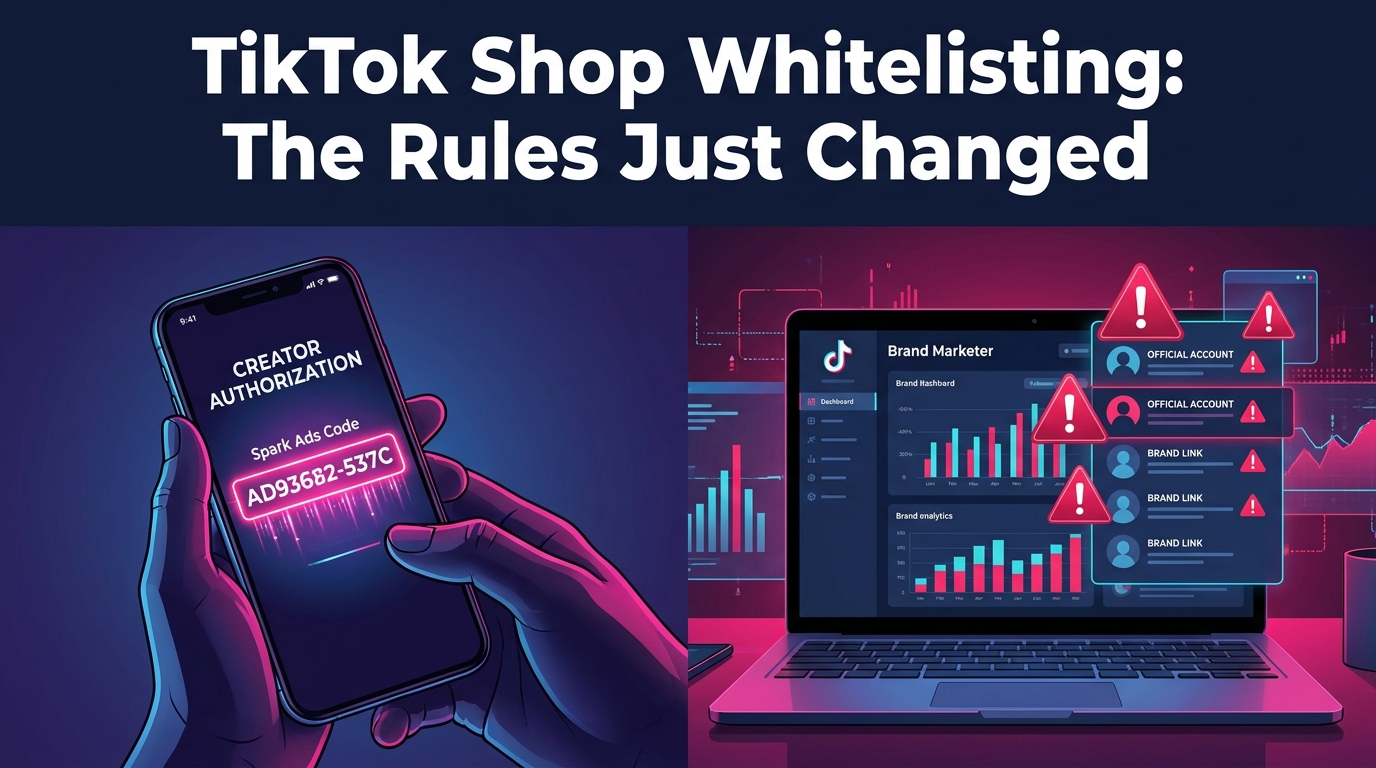
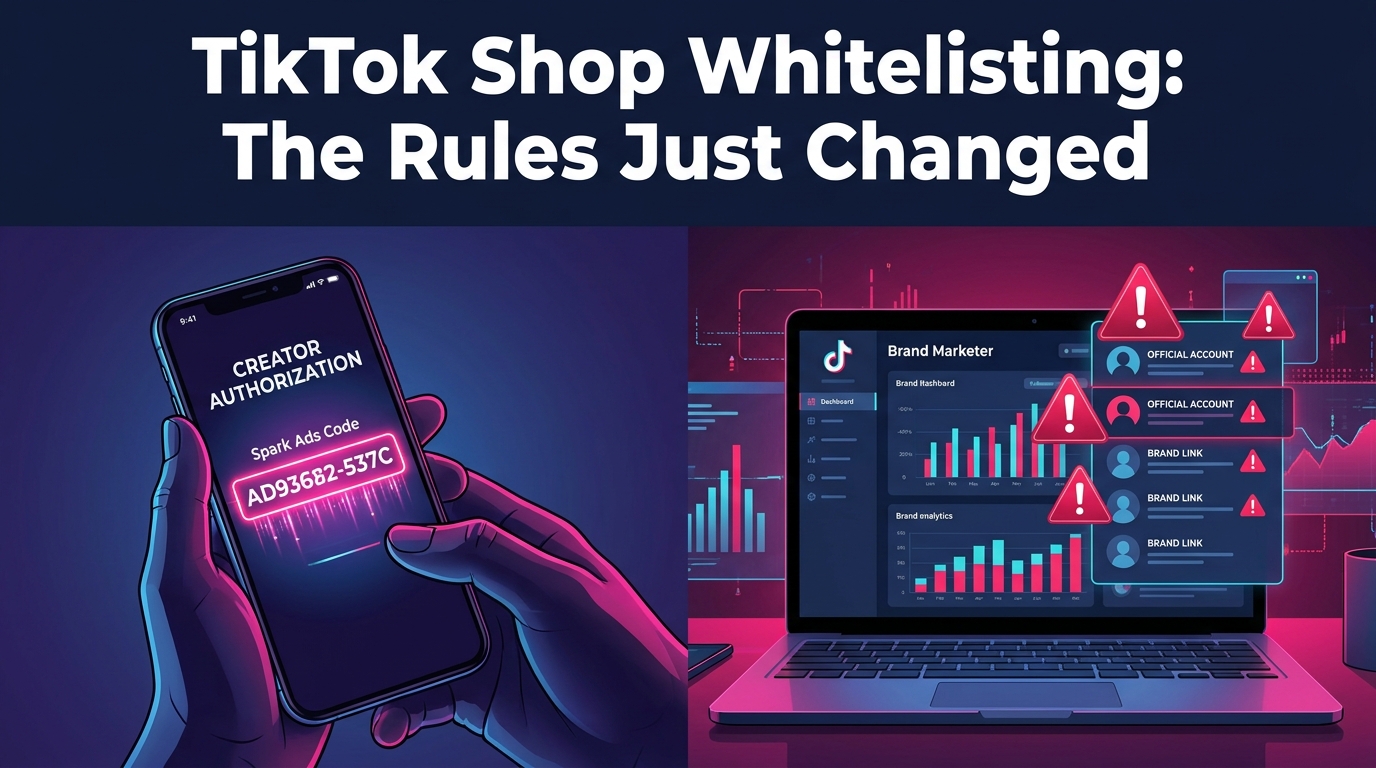
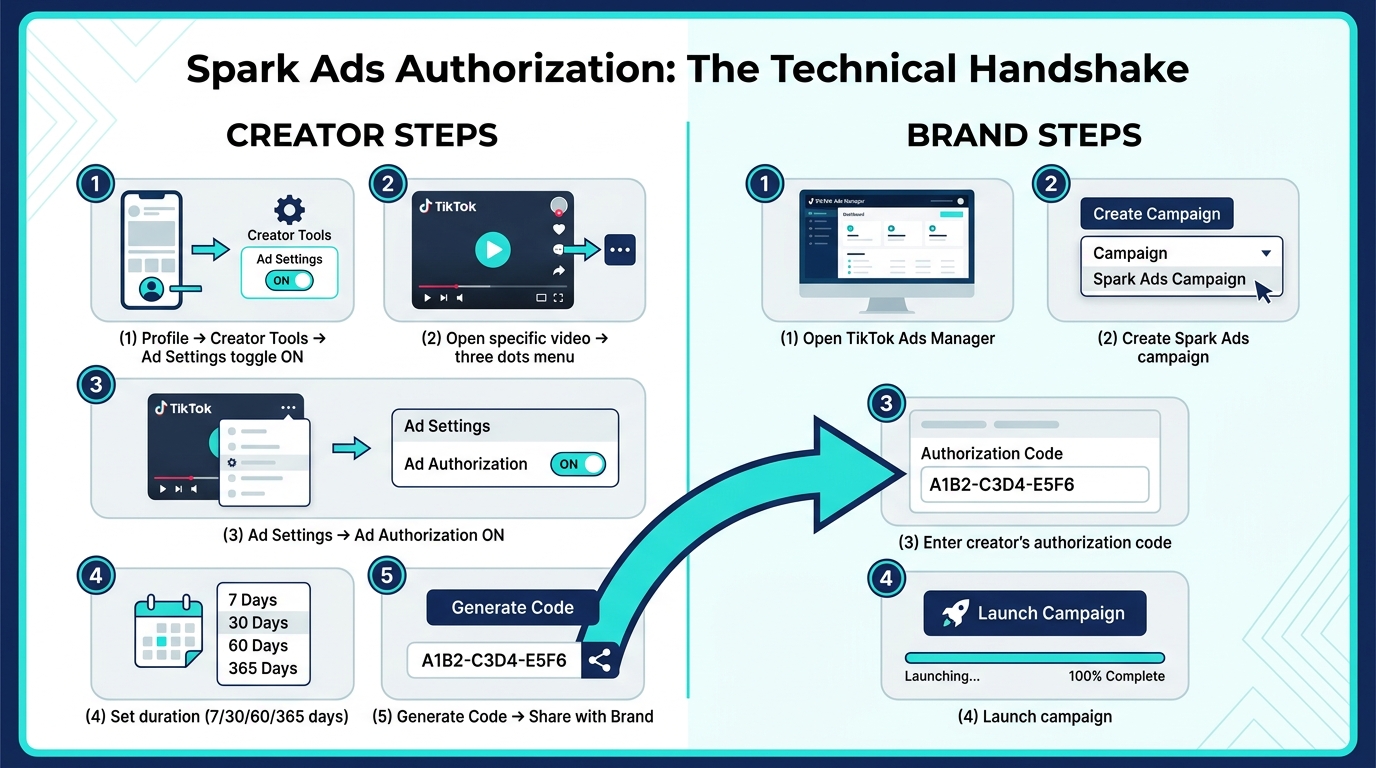
The authorization process requires the creator to generate a specific authorization code tied to a single video, with a configurable expiry window (7, 30, 60, or 365 days). Brands enter that code into TikTok Ads Manager to unlock the post for paid promotion. There is no single “whitelist this creator forever” option — each authorization is post-specific and time-bound.
Affiliate Creator Permissions: The Commerce Layer
The second meaning — and the one directly affected by the 2026 policy changes — is affiliate creator permissions. This refers to whether a creator’s account is eligible to promote TikTok Shop products for commission. A creator can be authorized to run Spark Ads (paid amplification) while having their affiliate permissions restricted or removed entirely. These two layers operate on different systems, governed by different policies.
When operators talk about “whitelisting a creator” in a TikTok Shop context, they often mean some combination of both: enabling that creator’s content for paid amplification and ensuring they have active affiliate permissions to earn commission on resulting sales. The April–May 2026 changes primarily affect the affiliate permission layer, which is why brands running purely paid Spark Ads campaigns with creators who have no affiliate relationship are less directly impacted — but not untouched, as we’ll see.
The April and May 2026 Policy Changes: Exactly What Moved
TikTok’s Policy Pulse communications rarely get the attention they deserve. They arrive as Seller Center updates rather than platform-wide announcements, which means they tend to reach brand managers slowly — often through a second-hand agency briefing or a creator’s confused inquiry about why their account setup no longer works. Here is a clear account of what the April and May 2026 updates actually changed.
Official Accounts Lose Affiliate Creator Permissions
The most operationally disruptive change is this: Official Accounts will no longer support affiliate creator permissions. This comes directly from TikTok Shop Seller Center’s Policy Pulse for April 2026.
To understand why this matters, you need to understand how Official Accounts were being used. A TikTok “Official Account” is essentially a brand-verified or business-linked account type — originally designed to give brands and organizations a verified presence. Over time, it became a workaround that some sellers and networks used to onboard creators into affiliate arrangements, particularly for creators who hadn’t reached standard follower thresholds or who were being managed as part of a brand’s in-house creator program.
By routing affiliate creator permissions through Official Accounts, brands could effectively “whitelist” creators into their affiliate ecosystem faster than the standard eligibility review would allow. TikTok’s April 2026 policy change closes that door. Any creator currently operating under an Official Account structure who relies on that account type for affiliate permissions needs to transition — specifically, TikTok is directing sellers and creators to check eligibility under the Marketing Creator account type through Creator Center.
The Creator Eligibility Policy (Effective May 11, 2026)
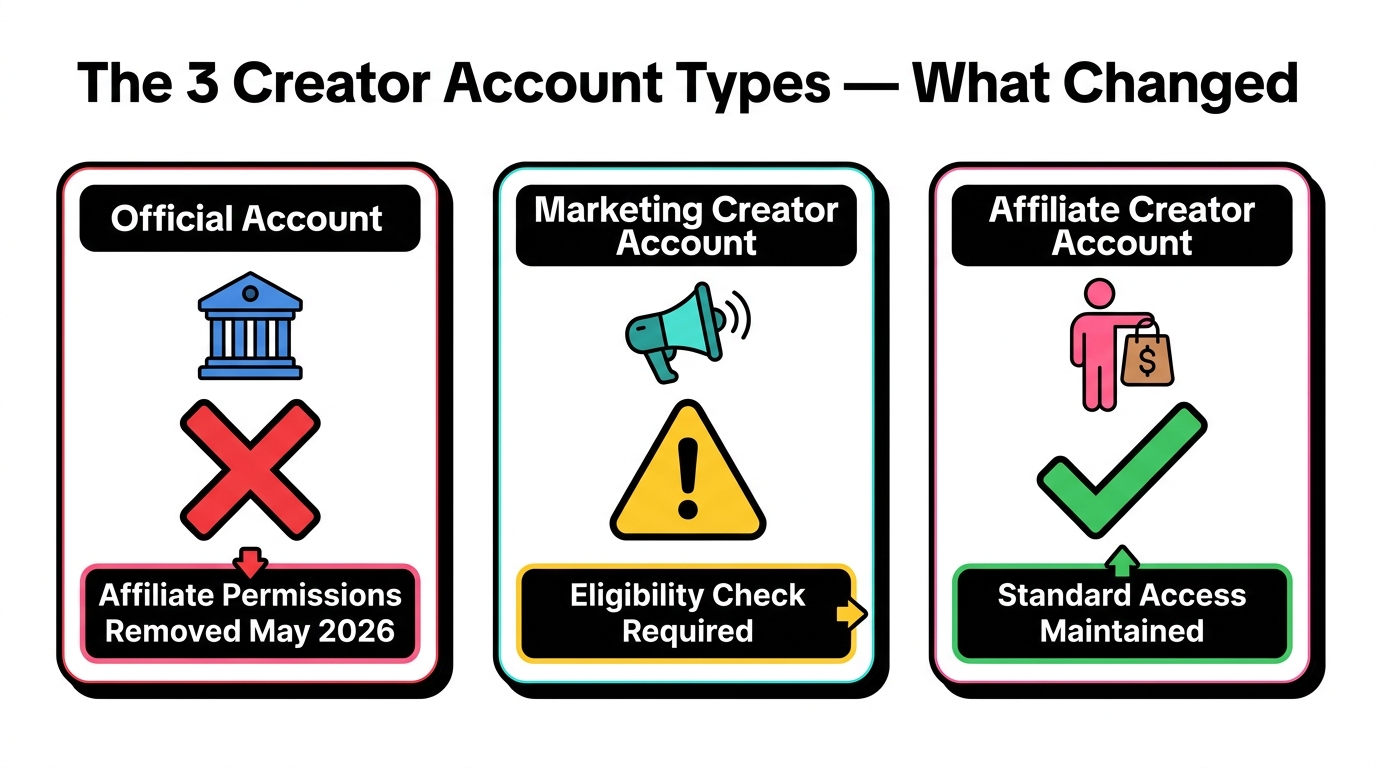
Running in parallel with the Official Account change, TikTok’s updated Creator Eligibility Policy — effective May 11, 2026 — formalizes a three-tier account taxonomy that was previously looser in enforcement:
- Official Accounts: Brand or organization accounts. No longer eligible for affiliate creator permissions.
- Marketing Creator Accounts: Creator-linked accounts used for branded content and promotional activity. Eligibility for affiliate permissions now requires a specific check through Creator Center — it is not automatic.
- Affiliate Creator Accounts: The standard affiliate pathway. Eligibility maintained under the existing framework, including the Creator Health Rating (CHR) system for ongoing compliance.
The effect of formalizing these three tiers is that the middle category — Marketing Creator — now requires explicit eligibility verification where it previously operated in a greyer zone. Brands that had been using Marketing Creator accounts as a flexible catch-all for creator relationships need to audit each account against the new eligibility criteria.
What Didn’t Change (And Why That Matters)
It’s worth being precise about the scope. The Spark Ads authorization code mechanism itself — the technical process by which a creator grants a brand permission to run paid ads from their post — has not been structurally altered. A creator with a standard affiliate account can still generate authorization codes exactly as before. The changes specifically affect the account-type eligibility layer that gates access to affiliate commission structures, not the paid amplification workflow itself.
This distinction matters because it means some brands will be more affected than others. If your TikTok Shop creator program runs primarily through Spark Ads amplification of affiliate-linked content (meaning creators earn commission on sales and you amplify their posts with paid budget), you are affected by both layers. If you run pure paid Spark Ads campaigns — amplifying creator content without affiliate commission structures — the May 2026 eligibility changes affect you less directly, though the account type taxonomy still shapes which creators you can work with and how.
The Three Creator Account Types and Why the Difference Now Matters
Before these changes, many brands treated TikTok creator account types as administrative labels. The practical consequence of which account type a creator used was minimal enough that most brand-side teams didn’t track it carefully. That’s no longer a workable position.
Official Accounts: Losing Their Commercial Utility
Official Accounts were always primarily designed for brand presence — a verified, institution-linked account type that signals legitimacy on the platform. Their use as a vehicle for affiliate permissions was always a functional workaround rather than a designed use case, which is arguably why TikTok has now closed it.
The practical implication for brands: if you have creators or promotional accounts in your ecosystem operating as Official Accounts with active affiliate relationships, those relationships need to be migrated. The migration path TikTok recommends is checking Marketing Creator eligibility through Creator Center — but that check is not guaranteed to result in approval. Some creators operating through Official Account structures may find themselves ineligible for affiliate permissions under the new taxonomy, which could mean restructuring the creator relationship entirely.
Marketing Creator Accounts: The New Variable
Marketing Creator accounts sit in an interesting middle position. They’re designed for creators who are doing branded content and promotional work — which describes most of the creators in a sophisticated TikTok Shop program. The issue is that “eligibility for affiliate permissions” under a Marketing Creator account is now explicitly conditional, not assumed.
TikTok directs brands and creators to verify eligibility through Creator Center before assuming affiliate access. What the eligibility check involves in detail is not publicly documented with the same granularity as the standard affiliate creator requirements. But based on TikTok’s existing framework, it’s reasonable to infer that account standing, content compliance history, and identity verification are all factors.
The operational message for brands: do not assume a Marketing Creator account type is affiliate-ready. Build eligibility verification into your creator onboarding workflow as a mandatory step, not an afterthought.
Affiliate Creator Accounts: Still the Cleanest Path
For creators whose primary relationship with TikTok Shop is earning commission on product promotions, the Affiliate Creator account path remains the most straightforward. The standard eligibility framework — 18+, identity verification, tax compliance for US creators, and ongoing compliance with the Creator Health Rating system — has not been materially altered.
The CHR (Creator Health Rating) is worth highlighting specifically because it’s the ongoing mechanism by which TikTok can remove affiliate permissions from previously eligible creators. A creator who meets the initial bar for affiliate access but then accumulates policy violations, content strikes, or engagement anomalies can see their CHR drop to a level that restricts or removes their ability to promote Shop products. Brands running large creator rosters need to monitor CHR at a portfolio level, not just at onboarding.
Open vs Target Collaboration: The Rebuilt Foundation Under Whitelisting
The whitelisting and account-type changes don’t happen in a vacuum. They sit on top of a collaboration structure that TikTok already simplified significantly — and that simplification is the foundation that the 2026 permission changes are now reshaping.
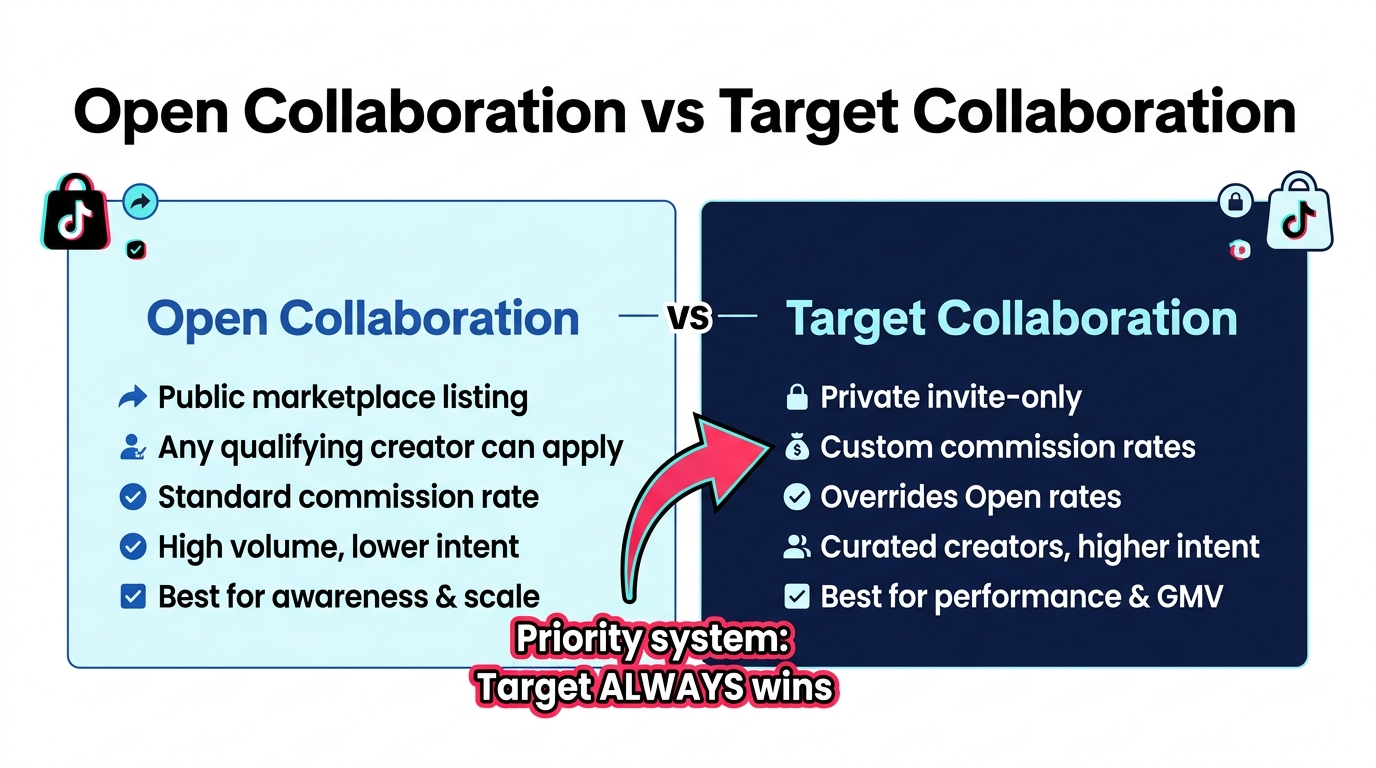
TikTok Shop now operates with exactly two affiliate collaboration modes. The old “Shop Plan” that previously formed a third tier has been sunset. What remains is:
Open Collaboration: Scale With Lower Intent
Open Collaboration is TikTok Shop’s public marketplace model. Brands list their products with an affiliate commission offer, and any creator who meets the eligibility criteria can discover and apply to promote those products. The commission rate set by the brand applies universally to all Open Collaboration activity on that product listing.
Open Collaboration is designed for reach and volume. Brands get distribution across a wide pool of creators without the overhead of managing individual relationships. The trade-off is control: you cannot curate which creators are promoting your products, you cannot customize their brief or messaging, and the conversion intent among Open Collaboration creators tends to be lower than among creators who have been specifically selected and briefed.
Open Collaboration is where most TikTok Shop affiliate programs start, and where many brands get stuck — believing that high creator volume automatically translates to proportional GMV. It often doesn’t. The 80/20 dynamic is acute here: a small number of creators typically generate a disproportionate share of revenue, while the long tail generates noise.
Target Collaboration: The Precision Layer
Target Collaboration is TikTok Shop’s invite-only, private model. Brands send direct invitations to specific creators with custom commission rates. The mechanics are straightforward, but the implications are significant.
First, Target Collaboration takes priority over Open Collaboration. If a creator has a Target Collaboration offer from a brand, that commission rate overrides any Open Collaboration rate on the same product. This priority logic means Target Collaboration is the system you use when you want your best creators to be operating under terms you’ve specifically negotiated — it prevents your top performers from falling back to the generic Open rate.
Second, Target Collaboration is where the real whitelisting work happens. When brands talk about building a “creator whitelist” in the strategic sense — a curated roster of high-performing, brand-aligned creators they can activate reliably — that roster is operationalized through Target Collaboration invitations combined with Spark Ads authorization. The two mechanisms work together: Target Collaboration governs the commission and affiliate relationship, Spark Ads authorization governs the paid amplification rights.
Why the Account Type Changes Complicate This
Here’s where the account type changes from April–May 2026 directly affect the Open vs Target architecture: Target Collaboration invitations can only go to creators who are eligible to receive affiliate commission. If a creator in your Target roster is operating through an Official Account that has now lost affiliate permissions — or a Marketing Creator account that hasn’t passed the new eligibility check — your Target invitation either won’t go through or the creator won’t be able to earn commission on resulting sales, even if the content performs.
For brands with large creator rosters, this creates an urgent audit requirement. Your Target Collaboration list needs to be reviewed against current account type eligibility, not against the eligibility criteria that applied when you first onboarded those creators.
Spark Ads Authorization: The Technical Workflow Brands Keep Getting Wrong
Even setting aside the account type changes, brands consistently create unnecessary friction in their Spark Ads workflows by misunderstanding how the authorization process actually works at a technical level. These are the failure modes worth addressing directly.
The Authorization Is Post-Specific, Not Creator-Wide
The single most common misconception is that “whitelisting a creator” grants the brand blanket rights to use any of that creator’s content in paid campaigns. It does not. Each authorization code is tied to a specific video. A creator can have 50 posts that are organic, excellent, and perfectly on-brand — but unless each individual post has been authorized and a code has been generated and entered into TikTok Ads Manager, none of those posts can be used in Spark Ads campaigns.
In practice, this means brands need a content authorization pipeline, not just a creator relationship. Every time a creator publishes a new video that a brand wants to amplify, a new authorization code needs to be generated and shared. TikTok does allow batch authorization of up to 20 video codes, which makes this manageable at scale — but it requires a workflow to actually execute it consistently.
Authorization Duration: Getting the Window Right
The authorization code comes with a configurable duration: 7 days, 30 days, 60 days, or 365 days. Brands default to the maximum (365 days) on the assumption that longer is better. This is a mistake for two reasons.
First, a 365-day authorization grants the brand the right to run paid ads from that creator’s post for an entire year. If the brand-creator relationship deteriorates, or if the creator publishes subsequent content that becomes a brand safety concern, the brand is still technically holding an active authorization on earlier videos. Managing revocation across a large creator roster is operationally messy if all authorizations default to 365-day windows.
Second, for campaign-specific activations — seasonal pushes, product launches, promotional windows — a long authorization window creates accounting ambiguity around which creative is running, when it was authorized, and whether the post is still suitable for the current campaign context. Matching authorization windows to actual campaign timelines (30 or 60 days for most activations) is cleaner operationally and safer from a brand safety perspective.
Spark Ads Versus Dark Posts: The Performance Gap
A persistent debate in TikTok Shop advertising is whether to run Spark Ads from creator handles (using authorization codes) or to run standard non-Spark ads using brand-uploaded creative (sometimes called “dark posts” in industry parlance). The performance data consistently favors Spark Ads for most TikTok Shop use cases, and the reason is structural rather than incidental.
When an ad runs from a creator’s handle, it carries the creator’s accumulated social proof — existing likes, comments, shares, and the psychological cues that tell a viewer this is content that real people engaged with organically. Non-Spark brand ads start from zero every time they are created. In a platform environment where users are primed to skip content that looks like an ad, the creator-handle presentation of Spark Ads reduces the cognitive friction that causes early skips.
TikTok’s own guidance specifically positions Spark Ads as the format for “leveraging creator content and audience to drive campaign performance with fewer resources.” This reflects the actual ad performance dynamic, not just marketing language. For TikTok Shop specifically, where the path from video view to in-app purchase needs to be as frictionless as possible, starting from a position of social proof rather than zero is a meaningful advantage.
The 10,000 Spark Ads Limit and the Deletion Constraint
Two technical constraints that brands running at scale need to plan around: first, each TikTok Ads Manager account can support a maximum of 10,000 active Spark Ads. For most mid-market brands, this ceiling won’t be hit quickly. But agencies managing multiple brand accounts — or brands running large-scale creator programs across hundreds of videos simultaneously — need to be aware that hitting this limit is possible and requires proactive management of which authorizations are active at any given time.
Second: a video cannot be deleted from the creator’s organic account while it is authorized as a Spark Ad. Authorization must be revoked first. This is a detail that catches teams off guard when a creator wants to delete or edit a video that is simultaneously running as paid media. Building a revocation process into your creator communication protocol — so creators know to request authorization removal before deleting any post — prevents the confusion and occasional conflict this creates.
Creator Vetting in 2026: Why Brand Safety Is Now a Compliance Function
The account type and eligibility changes don’t just affect mechanics — they change the standard of care brands need to apply when building and maintaining a creator roster. Vetting a creator for TikTok Shop whitelisting is no longer a marketing decision made on vibes and follower counts. It has become a compliance function with operational consequences if done poorly.
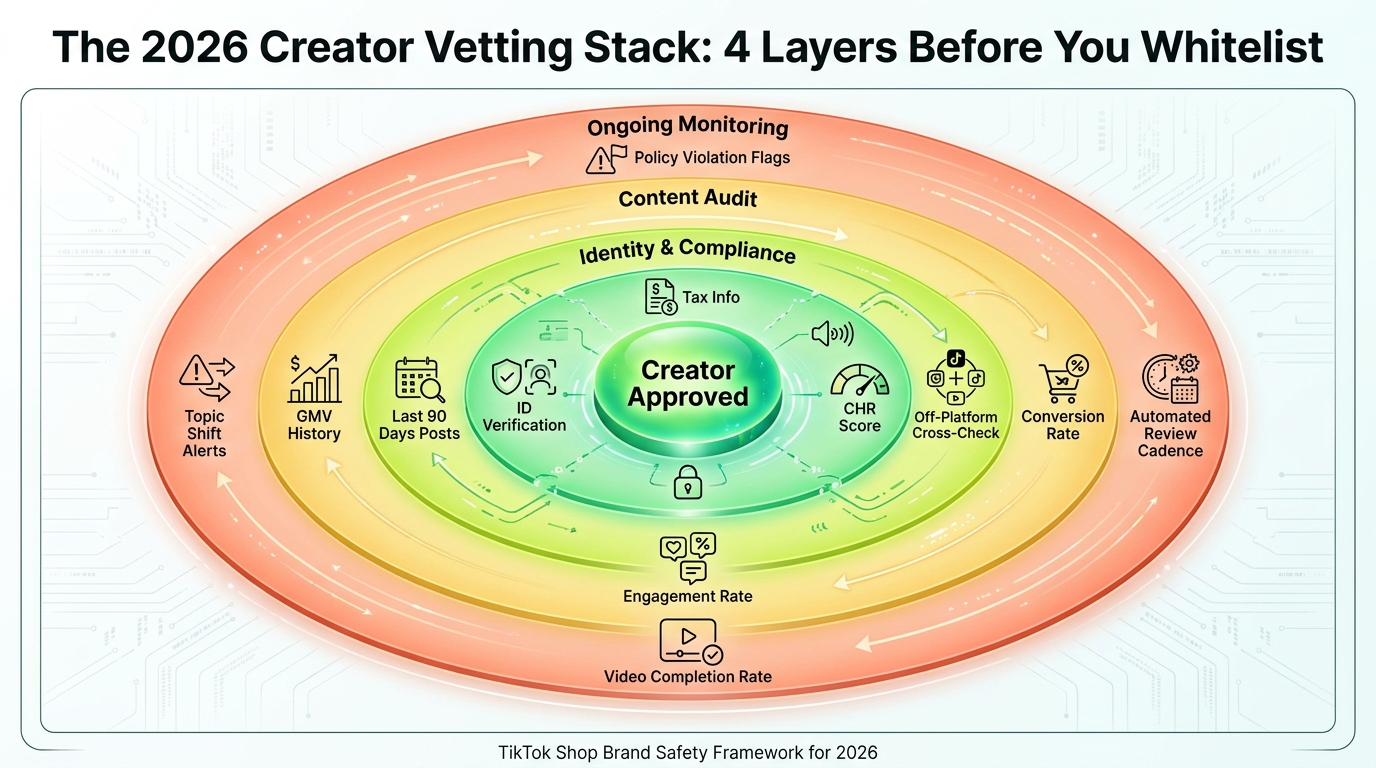
Layer One: Identity and Compliance Verification
The baseline for any creator entering a TikTok Shop affiliate relationship is identity verification — TikTok requires ID verification and, for US creators, tax information. This isn’t optional, and brands that try to activate creators who haven’t completed it will hit an eligibility wall at the worst possible moment (typically right before a launch campaign).
The Creator Health Rating (CHR) — TikTok’s ongoing compliance score for affiliate creators — is the other identity-layer check that brands need to incorporate into their onboarding flow. A creator with a low CHR may technically be eligible but is at elevated risk of having affiliate permissions restricted. Checking CHR at onboarding and periodically thereafter is table stakes for any managed creator program.
Layer Two: Content Audit
Industry guidance on creator content auditing has become significantly more rigorous in 2026. A check of the creator’s last 10 posts is no longer considered adequate due diligence. The current standard involves:
- Multi-year review of content history, not just recent posts
- Audio and spoken-word analysis of video content, not just caption and hashtag review — approximately 75% of risk markers in creator content live in the spoken audio, not in written text
- Cross-platform checks extending to YouTube, Instagram, and in some cases Telegram and alternative platforms, since creators often express views on secondary platforms that don’t appear in their TikTok content
- Automated topic-shift detection to flag sudden pivots in content category, which can indicate either an organic audience drift or a deliberate strategy shift that may conflict with brand positioning
This level of vetting might sound disproportionate for a TikTok affiliate relationship, but the operational stakes are real. A Spark Ads campaign amplifying a creator’s post to millions of impressions simultaneously amplifies any brand-safety risk in that creator’s profile. The paid media attached to a whitelisted creator post makes the brand’s association with that creator legible and traceable in a way that organic affiliate relationships are not.
Layer Three: Performance Data Verification
The third vetting layer is performance-based and forward-looking. Before committing a creator to a Target Collaboration arrangement with a custom commission rate — or before investing paid Spark Ads budget in amplifying their content — brands should have access to:
- Historical GMV attribution from any previous TikTok Shop activity, not just view counts or engagement rates
- Video completion rates on product-related content specifically, as completion rate on lifestyle content doesn’t predict completion rate on product demos
- Conversion rate from product views to purchases — TikTok Shop’s attribution data makes this visible for creators with meaningful Shop history
- Content cadence and reliability — how consistently does the creator publish, and how often do they produce content that actually drives commerce-related outcomes rather than just engagement?
Layer Four: Ongoing Monitoring
The shift the 2026 policy landscape demands most is from point-in-time vetting to ongoing monitoring. A creator who passes all checks at onboarding can develop issues — CHR drops, content violations, off-platform controversies — that make them unsuitable for continued whitelisting six months later. Brands need a monitoring cadence built into their creator program operations, not just an onboarding checklist.
TikTok’s own enforcement documentation (the Creator Enforcement Policy) confirms that severe or repeated violations can result in the complete removal of e-commerce permissions from a creator’s account — meaning a creator you’ve invested in developing, briefing, and authorizing can lose their affiliate eligibility without advance warning to the brand. Building monitoring checkpoints (quarterly at minimum, monthly for high-investment creators) into your program structure is how you avoid being caught off-guard by that scenario.
Scaling Whitelisting: From One-Off Authorizations to a Systematic Creator Pipeline
Most brands approach TikTok Shop creator whitelisting reactively: a piece of content performs well organically, someone suggests running it as a Spark Ad, an authorization code is requested, and it gets pushed live. This works for occasional activations. It breaks down completely at any meaningful scale.
Building the Authorization Workflow
A systematic whitelisting operation needs three operational components that most brands don’t have in place:
A content tracking system. Brands need visibility into which creator posts are currently authorized, which authorizations are expiring, and which high-performing organic posts from the creator roster have never been authorized. Without this tracking, paid budget defaults to the same two or three creator posts indefinitely while potentially better-performing newer content goes unamplified.
A creator communication protocol. Generating Spark Ads authorization codes requires action from the creator — specifically, navigating their TikTok app to Creator Tools, enabling ad settings, and generating a code for a specific post. For creators who aren’t deeply familiar with this flow, it creates a coordination bottleneck. A brief written or video onboarding guide that walks creators through the exact steps — including where to find the menu, how to set the duration, and how to share the code — eliminates most of the friction.
A content approval step before amplification. Before activating a Spark Ad from any creator post, the brand’s team should review the specific post for compliance with both TikTok’s ad policies and the brand’s internal standards. This is separate from the creator-level vetting done at onboarding — it’s post-level review. Content that was fine organically can create issues when amplified to paid audiences if it contains elements that TikTok’s ad review system flags, or if it makes claims that aren’t compliant with advertising standards in the brand’s category.
The Content Flywheel Model
The most efficient whitelisting programs operate on a content flywheel model: organic content from the creator roster is continuously monitored for performance signals (watch time, completion rate, engagement within the first 24–48 hours), high-performing posts are immediately identified for Spark Ads amplification, authorization codes are pulled proactively rather than reactively, and paid campaigns are launched while the organic content is still in its performance window.
The timing element matters because TikTok’s algorithm treats organic and paid signals as interacting systems. An organic post that is already gaining traction when paid amplification is added benefits from both the paid distribution and the algorithm’s existing positive signal on that content. Waiting a week after a post has already peaked to try to push Spark Ads behind it captures a fraction of the value of amplifying while organic momentum is building.
Volume Thresholds by Program Stage
A useful practical framework for thinking about creator roster size in relation to whitelisting operations:
- Early stage (1–20 creators): Manual authorization tracking works. Focus on building the communication protocol and content review checklist rather than tooling.
- Growth stage (20–100 creators): Manual tracking breaks down. A simple spreadsheet-based system with authorization expiry dates and post performance logs is the minimum viable infrastructure. At this stage, the Target Collaboration roster should be clearly defined and separated from the Open Collaboration pool.
- Scale stage (100+ creators): Requires dedicated tooling — either a purpose-built creator management platform or a significant customization of an existing CRM system. Authorization management, CHR monitoring, and content performance tracking cannot be done manually at this volume without meaningful operational risk.
What These Changes Mean for Different Brand Sizes
The impact of the April–May 2026 changes is not uniform across brand sizes. The operational implication depends significantly on how large and how structured a brand’s existing creator program is.
Direct-to-Consumer Brands at Early Stage
For DTC brands that are newer to TikTok Shop or running small creator programs (under 20 active creator relationships), the practical disruption is limited — provided they haven’t been relying on Official Account structures for affiliate permissions. The main action item is ensuring new creator onboarding uses the right account type from the start: encourage prospective creator partners to enroll through the standard Affiliate Creator pathway rather than through any Official or Marketing Creator workaround.
For early-stage brands, the bigger strategic implication is how the Open vs Target Collaboration structure should be set up from day one. Starting with a small, well-vetted Target Collaboration roster — even 5–10 creators with custom rates and explicit Spark Ads authorization agreements — is a stronger foundation than trying to generate volume through Open Collaboration without the infrastructure to manage it.
Mid-Market Brands With Established Creator Programs
This is where the April–May 2026 changes create the most immediate operational work. Mid-market brands are the category most likely to have built creator programs during the period when Official Account workarounds were available and widely used. They’re also most likely to have large enough creator rosters that manual auditing is burdensome but not large enough to have invested in purpose-built creator management infrastructure.
The priority action for mid-market brands is a creator roster audit specifically focused on account type eligibility. For each active creator in Target Collaboration arrangements, confirm: what account type are they operating under? Have they verified eligibility under the new framework? Is their CHR currently in good standing? This audit should be completed before any campaign that relies on affiliate attribution from those creators is scheduled to go live.
Agencies and Large Multi-Brand Programs
Agencies managing TikTok Shop creator programs across multiple brand clients face a compounded version of the same problem. The Official Account change and the Marketing Creator eligibility check requirement affect every client roster they manage, simultaneously. The opportunity here is to build a standardized creator eligibility and monitoring stack that can be applied consistently across clients — turning a disruptive policy change into a service differentiation.
The brands that get the most value from TikTok Shop creator relationships in 2026 will be the ones whose agency or internal team has built operational clarity around account type, authorization management, and ongoing compliance monitoring. The policy changes are friction for everyone — but they’re differentiating friction: the brands that navigate them cleanly pull ahead of the ones that don’t.
The Metrics That Actually Tell You If Your Whitelisted Creators Are Working
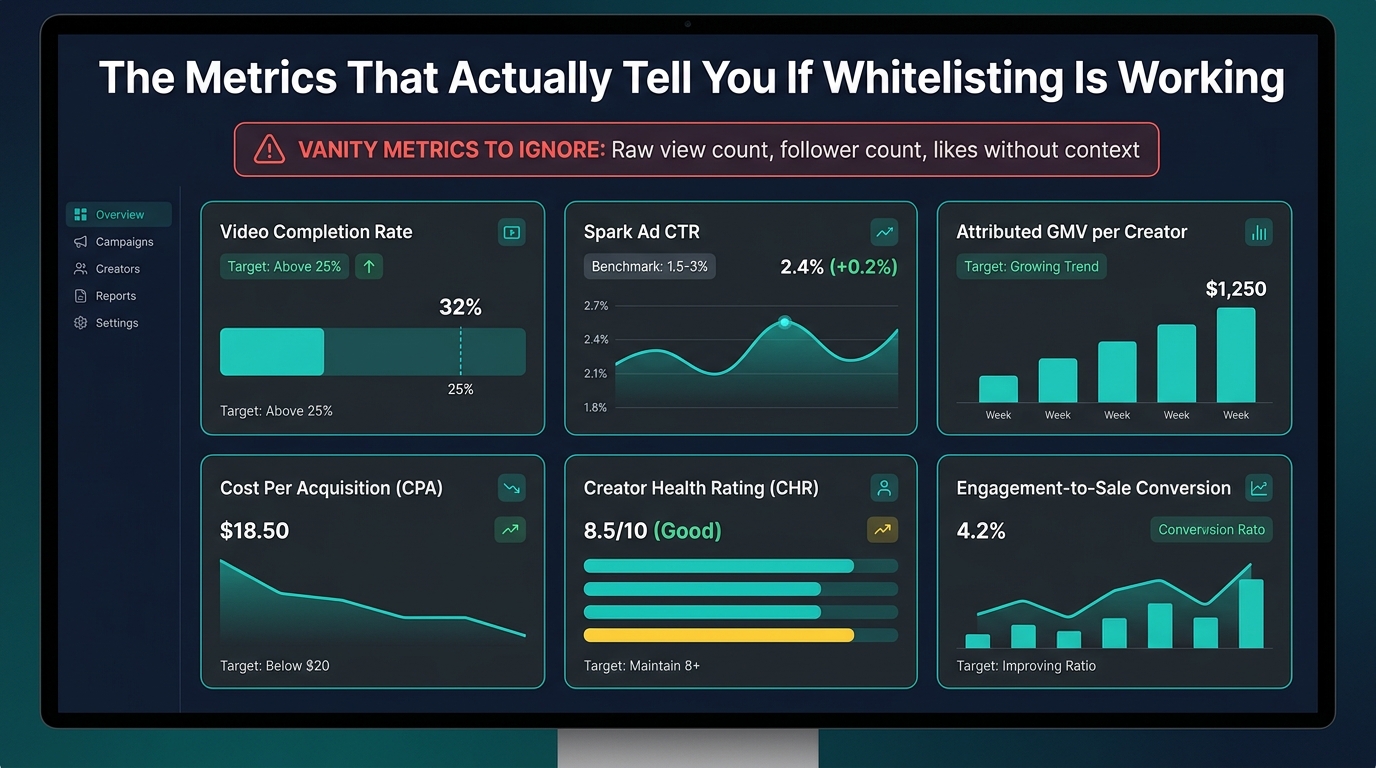
One of the most persistent problems in TikTok Shop creator programs is measuring the wrong things. Brands celebrate creator partnerships based on follower counts and raw view numbers while missing the metrics that actually predict whether the relationship is driving commerce outcomes. The policy changes of 2026 are an opportunity to reset what your measurement framework looks like — because the creators who survive the new account type requirements are the ones worth measuring properly.
Video Completion Rate on Product Content
Completion rate is the most underused proxy metric in TikTok Shop creator assessment. Not completion rate in general — completion rate specifically on product-related content. A creator who generates excellent completion rates on their lifestyle or entertainment content but poor completion rates on product videos is revealing something important: their audience is not in buying mode when they consume that creator’s content.
A general benchmark that practitioners reference: product demo videos with completion rates above 25% are strong candidates for Spark Ads amplification. Videos with completion rates below 15% are unlikely to convert efficiently regardless of how much paid budget is pushed behind them.
Spark Ad CTR Versus Organic Engagement Rate
Click-through rate on Spark Ads (the rate at which viewers click through to the product page or TikTok Shop) is a clean indicator of whether paid amplification of a creator’s post is actually driving consideration. The benchmark range cited by most TikTok Shop practitioners is 1.5–3% CTR for Spark Ads in commerce categories — with strong performers reaching above 3% and underperforming posts typically falling below 1%.
Importantly, a creator’s organic engagement rate is a poor predictor of Spark Ad CTR. High engagement on organic content reflects audience interest in the creator; high CTR on Spark Ads reflects intent to purchase the product being featured. A creator can have both, or either, or neither. Using organic engagement rate as a proxy for paid performance is one of the most common — and most costly — measurement mistakes in TikTok Shop creator programs.
Attributed GMV Per Creator, Not Total GMV
TikTok Shop’s attribution system allows brands to trace GMV back to specific creator posts and specific affiliate arrangements. This makes per-creator GMV attribution possible in a way that other affiliate platforms don’t always enable with the same granularity.
The right unit of analysis is GMV per creator, not total GMV from the creator program as a whole. Total GMV is a vanity metric at the program level — it tells you the program is working but not which creators are working, which means you can’t make intelligent decisions about Target Collaboration rate adjustments, Spark Ads budget allocation, or creator program investment prioritization.
Creator Health Rating as a Leading Indicator
The CHR is usually thought of as a compliance metric — a score that gates access rather than predicts performance. But CHR trends are also a leading indicator of creator reliability. A creator whose CHR has been declining over the past 90 days is more likely to experience affiliate permission restrictions in the next 90 days than a creator whose CHR is stable or improving. Monitoring CHR trends across your active creator roster and prioritizing Spark Ads investment on creators with stable or rising CHR reduces the probability of investing budget in creator relationships that are about to become ineligible.
Metrics to Deliberately Ignore
Equally important as knowing what to measure is knowing what not to measure in isolation:
- Raw follower count: Creator eligibility on TikTok Shop is not primarily a follower-count function. A micro-creator with 15,000 followers and a strong niche community often generates more GMV per view than a creator with 500,000 followers and a diffuse audience.
- Total views on whitelisted posts: Paid views on Spark Ads campaigns are partly a function of how much budget you’re putting behind them. High views with no corresponding CTR or GMV attribution is just spending money on impressions.
- Like-to-view ratio as a performance proxy: On TikTok, likes are cheap engagement. Shares are far more predictive of purchase intent than likes, and shares combined with product page visits are the strongest non-GMV indicator of a creator’s commerce effectiveness.
Building Creator Agreements That Survive Policy Changes
One operational lesson that the 2026 policy changes make unavoidable: creator agreements built around specific TikTok platform features or account types become fragile when TikTok changes those features or types. The brands that are least disrupted by the April–May 2026 changes are the ones whose creator agreements are structured around outcomes rather than mechanisms.
An agreement that says “Creator will maintain Marketing Creator account type and pass affiliate eligibility verification” is more robust than one that says “Creator will be onboarded as an Official Account affiliate.” The former survives account type changes; the latter doesn’t.
Practically, this means building the following into any new creator agreement structure:
- Creator responsibility to maintain eligibility under TikTok’s current creator policies, with periodic re-verification as required
- Brand right to pause or terminate Spark Ads authorization if the creator’s account type or CHR falls below a specified threshold
- Clear process for authorization code renewal, including timelines and point-of-contact responsibilities on both sides
- Content approval step before any Spark Ads activation, with reasonable turnaround expectations
- Right for both parties to adjust collaboration terms if TikTok’s platform policies materially change the economics or mechanics of the arrangement
This last clause — a policy-change flexibility clause — is the one most brands don’t include but most wish they had when a TikTok policy update lands without a platform-wide announcement.
Your 30-Day Action Plan
The 2026 whitelisting changes don’t require a complete rebuild of your TikTok Shop creator program. They require a specific, time-bounded audit and a set of process adjustments that can be completed in roughly 30 days if you’re organized about it. Here is a practical sequence:
Week One: The Account Type Audit
Pull your complete active creator roster — everyone in your Target Collaboration list and everyone you have active Spark Ads authorizations with. For each creator, identify: what account type are they currently operating under? Have they completed identity verification? Is their CHR currently in good standing? Flag any creator operating under an Official Account structure as an immediate action item, and any Marketing Creator account that hasn’t completed the new eligibility verification as a priority follow-up.
Week Two: Creator Communication
For every flagged creator, initiate a direct communication. Explain the account type change requirements clearly and without jargon. Provide a specific action item (typically: visit Creator Center, complete eligibility check, confirm account type and share results). Give a deadline. Make it easy for creators to ask questions. The goal is to bring your active roster into compliance with the new framework before any scheduled campaign activations are affected.
Week Three: Workflow and Documentation Update
Update your creator onboarding checklist to reflect the new account type taxonomy and eligibility requirements. Update your authorization management tracking system to include account type and CHR status fields for each creator. Review your authorization durations across active Spark Ads campaigns and align them with actual campaign timelines rather than defaulting to 365-day windows across the board.
Week Four: Measurement Baseline Reset
Pull 90-day performance data for your current creator roster using the metrics framework outlined above: completion rate on product content, Spark Ad CTR, attributed GMV per creator, and CHR trends. Identify your top-quartile performers and confirm they’re in compliance with the new account type requirements. Consider upgrading your Target Collaboration terms for top performers who have stayed in compliance — the disruption of the policy changes is a natural moment to re-evaluate commission structures and deepen relationships with creators who are demonstrating real value.
Conclusion: The Filter That Separates Serious Programs From Casual Ones
TikTok Shop’s creator whitelisting changes in 2026 are, at one level, an administrative complication. Official Accounts lose affiliate permissions. Marketing Creator accounts need eligibility checks. Authorization workflows need tightening. None of this is conceptually difficult.
At a deeper level, these changes are a filter. The creator permission architecture TikTok is building is one that rewards brands running structured, compliance-aware creator programs and creates friction for brands running informal, workaround-dependent operations. That’s not an accident. It reflects TikTok’s broader trajectory on Shop: moving the platform from a wide-open affiliate environment toward a more regulated, performance-accountable commerce ecosystem.
The brands that will perform best in that ecosystem are not necessarily the ones spending the most or the ones with the largest creator rosters. They’re the ones who understand the permission architecture they’re operating within, who vet and manage their creator relationships with operational discipline, and who measure outcomes rather than activity.
The policy changes that landed in April and May 2026 are a stress test of whether your creator program was built on solid foundations or convenient workarounds. Treat the next 30 days as an opportunity to find out — and to fix whatever the audit reveals before it costs you a campaign.
Actionable Checklist: Creator Whitelisting Compliance in 2026
- ✅ Audit all active creators for account type (Official, Marketing, Affiliate)
- ✅ Flag any Official Account creators with active affiliate relationships for immediate migration
- ✅ Verify Marketing Creator accounts against the new May 2026 eligibility criteria via Creator Center
- ✅ Check CHR standing for all creators in Target Collaboration arrangements
- ✅ Review active Spark Ads authorization durations and align with campaign timelines
- ✅ Implement a post-level content approval step before any Spark Ads activation
- ✅ Update creator onboarding checklist to reflect the new three-tier account taxonomy
- ✅ Set a quarterly CHR monitoring cadence for all active creators
- ✅ Shift performance measurement from follower/view metrics to completion rate, Spark CTR, and attributed GMV
- ✅ Add a policy-change flexibility clause to all new creator agreements