

Most paid search accounts are structurally dishonest. Not intentionally — the accounts are built by capable people, the platforms report the numbers faithfully, and the dashboards look healthy. But when you dig into how campaigns are actually segmented (or not segmented), the data you’re reading tells you almost nothing about how your spend is performing across different types of buyer intent.
Mixing branded, competitor, and generic keywords inside the same campaign isn’t just an organizational flaw. It’s a measurement failure. A branded keyword converting at 18% inflates the apparent conversion rate of your whole campaign. A generic keyword burning budget at $5.42 CPC drags down ROAS figures that were propped up by cheap branded clicks. The result is a blended number that masks what’s working, hides what isn’t, and makes it nearly impossible to bid intelligently.
In 2026, this problem is more acute than ever. Google’s AI bidding infrastructure is aggressively collapsing the boundaries between match types. Broad match is expanding into territory that used to belong to phrase and exact. Smart Bidding is optimizing across intent signals that span the entire branded-to-generic spectrum. And the cost of getting this wrong — mis-allocated budgets, missed incremental opportunities, inflated competitor spend — is measured in real money.
This article goes beyond the standard “run three separate campaigns” advice. We’ll look at the actual benchmark data for each campaign type in 2026, the incrementality evidence that’s reshaping how marketers think about branded spend, the precise economic trap built into competitor keyword targeting, and how to build a segmentation architecture that holds up even as AI continues to reshape what keyword control actually means.
The Three-Lane Framework: Understanding What Each Campaign Type Actually Does
Before getting into the mechanics, it’s worth being precise about what these three campaign types actually represent — because the common shorthand can obscure some critical distinctions.
Branded campaigns: demand capture, not demand creation
A branded campaign bids on searches that include your brand name, your product names, and close variants of both. The searcher already knows you exist. They’ve either encountered your brand elsewhere, they’re a returning customer, or someone recommended you. The critical implication: this campaign doesn’t create demand, it captures it. You didn’t earn this click through advertising — you earned it through everything that happened before the click: your product, your reputation, your organic presence, your PR.
This distinction matters enormously for how you measure performance. A branded campaign that shows a 15x ROAS isn’t necessarily a sign that advertising is working. It may simply be a sign that you have strong brand equity. The advertising is just making sure you collect what’s already yours — and preventing competitors from intercepting it.
Competitor campaigns: poaching with a price tag
A competitor campaign bids on searches that include a competitor’s brand name. The searcher is not looking for you — they’re looking for someone else. Your ad appears because you’ve paid to interrupt that journey. In theory, you can capture buyers who are comparison-shopping or who might be open to switching. In practice, the economics of this intent mismatch create a structural cost premium that many advertisers chronically underestimate.
The strategic role of competitor campaigns is narrower than most accounts treat it. It’s a market share offensive tool, most effective when (a) there’s genuine product superiority you can communicate in the window between click and landing page, and (b) the target competitor has a known weakness — price, features, service — that your landing page directly addresses.
Generic campaigns: the acquisition engine with the highest bill
Generic (or non-brand) campaigns bid on category-level and problem-level searches: “CRM software,” “running shoes for wide feet,” “email marketing platform for small business.” The searcher has intent but no brand preference. This is where new customers come from. It’s also where the highest CPCs live, where Quality Scores are hardest to maximize, and where the gap between click and conversion is widest. Generic campaigns are the acquisition engine — they just happen to be the most expensive part of the machine to run.
Understanding each campaign type through its functional role — not just its keyword composition — is the foundation of any rational segmentation strategy. Each type answers a different question and should be measured against a different standard.
Branded Campaigns: The Incrementality Problem Nobody Wants to Talk About
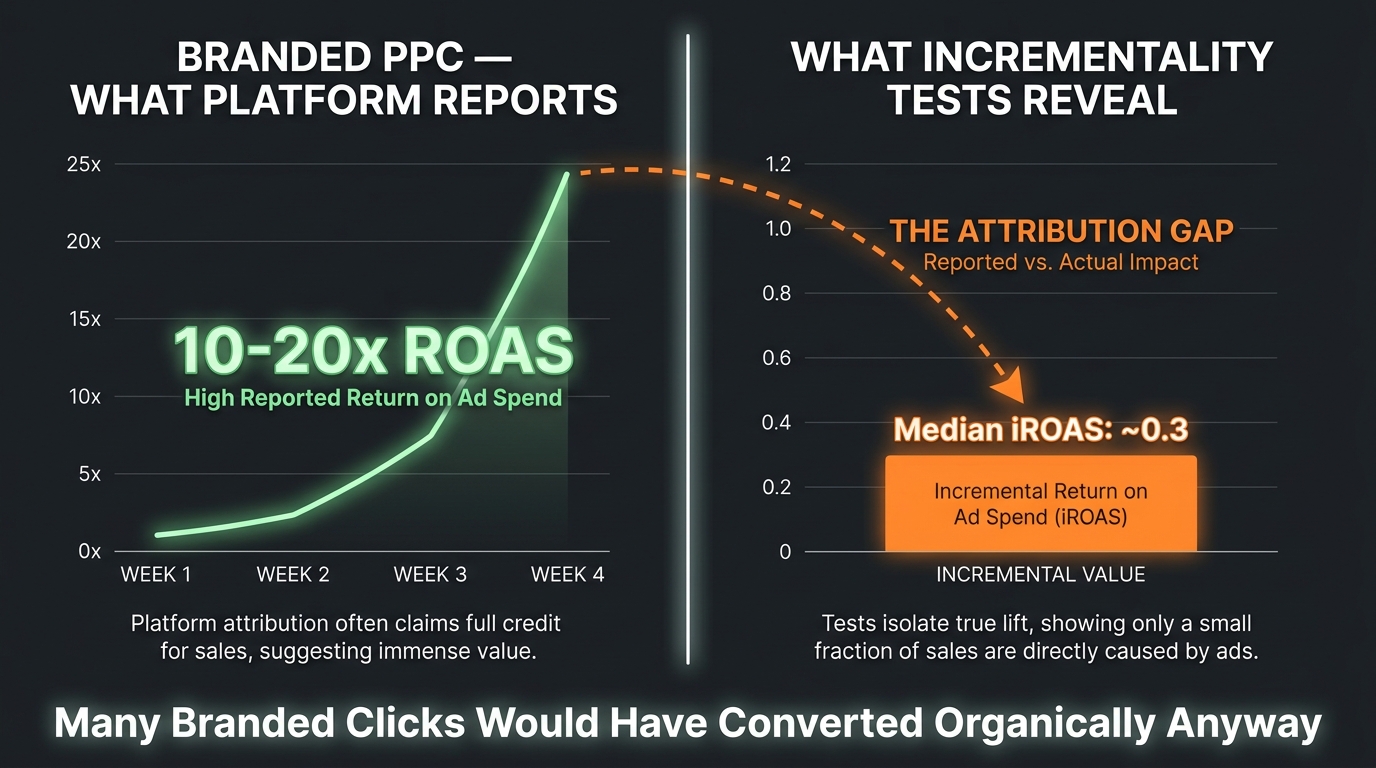
The branded campaign problem isn’t about performance — the numbers look great. The problem is that great-looking numbers can be almost entirely fictional from an incrementality standpoint.
What the data actually shows
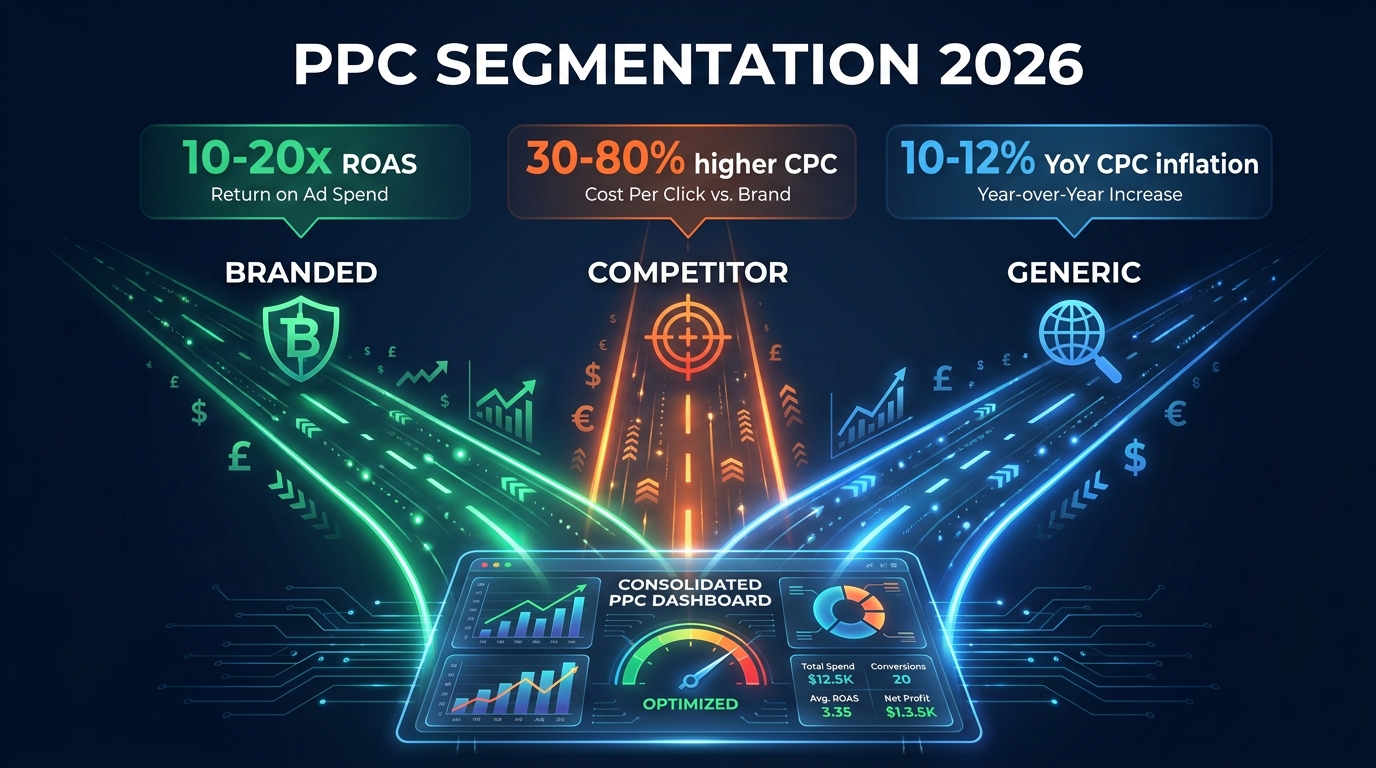
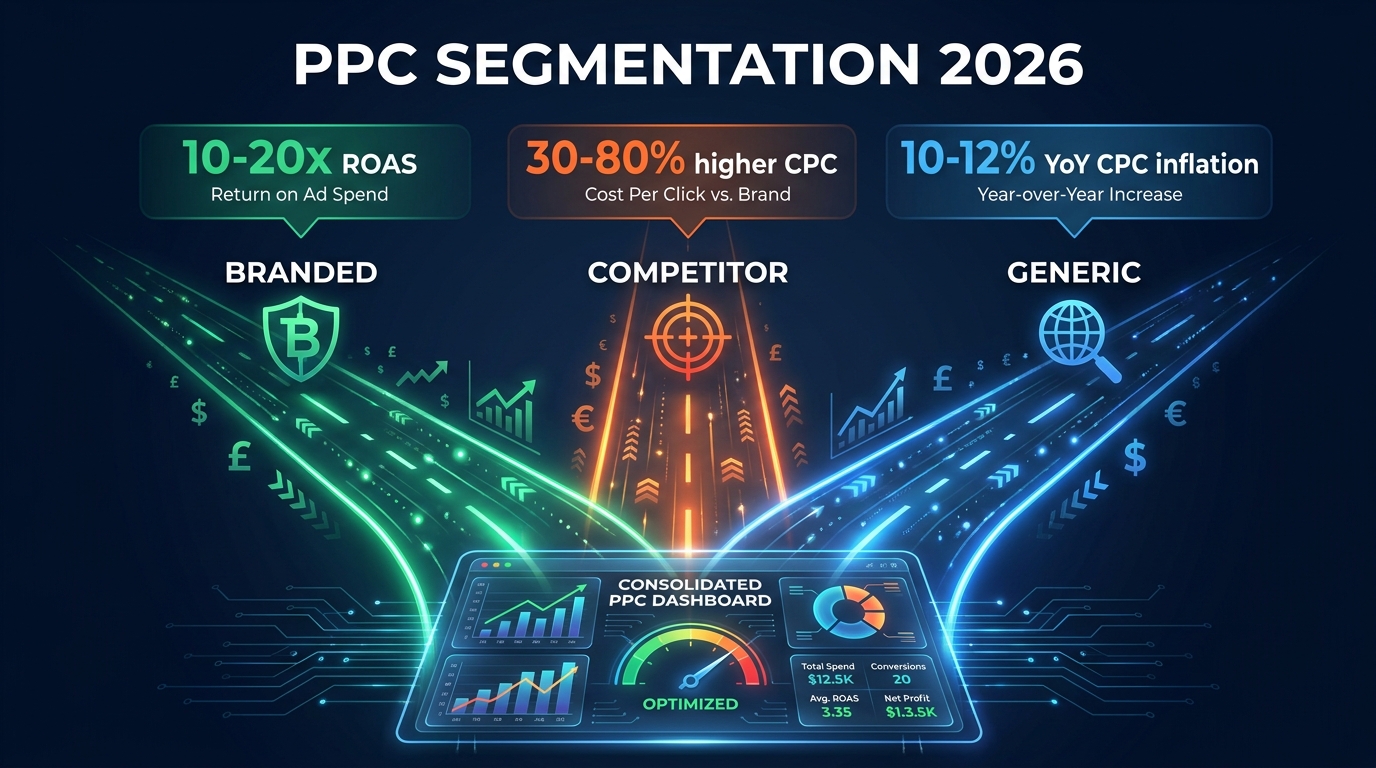
A 2026 causal lift meta-analysis across 225 DTC geo tests — one of the largest structured bodies of evidence on this question — found that branded search is a consistent “surprise underperformer” when measured on incremental ROAS (iROAS). The median iROAS across branded campaigns in this study was approximately 0.3. That number deserves unpacking: it means that for every dollar spent on branded PPC, only around 30 cents of revenue was genuinely incremental. The other 70 cents would have happened anyway — through organic search, direct traffic, or other channels — if the paid ad hadn’t been there.
Conversion rates on branded keywords typically run 12–20%, and ROAS figures of 10–20x are commonly reported across search accounts with healthy brand equity. These numbers are real. They accurately describe what happened when the ad was shown and clicked. They don’t describe what would have happened without the ad. Attribution systems — including Google’s data-driven attribution — have a structural tendency to give paid branded clicks credit for conversions that were already essentially guaranteed.
When branded PPC is genuinely worth the spend
This doesn’t mean branded campaigns are waste. There are three legitimate strategic cases for maintaining branded paid spend:
- Competitor defense: If competitors are actively bidding on your brand name (which most mid-market and enterprise brands face), pausing your branded campaign creates an opening for a competitor ad to appear above your organic result. The cost of ceding that position is real.
- Controlled messaging: Organic search results surface your homepage, your top-ranking pages, maybe a review site. Branded PPC gives you a headline, sitelinks, callouts, and a structured message that you control completely. For brands with reputation management needs, product launches, or promotional messaging, this control has value.
- Incremental lift in genuinely competitive SERPs: In categories where competitors have strong SEO, where your organic ranking isn’t position 1, or where AI-generated summaries are displacing traditional organic results, branded PPC captures traffic that might otherwise go elsewhere.
The right response: geo-holdout testing
The practical implication is that branded campaigns should not be evaluated on reported ROAS. They should be evaluated through structured incrementality testing — specifically geo-holdout experiments where branded ads are paused in a matched test geography and organic-plus-direct traffic is compared to the control region. This is the only measurement approach that separates actual paid lift from organic demand that would have arrived regardless.
Running these tests quarterly is now considered standard practice in sophisticated paid search programs. The results consistently surprise teams that have been optimizing branded campaigns based on platform-reported conversions. Many accounts discover their branded spend can be reduced by 30–50% with minimal impact on actual revenue — and that the freed budget generates far more incremental return when shifted to generic acquisition campaigns.
Key takeaway: Treat your branded campaign as a defensive infrastructure cost, not a performance channel. Fund it sufficiently to protect your SERP position. Do not optimize it for growth or use its reported ROAS to justify increased budget.
Competitor Campaigns: The 30–80% CPC Premium and When It’s Worth Paying
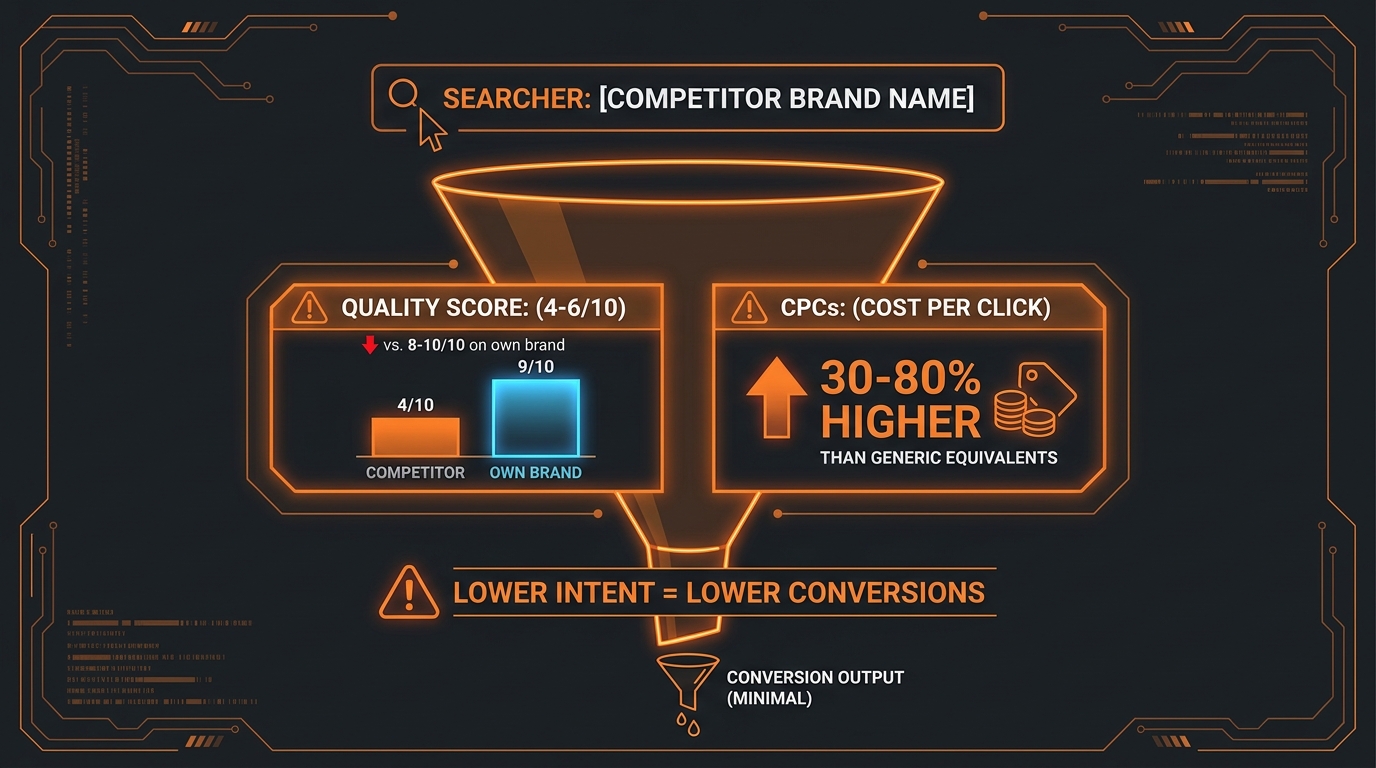
Competitor keyword campaigns are simultaneously one of the most seductive and most dangerous tactics in PPC. The logic is intuitive: find people actively searching for an alternative to you, intercept them, and convert them. In practice, the economics of competitor targeting create a structural disadvantage that most advertisers never fully account for.
The Quality Score gap and what it costs you
Google Ads Quality Score on competitor-branded keywords typically sits at 4–6 out of 10. On your own branded terms, it’s usually 8–10. This gap isn’t arbitrary — it reflects three structural realities:
- Expected CTR is lower — searchers looking for Brand X are less likely to click an ad for Brand Y.
- Ad relevance is penalized — Google’s trademark policies prohibit using a competitor’s brand name in your ad copy, which means your ad is inherently less relevant to the search query it’s responding to.
- Landing page experience scores lower — your landing page naturally optimizes for your own messaging, not for a user who just searched for a competitor.
The cost of this Quality Score penalty is direct and predictable: CPCs on competitor keywords run 30–80% higher than comparable non-branded keyword targeting for the same traffic volume. If you’re paying $3 per click on a generic category keyword, expect to pay $4–$5.40 on a competitor term targeting the same category intent.
The conversion rate mismatch
Beyond the CPC premium, competitor campaigns carry a structural conversion rate disadvantage. A searcher who types “[Competitor Brand] pricing” or “[Competitor Brand] reviews” is expressing intent toward that brand, not yours. Converting this person requires not only that your product is better, but that your ad and landing page successfully redirect their attention mid-journey — a fundamentally harder sell than intercepting someone at the beginning of an open-minded search.
Realistic conversion rates on competitor campaigns run 3–6%, compared to 8–12% for generic non-brand campaigns and 12–20% for branded campaigns. Combined with the CPC premium, this makes competitor traffic among the most expensive per-conversion traffic in a well-segmented account.
The three scenarios where competitor campaigns actually work
Despite the structural disadvantages, competitor campaigns can deliver positive ROI in specific, well-defined scenarios:
- Direct feature or price superiority: When you have a concrete, demonstrable advantage (lower price, specific feature the competitor lacks, better reviews on a key dimension), a comparison-focused landing page can convert competitor-intent traffic at rates that justify the CPC premium. The landing page must do the heavy lifting.
- Competitor experiencing public problems: Competitor outages, policy changes, price increases, or reputation incidents create a window when their customers are actively looking for alternatives. Temporarily scaling competitor campaigns during these events — with messaging that directly addresses the competitor’s known issue — can generate strong returns.
- High-LTV, low-competition markets: In B2B SaaS, enterprise software, or other high-LTV categories where a single converted customer is worth tens of thousands of dollars, the economics of a 5% conversion rate and a $10 CPC can still be strongly positive. The math must be modeled explicitly using LTV, not single-transaction ROAS.
Google’s trademark rules and where the line is
You can bid on competitor brand names as keywords. You cannot use competitor brand names in your ad headlines, descriptions, or display URLs without the trademark holder’s authorization — and authorization is rarely granted. This constraint isn’t merely a legal risk; it’s a practical limitation that further depresses Quality Scores and makes competitor campaigns more expensive to run than they’d otherwise need to be.
Key takeaway: Treat competitor campaigns as a controlled experiment with a strict budget cap — typically 3–10% of search budget. Test specific competitor pairs with targeted landing pages. Measure on LTV-adjusted CPA, not ROAS. Kill campaigns that don’t demonstrate positive ROI within a defined testing window.
Generic Campaigns: The Rising Cost of Discovery
Generic non-brand campaigns are where the actual work of customer acquisition happens, and in 2026, that work is getting meaningfully more expensive. Cross-industry Google Search CPCs for generic intent now average $2.69–$5.42, depending on vertical, with year-over-year inflation running at 10–12%. In high-competition verticals — legal, financial services, SaaS, healthcare — generic CPCs are considerably higher.
The real CPC picture in 2026
The $5.42 average CPC for Google Search includes a broad mix of industries and intents. When you narrow to specific high-intent category keywords in competitive verticals, the picture changes significantly:
- Financial services: Generic CPCs regularly exceed $15–$40 for high-value intent keywords.
- SaaS and B2B software: $10–$25 for category-level searches.
- E-commerce and retail: $1.50–$4 for most categories, with branded product categories at the higher end.
- Healthcare and legal: Among the highest CPCs in paid search, often $20–$80+ for competitive queries.
Paid customer acquisition cost (CAC) across generic search campaigns now commonly falls in the $55–$70+ range for cross-industry aggregates, with higher CAC in B2B ($100–$300+) and lower CAC in high-volume e-commerce ($20–$50 for transactional categories). With CAC rising at mid-to-high single digits annually, the pressure to get more from each generic campaign dollar is intensifying.
Why generic campaigns deserve the majority of budget — and the most attention
Despite the cost, generic campaigns serve a function that no other campaign type can replicate: they reach customers who don’t know your brand yet. This is the only campaign type that genuinely grows your addressable market. Branded campaigns collect customers who already know you. Competitor campaigns try to poach from competitors. Generic campaigns build the pipeline that feeds every downstream conversion, retention, and LTV number in the business.
The appropriate budget weighting reflects this: most mature, growth-oriented accounts allocate 60–80% of search budget to generic non-brand campaigns. The remainder is split between branded defense and competitor testing. Accounts that over-index on branded spend are effectively harvesting existing demand while underinvesting in the future customer pipeline.
Making generic campaigns work in a high-CPC environment
The strategic response to rising generic CPCs isn’t to spend less on generic campaigns — it’s to make each click work harder. Practically, this means:
- Tighter ad group thematic structure: Group keywords by specific problem or use case, not just by broad category. The closer the alignment between keyword, ad copy, and landing page, the better your Quality Score and the lower your effective CPC.
- Conversion rate investment: The cheapest way to lower CPA in a generic campaign is to improve post-click conversion. A 2% improvement in landing page CVR has the same effect on CPA as a 2% reduction in CPC — without requiring any bidding adjustment.
- Audience layering: First-party data signals (CRM lists, website visitor segments, purchase intent audiences) layered onto generic campaigns let you bid more aggressively for higher-probability converters within the generic traffic pool.
- Negative keyword rigor: In generic campaigns, irrelevant queries are a direct tax on every relevant click. Weekly search term reviews and structured negative keyword management consistently reduce wasted spend by 15–25% in accounts that implement them systematically.
Budget Allocation: Data-Driven Splits That Don’t Lie
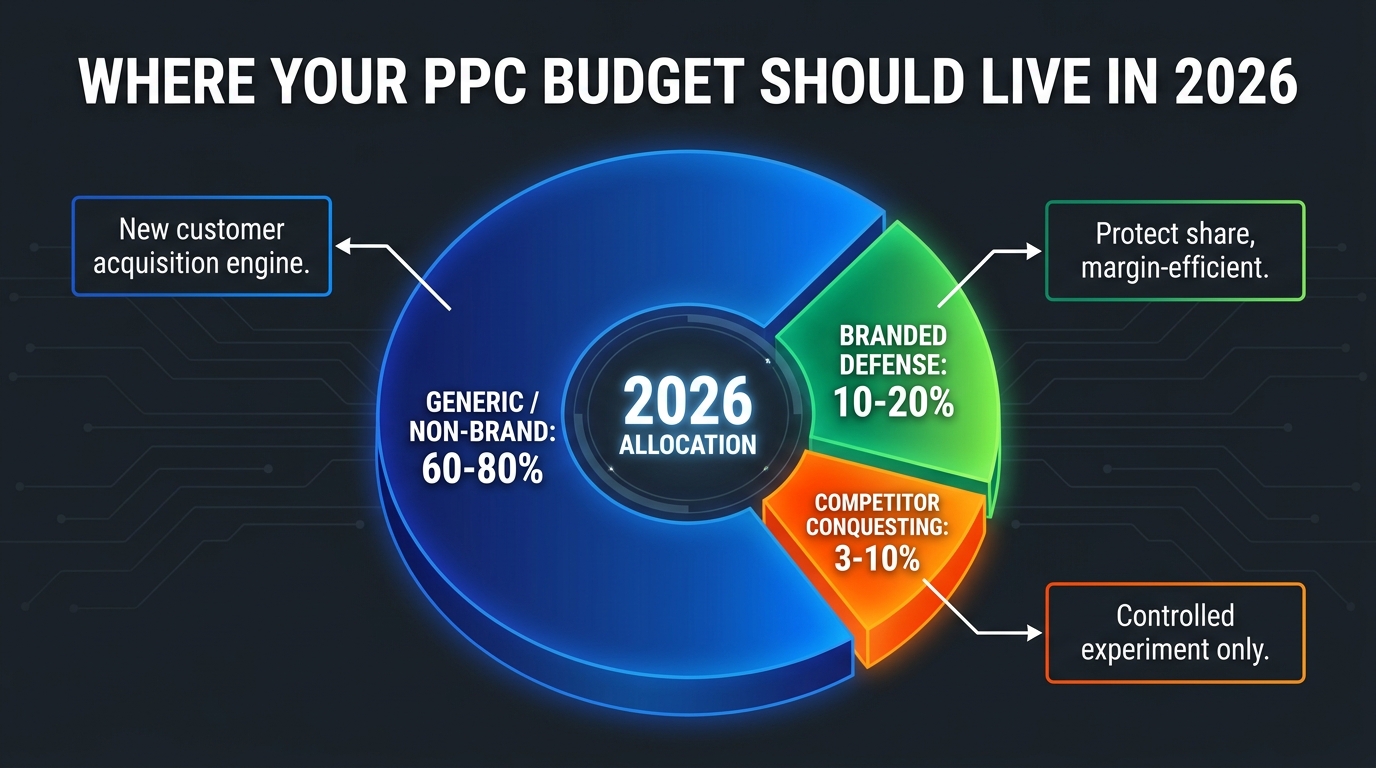
Budget allocation across branded, competitor, and generic campaigns is one of the most consequential decisions in a PPC account, and one of the most poorly documented. Most accounts inherit their budget splits from historical convention rather than strategic analysis. The recommended framework for 2026 reflects both current benchmark data and the underlying strategic role of each campaign type.
The recommended starting point
Current data-backed frameworks across search and retail media suggest the following starting allocation for a mature brand in a competitive market:
- Generic / non-brand: 60–80% of search budget
- Branded defense: 10–20% of search budget
- Competitor targeting: 3–10% of search budget
These are directional ranges, not fixed targets. A brand with strong organic search dominance that passes incrementality testing on branded campaigns might appropriately allocate just 5–8% to branded spend. A brand facing aggressive competitor bidding on its brand terms might need to increase branded defense to 25–30%. A SaaS company in a two-player market where competitor conquesting is demonstrably ROI-positive might justify 15% in competitor campaigns.
How business stage should shift the split
Brand maturity is a critical modifier. Early-stage brands (pre-$1M ARR or pre-established brand recognition) should heavily weight generic campaigns because branded search volume is minimal and there are few competitors bidding on their brand name. As the brand matures and brand search volume grows, the relative allocation to branded defense becomes more meaningful — and so does the incrementality testing requirement.
Growth-mode businesses should weight toward generic acquisition at the expense of margin efficiency. Profit-mode businesses can reduce generic investment and lean into branded defense, where ROAS is highest and acquisition costs are lowest — but only after confirming through incrementality testing that branded spend is generating actual lift.
The mistake most accounts make
The most common budget allocation error is allowing branded campaigns to absorb increasing budget share over time simply because their reported performance looks strong. As a brand grows, branded search volume grows with it. Without deliberate budget management, branded campaigns — with their artificially elevated ROAS figures — attract more spend through automated bidding, while generic campaigns are quietly starved of the budget they need to drive real acquisition growth.
This dynamic produces an account that looks increasingly healthy on a blended ROAS basis while becoming progressively less effective at generating new customers. Regular budget reviews, anchored to incrementality data rather than platform-reported ROAS, are the corrective mechanism.
Negative Keywords: The Structural Backbone That Makes Segmentation Work
Campaign segmentation without a robust negative keyword architecture is theater. You can create separate branded, competitor, and generic campaigns, label them carefully, and assign them distinct budgets — and then watch Google’s matching algorithms quietly blend them back together as broad match expands and AI bidding optimizes across intent signals.
The routing function of negatives
Negative keywords in a segmented account serve a routing function: they ensure that each query flows to the campaign best equipped to handle it, rather than to whichever campaign Google’s algorithm decides is most likely to generate a conversion. Without this routing layer, AI bidding will naturally push branded queries into generic campaigns (because branded queries convert well and improve the campaign’s measured performance) and gradually erode the clean signal separation that makes segmentation valuable.
The core negative structure for a three-way segmentation setup looks like this:
- Generic campaign negatives: Add all brand terms (including misspellings and variants) as exact and phrase match negatives. Add all major competitor brand names as negatives. This campaign should capture only category and problem-level intent.
- Branded campaign negatives: Add all generic category terms as negatives. This prevents the branded campaign from expanding into non-brand territory as broad match evolves.
- Competitor campaign negatives: Add your own brand terms and all generic category terms. This campaign should respond only to queries that explicitly include a competitor brand name.
Shared lists and the maintenance cadence
Managing negatives at the account level through shared lists is substantially more efficient than maintaining campaign-level negatives individually. A shared “Brand Terms” negative list applied to generic and competitor campaigns, updated as brand naming evolves, prevents the most common form of campaign bleed. A shared “Competitor Names” negative list applied to branded and generic campaigns keeps competitor targeting isolated.
The maintenance cadence matters. Weekly search term reports should be reviewed for any queries that appear in the wrong campaign type. Monthly, the negative lists should be audited for completeness and updated to reflect new product launches, competitor rebrandings, or emerging query patterns. Quarterly, the entire negative architecture should be reviewed against the current campaign structure to catch any systemic gaps.
The broad match problem in 2026
Google’s accelerating push toward broad match as the default match type creates specific challenges for segmentation. Broad match in 2026 interprets queries based on intent signals, not just keyword composition — meaning a broad match keyword for a generic category term can trigger on queries that include competitor names or brand terms, if the algorithm decides the intent is aligned. Negative keyword lists are the primary defense against this behavior, and their importance has increased as broad match has expanded.
Key takeaway: Build your negative keyword architecture before launching segmented campaigns, not after. Use shared lists at the account level. Review search terms weekly. Treat negatives as a live system that requires ongoing maintenance, not a one-time setup task.
Quality Score Penalties and the Competitor Bidding Trap
Quality Score deserves its own section when discussing competitor campaigns, because the penalty it imposes on competitor bidding is one of the most under-discussed structural costs in paid search. Most advertisers understand in principle that competitor terms have lower Quality Scores. Fewer understand the compounding economic impact of that reality.
How the penalty compounds
Quality Score (QS) in Google Ads is composed of three factors: expected CTR, ad relevance, and landing page experience. On competitor-branded keywords, all three factors are structurally disadvantaged:
- Expected CTR: Historical data shows that ads for Brand Y appearing on Brand X searches have lower click-through rates. The searcher wanted Brand X; they’re less likely to click Brand Y. Google registers this in QS.
- Ad relevance: Because Google’s trademark policy prevents you from using the competitor’s brand name in your ad copy, your ad text cannot mirror the search query. The mismatch reduces relevance scores.
- Landing page experience: Your landing page is optimized for your brand, not for a user who just searched for a competitor. Relevance signals between the search query and the destination URL are weaker.
A competitor campaign QS of 4–6 versus a branded campaign QS of 8–10 translates directly into Ad Rank. Ad Rank determines both ad position and the CPC you actually pay. The formula means that advertisers with lower QS must pay disproportionately more to achieve the same position as a higher-QS competitor. In practice, competitor campaign economics are often 40–60% worse per conversion than the raw CPC premium suggests, once the QS effect on position and actual CPC paid is fully accounted for.
The trap that catches most accounts
Competitor campaigns tend to look more attractive than they are because they’re typically evaluated on surface-level metrics: clicks, impressions, even conversion volume. The trap is that each of these metrics costs significantly more than equivalent volume from generic campaigns — but the cost premium isn’t obvious unless you’re comparing on a per-conversion or cost-per-acquisition basis with the segment properly isolated.
Accounts that run competitor campaigns inside mixed campaigns — without clean segmentation — almost never catch this. The competitor budget blends with generic budget, the blended CPA looks acceptable, and the competitor traffic is subsidized by the more efficient generic conversions around it. Proper segmentation surfaces the true economics and often reveals that competitor campaigns should be significantly scaled back, restructured with better landing pages, or eliminated entirely.
AI Bidding and Broad Match: How Automation Is Rewriting the Rules of Segmentation

The 2026 PPC landscape is fundamentally different from 2020 in one critical dimension: the locus of control has shifted. Keyword lists, match types, and bid adjustments used to be the primary tools of campaign management. They still matter — but Google’s AI infrastructure now makes decisions that used to require human judgment, often faster and at a scale that human management can’t match.
What Google’s AI actually does to your segmentation
Google now explicitly describes keywords as “thematic signals” rather than targeting constraints. Broad match keywords, combined with Smart Bidding and Performance Max infrastructure, are interpreted through a lens of user intent that the algorithm constructs from query patterns, audience signals, page context, and conversion history. This means a broad match keyword for “project management software” might trigger on queries like “[Competitor] alternative,” “[Your Brand] pricing,” or “best project management tools for remote teams” — spanning all three campaign intent categories in a single keyword.
The practical implication: without explicit negative keyword architecture, AI bidding will blur the boundaries between your branded, competitor, and generic campaigns. It won’t do this maliciously — it does it because blurring those lines often improves the algorithm’s conversion volume metric. But it destroys the measurement integrity that makes segmentation valuable in the first place.
AI Max and the consolidation pressure
Google’s AI Max campaign type, which became a central feature of account management in 2025 and has continued expanding into 2026, adds another dimension to this challenge. AI Max extends reach beyond traditional keyword matching using AI-generated expansions, and it operates across search and display inventory in ways that further complicate intent-based segmentation. Advertisers using AI Max alongside traditional search campaigns need explicit exclusion rules and asset separation to maintain meaningful category boundaries.
What segmentation means in an AI-driven environment
The value proposition of segmentation has shifted in 2026. It used to be about controlling where your ads appeared. Now it’s primarily about controlling what signals the algorithm receives and how performance is measured.
A properly segmented account in 2026 serves three functions that mixed campaigns cannot:
- Clean performance data by intent: You can only set rational ROAS targets, bid adjustments, and budget priorities if you know what type of intent is driving each conversion. Mixed campaigns produce blended metrics that make rational optimization impossible.
- Appropriate bidding strategy per intent: Branded campaigns should bid to protect position, not to maximize conversions. Generic campaigns should optimize for target CPA or target ROAS tied to acquisition economics. Competitor campaigns should run with strict budget caps and CPA floors. These objectives require separate campaigns.
- Negative enforcement: The only mechanism to prevent AI bidding from collapsing your intent categories is a maintained negative keyword architecture — and that architecture requires clearly defined campaign segments to build against.
The experts consistently finding performance gains from consolidation are consolidating within intent categories — not collapsing across them. Fewer campaigns within the generic category, consolidated under one budget and Smart Bidding strategy, can improve AI performance. Merging generic and branded into a single campaign in the name of “consolidation” destroys signal quality and measurement integrity simultaneously.
Measurement Frameworks: Different Campaigns Need Different KPIs
One of the most consequential mistakes in managing segmented campaigns is holding all three types to the same success metric. ROAS or ACoS applied uniformly across branded, competitor, and generic campaigns will systematically over-fund branded spend, under-fund generic acquisition, and produce misleading competitor campaign assessments.
Branded campaign KPIs
The primary success metric for branded campaigns should be impression share — specifically, the proportion of brand-name searches where your ad appears. The goal is to ensure you’re not losing branded search real estate to competitors. Secondary metrics include branded keyword cost per conversion (as a benchmark for competitive pressure), and — critically — incrementality-adjusted ROAS derived from geo holdout testing.
What branded campaigns should not be measured on: blended ROAS, conversion volume, or any metric that will be artificially inflated by capturing demand that organic search would have delivered anyway.
Competitor campaign KPIs
Competitor campaigns should be evaluated on LTV-adjusted CPA, not ROAS. Because competitor-intent traffic has structurally lower conversion rates, the math only works when the value of a converted customer is high enough to offset the cost premium. A B2B SaaS business with $15,000 LTV per customer can absorb a $500 competitor campaign CPA profitably. An e-commerce brand with a $60 average order value cannot.
Secondary metrics worth tracking in competitor campaigns: competitive impression share (how often your ad appears when competitors are searched), and conversion rate specifically from competitor-keyword traffic. The latter, if tracked over time, will show whether your landing pages are successfully addressing competitor-intent buyers or whether you’re generating expensive, low-quality clicks.
Generic campaign KPIs
Generic campaigns should be held to target CPA or target ROAS tied explicitly to new customer acquisition economics — not blended account ROAS. The question this campaign answers is: “What does it cost us to acquire a new customer through paid search?” That answer should be benchmarked against LTV, not against the efficient numbers branded campaigns produce.
Additional generic campaign metrics worth building into regular reporting: new-to-brand conversion rate (where platform data supports it), share of voice on key category terms, and Quality Score trends across ad groups (as a proxy for ad relevance and landing page quality).
Building a three-layer dashboard
Practically, this means constructing a reporting layer that surfaces different KPIs for each campaign type in a single view. The simplest implementation: a shared dashboard with one row per campaign type, with the relevant KPI columns for that type populated, and the irrelevant columns greyed out or excluded. This prevents the habitual error of comparing branded ROAS to generic ROAS and drawing conclusions about relative performance — a comparison that’s structurally meaningless.
Amazon PPC: Branded vs. Competitor vs. Generic ACoS Benchmarks
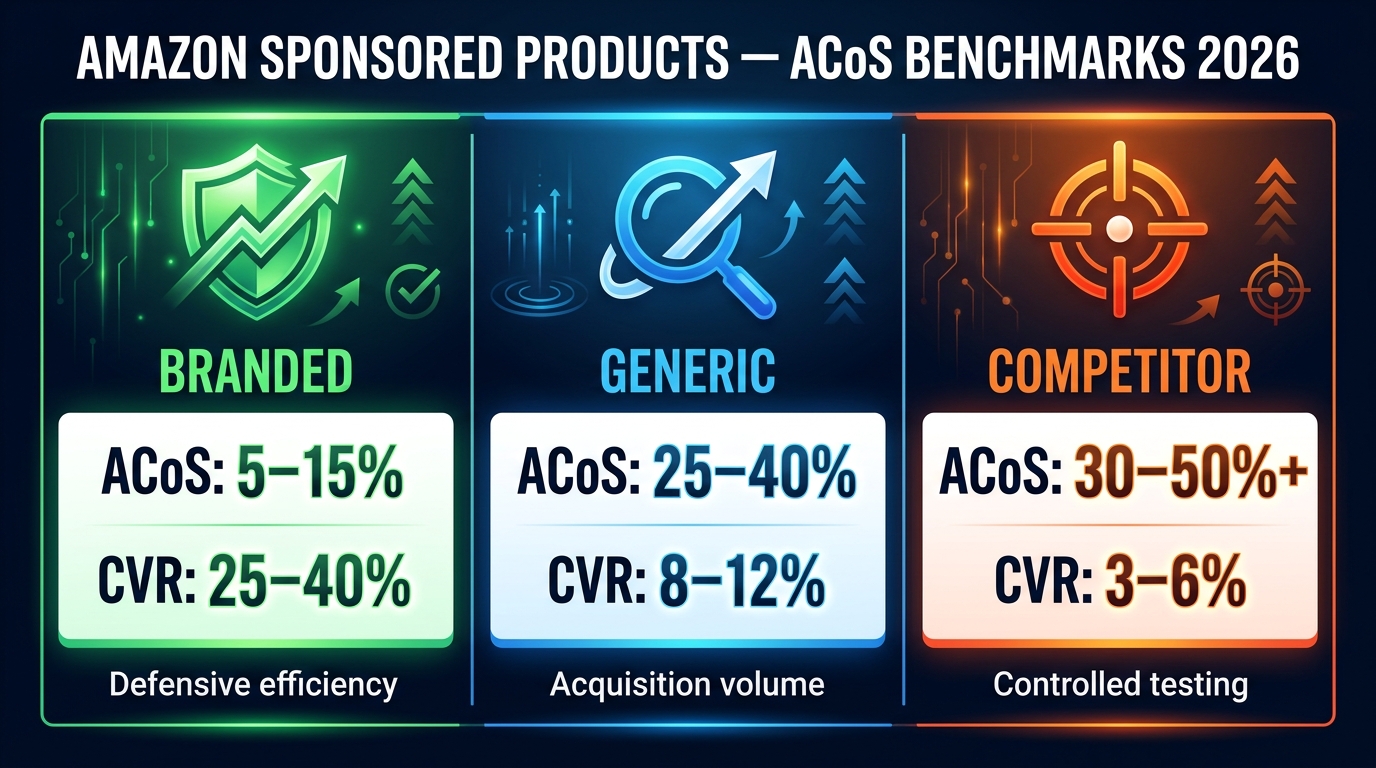
The branded vs. competitor vs. generic framework applies with equal force to Amazon Sponsored Products, though the platform mechanics and benchmark numbers differ from Google Search. Amazon’s closed marketplace ecosystem creates some specific dynamics that make clean segmentation even more important — and more valuable — than in open-web paid search.
ACoS benchmarks by campaign type (Sponsored Products, 2026)
Across mature Amazon Sponsored Products accounts in 2026, the following ACoS ranges represent consistent cross-category benchmarks:
- Branded campaigns: 5–15% ACoS. Conversion rates typically 25–40%, driven by buyers who are already familiar with and searching for your specific product. Low bid costs, high intent, efficient conversion. The primary strategic function is defensive — ensuring your ASIN appears when your brand is searched, rather than a competitor’s sponsored result.
- Generic / category campaigns: 25–40% ACoS. Conversion rates typically 8–12%. These campaigns target category searches and product-type keywords where the buyer is in discovery mode. Higher bids, lower conversion efficiency, but the primary source of new-to-brand customer acquisition on Amazon.
- Competitor conquesting campaigns: 30–50%+ ACoS. Conversion rates typically 3–6%. Targeting competitor ASINs or competitor brand names, these campaigns face the same structural challenges as Google competitor campaigns: the buyer wanted something else, and conversion requires redirecting that intent. ACoS at 30–50% is often above target, which is why competitor campaigns on Amazon are typically run with strict budget limits and evaluated on whether the acquired customers demonstrate higher LTV than the average generic-campaign acquisition.
The Amazon-specific complication: ASIN-level targeting
Amazon’s product targeting capabilities add a dimension that doesn’t exist in Google paid search: you can target specific competitor ASINs directly, appearing on their product detail pages. This creates a more granular form of competitor targeting than keyword-based campaigns alone. ASIN-level targeting often produces lower ACoS than brand-name keyword competitor campaigns because the intent signal is more specific — the buyer is actively evaluating a specific competitor product — and the landing page (your ASIN) is optimized for comparison buying behavior.
Best practice for Amazon competitor segmentation in 2026 is to run keyword-based competitor campaigns and ASIN-level product targeting campaigns separately, with distinct budgets, distinct ACoS targets, and separate performance reporting. The economics of these two tactics differ enough that blending them into a single “competitor” bucket masks meaningful performance differences.
Dayparting and campaign timing on Amazon
Amazon’s Sponsored Products platform doesn’t natively support dayparting in the same way Google Ads does, but campaign-level bid adjustments and budget scheduling can approximate the effect. For segmented campaigns, the most useful application is protecting branded campaign budgets from depleting early in the day — ensuring that brand defense is always-on — while allowing generic campaigns more budget flexibility during peak shopping windows. This is a structural advantage of maintaining separate campaigns rather than running a unified mixed campaign where budget competition between intent types is unmanaged.
Building a Segmentation Architecture That Scales
The practical challenge most PPC managers face isn’t understanding the theory of segmentation — it’s building and maintaining a segmented structure that holds up as the account scales, as new products launch, as competitors evolve, and as platform algorithms continue to shift the ground beneath them.
The foundational checklist
A segmentation architecture ready for 2026 includes the following components at minimum:
- Three structurally separate campaign types — branded, competitor, and generic — with distinct budgets, bid strategies, and performance targets.
- Account-level shared negative keyword lists — a Brand Terms list applied to competitor and generic campaigns; a Competitor Names list applied to branded and generic campaigns; a Generic Category Terms list applied to branded and competitor campaigns.
- Incrementality testing protocol — a quarterly geo-holdout test plan for branded campaigns, with documented methodology and historical results.
- Segmented reporting dashboard — with campaign-type-specific KPIs, not a blended ROAS view across all campaigns.
- Budget allocation review cadence — monthly review of the branded/competitor/generic split against current performance data and business objectives.
- Search term review cadence — weekly review to catch query bleed between campaign types and add necessary negatives.
What to do when the account grows
As product catalogs expand and account complexity increases, the simple three-campaign structure breaks down. A brand with 50 product lines can’t run a single generic campaign effectively — the keyword themes and landing page relevance requirements are too varied. The scaling approach that maintains segmentation integrity is to replicate the three-type structure at the product line or category level: a branded campaign, a competitor campaign, and a generic campaign per meaningful product group, each with its own budget and targets.
This approach multiplies campaign count quickly. The management overhead is real. But the alternative — consolidating diverse product categories into a single generic campaign — produces exactly the signal quality problem that makes AI bidding less effective, not more. Google’s AI works best with clean, coherent signals within a campaign. A generic campaign mixing running shoes, hiking boots, and athletic socks generates conflicting signals that degrade Smart Bidding performance across all three categories.
Where to start if your account is currently unsegmented
If you’re inheriting or rebuilding an account that currently runs branded, competitor, and generic keywords inside a small number of mixed campaigns, the migration path is a phased one:
- Phase 1: Extract branded keywords into a dedicated campaign immediately. This is the lowest-risk move and immediately improves measurement quality. Add brand terms as negatives to remaining campaigns.
- Phase 2: Isolate competitor keywords into a dedicated campaign. Apply the budget cap and CPA measurement framework. Add competitor names as negatives to branded and generic campaigns.
- Phase 3: Audit the remaining generic campaign(s) for internal coherence. Break into product or category groups if the theme range is too broad for Quality Score optimization.
- Phase 4: Build the negative keyword shared lists, set up the segmented reporting dashboard, and schedule the first incrementality test on branded campaigns.
This sequence takes 4–8 weeks to implement properly in a mid-sized account. The initial impact is often a temporary dip in reported performance as blended metrics are replaced by intent-specific ones — which is disorienting but actually reflects a gain in measurement accuracy, not a deterioration in actual performance.
Conclusion: Why Segmentation Is the Last Durable Advantage in Paid Search
Google and Amazon are systematically taking away the tactical levers that used to define PPC management. Exact match doesn’t mean what it used to. Bid adjustments are increasingly overridden by Smart Bidding. Ad creative is being generated and tested by AI. The levers that remain in human hands are structural ones: campaign architecture, budget allocation, measurement design, and signal quality.
Segmenting branded, competitor, and generic campaigns isn’t just good housekeeping. In 2026, it’s one of the few structural decisions that AI bidding cannot override. It’s how you ensure the algorithm receives coherent, intent-specific signals to optimize against. It’s how you catch the incrementality problem in branded campaigns before it quietly drains budget that should be going to acquisition. It’s how you identify when competitor campaigns are generating expensive noise rather than profitable conversions. It’s how you protect the measurement integrity that makes every other optimization decision in the account meaningful.
The brands that perform consistently well in paid search in 2026 aren’t the ones with the most sophisticated bidding strategies. They’re the ones who’ve built clean, structurally sound campaign architectures that give AI systems what they need to do their job well — and that produce measurement data clear enough for humans to make rational decisions on top of it.
Actionable takeaways
- Never evaluate branded campaigns on platform-reported ROAS. Run geo holdout incrementality tests quarterly. Let the data, not the dashboard, determine branded budget levels.
- Cap competitor campaigns at 3–10% of search budget unless you have specific evidence — LTV-adjusted CPA data — that the economics justify higher investment.
- Weight 60–80% of search budget to generic non-brand campaigns. This is where new customers come from. Protect it from being quietly consumed by efficient-looking branded spend.
- Build your negative keyword architecture before launching segmented campaigns, not after. The campaigns mean nothing without the routing layer.
- Use different KPIs for different campaign types: impression share for branded, LTV-adjusted CPA for competitor, target CPA or new-customer ROAS for generic.
- Review search terms weekly. AI bidding expands match scope constantly. The queries showing up in your generic campaign next Monday may include branded and competitor terms that need immediate exclusion.
- On Amazon, separate keyword-based competitor campaigns from ASIN-level product targeting. The economics differ enough to warrant distinct budgets and distinct ACoS targets.
The best segmentation architecture is one that’s built with deliberate intent, maintained with consistent discipline, and evaluated with metrics calibrated to the actual job each campaign type is doing. Get that right, and everything else in the account — bidding, creative, budget pacing — has a rational foundation to build on.