

TikTok Shop built its early identity on frictionless selling. Low barriers to entry. Rapid product launches. Viral traffic that could make an unknown brand’s sales spike overnight. For two years, that formula worked — and sellers played accordingly, moving fast and treating compliance like a footnote.
That era is over.
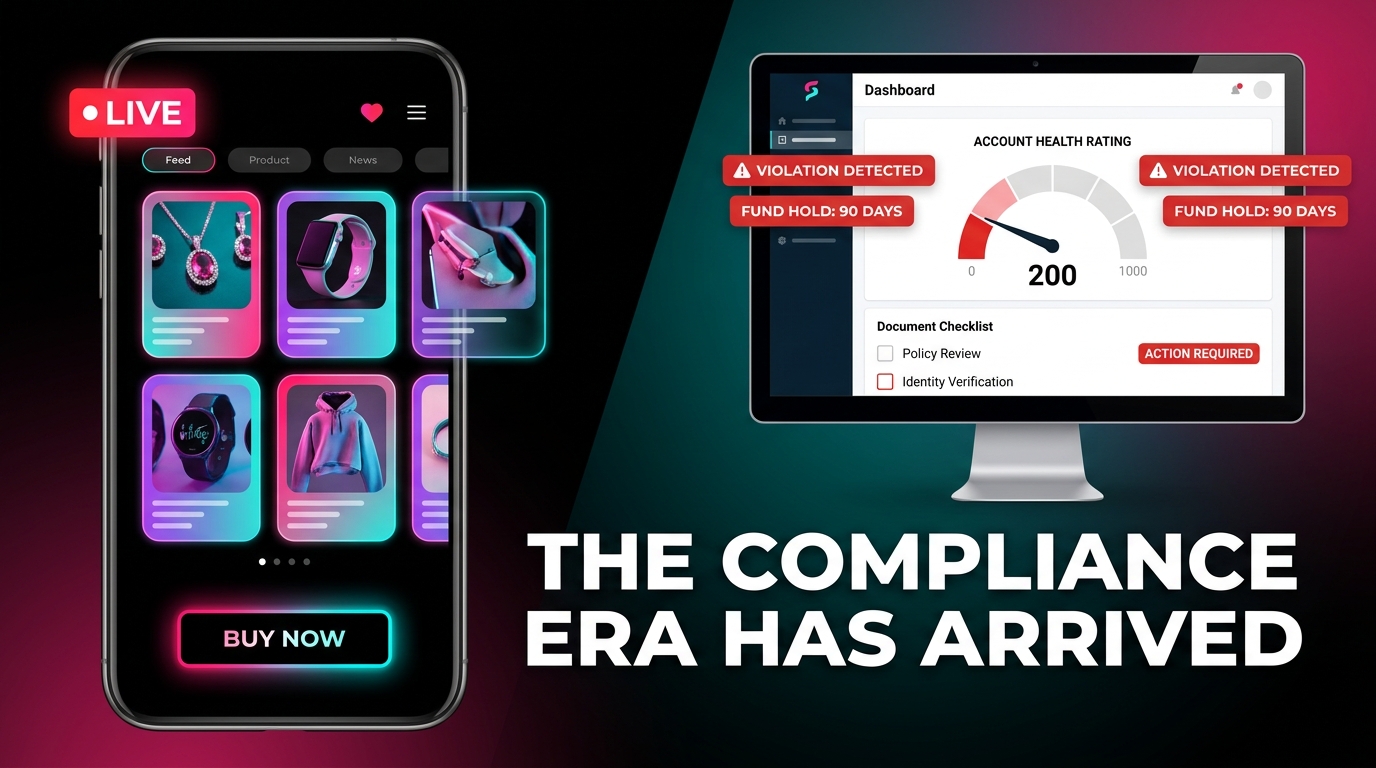
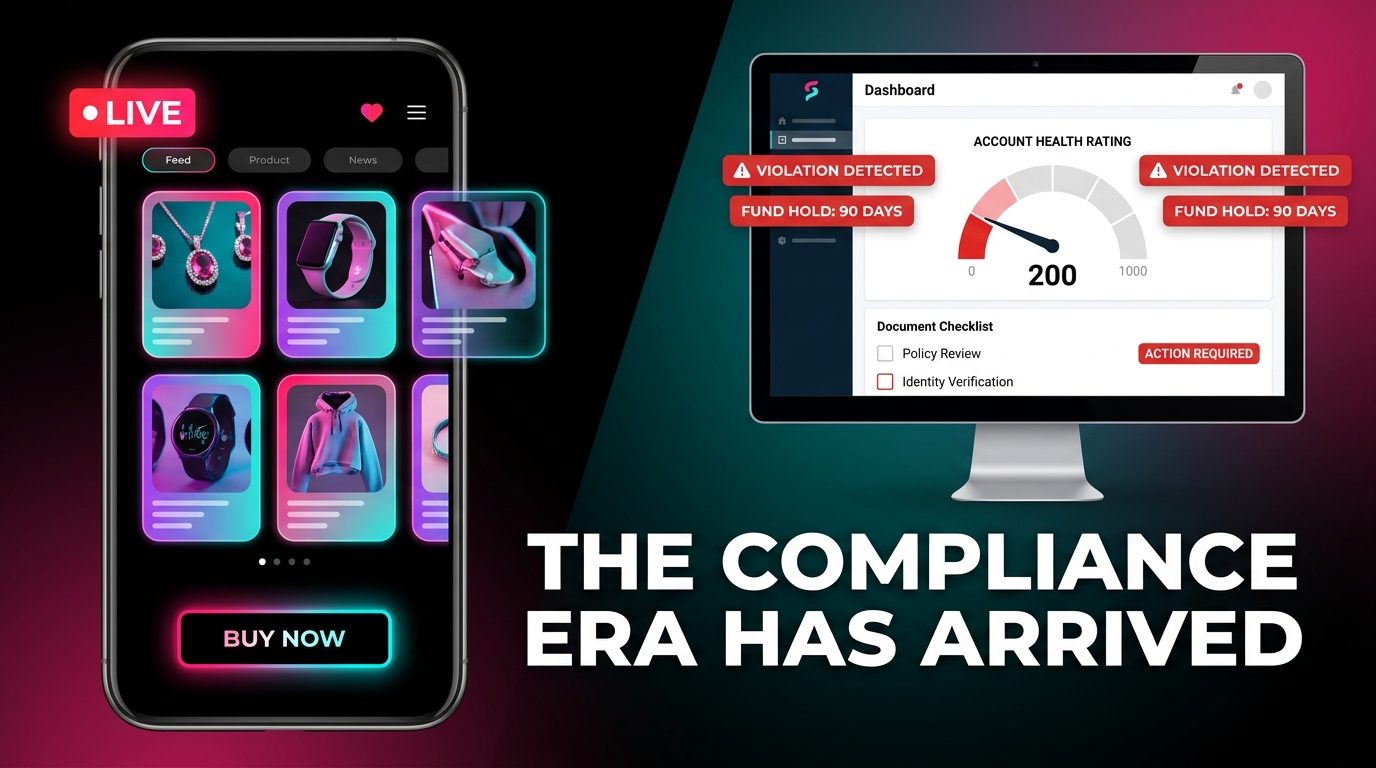
In 2026, TikTok Shop has executed one of the most aggressive policy pivots of any social commerce platform in recent memory. Account deactivations are happening faster. Fund holds are stretching to a year. Listings in health, beauty, and supplements can’t go live without pre-approved safety documentation. And a new algorithmic scoring system — the Account Health Rating — has quietly become the most important number in every seller’s business, whether they know it yet or not.
This isn’t about isolated enforcement actions. It’s a structural shift. TikTok Shop is deliberately repositioning itself from a high-growth, anything-goes marketplace into a regulated commerce environment — one that looks increasingly like Amazon circa 2019, when its own compliance crackdown reshaped who could survive on the platform long-term.
The sellers who understood that shift on Amazon early built sustainable businesses. The ones who ignored it lost catalogs, accounts, and years of work overnight. The same dynamic is now playing out on TikTok Shop — on a compressed timeline, with rules that are still being written in real time.
This guide covers everything that has materially changed in 2026: the scoring systems, the documentation requirements, the fulfillment enforcement, the content claim risks, and what the sellers staying clean are actually doing differently. If you’re operating on TikTok Shop — or planning to — this is the operating environment you’re entering.
The Old TikTok Shop vs. The New TikTok Shop: What Actually Changed
To understand where TikTok Shop’s compliance posture is now, it helps to be specific about what the platform used to tolerate — and why it stopped.
Through 2024 and into early 2025, TikTok Shop operated primarily on a violation points model. Sellers accumulated points for policy breaches, points decayed over time, and the thresholds for serious consequences were high enough that most active sellers never got close. The ecosystem rewarded speed and volume. Sellers who listed quickly, pushed products aggressively, and optimized for virality over documentation had a structural advantage over slower, more cautious operators.
The Strategic Pivot Behind the Crackdown
What changed isn’t just policy language — it’s TikTok’s strategic positioning. The platform is fighting on two fronts simultaneously. On one side, it faces mounting regulatory pressure in the U.S. and Europe around consumer protection, counterfeit goods, and unsafe products. On the other side, it’s competing directly with Amazon for brand investment and mid-to-high-value consumer purchases. Neither goal is achievable with a marketplace that tolerates phantom warehouses, unsubstantiated health claims, and sellers who disappear after a payout.
The result is a series of interlocking policy changes rolled out across 2026 that collectively push TikTok Shop toward what industry observers are calling “Amazon-level compliance infrastructure.” The platform’s own policy communications have become more explicit, its enforcement mechanisms more automated, and its penalty structure significantly more severe.
The Key 2026 Changes at a Glance
Several shifts stand out as structurally significant rather than incremental:
- Account Health Rating (AHR) replaces Violation Points — fully rolled out July 2026, with a 0–1,000 point scale and escalating enforcement milestones that directly control seller access and cash flow.
- Fulfillment and tracking enforcement tightened — fake or inaccurate tracking behavior now triggers automated penalties, with fund holds tied directly to confirmed violations.
- Documentation requirements for restricted categories — health, beauty, supplements, children’s products, and other high-risk categories now require pre-approval documentation before a listing can go live.
- Content claim enforcement automated — unsubstantiated health and performance claims are the single largest violation category in 2026, accounting for approximately 31% of all active content violations.
- INFORM Act verification tightened — high-volume sellers face mandatory annual re-verification with specific government-issued documents, with enforcement accelerated from March 2026 onward.
- Fund holds extended significantly — at the most serious violation levels, payout holds can now reach 365 days from the date of account action.
Each of these deserves detailed examination, because the specifics matter enormously for how sellers build their operations.
Inside the Account Health Rating: The Scoring System Running Your Business Now
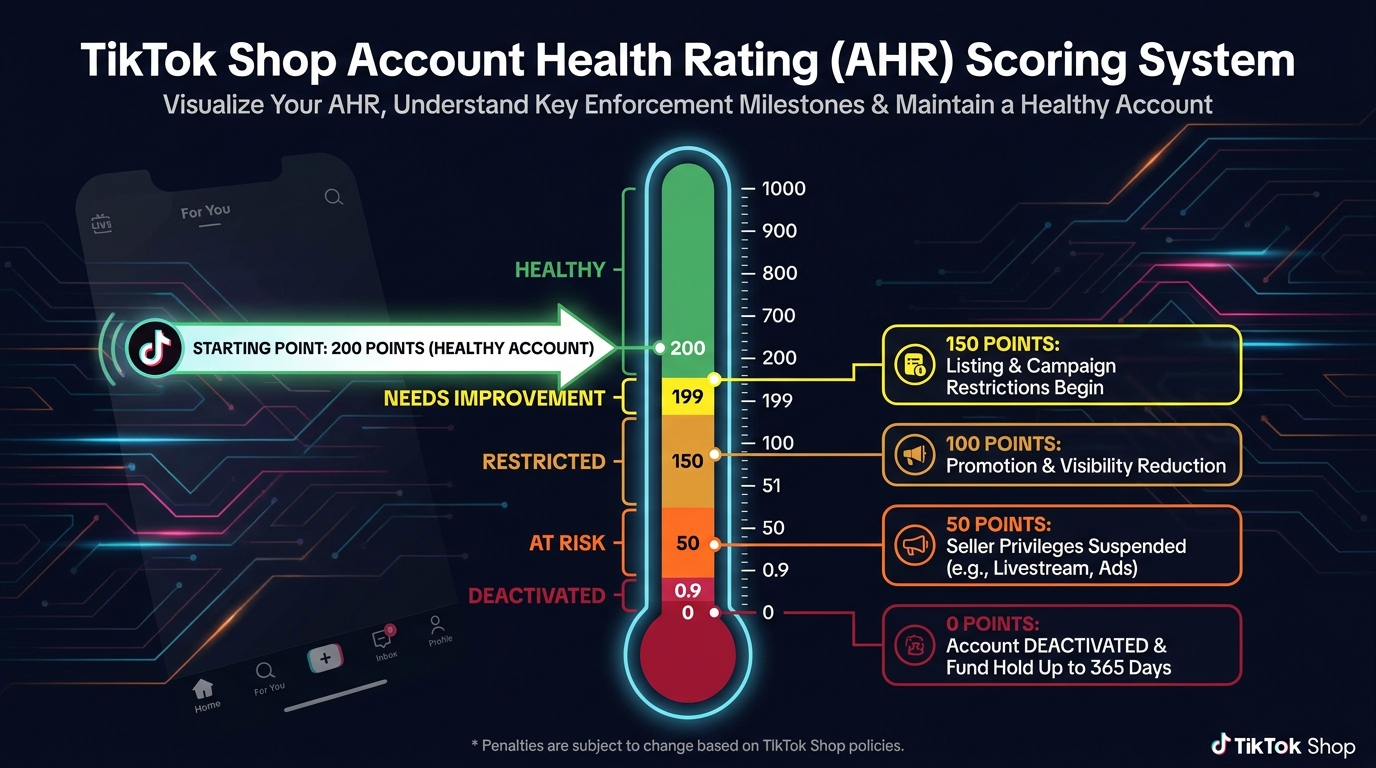
The Account Health Rating is not just a rebranding of the old Violation Points system. It represents a fundamentally different philosophy about how TikTok Shop monitors and enforces seller behavior — one that is continuous, pattern-sensitive, and algorithmically driven.
How the AHR Score Works
Every seller starts at 200 points on a 0–1,000 scale. The score is calculated on a rolling 180-day window, meaning points gained or lost through violations or improvements expire 180 days after the triggering event. This rolling structure is important: it means your history trails you, but it also means sustained clean performance can recover a damaged score — within limits.
TikTok’s official scoring bands are as follows:
- 200–1,000 points: Healthy. Full access to listings, campaigns, and standard settlement terms.
- 151–199 points: Needs improvement. The account is flagged but not yet restricted. Sellers in this zone receive warning notifications and should treat this as an urgent signal to remediate.
- 1–150 points: At risk of deactivation. This is where enforcement consequences become material. Listing capabilities and campaign access begin to be restricted at the 150-point threshold.
- 0 points: Deactivated. The shop loses selling privileges, and fund holds of up to 365 days are activated.
The Four Enforcement Milestones
Within the at-risk zone, TikTok applies escalating enforcement at four specific thresholds: 150, 100, 50, and 0 points. Each milestone triggers a new level of restriction. At 150, listing and campaign restrictions begin. At 100, the seller faces more significant operational limitations. At 50, the account is in a critical state with minimal functionality. At 0, deactivation is automatic.
The key design insight here is that TikTok built the penalty structure to hurt sellers before they reach deactivation — not after. By restricting listings and campaigns starting at 150 points, the platform creates a compounding penalty: you’re still technically operating, but you’re losing visibility, sales, and algorithm momentum while your score continues to slide. For many sellers, the operational damage at 100 points is worse than the administrative damage of a formal deactivation.
What Moves Your Score
The AHR score is affected by policy violations across multiple categories: fulfillment metrics, product listing accuracy, content claims compliance, documentation status, and account-level behaviors like payment disputes. Critically, violations are weighted differently — a single severe violation (such as a counterfeit product finding or a safety recall) can move the score dramatically, while minor listing inaccuracies accumulate more gradually.
The 180-day rolling window also means that sellers who had a difficult period six months ago are only now seeing those violations expire from their score — while simultaneously needing to avoid new violations to prevent the score from staying depressed. Understanding this rolling dynamic is essential for planning your recovery if your score has already dropped.
Tracking and Fulfillment Fraud: Why TikTok Is Hitting Sellers Where It Hurts Most — Their Cash
Of all the 2026 policy changes, the tightening around fulfillment tracking is the one that has caught the most sellers off guard — largely because many operators didn’t consider their logistics practices a compliance risk at all.
What TikTok Now Classifies as Abusive Tracking
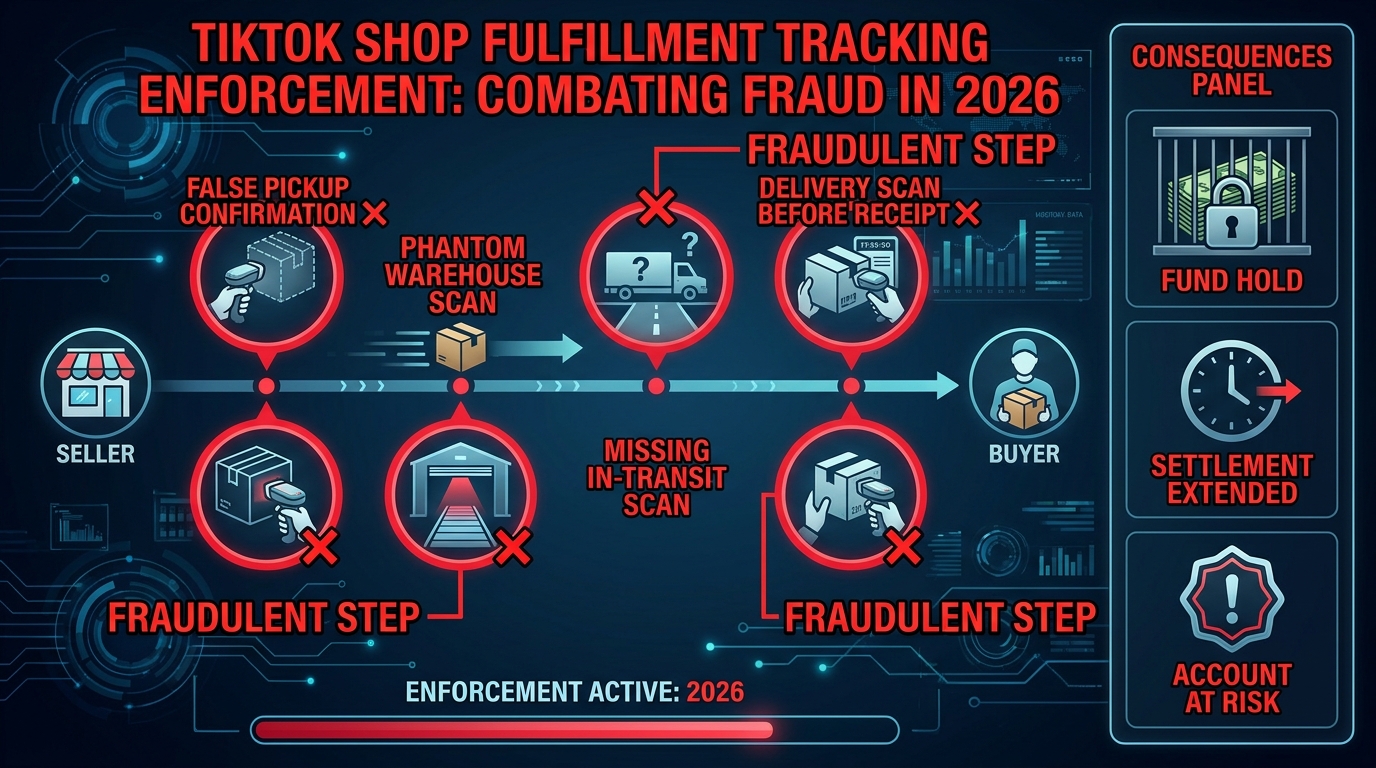
TikTok Shop’s June 2026 Policy Pulse explicitly announced “strengthened enforcement for inaccurate tracking information,” with enforcement mechanisms that go significantly beyond what the platform previously monitored. The behaviors now flagged include:
- False pickup confirmations — marking an order as picked up before a carrier has actually scanned it.
- Phantom warehouse behavior — shipping from locations that are not the registered or declared fulfillment address.
- Missing in-transit scans — packages that show no carrier movement after pickup, suggesting the tracking number was generated but the package wasn’t shipped.
- Delivery scans before actual receipt — confirming delivery before the customer has actually received the order.
These behaviors aren’t always deliberate fraud. Some are the result of third-party logistics providers using batch scanning processes, or sellers using fulfillment centers that don’t integrate cleanly with TikTok’s tracking system. TikTok’s enforcement, however, does not currently distinguish between intentional abuse and operational sloppiness — both generate violations, and both affect the AHR score.
How Fund Holds Are Triggered
The cash-flow dimension of fulfillment violations is where sellers feel the consequences most directly. Under TikTok Shop’s 2026 framework, confirmed tracking violations can trigger extended settlement periods — meaning your payout timeline stretches beyond the standard window while TikTok investigates or holds funds as a risk buffer.
At the most serious violation levels, fund holds can extend to 45 days, 90 days, or even longer depending on the severity and pattern of the violations. For sellers running on tight margins or carrying significant inventory, a 45-day fund hold is a cash-flow crisis. A 90-day hold at meaningful order volume can be existential.
The incentive structure here is intentional. TikTok is using cash as a lever to deter tracking abuse — which was previously a low-cost behavior for bad actors who simply wanted to game performance metrics or delay order processing. By making the financial consequence immediate and severe, the platform has changed the risk calculation for both intentional abusers and negligent operators alike.
The Practical Fix for Legitimate Sellers
For sellers using standard carriers and fulfillment centers, the immediate priority is ensuring that your logistics provider’s scanning processes align with TikTok’s tracking expectations. This means real-time scan updates at pickup, regular in-transit scans, and delivery confirmation that matches actual customer receipt. If you’re using a 3PL, confirm that their carrier integrations push tracking updates to TikTok’s system on the platform’s expected timeline.
Sellers who have shifted to TikTok’s own logistics infrastructure — where available — report significantly fewer tracking-related violations, because TikTok’s system has direct visibility into its own carrier network’s data. That’s not always a practical option, but it’s worth modeling if your current fulfillment approach is generating AHR friction.
The Documentation Wall: What Health, Beauty, and Restricted-Category Sellers Must Prove Before Going Live
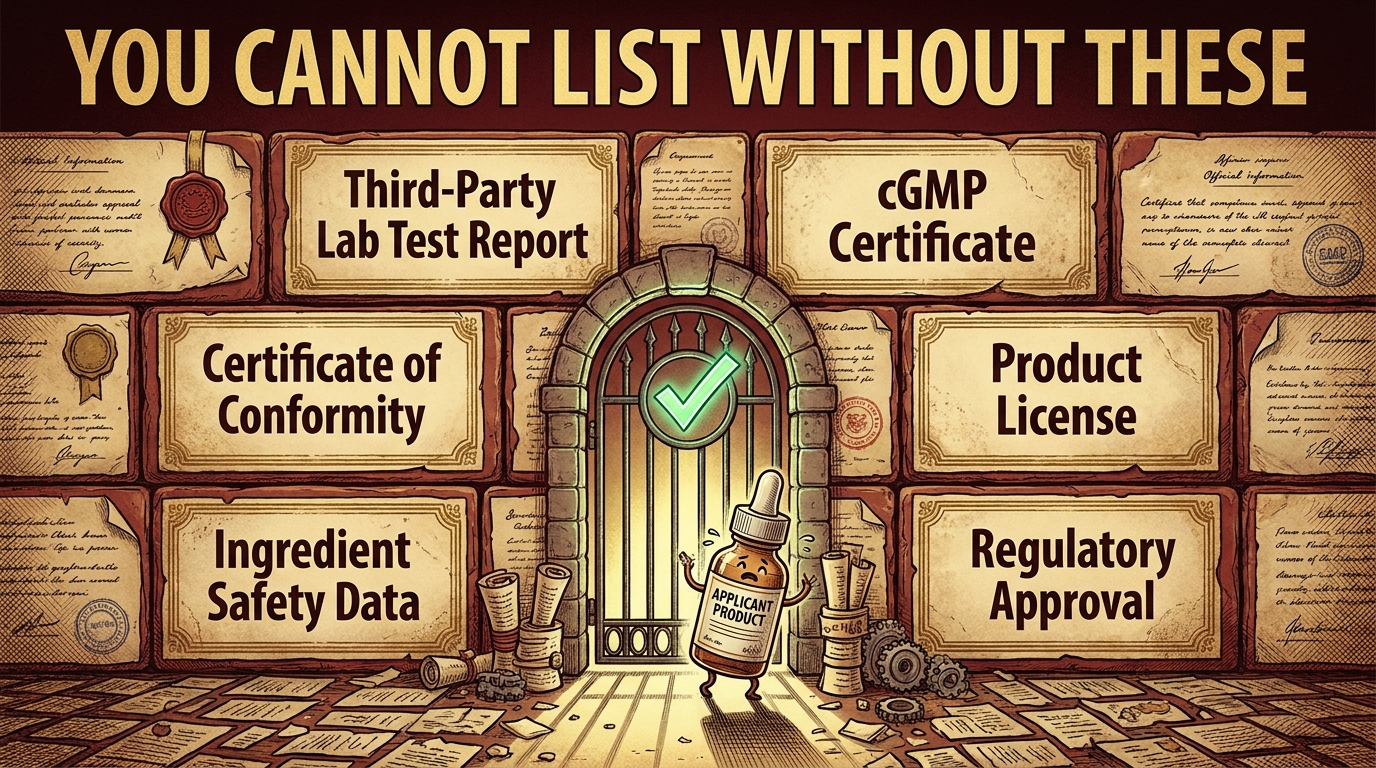
If you sell supplements, skincare, health devices, children’s products, or any other restricted category on TikTok Shop, 2026 has introduced what amounts to a pre-approval gate. Your listing cannot go live until TikTok has reviewed and accepted your supporting documentation. This is a categorical departure from how restricted categories were handled as recently as 12 months ago.
The Documents TikTok Now Requires at Listing Level
TikTok Shop’s updated documentation requirements for restricted categories vary by product type and market, but the core documents that must be submitted and approved before a listing goes live include:
- Third-party test reports from an accredited laboratory, specifying the product name, tests conducted, results, issuance date, and the lab’s official stamp or signature. The lab must be recognized as accredited in the relevant market.
- cGMP certificates (Current Good Manufacturing Practice) for applicable product categories, particularly supplements and health products.
- Product certificates of conformity — formal documentation that the product meets applicable safety or quality standards in the target market.
- Product license details — for categories that require regulatory licensing (pharmaceutical-adjacent products, certain medical devices, specific health claims).
- Ingredient safety data — for cosmetics and skincare, confirming that all active and inactive ingredients meet applicable safety standards.
All documentation must be submitted in PDF format and must be current — expired test reports or certificates are not accepted. This matters because compliance documents have varying validity periods, and sellers who obtained certification for their products 18–24 months ago may find that their documentation no longer meets TikTok’s 2026 standards.
Why This Is Catching Sellers Off Guard
The documentation wall is most disruptive for sellers who entered TikTok Shop when compliance thresholds were lower and built their catalog without investing in formal product certification. Many of these sellers have been operating for 12–18 months, have established sales history, and are suddenly discovering that their existing listings may face review — and that new listings in their category cannot go live without documents they have never obtained.
The onboarding timeline has materially lengthened as a result. Sellers in health and beauty who previously could launch a new SKU in 24–48 hours are now dealing with listing review periods of 5–15 business days while documentation is verified. Third-party lab testing adds additional lead time upstream — a full product safety assessment typically takes 2–6 weeks depending on the testing scope and lab capacity.
Category Expansion Requires Planning Ahead
For brands looking to expand into restricted categories on TikTok Shop, the documentation requirement fundamentally changes the launch planning process. You cannot sequence this the way you might have in 2024 — product ready, listing built, launch. The 2026 sequence looks more like: product finalized, documentation ordered (2–6 weeks), documentation submitted and reviewed (5–15 days), listing approved, launch.
That’s potentially 8–10 weeks of lead time before a product can go live in a restricted category, compared to a 48-hour process previously. Sellers who don’t build this timeline into their product development calendar will find themselves holding inventory they can’t sell while waiting for compliance approval.
Content Claims Enforcement: Why 1 in 3 Violations Now Come From What You Say, Not What You Sell
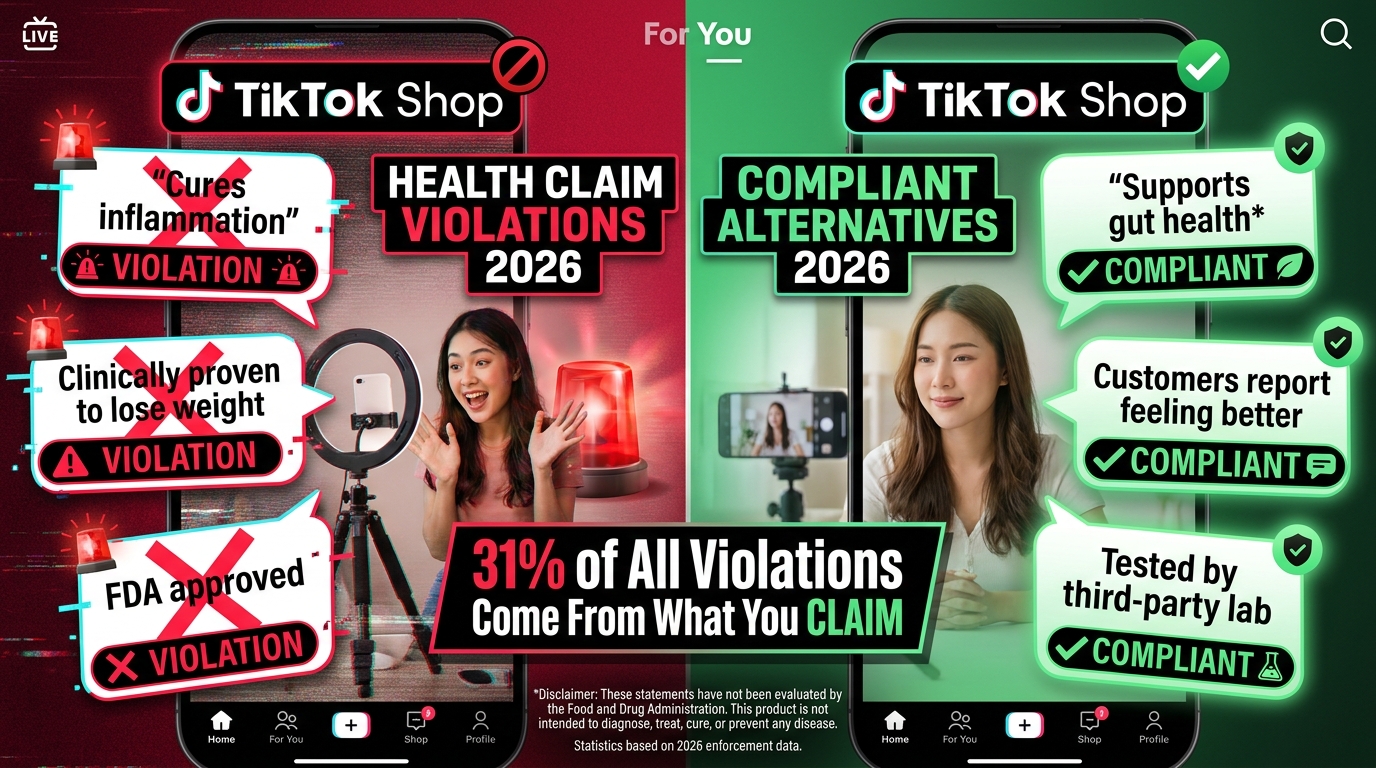
Here is the single most important data point about TikTok Shop’s 2026 enforcement landscape: unsubstantiated health claims are now the largest individual violation category on the platform, accounting for approximately 31% of all active content violations. That means nearly one in three enforcement actions isn’t about a prohibited product or a shipping problem — it’s about something a seller or creator said in a video or listing description.
What Triggers a Content Claim Violation
TikTok Shop’s content claims policy prohibits making health, efficacy, safety, or performance claims that cannot be substantiated by accepted scientific evidence or regulatory approval. The types of claims that consistently generate violations include:
- Disease-cure language — phrases like “cures,” “treats,” “heals,” or “eliminates” when applied to health conditions, without regulatory approval to make such claims.
- Superlative efficacy claims — “clinically proven,” “scientifically formulated,” or “doctor-recommended” without documented backing for those specific claims.
- Unauthorized safety endorsements — “FDA approved” when the product has not actually received FDA approval (most supplements have not).
- Before/after comparisons — weight loss, skin transformation, or health improvement imagery or claims that imply typical results without required disclaimers.
- Misleading urgency or comparative claims — pricing claims, comparison claims, or availability claims that do not match verifiable reality.
The detection mechanism for these violations is increasingly automated. TikTok’s content moderation systems process video audio transcripts, on-screen text, listing copy, and product titles in near-real-time. The 93.8% automation rate reported in TikTok’s European transparency data for the second half of 2025 is directionally representative of how enforcement works globally — human review is the exception, not the rule.
The Severity of Content Claim Penalties
The standard penalty for a first-time unsubstantiated health claim violation is a 72-hour listing freeze combined with mandatory compliance training. That sounds manageable in isolation — but at meaningful sales velocity, a 72-hour freeze on a top-performing SKU is a significant revenue event. And the listing freeze typically compounds with an AHR score reduction, which means the violation’s damage extends well beyond the immediate sales interruption.
Repeat content claim violations escalate quickly. A pattern of health claim violations within a 90-day window can trigger extended listing suspensions, broader account restrictions, and in serious cases, permanent deactivation of selling privileges for specific product categories.
The Substantiation Standard
The compliance threshold is not zero claims — it is substantiated claims. Sellers who have third-party test data, clinical study references (properly cited and accurately characterized), or regulatory documentation supporting their product’s performance can make substantive claims about their products. The difference between a compliant claim and a violation is often a single phrase or the presence of a properly sourced disclaimer.
For example: “Cures inflammation” is a violation. “Formulated with ingredients shown in third-party studies to support healthy inflammatory response*” with a footnote linking to the study is compliant. “FDA approved” is a violation for most supplements. “Manufactured in an FDA-registered facility following cGMP standards” is compliant. The underlying message can be similar; the specific language and substantiation documentation make the difference.
INFORM Act Verification: The Annual Compliance Checkpoint Most Sellers Don’t Know They’re Failing
The INFORM Consumers Act is federal U.S. legislation that requires online marketplaces to collect, verify, and disclose identity information for high-volume third-party sellers. TikTok Shop’s INFORM compliance requirements were significantly tightened in March 2026, and enforcement has accelerated since then — but the majority of affected sellers still aren’t treating it as a compliance priority.
Who the INFORM Requirements Apply To
TikTok Shop’s 2026 INFORM policy classifies a seller as “high-volume” — and therefore subject to verification requirements — if, in any continuous 12-month period within the past 24 months, they have conducted 200 or more separate sales of new or unused products AND generated at least $5,000 in gross revenue. Both thresholds must be met, but for any active TikTok Shop seller with a functioning catalog, meeting both is common.
What Documentation Is Required
High-volume sellers must provide one primary verification document from three accepted categories:
- Photo ID of the authorized representative — U.S. passport, U.S. driver’s license, or other government-issued ID meeting TikTok’s specifications.
- IRS-issued tax document — specific IRS-issued documentation confirming the seller’s tax identity.
- Business registration document — state or federal business registration confirming the entity’s legal identity and status.
Notably, W-9 forms are explicitly not accepted for INFORM compliance, despite being common for tax identity purposes. Sellers who have submitted W-9s in the past and assumed that satisfied their INFORM obligation need to recheck their compliance status in Seller Center’s Qualification Center.
The Annual Re-Verification Requirement
INFORM compliance is not a one-time event — it requires annual re-verification. Sellers who completed their initial verification 12 or more months ago are now due for renewal. TikTok’s enforcement mechanism ties verification status directly to account standing: sellers who are out of compliance with INFORM verification face listing restrictions and, in serious cases, account-level actions.
The practical complication for multi-entity sellers or sellers who have changed their business structure, ownership, or contact information is that re-verification may require updated documents that weren’t needed at initial setup. TikTok also added biometric verification requirements for certain seller categories in the May–July 2026 rollout period, adding another document type to the compliance checklist for affected accounts.
Checking your INFORM compliance status should be a monthly calendar item, not a reactive task. The Qualification Center in Seller Center shows your current verification status and flags documents approaching expiration or requiring renewal.
The Real Cost of Non-Compliance: Fund Holds, Settlement Freezes, and What Happens at AHR Zero
Abstract penalty structures become concrete when you run the numbers on what non-compliance actually costs. The financial exposure from TikTok Shop’s 2026 enforcement framework is significant enough to be existential for smaller sellers and materially damaging for larger ones.
The Settlement Period Escalation Ladder
Under normal circumstances, TikTok Shop’s standard settlement period — the time between a completed sale and receiving your payout — follows a defined schedule based on product category and seller tier. When violations occur, this settlement period extends, and the extension scales with the severity of the violation.
Based on current enforcement patterns, the escalation structure runs roughly as follows:
- Minor violations: Standard settlement period maintained, but AHR score reduction creates downstream campaign and listing friction.
- Significant violations (tracking fraud, documentation failures, repeated content claim breaches): Extended settlement periods in the 45–90 day range, often paired with listing-level restrictions.
- Severe violations (counterfeit goods, safety incidents, persistent fraud patterns): Fund holds of 90–365 days, often combined with shop deactivation.
- AHR at zero: Automatic deactivation with fund holds of up to 365 days from the date of action.
What a 365-Day Fund Hold Actually Means
A 365-day fund hold at meaningful sales volume is not just a cash-flow problem — it can be a business-ending event. Consider a seller doing $50,000 per month on TikTok Shop: at the time of deactivation, they may have 30–60 days of accumulated sales in the settlement pipeline. A 365-day hold means those funds — potentially $50,000–$100,000 — are inaccessible for a year while the account is under review.
Most small businesses cannot sustain operations while their working capital is frozen for 12 months. This is, by design, a deterrent. TikTok is using the settlement system as a risk management tool, creating a financial incentive for compliance that operates independently of the AHR score itself.
The Appeals Process Is Narrow
Sellers who receive what they believe are erroneous violations — particularly in the tracking enforcement area, where automated flagging can generate false positives — have a formal appeals process available. However, the appeals pathway requires specific, documented evidence that directly contradicts TikTok’s violation finding. General disputes or explanations without carrier-verified data are unlikely to succeed.
The practical lesson from sellers who have navigated the appeals process is that your ability to appeal successfully is directly proportional to the quality of your documentation before the violation occurs. Sellers who have carrier-stamped pickup records, GPS-verified warehouse locations, and time-stamped fulfillment records are in a substantially better position to appeal tracking violations than sellers who rely on their 3PL’s word without independent documentation.
Creator Content Is a Compliance Risk Too — And Most Brands Don’t Know It
One of the most underappreciated dimensions of TikTok Shop’s compliance framework is that the platform holds brands accountable for violations in affiliated creator content. This means that a creator you work with — whether through TikTok’s affiliate program, a direct partnership, or an influencer management platform — can generate a violation against your shop without you having approved or even seen the specific content before it went live.
How Creator-Generated Violations Work
When an affiliated creator makes a claim about your product in a TikTok video — whether in a product review, a live shopping session, or an organic post linking to your shop — that content is treated as part of your commercial activity on the platform. If the creator makes unsubstantiated health claims, misrepresents product specifications, uses unauthorized safety endorsements, or makes pricing or availability claims that don’t match your actual listing, the violation can attach to your shop’s AHR score.
This creates a compliance governance problem that most brands haven’t solved. Traditional influencer marketing operates on a brief-and-review model: you provide talking points, the creator executes, and the content goes live after brand approval. But TikTok’s affiliate ecosystem — particularly around live shopping — moves faster than that model allows. Creators go live with products, improvise claims, and reach audiences in real time, often without brand representatives monitoring the session.
Building Creator Compliance Infrastructure
The brands that are managing creator compliance risk effectively in 2026 are operating with several specific controls in place:
- Compliance-specific creator briefs: Beyond product talking points, these briefs explicitly list claims that are approved for use, claims that are prohibited, and required disclaimers. The best briefs are formatted as a “say this / don’t say this” reference card that creators can keep accessible during live sessions.
- Pre-approved claim libraries: For health and beauty products especially, brands are maintaining documented libraries of approved claims with underlying substantiation on file. Creators are briefed to only use claims from this library.
- Live session monitoring protocols: For high-volume affiliate partnerships, brands are assigning staff or agency resources to monitor live shopping sessions in real time, with a defined escalation process if off-brief claims appear.
- Affiliate agreement compliance clauses: Legal agreements with affiliated creators now explicitly include compliance requirements, indemnification for violation-related costs, and termination clauses for repeat policy breaches.
The underlying principle is that creator content is your liability on TikTok Shop. Treating it as someone else’s responsibility — the creator’s, the affiliate platform’s — is a compliance risk that has become materially expensive in 2026.
Building a Compliance-First Operations Stack: What the Sellers Staying Clean Are Actually Doing
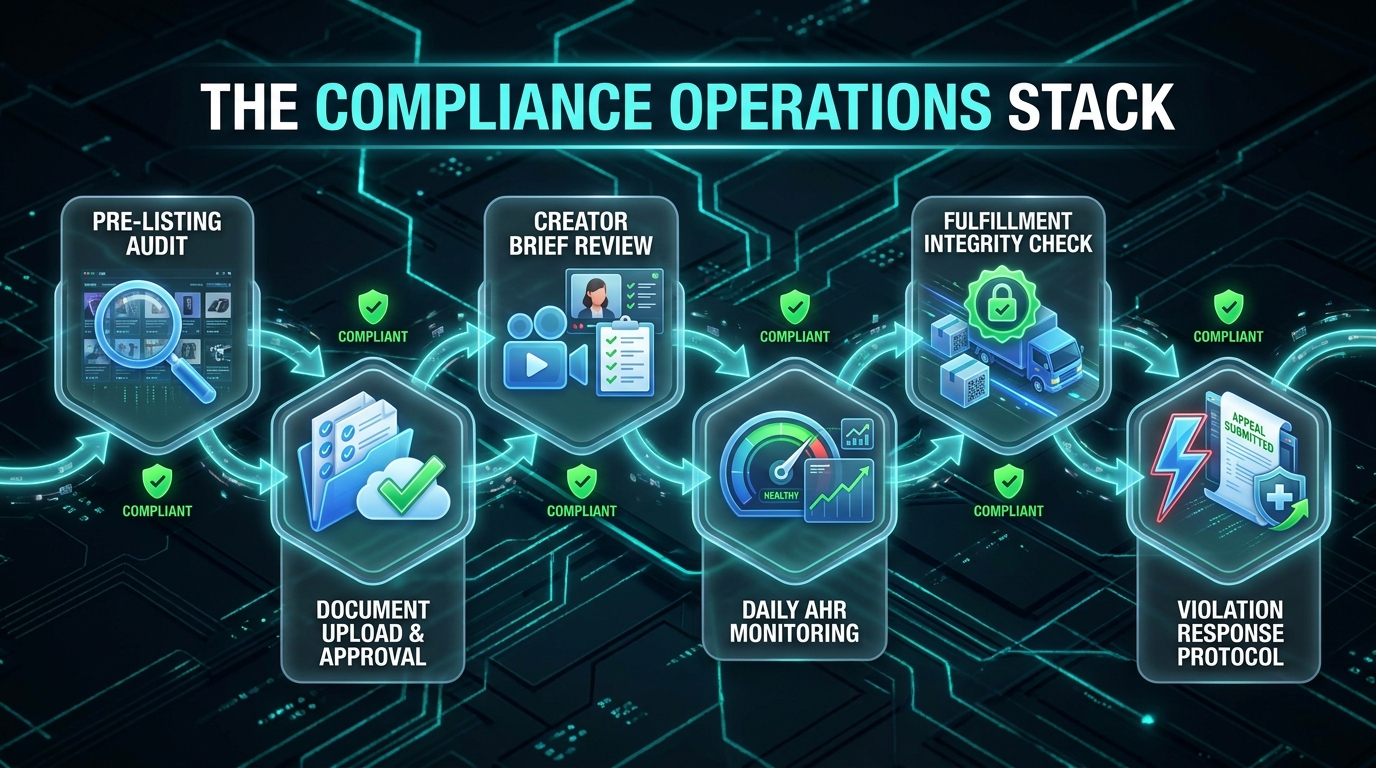
The sellers maintaining clean AHR scores in 2026 share a common characteristic: they treat compliance as an operational system, not a periodic checklist. Compliance is built into their product launch process, their creator management workflow, their fulfillment operations, and their daily account monitoring — not reviewed quarterly when something goes wrong.
Stage 1: Pre-Listing Compliance Audit
Before a new product listing goes live on TikTok Shop, compliant sellers run a structured pre-listing review that covers five dimensions:
- Category eligibility: Is this product in a restricted category? If so, is all required documentation in hand and pre-approved by TikTok?
- Listing copy claims review: Does every claim in the title, description, and bullet points have documented substantiation on file?
- Image compliance: Do product images contain any text claims that would require substantiation if they appeared in copy?
- INFORM status check: Is the seller’s INFORM verification current and valid?
- Pricing accuracy: Does the listed price, any “original” price reference, and any promotional pricing meet TikTok’s pricing claim policy?
Stage 2: Documentation Management System
High-performing compliant sellers maintain a centralized documentation repository — typically a structured folder system or dedicated compliance software — that holds current versions of all relevant compliance documents organized by SKU. This includes lab test reports, certificates, licenses, and the claim substantiation files for every approved marketing claim.
Critically, this system includes expiration date tracking. Documentation validity periods vary: some lab reports are valid for 12 months, others for 24 months. Without active tracking, sellers with large catalogs routinely discover that documents have lapsed only when a listing review flags the issue.
Stage 3: Creator Brief and Content Approval Protocol
As discussed above, creator content represents a live compliance risk. The operational response is a formal creator content governance system: standardized brief templates for each product category, a defined approval process for any creator content making specific product claims, and a real-time monitoring protocol for live shopping sessions involving high-risk category products.
Stage 4: Daily AHR and Account Health Monitoring
Compliance-first sellers treat AHR monitoring as a daily operational task. The AHR score is checked every business day, any movement below the previous day’s reading triggers an immediate investigation into what violation or performance issue caused the change, and teams have a defined escalation protocol for scores approaching the 151–199 warning zone.
The rationale for daily monitoring is simple: the AHR’s 180-day rolling window means that the score reflects accumulating behavior, not just today’s violations. Spotting a downward trend early — before it reaches the 151 threshold — gives sellers time to remediate before restrictions kick in.
Stage 5: Fulfillment Integrity Verification
To protect against tracking violations, compliant sellers have implemented fulfillment integrity checks that validate key tracking data points against carrier records at each stage of the shipping process. This includes confirming that pickup scans match the carrier’s actual schedule, that in-transit scans are appearing at expected intervals, and that delivery confirmations align with customer-reported receipt.
For sellers using 3PLs, this means establishing a data-sharing protocol with the logistics provider that gives the brand direct visibility into tracking event data — not just relying on the 3PL’s internal reporting.
Stage 6: Violation Response Protocol
Even well-managed operations receive violations. The difference between sellers who recover quickly and those who see their AHR slide is the speed and quality of their response. High-performing sellers have a pre-built violation response playbook that specifies: who is notified within the first hour of a violation notice, what documentation needs to be pulled, who is authorized to file the appeal, and what the escalation timeline looks like if the first appeal is unsuccessful.
How to Appeal, Remediate, and Recover When Violations Hit
Appeals on TikTok Shop are possible for most violation types, but the success rate is directly related to how quickly and specifically you respond. Understanding the mechanics before a violation occurs — rather than learning them under pressure — is one of the most valuable compliance investments a seller can make.
The Appeals Window
TikTok Shop typically provides a defined window in which appeals must be submitted after a violation notice. This window varies by violation type but is generally short — often 48–72 hours for listing-level violations and longer for account-level actions. Missing the appeals window eliminates your formal recourse options for that specific violation, and the score reduction stands regardless of whether the violation was accurate.
What a Strong Appeal Contains
A successful TikTok Shop appeal is evidence-based, not narrative-based. Submitting a written explanation of why the violation is incorrect, without supporting documentation, is unlikely to succeed. The elements of a strong appeal include:
- Specific documentation that directly contradicts the violation finding — carrier records for tracking violations, lab reports for documentation violations, claim substantiation files for content claim violations.
- Timeline evidence showing that the alleged violation event did not occur as TikTok’s system records it — GPS data, carrier-stamped pickup records, timestamped internal records.
- Corrective action documentation — even if you’re appealing, showing that you’ve already taken steps to prevent recurrence improves the appeal’s reception.
AHR Score Recovery: The Long Game
If your AHR score has already dropped into the warning or at-risk zone, recovery is possible — but it operates on the 180-day rolling window timeline. Every day of clean operation, accurate fulfillment, and compliant content moves you incrementally in the right direction as older violations age out of the scoring window.
The practical recovery strategy is to:
- Immediately halt any listing, fulfillment, or content practices that are generating new violations.
- Complete any mandated compliance training attached to violations — failure to complete training can generate additional score reductions.
- Appeal any violations you have strong documentation to contest, prioritizing those with the highest point impact.
- Implement the pre-listing audit and daily monitoring processes to prevent new violations from entering the 180-day window.
- Monitor the score weekly against the violation expiration timeline to track recovery progress.
Sellers who have gone through this process report that a sustained clean operation period of 90–120 days produces noticeable AHR score improvement as the oldest violations expire. The first 30 days feel slow because the violation history is still relatively fresh; the recovery accelerates as the 180-day window begins to exclude more of the problematic activity period.
Compliance as the New Competitive Moat on TikTok Shop
The natural instinct when encountering a more demanding compliance environment is to view it as a cost — additional documentation, slower launches, more operational overhead, creator governance complexity. That framing is understandable but strategically incomplete.
TikTok Shop’s compliance crackdown is also a market consolidation mechanism. Every seller who exits the platform because compliance costs exceed their margin, or who gets deactivated for violations they never addressed, is a competitor leaving your category. Every brand that can’t get its restricted-category products documented and approved in time is creating shelf space for brands that did the work earlier.
The Visibility Dividend for Compliant Sellers
There’s a growing body of evidence that TikTok Shop’s algorithm rewards accounts with healthy AHR scores in the same way that a clean seller account on Amazon tends to receive preferential treatment in ranking signals. Compliant sellers report better listing placement, more consistent ad delivery, and greater affiliate creator recruitment — because creators, too, are increasingly evaluating brand compliance status before accepting partnership offers to protect their own creator health scores.
The inverse is also true: sellers with depressed AHR scores, listing restrictions, or known compliance histories are finding it harder to recruit quality creators, harder to run effective campaigns, and harder to compete for category placement — even when they are technically still operational.
Brand Trust as a Platform Positioning Signal
TikTok Shop’s explicit goal is to position itself as a trusted commerce destination — not just a discovery platform. The brands that align with that goal in 2026, by investing in documentation, substantiated claims, and verified fulfillment, are building a positioning advantage that will compound as the platform continues its compliance evolution.
That doesn’t mean compliance is easy or cheap. For sellers in restricted categories, the upfront investment in lab testing, certification, and documentation infrastructure is real. For sellers with large creator affiliate networks, the governance overhead is significant. But these costs are one-time investments in a compliance foundation that protects the business through future enforcement cycles — cycles that TikTok has made clear will only intensify.
What to Do This Week
The most actionable immediate step for any TikTok Shop seller reading this is a compliance audit across five areas:
- Check your AHR score today in Seller Center and note where it sits relative to the 200 healthy baseline and the 151 warning threshold.
- Audit your top five revenue-generating listings for content claims that may not have documented substantiation on file.
- Verify your INFORM compliance status in the Qualification Center and confirm when your current verification expires.
- Review your tracking data for the past 30 days and identify any SKUs or fulfillment partners generating in-transit scan gaps.
- Audit your most active creator partnerships for recent content — specifically any health, performance, or safety claims that weren’t in your approved brief.
The sellers who will own meaningful market share on TikTok Shop in 2027 are the ones who treated 2026 not as a year to react to policy changes, but as a year to build the operational infrastructure that makes compliance automatic. That window is still open — but it is narrowing, and the cost of waiting grows with every enforcement cycle TikTok runs.
The platform that once rewarded speed above all else now rewards something more durable: the ability to operate at scale without breaking rules. That’s a different skill set than virality — and it turns out, it’s a much harder one to copy.