

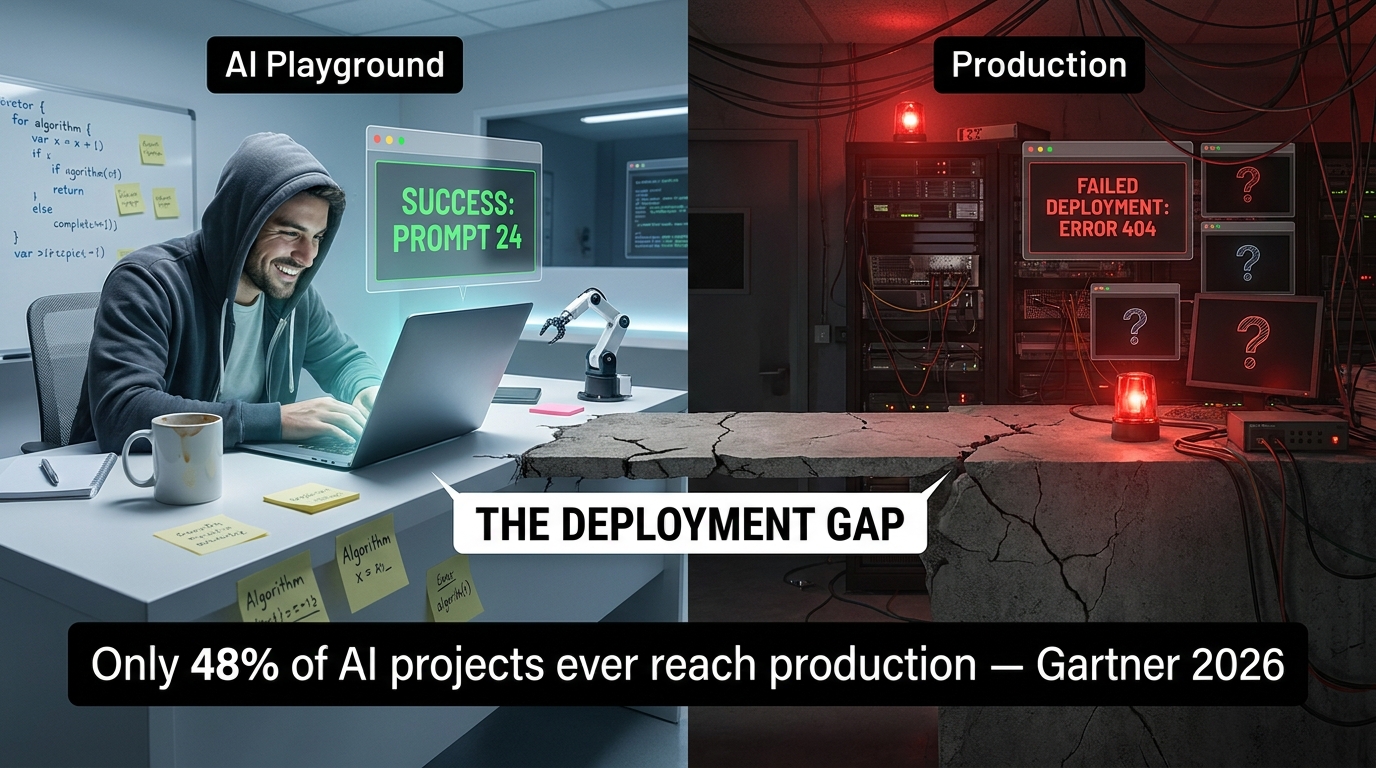

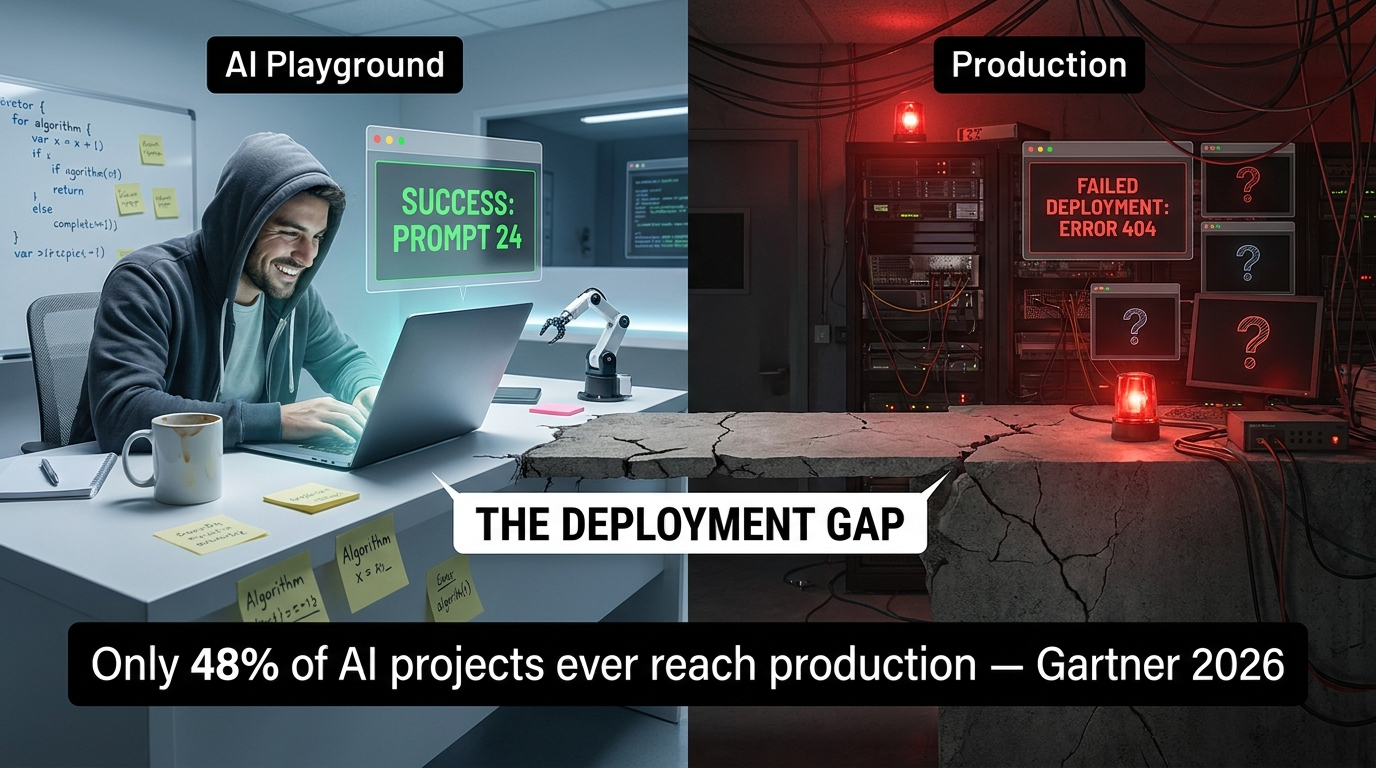
The demo works perfectly. The Jupyter notebook is clean, the prompt responses are crisp, and the stakeholders in the room are visibly impressed. Then six months pass. The workflow never ships.
This is not a rare failure. According to Gartner, only 48% of AI projects ever make it to production. S&P Global Market Intelligence found that enterprises scrapped 46% of AI proof-of-concepts before they reached a live environment. MIT’s NANDA research puts an even starker number on it: as few as 5% of enterprise AI pilots cross the finish line in any meaningful, maintained form.
The gap between playground and production is the most expensive problem in enterprise AI right now — and it is almost never caused by the model. The LLMs work. The RAG pipelines retrieve. The agents reason. What fails is the system around the AI: the data plumbing, the observability instrumentation, the governance guardrails, the organizational ownership, and the deployment engineering that turns a notebook into a network-scale service.
This post is about that gap — what causes it, what the fastest teams do differently, and how to build a workflow that actually survives contact with production. We’ll cover the specific technical decisions, tooling choices, rollout strategies, and organizational patterns that separate the 48% who ship from the 52% who don’t.
No amount of prompt engineering fixes a deployment problem. But the right production engineering mindset can compress an eight-month slog into a six-week sprint — and this is exactly what the data shows the fastest teams are doing.
Why Playgrounds Lie: The False Confidence Trap
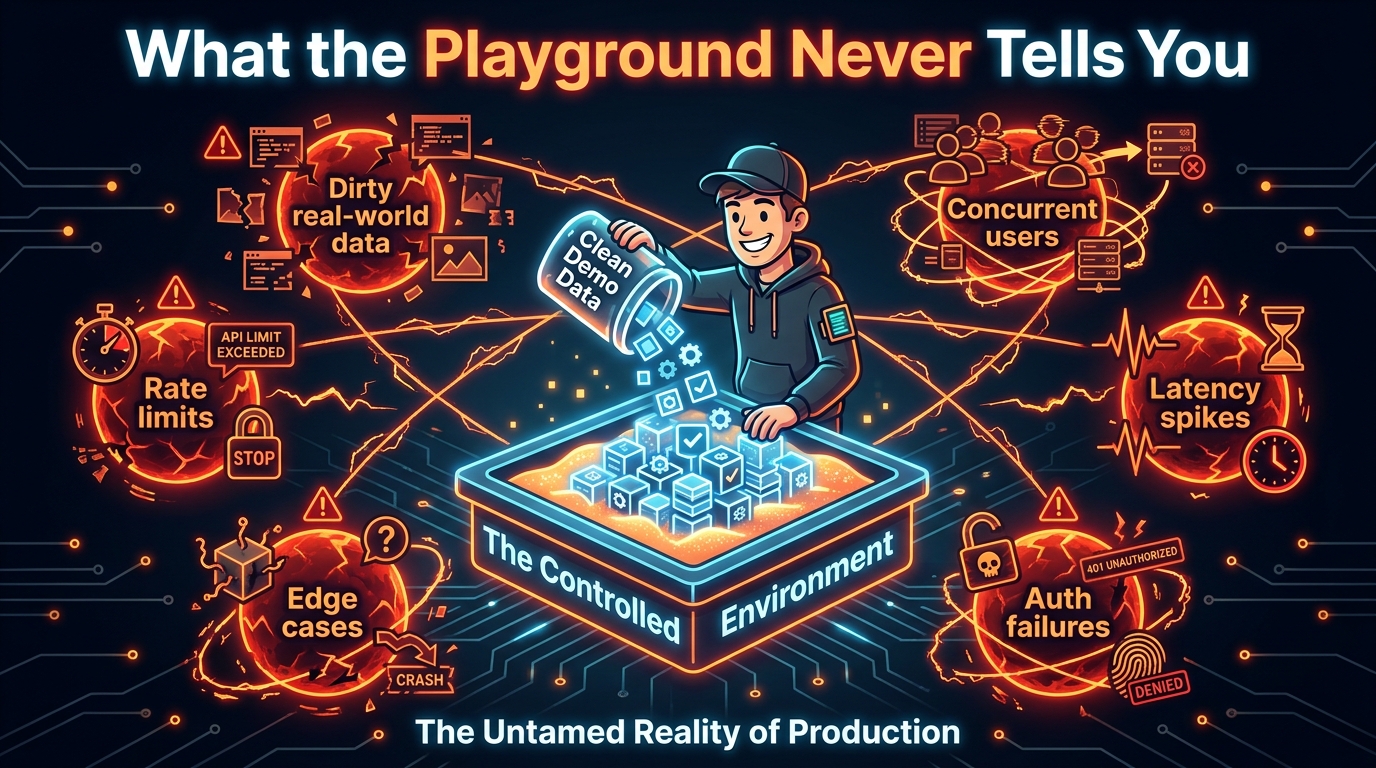
AI playgrounds — whether that’s OpenAI’s Playground, a Colab notebook, a locally-running LangChain demo, or a vendor’s hosted sandbox — are engineered for one thing: making AI look good. They strip away every variable that makes production hard. That’s the problem.
The Curated Data Illusion
In a playground, you feed the model your best examples. You choose the queries you know it handles well. You iterate on prompts until the outputs look polished. Production does not extend you this courtesy. Real users send malformed inputs, incomplete context, multi-language queries, and edge cases that no one thought to test. Real databases have nulls, inconsistencies, schema drift, and stale records. The model that scores brilliantly on your hand-picked demo set can collapse within hours of real-world traffic because the data it encounters bears little resemblance to what it was tested on.
This is not a hypothetical — it is the single most commonly cited cause of AI prototype failure across every major survey from 2024 to 2026. Poor or insufficient data quality consistently ranks as the top reason AI projects fail to reach or sustain production.
The Concurrency Blind Spot
Playgrounds are single-user environments. You send a request, you get a response, you iterate. Production means thousands of concurrent requests, rate limits at every API boundary, token budgets that scale with usage, and latency that compounds across every hop in a multi-step workflow. An agent that takes four LLM calls to complete a task might feel snappy when you’re the only user. At 500 concurrent sessions, it becomes a cost bomb and a latency nightmare simultaneously.
Teams that skip load testing, token consumption profiling, and concurrent-request simulation before production rollout are routinely blindsided. The performance envelope of a playground bears no relationship to what a workflow will experience under real conditions.
The Integration Fiction
Most AI playgrounds operate in isolation. They don’t have to authenticate against your internal SSO provider, respect your data residency requirements, integrate with your CRM’s rate-limited API, or write results back into a legacy system that predates REST. In production, every integration point is a failure mode. Each API boundary carries authentication overhead, retry logic complexity, and potential data-format mismatch. The playground has none of this friction. Production has all of it.
The practical takeaway is that playground success is a prerequisite for production investment, not evidence of production readiness. Teams that treat demo success as deployment validation are confusing the first mile for the whole race.
The Eight-Month Trap: What the Data Actually Shows
The average time from AI prototype to production, for organizations that successfully make the transition, is eight months. Gartner’s 2026 data puts this number squarely in the range that most teams experience: a prolonged, painful middle period between “it works in the notebook” and “it’s running at scale in our infrastructure.”
That eight-month average, though, hides a bimodal distribution. Some teams are shipping scoped AI workflows in 30 to 60 days. Others are stuck in a perpetual near-production state, perpetually “almost ready,” for a year or more before the project dies quietly. Understanding what separates these two outcomes is more useful than dwelling on the average.
The Long-Tail Failure Modes
Teams that spend a year in limbo are not failing because their models underperform. They’re failing for a specific cluster of organizational and engineering reasons that recur with striking consistency across industries and company sizes:
- No clear ownership of the production transition. The data science team built the prototype. The platform team owns production infrastructure. Neither has explicit accountability for the gap between them. The workflow exists in a no-man’s-land where everyone assumes someone else is responsible for moving it forward.
- Scope that expands during production hardening. A workflow scoped for one use case in a playground frequently balloons when production requirements surface: it needs to handle more data sources, more user roles, more edge cases. Each expansion restarts the hardening cycle.
- Governance reviews that trigger late in the process. Security, compliance, and legal reviews are often treated as a final gate rather than an early design constraint. Teams reach the end of an eight-month build and discover that the workflow processes data in a way that violates internal policy or regulatory requirements, sending them back to architecture.
- Missing observability infrastructure. Without logging, tracing, and evaluation tooling built in from the start, teams cannot diagnose why a production deployment is underperforming. They know something is wrong but not what — so fixes are slow, iterative, and expensive.
What the Fast Teams Do in the First Week
The teams shipping in six weeks or less do something distinctive in week one: they define what “done” means with production-level specificity before they write a line of agent code. They answer: What does a good output look like, in measurable terms? What latency is acceptable? What failure modes must be caught? What integrations are in scope? These constraints are not imposed late — they are baked into the initial design, and they prevent the scope expansion that kills slower projects.
47% of executives in recent surveys report that their organizations are moving “too slowly” on AI despite active investment. The bottleneck is rarely the technology. It is almost always the absence of a clear production engineering discipline around AI workflows.
The Production Readiness Layer Cake
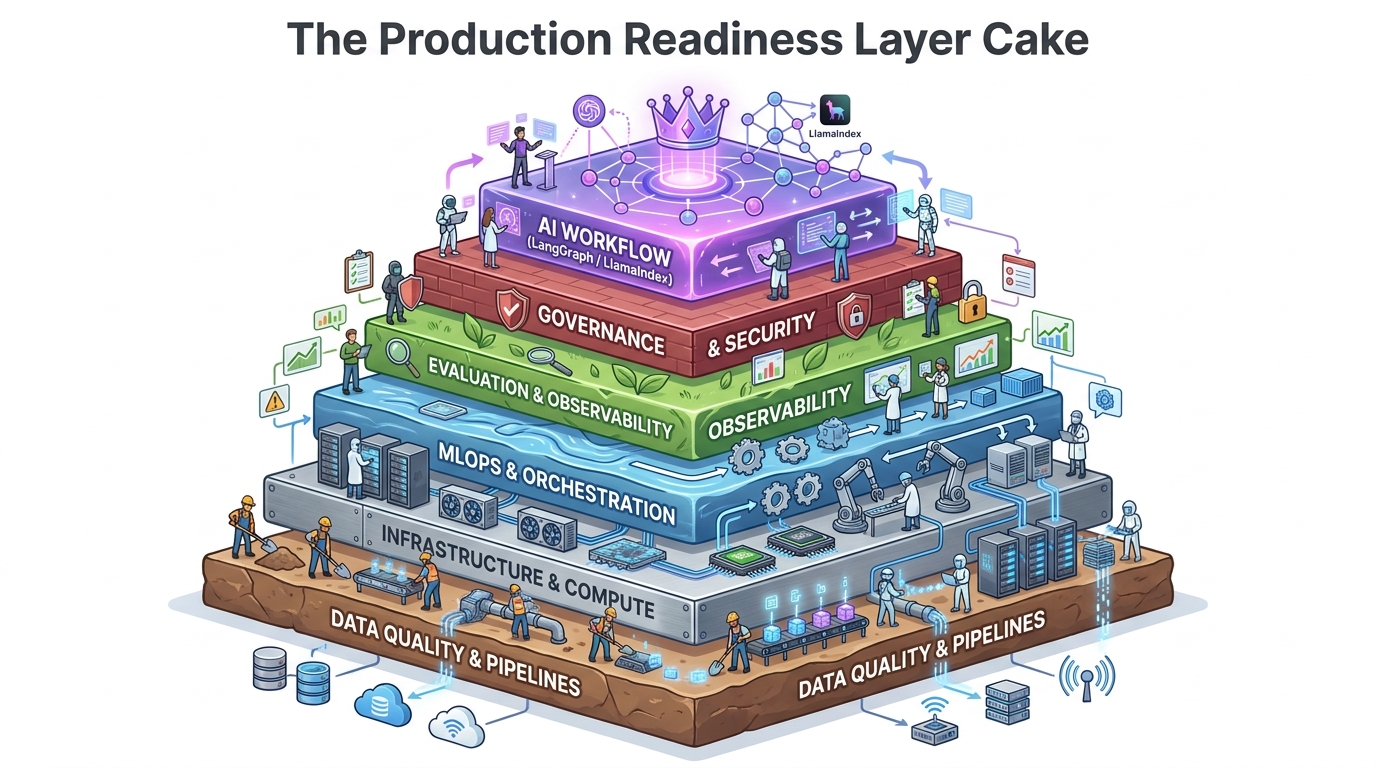
Production readiness for an AI workflow is not a single checkpoint. It is a stack of interdependent layers, each of which must be addressed before the layer above it can be stable. Think of it as a cake: you cannot frost a layer that hasn’t been baked yet, and the whole structure collapses if any layer underneath is weak.
Layer 1: Data Quality and Pipeline Reliability
This is the foundation, and it is the most commonly skipped one. For any AI workflow that processes real business data — documents, records, events, user inputs — the quality and consistency of that data determines the quality of outputs more than any prompt engineering technique. Before production deployment, teams need to audit their data sources for completeness, freshness, schema consistency, and permission compliance. They need to build pipelines that handle schema drift, missing fields, and upstream API failures gracefully rather than silently corrupting context.
This is not glamorous work. It does not generate impressive demos. But organizations that invest in data pipeline reliability before workflow deployment report dramatically fewer production incidents and much faster iteration once the workflow is live. The AI can only reason about what it receives.
Layer 2: Infrastructure and Compute Planning
The infrastructure choices made for a prototype are almost never appropriate for production. Model serving infrastructure needs to account for concurrency, caching, and cost optimization. Embeddings databases need replication and backup strategies. Vector stores need to handle update frequency appropriate to the use case. API rate limits need to be managed with queuing and backoff logic rather than failed-request errors.
Cost surprises are among the most commonly cited “unexpected” production challenges. Teams that don’t profile token consumption and compute costs against realistic usage volumes routinely discover in production that their workflow costs five to ten times what they projected in the prototype phase. Compute planning before deployment is non-negotiable for any workflow expected to scale.
Layer 3: MLOps and Workflow Orchestration
In 2026, the orchestration layer for production AI workflows has largely crystallized around a two-tier pattern. The AI-native orchestration layer — typically LangChain with LangGraph for stateful agent workflows, or LlamaIndex for retrieval-heavy RAG pipelines — handles the logic of how the AI components interact, branch, retry, and pass state. Beneath this, for workflows that need durable execution guarantees, systems like Temporal provide crash-safe state persistence, reliable retries, and long-running workflow management that pure agent frameworks don’t offer by themselves.
Choosing the right orchestration stack matters because it determines what failure modes you can recover from automatically. A workflow that can resume from a checkpoint after an infrastructure failure is far more production-appropriate than one that must restart from scratch. This resilience is built at the orchestration layer, not the model layer.
Layer 4: Evaluation and Observability
You cannot improve what you cannot see. Production AI workflows need distributed tracing at the agent level — tracking which tools were called, what context was passed, how long each LLM call took, and what the outputs were at each step. This is materially different from traditional application monitoring, which focuses on request/response latency and error rates. AI workflows fail in ways that traditional monitoring cannot detect: a response can be returned in 200ms with a 200 status code and still be completely wrong.
LLM evaluation in production means continuously scoring outputs against quality criteria — whether that’s relevance, accuracy, tone, safety, or task completion — and alerting when quality drifts. The tooling ecosystem for this (LangSmith, Arize, Weights & Biases, Braintrust, Langfuse) has matured significantly in the past 18 months, and the leading pattern is integrating evals into both CI/CD gates and live production monitoring pipelines simultaneously.
Layer 5: Governance and Security
The top layer is where the workflow meets organizational policy, regulatory requirements, and security controls. In 2026, with the EU AI Act in enforcement and 54% of IT leaders citing AI governance as a top enterprise risk priority, this layer cannot be treated as a post-deployment formality. Data privacy constraints must be designed into the workflow architecture: what data can the model see, which outputs can be stored, who can access logs, and what audit trail is required.
Security at plugin and tool-use boundaries is a particularly acute challenge for agentic workflows. An agent that can read from and write to external systems creates a new attack surface at every integration point. Input sanitization, output validation, and least-privilege tool access are not optional production hardening steps — they are mandatory for any workflow that touches sensitive business data or takes actions with real-world consequences.
The 2026 Production AI Stack: Tooling That Actually Matters
The AI tooling landscape has undergone a consolidation in 2026 that makes stack choices clearer — and higher-stakes — than they were two years ago. The experimental phase of “try every framework” has given way to a more settled picture of what the production layer looks like for different workflow types.
Orchestration: LangGraph vs. LlamaIndex Workflows
For agent-centric, multi-step workflows with complex branching logic, LangGraph (part of the LangChain ecosystem) has become the dominant choice. Its explicit state graph model gives engineering teams precise control over control flow, retries, human-in-the-loop interrupts, and parallel execution paths. This control is exactly what production requires: the ability to reason about and debug every decision point in a running agent workflow, not just observe inputs and outputs.
For retrieval-heavy, document-processing workflows where the primary challenge is getting the right context into the model, LlamaIndex Workflows offer a structured approach that optimizes the retrieval pipeline — chunking strategies, embedding models, reranking, and hybrid search — without requiring teams to manage the full agent control flow complexity.
Most production stacks of any complexity use both: LlamaIndex to power the retrieval layer, LangGraph to orchestrate the higher-level agent logic that determines when to retrieve, what to do with retrieved content, and how to route between sub-tasks.
Durable Execution: When to Add Temporal
Temporal belongs in the stack when workflows need to be crash-safe across infrastructure failures, run for extended periods (hours to days), or coordinate work across multiple services with guaranteed delivery semantics. Agent frameworks handle LLM-level logic; they do not inherently handle the case where your workflow is halfway through a complex multi-step process and the pod it’s running on gets killed. Temporal’s durable execution model persists workflow state externally, so resumption after failure is automatic.
The overhead of adding Temporal is real — it’s a new infrastructure dependency with its own operational requirements. For short-lived, synchronous workflows that complete in seconds, it is unnecessary. For long-horizon workflows that touch multiple systems and cannot afford to lose intermediate state, it is close to mandatory.
Observability: The Must-Have Tools
The observability stack for production AI has consolidated around platforms that offer LLM-native tracing rather than generic application monitoring. LangSmith (tightly integrated with the LangChain ecosystem), Langfuse (open-source, self-hostable), and Arize Phoenix (strong for model quality monitoring) are the most commonly deployed in 2026. Weights & Biases Weave offers strong experiment-to-production continuity for teams that are already using W&B for training runs.
The key capability to prioritize: the ability to replay failed traces. When a production workflow produces a bad output or an unexpected behavior, you need to reconstruct exactly what the model received, what tools it called, and what decisions it made at each step. Without this, debugging production AI is guesswork.
Progressive Delivery for AI: Feature Flags, Canaries, and Shadow Mode
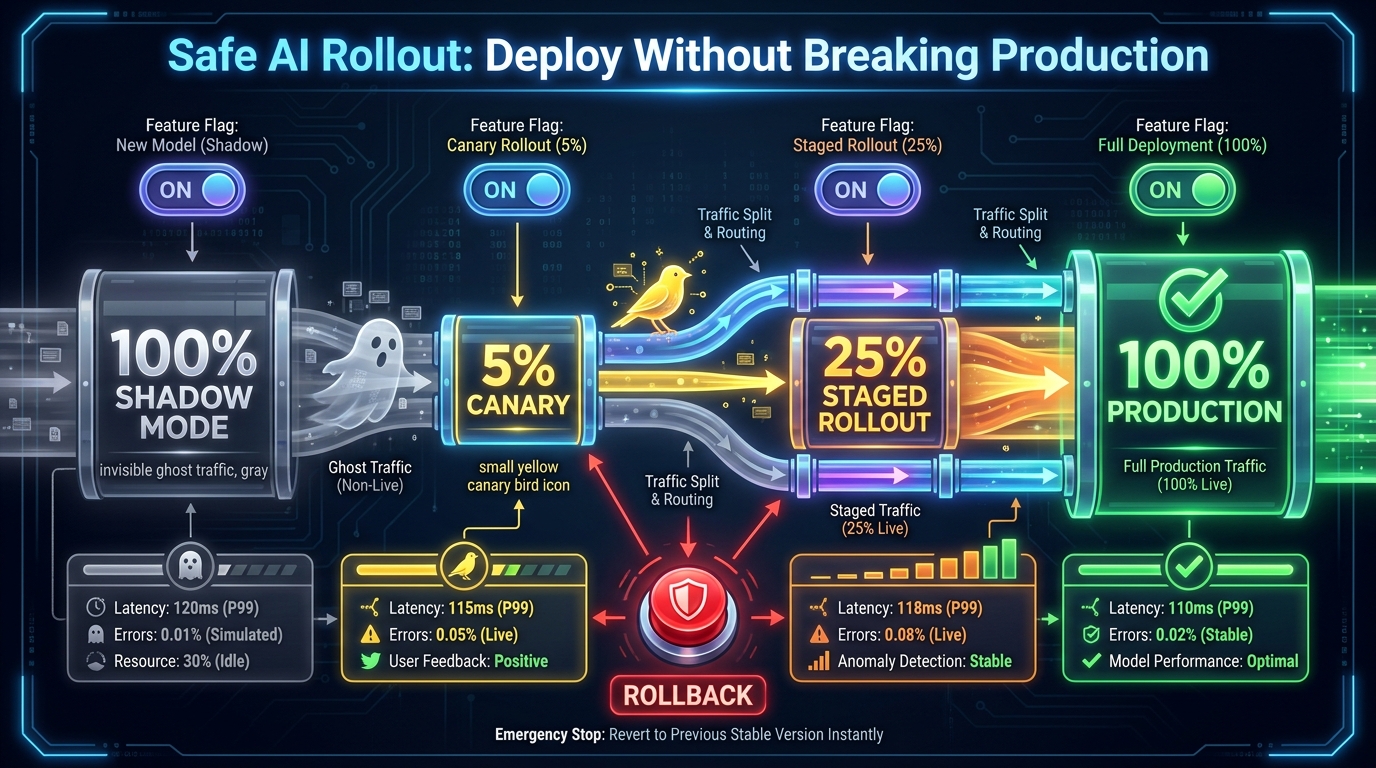
One of the biggest mistakes teams make when shipping AI workflows is treating deployment as a binary event: either the workflow is off, or it’s on for everyone. Progressive delivery — the practice of shipping to incrementally larger audiences with automated monitoring and instant rollback capability — is the engineering pattern that makes fast, safe AI deployment possible.
Shadow Mode: The Safest First Step
Shadow mode is the practice of running a new AI workflow against real production traffic without surfacing its outputs to users. The workflow receives live inputs, generates outputs, and logs everything — but users continue to see the existing system’s responses. This gives teams the highest-fidelity data possible about how the workflow behaves under real conditions, without any user impact if it misbehaves.
Shadow mode deployments typically run for one to two weeks before a canary rollout. During this period, teams compare the new workflow’s outputs against the existing system’s outputs at scale, identify failure modes that didn’t appear in testing, and tune the evaluation criteria that will gate the canary release. It is the most powerful pre-production validation technique available for AI workflows, and it is underused.
Canary Releases: Controlled Exposure
A canary release exposes the new workflow to a small slice of real users — typically 5% to 10% — while the rest continue to use the existing system. Automated monitors watch quality metrics, latency, error rates, and user feedback signals. If metrics stay within acceptable bounds for a defined period, the rollout proceeds to the next tier (25%, 50%, 100%). If any metric breaches a threshold, the rollout automatically rolls back to the previous version.
For AI workflows specifically, canary releases need to monitor not just technical metrics but quality metrics. A workflow can exhibit excellent technical performance (fast, no errors) while producing outputs that are factually wrong, off-brand, or harmful. Quality monitoring — automated evals scoring live outputs — is what makes AI canary releases meaningful rather than just latency-and-uptime checks.
Feature Flags: More Than Just On/Off Switches
In 2026, feature flags have evolved from simple on/off toggles into orchestration layers for AI workflow delivery. Modern flag systems can route specific user cohorts (internal users, beta testers, high-value accounts) to different workflow versions, enabling targeted exposure before broad rollout. They also enable instant kill switches: if a production AI workflow starts producing problematic outputs, a flag flip takes it offline in seconds without a code deployment.
For prompt changes and model configuration updates — which don’t require a new code deployment — feature flags provide version control and rollback capabilities that would otherwise require a full redeployment. This is especially important for workflows where prompt tuning is ongoing: the flag system becomes the mechanism for safely testing prompt changes against real traffic before committing them fully.
Eval-Driven Development: Build the Test Before You Build the Feature
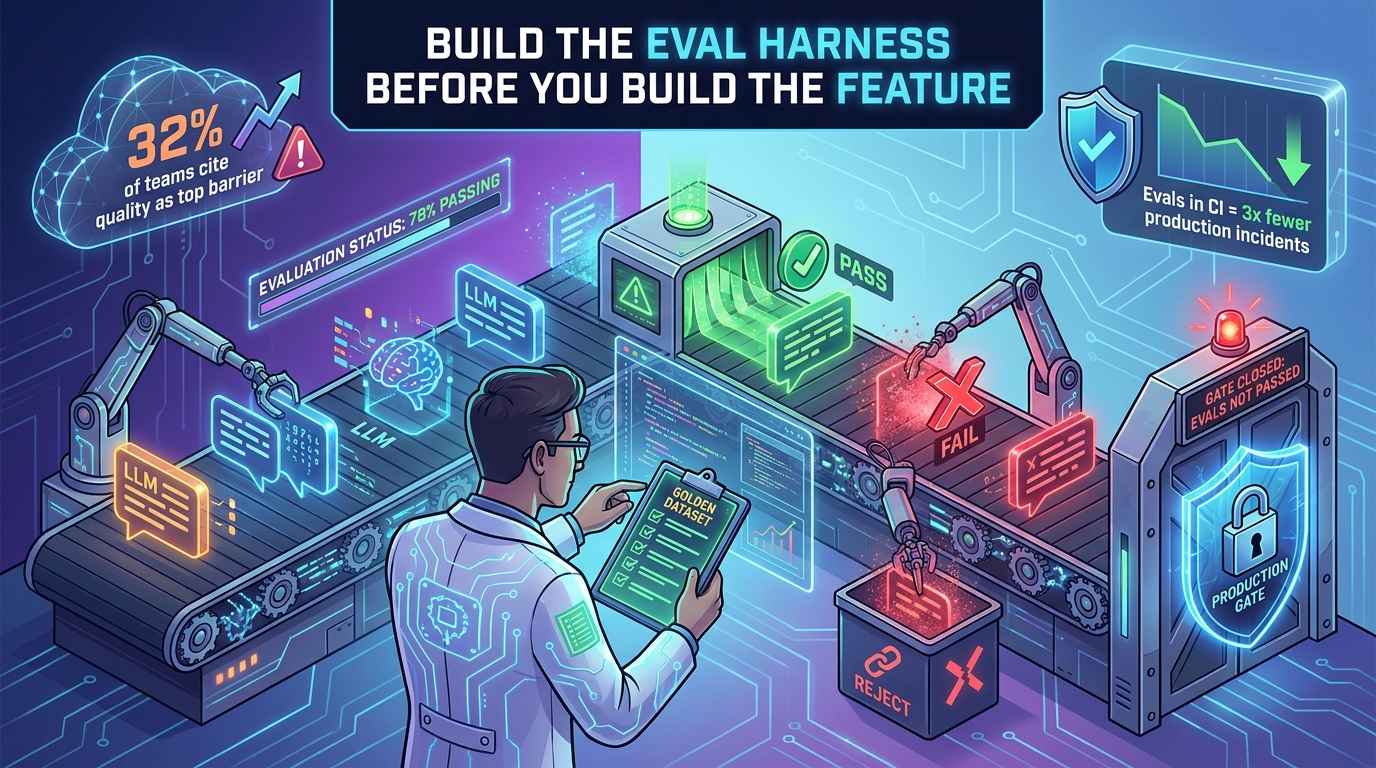
The most counterintuitive practice among fast-shipping AI teams is that they build their evaluation infrastructure before — not after — they build the workflow itself. This is eval-driven development, and it is the single practice most associated with teams that consistently ship production-quality AI quickly.
What a Golden Dataset Actually Is
An evaluation golden dataset is a curated set of inputs with known-good expected outputs against which every version of the workflow is scored. It is not a test suite in the traditional unit-testing sense: there is rarely a single correct output for an LLM call. Instead, golden datasets define criteria for what “good” means — correct facts, appropriate tone, complete task execution, absence of specific failure modes — and evaluate outputs against those criteria using a combination of automated scoring, reference comparisons, and in some cases a judge LLM.
Building the golden dataset forces product and engineering teams to agree, before any code is written, on what success looks like. This is more valuable than it sounds. Most AI projects that fail to reach production suffer from precisely this ambiguity: stakeholders have different mental models of what the workflow should do, and those differences surface only late in the development cycle when they are expensive to resolve.
Evals in CI: Gating Deployments on Quality
Once a golden dataset exists, it can be integrated into the CI/CD pipeline as a deployment gate. Every pull request that changes prompt text, model configuration, retrieval logic, or tool definitions triggers an eval run against the golden dataset. A regression in quality scores blocks the merge. This prevents prompt changes, model upgrades, and configuration drift from silently degrading production quality — a failure mode that is extremely common when AI workflows are maintained by teams without formal eval infrastructure.
LangChain’s 2026 State of AI Agents report found that 32% of organizations cite quality — hallucinations, reliability, accuracy — as the primary barrier to broader AI deployment. Eval-driven development directly addresses this barrier by making quality measurable and continuously monitored, rather than subjectively assessed at demo time.
Online Evals: Monitoring Quality in Live Traffic
Pre-production evals catch regressions before deployment. Online evals catch drift after it. Production AI systems degrade in ways that offline testing cannot anticipate: the distribution of real user inputs shifts over time, upstream data sources change, external APIs return different content, and edge cases that weren’t in the golden dataset begin appearing at scale.
Online eval pipelines continuously score a sample of live production outputs against quality criteria, surfacing quality degradation as a monitorable signal — not just an operational metric like latency or error rate. The leading teams in 2026 have automated incident response workflows that trigger when online eval scores drop below threshold, creating a feedback loop from production quality back into the eval dataset and the improvement cycle.
Governance Baked In, Not Bolted On
The fastest AI teams in 2026 are not the teams that skip governance. They are the teams that integrate governance requirements so early that governance reviews don’t slow them down. The teams that treat governance as a final gate — something to pass through before launch — reliably discover late-stage compliance blockers that send them back to architecture. This is a structural problem, not a personnel problem.
Designing for Data Minimization from Day One
Every AI workflow that processes personal, sensitive, or regulated data needs to be designed with data minimization as a first-class requirement. What is the minimum context the model needs to complete the task? Can personally identifiable information be redacted or anonymized before it enters the LLM context? Can outputs be classified and filtered before being logged?
These are not questions to answer after the workflow is built. Retrofitting data minimization into a workflow that was designed without it is expensive and often requires significant re-architecture. Teams that answer these questions in the initial design phase avoid a class of late-stage compliance failures that are among the most common causes of delayed or cancelled AI deployments.
The EU AI Act Reality in 2026
With the EU AI Act now in active enforcement across all member states, enterprise AI workflows that fall under its scope face concrete obligations: risk classification, transparency documentation, human oversight requirements, and in some cases conformity assessments. 54% of IT leaders now identify AI governance as a top enterprise risk priority — a figure that has nearly doubled in two years.
The practical implication for production AI workflow teams is that the risk classification process needs to happen at the workflow design stage, not the launch stage. A workflow that touches employment decisions, credit assessment, or safety-critical systems may face high-risk classification requirements that substantially change its architecture. Discovering this at month seven of an eight-month development cycle is a project-ending event. Discovering it in week one is a design constraint that can be accommodated.
Agentic Workflows and the Least-Privilege Principle
As AI workflows gain more agency — the ability to take actions in external systems, not just generate text — the security implications compound. An agentic workflow with broad tool permissions is a significant attack surface. Prompt injection attacks, where malicious content in retrieved documents or user inputs attempts to redirect the agent’s behavior, are a real and documented threat in 2026 production environments.
The principle of least privilege applies directly: give each tool the minimum permissions needed for its stated function. A tool that reads customer records should not be able to modify them. A tool that queries a database should have read-only credentials. Every permission that an agent does not strictly need is an attack surface that can be eliminated at design time.
The Organizational Unlock: Who Owns the Bridge?
The deployment gap is not purely a technical problem. In most organizations, it is also an ownership problem. The data science or ML team that builds the prototype and the platform or SRE team that owns production infrastructure operate under different incentives, different timelines, and different definitions of “done.” Without a clear accountable owner for the prototype-to-production transition, that transition falls into the gap between teams.
The Rise of the AI Platform Engineer
The emerging solution is a distinct role: the AI platform engineer, or AI infrastructure engineer, whose explicit responsibility is building and maintaining the production infrastructure for AI workflows. This is not the data scientist who built the model, and it is not the SRE who manages the existing application stack. It is a hybrid role that understands both LLM system design and production engineering well enough to bridge the gap.
In 2026, the demand for this profile has outstripped supply significantly. Organizations that cannot hire or develop this capability internally are increasingly turning to platform teams that can provide AI production infrastructure as an internal service — a shared capability that multiple workflow teams can deploy on top of, rather than each team solving the production engineering problem independently.
The Internal Developer Platform Pattern
The fastest-shipping AI organizations have a platform layer that abstracts production complexity away from the teams building individual workflows. Deployment to production follows a self-service path: the workflow team defines their use case, the platform provides the guardrails, observability hooks, deployment scaffolding, and governance gates as infrastructure. The workflow team doesn’t need to be experts in production AI engineering to ship safely — that expertise is baked into the platform.
This pattern is directly borrowed from the internal developer platform (IDP) movement in software engineering, where platform teams build golden paths to production that application teams follow without needing to reinvent infrastructure. It scales AI deployment capability across the organization rather than concentrating it in a single team or requiring every team to independently develop production AI competence.
Governance as a Service
Similarly, the compliance and governance review process can be productized rather than ad-hoc. Organizations that have deployed five or more AI workflows have typically encountered the same set of governance questions repeatedly. Documenting those questions, the acceptable answers, and the workflow design patterns that satisfy them creates a reusable governance asset. New workflow teams can self-service most of the compliance review by following documented patterns, reserving human legal and compliance review for genuinely novel risk scenarios.
Speed Patterns from Teams Shipping in Days, Not Months
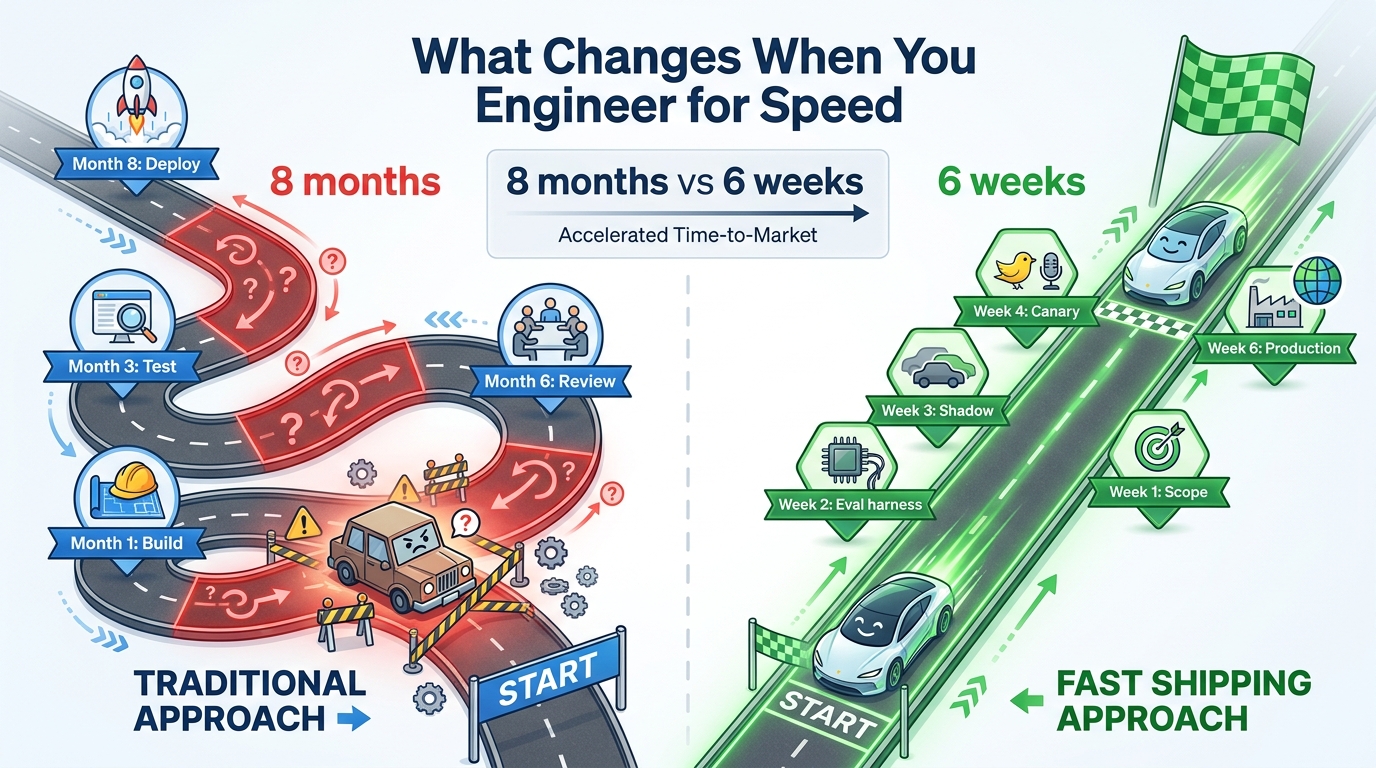
Across the case studies and patterns that have emerged in 2026, the teams shipping production AI workflows in days to six weeks share a recognizable set of practices. These are not theoretical best practices — they are the observable behaviors of teams achieving 30-to-60-day production timelines in an environment where the average is eight months.
Scope First, Build Second
Fast teams scope obsessively before they build. The scope definition includes not just what the workflow does, but what it explicitly does not do, what data sources are in scope, what error handling is expected, and what integrations are required. This scope document serves as the acceptance criteria for the golden dataset and as the specification that production engineering reviews against. It prevents the scope expansion that is the primary cause of prolonged development cycles.
The scope definition also includes a deliberate decision about what to exclude from the first production version. AI workflow teams that try to handle every edge case in v1 routinely spend months on cases that represent a small fraction of real usage. Fast teams ship a v1 that handles 80% of use cases cleanly, with defined fallback behaviors for the remaining 20%, and iterate from production data rather than trying to anticipate every scenario in pre-production.
The Week-One Eval Harness
Before any agent logic is written, fast teams build the evaluation harness. This means defining the golden dataset, specifying the evaluation criteria and scoring methodology, and integrating the eval runner into the CI pipeline. When the first agent code is written, it is immediately tested against real quality criteria — not just manually inspected and declared “good enough.”
This front-loading of evaluation infrastructure pays compounding returns. Every subsequent iteration is scored automatically. Regressions are caught immediately. The team always knows where quality stands relative to the baseline. The eval harness also serves as documentation: the golden dataset is, in effect, a specification of intended workflow behavior that is executable and measurable.
Platform-First Deployment
Fast teams deploy on established infrastructure rather than building production infrastructure from scratch. Whether that is an internal AI platform, a managed orchestration service, or a well-documented cloud-provider AI workflow service, the key is that the deployment target has established patterns for logging, security, scaling, and monitoring. The team writes workflow logic; they do not provision observability infrastructure, configure network security groups, or build retry logic from scratch.
This is why internal AI platforms have emerged as such a strong organizational investment. The marginal time cost of deploying a new workflow on an established platform is measured in days. The marginal time cost of deploying on bespoke, per-workflow infrastructure is measured in months.
Production Starts at Shadow, Not at Full Rollout
Fast teams define “going to production” as starting the shadow deployment — not completing the full rollout. This mental model shift matters. When shadow deployment is production, the team begins collecting real-world performance data immediately after the workflow passes eval gates. The canary and staged rollout phases happen in production, with real data and real feedback loops, rather than in an extended pre-production staging environment.
This approach compresses the feedback cycle from weeks (waiting to go to production) to days (analyzing shadow data from day one). It also catches a class of issues that staging environments never reveal: behavior drift driven by the specific distribution of real user inputs that only appears when the full breadth of production traffic is represented.
Organizational Loops That Close Quickly
Technical speed is necessary but not sufficient. Fast teams also have short organizational feedback loops: product decisions get made quickly, governance reviews are integrated into the workflow from the start rather than scheduled at the end, and stakeholder sign-off happens against measurable eval criteria rather than subjective demos. When the acceptance criteria are defined in week one, the sign-off process in week six is a data review, not a negotiation.
A Practical Six-Week Shipping Framework
Based on the patterns observed in fast-shipping teams, a practical production workflow can be organized into six two-week phases. This is not a rigid methodology — it is a structural template that the fastest teams approximate in practice.
Weeks 1–2: Define and Instrument
Define the workflow scope with production-level specificity: inputs, outputs, integrations, error handling, compliance constraints. Build the golden dataset (aim for 50–200 high-quality examples covering the primary use cases and known edge cases). Set up the observability and eval infrastructure. Choose the orchestration framework and confirm the deployment target. By the end of week two, the team should be able to score any workflow version against measurable quality criteria.
Weeks 3–4: Build and Test
Build the workflow against the eval harness. Evals run on every commit. The target is not a perfect score — it is a score that meets the pre-defined acceptance threshold for shadow deployment. Load test against realistic concurrency and token consumption profiles. Profile costs against usage projections. Complete the governance review against the documented scope.
Weeks 5–6: Shadow and Canary
Deploy to shadow mode. Collect real traffic data. Compare outputs against the existing system (or against baseline behavior if this is a new capability). Analyze failure modes. Tune the workflow and update the golden dataset with any new failure cases discovered in shadow. Launch canary at 5%. Monitor quality metrics alongside technical metrics. Graduate the rollout in stages based on automated monitoring gates.
At week six, the workflow is in production. Not perfect — but live, observable, and improving from real data rather than synthetic assumptions.
Closing the Gap: The Decisions That Actually Move the Timeline
The deployment gap between AI playground and production is real, expensive, and largely preventable. It persists not because AI is hard to build, but because production AI requires a different engineering discipline than prototype AI — one that most organizations are still developing.
The 48% of AI projects that successfully reach production are not better at prompt engineering than the 52% that don’t. They are better at data pipeline design, eval infrastructure, progressive delivery, and organizational ownership of the transition process. They treat the workflow as a production system from day one, not a demo that eventually needs to be hardened.
The gap is closing. The tooling has matured, the patterns have crystallized, and the 30-to-60-day production timelines that were exceptional two years ago are increasingly achievable for well-scoped workflows on established platforms. But the teams achieving those timelines are making specific, concrete decisions differently — and those decisions need to be made in week one, not at the end of a six-month build.
The Decisions That Matter Most
- Define “done” in measurable terms before writing code. What does a good output look like, and how will you score it?
- Build the eval harness in week one. If you can’t measure quality, you can’t ship safely.
- Choose a deployment target with established infrastructure. Per-workflow production engineering is a timeline killer.
- Run governance review alongside the build, not after it. Late compliance blockers are the most common cause of delayed AI launches.
- Start production at shadow mode. Real traffic data is worth more than any staging environment.
- Scope for 80% in v1. Ship the workflow that handles the common cases cleanly and iterate from production data.
- Own the transition. Designate a person or team accountable for taking the workflow from prototype to production. This role cannot be assumed to be covered by implication.
The playground is for learning. Production is where the value is created. The bridge between them is built from engineering discipline, not model quality — and in 2026, the teams that understand this distinction are the ones setting the pace.