


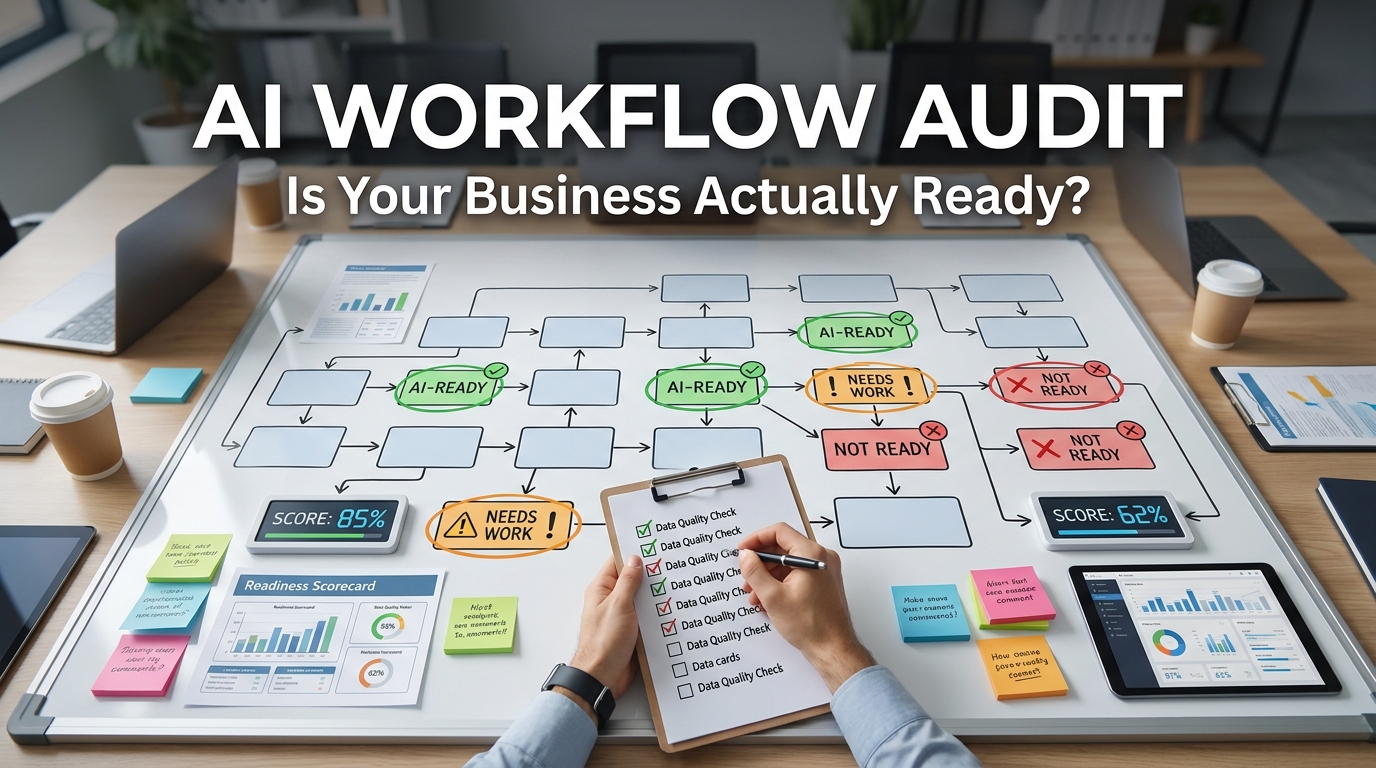

Here is the uncomfortable number that should sit at the top of every AI strategy conversation: 74% of enterprise leaders believe their organization is audit-ready for AI. Only 27% actually are. That gap — according to Schellman research cited in 2026 — is not a rounding error. It is a structural problem rooted in the distance between what leadership assumes about their processes and what those processes look like on the ground.
Most businesses do not fail at AI because the technology does not work. They fail because the workflows that AI is supposed to improve were never properly mapped, the data feeding those workflows was never properly assessed, and the governance framework required to operate AI responsibly was never built. The tool arrives before the foundation is ready, and the project collapses under its own weight.
An AI workflow audit is the diagnostic step that most organizations skip entirely. It is not a readiness questionnaire you fill out in an afternoon, and it is not a vendor-led discovery call designed to sell you software. It is a structured, evidence-based review of how your business actually operates — not how your process documentation says it operates — followed by a clear, prioritized picture of where AI can create durable value and where it will break things instead.
This guide walks through how to conduct that audit properly. Not as a theoretical framework exercise, but as a practical operating model you can run inside a real business, with real constraints, in roughly 30 days. Every section is grounded in what the research and the practitioner community have consistently found to be the actual blockers — not the aspirational ones.
If you have been burned by an AI pilot that went nowhere, or if you are preparing to launch one and want to avoid the same fate, this is where to start.
Start With the Workflow, Not the Tool
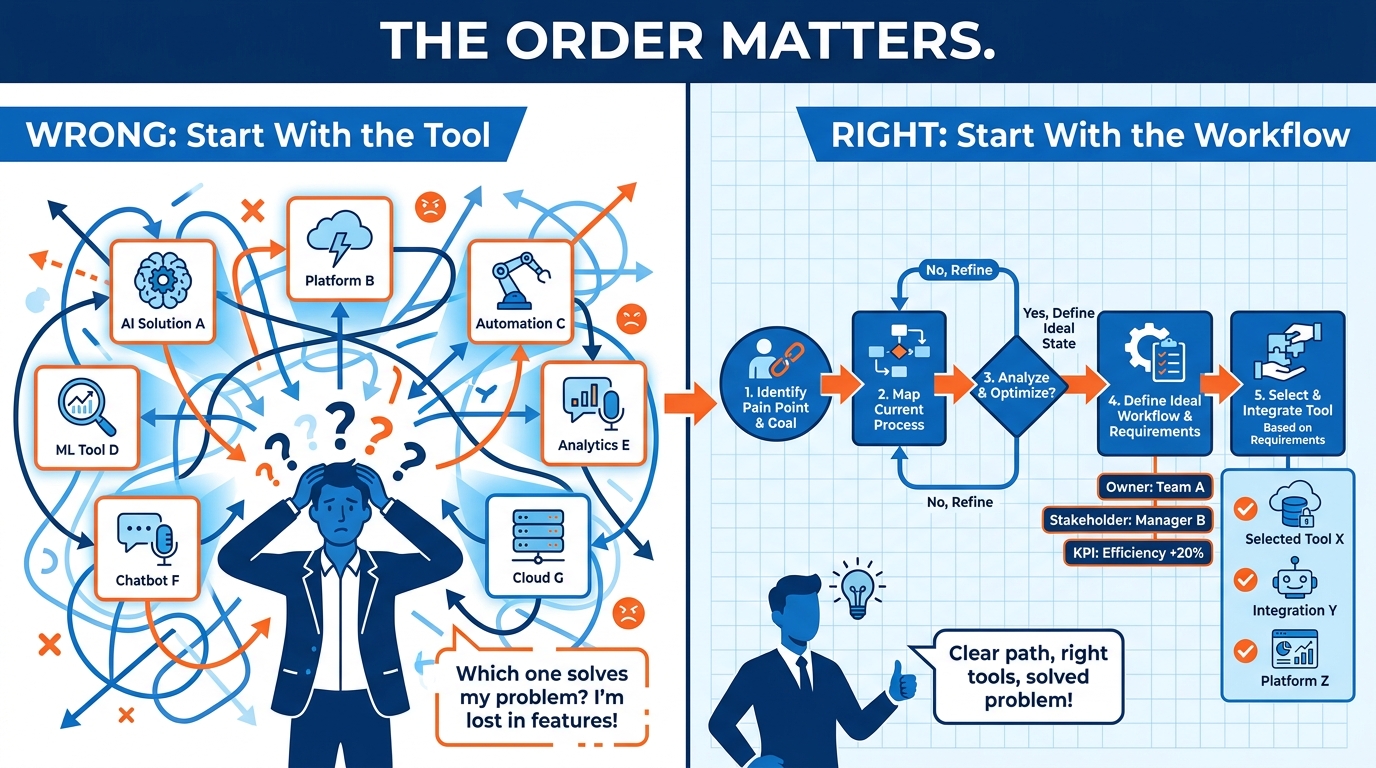
The single most common mistake businesses make when approaching AI adoption is choosing the tool before understanding the work. A team identifies a technology — an AI writing assistant, a document processing platform, an agentic workflow tool — and then goes looking for processes to apply it to. This is backwards, and it produces predictably poor results.
McKinsey’s research in 2026 found that only 11% of organizations have reached what it calls the “reinvention” stage — where workflows are genuinely redesigned around AI rather than having AI layered on top of existing processes. The other 89% are still in adoption mode: using AI to do the same work slightly faster, without fundamentally improving how the work is done. The distinction matters enormously for ROI.
Why Tool-First Thinking Fails
When you start with the tool, you inherit its assumptions. Every AI platform is designed with particular workflow patterns in mind, and if your processes do not match those patterns, the implementation requires workarounds. Those workarounds accumulate. Within six months, your “AI-powered” process looks like a patched-together hybrid that is slower than what you had before and harder to troubleshoot.
Tool-first thinking also creates a political problem. When a specific technology is already on the table, the audit becomes a justification exercise rather than a genuine assessment. Teams feel pressure to find use cases that fit the tool rather than honestly evaluating whether the tool fits their actual needs. The audit loses its diagnostic value before it has even started.
The Workflow-First Approach
A workflow-first audit begins with a simple question: What work actually happens here, and what does it cost to do it? Before any technology enters the conversation, you need a clear map of your business processes — not the version that lives in your procedure manual, but the version that reflects what people actually do on a Tuesday afternoon when three things need to happen at once.
This means sitting with the people doing the work, not just the managers describing it. It means looking at system logs, email threads, spreadsheet hacks, and the informal handoffs that nobody has ever bothered to document. The goal is to close the gap between your official process map and the real one — because AI will operate on the real one, not the official version.
Once the real workflows are visible, the tool selection question becomes much easier to answer with rigor. You are no longer asking “what can this tool do?” You are asking “what does this specific process need, and is there an AI capability that matches that need well enough to justify the implementation cost?”
The discipline of workflow-first auditing is also a forcing function for process improvement that has nothing to do with AI. Most organizations that go through the exercise discover at least two or three processes that are inefficient not because they lack AI, but because they are poorly designed. Fixing those first makes any subsequent AI implementation cleaner, faster, and cheaper to maintain.
The Five Signals That a Process Is Worth Auditing for AI
Not every business process is a candidate for AI automation, augmentation, or oversight. Part of a good audit is being selective — knowing which processes to spend time on and which to park. There are five reliable signals that a process is worth evaluating seriously.
Signal 1: High Volume, Low Variation
The strongest candidates for AI are processes that happen many times — daily, weekly, or at scale across many customers or employees — and that follow a consistent pattern most of the time. Invoice processing, customer ticket triage, order confirmation, report generation, and data extraction from structured documents all fit this profile. The higher the volume and the more predictable the pattern, the stronger the case for automation.
Low-volume, high-complexity processes are generally poor AI candidates at the audit stage. They might become candidates later, once simpler processes have been automated and the team has built operational experience with AI systems. But starting there is a mistake.
Signal 2: Measurable Pain
A process worth auditing has a clear, quantifiable problem. Cycle time is too long. Error rate is too high. Staff are spending a disproportionate share of their time on it relative to its strategic value. Customer satisfaction drops at this step. There is a growing backlog that the current team cannot clear.
If the pain cannot be measured, it cannot be used to evaluate whether AI actually helped. You need a baseline to compare against. Processes with no measurable baseline should be baselined first — before any AI work begins.
Signal 3: Structured or Semi-Structured Data
AI performs best when the inputs to a process are consistent and structured. Processes that rely on forms, databases, spreadsheets, CRM records, or standardized documents are generally good candidates. Processes that depend primarily on unstructured communication — loose email chains, verbal agreements, highly contextual judgment calls — are harder and riskier to automate.
Semi-structured data (PDFs with variable formatting, email with extractable fields, mixed-format reports) can work, but it requires more validation and more human oversight during the early phases of deployment.
Signal 4: Clear Success Criteria
An AI-ready process is one where success can be defined unambiguously in advance. “The invoice was processed correctly” has a clear yes/no answer. “The customer inquiry was handled well” is significantly harder to define. Processes with fuzzy success criteria create a governance problem: if you cannot define what correct looks like, you cannot build the evaluation system that catches errors, and you cannot prove that the AI is performing acceptably.
Signal 5: Named Ownership
Every process that enters the audit should have a named owner — a specific person who is responsible for its performance, who can answer questions about exceptions and edge cases, and who will be accountable for outcomes after AI is introduced. Ownerless processes are audit dead-ends. Even if everything else checks out, an AI implementation without a clear human owner will drift, accumulate technical debt, and eventually fail silently.
Shadow AI and the Hidden Processes Nobody Mapped

Before you can audit what you intend to automate, you need to surface what is already being automated — with or without your knowledge. Shadow AI is one of the most significant and least discussed complications in any serious AI workflow audit, and the numbers are striking.
According to 2026 governance research, 59% of audit, GRC, and IT leaders are concerned about shadow AI — employees using AI tools that have not been reviewed, approved, or inventoried by the organization. Only 34% of organizations have an AI model inventory, and just 31% have AI incident-response procedures in place. Meanwhile, only 18% are actively blocking unauthorized AI tool domains.
Why Shadow AI Complicates the Audit
Shadow AI matters to a workflow audit for two reasons. First, it means some of your processes have already been partially automated — but in ways that are undocumented, unmonitored, and not governed. Employees have built personal workflows around ChatGPT, Claude, Copilot, or any number of specialized tools. Those workflows are doing real work. They are shaping outputs. They may be handling sensitive data. And nobody has reviewed them.
Second, shadow AI creates a false picture of your baseline. If you are trying to measure how long a process takes or what error rate looks like, but half your team is already using AI informally to complete parts of that process, your baseline is contaminated. You are not measuring the unaugmented process — you are measuring a hybrid of human and AI work that was never designed, documented, or validated.
How to Surface It
An effective shadow AI discovery process has three components. The first is a workflow interview protocol where you ask the people doing the work — not their managers — directly: “What tools do you use to complete this task?” and “Are there any workarounds, shortcuts, or tools you’ve added on your own that aren’t officially part of the process?” Most employees will answer honestly if the conversation is framed as discovery rather than compliance enforcement.
The second component is a systems and application inventory. Work with IT to pull a list of SaaS applications in use across the organization — browser extensions, API connections, and third-party integrations included. One audit firm documented 2,493 applications in active use within their organization when they had initially estimated around 200. That scale of gap is not unusual.
The third component is a data flow mapping exercise that tracks where sensitive or proprietary information is going. If employees are pasting customer data, internal pricing, or confidential communications into external AI tools, that is both a governance risk and a data contamination issue that will affect the quality of your AI audit findings.
What to Do With What You Find
The goal of shadow AI discovery is not to punish employees for being resourceful. It is to bring informal automation into the formal audit scope, evaluate whether it is safe to continue, document the workflows involved, and decide whether to formalize, replace, or discontinue each one. In many cases, shadow AI discoveries become the highest-value use cases in the entire audit — because they represent problems employees cared enough to solve on their own, without waiting for IT approval.
Building Your Workflow Map Without It Becoming a Whiteboard Exercise
Every AI consultant will tell you to “map your workflows.” Very few explain how to do it in a way that produces something useful rather than a large, beautiful diagram that nobody ever looks at again. The discipline of workflow mapping for an AI audit is different from general process documentation — it has a specific objective and a specific level of resolution.
What the Map Needs to Capture
For AI audit purposes, a workflow map needs to capture six things for each process under review:
- The trigger: What initiates the process? Is it a time-based event, a customer action, an internal system event, or a human decision?
- The steps and decision points: Every discrete action and every fork in the road, including the informal ones that are not in the official documentation.
- The data inputs and outputs: What information flows in, what systems it comes from, what is produced, and where it goes.
- The handoffs: Every point where work moves between people, teams, or systems. These are almost always where delays, errors, and bottlenecks concentrate.
- The exceptions: What happens when the standard path breaks? How often does it happen? Who handles it?
- The time and volume metrics: How long does each step take? How many instances of this process run per day, week, or month?
Process Mining as a Shortcut
If your processes run through ERP, CRM, service management, or financial systems, process mining tools can reconstruct the actual workflow from system event logs — automatically and with much higher fidelity than manual documentation. Rather than asking people to describe what they do, you can observe what the data shows they actually did, across thousands of cases.
Process mining is particularly valuable for discovering deviation patterns: cases where the standard process was not followed, steps were skipped, work was returned for rework, or unusual sequences emerged. These deviations are often where the highest AI value lives — because they indicate either a poorly designed process or a category of exceptions that would benefit from better classification and routing.
The pre-work for process mining is worth understanding before you commit to it. You need confirmed event-log fields (case IDs, timestamps, activity names, user IDs), source system access, privacy and legal approvals for the data being analyzed, and a named owner who can interpret what the data shows. Without those foundations, process mining produces confusing output rather than actionable insight.
Resolution Matters: Neither Too Broad Nor Too Granular
One of the most common workflow mapping mistakes is choosing the wrong level of resolution. Too broad — “customer onboarding” as a single box — and the map tells you nothing about where AI can actually be inserted. Too granular — mapping every mouse click — and the exercise becomes impossible to maintain and irrelevant to strategic decisions.
For an AI audit, the right resolution is the task level: discrete units of work that have a clear beginning, a clear end, a defined input, and a defined output. “Review submitted application for completeness” is a task-level step. “Customer onboarding” is a process that contains many such steps. The former is mappable, scoreable, and actionable. The latter is not.
Scoring Each Workflow: The Rubric That Cuts Through Opinion
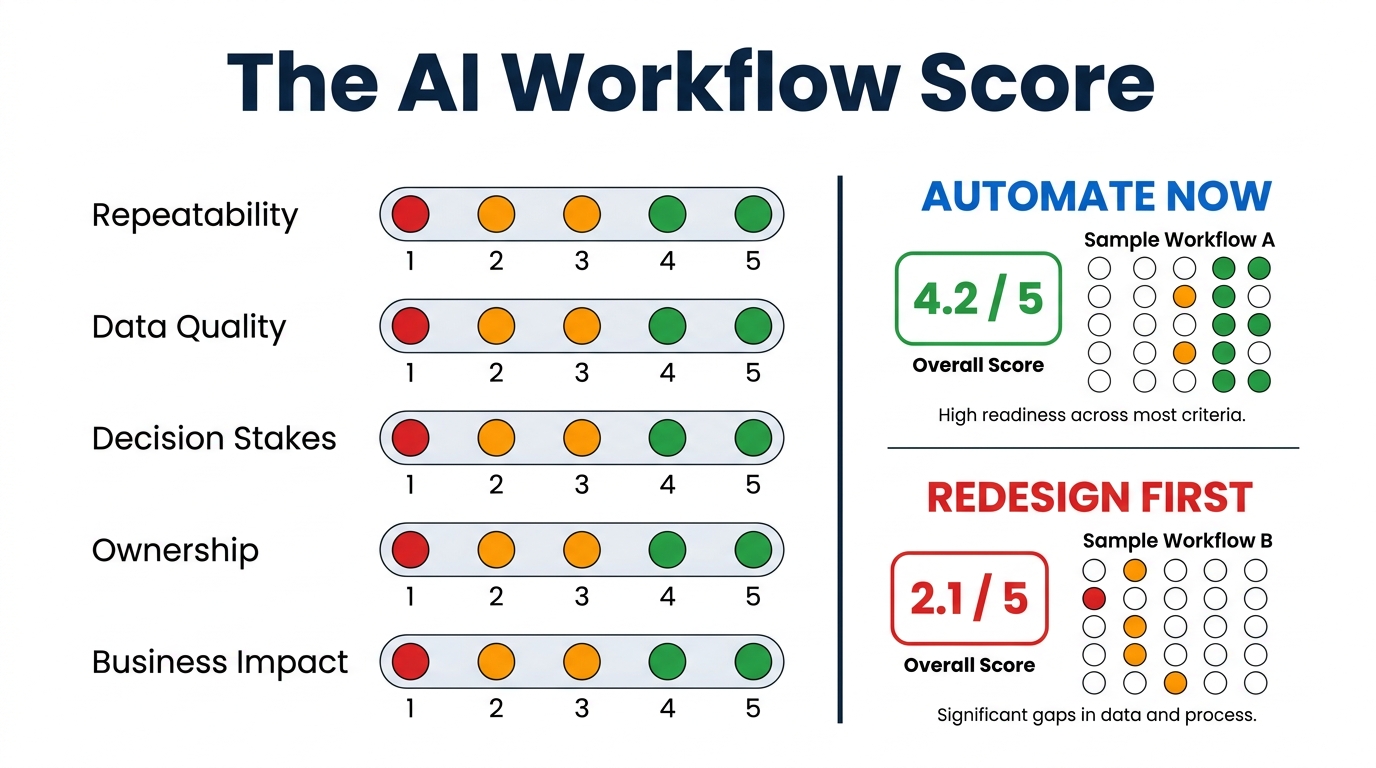
Once workflows are mapped, the audit moves into its most operationally valuable phase: scoring. Without a scoring rubric, AI prioritization decisions become political. The loudest department wins, or the most expensive pilot gets approved because of seniority rather than merit. A rubric forces the conversation to be evidence-based.
The strongest 2026 frameworks converge on five scoring dimensions. Each is rated on a scale — a simple 1–5 per dimension works well — and the composite score determines whether a workflow is a priority candidate, a redesign-first candidate, or a long-term consideration.
Dimension 1: Repeatability (1–5)
How consistently does this process run the same way? A score of 5 means the process is highly standardized — the same inputs reliably produce the same outputs, with few exceptions and minimal human judgment required. A score of 1 means the process is highly variable — context-dependent, exception-heavy, and reliant on tacit knowledge that is difficult to document.
Repeatability is the foundation of automation feasibility. An AI system trained or configured for a process will perform well when the process is consistent and poorly when it is not. Low repeatability scores should trigger a process redesign conversation before any AI work begins.
Dimension 2: Data Quality (1–5)
How complete, accurate, consistent, timely, and accessible is the data this process depends on? This is scored separately from data availability — a dimension discussed in depth in the next section. A process can have abundant data (score that as available) but data that is incomplete, inconsistently formatted, or poorly labelled (score that as low quality). The distinction is important.
Dimension 3: Decision Stakes (1–5, inverted)
Note that this dimension is inverted: a high score on decision stakes is a lower overall readiness indicator. Decision stakes measures how serious the consequences are if the AI makes a mistake. Low-stakes errors (a draft email has a minor tone issue) are recoverable and acceptable. High-stakes errors (a credit decision is made incorrectly, a patient is given wrong medication instructions) require human oversight and a much more careful implementation approach.
When scoring, use a low number (1–2) for high-stakes processes where AI errors could cause serious harm, regulatory violation, or significant customer impact. Use high numbers (4–5) for low-stakes processes where errors are easily caught and corrected.
Dimension 4: Ownership Clarity (1–5)
Is there a named process owner who understands it well, is accountable for its outcomes, and will accept responsibility for monitoring AI performance after deployment? Ownership clarity is a governance prerequisite, not a nice-to-have. Processes with ambiguous or contested ownership tend to produce AI implementations that are not monitored, not improved, and not caught when they degrade.
Dimension 5: Business Impact (1–5)
If AI were deployed and performing well on this process, what would the measured business impact be? This score should be tied to a specific metric: time saved per week, cost per transaction reduced, error rate improvement, customer satisfaction score change. Processes with a clear, quantifiable impact case score 4–5. Processes where the business case is vague or speculative score 1–2.
Interpreting the Composite Score
Add the five dimension scores. The resulting composite (out of 25, adjusted for the inverted stakes dimension) places each workflow into one of three bands:
- 18–25: Automate Now. High-readiness candidates where the data, process, ownership, and business case are all strong. These should be the first pilots.
- 10–17: Redesign First. Processes with potential but with specific gaps — usually in data quality, repeatability, or ownership — that need to be addressed before AI deployment will be reliable.
- Below 10: Long-Term Consideration. Either the business case is not compelling enough, or the structural gaps are too significant to address in a near-term initiative. Park these and revisit in 12–18 months.
Data Readiness vs. Data Availability: Why They’re Not the Same Thing
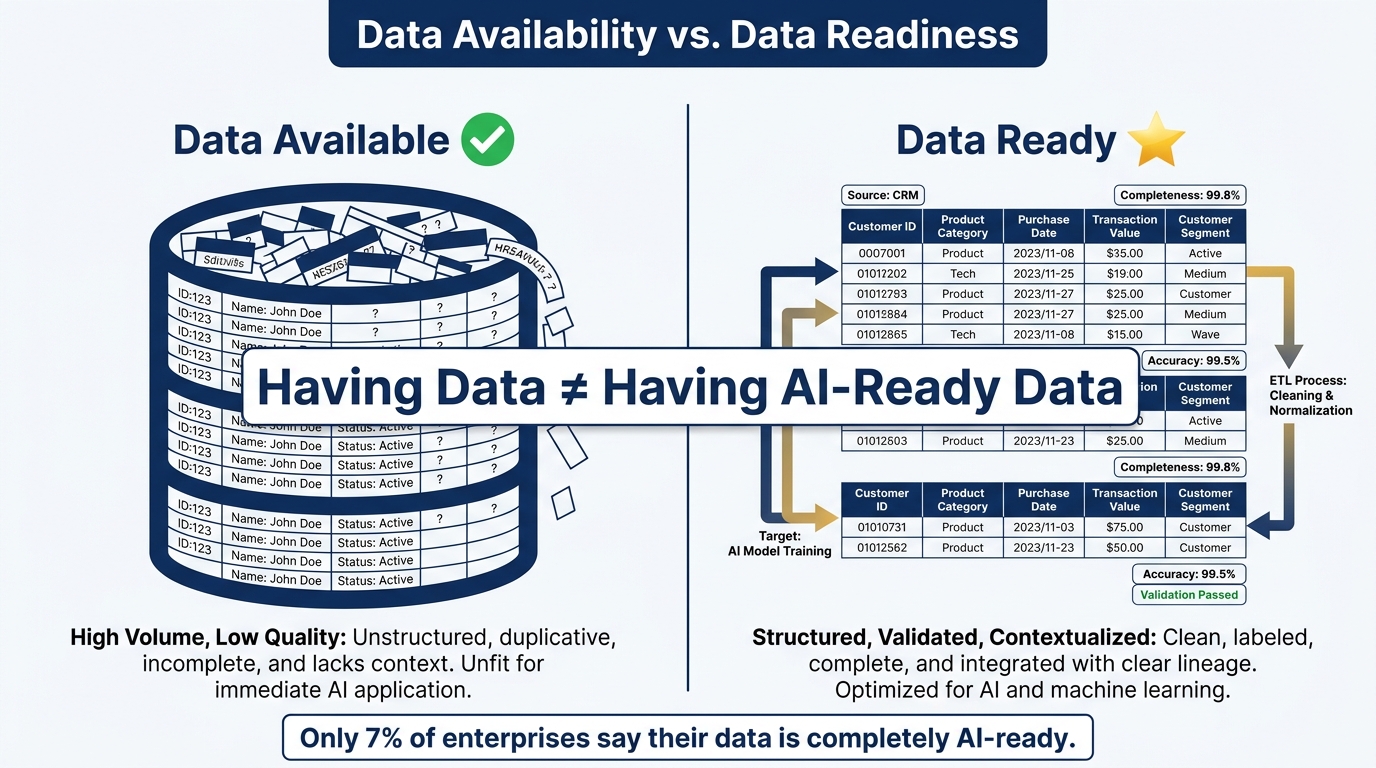
The most common misdiagnosis in an AI audit is confusing data availability with data readiness. Organizations frequently say “we have years of data on this process” as evidence that it is ready for AI — and then discover, six months into implementation, that the data they have is not usable in the form it exists.
The research confirms this gap is nearly universal. 87% of business leaders say their data is AI-ready. Independent assessments that include both leaders and practitioners put that number far lower. One benchmark found only 7% of enterprises report their data as completely AI-ready when specific criteria are applied. The gap between self-assessment and reality is not a matter of degree — it is an order of magnitude.
The Seven Data Readiness Criteria
A data readiness assessment for AI should check seven distinct properties, each of which must pass independently for the data to be considered fit for purpose.
Completeness. Are there significant gaps in the dataset? Missing fields, missing records, or periods where data was not captured? AI models trained on incomplete data learn incomplete patterns — and those patterns will surface as errors in production.
Accuracy. Does the data reflect reality? This requires sampling and validation, not just trust. Common accuracy problems include incorrectly coded fields, manual entry errors, and system migration artefacts where data was transformed incorrectly during a platform switch.
Consistency. Is the same information represented the same way across different systems and time periods? “United States,” “US,” “USA,” and “U.S.” are the same country but four different values if the data is not harmonized. Inconsistency at scale makes pattern recognition unreliable.
Timeliness. Is the data current enough to be representative of how the process works today? Data that accurately reflected a process three years ago may be misleading if the process has changed since. This is particularly important after system migrations, organizational restructurings, or significant regulatory changes.
Uniqueness. Are there duplicate records that would skew analysis or introduce noise into training data? Duplicates are particularly common in CRM and customer data, where the same entity may exist under multiple records created through different channels.
Accessibility. Can the data actually be retrieved in a usable format? Data locked in legacy systems, stored in formats that require specialized tools to read, or sitting behind access controls that require weeks of approval to navigate is not practically accessible — even if it technically exists.
Lineage and Traceability. Can you trace where the data came from, how it was transformed, and who handled it? Data lineage is essential for governance and for debugging AI errors. If an AI makes a wrong decision and you cannot trace it back to a specific data input or transformation, you cannot fix the root cause.
What to Do When Data Fails the Assessment
When a process has strong scores on every dimension except data readiness, the appropriate response is not to abandon the AI use case. It is to define a data remediation plan with a clear timeline and cost estimate, and to factor that into the overall prioritization decision. Some data quality problems can be fixed in weeks. Others require significant engineering work spanning months.
The audit should surface these costs explicitly. A process that looks attractive on repeatability and business impact may be the wrong first choice if data remediation would take eight months and cost more than the projected AI savings. A slightly lower-scoring process with clean, accessible data may produce faster, cheaper, and more reliable results.
Governance, Ownership, and the “Who Owns the Mistake?” Test
Governance is the dimension of AI audits that gets the most discussion in policy documents and the least real attention in practice. Most organizations have governance frameworks that exist on paper — policies, committees, approval workflows — and AI implementations that operate entirely outside those frameworks because nobody connected them.
The practical governance gap is significant. In 2026 research, only 31% of organizations have AI incident-response procedures, and just 34% have a model inventory. This means that even in organizations with formal AI governance policies, the majority do not know what AI systems they are running, and they do not have a defined response when one of those systems fails.
The “Who Owns the Mistake?” Test
The most practical governance question you can ask during an audit is: “If this AI makes a consequential mistake, who is accountable, and what happens next?” Walk through the answer for each candidate workflow. Be specific. Name the person. Describe the consequence. Explain the remediation path.
If the answer is unclear, vague, or produces disagreement in the room, the governance foundation for that process is not ready for AI deployment. This does not mean the process cannot become AI-ready — it means there is governance work to do before deployment, not after.
The Four Governance Elements Every AI Workflow Needs
Named ownership. A specific individual (or role, with a specific backup) who is responsible for monitoring performance, responding to errors, and approving changes. Not a committee. Not “the AI team.” A person.
Documented decision authority. A clear written statement of what the AI is authorized to decide, act on, or output without human review — and what it is not. The boundary between autonomous AI action and human-required approval should be explicit, not assumed.
An error-detection and escalation path. How will the organization know if the AI is performing below acceptable thresholds? What metric triggers a review? Who reviews it? What happens if the review finds a problem? These questions should have documented answers before deployment, not improvised answers after something goes wrong.
An audit log. Every consequential AI decision or output should be logged in a format that can be reviewed, reproduced, and traced. This is not just a compliance requirement — it is the mechanism by which you improve the system over time. Without logs, you are flying blind.
Regulatory Considerations for 2026
The governance landscape for AI is moving quickly. The EU AI Act’s requirements are increasingly influencing how organizations document and govern AI systems — not just in Europe but globally, as multinational businesses standardize on the more demanding framework. High-risk AI use cases (those involving employment decisions, credit assessments, customer-facing scoring systems, and healthcare applications) face explicit requirements for documentation, human oversight, and conformity assessment.
Even if your business is not currently subject to specific AI regulation, building governance documentation now is a form of operational insurance. The businesses that will struggle most as the regulatory environment tightens are the ones that deployed AI at scale with minimal documentation and are now retroactively trying to prove that their systems behaved acceptably.
The Human Handoff Architecture — Where AI Should Stop and People Should Start
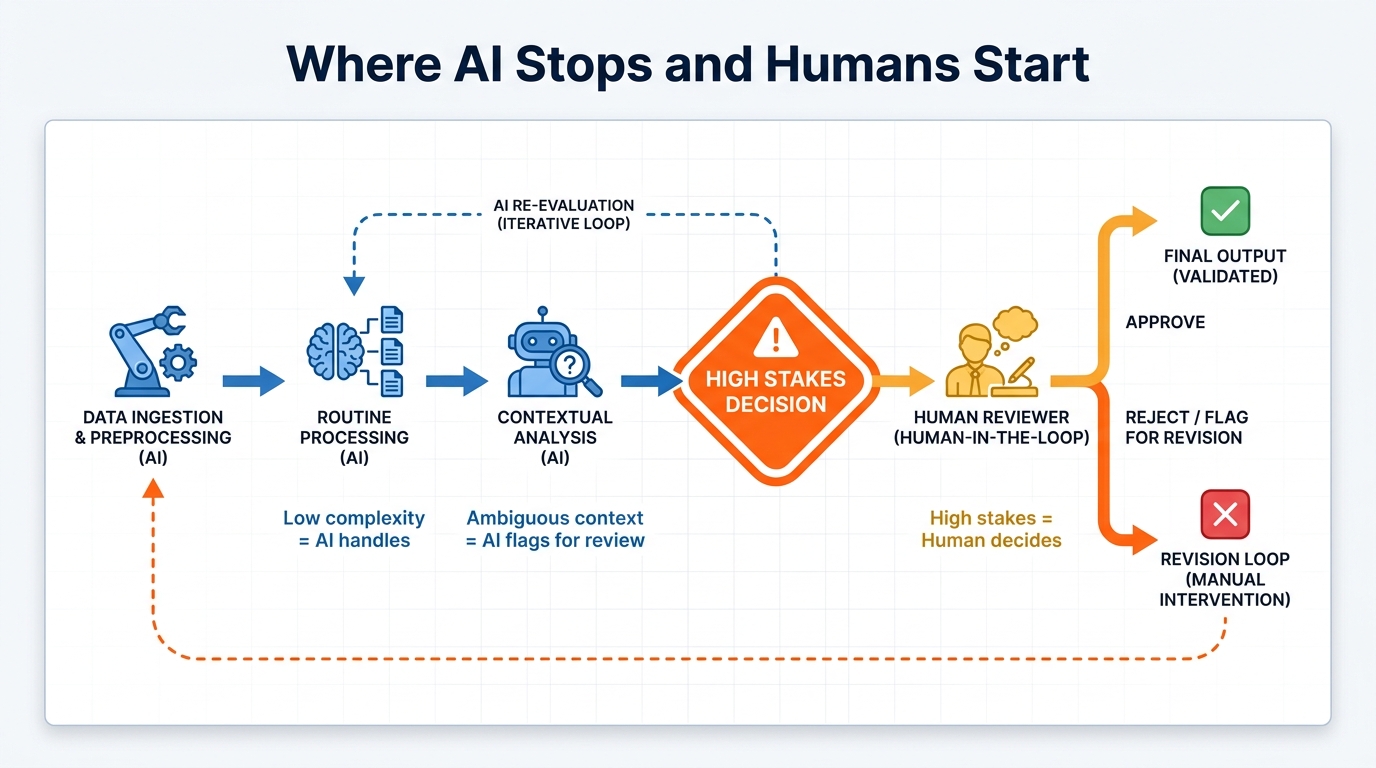
One of the most consequential design decisions in any AI workflow is determining exactly where human involvement is required. Not as a general principle — “humans should be involved when stakes are high” — but as a specific, documented architecture that defines the precise conditions under which AI output is used directly, flagged for review, or overridden entirely.
Most AI implementations get this wrong in one of two directions. They either automate too aggressively — removing human oversight from decisions that warrant it — or they automate too conservatively, requiring human sign-off on every output and eliminating most of the efficiency gain. The audit phase is the right time to design the handoff architecture deliberately, before it gets set by default.
Three Zones of AI Action
Zone 1: Autonomous action. The AI processes the input and produces an output that is used directly, without human review. Appropriate when the decision is low-stakes, the process is highly repeatable, the data quality is high, and the error rate in testing falls below an acceptable threshold. Examples: routing a support ticket to the right team, extracting structured fields from a standard form, generating a first-draft summary of a meeting transcript.
Zone 2: AI-assisted with human review. The AI produces a recommendation or draft, and a human reviews it before it is acted upon. Appropriate when the stakes are moderate, the context is occasionally ambiguous, or the error consequences are recoverable but non-trivial. Examples: drafting a customer response email, generating a risk flag on a new vendor, producing a contract clause suggestion from a template library.
Zone 3: Human-led with AI support. The human makes the decision; the AI provides relevant information, analysis, or options to inform that decision. Appropriate for high-stakes decisions, novel situations without historical precedent, legally or ethically sensitive determinations, and cases where the AI confidence score is below an established threshold. Examples: employee performance assessments, credit decisions above a defined threshold, clinical recommendations, or any decision with significant downstream consequences for a third party.
Designing the Escalation Triggers
The boundary between zones should be defined by explicit, measurable triggers — not by general principles. A trigger is a specific condition that moves a case from one zone to the next. Examples of well-designed triggers include:
- AI confidence score below a defined threshold (e.g., below 0.75 on a classification task)
- Input contains certain flagged terms or categories (e.g., mentions of legal, regulatory, or medical content)
- Output deviates from the expected distribution by more than a defined margin
- The case involves a customer or account flagged for elevated attention
- The value of the transaction or decision exceeds a defined amount
These triggers should be documented in the workflow specification and reviewed by both the process owner and a governance stakeholder before deployment. They should also be reviewed quarterly, because the appropriate thresholds for a process in its first month of AI deployment are often more conservative than what is appropriate after six months of validated performance data.
Turning Audit Findings Into a Prioritized Action Plan
An audit that produces a comprehensive set of findings but no prioritized action plan has not been completed. The entire value of the exercise lies in what happens next — and the transition from diagnostic findings to actionable roadmap is where most audits either crystallize into clear direction or dissolve into a list of recommendations that nobody implements.
The Priority Matrix
After scoring all candidate workflows and completing the data and governance assessments, the prioritization step uses a two-axis matrix: implementation readiness (composite score from the rubric) on one axis and business impact potential on the other.
The upper-right quadrant — high readiness, high impact — is your first cohort of pilots. These are the processes where the infrastructure is genuinely ready and the value is clear. Start here. Build operational experience. Document what worked and what did not. Use those learnings to improve the second cohort.
The upper-left quadrant — high impact but lower readiness — defines your investment priorities. These are the processes worth preparing for AI, whether that means cleaning data, redesigning the workflow, clarifying ownership, or building governance documentation. The audit findings should translate directly into a set of preparation tasks with owners, timelines, and cost estimates.
The lower-right quadrant — high readiness but lower impact — is where you find quick wins. These are not strategic priorities, but they are useful for building organizational confidence in AI implementations and for training teams on governance and monitoring practices. A few quick wins in this quadrant can significantly improve the political and operational environment for the more complex, higher-impact work that follows.
The lower-left quadrant — low readiness, low impact — should not appear in the near-term roadmap at all. Document them, revisit them annually, and do not let internal enthusiasm pull resources toward them prematurely.
Writing the Action Plan
A well-structured action plan from an AI workflow audit includes four elements for each priority item:
The specific process being targeted, with its workflow map and scoring rubric on file.
The gaps that need to be addressed before deployment — data remediation tasks, governance documentation, ownership confirmation, workflow redesign steps — each with an owner and a timeline.
The success metrics that will be used to evaluate performance after deployment — not vague goals like “improved efficiency” but specific, measurable, time-bound targets.
The review schedule: when the pilot will be assessed, what triggers a pause or rollback, and when the process will be considered mature enough for the next stage of deployment.
The 30-Day Audit Sprint: A Practical Week-by-Week Structure
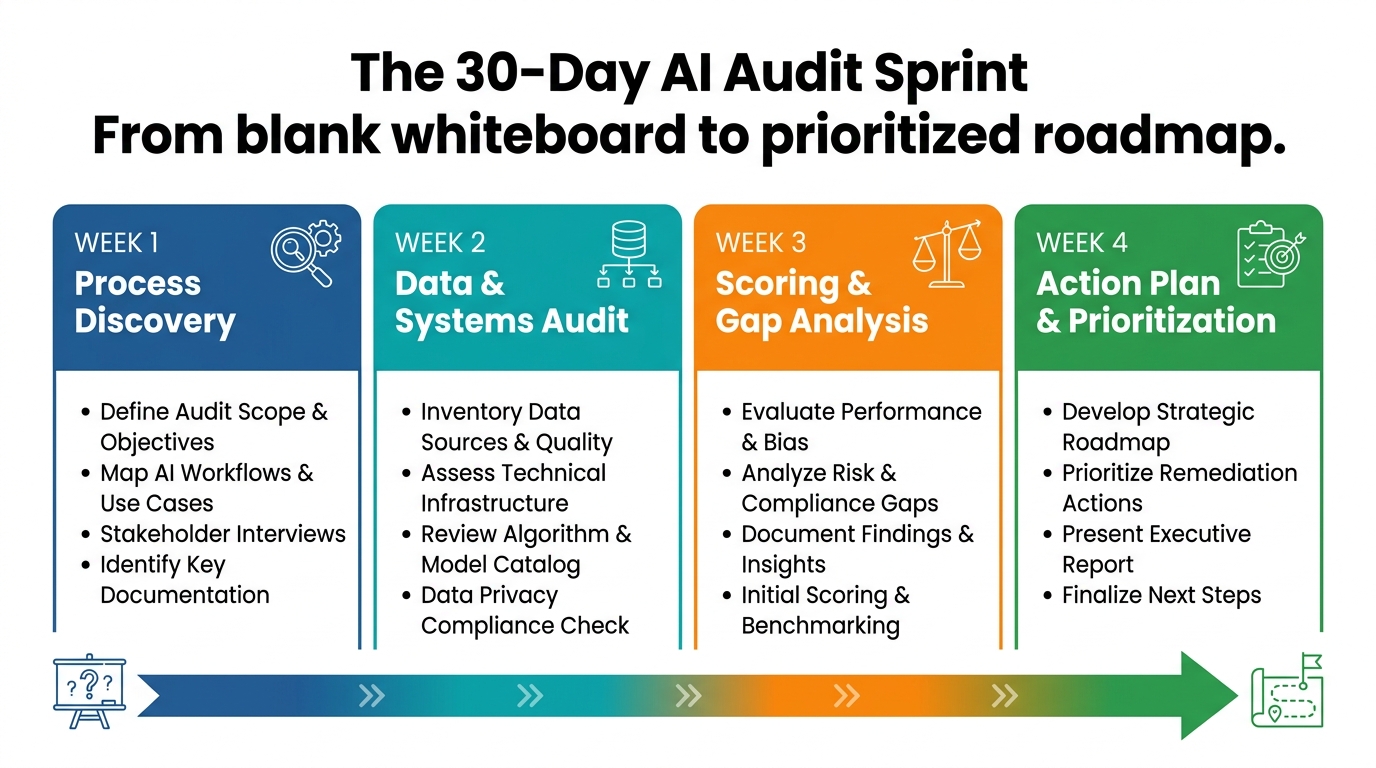
A thorough AI workflow audit does not need to take six months. Conducted with focus and appropriate resourcing, it can be completed in 30 days — producing a clear, actionable output that the business can act on immediately. Here is a practical week-by-week structure.
Week 1: Process Discovery
The first week is entirely about understanding what work actually happens in the organization. This is not a desk exercise. It requires conversations with frontline workers, team leads, and department heads — separately, because the description of the same process often differs significantly between levels of the hierarchy.
Specific activities for Week 1 include: structured workflow interviews with the people doing the work in each target department; a shadow AI and informal tools inventory (using the discovery approach described earlier); initial collection of process metrics (volume, cycle time, error rate, backlog data) wherever those are available; and identification of known pain points ranked by the people experiencing them.
By the end of Week 1, you should have a raw inventory of 15–25 processes across the business, along with preliminary notes on data availability, known pain, and process ownership for each.
Week 2: Data and Systems Audit
Week 2 narrows the scope to the 8–12 most promising processes from Week 1 and goes deeper on data and systems readiness for each. This is where the seven data readiness criteria are applied, system logs are reviewed, and integration points are mapped.
Key activities include: data sampling and quality assessment for each candidate process; mapping of the systems involved (which data lives where, what format it is in, who owns access); identification of data lineage gaps; and a preliminary review of any existing governance documentation for these processes.
Week 2 also includes an infrastructure assessment: do the systems involved support the kind of integration that AI deployment would require? Are there API limitations, legacy system constraints, or security architecture issues that would significantly complicate implementation?
Week 3: Scoring and Gap Analysis
With process maps and data assessments in hand, Week 3 applies the scoring rubric to each candidate workflow and produces a comprehensive gap analysis. Every process gets scored on all five dimensions. The composite scores are calculated. The priority matrix is populated.
For each process that scores in the “Redesign First” band, Week 3 should produce a specific gap analysis — a clear statement of what needs to change, what that change requires, and a rough estimate of time and cost. This turns vague readiness gaps into concrete preparation tasks.
Week 3 also includes a governance review: for each high-priority process, confirming or identifying the named owner, checking whether documented decision authority exists, and noting what incident-response procedures are or are not in place.
Week 4: Action Plan and Presentation
The final week synthesizes findings into the action plan and prepares the output for stakeholder review. This includes populating the priority matrix with final scores, writing the action plan for each first-cohort and second-cohort process, defining the success metrics and review schedule for first pilots, and preparing the gap-to-preparation task list for processes in the investment queue.
The output of Week 4 should be a stakeholder-ready document that clearly answers three questions: What can we pilot in the next 90 days? What do we need to invest in to be ready for the next cohort? And: What are we not going to do, and why?
That last question is as important as the first two. An AI audit that ends with a list of 20 things to do simultaneously is not useful. One that produces a clear “start here, invest there, ignore those” structure is.
What the Audit Actually Tells You — And What Comes Next
When a well-executed AI workflow audit is complete, what you have is not a technology roadmap. It is a picture of your business’s operational maturity — a clear, evidence-based view of where your processes are documented and repeatable, where your data is trustworthy, where your governance is solid, and where the gaps are that have been quietly limiting your ability to do anything well at scale, with or without AI.
That is worth more than the AI implementation plan it produces. Organizations that go through this exercise consistently report that it surfaces process inefficiencies, data quality problems, and ownership ambiguities that were costing them money and time long before AI entered the conversation. Fixing those problems directly is often the highest-ROI outcome of the audit — even before a single AI tool is deployed.
The Honest Assessment Problem
The hardest part of a genuine AI workflow audit is maintaining intellectual honesty when the findings are inconvenient. The audit may reveal that the process a senior leader championed for AI automation is actually a poor candidate. It may show that the data a team believed was comprehensive is missing three years of records. It may surface that nobody actually owns a critical workflow that everyone assumed someone else was responsible for.
These are uncomfortable findings. They also happen to be exactly the findings that, when addressed, produce the durable operational improvements that make AI deployments succeed over a 12-to-24-month horizon rather than fail within six months.
The organizations that get the most value from AI are not the ones who moved fastest. They are the ones who moved with the most accurate self-knowledge about where they were actually ready and where they were not.
Repeating the Audit as a Practice
An AI workflow audit is not a one-time event. As processes are improved, data pipelines are cleaned, and AI implementations go live, the readiness landscape changes. Processes that scored poorly in the first audit may be fully ready 12 months later. New processes emerge. Shadow AI evolves. Governance requirements shift.
The most sophisticated organizations treat the workflow audit as an ongoing operational practice — running a full audit annually and lightweight spot-checks quarterly on high-priority areas. This turns AI readiness from a project into a capability: something the organization actively maintains rather than periodically catches up on.
Six Takeaways to Act On This Week
- Run a shadow AI inventory before any formal audit begins. Ask frontline employees — not managers — what tools they use to get their work done. You will likely find processes already partially automated that nobody has reviewed.
- Choose three candidate processes and map them end-to-end at the task level. Include exceptions. Include handoffs. Include the steps that are not in any official documentation.
- Apply the seven data readiness criteria to the data those processes depend on. Do not assume availability means quality. Sample the data and check it directly.
- Name an owner for each candidate process before any AI discussion continues. If you cannot name one, you have a governance problem that needs to be solved first.
- Define your decision stakes explicitly for each process. Write down what a consequential AI mistake looks like, who is accountable for it, and what the remediation path is.
- Build the priority matrix using the five-dimension scoring rubric. Let the scores determine the first pilots — not advocacy, seniority, or enthusiasm.
The businesses that will be operating the most capable, reliable AI systems in 2028 are not the ones spending the most on AI software today. They are the ones investing the most in understanding their own operations clearly enough to know where AI will genuinely help — and building the data, process, and governance foundations that make that help durable.
The audit is where that starts.