
Most affiliate sites are essentially vending machines with broken buttons. Someone lands on a review post, maybe clicks an affiliate link, maybe doesn’t — and then they’re gone forever. There’s no follow-up, no second chance, no system for bringing that reader back when they’re finally ready to buy. The whole operation depends on catching the right visitor at exactly the right moment, which is about as reliable a growth strategy as hoping for rain.
The numbers tell the story clearly. Organic search traffic converts to a purchase at roughly 2.1% for consumer audiences. That means for every hundred people who land on an affiliate post, roughly 98 leave without buying anything — and most of them are never seen again. Affiliate marketing drove an estimated $113 billion in U.S. e-commerce sales in 2024, and that number keeps climbing. But the vast majority of affiliate publishers are capturing a thin sliver of what their traffic is actually worth.
The problem isn’t the content. It’s the architecture around the content. Most affiliate sites have posts but no funnel — individual pieces of writing scattered across a domain with no connective tissue pulling readers toward a purchase, no mechanism for staying in touch, and no structure for earning from a visitor on their second or fifth or fifteenth visit rather than just the first.
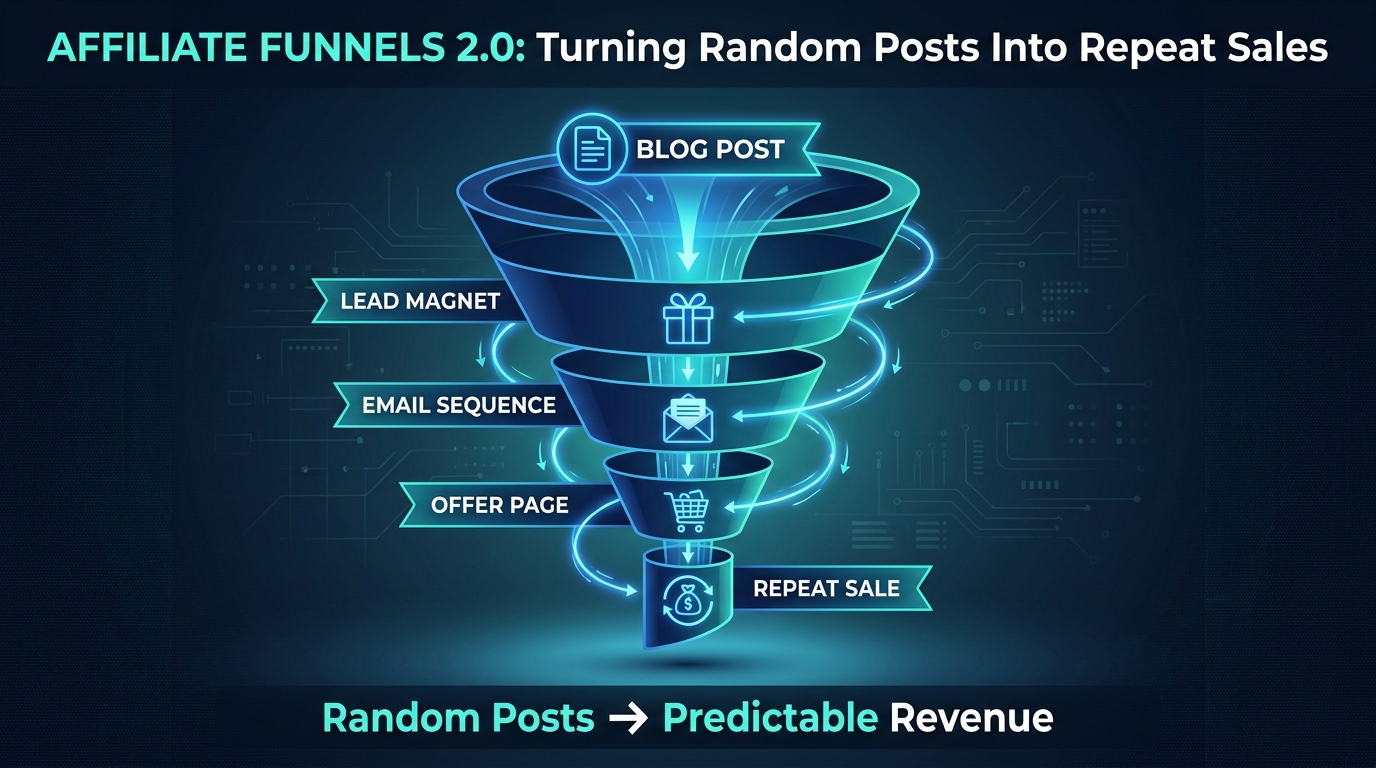
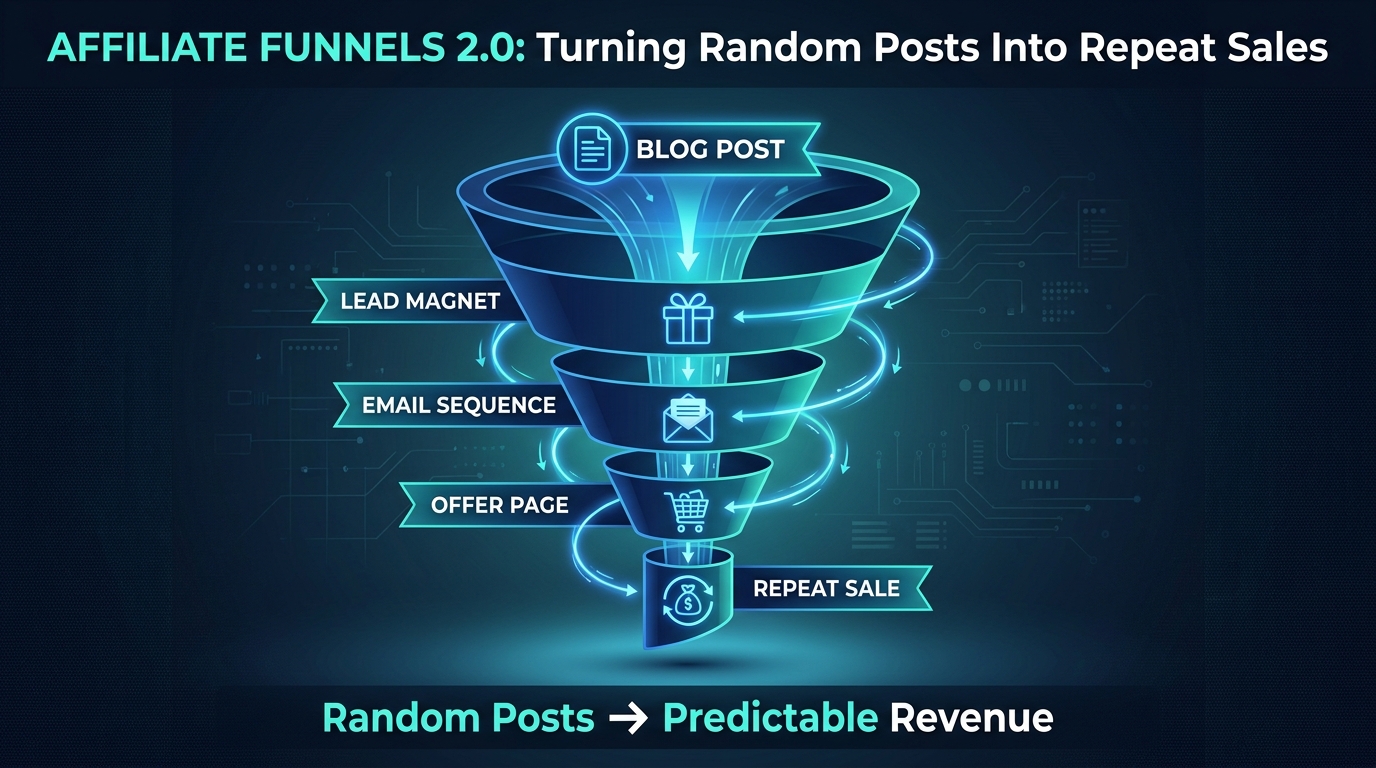
This is exactly what Affiliate Funnels 2.0 is designed to fix. Not by reinventing affiliate marketing from the ground up, but by treating every post as the entry point to a system — a deliberate sequence of steps that takes a first-time reader and, over time, turns them into someone who buys repeatedly through your recommendations. This post walks through the full architecture, from how to map reader intent to how to build email sequences that sell, from behavioural segmentation to recurring commission stacking, from internal linking strategy to a measurement framework that actually reflects what’s working.
The goal isn’t to add complexity for its own sake. It’s to stop leaving 98 out of every 100 visitors on the table.
Why “Post and Pray” Is a Dead-End Strategy in 2026
To understand why a funnel-first approach matters so much right now, it helps to understand exactly how the old model breaks down — and why the cracks are getting wider, not smaller.
The Last-Click Illusion
For years, affiliate publishers have operated on what’s essentially a last-click model. Write a review, rank it on Google, wait for someone to search exactly the right query at exactly the right time, and collect a commission when they click through and buy. It worked reasonably well when Google search results were dominated by organic listings and buyer intent was easy to intercept at the moment of decision.
That model is under pressure from multiple directions in 2026. AI-generated search summaries are answering more product questions without driving a click to any publisher. Paid shopping placements are consuming more real estate on results pages. And the fundamental economics of the model — capturing already-decided buyers at the last step of their journey — means there’s almost no loyalty, no relationship, and no recurring value being built.
A visitor who arrives, reads, and clicks is worth one commission. A subscriber who arrives, reads, joins an email list, and receives a sequence of relevant recommendations over six weeks is worth a fundamentally different amount. The channel economics are categorically different, not marginally different.
Cookie Decay and Attribution Erosion
The technical infrastructure that underpinned affiliate tracking is also deteriorating. Third-party cookie deprecation, browser-level tracking prevention, and the growing gap between ad exposure and purchase (as more buyers do research across devices and over time) mean that affiliate programs are attributing fewer of the sales that affiliate content actually influenced.
Publishers who rely solely on that attribution chain — read post, click link, buy within 30 days — are watching their reported revenue shrink even when their actual influence on purchase decisions hasn’t changed. Building an owned channel, specifically an email list, is the most direct response to this problem. Once someone opts in, you own that relationship in a way you never do with organic search traffic. The contact doesn’t disappear when they close the browser tab.
The Compounding Disadvantage
There’s also a competitive dimension. As more affiliate publishers produce more content targeting the same buyer-intent queries, the average position, click-through rate, and traffic share of any individual post declines. Publishers who are only competing on content volume are running faster to stay in place.
Funnels change the competitive dynamic. When your content doesn’t just rank but also captures subscribers, and those subscribers receive a structured sequence that builds trust and drives purchases, you are generating revenue from a pool of people your competitors have already given up on. You’re monetising the 98 who didn’t buy immediately, not just the 2 who did.
The Anatomy of a Modern Affiliate Funnel
A modern affiliate funnel isn’t a single page or a single email. It’s a connected system of components that work together across time, each one designed to move a specific type of visitor one step further toward a commission-generating purchase.
The Five Core Components
The funnel has five distinct layers, and each one needs to be intentionally built rather than hoped for:
- Traffic entry points — The blog posts, comparison pages, and cluster content that bring readers in from search, social, and referral sources.
- Lead capture mechanism — A lead magnet, content upgrade, or opt-in offer that converts anonymous readers into named email subscribers.
- Pre-sell architecture — Bridge pages, extended comparison content, or testimonial-led pages that warm a visitor to a specific offer before they land on the affiliate destination.
- Email nurture sequences — A structured series of emails, triggered by subscriber behaviour, that builds trust, provides value, and converts readers to buyers over days or weeks.
- Offer ascension path — A deliberate sequence of offers, from entry-level to high-ticket to recurring, that extracts full revenue potential from each subscriber relationship over time.
These five components exist in virtually every high-performing affiliate operation, whether the publisher consciously designed them that way or evolved into them through experimentation. The difference between random posts and a repeat-sales machine is that the machine has all five components, they’re connected, and they’re optimised together.
What “2.0” Adds to the Traditional Model
The original version of an affiliate funnel — write post, put opt-in on it, send a few emails, include affiliate links — still works. What’s changed is the layer of intelligence that sits on top of it.
Behavioural tagging means the funnel now knows something about each subscriber: which post they came from, what lead magnet they downloaded, which emails they opened, which links they clicked. That data drives personalisation. Instead of sending the same five-email welcome sequence to everyone, the 2.0 version sends different sequences to different people based on what they’ve already shown interest in.
The result is measurably better performance. Research consistently shows that hyper-segmented micro-audiences convert at rates 3.4 times higher than audiences receiving generic broadcast emails. When your sequences are built around demonstrated interest rather than guessed interest, the math changes substantially.
Mapping the Content-to-Customer Journey: Intent at Every Stage
Before building any specific funnel component, you need a clear model of how your readers move from first discovering your content to making a purchase. Most affiliate publishers skip this mapping step and pay for it in low conversion rates that they attribute to bad offers or bad traffic, when the real problem is mismatched messaging.
The Four Intent Stages
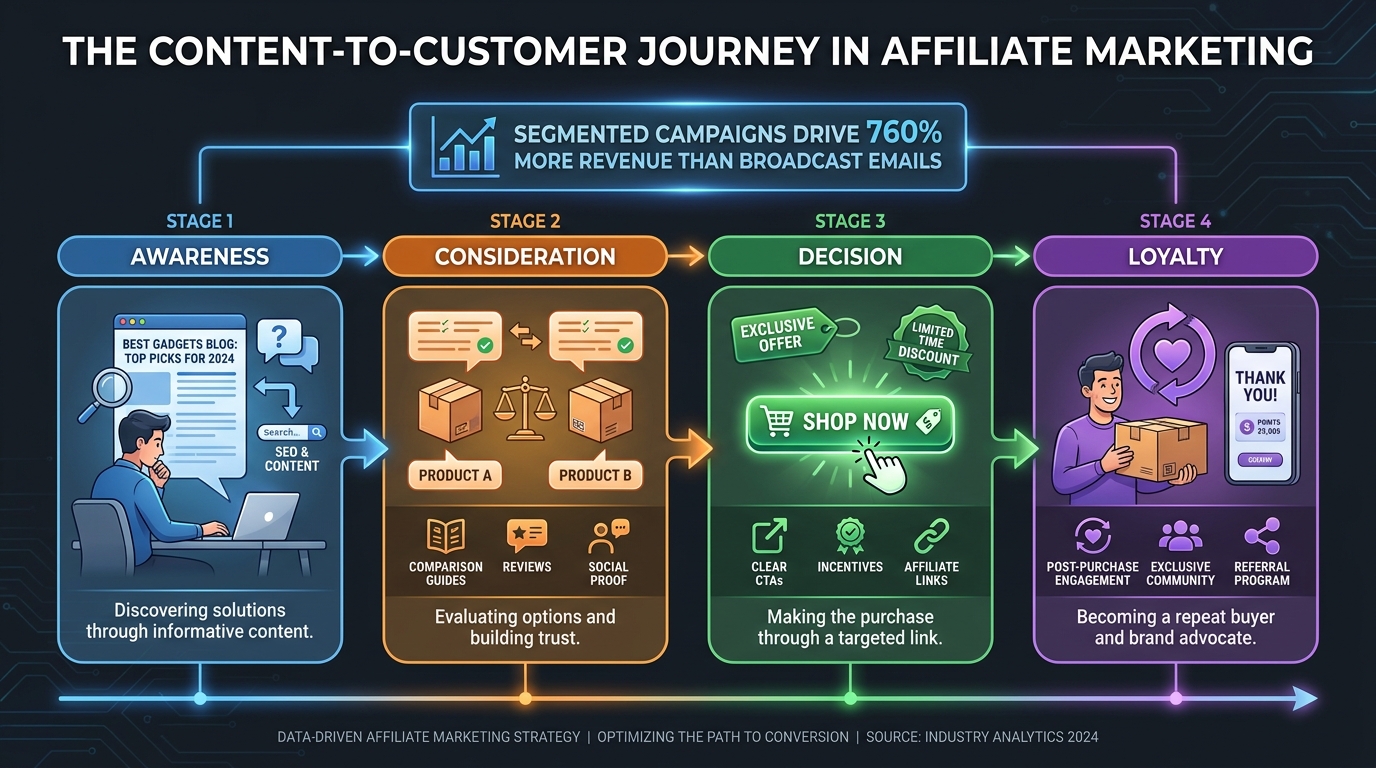
Readers arrive at affiliate content from four meaningfully different intent states, and each one requires a different response from your funnel:
Stage 1: Awareness — The reader knows they have a problem or interest but doesn’t yet know what categories of solutions exist. They’re searching for things like “how to manage a remote team” or “why my website loads slowly.” They’re not ready to buy anything. The right funnel response here is educational content that earns trust and sets up the category you’ll later recommend within.
Stage 2: Consideration — The reader knows what category of solution they need and is researching options. They’re searching for “best project management software” or “top VPN services.” They’re evaluating, comparing, building a shortlist. The right funnel response is comparison content, feature breakdowns, and use-case matching — plus a lead magnet that helps them make the decision (like a comparison checklist or a feature matrix).
Stage 3: Decision — The reader has narrowed to one or two options and wants confirmation before committing. They’re searching for “[Product Name] review” or “[Product A] vs [Product B].” They need social proof, honest assessment of downsides, and a clear reason to act now. The right funnel response is a detailed review or pre-sell page with a strong call to action.
Stage 4: Post-Purchase — The reader has already bought something and is looking to get more value from it, or is considering the next purchase in the same category. This is the most underserved stage in affiliate marketing. The right funnel response is onboarding content, advanced tips, and recommendations for complementary products — which is where recurring commission and product ascension live.
Why Stage Mismatch Kills Conversions
The most common affiliate funnel mistake isn’t bad copy or weak offers — it’s sending consideration-stage visitors straight to a decision-stage offer. If someone found you via a broad awareness post and your very next email is a hard pitch for a $99/month subscription, the mismatch destroys trust rather than building it.
Intent mapping prevents this. When you know which stage a subscriber entered from (signalled by which post they read, which lead magnet they downloaded, or which search term brought them in), you can start their email sequence at the right point in the educational journey. You’re meeting them where they are, not where you wish they were.
This also shapes your internal linking strategy, which is covered in detail in the content cluster section below. The goal is to have natural pathways from awareness content to consideration content to decision content, so the site itself moves readers through stages even before they ever join an email list.
Lead Magnets That Actually Convert Affiliate Traffic
The lead magnet is the hinge between random traffic and a managed relationship. Get it right and you’re building an asset. Get it wrong and your posts stay as isolated traffic events, each one complete in itself, with no compounding value.
The Specificity Principle
The most common reason lead magnets fail on affiliate sites is generic-ness. A PDF titled “10 Marketing Tips” offered on a post about email marketing tools is competing with the ten other free PDFs the reader has already downloaded this week and never opened. It provides no signal of what the reader will receive if they subscribe, and no specific reason to hand over an email address right now.
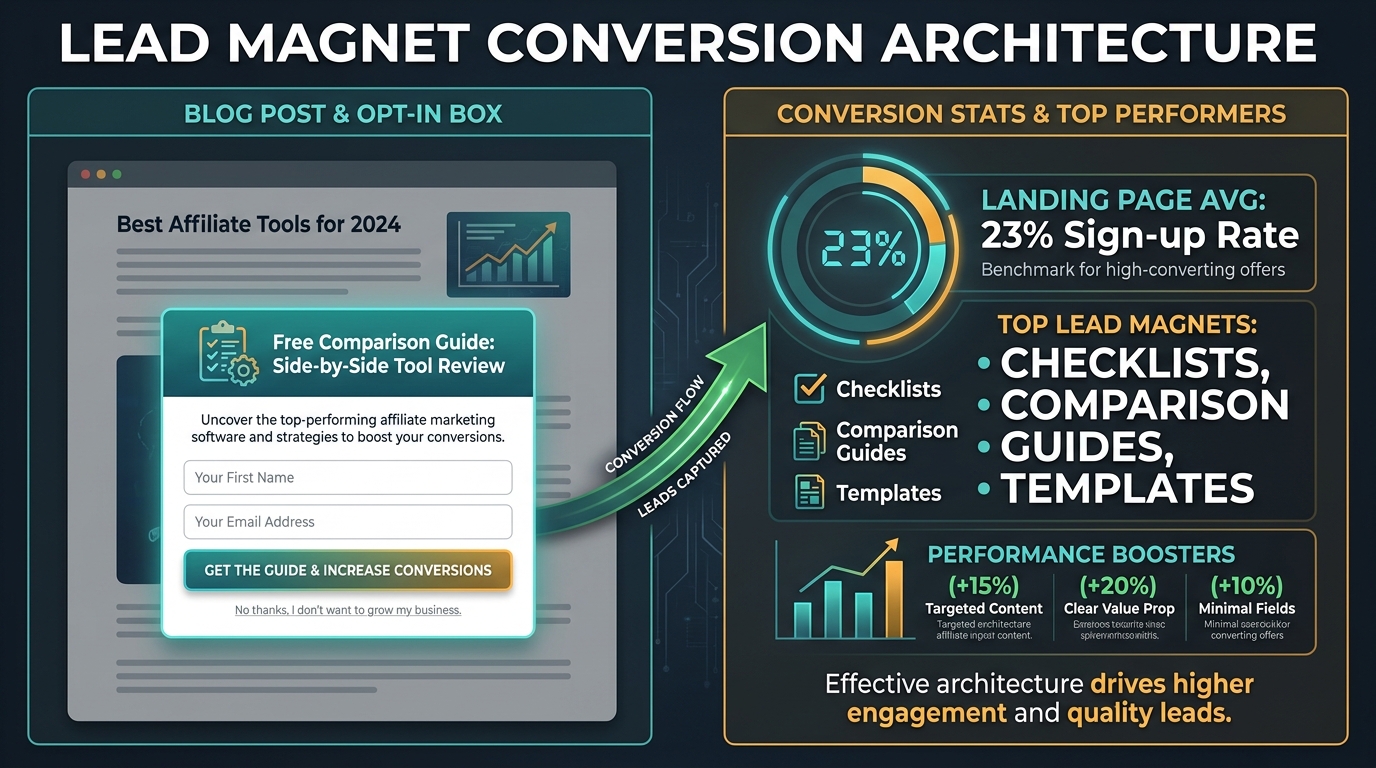
Specificity is the fix. The best lead magnets for affiliate sites are tightly matched to both the content the reader just consumed and the decision they’re trying to make. Examples:
- A “Top 10 Email Tools” comparison post pairs with a downloadable comparison matrix showing 6 tools across 12 features — giving the reader exactly what they need to make the decision they came to the post for.
- A “How to Set Up a Home Office” awareness post pairs with a curated “Home Office Gear Checklist” — giving the reader a practical tool that naturally contains affiliate links and keeps them in your ecosystem.
- A “[Tool Name] Review” decision-stage post pairs with a “30-Day [Tool Name] Setup Checklist” — giving a buyer-ready visitor a reason to subscribe and positioning you as someone who will help them get results, not just make a sale.
When lead magnets are matched this precisely to the post and the reader’s intent, landing page sign-up conversion rates average around 23%, compared to 6.6% median for generic lead generation pages. That gap compounds over time — a site generating four times as many email subscribers from the same traffic is building a fundamentally different business.
Content Upgrades vs. Standalone Magnets
There are two structural approaches to affiliate lead magnets. Standalone magnets sit in a site-wide sidebar or pop-up and offer a single resource to all visitors regardless of which page they’re on. Content upgrades are post-specific — they extend or enhance the specific content the reader just consumed.
Content upgrades consistently outperform standalone magnets for conversion rate because they’re contextually matched. A reader who just spent five minutes reading a 3,000-word comparison of CRM tools is a far more likely subscriber to “The CRM Decision Guide” than a general “Digital Marketing Toolkit.” The specificity signals value and relevance.
The practical tradeoff is production time. Standalone magnets are created once; content upgrades need to be created for each major post or content cluster. A sensible approach for most affiliates is a small library of 4–6 high-quality standalone magnets matched to topic clusters (e.g., one for project management tools, one for marketing software, one for e-commerce platforms), which functions similarly to a content upgrade without requiring individual creation for every post.
Delivery Format Matters
PDF guides still work but are increasingly competing with interactive formats that provide more immediate value. Quizzes (“Which CRM is Right for Your Business?”) are particularly effective for affiliate funnels because they generate segmentation data at the point of opt-in — you learn something about the subscriber’s needs at the very moment they join your list, which shapes the entire sequence they’ll receive.
Tool-based magnets — spreadsheet templates, calculators, trackers — also perform well because they’re used repeatedly rather than downloaded once and forgotten. Every time a subscriber opens a spreadsheet you gave them, your brand gets a reminder impression.
Bridge Pages and Pre-Sell Architecture: The Invisible Conversion Driver
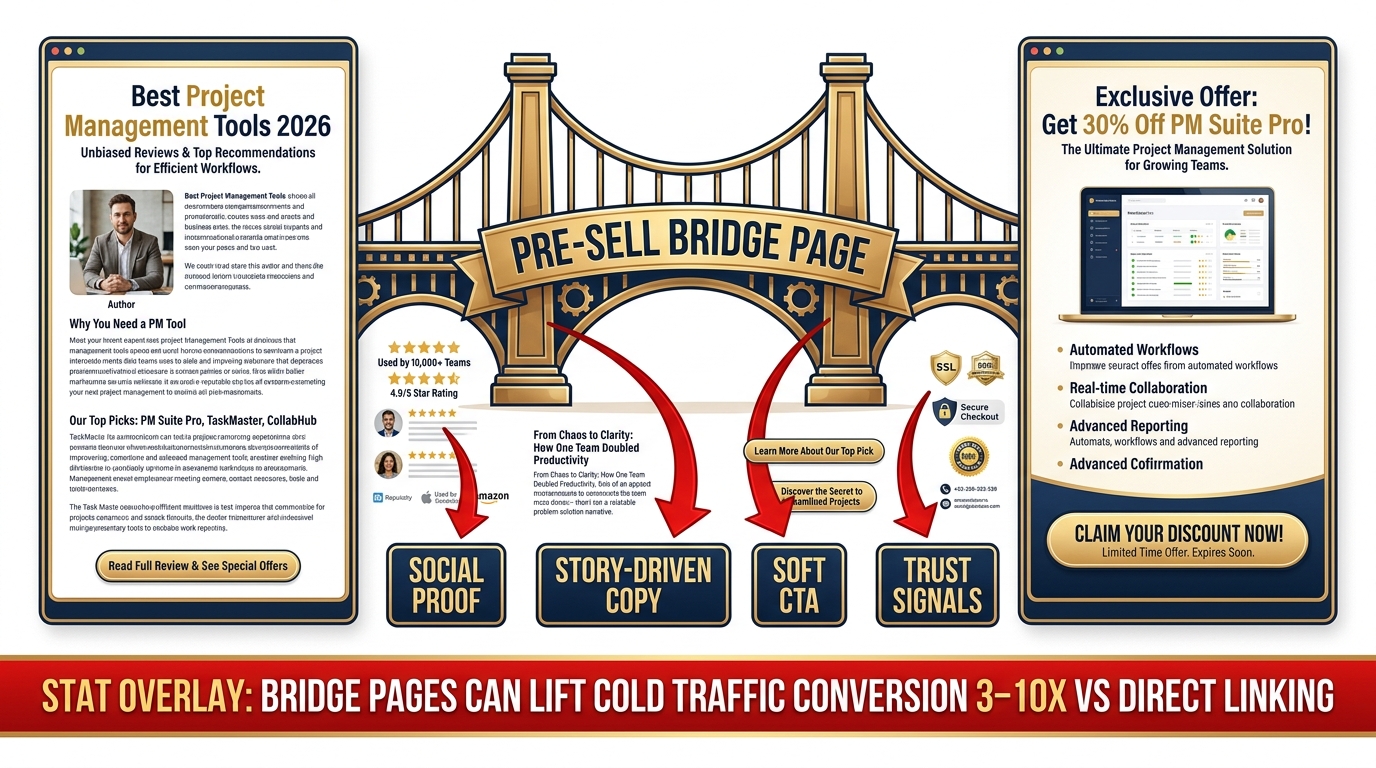
The single biggest conversion gap in most affiliate funnels isn’t the email sequence or the traffic source — it’s the absence of any meaningful step between the content and the offer. Readers go from a post to a vendor’s sales page with nothing in between to address their remaining objections, build trust in your recommendation, or create any psychological momentum toward the purchase.
Bridge pages fill that gap. They’re a dedicated page (or section) that sits between your content and the affiliate destination, and their sole purpose is to make the visitor more likely to buy once they arrive at the vendor’s page.
What a Bridge Page Actually Does
A well-built bridge page accomplishes four things that a blog post rarely does well because a blog post is trying to do too many things at once:
It narrows focus. A blog post comparing five tools needs to address all five. A bridge page is dedicated to a single offer and can go deep on exactly why this specific tool is the right choice for this specific reader.
It handles objections directly. By the time a reader clicks through to a bridge page, they’ve already shown strong intent. The bridge page can address the two or three objections that most commonly prevent purchase — price, complexity, commitment — with specific answers rather than generic reassurance.
It deploys social proof strategically. Testimonials, case study snippets, and specific results placed right before a purchase click are more persuasive than the same content buried in a long review post.
It establishes personal authority. A bridge page written in first person — “Here’s why I use this, what I’ve tried, and what I found” — creates a different relationship than a third-person review. It’s a recommendation from a trusted source, not an evaluation from an anonymous reviewer.
Practitioner data consistently shows that well-executed bridge pages lift conversion rates for cold and semi-warm traffic by a factor of 3 to 10 compared to direct linking. That’s not a marginal improvement — it’s the difference between a campaign being profitable and being unprofitable.
Bridge Pages in Email Funnels
Bridge pages aren’t only for organic search visitors. In an email sequence, the “bridge” is usually the email itself — a personal, story-driven message that pre-sells the reader on a specific offer before they click the link. The principles are identical: narrow the focus, address objections, deploy social proof, establish personal authority.
The most effective email-based bridge format is what practitioners call the “story → pivot → pitch” structure. Start with a relevant personal experience or case study (the story), connect it explicitly to the reader’s situation (the pivot), then introduce the offer as the natural solution (the pitch). This sequence mirrors the way trusted recommendations actually happen in conversation, which is why it converts better than leading with benefits and features.
Email Sequences That Do the Selling: Architecture and Timing
Email is the highest-ROI channel in affiliate marketing and it isn’t close. The average return of $36 to $42 for every dollar spent on email marketing consistently outperforms paid search, organic social, and paid social. But that average hides an enormous range — from affiliates who use email as an afterthought broadcast channel to those who have built structured, behaviour-driven sequences that convert at rates most content-only affiliates would find implausible.
The Welcome Sequence: The Most Valuable Real Estate You Have
The window immediately following a subscriber’s opt-in is the highest-engagement period in the entire relationship. Open rates for welcome emails are typically 4 to 5 times higher than average broadcast open rates. This is the moment to set expectations, establish authority, and make an initial recommendation — not to make a hard sell, but to begin the process of connecting the subscriber with the products and offers that are most relevant to their situation.
A high-performing affiliate welcome sequence typically runs 5 to 7 emails over 7 to 10 days. The structure:
- Email 1 (Immediate): Deliver + Introduce. Deliver the lead magnet, introduce yourself or your brand in one paragraph, set a clear expectation for what comes next.
- Email 2 (Day 2): Educate. Teach something genuinely useful related to the topic. No pitch. Pure value. This email builds the credibility that makes later recommendations believable.
- Email 3 (Day 3–4): Story + Soft Recommendation. Share a relevant personal experience or case study that naturally leads to mentioning a specific tool or product. Affiliate link present but secondary to the story.
- Email 4 (Day 5): Social Proof. Share a real result or testimonial related to the main offer you’re building toward. Remove uncertainty by showing evidence.
- Email 5 (Day 6–7): Objection Handling. Address the most common reasons people hesitate on the primary offer. Be direct and honest — including about limitations.
- Email 6 (Day 8–9): The Offer. Make a clear, direct recommendation with a call to action. This is the first email where the offer is the primary subject, not a secondary mention.
- Email 7 (Day 10): Follow-Up. A shorter email referencing the offer from day 8–9. Different angle — address a different objection or share a different use case.
After the welcome sequence ends, subscribers transition to a longer-term nurture track or to behaviour-triggered sequences based on what they engaged with during onboarding.
Behaviour-Triggered Sequences
This is where the 2.0 designation earns its place. Static email sequences treat every subscriber as identical after the welcome series. Behaviour-triggered sequences treat each subscriber based on what they’ve actually done — what they’ve read, what they’ve clicked, what they’ve ignored.
The key triggers that drive the most valuable sequences in affiliate funnels:
- Clicked an affiliate link but didn’t purchase — This subscriber has shown strong intent. They deserve a specific follow-up sequence that addresses the most likely reasons for hesitation: price objections, competitor comparisons, or uncertainty about fit.
- Opened multiple emails on a specific topic — This signals deep interest in a particular category. Trigger a deeper content or offer sequence focused on that category.
- Downloaded a content upgrade on a specific product category — Immediately begin a category-specific sequence rather than a generic one.
- Returned to the site and visited a pricing page — This subscriber is in a decision window. A triggered email within 12 to 24 hours of this behaviour significantly increases conversion rates.
Building these trigger sequences requires an email service provider that supports behavioural automation and a site integration that passes event data back to the ESP. Tools like ActiveCampaign, ConvertKit (now Kit), and Klaviyo all support this at various price points and complexity levels.
Optimising Subject Lines and Send Times
Two technical optimisations that most affiliate email marketers underinvest in: AI-optimised subject lines and send-time personalisation. Current data shows AI-optimised subject lines improve open rates by an average of 26%, and personalised send-time optimisation adds another 14% uplift. Across a sequence of seven emails, those improvements compound into meaningfully higher engagement and conversion through the funnel.
Behavioural Tagging and Segmentation: The Intelligence Layer
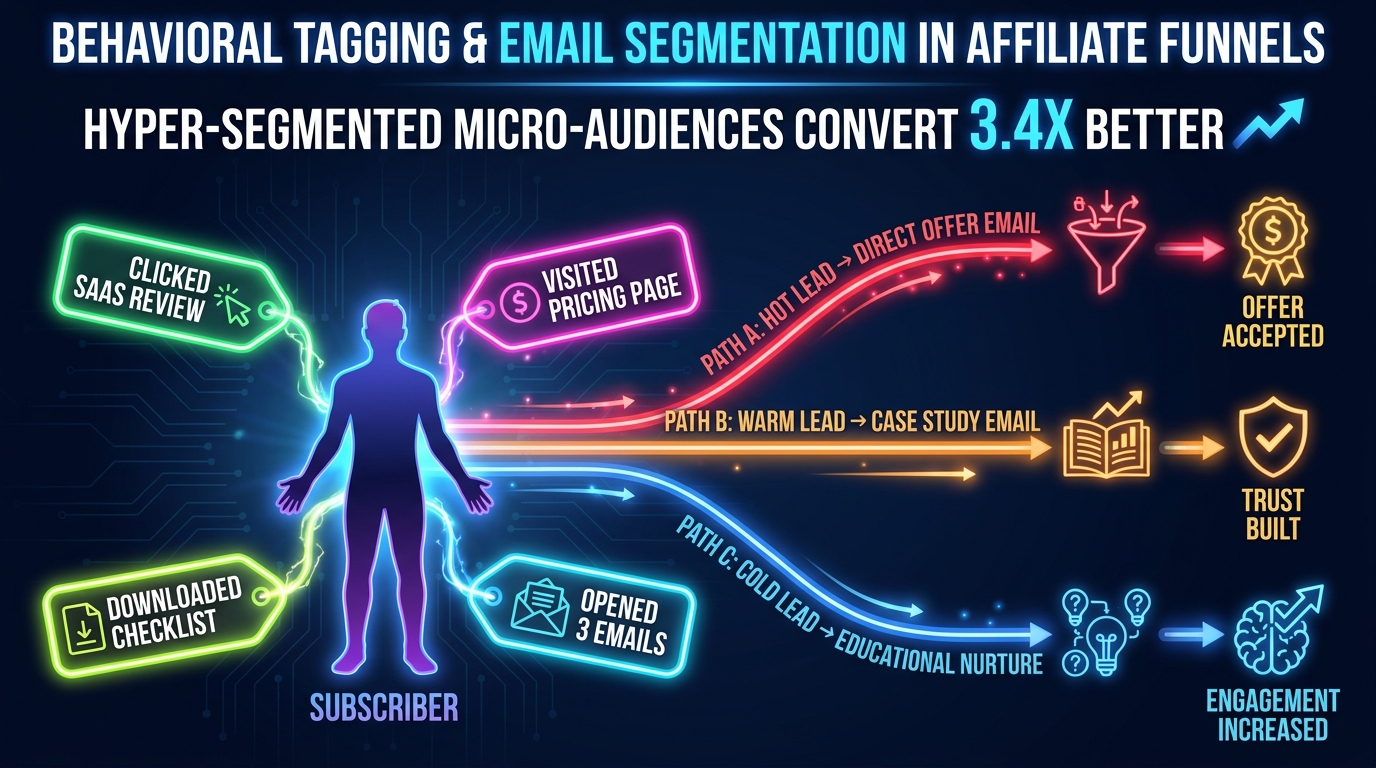
Segmentation is the mechanism that makes personalisation real rather than theoretical. Without it, behavioural data accumulates in your analytics dashboards without changing what any individual subscriber actually receives. With it, the same behavioural data actively reshapes the sequence and offers delivered to each person.
Building a Tagging Architecture
The most effective affiliate tagging systems are built around three dimensions:
Topic interest tags — What category has this subscriber demonstrated interest in? Tags like “interested: project management tools” or “interested: email marketing software” are applied when a subscriber clicks a link in that category, visits a related page, or downloads a category-specific lead magnet. These tags drive which product offers appear in their nurture sequences.
Funnel stage tags — Where in the decision process is this subscriber? “Stage: awareness” through “Stage: decision-ready” tags are applied based on which content the subscriber has engaged with and which links they’ve clicked. A subscriber who has opened three comparison emails and clicked an affiliate link is clearly further along than one who only opened the welcome email.
Engagement health tags — How engaged is this subscriber? Tags tracking open frequency, click frequency, and recency allow you to identify active subscribers who deserve more offer-forward sequences and disengaged ones who need a re-engagement campaign before any pitch.
This three-dimensional tagging system creates a clear picture of each subscriber: what they’re interested in, how ready they are to buy, and how engaged they currently are. The intersection of those three dimensions tells you exactly what to send next.
Dynamic Segmentation in Practice
The practical application of this tagging architecture looks like this: A subscriber arrives via a post about CRM tools for small businesses, downloads a comparison checklist (tagged: “interested: CRM”, “Stage: consideration”), opens the first three emails in the welcome sequence (tagged: “engagement: active”), and clicks a link to a specific CRM’s pricing page (tagged: “Stage: decision-ready”, “Clicked: [CRM name] pricing”).
With those tags applied, that subscriber should automatically be enrolled in a short, 3-email sequence specifically about the CRM they showed interest in, with content addressing the objections most common at the decision stage. The sequence is triggered not because you manually noticed their behaviour, but because the tagging architecture captured it and the automation responded.
Research shows segmented campaigns generate 760% more revenue than unsegmented broadcast campaigns. That figure sounds implausible until you understand that it’s not comparing “good copy” to “bad copy” — it’s comparing sending the right message to the right person at the right time versus sending the same message to everyone all the time.
Recurring Commission Products and LTV Stacking
The affiliate funnel architecture described so far is designed to convert visitors into first-time buyers. But the most significant multiplier on affiliate income isn’t improving first-purchase conversion — it’s extending the revenue generated from each relationship over time through recurring commissions and offer ascension.
Why Recurring Commission Beats One-Off CPA
Compare two affiliate scenarios. In Scenario A, you earn a $30 flat commission on a $99 software purchase. In Scenario B, you earn a 25% recurring commission on a $79/month subscription — which pays you approximately $20 per month for as long as that customer remains subscribed. If that customer stays for 18 months (a realistic retention figure for a well-matched SaaS product), Scenario B generates $360 from the same initial recommendation.
The difference is customer lifetime value. One-off CPA programs pay affiliates only for acquisition. Recurring commission programs pay affiliates for retention — which means the affiliate’s incentive is aligned with recommending products that genuinely serve their audience, not just products that convert on a landing page.
In 2026, the strongest affiliate commission rates in the recurring category sit in:
- SaaS and software tools — Commonly 20–30% monthly recurring, with some programs offering 40%+ for high-volume partners. Product categories like email marketing platforms, CRM tools, landing page builders, and marketing automation tools all have active affiliate programs in this range.
- Membership platforms and online courses — Platforms like Kajabi and Thinkific offer 30% lifetime recurring commissions. Because membership churn is lower than SaaS churn in well-positioned education products, LTV per referral is very high.
- Hosting and infrastructure — Web hosting affiliates are traditionally high-commission, though these tend toward large one-time bounties rather than recurring payments. However, managed hosting platforms and specialised infrastructure (e.g., CDN services, email delivery platforms) increasingly offer recurring models.
- Replenishable physical products — Subscription boxes, consumables with subscription models (supplements, coffee, pet food), and auto-replenishment programs create recurring commission opportunities in physical goods categories where they were previously unavailable.
Building an Offer Ascension Path
Offer ascension is the deliberate sequencing of recommendations from lower-commitment to higher-commitment, matched to the growing trust and demonstrated interest of a subscriber over time. It’s the difference between having one affiliate offer and having an offer architecture.
A typical ascension path in a software affiliate funnel might look like:
- Entry offer: A free trial or freemium product recommendation that has zero friction. The subscriber can accept without any financial commitment. Commission is usually a small flat fee or deferred to first payment.
- Core offer: The primary paid subscription recommendation, typically 2–4 weeks into the relationship once trust has been established. This is where the bulk of recurring commission revenue is generated.
- Upgrade offer: A recommendation to upgrade from the entry tier to a more capable (and more expensive) plan, often triggered when a subscriber has been active with the entry offer for 30 to 60 days.
- Complementary offer: A recommendation for a tool or service that complements the primary product — a CRM user being recommended a landing page builder, for example, or an email marketing subscriber being recommended a deliverability monitoring tool.
Each step in this ascension path generates a commission opportunity, and because the recommendations are sequenced to match demonstrated behaviour and established trust, conversion rates at each step are materially higher than cold recommendations would be.
Content Cluster Funnels: Internal Linking as a Sales System
Most discussion of content clusters focuses on their SEO benefits — topical authority, crawl efficiency, keyword coverage. These benefits are real, but the more important function of a well-built content cluster in an affiliate context is its ability to move readers through funnel stages without requiring them to join an email list first.
Designing Clusters Around the Buyer Journey
An affiliate content cluster, properly designed, maps directly to the four intent stages outlined earlier. The pillar page covers the broad category (awareness/consideration), cluster posts cover specific sub-topics and comparisons (consideration/decision), and money pages — reviews, direct comparisons, best-of posts with strong CTAs — capture readers at the moment of highest purchase intent.
The internal linking strategy within this cluster is what turns it into a funnel. Every awareness post should have clear internal links to consideration-stage content for each of the product categories it mentions. Every consideration post should link to the relevant decision-stage review or comparison page. And every decision-stage page should link to either the affiliate offer directly or to a bridge page that pre-sells the offer.
This creates a navigational path that naturally moves a reader from “I need to understand this topic” to “I’m ready to make a purchase decision” without requiring any intervention from you. The funnel is built into the site architecture itself.
The Hub-Spoke-Bridge Architecture
The most effective implementation of this in 2026 uses what content strategists call a hub-spoke-bridge structure:
- Hub page: The comprehensive, authoritative resource on a topic. Targets broad category keywords. Links out to all spoke pages. Not primarily designed to convert — designed to rank, establish authority, and distribute traffic to conversion-focused pages.
- Spoke pages: Topic-specific content pieces that go deep on a specific aspect, product, or use case within the hub topic. Each spoke page links back to the hub and forward to relevant bridge pages.
- Bridge pages: Dedicated pre-sell pages for specific affiliate offers, linked from relevant spoke pages. As described earlier, these pages exist purely to prepare a visitor for the purchase decision.
Beyond the SEO benefits, this architecture gives you a clear picture of where in the funnel your traffic is at any given point. Hub page visitors are at the top — they need nurturing. Bridge page visitors are at the bottom — they’re ready to convert. Traffic analytics segmented by page type tell you immediately which stage of your funnel is working and which is leaking.
Answer Engine Optimisation and the New Discovery Layer
One structural change that’s affecting affiliate content clusters in 2026 is the rise of AI-generated search summaries and answer engines. When an AI search response covers a category overview, it may reduce traffic to hub-level awareness content while leaving comparison and review content relatively unaffected — because detailed comparisons and authentic reviews are harder for AI to generate at scale with specific credibility.
The implication for content cluster design is to ensure that comparison, review, and pre-sell content is strong enough to stand on its own as a traffic entry point, not just as a destination for internal traffic from hub pages. Each spoke page should be structured to capture its own organic search traffic, not only to receive referrals from the hub.
Attribution and Tracking: Measuring What Actually Matters
One of the most persistent problems in affiliate marketing is measuring the wrong things and optimising for them. Last-click attribution — which credits the final touch point before a purchase — significantly understates the contribution of content that operates higher in the funnel and significantly overstates the contribution of content that merely intercepts buyers who were already decided.
Moving Beyond Last-Click
In an affiliate funnel with multiple components — awareness content, email sequences, bridge pages, comparison content — last-click attribution will assign all credit to whichever page happened to be the final touch before the affiliate link was clicked. This creates a distorted view of what’s actually driving revenue.
A more useful measurement framework for multi-component affiliate funnels tracks:
- First-touch attribution — Which content piece first brought this visitor into your orbit? This tells you which traffic entry points are generating the highest-quality audiences, regardless of where in the funnel they eventually convert.
- Email sequence conversion rates — For each sequence, what percentage of subscribers who enter the sequence end up clicking an affiliate link? And what percentage of those clickers convert to a reported commission? This isolates email sequence performance independent of traffic source.
- Lead magnet cohort analysis — Subscribers acquired through different lead magnets behave differently. Segmenting your email revenue by the lead magnet that originated the subscription tells you which capture mechanisms generate the most valuable subscribers, not just the most subscribers.
- Lifetime affiliate revenue per subscriber (ARLPS) — The single most important number in a funnel-first affiliate operation. It’s the total commission revenue generated by a subscriber cohort divided by the number of subscribers in that cohort. Tracking this metric by traffic source, lead magnet, and acquisition date gives you a full picture of which inputs generate the most long-term output.
First-Party Data as Tracking Infrastructure
As third-party cookies continue to erode and privacy regulations expand, the only durable tracking infrastructure for affiliate funnels is first-party data — information collected directly from subscribers with their consent. Your email list is the foundation of this. Every subscriber who clicks a link in your email generates a trackable event that you own, regardless of what happens to browser-based tracking.
This is why the email list is so central to the Affiliate Funnels 2.0 model. It’s not only a communication channel — it’s a first-party data asset that becomes more valuable relative to traffic-based tracking as privacy constraints tighten. Every subscriber you add to your list is a relationship that remains measurable even in a post-cookie environment.
Scaling What Works: The Affiliate Revenue Flywheel
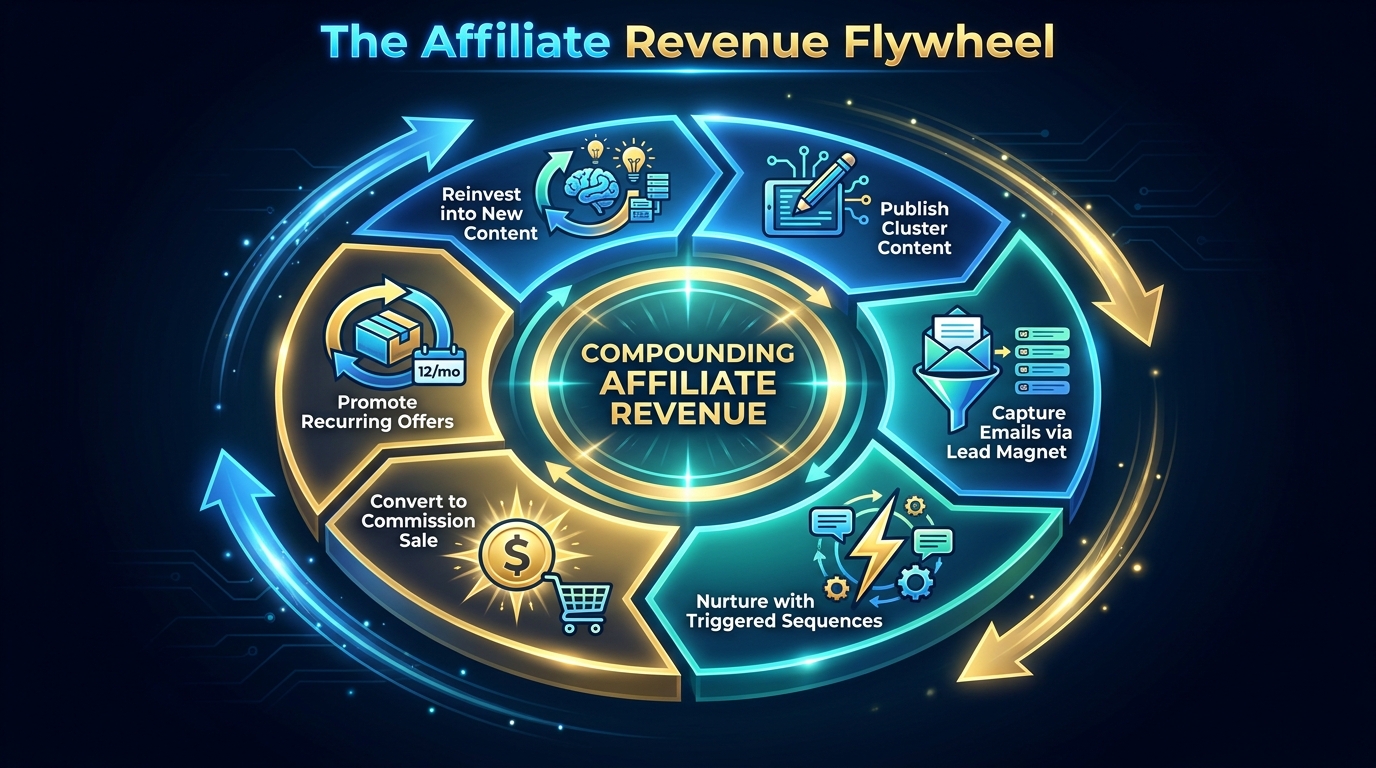
The transition from “I have a funnel” to “I have a flywheel” happens when the outputs of the funnel begin funding the inputs. Commission revenue funds new content production. Better content attracts more traffic. More traffic generates more subscribers. More subscribers generate more commission revenue. The loop is self-reinforcing, and once it’s moving, it accelerates.
The Five Flywheel Stages
The affiliate flywheel has five stages, each feeding the next:
Stage 1: Content production. New cluster content expands the surface area of topics on which you can rank and attract traffic. Each new post is a new funnel entry point, a new opportunity to generate a subscriber, and a new asset in the content cluster architecture.
Stage 2: Email list growth. Better-matched lead magnets and more entry points in the content cluster mean more subscribers being added to the email list each month. The list grows as a compounding asset — each month adds to the base rather than replacing it.
Stage 3: Sequence optimisation. As the list grows, the data available for optimising sequences improves. Split tests have more statistical power. Cohort analyses have more data. The intelligence layer described in the segmentation section gets sharper over time.
Stage 4: Commission revenue. Better sequences delivering more relevant offers to a larger, better-segmented list generate more commission revenue. Recurring commission products mean revenue compounds even between content publishing cycles.
Stage 5: Reinvestment. Commission revenue funds more content production, better tools, and potentially paid traffic to accelerate list growth. The outputs of the funnel feed back into the inputs, creating the flywheel effect.
Where Most Affiliates Stall
The flywheel stalls most often at the transition between Stage 1 and Stage 2. Content gets produced, traffic gets generated, but no lead capture mechanism exists to convert that traffic into subscribers. Each post generates visitors who leave and are never heard from again. The list stays flat. The sequences never get enough data to optimise. Commission revenue stays a function of traffic volume rather than relationship depth.
The second common stall point is between Stage 4 and Stage 5. Commission revenue gets treated as profit rather than as investment capital. The flywheel doesn’t spin faster because the outputs aren’t being reinvested into the inputs. Growing the flywheel requires intentional reinvestment during the early stages, before the compounding effects become self-evident in the revenue numbers.
Identifying Your High-Leverage Points
Not every part of the flywheel deserves equal attention at every stage of an affiliate operation’s growth. Early on, the highest leverage is almost always at Stage 1 (content production) and Stage 2 (lead capture) — because without a meaningful list, everything downstream is starved of inputs.
Once the list has meaningful scale — broadly, above 1,000 to 2,000 active subscribers — the highest leverage shifts to Stage 3 (sequence optimisation). A list of 5,000 subscribers with optimised, segmented sequences will typically generate more revenue than a list of 15,000 subscribers receiving generic broadcasts. Scale is not a substitute for quality at this layer.
At scale, the highest leverage shifts again to recurring commission products and offer ascension at Stage 4. The revenue ceiling from one-time commissions is fundamentally lower than the ceiling from a well-built recurring portfolio. Affiliates who made that transition early — from primarily CPA-based income to primarily recurring-commission income — are in structurally stronger positions than those who didn’t.
Putting It All Together: Your 90-Day Funnel Build
Abstract frameworks are useful; implementation timelines are more useful. Here’s a realistic 90-day sequence for converting a typical content-focused affiliate site from “random posts” to a functioning repeat-sales system.
Days 1–30: Foundation
Audit your content for intent signals. Go through your existing posts and tag each one with the intent stage it serves — awareness, consideration, or decision. Identify where you have gaps (most sites are heavily overweight in decision content and underweight in consideration content). Note which posts already receive meaningful organic traffic.
Build your first lead magnet. Choose the content cluster generating your most traffic and build a single, highly specific lead magnet tied to it. A comparison matrix, a checklist, or a quiz are all appropriate starting points. Deploy it as an in-post content upgrade on your three highest-traffic posts in that cluster.
Set up your email infrastructure. If you don’t have an email service provider with behavioural automation capabilities, this is the month to switch. Configure your welcome sequence — seven emails over ten days — and connect your lead magnet delivery to it.
Days 31–60: Build the Sequence Stack
Write your core offer sequence. Build the 5-to-7 email sequence for your primary affiliate offer. Follow the story-pivot-pitch structure for each email. Set up the affiliate link click trigger that enrolls subscribers in a 3-email follow-up if they click but don’t convert.
Build your first bridge page. For your primary affiliate recommendation, create a dedicated bridge page. Write it in first person. Include specific results, address the top two or three objections directly, and end with a single clear call to action.
Implement basic tagging. Set up topic-interest tags triggered by email link clicks and, if your site integration supports it, by page visits. Even a simple three-tag system (e.g., “interested: [Category A]”, “interested: [Category B]”, “Stage: decision-ready”) will meaningfully improve the relevance of sequences you can send.
Days 61–90: Optimise and Expand
Review cohort data from your first subscribers. Which lead magnets are generating the most engaged subscribers? Which emails have the highest click rates? Which affiliate offers are converting most consistently? Use this data to identify the single highest-leverage change to the funnel.
Add a recurring commission product. Identify one affiliate program in your niche that pays recurring commissions and build a content piece and email sequence specifically for it. Even a single recurring-commission product generating 20 new subscribers per month adds compounding income over 12 to 24 months.
Expand the cluster. Publish 4 to 6 new cluster posts filling the intent-stage gaps you identified in days 1–30. Ensure internal links are in place between cluster posts, the hub, and the bridge pages.
By the end of 90 days, you’ll have the foundational components of a functioning affiliate funnel system: a list growing with intent-matched subscribers, a sequence architecture that delivers relevant offers based on demonstrated interest, and the beginnings of a recurring income stack. The flywheel won’t be spinning fast yet — but it will be spinning.
What Separates Funnel Builders from Funnel Owners
There’s a practical distinction between building a funnel and owning a funnel that rarely gets discussed. Building a funnel means creating the components. Owning a funnel means having a clear understanding of where each subscriber is in the sequence, why each sequence element exists, what the expected conversion rate is at each stage, and what the data says about how that expectation compares to reality.
Most affiliate marketers who build funnels never graduate to owning them because they skip the measurement infrastructure. They know their commission revenue for the month but not their revenue per subscriber, their open rates by sequence position, their click-to-conversion rate by offer, or their subscriber acquisition cost by lead magnet. Without those numbers, the funnel is a black box — it either makes money or it doesn’t, and there’s no systematic way to make it make more.
Owning a funnel means treating it as an asset with known parameters. A subscriber acquired via lead magnet X, arriving from content cluster Y, has an expected affiliate revenue value of Z over 90 days, based on historical cohort data. That expected value tells you how much you can spend to acquire that subscriber — via paid traffic, content production, or partnership — and still be profitable. Without that number, scaling is guesswork.
The Honesty Advantage
One underrated competitive advantage in affiliate funnel building is honest, specific, experience-based content that AI-generated summaries cannot replicate. A pre-sell page that says “I used this tool for eight months before recommending it, and here’s the one thing that actually surprised me after month three” is providing something that generic review content and AI-generated summaries simply cannot provide: lived experience, with specific detail and authentic perspective.
As AI content floods the web and answer engines commoditise general knowledge, the premium on genuine expertise and specific experience only increases. The affiliate publishers who will compound the fastest in the next three years are those who are building both the technical infrastructure of funnels and the authentic authority that makes those funnels worth subscribing to.
Conclusion: From Traffic Events to Revenue Assets
The core shift that Affiliate Funnels 2.0 represents isn’t technical — it’s philosophical. It’s the move from treating each post as a self-contained event that either generates a click or doesn’t, to treating each post as an entry point to a relationship that has compounding value over time.
The mechanics of that shift are specific and learnable: lead magnets that match reader intent, bridge pages that pre-sell specific offers, email sequences structured around the buyer journey, behavioural tagging that routes each subscriber to content matched to their demonstrated interests, recurring commission products that extend revenue well beyond first purchase, and content clusters with internal linking that move readers through funnel stages even before they join an email list.
None of these components is individually complex. The complexity is in building them as a connected system and then measuring that system with enough precision to know which elements to improve. That’s what separates affiliate operations that plateau at a few thousand dollars per month from those that compound into something significantly larger over two or three years.
The 98% of visitors who don’t buy on their first visit aren’t gone — they’re just not yet in a relationship with you. Affiliate Funnels 2.0 is the infrastructure for starting that relationship and maintaining it long enough for trust to translate into revenue, repeatedly.
Key Takeaways
- Every post needs a next step. An affiliate post with no opt-in mechanism is a dead end. Even a simple, highly relevant content upgrade converts 4 to 5 times better than a generic lead magnet and builds a list that compounds over time.
- Intent matching is the most impactful conversion lever. Sending the right message to someone in the right stage of their decision journey outperforms better copy, better design, and bigger email lists on their own.
- Bridge pages are non-negotiable for serious offers. Direct linking from content to affiliate offers leaves significant conversion rate improvements on the table. A dedicated pre-sell page that handles objections and deploys social proof pays for the time invested almost immediately.
- Behavioural tagging doesn’t require complexity. Even three to five well-chosen tags applied consistently across a funnel create the segmentation data needed to deliver meaningfully personalised sequences.
- Recurring commissions change the economics fundamentally. Identifying even two or three SaaS or membership products in your niche with recurring commission structures changes your revenue ceiling from a function of traffic volume to a function of relationship quality and retention.
- Measure affiliate revenue per subscriber, not just total revenue. This single metric is the clearest indicator of funnel health and the most useful input for scaling decisions.
- The flywheel requires intentional reinvestment. Commission revenue that gets withdrawn before the flywheel has meaningful momentum stops the compounding before it starts. Early-stage affiliate funnels need investment in content, tools, and testing to reach the self-sustaining stage.