

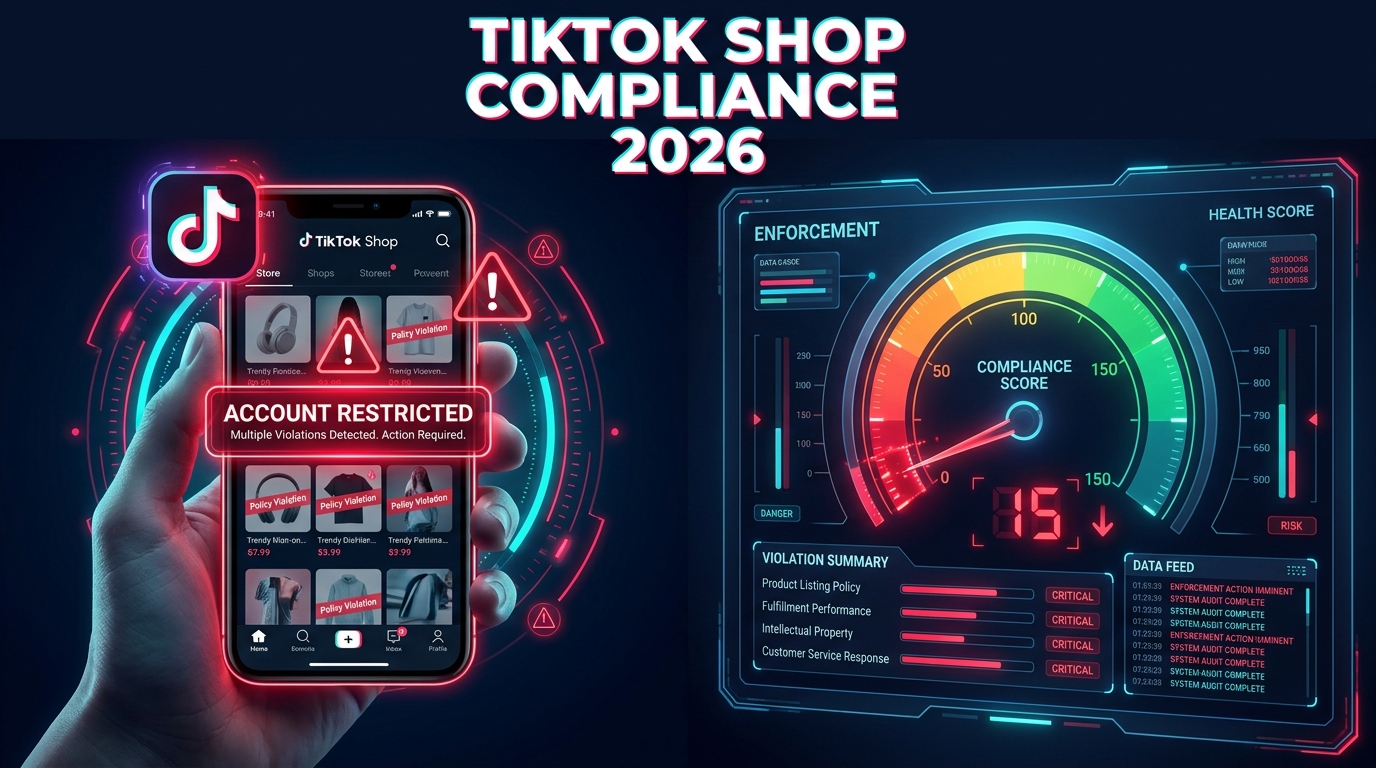
For the first three years of TikTok Shop’s U.S. existence, most sellers treated compliance as an afterthought — a list of rules you hoped you were following, with occasional listing removals as the worst likely outcome. That era is over.
In the first half of 2026, TikTok Shop has quietly deployed what amounts to a systematic enforcement architecture: automated health scores, threshold-based penalties, identity authentication gates, fund withholding schedules, and category-level documentation requirements that operate with almost no human review in the loop. The system doesn’t wait for complaints. It watches, scores, and acts.
Most sellers and affiliates have no clear picture of how these systems interact. They know they got a warning, or a listing was removed, or their payout was delayed — but they don’t know why the trigger fired, what score they’re sitting at, or how close they are to the next escalation tier. That informational gap is where the real damage happens.
This article breaks down TikTok Shop’s 2026 compliance architecture end to end. Not the policy language — which is long, dense, and deliberately general — but the actual operating mechanics: what scores exist, what thresholds matter, what documentation is now required at the listing level, how fund holds work, and what connects these systems in ways that can turn a single violation into cascading restrictions across your entire operation. The goal is to give sellers and affiliates a clear, factual map of the terrain they’re actually operating in.
From Violation Points to Account Health: The Enforcement Architecture Shift
Until mid-2026, TikTok Shop’s primary enforcement mechanism for sellers was a simple accumulation-based system: collect enough violation points, face escalating consequences. It was opaque and somewhat arbitrary — sellers often had no real-time visibility into their point totals — but it was at least conceptually familiar. Break a rule, receive points, accumulate too many points, lose access.
TikTok is replacing that model with something more complex and, in important ways, more consequential: the Account Health Rating (AHR). Scheduled for full rollout to all U.S. sellers by July 1, 2026, the AHR represents a fundamental change in how TikTok measures and enforces seller performance. Rather than a counter that only moves in one direction — up, as violations accumulate — AHR is a bidirectional score that can rise or fall based on seller behavior.
Why the shift matters
The old violation-points system had a structural blind spot: it only measured negative events. A seller who processed thousands of compliant orders was scored identically to a seller who processed zero — both had zero violation points, both appeared “healthy.” AHR corrects for this by making compliant, positive activity visible in the score.
The practical implication is significant. Under AHR, a seller who has been active and compliant for months builds a score buffer that protects against the occasional slip. A new seller or a seller who has been dormant starts with minimal buffer and is more vulnerable to penalties from even minor violations. The system rewards tenure and consistency, but it also means that sellers who have coasted on zero violations without actively building their score may be in a weaker position than they realize.
The second implication is accountability on both sides. Sellers can now point to a concrete score and track it over time. TikTok, in theory, has a more defensible basis for enforcement actions — though sellers have been quick to note that the score calculation methodology isn’t published in granular detail, which creates its own friction when disputing penalties.
The old system’s legacy period
It’s worth noting that the old violation-points system hasn’t been instantly retired for all sellers simultaneously. TikTok is running a transition period, and some sellers — particularly those who onboarded before the AHR rollout — will see both systems referenced in their Seller Center for a period. Understanding where you sit in that transition matters for how you read your current compliance standing.
How AHR Scoring Actually Works: The Numbers Behind the Gauge
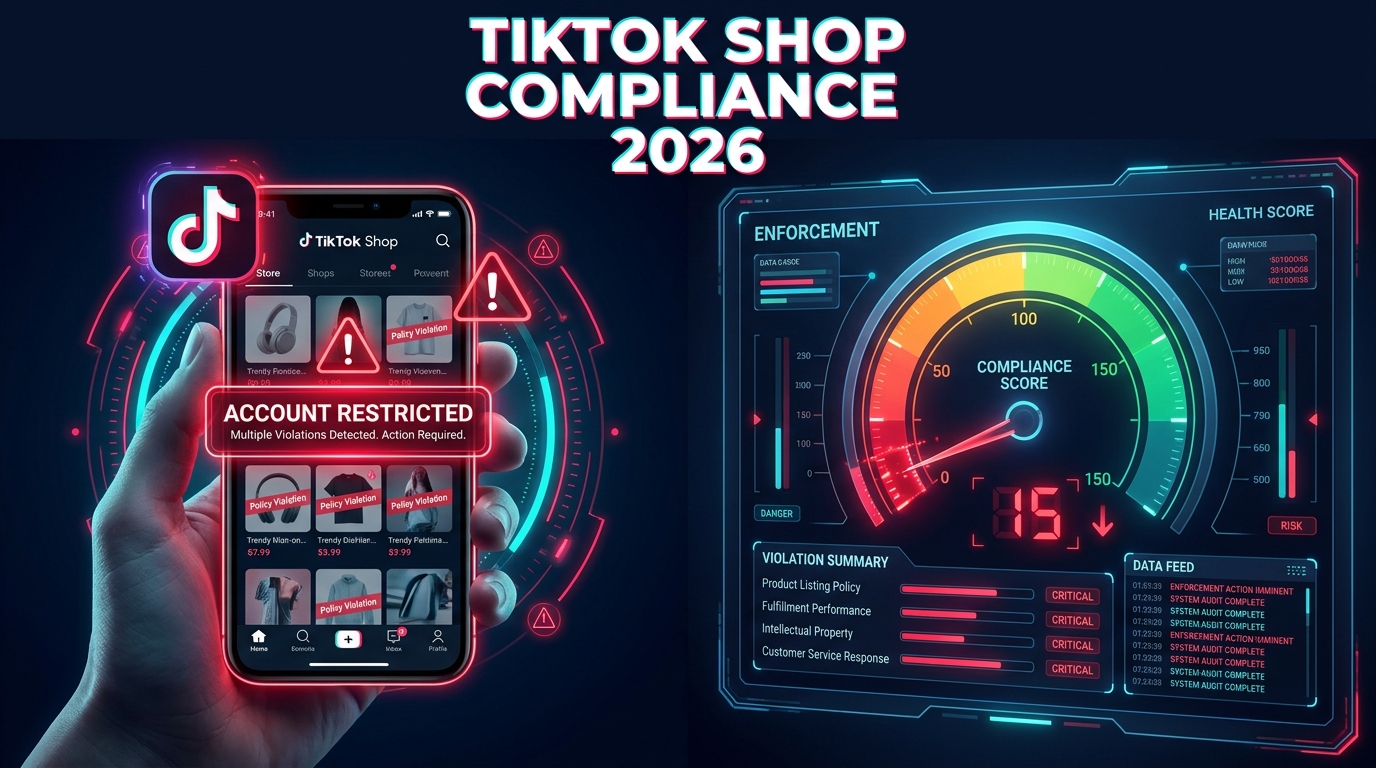
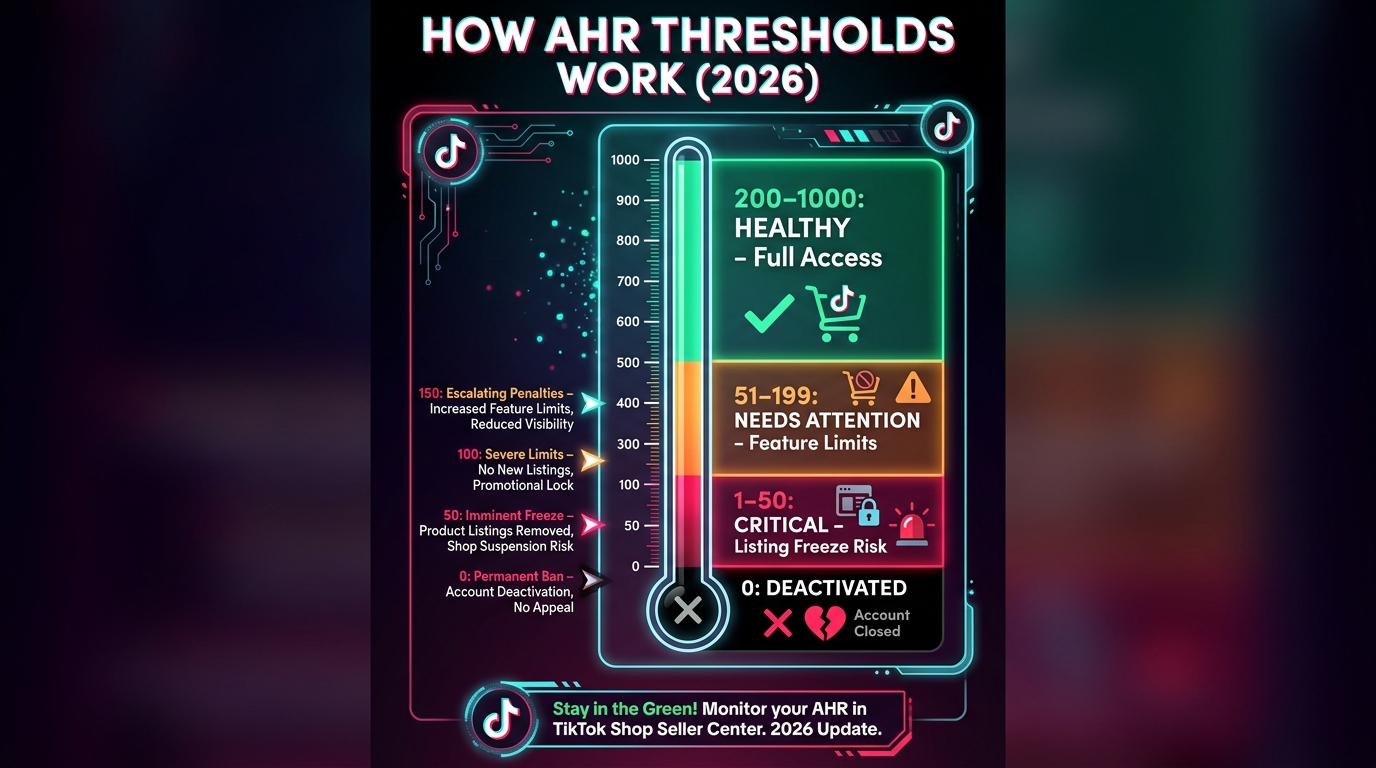
The Account Health Rating runs on a 0–1,000 point scale. Every new seller starts at 200 points. That starting position is important context: new sellers are not starting at maximum health. They’re starting at the lower edge of the green zone, with limited buffer before they hit penalty territory.
The three performance bands
TikTok divides the AHR scale into three operative bands:
- Green (200–1,000 points): Account healthy. Full access to all shop features, listing capabilities, campaign eligibility, and normal payout schedules.
- Orange (51–199 points): Needs attention. Feature restrictions begin to apply. The specific restrictions depend on score position within this band, but expect limitations on campaign participation, reduced listing visibility, and potential holds on new product approvals.
- Red / Critical (0–50 points): Account in serious jeopardy. Listings can be frozen. Payouts may be delayed or withheld. Account deactivation becomes an active risk.
How the score moves
Scores go up through two primary mechanisms: completed orders (each verified, non-disputed, on-time order contributes positive points) and compliance education (passing policy quizzes and completing Seller University courses adds incremental points). The score goes down when violations are recorded — each policy violation carries a point deduction calibrated to violation severity.
The scoring operates on a rolling window — reports suggest 90 or 180 days depending on region and seller tier — meaning older violations eventually stop dragging the score down, and older positive activity eventually stops contributing upward. This creates a dynamic score that reflects recent behavior rather than lifetime history, which can work for or against sellers depending on trajectory.
What sellers routinely get wrong about the score
The most common misconception is treating AHR as a static baseline. Sellers who haven’t looked at their score in weeks are often surprised to find it has drifted significantly — sometimes in both directions. Fulfillment issues accumulate quietly. A batch of late dispatches, a cluster of product-level complaints, or a series of minor listing policy flags can erode a score that looked comfortable at last check.
The second misconception is assuming that avoiding violations is sufficient. Under the AHR model, a seller who processes few orders and passes no policy quizzes is not scoring positively. They’re simply not accruing the positive points that would build buffer. Against a rolling window, that means a clean but inactive account can drift toward the orange band through score decay alone, even without any specific violation.
Score recovery mechanics
TikTok does allow score recovery, but it’s gradual by design. Sellers cannot buy or shortcut their way back to green — they have to earn points through compliant transaction volume and education completion. This is intentional: TikTok wants the score to reflect demonstrated, sustained behavior, not a one-time corrective action. For sellers who have dropped into the orange band, the path back requires weeks of clean operations and active participation in the compliance education system.
The Creator Health Rating: The Parallel System That’s Catching Affiliates Off Guard
Sellers operating with an affiliate network — or creator-sellers who both make and promote content — need to understand that AHR is only half of the scoring picture. TikTok Shop runs a separate but structurally parallel system for creators and affiliates: the Creator Health Rating (CHR).
The CHR operates on the same 0–1,000 scale and uses the same starting point of 200. But the penalty milestones are mapped slightly differently, and the types of violations that trigger deductions are specific to creator behavior rather than seller operations.
CHR milestone penalties
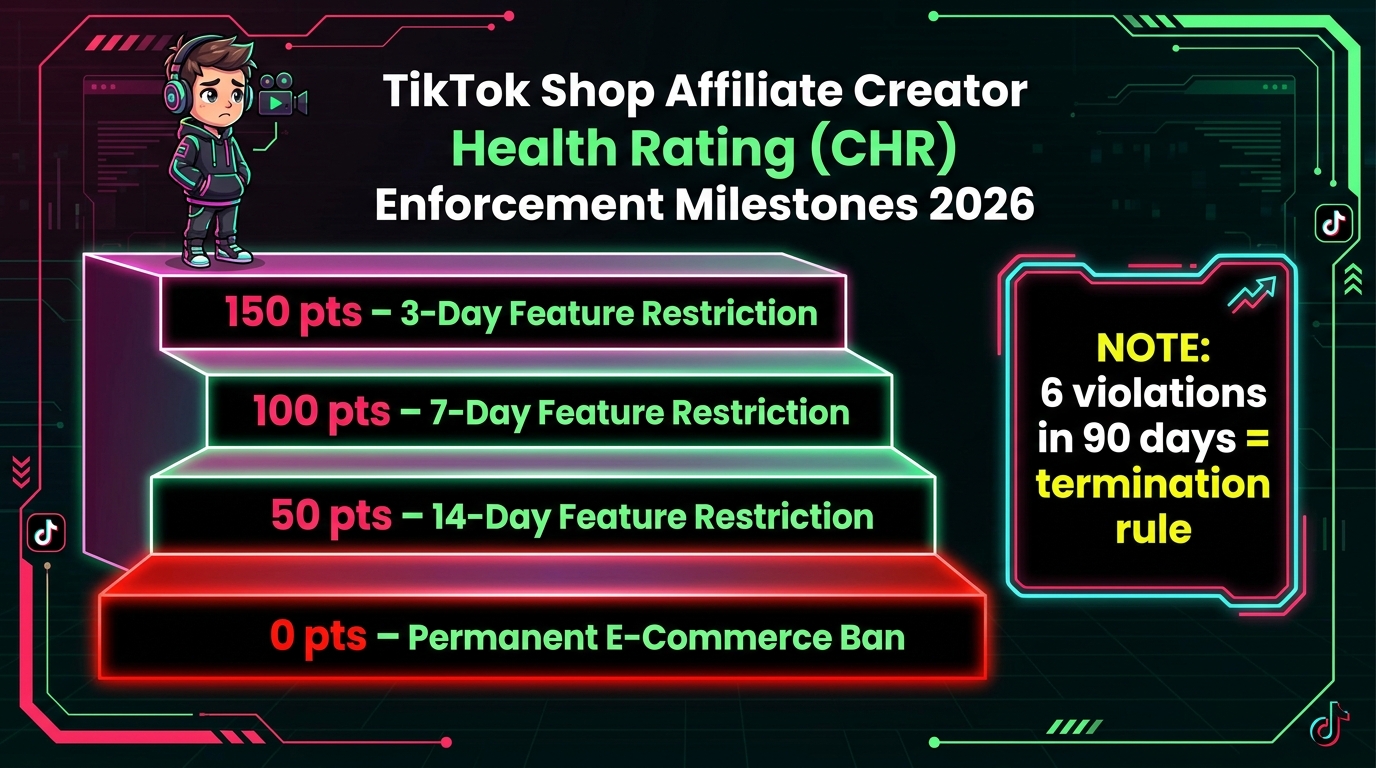
The published CHR enforcement milestones are specific and graduated:
- 150 points: 3-day restriction on shoppable videos, LIVE commerce, and Product Showcase. Ineligible for platform campaigns during restriction period.
- 100 points: 7-day restriction on the same feature set. Campaign ineligibility extends.
- 50 points: 14-day restriction. At this threshold, TikTok may begin reviewing the account for broader action.
- 0 points: Permanent loss of e-commerce creator permissions. This is not a temporary suspension — it is a termination of the creator’s ability to participate in TikTok Shop’s affiliate ecosystem.
The “6 violations in 90 days” termination rule
Beyond the score-based milestones, there is a separate rule that operates independent of the numeric score: six policy violations within any 90-day rolling window can trigger account termination even if the creator’s CHR score hasn’t hit zero. This is a pattern-based trigger that the automated enforcement system watches for regardless of absolute score level.
This rule catches affiliates by surprise more than almost any other mechanism in the system. A creator with a healthy CHR of 300 who receives six violations in a concentrated period — perhaps during a high-volume campaign push where content standards slip — can face termination that their score alone wouldn’t have predicted. The 90-day window resets, but violations don’t disappear mid-window: they all count for the full 90 days they were issued.
What triggers CHR deductions for creators
Creator violations are categorized around content quality and accuracy, promotional compliance, and community standards. Common triggers include: misleading product claims in promotional content, promoting restricted products without the required seller qualification in place, content that fails platform community guidelines, failure to disclose affiliate relationships appropriately, and low-quality or deceptive promotional tactics. The last category is particularly broad — it can encompass everything from artificially inflated review claims to content that misrepresents product availability or pricing.
The creator-seller overlap problem
Brands that have creator accounts linked to their seller accounts face a compounding risk: violations on the creator side can influence the seller side, and vice versa. TikTok’s enforcement architecture explicitly tracks connected accounts, which means a CHR issue in an affiliate program can have implications for the parent brand’s AHR if the accounts are sufficiently linked. We’ll return to the connected-account risk in a later section, but for now, the key point is that brands can’t treat AHR and CHR as independent silos.
INFORM Act Compliance: The Annual Verification Trap That Freezes Payouts
The INFORM Consumers Act — a U.S. federal law requiring online marketplaces to collect and verify information about high-volume third-party sellers — created a new category of compliance obligation that TikTok Shop has tightened significantly in 2026. Understanding the thresholds and the re-verification mechanics is essential for any seller operating at meaningful scale.
The threshold that activates the obligation
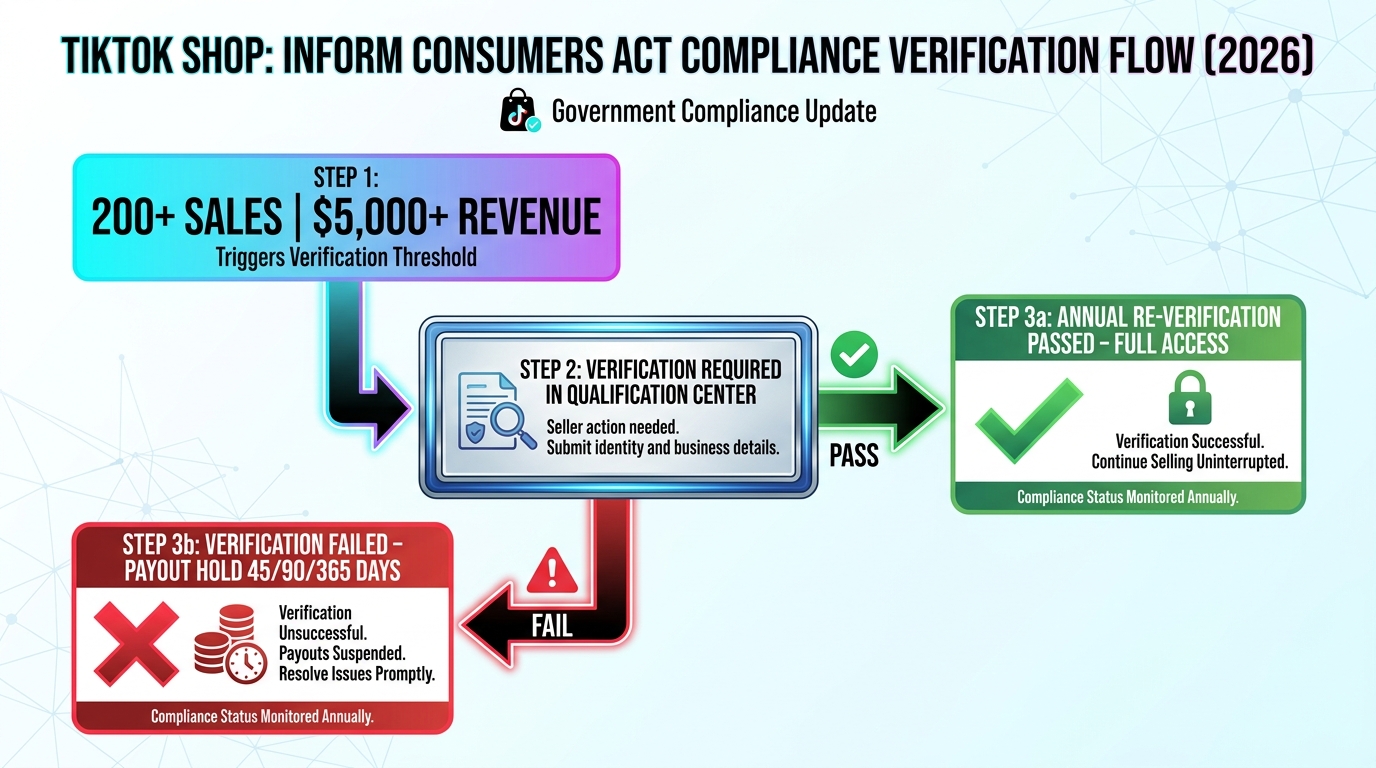
Under TikTok Shop’s March 2026 INFORM policy, sellers are classified as “high-volume” — and therefore subject to verification requirements — when they meet both of the following conditions within any continuous 12-month period in the past 24 months:
- 200 or more separate sales of new or unused products
- At least $5,000 in gross revenue
Both conditions must be met simultaneously. A seller who crosses 200 transactions but hasn’t hit $5,000 in revenue isn’t yet classified as a high-volume seller under this framework — though that changes quickly if they are pricing products above $25.
The annual re-verification requirement
The critical change in 2026 is that INFORM compliance is not a one-time onboarding check. TikTok now requires annual re-verification through the Seller Center’s Qualification Center. High-volume sellers who passed initial verification must re-certify their identity, business registration, and tax information on a 12-month cycle.
This creates a trap for sellers who complete initial verification and then assume the matter is closed. When the re-verification window opens, TikTok sends notifications through Seller Center — not necessarily by email prominently — and sellers who miss the window or fail to complete re-verification in time face concrete consequences: payment restrictions, listing limitations, and in non-response cases, account-level enforcement actions.
What non-compliance with INFORM triggers
TikTok’s Seller Enforcement Policy explicitly links INFORM Act compliance failures to the fund withholding schedule. Failing to complete required verification can trigger fund withdrawal restrictions — meaning earned revenue already in your TikTok Shop account is held and inaccessible. The withholding periods are tiered: 45 days for initial failures, 90 days for continued non-compliance, and 365 days for serious or repeated violations. We’ll cover the full fund-hold ladder in detail in a later section.
The re-verification process requires specific documentation: government-issued ID for individual sellers, business registration certificates for entity sellers, bank account verification, and tax ID numbers. TikTok has also begun implementing biometric facial verification as part of the process in some markets, which we cover in the identity authentication section below.
Practical risk management for INFORM compliance
The sellers at highest risk are those who crossed the threshold recently and haven’t yet been flagged as high-volume — but whose transaction history means the classification is imminent — and sellers who completed initial verification but haven’t tracked their re-verification anniversary. The Qualification Center in Seller Center is the single authoritative source for your current INFORM compliance status. Checking it quarterly rather than waiting for a notification is the minimum standard for proactive compliance management.
Listing-Level Documentation Triggers: Where Most Violations Actually Start
The enforcement model most sellers imagine — where violations come from behavioral infractions like misleading claims or prohibited products that someone reports — is only part of the picture. An increasingly large share of compliance enforcement in 2026 is triggered not by behavior but by documentation: what files, certificates, and supporting materials are or aren’t attached to a listing at the time TikTok’s systems audit it.
TikTok’s shift to listing-level compliance documentation is perhaps the most operationally consequential change of 2026. It moves the compliance burden from a reactive “don’t break rules” posture to a proactive “maintain documentation for everything” posture.
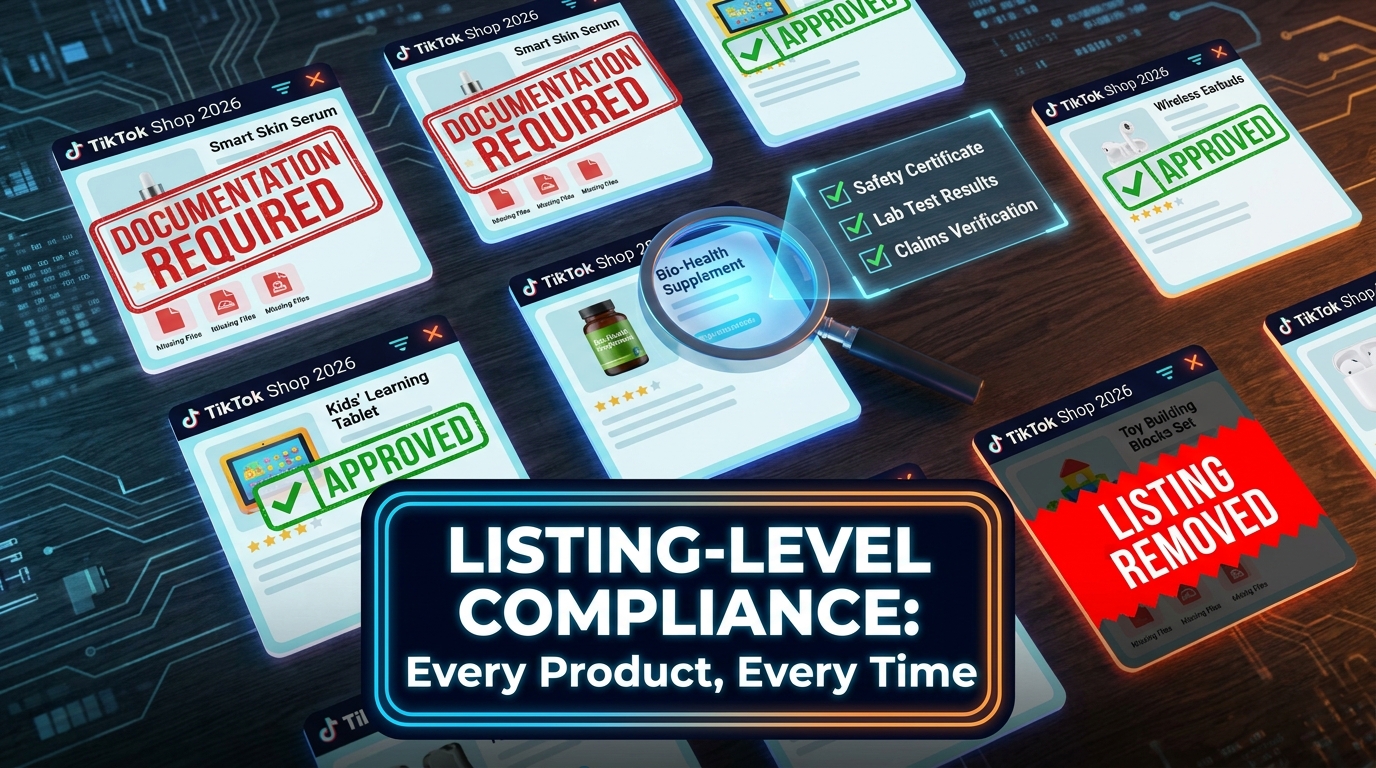
What “listing-level” compliance means in practice
Previously, product compliance was largely a category-level concern: certain categories required seller-level qualification before you could list in them, and that qualification was reviewed at onboarding. The 2026 model adds a per-listing layer. Even within a category you’re already approved to sell in, individual product listings can be flagged, paused, or removed if they lack the specific documentation TikTok has determined is required for that product type.
The revised Content Policy (May 22, 2026) and new Product Listing Policy (June 2, 2026) are the two governing documents here. Together, they establish that TikTok can request — at any time, including after a product is already live — the documentation required to substantiate a listing’s compliance. Failure to produce documentation on request is itself a violation, independent of whether the underlying product is actually compliant.
The documentation types TikTok is requesting
Documentation requirements vary by product category and claim type, but the most commonly requested categories of documentation in 2026 include:
- Safety certifications: Third-party lab test results demonstrating product safety standards compliance. Required for items that contact skin, are ingested, are used by children, or fall under electrical safety standards.
- Claims verification: Substantiation for any efficacy or performance claims made in listing copy or product imagery. This includes health benefit claims, before/after comparative claims, and quantitative performance claims.
- Regulatory compliance documents: For specific categories — pesticides, medical devices, OTC drugs — regulatory approval documentation from the relevant federal agency (EPA, FDA) is required.
- Brand authorization letters: For resellers operating as authorized retailers, letters from brand owners are required in certain categories to prevent unauthorized resale enforcement actions.
- Country-of-origin and manufacturing documentation: Increasingly required for products in food, supplements, and children’s product categories, driven partly by consumer protection policy and partly by tariff compliance concerns.
The timing problem: documents required on demand
The phrase “at any time” in TikTok’s listing policy is the operative danger for sellers. Products that have been live and selling without incident for months can suddenly receive a documentation request. If the seller doesn’t have the required certificates ready to upload, the listing is removed — and the removal counts against AHR. The removal doesn’t wait for the seller to source the documentation; it happens on a defined response deadline, typically 48 to 72 hours from the request.
Sellers who run large catalogs are at particular risk here. Maintaining a complete documentation library for hundreds or thousands of SKUs is operationally demanding. The sellers who weather this best have pre-built documentation repositories organized by SKU, with renewal tracking for certificates that expire — many safety certs have 1–2 year validity windows.
Image and content compliance as a listing trigger
Listing-level compliance isn’t limited to attached documents. The Product Listing Policy (June 2026) also includes enforcement standards for listing images and copy. Prohibited elements include: product images that make unsubstantiated efficacy claims through visual comparison, images showing prohibited products in use, lifestyle imagery that implies uses outside the product’s approved scope, and copy that makes category-regulated claims without appropriate qualification.
This image and copy enforcement operates through automated scanning, not human review. Listings can be flagged by TikTok’s content detection systems and removed or penalized without a complaint ever being filed. Understanding what content triggers automated flags — and auditing live listings proactively — is now a core compliance function, not just a best-practices recommendation.
Prohibited and Restricted Product Enforcement: The 2026 Category Tightening
TikTok’s Prohibited Products Policy was updated in May 2026 with an expanded scope that explicitly bans a wider set of items than earlier versions of the policy covered. For sellers, the critical distinction is between products that are prohibited (cannot be listed under any circumstances) and products that are restricted (can be listed but only with appropriate seller qualification and documentation).
The prohibited products expansion
The May 2026 update to the U.S. Prohibited Products Policy expanded the explicitly banned categories to include a broader range of wellness and health-adjacent products that had previously existed in a gray zone. The categories most affected by the expansion include:
- Adult products: Broader scope on what constitutes an adult product, with stricter application to items that had been listed under general wellness.
- Supplement and drug-adjacent products: Products making structure/function claims that TikTok’s systems interpret as drug claims — even implicitly — are now more aggressively pulled.
- Hazardous items: Expanded definitions in the chemical and electrical hazard categories, affecting some cleaning products and certain consumer electronics accessories.
- Counterfeit and intellectual property violations: Not new in principle, but automated detection has improved significantly, catching more listings that imply brand affiliation without authorization.
Restricted categories requiring qualification
Several high-volume TikTok Shop categories now sit firmly in restricted status, requiring sellers to obtain category-specific qualification before listing. The three most commercially significant are:
Beauty and Personal Care: One of TikTok Shop’s most active categories is now subject to qualification requirements that include safety documentation, ingredient disclosure for formulated products, and claims substantiation. The shift reflects both regulatory pressure and the high volume of consumer complaints that had accumulated in this category. Sellers who had built sizeable beauty catalogs without going through formal qualification are being re-reviewed.
Consumer Electronics: Electrical safety certification requirements have been tightened. Products sold in this category must demonstrate compliance with relevant UL or equivalent standards, and battery-containing products face additional scrutiny around transportation and handling documentation — a requirement with implications for how listings describe shipping and storage.
Children’s Products: This category has faced the strictest documentation requirements, consistent with CPSC regulatory standards. Age-grading documentation, ASTM compliance records, and CPSIA certification are required for most products in this space. The enforcement here is particularly unforgiving because violations carry potential liability implications beyond the platform.
How restricted product violations escalate
Listing a product in a restricted category without proper qualification doesn’t just result in that listing being removed. The violation is logged against AHR with a deduction calibrated to the severity of the restriction breach. If the product also makes claims that cross into prohibited territory — a supplement listed in a restricted wellness category that also makes drug-adjacent claims — the violation can be classified at a higher severity, with correspondingly larger point deductions and potential for order cancellations and customer refund obligations on top of the AHR penalty.
Fulfillment and Logistics Compliance Triggers: The Metrics That Feed Your Score
While product compliance gets the most attention in seller discussions, logistics and fulfillment performance is a direct and continuous input into AHR. The operational metrics TikTok tracks aren’t just customer experience indicators — they are compliance triggers in their own right.
The seller shipping policy reversal and what it left behind
TikTok’s original plan to end independent Seller Shipping and mandate TikTok Shop Logistics Services for all U.S. sellers by March 31, 2026 was paused and partially reversed in mid-February 2026. The full exclusivity mandate was shelved, leaving a hybrid model where sellers can continue to use their own shipping labels.
However, the pause on the mandate did not pause the enforcement of logistics performance standards. The metrics that would have been enforced under the logistics mandate are still tracked and still feed into AHR regardless of which shipping method a seller uses. The reversal gave sellers a choice of logistics provider; it did not give them a choice about whether their logistics performance gets scored.
The Late Dispatch Rate threshold
The most consequential logistics metric for AHR is the Late Dispatch Rate (LDR). TikTok’s official threshold is a recommended rate of 4% or below, with enforcement triggered when LDR exceeds 10%. Between 4% and 10% is a warning zone where sellers can expect increased scrutiny but not yet automated enforcement.
The 10% trigger is not a soft guideline — breaching it generates an automated AHR deduction. For sellers running high-volume operations during promotional events, where order spikes can stress fulfillment capacity, the LDR can move quickly. A campaign that drives 3x normal order volume over 72 hours, with normal staffing levels, can push a seller’s LDR from below 4% to above 10% within that single window, generating an enforcement action even if the underlying business is fundamentally healthy.
Other logistics metrics in the scoring model
Beyond LDR, the fulfillment performance inputs to AHR include order cancellation rate, valid tracking rate (the percentage of orders with a functioning tracking number uploaded within the required time window), and customer-reported delivery failures. Each of these is measured on a rolling basis and can generate both direct AHR deductions and flags for manual review if the numbers deteriorate sharply.
Sellers using FBT (Fulfilled By TikTok) are shielded from most of these metrics, since TikTok controls the fulfillment process and takes on the associated performance risk. For seller-fulfilled orders, every metric is the seller’s responsibility, and no amount of extenuating circumstances — carrier delays, natural events, demand spikes — automatically excuses a metric breach. Sellers can appeal enforcement actions through Seller Center, but appeals require documentation and take time, during which the AHR impact is already in effect.
The Fund Withholding Ladder: 45, 90, and 365 Days
The enforcement mechanism that gets the least attention but carries the most financial risk is TikTok Shop’s fund withholding system. Under the Seller Enforcement Policy, TikTok can restrict access to a seller’s account balance — including revenue from completed, already-delivered orders — as a consequence of compliance violations.
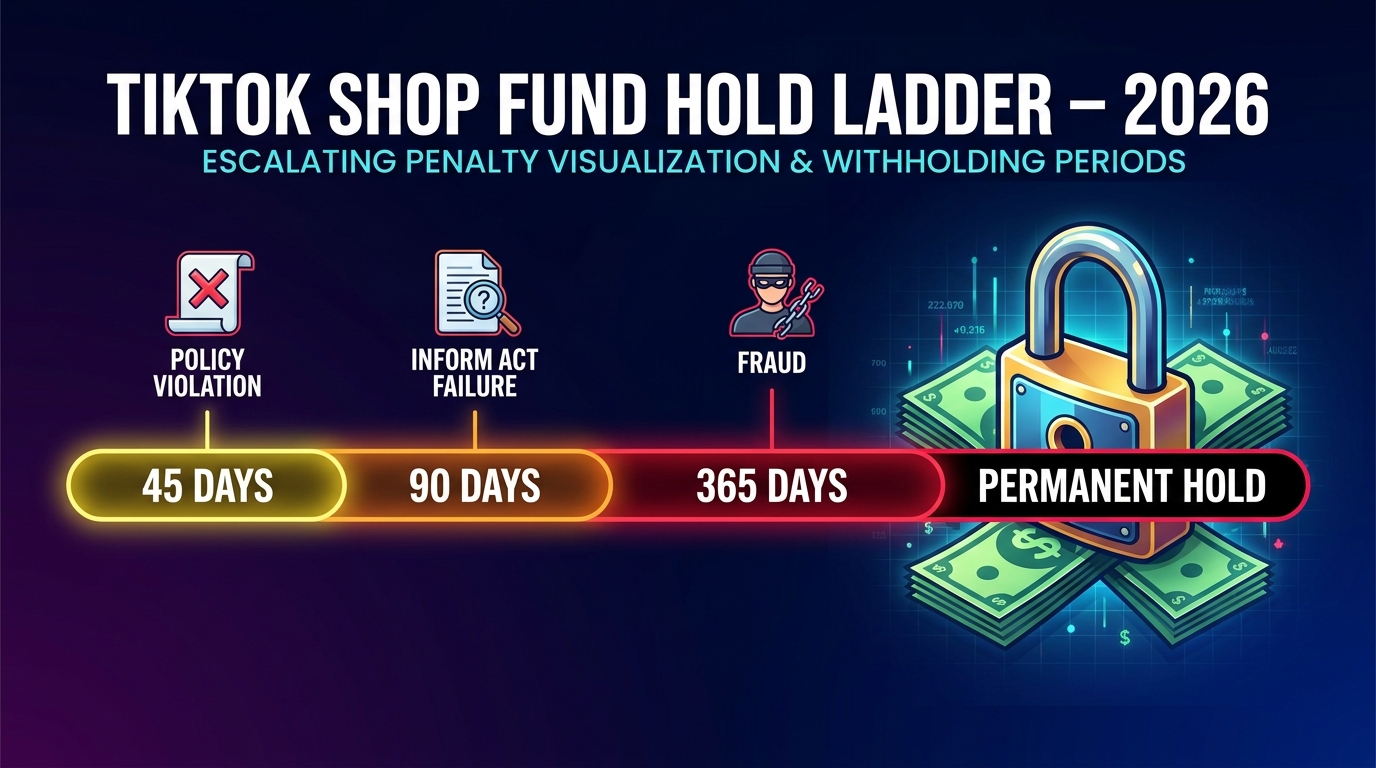
How the withholding tiers work
Fund withdrawal restrictions are graduated and linked to violation type and severity:
- 45-day holds: Applied for initial or moderate policy violations, including first-instance INFORM Act non-compliance where the seller has not responded to verification requests. Revenue generated during this period continues to accumulate in the account but cannot be withdrawn.
- 90-day holds: Applied for continued non-compliance after an initial hold, for more serious category violations, or for patterns of behavior that TikTok’s systems flag as elevated-risk. The seller’s account remains active in some cases but payouts are fully blocked.
- 365-day holds: Applied for serious compliance failures, particularly those tied to INFORM Act re-verification non-completion at scale, or to violations that TikTok’s systems classify as potentially fraudulent. The seller cannot withdraw any funds for the full year, though in some cases the account may continue to operate in a restricted capacity.
- Permanent withholding: Applied when TikTok determines fraud or intentional policy evasion has occurred. Funds are held indefinitely and may ultimately be returned to customers or held by TikTok per its enforcement policy.
The cash flow reality of a 365-day hold
For any seller operating TikTok Shop as a meaningful revenue stream, a 365-day fund hold is a potential business-ending event. The seller continues to incur costs — inventory, advertising spend, platform fees — but receives zero cash from the channel for a full year. Unlike a bank loan or line of credit, which has a defined repayment structure, a 365-day hold exists entirely on TikTok’s terms, with limited recourse outside of the appeal process.
This is not a theoretical risk. Sellers who miss INFORM re-verification windows, who operate in restricted categories without proper qualification, or who accumulate serious violations in a short period are exposed to this level of enforcement. The appeal window exists, but appeals are adjudicated on TikTok’s timeline, not the seller’s.
What sellers get wrong about their balance
A common misconception is that funds from completed and delivered orders are inherently safe once the settlement cycle closes. Under TikTok’s Seller Enforcement Policy, this is not the case. Funds that have cleared TikTok’s settlement process but haven’t been withdrawn to a bank account remain in the TikTok Shop balance and are subject to withholding if a compliance action is triggered after settlement but before withdrawal. Sellers who let large balances accumulate in their accounts — rather than withdrawing on a regular schedule — are exposed to larger fund holds in the event of an enforcement action.
Identity Authentication: The New Onboarding Gatekeeping
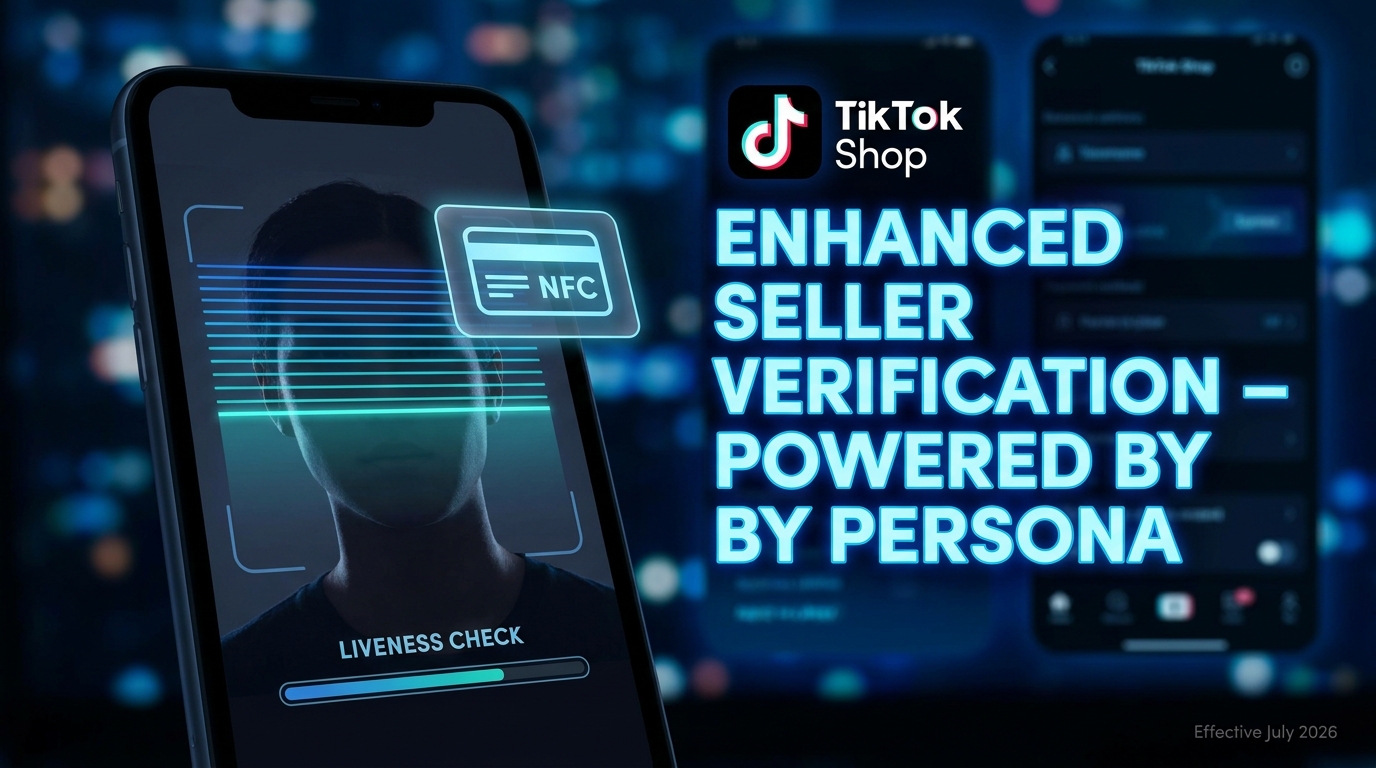
One of the clearest signals of TikTok Shop’s compliance direction in 2026 is the significant upgrade to seller identity verification at the onboarding stage. In May 2026, TikTok Shop U.S. announced enhanced identity verification for new seller onboarding, powered by Persona — a specialist identity verification platform — using video-based facial scans and ID document comparison on both desktop and mobile.
What the new verification requires
New sellers onboarding after the May 2026 implementation face a more demanding identity verification process than their predecessors. The process requires:
- Government-issued photo ID submission and automated verification
- Facial scan matching the ID photograph, performed via Persona’s live verification technology
- Liveness detection to prevent static photo or pre-recorded video spoofing
- For business entity sellers: business registration documents alongside personal ID for the account owner
In Vietnam, TikTok has gone further, requiring NFC-chip ID reading in addition to the facial scan from July 1, 2026 — a higher standard that reads the cryptographically secure data embedded in new identity documents. Whether NFC verification expands to U.S. sellers is not confirmed, but the Vietnam implementation is typically an indicator of direction for broader rollout.
Why this matters beyond onboarding
Enhanced identity verification at onboarding has implications beyond just new-seller friction. It directly addresses the problem of new accounts being created as workarounds for suspended accounts — a long-standing enforcement evasion tactic where sellers who receive permanent bans simply open new shops under different email addresses.
With biometric verification in place, creating a new account after a permanent ban requires defeating the facial matching system — a significantly higher barrier than just using a new email. This is part of TikTok’s broader connected-account enforcement strategy, where the goal is to make enforcement actions stick rather than be easily circumvented.
Existing seller re-verification
Identity verification isn’t only a new-seller concern in 2026. TikTok has also been requiring re-verification for existing sellers who trigger certain risk signals — account access changes, unusual transaction patterns, changes in business information — or who fall under the INFORM Act re-certification cycle. Sellers who set up their accounts before enhanced verification was implemented may receive re-verification requests that require them to complete the biometric process retroactively.
Connected Accounts and Enforcement Contagion
The final and perhaps most underappreciated dimension of TikTok Shop’s compliance architecture is the way enforcement actions spread across connected accounts. TikTok explicitly tracks account relationships — shared payment methods, linked phone numbers, common IP addresses, related business entities, and verified ownership connections — and can extend enforcement from one account to related accounts when it determines that connection is relevant.
How connected-account enforcement works
The mechanism is clearest in cases of permanent shop deactivation. When TikTok permanently deactivates a seller account for serious violations, it doesn’t simply close that account — it also reviews connected accounts for the same violations or for participation in the same conduct. If the connection is sufficiently close, the deactivation can extend to linked shops.
This has particular implications for brands that operate multiple seller accounts — a common strategy for testing new product lines, maintaining separate storefront experiences, or managing different regional presences. If these accounts share underlying identity verification credentials, payment methods, or business registration details, they may be treated as a single entity for enforcement purposes. An AHR crisis on one account can become an AHR crisis across the portfolio.
The creator-seller connection risk
For brands that also operate creator accounts — whether through employee creator profiles or owned content channels — the connection between the brand’s seller AHR and the creator’s CHR is a real operational risk. When TikTok’s systems identify that a creator account is controlled by or closely affiliated with a seller account, violations on either side can have implications for the other. A CHR penalty on a brand’s creator account, triggered by a content violation in an affiliate campaign, can register as a related compliance event on the brand’s seller AHR.
This doesn’t mean every penalty on a creator account automatically docks the seller AHR — the systems are not fully integrated at the penalty level. But during account reviews triggered by other compliance events, the connected-account picture is part of TikTok’s assessment. Brands that have built large, active creator-commerce presences alongside their seller operations should audit both sides of that relationship for compliance health regularly.
Third-party agencies and management accounts
A less-discussed connected-account risk involves third-party agencies that manage TikTok Shop operations on behalf of multiple brands. Agencies that use shared management accounts, shared IP environments, or shared credentials across client accounts may create inadvertent connections in TikTok’s systems. If one client account faces serious enforcement action, the agency’s technical management infrastructure can become part of the review. This is a structural risk that responsible agencies should be actively managing through proper account segmentation and credential isolation.
Operating in an Automated Compliance Environment: What Changes Now
The cumulative picture of TikTok Shop’s 2026 compliance architecture is of a system that has moved from periodic, human-reviewed enforcement to continuous, automated monitoring with predetermined thresholds and automated consequences. The system doesn’t negotiate, doesn’t accept informal explanations, and doesn’t wait for a violation to become obvious before it acts. It scores, it watches, and at defined thresholds, it executes.
For sellers and affiliates, the operational shift this demands is substantial. Compliance can no longer be treated as a periodic audit function — something you check quarterly or in response to a warning. In a threshold-based automated system, the time between a score dipping into the orange band and hitting a penalty milestone is measured in transactions and days, not months. By the time a formal warning arrives, the window for proactive correction may have already narrowed significantly.
Building a compliance operating model
The sellers and affiliates who are navigating 2026’s enforcement environment successfully share a common characteristic: they’ve made compliance a continuous operational function rather than a periodic compliance check. In practice, that means:
- Weekly AHR monitoring: Checking the current score and flagging any movement toward the orange band before it becomes a milestone problem. Not monthly — weekly at minimum for active sellers.
- Documentation pre-flight for new products: Building the compliance documentation package — safety certs, claims substantiation, manufacturer documentation — before a product is listed, not after TikTok requests it. The 48–72 hour response window is not adequate time to source documentation for products that weren’t documented at launch.
- INFORM Act calendar management: Tracking re-verification anniversaries as a hard calendar item, not a reactive response to a notification. Failing re-verification is an avoidable, calendar-preventable risk.
- Creator and affiliate compliance oversight: For brands running affiliate programs, monitoring CHR scores and violation patterns in the creator network — not just seller-side metrics. A cluster of creator violations in 90 days can trigger the termination rule regardless of individual score levels.
- Regular fund withdrawals: Not leaving large balances in TikTok Shop accounts. Weekly or biweekly withdrawal schedules reduce the capital-at-risk in any enforcement scenario.
Disputing enforcement actions
When enforcement actions are triggered — and for active sellers at scale, some will be — TikTok’s appeal process in Seller Center is the formal recourse. Appeals require specific documentation: evidence that the violation finding was incorrect, that documentation existed and was available at the time of the review, or that the metric calculation was erroneous. Appeals without supporting documentation are routinely rejected.
The timeline for appeals is not seller-determined. TikTok processes appeals on its own schedule, and during the review period, the enforcement action remains in effect. This is a strong reason to front-load compliance investment — the cost of maintaining documentation and scores proactively is significantly lower than the operational disruption of managing enforcement actions reactively.
The longer arc: where this enforcement architecture is heading
TikTok Shop’s 2026 compliance architecture is not a finished product. The systems deployed this year — AHR, CHR, enhanced identity verification, listing-level documentation requirements — are components of a larger infrastructure that TikTok is still building out. The trajectory is toward more automation, tighter thresholds, and more integration between the various compliance signals.
The INFORM Act compliance framework will likely tighten further as federal enforcement of the Act increases. Product safety documentation requirements are likely to expand from the current high-risk categories to broader catalog coverage. Identity verification requirements, already at biometric standards in some markets, will likely become the global baseline over the next 12–18 months.
Sellers who build the compliance infrastructure now — documentation systems, monitoring workflows, staff or agency capability to manage health scores and appeals — are building an asset that will serve them through successive waves of enforcement tightening. Those who treat each new compliance requirement as an isolated inconvenience, responding reactively when something breaks, will find the cost of that approach rising with each new threshold TikTok introduces.
The platform’s commercial opportunity is real and growing. But in 2026, access to that opportunity has a compliance price. Knowing exactly what that price is — and how TikTok’s systems are built to collect it — is now a core business competency for anyone selling seriously on TikTok Shop.
The sellers who come out ahead in TikTok Shop’s enforcement environment aren’t the ones with the cleanest record by luck. They’re the ones who understand how the scoring systems work well enough to manage them deliberately — before the thresholds fire, not after.