
Something shifted in May 2026, and sellers felt it before they understood it. Videos that used to pull reliable traffic went quiet. Products that had been converting steadily saw their impressions drop. Meanwhile, accounts with smaller followings but tighter conversion metrics were seeing organic reach they’d never experienced before. The pattern was unmistakable: the rules had changed.
What happened wasn’t a minor tweak to ranking weights or a seasonal fluctuation in ad costs. TikTok’s May 2026 algorithm update represented a deliberate structural change in how the platform assigns value to content — specifically, commerce-driving content. After years of operating primarily as an entertainment recommendation engine that happened to have shopping features bolted on, TikTok has now inverted the priority order. The commerce layer is no longer secondary to the content layer. In the platform’s current architecture, they’re the same thing.
This post breaks down exactly what changed, what it means for sellers operating TikTok Shops right now, and how the new signal hierarchy should reshape the way you create content, run ads, manage your creator network, and think about discoverability going into the second half of 2026. There’s a lot of noise out there. This is the signal.
The End of “Going Viral” as a Sales Strategy
For years, the dominant TikTok seller strategy was deceptively simple: make something viral, hope the views convert. A video with 2 million plays was treated as a major commercial win even if the actual product click-through rate was 0.3%. Brands hired people specifically for “virality” — chasing audio trends, riding cultural moments, optimizing for the dopamine hit of a share. The algorithm appeared to reward all of that. So sellers kept doing it.
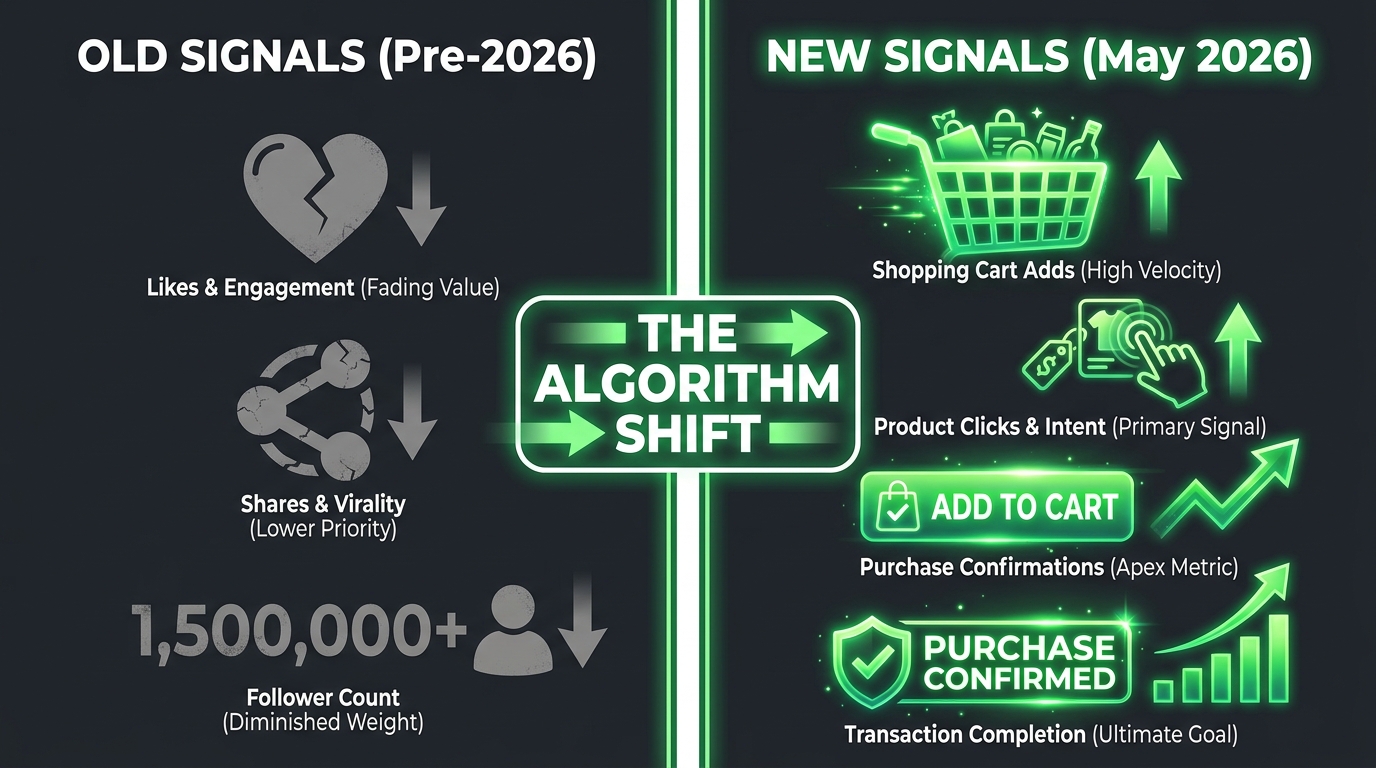
The May 2026 update dismantles that logic at the infrastructure level. TikTok’s algorithm has shifted from an entertainment-signal weighting system to a commerce-signal weighting system. Likes, shares, follows, and even plain watch time now carry less algorithmic weight for product-linked content than they previously did. The metrics that now drive distribution for TikTok Shop sellers are fundamentally transactional: product page clicks, add-to-cart actions, and completed purchases.
Why This Change Was Inevitable
TikTok’s projected US Gross Merchandise Value for 2026 sits at $23.4 billion — a number the platform cannot reach by accident. GMV doesn’t grow from entertainment views. It grows from purchase conversions. The platform has a direct financial stake in ensuring that its recommendation engine routes traffic to products likely to sell, not just content likely to entertain. The May 2026 changes are the most explicit acknowledgment yet that TikTok is optimizing its entire content distribution system around commercial outcomes.
This means a video that entertains 500,000 people but drives zero product interactions will receive less future distribution than a video seen by 12,000 people that generates 400 product page visits and 80 purchases. The entertainment metric looks better on a dashboard. The commerce metric is what TikTok’s algorithm now considers more valuable.
What Sellers Need to Measure Instead
The practical implication is an immediate audit of what your team tracks. If your weekly reporting still centers on views, follower growth, and raw engagement rates, you are optimizing for a system that no longer exists in its previous form. The metrics that now correlate with algorithmic distribution for Shop sellers are: product click-through rate (pCTR), add-to-cart rate from video, video-attributed purchases, and GMV generated per video asset. Each of these signals directly informs how broadly TikTok will push that content — and by extension, how much organic reach your products receive.
The shift doesn’t mean entertainment is irrelevant. Content that fails to hold attention won’t generate commerce signals at all. But entertainment is now a means to a commerce end, not the end itself. That’s a subtle but consequential reframe for every seller who has been treating their TikTok presence primarily as a content channel.
The Content-Commerce Graph: How TikTok Now Classifies Your Videos
One of the less-discussed structural changes in TikTok’s 2026 update is the formalization of what the platform calls the content-commerce graph. This is the underlying framework TikTok uses to understand the relationship between a piece of content, the creator who made it, the products associated with it, and the users most likely to convert on it.
Previously, TikTok’s recommendation system was primarily built around a content-user graph — matching videos to viewers based on behavioral patterns like watch history, interaction patterns, and declared interests. The commerce graph overlays a new layer: it maps purchase intent signals onto both content and user profiles, allowing the algorithm to identify which viewers are in a buying mindset and which content assets are most effective at triggering purchase behavior for specific product categories.
What This Means for Mixed Accounts
Sellers who operate as both content creators and shop operators face a specific challenge with the content-commerce graph. Accounts that post entertainment content alongside product content create a mixed signal profile — the algorithm has difficulty assigning a clear commercial intent score to the account as a whole. In the updated system, this ambiguity is penalized through inconsistent distribution.
Accounts with a strong, consistent commercial identity — where the majority of content is product-adjacent, review-based, or tutorial-oriented — receive more reliable distribution for their Shop content because TikTok can confidently classify the account within its commerce graph. Accounts that alternate between trending sounds with no commerce intent and occasional product drops get treated as entertainment accounts with occasional commercial noise, which means the product-linked content gets less push.
How the Algorithm Assigns Commercial Intent
Commercial intent is inferred through multiple signals simultaneously. The presence of a product tag is the most direct indicator, but the algorithm also evaluates visual and audio content to assess whether the video is likely to drive purchase behavior. A video that shows a product in use, includes spoken product descriptors, features price or urgency cues, and has a clear call to action is classified as high commercial intent. A video that tags a product in the corner while primarily executing a trending dance challenge is classified as low commercial intent — regardless of how many views it gets.
This classification matters because high-commercial-intent content is eligible for broader commerce distribution (including placement in the Shop Tab, Search results, and product pages), while low-commercial-intent product content is effectively treated as organic entertainment and distributed on entertainment signals alone. The distinction has real implications for reach.
GMV Max: The Algorithm’s New Control Tower
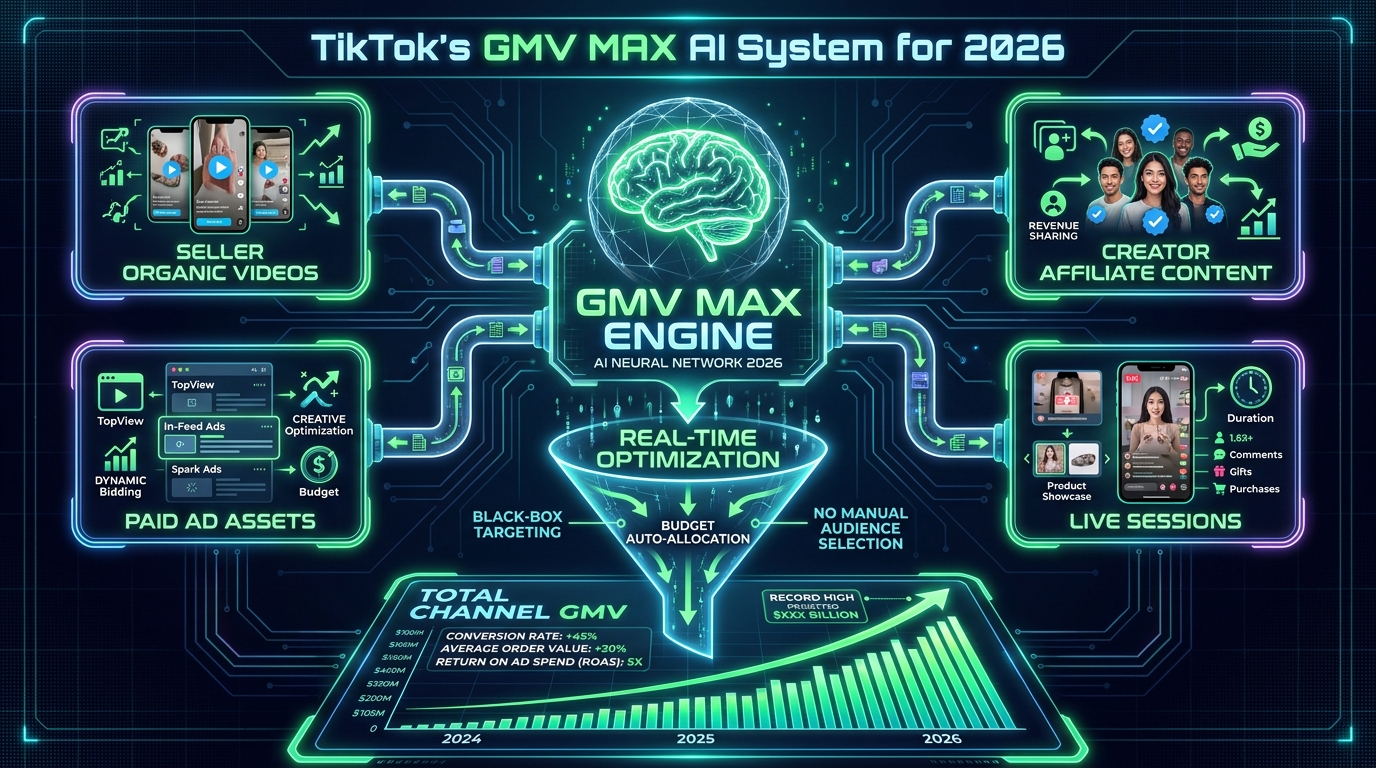
GMV Max became the only supported campaign type for TikTok Shop Ads in July 2025, but its full influence on the broader content ecosystem only became apparent through the May 2026 update. Understanding GMV Max isn’t just an advertising question — it is a fundamental requirement for understanding how TikTok distributes all commerce-related content on the platform.
At its core, GMV Max is a fully automated AI campaign system. Sellers input three things: eligible products, a daily budget, and a target return on ad spend (ROAS). From there, the system operates as a near-complete black box. The algorithm scans all authorized content associated with a seller’s shop — including organic videos from the seller account, whitelisted creator content, affiliate videos, and LIVE sessions — and selects which assets to promote, to which audiences, at which bid levels, across which placements.
How the “Smash and Test” Framework Works
GMV Max operates on what practitioners have labeled a “smash-and-test” approach. When a campaign launches, the system simultaneously deploys multiple content assets across different audience segments and placement types. It reads real-time engagement and purchase signals within the first several hours and rapidly reallocates budget toward the assets and audience combinations showing the strongest purchase probability. Assets that underperform in the initial test window get starved of budget. Assets that show strong early commerce signals receive exponential budget increases.
This means the content quality and commerce signal strength of your video assets directly determines how much free amplification your paid budget generates. A seller with ten mediocre videos and $1,000 daily budget will see that budget spread thin and underperform. A seller with two highly optimized, commerce-signal-rich videos and the same budget may see dramatically more efficient GMV per dollar spent, because GMV Max has clear winning assets to push hard.
What Sellers Cannot Control — and Where to Focus Instead
The black-box nature of GMV Max frustrates sellers accustomed to manual audience targeting, placement selection, and creative testing with defined variables. None of that is available. There are no demographic targeting options, no manual bid strategies for individual placements, and no ability to exclude specific audience segments. The system makes all of those decisions autonomously.
What sellers can influence is the input quality. The number of authorized content assets available to GMV Max, the commercial signal density of each asset, the product listing quality (titles, imagery, price competitiveness, review count), and the baseline ROAS target all shape how the algorithm behaves. Sellers who treat GMV Max as a “set it and forget it” tool and neglect the content and listing inputs will consistently underperform against sellers who understand that GMV Max is only as good as what it’s given to work with.
The Creator Health Rating: A New Algorithmic Lever
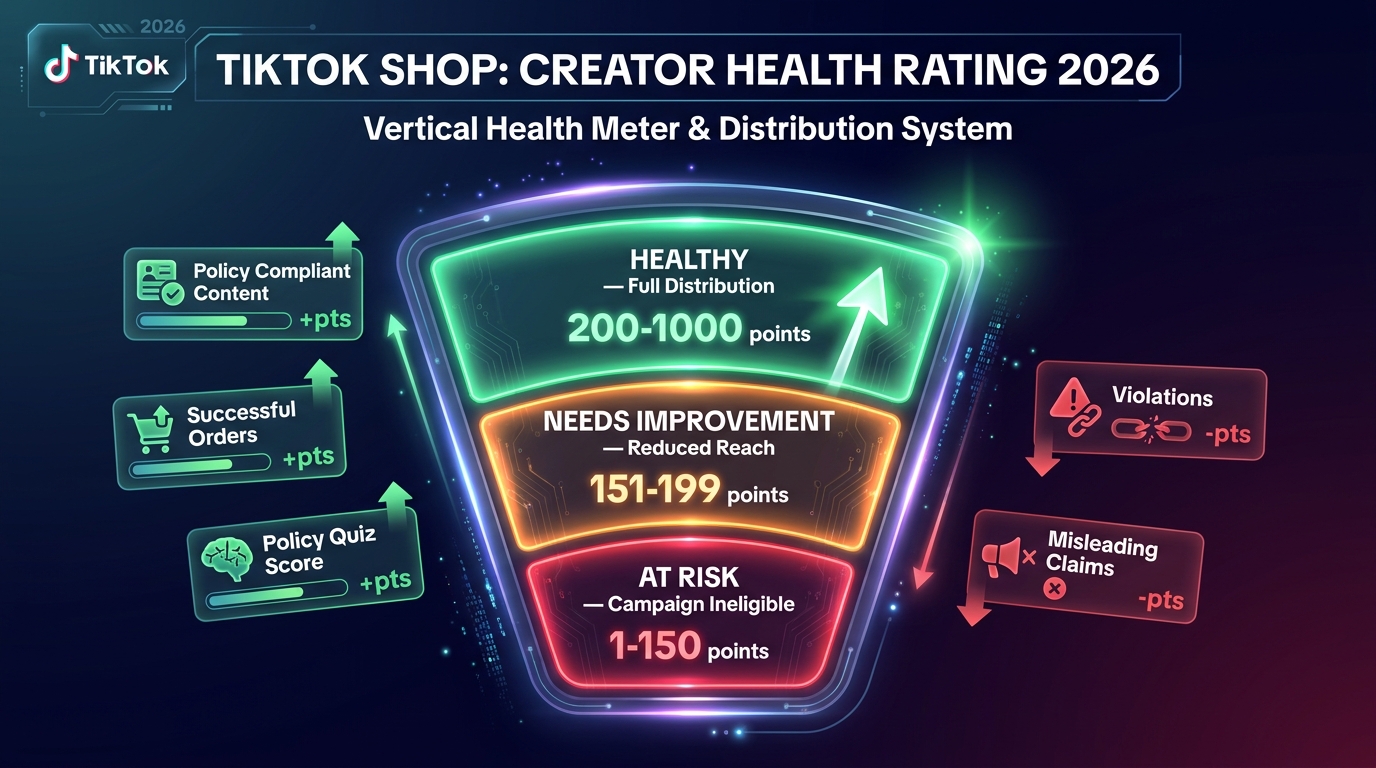
Launched globally between January 12–19, 2026, the Creator Health Rating (CHR) replaced TikTok’s previous Violation Points system and introduced a far more nuanced way for the platform to assess and reward (or penalize) creator account behavior. Every creator and seller operating an affiliate relationship on TikTok Shop now operates under this scoring framework, and its implications for algorithmic distribution are significant.
The CHR is a 0–1,000 point scale. All creators who were active on the platform before the January 2026 launch were reset to a starting score of 200 points, placing them in the green (healthy) tier. New creators also start at 200. Scores update every Monday and are visible in the Creator Center dashboard.
How the Score Works
Points increase through positive account behaviors: posting policy-compliant content, generating successful shop orders, completing policy quizzes with perfect scores, and maintaining clean performance metrics over time. Points are deducted for policy violations, with the severity of the deduction tied to the severity of the violation. Importantly, point deductions from violations reset after 90 days — meaning creators can recover from isolated incidents rather than being permanently marked by a single mistake.
The three-tier system creates clearly distinct distribution outcomes:
- Green (200–1,000 points): Healthy account status. Full distribution access, full campaign eligibility, no restrictions on product linking or affiliate participation.
- Orange (151–199 points): Needs improvement. Reduced organic reach and limited campaign eligibility. The algorithm actively deprioritizes content from orange-tier accounts in Shop-related placements.
- Red (1–150 points): At-risk status. Significant distribution restrictions, potential campaign ineligibility, and risk of permanent e-commerce bans at a score of 0 (with an appeal process available).
Why This Matters for Sellers Who Use Affiliates
For sellers relying on an affiliate creator network, the CHR introduces a new due-diligence requirement: understanding the health scores of the creators you’re partnering with. A creator with a red CHR score posting affiliate content for your products isn’t just ineffective — the distribution restrictions on their account mean your products are being promoted into an algorithmic dead zone. The content exists but doesn’t reach buyers. Sellers who managed large affiliate networks under the old Violation Points system need to revisit those networks through the CHR lens and re-evaluate which partnerships are still algorithmically viable.
The good news is that CHR creates a clear competitive sorting mechanism. High-quality, policy-compliant creators who consistently drive sales will accumulate points over time and build stronger algorithmic advantages. For sellers willing to invest in creator relationships rather than treating affiliates as disposable, the CHR system rewards that investment with compounding distribution benefits.
Search Is Now Bigger Than the FYP for Shop Sales
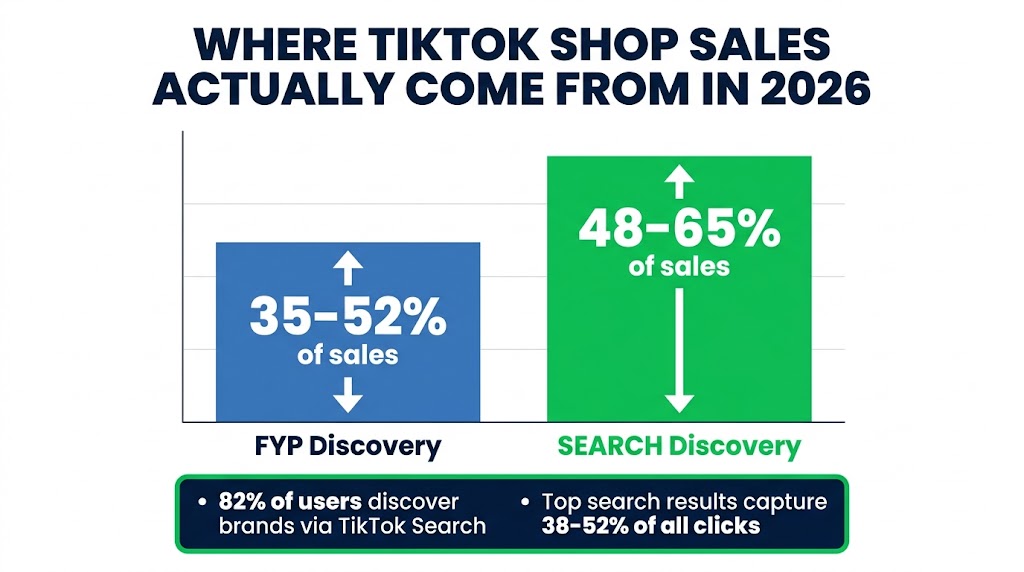
Perhaps the most consequential — and least expected — finding embedded in the May 2026 algorithm data is this: 48–65% of TikTok Shop sales now originate from Search, not the For You Page. For the platform that invented the modern algorithmic feed and built its entire identity around the addictive scroll experience, this represents a profound behavioral and commercial shift.
Users are no longer waiting to be served products by the FYP. They are actively going to TikTok’s search bar with purchase intent, typing queries the way they used to type into Google or Amazon, and buying what they find. Gen Z now prefers TikTok search over Google for product discovery at a rate 35% higher than any other demographic group. This is not a minor trend. It’s a structural change in how people shop online.
Multi-Modal SEO: The Three Channels TikTok Reads
TikTok’s search algorithm in 2026 is not reading your content the way a traditional search engine reads a webpage. It’s using three separate AI systems simultaneously to understand what your video is about and whether it should rank for specific queries:
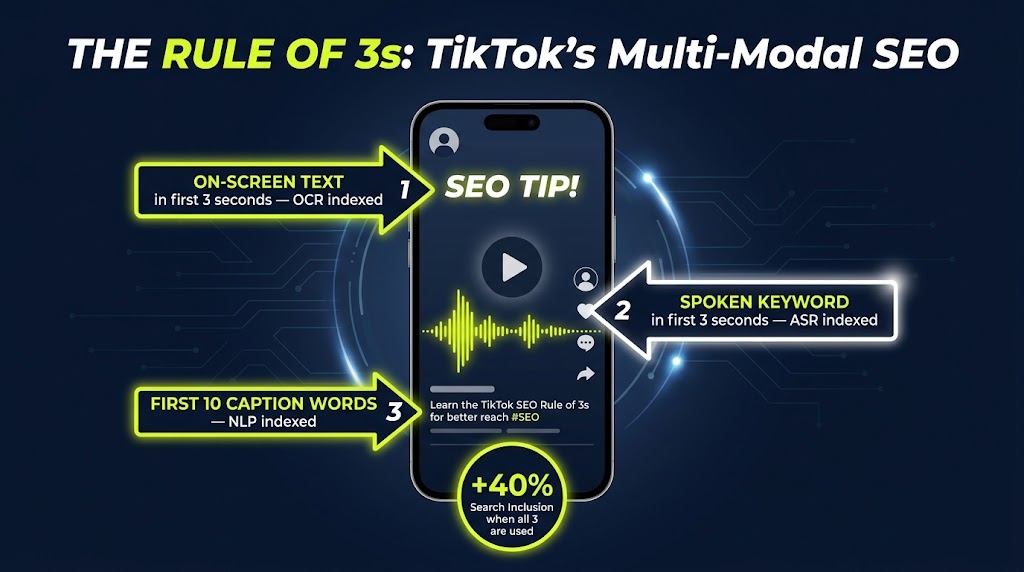
- OCR (Optical Character Recognition): TikTok reads text that appears on-screen within your video, particularly text visible in the first three seconds. This is indexed as a primary content signal.
- ASR (Automatic Speech Recognition): The spoken word in your video, especially in the first three seconds, is transcribed and indexed. Sellers who state their primary product keyword in their opening line receive a documented 40% higher search inclusion rate.
- NLP (Natural Language Processing): The first ten words of your video caption are processed and weighted heavily as topical signals. Keyword density in captions beyond the first ten words still matters, but the opening words carry disproportionate algorithmic weight.
The Rule of 3s: A Practical Framework
These three indexing systems give rise to what practitioners call the Rule of 3s — a framework for ensuring maximum search discoverability from every video you publish. The principle is simple: in the first three seconds of every product video, state your primary keyword in voiceover, display it as on-screen text, and open your caption with it. When all three modalities carry the same keyword signal, TikTok’s search algorithm receives a high-confidence categorization signal and is more likely to serve the content for relevant queries.
Beyond the first three seconds, long-tail keyword strategy becomes important. TikTok’s autocomplete data and competitor caption analysis reveal the search language your category’s buyers actually use — often different from the formal product language sellers default to. A buyer searching “apartment vacuum that doesn’t tangle hair” is using very different language than a seller who writes “premium cordless vacuum cleaner” in their listing title. The 2026 algorithm rewards sellers who bridge that gap through natural language keyword integration in their content.
Product Listing SEO vs. Content SEO
TikTok’s search ranking also weighs product listing signals alongside content signals, which means that your product title, description, review count, and seller rating all contribute to where your products appear in search results. Top-ranking search results on TikTok Shop in 2026 capture 38–52% of all clicks for a given query. Page three and beyond see conversion rates that make them commercially irrelevant. The stakes of search ranking are comparable to the first-page-of-Google dynamic that e-commerce sellers have wrestled with for two decades — just playing out on a newer platform with faster-moving rules.
Content Quality Penalties: What the Algorithm Is Actively Punishing
The May 2026 update isn’t only about rewarding the right behaviors. It’s equally defined by what the algorithm is now penalizing — and the penalties are more specific and more consequential than they were under previous policy frameworks.
The Content Posting Limit Policy
One of the most operationally significant new policies is the Content Posting Limit (CPL), which targets sellers who flood the platform with low-engagement, non-interactive product videos in an attempt to game distribution through volume. Under the CPL policy, sellers who post five or more non-interactive or misleading videos within a seven-day window are restricted to posting a maximum of seven product-linked videos in the following week, with any additional product links hidden from distribution.
The practical impact is severe for sellers who relied on high-volume content strategies. If your Shop’s content approach involved posting 15–20 product clips per week — short, low-effort clips with product tags slapped on — you are now either hitting posting limits or burning your account’s commercial reach through the quality penalty mechanisms that feed the CPL trigger.
Originality Penalties and Watermark Detection
The algorithm’s 2026 originality enforcement is dramatically more aggressive than anything that existed on the platform before. Reposted content — including videos with competitor watermarks, duplicated content fingerprinted from other accounts, and mass-produced identical clips uploaded across multiple affiliate accounts — now faces reach reductions of 50–90%. Content flagged by watermark detection is immediately ineligible for Shop monetization, meaning product links in watermarked videos are effectively invisible to the algorithm.
This has specific implications for sellers who use content farms or who repurpose video content created on other platforms (Instagram Reels, YouTube Shorts, etc.) by removing watermarks before uploading. TikTok’s fingerprinting technology now identifies these videos even after watermark removal, applying distribution penalties that can persist at the account level. The cost of shortcuts here is extremely high relative to the marginal savings in content production.
Misleading Claims and Fake Urgency
The algorithm’s AI detection systems are trained to identify specific manipulative patterns in product content: identical “50% off, 4 hours left” countdown text appearing across multiple unrelated videos, false “last unit” scarcity claims, before/after editing that implies product results not substantiated by the content, and undisclosed commercial promotions that don’t carry the mandatory commercial disclosure label. Any of these patterns triggers automated flagging and potential For You Page removal, regardless of how well the video otherwise performs.
This is worth taking seriously as a compliance issue, not just a marketing strategy question. Sellers who have normalized fake urgency tactics as a conversion lever will need to rebuild their content frameworks around genuine value demonstration rather than psychological pressure tactics that TikTok’s moderation systems now specifically target.
LIVE Commerce and the Algorithm’s Amplification Logic
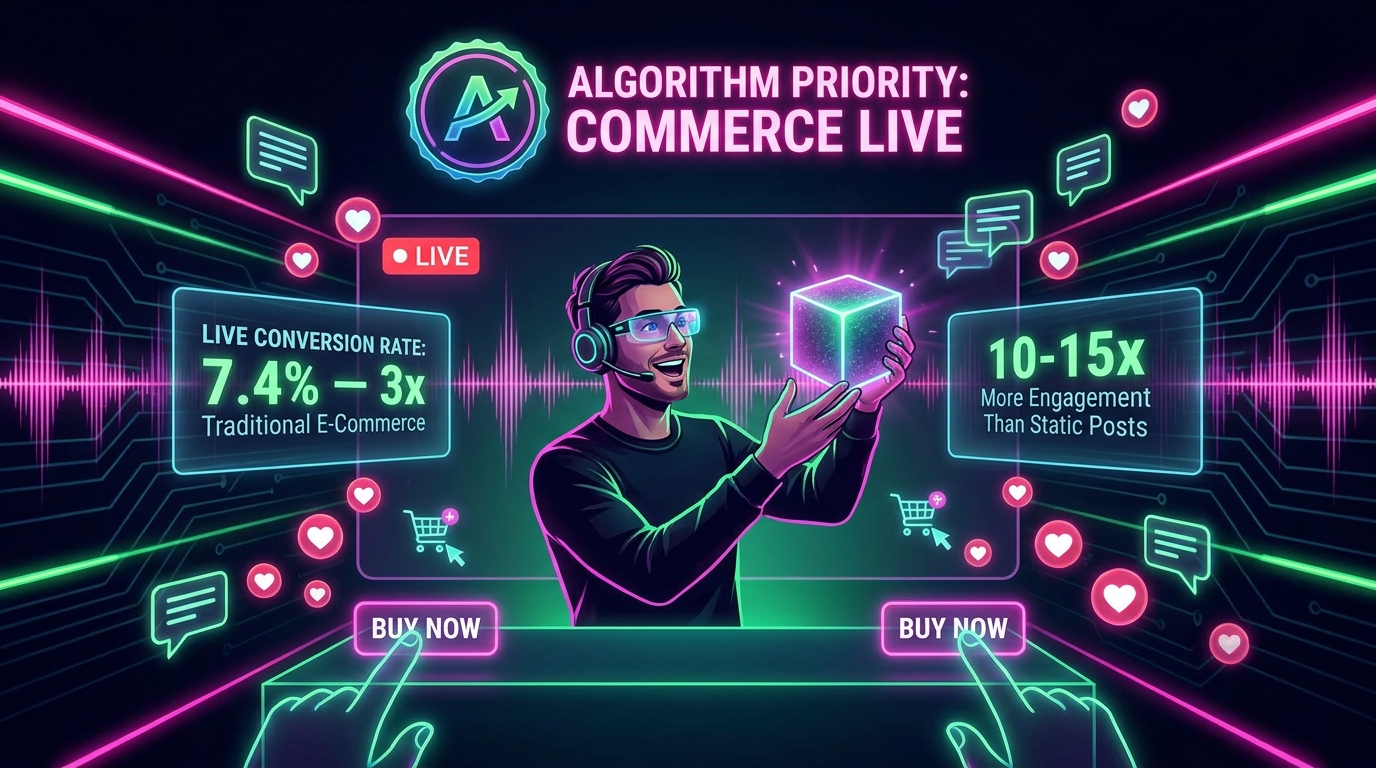
If there is one format that the May 2026 algorithm actively supercharges, it is LIVE commerce. TikTok LIVE shopping sessions now generate conversion rates of 7.4% — more than three times the conversion average for traditional e-commerce channels. They produce 10–15x more engagement than static product posts. And the algorithm explicitly prioritizes LIVE sessions that show strong commerce signals in real time, pushing them to broader audiences as those signals accumulate.
Understanding why LIVE gets this treatment requires understanding how TikTok’s algorithm reads commerce signals in a LIVE context versus a pre-recorded video context. In a standard video, commerce signals are recorded retrospectively — the algorithm sees how many people clicked, carted, and purchased after the fact, and adjusts future distribution accordingly. In a LIVE session, those signals happen in real time and trigger immediate distribution adjustments. A LIVE session that sees a spike in product page clicks at the 15-minute mark will receive a burst of algorithmic reach at the 16-minute mark, funneling more viewers into the session precisely when purchase momentum is building.
What the Algorithm Looks for in LIVE Sessions
Not all LIVE sessions receive equal treatment. The algorithm evaluates LIVE commerce streams on a specific signal hierarchy:
- Watch time and average session duration: Streams where viewers stay for 3–5 minutes (good) or 8+ minutes (excellent) receive stronger distribution than streams with high drop-off rates. Tactics that keep viewers engaged — Q&A segments, polls, viewer shoutouts, product demonstrations — directly improve this signal.
- Real-time purchase velocity: A stream that generates a purchase every two to three minutes is receiving a constant stream of positive commerce signals. The algorithm reads purchase velocity as evidence that the stream deserves broader reach. Sellers who structure LIVE sessions with a product cadence designed to drive consistent buying (rather than all-at-once sales pushes) tend to see better algorithmic distribution throughout the stream.
- Comment and interaction density: Comment volume per viewer — not just raw comment count — signals genuine audience engagement. Streams where hosts actively engage with comments, answer questions, and acknowledge viewers by name generate substantially higher interaction density, which feeds the distribution algorithm’s engagement signal inputs.
The 1,000-Follower Minimum and Its Strategic Implication
One policy change that intersects with the LIVE algorithm is the 1,000-follower minimum now required to host a Shop LIVE stream. For new or small sellers, this creates a specific sequencing requirement: building a baseline follower presence is a prerequisite for accessing the highest-converting content format on the platform. Sellers who haven’t prioritized follower growth because they were focused on pure product content need to factor this threshold into their TikTok strategy as a near-term objective, not a long-term aspiration.
Native Commerce Only: The External Link Removal and What It Means
One of the most structurally significant changes of 2026 — predating May but fully embedded in the current algorithm’s logic — is TikTok’s elimination of external storefronts and off-platform links from its commerce ecosystem. External links to Shopify stores, branded websites, and third-party checkout experiences have been removed. All product discovery, browsing, and transaction activity must now occur natively within TikTok Shop.
For sellers who built hybrid strategies involving TikTok as a traffic source to independent Shopify stores, this change is genuinely disruptive. That funnel no longer functions. The traffic TikTok generates cannot be redirected off-platform through standard link mechanisms. Every buyer who discovers your product on TikTok must complete their purchase within the TikTok Shop ecosystem.
The Opportunity Inside the Restriction
There is, however, a meaningful upside embedded in this constraint. By forcing all transactions through TikTok’s native checkout, the platform also ensures that every purchase generates a clean, attributable commerce signal that feeds directly back into the algorithm. This is why the content-commerce graph can function at all — TikTok can trace purchase behavior back to specific content assets because the entire purchase journey is contained within the platform.
This creates a more direct and measurable feedback loop between content quality and sales performance than any external link strategy ever could. When a video drives a TikTok Shop purchase, TikTok knows immediately and adjusts the video’s distribution accordingly. That closed-loop attribution is what makes the algorithm’s commerce signal weighting possible — and it’s what sellers who embrace the native ecosystem will benefit from as the algorithm matures.
Sellers transitioning from hybrid strategies should prioritize two things: first, ensuring their TikTok Shop product listings are as complete and well-optimized as their Shopify equivalents (strong imagery, complete descriptions, accurate categorization, competitive pricing); and second, understanding that TikTok’s native checkout data is now their most valuable performance signal, replacing the UTM-based tracking and pixel data that off-platform funnels relied upon.
Integrations Still Exist — But the Product Lives on TikTok
It’s worth clarifying that TikTok’s 2026 commerce policy doesn’t eliminate integrations with platforms like Shopify and WooCommerce altogether. Those integrations still exist for inventory syncing and order management purposes. The difference is that the storefront experience — browsing, discovery, checkout — now exclusively happens within TikTok. The back-end infrastructure can connect; the consumer-facing experience cannot leave the platform. This distinction is important for sellers managing multi-channel inventory, who can still use Shopify as their inventory management backend while conducting all consumer-facing transactions through TikTok Shop’s native interface.
The Rule of 3s, Completion Rates, and Building Content Around Commerce Signals
Understanding what the algorithm values is only useful if it translates into specific, actionable content changes. The following section addresses the concrete video production and strategy adjustments that align with the May 2026 signal hierarchy — the practical changes sellers can implement starting with the next video they produce.
The 70% Completion Rate Threshold
The 2026 algorithm now requires a 70% average completion rate for a video to achieve broad FYP distribution — up from the 50% threshold that characterized 2024’s algorithm. This is a significant increase that effectively demands tighter, more consistently engaging videos. A 70% completion rate means seven out of ten viewers who start watching must watch through to near the end. For a 60-second video, that means holding attention for 42 seconds or more on average across the audience. For a 3-minute video, it means holding for over two minutes.
The implication for video structure is clear: pace matters more than ever. Weak hooks, slow introductions, and extended mid-video plateaus are now costly. Strong hooks in the first two seconds, consistent information density throughout, and value delivery that doesn’t front-load everything before the video ends are all structural requirements for hitting the completion rate threshold that unlocks broad distribution.
The Shift to Longer Video Formats (60–180 Seconds)
Counterintuitively, the algorithm’s 2026 weighting now favors longer videos in the 60–180 second range for product content. This runs counter to the “shorter is better” instinct that shaped TikTok content strategy for its first several years. The reason is directly tied to commerce signal generation: a 60–180 second product video allows enough time to demonstrate a product, address objections, include social proof, and deliver a clear call to action — all of which creates more opportunity for the commerce signals (product clicks, add-to-cart actions) to generate before the video ends.
A 12-second product clip can go viral. It is much less likely to generate the deliberate, considered purchase action that creates a strong commerce signal. Longer videos that follow the completion-rate requirements above allow sellers to build the trust and information context needed to drive high-intent purchase behavior — which is exactly what the algorithm is now designed to reward and amplify.
Original Audio, Native Captions, and In-App Editing
The algorithm’s originality enforcement extends to content production tools. Videos produced using TikTok’s in-app editing and captioning tools receive a subtle but real distribution advantage over videos edited entirely externally and uploaded as complete files. The use of native captioning (auto-captions generated within TikTok, not embedded in the video file as burned-in text) is particularly significant — TikTok’s caption data feeds its NLP indexing system directly, providing clean keyword signals that burned-in captions or external subtitle files don’t deliver with the same fidelity.
Original audio — either a seller’s unique voiceover, an original brand audio identity, or an audio component not watermarked from another platform — also performs better under the algorithm’s 2026 originality scoring than trending audio borrowed from entertainment content that has no commerce relevance. This doesn’t mean trending audio should be abandoned entirely, but it means the tactical move of slapping a trending sound onto a product video without intentional integration is less algorithmically valuable in 2026 than it was in 2023 or 2024.
Follower-First Testing: The January 2026 Distribution Change
A related update from January 2026 that shapes how all of the above plays out: TikTok now tests new videos with the posting account’s existing followers first, before expanding distribution to non-followers. This follower-first testing window measures whether your own audience engages strongly with the content before the algorithm considers broader distribution. Strong performance in the follower-first window — high completion rates, shares, saves, and commerce signals — triggers expansion to non-follower audiences. Weak follower performance limits distribution significantly.
The practical consequence is that growing an engaged, commerce-interested follower base is now more strategically important than it has ever been on TikTok. Follower count was famously irrelevant to TikTok distribution in the platform’s early years. That is no longer true in 2026. Your followers serve as the algorithm’s confidence signal for every new video you publish.
What to Watch for in the Second Half of 2026
The May 2026 update is the most significant structural change TikTok has made to its Shop algorithm since the platform launched commerce in the US market. But it won’t be the last. Several developments are emerging that sellers should monitor closely as the year progresses.
AI-Powered Shopping Tools Are Getting More Aggressive
TikTok’s rollout of AI content tools — including AI Dubbing, the Fashion Video Maker, and “List with AI” for product setup — represents an investment in lowering the barrier to high-quality commerce content. These tools are being surfaced more prominently to sellers and creators through 2026. As AI-assisted content becomes more common, the algorithm’s originality detection will need to adapt, and sellers who use AI tools thoughtfully (to produce genuinely differentiated content) will outperform those who use them lazily (to produce high-volume, low-differentiation output).
The Local Feed and Location-Based Commerce
TikTok’s Local Feed launch on February 11, 2026 — an opt-in feature for users over 18 that surfaces local travel, news, and shopping content — represents a new commerce surface that sellers haven’t yet fully mapped. For brands with physical presence or region-specific products, the local feed creates an organic discovery channel that didn’t exist before. The algorithm’s behavior on the local feed is still maturing, but early signals suggest that commerce content with strong local relevance (pricing, availability, local community signals) performs disproportionately well in this surface.
Automated Sample Requests
TikTok has begun testing automated sample request systems that match creators above a defined engagement threshold with sellers offering product samples. This is a significant shift from the manual outreach model that most affiliate programs rely on. As this system matures and the matching algorithm improves, sellers who keep their sample programs well-stocked and respond quickly to automated requests will gain creator relationship advantages that compound over time through the CHR-linked distribution benefits described earlier in this post.
The Seller’s Action Checklist for the Post-May 2026 Algorithm
The changes detailed throughout this post amount to a significant operational shift for any serious TikTok Shop seller. Here is a consolidated action framework for adapting to the new environment:
- Audit your success metrics immediately. Replace views and follower growth as primary KPIs with product click-through rate, add-to-cart rate, video-attributed purchases, and GMV per asset. These are the signals the algorithm now responds to.
- Implement the Rule of 3s on all new content. State your primary keyword in the first three seconds via on-screen text, spoken voiceover, and caption opening. Use TikTok’s native caption tools — not burned-in captions — for maximum NLP indexing fidelity.
- Restructure your content calendar around 60–180 second formats. Design each video to hold a 70%+ completion rate: strong two-second hook, consistent pacing, and value delivered throughout rather than front-loaded into the first third.
- Audit your affiliate network using the Creator Health Rating. Remove or pause partnerships with creators in the orange or red CHR tier. Build your active affiliate pool from green-tier creators who are generating consistent commerce signals.
- Check your GMV Max asset pool. Make sure GMV Max has access to a diverse, high-quality library of authorized content assets. The AI can only optimize what it’s given. Thin asset pools lead to underperformance regardless of budget.
- Eliminate high-volume, low-quality content strategies. Five or more non-interactive videos in a seven-day window triggers the Content Posting Limit. Quality over quantity is now algorithmically enforced, not just recommended.
- Optimize your TikTok Shop product listings for search. Front-load primary keywords in product titles. Complete all fields in your listing. Build review count through post-purchase follow-up. Search rankings depend on listing quality as much as content quality.
- Build toward the 1,000-follower threshold if you haven’t already. LIVE commerce is the highest-converting format on the platform. If you’re below the hosting threshold, make building a baseline follower audience a near-term priority.
- Strip fake urgency and undisclosed commercial patterns from all content. AI detection of these patterns is now sophisticated enough to affect distribution at scale. Replace pressure tactics with genuine product demonstrations and verified social proof.
- Monitor the Local Feed for your product category. If your brand has geographic relevance, the Local Feed represents an emerging organic discovery surface that most sellers are not yet actively optimizing for.
Conclusion: The Algorithm Rewards Sellers Who Think Like the Platform
The May 2026 TikTok Shop algorithm update is most accurately understood not as a set of technical changes to a ranking system, but as TikTok making explicit what it has always wanted to become: the most effective digital commerce channel in the world. Every change described in this post — the shift to commerce signals, the content-commerce graph, GMV Max’s dominance, the Creator Health Rating, the ascendance of Search, the native-only transaction model — is designed to close the gap between content and conversion.
The sellers who adapt quickly are the ones who align their thinking with that goal. They stop measuring what was easy to measure and start measuring what the algorithm actually cares about. They produce content that earns the commerce signals the algorithm uses to justify distribution. They build affiliate relationships with creators who have algorithmic credibility as well as audience reach. They treat their TikTok Shop presence as a native commerce ecosystem — not a traffic source, not a social media add-on, not a brand awareness play.
The platform is, for the first time, clearly telling sellers exactly what it values and exactly what it will reward. The algorithm decoded is no longer a mystery. What happens next depends on whether sellers choose to listen.