


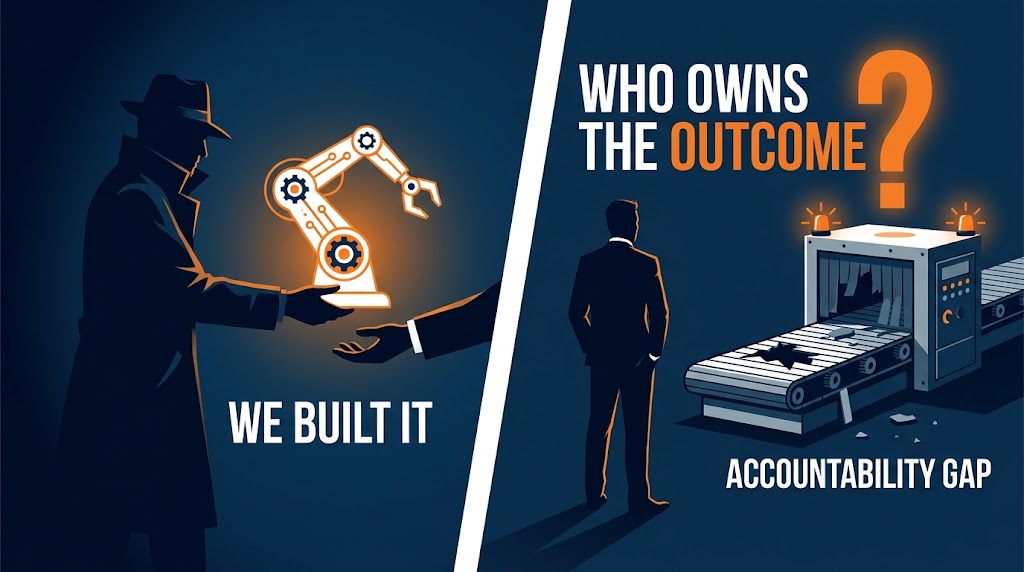

There is a conversation happening in every AI automation sales call right now, and it almost never gets finished. The provider walks through the workflow diagram, explains the integrations, demos the agent behavior, quotes a number. The client nods, asks about timelines, and somewhere around slide nine, someone says the phrase: “So once this is live, what does success actually look like?”
And then the answer gets vague.
Not because either party is being dishonest — but because neither one has prepared to answer it clearly. The provider is selling a build. The client is buying an outcome. And the gap between those two things is where most AI automation engagements go quietly wrong.
In 2026, the global AI automation market is estimated at over $169 billion. Enterprise adoption is near-ubiquitous on paper — roughly 88% of large organizations report using AI automation in at least one function. Yet project failure rates remain stubbornly high, pilots stay in pilot status indefinitely, and the same complaints keep surfacing: “It didn’t do what we needed,” “We can’t tell if it’s working,” “We’re not sure whose problem this is to fix.”
The technology is rarely the issue. The offer design is.
This article is about what it actually takes to build an AI automation offer where someone — either you, your client, or both of you together — explicitly owns the outcome. Not the build. Not the license. Not the deliverable. The result. We’ll look at how to define outcomes precisely, how to price for the risk that comes with owning them, how to structure contracts that hold, and how to decide which outcomes you should never agree to own in the first place.
Why “We Build the Bot” Is Not an Offer
Most AI automation service providers have a delivery problem disguised as a positioning problem. They believe the issue is how they describe what they do. In reality, the issue is what they are actually agreeing to deliver.
“We build AI automation workflows” is a description of an activity. It tells a prospective client what will be produced — code, a platform configuration, an agent deployment — but says nothing about what will change in their business as a result. This framing creates a fundamental misalignment that doesn’t show up until after the invoice is paid and the handover is complete.
The Output-Outcome Confusion
An output is something the provider produces: a workflow, a model, an integration, a dashboard, an agent configuration. An outcome is something that changes in the client’s business as a result: fewer support tickets handled by humans, shorter invoice processing cycles, more qualified leads routed to sales, reduced error rates in data entry.
These are not the same thing, and they do not automatically lead from one to the other. A perfectly built automation that runs on clean data in a controlled environment can fail to produce its intended outcome when it meets real-world conditions — messy data, low adoption rates, process exceptions, organizational resistance, or simply the wrong workflow being automated in the first place.
When a provider sells an output and a client buys hoping for an outcome, you have set up a relationship that will become adversarial the moment reality diverges from expectation. The provider believes they delivered. The client believes they didn’t get what they paid for. Both are right within their own definitions of the deal.
Why This Has Gotten Worse, Not Better
The rise of agentic AI systems has sharpened this problem considerably. Earlier automation work — RPA scripts, simple API integrations, rule-based chatbots — operated in tightly bounded environments where the distance between “it works technically” and “it delivers value” was relatively short. You could hand off a working bot and reasonably expect the client to get something useful from it.
Agentic AI systems are different. They detect work, initiate actions, chain decisions, and interact with multiple external systems — often without human checkpoints. The blast radius of a poorly calibrated agent is much larger than a broken RPA script. And the conditions required for an agent to produce reliable outcomes are far more complex: data quality, integration stability, exception handling logic, human escalation paths, monitoring infrastructure, and ongoing calibration.
Selling agentic AI as an output — “we’ll deploy the agent, you take it from there” — is not a viable offer. It is a recipe for a difficult relationship and an angry client in three months.
“The most successful AI automation providers in 2026 are not the ones who build the best bots. They’re the ones who take responsibility for what the bot is supposed to accomplish — and design everything from pricing to contract language around that responsibility.”
The Outcome Ownership Spectrum: Four Positions and What Each Costs You
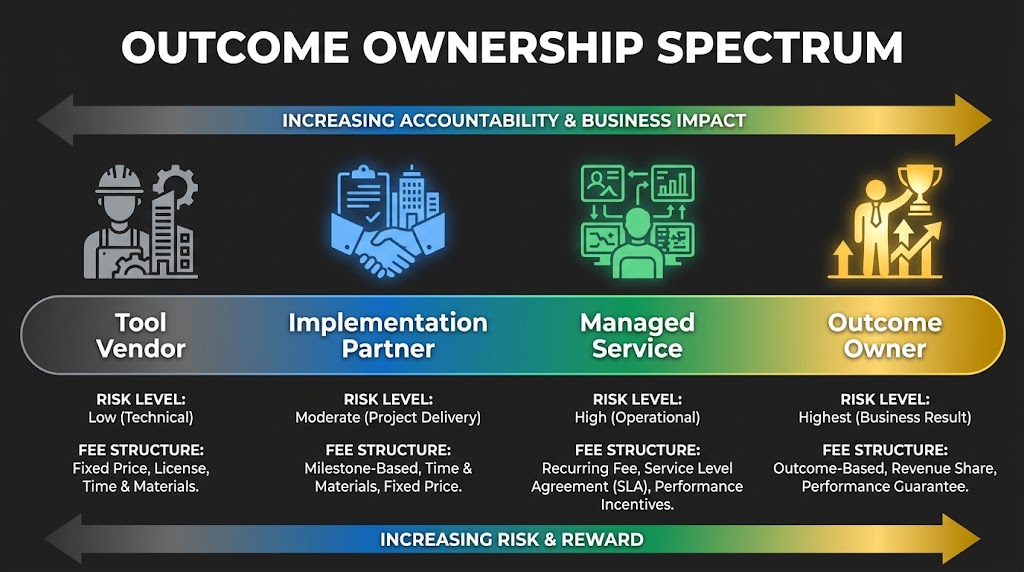
Before you can design an offer that owns outcomes, you need to decide where you want to sit on the spectrum of accountability. There are four distinct positions, and each carries a different risk profile, commercial structure, and relationship expectation.
Position 1: Tool Vendor
The tool vendor provides software, models, or platform access. Outcome responsibility sits entirely with the buyer. Pricing is seat-based, usage-based, or flat license. This is the model most SaaS companies use. The commercial ceiling is determined by user count or usage volume, not by business impact. Risk is low. Margin is high at scale. But the sales cycle is long, churn is painful, and differentiation in a crowded AI tooling market is increasingly difficult without demonstrable outcome links.
Position 2: Implementation Partner
The implementation partner builds, configures, and deploys — then hands the keys to the client. This is the most common position for AI automation agencies and consulting firms today. Project fees are typically fixed-scope. The engagement has a defined end date. Outcome responsibility transfers to the client upon go-live. The risk here is scope creep during the build phase, and the commercial ceiling is limited by the number of projects you can deliver in parallel. Many agencies in this position compete primarily on price, which is not a sustainable differentiation strategy.
Position 3: Managed Service
The managed service provider builds, deploys, and continues to operate the automation — monitoring performance, managing incidents, handling iteration cycles, and keeping the system calibrated. A monthly retainer covers ongoing operations. Outcome responsibility is shared: the provider is accountable for system performance, the client is accountable for business adoption and usage. This model creates more predictable recurring revenue, deeper client relationships, and a much stronger position from which to demonstrate and measure value.
Position 4: Outcome Owner
The outcome owner builds, operates, and stands behind a specific, measurable business result. Pricing includes a performance component tied directly to that result — booked meetings, reduction in manual processing hours, cost savings against a baseline, qualified leads generated. The provider’s compensation is explicitly linked to whether the outcome is achieved. This model carries the highest risk, the highest potential reward, and the most complex commercial and contractual design. It also creates the most durable competitive advantage: it is very hard to commoditize a provider who has proven they can own results.
Most providers who are building AI automation services today will find their natural home in positions 3 or 4 — depending on how confident they are in their delivery methodology, how measurable the target outcome is, and how much operational influence they can maintain over the conditions that determine whether the outcome is achieved.
Mapping Outcomes Before You Scope the Automation
The single most common structural error in AI automation offer design is sequencing the work in the wrong order: scoping the automation first, then trying to retrofit an outcome statement onto it. This produces offers that describe what will be built rather than what will change — and it makes the “who owns the outcome” question impossible to answer cleanly.
The correct order runs exactly backward. Start with the outcome. Then design the automation that serves it.
The Outcome Mapping Process
Before any technical scoping begins, a well-designed offer process should surface three things clearly.
First: the baseline metric. What is the current state of the thing you are trying to change? If the outcome is “reduce invoice processing time,” what is the current average processing time, measured how, against what volume? Without a documented baseline, you have no reference point for measuring progress, and any claim of improvement is contested by definition.
Second: the target metric. What specific, quantified change constitutes success? “Reduce invoice processing time by 40%” is a target. “Make invoicing faster” is a wish. Outcome-owning offers require specific targets, not directional intentions — because you cannot price risk you cannot measure.
Third: the attribution path. What is the chain of causation between the automation you build and the metric you are targeting? Which steps in that chain are directly controlled by your system, and which are dependent on client behavior, data quality, third-party integrations, or factors outside anyone’s direct control?
This attribution mapping exercise is not just a governance formality. It is the foundation of commercial integrity. If there are three variables between your automation and the outcome metric, and two of those variables are owned by the client, then your outcome ownership is actually conditional on the client meeting their side of those conditions. That conditionality needs to be explicit in both the offer and the contract.
Choosing the Right Outcome Altitude
One underappreciated design decision is how far “up the value chain” you set your outcome target. There is a direct tradeoff between outcome altitude and outcome attribution clarity.
A low-altitude outcome — “reduce average handle time on support tickets by 35%” — is tightly connected to the automation you deploy. You can demonstrate the link clearly, measure it directly, and control most of the variables. Attribution is clean. Ownership is defensible.
A high-altitude outcome — “increase customer lifetime value by 20%” — is deeply meaningful to the client but involves dozens of variables beyond the automation: pricing strategy, product quality, sales process, marketing effectiveness, customer success resourcing. Your automation might contribute 5% of the total movement on that metric. Owning it is commercially unjustifiable.
The sweet spot for outcome ownership is mid-altitude: outcomes that are meaningful enough to the client to justify a premium, but specific enough that your automation is the primary driver of the measured change. Process-level metrics almost always fit here — cycle times, throughput rates, error rates, qualification rates, response times.
Pricing Architecture for Outcome-Owning Offers
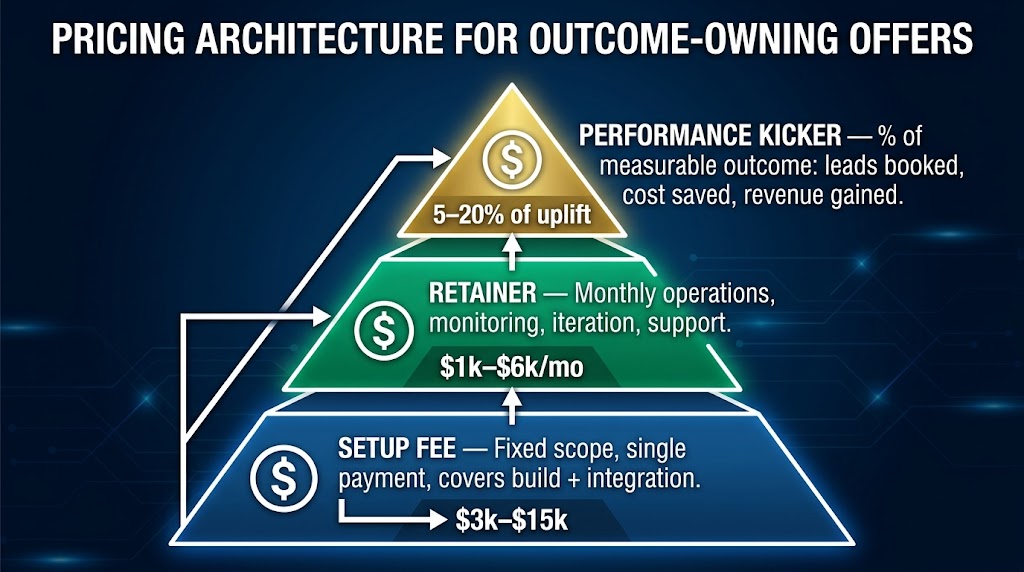
Outcome-owning offers require a fundamentally different pricing architecture than output-based project fees. The reason is straightforward: you are taking on risk that was previously the client’s problem, and risk that has commercial value should be priced accordingly.
The pricing model that best fits this approach is a three-layer structure that aligns each layer to a different type of value delivered.
Layer 1: The Setup Fee
The setup fee covers the cost of building, integrating, and launching the automation. This is a fixed, one-time payment scoped to a defined deliverable. It should recover your actual costs of delivery — development, integration work, testing, change management, and initial training — plus a margin that accounts for scope risk within the build phase.
Current market ranges for AI automation setup fees cluster around $3,000–$8,000 for simpler, single-workflow deployments, $8,000–$20,000 for multi-system integrations with meaningful complexity, and $20,000–$60,000+ for enterprise-grade implementations with custom model work. The setup fee is not where outcome-owning value is priced. It is simply cost recovery for the build.
A common mistake is attempting to price the entire expected value of the engagement into the setup fee. This creates sticker shock, stalls sales cycles, and doesn’t reflect how value is actually delivered — which happens over time, not at go-live.
Layer 2: The Operations Retainer
The retainer covers ongoing operations: monitoring system performance, handling exceptions, running iteration cycles, updating models as data drifts, maintaining integrations as third-party systems change, and providing support. This is the layer that distinguishes a managed service from a project-based handoff, and it is also the layer that makes outcome ownership operationally feasible.
You cannot own an outcome if you hand over the system and walk away. Outcomes require ongoing stewardship — because the real world is not static. Data changes, processes evolve, edge cases accumulate, and automation performance drifts if left unattended. The retainer is the commercial mechanism that keeps you in contact with the system and therefore capable of defending the outcome you’ve promised.
Monthly retainer ranges for AI automation managed services currently run from $1,000–$3,000/month for lightweight monitoring and support, $3,000–$8,000/month for active management with iteration cycles, and $8,000–$20,000+/month for deep operational partnership arrangements where the provider is functionally part of the client’s operations team.
Layer 3: The Performance Kicker
The performance component is where outcome ownership is commercially expressed. This is an additional fee — or reduced retainer — tied to whether specific outcome metrics are achieved above a defined threshold.
Structurally, there are several approaches. A bonus-on-achievement model adds a predetermined fee when specific milestones are hit — for example, a $5,000 bonus when the automation demonstrably reduces processing time by 30% within 90 days. A gainshare model gives the provider a percentage of the measurable value created — for example, 15% of documented cost savings above the baseline. A tiered fee model adjusts the ongoing retainer rate based on performance — higher if targets are met, lower (or partially refunded) if they are not.
The performance component does not need to be a large percentage of total contract value. Even a 10–20% performance component signals a fundamentally different commercial relationship — one where the provider has skin in the game and has structured the entire engagement around actually delivering the stated result, not just completing the stated scope.
Understanding Your True Cost of Outcome Risk
Before adding a performance component to any offer, the provider needs to calculate what “underperformance” actually costs them. If the performance bonus represents $12,000 of potential upside, but the remediation work required to close a performance gap would cost $15,000 in engineering and operations time, the financial logic of the offer breaks down. Outcome ownership should be priced to account for both the probability of success and the cost of the recovery path if performance falls short.
The Scope Creep Trap: How Outcome Offers Collapse Without Hard Edges
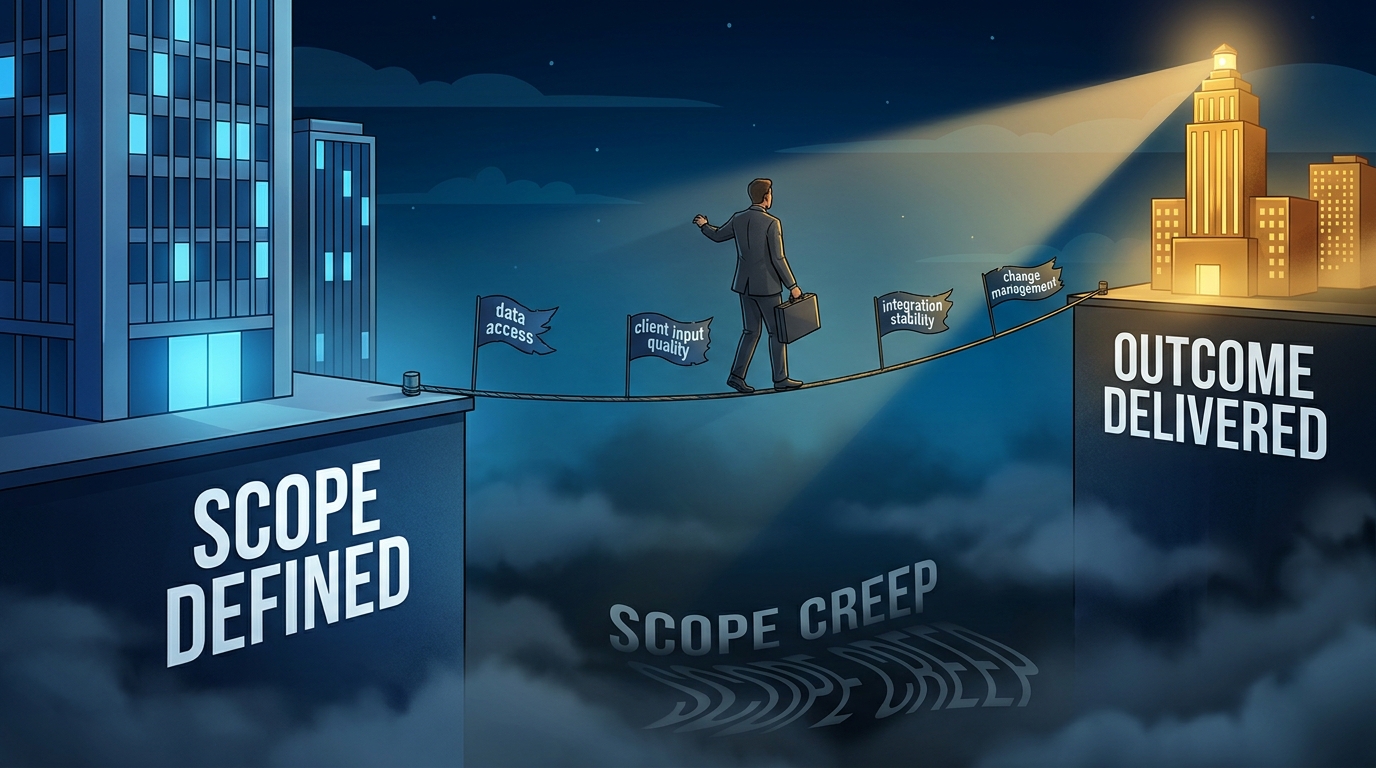
Outcome-owning offers are not more exposed to scope creep than output-based offers — they are differently exposed to it. The failure mode is not “the client keeps asking for more features.” The failure mode is “the outcome keeps shifting because the conditions required to achieve it were never explicitly agreed.”
This is a subtler and more damaging form of scope drift, because it happens in the measurement layer rather than the delivery layer. The automation might be working exactly as designed. But if the outcome metric was loosely defined, if the baseline was never formally documented, or if the conditions for achievement were left implicit, then the question of whether the outcome was delivered becomes permanently open to interpretation.
The Four Conditions You Must Lock Down Before You Sign
Data access and quality commitments. The performance of an AI automation is directly dependent on the quality and availability of the data it operates on. If the client’s data is incomplete, siloed, or inconsistently structured, the automation cannot perform to specification — and therefore the outcome cannot be achieved. An outcome-owning offer needs explicit documentation of what data the provider requires, in what format, at what refresh cadence, and who is responsible for data quality maintenance. Deviations from this spec should be tracked as a condition on the performance guarantee.
Process adoption requirements. An automation that reduces manual processing time by 40% only produces that result if humans in the organization actually route work through it, rather than continuing to handle exceptions manually by habit. Client-side adoption rates, workflow compliance, and process adherence are variables that sit entirely outside the provider’s control — but they directly affect whether the outcome metric moves. Minimum adoption thresholds need to be defined and tracked.
Integration stability obligations. AI automations that connect to third-party systems — CRMs, ERPs, communication platforms, databases — are exposed to the behavior of those systems. If a CRM upgrade breaks an integration and causes two weeks of data loss, that performance gap should not be counted against the provider’s performance record. API change notification obligations, maintenance windows, and integration SLAs from third parties need to be explicitly scoped out of the provider’s outcome guarantee.
Change request boundaries. Any change to the underlying process, data model, target metric, or system configuration after go-live constitutes a scope change that resets or modifies the performance baseline. Without a documented change request process that acknowledges this reset, the provider will find themselves delivering an endlessly moving target while being held to the performance standard set on day one. Every change request should be formally acknowledged as a baseline adjustment event.
The Outcome Zone: A Useful Mental Model
Think of the outcome the provider owns as occupying a defined “outcome zone” — a space bounded on all sides by client-side conditions. Within those boundaries, if the client holds up their side, the provider guarantees the result. Outside those boundaries — when data quality drops, adoption rates fall, integrations break, or the goalposts shift — the outcome guarantee is suspended until conditions return to spec.
This is not a way of dodging accountability. It is a way of making accountability meaningful. Owning an outcome that has no conditions attached is not a guarantee — it is a liability with no operational basis. Defining the zone is what makes the guarantee credible and defensible.
Contract Language That Actually Holds: Defining the Outcome Zone
The gap between a well-designed outcome offer and a well-executed engagement almost always lives in the contract. Most AI automation contracts in 2026 are adapted from generic software services agreements — and those templates were designed for output delivery, not outcome ownership. They are not fit for purpose.
An outcome-owning contract needs to do several things that a standard MSA or SoW simply doesn’t address.
The Outcome Definition Clause
The contract should include a dedicated outcome definition section that specifies, with no ambiguity, the following: the exact metric that constitutes the outcome; the measurement methodology (how it is counted, by which system, at what frequency); the documented baseline against which improvement is measured; the target threshold that constitutes success; the measurement period during which performance is assessed; and the party responsible for producing the measurement data.
This section should be written in plain language — not legal boilerplate — because it will need to be referenced operationally, not just in dispute resolution. If the operations team on both sides can’t read it and agree on what it means, it is not specific enough.
The Provider Conditions Schedule
Alongside the outcome definition, the contract needs an explicit schedule of conditions under which the provider’s performance guarantee applies. This is the formal contractual expression of the outcome zone concept described earlier. It should list the data quality standards the client commits to maintaining, the adoption minimums the client agrees to enforce, the integration SLAs provided by third-party platforms that fall outside both parties’ direct control, and the change management obligations the client accepts when requesting modifications post-go-live.
Each condition should have a corresponding consequence: what happens to the performance guarantee if that condition is not met, for how long, and what remediation process is triggered.
The Performance Measurement Protocol
How the performance component is calculated needs to be specified with enough detail that it cannot be disputed. This means documenting the exact calculation methodology, identifying which system of record is authoritative, agreeing on how attribution is handled when multiple factors influence the metric, and specifying how disputes about measurement are resolved (including whether an independent third party can be called in).
Vague language — “subject to mutual agreement,” “as reasonably determined” — is not appropriate here. Performance components tied to compensation need measurement language that is as precise as a financial audit standard. If it cannot be calculated unambiguously from available data, it should not be included in the offer.
Exit and Suspension Clauses
Outcome-owning contracts also need clear mechanisms for what happens when performance conditions cannot be restored — when the engagement is not salvageable under the current terms. An exit clause that allows either party to exit cleanly, with defined financial consequences, is better than an ongoing dispute. Defining the suspension conditions — circumstances under which the performance guarantee is paused rather than voided — protects the provider from being penalized for events outside their control while maintaining the integrity of the outcome commitment when conditions are met.
Data, Attribution, and the Measurement Problem No One Talks About
The practical failure mode for outcome-owning offers is rarely disagreement about whether the automation was built correctly. It is almost always a disagreement about measurement. And measurement problems in AI automation engagements are more complex than they appear during the proposal phase.
The Baseline Contamination Problem
Baselines get contaminated. The measurement of the current state — the “before” number that defines what improvement means — is taken at a specific point in time, under specific conditions. By the time the automation has been running for three months and you’re assessing performance, those conditions may have changed substantially. Seasonal volume shifts, organizational restructuring, a new product launch, a pricing change, or an operational crisis can all alter the “baseline” behavior of the metric you’re tracking, making it impossible to isolate the automation’s contribution.
This is not a hypothetical edge case. It is a routine operational reality. Outcome-owning offers need to include provisions for baseline recalibration — predetermined triggers (volume changes greater than 25%, organizational changes affecting the in-scope process, etc.) that allow both parties to agree on a revised baseline rather than arguing about whether the original one is still valid.
The Attribution Overlap Problem
In most real business processes, the automation is not the only variable changing. While the AI support automation is being deployed, the support team is also being retrained. While the lead qualification agent is being calibrated, the marketing team is running a new campaign that changes the quality of incoming leads. Attribution — determining what percentage of the metric movement is caused by the automation versus other concurrent factors — is methodologically challenging and often politically charged.
The cleanest solution is controlled rollouts: deploying the automation to a defined subset of the workflow while maintaining a control group on the existing process. This is not always operationally feasible, but where it is, it produces defensible attribution data that protects both parties. Where controlled rollout is not possible, the contract should acknowledge the attribution limitations explicitly and specify a methodology for reasonable estimation rather than pure attribution.
The Latency Problem
Some outcomes take longer to materialize than the payment timeline assumes. An automation deployed to improve sales pipeline qualification might not produce measurable revenue impact for four to six months — because sales cycles are long. Pricing performance components against 90-day windows in these cases creates misaligned incentives and measurement artifacts. The timeline of the performance component needs to match the natural latency of the outcome being measured.
The Accountability Stack: Structuring Client and Provider Roles
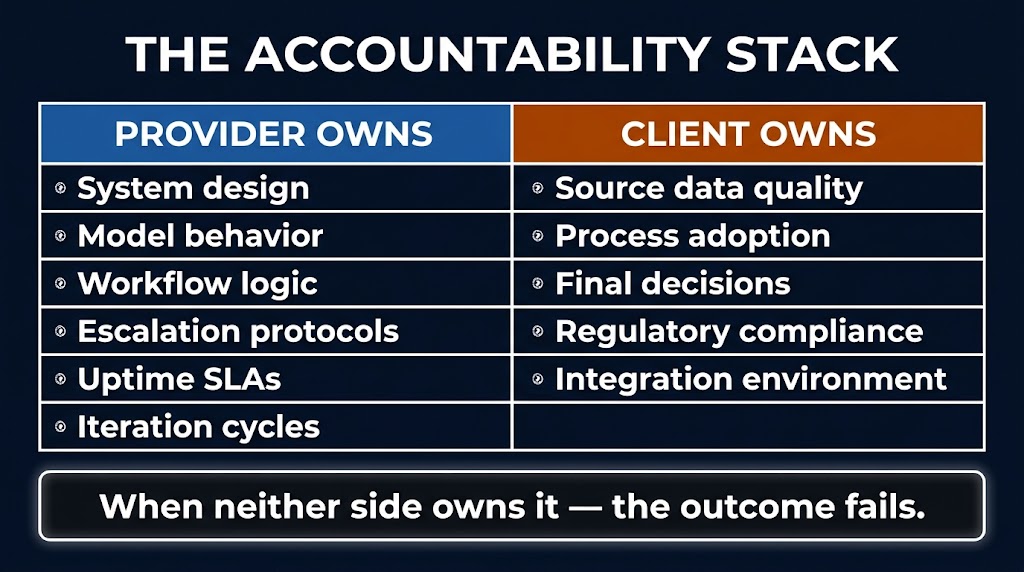
Outcome ownership is not a unilateral concept. Even in the most aggressive outcome-owning offer structure, the provider does not own everything. Understanding what the provider legitimately controls — and what the client must own regardless of the contract language — is essential for building offers that are commercially viable and operationally coherent.
What the Provider Should Own
The provider’s ownership zone covers the things directly within their design and operational control. This includes the architectural choices made in building the automation, the behavior of the models and agents they deploy, the logic of the workflow they design, the escalation paths they define for handling edge cases, the uptime and reliability of the systems they operate, and the iteration cycles they run to maintain performance. If something in this list breaks or underperforms, that is the provider’s problem to fix.
Critically, the provider also owns the quality of the discovery process that defined the outcome in the first place. If the outcome was poorly defined because the provider rushed through scoping, or if the baseline was incorrectly measured because the provider didn’t invest in a rigorous audit, that is not a client failure. The provider owns the quality of their own commercial process.
What the Client Must Own
The client’s ownership zone covers the things the provider cannot reach. Source data quality — the completeness, accuracy, and consistency of the data the automation operates on — is the client’s responsibility. Process adoption — whether their organization actually routes work through the automation rather than working around it — is the client’s responsibility. The organization’s final business decisions, the regulatory environment they operate in, their strategic direction, and their internal culture are all client-owned variables that no provider can control or guarantee against.
This is not a way of shifting blame. It is a realistic description of operational reality. A provider who accepts outcome accountability for things they cannot influence has not designed a generous offer — they have designed a losing commercial bet.
The Dangerous Middle Ground
The failures happen in the middle — in the shared zone between clear provider ownership and clear client ownership. Integration health (partly the provider’s responsibility, partly dependent on the client’s IT environment and third-party vendors), data transformation quality (partly the provider’s workflow design, partly the client’s source data), and change management effectiveness (partly the provider’s training and documentation, partly the client’s organizational adoption capability) all sit in this ambiguous space.
Outcome-owning offers need to resolve this middle ground explicitly rather than leaving it to good faith. The accountability stack needs to name specific individuals on each side who are responsible for each shared-zone element, define the handoff protocols between those individuals, and specify what happens operationally when a shared-zone breakdown occurs. Ambiguity in the shared zone is where engagements die.
When to Walk Away: Outcomes You Should Never Own
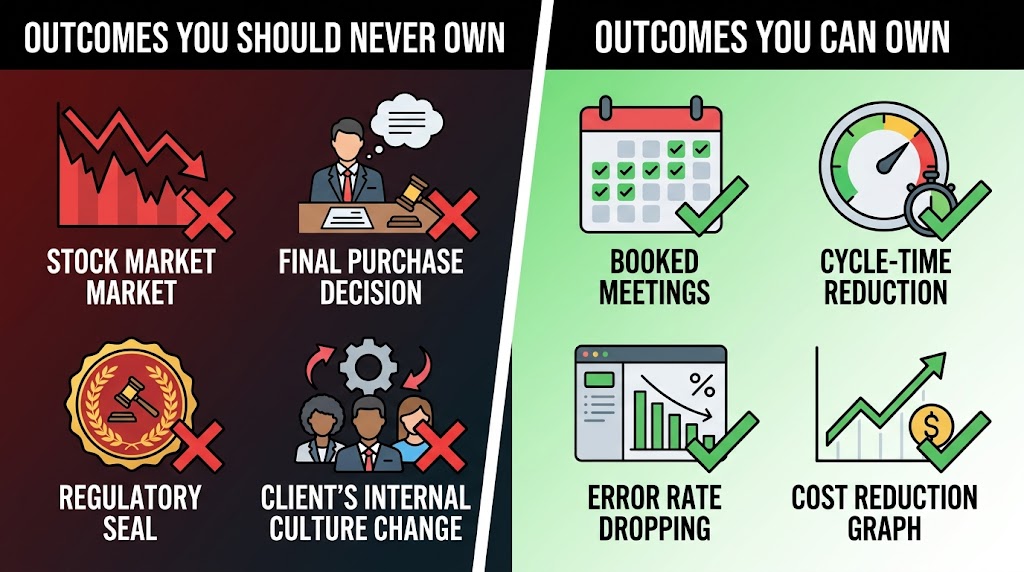
Not every outcome a client wants is one a provider should agree to own. The enthusiasm for outcome-based models can lead providers to over-commit — agreeing to performance terms they cannot operationally back up because the commercial pressure to close the deal overrides rigorous thinking about what they can actually deliver.
There are five categories of outcomes that should trigger immediate caution — and often an outright refusal to accept outcome ownership.
Outcomes That Require Decisions You Don’t Make
If the final step between the automation’s output and the business outcome is a human decision — a purchase decision, a hiring decision, a pricing decision, a legal judgment — then the outcome is not ownable by the provider. The automation can qualify leads, but it cannot close deals. It can surface compliance risks, but it cannot guarantee regulatory adherence. It can recommend candidates, but it cannot make a hire. Providers who agree to own outcomes that terminate in a client-side decision are accepting accountability for choices they have no power over.
Outcomes Dependent on External Market Conditions
Revenue outcomes in competitive markets are dangerous to own because they depend on factors entirely outside the engagement: competitor pricing, market demand cycles, macroeconomic conditions, and customer sentiment. An AI-powered sales outreach system might function perfectly — generating qualified appointments at a 15% conversion rate — while overall revenue declines because the market contracted. The provider cannot own that revenue outcome. They can own the activity metric (appointments generated, qualification rate), not the revenue result.
Outcomes in Unmeasured Environments
If the client does not currently have reliable measurement infrastructure for the outcome in question — no clean baseline, no consistent data collection, no system of record — then outcome ownership is premature. Building a performance commitment around a metric that cannot be reliably measured is not a commercial offer; it is a setup for an unresolvable dispute. The right move is to include a measurement infrastructure component in the engagement scope before any performance terms are agreed.
Outcomes That Require Organizational Change Beyond Process Automation
Significant culture change, cross-functional collaboration shifts, or leadership behavior changes that need to accompany automation deployment to produce the target outcome are not within the provider’s control. If the automation requires the customer success team to change how they escalate tickets and the operations team to change how they prioritize queues, and those behavioral changes have not been pre-committed by the client’s leadership, the automation cannot produce its target outcome regardless of technical quality.
Outcomes Under Active Regulatory Uncertainty
In 2026, the regulatory environment for AI-driven decision systems — particularly under the EU AI Act, emerging US state-level AI regulations, and industry-specific guidance in finance and healthcare — is actively evolving. For automations operating in high-risk regulatory categories, accepting outcome ownership before the regulatory picture is clear can expose the provider to liabilities that were not priced into the original offer. Outcome guarantees in regulated automation contexts should be explicitly conditioned on the regulatory environment remaining within the bounds assumed at contract signing.
Building Your First Outcome-Owning Offer: A Practical Framework
Moving from an output-based model to an outcome-owning model is not a single step. For most providers, it is a progression — starting with a tighter managed service structure and then layering in performance components as operational confidence and measurement infrastructure mature. Here is a practical sequence for making that transition without exposing the business to unacceptable risk.
Step 1: Choose One Process Domain and One Outcome Metric
Do not attempt to design an outcome-owning offer across the full breadth of your service portfolio simultaneously. Choose one process domain where you have consistent delivery experience — customer support automation, lead qualification, invoice processing, data entry elimination, or whatever your strongest vertical is — and define one metric within that domain that you can reliably influence and measure.
The more specific this metric is, the better. “Reduce average first-response time on Tier 1 support tickets from 6 hours to under 2 hours” is a usable outcome. “Improve customer experience” is not. Specificity is what makes the offer credible and the performance component honest.
Step 2: Run a Paid Discovery Engagement
Before any performance commitments are made, run a fixed-fee discovery engagement — typically 2–4 weeks, priced at cost — that produces a documented baseline, an attribution map, and a conditions assessment. This engagement answers three questions: what is the current state of the target metric, what are the conditions that would need to hold for the automation to drive the target outcome, and what is the risk profile of those conditions given this client’s specific environment?
The output of the discovery engagement is not just information — it is the contract foundation. The baseline documented in discovery becomes the reference point for the performance component. The conditions assessed in discovery become the Provider Conditions Schedule in the MSA. The discovery process is not a sales cost; it is a risk management mechanism.
Step 3: Introduce a Modest Performance Component in the First Engagement
For your first outcome-owning engagement, cap the performance component at 10–15% of total contract value. This is enough to signal genuine commitment — and to give your client confidence that you believe in the outcome — without exposing your business to catastrophic downside if delivery conditions turn out to be more complex than the discovery suggested.
Treat the first engagement as a calibration exercise. Document everything: what you predicted, what actually happened, where the variance came from, and what you would do differently in the offer design. This operational learning is the asset that allows you to increase the performance component and therefore the commercial premium in subsequent engagements.
Step 4: Build a Results Library
Outcome-owning offers are sold on track record. Every engagement where you have delivered against a defined outcome metric — or where you have transparently documented why you didn’t and what you did to recover — is a proof point that makes the next offer easier to close at a higher price. Build a structured results library: the outcome that was targeted, the baseline, the result achieved, the time period, and any contextual factors that are relevant to the comparison.
This library is not just a sales asset. It is an operational feedback mechanism that identifies which process domains and client types produce reliable results and which ones carry higher-than-expected variance. Over time, it becomes the data that allows you to price performance components with actuarial confidence rather than gut feel.
Step 5: Productize the Offer Around the Proven Outcome
Once you have three to five engagements delivering against the same outcome metric in the same process domain, you have enough data to productize. A productized outcome offer has a defined scope, a fixed setup fee, a standard retainer structure, and a documented performance component — all pre-built around the specific outcome your track record supports. Sales cycles shorten dramatically because the offer is concrete rather than custom. Delivery margins improve because the methodology is standardized. The commercial case for the client is immediate because the track record is tangible.
This is the competitive position that is genuinely difficult for competitors to replicate: not “we have the best AI technology,” but “we have delivered this specific outcome for clients like you, measured this way, with these results.” That is a differentiated offer. Building one takes time, operational discipline, and a willingness to accept accountability before you have proof — but the compounding advantage is substantial.
The Market Is Already Sorting This Out — Which Side Are You On?
The AI automation market in 2026 is not short on supply. There are thousands of agencies, consultancies, and platform vendors who can build an automation. The differentiation problem — “why should I choose you over the twenty other providers who sent me a proposal last week” — is getting harder, not easier, to solve on the basis of technical capability alone.
The providers who are winning the most interesting engagements are not necessarily the most technically sophisticated. They are the ones who have made the sharpest commercial bet: I believe in my ability to deliver this outcome so completely that I am willing to structure my compensation around it.
That bet is not reckless. It is strategic. It forces the kind of operational rigor — tight scoping, serious discovery, measurement infrastructure, accountability stack definition — that separates providers who consistently deliver from those who consistently justify why they didn’t. And it creates a commercial model where the value of the engagement is visible, measurable, and tied to something the client actually cares about.
Clients in 2026 are not naive about AI. They have been through enough pilots, failed deployments, and overpromised timelines to ask harder questions than they did three years ago. When a provider says “I’ll own the outcome,” the sophisticated client’s first response is not excitement — it is skepticism followed by a detailed interrogation. If you can answer that interrogation clearly — here is the specific outcome, here is how we measure it, here are the conditions that need to hold, here is what happens if they don’t — you are no longer in a commodity sales conversation. You are in a partnership negotiation.
That is a fundamentally more valuable place to be.
Actionable Takeaways
- Audit your current offer language. Count how many times you describe what you will build versus what will change in the client’s business. Rewrite every deliverable description as an outcome statement and see what that forces you to think about differently.
- Start every new engagement with a paid discovery. Never make performance commitments before you have a documented baseline and a conditions assessment. This is not a luxury — it is the commercial foundation of outcome ownership.
- Pick one process domain and own it completely. The best outcome-owning providers in 2026 are specialists, not generalists. Pick the domain where your track record is strongest and invest in building a results library there before expanding.
- Write the outcome definition before the technical scope. If you cannot write a crisp, specific, measurable outcome statement before you’ve opened your workflow diagram, you are not ready to scope the automation.
- Map every client-side condition before you sign. If the outcome depends on client data quality, adoption rates, or third-party integrations, those conditions need to be explicitly contracted — not assumed. Good faith is not a performance guarantee.
- Start small on performance components. A 10% performance component with a strong delivery methodology is more commercially credible than a 40% performance component with no track record. Build the record before you build the component.
The outcome ownership model is not a new idea. It has existed in consulting, outsourcing, and managed services for decades. What is new is the opportunity — and the obligation — to apply it to AI automation, where the technology is capable of producing outcomes that are genuinely measurable, genuinely significant, and genuinely attributable to the provider’s design choices. The tools are there. The demand is there. The question is whether the offer design is there to match.