

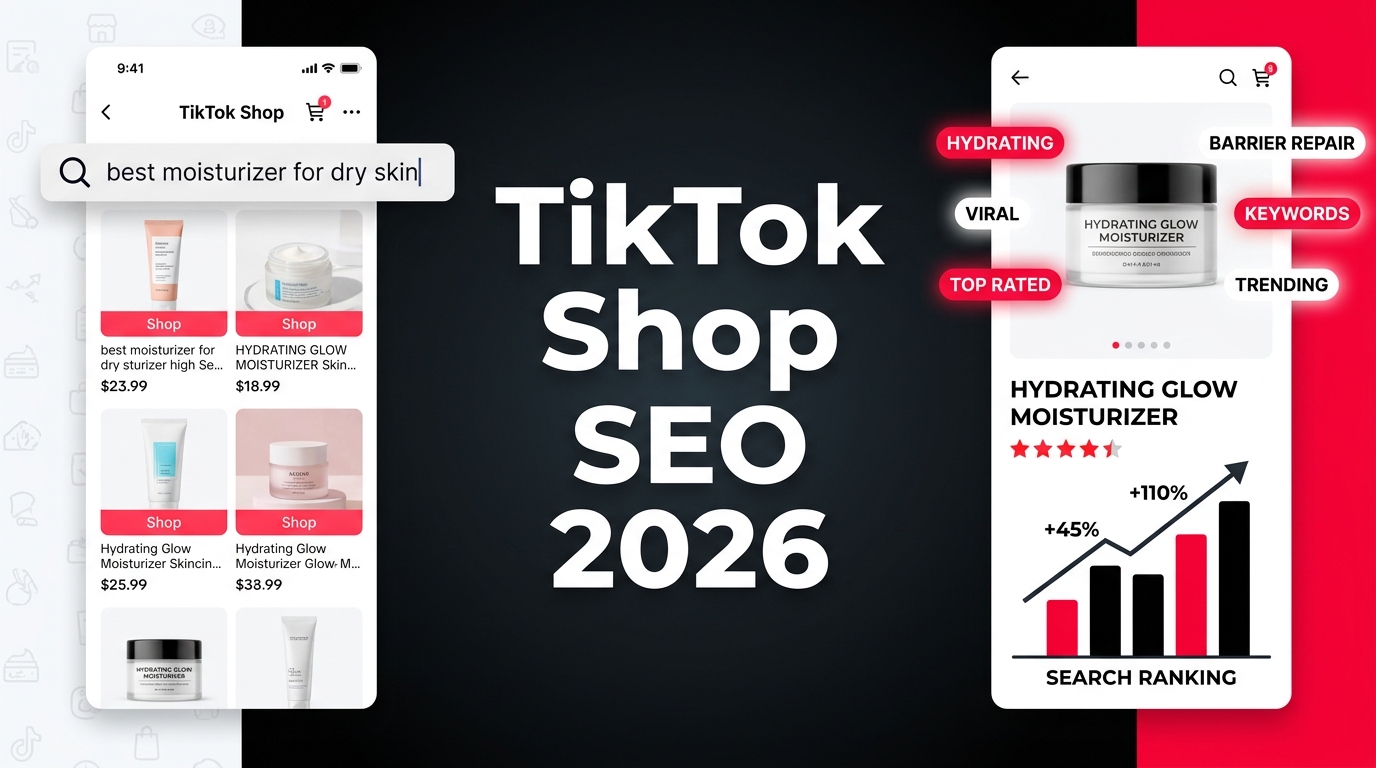

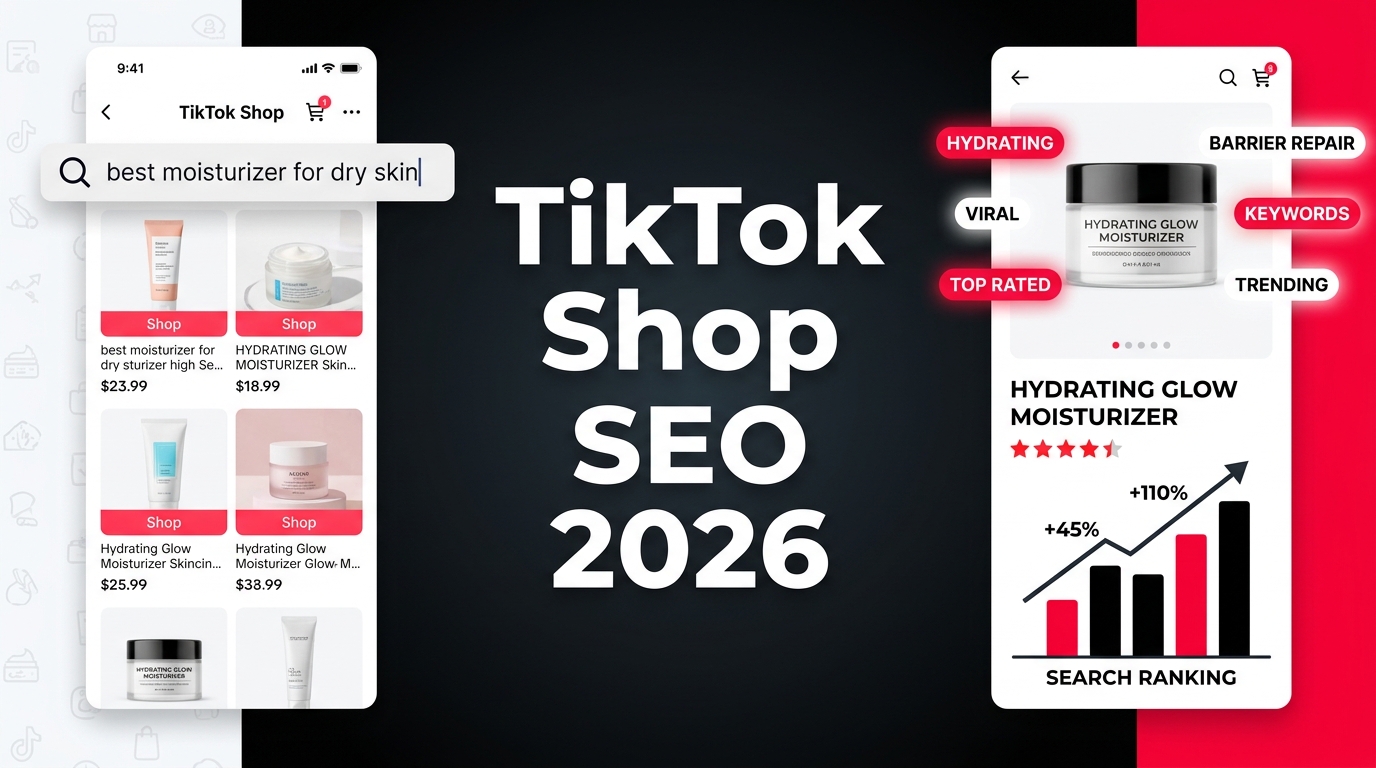
There’s a version of TikTok Shop SEO that most sellers learned in 2023 or 2024: write a keyword-heavy title, fill in your description, get some reviews, and let creator content do the heavy lifting. That version still circulates in seller Facebook groups and agency decks. And in 2026, it’s actively working against you.
The platform has matured significantly. TikTok’s internal data shows search queries on the platform have grown 174% year over year, and 67% of Gen Z now use TikTok as a primary search engine — with 78% of those users specifically searching for product reviews. One analysis of TikTok Shop session data found that search-driven sessions convert in the same browsing session at an 82% rate. These are not passive discovery numbers. This is a search engine with purchase intent baked in.
But here’s the thing: TikTok Shop’s ranking system doesn’t work like the search engines your SEO muscle memory was built on. It’s not Google. It’s not Amazon. It’s a multi-surface visibility architecture where five different discovery channels feed each other — and optimizing only one of them, the product listing page, means you’re competing at a fraction of your potential.
This post breaks down what TikTok Shop SEO actually looks like in 2026: the real ranking signals, the native research tools most sellers underuse, the role of affiliate creator content as an indexing layer, and the compliance floor that’s quietly throttling sellers who haven’t updated their approach. If you’ve been treating TikTok Shop SEO as a one-and-done listing task, this is the recalibration you need.
How TikTok Shop’s Ranking Engine Is Actually Structured
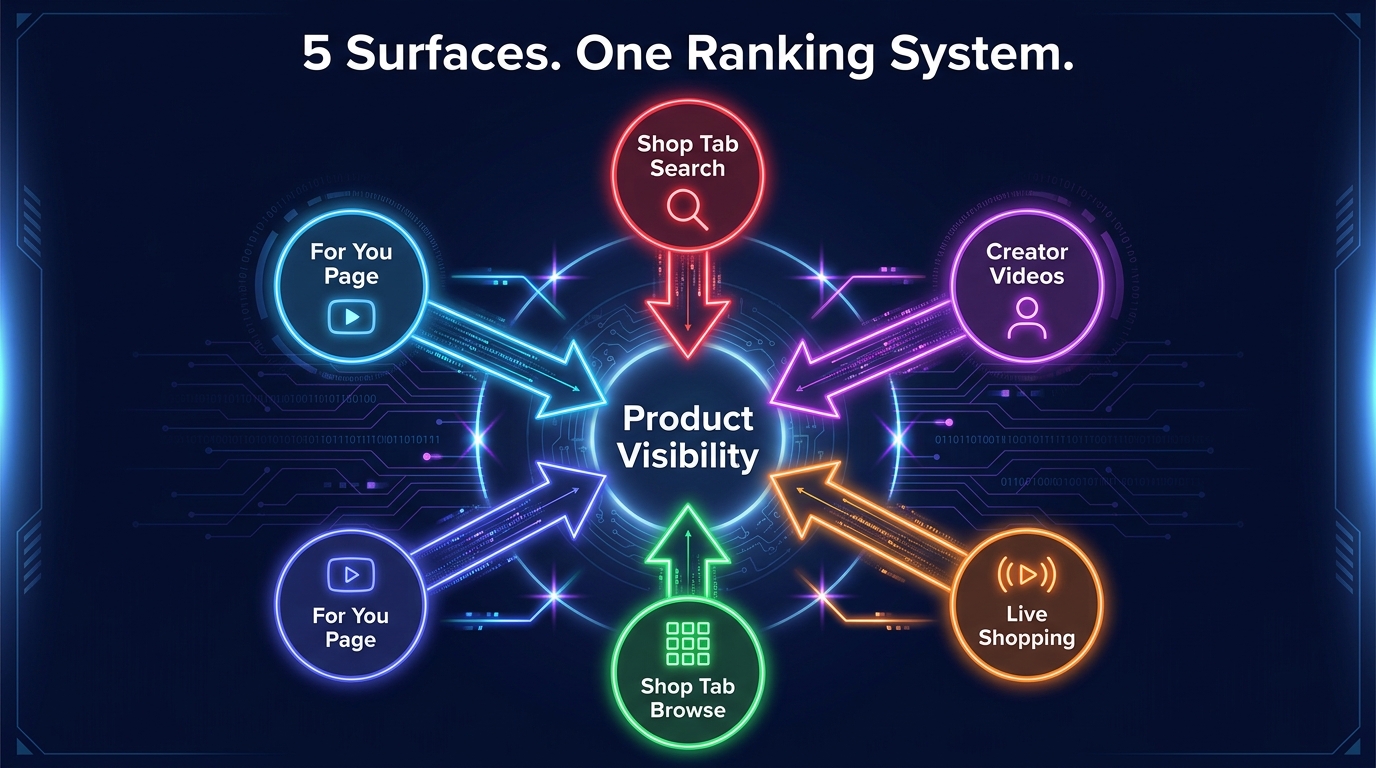
The most common misunderstanding about TikTok Shop SEO is treating it as a single algorithm with a single ranking list. In reality, TikTok’s commerce visibility system operates across at least five distinct surfaces, each with its own ranking logic and each capable of feeding signals back to the others.
Surface 1: Shop Tab Search
This is the most explicit commerce surface — the search bar inside the TikTok Shop tab. When a user types “collagen gummies” or “portable blender” here, they’re expressing clear purchase intent. The ranking here is most analogous to traditional e-commerce SEO: keyword relevance in the product title, attributes, and description carries significant weight, alongside conversion metrics like click-through rate (CTR), add-to-cart rate, and purchase conversion. Recent sales velocity also matters — a product that sold 300 units in the last seven days will outrank a competitor with higher total historical sales but lower recent momentum.
Surface 2: For You Page (FYP) Product Discovery
The FYP is TikTok’s recommendation engine, and while it’s primarily content-driven, shoppable videos tagged to your product listing create an indirect ranking signal. When a shoppable video performs well — high watch time, shares, saves, and product-page clicks — those engagement and commerce signals flow back to the listing itself, strengthening its position across other surfaces including Shop Tab Search. FYP discovery is where demand gets created; Shop Tab is where it gets captured.
Surface 3: Creator and Affiliate Video Indexing
Every creator video tagged to your product is an indexable content asset. TikTok reads captions, on-screen text via OCR, and spoken audio through its audio processing layer. This means the keywords a creator uses while describing your product — in their caption, in their spoken demo, or in text overlays — contribute to how TikTok categorizes and surfaces that product in search. A product with 40 creator videos all using the phrase “best vitamin C serum for sensitive skin” has a dramatically stronger semantic footprint than a product with only its listing metadata.
Surface 4: Live Shopping
Live shopping sessions function as what you might call a conversion velocity accelerator. When a product gets featured in a live stream, it receives a concentrated burst of commerce signals: product page clicks, add-to-cart actions, and direct purchases — all within a compressed timeframe. TikTok’s ranking system reads this velocity spike and can lift the featured product’s search position during and after the session. Live doesn’t create a separate “live rank” — it creates a surge of exactly the commerce signals that the Shop Tab search algorithm values most.
Surface 5: Shop Tab Browse
Beyond search, TikTok’s Shop Tab also surfaces products through category browse, trending collections, and personalized recommendations. Listing completeness — filled-in attributes, accurate category assignment, high-quality images — strongly influences placement here. Think of it as the passive discovery layer: you don’t need to win a keyword to show up, but your listing quality has to clear the bar TikTok sets for browse recommendations.
The critical takeaway: these five surfaces are not independent. A strong live session creates conversion signals that lift search rank. A well-optimized listing increases CTR from creator video traffic. Strong search rank creates more sales velocity, which strengthens your FYP recommendation signals. Building for all five surfaces simultaneously, rather than sequentially, is the core structural shift in TikTok Shop SEO for 2026.
The Five Ranking Signals That Actually Drive Visibility
Across seller data, TikTok’s own Seller Center documentation, and third-party analysis of high-performing shops, five clusters of signals emerge as the primary drivers of product visibility in 2026. Understanding each one — and how they interact — is the foundation of any serious SEO strategy on the platform.
Signal 1: Keyword Relevance
TikTok Shop’s search algorithm scans keyword relevance across multiple content layers simultaneously. Your product title carries the most weight, followed by your product description, attribute fields, and category assignment. But critically, TikTok also indexes keywords from associated creator video captions, spoken audio transcripts, and on-screen text — meaning your keyword footprint extends well beyond the listing itself.
Sellers who treat TikTok keyword relevance as a listing-only problem are leaving significant indexing surface area on the table. A coordinated approach — where your listing, your creator briefs, and your own shoppable video captions all reinforce the same primary keyword cluster — creates a semantic signal density that isolated listing optimization simply cannot match.
Signal 2: Conversion Signals (CTR, Add-to-Cart, Purchase Rate)
TikTok Shop is more explicitly conversion-signal-driven than most sellers realize. Click-through rate from search results, add-to-cart rate on the product page, and final purchase conversion rate are all tracked at the product level and fed back into the ranking model. This is where TikTok Shop SEO and conversion rate optimization (CRO) converge: every change you make to your listing that improves conversion also improves search rank. Your first product image, your pricing, your review count — all of these affect the commerce signals that determine ranking position.
Signal 3: Recent Sales Velocity
Recency is weighted heavily. TikTok’s algorithm favors products with recent momentum over products with high historical sales but flat recent performance. This has two practical implications: first, a new product that’s converting well in its first two weeks can outrank established competitors; second, a successful product that goes out of stock for a week or loses its promotional momentum can drop significantly and require active effort to recover. Maintaining consistent sales velocity — through promotions, affiliate outreach, or live sessions — is not just a revenue strategy. It’s an SEO maintenance strategy.
Signal 4: Review Quality and Recency
Review signals operate in two dimensions: aggregate rating (your star score) and review recency (how recently customers have left feedback). A product with a 4.7-star rating and 20 reviews in the last 30 days will outperform a product with a 4.8-star rating and 200 total reviews but only 2 in the last month. This means review generation should be a continuous operational task, not a launch-phase initiative. Sellers who treat reviews as a “set it and forget it” metric often find themselves gradually losing ground to newer, actively managed competitors.
Signal 5: Shop Trust and Fulfillment Quality
TikTok assigns a shop-level trust score based on fulfillment metrics: on-time dispatch rate, on-time delivery, return/dispute resolution, and seller response time. This trust score acts as a ranking modifier that affects all products in your shop simultaneously. A shop with a poor fulfillment track record faces a visibility ceiling that no amount of listing optimization can overcome — the algorithm treats shop health as a prerequisite, not a tiebreaker. Fulfillment performance is, quite literally, an SEO metric on TikTok Shop.
Keyword Strategy for TikTok Shop (Not Amazon Transplants)
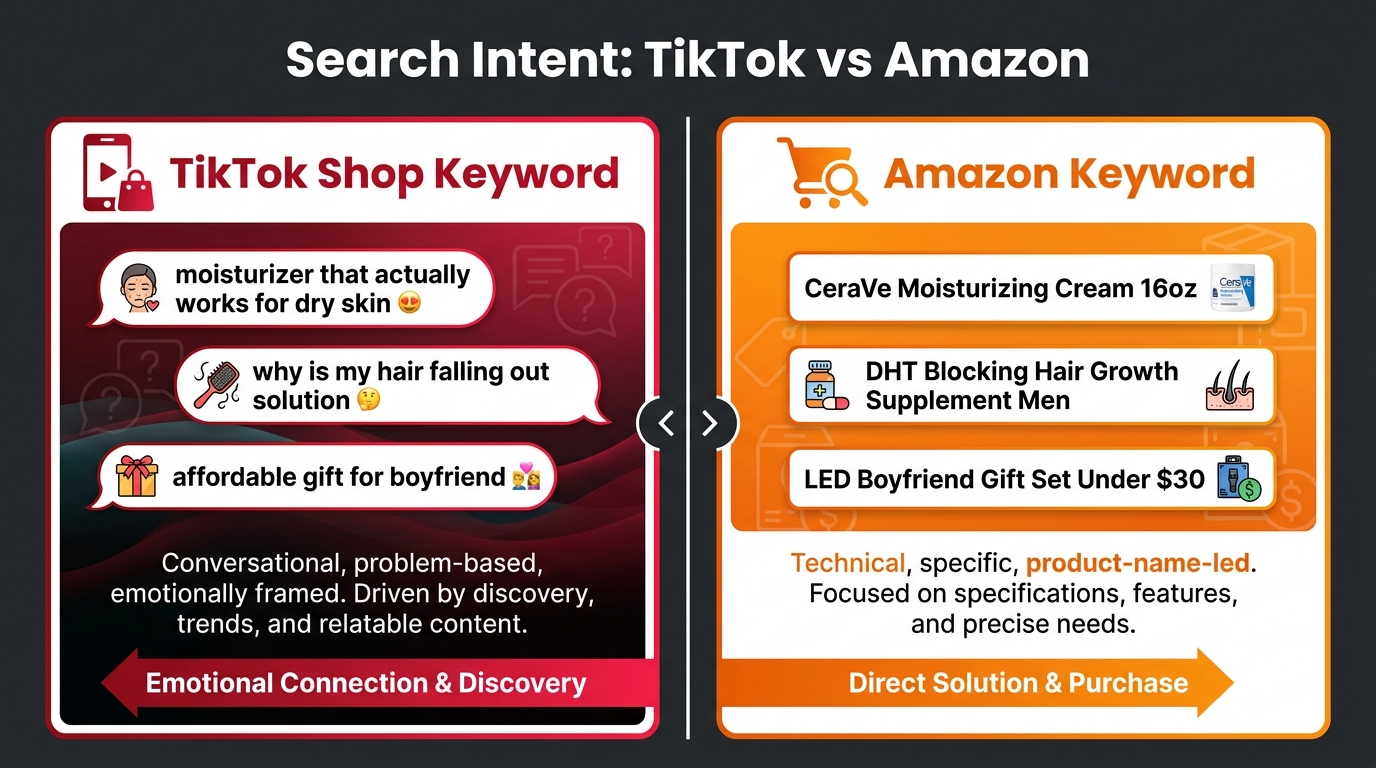
The single most damaging SEO mistake on TikTok Shop in 2026 is importing Amazon keyword logic into TikTok’s fundamentally different search environment. These are not the same users, asking questions in the same way, at the same stage of the buying process.
Why TikTok Queries Sound Different
Amazon search is task-driven and product-specific. A user searching Amazon already knows what they want and is comparing options: “CeraVe moisturizing cream 16oz,” “DHT blocking supplement men 60 capsules,” “cast iron skillet pre-seasoned 12 inch.” The intent is explicit, the category is clear, and the specification detail is high.
TikTok search is problem-driven and outcome-oriented. Users search to find content that validates a problem they have or a result they want: “moisturizer for dry skin that doesn’t feel greasy,” “why is my hair falling out and what to do,” “gift ideas boyfriend actually uses.” The queries are conversational, emotionally inflected, and often structured around a pain point or desired outcome rather than a product specification.
This distinction has direct consequences for title construction. An Amazon-transplanted title like “Vitamin C Face Serum 30ml Niacinamide Anti-Aging Brightening” may rank well on Amazon but performs poorly on TikTok Shop search because TikTok users aren’t searching for ingredient lists — they’re searching for “glowing skin serum that works fast” or “vitamin C serum for dark spots beginners.”
Native Keyword Research Tools
TikTok provides first-party keyword research tools inside Seller Center that are significantly more accurate for TikTok Shop optimization than any third-party Amazon keyword tool:
- Keyword Rankings: Shows top-performing, rising, and high-potential search terms in your category, filterable by competition level and search volume trend.
- Search Insights: Tracks actual search performance metrics for your products — search impressions, CTR from search, and search-attributed GMV — letting you see which keywords are driving real commercial results, not just traffic.
- Product Opportunities: Surfaces gaps between search demand and current product supply in your category, highlighting high-intent queries where competition is thin and opportunity is concentrated.
- TikTok Autocomplete: The search bar autocomplete is a direct window into real user search behavior. Querying your primary product category and scrolling autocomplete suggestions surfaces the exact natural-language queries your potential buyers are already using.
The Title Formula That Works in 2026
The most consistently effective title structure for TikTok Shop in 2026 follows this pattern: Primary keyword (first 30–60 characters) + Key benefit + Differentiator or Use Case.
For a skincare product, this might look like: “Vitamin C Brightening Serum — Fades Dark Spots in 2 Weeks, Fragrance-Free.” The primary keyword leads, the benefit is concrete and outcome-specific, and the differentiator speaks to a specific objection or use-case filter (“fragrance-free” addresses a real buyer concern and adds specificity without padding).
What to avoid: keyword stuffing (TikTok’s listing quality system flags this), ingredient stacking without benefit framing, and titles that front-load brand names over category keywords unless your brand has significant search recognition on TikTok specifically.
Attributes and Category Accuracy
One of the most underused levers in TikTok Shop SEO is complete and accurate attribute completion. TikTok uses attribute data — size, color, material, age group, use case, ingredient, etc. — for both search filtering and category browse recommendations. Incomplete attributes don’t just reduce search match accuracy; they disqualify your product from appearing in filtered search results and category browse surfaces entirely. Audit your attribute fields as systematically as your title. In competitive categories, complete attribute coverage is a meaningful differentiator.
The Multi-Surface SEO Model in Practice
Understanding the five ranking surfaces is one thing. Coordinating optimization across all five simultaneously is another — and it requires a structural shift in how most sellers organize their TikTok Shop work.
The Old Model: Listing-First, Content-Second
The legacy approach most sellers still use: optimize the listing, then separately brief creators, then run occasional live sessions, then check search rank occasionally. These activities happen in sequence, managed by different team members or external vendors, with no shared SEO framework tying them together.
The problem: every element of this system is producing keyword and commerce signals in isolation. Creator content may not reinforce listing keywords. Live sessions may not promote the products with the highest search potential. The listing title may not reflect the language buyers actually use based on real search data.
The New Model: Search-First Architecture
In a search-first architecture, the keyword research happens first, and every downstream activity is structured around validated search demand:
- Keyword research identifies the primary search terms with the best combination of volume, intent, and competition in your category.
- Listing optimization uses those terms to build the title, description, attributes, and backend fields.
- Creator briefs are built around those same terms — specifying the phrases creators should use in captions, spoken audio, and on-screen text.
- Live sessions are scheduled to feature products with high search potential and strong recent conversion rates, creating a targeted velocity burst for the listings most likely to benefit from it.
- Analytics review loops back to Seller Center’s Search Insights to measure what’s moving and where opportunity remains.
This approach treats TikTok Shop not as a content platform that happens to have a store, but as a commerce search engine that uses content as one of its primary indexing inputs. The distinction matters for how you resource and prioritize SEO work.
Live Shopping as a Deliberate SEO Tactic
Live shopping deserves specific attention because most sellers use it primarily as a revenue tool without understanding its ranking mechanics. When you feature a product in a live session and drive strong add-to-cart and purchase actions, you’re generating a concentrated burst of exactly the commerce signals TikTok’s search algorithm weights most heavily — all attributed to that specific SKU in a compressed timeframe.
The practical implication: strategically featuring products that are close to a ranking threshold in live sessions can create enough conversion velocity to push them over that threshold and into a higher search position that sustains itself after the session ends. This is an SEO tactic disguised as a sales event.
How Affiliate Creator Content Functions as an SEO Asset
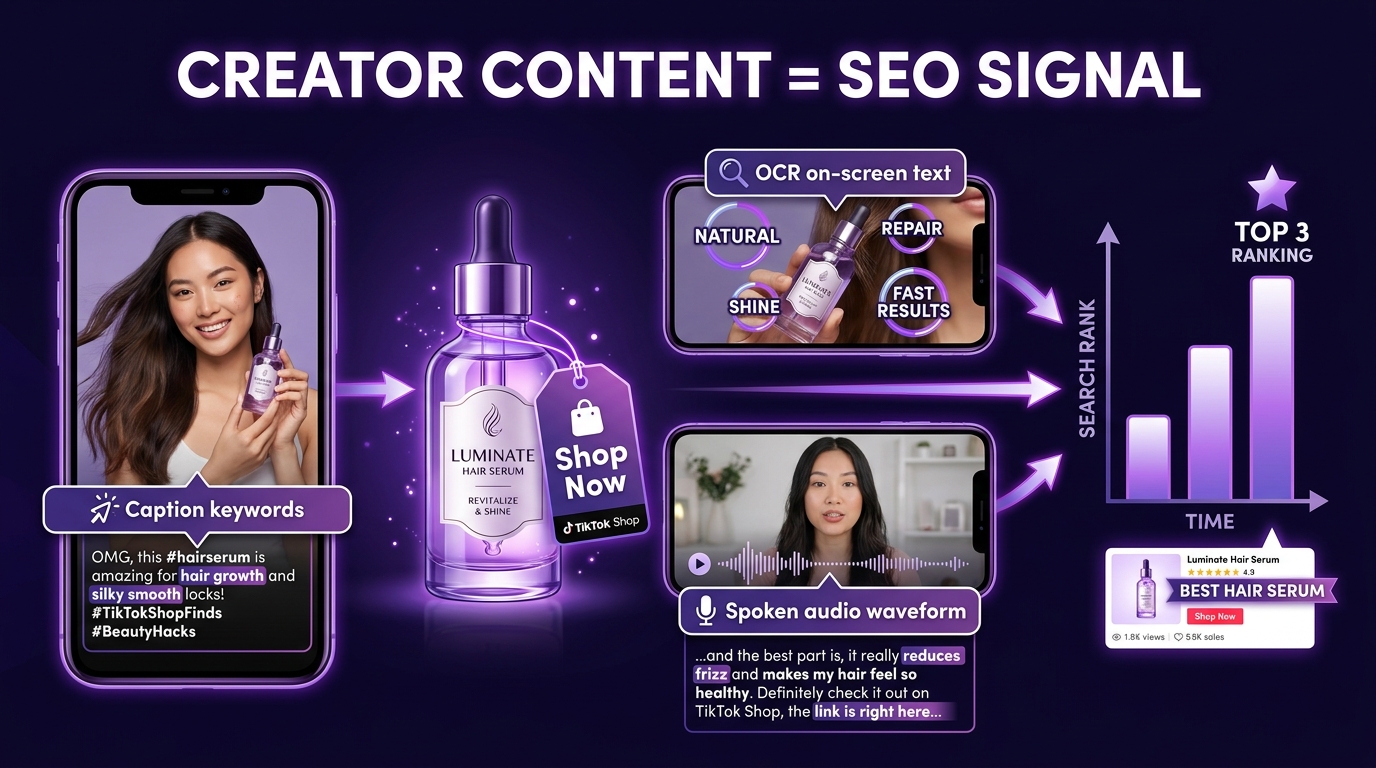
TikTok indexes creator content far more comprehensively than most sellers realize — and every affiliate video tagged to your product becomes a structured SEO asset, not just a distribution channel.
Three Indexing Layers TikTok Reads from Creator Videos
1. Caption Text: The caption is the highest-weight text signal in a creator video. TikTok reads it for keyword relevance, both for surfacing the video in search results and for strengthening the semantic association between that video and the linked product. The first 80–150 characters of a caption carry the most indexing weight. Creators who front-load the product’s primary keyword in their caption — “This Vitamin C serum genuinely changed my skin in two weeks…” — are directly contributing to the product’s search footprint.
2. On-Screen Text (OCR): TikTok’s OCR (Optical Character Recognition) layer reads text overlays, subtitles, and captions that appear visually in the video frame. If a creator adds text overlays saying “Best serum for dark spots” or “Fragrance-free formula” over their product demo, those strings are indexed and contribute to keyword relevance. This is an underutilized channel — most creator briefs focus on spoken content and ignore the on-screen text layer entirely.
3. Spoken Audio: TikTok processes spoken audio for indexing, treating a creator’s spoken description of your product as indexable content in the same way captions and on-screen text are. This means the specific words a creator uses when verbally describing your product — its name, its benefits, the problems it solves — directly feed into TikTok’s understanding of what your product is and what searches it should appear for.
Building Creator Briefs for SEO, Not Just Virality
Most brand briefs given to affiliate creators focus entirely on what to say about the product (benefits, features, offer) and how to say it (tone, hook, pacing). Very few include any SEO guidance about which specific words to use and where to use them.
An SEO-optimized creator brief includes:
- Primary keyword phrase to use in the caption’s first 100 characters
- Secondary keywords or benefit phrases to include in spoken audio during the demo
- Suggested on-screen text overlays using target search terms
- Guidance on the product tag placement to ensure the correct product SKU is linked
At scale, this creates what could be described as a distributed keyword reinforcement network: 40 creator videos all using the same core keyword cluster, each contributing caption, audio, and OCR indexing signals to the same product listing. The aggregate semantic signal density of a well-briefed creator network is simply not achievable through listing optimization alone.
The Volume Multiplier
Beyond keyword signals, a larger number of creator videos generates a larger surface area for commerce signals to accumulate. Each video that drives a product-page click, an add-to-cart action, or a purchase contributes to that product’s demand signal profile. Ten creator videos driving moderate engagement each produce more total demand signals than one creator video driving high engagement — and those distributed signals are harder to lose suddenly compared to a reliance on a single viral post.
Listing Quality and Compliance as a Ranking Floor
In 2026, TikTok Shop has tightened its enforcement of listing quality and policy compliance, and the consequences are directly SEO-relevant. A listing that violates policy guidelines — even subtly — faces throttled search visibility, ineligibility for promotional surfaces, and in some cases outright removal. This isn’t a separate “policy problem” from your SEO strategy. It’s a prerequisite for having an SEO strategy at all.
What TikTok’s Listing Quality System Evaluates
TikTok’s listing quality framework evaluates several dimensions:
- Claim accuracy: Product titles and descriptions that make unsubstantiated health, performance, or comparative claims trigger compliance flags. Keywords that look like SEO wins (“clinically proven,” “best on TikTok”) can simultaneously be compliance liabilities.
- Image quality and compliance: Main product images must meet technical quality standards and cannot contain misleading visual claims, unauthorized logos, or promotional text that violates TikTok’s image guidelines.
- Category accuracy: Products listed in incorrect categories — often done to target higher-traffic categories — are identified and re-categorized, which can disrupt existing search rank.
- Attribute completeness: Listings with missing required attributes are scored lower in quality assessments and may be deprioritized in browse and recommendation surfaces.
- Description accuracy: Descriptions that use excessive keyword repetition, misleading phrasing, or content that doesn’t match the product are flagged under TikTok’s anti-manipulation policies.
AI-Assisted Listing Tools
TikTok has built AI-assisted listing optimization directly into Seller Center, reducing the friction between knowing what to do and actually doing it at scale. The “List with AI” workflow uses TikTok’s own search data to generate listing titles and descriptions that are both keyword-relevant and policy-compliant — pulling from the same intent data that powers the search ranking system. The Smart Listing Optimizer analyzes existing listings and surfaces specific improvement recommendations: title rewrites, missing attributes, image quality flags, and description gaps.
One case study from TikTok’s own university content involved a brand called Danos Seasoning, which used auto-generated bullet points via the AI optimization tool and saw measurable improvements in engagement and conversion metrics. The implication is that TikTok’s AI tools are optimizing for the same signals the ranking algorithm rewards — making them worth using even for sellers who have in-house content teams.
The Compliance-First Mindset Shift
Many sellers approach compliance reactively — waiting for violations before adjusting listings. In a tightening enforcement environment, this is an expensive approach. A listing that gets flagged, reviewed, and restored loses ranking momentum during the downtime. A listing that was never flagged maintains continuous momentum accumulation. Building listings to compliance standards from the start is faster and more SEO-efficient than the cycle of optimization → violation → appeal → restore.
First-Party Data and Seller Center Analytics
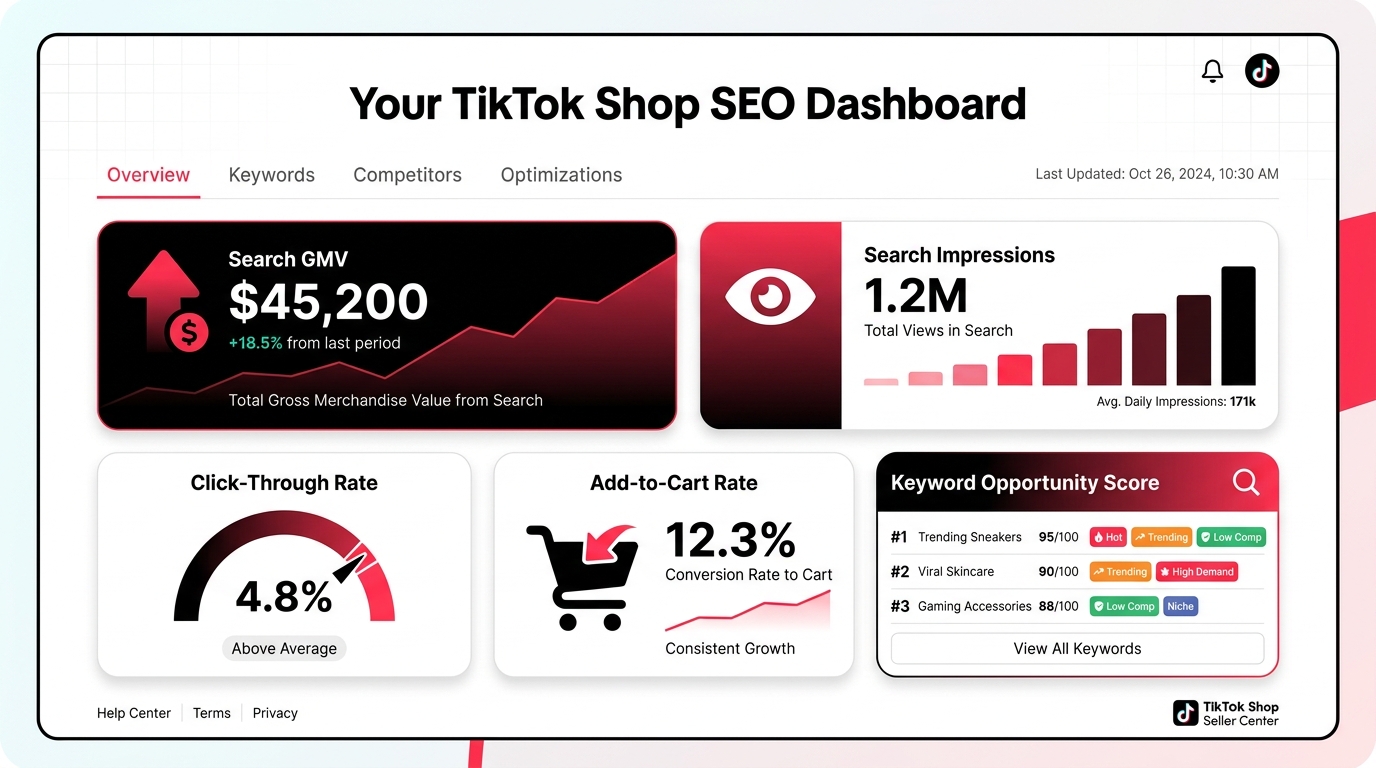
One of the most underused competitive advantages available to TikTok Shop sellers in 2026 is TikTok’s own first-party search data. Unlike most SEO tools — which estimate search volume from sampling or panel data — TikTok Seller Center provides direct access to actual search performance metrics for your shop and products. Used correctly, this data makes keyword decisions dramatically more precise.
The Six Metrics That Matter in Search Insights
Search GMV: The total revenue your product generated from search-sourced sessions. This is the clearest measure of whether your SEO is driving actual commercial outcomes or just traffic.
Search Orders: The count of orders specifically attributed to search discovery. Comparing this to total orders reveals how dependent your product is on other discovery surfaces — and how much upside there is in strengthening search performance.
Search Impressions: How often your product appears in search results. A product with high impressions but low CTR has a presentation problem (title, image, price). A product with low impressions has a relevance or ranking problem.
Click-Through Rate from Search: The percentage of impressions that result in a product-page click. This is the critical bridge between ranking and revenue. Average CTR benchmarks vary by category, but consistently below-average CTR is a strong signal that your primary image, title, or pricing needs work.
Add-to-Cart Rate: Tracked from both search and other surfaces, this metric is a leading indicator of purchase intent quality. Products with high search CTR but low add-to-cart rates often have a product page problem — unclear benefits, weak imagery, or pricing misalignment with what the search query promised.
Keyword Opportunity Score: TikTok’s Seller Center surfaces keywords classified as “hot,” “trending,” or “low competition” — giving you a prioritization framework for which keyword opportunities to pursue based on demand volume and competitive intensity simultaneously.
Using Search Insights for Keyword Gap Analysis
A highly practical application of Search Insights is keyword gap analysis: identifying searches where your products are receiving impressions but not converting, which reveals keyword-product misalignment. If your product appears for “vitamin C serum for oily skin” but has consistently low CTR and conversion on that query, it signals either that your listing doesn’t communicate suitability for oily skin, or that the product genuinely doesn’t serve that query well and should not be optimized for it.
This level of diagnostic clarity is simply not available through any third-party tool. The only way to get it is through Seller Center’s native analytics — which many sellers log in and ignore beyond the top-level GMV and orders dashboard.
Benchmarking Against Category Leaders
Search Insights allows category-level benchmarking, showing you where your search performance metrics sit relative to category leaders. A seller whose search CTR is 2.1% in a category where top performers average 4.7% has an immediately actionable priority: product image and title testing. A seller whose search conversion rate is below category average despite strong CTR knows the product page is the weak link. This benchmarking layer transforms Search Insights from a historical reporting tool into a gap-identification and prioritization engine.
The Conversion Feedback Loop: Where SEO and CRO Become the Same Thing
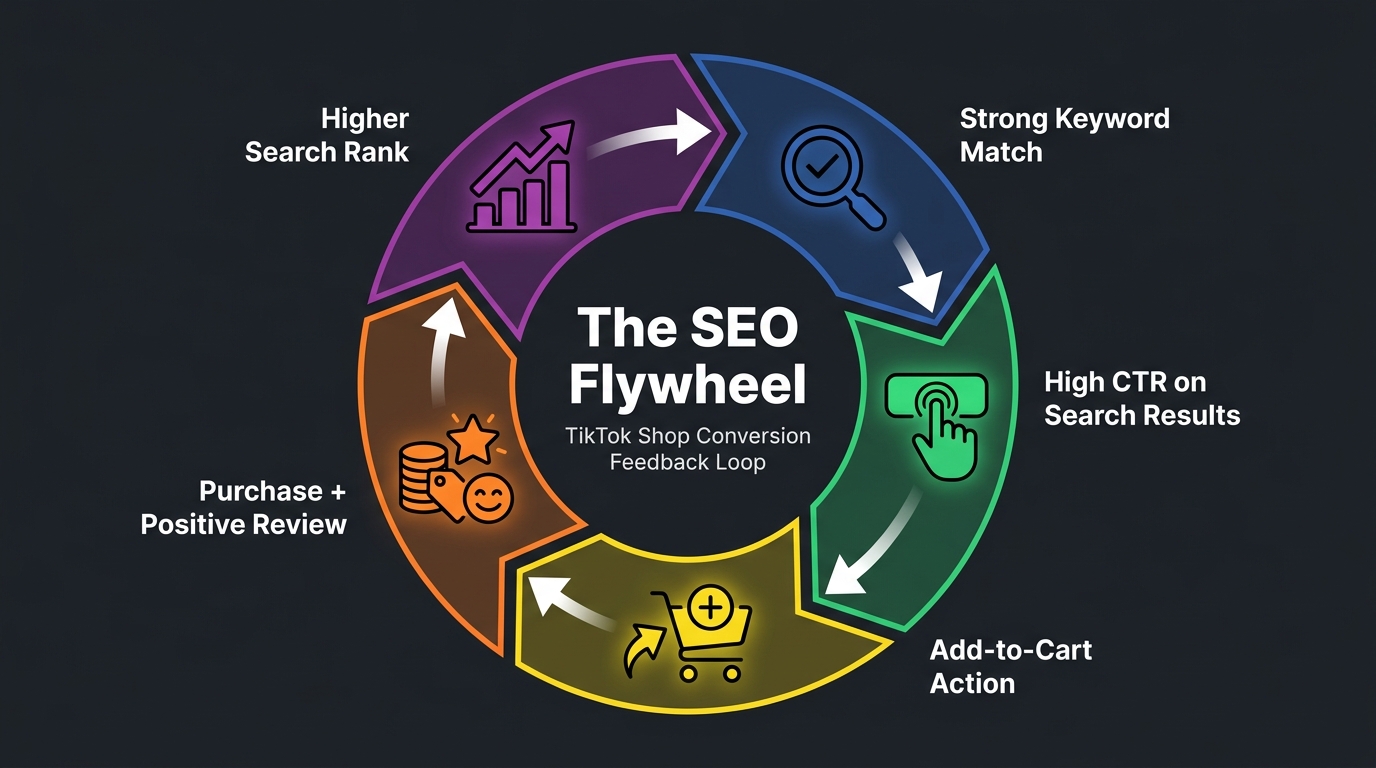
One of the most important structural features of TikTok Shop’s ranking system is the degree to which SEO and conversion rate optimization are not separate disciplines — they’re the same feedback loop expressed at different points in the buyer journey.
How the Flywheel Works
The sequence runs like this: strong keyword relevance gets your product into the search results. Your product image and title determine whether shoppers click (CTR). Your product page layout, reviews, and pricing determine whether they add to cart. Your checkout flow and trust signals determine whether they complete the purchase. Their purchase — and the review they potentially leave — feeds back into TikTok’s ranking algorithm, improving both keyword relevance weighting and commerce signal strength for the next search. The result is a self-reinforcing loop where conversion optimization is not just a revenue tool but a compounding ranking mechanism.
This means every CRO improvement — a better first image, a more compelling title, a higher review count, a cleaner product page — directly increases search ranking, which increases traffic, which gives you more conversion opportunities, which generates more commerce signals. In most e-commerce environments, SEO and CRO are run by different teams with different KPIs. On TikTok Shop, they share an optimization target.
First Image Optimization as an SEO Tactic
Your primary product image is the most direct lever for CTR from search results. In a grid of search results, the first image is the only visual signal available to drive a click. Categories like beauty, apparel, and home goods are intensely visual, and the difference between a 2% and 5% search CTR can mean a 2.5x difference in search-driven revenue from the same ranking position.
What drives higher CTR on TikTok Shop specifically — based on patterns in high-performing shops — tends to be: lifestyle context over pure product-on-white backgrounds, visible product detail without clutter, and direct result or benefit visualization (showing the outcome, not just the product). The platform’s audience is visually literate and conditioned to high-production short-form content, which sets a quality bar for product imagery that simple catalog photography often doesn’t meet.
Review Velocity as an Active SEO Strategy
Given the recency weighting in TikTok’s review signals, generating a steady stream of new reviews is not a passive outcome — it requires active systems. The most effective approaches in 2026 include: post-purchase messaging sequences through TikTok’s buyer communication tools, creating review incentive structures within TikTok’s policy guidelines, and featuring the product in creator content that drives purchase from a highly satisfied audience segment (since creator-influenced buyers who specifically made the purchase because of the content they saw tend to leave reviews at higher rates).
A product generating 15 new reviews per month consistently will outperform a product with 300 total reviews and 2 new per month in the recency-weighted component of TikTok’s ranking model — even if the older product has a marginally higher average rating.
What Actually Breaks TikTok Shop SEO in 2026
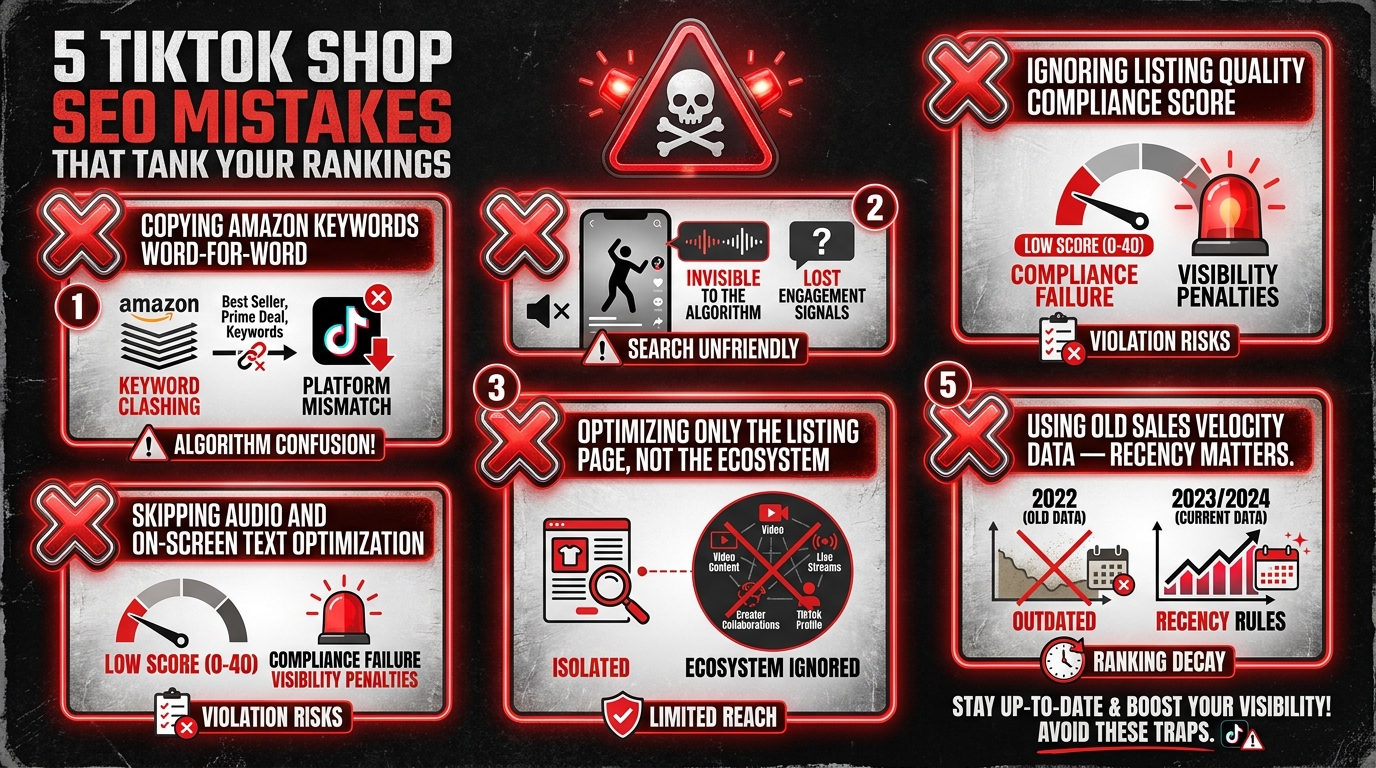
With five ranking surfaces, multiple signal types, and a native analytics ecosystem most sellers underuse, there are several ways the SEO strategy falls apart in practice. These are the most common failure patterns observed across competitive categories in 2026.
Mistake 1: Treating TikTok Shop as an Amazon Satellite Store
This is the most pervasive mistake. Sellers who duplicate their Amazon listings on TikTok Shop — same title, same bullet points, same images — import Amazon’s keyword logic into an environment where that logic doesn’t apply. Amazon keywords are technical and specification-focused; TikTok keywords are problem-based and outcome-oriented. Amazon images are designed for comparison shopping; TikTok images need to stop a scroll. A listing optimized for Amazon will systematically underperform on TikTok Shop’s search surface, because it’s answering a question TikTok users aren’t asking.
Mistake 2: Ignoring Audio and On-Screen Text in Creator Content
Most sellers who use affiliate creators for TikTok Shop focus exclusively on the creator’s reach and engagement rate. The SEO dimension — what keywords the creator uses in their caption, in their spoken content, and in their text overlays — is almost never briefed. This means a creator with 500,000 followers who uses generic language (“this product is amazing, link in bio”) provides almost no keyword relevance signal to TikTok’s indexing layer, while a creator with 50,000 followers who uses your specific target keywords throughout the caption, audio, and on-screen text creates a meaningful indexing contribution. Reach and SEO value of creator content are not the same thing.
Mistake 3: Optimizing One Surface and Ignoring the Rest
A common pattern: a brand spends significant effort on listing optimization, achieves strong Shop Tab search rankings for core terms, then plateaus. They’ve optimized one of the five surfaces. The FYP discovery surface, the creator video indexing surface, the live session conversion velocity surface — all of them remain underbuilt. Because these surfaces feed signals back to search rank, the seller who builds only the listing is leaving compounding ranking upside on the table.
Mistake 4: Letting Compliance Issues Accumulate Reactively
As TikTok tightens its listing quality enforcement, the reactive approach to compliance — waiting for a flag before fixing a problem — becomes increasingly costly. Every day a flagged listing spends under review is a day of interrupted commerce signal accumulation. A listing that gets flagged, drops in search position during the review period, and then gets restored is not simply returned to its prior position — it has lost the momentum that continuous visibility and conversion accumulation would have provided during that window.
Mistake 5: Using Stale Sales Velocity Data
TikTok’s recency weighting in sales velocity means that decisions based on historical sales data — which keywords drove orders last quarter, which SKUs had the strongest sales history — can actively misdirect optimization effort. A product that sold strongly three months ago but has since slowed is not the same SEO opportunity it once was. Seller Center’s search metrics are best reviewed on a rolling 7–14 day basis to identify what’s building momentum now, not what performed well historically. Sellers who optimize based on 90-day lookback windows are consistently reacting to ranking conditions that have already changed.
Building a TikTok Shop SEO System That Compounds
The thread running through everything in this post is the same: TikTok Shop SEO in 2026 is not a task — it’s an architecture. It requires coordinated optimization across five discovery surfaces, a keyword strategy built from TikTok’s own native search data rather than imported from adjacent platforms, and an operational rhythm that treats creator content, live sessions, and fulfillment quality as SEO inputs — not separate business functions.
The Weekly SEO Rhythm That Works
For brands serious about compounding TikTok Shop search performance, the most effective operating cadence in 2026 looks something like this:
- Weekly: Review Search Insights for rolling 7-day CTR, conversion rate, and search GMV by product. Identify any product with declining search impressions or CTR, and flag for title or image update. Check for any listing quality flags or compliance notifications in Seller Center.
- Bi-weekly: Audit creator video performance — which videos are generating product-page clicks and add-to-cart actions. Brief new creator waves using updated keyword clusters from Seller Center’s trending keyword data. Schedule live sessions for any product approaching a ranking threshold.
- Monthly: Full keyword gap analysis — identify search terms where you’re getting impressions but low CTR or conversion. Review attribute completeness across your catalog. Check category-level benchmark metrics in Search Insights to prioritize where performance gaps are largest relative to category leaders.
- Quarterly: Revisit your core keyword strategy using Product Opportunities data. Look for emerging high-volume, low-competition queries that have developed since your last audit. Update creator briefs to reflect any significant new keyword discoveries.
The Compounding Advantage
Sellers who maintain this kind of systematic SEO rhythm accumulate a structural advantage that’s difficult for competitors to close quickly. Every week of strong conversion signals, every new batch of reviews, every creator video adding keyword reinforcement — these inputs stack. A well-maintained TikTok Shop SEO system running for 12 months consistently outperforms a more resource-intensive but sporadic approach because the signal accumulation is continuous rather than episodic.
The platform continues to build its commerce infrastructure with clear intent: TikTok wants to be a full-funnel purchase destination, not just a discovery channel. The sellers who will be best positioned as that infrastructure matures are the ones treating search performance as a system today — before the competition in their category figures out the same thing.
Conclusion: Five Surfaces, One System
TikTok Shop SEO in 2026 has outgrown its early reputation as a “just go viral and sell” model. The platform now has a sophisticated, multi-surface ranking architecture that rewards the same fundamentals that matter in any serious search and commerce environment: keyword relevance, conversion quality, recency, reviews, and operational trust. What makes it different — and what catches sellers who borrowed their SEO playbook from elsewhere — is how these signals distribute across surfaces, how creator content functions as an indexing input, and how tightly conversion rate optimization and search ranking are intertwined.
The actionable framework is straightforward, even if executing it at scale requires real discipline:
- Start with native keyword research from TikTok’s own Seller Center tools — Keyword Rankings, Search Insights, autocomplete — not Amazon keyword data.
- Build your title for TikTok’s search language: problem-oriented, benefit-led, primary keyword in the first 30–60 characters.
- Brief your creators for SEO: specific keywords in captions, spoken audio, and on-screen text overlays.
- Use live sessions as deliberate ranking accelerators, featuring products that are close to search ranking thresholds and would benefit most from a conversion velocity spike.
- Treat listing quality compliance as SEO maintenance — proactively, not reactively.
- Review Search Insights weekly, not quarterly. TikTok’s recency weighting means the ranking landscape you see today reflects the last 7–14 days, not the last three months.
The sellers who understand TikTok Shop as five surfaces operating as one system — and who organize their teams, their creator relationships, and their analytics around that architecture — are the ones compounding visibility while everyone else optimizes in circles.