


TikTok Shop crossed $23.41 billion in projected US sales for 2026 — a number that puts it ahead of Costco and Target in e-commerce terms and makes it one of the fastest-growing retail channels in American commerce history. More than 70 million products are now live on the platform, and every week new sellers enter with high hopes, a ring light, and a product sourced from Alibaba.
Most of them plateau within 90 days.
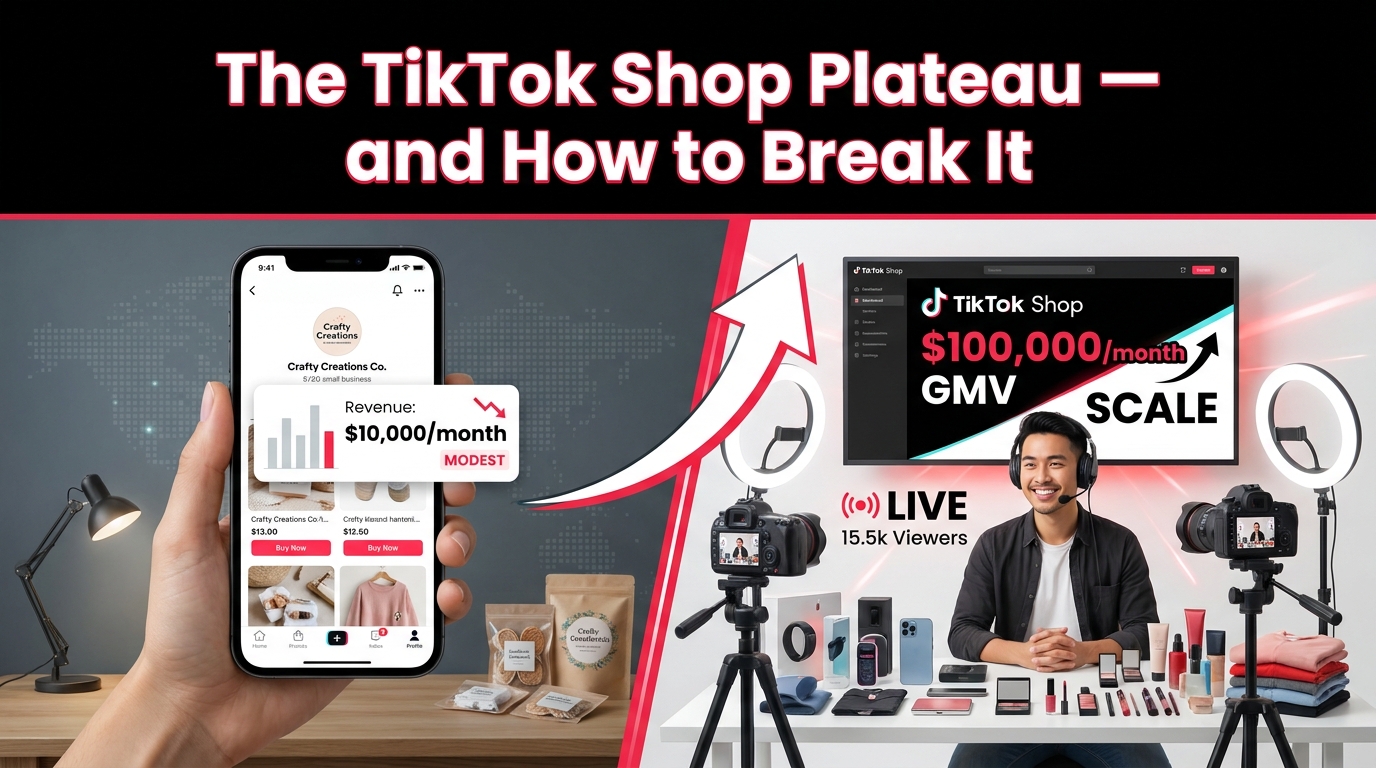
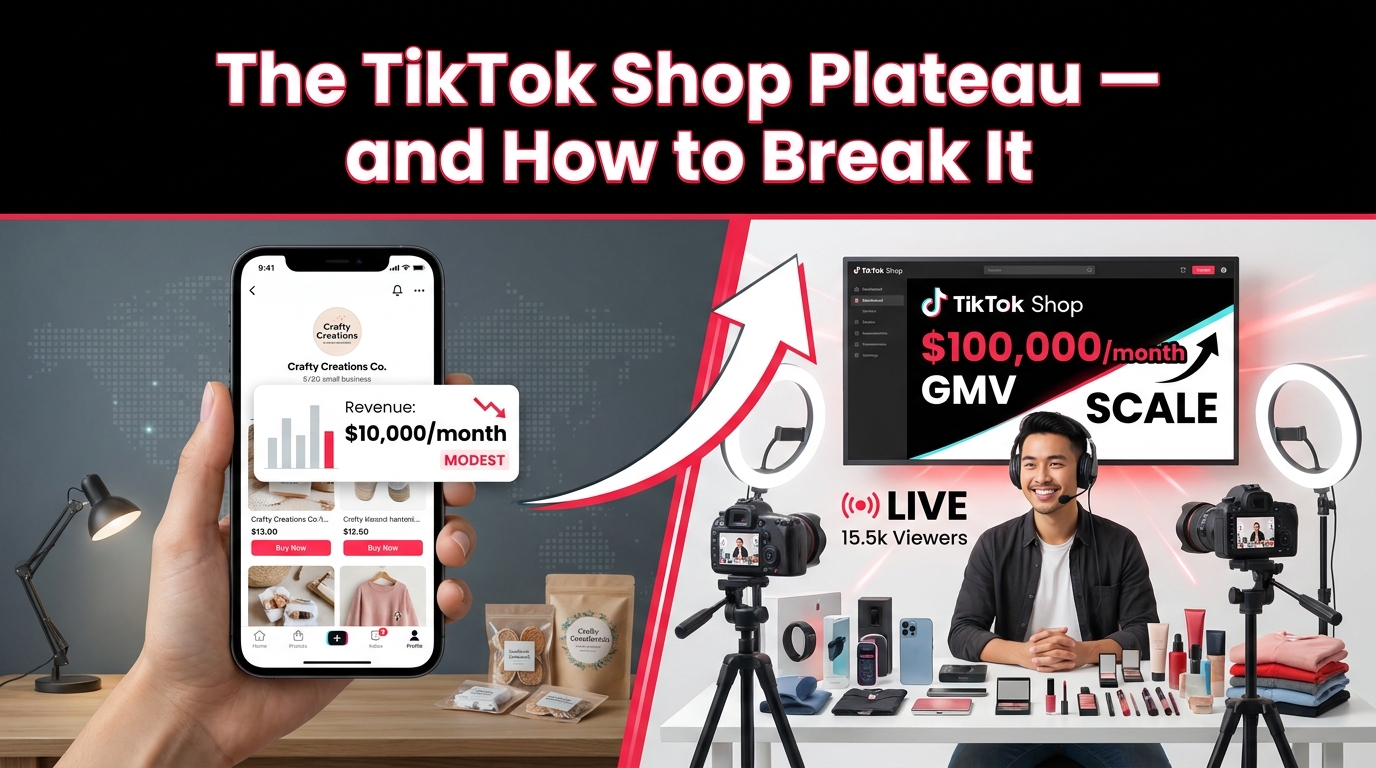
Not because TikTok Shop doesn’t work — it clearly does. Not because their product is wrong, or their content is boring, or the algorithm has it out for them. Most sellers plateau because they treat TikTok Shop as a single channel with a single lever: post videos, get sales. They optimise the one thing they can see — their content — while ignoring the structural machinery that actually separates a $10,000/month seller from a $100,000/month one.
This post isn’t about TikTok Shop’s SEO ranking system (we’ve covered that), and it won’t rehash May 2026’s algorithm changes or the commission structure shift. What it will do is go deeper than any of that — into the operational, strategic, and commercial architecture that the top 5% of TikTok Shop sellers have quietly built while everyone else is busy filming another unboxing video.
If you’re generating some sales on TikTok Shop but can’t seem to break through to the next level, this is the post that explains why — and what to actually do about it.
The Three-Channel Model: Videos, Lives, and Shop Tab — Why You Need All Three
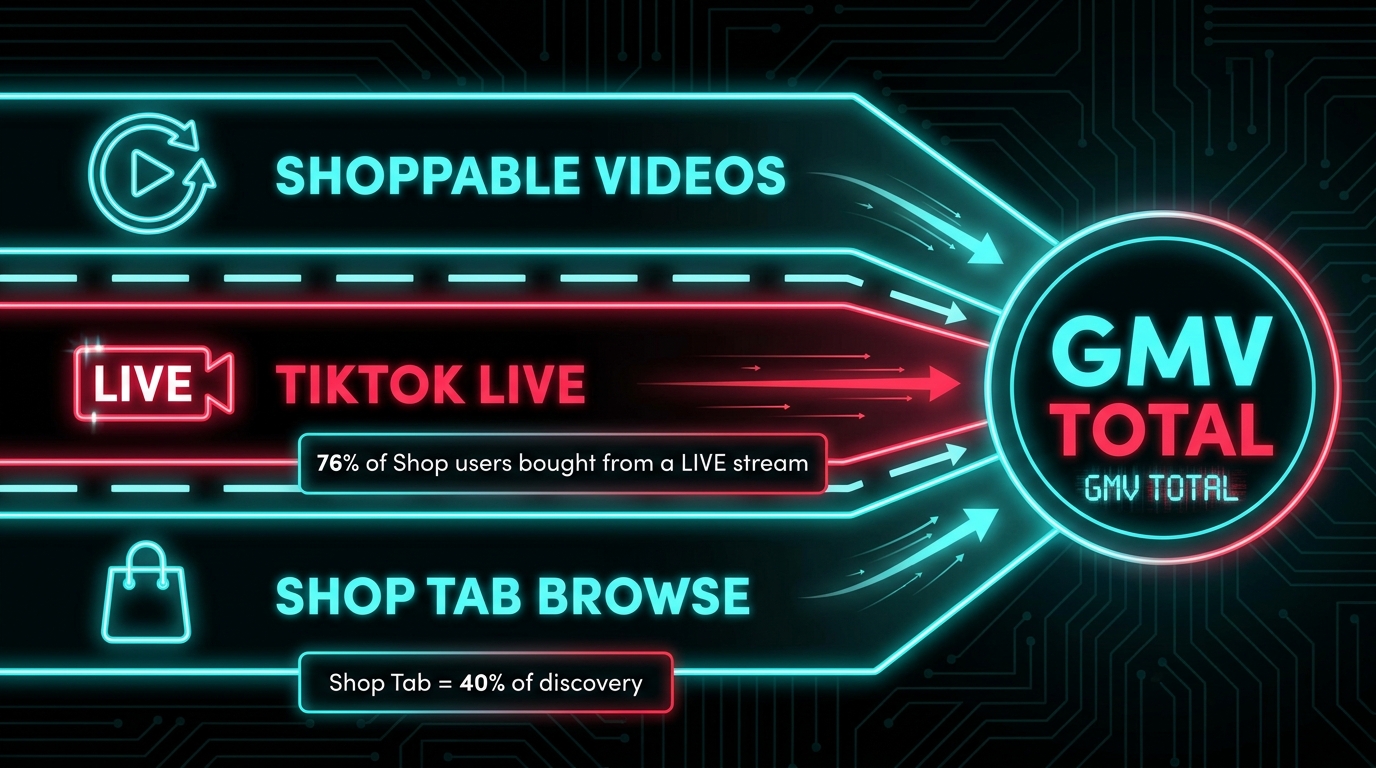
The single biggest structural mistake most plateau-stage TikTok Shop sellers make is treating TikTok Shop as if it were one channel. It isn’t. TikTok Shop is three distinct commerce surfaces that serve completely different buyer behaviors — and unless all three are working simultaneously, you’re leaving the majority of your revenue on the table.
Surface One: Shoppable Videos
Shoppable videos are the front door most sellers know. A video appears in a user’s For You feed, the product link sits at the bottom of the screen, and a viewer can purchase without leaving the app. This is TikTok Shop’s most visible feature and the one sellers invest the most energy in — but it also has a structural limitation that few acknowledge: organic video shelf life is roughly 48–72 hours.
Unless a video goes genuinely viral (which you can engineer for, but never reliably predict), each video represents a finite traffic spike. That’s why sellers who rely purely on shoppable videos experience the roller-coaster revenue pattern that’s so common at the $5K–$10K/month stage: a good video drops, sales spike, then fall back to near-zero as the video ages out of the algorithm’s distribution window.
The fix isn’t posting more videos. It’s supplementing videos with the other two surfaces.
Surface Two: TikTok LIVE
TikTok LIVE commerce is the surface that most Western sellers underinvest in, despite the data being unambiguous. A 2025 GlobalData survey found that 76% of consumers who used TikTok Shop bought a product from a livestream in the prior year. In Southeast Asian markets where TikTok Shop has been operating longer, LIVE commerce drives the majority of total platform GMV.
LIVE sessions are fundamentally different from videos. They create urgency (the session is happening now), they create community (regular viewers build loyalty), and they create a feedback loop where the host can respond to comments, handle objections in real time, and drive conversion through authentic demonstration. Unlike a video that ages out, a regular LIVE schedule builds a recurring audience that returns weekly — and that audience compounds over time.
The barrier sellers cite is the time commitment. A four-hour live session is a real investment. But it’s also a four-hour window where your product is in front of an actively engaged, purchase-ready audience. The math, when done correctly, is almost always favorable.
Surface Three: The Shop Tab
The Shop tab — TikTok’s dedicated in-app marketplace — is the surface most sellers pay the least attention to and that offers the most underrated passive discovery opportunity. When users open the Shop tab, TikTok serves them personalised product recommendations based on their viewing history, purchase history, and behavioral signals. This is pure demand-capture for buyers already in purchase mode.
Getting strong Shop tab placement comes down to your listing quality, your seller health score, your review volume, and your sales velocity — all things we’ll dig into later in this post. But the key insight is this: sellers who optimize for Shop tab discovery are capturing buyers at the bottom of the funnel, when intent is highest, without spending a dollar on ads.
The three-surface rule: If you’re only active on one TikTok Shop surface, you are, by definition, a one-leg stool. The sellers who break past $50K/month almost universally run all three simultaneously — even if the execution isn’t perfect on each one.
Product-Market-Platform Fit: The TikTok Shop Selection Framework
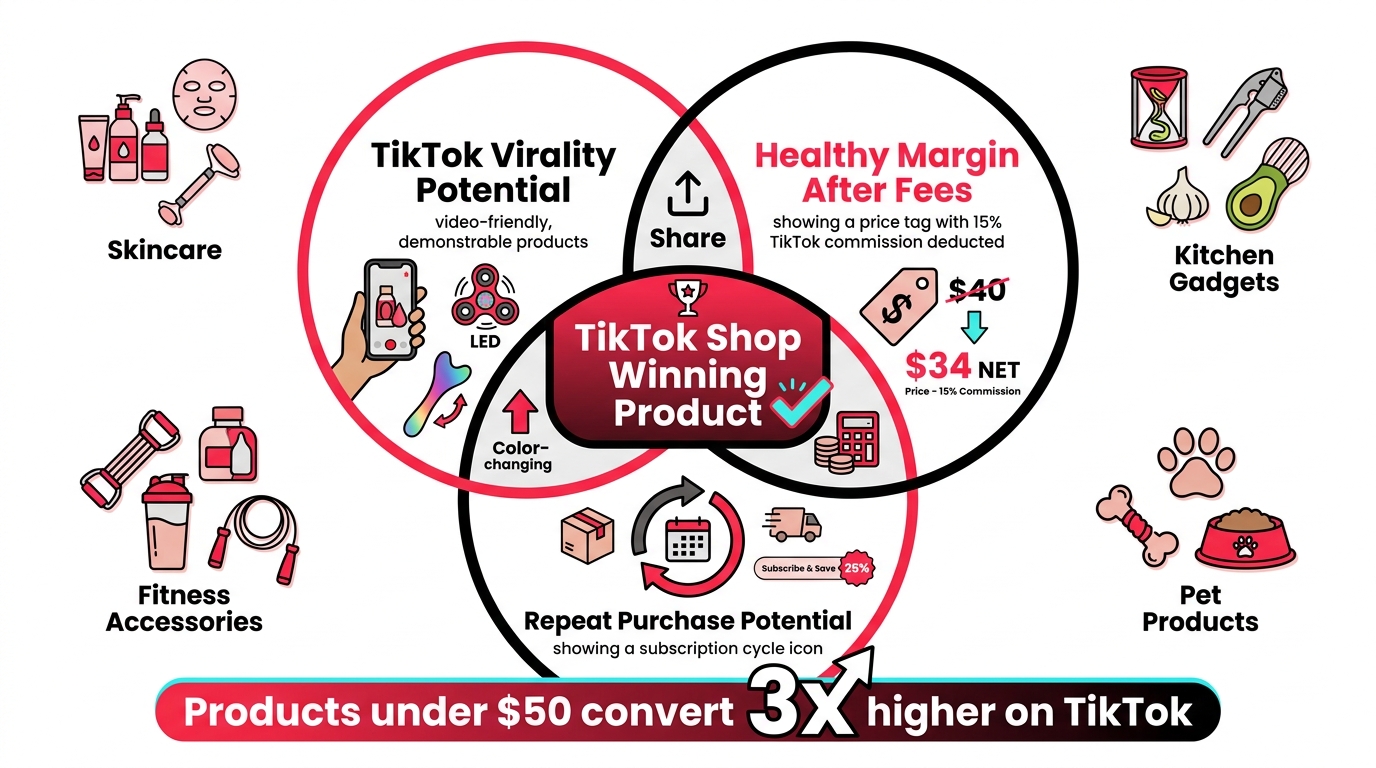
Product selection for TikTok Shop is not the same as product selection for Amazon or Shopify. The platform’s mechanics reward a specific kind of product profile, and sellers who carry over their Amazon product research frameworks without adjustment tend to either pick products that can’t go viral or products that can go viral but destroy their margins when TikTok’s fee structure is applied.
The Three-Leg Test
Before committing to any product for TikTok Shop, evaluate it against three criteria simultaneously:
1. Demonstrability: Can a 30-second video make this product’s value instantly obvious? Products that require complex explanation, dense reading, or technical context are fighting the format. The platform’s algorithm rewards completion rate and shares — and the content that earns both typically features a clear before/after, a satisfying result, or a genuinely surprising use case. Skincare transformations, cleaning products in action, food demos, gadgets with a clear “wow” moment — these are naturally TikTok-native. Industrial equipment, B2B software accessories, or fine art prints are not.
2. Margin architecture after platform fees: TikTok Shop charges sellers a referral fee that varies by category and has been evolving through 2025 and 2026. When you add platform fees, affiliate commission (if you’re running an affiliate program, which you should be), shipping costs, and potential return processing costs, many products that look attractive at first glance become marginally profitable or unprofitable at scale. A product priced at $25 with a landed cost of $8 looks like a 68% gross margin — until you subtract a 6–8% referral fee, a 10–15% affiliate commission, $3–5 in shipping, and 3–5% in returns. You can arrive at a net margin of 30% or 10% depending on how your cost stack shakes out. Model it before you list it.
3. Repeat purchase potential: The hardest thing to build on TikTok Shop is a loyal customer base, because the platform’s discovery-first algorithm naturally pushes new users toward your content but provides few mechanisms to re-engage past buyers (unlike email in DTC or the buy box in Amazon). Products with inherent repurchase cycles — consumables, subscriptions, or products with companion SKUs — give sellers a structural advantage because each customer acquired has lifetime value beyond the first order, even if TikTok’s data infrastructure doesn’t make that easy to track.
Price Point Reality
TikTok Shop’s audience skews younger and more price-conscious than Amazon’s, particularly in the US. This doesn’t mean you can only sell cheap products — premium items do sell, especially in beauty, health, and wellness — but it does mean that the platform’s native conversion behavior strongly favors products in the $15–$60 price range. Below $15, margins become difficult to defend. Above $60, the impulse-buy psychology that drives TikTok conversions starts to weaken, and buyers need more social proof and more research time than the format naturally provides.
There are exceptions, particularly in LIVE commerce where hosts can build enough trust through demonstration and live Q&A to close higher-ticket items. But for shoppable videos and Shop tab placement, the $15–$60 sweet spot is where most of TikTok Shop’s conversion energy lives.
Your Listing Is a Sales Page — Start Treating It Like One
Here’s a truth that most TikTok Shop sellers resist: the quality of your product listing matters enormously, even on a platform where content is supposedly king. Every buyer who clicks through from a video — whether yours or an affiliate creator’s — lands on your product listing page before they complete a purchase. That listing page either closes the sale or loses it.
The Anatomy of a High-Converting TikTok Shop Listing
Title: Your product title serves two masters simultaneously — the TikTok Shop search algorithm and the human buyer who’s reading it on a 6-inch screen. The practical guidance is to lead with the most descriptive, benefit-forward language in the first 30 characters, since that’s what shows in most mobile views before the title truncates. “Vitamin C Serum — Brightening, Anti-Aging, 30ml” outperforms “Premium Skin Care Product for Face by Brand Name.”
Images: TikTok Shop product images are more important than most sellers realize, because the Shop tab serves image-first browsing. You need a clean hero image on a white or neutral background for algorithmic compatibility, followed by lifestyle images showing the product in use, a callout image highlighting key ingredients or features, and a social proof image showing reviews or user-generated content. Five to eight images is the functional minimum. Sellers who list with one or two product photos are making a checkout-killing error.
Description and bullet points: Keep descriptions scannable. TikTok Shop buyers are still in a mobile-first, fast-scroll mindset even when they’re on a product page. Short paragraphs, bold benefit headers, and a clear FAQ section addressing the most common objections (size, shipping time, ingredients, return policy) are what convert. Walls of text do not.
Pricing and promotional signals: TikTok Shop’s interface prominently displays promotional badges — “Limited Time Deal,” percentage-off stickers, countdown timers — and these visual cues meaningfully lift conversion rates. Running periodic promotions isn’t just a sales tactic; it’s part of optimizing how your listing looks within the platform’s interface. A listing with a visible discount badge catches the eye in Shop tab browsing in a way that a full-price listing cannot match.
The Video Listings Feature Most Sellers Miss
TikTok Shop allows sellers to attach videos directly to product listings — videos that play when buyers visit the product page. These listing videos have a far higher conversion impact than static images, because they provide the same demonstration effect that drives purchases in the For You feed, but at the exact moment a buyer is considering purchasing. A 30–60 second demonstration video attached to your listing is one of the highest-leverage, lowest-effort improvements most sellers can make. Surprisingly few do it.
The Affiliate Machine: Building a Creator Network That Sells While You Sleep
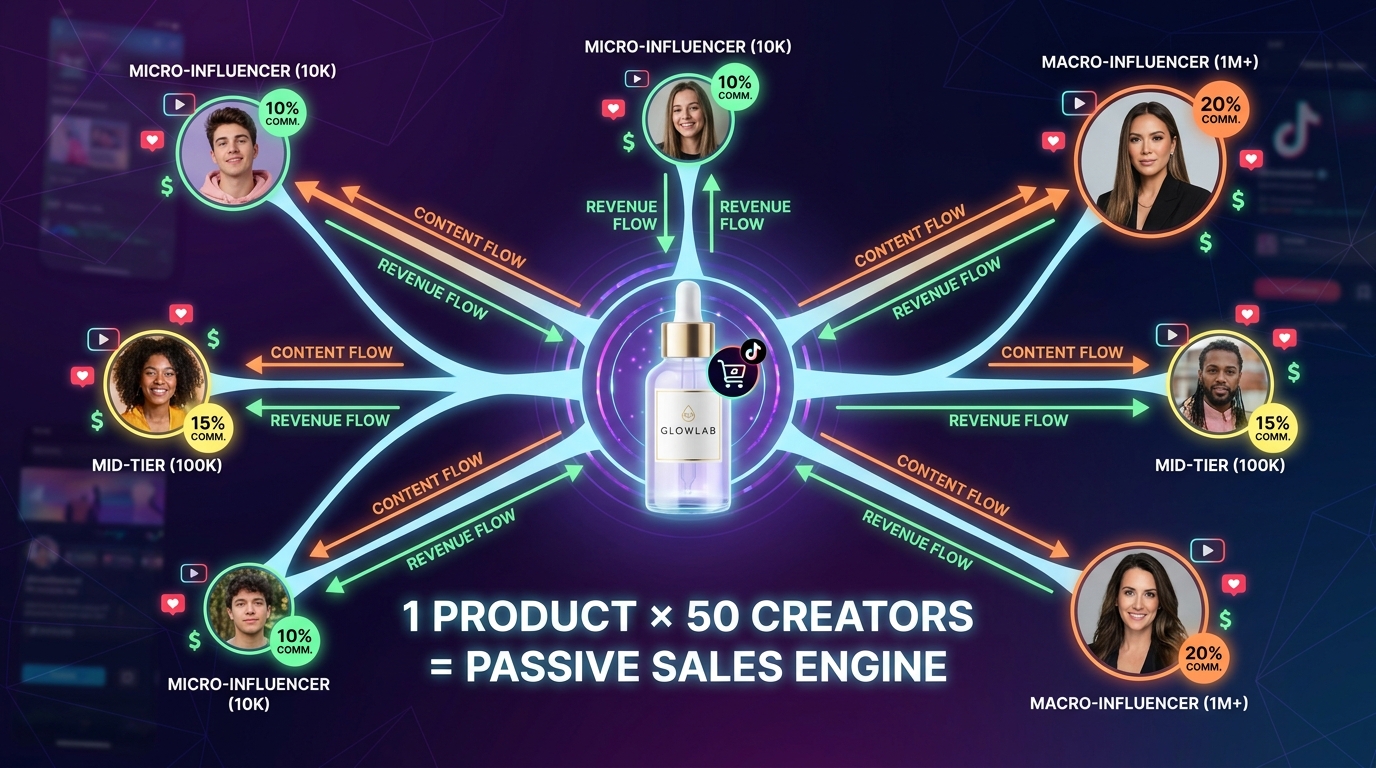
If there is a single structural feature of TikTok Shop that separates the top-tier sellers from everyone else, it is the Affiliate Marketplace — and specifically, the ability to build a self-sustaining network of creators who promote your products on a pure performance basis.
TikTok Shop’s affiliate system allows any creator to browse available products, pick one up as an affiliate, create content featuring it, and earn a commission on every sale they drive — without any upfront cost to the seller. For the seller, this means you can generate sales through creator content at zero fixed cost, paying only when a sale actually occurs. On a platform where content volume and diversity drive algorithmic distribution, this is an extraordinarily powerful lever.
Why Most Sellers Set It Up Wrong
The most common mistake is passive participation. A seller sets their affiliate commission rate, lists their products in the marketplace, and then waits for creators to find them. Some do. Most don’t. The TikTok Affiliate Marketplace has an enormous supply of products competing for creator attention, and sitting passively means your products are being overlooked in favor of brands actively recruiting and incentivizing creators.
Active affiliate management looks fundamentally different. It involves:
- Targeted outreach: Using TikTok Shop’s creator search tools to identify creators already making content in your product category, then proactively inviting them to your affiliate program with a personalized message explaining the product and commission rate.
- Tiered commission structures: Offering a base commission to the open marketplace (say, 10–12%) and higher commissions (15–20% or more) to select creators you’re actively partnering with. This creates differentiation and gives your top-performing creators a financial reason to prioritize your product over competitors.
- Product sampling: Sending free product to promising creators before they commit to promoting it. A creator who has held the product, tested it, and genuinely likes it creates far more authentic and persuasive content than one working purely from listing photos. Authentic content converts better and avoids the awkward, scripted quality that TikTok audiences can detect instantly.
- Creator briefing without over-briefing: Providing clear information about your product’s key benefits and your target customer, without scripting the content so heavily that the creator’s natural voice disappears. Creator authenticity is the mechanism through which TikTok content earns trust. Over-produced, over-scripted affiliate content underperforms organic creator content almost every time.
The Volume Math Behind Affiliate Success
Building a real affiliate network is a numbers game, and sellers who understand the math approach it very differently from those who don’t. Of 100 creators you invite to your program, perhaps 20–30 will accept. Of those, perhaps 10–15 will actually create content. Of those, 3–5 will create content that generates meaningful sales. And 1–2 will become high-performing partners who drive disproportionate volume.
This means that the right mental model for affiliate recruitment isn’t “I need to find the perfect creator.” It’s “I need to run enough volume through the top of this funnel that the math produces the handful of genuinely high-performing partners I need.” Top sellers on TikTok Shop often have hundreds of active affiliates — not because all of them drive significant volume, but because the long tail of small-volume creators collectively adds up, and because the process of running volume produces the rare high-performers you can’t identify in advance.
TikTok Shop Ads vs. Organic: Where the Real ROI Lives in 2026
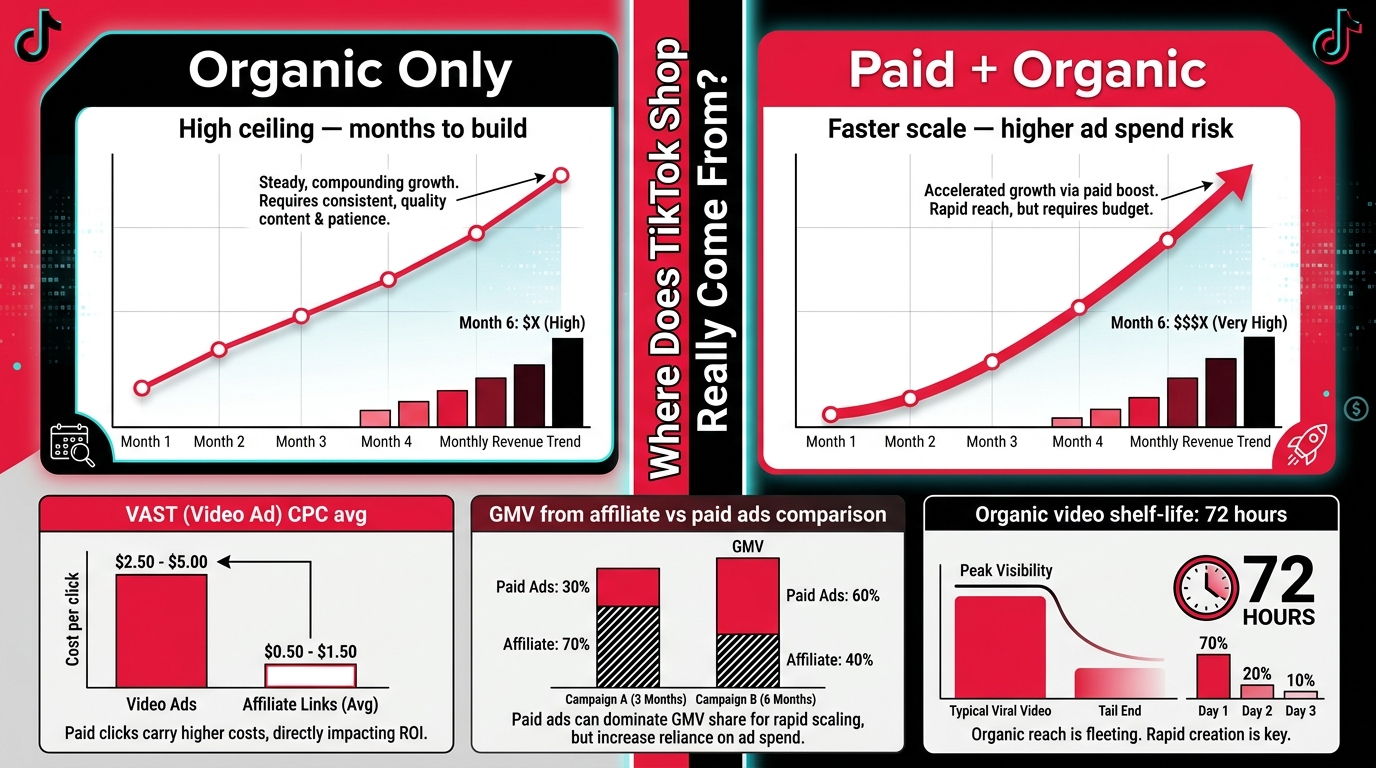
TikTok Shop’s advertising products have matured significantly since the platform’s early days, and the question of how to balance paid and organic is one that every seller approaching meaningful scale needs to resolve thoughtfully. The honest answer is that the right allocation varies by product, margin, and where you are in the business lifecycle — but there are some structural realities about TikTok Shop’s ad ecosystem that most sellers either don’t know or misapply.
The Two Primary Ad Products for Sellers
Video Shopping Ads (VSA): These are shoppable video ads that run in the For You feed alongside organic content. They look almost identical to organic posts, and TikTok’s algorithm distributes them to users most likely to convert based on behavioral data. VSAs are the primary paid acquisition tool for most TikTok Shop sellers, and they work on a cost-per-click or cost-per-action basis. The effective use of VSAs requires good creative — an ad that looks and feels like organic content rather than a traditional advertisement. TikTok audiences are highly sophisticated at identifying and scrolling past content that feels promotional in tone.
LIVE Shopping Ads: Less commonly used but often more powerful during active LIVE sessions. These ads drive traffic to an ongoing LIVE stream, and because the ad is bringing viewers into an active, real-time selling environment, conversion rates can be significantly higher than VSAs. The constraint is obvious — you need to be running a LIVE session for these ads to work, which requires the operational commitment to regular live selling.
The Organic-First Principle
Here’s what the best TikTok Shop operators know that average sellers don’t: TikTok’s paid advertising works significantly better when it amplifies content that has already demonstrated organic traction. Boosting a video that has already earned organic engagement — comments, shares, replays — tends to produce better paid performance than cold-starting an ad with no organic proof of concept.
This is the inverse of how most sellers approach it. They create content specifically for ads, spend budget testing it, and wonder why performance is mediocre. The more effective workflow is to post content organically first, identify the videos that show early signs of engagement (even modest ones — a 5% completion rate uplift, comment volume above average, save rate above baseline), and then put ad spend behind those proven performers.
This approach has a secondary benefit: it dramatically reduces creative testing costs, because you’re letting the organic distribution function as a cheap, real-world creative test before committing ad budget.
Where Affiliates Beat Paid Every Time
For most sellers at the $10K–$50K/month range, a well-managed affiliate network will deliver better ROI than equivalent spend on paid ads. The economics are straightforward: you pay affiliate commission only on completed sales (pure performance-based spend), while paid ads charge for clicks or impressions regardless of whether a conversion occurs. In a category with a 2–4% video-to-purchase conversion rate, a significant portion of your ad spend is generating views and clicks that don’t convert.
Affiliate content also has a durability advantage — a video a creator posted six months ago can still be generating affiliate sales today if it continues to circulate, whereas a paid ad stops delivering the moment you stop funding it. The compounding nature of a large affiliate content library is one of the most underappreciated assets in TikTok Shop selling.
Fulfillment and Operations: The Backend That Quietly Kills Most Shops
Few topics in TikTok Shop are less glamorous than fulfillment and operations, and that’s exactly why it’s where so many sellers quietly destroy themselves. You can have exceptional content, a viral product, and a perfectly optimized listing — and still tank your shop’s health score, generate a flood of negative reviews, and trigger platform suppression, all because your shipping and fulfillment setup isn’t designed for TikTok Shop’s specific requirements.
TikTok Shop’s Fulfillment Expectations Are Non-Negotiable
TikTok Shop operates on a customer experience model that penalizes sellers hard for late shipment, incorrect orders, and slow customer service response. The platform’s seller standards require that orders are shipped within the handling time specified in your listing (typically 1–3 business days), and that tracking information is uploaded promptly upon shipment. Missing these windows consistently triggers seller health flags that reduce your listings’ visibility in the Shop tab and affiliate marketplace — a penalty that is invisible to most sellers but very real in its impact on sales.
The critical error many small sellers make is treating TikTok Shop orders like their Etsy or Shopify orders — shipping when they get around to it, using personal Post Office runs as their fulfillment infrastructure. TikTok Shop’s volume spikes can be sudden and dramatic. A single viral video can generate hundreds of orders in 24 hours. A seller who processes 5–10 orders per day manually is completely unprepared for that scenario.
Fulfillment Infrastructure Options
Sellers approaching or past $10K/month should have already evaluated their fulfillment setup against TikTok Shop’s volume requirements. The main options:
Self-fulfillment with 3PL backup: Viable at lower volumes, but sellers need a pre-identified third-party logistics (3PL) partner ready to scale into during volume spikes. Having a 3PL relationship in place — even if you’re not using it daily — means you have a safety valve when a video goes viral and your order queue suddenly looks terrifying.
TikTok Shop Fulfilled by TikTok (FBT): TikTok’s own fulfillment service, analogous to Amazon FBA. Sellers send inventory to TikTok’s fulfillment centers, and TikTok handles pick, pack, ship, and customer service for those orders. FBT-fulfilled listings get a visible badge on the platform that signals fast, reliable shipping to buyers — a social proof signal that meaningfully lifts conversion rates. If you’re selling in sufficient volume to make the economics work, FBT removes a significant operational burden and improves your listing’s competitive position.
Shopify integration with existing 3PL: For sellers who already have a Shopify store and an established 3PL relationship, connecting TikTok Shop to Shopify and routing TikTok orders through your existing fulfillment infrastructure is often the most operationally seamless path. The Shopify TikTok app makes this integration relatively straightforward, and it means you’re not managing two separate inventory and fulfillment systems.
The Return Handling Problem
Returns on TikTok Shop are a more complex topic than most sellers anticipate. The platform’s customer-first policies mean buyers have relatively favorable return terms, and sellers who don’t have a clear, fast, responsive return handling process will see those returns escalate into disputes, negative reviews, and order defect rate increases — all of which feed directly into seller health scores. Having a clear internal protocol for returns (who processes them, how fast, what the disposition is for returned inventory) is operational infrastructure that needs to exist before you’re at volume, not after.
Reviews, Returns, and Seller Health Scores — What TikTok Actually Measures
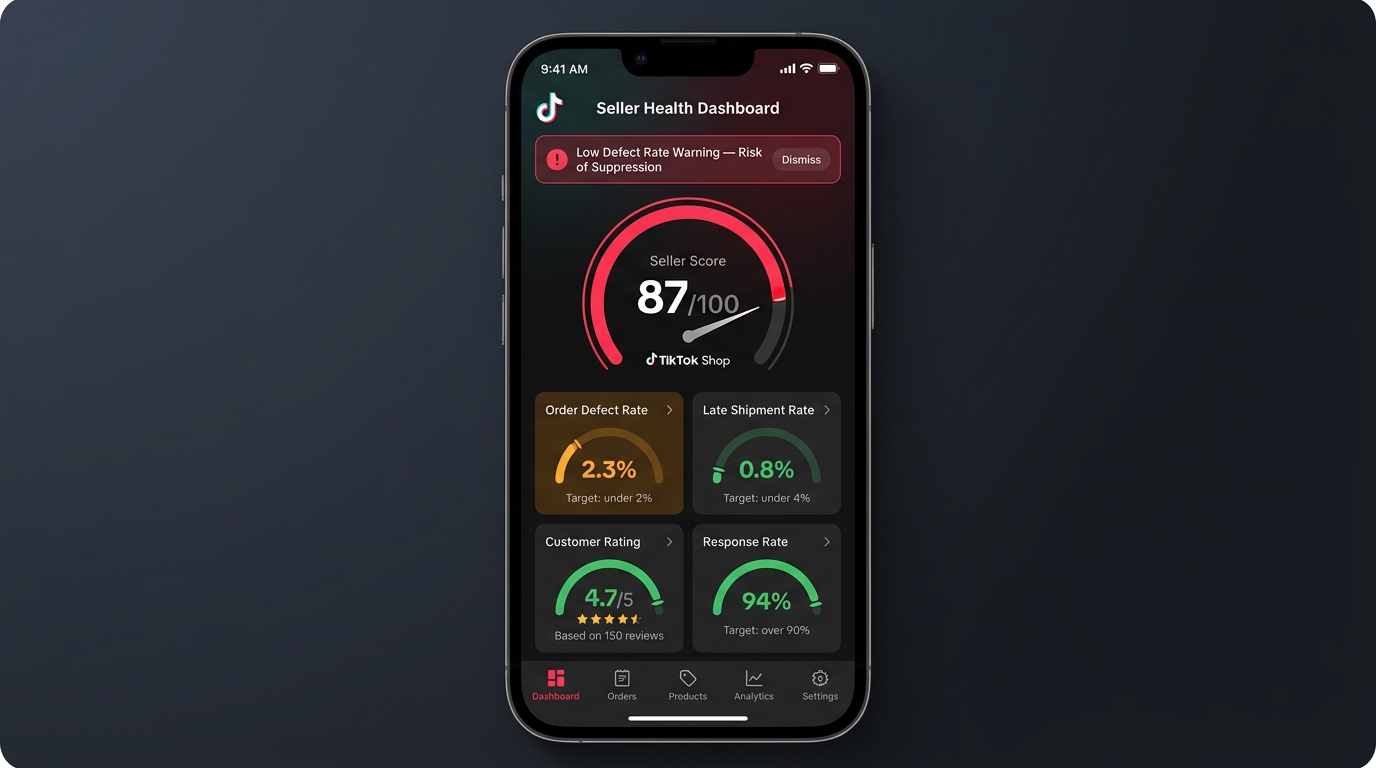
TikTok Shop’s seller health system is the invisible infrastructure that governs how much (or how little) of the platform’s organic distribution your listings and shop receive. Most sellers know it exists in the abstract. Very few understand what it actually measures, how the metrics interact, and what the practical consequences of different score levels are.
The Core Metrics TikTok Tracks
TikTok Shop’s Seller Center surfaces several key performance metrics that collectively constitute your seller health standing:
Order Defect Rate (ODR): This is the most consequential single metric. ODR captures the percentage of orders that result in a defect — defined as a cancellation by the seller, a late shipment, a missing item, a damaged item, or a buyer complaint. TikTok’s threshold for ODR varies but is generally in the 2% range. Consistently above that threshold triggers escalating penalties: reduced Shop tab placement, reduced visibility in the affiliate marketplace, and ultimately potential account restrictions.
Late Shipment Rate: The percentage of orders not shipped within the committed handling time. This is a direct penalty metric — it feeds into ODR, and TikTok also tracks it independently. Sellers running high late shipment rates during periods of traffic spike (exactly when they most need the algorithm’s goodwill) are at serious risk of suppression at the worst possible time.
Customer Satisfaction Rating: Your aggregate star rating across fulfilled orders. This is more nuanced than Amazon’s rating system, because TikTok Shop ratings are heavily influenced by the in-app experience — not just the product itself. A buyer who received their product fine but found the packaging disappointing or the seller’s customer service slow may still leave a 3-star review. Actively managing the post-purchase experience (order confirmation messages, shipping updates, proactive resolution of issues before they escalate to reviews) is how sophisticated sellers maintain high ratings at scale.
Response Rate and Response Time: TikTok Shop tracks how quickly and consistently you respond to buyer messages. Slow or absent responses increase the probability of escalated complaints and negative reviews. Many sellers underestimate this metric until they’re scaling and the message volume becomes significant. Having a customer service workflow — whether that’s a dedicated team member, a virtual assistant, or a templated response system — is not optional at meaningful scale.
How Seller Health Connects to Algorithmic Visibility
The crucial insight most sellers miss: TikTok Shop’s algorithm uses seller health signals as an input into how your products are ranked and distributed. This means that a seller with a genuinely viral product but a degraded seller health score will be systematically underserved by the platform’s discovery systems. Your video might be great, your product might be compelling — but if TikTok’s system has flagged your shop as a poor buyer experience, it will be more conservative about surfacing your products to potential buyers.
This creates a compounding dynamic that cuts both ways. Sellers who maintain excellent health scores get amplified distribution — their listings appear more prominently in the Shop tab, their products are surfaced more readily to affiliate creators, and their paid ads may perform better due to algorithmic quality signals. Sellers who let their health scores degrade get quietly deprioritized, often without any explicit notification that it’s happening.
Review Generation — The Right Way
Generating reviews on TikTok Shop is constrained by the platform’s policies, which prohibit incentivizing reviews with free products, discounts, or cash. What is permitted is post-purchase follow-up — using TikTok Shop’s messaging system to remind buyers to leave a review, providing exceptional product packaging and unboxing experiences that naturally motivate buyers to share their experience, and creating the kind of remarkable product experience that prompts organic review behavior. Sellers who do this systematically build review volume significantly faster than those who leave review generation entirely to chance.
Multi-SKU Strategy: How Top Sellers Use a Portfolio Approach
The mental model most new TikTok Shop sellers start with is: find one great product, make it work, then find the next one. This isn’t wrong as a starting framework — focus is valuable in the early stages. But it becomes a ceiling once you’ve found initial product-market fit, because a single-SKU shop has structural vulnerabilities that a portfolio approach solves.
Why Single-SKU Dependence Is Risky
A single-product TikTok Shop faces several compounding risks. First, trend dependency: TikTok’s content-driven commerce is inherently trend-accelerated, meaning that a product category can go from hot to saturated in 60–90 days as more sellers pile in, content fatigue sets in, and the algorithm starts throttling distribution for oversaturated product types. A seller with one SKU is one trend cycle away from a dramatic revenue drop.
Second, algorithmic dependency: if your one product loses organic visibility — whether due to algorithm shifts, seller health issues, or competitor content outcompeting yours — you have no fallback. A seller with 8–12 active SKUs can absorb the underperformance of 2–3 products without catastrophic revenue impact.
Third, affiliate network limitations: affiliate creators who promote your product today may move on to more exciting new products tomorrow. A portfolio of complementary products gives you more options to maintain creator relationships even as their interest in individual SKUs evolves.
How a Portfolio Strategy Works in Practice
The most common portfolio structure among high-volume TikTok Shop sellers is a hero-plus-support architecture:
- 1–2 Hero SKUs: Products that drive the majority of your volume and affiliate attention. These are your most demonstrable, most viral-potential products — the ones you invest the most content and affiliate recruitment energy into.
- 4–6 Support SKUs: Complementary products that capture buyers who’ve discovered you through a hero product and want to explore. These might be lower-margin products, bundle components, or adjacent category items that serve the same buyer profile.
- 2–4 Test SKUs: New products in active validation. You’re generating initial content, recruiting a small number of affiliates, and watching conversion data to identify whether any test SKU has the potential to become the next hero product.
This portfolio structure serves several functions simultaneously. It increases your average order value potential (buyers who purchase a hero product and see related products in your shop). It diversifies your algorithmic risk. And it gives affiliate creators more choices when selecting which of your products to promote — different creators may find different SKUs resonate with their audience, and that diversity of fit is valuable.
Bundling as a Margin Defense
One specific multi-SKU tactic that high-volume TikTok Shop sellers use aggressively is bundling. A bundle — combining two or three complementary products into a single listing at a slightly lower combined price than individual purchase — serves multiple strategic purposes. It increases average order value. It improves margin efficiency because shipping cost is spread across multiple items. It creates a listing that is harder for competitors to directly price-match. And it often converts better than individual items because buyers perceive higher value.
Cross-Platform Architecture: TikTok + Shopify + Amazon Working Together
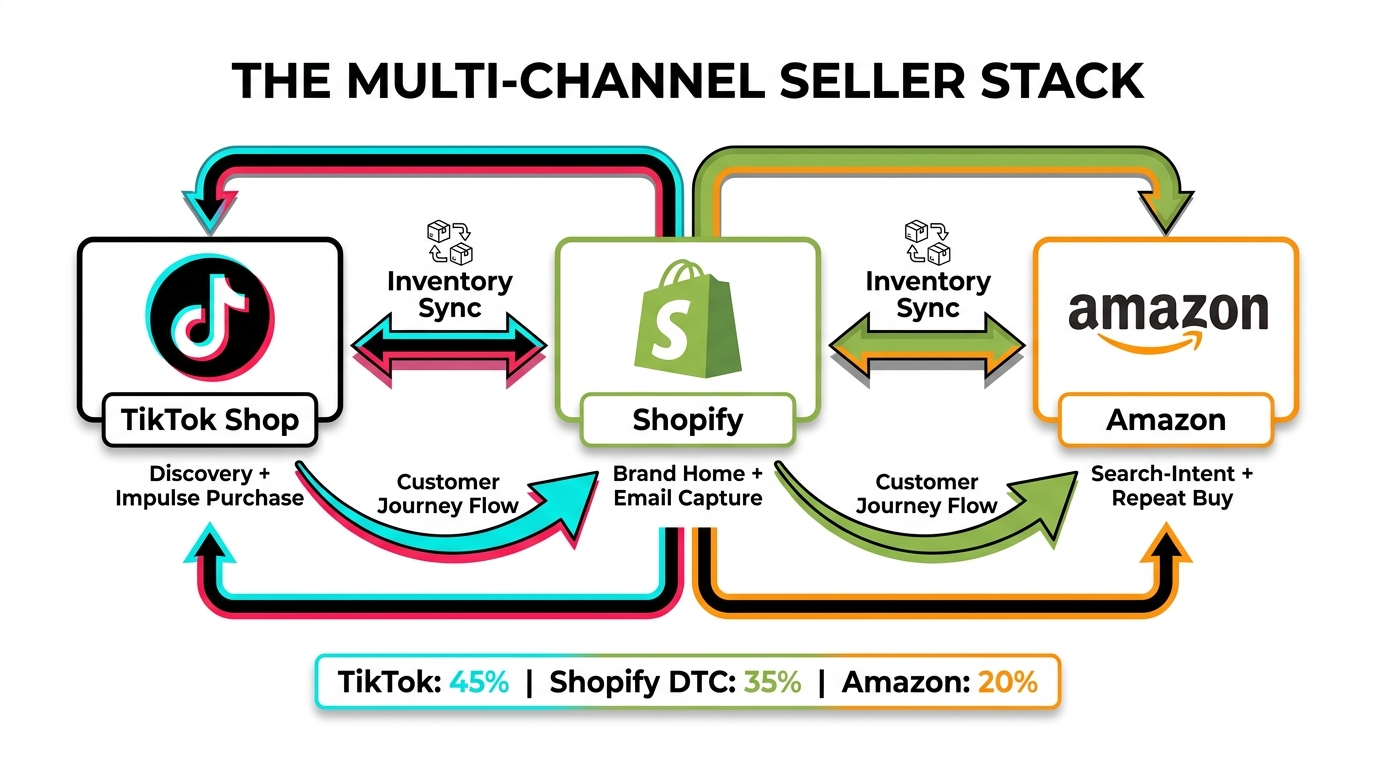
Here’s a strategic reality that confuses many new TikTok Shop sellers: TikTok Shop is a discovery and impulse-purchase engine, not a loyalty and repeat-purchase engine. The platform is phenomenal at introducing buyers to products they didn’t know they needed. It is structurally poor at building the kind of brand relationship that brings customers back again and again on their own initiative.
This is not a criticism of TikTok Shop — it’s simply an accurate description of what the platform is designed to do. And understanding it explains why the highest-revenue operators in this space don’t treat TikTok Shop as their only channel. They treat it as the top of a multi-platform funnel.
The Role Each Platform Plays
TikTok Shop: Discovery and First Purchase. A buyer discovers your product through a creator’s video or a Shop tab recommendation. They make an impulse purchase. This is where TikTok Shop is unmatched — its ability to create demand where none existed before is extraordinary. But TikTok gives you limited tools to re-engage that buyer after the sale.
Shopify/DTC: Brand Building and Customer Retention. The most sophisticated TikTok Shop sellers use their TikTok presence to drive initial purchases and then work to migrate buyers into their direct channel — whether by including an insert card in packaging directing buyers to their website, or by building brand recognition strong enough that buyers who want to repurchase seek them out directly. The DTC channel gives sellers something TikTok cannot: an email address. And with an email address, you can market directly to a buyer for years without paying the platform for distribution.
Amazon: Search-Intent Capture. A buyer who discovers a brand on TikTok Shop and has a positive experience frequently searches for that brand or product on Amazon for subsequent purchases — particularly if they’re already Prime members for whom Amazon shopping is habitual. Sellers who are present on Amazon can capture this demand that TikTok itself generated. This isn’t cannibalization; it’s completing the customer journey the buyer naturally wants to take.
Inventory Synchronization Is Non-Negotiable
The operational prerequisite for a multi-platform strategy is real-time inventory synchronization. Selling on TikTok Shop, Amazon, and your Shopify store simultaneously without a centralized inventory management system is a stockout and oversell waiting to happen. A single viral TikTok video can clear your inventory in hours — if that same inventory is simultaneously listed on Amazon and Shopify without automated stock level updates, you’ll be generating oversells that damage your seller health across multiple platforms simultaneously.
Inventory management tools like Linnworks, Skubana, or Shopify’s native multi-channel inventory management can sync stock levels across channels in near real-time. This isn’t optional infrastructure for multi-platform sellers — it’s a foundational requirement.
The Packaging Insert Strategy
One of the most underrated tactics in cross-platform commerce is the packaging insert. Every TikTok Shop order you fulfill is an opportunity to deepen the buyer relationship beyond the TikTok ecosystem. A well-designed insert card that directs buyers to your website for exclusive deals, invites them to join your email list in exchange for a discount on their next order, or encourages them to follow your TikTok account for new product drops is converting a one-time TikTok buyer into a brand customer. Done consistently at scale, this insert strategy can generate a meaningful DTC customer list from TikTok’s discovery engine — a list that belongs to you, not to the platform.
What the $100K+/Month Sellers Do Differently
The sellers who have broken through the plateau and are operating at $100,000/month or more on TikTok Shop are not doing so with fundamentally different products, more talent, or better luck. They have built systems where the individual components — product selection, listing optimization, affiliate networks, fulfillment, seller health management, and cross-platform strategy — operate in a coordinated way rather than as disconnected tactics.
They Treat the Business as a Business
At the $5K–$10K/month level, TikTok Shop selling is often a side project or a scrappy one-person operation. Decisions are made reactively, systems are informal, and measurement is inconsistent. At $100K/month, the operation looks fundamentally different: there are clear KPIs tracked weekly (video performance, affiliate GMV contribution, seller health metrics, conversion rate by surface), defined roles for content creation, affiliate management, customer service, and fulfillment, and regular reviews of what’s working and what isn’t.
This sounds obvious stated plainly. But the gap between knowing a business needs systems and actually building them is where most sellers get stuck. The plateau at $10K/month is frequently a systems ceiling — the business has grown to the point where informal management can no longer handle the volume and complexity, but the seller hasn’t yet made the organizational changes needed to operate at the next level.
They Invest in Content Velocity, Not Just Content Quality
A common misunderstanding is that the path to more sales on TikTok Shop is better content — higher production values, more creative concepts, more polished execution. Quality matters, but the data from high-volume sellers consistently shows that content volume matters more than content perfection. A seller posting 3–5 videos per week has multiple at-bats per week to find a video that gains algorithmic traction. A seller posting once per week is limiting themselves to one shot.
This is why top sellers build content production systems rather than relying on individual creative inspiration. They use content calendars, product demonstration frameworks that can be adapted across dozens of videos, UGC repurposing workflows, and affiliate content libraries to maintain high posting velocity without the creative bottlenecks that cap most sellers.
They Understand Their Unit Economics Precisely
High-volume TikTok Shop sellers know, to the cent, what it costs to acquire a customer on each surface (organic video, LIVE, Shop tab, paid VSA, affiliate) and what the contribution margin of each sale is after all platform fees, fulfillment costs, and affiliate commissions are accounted for. They make decisions about content investment, affiliate commission rates, and ad spend based on real margin data, not gut feel.
Most plateau-stage sellers don’t have this visibility. They know their top-line revenue and their rough cost of goods, but the detail layer below that — broken out by channel, by SKU, by acquisition source — is opaque. Without that data, you can’t make the capital allocation decisions that separate sustainable scaling from revenue that looks impressive on the surface but doesn’t generate proportional profit.
They Build Creator Relationships, Not Just Creator Transactions
The most successful affiliate programs on TikTok Shop are not purely transactional. The top-performing sellers invest in the creators who perform best for them — giving them early access to new products, providing higher commission tiers as a loyalty reward, featuring their content on the brand’s own channels, and treating them as genuine brand partners rather than interchangeable contractors.
This relational approach pays dividends because TikTok’s best creators — the ones with genuinely engaged audiences who trust their recommendations — have a lot of brands competing for their attention. The sellers who invest in the relationship are the ones who retain these creators’ consistent promotion over time, while purely transactional brands find that their best affiliates gradually shift attention to whoever is offering the next attractive commission rate.
Putting It All Together: The Compound Effect of Getting the Fundamentals Right
TikTok Shop’s $23.41 billion US market projection for 2026 is not built on viral accidents. It’s built on a large and growing number of sellers who have figured out that this platform rewards operational discipline as much as creative talent — and probably more.
The sellers who plateau at $10K/month typically have one or two things working: good content, or a decent product, or a few affiliates generating some volume. But the structural gaps — a listing that doesn’t convert, a fulfillment setup that isn’t ready for volume, a seller health score that’s slowly eroding, no cross-platform strategy — are silently constraining what those working elements can actually deliver.
Breaking through requires stepping back from the day-to-day content treadmill and assessing the business honestly at a structural level. Which of the three surfaces are you actually running on? Is your product selection genuinely optimized for TikTok’s specific mechanics, or are you using a framework built for a different platform? Is your listing working as hard as the content that drives traffic to it? Have you built an affiliate network, or just set up a passive affiliate listing and hoped? Is your fulfillment infrastructure capable of handling the volume spikes that TikTok’s viral nature will inevitably create?
The sellers who answer these questions honestly and systematically close the gaps tend to find that breakthrough is less about finding the perfect viral moment and more about removing the structural constraints that have been limiting them all along.
The key takeaway: TikTok Shop doesn’t reward creators. It rewards operators who happen to create. The content is the front door. The system behind it is what determines whether that front door leads anywhere.
Actionable Steps to Take This Week
- Audit your three surfaces. Are you actively operating on shoppable videos, TikTok LIVE, and the Shop tab? If one surface is missing, that’s the first structural gap to close.
- Run your margin math. For every SKU, calculate net margin after platform fees, affiliate commission, shipping, and returns. Any product under 25% net margin needs either a price adjustment or a cost reduction plan.
- Review your listing quality. Do you have 5+ images, a listing video, and a scannable description with an objection-handling FAQ? If not, your listing is losing sales that your content already earned.
- Set an affiliate recruitment target. Identify 20 creators in your product category and reach out this week with a personalized invitation. Start building the funnel before you need it.
- Check your seller health metrics. Log into Seller Center and pull your ODR, late shipment rate, and customer rating for the last 30 days. If any metric is at or above threshold, that’s a fire that needs fighting before anything else gets your attention.
- Define your cross-platform role for TikTok. If TikTok Shop is your primary channel, decide now how you plan to retain buyers after their first purchase. Packaging inserts, DTC website, email capture — pick your mechanism and implement it in the next 30 days.
The platform’s scale is real. The opportunity is genuinely there. What separates the sellers who capture it from the ones who stay stuck at the plateau is almost never luck. It’s structure.