
There is a moment that catches every new TikTok Shop seller off guard. They list a product, run the same playbook they used on Amazon or their Shopify store — clean photos, competitive pricing, keyword-rich description — and then wait. And wait. And get almost nothing back.
Then a micro-creator with 8,000 followers posts a 45-second video showing the product in their kitchen. Within 72 hours, that listing has 4,000 orders.
That is not a fluke. It is TikTok Shop functioning exactly as designed. The platform’s fundamental architecture, its algorithm, its audience psychology, and its sales mechanics are all built around a different premise than any marketplace that came before it. Not better or worse — genuinely different. And the brands and sellers who are winning there in 2026 are the ones who stopped trying to map their existing e-commerce logic onto it and started learning TikTok’s own rules from scratch.
This post is a practical, unvarnished look at how TikTok Shop actually works as a sales channel — from buyer psychology to fulfillment options, from product selection to live selling, from the affiliate network to the metrics that predict real revenue. If you are already selling on TikTok Shop, you will find the missing pieces. If you are evaluating it, you will finish this with a clear-eyed picture of what you are getting into.
The $23 Billion Platform Most Sellers Are Still Treating Like a Catalog
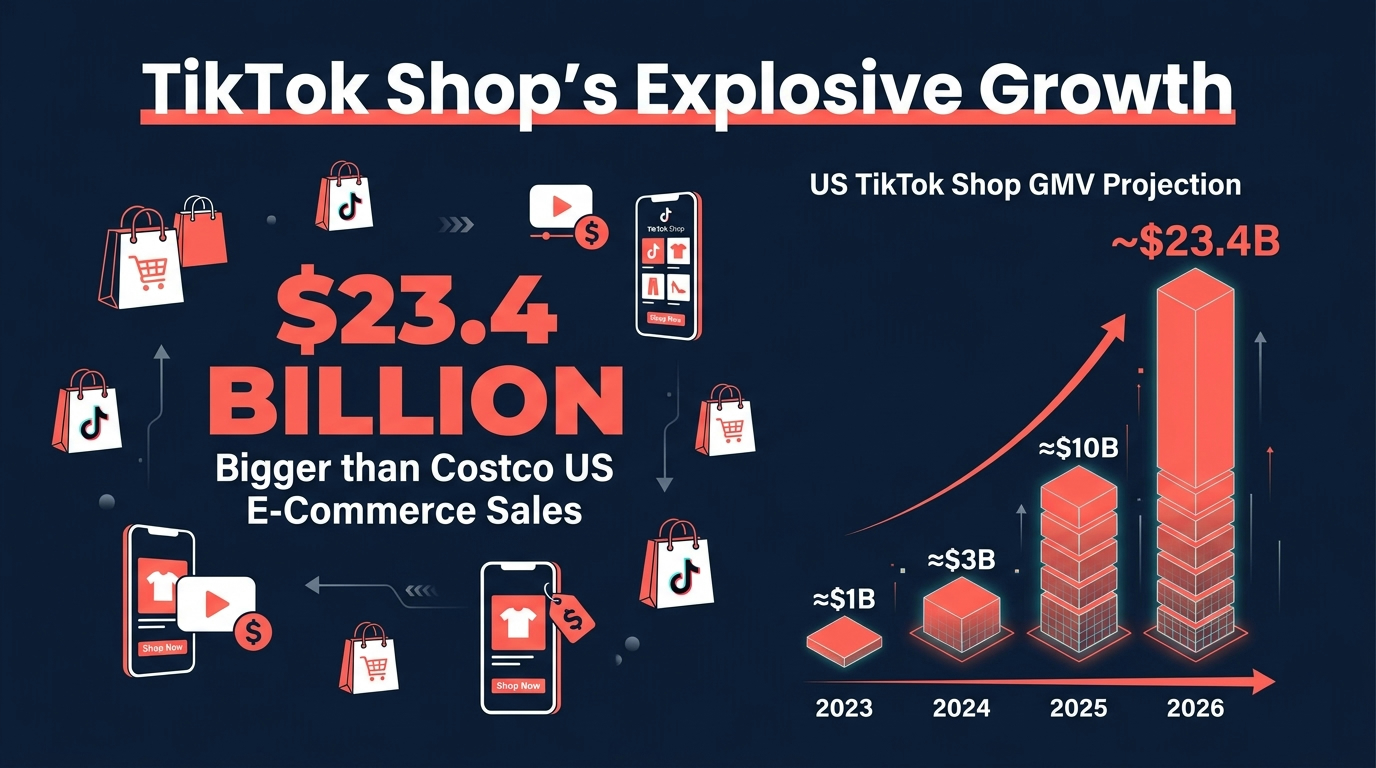
TikTok Shop launched in the United States in September 2023. By the end of 2026, it is projected to generate $23.41 billion in US e-commerce sales — a figure that would place it ahead of both Costco and Target in domestic online commerce. That is a remarkable trajectory for a platform that most legacy retailers were still treating as a marketing channel rather than a sales channel just two years ago.
The platform now hosts more than 70 million individual products across categories ranging from beauty and wellness to electronics and home goods. Millions of sellers — from solo operators dropshipping out of spare bedrooms to established consumer brands with nine-figure revenue lines — are competing for the attention of one of the most commercially active audiences in social media.
Why Scale Does Not Automatically Mean Opportunity
The numbers are impressive. But scale alone does not translate into seller success, and the gap between TikTok Shop’s headline GMV and the experience of the average seller is wide. Many sellers open a shop, upload their catalog, and generate almost no sales — not because their products are poor, but because they are operating under a fundamentally incorrect mental model of what TikTok Shop is.
Amazon is a search engine that happens to sell things. Google Shopping is a comparison engine. Your own Shopify store is a destination people visit because they were already looking for something. TikTok Shop is none of those things. It is an entertainment platform with commerce embedded inside it. The distinction sounds semantic. Its implications for how you sell are enormous.
The Mental Model Shift That Changes Everything
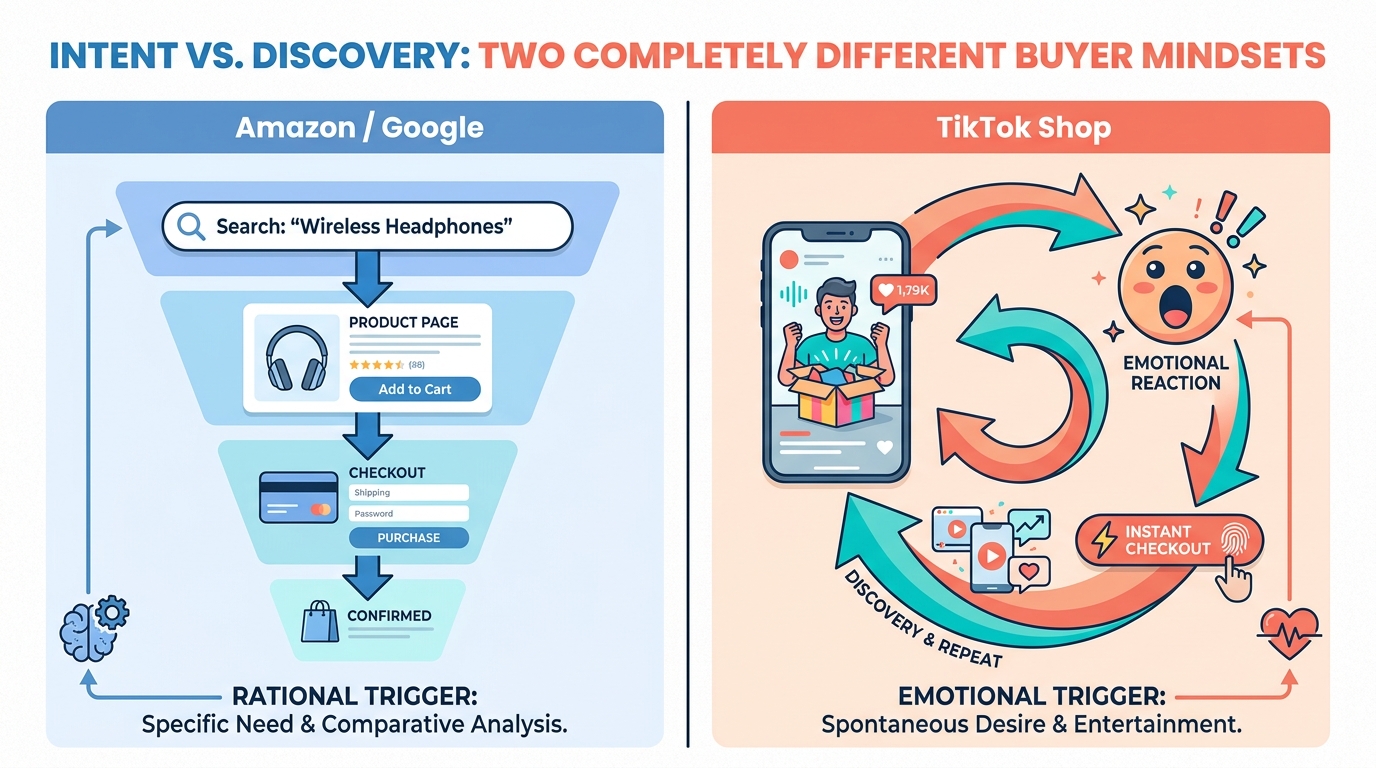
On Amazon, the buyer arrives with intent. They already know they need a standing desk or a protein powder or a dog harness. Your job as a seller is to be found at the moment of search and to win the conversion decision. On TikTok, the buyer arrives with no intent at all. They come to be entertained, informed, or amused. They have no purchase on their mind. Your job is to create the purchase desire — and then convert it — within the span of a single piece of content.
That changes your product selection strategy, your content strategy, your pricing logic, your affiliate approach, and your performance metrics. Understanding this distinction is not optional context. It is the foundation of everything that follows.
How TikTok Buyers Think — And Why That Rewrites Your Selling Strategy
The psychology of a TikTok buyer is meaningfully different from any other e-commerce context. Understanding this at a granular level — not just conceptually — lets you make better decisions at every step of building your TikTok Shop presence.
Passive Discovery Versus Active Intent
When someone opens TikTok, they enter a state of passive discovery. They are scrolling, absorbing content, reacting emotionally, and making rapid judgments about what holds their attention. This is a fundamentally different cognitive state than someone who has opened a browser, typed “best portable blender,” and started comparing product pages.
The active intent buyer is rational. They compare specs, read reviews, weigh price against value, and make a deliberate decision. The passive discovery buyer is emotional. They see something that surprises them, entertains them, solves a problem they had not consciously identified, or appears in a context they trust — and the purchase decision forms in seconds.
This means that TikTok Shop conversions are driven primarily by emotional resonance, not rational comparison. The product that converts is the one that triggered a feeling — “I need that,” “that’s so clever,” “why don’t I already own this?” — not the one with the objectively better specification sheet.
The Impulse Window and How to Use It
Behavioral research consistently shows that impulse purchases spike when a product is discovered in a trusted, entertaining context. When a creator a viewer genuinely follows — someone they find funny, relatable, or aspirational — shows a product in genuine use, the trust barrier to purchase drops dramatically. The product is no longer an unknown item from a stranger. It is something a trusted source has vetted through actual use.
This is why creator-led content on TikTok converts at rates that brand-produced content frequently cannot match. The creator is not a spokesperson. They are a trusted friend, and the viewer’s brain treats the recommendation accordingly.
The implication for sellers is that your job is not primarily to describe your product accurately. It is to place your product inside moments of trust — to get it into the hands of voices the algorithm has already decided people want to hear from, and to build your own authentic voice so that your own content can carry that same weight over time.
The “Aha Moment” — TikTok’s Purchase Trigger
Every product that goes viral on TikTok Shop contains what you might call an aha moment — a single second in a piece of content where the viewer sees the product do something they did not know was possible, or sees it solve a problem in a way that feels almost unfair. The ice roller that visibly reduces puffiness in real time. The cord organizer that transforms a chaotic desk in under a minute. The supplement that a creator holds up and says, “I’ve been taking this for 30 days and here’s what happened.”
The aha moment does not need to be dramatic. It needs to be undeniable. It needs to show — not tell — the product’s value in a way that makes the viewer think: “Oh. That’s what that does.” When you are selecting products for TikTok Shop or briefing creators, the question you should be asking is: “What is the aha moment in this product’s story?” If you cannot answer that clearly, the product is going to struggle on the platform.
The Four Sales Channels Inside TikTok Shop (And How Each One Actually Works)
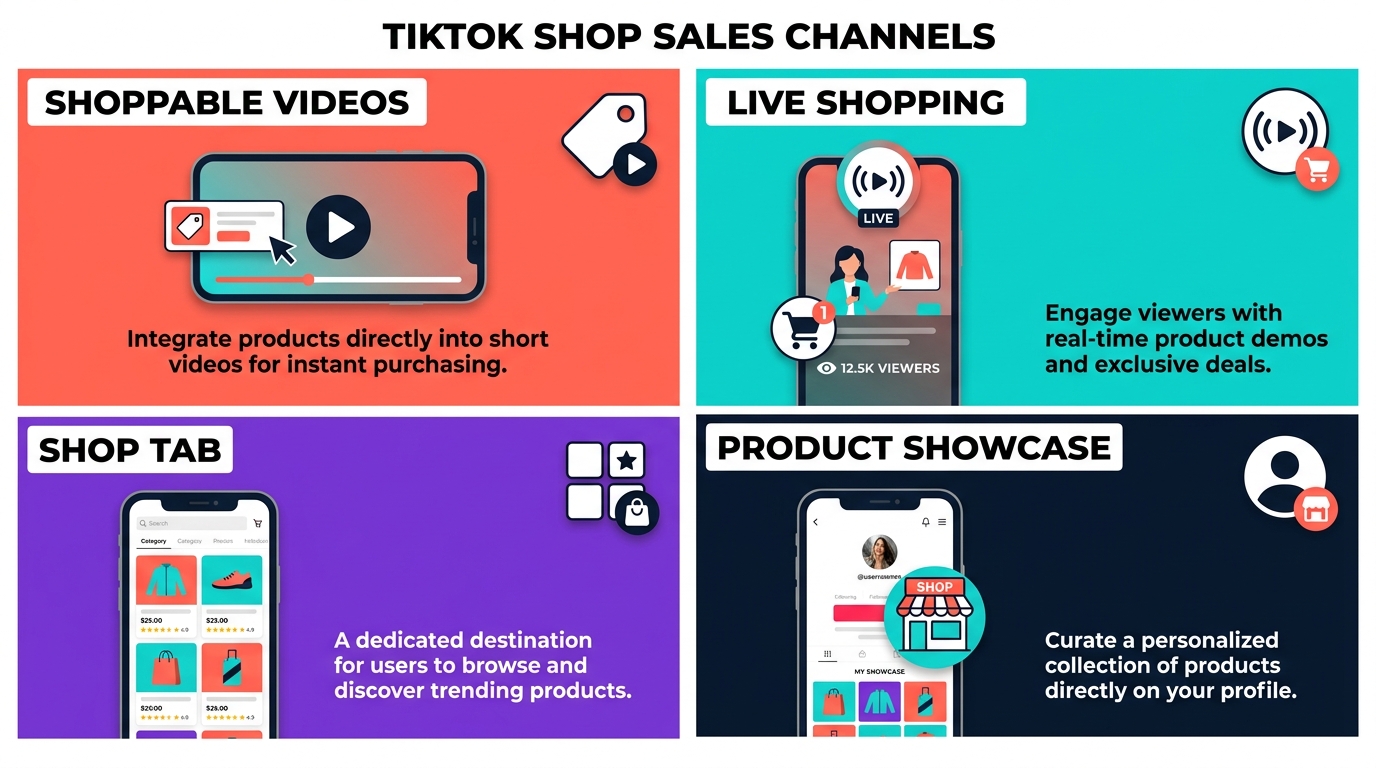
TikTok Shop is not one sales channel. It is four distinct mechanisms, each with its own discovery logic, audience behavior, and conversion dynamics. Most sellers activate one or two of these and leave significant revenue on the table by ignoring the others.
Shoppable Videos
Shoppable videos are the backbone of TikTok Shop. These are organic or paid in-feed videos with product links embedded at the bottom of the screen. When a viewer taps the product tag, they see an expanded product detail view — price, ratings, description, variants — and can add to cart or buy immediately without leaving the video.
The key insight about shoppable videos is that the video content is not the advertisement. It is the product experience itself. The viewer is not watching an ad; they are watching content that naturally includes a product. The conversion happens because the content convinced them, not because an ad targeted them. This is a fundamentally more efficient path to purchase when it works — and it works most reliably when the content is genuinely entertaining or useful rather than transparently promotional.
From a seller’s perspective, shoppable videos can come from your own brand account, from affiliated creators, or from paid advertising campaigns that run your existing shoppable content as promoted posts. All three distribution mechanisms use the same underlying product link infrastructure.
Live Shopping
Live shopping on TikTok is real-time broadcasting with embedded product listings. As a seller or creator goes live, they can pull products onto the screen, demonstrate them in real time, answer viewer questions directly, and create time-limited offers that are only available during the stream. Viewers can purchase without leaving the broadcast.
A 2025 GlobalData survey found that 76% of consumers who used TikTok Shop bought an item from a livestream in the prior year. That is not a marginal figure. It indicates that for a significant portion of the TikTok Shop customer base, live selling is the primary discovery-to-purchase pathway.
Live shopping is covered in more depth in its own section below, because the mechanics of running an effective live session are substantial enough to warrant dedicated attention.
The Shop Tab
The TikTok Shop tab is a dedicated marketplace within the app — a curated space where buyers can browse products by category, explore daily deals, and discover recommendations personalized to their previous behavior. Think of it as TikTok’s version of a native marketplace, similar in concept to Amazon’s homepage, but powered by TikTok’s recommendation engine rather than a traditional search index.
The Shop tab is where buyers arrive with slightly more intent than on the For You Page — they have opened the tab specifically because they are in browsing mode. This means that product listing quality matters more here than on video content. Strong imagery, accurate titles, competitive pricing, and a solid review count are more influential here than anywhere else in the TikTok Shop ecosystem. Sellers who treat the Shop tab like a secondary Amazon listing — with careful keyword attention and polished creative — see meaningfully better performance than those who treat it as an afterthought.
Product Showcases and Profile Shops
Every TikTok account with a connected shop can display a product showcase on their profile — a scrollable grid of their listings that appears under a dedicated “Shop” tab on the profile page. This is a lower-traffic channel than the others, but it serves a critical trust function. When a viewer watches your content and is interested enough to check your profile, the product showcase is what converts that curiosity into a transaction. It is the closest TikTok Shop gets to a traditional storefront, and it needs to look the part. Curated collections, organized categories, and strong visual consistency across your listings all contribute to the conversion rate at this stage.
What Products Actually Win on TikTok Shop
Not every product is suited to TikTok Shop, and no amount of creative effort will overcome a fundamental product-platform mismatch. The characteristics of a product that thrives on TikTok Shop are specific and learnable.
Visual Storytelling Products
The platform rewards products whose value can be communicated visually in a short window. If showing the product in use tells the story better than describing it, TikTok Shop has an edge over text-heavy formats. Beauty and skincare products perform strongly because transformation is visible. Kitchen gadgets perform well because the before-and-after is immediate. Cleaning products, organization tools, fitness accessories, and wellness items all tend to have strong visual stories.
Products that are technical, require extended explanation, have their primary value in features the camera cannot capture (like material quality or structural durability), or require a high-information comparison process before purchase tend to underperform unless they are supported by extraordinarily skilled content.
Price Point and the Impulse Threshold
TikTok Shop’s strongest conversion corridor sits in the $15–$80 range. Below $15, the perceived value can undermine the product’s credibility in video content. Above $80, buyers start to slow down, conduct more research, and leave the platform to make price comparisons — breaking the impulse window that makes TikTok Shop work. That $15–$80 band is not a rule, but products that fall significantly outside it require disproportionately more content effort to move.
There are exceptions. Beauty consumables can perform at lower price points if they are bundled effectively. Tech accessories, home goods, and fashion items can convert at higher price points if the creator’s audience specifically trusts their taste in those categories. But the baseline principle stands: lower friction equals higher conversion, and price is a major friction lever on this platform.
Categories Currently Overperforming
Beauty, skincare, and personal care consistently lead TikTok Shop’s sales charts. The combination of visible results, repeat purchase cycles, and the platform’s beauty-forward creator ecosystem creates a natural flywheel. Health and wellness supplements have seen major growth, fueled by creator testimonials and before-and-after storytelling. Home organization and kitchen products continue to punch above their weight, driven by the satisfying visual payoff of demonstrating problem-solving products. Fashion and accessories, particularly trend-driven items at accessible price points, move quickly through creator networks. Pet products have emerged as a strong niche, benefiting from the universal emotional appeal of animals in content.
The Demonstration Principle
The single most reliable predictor of a product’s TikTok Shop potential is whether its core benefit can be demonstrated on camera in under 30 seconds. If yes, you have a platform-native product. If the demonstration takes longer, or does not translate visually, you are working against the platform’s grain. This is not a creativity problem — it is a structural product-market fit question for this specific channel.
Building a Content Engine That Sells Without Feeling Like Selling
The brands that fail on TikTok Shop share a common content failure: they treat their TikTok presence as an advertising channel rather than an entertainment channel with commerce embedded inside. Their content feels like commercials. And TikTok users, who have extraordinarily well-calibrated senses for authenticity versus performance, scroll past commercials at rates that make the ad spend essentially worthless.
Entertainment First, Product Second
Successful TikTok Shop content follows a counterintuitive principle: the product should feel like it belongs in the video, not like the video was made for the product. The video’s primary job is to entertain, inform, amuse, or surprise. The product’s role is to be the natural solution, tool, or element within that story.
A cleaning product does not need a cleaning ad. It needs a video about what happened when someone realized their bathroom grout had become genuinely embarrassing — and what fixed it. A skincare serum does not need a feature list. It needs an honest account of what it felt like to wake up and actually see a difference. The product provides the resolution. The story provides the hook.
Content Frequency and Consistency
TikTok’s algorithm rewards consistent output. The accounts that build organic reach on the platform are not the ones with the single best video — they are the ones posting regularly, testing different angles, and giving the algorithm multiple data points to understand who their audience is and how to distribute their content.
For sellers running their own TikTok accounts, the generally accepted floor for meaningful algorithmic traction is three to five posts per week. Below that, the algorithm does not have enough signal to reliably push your content. Above that (when quality is maintained), you accumulate reach faster than almost any paid strategy can match.
The challenge for most seller-run accounts is maintaining quality at that frequency. The solution is not to produce polished, high-production content — it is to develop a few repeatable content formats that you can execute quickly. Unboxing and review, “day in my business” behind-the-scenes, customer testimonials repurposed as POV content, and direct-to-camera product demonstrations are all low-production, high-authenticity formats that consistently perform.
Brand-Owned Content vs. Creator-Led Content
Brand-owned TikTok content and creator-led affiliate content serve different functions. Brand content builds familiarity, trust, and long-term community. It tells your brand’s story, establishes your voice, and creates a repository of content that new visitors encounter when they check your profile. Creator-led content drives spikes — rapid discovery among audiences who have never encountered your brand, triggered by a trusted recommendation from a voice they already follow.
The most effective TikTok Shop sellers operate both channels simultaneously. They build a brand account with consistent, authentic content while running an affiliate program that deploys creators to generate discovery-layer content at scale. Neither channel replaces the other. Together, they create a flywheel: creator content drives new visitors to your profile, your brand content convinces them to trust you, and your profile shop converts that trust into a transaction.
The TikTok Shop Affiliate Program: Your Off-Platform Sales Force
TikTok Shop’s affiliate program is one of the most underutilized — and most powerful — growth levers available to sellers on the platform. At its core, it allows creators of any size to browse the TikTok Shop marketplace, select products to promote, and earn a commission on each sale generated through their content. Sellers set their own commission rates and can invite specific creators or make their products available to the open creator marketplace.
Why Affiliates Beat Paid Ads for Discovery
The economics of TikTok Shop affiliates are genuinely compelling. Unlike paid advertising — where you pay upfront regardless of whether a sale occurs — affiliate commissions are pure performance fees. You pay only when revenue is generated. A creator with 15,000 followers who posts a 40-second video about your skincare product and drives $3,000 in sales while earning 15% commission ($450) is generating a return that most paid ad channels cannot match at equivalent cost.
Beyond the economics, affiliates solve TikTok’s authenticity problem. The same product video shot by a brand account and by a creator with an authentic relationship to their audience will perform very differently — the creator version typically converts at significantly higher rates because the audience trust has already been established. When that creator recommends your product, it arrives pre-validated. The work of building trust has already been done for you.
How to Build an Effective Affiliate Strategy
The mistake most sellers make with TikTok affiliates is treating it as a passive channel. They set a commission rate, open their product to the marketplace, and wait for creators to find them. A few will. Most won’t, and the ones who do are often the ones posting volume content across dozens of products with little genuine connection to any of them — which tends to produce weak conversion rates.
An effective affiliate strategy is active and curated. Start by identifying the specific type of creator whose audience matches your buyer profile. A fitness supplement should be finding creators who document their training and nutrition, not just creators who post fitness content generally. A home organization product should be looking at people who make “reset my space” or “clean with me” content, not just lifestyle creators.
Once you identify the right profile, reach out directly through TikTok’s creator marketplace or through DMs with a clear, brief pitch: here is the product, here is what makes it interesting for your audience, and here is what you are offering. Provide samples where possible. Giving a creator the chance to use the product before they post about it dramatically improves the authenticity — and therefore the performance — of the resulting content.
Commission Rates and Competitive Positioning
Commission rates on TikTok Shop’s affiliate marketplace are highly competitive and have risen significantly as more sellers have entered the space. In categories like beauty and wellness, top creators routinely command 15–25% commissions from sellers competing for their attention. Setting your rate too low effectively makes your product invisible in a crowded creator marketplace where dozens of alternatives are offering more attractive terms.
Think of your commission rate not as a margin sacrifice but as a customer acquisition cost. If your all-in cost to acquire a customer through paid channels is $22, and a 20% affiliate commission on a $45 product costs you $9, the affiliate channel is generating customers at less than half the cost while delivering higher trust and better conversion in the process.
TikTok Shop Live: The Highest-Converting Channel You’re Probably Underusing
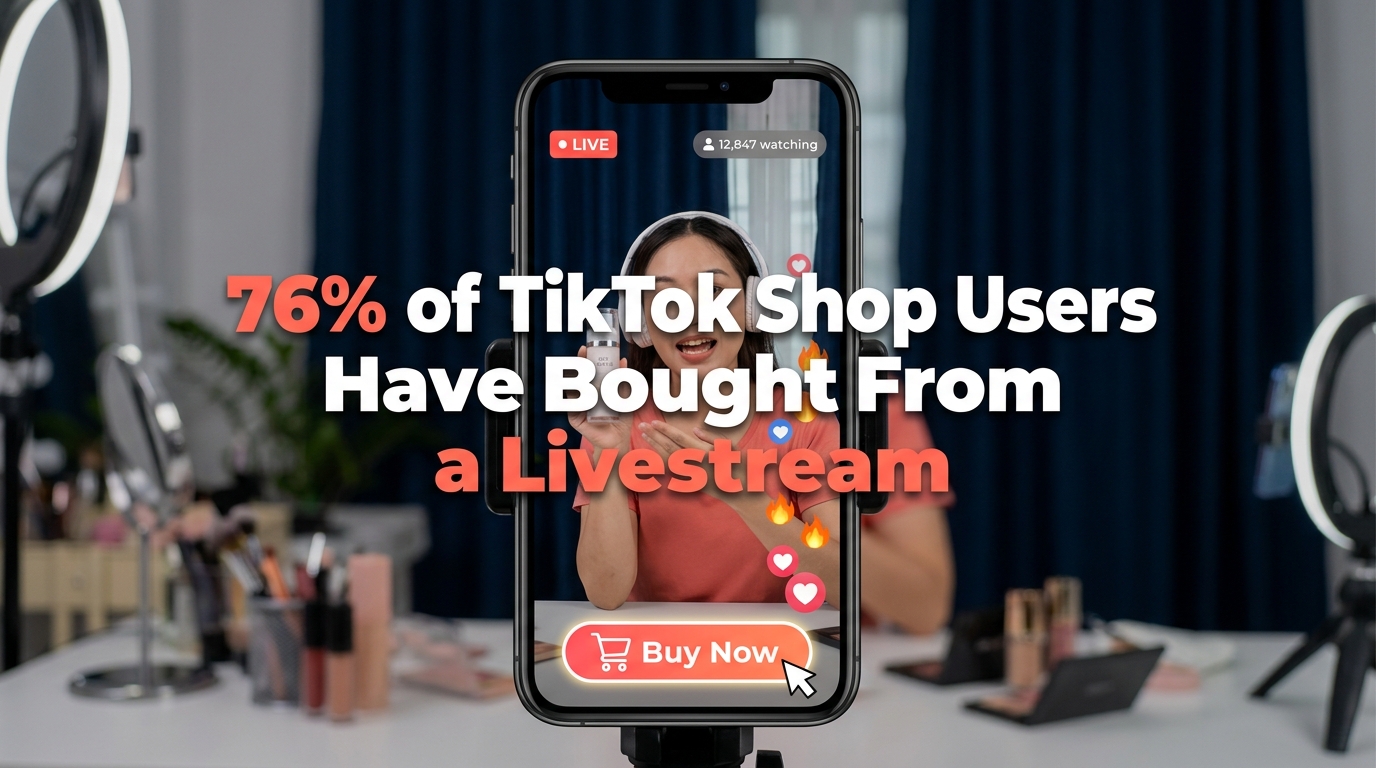
A 2025 GlobalData survey found that 76% of consumers who had used TikTok Shop bought an item from a livestream in the prior year. That figure deserves to be read slowly. Three out of four TikTok Shop buyers have purchased directly from a live broadcast. Yet the majority of US-based sellers on the platform have never gone live, or have done so sporadically without a structured approach.
The gap between the potential of TikTok Live selling and how most US sellers are using it is one of the biggest missed opportunities in e-commerce right now.
Why Live Selling Converts at Rates That Other Channels Can’t Match
Live selling concentrates every psychological trigger that makes TikTok Shop effective — trust, entertainment, immediacy, and social proof — and amplifies them in real time. A viewer watching a live broadcast is not passively scrolling. They have chosen to stay. They are engaged, they are asking questions, they are watching other viewers react, and they are experiencing the product being demonstrated with the knowledge that they can ask any question they want answered before they buy.
This is fundamentally different from reading a product description or even watching a recorded video. The interactivity removes uncertainty. The live context creates urgency — this conversation is happening now, the offer on screen is available now, and the community of viewers sharing comments creates the social validation that makes hesitant buyers feel safe clicking “Buy Now.”
Structuring a TikTok Live Session That Actually Sells
Effective TikTok Live sessions are structured, not improvised. The highest-performing live sellers follow a repeatable format with several consistent elements.
Hook within the first 30 seconds. New viewers enter a live at random moments, so the beginning of the stream needs to immediately establish what is being shown and why it is worth staying for. Do not start with housekeeping or greetings. Start with the product in your hand, doing something interesting.
Product rotation with clear transitions. A live session that focuses on a single product for an entire hour will lose audience momentum. Rotate products every 10–20 minutes, with clear verbal transitions: “Okay, I have to show you what’s coming next because this one sold out last time we went live.” The rotation creates narrative momentum and gives late-arriving viewers a reason to stay for the next product.
Live-exclusive offers and countdown urgency. Time-limited discounts available only during the live broadcast are a proven conversion accelerator. The key is that the urgency must be real. If the same discount is always available, viewers learn that it is not actually exclusive, and the incentive loses its power. Use genuine live-exclusive pricing, bundle offers, or limited-quantity deals that genuinely expire when the broadcast ends.
Active comment engagement. The biggest differentiator between high-converting lives and average ones is how the host handles comments. Specifically calling out viewer names, answering questions immediately, and repeating questions aloud before answering them (for the benefit of viewers who cannot see comments quickly enough) makes viewers feel that being present has value. That sense of participation increases both session duration and purchase conversion.
Optimal Session Length and Frequency
TikTok Live sessions under 30 minutes rarely reach their algorithmic potential — the platform’s live discovery engine takes time to warm up and start distributing the broadcast to users who are not already following you. Experienced live sellers report that the 45-minute to 2-hour range tends to hit the best balance between audience retention and algorithmic reach. Longer sessions work for dedicated live-selling accounts with trained audiences; shorter ones tend to underperform for discovery.
For frequency, the data from high-volume live sellers consistently shows that going live at least three times per week, at consistent times, dramatically outperforms irregular scheduling. Consistency trains both the algorithm and your audience — viewers who know you go live every Tuesday, Thursday, and Saturday at 7pm will develop a habit around your broadcasts that irregular schedules cannot build.
Fulfillment, Logistics, and the Operational Reality of Running TikTok Shop
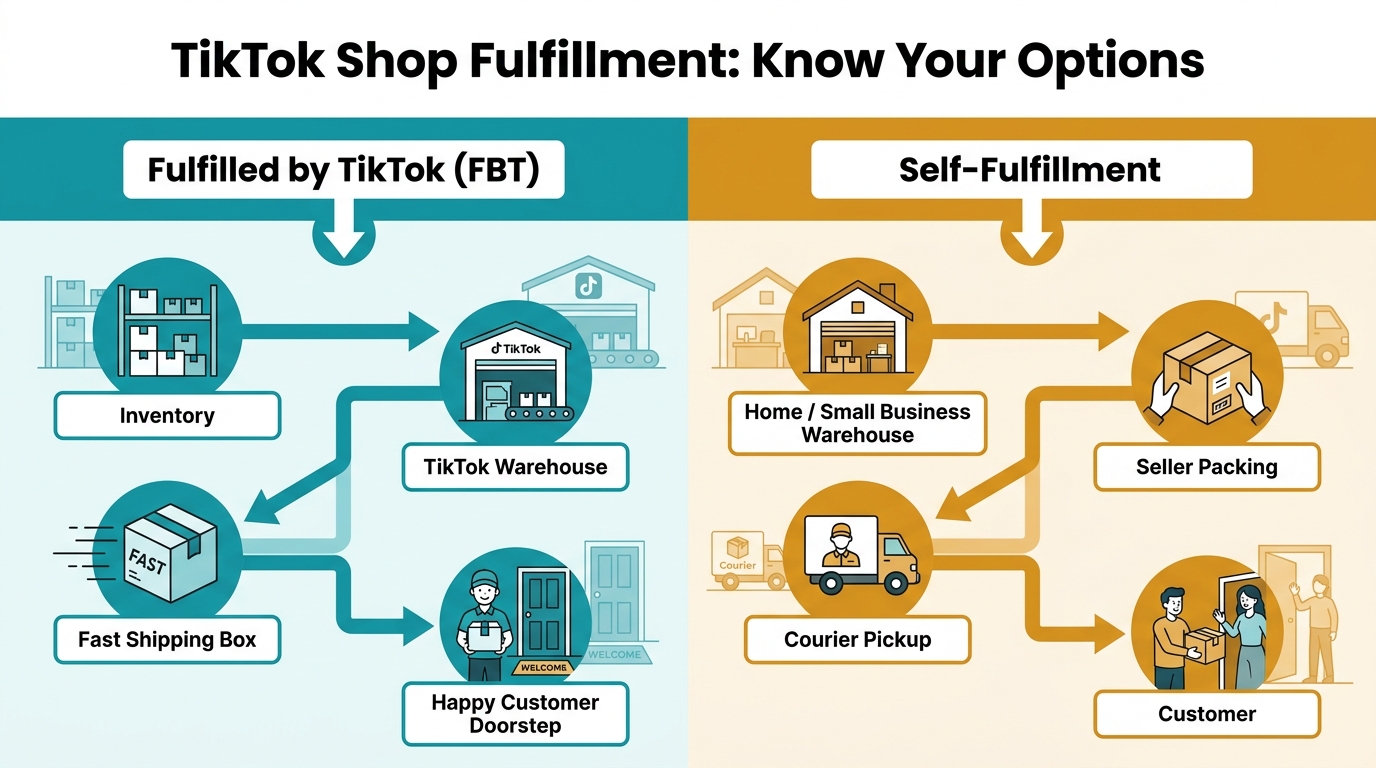
TikTok Shop’s commerce mechanics are the part of the platform that sellers most frequently underestimate before launch. The discovery and content strategy get all the attention. The fulfillment realities quietly determine whether your business is actually sustainable.
Fulfilled by TikTok (FBT)
Fulfilled by TikTok is TikTok’s equivalent of Amazon’s FBA service — a model where sellers send inventory to TikTok’s partner fulfillment warehouses, and TikTok handles storage, picking, packing, and shipping on each order. The service is provided in partnership with third-party logistics providers such as ShipBob in the United States.
FBT has significant advantages. It removes the operational burden of order-by-order fulfillment, which becomes genuinely unmanageable the moment a product goes viral and you receive hundreds or thousands of orders within a 48-hour window — a scenario that is not hypothetical on TikTok Shop. FBT also tends to qualify products for faster shipping badges and promoted visibility in certain parts of the platform, since TikTok has an interest in ensuring reliable fulfillment experiences for buyers.
The trade-off is inventory commitment. FBT requires sending stock to warehouses before you know how much you will sell, which introduces inventory risk that self-fulfillment avoids. For sellers with predictable demand and the capital to pre-position stock, FBT is frequently the right call. For sellers testing new products or managing tight cash flow, starting with self-fulfillment and transitioning to FBT as sales velocity becomes clearer is the more prudent approach.
Self-Fulfillment Realities
Self-fulfilled TikTok Shop orders carry specific platform-level performance requirements that sellers need to understand before they launch. TikTok monitors shipping time, delivery confirmation rates, and seller-related cancellation rates, and these metrics directly affect your account’s standing, visibility, and eligibility for platform promotions.
Specifically, sellers who fail to ship within the expected window — which is typically 2 business days for most categories — face order cancellation penalties and potential suppression of their listings. If a video goes viral at 2am on a Sunday and generates 500 orders before Monday morning, self-fulfillment sellers need to have the operational infrastructure to process all of those orders within the required window. That means reliable packing capacity, carrier relationships, and ideally some level of staffing or 3PL partnership that is not dependent on a single person’s schedule.
Returns and Buyer Expectations
TikTok Shop buyers have been conditioned by the platform’s social commerce context to expect frictionless returns. The platform offers buyer protection that allows returns within a standard window, and sellers need to factor return rates into their margin calculations from the outset — particularly in fashion, where return rates can be significantly higher than in other categories.
Managing returns well is also a reputation issue. TikTok Shop seller scores — which are publicly visible on your profile — include metrics related to fulfillment speed, response time, and dispute resolution. A degraded seller score makes every other part of your TikTok Shop strategy work harder for worse results. Treat logistics not as a back-office concern but as a front-line part of your seller brand.
Pricing, Promotions, and Avoiding the Race to the Bottom
TikTok Shop has a promotions and discounting culture that is real, visible, and genuinely powerful for driving short-term volume. Flash sales, vouchers, bundle offers, and platform-sponsored discount events like TikTok Shop’s periodic shopping festivals all create moments where heavy discounting becomes the competitive norm. Navigating this without eroding your margins or your brand positioning requires deliberate strategy.
How TikTok Shop Promotions Actually Work
TikTok Shop’s Seller Center offers several promotional tools: product-level discounts, shop-wide vouchers, flash sales with countdown timers, bundle pricing, and free shipping thresholds. Each of these can be configured independently or combined for campaign moments. The platform also runs platform-wide promotional events — seasonal sales, flash deal days, and category-specific promotion windows — where participating sellers receive additional visibility in exchange for committing to minimum discount levels.
Participating in platform promotions is generally worth doing, particularly for new sellers trying to build review counts and visibility. The visibility boost from being featured in a platform deal event typically outweighs the margin compression, especially when the increased review volume from promotion-driven sales then improves organic rankings in the Shop tab. This is a classic invest-now, return-later dynamic that makes early-stage discounting rational even if it feels uncomfortable.
Where Sellers Damage Themselves with Discounting
The mistake is treating promotions as a permanent pricing strategy rather than a tactical tool. When a seller runs continuous 30% discounts, they train their audience to expect that price as the standard. Buyers who would have purchased at full price wait for the next sale. New buyers discover the product at the discounted price and set that as their reference point. The result is that your effective price floor gets permanently reset downward, and you have no room left to run promotional events that feel genuinely compelling because your “sale” price is already your everyday price.
The sellers who avoid this trap treat their standard pricing as real and their promotional pricing as genuinely exceptional. They run sales fewer times, make the events feel like events, and maintain enough margin headroom that when they do discount, the offer is meaningful to the buyer and sustainable for the business.
Competing on Value, Not Just Price
On a platform where purchase decisions are made in seconds based on video content rather than extended comparison sessions, perceived value matters more than price optimization. A product that looks premium in video, is demonstrated with obvious quality, and has a review profile showing genuine buyer satisfaction can command a price premium over technically equivalent competitors who have not invested in their content quality.
This is the counterintuitive advantage of TikTok Shop for quality-differentiated brands: the platform rewards how a product looks and feels in video, not just what it costs. If your product is genuinely better and your content shows why, you can hold price while lower-quality alternatives race each other to the bottom.
Tracking TikTok Shop Performance Without Getting Lost in Vanity Metrics
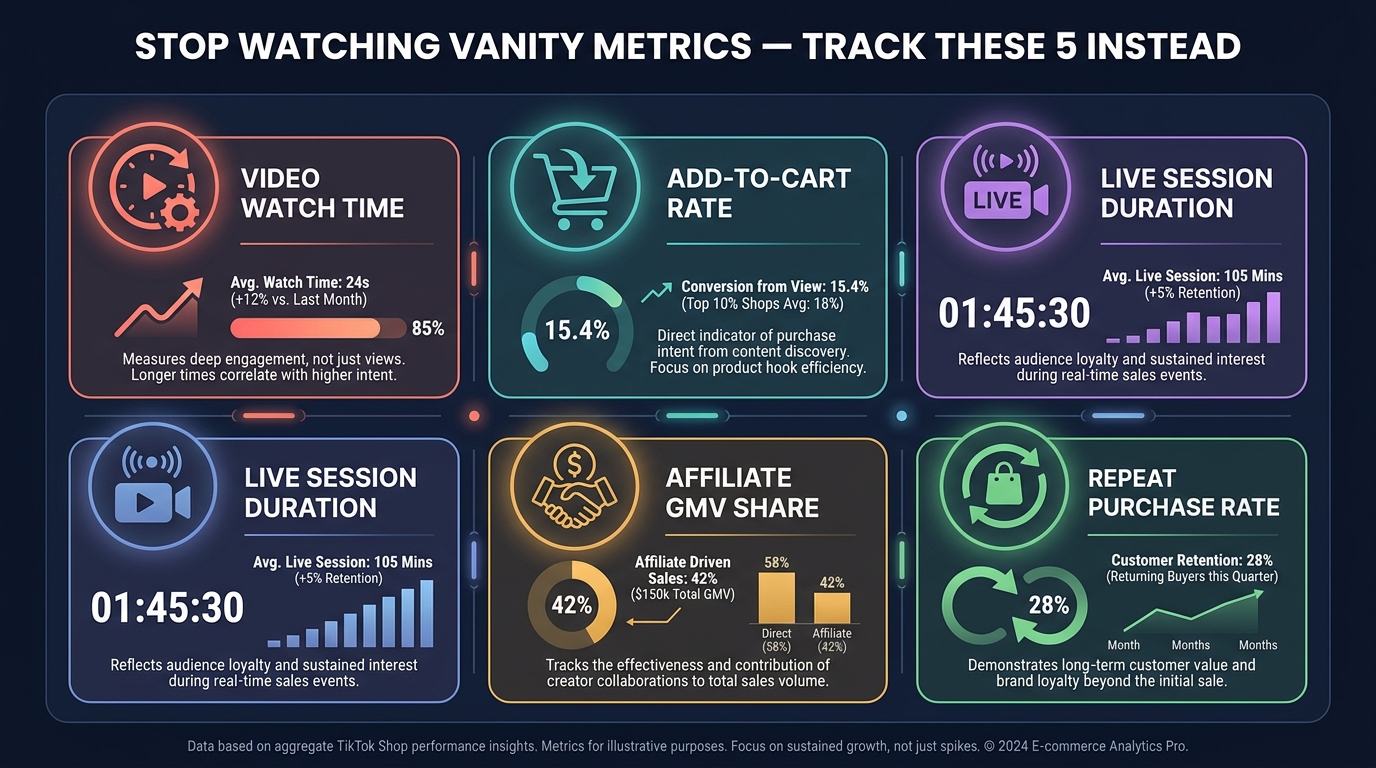
TikTok Shop’s Seller Center provides a substantial analytics dashboard covering everything from video views and click-through rates to order volume, revenue, and fulfillment performance. The availability of so much data creates a specific problem: it is very easy to stare at metrics that feel important but do not actually predict revenue, and to miss the signals that do.
The Metrics That Actually Predict Revenue
Video Watch Time and Completion Rate. These are the most important content-level signals. If viewers are watching your shoppable videos to the end, the algorithm interprets the content as high-quality and distributes it more aggressively. Low watch time means the content is failing at the entertainment layer — the product never gets a chance to convert because the video is not being watched. Track this per video and use it to diagnose content issues before they become sales problems.
Add-to-Cart Rate. This metric shows what percentage of people who saw your product detail page added it to their cart. It is a cleaner signal of product-market fit than the raw conversion rate because it isolates buyer interest from downstream friction like shipping cost or checkout hesitation. A high add-to-cart rate with a low purchase rate suggests the problem is at checkout — price, shipping cost, or trust — not with the product itself.
Live Session Duration and Peak Viewer Count. For sellers running live shows, the average session duration of viewers (how long they stay) and the peak concurrent viewer count are the most reliable leading indicators of a session’s revenue potential. Sessions with strong viewer retention consistently outperform sessions with high peak viewership but rapid drop-off.
Affiliate GMV Share. Tracking what percentage of your total GMV is being generated by affiliate content versus your own brand content gives you a clear picture of your channel dependency. If 90% of your revenue is coming from one affiliate creator, you have a concentration risk. A healthy affiliate program drives meaningful GMV contribution from multiple creators across different content styles and audience sizes.
Repeat Purchase Rate. Probably the most undertracked metric in early-stage TikTok shops. Because TikTok Shop optimizes for discovery, there is a natural tendency to measure success by new customer acquisition. But the economics of a sustainable TikTok Shop business depend heavily on repeat purchase — particularly for consumable products like supplements, skincare, and cleaning supplies. If buyers are purchasing once and not returning, you have a retention problem that no amount of new customer acquisition will fix sustainably.
What to Ignore
Video views and follower counts are the metrics that create the most noise. A video can generate a million views and produce no meaningful sales if the content attracted the wrong audience or failed to make the product relevant. Follower count is a particularly misleading vanity metric on TikTok, where algorithmic reach consistently drives more distribution than follower base size. Optimize for revenue-correlated signals. Let the vanity metrics take care of themselves.
The Long Game — Building a TikTok Shop Brand That Lasts
Most discussions of TikTok Shop focus on how to generate the first sale, the first viral video, the first live session. Far fewer address the harder and more important question: how do you build a TikTok Shop business that still exists and grows two years from now?
Community as Competitive Moat
The sellers who are building durable TikTok Shop businesses are the ones who treat their TikTok audience as a community rather than a traffic source. This distinction sounds philosophical but has practical implications. Brands that respond to every comment, acknowledge their most engaged followers, act on community feedback about products, and share the behind-the-scenes reality of their business build a degree of buyer loyalty that pure content-production strategies cannot.
A viewer who has followed your TikTok journey for six months, who has seen you work through product development, read your responses to comments, and watched your live sessions regularly, is not just a customer. They are an invested participant in your brand’s story. The retention rate of that relationship dwarfs what you can achieve through algorithm-mediated discovery alone.
Repeat Purchase Architecture
Building for repeat purchases on TikTok Shop requires deliberate product architecture. If you sell a single product with no natural replenishment cycle, every customer you win has to be replaced. If you have a product line where a first purchase naturally leads to a second — a skincare serum that runs out in six weeks, a cleaning concentrate that needs to be replaced monthly, a fashion line that releases new drops regularly — your business model has durability built into it.
Many TikTok Shop sellers who started with a single hero product are now actively expanding their line not because they want more SKUs to manage, but because repeat purchase economics are the only path to a business that does not require perpetual viral moments to survive. Your second product is not a distraction from your first — it is the mechanism that makes your first purchase retain its value.
Cross-Platform Integration Without Losing TikTok’s Native Feel
TikTok Shop integrates with both Shopify and a growing ecosystem of e-commerce platforms, allowing sellers to sync inventory, manage orders from a single interface, and cross-pollinate their customer base. Sellers who are building for longevity are treating this integration not as a technical convenience but as a strategic asset.
A customer who discovers you on TikTok Shop, buys once, and joins your email list (via your Shopify integration) is now reachable through a channel you own — independent of TikTok’s algorithm, TikTok’s policy decisions, or any future platform changes. Building that email list is not optional for sellers who want a business that survives whatever comes next. It is essential risk management.
The integration also enables remarketing — serving ads to TikTok Shop buyers on other platforms, which has been shown to significantly improve lifetime value for brands that execute it well. Your TikTok Shop customer who sees a relevant Instagram ad for a complementary product in the week after their first purchase is far more likely to buy than a cold audience member who has never interacted with your brand.
Getting Started: A Practical Launch Sequence for New TikTok Shop Sellers
All of the strategy above is most useful when it is grounded in a practical sequence. Here is a realistic launch order for sellers entering TikTok Shop for the first time in 2026.
Weeks 1–2: Foundation
Complete your seller registration and documentation. Set up your shop with no more than five to ten of your best-performing products initially — trying to list your entire catalog immediately diffuses your attention and makes it harder to develop strong content for any individual product. Configure your shipping templates, connect your bank account, and decide whether FBT or self-fulfillment is appropriate for your initial inventory levels.
Before you post a single video, spend time purely as a consumer. Scroll the For You Page. Visit the Shop tab. Watch successful live sessions in your category. Note what kinds of content stop your thumb, what makes you want to click through to a product, and what live hosts are doing that makes you want to stay. This immersion is not optional — it is market research that you cannot get from a strategy document.
Weeks 3–4: Content and Early Affiliate Outreach
Begin posting content from your brand account — a minimum of three times per week. Focus on demonstration and storytelling formats rather than pure promotional content. At the same time, identify five to ten creators in your niche and reach out directly with a product and a clear pitch. Send physical samples where your margin allows. You are not looking for viral creators — you are looking for engaged, authentic voices whose audience genuinely overlaps with your buyer profile.
Weeks 5–8: First Live Sessions
Start going live at least twice per week with structured sessions of 45–60 minutes each. Your first live sessions will almost certainly perform below their eventual potential — that is normal. Live selling is a skill that improves with practice, and TikTok’s algorithm takes time to understand and distribute a new live account. Commit to the practice regardless of early session size and optimize based on what you learn from each session.
Month 3 Onward: Scale What’s Working
By month three, you will have enough data to know which of your products is resonating, which content formats are driving add-to-cart behavior, and which affiliate relationships are generating real GMV. Double down on what is working, retire what is not, and use your growing review count and seller score to push into platform promotional events for your category.
Conclusion: Selling on TikTok Shop Is a Different Skill Set — and That’s the Opportunity
TikTok Shop is not a harder version of Amazon. It is not a social media add-on to your Shopify store. It is a genuinely different commerce environment with its own logic, its own buyer psychology, its own content requirements, and its own definition of what “success” looks like. That is exactly why it represents a real opportunity for sellers willing to learn it on its own terms.
The brands that are winning on TikTok Shop in 2026 are not winning because they have the best products or the biggest budgets. They are winning because they understood that this platform sells through entertainment, discovery, and trust — not through search and comparison. They built content engines instead of catalog strategies. They deployed affiliates as a sales force instead of treating them as optional extras. They went live consistently instead of occasionally. They tracked the metrics that predicted revenue instead of the metrics that looked impressive in screenshots.
TikTok Shop’s most important feature is not its algorithm, its affiliate network, or its live selling infrastructure. It is the way it has permanently changed the question that sellers need to answer. Not “how do I get found?” but “how do I deserve to be watched?”
The answers to that question — compelling, entertaining, authentic content; products with visible aha moments; creators with genuine audience trust; consistent live shows that treat viewers as a community — are the building blocks of a TikTok Shop business that lasts longer than a single viral moment.
Key takeaways for TikTok Shop sellers in 2026:
- Understand that TikTok buyers operate from discovery, not intent — and build every strategy around that distinction.
- Use all four sales channels: shoppable videos, live shopping, the Shop tab, and your profile showcase. Do not leave any of them idle.
- Select products with a clear, demonstrable aha moment that translates on camera in under 30 seconds.
- Activate your affiliate program actively, not passively — identify the right creator profiles, send samples, and set competitive commission rates.
- Go live consistently, at scheduled times, with structured sessions — it is your highest-converting channel by a significant margin.
- Match your fulfillment model to your actual operational capacity, and treat your seller score as a front-line brand asset.
- Track video watch time, add-to-cart rate, live session duration, affiliate GMV share, and repeat purchase rate. Ignore raw view counts and follower growth as primary KPIs.
- Build your email list from day one using platform integrations. Your TikTok Shop customer base should also be an asset you own independently.