


TikTok Shop has always had fulfillment rules. What changed in 2026 is that those rules now have teeth — real, measurable, algorithmically enforced consequences that can quietly suppress your listings before you even know something is wrong.
For most of TikTok Shop’s early years in the U.S., fulfillment was largely the seller’s domain. You picked a carrier, packed a box, and hoped it arrived on time. The platform watched but rarely acted. That era is over.
In the first half of 2026, TikTok Shop rolled out a restructured compliance architecture: a new Account Health Rating system replacing the old violation-points model, tighter dispatch deadlines enforced at the carrier scan level, a partial-then-reversed mandate around platform-controlled logistics, and a returns workflow that now generates its own performance metrics. Sellers who were operating on autopilot from 2024 practices are now hitting invisible ceilings — order caps, listing demotions, and auto-cancellation triggers they never anticipated.
This post is not an introduction to TikTok Shop. It’s a technical operations guide for sellers who are already selling but need to understand exactly what the platform is measuring, how those measurements affect your visibility and cash flow, and what specific changes to make in the next 30 days. We’ll cover the four core fulfillment metrics, the new AHR scoring system, the FBT-versus-self-ship decision framework, how viral spikes can break your metrics overnight, and what the returns system is quietly tracking about your shop. By the end, you’ll have a sequenced action plan you can hand to your ops team immediately.
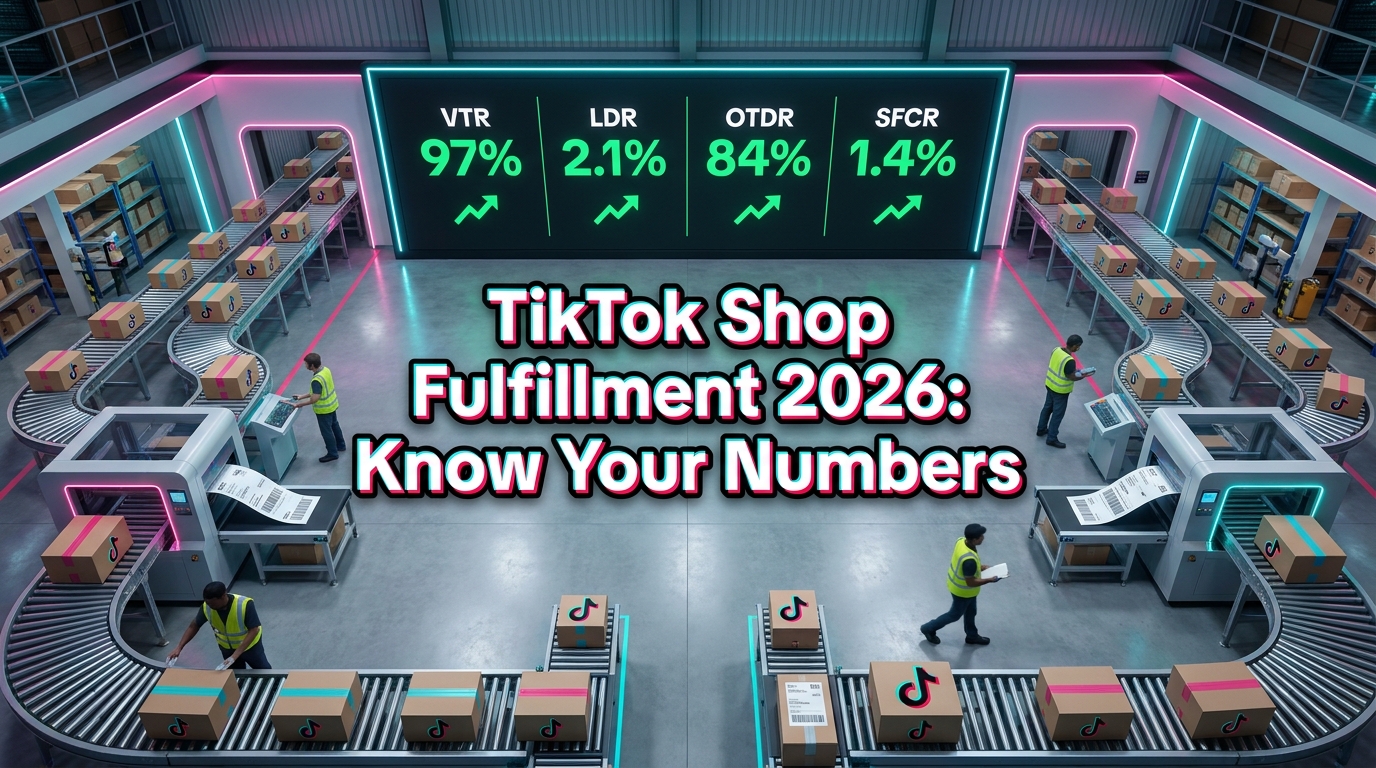
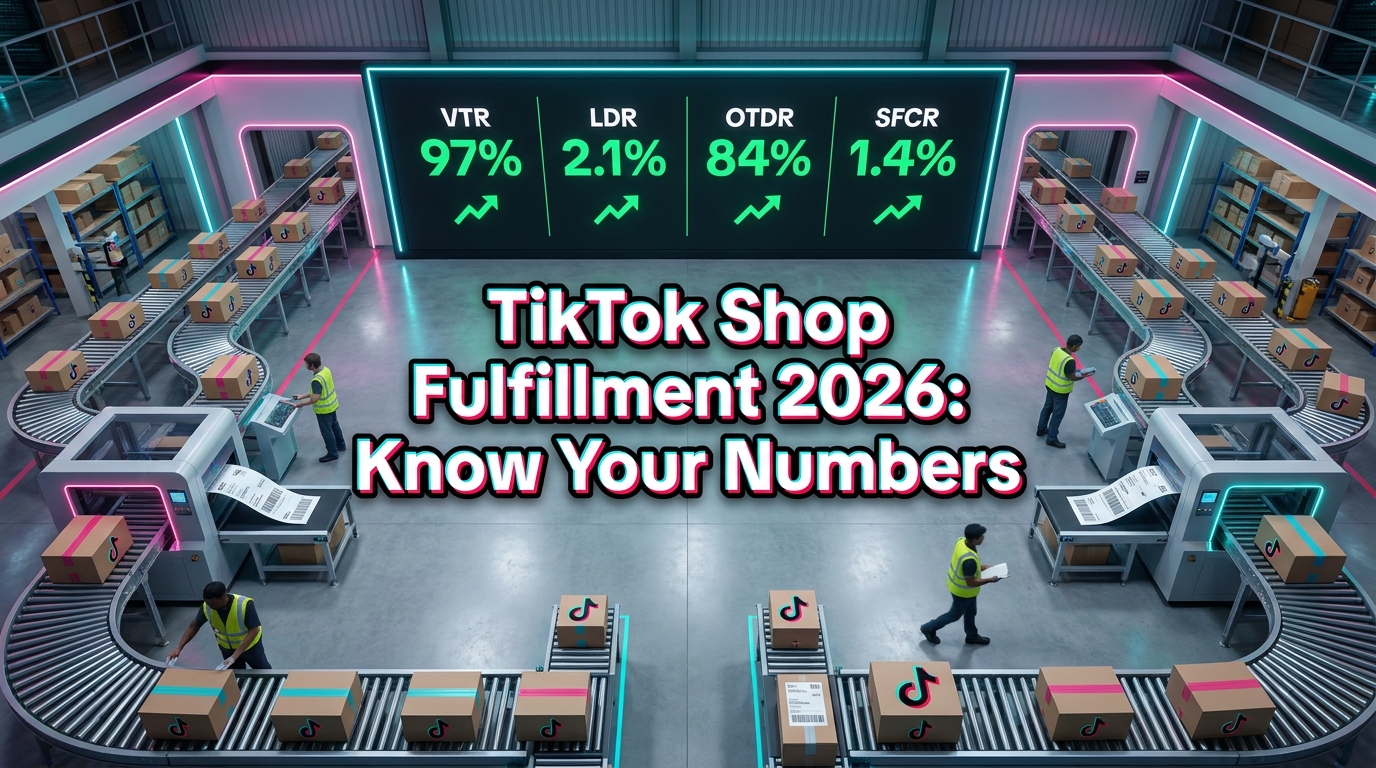
The Four Metrics TikTok Actually Enforces
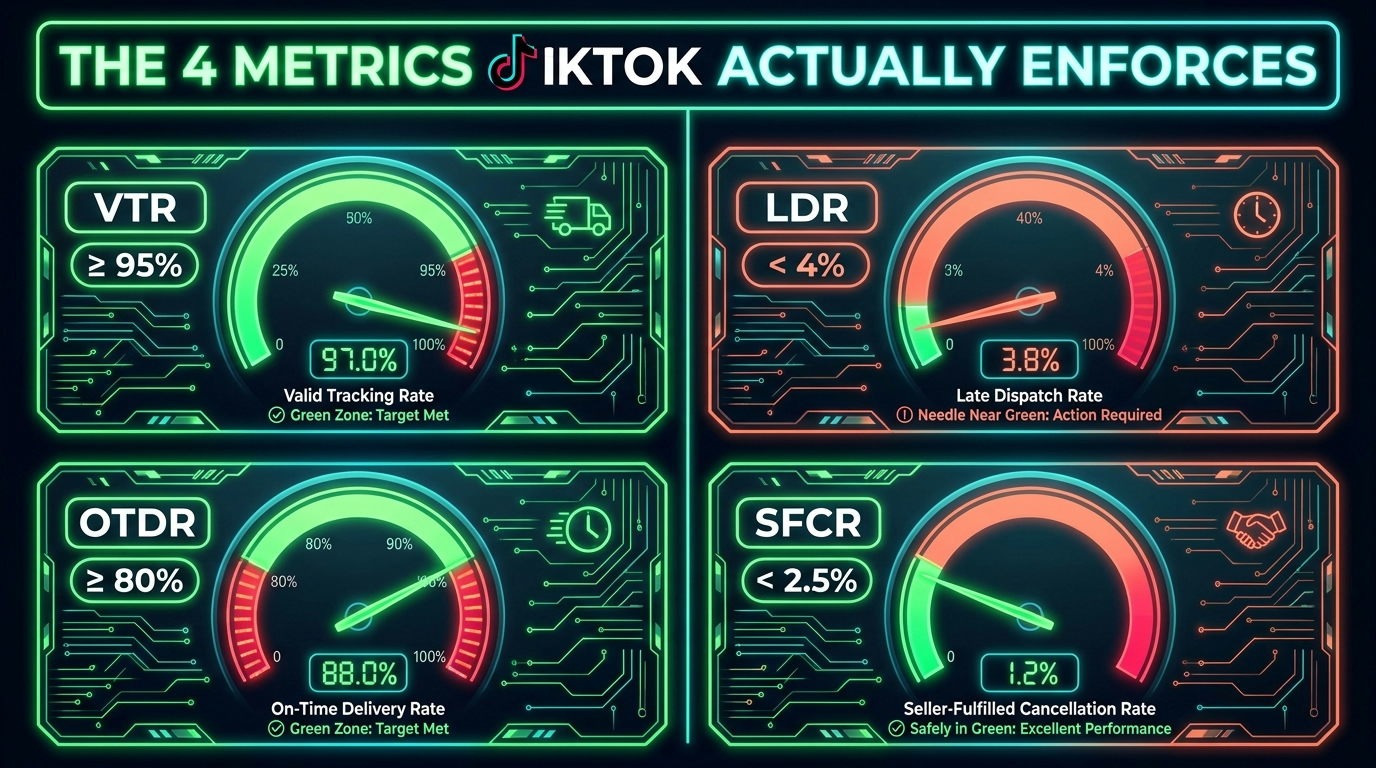
Before anything else, you need to know which numbers TikTok is watching — because not every metric weighs equally, and the ones sellers most commonly neglect are often the ones triggering enforcement. TikTok Shop’s fulfillment compliance framework rests on four core performance indicators.
Valid Tracking Rate (VTR): ≥ 95%
VTR measures the percentage of your dispatched orders that have valid, carrier-confirmed tracking information uploaded to TikTok Shop within the required window. The threshold is 95% — meaning no more than 5% of orders can have missing, invalid, or unconfirmed tracking data at any given time.
This sounds straightforward, but VTR violations are surprisingly common. The failures tend to cluster around a few specific scenarios: manual tracking entry errors, carriers that don’t report scan events back to TikTok’s API in real time, shipping label generation delays on high-volume days, and orders routed through logistics providers not yet integrated with TikTok’s tracking ecosystem. If you’re using a third-party logistics provider, confirming that their integration pushes tracking events to TikTok automatically — not through a batch upload at end of day — is one of the fastest VTR fixes available.
Falling below 95% VTR doesn’t just trigger a warning. TikTok can restrict your product exposure and, in persistent cases, cap incoming orders. Buyers also see tracking status directly in the app, so VTR failures affect customer experience before enforcement even enters the picture.
Late Dispatch Rate (LDR): < 4%
LDR is the percentage of orders not dispatched within TikTok’s required window. In 2026, that window is two business days from order placement for U.S. sellers. “Dispatched” means the carrier has scanned the package — not just that you’ve generated a label. A label sitting on your packing bench at 11:59 PM is not a dispatched order.
TikTok’s published threshold for LDR is under 4%, but the platform begins flagging accounts well before that ceiling. Sellers consistently above 2% LDR report increased audit frequency and reduced promotional eligibility. Above 10% is where formal enforcement — order limits, account warnings, or listing demotion — typically begins in earnest.
LDR is the metric most directly connected to your physical operations. It’s a direct measure of whether your pick-pack-ship workflow can reliably process orders within 48 hours, including orders placed late Friday or over a long weekend. Most LDR failures happen not on normal business days, but on the edges: holiday-adjacent days, days following a viral content spike, or periods when a key team member is unavailable.
On-Time Delivery Rate (OTDR): ≥ 80%
OTDR measures the percentage of orders that arrive by the estimated delivery date shown to the buyer at checkout. For Express shipping, TikTok targets delivery within three business days and expects a 95% on-time rate for that service tier. For Standard and Economy shipping, the window is six business days, with an 80% overall OTDR floor across your account.
The nuance here is that OTDR is not fully within your control. Carrier delays, weather events, and last-mile failures all affect the number. However, TikTok does differentiate between seller-fault and carrier-fault delivery failures — orders with valid tracking that show documented carrier delays are treated differently than orders without tracking or with dispatch delays that caused the late delivery. This makes VTR and LDR upstream protections for OTDR: if your tracking is current and your dispatch was on time, a carrier delay is less likely to count against you.
Seller-Fault Cancellation Rate (SFCR): < 2.5%
SFCR is the percentage of orders cancelled due to seller-side issues — out-of-stock, inability to fulfill, or failure to dispatch within the cancellation deadline. The threshold is under 2.5%. This metric is particularly punishing because every seller-fault cancellation is a confirmed customer disappointment that TikTok directly attributes to your operations.
SFCR spikes are most commonly caused by inventory inaccuracies — selling products that aren’t actually available to ship — and by affiliate-driven demand that outpaces stock. A single viral creator video promoting a product you have 40 units of can generate 200 orders in an hour. If you don’t have a real-time inventory buffer system or a pre-set inventory cap on TikTok Shop listings, SFCR can hit dangerous levels before your morning team has a chance to respond.
Key insight: These four metrics are not siloed. A shipping label that never gets scanned affects VTR. That same order, not dispatched in time, adds to LDR. If it arrives late as a result, it hits OTDR. And if the buyer cancels before delivery and TikTok attributes it to seller fault, it shows up in SFCR. One operational failure can damage all four simultaneously.
Account Health Rating: What the 0–1,000 Score Really Means
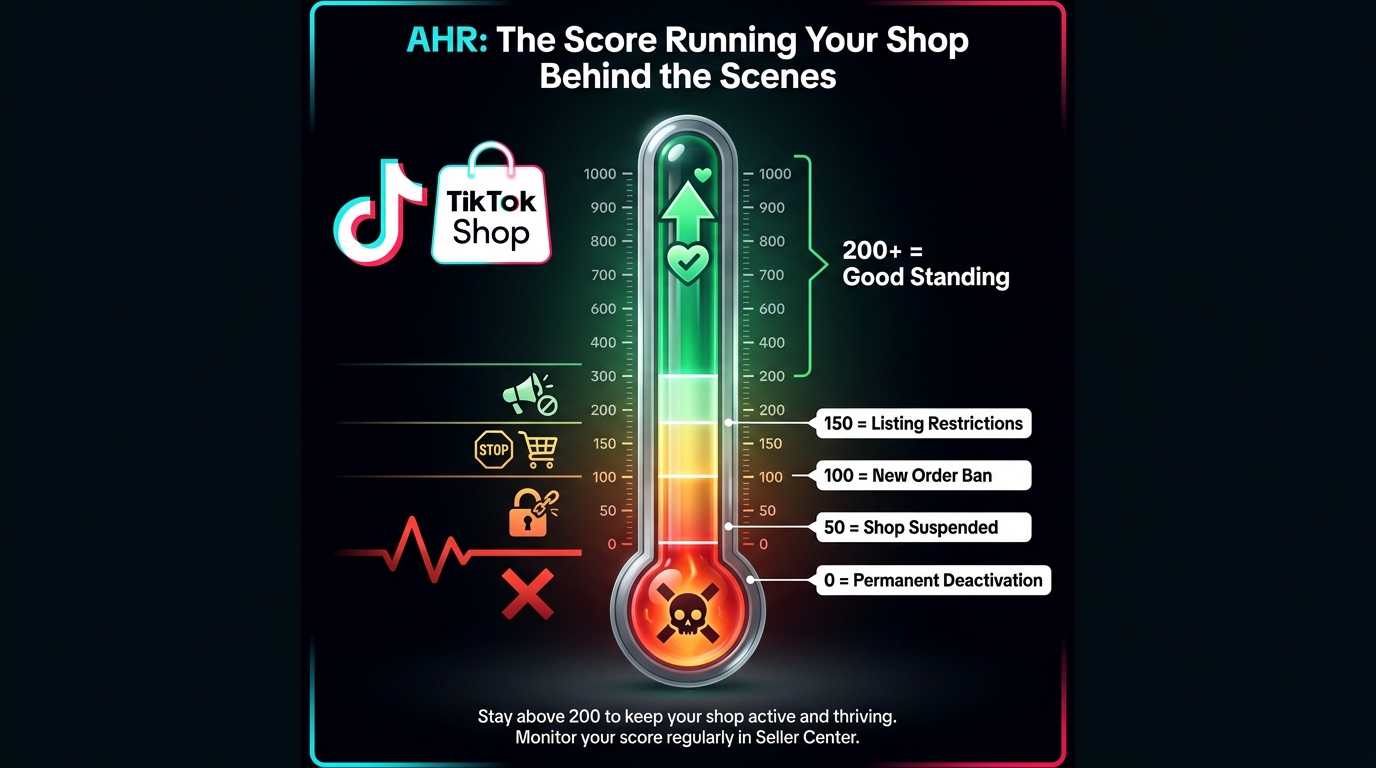
Starting June 15, 2026, TikTok Shop began replacing its previous violation-points system with the Account Health Rating, or AHR. Full global rollout is complete as of July 2026. This is not a cosmetic rebrand — it’s a structural change to how TikTok Shop measures, communicates, and enforces seller compliance.
How AHR Is Structured
The AHR is a 0-to-1,000 score that reflects the overall health of your shop across a rolling 180-day window. The scoring aggregates policy compliance, fulfillment performance, and after-sales handling. All sellers begin at 200 points — the green zone baseline. Violations cause point deductions; sustained strong performance can maintain or recover your score. The system uses color coding: green (good standing), yellow (caution), orange (warning), and red (enforcement zone).
What makes AHR materially different from the old violation-points model is the milestone enforcement structure. Rather than accumulating violations until a threshold trips, AHR enforces at specific score levels with escalating consequences:
- Below 150 points: Listing restrictions begin — certain products may be demoted or made ineligible for promotions and affiliate campaigns.
- Below 100 points: New order acceptance may be blocked, preventing your shop from taking additional orders until the score recovers.
- Below 50 points: Shop suspension — your entire storefront is deactivated, with no new orders possible.
- 0 points: Permanent deactivation. Account appeal options are extremely limited at this stage.
What Drives AHR Down — And What Pulls It Back Up
Fulfillment violations are now primary drivers of AHR deductions. Late dispatch incidents, low VTR, high SFCR, and slow after-sales handling all reduce your score. The 180-day rolling window means that a bad month three months ago is still weighing on your current score — but so is the improvement you’ve made since.
Policy violations (listing prohibited items, inaccurate product descriptions, intellectual property infractions) also hit AHR, but fulfillment metrics are the most operationally controllable inputs. Unlike a policy violation that might require an appeal, a fulfillment metric can be improved within days through operational changes alone.
AHR recovery is possible but requires sustained performance. Sellers who fix a root cause issue — say, integrating their 3PL tracking with TikTok’s API — typically see VTR improvement within the first week and AHR stabilization within 30 to 45 days, given the rolling window mechanics.
The Strategic Implication of AHR
AHR reframes fulfillment from a back-office operational concern to a commercial risk management priority. A shop running at 185 points is not “safe” — it’s one bad week away from listing restrictions. Most seasoned operators are now targeting a 300+ AHR buffer as a risk management posture, not just staying above 200.
The other implication: AHR is visible to TikTok’s affiliate creator system. Creators evaluating which shops to promote can see shop performance signals, and low-AHR shops are less likely to be matched with high-performing affiliates in TikTok’s open collaboration ecosystem. Your fulfillment performance, in other words, now has a direct bearing on your ability to attract creator partnerships — not just on whether you stay on the platform.
FBT vs. Merchant Fulfilled vs. 3PL: Choosing Per SKU, Not Per Shop
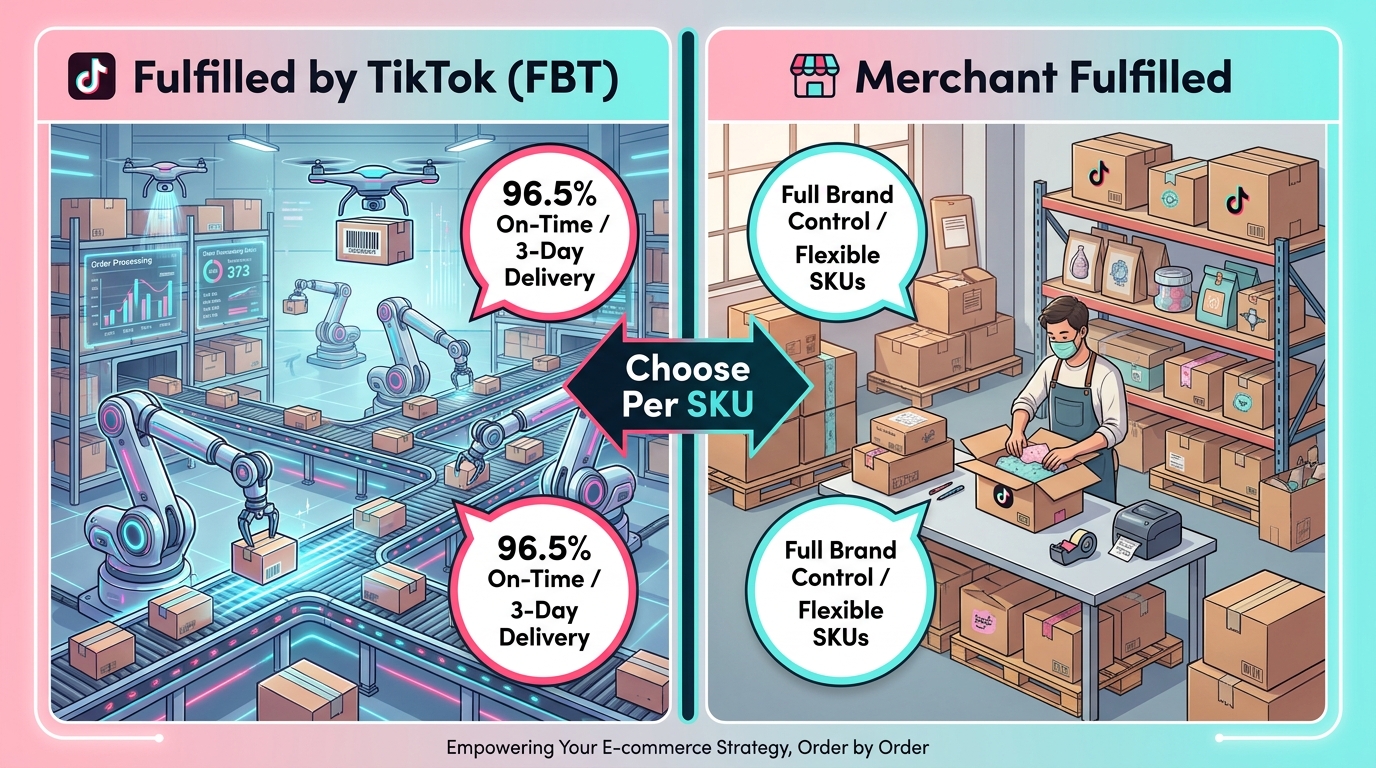
One of the most consequential decisions a TikTok Shop seller makes in 2026 is how to fulfill — not just as a business-wide choice, but at the individual SKU level. The three options each carry distinct performance profiles, cost structures, and risk tolerances.
Fulfilled by TikTok (FBT)
FBT is TikTok’s first-party logistics service. Sellers send inventory to TikTok’s fulfillment centers, and TikTok manages pick, pack, ship, and customer communications. The performance numbers are materially better than most self-fulfilled operations: FBT orders report approximately 96.5% on-time delivery, three-day delivery for most U.S. markets, and significantly lower LDR since TikTok’s own warehouse controls dispatch timing.
The platform advantage is also real. FBT-enrolled listings tend to receive a fulfillment quality badge that appears in search results and product pages, signaling reliability to buyers. There is strong circumstantial evidence — backed by operator reports — that FBT listings receive preferential placement in organic search and Shop tab results, though TikTok has not formally confirmed this as a ranking factor.
FBT works best for: high-velocity SKUs with predictable demand patterns, products under 10 pounds, items where packaging is standardized and brand-customized unboxing is not a priority, and any SKU where your current self-fulfillment metrics are borderline or weak.
FBT’s limitations are real, though. You lose control over packaging and unboxing experience. Inventory sent to TikTok’s centers is committed — returning unsold stock has lead times and potential fees. For slow-moving or experimental SKUs, FBT can create holding cost problems. And for sellers with highly customized packaging or fragile items requiring special handling, FBT’s standardized process may not be appropriate.
Merchant Fulfilled (Self-Ship)
Merchant-fulfilled shipping — where you control the entire logistics chain — remains available in 2026 after TikTok’s attempted mandate reversal (more on that in the next section). This is the right choice when: your product requires specialized handling or brand packaging; your SKU is large, heavy, or has carrier restrictions; you’re testing a new product and don’t want to commit inventory to a fulfillment center; or your existing 3PL already achieves sub-2% LDR and 96%+ VTR consistently.
The risk of merchant fulfillment is operational exposure. Every fulfillment metric — VTR, LDR, OTDR, SFCR — is entirely on you. If your team has a bad week, your account health takes the direct hit. If your 3PL has a system outage, your tracking integration goes dark. The buffers FBT provides simply don’t exist when you own the logistics chain.
Third-Party Logistics (3PL) Integration
The 3PL path is merchant fulfillment with an outsourced warehouse. In 2026, TikTok requires that 3PLs connect to your TikTok Shop account via API or approved middleware — not through manual CSV uploads or batch tracking submissions. Real-time integration is functionally mandatory to maintain VTR compliance, because batch-uploaded tracking data frequently registers as “late” against TikTok’s fulfillment clock even if it was generated on time.
When evaluating a 3PL for TikTok Shop compatibility, the due diligence list should include: native TikTok Shop API integration (not just Shopify or WooCommerce pass-through), SLA guarantees at or better than 48-hour dispatch, dedicated capacity reservation for TikTok Shop orders during peak periods, and real-time inventory syncing across all channels to prevent SFCR-triggering oversells.
The SKU-Level Decision Matrix
The most sophisticated operators in 2026 are not choosing a single fulfillment model for their entire catalog. They’re running FBT on their top 20% of SKUs by volume — the ones most likely to appear in viral creator videos, the ones with the highest order velocity during campaigns — while maintaining merchant-fulfilled or 3PL arrangements for slow movers, large items, and products with complex packaging needs.
This hybrid approach requires more operational coordination but provides the best mix of platform performance, cost control, and brand integrity. The practical approach: audit every active SKU by average weekly order volume, average unit dimensions and weight, packaging complexity, and current LDR and SFCR contribution. SKUs with high volume and simple packaging should move to FBT. Everything else stays merchant-fulfilled with robust 3PL integration.
The Mandatory Logistics Reversal: What Actually Happened
No discussion of TikTok Shop fulfillment in 2026 is complete without addressing the episode that rattled thousands of U.S. sellers in the first quarter of the year: TikTok’s attempted elimination of Seller Shipping as a fulfillment option.
What Was Announced
In late 2025, TikTok Shop began communicating to U.S. sellers that independent Seller Shipping — carrier-of-choice fulfillment — would be phased out, with all orders expected to route through TikTok Shop Logistics Services. The three approved options were Fulfilled by TikTok (FBT), Upgraded TikTok Shipping (a label-purchase-through-TikTok model), and Collections by TikTok (CBT), a pickup-at-warehouse program available near major logistics hubs. The proposed timeline targeted a full cutover between February 25 and March 31, 2026.
The seller community reaction was significant. Sellers with large, heavy, or fragile items — categories where TikTok’s standard logistics networks weren’t designed — faced potential incompatibility with FBT. Sellers in geographic areas not covered by TikTok’s pickup zones had no CBT option. And sellers with custom packaging or temperature-sensitive products saw no viable path within the platform logistics ecosystem.
What Actually Happened
By March 2026, TikTok had walked back the most aggressive elements of the mandate. Independent merchant-fulfilled shipping using third-party carriers remains available. However, the rollback was not a full retreat to pre-2026 norms. Several meaningful changes persisted after the reversal:
- Dispatch SLAs tightened regardless of fulfillment model — two business days applies universally.
- Tracking integration requirements became stricter — batch uploads are effectively non-compliant with VTR standards.
- FBT-eligible SKUs now receive enhanced placement signals that non-FBT listings don’t receive.
- The rollout of AHR scoring (which weights fulfillment heavily) proceeded on the original timeline, independent of the logistics mandate reversal.
The Lesson for Sellers
The episode reveals something important about TikTok Shop’s direction: the platform is moving toward logistics standardization. The March reversal was a timing adjustment, not a strategic retreat. Sellers who treat the reversal as a permanent reprieve are likely to find themselves scrambling when the next push comes — and operators who used the window to voluntarily migrate high-velocity SKUs to FBT or tightly integrated 3PLs are now in a meaningfully stronger compliance posture.
The strategic read: use the current flexibility to proactively align with where TikTok’s logistics requirements are headed, not to stay exactly where you were before the mandate was announced.
Dispatch Speed as a Ranking Signal, Not Just a Compliance Bar
Most sellers treat the 48-hour dispatch requirement as a compliance floor — a minimum standard to avoid penalties. This is the wrong frame. In TikTok Shop’s 2026 algorithm, fulfillment speed functions as a positive ranking input, not just an absence-of-penalty condition.
How Fulfillment Feeds Product Visibility
TikTok Shop’s product ranking system incorporates operational signals alongside relevance and conversion signals. Listings with consistently strong fulfillment metrics — specifically, low LDR and high OTDR — are associated with lower buyer-side risk. TikTok’s model treats reliable fulfillment as a proxy for buyer satisfaction, and it surfaces those listings more aggressively in search, Shop tab browse, and affiliate campaign matching.
The inverse is equally important. Listings where TikTok’s system has detected elevated LDR or low VTR may be algorithmically throttled before a formal enforcement action is ever taken. Sellers sometimes report declining impressions with no warning notification — in many of these cases, a fulfillment metric has drifted into a soft penalty zone without crossing the formal enforcement threshold.
Same-Day Dispatch as a Competitive Differentiator
While TikTok’s stated threshold is two business days, operators who consistently achieve same-day dispatch on orders placed before a set daily cutoff time are seeing measurable gains in buyer conversion rates. Buyers who see “ships today” or “arrives by [date two days from now]” in the estimated delivery display convert at higher rates than those seeing estimates three or more days out.
For merchant-fulfilled sellers, implementing a same-day dispatch cutoff — for example, orders placed before 1 PM ship same day — requires coordination between your order management system and warehouse team, but the conversion lift often justifies the operational investment. Several mid-market TikTok Shop brands have reported 12–18% conversion rate improvements after shifting from next-day to same-day dispatch for their primary SKU lineup.
Carrier Selection and OTDR
Not all carriers perform equally against TikTok’s delivery windows — and carrier performance directly affects your OTDR. For standard domestic U.S. shipping, USPS Ground Advantage and UPS Ground both perform well within TikTok’s six-business-day Standard window for most zones. For the three-business-day Express tier, Priority Mail and UPS 2-Day are the more reliable options, though both carry higher per-shipment costs that need to be weighed against the OTDR benefit.
In 2026, a growing number of sophisticated TikTok Shop sellers are building zone-aware shipping rules — routing orders from buyers in certain geographic zones to faster carriers automatically, ensuring OTDR compliance even for distant destinations without upgrading every order to an expensive express tier. This carrier-zone optimization, while more complex to implement, can materially reduce shipping costs while maintaining strong OTDR.
Handling Viral Spikes Without Torching Your Metrics
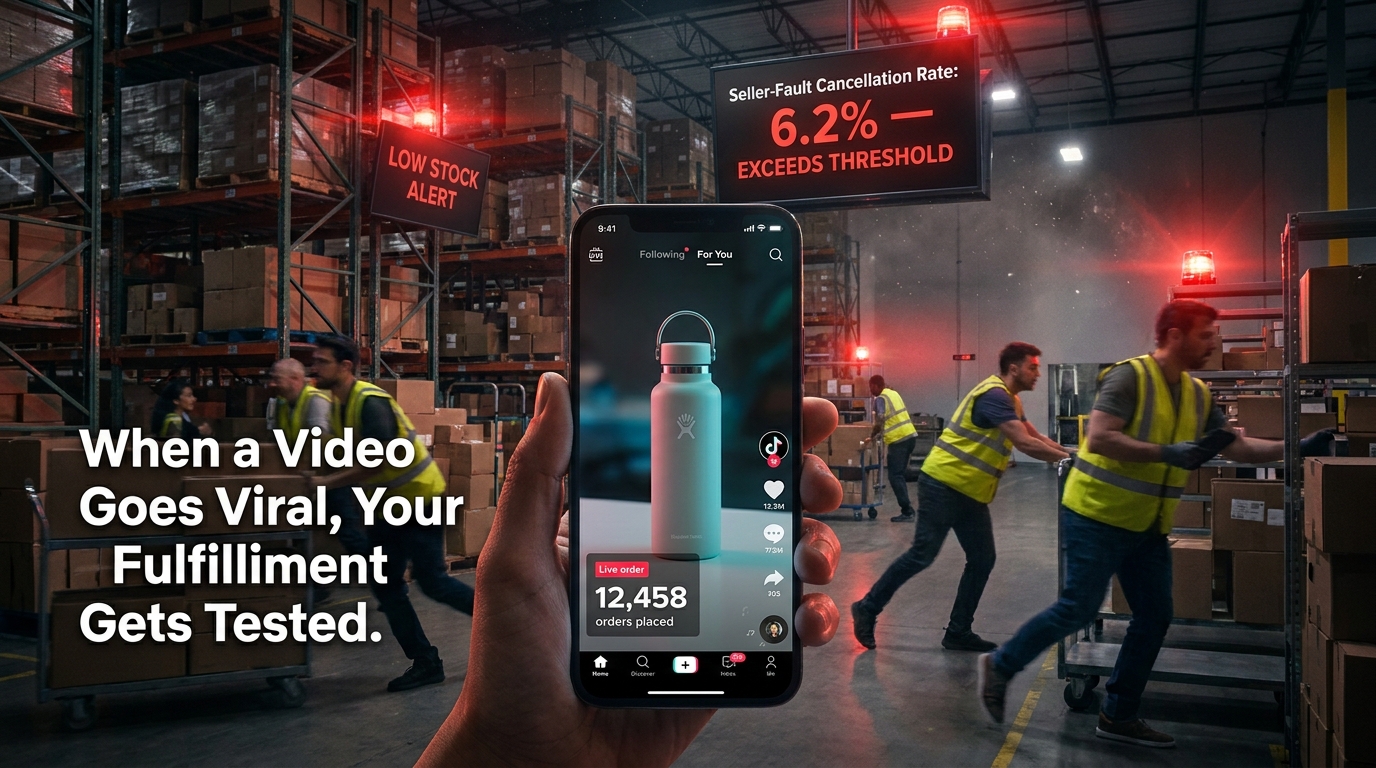
The most operationally dangerous moment for any TikTok Shop seller is not a slow week. It’s the day a creator video goes viral. A product with 50 units in stock and 30 average orders per week can receive 400 orders in 18 hours when the right video hits. What happens next determines whether a viral moment becomes a business-building event or an AHR-destroying crisis.
The Inventory Buffer Problem
Inventory buffers for TikTok Shop must be calibrated differently than for other channels. On Amazon or Shopify, demand spikes are typically more gradual — even aggressive ad campaigns take hours to ramp. On TikTok, a single 60-second video can generate demand faster than most warehouses can process orders, let alone replenish stock.
The practical solution is a tiered inventory commitment system. Your TikTok Shop-listed quantity should never equal your total on-hand quantity. A reasonable starting structure for sellers without FBT is to list 60–70% of on-hand stock as available on TikTok Shop, keeping the remainder as a fulfillment buffer. If TikTok Shop inventory depletes, you have time to either replenish or manually reduce the TikTok listing quantity before oversells occur.
For FBT sellers, the buffer calculation changes: TikTok controls the inventory visibility number at its fulfillment centers, and their system is generally better at preventing oversell than manual seller management. This is one of FBT’s underappreciated operational advantages — it reduces SFCR risk during demand spikes.
Coordinating with Affiliates Before Content Goes Live
In TikTok Shop’s open collaboration model, creators often don’t notify sellers before posting product content. A creator accepted into your affiliate program can post content at any time — including on the same day you’ve depleted inventory or sent your last FBT restock to the fulfillment center.
Best-practice operators in 2026 are building proactive communication protocols with their top 10–15 performing affiliates: a simple system where creators signal upcoming post dates at least 48 hours in advance. In exchange, brands offer priority access to new SKUs, higher commission tiers, or early campaign participation. This doesn’t eliminate the surprise-spike problem, but it significantly reduces its frequency for the creators driving the most volume.
Inventory Pause vs. Cancellation: Knowing the Threshold
When inventory depletes faster than expected, sellers face a choice: pause the listing (stopping new orders) or continue accepting orders they may not be able to fulfill. The math is almost always in favor of pausing.
Pausing a listing is operationally simple — set quantity to zero or deactivate the listing temporarily. It has no direct AHR consequence. Accepting orders you can’t fulfill, by contrast, generates SFCR violations that directly depress your account health score and may trigger auto-cancellations that TikTok issues automatically on behalf of buyers after dispatch deadlines are missed.
The operational discipline here: establish a hard inventory floor below which TikTok Shop listing quantity automatically drops to zero. For most mid-market sellers, a floor of 10–15 units is appropriate — enough to fulfill the last orders received while the listing is being paused, without exposing yourself to SFCR from orders you genuinely can’t ship.
Post-Spike Recovery Checklist
After a viral demand event, the work isn’t done when orders are shipped. The post-spike period is when metric damage becomes visible, and when proactive steps can prevent compounding effects:
- Pull your LDR dashboard for the 72-hour window around the spike — identify any orders that exceeded the 48-hour dispatch window and document the root cause.
- Check VTR for the same period — high-volume days sometimes expose tracking upload bottlenecks in 3PL or OMS integrations.
- Review any auto-generated cancellations during the spike period and calculate their contribution to SFCR.
- Refresh FBT inventory or restock your 3PL immediately — the same viral video often resurfaces weeks later with a second demand wave.
- Debrief with the creator if possible — understanding when content is scheduled for repost or reshare allows better inventory prep.
Returns and After-Sales: The Fulfillment Metrics Most Sellers Overlook
Most sellers think of fulfillment as the outbound journey only — from their warehouse to the buyer’s door. TikTok Shop in 2026 measures it as a round trip. The returns and after-sales system now generates its own performance metrics that feed into your AHR and overall shop health standing.
The Two Key After-Sales Metrics
After-Sales Handling Time (AHT) measures how quickly you respond to return and refund requests. TikTok’s standard is four business days for standard return requests. For refund-only requests on orders valued at $100 or less, the review window compresses to two business days. Sellers who consistently exceed these response windows accumulate AHT violations that reduce AHR.
Invalid Seller Rejection Rate (ISRR) measures the rate at which you reject return requests that TikTok subsequently determines were valid. If you reject a return on grounds TikTok doesn’t accept — for example, claiming buyer misuse when the product arrived damaged — and TikTok overrides your rejection, that override is logged as an invalid rejection. High ISRR indicates that your return review process is out of alignment with TikTok’s policies and directly depresses your account health.
The 30-Day Return Window
TikTok Shop’s standard return window for eligible items in the U.S. is 30 days from delivery. Sellers cannot unilaterally shorten this window for standard product categories. Within that window, TikTok is increasingly automating the approvals process — particularly for low-value orders or orders where the buyer has uploaded photographic evidence of the issue.
Auto-approval means the refund or return is approved without requiring your manual review. For sellers with high return rates on specific SKUs, this automation removes any ability to contest individual claims. The upstream implication: listing quality — accurate product descriptions, honest photography, clear sizing or specification information — is now a direct input to your return rate, which in turn affects AHT workload and ISRR risk.
Return Cost Allocation in 2026
TikTok has been progressively adjusting how return shipping costs are allocated between buyer and seller. In 2026, the general structure allocates return shipping costs to sellers when the return is caused by fulfillment error (wrong item, damaged goods, item not as described) and to buyers when the return is buyer-preference (changed mind, doesn’t fit, didn’t want it anymore).
However, “not as described” is broadly interpreted by TikTok’s dispute resolution system. A product that looks materially different from its listing photos — even if it technically matches the written description — is often categorized as seller-fault. This creates a financial exposure most sellers don’t fully anticipate. The mitigation: ensure listing images are accurate representations of the exact item being shipped, not idealized product photography that doesn’t match what arrives in the box.
Building a Returns Workflow That Protects Your Metrics
The sellers with the strongest after-sales metrics in 2026 are those who have built structured, staffed return review workflows — not treating returns as an afterthought. Practically, this means:
- Assigning a dedicated team member or defined daily time block specifically for return request review.
- Using TikTok Seller Center’s after-sales dashboard daily, not weekly — requests that sit unreviewed can exceed the AHT window before you notice them.
- Documenting rejection reasons with specific policy references when you do reject — this creates a record if TikTok reviews the rejection.
- Tracking return rates by SKU monthly — any SKU with a return rate above 8–10% is a listing quality or product issue that needs addressing, not just a returns management problem.
Cross-Border Fulfillment: What CBT Can and Can’t Do in 2026
For sellers operating internationally or sourcing from overseas, TikTok Shop’s cross-border fulfillment landscape in 2026 is more restrictive than many expect — and more fluid than official documentation always reflects.
The Three Logistics Tiers and International Limitations
TikTok Shop Logistics Services encompasses three options: FBT (first-party fulfillment centers, U.S. domestic), Upgraded TikTok Shipping (label purchasing through TikTok’s carrier network for U.S. domestic orders), and Collections by TikTok (CBT), a warehouse pickup program available near major logistics hubs in select U.S. regions.
The critical limitation: as of mid-2026, TikTok Shipping and CBT are U.S. domestic programs. They are not available for cross-border warehouse operations. A seller fulfilling from a factory or warehouse outside the U.S. cannot use FBT or CBT for that inventory directly. They must either ship to a U.S. fulfillment center first (then use FBT domestically) or fulfill directly from overseas using merchant-shipping protocols — which carry all the VTR and OTDR risks associated with international shipping timelines.
Cross-Border Performance Realities
International shipping to U.S. buyers faces inherent delays that are difficult to reconcile with TikTok’s three-to-six business day delivery expectations. Customs clearance alone can consume two to three of the six business days in the Standard shipping window. This makes OTDR compliance structurally difficult for direct cross-border shipping into TikTok’s Express or Standard categories.
The platform’s response to this reality has been partial rather than comprehensive. Some categories of cross-border sellers operate under adjusted delivery expectations or separate program guidelines, but these are not uniformly documented and can change with policy updates. Sellers fulfilling primarily from overseas are strongly advised to consult current TikTok Seller University documentation and, where possible, to establish a U.S.-based buffer inventory — even a small FBT send-in or 3PL stock point — to serve their highest-velocity SKUs with domestic fulfillment speeds.
Customs, VAT, and Compliance Documentation
For cross-border shipments, customs and tax compliance adds another layer of fulfillment complexity. TikTok Shop’s platform does collect and remit sales tax for U.S. domestic transactions, but customs duties, import taxes, and any applicable VAT on international shipments are not handled by the platform. Sellers remain responsible for ensuring their cross-border shipments comply with import regulations, and mis-declared packages or incorrect duty categorizations can cause delivery delays that damage OTDR without any carrier failure being at fault.
The operational recommendation: if you’re running cross-border fulfillment at meaningful scale in 2026, work with a customs broker or freight forwarder who has specific experience with e-commerce parcel volumes and TikTok Shop’s delivery expectations. The cost of professional customs compliance is typically recovered within weeks through reduced OTDR violations alone.
Building Your Fulfillment Audit: The 30-Day Action Plan
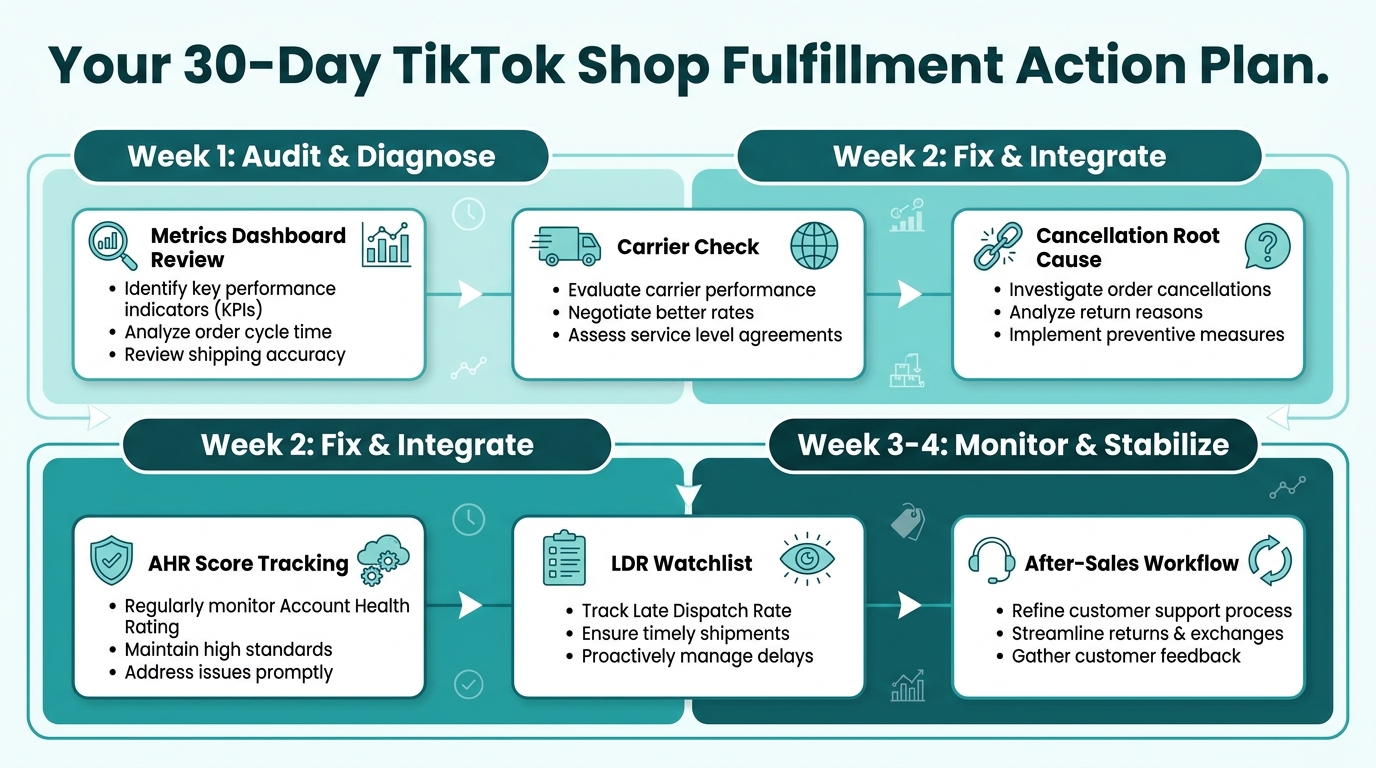
Everything above is context. This section is the action. Here is a sequenced 30-day plan for auditing and tightening your TikTok Shop fulfillment operation in 2026, organized by week.
Week 1: Audit and Diagnose (Days 1–7)
Days 1–2: Pull your current metric baseline. Log into TikTok Seller Center and navigate to Account Health. Record your current AHR score, and then pull the last 30-day snapshots for each of the four core metrics: VTR, LDR, OTDR, and SFCR. Write down the actual numbers — not just whether they’re green or red — because you need the raw rates to understand severity and to track improvement.
Days 3–4: Root cause map each failing metric. For every metric below threshold or trending toward threshold, work backward through the fulfillment chain to find the cause. LDR issues? Check whether they concentrate on specific days of the week, specific product categories, or specific order volume levels. VTR issues? Check your 3PL or OMS integration — are tracking numbers uploading in real time or via batch? SFCR issues? Pull the cancelled orders and identify whether they were stock-outs, dispatch failures, or system errors.
Days 5–6: SKU-level audit. For every active SKU, record its average weekly order volume, current fulfillment model (FBT, merchant, or 3PL), its contribution to LDR and SFCR over the past 30 days, and its average return rate. Build a simple spreadsheet. This becomes your prioritization input for Week 2.
Day 7: Carrier and integration review. Audit every carrier you currently use against your OTDR data by zone. Identify which carrier-zone combinations are consistently producing late deliveries. Simultaneously, test your tracking integration — confirm that tracking numbers upload to TikTok within 30 minutes of dispatch, not batched at end of day.
Week 2: Fix and Integrate (Days 8–14)
FBT enrollment for priority SKUs. Based on your SKU audit, identify the top 20–30% of SKUs by volume that are: under 10 lbs, simply packaged, and currently merchant-fulfilled. Begin the FBT enrollment process for these items. FBT onboarding typically takes 7–14 days from application to receiving inventory — starting now means you’re FBT-active within three to four weeks.
3PL integration fixes. If your root cause audit identified tracking batch upload as a VTR risk, escalate immediately to your 3PL for real-time API integration. Most modern 3PLs have TikTok Shop integration available — the bottleneck is usually configuration and testing, not capability. If your current 3PL cannot achieve real-time tracking upload, document the gap and begin evaluating alternatives.
Inventory floor implementation. Set automated inventory floors on your TikTok Shop listings. This can be done through your OMS, your 3PL WMS settings, or via TikTok Seller Center’s manual inventory management for smaller catalogs. The floor should reflect the number of units needed to fulfill in-flight orders while you pause the listing — typically 10–20% of your average weekly order volume.
Affiliate communication protocol. Send a brief communication to your top 10–15 affiliates asking them to signal upcoming post dates at least 48 hours in advance. Offer a concrete incentive — a small commission bump or early access to a new SKU. This is a soft change that pays dividends immediately during your next viral event.
Weeks 3–4: Monitor and Stabilize (Days 15–30)
Daily metric check-in. For the first two weeks after making operational changes, check your four core metrics and AHR score every business day. You’re looking for directional improvement, not immediate perfection. VTR and LDR should respond quickly to operational fixes — within 5–7 days. OTDR responds more slowly because it reflects a rolling delivery completion window. SFCR improves as inventory floors take effect and oversell incidents stop occurring.
Return rate review by SKU. Pull 30-day return rates for every SKU. Any product above a 10% return rate needs a root-cause review: are the returns due to sizing issues (fix the size guide), product-not-as-described (fix the listing), or quality failures (address with supplier)? Do not treat high return rates as a cost-of-business line item — they generate ISRR risk and reduce AHR over time.
After-sales workflow audit. Check your average response time on return requests for the past 30 days. If any requests exceeded the four-business-day window, identify whether that was due to staffing gaps, notification failures, or dashboard oversight. Implement a daily after-sales review block — 15 minutes each morning reviewing open return requests — to prevent AHT violations going forward.
AHR trajectory assessment. By Days 28–30, you should have enough data to see whether your AHR score is trending upward, stable, or still declining. If declining despite operational fixes, look for a policy compliance issue — a listing that violates content rules or an IP complaint that’s feeding score reductions outside the fulfillment metrics.
Quick-Reference Thresholds for Day-to-Day Monitoring
| Metric | Target (Safe Zone) | Caution Zone | Enforcement Zone |
|---|---|---|---|
| VTR | ≥ 97% | 95–96.9% | < 95% |
| LDR | < 2% | 2–4% | > 10% |
| OTDR | ≥ 85% | 80–84.9% | < 80% |
| SFCR | < 1% | 1–2.5% | > 2.5% |
| AHR Score | 300+ | 150–299 | < 150 |
What Operationally Strong Sellers Are Doing Differently
Across the patterns of sellers who are consistently performing in the top tier of TikTok Shop fulfillment metrics in 2026, several behaviors distinguish them from those who are perpetually firefighting compliance issues.
They Treat Fulfillment as a Marketing Function
Top-performing sellers don’t separate fulfillment operations from their marketing team’s planning. When an affiliate campaign is being planned, the ops team is in the room. When a new creator is given access to a product for review, inventory levels are checked. When a Live Shopping event is scheduled, a minimum inventory buffer is confirmed before the stream goes live. This cross-functional coordination is not sophisticated — it’s straightforward — but it’s absent from the majority of TikTok Shop operations below the top tier.
They Operate With a 300+ AHR Target, Not a 200 Floor
Sellers who stay above 300 AHR have meaningful protection against a bad operational week. If a carrier outage, staffing shortage, or demand spike causes a temporary metric dip, a 300+ AHR gives you room to absorb the hit without crossing into enforcement territory. Sellers operating at 210 or 220 have almost no buffer — one challenging week can push them into listing restrictions.
They Use FBT Strategically, Not Universally
The nuance is important: the best operators are not “FBT everything” or “FBT nothing.” They’ve done the SKU-level math on which products benefit from FBT’s speed and platform placement signals, and which products are better served by a tightly managed 3PL. They review this allocation quarterly as their SKU mix evolves and as platform requirements change.
They Have a Documented Escalation Protocol
When a metric crosses a threshold — or trends toward one — there’s a documented response protocol that doesn’t rely on institutional memory or a single person’s judgment. Who is notified? What actions are taken first? Who has authority to pause a listing? What’s the communication to the affiliate team? Having these answers documented before a crisis means the response time is measured in hours, not days.
The Real Cost of Letting Fulfillment Slide
It’s worth being explicit about what actually happens when fulfillment metrics degrade — because the consequences are not always immediate and visible. They’re often slow, compounding, and by the time they’re obvious, expensive to reverse.
In the first phase, a drifting metric — say, LDR creeping from 1.5% to 3.5% over six weeks — typically has no formal enforcement action associated with it. But TikTok’s algorithm is already adjusting. Product impressions in search may decline subtly. Affiliate matching recommendations may begin favoring competing listings with cleaner fulfillment records. The listing’s position in Shop tab browse may slip by one or two ranks. None of this triggers a notification. The revenue impact accumulates quietly.
In the second phase, if the metric crosses a formal enforcement threshold, the consequences become explicit: an account health warning, a promotional campaign restriction, or an order cap. At this point, the seller is also dealing with a 180-day AHR window that already contains weeks or months of below-par performance. Fixing the operational root cause today doesn’t flip the score tomorrow — it starts a slow climb out of a hole that took months to dig.
In the third phase — sub-150 AHR, listing restrictions active — sellers face a compounding problem. Reduced visibility generates fewer orders. Fewer orders mean less revenue to invest in operational fixes. The affiliate creators who might drive recovery traffic are matching with competitors instead. Recovery is possible, but it requires both operational fixes and sustained patience through a rolling window that takes months to reflect improvement.
The sellers who understand this cascade are the ones who treat a 3% LDR as urgently as they’d treat a 15% LDR. The metric you fix at 3% costs a week of operational focus. The metric you address at 15% costs months of compounding recovery.
Where Fulfillment Standards Go From Here
TikTok Shop’s trajectory is clear, even if the exact timeline of individual policy changes is not. The platform is building toward a model where fulfillment performance is as central to seller success as product quality and marketing. The AHR system formalizes that relationship. The FBT push — even after its partial reversal — signals where the platform’s logistics preferences lie.
Sellers who approach 2026’s fulfillment standards as a baseline to maintain are operating defensively. Sellers who approach them as a competitive variable — a set of performance inputs they can optimize above and beyond the floor — are positioned to compound advantages over the next two to three years as the platform matures and the field of compliant sellers grows.
The four metrics are fixed. The AHR thresholds are published. The 30-day action plan above is executable this week. What’s left is the operational will to treat fulfillment as the commercial lever it has become — not the back-office afterthought it used to be.