

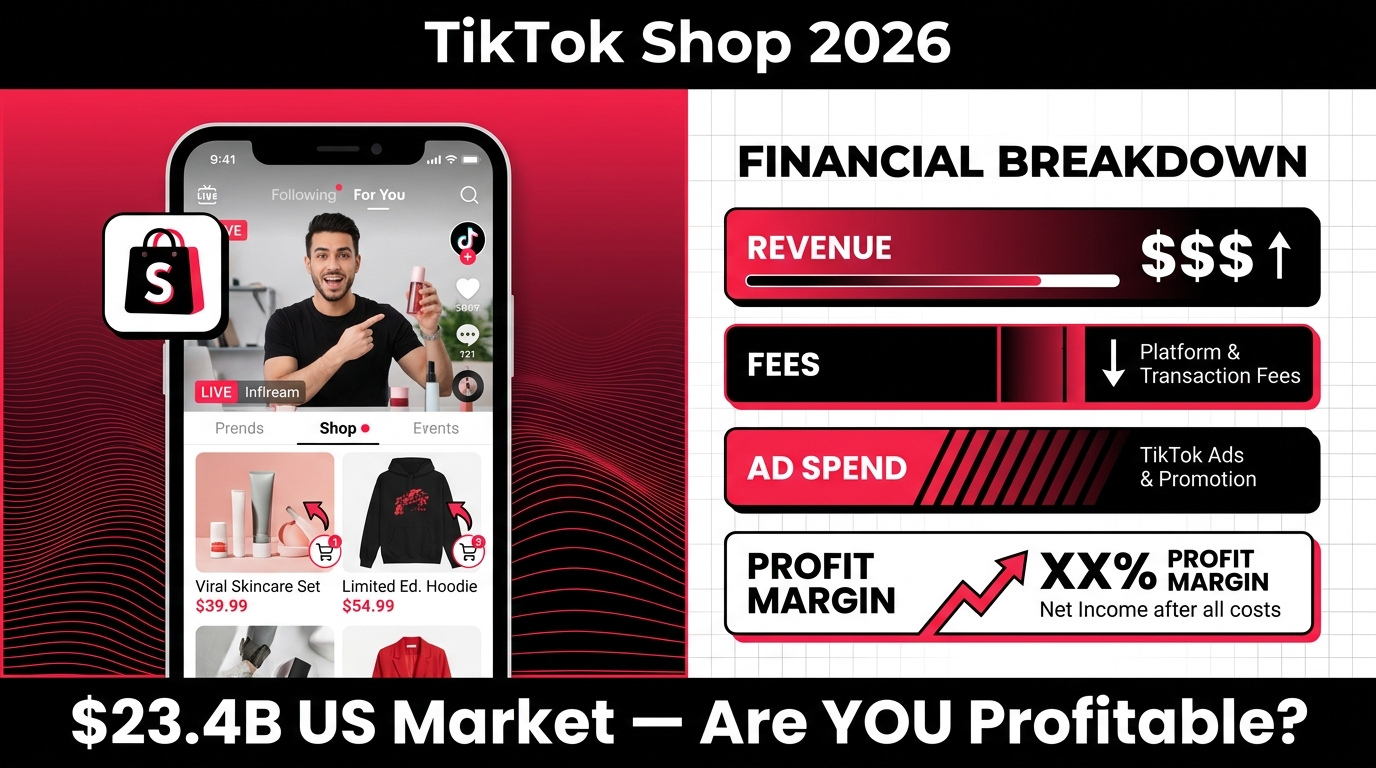

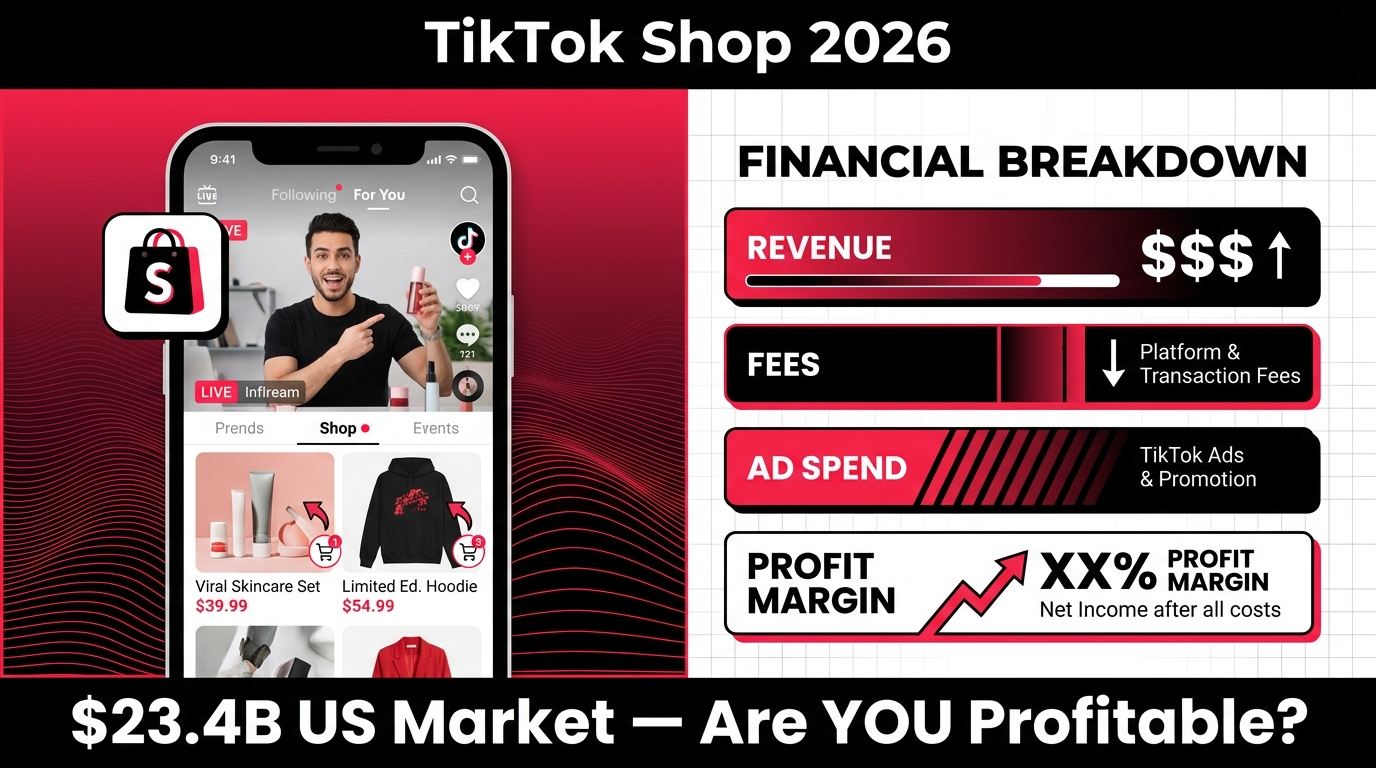
TikTok Shop is on track to hit $23.41 billion in US gross merchandise value in 2026 — a figure that puts it ahead of Costco and Target by some projections. Over 70 million products are listed on the platform. Brands that were sitting on the sidelines two years ago are scrambling to get in.
And yet, for every seller celebrating a viral moment, there’s another one quietly running out of cash. The video went live, the orders flooded in, the inventory evaporated — and the numbers at the end of the month didn’t add up the way they were supposed to.
The conversation around TikTok Shop has been dominated by two narratives: the rags-to-riches success story and the SEO/algorithm optimization angle. What’s missing is the operational and financial reality underneath both of those. What are the actual costs that hit your margin on every sale? How do you choose products that don’t die in two weeks? What does a durable, repeatable TikTok Shop business look like — not just a one-hit wonder?
This post is about the mechanics that separate sellers who are genuinely building a sustainable business on TikTok Shop from those who are just renting someone else’s trend cycle. We’ll cover unit economics, traffic channel strategy, affiliate network building, live commerce operations, inventory pacing, and account health — the full operational picture most sellers don’t see until they’ve already made expensive mistakes.
The Real Cost Stack: What You Actually Keep After Every TikTok Shop Sale
The single most dangerous assumption new TikTok Shop sellers make is confusing revenue with income. A viral product that generates $50,000 in GMV in a week can still produce a negative cash outcome when you actually stack the cost structure from top to bottom.
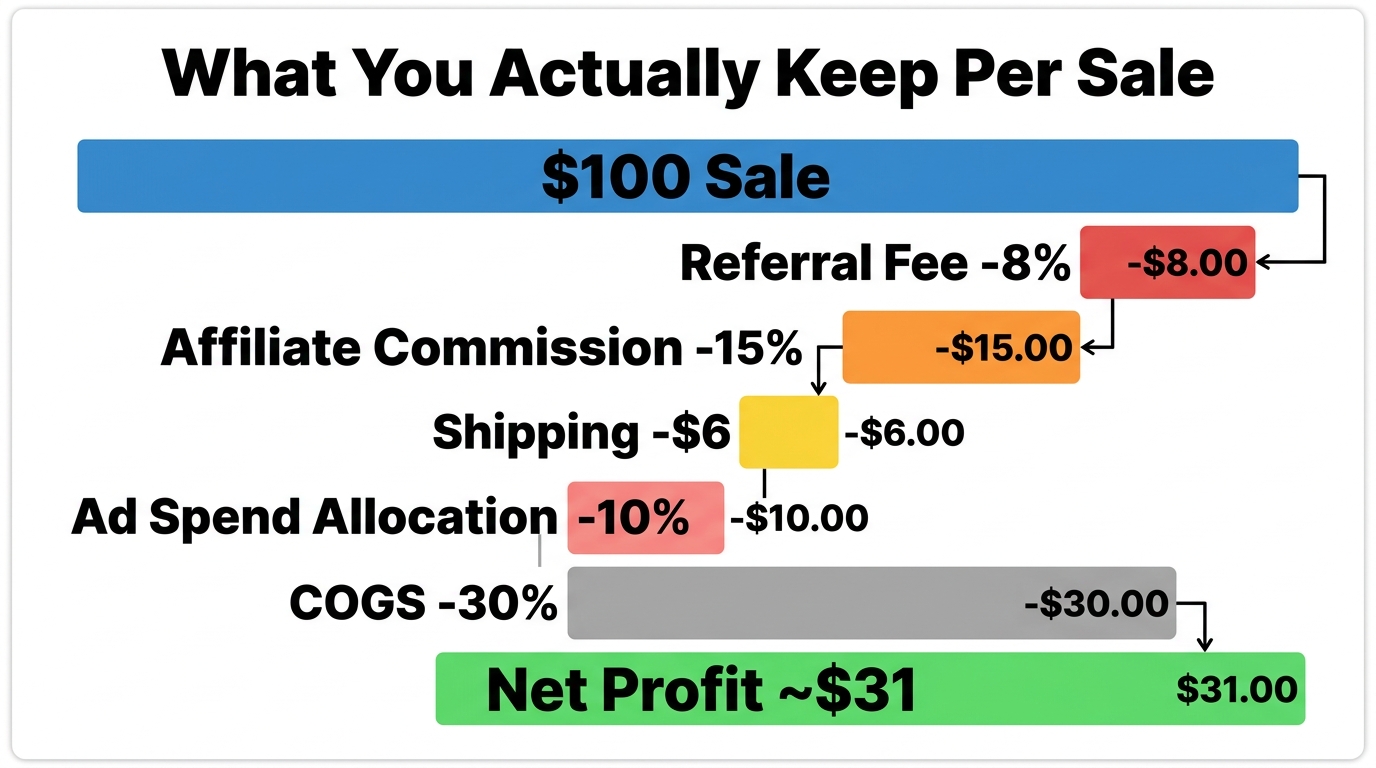
Here’s how the numbers actually flow on a typical $100 sale in 2026:
Referral Fees
TikTok Shop charges sellers a referral fee based on product category, which typically ranges from 2% to 8% depending on the vertical. Most competitive categories — beauty, apparel, electronics accessories — sit at or near the 8% ceiling. On a $100 sale, that’s $8 gone before anything else. This fee is non-negotiable and applies to every order regardless of whether the sale came from organic content, an affiliate, or a paid ad.
Affiliate Commissions
This is the line item that blindsides the most sellers. TikTok Shop’s affiliate marketplace is how most products gain traction — creators pick up your products, make content, and earn a commission on every sale they drive. The commission rate is set by you, the seller, but the market reality is that competitive commissions in most categories now sit between 10% and 20%. If you list at 10%, top-tier creators with large followings will simply skip your product in favor of a competitor offering 15% or more. On a $100 sale at a 15% commission: that’s another $15 gone.
Combined, your referral fee plus affiliate commission has already consumed 23% of your sale price before you’ve shipped a single unit.
Shipping and Fulfillment
TikTok Shop’s fulfillment model offers two paths: seller-fulfilled (you handle it) or TikTok’s own fulfillment network (similar to FBA). Seller-fulfilled orders in the US typically run $4 to $8 per package depending on weight and carrier, and TikTok does apply shipping subsidies selectively — but these are not guaranteed and can change. Budget a realistic $6 per order for the average small-to-mid-size product.
Cost of Goods
A 30% COGS ratio is considered healthy for physical product businesses, though many TikTok Shop sellers pushing commodity or trending items face COGS ratios of 40–50% as sourcing competition drives prices up and sellers race to underprice each other. For this illustration, let’s use 30%: that’s $30.
Ad Spend Allocation
Even if a sale comes from an affiliate creator, you’re likely running some level of Shop Ads (formerly known as TikTok’s in-feed shopping ads) to seed initial velocity or retarget viewers. A conservative allocation of 8–12% of GMV on paid ads is common for sellers in growth mode. That’s another $10 on a $100 sale.
The Bottom Line
Stack it all together on that $100 sale:
- Referral fee: -$8
- Affiliate commission: -$15
- Shipping: -$6
- COGS: -$30
- Ad spend: -$10
- Net margin: ~$31 (31%)
That 31% assumes everything goes right — no returns, no customs issues on imported goods, no customer service labor, no platform refunds. Factor in a realistic 4–8% return rate (which TikTok Shop handles by processing refunds that come back to you), and your actual realized margin per dollar of GMV can drop below 25%.
The takeaway: you need a minimum price point and margin structure built into your product selection before you ever list anything. A $12 product with a 40% COGS is almost certainly unprofitable on TikTok Shop once all costs are applied. The floor for sustainable selling is generally a price point above $25, with COGS below 35% and a product that can command affiliate commissions without pricing itself out of the market.
Choosing Products That Survive Past the Viral Spike
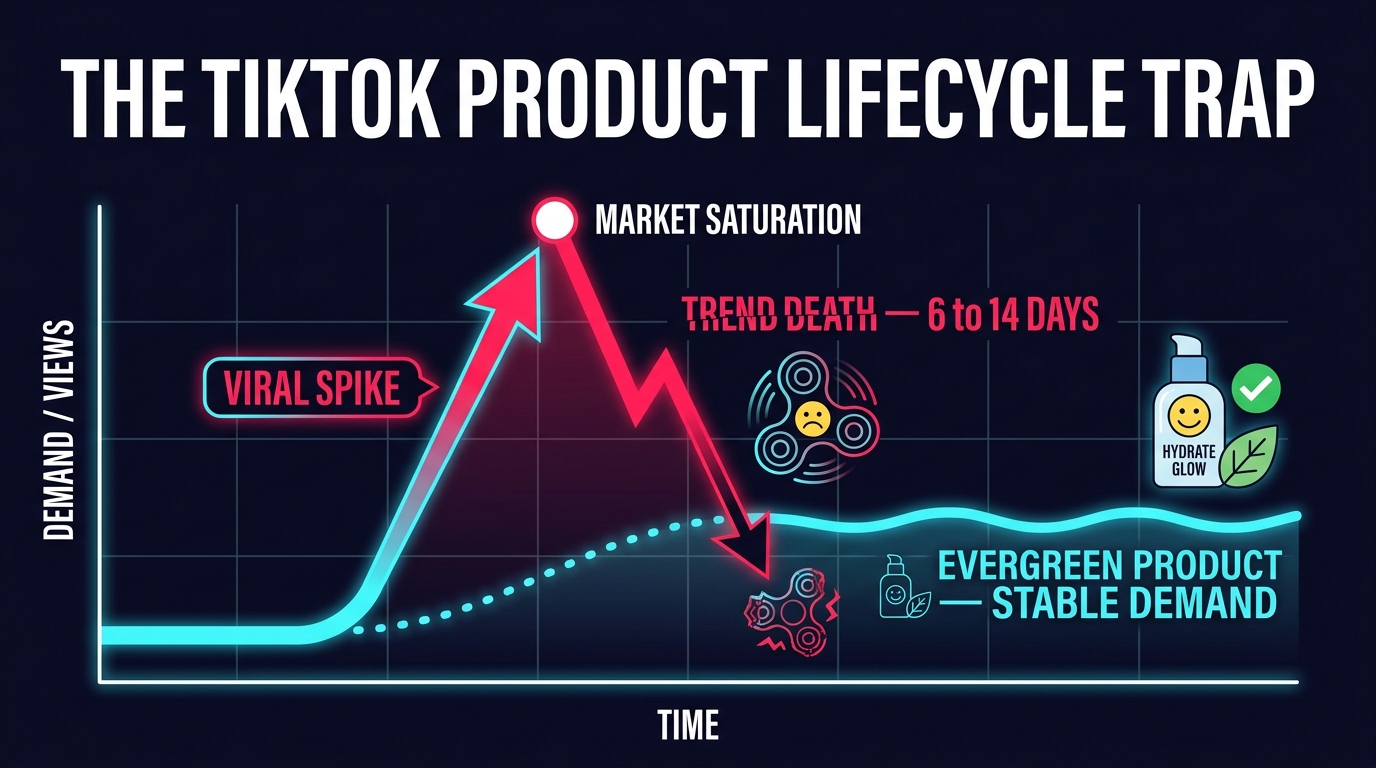
TikTok is one of the most powerful product discovery engines ever built. It can take an unknown item from zero to millions of views in 48 hours. That power cuts both ways: the same mechanism that amplifies your product also amplifies every competitor who notices what’s working.
The Trend Compression Problem
In traditional retail, a trend cycle might last 6 to 18 months. On TikTok, that compression can be extreme. A novelty product that goes viral on a Tuesday can face 50+ new competitors by the following Monday, with sourcing agents in China watching TikTok feeds specifically to replicate anything that gets traction. Some product categories have seen viral moments go from first hit to complete market saturation in as little as 10 to 14 days.
This is not a reason to avoid trending products entirely — it’s a reason to treat them as a cash-flow event rather than a business foundation. The sellers who make serious money from trend cycles are those who can move fast, liquidate before the saturation hits, and have a catalog of stable products carrying the business in between.
The Evergreen vs. Trend Portfolio Model
Successful TikTok Shop sellers increasingly think in portfolio terms rather than single-product terms. The operating model looks like this:
- 60–70% of catalog: Evergreen products — items with consistent, year-round demand that don’t require viral moments to sell. Think everyday supplements, home organization products, reusable items, pet accessories. These generate predictable cash flow and keep your shop metrics healthy even during slow creative periods.
- 20–30% of catalog: Trend-adjacent products — items that ride broader category waves (e.g., “gut health” as a sustained wellness trend, not a single viral moment). These benefit from TikTok’s interest-based discovery without depending on a single content explosion.
- 10% of catalog: Opportunistic trend plays — genuine trend chasers where you move fast, keep inventory light, and cash out before saturation. These can be high-margin events but should never be the thing your cash flow depends on.
Product Validation Signals to Watch
Before committing to a product, look for these signals in TikTok’s own data tools and the broader market:
- Search volume trend in TikTok Creative Center: Is the keyword growing steadily, or did it spike once and drop? A single-peak keyword suggests a trend already past its cycle.
- Number of competing listings: If 400 sellers are already listing the exact item with similar images, the margin compression has likely already begun.
- Review velocity on Amazon for the same product: Amazon can be a useful leading or lagging indicator — if the product is surging there too, you’re in a broader trend. If it’s only on TikTok, it may be more ephemeral.
- Repeat purchase potential: Products that get consumed or need replacement (consumables, skincare, coffee, supplements) build customer lifetime value even on a platform that doesn’t share customer data.
The Four Traffic Channels Inside TikTok Shop — and Where to Focus
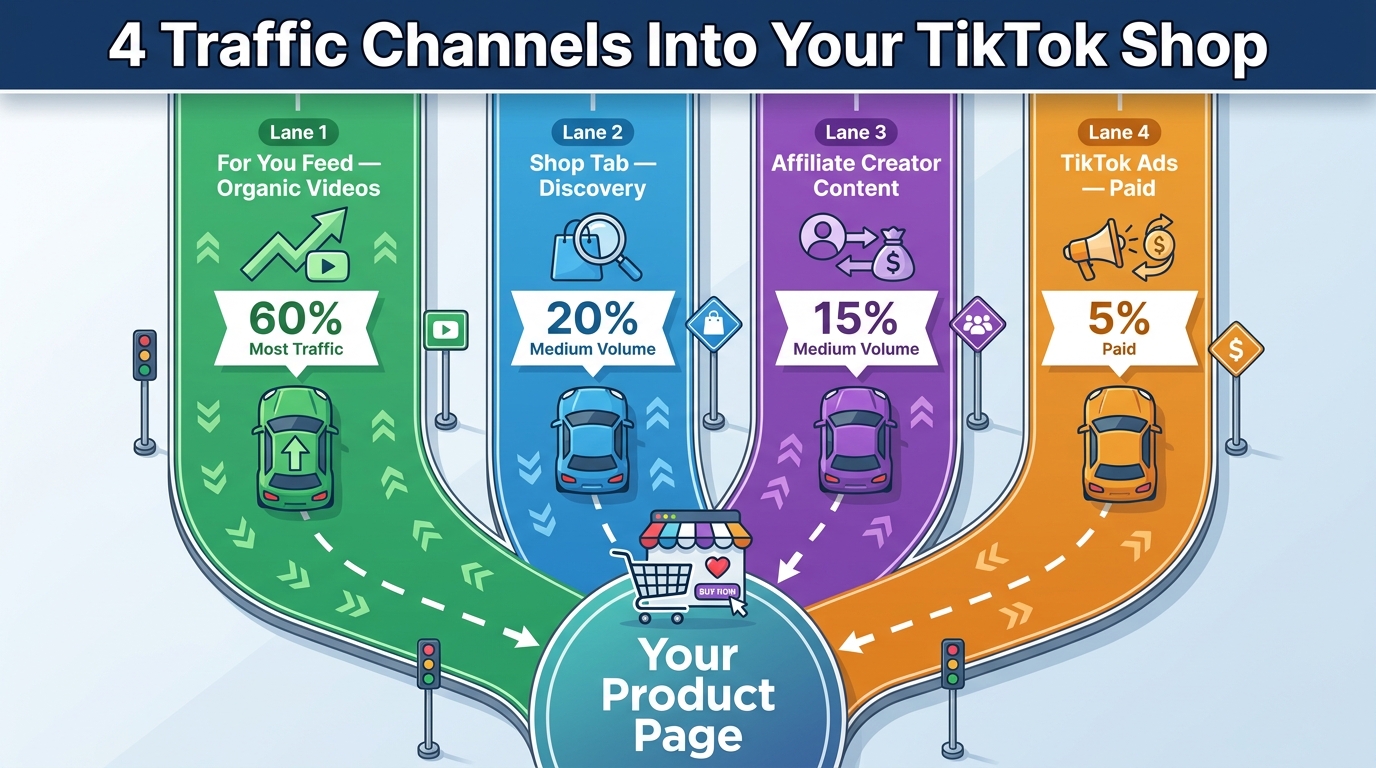
One of the most important strategic decisions a TikTok Shop seller makes — usually without realizing it — is which traffic channel to lead with. Each of the four main channels operates on different economics, timelines, and risk profiles.
Channel 1: Organic Shoppable Videos (For You Feed)
This is TikTok’s flagship. A shoppable video embedded with a product link appears in users’ For You feeds as native content. When it lands well, the economics are exceptional — you pay only the referral fee and COGS, with no ad spend or affiliate commission cutting in. The challenge is consistency. Very few brand accounts can reliably produce organic viral content at scale. The For You feed should be part of your strategy but is a fragile primary channel to depend on.
Best practice: commit to a baseline of 3–5 product-focused organic videos per week. Use the first few seconds to demonstrate the product solving a specific, tangible problem. Don’t pitch — show. TikTok’s algorithm surfaces content based on completion rate and engagement, not follower count, which means a zero-follower brand account can go viral if the content is genuinely compelling.
Channel 2: The Shop Tab
The Shop tab is TikTok’s dedicated commerce surface — a personalized product discovery feed that functions similarly to Amazon’s browse and search experience inside TikTok. Products surface here based on listing quality, sales velocity, review count, and shop metrics. This channel rewards sellers who treat their product listings with the same rigor as they would an Amazon listing: clear titles with relevant keywords, high-quality primary images, complete specifications, and robust review counts.
The Shop tab is increasingly important as TikTok trains its user base to shop without needing to see creator content first. Buyers who discover products through the Shop tab convert at higher rates because they have purchase intent already — they’re actively browsing. Optimizing for Shop tab visibility is one of the highest-leverage activities a seller can invest in.
Channel 3: Affiliate Creator Content
The TikTok Shop affiliate marketplace allows creators of any size to browse your product catalog, request free samples, and post content earning commissions on sales they drive. This is arguably the most scalable traffic channel for most sellers because it decentralizes content creation. Instead of relying on your own brand account, you’re building an army of creators making videos about your product.
The economics are clear: you pay only when a sale happens. There’s no upfront ad spend risk. The challenge is that top-performing creators are selective, and most brands with fewer than 500 reviews and a weak commission offer will be ignored. We’ll cover affiliate network building in the next section.
Channel 4: TikTok Shop Ads (Paid)
TikTok’s ad suite for Shop includes several formats: Video Shopping Ads (VSA), LIVE Shopping Ads (LSA), and Product Shopping Ads (PSA). Paid ads function as an amplifier — they work well when you already have proven organic or affiliate content to put spend behind, and they work poorly as a cold-start mechanism without existing social proof.
The biggest mistake sellers make with TikTok Shop ads is treating them like Meta or Google campaigns with immediate ROAS expectations. TikTok ads operate on a learning phase of 7–14 days before the algorithm understands your audience well enough to optimize delivery. Pulling budgets early kills campaigns before they find their stride. Budget at least two full weeks of learning-phase spend before judging ad performance.
Building Your Affiliate Network Before You Need It
Most sellers approach affiliate marketing reactively: they list a product, then hope creators find them. The sellers generating consistent sales from affiliate traffic are the ones who treat creator relationships as a proactive, managed function — not a passive listing benefit.
The Tier Structure of TikTok Creators
Not all creators are equal, and not all are appropriate for every product. Understanding the tier structure shapes how you recruit and incentivize:
- Mega-creators (1M+ followers): High reach, high cost, often managed by agencies. Commission offers alone rarely secure their promotion — expect to negotiate paid sponsorships on top of commissions. ROI can be excellent but is unpredictable.
- Mid-tier creators (100K–1M followers): The sweet spot for most brands. Engaged audiences, more accessible for direct outreach, and often willing to work on commission-only terms for products they genuinely like. Commission rates of 15–20% are competitive for this tier.
- Micro-creators (10K–100K followers): Lower individual reach but often higher engagement rates and more niche authority. A micro-creator in the skincare niche with 30K dedicated followers can outperform a general lifestyle creator with 500K. Micro-creators are also more willing to post quickly with minimal friction.
- Nano-creators (<10K followers): Often overlooked but valuable in aggregate. A coordinated campaign with 50–100 nano-creators can generate significant content volume at very low cost per video, and some of those videos will randomly surface in the algorithm regardless of follower count.
Proactive Outreach Strategy
Rather than waiting for creators to find you in the affiliate marketplace, the fastest way to build momentum is direct outreach. Use TikTok’s creator marketplace or simply find creators posting in your product category and send a targeted collaboration request through the Seller Center. Your outreach message should be specific: reference their recent content, explain why your product is relevant to their audience, and lead with the commission offer plus a free sample.
Sample volume matters more than most sellers realize. Offering free product samples in exchange for content (with no obligation to post if they don’t like it) builds goodwill and produces authentic reviews. A creator who genuinely tried your supplement and liked it will make a more convincing 60-second video than one who’s just doing it for the commission.
Setting Commission Rates Strategically
Your commission rate is a competitive signal to creators browsing the affiliate marketplace. Set it too low (under 10%) and your product gets passed over. Set it too high (above 25%) and you may attract volume but kill your margin. The strategic approach is tiered commissions: start at a base rate for the marketplace, then negotiate elevated rates directly with proven creators who’ve demonstrated they can convert their audience into buyers. A creator who drove $10,000 in GMV last month is worth paying 22% — someone who’s never sold a unit of your product is not.
Live Shopping as a Sales Engine, Not a Performance
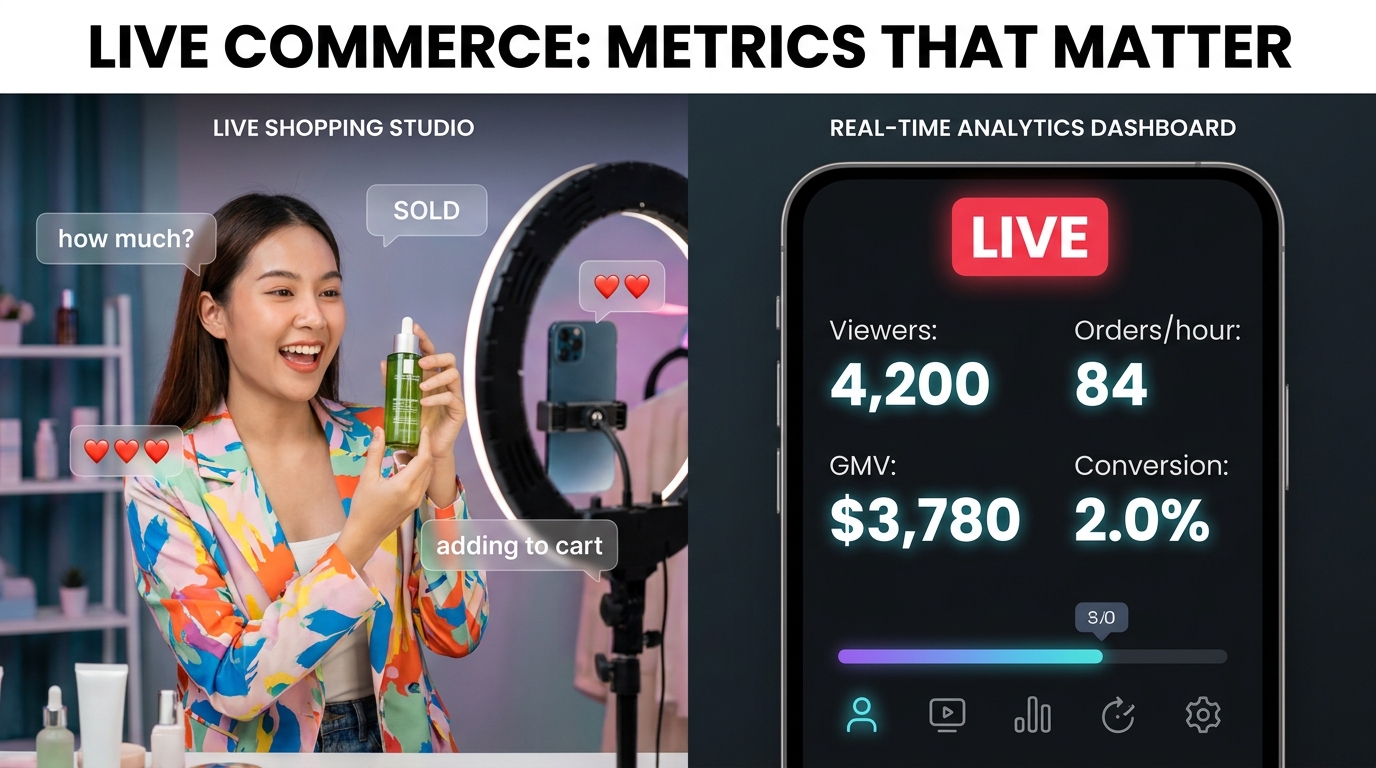
A 2025 GlobalData survey found that 76% of consumers who used TikTok Shop purchased an item from a livestream in the prior year. In markets like Indonesia and Southeast Asia, TikTok Live generates the majority of Shop GMV. The US market is following — live commerce is no longer experimental.
But too many brands approach TikTok Live as a performance, focusing on entertainment value rather than sales mechanics. The sellers converting live viewers into buyers at the highest rates are running their livestreams like structured sales operations.
The Architecture of a High-Converting Live Session
A high-converting live session has a deliberate rhythm. It’s not just a creator talking about products for 90 minutes. The structure looks like this:
- Hook (first 60 seconds): The opening of every live stream is the most critical. You have 60 seconds to give new viewers a reason to stay. This means leading with your strongest, most visual product or a compelling offer — not housekeeping, not greeting people by name, not “we’re just getting started.” The algorithm is watching drop-off in real time and will throttle distribution if viewers leave immediately.
- Product rotation: Don’t spend more than 8–12 minutes on a single product. Rotate between items to maintain novelty and give different segments of your audience a reason to engage. Use the “coming up next” technique to give viewers a reason to stay for the next product.
- Urgency triggers: Time-limited discounts, bundle deals exclusive to the livestream, and countdown timers all drive conversion. “This price is only live for the next 10 minutes” works because it’s true — you can actually structure your pricing to make it true during the session.
- Social proof in real time: Call out purchases as they happen. “We just had 12 orders in the last two minutes” or “Sarah from Texas just grabbed three of these” — live social proof is uniquely effective because it’s unscripted and time-specific.
- Close and repeat: End the live with a strong call to action and tease the next session. Your most engaged viewers will return for the next live if they know when it is.
Frequency and Scheduling
Consistency matters as much as quality in TikTok Live. The platform rewards accounts that go live on a predictable schedule — its algorithm learns to push notifications to viewers who’ve engaged with your past sessions. The minimum effective frequency for live selling is 3 sessions per week, ideally at consistent times your audience has demonstrated engagement. Use your past live analytics to identify your peak concurrent viewer windows — these vary significantly by demographic and product category.
When to Use a Professional Host vs. a Founder
There’s no one-size-fits-all answer here. Founder-led lives have authenticity that’s hard to replicate — a CEO demonstrating why they built a product and fielding genuine questions is compelling content. But founders often lack the pace, urgency mechanics, and stamina for 3-hour sessions. Professional live hosts (increasingly a specialized role in the TikTok ecosystem) bring structured sales technique but may lack product depth. The best solution for scaling brands is a hybrid: founder appearances for launches and key campaigns, professional hosts for routine selling sessions.
Inventory Pacing: The Quiet Killer of TikTok Shop Sellers
Inventory management on TikTok Shop is fundamentally different from any other channel you’ve managed. The demand curve is not smooth. It’s a series of irregular spikes — a video lands, orders surge, a creator posts, orders surge again — separated by quiet periods. The gap between a stockout and restocking is often the difference between holding onto sales momentum and watching your ranking collapse.
Why Stockouts Hurt More on TikTok Than Anywhere Else
On a platform like Amazon, going out of stock is painful but the recovery is manageable — your listing stays indexed, your reviews stay, and buyers can back-order or find you when you restock. TikTok is different. The platform’s algorithm is surfacing products based on recent sales velocity. The moment you go out of stock, orders stop. When orders stop, your velocity signal drops. When your velocity drops, the algorithm deprioritizes your product in the Shop tab and in the feed. By the time you restock, you’re effectively starting over — the momentum is gone, and you’ve lost whatever position you’d built.
This is especially acute after a viral moment. A video explodes on Thursday. You sell 500 units over the weekend. Your remaining 200 units sell out by Tuesday. You place a restock order — but your supplier’s lead time is 14 days. You’re out for two weeks right when the algorithm is trying to give you its biggest push. You’ve just handed your momentum to a competitor who happened to have inventory ready.
The Buffer Stock Rule
Build your reorder point with TikTok’s demand volatility in mind. A standard safety stock formula might be 2 weeks of average daily sales. For TikTok, a more appropriate buffer for products with viral potential is 4 to 6 weeks of peak-period sales. This is a capital commitment, but it’s the cost of being able to actually capitalize on the moments you’ve worked to create.
Working With Suppliers on Faster Response Windows
The suppliers who win TikTok Shop seller relationships in 2026 are those who can provide flexible small-batch restocking. Traditional sourcing models built around large, infrequent purchase orders are poorly matched to TikTok’s demand patterns. If your supplier has a 1,000-unit minimum order quantity and a 30-day lead time, you have a structural inventory problem that no amount of content strategy can fix.
Negotiate standby inventory arrangements where possible — arrangements where your supplier holds a base quantity of finished or near-finished goods that they can ship within 72 hours of a trigger order. You pay a small holding premium, but the protection against stockout-driven momentum loss is worth it for your best-performing SKUs.
TikTok Shop Ads — When to Spend and When to Pull Back
TikTok Shop’s advertising tools have matured significantly, but they’re still frequently misused by sellers who bring their Meta or Google advertising intuitions to a platform that operates differently. Understanding the structural differences prevents wasted spend.
The Three Ad Types and What They’re For
Video Shopping Ads (VSA) appear in the For You feed as native videos with a shopping link embedded. They perform best when built on top of organic content that’s already proven — you’re not guessing whether creative will work, you’re putting money behind what already converted. Cold creative VSAs with no organic foundation tend to have poor ROAS until the learning phase completes.
Product Shopping Ads (PSA) place your products in the Shop tab alongside organic listings, styled like a standard product card. These function closer to Google Shopping or Amazon Sponsored Products — they’re intent-based placements shown to people already browsing. PSAs generally have lower CPCs and more predictable ROAS than VSAs because the audience is self-selecting as a buyer. If you’re only going to run one ad type, PSAs are usually the most reliable starting point.
LIVE Shopping Ads (LSA) push your active livestream to audiences beyond your followers during a live session. These are best deployed when your livestream is already converting well organically — essentially buying more eyeballs for a session you already know is working. Running LSAs on a low-converting live wastes budget without the ability to diagnose why conversion is low.
ROAS Benchmarks and What “Good” Looks Like
Acceptable TikTok Shop ad ROAS varies significantly by product category, margin structure, and the maturity of your shop. Broadly speaking, sellers with healthy operations target a blended ROAS of 3x to 5x across all paid placements. However, this number is misleading in isolation because it doesn’t account for the organic halo effect of TikTok ads — people who see your ad and then search for your product organically. The platform’s attribution model captures direct clicks, but not this ambient lift.
A better metric for many TikTok Shop sellers is Total ROAS: (total shop GMV in period) ÷ (total ad spend in period). This captures the full revenue picture including the organic traffic your ads stimulate. If your total shop GMV is $100,000 and your ad spend is $15,000, your Total ROAS is 6.67x — which is the number that actually tells you whether advertising is accretive to your business.
Customer Retention on a Platform That Doesn’t Give You Customer Data
Here’s one of TikTok Shop’s most uncomfortable realities for experienced e-commerce sellers: you don’t own your customer data. Unlike Shopify, where every buyer becomes a customer record you can email, retarget, and segment, TikTok Shop keeps buyer information within its own walls. You see order IDs, quantities, and shipping addresses — but you can’t build an email list or CRM from your TikTok Shop buyers.
This is a fundamental structural constraint that changes how you think about retention and lifetime value. It doesn’t make retention impossible — it just means you need indirect mechanisms.
The Package Insert Strategy
Every physical shipment you send is a touchpoint you fully control. A well-designed package insert can accomplish several things: drive buyers to your own website with an exclusive discount, request a follow on your TikTok account, invite them to a community (Discord, Facebook Group, email list), or ask for a review. The insert is the one direct communication channel you have with a TikTok Shop buyer after the sale, and most sellers waste it with generic branding rather than a specific, action-driving call to action.
A simple insert with “Scan this QR code to get 20% off your next order on our website + join our exclusive community” converts a TikTok transaction into a first-party customer relationship. Track this QR code separately so you can measure how many TikTok buyers convert to owned-channel customers.
Repeat Purchasing Through TikTok Itself
Buyers who follow your TikTok account after purchasing will see your content in their feed, giving you organic repeat reach. This makes follower conversion — getting TikTok Shop buyers to follow your account — a meaningful retention lever. Your post-purchase insert, your live sessions, and all your content should nudge buyers to follow the account. A follower who’s already bought from you is far more likely to buy again when they see your next video than a cold audience member.
The Review Flywheel
Reviews on TikTok Shop function similarly to Amazon — they build the social proof that converts hesitant browsers into buyers, and they contribute to the platform’s trust signals that influence how prominently your products are surfaced. Building a post-purchase review request flow is essential. Since you can’t email buyers directly, your lever is the package insert and any in-app messaging tools TikTok provides through the Seller Center. A polite, specific review request (“Tell us how the serum worked for your skin type”) generates more detailed reviews than a generic ask.
Protecting Your Shop Score and Seller Metrics
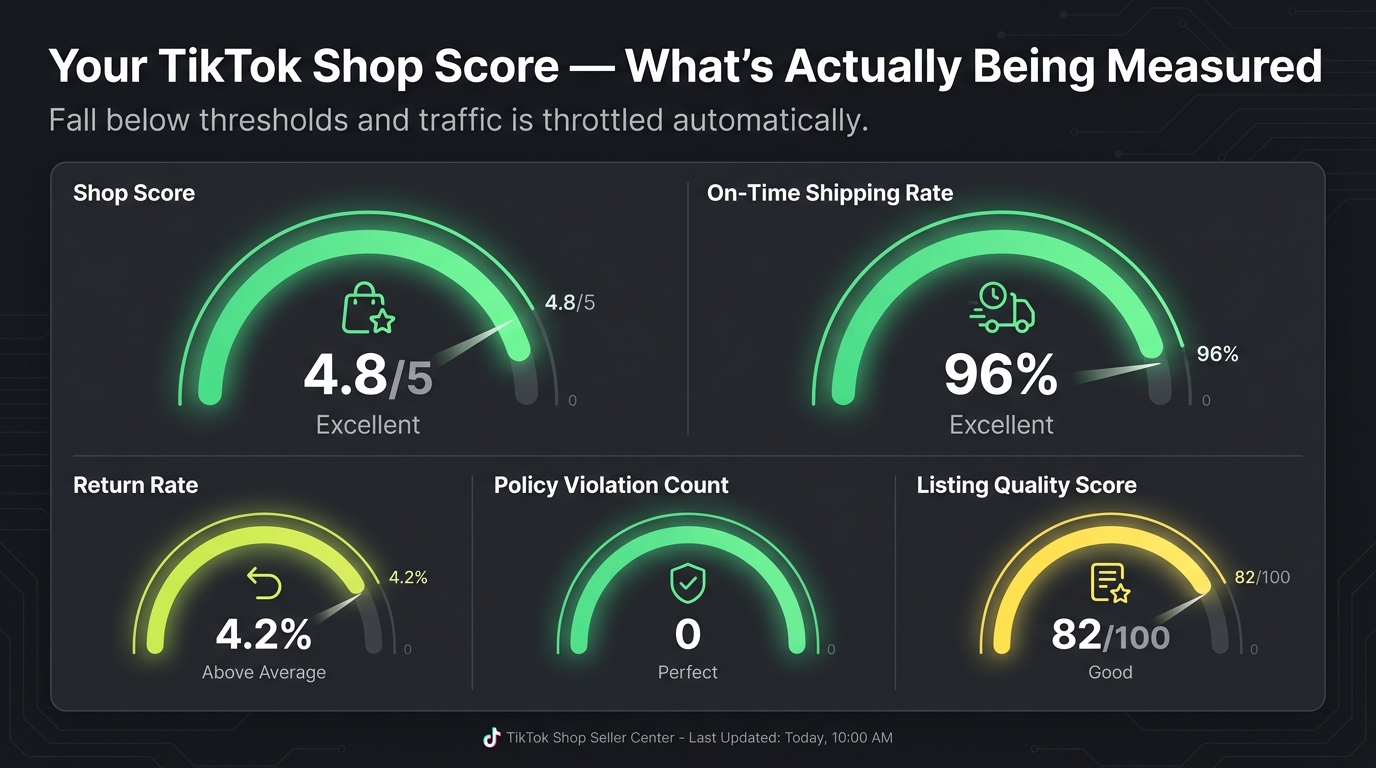
TikTok Shop operates an algorithmic seller health system that most sellers don’t fully understand until they’ve already tripped one of its thresholds. Your shop score is a composite metric that influences how much traffic TikTok’s algorithm allocates to your products. A high shop score means your products get better placement in the Shop tab, more algorithmic amplification in the feed, and preferential treatment in affiliate discovery. A low shop score throttles all of the above.
The Key Metrics That Compose Your Shop Score
On-time shipping rate is often the most impactful single metric. TikTok expects sellers to confirm shipment within the stated dispatch window — typically 24 to 48 hours for most categories. Consistently missing this threshold has a direct negative impact on your score. If you’re seller-fulfilling orders, build a fulfillment process that treats the TikTok dispatch confirmation as a hard deadline, not a suggestion.
Order defect rate captures returns due to product quality issues, items not as described, and customer complaints. This is distinct from preference returns (buyer changed their mind) and is weighted more heavily. A sustained defect rate above 2–3% will trigger score penalties. Proactive quality control — testing products from each new supplier batch, reading and responding to quality-related reviews — is the prevention mechanism.
Listing policy compliance matters more than sellers expect. TikTok’s product policy team actively reviews listings for prohibited claims, misleading descriptions, and restricted product categories. A policy violation doesn’t just remove the offending listing — it adds to your violation count, which directly impacts your shop score. Review TikTok’s prohibited and restricted products list carefully for your category, and be especially careful with health-related claims, which are heavily scrutinized.
Response rate and response time to customer messages are factored in. TikTok monitors whether sellers are engaging with buyer inquiries in a timely manner. Failing to respond to messages within 24 hours contributes negatively. If your order volume is high, invest in a basic customer service workflow — even a single dedicated person checking the Seller Center message queue twice daily dramatically improves this metric.
Recovery if Your Score Drops
If you discover your shop score has declined, the recovery path is methodical but slow. Focus on your defect rate and shipping rate first — these have the fastest direct impact. File appeals for any policy violations you believe were incorrect; TikTok does have an appeal process and sellers report varying success rates depending on the clarity of the documentation provided. Crucially, don’t launch new products or scale ad spend while your shop score is recovering — you want the algorithm to be re-evaluating your account based on improving metrics, not flagging new activity.
Building Multi-Channel Redundancy So TikTok Isn’t Your Only Lifeline
By this point, the operational complexity of TikTok Shop should be clear. It’s a high-reward platform with real structural risks: policy changes, algorithm shifts, viral moment dependency, and — as anyone who followed the US legislative drama of late 2024 and early 2025 remembers — platform-level existential uncertainty. Building TikTok Shop as your only sales channel is a fragile position regardless of how well you execute everything else.
The “TikTok as Discovery” Model
The most resilient operators use TikTok Shop as a discovery engine that feeds other channels rather than the only place business gets done. When someone discovers your product through a TikTok video or Live session, your goal is not just to complete that single transaction — it’s to bring them into an owned environment where you control the relationship. Your own Shopify or branded website becomes the destination for repeat purchases, subscriptions, bundles, and higher-AOV transactions that TikTok Shop’s platform structure makes difficult.
This doesn’t mean deprioritizing TikTok Shop — it means treating it as the top of a funnel that leads somewhere you control, not as the entire funnel itself.
Amazon as a Complementary Channel
For many TikTok Shop sellers, Amazon is not a competitor — it’s a complementary surface. TikTok is extraordinary at awareness and impulse purchasing. Amazon captures the buyer who discovers something on TikTok, searches for more reviews and product details, and then completes the purchase on Amazon where they feel more secure. Running both channels in parallel lets you capture buyers at different points of their decision journey. TikTok gets the impulse buyer; Amazon gets the deliberate buyer. Together, they cover more of the purchasing spectrum than either does alone.
Email and SMS as the Retention Layer
Every mechanism that converts a TikTok Shop buyer into an email or SMS subscriber is a long-term asset. A buyer on your email list is a buyer you can reach without paying the platform a new toll every time. Given TikTok Shop’s data opacity, building an owned list is the single highest-leverage retention investment you can make. Even capturing 10% of your TikTok Shop buyers into an email list over time builds a meaningful asset that functions independently of any platform’s algorithm, policy, or operational status.
The Numbers That Actually Predict Whether Your TikTok Shop Will Survive
Most sellers track GMV because it’s the biggest number and TikTok shows it prominently. GMV is a vanity metric for a single-channel business. The indicators that actually predict long-term viability are different:
- Net margin per order after all costs (referral fee, affiliate, shipping, COGS, ad allocation): This should be positive and at least 20% for the business to be sustainable at scale. If it’s not, the problem is structural — either COGS, pricing, or commission structure needs adjustment.
- Affiliate-driven GMV as a % of total GMV: A healthy TikTok Shop business has a growing share of affiliate-driven revenue, because it means content production is decentralized and not dependent on your own account’s output. Target 30–50% affiliate-driven GMV as an indicator of a healthy creator ecosystem around your products.
- Reorder rate within 90 days: Even on a platform where you don’t own customer data, TikTok Seller Center tracks repeat purchase behavior by product and shop. A product with a 20%+ 90-day reorder rate has something beyond novelty — it has genuine product-market fit. Chase this number.
- Shop score trend: Not just the absolute number, but the trend over 30 and 90 days. A declining score is an early warning signal even if the current number looks acceptable. Investigate why it’s moving before it becomes a traffic problem.
- Return rate by SKU: A high return rate on a specific product is both a margin problem and a quality signal. Dig into the return reason data in Seller Center — “not as described” returns often point to listing issues; “quality issue” returns point to sourcing problems that need to be resolved at the supplier level.
Conclusion: The Difference Between a TikTok Shop Business and a TikTok Shop Moment
TikTok Shop in 2026 is not a lottery ticket. It’s not a platform where the right viral video automatically equals sustainable revenue. It is, however, a genuinely significant commerce infrastructure with real scale, a growing buyer base, and a content-discovery engine unlike anything that existed in e-commerce five years ago.
The sellers who will look back at this period as a turning point for their businesses are not the ones who got lucky with a single trending product. They’re the ones who built the operational foundation underneath the content: the margin-conscious product catalog, the proactive affiliate network, the disciplined live commerce operation, the inventory buffer that prevented stockouts at the worst possible moment, and the multi-channel redundancy that insulated them when TikTok’s own policy environment got turbulent.
Here are the core operating principles to carry forward:
- Model your unit economics before listing any product. If the math doesn’t work at a 15% affiliate commission and 8% referral fee, it doesn’t work on TikTok Shop.
- Build a portfolio of evergreen products to generate baseline cash flow, not just trend plays to generate excitement.
- Treat your affiliate creator relationships as a managed function, not a passive listing benefit. Proactive outreach and tiered commission structures move the needle.
- Run live sessions on a consistent schedule with deliberate sales mechanics — not as entertainment, as structured commerce.
- Keep 4–6 weeks of peak-demand inventory for your top SKUs. Stockouts are momentum killers the algorithm punishes fast.
- Monitor your shop score weekly. A declining score is an early warning; a crashed score is a crisis. Catch it early.
- Convert TikTok buyers into owned relationships through package inserts, QR codes, and every legitimate touchpoint available to you.
- Treat TikTok Shop as one surface in a multi-channel operation, not the whole business.
TikTok Shop’s trajectory is real. $23 billion in US GMV in 2026 is not a fluke — it reflects a genuine behavioral shift in how consumers discover and buy products. The opportunity for sellers who approach it with operational discipline rather than content-first wishful thinking is substantial. The platform will reward the sellers who’ve done the work underneath the surface. That’s the business worth building.