



There’s a version of the TikTok Shop story that gets told over and over: someone posts a 60-second product video, it racks up a million views overnight, and orders flood in while they sleep. That version is technically possible. It’s also economically incomplete in ways that quietly destroy businesses.
TikTok Shop is projected to reach $23.41 billion in US gross merchandise value in 2026 — a number large enough to outpace retail giants like Costco and Target. That GMV is real. But GMV is revenue flowing through the platform, not money flowing into seller bank accounts. The gap between those two figures is where most TikTok Shop businesses either survive or quietly collapse.
Most content about TikTok Shop focuses on the top of the funnel: how to get views, how to write captions, how to find trending sounds. Those are real levers. But the sellers who actually build durable, profitable businesses on TikTok Shop are obsessively focused on something different — the economics of what happens after the view. The fee structures. The return rates. The cash flow lag. The content-to-conversion pipeline. The unit math on every product before it gets listed.
This post is about those numbers. Not views — margins. Not virality — velocity. Not how to get on TikTok Shop, but how to run a business on it that doesn’t quietly bleed out while the view counts climb.
What $23 Billion in US Sales Actually Tells Us About Who’s Making Money
TikTok Shop’s trajectory in the US has been steep and fast. Launched domestically in late 2023, the platform has already become a force in social commerce that neither Amazon, Shopify, nor traditional retailers can afford to ignore. But aggregate GMV figures obscure something important: the distribution of that revenue across sellers is extremely uneven.
The Concentration Problem
Marketplace economics follow a power law distribution, and TikTok Shop is no exception. A relatively small number of sellers — brands that arrived early, built affiliate networks systematically, and cracked LIVE commerce — account for a disproportionate share of total GMV. The broader seller base is vast, growing quickly, and largely fighting over a much smaller slice of the opportunity.
This doesn’t mean the opportunity isn’t real for new or mid-tier sellers. It means the conditions for capturing that opportunity are more specific than the platform’s marketing materials suggest. Sellers who understand the economics clearly — before they scale — are the ones who build sustainable businesses. Sellers who optimize for vanity metrics and figure out the numbers later often discover, too late, that they’ve been building on a structurally unprofitable model.
The Social Commerce Buyer Behavior Shift
What makes TikTok Shop genuinely different from Amazon or Google Shopping is the nature of purchase intent among buyers. TikTok buyers are frequently making unplanned purchases triggered by content discovery — not satisfying a pre-existing search query. A 2025 GlobalData survey found that 76% of consumers who used TikTok Shop had bought an item from a livestream in the prior year. That’s a remarkable statistic that speaks to how effectively the platform collapses the discovery-to-purchase funnel.
But unplanned purchases have a dark side for sellers: they generate higher return rates than intent-driven purchases. When a buyer searches Amazon for “stainless steel water bottle,” they’ve done some mental pre-qualification. When they buy a water bottle because they watched a 45-second demo while lying on the couch at 11pm, the post-purchase rationalization hits differently. Understanding this behavioral dynamic is foundational to the economic model — and it’s why product selection and price point matter so much more on TikTok Shop than many sellers initially realize.
The Platform’s Commercial Ambition
ByteDance’s commitment to TikTok Shop as a revenue engine — not just a feature — has materialized in significant infrastructure investment: fulfillment warehouses, seller support systems, affiliate marketplace tooling, and aggressive seller subsidies in the platform’s early growth phases. Those subsidies (reduced fees, free shipping promotions, voucher programs) have pulled forward GMV and made the economics of selling on TikTok Shop artificially favorable during the growth phase. Sellers who built their models on subsidized economics are now facing a different reality as the platform matures and fee structures normalize.
The Unit Economics Every TikTok Shop Seller Must Model Before Listing a Product
Before a single product goes live on TikTok Shop, there is a set of calculations that determine whether selling it can ever be profitable. Most sellers don’t run these numbers explicitly. They list the product, watch the orders come in, and realize the margin problem weeks or months later.
Building the Full Cost Stack
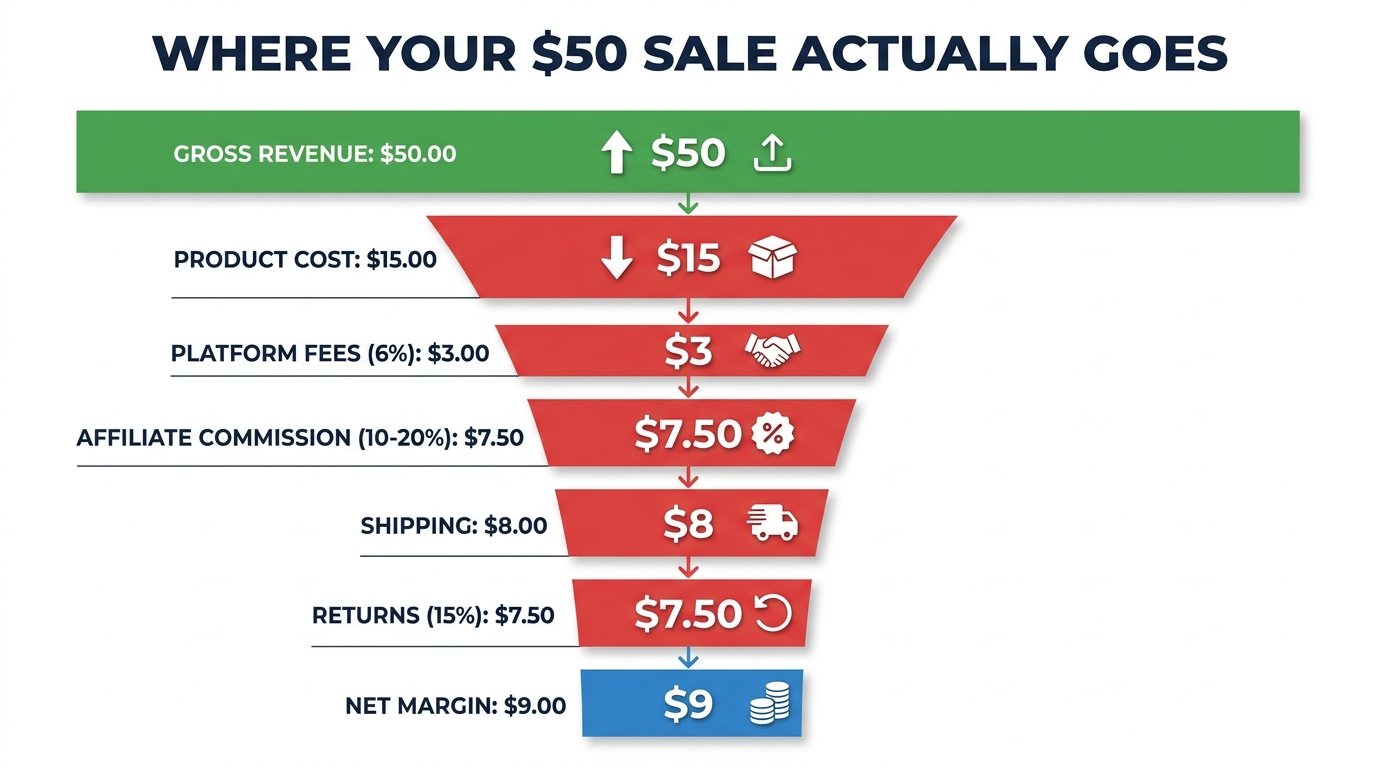
Start with a product retailing at $40. Here’s what the cost stack actually looks like for a typical TikTok Shop seller in 2026:
- Product cost (COGS): $10.00 — This assumes a landed cost of 25% of retail, which is a reasonable target for physical goods at this price point. Many sellers are operating at 30–40% COGS ratios, which creates immediate margin pressure.
- TikTok Shop referral fee: $2.40–$3.20 — Platform commission currently sits at 6–8% of the sale price depending on category. This fee structure has been increasing as TikTok Shop moves through its growth subsidy phase.
- Affiliate commission: $4.00–$8.00 — If you’re using creator affiliates (and at scale you need to), you’re paying 10–20% commission on the sale price. This is the largest variable cost in most seller P&Ls and the one most underestimated during planning.
- Outbound shipping: $4.50–$6.00 — Standard small parcel domestic shipping. If you’re using TikTok Fulfilled or a 3PL, this cost structure may differ but doesn’t disappear.
- Return processing: $1.50–$3.00 — This is a blended return cost (shipping back plus restocking/write-offs) applied at the expected return rate. Returns on TikTok Shop for soft goods and beauty products can run 15–25%.
- Payment processing: $1.20 — TikTok Shop processes payments and remits to sellers, but transaction costs are embedded in the platform economics.
- Packaging & inserts: $0.75–$1.50
Adding up the low end of that cost stack: $10 + $2.40 + $4.00 + $4.50 + $1.50 + $1.20 + $0.75 = $24.35 in costs on a $40 sale, leaving $15.65 — a 39% gross margin.
That sounds workable. Now layer in the high end: $10 + $3.20 + $8.00 + $6.00 + $3.00 + $1.20 + $1.50 = $32.90 in costs, leaving $7.10 — a 17.75% gross margin.
The Margin Compression Trap
That 17.75% gross margin is before advertising spend, before overhead, before any paid creator partnerships or sponsored placements. For most consumer goods businesses, a 17–20% gross margin means the business is structurally unprofitable at any reasonable operating cost level.
The sellers who survive this math have one of three things going for them: very low COGS relative to retail price (typically meaning high-margin, differentiated products rather than commodities), very low return rates (meaning product-market fit is strong and the demo matches the delivered experience), or volume so high that fixed costs per unit are minimal. Usually, it’s a combination of all three — which is why the product selection decision, made before anything goes live, is the single highest-leverage choice in TikTok Shop economics.
Cash Flow Timing: The Invisible Strain
One economic factor that sellers consistently underestimate is cash flow lag. TikTok Shop typically remits seller payments on a 7–15 day settlement cycle after order completion. Factor in the return window (buyers have multiple days to initiate returns), and the effective cash conversion cycle for a TikTok Shop seller can stretch 20–30 days from sale to cash. Meanwhile, you’re buying inventory upfront, paying creators and shipping costs immediately. For a rapidly growing seller, this timing gap can create a working capital crisis even when the business is technically profitable on paper.
The Three Revenue Channels and Why Most Sellers Rely on Only One
TikTok Shop offers sellers three distinct channels for generating sales, each with different economics, effort profiles, and scalability. The sellers with the highest GMV — and typically the strongest margins — run all three simultaneously. The majority run only one.
Channel 1: Shoppable Organic Video
This is the channel most sellers start with, and for good reason — it has the lowest barrier to entry and the highest upside when a video goes viral. You create a short-form video, tag your product, and if the algorithm distributes it broadly, purchases happen passively through the product link embedded in the video.
The economics here are seductive: if you create content yourself, the cost per acquisition can be very low. A single video generating $5,000 in sales might cost $200 in production time and resources, implying a near-zero customer acquisition cost. But this channel also has the highest variance of the three. Organic reach is algorithmically controlled and inconsistent. A seller who went viral last month may get half the reach this month for reasons that have nothing to do with content quality. Building a business on a single organic channel is building on sand.
Channel 2: TikTok LIVE Commerce
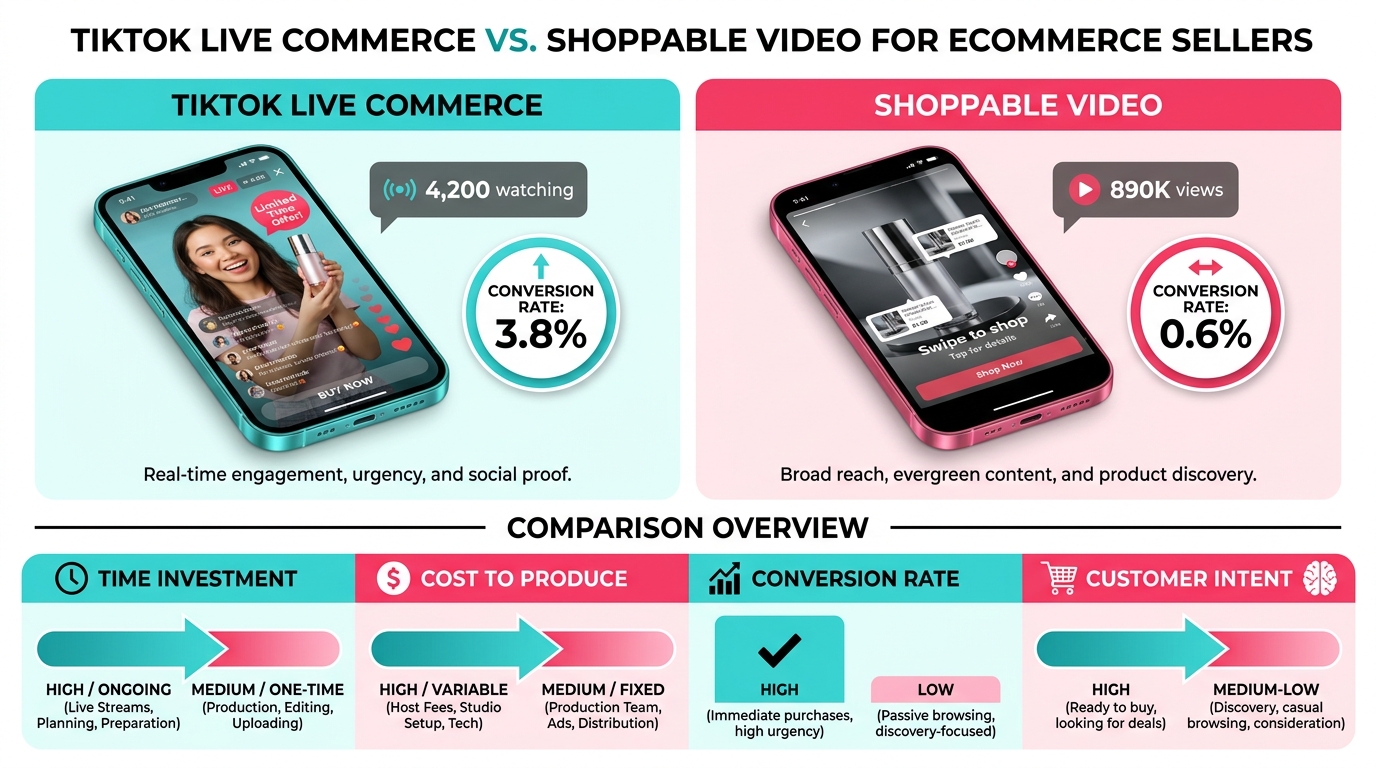
LIVE is the channel with the highest conversion rate on the platform. When a viewer watches a live session and sees a product demonstrated in real time — with the host responding to questions, showing different sizes or colors, creating urgency with limited-time offers — they are much further down the purchase funnel than a viewer who watched a 30-second video. Conversion rates for LIVE sessions can run 3–6x higher than for shoppable videos for comparable products.
The tradeoff is effort and consistency. Running effective LIVE commerce sessions requires scheduling, preparation, a compelling host, and usually a committed streaming window (2–4 hours for a meaningful session). Brands that commit to regular LIVE schedules — 3–5 sessions per week — typically see their LIVE revenue compound over time as repeat viewers return and the algorithm rewards session engagement. It’s not passive income; it’s closer to running a daily broadcast operation.
Channel 3: Affiliate Creator Commerce
This is the channel that, at scale, accounts for the majority of top sellers’ GMV. TikTok Shop’s affiliate marketplace allows creators to browse your product catalog, request samples, and create content promoting your products in exchange for a commission on every sale they generate. For sellers, it’s performance-based marketing — you only pay when a sale happens.
The challenge is that building a meaningful affiliate network takes time and active management. You need to recruit creators systematically, provide product samples, set competitive commission rates, and communicate clearly about what content performs. Passive affiliate enrollment — just listing your products and hoping creators find them — rarely produces material results. The sellers who win at affiliate commerce treat it like a managed marketing operation, not a set-it-and-forget-it channel.
Shoppable Video vs. LIVE Commerce: Where Your Conversion Dollars Actually Go
The choice between investing in shoppable video content and investing in LIVE commerce isn’t either/or — the strongest sellers do both. But understanding the different economics of each channel helps sellers allocate resources intelligently, especially in early-stage operations when bandwidth is limited.
Shoppable Video: The Discovery Engine
Shoppable videos function primarily as top-of-funnel discovery tools. Their job is to reach new audiences — people who have never heard of your brand — and convert a percentage of them into buyers in a single viewing moment. The content format is short (15–60 seconds typically performs best for conversion), demo-focused, and built around a clear purchase trigger: a problem shown, a solution demonstrated, a “wow” moment created.
The key performance metrics for shoppable video are:
- Click-through rate (CTR) on the product link: How many viewers click through to the product page. Top-performing videos achieve 3–5% CTR.
- Product page conversion rate: Of those who clicked, how many completed a purchase. A well-optimized product page converts 5–15% of visitors.
- Video-to-sale conversion rate: The product of the above two — typically 0.15% to 0.75% of total video viewers. For a video with 500,000 views, that’s 750 to 3,750 sales at the high end.
The challenge with shoppable video economics is that creating content with any consistency requires either your own time or a production budget. Brands that generate high shoppable video volume — 20-30 videos per month — tend to do so by leaning heavily on creator affiliates rather than producing all content in-house. This creates a compounding advantage: more creators testing different angles means more data on what converts, which informs future content strategy.
LIVE Commerce: The Conversion Engine
Where shoppable video excels at reaching new audiences, LIVE commerce excels at converting warm audiences at a higher rate. Viewers who show up to a LIVE session are typically already somewhat aware of the brand or product — they may have seen a video, visited the shop tab, or followed the account. The LIVE environment creates a sense of real-time social proof and urgency that passive video cannot replicate.
Several mechanics drive LIVE commerce conversion specifically:
- Live social proof: Seeing other viewers comment “just ordered!” or “already bought twice!” creates real-time validation that influences purchase decisions at scale.
- Limited-time offers: LIVE-exclusive discount codes or flash bundles create genuine urgency without cheapening the brand. These are most effective when used sparingly — if everything is always “LIVE exclusive,” the exclusivity loses its power.
- Q&A-driven conversion: A skilled host can identify and address purchase objections in real time. Someone asking “does this work for oily skin?” gets an immediate, personalized answer that a product listing can never replicate.
- Pinned product rotation: During a LIVE session, the host pins products to the bottom of the screen, and rotating which product is featured every 20–30 minutes keeps the content fresh and captures attention from viewers who join mid-session.
The fundamental difference in investment profile: shoppable video is an asset (a video can generate sales for months), while LIVE is an operation (each session is a live performance that requires active hosting). The sellers who run the strongest TikTok Shop businesses treat LIVE not as an ad hoc tactic but as a scheduled, rehearsed, systematically improved broadcast operation.
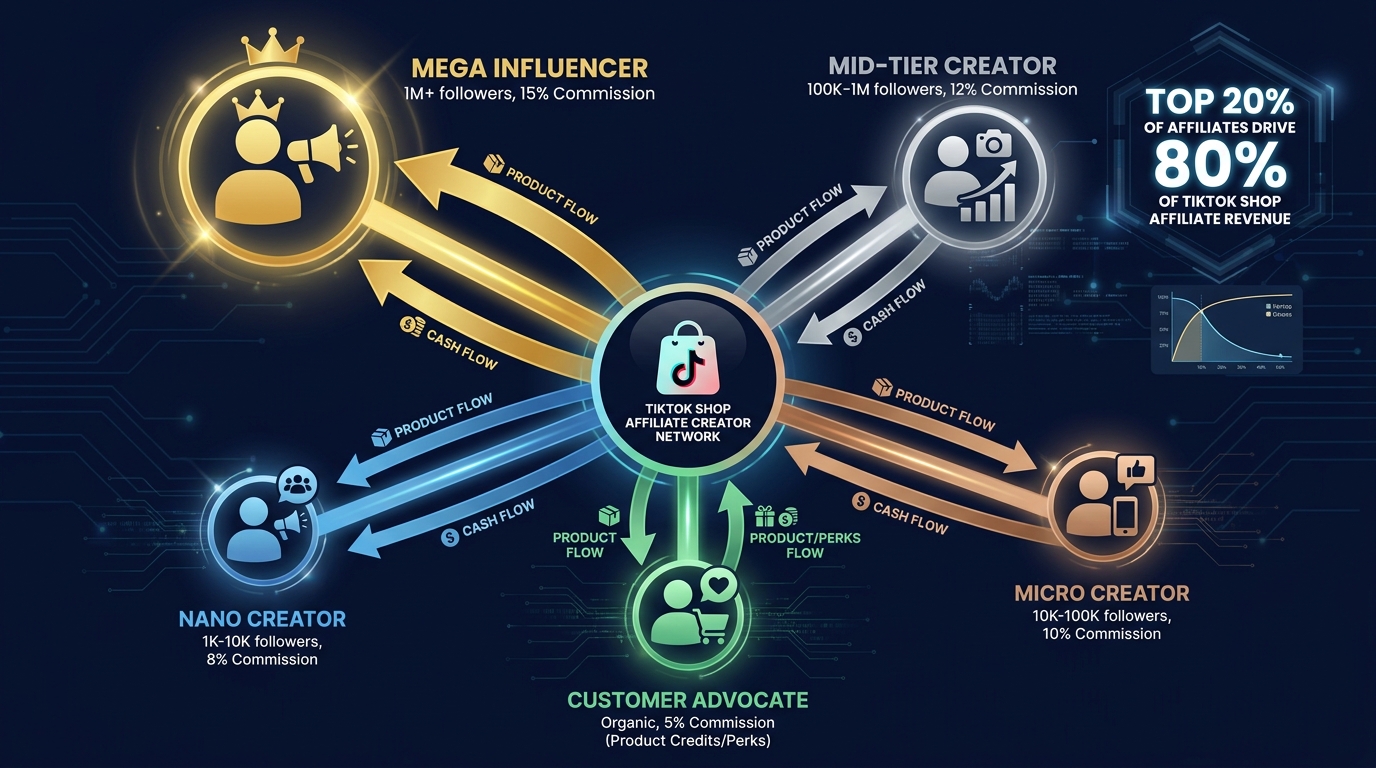
The Affiliate-Creator Relationship: Building a Network That Compounds
The affiliate program is arguably TikTok Shop’s most powerful differentiator from other commerce platforms. Instead of paying for reach upfront through advertising, sellers can build a network of creators who produce content and earn commission only when their content converts to a sale. Done well, this creates a performance-marketing machine where acquisition costs are fully variable and directly tied to revenue generated.
Tiering Your Creator Strategy
Not all creators are equal, and not all creator tiers serve the same strategic purpose. A mature TikTok Shop affiliate strategy typically spans multiple tiers, each with a different role:
Nano creators (1K–10K followers): These are often highly engaged, niche-specific creators whose audiences trust their recommendations. Commission rates of 5–8% are typical at this tier. Individually, their GMV contribution is modest — but a portfolio of 50–100 nano creators can generate significant aggregate revenue with lower per-creator risk than concentrating on a handful of large accounts.
Micro creators (10K–100K followers): The workhorse tier for most successful TikTok Shop brands. These creators have enough reach to generate meaningful individual GMV contributions, and their audiences are typically more targeted than those of mega influencers. Commission rates of 8–12% are common. This is the tier where most brands should concentrate their relationship-building energy.
Mid-tier creators (100K–1M followers): At this level, creators often expect product-first whitelisting, dedicated samples, and structured collaboration agreements — not just passive affiliate enrollment. Commission rates of 10–15% are typical, and brands sometimes combine affiliate commissions with upfront fees for dedicated content. The GMV from a well-matched mid-tier creator with a highly relevant audience can be substantial.
Mega creators (1M+ followers): These partnerships are high-cost, high-variance, and rarely economically efficient for most TikTok Shop sellers. Mega creators expect significant upfront compensation in addition to commissions, and their broad audiences often have lower purchase intent for any specific product category. Some brands use mega creator partnerships for awareness and brand association rather than direct GMV.
Recruiting and Managing Affiliates at Scale
TikTok Shop’s affiliate marketplace allows sellers to list products for affiliate promotion and set commission rates. But passive enrollment — just making products available — is not a strategy. Active affiliate recruitment involves:
- Targeted outreach: Identifying creators who already make content relevant to your product category and reaching out directly through TikTok’s collaboration request system or off-platform channels. A creator who already makes skincare content is more likely to convert sales for a skincare product than one who needs to create a new content category for you.
- Sample programs: Creators who can physically experience your product create more authentic, higher-converting content. Building a structured sample program — with clear expectations about content creation timelines and disclosure requirements — is an operational investment that pays back significantly in content quality.
- Commission rate testing: Higher commission rates attract more creators and more promotional effort from existing creators. But they also reduce margin. Testing commission rate changes and their impact on affiliate-generated GMV is legitimate performance-marketing optimization.
- Performance tracking and re-engagement: An affiliate who generated strong GMV last month and has gone quiet this month is worth a personal re-engagement message. Understanding why creator performance drops — and addressing it — is part of the operational discipline of affiliate management.
The Compounding Dynamic
The reason affiliate networks compound over time is that successful content assets don’t disappear. A video a creator made six months ago can still be generating affiliate commissions today. As your creator roster grows and accumulates content history, the aggregate passive revenue from older content combines with fresh content from ongoing creator relationships. This compounding effect is one of the most powerful economic features of TikTok Shop’s affiliate model — but it only materializes for sellers who invest in building and maintaining creator relationships systematically over months, not weeks.
Fulfillment and Returns: The Hidden Margin Killers Nobody Warns You About
No section of TikTok Shop economics is more consistently underestimated by new sellers than fulfillment and returns. These are the costs that are invisible at small volume, tolerable at medium volume, and catastrophic at large volume if not managed actively from the start.
Fulfillment Model Choices
TikTok Shop sellers have three primary fulfillment options, each with different cost structures and scalability profiles:
Self-fulfillment: The seller ships orders directly from their own warehouse or home. Unit economics are most favorable at low volume — no 3PL markup, full control over packaging and quality. But this model doesn’t scale. At 50+ orders per day, self-fulfillment becomes operationally untenable unless you have a warehouse operation and staff. The hidden cost of self-fulfillment is time — owner-operators who spend 4–6 hours per day on packing and shipping are not spending that time on the strategic activities (content, creator relationships, sourcing) that actually grow the business.
Third-party logistics (3PL): Outsourcing fulfillment to a 3PL partner adds per-order pick-and-pack fees (typically $2–$4 per order), storage fees, and receiving fees — but eliminates the time and operational complexity of self-fulfillment. For sellers at 50+ daily orders, the economics of a 3PL typically beat self-fulfillment once owner time is valued appropriately. Integrating TikTok Shop orders with a 3PL requires middleware or direct API integration, which adds a setup investment.
TikTok Fulfilled (TikTok’s own warehouse program): Analogous to Amazon FBA, TikTok Fulfilled allows sellers to send inventory to TikTok’s fulfillment centers, which then handle pick, pack, and ship for every order. The benefits include platform-side shipping speed guarantees, potential algorithmic preference for TikTok Fulfilled listings, and elimination of per-order shipping negotiation. The costs include storage fees, per-unit fulfillment fees, and the logistical challenge of predicting and pre-positioning inventory accurately.
The Return Rate Reality
Return rates on TikTok Shop vary significantly by category, but sellers entering the platform should build their financial models around realistic category benchmarks rather than optimistic assumptions:
- Beauty and personal care: 5–12% return rate (lower because the product is typically consumable and expectations are set by demo videos)
- Apparel and accessories: 15–30% return rate (fit, color, and quality expectations frequently don’t match delivery)
- Home goods and gadgets: 10–20% return rate
- Electronics: 15–25% return rate
The economics of a return don’t just affect the cost of that transaction. A high return rate increases the complexity of your logistics operation, creates negative feedback loops in seller ratings (which affect algorithmic placement), and — in cases of suspected abuse — can trigger policy reviews from TikTok Shop’s seller trust system.
Managing Returns Proactively
The most effective way to reduce return rates is upstream, in the content that sells the product. When a video demo accurately represents the product’s size, color, texture, and realistic use case, purchase expectations are calibrated correctly. When a demo shows an aspirational version of the product that doesn’t match the box — a pattern common in commodity dropshipping — the return is nearly inevitable. High-quality product photography on the listing page, detailed size charts, and accurate description language all contribute to lowering return rates before a single order ships.
The Product Selection Framework That Survives Algorithm Shifts
If you reverse-engineer the economics of every profitable TikTok Shop business, you almost always arrive at the same foundational advantage: the right product. Not the right hashtag, not the right posting time, not the right influencer. The product itself. Specifically, a product that is structurally suited to TikTok’s commerce environment — one that converts well through video, retains its margin through the full cost stack, and generates low enough returns to be operationally manageable.
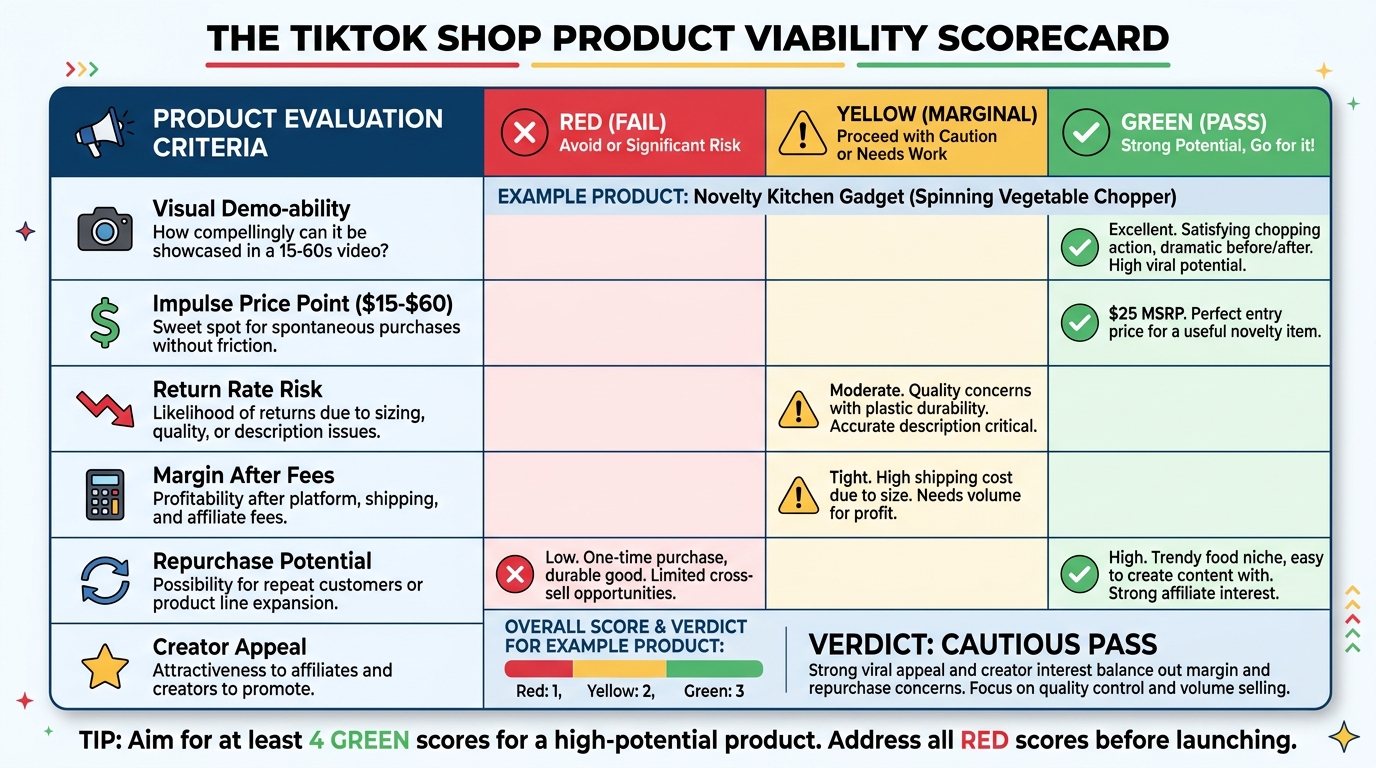
The Six Product Criteria That Actually Matter
1. Visual demo-ability. Can this product’s value proposition be communicated in 30–45 seconds of video without extensive explanation? Products where the “before and after” or “moment of use” is visually compelling and immediate are structurally advantaged on TikTok Shop. A hair serum that shows dramatic frizz reduction in a 20-second before/after clip sells itself. A B2B software subscription does not.
2. Impulse-friendly price point. TikTok Shop buyers are making unplanned purchases. The research-to-decision timeline is extremely short — often measured in seconds. Products priced between $15 and $60 hit the impulse-purchase sweet spot: low enough that purchase hesitation is minimal, high enough that the margin math works. Products priced above $80–100 require more buyer deliberation than a TikTok scroll typically allows. Products below $15 rarely generate enough gross margin to cover the full cost stack after fees and returns.
3. Differentiated enough to command the price. A product that is visually indistinguishable from ten identical options on TikTok Shop — and priced identically — competes on algorithm and creator network rather than product merit. This is a difficult and expensive way to sell. Products with genuine differentiation (unique design, proprietary formulation, verifiable quality signal) can build a brand narrative that creates preference even in a crowded category.
4. Low return rate risk by category and product design. As covered above, some categories have structurally high return rates. If you choose to operate in a high-return category, you need to price accordingly and manage expectations aggressively through content. Products where sizing and fit are irrelevant (consumables, beauty, food) are structurally lower return-rate products. Products where individual fit variation is significant (footwear, clothing) carry higher return risk regardless of how good the content is.
5. Creator content appeal. Will a creator feel comfortable — even excited — making content about this product? Products in beauty, wellness, food, fashion, home, and pet categories have natural creator communities who already make content in those verticals. Products that are difficult to create content around (industrial supplies, highly technical goods, sensitive health conditions) will struggle to build the affiliate creator networks that drive TikTok Shop GMV at scale.
6. Repurchase potential or catalog extension. A one-time purchase product caps your lifetime customer value at a single transaction. Products with natural repurchase cycles (consumables, seasonal items, refillable packaging) or natural catalog extensions (one product in a series, bundling opportunities) allow sellers to build customer lifetime value that compensates for the cost of the initial acquisition. On a platform not natively designed for repeat purchase behavior, the sellers who build repurchase mechanics into their product strategy have a substantial structural advantage.
The Commodity Trap
TikTok Shop has attracted a significant volume of dropshipped commodity products — items sourced from Chinese wholesale platforms and listed at thin margins, competing purely on price and algorithm exposure. These businesses can generate high GMV in the short term, particularly during platform growth phases when seller subsidies artificially improve economics. But they are structurally fragile: any increase in competition, any rise in platform fees, any algorithm change that reduces their organic reach, and the unit economics collapse. Durable TikTok Shop businesses are built on products with genuine differentiation and defensible positioning.
Building Repeat Purchase Behavior on a Platform Not Designed for Loyalty
TikTok is designed for content discovery, not customer relationship management. There is no native email list, no CRM integration, no push notification system for purchase re-engagement. A buyer who purchased from your TikTok Shop last month has no inherent reason to come back — unless they follow your account, happen to see your content in their feed, or remember your brand well enough to search for it directly.
This is one of the most significant structural differences between TikTok Shop and owned e-commerce channels like Shopify — and understanding it is critical to building a business with staying power.
The Follow Conversion Strategy
The most important single post-purchase action a TikTok Shop seller can drive is getting the buyer to follow the brand’s TikTok account. A follower will see future content in their feed. They will see future LIVE sessions promoted on their For You Page. They are, in effect, opting in to a re-engagement channel within the platform.
Driving follow conversions requires an explicit and valuable reason to follow. Some effective approaches: promising followers-only discount codes, scheduling regular LIVE sessions where followers-only early access is highlighted, and creating content series (rather than one-off posts) where following is the only way to see the continuation. The packaging insert that says “Follow us @[brandname] for 15% off your next order — scan the QR code” is an underused tactic that converts post-purchase intent into future engagement.
Off-Platform Capture
The most strategically sound approach to customer retention on TikTok Shop is capturing customer contact information off-platform, where you own the relationship. This means:
- Post-purchase email capture: Insert cards in packaging that direct buyers to a landing page where they register a product, claim a warranty, or access exclusive content — in exchange for their email address. This converts a TikTok Shop transaction into a direct email marketing relationship that TikTok cannot alter or take away.
- SMS sign-ups: A short code or QR code in packaging that offers an SMS discount for opt-in. SMS has significantly higher open rates than email for promotional communications.
- DTC redirect strategy: Some brands use TikTok Shop as a discovery channel — the first purchase happens on TikTok — and then actively migrate customers to their own website for subsequent purchases. This requires incentive design (the DTC price is lower, or the DTC experience is meaningfully better), and it works best for brands with product lines wide enough to justify a repeat site visit.
Product Bundling and Subscription Architecture
Where the product category allows it, subscription mechanics and bundle structures can create natural repeat purchase velocity without requiring active re-acquisition. A beauty brand that sells a 30-day supply of a consumable product can offer a subscription at a 10% discount, converting a one-time buyer into a recurring customer. Even on TikTok Shop, where native subscription mechanics are limited, brands can use off-platform subscription infrastructure (Recharge, Skio, etc.) that integrates with their broader commerce stack and drives repeat revenue independently of TikTok’s algorithm.
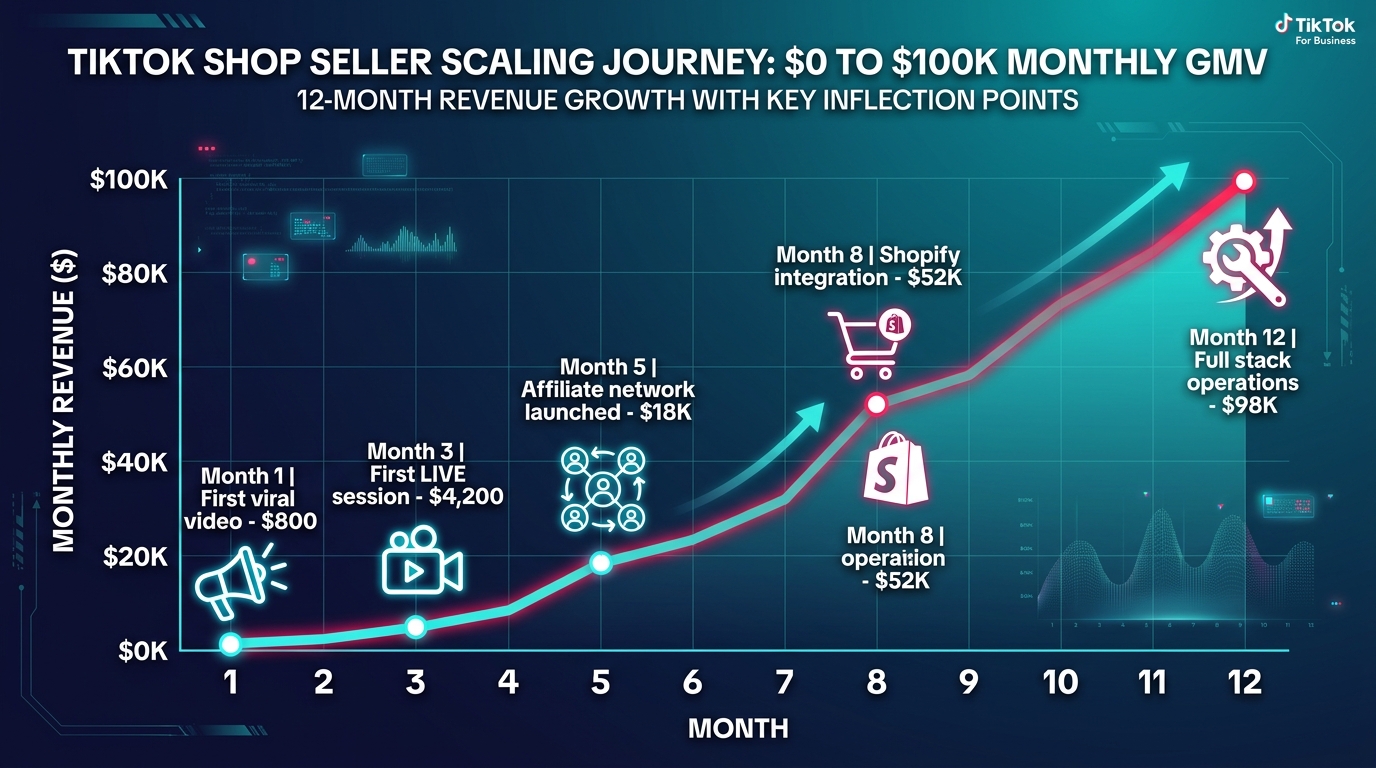
Scaling from $10K to $100K/Month: The Operational Inflection Points
Growing a TikTok Shop business from its first significant revenue month to a six-figure monthly operation is not a linear process. It goes through distinct phases, each with its own bottlenecks, its own required investments, and its own economic characteristics. Sellers who don’t recognize these inflection points often hit a ceiling — either trying to scale beyond what their current operations can support, or under-investing in the infrastructure needed to move to the next phase.
Phase 1: Finding Product-Market Fit ($0–$10K/month)
At this phase, the primary task is validating that your product converts on TikTok Shop before making significant inventory or operational investments. This means testing with small inventory runs, creating multiple video angles for the same product to identify which creative approach converts best, and experimenting with both organic content and a small pool of micro-affiliate creators.
The critical discipline at this phase is not to over-invest in production quality, inventory volume, or creator spend before the conversion signal is clear. Many sellers burn through their initial capital at this phase by buying large inventory positions for products that don’t convert, or spending heavily on creator collaborations before understanding which product angle resonates. Treat Phase 1 as a structured learning exercise, not a scaling operation.
Phase 2: Channel Development ($10K–$40K/month)
Once a product has demonstrated consistent conversion across multiple video formats and creator types, the growth lever is channel expansion. At this phase, sellers should be developing all three revenue channels simultaneously: deepening their organic content library, systematically recruiting affiliate creators, and launching regular LIVE commerce sessions.
The fulfillment operation typically requires a transition at this phase. Self-fulfillment becomes untenable at 100+ daily orders, and the investment in 3PL integration — or the decision to move to TikTok Fulfilled — needs to happen before operational strain becomes a customer experience problem. Shipping delays and fulfillment errors at this phase can generate negative reviews and seller rating drops that cost algorithmic visibility.
Phase 3: Systematic Scaling ($40K–$100K/month)
Moving from $40K to $100K/month requires systematizing what worked in Phase 2. This means:
- Creator management infrastructure: At 50+ active affiliates, managing outreach, sample shipments, commission tracking, and content scheduling manually becomes unsustainable. Sellers at this scale typically use TikTok Shop’s affiliate management tools plus external relationship tracking to manage creator portfolios efficiently.
- LIVE commerce team: Rather than a single person hosting all LIVE sessions, scaling sellers typically hire or contract dedicated LIVE hosts, invest in proper streaming equipment (ring lighting, quality camera setup, product display stands), and develop structured LIVE session frameworks that can be executed consistently.
- Inventory forecasting: Viral moments create inventory crises. A video that unexpectedly hits 2 million views can generate 3,000 orders in 48 hours for a seller with 500 units in stock. At the $40K+ phase, sellers need demand forecasting processes and inventory buffers that can absorb viral spikes without stockouts that destroy conversion momentum.
- Financial management: The cash flow timing issues discussed earlier become acute at this scale. Sellers operating at $80–100K/month GMV with 15–20 day settlement cycles and upfront inventory commitments need working capital facilities — whether from their bank, from revenue-based financing providers, or from the cash reserves built during earlier phases.
Integrating TikTok Shop With Your Existing Commerce Stack
For sellers who operate beyond TikTok Shop — on Amazon, Shopify, or their own DTC sites — TikTok Shop is most powerful when it’s integrated into a unified commerce operation rather than managed as a separate silo. Siloed operations mean duplicated inventory management, inconsistent pricing, and missed opportunities to leverage data across channels.
The Shopify Integration
Shopify’s TikTok integration allows sellers to sync product catalogs from Shopify to TikTok Shop, manage orders from a single dashboard, and ensure inventory levels stay synchronized across both platforms. For sellers already on Shopify, this integration dramatically reduces the operational overhead of adding TikTok Shop as a channel — product listings, inventory counts, and order management flow through existing workflows rather than requiring parallel operations.
The integration also enables promotion syncing: promotional pricing set in Shopify can flow through to TikTok Shop listings, ensuring consistent pricing and simplifying discount management across channels. This is particularly valuable during sale events where inconsistent pricing across channels can create customer confusion and brand perception problems.
Multichannel Inventory and Fulfillment
The emergence of dropshipping and multichannel platforms that integrate with TikTok Shop — tools like TopDawg, which now supports native TikTok Shop integration alongside Amazon, Walmart, eBay, and Shopify — means that sellers can list across multiple channels from a centralized product catalog and routing system. This reduces the risk of overselling and simplifies the operational complexity of multichannel fulfillment.
For brands sourcing from wholesale suppliers or managing complex SKU catalogs, these integrations represent a meaningful reduction in administrative overhead. The investment in setting up proper multichannel infrastructure pays back in reduced errors, faster order routing, and the ability to sell across more channels without adding proportionally more operational staff.
Data Architecture for Multi-Channel Sellers
One underappreciated advantage of running TikTok Shop alongside other channels is the cross-channel data signal. A product that gets strong organic traffic on TikTok Shop but low conversion on Amazon may be signaling an audience mismatch. A product that converts well on your Shopify DTC site but poorly on TikTok may be solving a problem that doesn’t translate into a compelling video demo. Reading these cross-channel data signals systematically — rather than managing each channel in isolation — produces better product decisions, better content strategy, and better inventory planning.
Sellers who invest in basic data infrastructure (even a simple consolidated spreadsheet that tracks channel-level revenue, conversion rate, return rate, and margin data weekly) operate with a clearer picture of their business than those who manage each channel purely within its native analytics environment. Unified data is a competitive advantage that costs very little to build and pays back disproportionately in better decisions.
The Seller Rating System and Why It Has More Leverage Than Most Think
TikTok Shop operates a seller rating and compliance system that directly influences algorithmic visibility. Most sellers are dimly aware that their rating matters — few understand the specific mechanics well enough to manage it proactively.
What Goes Into Your Seller Score
TikTok Shop evaluates sellers across several dimensions that collectively determine their standing on the platform:
- On-time shipping rate: The percentage of orders shipped within the committed handling time window. Late shipments generate system flags and, if sustained, algorithmic penalties.
- Order cancellation rate: High cancellation rates (typically driven by stockouts or operational issues) are treated as a signal of poor seller reliability.
- Customer review scores: Product reviews and seller ratings from buyers contribute to the overall seller score. Reviews are also surfaced directly to buyers during purchase consideration, making negative review management an active operational discipline, not a passive one.
- Dispute and infringement rate: Intellectual property disputes, product authenticity challenges, and buyer disputes all affect seller standing. Categories like beauty, electronics, and branded goods are particularly high-risk for authenticity-related complaints.
- Policy compliance: Violation of TikTok Shop’s product listing policies (prohibited categories, misleading claims, inadequate disclosures) can result in listing removals and seller standing deductions that take significant time to recover from.
The Algorithmic Consequence of Rating Drops
A seller rating drop doesn’t just affect buyer trust — it directly affects where your products appear in TikTok Shop’s search and recommendation system. Sellers with higher ratings receive preferential placement in the Shop tab, in product recommendation surfaces, and in affiliate marketplace visibility (where creators browse products to promote). This means that operational failures — stockouts that cause cancellations, fulfillment delays, or a spike in negative reviews — have both direct economic costs and compounding indirect costs through reduced algorithmic exposure.
Managing seller rating proactively means monitoring it weekly, understanding which specific metrics are declining, and addressing root causes before they compound. A seller who notices an on-time shipping rate dip can investigate and fix the fulfillment issue before it affects their rating score materially. A seller who only checks their rating after it has already dropped is managing the consequence rather than the cause.
What Durable TikTok Shop Businesses Actually Look Like
The sellers who build businesses that are still operating profitably two or three years after launch have several things in common — none of which involve going viral.
They started with the economics, not the content. Before the first product went live, they modeled the full cost stack, set a target margin, and chose a product that could hit it. Content strategy came after the unit economics were validated.
They built all three revenue channels deliberately. Organic shoppable video for discovery and content asset accumulation. LIVE commerce for high-conversion sessions that build community. Affiliate networks for scalable, performance-based reach. No single channel is sufficient at scale; the compounding of all three is what produces durable GMV.
They invested in off-platform customer ownership. Email lists, SMS subscribers, and DTC customer relationships give durable TikTok Shop sellers a base of revenue that doesn’t depend on any algorithm remaining favorable. The business is on TikTok Shop, but it isn’t of TikTok Shop.
They managed operations with the same discipline as marketing. Fulfillment accuracy, return rate management, seller rating maintenance, and inventory forecasting are not afterthoughts — they are operational priorities with the same attention as content strategy and creator management. The best-marketed product in the world fails if the operational engine behind it is leaking margin at every step.
They treated the platform as a distribution channel, not a business model. TikTok Shop’s policies, fee structures, and algorithmic rules will continue to evolve. Sellers who understand this — who build product quality, creator relationships, and customer data assets that exist independently of any single platform — are positioned to adapt when the rules change, as they inevitably will.
“The sellers who win on TikTok Shop long-term are running a disciplined commerce business that happens to use TikTok as its primary distribution channel. They’re not running a TikTok content business that happens to sell products.”
Practical Takeaways: What to Do This Week
Whether you’re evaluating TikTok Shop as a new channel or looking to improve the economics of an existing operation, these are the highest-leverage actions to take immediately:
- Build your unit economics model before listing anything new. Use the full cost stack framework from this post. If the product can’t generate at least 35% gross margin after all variable costs (including realistic return rates and affiliate commissions), the product is not ready for TikTok Shop.
- Audit your current channel mix. If you’re selling exclusively through organic shoppable video with no LIVE schedule and no affiliate program, you’re leaving significant revenue and resilience on the table. Identify which second channel to develop first based on your current resources and audience size.
- Build an off-platform capture mechanism. Whether it’s a packaging insert with a QR code for email sign-up or an SMS opt-in incentive, start building a customer contact base that you own and control.
- Run your seller rating dashboard weekly. Identify which metrics are moving in which direction and address root causes proactively. Seller rating management is one of the highest-leverage operational disciplines in TikTok Shop, and one of the most neglected.
- Map your product to the six-criteria scorecard. For every product in your consideration set, score it against demo-ability, price point, differentiation, return risk, creator appeal, and repurchase potential. The products that score highest across all six criteria are your strongest candidates for TikTok Shop investment.
TikTok Shop’s trajectory is real, its scale is impressive, and the opportunity for sellers who approach it with operational and economic discipline is substantial. The platform will reward those who do the unglamorous work — the unit economics modeling, the operational infrastructure building, the systematic creator relationship management — far more reliably than it rewards those chasing the next viral moment.
The viral moment is a gift when it arrives. The economics are what you build while you’re waiting for it.