

There is a gap between deploying a multi-agent system and actually operating one. Most teams are living in that gap right now.
Google’s Gemini platform has made it genuinely easier than ever to wire together a set of specialized agents, assign them tools, and hand off work between them. The Agent Development Kit (ADK), the Agent2Agent (A2A) protocol, Vertex AI Agent Engine, and the Gemini Enterprise Agent Platform have, as a combined stack, removed most of the infrastructure friction that used to make multi-agent systems a research project rather than a production reality.
The problem is that removing friction from deployment is not the same as removing friction from performance. Teams that have stood up multi-agent Gemini workflows in 2026 are now hitting a second wave of challenges — cascading failures, runaway token costs, state management confusion, and latency that compounds with every agent hop. These are not model problems. They are architecture problems.
This article is about that second wave. Not the how-to-get-started fundamentals — those are well-covered — but the decisions that separate a multi-agent pipeline that runs cleanly and cheaply in production from one that is slow, brittle, and expensive in ways that only become visible after you have committed to the design. We will cover the failure taxonomy, the optimization levers that matter most, the protocol architecture decisions you have to get right early, and what the real production numbers look like from organizations that have already worked through these problems.
What “Multi-Agent” Actually Means Inside Gemini’s Stack
Before examining what goes wrong, it is worth being precise about what the Gemini multi-agent stack actually consists of — because “multi-agent” is used loosely enough in marketing materials that the technical reality is often blurrier than practitioners expect.
The Core Components
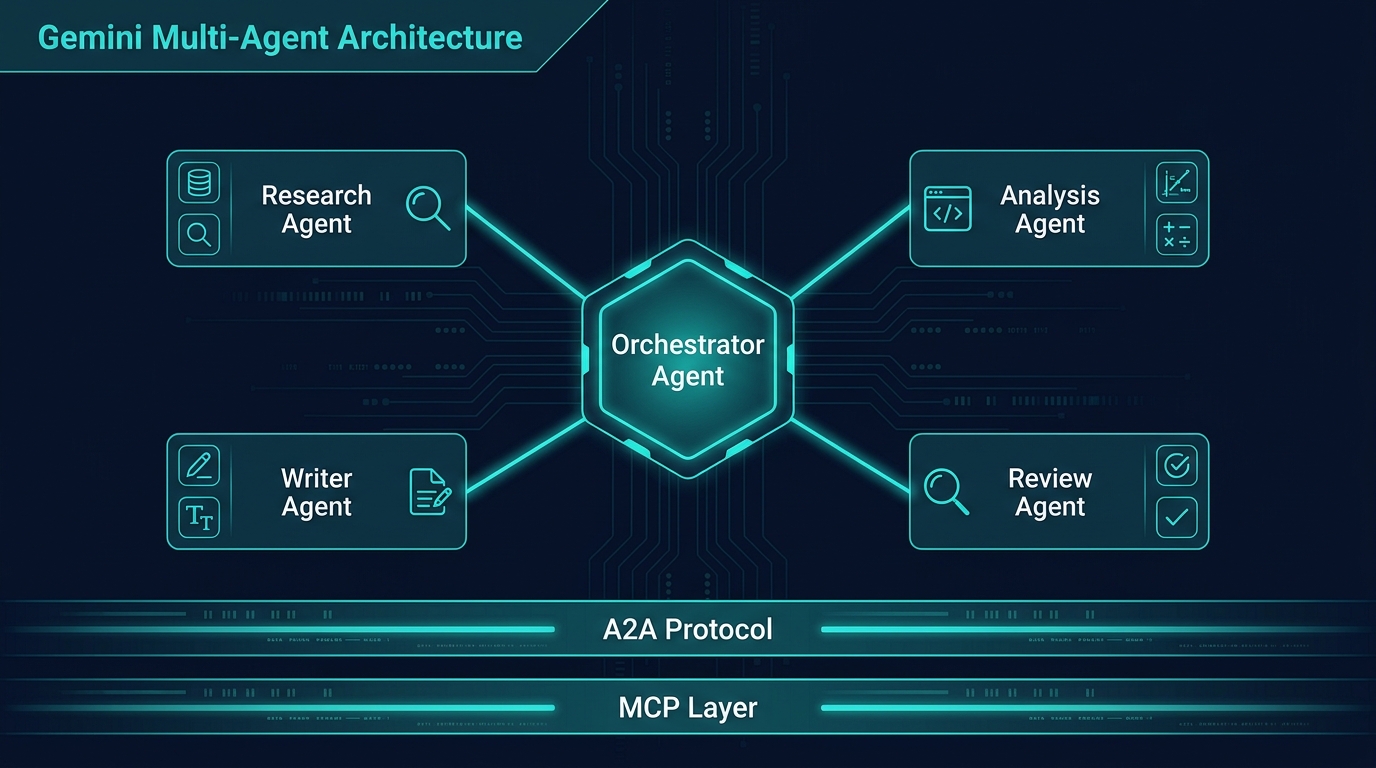
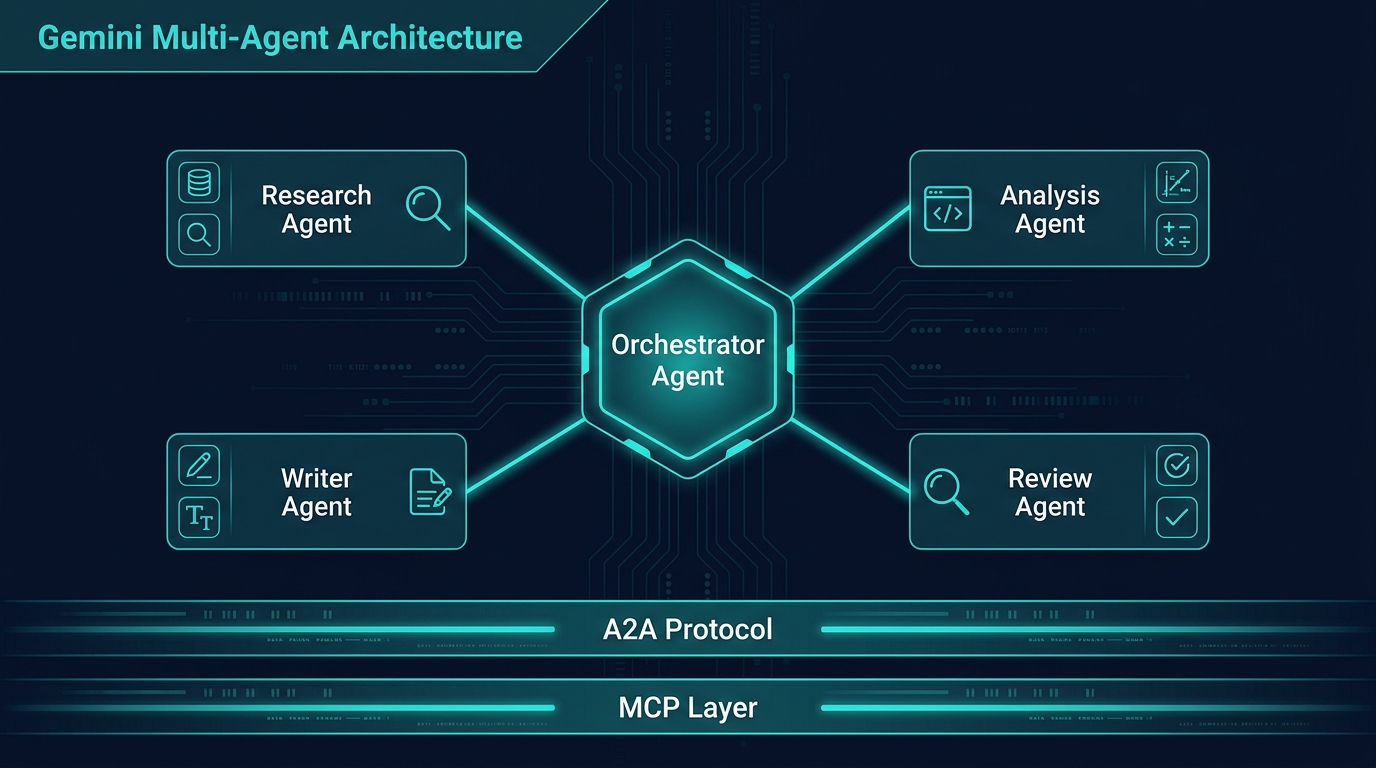
Google’s multi-agent infrastructure in 2026 is built on four interlocking layers. The Agent Development Kit (ADK) is the programming model — it is the framework you use to define agents, assign them tools, set their system instructions, and compose them into workflows. ADK supports sequential chains, parallel fan-outs, loop patterns, and hierarchical orchestration through explicit workflow primitives rather than emergent behavior.
The Vertex AI Agent Engine (often surfaced under the Gemini Enterprise Agent Platform umbrella) is the managed runtime that executes these workflows. It handles sessions, background execution, lifecycle management, and the operational plumbing that would otherwise require custom infrastructure. One of its defining characteristics in 2026 is support for agents that run continuously for up to seven days — a meaningful shift from the earlier assumption that agent sessions were inherently short-lived.
The Agent2Agent (A2A) protocol is the interoperability standard that governs how agents communicate with other agents, including agents running on different platforms or built by different vendors. A2A defines discovery (via Agent Cards), task delegation, status communication, and message exchange formats. It has moved from an open-source launch with 50+ partners into production use at approximately 150 organizations, with governance now held by the Linux Foundation’s Agentic AI Foundation.
The Model Context Protocol (MCP) sits at a different layer — it governs how each individual agent connects to its tools and data sources. If A2A is the horizontal layer connecting agents to agents, MCP is the vertical layer connecting an agent to the capabilities it needs: databases, APIs, code execution environments, search indexes, and business applications.
Why the Layering Matters
Understanding this four-layer structure matters because most architecture mistakes happen when teams conflate the layers. Using A2A-style patterns for tool access (when MCP is the right fit) introduces unnecessary overhead. Using direct function calls where A2A delegation belongs means you lose the discovery, governance, and interoperability benefits. The two protocols are designed to compose — MCP inside each agent, A2A between agents — and treating them as alternatives rather than complements is where the first design errors tend to enter.
The Four Orchestration Patterns and When to Use Each
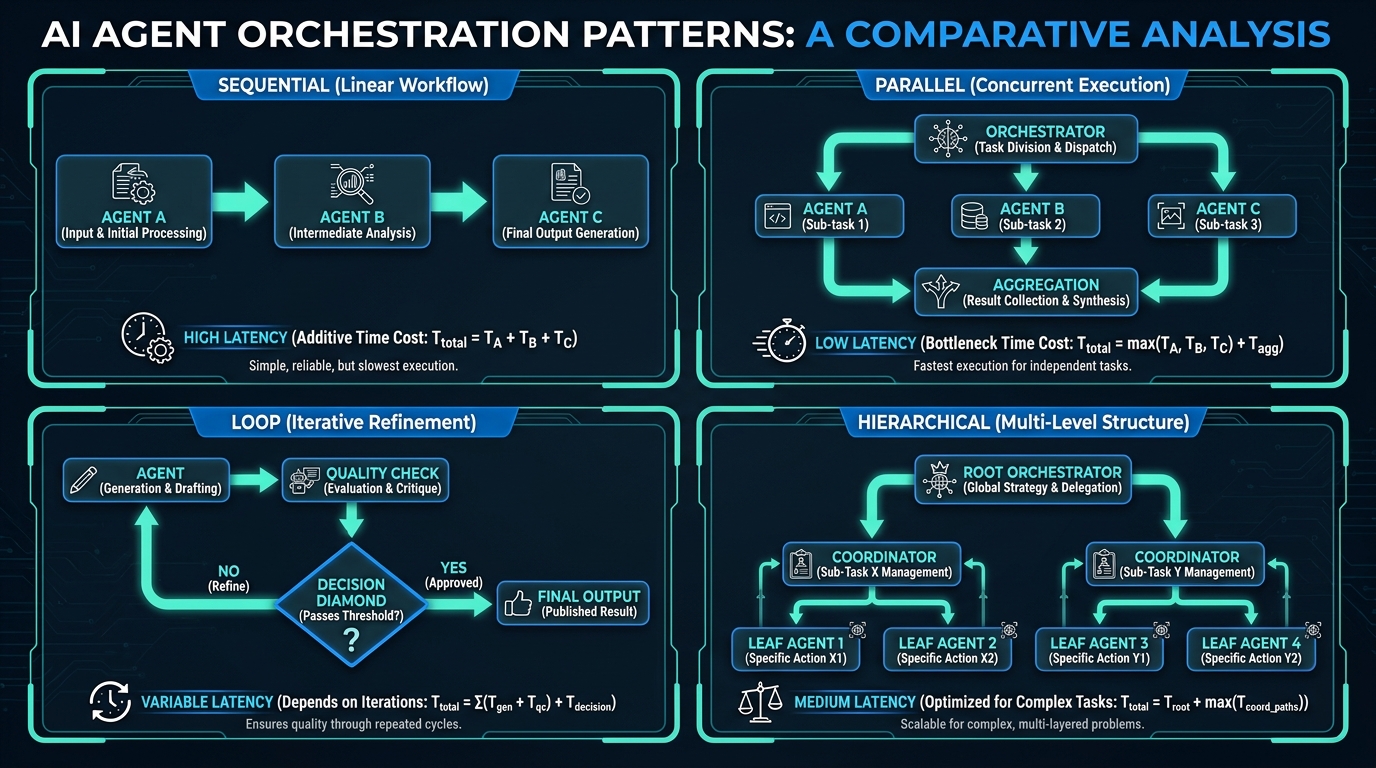
ADK formalizes four primary orchestration patterns. Each has a different cost profile, failure surface, and use case. The most common optimization mistake is selecting a pattern based on conceptual fit rather than operational characteristics.
Sequential (Pipeline) Pattern
In a sequential workflow, each agent completes its task before passing output to the next agent in the chain. The output of Agent A becomes the input context for Agent B, and so on. This is the simplest pattern, the easiest to debug, and the starting point Google explicitly recommends in its ADK documentation before introducing more complex orchestration.
Sequential pipelines are the right choice when tasks have strict ordering dependencies — when Agent B genuinely cannot begin until Agent A has finished. They are the wrong choice when the steps are actually independent, because the total latency equals the sum of all individual agent latencies. In a five-agent sequential chain where each agent takes two seconds, the pipeline floor is ten seconds regardless of how fast any individual component is.
The sequential pattern also has the highest cascading-failure risk. A failure at step two does not just end step two — it terminates the entire downstream pipeline. Error isolation is not inherent to this pattern; it must be engineered explicitly through retry logic, fallback handlers, and circuit breakers at each handoff boundary.
Parallel (Fan-Out) Pattern
In a parallel workflow, the orchestrator agent dispatches multiple sub-agents simultaneously and waits for all (or a subset) of them to complete before synthesizing their outputs. Total latency approaches the latency of the slowest individual agent rather than the sum of all agents — which, for independent subtasks, can represent a 3x to 5x wall-clock improvement over sequential execution.
The parallel pattern is optimal when subtasks are genuinely independent — when there is no data dependency between them. Agentic RAG systems use this heavily: multiple search and retrieval agents run in parallel across different data sources, with results merged by an orchestrator before the final synthesis step. Google’s own agentic RAG framework, which reports up to 34% higher factuality accuracy than standard RAG, relies heavily on parallel retrieval fan-outs.
The overhead to watch for is merge complexity. When parallel agents return heterogeneous outputs — different formats, different confidence levels, partial results — the orchestrator’s synthesis task becomes significantly harder, and the quality of the merged result is often worse than any individual result. Parallelism optimizes for speed; it does not automatically optimize for output quality.
Loop (Iterative Refinement) Pattern
Loop workflows use a feedback cycle: an agent produces output, a reviewer or evaluator agent assesses it against a quality threshold, and if the threshold is not met, the cycle repeats with updated context. ADK formalizes this with the LoopAgent primitive.
Loop patterns are appropriate when output quality cannot be verified upfront — when the task inherently requires iterative refinement, such as code generation, complex document drafting, or multi-step reasoning chains. They are deeply inappropriate as a default fallback for poorly-specified tasks, which is precisely how they tend to get misused. A loop that runs because the agent did not understand the task will not converge; it will run until it hits a token budget ceiling or a maximum iteration count.
Google’s guidance is explicit: add loops only after a baseline sequential workflow is working correctly. The cost profile of an unbounded loop grows linearly with each iteration — and in the worst case, a loop that does not converge doubles or triples token spend before the circuit breaker fires.
Hierarchical (Orchestrator-Specialist) Pattern
Hierarchical workflows introduce multiple tiers: a root orchestrator that plans and routes, mid-level coordinator agents that manage domains or subtask clusters, and leaf-level specialist agents that do focused execution work. Google’s own reference architecture describes this as an Orchestrator → Planner Agent → Query Rewriter → Search Fanout Agent stack for complex enterprise queries.
This pattern offers the best scalability — each layer can be independently optimized, replaced, or scaled without touching the others. It also offers the worst debugging experience, because failures can originate at any tier and the error signal often surfaces at the root level without a clear trace back to the originating sub-agent. Robust observability is not optional in hierarchical systems; it is a prerequisite for operating them at all.
Where Workflows Break: The Five Most Common Failure Modes in Production
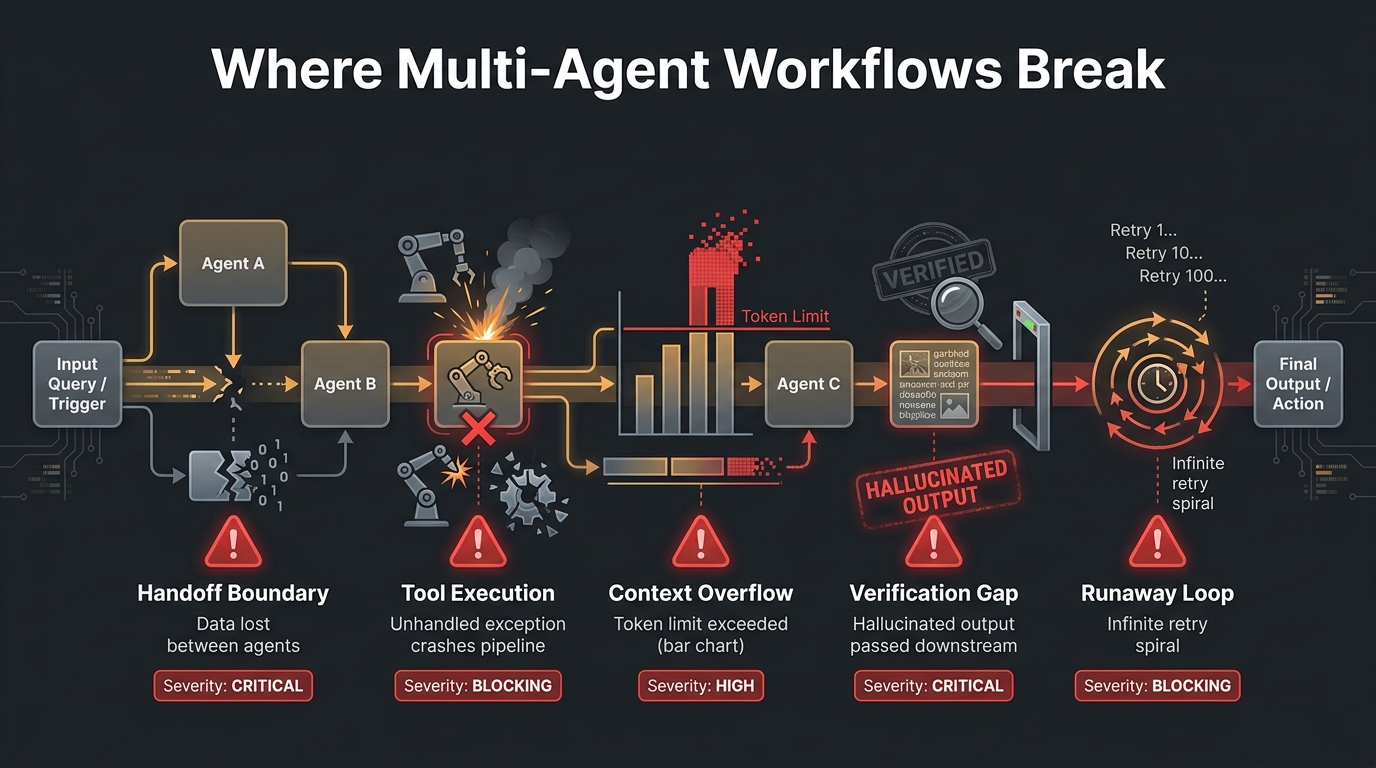
Production Gemini multi-agent workflows fail in predictable ways. Understanding the failure taxonomy is the fastest path to building workflows that do not fail in those ways.
1. Cascading Handoff Failures
The most common and most damaging failure mode occurs at handoff boundaries — the points where one agent passes context to the next. When a handoff fails (because the output format was unexpected, the required key was missing from session state, or the downstream agent’s system prompt did not anticipate the shape of the incoming data), sequential pipelines crash entirely rather than degrading gracefully.
Google’s own ADK issue tracker documents this pattern specifically: when an MCP tool fails and throws an unhandled exception, it propagates as an uncaught error that stops subsequent agents in the pipeline. The fix requires explicit exception handling at every tool call boundary — not global try/catch at the orchestrator level, which catches the failure too late to isolate it.
Practically, this means every agent that produces output for downstream consumption needs a validated output schema. The orchestrator should verify that the handoff payload conforms to the expected structure before passing it. This sounds obvious; it is almost never implemented in initial deployments.
2. Context Drift and State Pollution
In long-running workflows, session state accumulates. An agent early in the pipeline writes a value to session.state. Several steps later, a different agent writes a conflicting value to the same key. Downstream agents then read state that does not reflect the current step of the workflow — a condition known as state pollution.
ADK’s solution is to use descriptive, namespaced keys in session state and to be explicit about which agent is authorized to write to which keys, preventing one agent from silently overwriting another’s output. In practice, the most reliable convention is to include the agent name and step number in every state key — verbose, but unambiguous.
3. Context Window Overflow and Token Bloat
Even with Gemini models’ large context windows (up to 1 million tokens), multi-agent workflows can exceed them in production. More commonly, they stay within window limits but consume far more tokens than necessary — driving up cost without improving output quality. The typical culprit is full context passthrough: each agent receives the entire conversation history including all prior agent outputs, most of which is irrelevant to the current step.
A research agent that has read and summarized a 50-page document should not be passing that raw document to the formatting agent that comes after it. The formatting agent needs the summary, not the source material. This sounds self-evident; the default behavior of many orchestration implementations is to pass everything.
4. Verification Gaps and Hallucination Propagation
Without a verification layer, an agent that produces a hallucinated or factually incorrect output silently passes that error to the next agent, which builds on it, which passes it further. By the time the error surfaces in the final output, it has been validated implicitly by every downstream agent that processed it.
Agentic RAG mitigates this by grounding agent outputs in retrieved evidence before they pass downstream — Google reports up to 34% higher factuality accuracy using this approach compared to standard RAG. For workflows that do not use retrieval grounding, an explicit fact-checking or consistency-checking agent at key handoff points is the equivalent control.
5. Runaway Loops and Unbounded Retries
Loop agents without convergence criteria and retry logic without circuit breakers create unbounded cost exposure. A loop that fires on every quality-check failure with no maximum iteration count, combined with a quality threshold that the current model cannot meet, will run until token budget exhaustion. A retry policy that attempts a failing tool call ten times before surfacing an error multiplies the cost of every tool failure by ten.
Every loop needs an explicit max_iterations parameter. Every retry policy needs a maximum attempt count, exponential backoff, and a defined behavior on final failure — whether that is fallback to a simpler agent, human escalation, or graceful degradation to a partial result.
The MCP + A2A Stack: Why Getting the Layers Wrong Kills Performance
The relationship between MCP and A2A is one of the most misunderstood design choices in Gemini multi-agent architecture, and the consequences of getting it wrong compound across every workflow execution.
What Each Protocol Actually Does
MCP (Model Context Protocol) is a client-server protocol that governs how an agent accesses tools and data. When an agent needs to run a SQL query, read a file, call an external API, or search a knowledge base, MCP is the protocol that structures that request and the tool’s response. It operates vertically — within an agent’s scope, connecting that agent to its capabilities.
A2A (Agent2Agent) is a peer-to-peer protocol that governs how one agent delegates work to another agent and receives results back. When an orchestrator needs a specialist agent to take over a subtask, A2A is the protocol that handles the handshake, the task specification, status updates, and result delivery. It operates horizontally — across agents, connecting one agent’s needs to another agent’s capabilities.
The production architecture pattern that Google and its 150+ A2A production organizations have converged on is: MCP inside each agent, A2A between agents. An agent uses MCP to access its tools. It uses A2A to delegate work to other agents. These are not interchangeable; using A2A for what should be an MCP tool call introduces a round-trip agent discovery and task lifecycle overhead that can add hundreds of milliseconds per call.
Agent Cards and Discovery Overhead
A2A uses a discovery mechanism called Agent Cards — JSON documents that describe an agent’s capabilities, input/output formats, and service endpoint. Before one agent can delegate to another, it (or the orchestrator) needs to resolve the target agent’s card.
In a workflow where agent discovery happens at runtime for every delegation, this adds latency. In a well-optimized workflow, agent cards are resolved once at workflow initialization and cached for the duration of the session. Teams that benchmark A2A delegation overhead and find it surprisingly high are almost always paying for repeated runtime card resolution rather than the delegation itself.
Cross-Vendor Agent Delegation
One of A2A’s clearest value propositions — and one that is becoming practically relevant in 2026 — is cross-vendor agent delegation. A Gemini orchestrator can delegate to a specialist agent running on Salesforce, ServiceNow, or AWS without a custom point-to-point integration. This is the architecture behind enterprise deployments that mix Google’s AI capabilities with domain-specific agents from other vendors.
The governance consideration here is significant: when you delegate to an agent outside your own infrastructure, you need explicit policies around what data that agent can receive, what it can do with it, and what audit trail is created. A2A’s task lifecycle model (task specification, in-progress status, completed status with artifacts) provides the structural hooks for this governance, but the policies themselves must be implemented by the deploying organization.
Context Is the Hidden Cost Driver
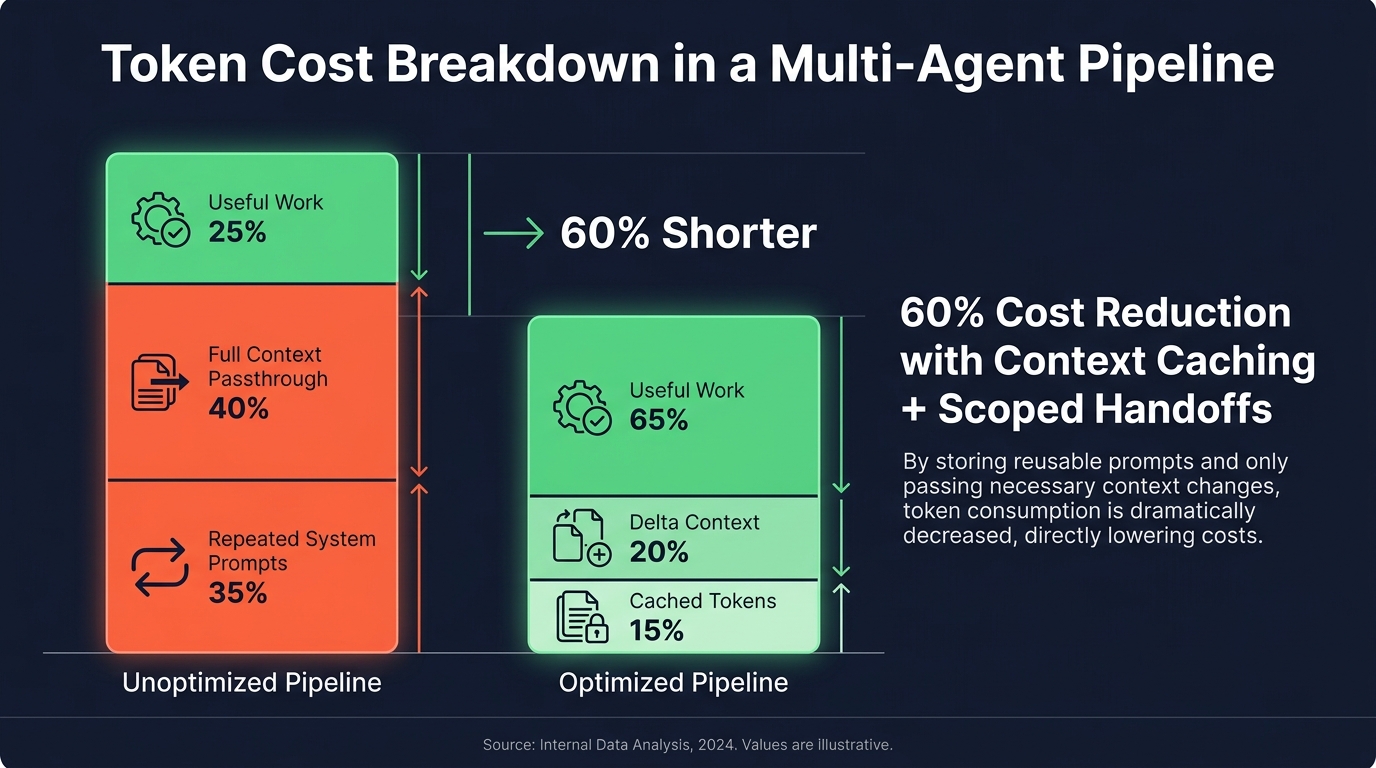
Token cost is the most predictable lever in multi-agent optimization — and the most consistently underestimated. When teams run a cost analysis on their initial multi-agent deployment, they are often surprised to find that 60 to 70 percent of their token spend is going to context — not to the actual work the agents are doing.
How Context Bloat Happens
It starts with system prompts. Every agent call includes the agent’s system prompt — which, in an unoptimized setup, might be a thousand tokens or more of instructions, persona definitions, output format specifications, and behavioral guidelines. In a ten-agent pipeline where each agent is called once, that is ten thousand tokens of system prompt overhead on every pipeline run, regardless of task complexity.
It compounds with context passthrough. If the orchestrator passes the full conversation history — including all prior agent outputs — to each sub-agent, and those outputs are verbose, the context payload grows with every step. By agent seven in a ten-agent chain, the input context might be five times larger than what that agent actually needs to do its job.
It escalates with repeated tool results. When a tool returns a large payload (a document, a database result set, a search response), and that payload is included in the conversation history that gets passed to the next agent, the same data is being paid for again with every subsequent model call.
Context Caching: The Single Highest-ROI Optimization
Gemini’s context caching feature allows repeated input tokens — stable content that does not change between calls, such as system prompts and reference documents — to be cached and reused at a significantly lower cost than re-sending them. For Gemini 2.5 family models, the minimum cache threshold is 4,096 tokens; for the Gemini 2 family, it is 2,048 tokens.
Cached input tokens are billed at a fraction of the standard input rate. The storage cost is approximately $1.00 per million tokens per hour. For any agent with a system prompt above the minimum threshold and a call frequency above a few calls per hour, context caching is almost always cost-positive within the first session.
The practical implementation: identify the stable portion of every agent’s context — the system prompt, the standing instructions, any reference documents that do not change between calls — and cache it explicitly. Pass only the dynamic delta (the task-specific input, the current step’s context) as uncached tokens. This pattern alone has been reported to cut per-run token costs by 30 to 60 percent in workflows with heavy system prompt reuse.
Scoped Context Handoffs
Google’s 2026 ADK guidance explicitly recommends “scoped by default” context passing: agents should receive the minimum context necessary to complete their task, fetching additional context through tool calls only when needed rather than receiving everything up front.
The operational implementation of this is a summary agent pattern: before passing a large agent output to the next stage, a lightweight summarizer agent (or even a simple structured extraction step) distills the upstream output to only the elements the downstream agent needs. This adds a step to the pipeline but reduces the context payload for every subsequent step — and in longer pipelines, the cumulative token savings typically outweigh the added summarization cost within three or four downstream steps.
State Management Done Right: Sessions, Memory Banks, and What Goes Where
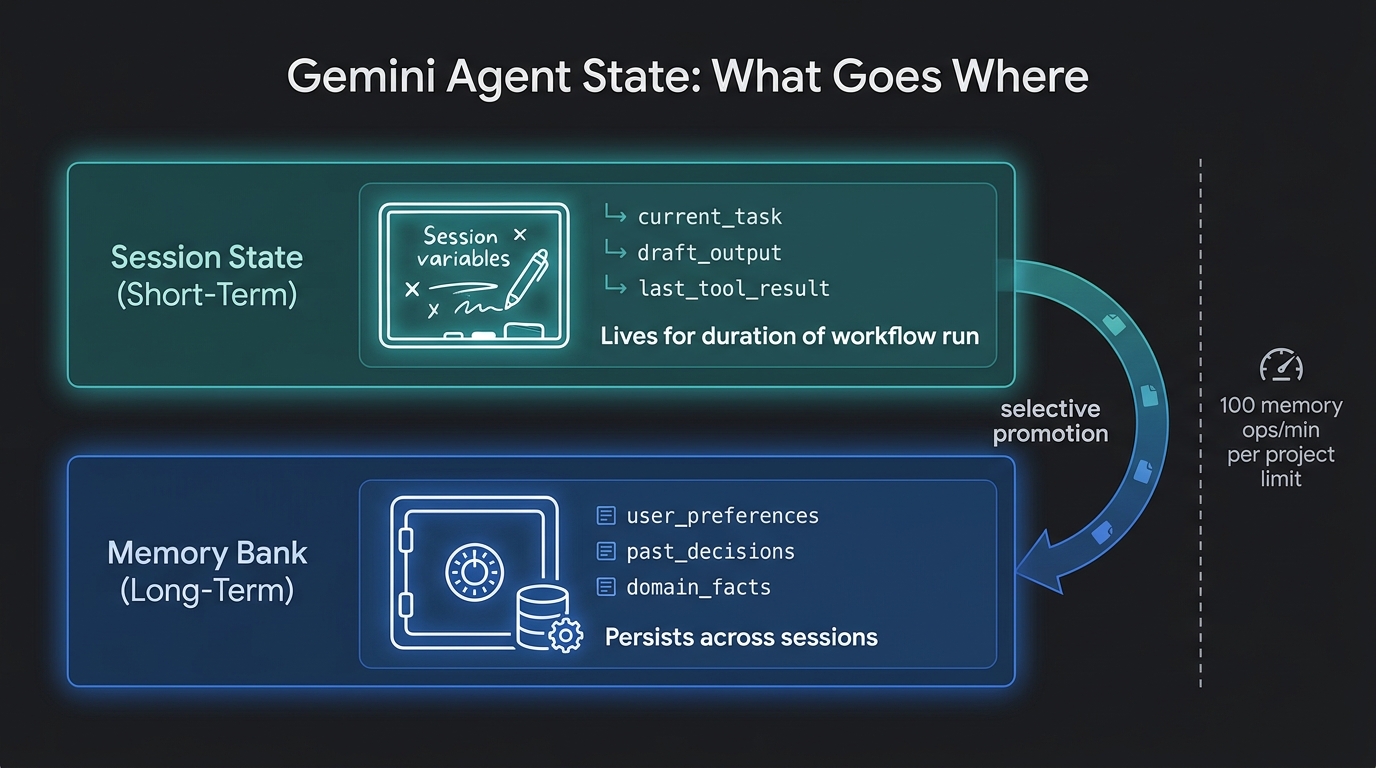
State management is the structural backbone of any multi-agent workflow that runs across multiple steps, multiple sessions, or multiple users. Getting it right requires understanding the two distinct layers Google provides — and being deliberate about what belongs in each.
Session State: The In-Run Whiteboard
Session state (session.state in ADK) is the shared memory space that all agents in a workflow can read from and write to during a single run. It exists for the duration of the workflow execution and is the primary mechanism for passing structured data between agents without embedding that data in the conversation context itself.
Good session state design has three characteristics. First, keys are descriptive and namespaced — research_agent.document_summary rather than just summary. Second, write authority is explicit — the orchestrator should define which agents are permitted to write to which keys, preventing one agent from silently overwriting another’s output. Third, the state schema is defined at workflow initialization, not discovered at runtime, so downstream agents know exactly what to expect.
The output_key parameter in ADK is specifically designed for this: it allows an agent to write its primary output to a named session state key, making that output reliably available to any subsequent agent that declares a dependency on it. Using output_key consistently is the difference between a workflow where data flow is explicit and one where it is implicit and fragile.
Memory Bank: Persistence Across Sessions
The Memory Bank in Vertex AI Agent Engine is the long-term persistence layer — it stores information that needs to survive beyond a single workflow run. User preferences, accumulated domain knowledge, historical decisions, learned entity relationships, and behavioral patterns all belong in the Memory Bank rather than in session state.
In 2026, Google moved Agent Engine Sessions and Memory Bank to general availability, making them production-grade features rather than experimental capabilities. The published rate limits are worth noting for capacity planning: 100 memory resource operations per minute per project per region. At high concurrency (many users or workflows running simultaneously), this ceiling can become a constraint and should be factored into throughput planning.
The selective promotion pattern — deciding what gets written from session state to Memory Bank at workflow completion — is a design decision that requires deliberate thought. Writing everything to Memory Bank creates storage costs and retrieval noise. Writing nothing means every new session starts cold. The optimal pattern identifies a small set of high-value, stable facts from each run and promotes only those.
Human-in-the-Loop Pause Points
One of the more practically useful recent additions to ADK state management is native support for human-in-the-loop pause and resume. A workflow can pause at a defined checkpoint, persist its current state, and wait for human input — approval, correction, additional information — before continuing. When the workflow resumes, it picks up exactly where it left off rather than restarting.
This capability matters most in regulated industries (finance, healthcare, legal) where human review of intermediate outputs is a compliance requirement, not just a quality preference. Implementing it at the platform level, rather than as custom middleware, removes one of the most common blockers for production deployment in those sectors.
Real Results from Real Deployments
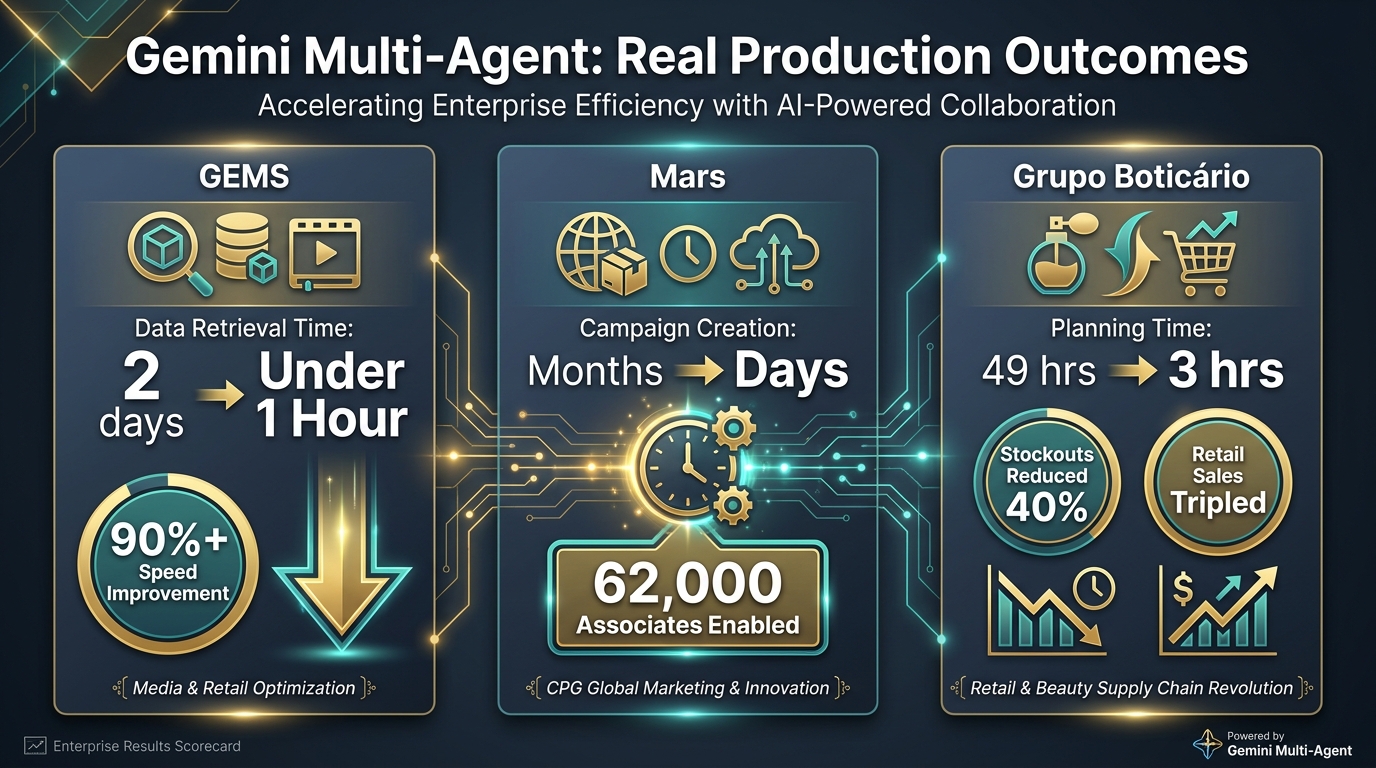
The production numbers that have emerged in 2026 from organizations that have deployed Gemini multi-agent workflows in earnest are worth examining in detail — both for what they demonstrate and for the specific architectural conditions under which those results were achieved.
GEMS: Two Days to Under One Hour
GEMS (a multi-sector enterprise data platform) deployed a Gemini multi-agent system for multi-operational data retrieval — a task that previously required manually querying multiple disconnected systems and aggregating results by hand. Their pre-agent baseline was approximately two days per complex query cycle.
With a multi-agent architecture that used specialized retrieval agents running in parallel across different data domains, combined with an orchestrator that aggregated and cross-validated results, the same retrieval task was reduced to under one hour. Google reports this as a greater than 90% improvement in executive decision-making speed.
The key architectural element that made this possible was genuine parallelism — the retrieval agents did not depend on each other’s outputs, making simultaneous execution safe. The orchestrator’s aggregation logic was also designed to handle partial results gracefully: if one retrieval agent failed or timed out, the remaining results were merged and flagged for incompleteness rather than the entire query being discarded.
Mars: Months to Days at 62,000-Associate Scale
Mars’s deployment is notable both for its outcome and its scale. Global campaign creation — a process that previously spanned months and required coordination across regional teams, legal review, and creative production — was compressed to days using a multi-agent workflow that coordinated across planning, legal checking, creative generation, and regional adaptation agents.
The 62,000 associates figure is significant: it reflects not just a central deployment but a broadly distributed one where individual users are interacting with agent-powered tools in their day-to-day work. At this scale, the latency and cost optimization decisions made at the architecture level have a compounding effect on total operational spend.
Grupo Boticário: 49 Hours to 3 Hours, 40% Fewer Stockouts
Grupo Boticário’s deployment across 4,500 retail stores combined 16,000 AI models on the Gemini Enterprise Agent Platform and BigQuery. Their production planning time dropped from 49 hours to 3 hours — an 84% reduction. Inventory stockouts dropped by up to 40%. Retail sales tripled in the period following deployment.
The scale of this deployment — 16,000 models, 4,500 stores, 100% platform adoption — makes it one of the most demanding multi-agent Gemini implementations in public documentation. The 40% stockout reduction is particularly meaningful because it reflects the accuracy of agent-driven demand forecasting and replenishment recommendations, not just process speed.
Google’s Agentic RAG: 34% Factuality Improvement
Google’s own research on agentic RAG using multi-agent orchestration reports factuality accuracy improvements of up to 34% versus standard single-pass RAG, with cross-corpus routing accuracy at approximately 90%. This is the internal benchmark that most directly supports the verification layer argument: routing retrieval across multiple specialist agents, rather than running a single retrieval call, improves both coverage and accuracy of the grounded response.
Long-Running Agents: What the 7-Day Runtime Changes About Workflow Design
The ability to run an agent continuously for up to seven days — one of the defining features of the Gemini Enterprise Agent Platform in 2026 — sounds like a simple capacity increase. In practice, it changes the design assumptions for an entire category of workflows.
Asynchronous Work at Human Timescales
Short-lived agents (sub-second to a few minutes) operate at machine timescales. The assumption is that the calling process can block and wait for the result. Long-running agents operate at human timescales — they might be monitoring a data source, completing a multi-day research task, or coordinating a procurement workflow that requires external responses. The calling process cannot block for hours. The workflow architecture must be explicitly asynchronous.
This means the orchestrator cannot use a synchronous request-response pattern for tasks dispatched to long-running agents. It needs to use a task lifecycle model — dispatch, poll for status, handle completion — or use an event-driven callback when the agent completes its work. A2A’s task object model (which tracks task status through submitted, in-progress, and completed states) is specifically designed for this pattern.
State Recovery and Resumption
Any agent running for hours or days will encounter infrastructure disruptions — network interruptions, service restarts, platform maintenance windows. A well-designed long-running agent must be able to resume from a checkpoint rather than restart from scratch. ADK’s native state recovery support, moved to general availability in 2026, handles this through persistent session state checkpointing.
The design implication is that long-running agents must write their progress to session state at meaningful intervals — not just at completion. An agent that processes 200 records over six hours and checkpoints every 50 records can resume from record 150 after a disruption. An agent that only writes final output must restart from record zero.
Cost Model Differences
Long-running agents also change the cost model. A short-lived agent’s cost is dominated by per-call token usage. A long-running agent running continuously generates both token costs (for each reasoning step and tool call) and infrastructure costs (for the Agent Engine runtime). Batch API pricing, which offers approximately 50% discounts versus synchronous API pricing for non-time-sensitive work, is worth evaluating for long-running tasks where latency is not critical.
Governance, Guardrails, and Why Observability Is Not Optional
Multi-agent systems in production create governance challenges that do not exist for simpler AI deployments. The distribution of work across multiple agents, tools, and potentially multiple external services means that a single user prompt can trigger dozens of actions, tool calls, and data reads. Without visibility into that chain of events, auditing, debugging, and compliance are not possible.
The Observability Stack
Google’s recommended observability approach for Gemini multi-agent systems follows a diagnostic hierarchy: summary metrics first, then per-case results, then failure clusters, then traces. In practice, this means instrumenting four measurement layers:
Latency metrics at each agent boundary — not just end-to-end pipeline latency, but per-agent latency and per-tool-call latency. Latency spikes in sub-agents are invisible in aggregate metrics but represent the most actionable optimization signal.
Error rates by failure type — distinguishing between tool call failures, handoff validation failures, context overflow errors, and model refusals. These have different root causes and different fixes; aggregating them into a single error rate obscures actionable signal.
Token usage by agent and by call type — input versus output, cached versus uncached. This is the cost attribution layer. Without it, there is no way to identify which agent or which workflow step is the primary cost driver.
Tool-use quality — tracking whether tool calls return expected outputs, how often tools fail or time out, and whether agents are calling tools with correct parameters. Poorly formed tool calls that consistently fail are a reliability and cost problem that only becomes visible with per-tool instrumentation.
Guardrails for Autonomous Action
As agents gain the ability to take actions — writing to databases, sending emails, making API calls to external services, creating or deleting records — the risk surface expands significantly. Unlike read-only retrieval agents, action-taking agents can cause real-world harm through mistakes, hallucinations, or unexpected interpretations of ambiguous instructions.
The guardrail pattern Google recommends for action-taking agents is a pre-execution validation step: before taking any consequential action, the agent verifies that the action is within its defined authority, that the parameters are within expected bounds, and (for high-stakes actions) that a human review checkpoint has been cleared. This is not just best practice — in regulated industries, it is increasingly a compliance requirement.
Cross-vendor A2A delegation adds an additional governance layer: when delegating to an external agent, the delegating system needs policies that define what data can be shared (data classification rules), what actions the external agent is permitted to take (capability restrictions), and what audit record is required. A2A’s task lifecycle model provides structural support for audit trails, but the data classification and capability restriction policies are organizational decisions that must be implemented explicitly.
The Optimization Checklist: 12 Decisions That Separate Fast, Cheap Pipelines from Slow, Expensive Ones
Synthesizing the patterns above into a practical decision framework, these are the twelve architecture and implementation decisions that have the highest leverage on multi-agent pipeline performance and cost in production.
Architecture Decisions
- Start sequential, add complexity deliberately. Build the simplest possible sequential pipeline first. Add parallelism, loops, and hierarchical layers only when the baseline is working correctly and the need is demonstrated by real task requirements — not by what sounds more sophisticated.
- Match the protocol to the layer. Use MCP for agent-to-tool connections. Use A2A for agent-to-agent delegation. Do not conflate them. The performance penalty for using the wrong protocol at the wrong layer is real and compounding.
- Define agent authority explicitly. Every agent should have a narrow, documented scope. An agent that can theoretically do anything will routinely attempt to do the wrong thing. An agent with a well-defined scope and clear output specification is easier to debug, cheaper to run, and more reliable in production.
- Cache agent card resolution. Resolve A2A agent cards at workflow initialization, not at each delegation call. Runtime card resolution is the most common source of unexplained A2A latency overhead.
Context and Token Decisions
- Enable context caching for every stable system prompt above the minimum threshold. For Gemini 2.5 models, any system prompt above 4,096 tokens should be cached. This is the single highest-return optimization for most workflows and requires minimal implementation effort.
- Pass delta context, not full history. Every handoff should carry only the minimum context the downstream agent needs. If full history is genuinely necessary, structure it explicitly — do not pass raw conversation history and let the downstream model sort out what is relevant.
- Insert a summarization step before long downstream chains. In pipelines of five or more agents, a lightweight summarization step after the first heavy-context stage often pays for itself in reduced token costs within three downstream steps.
- Set token budgets per agent. An agent without a token budget will use however many tokens it generates by default. Setting per-agent output token limits enforces discipline on verbosity and reduces cascading context bloat.
Reliability and Governance Decisions
- Validate every handoff payload against a schema. Before passing an agent’s output to the next stage, the orchestrator should verify that the payload conforms to the expected structure. Missing fields and unexpected formats caught at the handoff boundary are isolated failures; the same errors caught at step seven are pipeline crashes.
- Set explicit maximum iterations on every loop and maximum retries on every tool call. Unbounded loops and infinite retries are not just performance problems — they are cost exposure events. Every loop and every retry must have a hard ceiling and a defined behavior on failure.
- Instrument four metric layers. Latency by agent, error rate by failure type, token usage by agent and call type, and tool-use quality. Without these four layers, optimization decisions are guesses. With them, the highest-impact improvements are usually obvious within the first week of production monitoring.
- Implement human-in-the-loop checkpoints for high-stakes actions. Any agent action that creates, modifies, or deletes data in external systems should have a human review checkpoint in regulated contexts — and a validation checkpoint even in non-regulated ones. Native ADK pause/resume support makes this architecturally straightforward.
Build for Reliability First, Speed Second
The organizations that are getting the most out of Gemini’s multi-agent capabilities in 2026 share a common pattern: they invested in reliability infrastructure before they optimized for speed or scale. The case studies above — GEMS, Mars, Grupo Boticário — did not achieve their results by deploying ambitious multi-agent pipelines and tuning them under load. They achieved them by first building workflows that were predictable, well-instrumented, and failure-tolerant, then using that stable foundation to add parallelism, longer-running tasks, and cross-system delegation.
This sequence matters because the failure modes of an unreliable multi-agent system compound in ways that a single-agent failure does not. A hallucinated output from a single model is a problem. A hallucinated output from agent two in an eight-agent chain, validated implicitly by agents three through seven, is a systems problem that is far harder to detect and much more expensive to fix.
The optimization levers are real and significant. Context caching at scale, scoped handoffs, parallel fan-out where tasks are genuinely independent, and structured state management can collectively cut token costs by 40 to 60 percent and wall-clock latency by 50 to 80 percent compared to an unoptimized initial deployment. But these gains are only accessible on a foundation that is already reliable — a pipeline where failures are isolated, state is predictable, and observability is sufficient to distinguish between a performance problem and a correctness problem.
The teams that are building that foundation now — with explicit handoff schemas, per-agent token budgets, early observability, and conservative loop bounds — are the ones that will be deploying confidently at scale in six months. The teams that are chasing architectural sophistication without that foundation are accumulating technical debt in a system whose failure modes do not reveal themselves until you are deep enough in that unwinding is expensive.
Start with the sequential chain. Instrument everything. Optimize context aggressively. Add complexity only when the task genuinely requires it.
Key Takeaway: The performance ceiling in Gemini multi-agent workflows is almost never the model. It is the orchestration. Fix the handoffs, the context strategy, and the state design, and the model performance you already have is likely more than sufficient for the task you are trying to accomplish.