
Amazon advertising has never been cheap. But in 2026, it’s reached a level of expense that demands a different kind of thinking — not louder bidding, not bigger daily caps, and not the same tired advice about “optimizing your keywords.” According to Ad Badger, the average Amazon CPC hit $1.18 in 2026, peaking at $1.21 in February. For Sponsored Products specifically, Jungle Scout’s 2026 State of the Amazon Seller Report places the average CPC at $1.34 — a 34% jump year-over-year. Sponsored Display? A staggering $3.72 average CPC, up 49% from the year before.
These aren’t incremental adjustments. They’re structural shifts in the cost of doing business on Amazon. And the sellers who respond with structural thinking — rather than reactive panic or passive acceptance — are the ones who will protect their margins and compound their gains while competitors bleed spend into a system that’s increasingly expensive to operate without discipline.
This guide is built around a single premise: in a high-CPC environment, your Amazon PPC budget needs to be treated like a surgical instrument. Every dollar you deploy should be going somewhere deliberate — a specific campaign type, a specific keyword tier, a specific conversion window, a specific objective in the organic rank journey. The goal isn’t just efficiency. It’s precision.
We’ll cover the real mechanics of why CPCs are rising, why the instinctive responses tend to make things worse, and then walk through every major lever you have: from budget triage and TACoS-driven governance, to the algorithm change that’s burning your budget before lunch, to ad type arbitrage and the flywheel play that can eventually reduce your ad dependency altogether.
The CPC Inflation Reality Check: What the 2026 Numbers Actually Tell You
Before making any budget decisions, you need an honest read on what’s driving CPC inflation — because the cause determines the cure. The headlines say “CPCs are up,” but the underlying mechanics vary significantly by category, ad type, and competitive landscape. Treating all CPC increases the same way is how sellers end up applying the wrong remedy.
The Numbers Behind the Trend
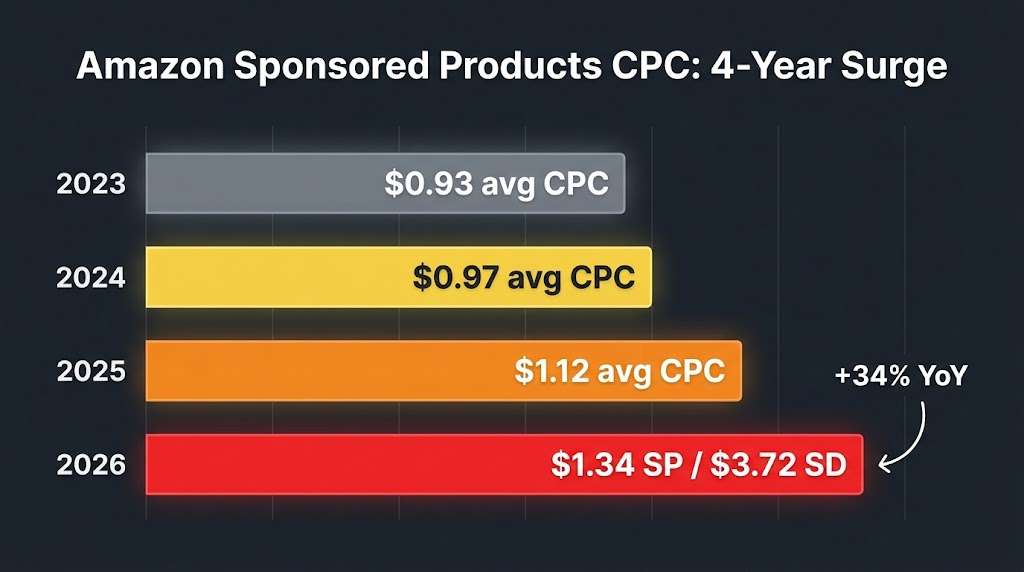
The trajectory is clear and consistent. Amazon’s average CPC sat around $0.93–$0.98 in 2023. By 2024, it had moved to roughly $0.97. Then in 2025, the market saw a 15.5% jump, landing the average at approximately $1.12. In 2026, a further 8–12% increase is forecast across most aggregators, with early-year data from Ad Badger confirming the trend is already playing out.
But these are averages. The format-level data tells a more nuanced story. Sponsored Products — the workhorse of most Amazon ad accounts — average around $1.34, but in highly competitive categories like supplements, electronics accessories, or pet care, CPCs can run two to three times the baseline. Sponsored Display, often used for retargeting and competitor conquesting, has surged to $3.72 per click on average. That’s not a supplemental line item anymore — at those rates, SD campaigns require far more disciplined conversion tracking to justify their place in the budget.
Why CPCs Keep Rising: The Structural Drivers
Three core dynamics are fueling the CPC climb, and they aren’t going to resolve on their own.
More advertisers, same inventory. Amazon’s seller base continues to grow. As more sellers launch PPC campaigns — particularly new entrants funded by aggregators and e-commerce roll-ups — the auction becomes more crowded, especially for high-intent, bottom-funnel keywords. Basic supply and demand: more bidders chasing the same top placements equals higher clearing prices.
Amazon’s own algorithm changes. The shift to predictive conversion pacing (more on this later) has altered how budgets are consumed intra-day, which affects auction dynamics at different hours. Amazon’s increasing use of machine-learning bidding also tends to push CPCs upward as the system bids more aggressively on high-conversion-probability placements.
The brand defense arms race. As more established brands set up Amazon advertising, they’re not just competing for new customers — they’re defending branded keywords, which drives up costs for everyone. Branded keyword CPCs have historically been lower, but as brand defense bidding intensifies, even those safe havens are seeing upward pressure.
What This Means for Your Business Model
The practical implication is that your allowable CPC — the maximum you can pay per click while remaining profitable — is being squeezed from both ends. Rising CPCs are increasing your cost side, while increased competition on placements is reducing your conversion rates on many terms. If your margins haven’t expanded to absorb these costs, you’re now paying more for the same outcome, or paying the same and getting less.
The answer isn’t to accept this as the cost of doing business. The answer is to become more deliberate about which battles you fight and which you don’t.
Why “Raise the Daily Budget” Is the Worst First Response
When sellers notice their campaigns running out of budget before the day ends, or when they see their impressions declining, the instinctive response is to throw more money at the problem. Increase the daily budget. Raise bids. Get back into auctions. This logic feels sound on the surface — you need traffic to generate sales — but in a high-CPC environment, it’s often the fastest path to margin destruction.
The Efficiency Problem You’re Amplifying
Here’s the issue: if you raise your daily budget without fixing the underlying efficiency of your campaigns, you’re not buying more performance. You’re buying more of the same performance at a higher cost. Every inefficiency in your current setup — irrelevant search terms, overbid non-converting keywords, poorly structured match types, weak negatives — gets amplified proportionally with your budget increase.
Think of it like adding water to a leaky bucket. The bucket holds a bit more water for a while, but the holes are still there. Budget increases are only appropriate after you’ve confirmed that the campaigns consuming that budget are operating at or near their optimal efficiency. Increasing budget on a broken campaign is just funding the problem.
The Impression Share Trap
Another version of this mistake comes from chasing impression share. Sellers see their impression share declining — a natural outcome when CPCs rise but budgets stay flat — and interpret this as lost market share. The remedy seems obvious: spend more to recapture those impressions.
But not all impressions are created equal. The impressions you’re losing when your budget runs out mid-day may not be the highest-converting impressions in your category. In fact, if you’re running out of budget in the morning (a pattern we’ll address in detail shortly), you may already be capturing the best conversion windows and missing only lower-intent traffic later in the day. Chasing impression share indiscriminately can mean spending more to acquire lower-quality clicks — the exact opposite of what a high-CPC environment demands.
What Should Come First
Before raising any budgets, the right sequence is: audit what your current spend is producing, identify where it’s being wasted, and restructure the campaigns to eliminate that waste. Only then does it make sense to add budget — and only to the campaigns that have demonstrated the ability to use it efficiently. This is the core premise of budget triage, which we’ll cover next.
The Budget Triage Framework: What to Cut, What to Protect, What to Scale
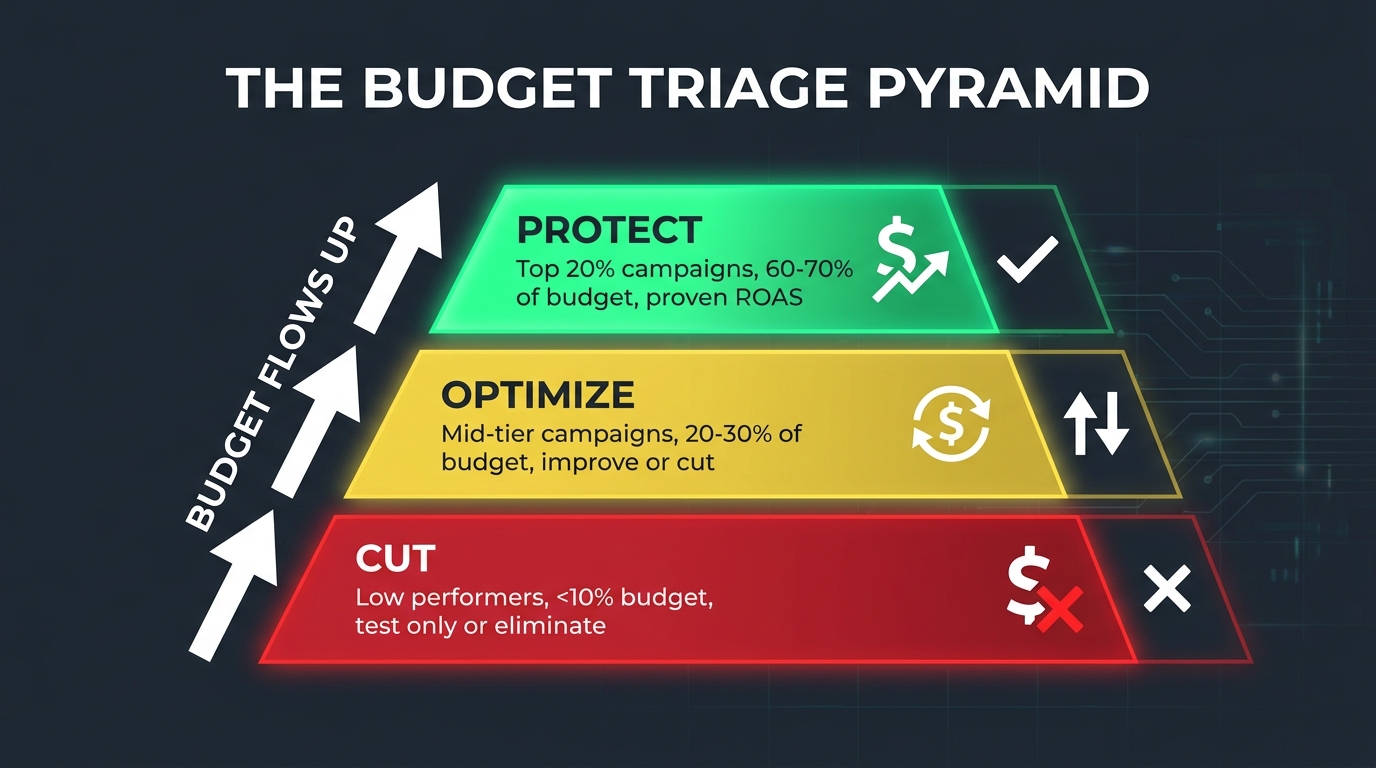
Budget triage means treating your ad account the way a field medic treats casualties: not everyone gets equal resources, and decisions need to be fast, systematic, and based on clear criteria. The goal is to identify where budget is generating the best return, where it’s marginal, and where it’s actively destroying value — then move capital accordingly.
Tier 1: The Protected Core (60–70% of Budget)
This tier contains your highest-ROAS, lowest-ACoS campaigns — typically your top-performing exact match keywords, your best-converting product targets, and your branded defense campaigns. These are campaigns where the math is already working: the conversion rate is solid, the CPC is justified by the margin, and the sales velocity is contributing to organic rank.
The instinct when CPCs rise is to reduce budgets across the board to “manage costs.” Resist this instinct for Tier 1. Cutting budget from your best-performing campaigns to compensate for inefficient ones is a backwards move — you’re defunding your winners to subsidize your losers. These campaigns deserve a protected budget allocation — meaning they’re the last place you look when you need to find savings.
Identify Tier 1 campaigns by 30-day and 90-day ACoS data. Set a clear threshold based on your product’s break-even ACoS. Any campaign consistently operating at or below that threshold with meaningful impression volume is Tier 1. These campaigns get funded first, fully, and consistently.
Tier 2: The Optimization Candidates (20–30% of Budget)
Tier 2 campaigns are showing potential but not yet operating at full efficiency. They might have a few high-performing keywords buried in a sea of average ones. They might have the right targeting but weak bids. They might convert well on some ASINs but poorly on others. These campaigns get budget — but conditional budget, paired with active work to push them into Tier 1 or remove them from the account.
The most common mistake with Tier 2 campaigns is passive management: you fund them at a moderate level, check performance occasionally, and never make a decision about them. This is how campaigns live in purgatory for months, consuming 20–30% of your budget with mediocre returns. Each Tier 2 campaign needs an explicit improvement goal and a decision deadline. If it doesn’t cross the threshold in 30 days, it gets demoted or restructured.
Tier 3: The Test and Cut Layer (10% or Less)
This is your discovery and experimentation layer — new keywords you’re testing, auto campaigns gathering data, new product launches getting initial traction data. The budget here is intentionally constrained. You’re not trying to drive significant volume from Tier 3; you’re trying to gather signal at the lowest possible cost.
A common structural error is allowing Tier 3 campaigns to consume 25–30% of total budget because they were set up with large daily caps and never pruned. In a normal-CPC environment, this is wasteful. In a high-CPC environment, it’s potentially catastrophic for margins.
Set hard budget caps on all Tier 3 campaigns. Establish explicit promotion criteria — the performance threshold a search term or targeting type must meet before it gets moved into a controlled Tier 1 or Tier 2 campaign. And set a sunset rule: if a campaign has been in Tier 3 for 45–60 days without generating any promotable signals, it gets paused or eliminated.
Portfolio-Level Reallocation: The ASIN Dimension
Budget triage also applies across your product catalog. Not all ASINs deserve equal advertising support. ASINs with higher average selling prices (ASP) and stronger contribution margins can afford higher CPCs while remaining profitable. Low-ASP, low-margin products have less room to absorb CPC inflation.
When the TYR sporting goods brand (a case study documented by the Nectar agency) reallocated budget away from low-ASP accessories and toward higher-margin apparel items, they saw both ROAS and total revenue efficiency improve. The low-priced items weren’t bad products — they were simply consuming a disproportionate share of budget relative to their margin contribution. That’s a portfolio reallocation decision, not a keyword decision, and it’s one of the highest-leverage budget moves available in a rising-CPC environment.
TACoS as Your Budget Governor, Not ACoS
One of the most persistent problems in Amazon PPC management is the overreliance on ACoS — Advertising Cost of Sales — as the primary decision metric. ACoS is useful. It tells you how efficiently a specific campaign is converting ad spend into ad-attributed revenue. But it’s an incomplete lens, and in a high-CPC environment, using ACoS alone can lead to decisions that look right on the campaign level but hurt you at the business level.
The Critical Difference
ACoS measures: Ad Spend ÷ Ad-attributed Sales. It’s a campaign efficiency metric. The problem is that it only counts revenue that Amazon’s attribution system credits to a paid click. It misses all the organic sales your product generates, including the organic sales that exist partly because of your PPC activity building keyword-level rank.
TACoS — Total Advertising Cost of Sales — measures: Ad Spend ÷ Total Sales (ad + organic). This is a business health metric. A high ACoS campaign might actually be running a healthy TACoS if it’s driving significant organic lift. Conversely, a “good” ACoS campaign might be hiding an unhealthy TACoS if it’s replacing organic sales rather than supplementing them.
Setting TACoS Targets by Product Stage
Your acceptable TACoS range should be different depending on where a product sits in its lifecycle:
- New launch phase: TACoS of 20–35% may be acceptable, because you’re investing in building organic rank. A high TACoS at launch is a feature, not a bug — it reflects deliberate spend to establish velocity.
- Growth phase: TACoS should be declining as organic rank improves and organic sales start to account for a larger share of total revenue. A target in the 12–20% range is common for growing products.
- Mature/established products: TACoS should sit at 8–12% or below for well-ranked products. If a mature product still has a TACoS above 20%, it likely has an organic rank problem that PPC alone can’t solve.
How TACoS Changes Your Budget Decisions
When you govern budgets by TACoS rather than ACoS alone, you make fundamentally different decisions. You might protect a campaign with a 35% ACoS because its TACoS is 14% and it’s clearly building organic rank. You might cut a campaign with a 20% ACoS because its TACoS is 22%, suggesting it’s cannibalizing organic rather than supplementing it.
You also make smarter decisions about how much CPC you can tolerate. If your product has strong organic rank and a healthy TACoS, you can afford a rising CPC on specific keywords because the business-level return still justifies the spend. If your TACoS is already elevated, rising CPCs are a genuine crisis — and the right response is to reduce volume, not maintain it.
“ACoS is the campaign’s pulse. TACoS is the business’s heartbeat. You need both, but don’t mistake one for the other.”
Amazon’s Predictive Conversion Pacing: The Algorithm Change Eating Your Budget Before Noon
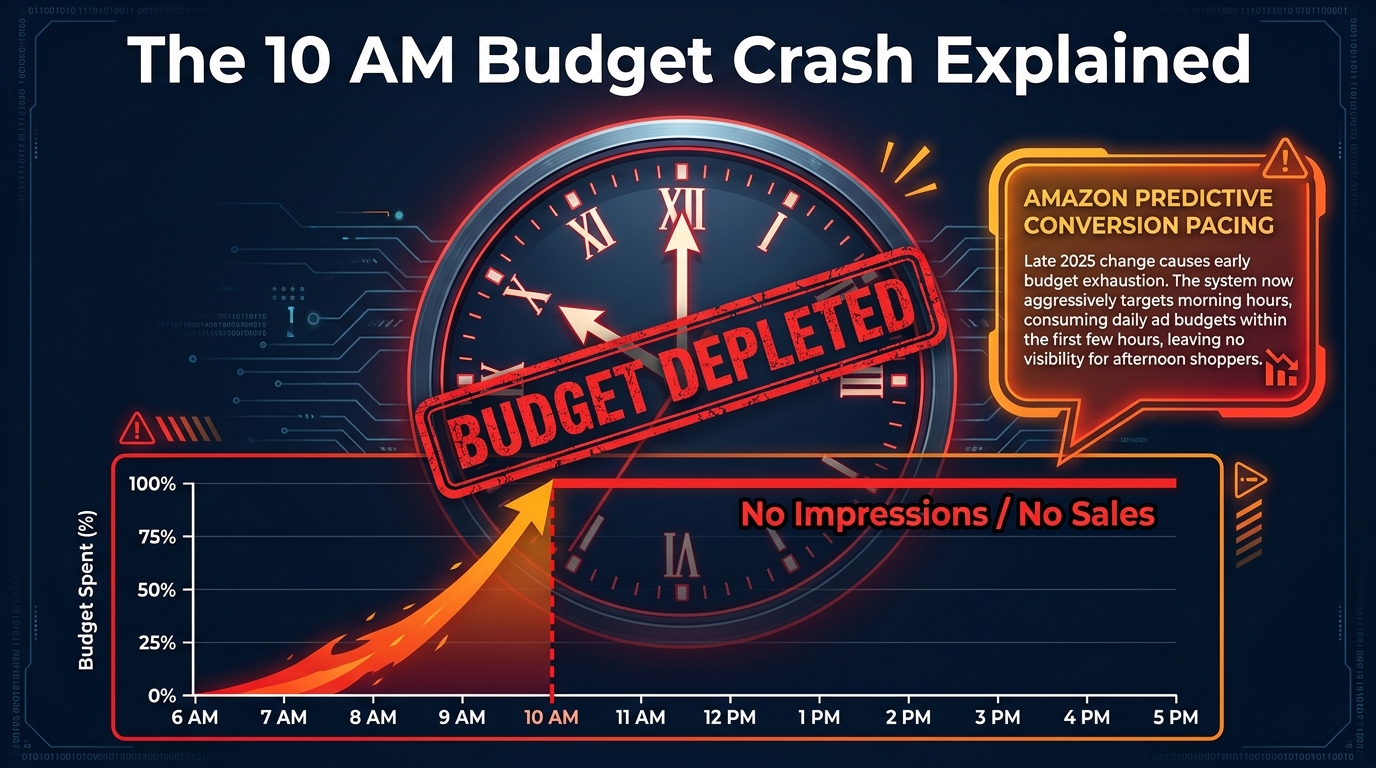
If you’ve noticed that your Sponsored Product campaigns are running out of budget much earlier in the day than they used to — sometimes as early as mid-morning — without any changes to your settings, you’re experiencing the downstream effect of one of the most significant recent changes to Amazon’s ad delivery system.
What Changed in Late 2025
Amazon quietly shifted its ad pacing model from “Even Pacing” to what SellerMetrics has termed “Predictive Conversion Pacing.” Under the old system, your daily budget was distributed relatively evenly across all hours of the day. Your campaign would spend roughly the same amount in the early morning as it did in the evening. This was predictable, if not always optimal.
Under Predictive Conversion Pacing, Amazon’s algorithm analyzes historical conversion patterns and concentrates your budget spend into the hours it predicts will generate the best conversion outcomes. In theory, this sounds like an improvement — your money goes where it converts best. In practice, it creates a phenomenon that SellerMetrics has called the “10 AM Budget Crash.”
Here’s what happens: Amazon’s models predict that morning hours (roughly 8 AM–noon) are high-conversion periods for many categories. So it front-loads your daily budget into those windows. If your daily cap was already close to what you’d spend under even pacing, you now hit zero budget by late morning — often between 10 AM and noon — leaving you with no ad coverage for the afternoon and evening, which may also contain significant conversion volume in your specific category.
Why This Is a High-CPC Disaster
In a normal-CPC environment, this was a nuisance. In a high-CPC environment, it’s a budget efficiency catastrophe. Here’s why: when your campaigns burn through budget by 10 AM, you’ve spent all your daily allocation on a concentrated window. Any waste in that window — irrelevant clicks, low-conversion searches, overbid placements — has no opportunity to be averaged out by more efficient clicks later in the day. You’ve essentially given the algorithm a budget to spend quickly in a narrow window, and if anything in that window goes wrong, you’ve burned your daily cap with nothing to show for it.
The Countermeasures
There are several practical responses to this dynamic:
Increase daily budgets gradually with monitoring. If you’re hitting your daily cap by mid-morning, a modest budget increase may extend your coverage without meaningfully changing your per-click costs. The key is to monitor whether the additional spend produces returns at the same efficiency as your morning spend, or whether it’s serving lower-quality inventory as competition thins in the afternoon.
Implement dayparting through rules-based automation. Amazon doesn’t offer native dayparting, but third-party tools (SellerMetrics, Perpetua, Pacvue, Helium 10 Adtomic, and others) allow you to set automated rules that pause campaigns during certain hours and resume them in others. If your data shows that afternoon traffic in your category converts well, structuring your campaigns to not front-load their entire budget in the morning can extend your coverage across the full day.
Segment your campaigns by time-sensitivity. Some campaigns — branded keywords, for example — are always worth being in auction for. Others — broad match discovery campaigns — are more expendable. Consider setting different budget structures for time-critical campaigns versus those where you’re willing to miss coverage windows in exchange for efficiency.
Review your category’s hourly conversion data. Before assuming you need more budget to cover lost afternoon hours, check whether afternoon and evening traffic actually converts well in your specific category. Amazon’s Search Term Report doesn’t provide time-of-day breakdowns natively, but third-party analytics tools can slice this data. If your conversion data shows that morning hours genuinely dominate, the budget crash may be a feature — you’re spending where you convert. If it shows strong evening conversion that you’re now missing, you have a real problem to solve.
Bid Strategy Surgery: When Fixed Bids Beat Dynamic — and When They Don’t
One of the most consequential and least-discussed decisions in Amazon PPC setup is the choice between bid strategy types. In a rising-CPC environment, this choice can mean the difference between controlled costs and runaway spend — and there’s no universally correct answer. The right bid strategy depends on what you’re trying to accomplish with each specific campaign.
The Three Options and Their Trade-offs
Dynamic Bids – Down Only: Amazon lowers your bid when it predicts a conversion is less likely, but never raises it above your set bid. This gives you a cost floor but no ceiling protection against algorithm-driven bid increases. It’s a conservative strategy — appropriate for campaigns where you want to reduce waste on low-intent queries but don’t need Amazon to push harder for high-intent placements.
Dynamic Bids – Up and Down: Amazon adjusts your bid both ways based on predicted conversion probability, potentially raising your bid up to 100% (for top-of-search placements) or more with placement multipliers applied on top. This can produce excellent results on high-performing campaigns, but in a high-CPC environment it can also cause unexpected cost spikes. A bid you set at $1.50 can effectively become a $3.00 bid after Amazon’s upward adjustments and placement multipliers are applied. If your daily budget is tight, this can drain it far faster than planned.
Fixed Bids: Amazon uses exactly your set bid, no algorithmic adjustments. Maximum control, fully predictable CPCs. The downside is that you miss potential conversion improvements from dynamic adjustments on high-intent moments. The upside is that your cost is entirely under your control.
The 2026 Case for Strategic Fixed Bid Deployment
In previous years, dynamic bidding was broadly recommended as a “set it and let the algorithm work” approach. In 2026’s high-CPC environment, the case for fixed bids in specific scenarios is stronger than it’s been in years. Here’s when to reach for fixed bids:
- Exact match keywords where you know the conversion rate precisely. If you have 6+ months of data on a specific keyword and know it converts at, say, 12%, you can calculate your maximum allowable bid with precision. A fixed bid protects you from paying above that threshold.
- Brand defense campaigns. Your branded keywords should not need Amazon’s algorithm to bid them up. You want to appear for your own brand terms at a controlled cost, not have the system dynamically adjust upward based on competitive signals.
- Mature products with established organic rank. Once a product has strong organic positioning, the role of PPC shifts from building rank to supplementing it. Fixed bids on these campaigns keep costs predictable while you let organic do the heavy lifting.
When Dynamic Bidding Still Makes Sense
For new product launches, competitive keyword conquest, and campaigns where you’re still learning what the optimal bid is, dynamic bidding provides valuable flexibility. The key is to pair dynamic bid strategies with placement bid adjustments that you’ve actively calibrated, rather than leaving them at defaults. Amazon’s default placement multipliers are not set with your specific product economics in mind. Reviewing and adjusting top-of-search and product-page placement multipliers — based on actual conversion data from those placements — is one of the highest-leverage tuning moves available.
The Search Term Isolation Ladder: From Discovery to Profit Engine
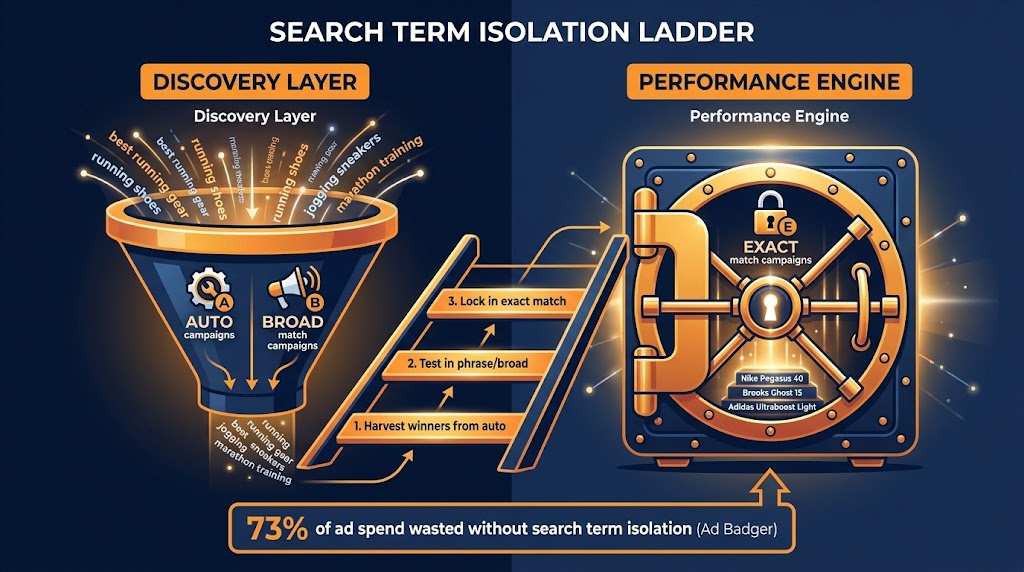
If there’s a single structural habit that separates Amazon PPC accounts that scale profitably from those that plateau, it’s systematic search term isolation. Ad Badger’s data suggests that without active search term tracking and isolation, approximately 73% of Amazon ad spend is wasted on irrelevant or underperforming queries. That’s an extraordinary number — and in a $1.34-per-click environment, it represents a massive and addressable cost problem.
Why Match Type Architecture Matters More When CPCs Are High
In a low-CPC world, sloppy match type management was expensive but survivable. At $0.50 per click, a poorly targeted campaign would generate noise but rarely threatened your whole account economics. At $1.34 per click — and much higher in competitive categories — every click through a poorly matched search term is material waste. The same dollar of budget misallocation now costs 2–3x what it did three years ago.
The fundamental principle is simple: auto and broad match campaigns are discovery engines. They expose you to search terms you haven’t thought of, surface real customer language, and generate conversion signal on unexpected queries. But they are not, and should never be, profit engines. Treating them as both — running them at high budgets and expecting them to perform like your best exact-match campaigns — is the structural error that drives the waste Ad Badger quantified.
The Three-Stage Isolation Process
Stage 1 — Discovery (Auto + Broad): Run auto and broad match campaigns with deliberately constrained budgets. Their job is to generate data, not revenue. Extract the Search Term Report weekly. Sort by: (a) terms that have generated orders, (b) terms that have generated clicks with no orders (waste), and (c) terms you never thought of that have positive signals.
Stage 2 — Testing (Phrase Match): Move terms with promising signals from Stage 1 into phrase-match campaigns. Phrase match gives you some targeting control while allowing enough variation to understand how different phrasings of a search intent convert. Set bids based on the data you already have from Stage 1, rather than starting blind. Phrase match campaigns operate at a tighter budget than discovery campaigns but with more focused data collection goals.
Stage 3 — Locking In (Exact Match): Terms that have proven conversion rates in phrase match — with sufficient volume to be statistically meaningful — graduate into exact match campaigns. These are your profit engine campaigns. Exact match gives you complete control: you know exactly what search triggered your ad, you know exactly what it converts at, and you can set a bid that reflects your allowable CPC for that term with precision.
The Negative Keyword Layer: The Budget Recovery System
Isolation doesn’t just mean moving winners up the ladder. It also means aggressively blocking losers from continuing to consume budget. Every term you identify in Stage 1 that generates clicks without conversions — or that is clearly irrelevant to your product — should immediately become a negative keyword in all campaigns that could serve it.
Think of negative keyword management not as housekeeping but as a budget recovery system. Every irrelevant search term you add as a negative keyword is budget that stops being wasted on bad clicks and is instead available for campaigns that work. In a $1.34-per-click environment, each negative keyword can be worth dozens of dollars per day in recovered budget, depending on the search volume of the term you’re blocking.
The cadence matters. Reviewing your Search Term Report once a month is not sufficient when CPCs are high. Weekly reviews — with a focus on newly surfaced terms that are spending without converting — are the minimum discipline for a well-managed account. Many top-performing Amazon advertisers review search term performance twice weekly during high-traffic periods.
Ad Type Arbitrage: Sponsored Products vs. Brands vs. Display When CPCs Are High
One of the less-discussed levers in an Amazon PPC budget is the allocation across ad types. Most sellers default to putting the vast majority of their budget into Sponsored Products, and this is generally correct — but the spread between ad type CPCs has widened dramatically in 2026, creating genuine arbitrage opportunities for sellers who think carefully about their funnel architecture.
The 2026 Ad Type CPC Landscape
Current benchmarks paint a stark picture. Sponsored Products average around $1.34 per click. Sponsored Brands — which appear at the top of search results with brand-level creative — typically run between $1.10 and $2.50 per click, with Sponsored Brands Video often delivering better efficiency per dollar in terms of engagement and click quality. Sponsored Display, at $3.72 average CPC, is the most expensive per-click format by a significant margin.
The typical recommended budget split for 2026 is approximately 60–70% Sponsored Products, 15–22% Sponsored Brands, 10–18% Sponsored Display. But this is a starting-point framework, not a universal truth. Your optimal split depends on your product category, your competitive position, and what job each format is doing in your customer acquisition funnel.
When to Shift Budget Away from Sponsored Products
There are specific scenarios where moving budget away from SP and toward SB or SD can improve overall account performance:
Category with extreme SP CPC inflation. In categories where Sponsored Products CPCs have surged well above the average — supplements, electronics, baby products — Sponsored Brands Video sometimes offers a lower effective cost per conversion because the video format qualifies clicks more aggressively. Shoppers who click through a 30-second product video have already demonstrated intent, reducing wasted clicks from curiosity-only searches.
Retargeting high-intent visitors. Sponsored Display’s remarketing capabilities — targeting shoppers who viewed your product detail page or category — can be extremely efficient for products with high consideration cycles. A shopper who visited your listing but didn’t purchase is a much warmer prospect than a cold keyword search. At $3.72 average CPC, SD retargeting still needs to be justified by conversion data, but for high-margin products, the economics often work even at that price point.
Brand defense and competitor conquesting. Sponsored Brands at the top of search are powerful brand defense tools. If a competitor is heavily conquesting your branded terms, a Sponsored Brands campaign can occupy more visual real estate on the search results page, reducing the effectiveness of their attack. The cost here is often worth paying because the alternative — losing brand term traffic to a competitor — is more expensive in the long run.
What Sponsored Display Is Actually Good for in 2026
Given its high CPC, Sponsored Display deserves particular scrutiny. The use cases where it justifies its cost in 2026 are narrow but valuable: category retargeting on high-margin products, conquesting specific competitor ASINs where you have a clear feature or price advantage, and cross-selling to existing customers (using the “views remarketing” and “purchases remarketing” audiences). If you’re using SD for broad awareness on low-margin products, you’re almost certainly burning money. The $3.72 CPC demands a product economics profile that can absorb it while remaining profitable.
Dayparting and Budget Shifting: How to Stop Funding Dead Hours
Related to the budget crash problem discussed earlier, dayparting — the practice of concentrating ad spend on hours with higher conversion probability and reducing or eliminating spend during lower-performing windows — is one of the most direct levers for improving budget efficiency in a high-CPC environment.
The Problem with “Always On” Budget Allocation
Amazon doesn’t offer native dayparting controls in its advertising console. Campaigns run 24 hours a day by default. But not all 24 hours are equal. Most categories see peak conversion windows concentrated in morning-to-evening hours (roughly 9 AM–9 PM in the buyer’s time zone), with overnight hours generating lower conversion rates relative to CPC cost. Paying $1.34 per click at 2 AM, when conversion probability is lower, is a structural inefficiency — and in a high-CPC environment, structural inefficiencies compound quickly.
How to Implement Dayparting Without Native Controls
Third-party Amazon PPC tools — SellerMetrics, Perpetua, Pacvue, Helium 10 Adtomic, and others — offer rules-based automation that can replicate dayparting functionality. The mechanics typically work like this: you set a rule that pauses specific campaigns between certain hours (e.g., midnight to 7 AM) and resumes them automatically when conversion probability rises. Some tools allow hourly bid adjustments rather than full pauses, which is more granular.
Before implementing dayparting, you need actual hourly performance data from your account. Generic dayparting recommendations are risky because conversion patterns vary significantly by category, product type, and customer demographics. A product sold primarily to morning commuters might actually convert well at 7 AM. A product that makes a good late-night impulse purchase might have strong midnight-to-2 AM conversion. The data in your specific account is the only reliable guide.
The Budget Shifting Version: Moving Spend Into High-Value Windows
An alternative to dayparting (pausing campaigns) is budget shifting: keeping campaigns active but increasing bids during peak conversion windows and decreasing them during off-peak windows. This is more nuanced than a simple on/off schedule and requires hourly data to calibrate correctly, but it allows you to stay in the auction during all hours while expressing a clear preference for the hours where your money works hardest.
The combination of budget triage (allocating budget to the right campaigns) and dayparting (allocating budget to the right hours within those campaigns) can meaningfully improve your overall account efficiency — often recovering enough budget from waste to fund meaningful expansion in the high-performing windows without any net increase in daily spend.
The Organic Flywheel Defense: Using PPC Spend to Earn Free Traffic
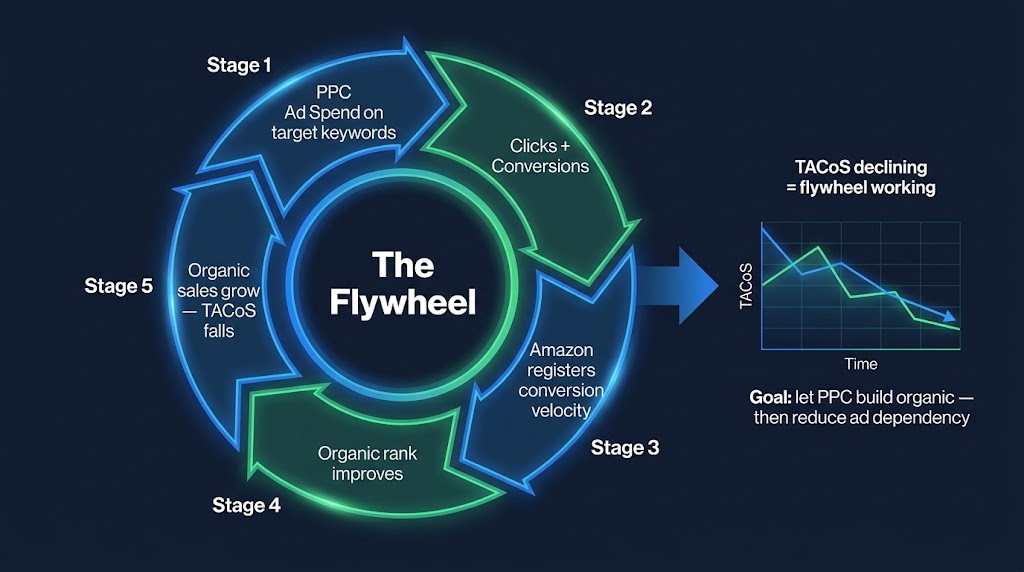
The most sophisticated response to rising CPCs isn’t a defensive one — it’s structural. Instead of just managing costs more tightly, advanced sellers use their PPC spend strategically to build organic rank, so that over time, a growing share of their revenue arrives at zero incremental advertising cost. This is the flywheel concept applied to Amazon’s search algorithm, and it’s the closest thing to a long-term CPC defense that exists on the platform.
How PPC Builds Organic Rank
Amazon’s algorithm — broadly understood to weigh conversion velocity heavily in its ranking decisions — treats a paid click followed by a purchase as a positive signal for that keyword. Each time a shopper searches for “running shoes women wide width,” clicks your Sponsored Product, and purchases, Amazon’s system logs that your product is relevant and converting for that keyword. Over time, sufficient conversion velocity on a keyword pushes your product higher in the organic search results for that term.
This means that PPC spend, when deployed on the right keywords in the right volume, does double duty: it generates immediate sales while simultaneously building organic rank that will generate future sales at zero cost. The mechanism is well-established among experienced Amazon sellers, but the execution discipline required to exploit it is often underestimated.
Targeting for Flywheel Impact: The Keyword Selection Criteria
Not every keyword is worth investing in for flywheel purposes. The right flywheel targets have specific characteristics:
- High search volume with achievable organic rank. You want keywords where enough shoppers are searching to make organic rank meaningful, but where your current organic position is close enough to page one that concentrated PPC investment can realistically move you there.
- Strong conversion alignment. The keyword needs to describe your product accurately. Ranking organically for a keyword your product doesn’t truly serve will generate traffic without conversion — which actually hurts your organic rank signal over time.
- Acceptable CPC-to-margin ratio during the investment phase. Flywheel targeting means accepting above-breakeven ACoS in the short term, funded by TACoS logic: the investment in current ad spend is expected to reduce future ad dependency. You need a product margin that can support this temporary loss without breaking your overall economics.
Reading the Flywheel Signal: When It’s Working
The clearest indicator that your flywheel investment is paying off is a declining TACoS over time, with stable or growing total revenue. This pattern means your organic share of total sales is growing — more of your revenue is arriving without an ad cost attached to it. Your ACoS on paid campaigns might stay flat or even rise (because you’re investing more aggressively in rank-building keywords), but your TACoS falls because the organic side of the equation is growing.
If your TACoS is flat or rising despite consistent PPC investment on target keywords, the flywheel isn’t turning. The most common reasons: poor listing optimization reducing conversion rates (making your PPC clicks less powerful as rank-building signals), too-small budget on target keywords to generate sufficient velocity, or extreme category competition that requires more volume than your current budget can provide.
The Endgame: CPC-Independent Revenue Streams
The ultimate goal of flywheel investment is to develop a portion of your revenue base that is genuinely CPC-independent — organic rankings that produce consistent sales regardless of what you spend on ads. This doesn’t mean eliminating PPC spend. Even highly ranked products benefit from Sponsored Products for brand defense and share-of-voice. But it means that your baseline revenue — the foundation of your business — doesn’t erode every time Amazon CPC benchmarks move upward.
In a category where CPCs have risen 34% in a year, the sellers with strong organic positions are absorbing that CPC increase with a modest TACoS impact. The sellers who built no organic position and fund all their revenue through paid advertising are experiencing a genuine 34% cost increase on a substantial portion of their revenue base. That’s not a bidding problem. It’s a structural problem. And it’s one that only the flywheel investment — started months or years earlier — can fully solve.
Building a CPC-Resistant PPC Architecture: Putting It All Together
The individual tactics covered in this guide are powerful in isolation. But their real value comes from how they combine into a coherent architecture — a set of structural decisions about your ad account that makes it inherently more resilient to CPC inflation regardless of how the market moves.
The Architecture Checklist
A CPC-resistant Amazon PPC account has the following structural properties:
Clear budget governance by tier. You know exactly where your budget is going, why it’s going there, and what performance threshold it needs to meet to stay there. The Tier 1/2/3 framework isn’t just a one-time analysis — it’s a standing structure that you review monthly and update based on performance data.
TACoS as the primary metric. Every budget decision is ultimately evaluated at the TACoS level. This keeps you from making campaign-level optimizations that look good on paper but erode your total business economics.
Aggressive search term isolation maintained weekly. Your discovery layer (auto/broad) is tightly budgeted. Winners graduate to phrase, then to exact. Losers become negative keywords. This system runs continuously, not as a quarterly cleanup project.
Bid strategy matched to campaign purpose. High-data exact-match campaigns use fixed or tightly calibrated dynamic bids. Discovery campaigns use down-only dynamic bids. Launch campaigns accept higher bid volatility in exchange for data collection.
Dayparting or budget shifting applied to high-spend campaigns. You’re not paying $1.34 per click at 2 AM when conversion probability in your category is low. Your budget is concentrated in the windows where your data says it works.
Ad type allocation driven by funnel logic. SP dominates for bottom-funnel, high-intent traffic. SB provides brand-level coverage and creative differentiation. SD is used selectively for retargeting and competitive defense on high-margin products only.
Flywheel keywords identified and funded consistently. You have a defined set of target keywords where you’re investing PPC budget for organic rank improvement, monitored by TACoS trajectory over rolling 90-day windows.
The Mindset Shift: From Spend Management to Capital Allocation
Perhaps the deepest change that rising CPCs demand is a shift in how sellers think about their PPC budget. Most Amazon advertisers think in terms of spend management — setting caps, controlling costs, trying to keep ACoS in a target range. This is necessary but not sufficient.
The sellers who are building durable businesses on Amazon in 2026 think in terms of capital allocation. They ask: given our product margin, our competitive position, and our organic rank trajectory, what is the highest-return deployment of each advertising dollar? They treat their PPC budget the same way a disciplined investor treats a portfolio — with explicit return expectations, defined risk tolerances, and regular rebalancing based on evidence.
In that framework, rising CPCs are not simply a cost problem. They’re a signal that changes the return profile of certain investments and creates new opportunities in others — cheaper keywords that competitors are abandoning, alternative ad formats where competition hasn’t yet caught up, and organic rank positions that represent permanent value because they cost nothing to maintain once earned.
What to Do in the Next 30 Days
If you’ve read this far, you have the framework. Here’s the practical starting point:
- Week 1: Pull your last 90 days of campaign data. Segment every campaign into Tiers 1, 2, and 3 by ACoS and total contribution margin. Identify the top 20% of campaigns generating 80% of your profitable revenue.
- Week 2: Calculate TACoS for your top 5 SKUs. Compare it to your ACoS. Where they diverge significantly, dig into whether PPC is building organic rank or cannibalizing it.
- Week 3: Run a Search Term Report audit. Add negative keywords for every term that’s generated 5+ clicks with zero conversions. Move any search terms that have generated 3+ conversions in broad/phrase into exact match campaigns.
- Week 4: Review your bid strategies. Identify any campaigns running Dynamic Up and Down where CPCs have spiked unexpectedly. Consider switching high-data, well-performing campaigns to fixed bids to cap your exposure.
These four weeks won’t solve everything. But they will give you clarity on where your money is going, where it’s working, and where it’s being wasted — which is the foundation of every intelligent budget decision that follows.
The CPC environment in 2026 is demanding. But it’s also a filter. The sellers who respond with precision will emerge with structurally stronger ad accounts. The sellers who respond with panic or passivity will find their margins gradually disappearing into Amazon’s auction engine. The difference between those two outcomes is almost entirely a function of how deliberately you treat your budget as a surgical instrument — not a blunt force tool.