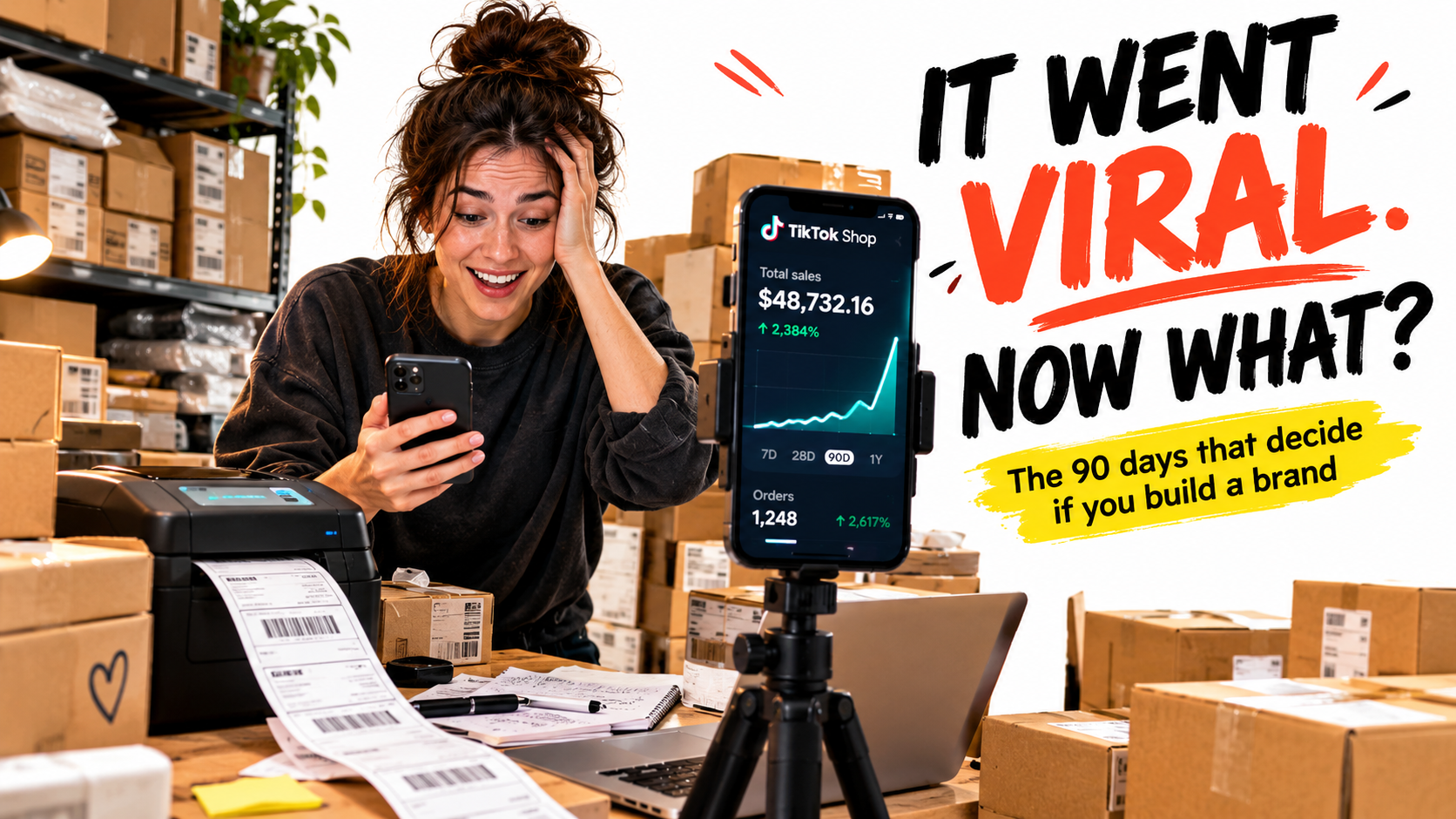

Most TikTok Shop advice is about getting the first hit: how to find the product, brief the creator, and land on the For You feed. Very little of it covers the moment straight after, when orders jump from a dozen a day to several hundred, the inbox fills with “where’s my package?” messages, and three lookalike listings appear in your category by the weekend.
That moment decides far more than the launch does. A viral product puts every weak spot in your business under pressure at once: inventory, fulfillment, customer service, creator relationships, cash flow and brand identity. Some sellers come out of it with a lasting brand. Many more come out with a pile of returns, a damaged shop rating and a product nobody remembers six weeks later.
The stakes are bigger than they used to be. TikTok Shop launched globally in September 2023 with daily sales averaging around $7 million that October. A year later it was pulling in more than $100 million over Black Friday 2024 alone. TikTok’s own October 2026 announcement, citing PF Global’s U.S. 2026 Economic Impact Report, says more than 8.5 million U.S. businesses are powered by TikTok, adding $81 billion to GDP and supporting more than 400,000 jobs. More sellers means more competition for every viral moment, and less forgiveness for sellers who can’t hold onto one.
This guide covers the 90 days after a spike: what to fix in the first week, how to plan inventory when demand is falling, how to turn one-time buyers into repeat customers, and how to build the creator bench, content system and LIVE schedule that keep a product selling after the first video fades. Throughout, the aim is to stop treating virality as the goal and start treating it as the opening of a brand.
Why a Viral Spike Is a Stress Test, Not a Finish Line
TikTok Shop is a discovery engine first and a marketplace second. TikTok describes the For You feed as a place that recommends content based on people’s interests, helping them find products “they may never have searched for or found on their own.” That is what makes it so strong for new brands, and it’s also why spikes don’t last.
Discovery demand behaves differently from search demand
On a search-led marketplace, demand already exists. Shoppers type in a need, and your listing competes to fill it. On TikTok, the demand is created by the content. Someone who had no plan to buy a scalp serum sees a convincing video and buys on impulse.
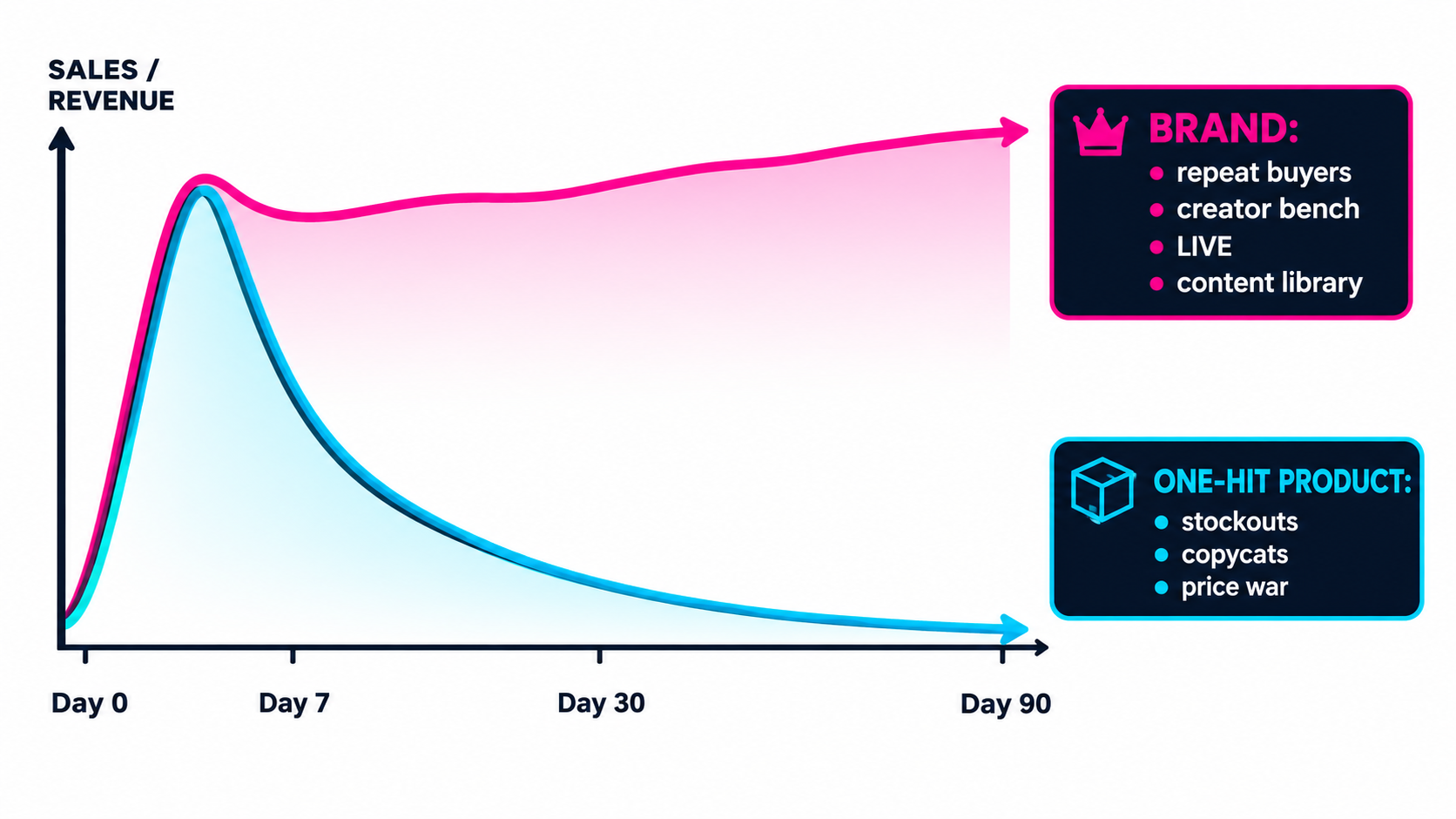
Demand that a video created will fade when the video stops circulating. Once the algorithm has shown your hero video to the audience most likely to respond, reach shrinks. Unless new content, new creators or returning buyers fill the gap, sales fall back toward where they started.
The two paths after a spike
Broadly, sellers end up on one of two paths after a viral moment:
- The one-hit path: Stock runs out at the peak, shipping slips, reviews suffer, copycats undercut the price, and by the time new stock arrives the trend has moved on. The seller is left with excess stock and a weaker shop.
- The brand path: The seller protects fulfillment quality, captures buyers into some kind of ongoing relationship, spreads content across many creators, and uses the spike’s revenue to fund a deliberate next step. Sales settle at a baseline higher than before the spike.
What the spike actually gives you
Look past the revenue and a viral moment hands you three useful things:
- Proof of demand: Real evidence that a message, format and price point work with a real audience.
- A customer list: Hundreds or thousands of buyers who have already trusted you once.
- Cash and attention: Working capital and creator interest you didn’t have last month.
Everything in the next 90 days comes down to putting those three things to work before they wear off. Proof of demand goes stale, customer lists cool, and creators move on to the next trending product within weeks.
Days 0–7: Operational Triage
The first week isn’t the time for strategy. It’s the time to stop the damage. A spike you can’t fulfill hurts more than no spike, because late shipments, cancellations and bad reviews pile up on your shop record and shape how future buyers and the platform see you.
Protect fulfillment before anything else
TikTok Shop asks sellers to verify their business, follow platform policies and meet service expectations. Shipping speed and order cancellations are among the most visible signals of whether a seller is reliable. In week one, put these ahead of everything else:
- Ship on time, even if it means slowing sales. If you can’t pack orders fast enough, pausing promotion or temporarily lowering available inventory beats taking orders you’ll ship late.
- Don’t oversell. Check that the inventory count in Seller Center matches what’s physically on the shelf. Overselling leads to cancellations, and cancellations are among the most damaging events for a young shop.
- Bring in temporary help. Friends, family, a local staffing agency or a third-party logistics provider can all absorb volume. Paying for help for a few weeks costs less than a damaged shop record.
Set up customer service for volume
Message volume rises roughly in step with order volume. Most messages fall into a few predictable groups: shipping status, how to use the product, sizing or fit, and return requests.
Write saved replies for each group on day one. Set a target response window and give one named person ownership of the inbox. Fast, friendly answers to “where’s my order?” stop many buyers from opening a dispute or leaving a frustrated review.
Read the reviews and comments like a product manager
At scale, the first wave of reviews will show problems your small test batch never surfaced: a pump that leaks in transit, a size chart that runs small, an instruction card that confuses people. Read every review and the comments on the viral video during week one.
Log each recurring complaint and sort it into three buckets: fix in packaging, fix in listing copy, and fix in the product itself. Packaging and copy fixes can usually go live within days. Product fixes feed into your next production run.
Check your margin at actual volume
Viral volume often comes with hidden costs: rush shipping on restock, overtime, higher affiliate commissions paid to the creator who drove the spike, and a bump in returns. Recalculate contribution margin per order using real week-one numbers, not launch assumptions. If the spike is losing money on every order, you need to know now, before you reorder thousands of units at the same economics.
Week-one checklist
- Inventory in Seller Center matches physical stock
- Daily shipping capacity known and not exceeded
- Saved replies written for the top five message types
- Complaint log started and sorted
- Contribution margin recalculated at real volume
- Thank-you message sent to the creator(s) who drove the spike
Inventory Under Uncertainty: Planning for the Decay Curve
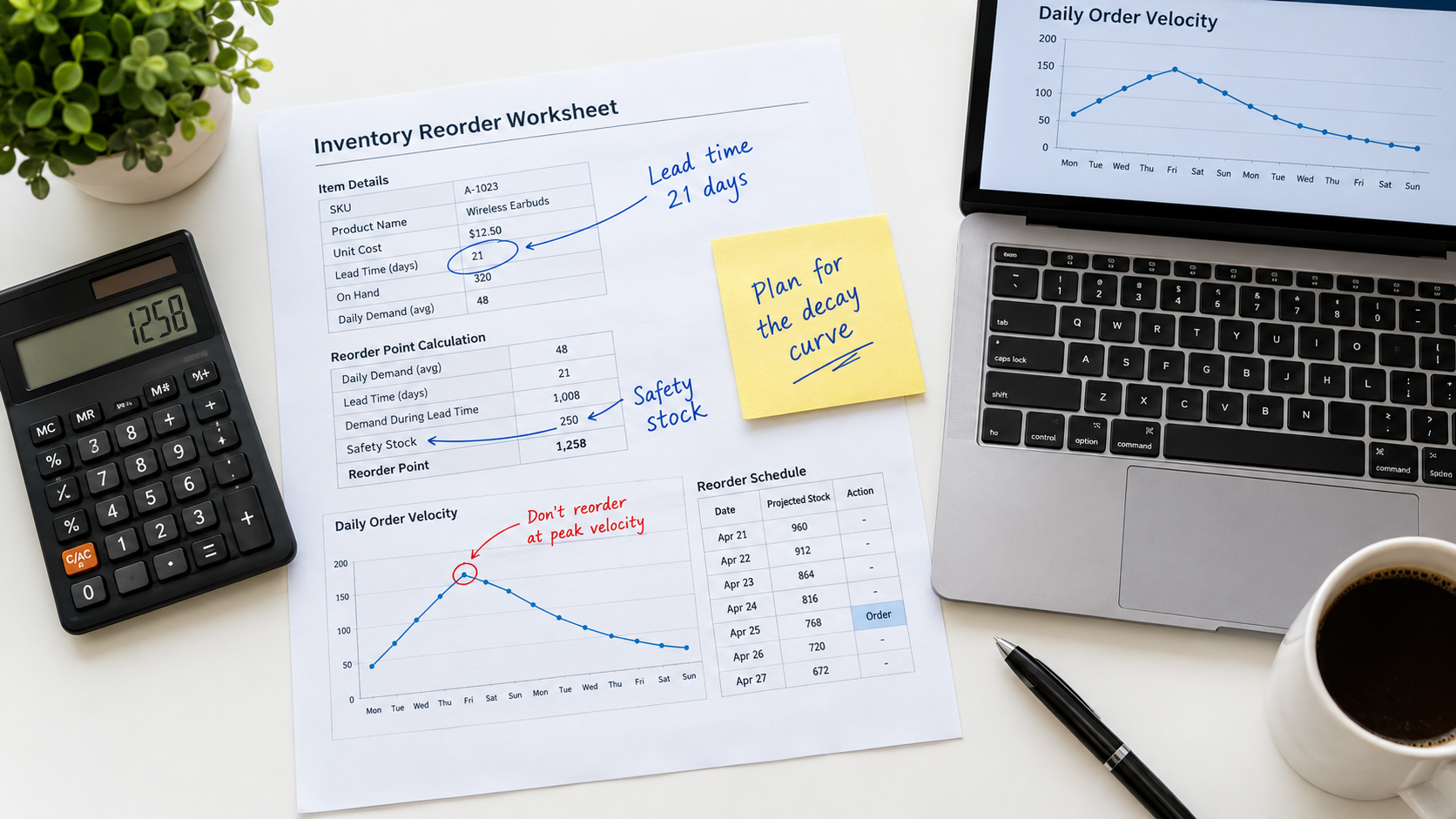
The most expensive mistake after a viral spike is reordering at peak velocity. When you’re selling 400 units a day, it feels obvious to order 12,000 units for the next month. But if supplier lead time is three weeks, that stock will land in a very different demand environment.
Model the decay, not the peak
Discovery-driven demand usually follows a spike-and-decay shape. A better approach is to forecast in three scenarios:
- Fast decay: Sales drop back close to pre-spike levels within two to three weeks, because no new content picks up.
- Moderate decay: Sales settle at a meaningfully higher baseline as secondary creators and returning buyers keep the product moving.
- Sustained growth: New creator content, LIVE sessions and paid amplification hold or extend demand.
Base your reorder on the moderate scenario, with a clear plan for what you’ll do if fast decay happens. Only plan for sustained growth if you’ve already lined up the content and creators to drive it, because that scenario doesn’t happen by default.
A worked example (illustrative)
Picture a seller whose product peaked at 400 units a day, with a 21-day supplier lead time. Last week’s average was 250 units a day, and the week before was 400.
- A peak-based reorder would plan 400 × 30 = 12,000 units.
- A decay-aware plan might assume demand averages 150 units a day over the month after arrival. That’s 4,500 units plus safety stock, or roughly 5,500 units.
- If demand holds better than expected, the seller places a second, smaller order (or pays for faster freight) once the trend is confirmed.
The decay-aware seller might lose some sales if demand stays high. The peak-based seller risks tying up thousands of units of cash in slow-moving stock, which is a far worse position for a small brand.
Split orders and negotiate flexibility
Viral momentum gives you leverage-free bargaining power you didn’t have before: proof of volume. Use it to ask suppliers for:
- Smaller, more frequent production runs instead of one large batch
- Faster turnaround on a partial shipment
- Reserved raw materials or packaging, so you can reorder quickly if needed
- Better per-unit pricing in return for a committed quarterly volume rather than a single big order
Stockouts are not always fatal, but plan them
Sometimes running out can’t be avoided. If it happens, handle it on purpose. Tell your audience, collect restock interest through comments or a waitlist, and plan a restock moment (often a LIVE session) for when inventory comes back. A well-handled restock can work as a second launch, especially if the community feels part of it.
Turning First-Time Buyers Into Repeat Customers
A viral spike fills your order history with first-time buyers. Whether you’re building a brand comes down to how many of them buy again, and that depends heavily on what happens between delivery and the moment they’d need a refill.
Design the post-purchase experience
Most TikTok Shop buyers arrive on impulse. They didn’t research your brand or compare alternatives. That makes the unboxing and first use your first real chance to make an impression.
- Insert cards with real value: Instructions for getting the best result, a QR code to a how-to video, and a note on when to expect results.
- Set expectations honestly: If a product takes two weeks to show results, say so. Buyers who expected overnight results are the ones who leave one-star reviews on day three.
- Introduce the brand, not just the product: A short founder note or brand story turns a random purchase into a connection with a specific company.
Before using any insert to drive buyers off-platform, check current TikTok Shop policy, because marketplaces commonly restrict how sellers can redirect customers. The safest inserts focus on product education and brand identity.
Match follow-up to the replenishment cycle
Consumables have a built-in repeat rhythm. If a bottle lasts about 30 days, the best time to reach a buyer is around day 25. Use the tools TikTok Shop gives you, such as follower-targeted vouchers, shop promotions and content that reaches existing followers, timed to that window.
For non-consumables, repeat purchases come from add-ons and complementary products instead. A buyer who got a viral styling tool is a natural prospect for the heat-protection spray that goes with it.
Use bundles to raise order value and stickiness
TikTok Shop supports bundles, discounts and promotional vouchers through Seller Center. A post-viral bundle such as a “starter kit” or a “two-month supply” does three jobs at once: it lifts average order value, increases the chance the buyer forms a habit, and makes your offer harder for copycats to match on price alone.
Track repeat rate as a core metric
GMV gets the headlines, but repeat purchase rate tells you whether you’re building a brand. Track, by month of first purchase:
- The share of buyers who order again within 60 and 90 days
- Average number of orders per customer
- Repeat revenue as a share of total revenue
If repeat revenue barely moves as the spike fades, the product may be a good novelty but a weak foundation for a brand, and that’s useful to learn before you put more money into it.
From One Hit Video to a Content System
Most viral spikes trace back to one video. The trap is treating that video as luck. The better move is to take it apart, work out why it worked, and build a repeatable system from those parts.
Deconstruct the winning video
Watch the viral video frame by frame and write down:
- The hook: What happens in the first one to two seconds? A visual result, a bold claim, a relatable problem?
- The proof moment: Where does the viewer see that the product works? A before-and-after, a demonstration, a reaction?
- The format: Talking head, voiceover with b-roll, get-ready-with-me, unboxing, comparison?
- The language: What phrases does the creator use, and which phrases show up again in the comments?
- The call to action: How does the video steer viewers to the product link?
The comments are especially useful. They show which part of the message actually landed, and the questions people ask point straight to your next videos.
Build content pillars from what worked
Turn your analysis into three to five content pillars you can keep producing:
- Result-led content: Variations on the proof moment, with different people, settings and use cases.
- Objection-handling content: Direct answers to the doubts in your comments (“Does it work on fine hair?”, “Is it worth the price?”).
- Behind-the-brand content: How the product is made, who founded the company, and why.
- Community content: Stitches and duets of customer videos, reactions to reviews, and user-generated content.
- Educational content: How to get the most from the product, routines and pairings.
Use AI tools for volume, not as a replacement for proof
TikTok has been pushing AI creative tools such as TikTok Symphony, which it describes as a suite of generative AI creative solutions to help advertisers create and scale content. In one example TikTok shared, an agency used Symphony Agent to turn a hotel’s existing photos into videos without a new shoot, cutting production time and improving click-through rates.
For product sellers, tools like this work well for variations: new hooks on proven footage, resized cuts, and fast tests of different openings. They can’t replace the thing that sells most on TikTok Shop, which is believable proof from real people using the product. Use AI to multiply what works, not to make up claims.
Set a sustainable posting cadence
Brand-owned accounts that post on a steady schedule build a library that keeps surfacing long after a single spike. Pick a cadence your team can actually keep up for 90 days, whether that’s daily or three times a week, rather than a heroic schedule that falls apart by week three.
Building Creator Bench Depth
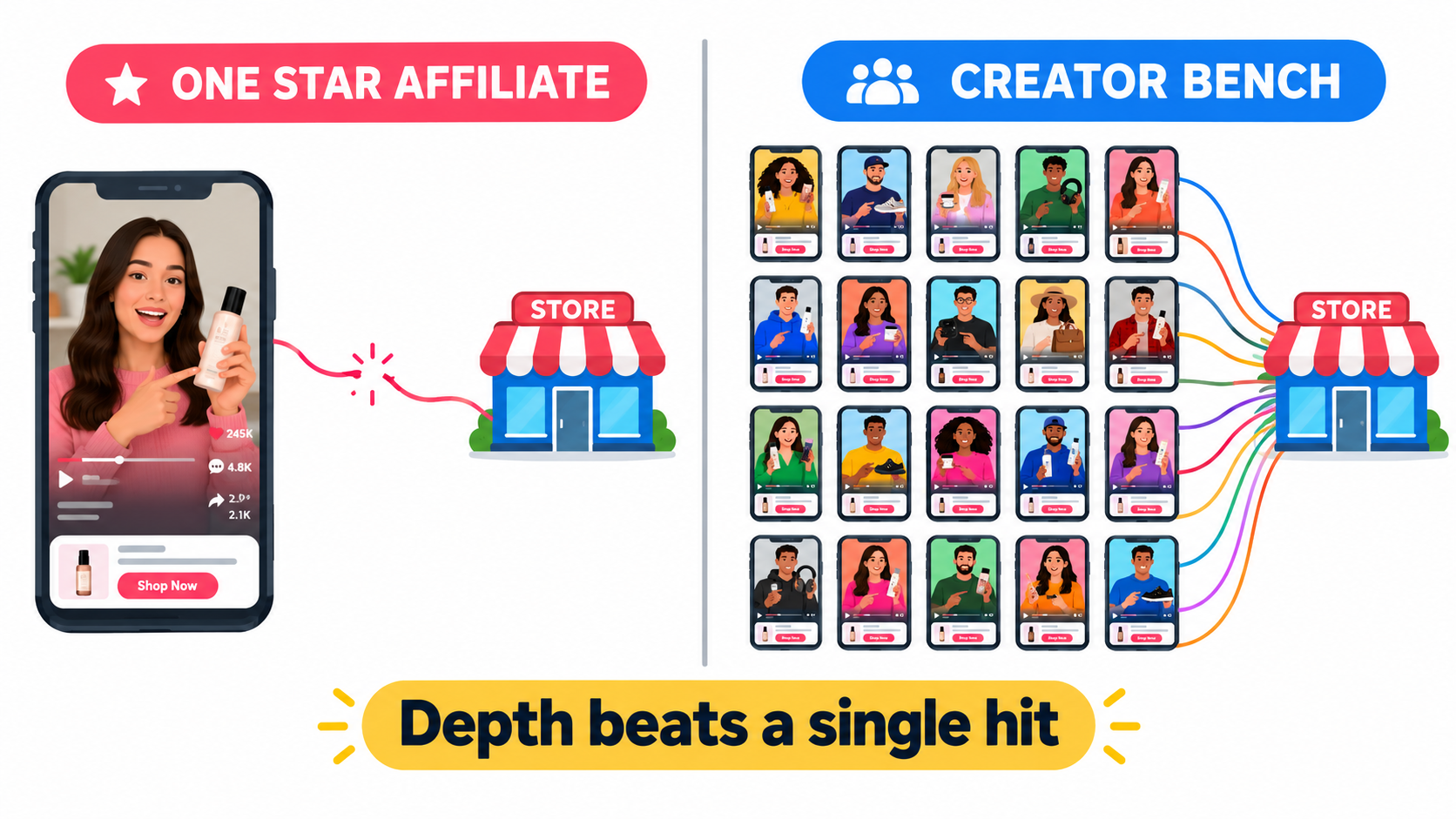
Many viral spikes depend on a single creator. That’s a fragile spot to be in. The creator might move to another brand, their audience might tire of the product, or one video might simply be the best they’ll ever make for you. The answer is depth: a wide bench of creators producing steady content at different sizes and angles.
Recruit while momentum is visible
Creators in TikTok Shop’s affiliate program look for products that are already selling, because those products are more likely to earn them commission. Right after a spike, your product is at its most appealing to them. Use that window to:
- Send samples to creators who have engaged with or posted about similar products
- Invite creators who commented on or duetted the viral video
- Reach out to niche creators whose audiences match your buyers, even if their follower counts are modest
- Show social proof in your outreach: units sold, review rating and examples of the content that’s working
Tier your creators
Not every creator plays the same role. A practical way to organize them:
- Anchors: Your top-performing creators. Treat them as partners, with early access to new products, higher commission tiers and direct communication.
- Steady producers: Mid-sized creators who post regularly and drive consistent sales. They form the base of your post-spike baseline.
- Testers: New creators sampling the product. Most won’t break through, but a few will become your next steady producers or anchors.
Give creators better briefs, not tighter scripts
Your content deconstruction feeds directly into creator briefs. Share the hooks, proof moments and language that worked, along with common objections to address, but leave room for creators to speak in their own voice. Heavily scripted content often comes across as an ad, and TikTok audiences notice quickly.
Measure creators by contribution over time
A single viral video is memorable, but a creator who drives modest, steady sales every week may be worth more across 90 days. Track creator performance by total attributed sales, content consistency and conversion rate, not just peak views. Shift samples and attention toward the creators who build your baseline.
Keep the relationship human
Creators remember the brands that treated them well when they were driving results. Pay commissions promptly, share sales numbers with them, publicly credit them, and tell them before you make changes to commission or stock. Over 90 days these habits add up to a creator network that your competitors can’t easily copy.
LIVE Selling as a Retention Engine
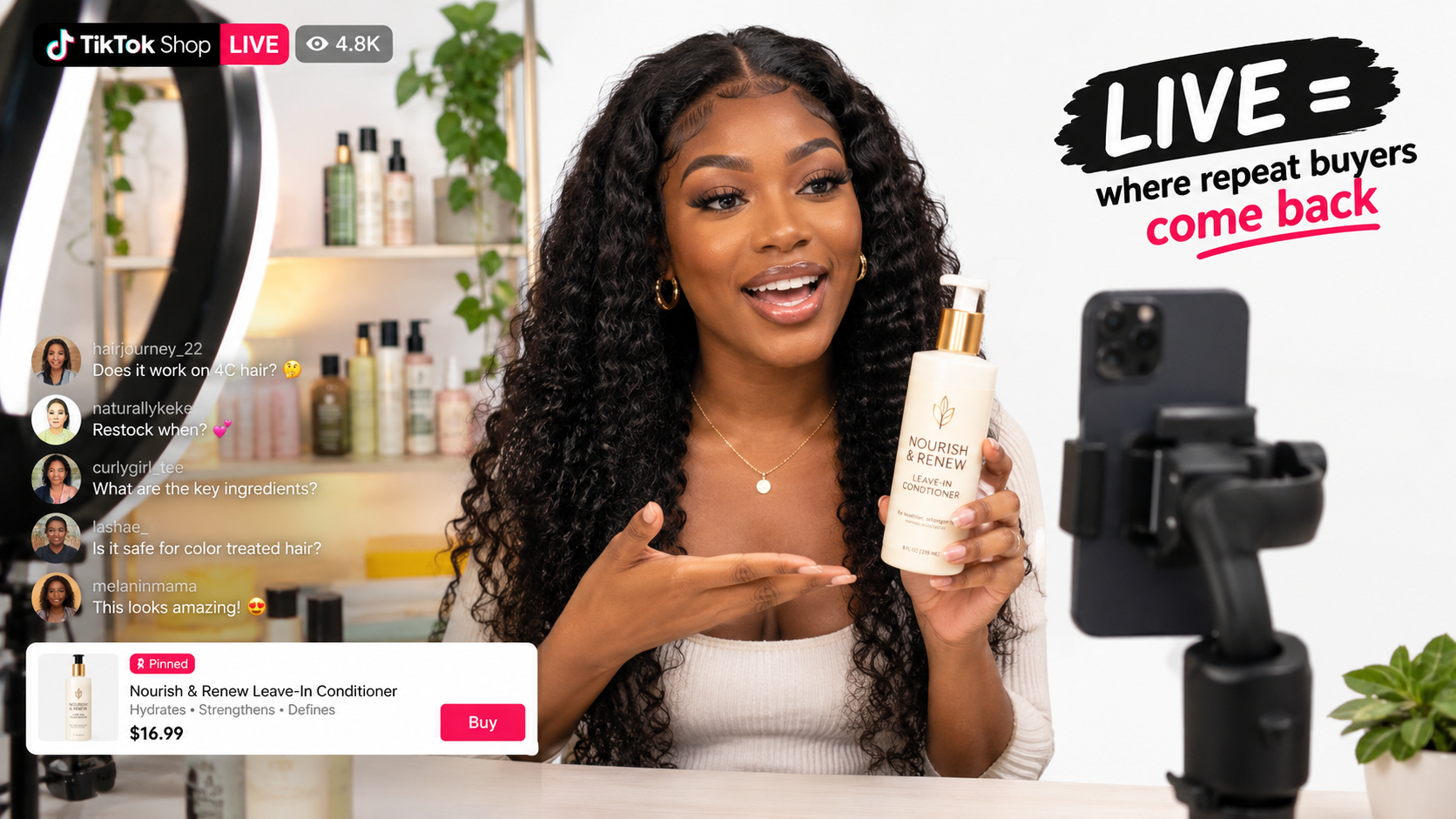
TikTok Shop includes livestreams where products can be promoted and bought in real time, and Seller Center includes a Live Planner to help sellers schedule sessions. Most sellers think of LIVE as a way to drive acquisition. After a spike, it’s more useful as a retention tool: a regular place where existing buyers and followers come back.
Why LIVE suits post-viral brands
After a spike, you have a big pool of people with questions. They want to know how to use the product, whether it suits their situation, and when it’ll be back in stock. A LIVE session answers all of those at once, in real time, with a human face attached to the brand.
That builds the trust that impulse buyers didn’t have when they first bought. It also gives you a direct read on what your audience cares about, which feeds back into content and product decisions.
Structure a repeatable LIVE format
Consistency beats production value. A simple, repeatable structure might look like:
- Open (first few minutes): Welcome viewers, state what’s happening today, and pin the featured product.
- Demonstration: Show the product in use, ideally with a live result.
- Q&A: Answer viewer questions by name. This is where trust builds.
- Offer: A LIVE-only bundle or voucher, with a clear time window.
- Recap: Repeat the key points and the offer for viewers who joined late.
Use LIVE for restocks and launches
If you sold out during the spike, a restock LIVE turns a frustrating gap into an event. Announce it ahead of time through your posts and to followers who asked about restock. The same works for new product launches: your most engaged buyers get first access, and the launch starts with built-in momentum.
Staffing and stamina
LIVE selling takes energy. If the founder is the only host, burnout comes fast. Over 90 days, plan to train at least one more host, which could be a team member, a part-time host or an anchor creator, so you can keep a regular schedule. A predictable weekly slot that viewers can plan around is worth more than sporadic marathon sessions.
Defending Against Copycats and Price Wars
Viral visibility doesn’t just attract buyers. It attracts competitors. Lookalike products, often sourced from similar factories, can show up quickly and undercut your price. You can’t stop every copycat, but you can make your brand much harder to replace.
Don’t win a race to the bottom
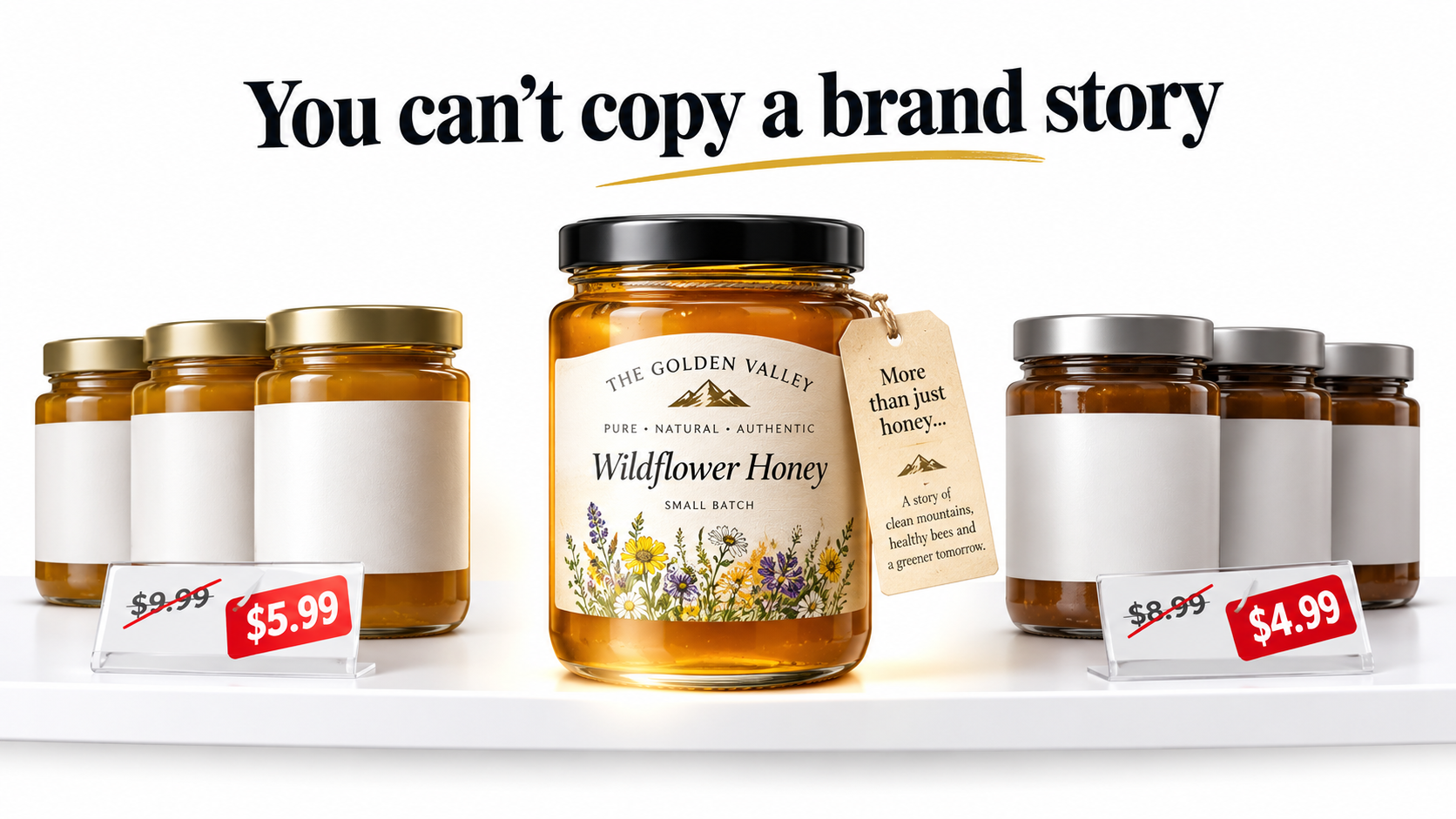
The instinct when a cheaper copy appears is to cut your price. That usually backfires. The copycat often has lower costs and fewer overheads, and a price war destroys the margin you need to fund content, creators and inventory.
Compete on things a copycat can’t easily reproduce instead:
- Proof and reviews: Your review count and rating took real sales to build. Keep earning them.
- Creator relationships: A deep bench of creators who know and trust your product.
- Brand story: A founder, a reason the product exists, and a community that identifies with it.
- Bundles and exclusives: Offers built around your catalog that a single-product copycat can’t match.
- Product improvements: The fixes you picked up from your week-one complaint log.
Protect your intellectual property
Where it applies, register trademarks for your brand name and logo, and keep records of your original designs, photos and videos. Marketplaces generally have intellectual property reporting processes, and having registered rights and documentation makes those processes much more effective. Talk to an IP professional about what protection fits your product and markets.
Make the brand visible in the content
Copycats thrive when shoppers see a product rather than a brand. If your viral video never showed your name, packaging or founder, viewers had no reason to pick you over a cheaper lookalike. Going forward, make sure your branding shows up naturally in creator content, through packaging, verbal mentions and a recognizable look, so buyers search for your name rather than a generic description.
Watch for counterfeit and misleading listings
TikTok Shop has faced criticism over misleading product information and fake reviews. Keep an eye on your category for listings that use your images, your name or your claims. Report infringements through the platform’s processes, and tell your audience how to recognize the genuine product.
What Bask & Lather’s Run Shows About Brand Durability
One of the clearest public examples of a TikTok Shop brand outlasting its early momentum is haircare company Bask & Lather. TikTok highlighted the brand in an October 2026 newsroom post tied to the 81st United Nations General Assembly, where founder and CEO Shaina Rainford spoke on a panel alongside TikTok’s Head of Public Policy for the Americas, Ziad Ojakli.
The reported numbers
According to TikTok’s announcement, Bask & Lather:
- Grew 1,400% from 2024 to 2026
- Generated more than $20 million in TikTok Shop GMV from January through August 2026
- Earned #1-ranking products on TikTok
The key detail is the timeframe. This isn’t one viral week. It’s a multi-year run of growth, which is exactly what the 90-day framework in this article is meant to set up.
What TikTok credited for the growth
TikTok’s description of the brand’s approach is worth noting. It says Rainford turned family hair remedies into a haircare brand and used TikTok to “share her story, build brand affinity, cultivate a highly engaged community, and drive meaningful business growth.”
Look at what’s on that list: story, affinity and community, with growth listed last, as a result of the other three. That matches the defensive moats covered above. A founder story and an engaged community are exactly what a copycat can’t buy from a factory.
Lessons for sellers at any scale
- Origin matters. A product with a real reason to exist (in this case, family remedies) gives creators and customers something to talk about beyond features.
- Community compounds. An engaged audience keeps buying, keeps creating content and keeps defending the brand in comments.
- Category leadership follows consistency. Ranking products came alongside sustained growth, not instead of it.
You don’t need $20 million in GMV to apply these lessons. Whether you have 500 customers or 50,000, the question is the same: are buyers connecting with a product, or with a brand?
Expanding the Catalog Without Diluting the Hero
Once a product has proven demand, the pull to launch more products is strong. Done well, catalog expansion raises lifetime value and makes the brand harder to copy. Done badly, it splits your attention, cash and content across products that drag down your hero.
Let customers tell you what to launch next
Your comments, reviews, DMs and LIVE questions are a ready-made product roadmap. Look for patterns such as:
- “Do you make a version for…?” (variant opportunities)
- “What do you use with this?” (complementary product opportunities)
- “I wish it came in…” (size, scent, color or format opportunities)
A product launched in answer to a request your community has made repeatedly starts with an interested audience already in place.
Expand outward from the hero
The safest expansions sit close to the hero product:
- Variants: New sizes, scents, shades or formats of the proven product.
- Complements: Products used alongside the hero, which suit bundles naturally.
- Routines: A set of products that together form a regimen, encouraging repeat use.
Jumping into an unrelated category (“we sold a viral hair serum, so let’s launch a kitchen gadget”) throws away the brand recognition you’ve just earned.
Test before committing
TikTok Shop is widely used as a testing ground. Some companies use it as a primary channel for testing new products before they reach traditional retail. Use small production runs, seed new products with your anchor creators, and launch them in LIVE to your most engaged buyers. Scale only once real sales data backs the decision.
Keep the hero fed
While new products are launching, keep investing in the hero. It’s still your main source of new customers, reviews and creator interest. A common pattern is for sellers to move all their content energy to a new launch, only to watch the hero’s baseline slip.
Owning the Relationship Beyond the App
Everything above happens on a platform you don’t control. Algorithm changes, policy updates, fee adjustments and wider regulatory questions can all affect your business overnight. Durable brands use TikTok Shop as a growth engine while slowly building assets they own.
Build platform-independent brand assets
- A brand website: A home for your story, full product range and customer resources.
- An email or SMS list: Built through compliant methods such as your website, product registration or warranty sign-ups, following platform rules about customer data and redirection.
- Presence on other channels: Other social platforms, marketplaces or retail where your audience also shops.
- Registered trademarks and owned creative: Brand assets that move with you wherever you sell.
Respect platform rules on customer data
Marketplaces, TikTok Shop included, typically set rules on how sellers may contact buyers and use their data. Breaking those rules to drive customers off-platform can put your shop at risk. Build off-platform audiences through legitimate channels and value-led reasons for people to connect, not by mining order data.
Use TikTok fame as retail proof
A strong TikTok Shop record has become a credible signal for wider distribution. Wholesale buyers, retail partners and investors increasingly watch which products are performing on social commerce platforms. Document your sales history, review ratings, creator content and repeat rates, because together they make a compelling case when you approach other channels.
Think about the bigger social commerce picture
Social commerce is projected to exceed $1 trillion by 2028, with TikTok Shop expected to play a major role in that growth. Other platforms are building their own versions. Amazon, for example, launched Amazon Inspire as a TikTok-style discovery feed. The skills you build on TikTok Shop, such as creator management, short-form content, LIVE selling and community-building, carry over to wherever social commerce goes next.
Watch platform incentives across markets
TikTok Shop keeps expanding and adjusting incentives by market. In the UK, for example, TikTok Shop has advertised up to £800 in incentives for new sellers, along with TikTok-funded discounts and campaigns. Brands that have stabilized after a domestic spike sometimes look to new markets for their next stage of growth, and launch incentives can lower the cost of testing.
Conclusion: Your 90-Day Post-Viral Checklist
A viral product on TikTok Shop is an opening, not a result. Discovery-driven demand fades by design, so a spike only turns into a business if you use its proof, customers and cash to build things that last: a reliable fulfillment record, repeat buyers, a deep creator bench, a content system, a LIVE schedule and a brand that copycats can’t easily replace.
Here’s how the next 90 days break down:
Days 0–7: Stabilize
- Match listed inventory to physical stock and stop overselling
- Protect on-time shipping, even if it means slowing promotion
- Set up saved replies and a named owner for customer service
- Start a complaint log sorted by packaging, copy and product fixes
- Recalculate contribution margin at real volume
Days 8–30: Build the foundation
- Reorder based on a decay-aware forecast, not peak velocity
- Negotiate split production runs and faster partial shipments
- Take apart the viral video and set three to five content pillars
- Recruit and sample a wide bench of creators while momentum is visible
- Launch a regular weekly LIVE slot
- Update inserts and listing copy based on early reviews
Days 31–60: Deepen relationships
- Time follow-up offers and vouchers to the product’s replenishment cycle
- Introduce bundles that lift order value and resist copycat pricing
- Tier creators into anchors, steady producers and testers
- File trademark applications and document original creative
- Train a second LIVE host
Days 61–90: Expand deliberately
- Review repeat purchase rate by cohort and decide whether the product can anchor a brand
- Test one close-to-hero product extension drawn from customer requests
- Keep investing in the hero product’s content and creators
- Start building platform-independent assets: website, compliant email list, other channels
- Package your performance data for retail, wholesale or new-market conversations
The sellers who come out of a viral moment with a brand aren’t necessarily the ones who had the biggest spike. They’re the ones who treated the spike as a stress test, fixed what broke, and used the attention to build relationships with customers, creators and a community. Bask & Lather’s multi-year run shows where that path can lead. The first 90 days are where it starts.