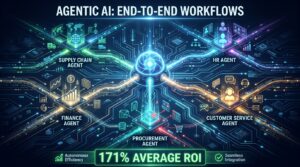


Something significant has shifted in how businesses operate. In boardrooms, warehouses, customer support centers, and marketing departments alike, artificial intelligence is no longer a concept discussed in future tense — it is actively handling tasks, making decisions, and driving outcomes right now. The 2026 business landscape has reached a point where 88% of companies use AI in at least one business function, a sharp rise from 78% just the year before. For the businesses still sitting on the sidelines, the gap between them and their automated competitors is growing by the quarter.
AI automation — the combination of artificial intelligence with process automation technologies — represents one of the most significant operational shifts in modern business history. Unlike traditional software that follows rigid rules, AI-powered automation learns, adapts, and handles complexity. It can read an unstructured email and route it correctly, predict which sales leads are most likely to convert, or detect a manufacturing defect that the human eye would miss. The applications are vast, and the results are measurable.
But the path to successful AI automation is not as simple as flipping a switch. Businesses that have seen the best returns — some reporting 250% average ROI within 18 months — have done so through careful planning, phased implementation, and a clear understanding of where automation adds genuine value. Those that have stumbled often rushed in without a strategy, ran into governance problems, or struggled to move beyond early pilots.
This guide covers everything decision-makers need to know about AI automation for business in 2026: what it is, why it matters, where it delivers the strongest returns, which tools lead the market, and how to build a practical implementation roadmap. Whether you run a five-person startup or a multinational enterprise, the principles here apply.
What Is AI Automation? Understanding the Core Concept
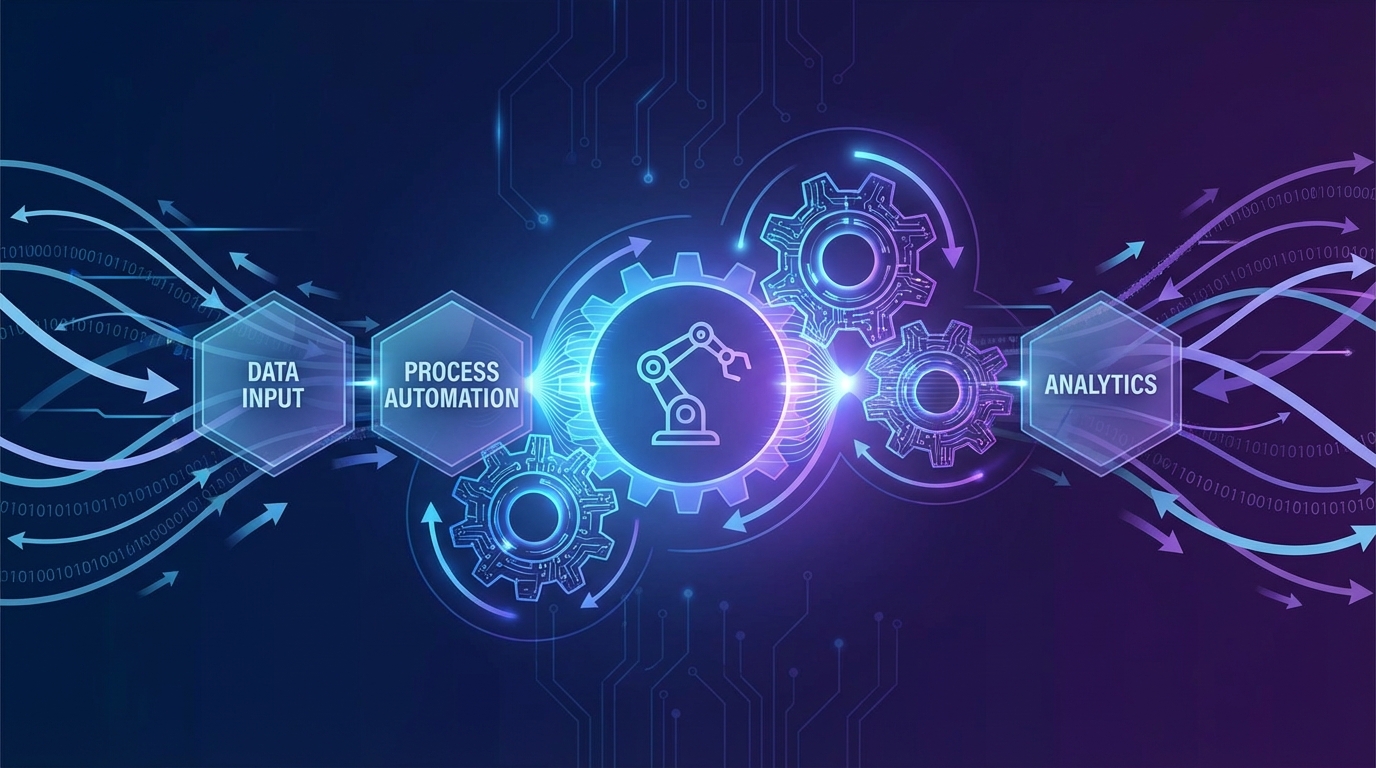
AI automation is the use of artificial intelligence technologies to perform tasks, make decisions, and execute workflows that would otherwise require human effort. It is distinct from traditional automation in one critical way: it can handle unstructured data and uncertain situations. Traditional rule-based automation breaks when it encounters something outside its predefined parameters. AI automation adapts.
Think of it this way: a traditional automation script can transfer data from one spreadsheet to another if the columns always match. An AI-powered system can do the same thing even when the column headers change, the data format shifts, or the source document is a handwritten scan. That flexibility is what makes AI automation so powerful in real business environments, where data is messy and exceptions are constant.
The Key Technologies Behind AI Automation
AI automation is not a single technology — it is an ecosystem of complementary tools and techniques working together. Understanding these components helps businesses choose the right combination for their specific needs.
- Robotic Process Automation (RPA): Software bots that handle repetitive, rule-based tasks such as data entry, form filling, invoice processing, and report generation. RPA is the workhorse of business automation, handling high-volume predictable tasks with speed and accuracy.
- Natural Language Processing (NLP): Enables machines to read, understand, and generate human language. Powers email parsing, chatbots, sentiment analysis, contract review, and voice-to-text workflows.
- Machine Learning (ML): Allows systems to learn from historical data and improve over time. Used in demand forecasting, fraud detection, predictive maintenance, and lead scoring.
- Computer Vision: Enables machines to analyze images and video. Used in quality control, document processing, security monitoring, and retail analytics.
- Agentic AI: The newest and most powerful tier — AI agents that can plan, reason, use tools, and execute multi-step workflows with minimal human intervention. In 2026, 62% of businesses are experimenting with AI agents, and 23% are actively scaling them.
- Generative AI: AI that creates content, code, summaries, and communications. Used for marketing copy, customer responses, code generation, and documentation.
How AI Automation Differs from Traditional Automation
Traditional automation handles tasks that are predictable and structured. If A happens, do B. AI automation handles tasks that require interpretation, judgment, and context. It is the difference between a conveyor belt (always moves the same way) and a logistics coordinator (adapts when the truck is late, the order changes, or the warehouse is full).
The practical implication for businesses is significant. Traditional automation can eliminate simple, repetitive work. AI automation can assist with — and in many cases replace — complex knowledge work: customer service interactions, financial analysis, content creation, and operational decision-making. The ceiling for what can be automated has risen dramatically.
Intelligent Automation and the Hyperautomation Trend
Many analysts now use the term hyperautomation to describe the broad, coordinated application of AI and automation tools across an entire organization. According to UiPath research, hyperautomation initiatives deliver 42% faster processes and 25% productivity gains. Rather than automating individual tasks in isolation, hyperautomation connects workflows end-to-end — from customer inquiry to fulfillment to billing — with AI managing the handoffs and exceptions throughout the chain.
The Business Case: ROI Statistics That Matter

The most common question business leaders ask about AI automation is simple: does it actually pay off? The answer, backed by multiple large-scale studies, is yes — and often far sooner than expected. But the returns are not uniform. The use case, implementation quality, and organizational readiness all shape the outcome.
Overall ROI and Adoption Benchmarks
According to McKinsey’s most recent global AI survey, 79% of organizations reported measurable ROI from at least one AI initiative. That figure marks a significant maturation point — the majority of businesses deploying AI are no longer guessing at returns, they are measuring them.
Across industries, studies point to an average ROI of 250% within 18 months for AI automation deployments, with leading implementations reaching 300% or higher. In dollar terms, this translates to annual savings of $6–10 million for large enterprises. For small and mid-sized businesses, even more modest deployments routinely recover their investment within the first year.
At the macroeconomic level, McKinsey projects that AI will boost labor productivity by 0.1 to 0.6 percentage points annually across the global economy, with that figure rising as adoption deepens. The AI automation services market itself is projected to surpass $19.6 billion by 2026, growing at a 23.4% compound annual growth rate.
ROI by Use Case: Where the Returns Are Strongest
Not all automation investments deliver equal returns. Data from leading implementation studies identifies which use cases consistently produce the best financial outcomes:
- Customer service automation: Average ROI of 340%, with time to ROI of approximately 6 months. Reduced support costs, faster resolution times, and 24/7 availability drive strong returns.
- Data entry and processing: Average ROI of 290%, with a 4-month payback period. Eliminating manual data handling reduces labor costs and error-related rework.
- Invoice processing: Average ROI of 280%, with a 5-month payback. Automating accounts payable and receivable workflows dramatically reduces processing time and exceptions.
- Email marketing automation: Average ROI of 240%, with an 8-month payback. Personalized, behavior-triggered campaigns outperform batch-and-blast approaches significantly.
- Lead scoring and sales outreach: Companies using AI-powered lead scoring report 40% more sales meetings and significant improvements in conversion rates.
Real-World Business Outcomes
The numbers behind these averages are substantiated by concrete business examples. Rachio, a smart irrigation company, deployed AI-powered customer support agents that handled more than one million queries with 95–99.8% accuracy. The result: a 30% reduction in support costs and the elimination of seasonal hiring surges. The company no longer needs to staff up every spring when product inquiries peak.
In warehouse operations, inVia Robotics automated fulfillment workflows and achieved a five-fold increase in picking productivity, with a corresponding reduction in labor costs. Microsoft 365 Copilot delivered 132% to 353% ROI over three years for small and medium businesses by automating routine tasks in Word, Excel, Teams, and Outlook — a remarkable return for an off-the-shelf tool many organizations already have access to through existing subscriptions.
These outcomes are not exceptional edge cases. They represent what well-executed AI automation looks like when applied to the right problems with the right tools.
Core Business Functions Where AI Automation Delivers
AI automation is not a single-department initiative. Its value crosses every business function, from the front office to the back office. Here is a detailed look at where organizations are finding the most traction.
Customer Service and Support
Customer service is the single highest-ROI area for AI automation, and it is easy to see why. Support operations are high-volume, repetitive, and time-sensitive — a perfect match for intelligent automation. AI-powered chatbots and virtual agents now handle routine inquiries, troubleshoot common issues, process returns, and escalate complex cases to human agents with full context already loaded.
Modern AI support systems go well beyond simple FAQ bots. They use NLP to understand intent, sentiment analysis to detect frustrated customers, and machine learning to continuously improve their responses based on outcomes. The best systems can resolve 60–80% of incoming inquiries without human involvement, reserving human agents for genuinely complex situations where empathy and judgment are essential.
Finance and Accounting
Finance teams deal with an enormous volume of structured, rule-based work: invoice processing, expense categorization, reconciliation, compliance reporting, and financial close cycles. All of these are prime automation targets. AI tools can now read invoices from any format, match them to purchase orders, flag discrepancies, and route approvals — all without human input on routine transactions.
Beyond transactional processing, AI is advancing into financial analysis. Machine learning models analyze cash flow patterns, flag anomalies that might indicate fraud, and generate forecasts with far more variables than any human analyst could track simultaneously. Companies using AI in their finance functions report reducing their monthly close time by as much as 50% while improving forecast accuracy.
Human Resources and Talent Management
HR departments handle a mix of high-volume administrative work and high-stakes human decisions. AI automation is increasingly handling the former, freeing HR professionals for the latter. Applicant tracking systems powered by AI screen resumes, schedule interviews, send status updates, and even conduct initial video screening assessments. Onboarding workflows automate document collection, system access provisioning, and training assignments.
For ongoing workforce management, AI tools predict attrition risk by analyzing engagement signals, flag performance trends, and surface insights about skills gaps across teams. According to adoption data, 47% of businesses have introduced AI into their HR functions — one of the fastest adoption rates across all business departments.
Marketing and Sales
Marketing is one of the most data-rich functions in any business, which makes it especially well-suited to AI automation. Modern marketing stacks use AI to personalize email campaigns at the individual level, optimize ad spend across channels in real time, score and prioritize leads, generate first-draft content, and analyze campaign performance with predictive modeling.
In sales, AI assists with CRM data entry (eliminating the single most hated task of every sales rep), drafts follow-up emails, surfaces next-best-action recommendations, and provides deal intelligence by analyzing communication patterns and win/loss history. The measurable impact is consistent: companies using AI-assisted sales workflows report 40% more qualified meetings and faster deal cycles.
Operations and Supply Chain
Operational automation spans demand forecasting, inventory management, logistics routing, supplier communication, and quality control. AI models that predict demand with greater accuracy reduce excess inventory and stockout events simultaneously — a significant financial benefit in industries where inventory carrying costs are high.
According to current adoption data, 54% of businesses have deployed AI in their operations and supply chain functions, making it the second-highest adoption area after product development. The measurable outcomes include 20–30% reductions in inventory costs and significant improvements in on-time delivery metrics.
Industry Spotlight: AI Automation Across Major Sectors
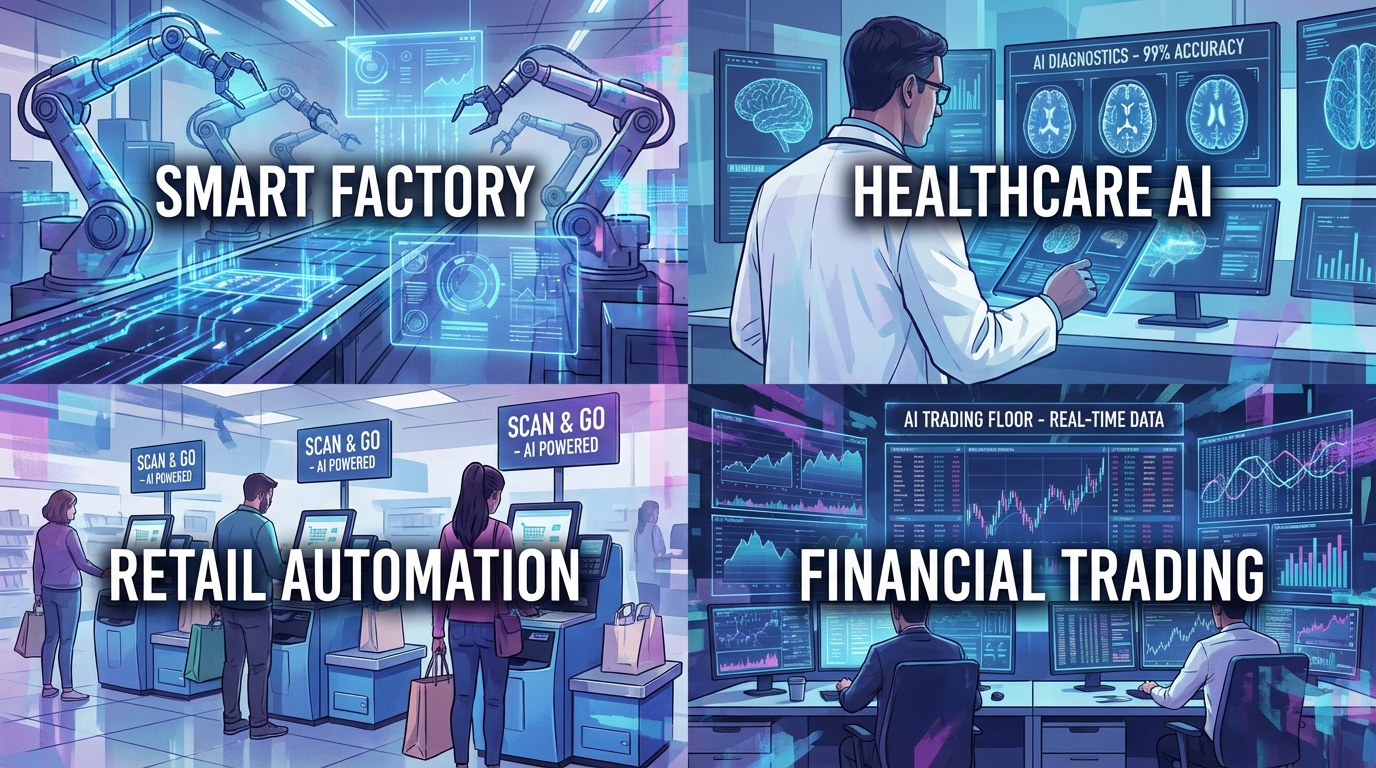
While the principles of AI automation are universal, their application varies significantly by industry. Each sector faces unique data structures, regulatory environments, and operational challenges that shape how automation is deployed and what outcomes it produces. Here is a detailed look at how the major sectors are advancing.
Manufacturing
Manufacturing leads all sectors in AI automation adoption, and the results are striking. The share of industrial manufacturers expecting to highly automate their key processes is projected to reach 50% by 2030, more than doubling from the current 18%. The most forward-thinking manufacturers — roughly the top 20% by innovation — are already at 29% high automation and targeting 65% within the decade.
The applications in manufacturing are diverse. Computer vision systems detect product defects in real time with accuracy rates that exceed human inspectors. Siemens has deployed such systems for electronic component manufacturing that identify 47 distinct defect types at 99.7% accuracy, reducing warranty claims by 40% and slashing quality-related costs by 35–50%. AI-driven production scheduling systems adjust manufacturing runs dynamically based on demand signals, material availability, and equipment status — a capability that 49% of manufacturers have now automated.
Energy management is another area seeing strong returns. Schneider Electric’s AI-driven energy systems have delivered 22% reductions in energy costs for manufacturing clients by optimizing consumption in real time. Generative AI is also entering product design, with tools that can compress design cycles by 40–60% by automatically generating and testing design variations against specification requirements.
Healthcare
Healthcare AI automation operates at the intersection of clinical outcomes and administrative efficiency. On the administrative side, AI handles appointment scheduling, insurance pre-authorization, claims processing, and documentation — reducing the clerical burden on clinical staff and freeing them for patient care. AI-powered medical coding systems process clinical notes and assign billing codes with higher accuracy than manual processes, reducing rejected claims.
Clinically, AI supports diagnostic imaging analysis, sepsis prediction, medication reconciliation, and treatment protocol recommendations. Machine learning models trained on large patient datasets can flag high-risk patients for early intervention, reducing costly complications and readmissions. The combination of administrative and clinical automation is helping healthcare organizations address one of their most persistent challenges: doing more with constrained staffing resources.
Financial Services
Financial services firms have been early and aggressive adopters of AI automation, driven by the sector’s data intensity and the high cost of compliance failures. Fraud detection is the flagship application: ML models analyze transaction patterns in real time, flagging suspicious activity with far greater precision than rule-based systems and far less latency than human review.
Credit underwriting has been transformed by AI models that incorporate hundreds of variables to assess borrower risk, producing more accurate decisions in a fraction of the time required by manual processes. Regulatory compliance — a major cost center for financial institutions — is being addressed through AI systems that monitor transactions for suspicious patterns, auto-generate compliance reports, and track regulatory changes across jurisdictions. Customer-facing applications include AI-powered wealth management tools, personalized product recommendations, and intelligent chat interfaces for banking inquiries.
Retail and E-Commerce
Retail has embraced AI automation across the customer journey, from discovery to delivery. Recommendation engines powered by machine learning drive a substantial share of revenue for major e-commerce platforms — Amazon attributes approximately 35% of its revenue to its AI-powered recommendation system. Demand forecasting models reduce both overstock and stockouts, improving margins and customer satisfaction simultaneously.
In-store retail is using computer vision for checkout-free experiences, inventory monitoring, and loss prevention. Customer service automation handles the high volume of order inquiries, return requests, and product questions that would otherwise require large support teams. Personalized marketing — triggered by browsing behavior, purchase history, and seasonal patterns — is a standard capability for retailers of all sizes thanks to accessible AI tools.
Top AI Automation Tools for Business in 2026
The AI automation tooling landscape has matured considerably. Businesses now have access to a wide range of solutions at every price point and technical complexity level. Here are the most widely adopted and effective platforms for 2026.
Workflow and Process Automation Platforms
Zapier AI Agents remains a dominant force for SMBs and mid-market businesses. Its no-code interface allows non-technical users to build sophisticated automated workflows connecting thousands of apps. In 2026, Zapier’s AI features enable multi-step decision-making within workflows — moving well beyond simple “if this, then that” logic. It is the go-to platform for businesses that want powerful automation without dedicated development resources.
Make (formerly Integromat) offers deeper customization than Zapier and appeals to businesses with more complex workflow requirements. Its visual drag-and-drop builder can handle sophisticated branching logic, API integrations, and data transformations that would otherwise require custom code. It has become particularly popular in agencies and operations-heavy businesses.
n8n is an open-source workflow automation tool that gives technical teams complete control over their automation infrastructure. With self-hosting options, it is attractive for businesses with data sovereignty requirements or those that want to avoid per-operation pricing. Its growing library of AI nodes makes it capable of sophisticated intelligent automation.
AI-Powered Productivity Suites
Microsoft 365 Copilot is arguably the most impactful AI automation tool for businesses already using the Microsoft ecosystem. Copilot is embedded directly into Word, Excel, Teams, Outlook, and PowerPoint, automating drafting, summarization, data analysis, and meeting transcription within the tools employees already use daily. For SMBs, the documented ROI of 132–353% over three years makes it one of the most financially defensible AI investments available.
ChatGPT Enterprise gives businesses access to OpenAI’s most capable models with enhanced security, privacy guarantees, and customization options. Organizations use it for knowledge management, content production, code generation, data analysis, and building internal AI tools. Its capabilities expand monthly as OpenAI continues advancing its models.
Customer Service and CRM Automation
Salesforce Einstein AI integrates AI deeply into the Salesforce CRM ecosystem, handling lead scoring, opportunity forecasting, automated email generation, and service case classification. For organizations already invested in Salesforce, Einstein represents a straightforward path to AI-enhanced sales and service operations.
Intercom and Zendesk AI have both embedded powerful AI capabilities into their customer service platforms. Automated resolution of common support queries, intelligent ticket routing, and AI-assisted agent responses are now standard features that significantly reduce support volume and improve response quality.
Specialized AI Agents
Relevance AI and My AI Front Desk represent the growing category of purpose-built AI agent platforms. These tools enable businesses to build and deploy AI agents that handle specific workflows autonomously — from inbound call handling to lead qualification to research tasks — with minimal setup and technical expertise required. This category is growing rapidly as agentic AI moves from experimental to production-ready.
How to Implement AI Automation: A Practical Step-by-Step Guide

Implementation quality separates successful AI automation deployments from costly failures. The businesses achieving the strongest ROI do not jump to the most sophisticated technologies first. They build systematically, validate returns, and scale what works. Here is the step-by-step approach that leading organizations follow.
Phase 1: Assess and Prioritize (Weeks 1–2)
Start with an honest audit of your current processes. The goal is to identify tasks and workflows that meet the criteria for high automation value: high volume, significant time consumption, high error rates, rule-based logic, and/or data-intensive nature. Document these processes in detail, noting where the time goes, where errors occur, and what the downstream cost of those errors is.
Build a prioritization matrix that scores each candidate process on:
- Time impact: How many hours per week does this consume across the team?
- Error cost: What does each error or delay cost in time, money, or customer satisfaction?
- Automation feasibility: How structured and rule-based is the process?
- Implementation complexity: How much technical work is required to automate it?
The highest-priority candidates are those with strong time/cost impact and high feasibility. Start here, not with complex, judgment-heavy processes that require advanced AI capabilities. Quick wins build momentum and demonstrate value to stakeholders who need to fund the next phase.
Phase 2: Define Goals and KPIs (Week 2–3)
Before selecting any tools or building any workflows, define exactly what success looks like. Set specific, measurable KPIs for each automation initiative: target cost reduction percentages, time savings targets, error rate benchmarks, and customer satisfaction scores. These metrics will guide your tool selection and serve as the basis for evaluating whether the deployment is working.
Align these goals with your broader business strategy. If reducing operational costs is the priority, weight your efforts toward back-office automation. If revenue growth is the goal, focus on sales and marketing automation first. Trying to automate everything at once dilutes focus and makes it difficult to measure success clearly.
Phase 3: Select Tools and Build Pilots (Weeks 3–8)
Match your tool selection to your team’s technical capabilities, your budget, and your specific use case requirements. For businesses without dedicated technical resources, no-code platforms like Zapier or Microsoft 365 Copilot offer the most accessible entry point. For businesses with development capacity and complex requirements, platforms like n8n, Make, or custom AI agent frameworks provide more flexibility.
Build your first automation as a contained pilot with a clear scope. Avoid the temptation to automate an entire end-to-end process on the first attempt. Instead, automate a specific, well-defined segment of a workflow, measure the results against your KPIs, and iterate before expanding. This approach reduces risk and generates the data you need to justify broader investment.
Phase 4: Deploy, Monitor, and Iterate (Weeks 8–16)
Once a pilot demonstrates positive results, move to full deployment with appropriate monitoring in place. AI automation systems require ongoing oversight — outputs should be audited regularly, especially in the early months. Set up alerts for error rates, processing failures, and outputs that fall outside expected parameters.
Establish a feedback loop where team members who interact with automated outputs can flag issues. The information from this feedback loop is invaluable for refining the system. Machine learning components will improve over time as they process more data, but supervised refinement accelerates that improvement significantly.
Phase 5: Scale and Expand (Month 4 Onward)
With proven pilots generating measurable returns, the case for expanding to additional processes becomes straightforward. Return to your prioritization matrix, select the next highest-value opportunities, and repeat the build-pilot-deploy cycle. As your team’s experience with AI automation grows, implementation cycles shorten and the complexity of what you can tackle increases.
The goal is not to automate as many things as possible as quickly as possible. It is to build a systematic capability for identifying automation opportunities and executing them well. Organizations that treat AI automation as a repeatable organizational capability — rather than a one-time technology project — consistently outperform those that do not.
Challenges, Risks, and How to Mitigate Them
AI automation delivers strong returns when executed well, but it introduces real challenges that organizations must address proactively. Understanding these risks before they materialize is far less costly than dealing with them reactively.
The Pilot Purgatory Problem
The most common barrier to realizing AI automation’s value is not technical — it is organizational. McKinsey’s research indicates that only about one-third of firms successfully deploy AI broadly for real impact. The rest get stuck in “pilot purgatory”: multiple small experiments running simultaneously, none scaled to production, with inconclusive results that neither justify continued investment nor enable leadership to pull the plug.
Escaping pilot purgatory requires treating AI automation deployments like any other capital investment: clear owners, defined success criteria, a budget for scaling, and executive sponsorship that maintains pressure on moving from pilot to production. Without these organizational elements, technical excellence alone cannot drive results.
Shadow AI and Governance Gaps
As AI tools become more accessible, employees are deploying them independently — often outside IT and legal oversight. This “shadow AI” phenomenon creates security exposures, data privacy risks, and fragmented decision-making that undermines the value of coordinated automation strategy. Employees may unknowingly pass sensitive customer or financial data through unvetted external AI tools, creating compliance violations.
The mitigation is clear governance: an explicit AI usage policy that distinguishes between approved tools and prohibited ones, a process for evaluating and onboarding new tools, and ongoing monitoring for unauthorized AI deployments. This governance does not need to be restrictive — the goal is coordination, not prohibition. Well-designed AI governance frameworks help employees use AI effectively while protecting the organization.
Data Quality and Integration Challenges
AI systems are only as good as the data they learn from and operate on. Poor data quality — duplicates, inconsistent formats, missing fields, siloed systems — is one of the most common reasons AI automation projects underperform. Before investing in sophisticated AI tools, businesses need honest assessments of their data infrastructure.
Data integration is equally important. Many businesses have customer data in CRM systems, operational data in ERPs, and financial data in accounting platforms that do not communicate with each other. Effective AI automation often requires integrating these data sources, which can be a significant technical undertaking. Factor this into your timeline and budget planning.
Talent and Change Management
Implementing AI automation requires people who understand both the technology and the business processes being automated. This combination is rare and increasingly competitive. Organizations frequently underestimate the internal capability required and the cultural change management needed to ensure new automated workflows are actually adopted by the teams they are designed to help.
Deloitte research notes that despite 85–91% of organizations increasing their AI investments, many are experiencing 2–4 year delays in reaching target ROI due to talent and change management gaps. Investing in internal AI literacy, creating dedicated AI implementation roles, and communicating clearly with affected teams are as important as the technology choices themselves.
Regulatory and Compliance Risks
The regulatory landscape for AI is evolving rapidly. The EU AI Act has introduced specific requirements for high-risk AI applications, and similar frameworks are emerging across other jurisdictions. Businesses in regulated industries — finance, healthcare, legal — face heightened scrutiny of AI systems that affect customers or make consequential decisions. Algorithmic bias — where AI models produce systematically unfair outcomes for certain demographic groups — is both a legal risk and a reputational one.
Proactive compliance means auditing AI systems for bias, maintaining explainability in decision-making systems, documenting model behavior, and staying current with regulatory developments. Organizations that build compliance into their AI governance frameworks from the start avoid costly retrofits when regulatory requirements tighten.
AI Automation and the Workforce: Navigating the Human Dimension

No discussion of AI automation for business is complete without addressing the workforce dimension. The impact of automation on jobs and workers is a genuine concern — and also one of the most frequently misrepresented topics in the public discourse around AI. The reality is more nuanced than the headlines on either side suggest.
The Job Displacement and Creation Picture
The most comprehensive recent analysis comes from the World Economic Forum’s Future of Jobs Report, which projects that 92 million jobs will be displaced globally by 2030 due to automation and AI, while 170 million new jobs will be created — yielding a net gain of 78 million positions. This is not a comforting statistic for individuals whose specific roles are eliminated, but at the macro level it suggests that AI automation, like previous waves of technological change, creates more work than it destroys.
Current data reflects this mixed reality. Employment in the most AI-exposed U.S. sectors has declined by approximately 1% since 2022, but wages in those same sectors have risen by 8.5% — suggesting that the jobs that remain are being upgraded in value, not simply preserved. The workers being most affected are those in routine, task-oriented roles, particularly early-career workers who typically begin in high-volume transactional work that is most automatable.
The Augmentation Reality
For the majority of workers in knowledge-intensive roles, AI automation is functioning as an augmentation tool rather than a replacement. Employees working alongside AI systems consistently report productivity gains of 12 hours per week on average — time redirected from administrative and repetitive tasks to higher-value work. For managers, this figure rises to 7.2 hours per week of time saved; for individual contributors, 3.4–5.6 hours per week.
The World Economic Forum predicts that by 2030, the jobs that grow fastest will be those requiring skills that complement AI: critical thinking, complex problem-solving, creative work, interpersonal communication, and ethical judgment. These are not coincidentally the skills that most workers and managers aspire to spend more of their time using — the work that automation enables people to do more of by removing the administrative burden that previously consumed their days.
What Businesses Must Do for Their People
Organizations implementing AI automation have both a practical and an ethical obligation to manage the workforce transition thoughtfully. The practical case is straightforward: automation projects that ignore the human element generate resistance, poor adoption, and underperformance. Employees who feel threatened by automation become obstacles to implementation rather than participants in it.
Best-practice organizations handle the workforce dimension through three mechanisms:
- Transparent communication: Explain clearly what is being automated, why, and what it means for roles. Ambiguity generates fear. Clarity — even when the news is imperfect — generates cooperation.
- Genuine upskilling investment: Provide training in AI tools, data literacy, and the higher-order skills that automation makes more valuable. Employees who gain new capabilities see automation as an opportunity, not a threat.
- Role redesign rather than role elimination: Whenever possible, redefine roles around the work automation cannot do, rather than simply eliminating positions that have been partially automated. This captures more organizational value while maintaining employee morale and institutional knowledge.
Building Your AI Automation Strategy: Key Considerations for 2026
With the landscape mapped and the implementation steps clear, the final question is how to build an AI automation strategy that is specific, actionable, and sustainable for your organization. Here are the key strategic considerations that separate effective programs from expensive experiments.
Start with Business Outcomes, Not Technology
The most common mistake in AI automation planning is starting with tools and working backward to use cases. The result is implementations searching for problems, which rarely deliver meaningful returns. Instead, start with the business outcomes that matter most to your organization: reduce customer service costs by 25%, close the monthly financial books in 3 days instead of 10, or double the volume of qualified leads handed to sales without adding headcount.
Once the desired outcome is clear, work backward to identify which processes drive that outcome, and then select the tools and automation approaches that can move those specific processes. This outcome-first thinking keeps investment focused and makes success metrics obvious from the start.
Invest in Data Infrastructure Before Advanced AI
Advanced AI capabilities are only valuable if the underlying data is clean, accessible, and trustworthy. Organizations that rush to deploy sophisticated AI tools on top of messy, siloed data consistently underperform relative to expectations. An investment in data quality, integration, and governance — less exciting than deploying a generative AI system, but foundational to everything else — typically delivers the best long-term returns.
Build a Center of Excellence
Organizations that achieve consistent, compounding returns from AI automation typically establish some form of internal center of excellence (CoE): a cross-functional team responsible for evaluating automation opportunities, maintaining standards, supporting implementations, and sharing learnings across the organization. This does not need to be a large dedicated team — even a part-time AI automation lead with a defined mandate can accelerate organizational learning significantly.
Plan for Continuous Evolution
AI automation is not a one-time project. The tools are evolving rapidly, new capabilities appear regularly, and the processes in your business change over time. The organizations extracting the most value treat AI automation as an ongoing operational capability that is continuously reviewed, refined, and expanded — not a technology deployment that gets checked off a project list and handed to IT to maintain.
Building regular review cycles into your AI automation program — quarterly assessments of existing automations, monthly scans for new use case opportunities, and annual strategy reviews — ensures that your program stays aligned with both business priorities and the rapidly advancing capabilities of the tools available to you.
Measure What Matters and Report It Clearly
Executive sponsorship is essential for AI automation programs, and executive sponsors stay engaged when they see clear evidence of returns. Build reporting dashboards that connect automation metrics to business outcomes: not just “we processed 10,000 invoices automatically this month” but “we reduced accounts payable processing costs by $47,000 this month and cleared a 4-day processing backlog.” Connect the technical activity to the financial and operational outcomes that leadership cares about.
The Road Ahead: What to Expect from AI Automation Through 2026 and Beyond
The pace of change in AI automation is not slowing. Several developments are worth watching as they will shape how businesses deploy and benefit from automation in the near term.
Agentic AI: From Assistants to Autonomous Actors
The shift from AI tools that require human instruction to AI agents that operate autonomously is accelerating. Gartner projects that agentic AI will be embedded in 40% of enterprise applications by 2026. These agents can plan sequences of actions, use tools like web browsers and databases, write and execute code, and course-correct when initial approaches fail — capabilities that fundamentally expand what can be automated without human intervention.
For businesses, this means that complex, multi-step processes that previously required human orchestration are becoming automatable. Research tasks, proposal generation, multi-system data gathering, and cross-functional workflow coordination are all moving into the realm of agent-driven automation. Businesses that experiment with agentic AI now will be better positioned to deploy it at scale as the technology matures.
AI Orchestration and the Connected Enterprise
As the number of AI tools in use grows, the challenge of coordinating them effectively grows with it. AI orchestration platforms — tools that manage how multiple AI systems interact, hand off tasks, and maintain consistent outputs — are becoming a critical layer of enterprise technology infrastructure. Organizations that build orchestration capabilities now will be better positioned to manage increasingly complex AI ecosystems.
Democratization for Small Businesses
The tools, expertise, and infrastructure required for serious AI automation are becoming dramatically more accessible. In 2026, a 57% share of U.S. small businesses has already invested in AI tools — up from just 36% in 2023. No-code platforms, pre-built AI agents, and subscription-based AI capabilities embedded in existing tools mean that competitive AI automation is no longer the exclusive domain of enterprises with large technology budgets. Small businesses that move quickly can achieve the same operational efficiency gains that previously required enterprise-scale resources.
Conclusion: Turning AI Automation Potential into Business Reality
AI automation for business has crossed the threshold from emerging technology to operational necessity. With 88% of organizations using AI in some capacity and adoption continuing to accelerate, the question for business leaders is no longer whether to implement AI automation — it is how to do so strategically enough to generate real, sustainable returns.
The evidence is clear: well-executed AI automation delivers substantial financial returns, measurable productivity gains, and competitive advantages that compound over time. Customer service automation generates 340% ROI in six months. Data processing automation pays for itself in four months. Across functions and industries, businesses that have moved from experimentation to systematic deployment are reporting outcomes that justify further investment.
But the path from potential to reality requires more than technology. It requires business-outcome-first thinking, investment in data infrastructure, disciplined governance, genuine attention to the human and workforce dimensions, and organizational commitment to treating AI automation as a capability to be built — not a project to be completed.
“AI automation’s greatest value is not in replacing human work wholesale — it is in freeing humans from the work that diminishes their potential, so they can focus on the work that only humans can do.”
The businesses that will look back on 2026 as a turning point are those making deliberate decisions today: choosing their first automation initiatives carefully, investing in the infrastructure that makes success possible, and building the organizational capabilities that allow them to keep improving. The gap between automated and non-automated competitors is already significant. In two years, it will be defining.
Actionable Takeaways
- Audit your processes this week: Identify your top 5 highest-volume, most error-prone, or most time-consuming repetitive tasks. These are your best first automation candidates.
- Start with a proven use case: Customer service, invoice processing, and data entry consistently deliver the fastest and strongest returns. Begin there before tackling complex workflows.
- Assess your data quality honestly: Clean, well-organized data is the prerequisite for effective AI automation. Fix foundational data problems before investing in advanced AI tools.
- Choose tools that match your team’s capabilities: No-code platforms like Zapier or Microsoft 365 Copilot are better for non-technical teams than powerful but complex tools that require development expertise to deploy.
- Set measurable KPIs before you build: Define what success looks like in specific, financial terms before any implementation begins. This keeps investment focused and makes the case for scaling much easier.
- Involve your team in the transition: Employees who understand automation and have been upskilled to work alongside it outperform those who feel displaced by it. Invest in training alongside technology.
- Treat it as an ongoing capability, not a one-time project: The organizations generating compounding returns from AI automation review, refine, and expand their programs continuously. Build that discipline into your operational cadence from the start.
AI automation is not a destination — it is a direction. And the businesses moving in that direction with clarity and purpose are building operational advantages that will only grow more durable over time.