





Something changed on Amazon in early 2026, and it wasn’t subtle. Sellers who had maintained stable top-10 rankings for months — sometimes years — started sliding. Not because their products got worse. Not because competitors suddenly slashed prices. The rankings shifted because Amazon’s scoring system quietly updated what it considers worth rewarding.
This isn’t a story about a single algorithm update. Amazon rarely announces these changes in the way Google publishes core update notices. The shuffle happens through accumulated refinements: a new AI layer here, a heavier weight on a behavioral signal there, a fee structure that encodes a preference. By the time most sellers notice something is wrong, the gap between them and the new winners has already widened.
The sellers who are pulling ahead in 2026 are not necessarily the ones with the best products or the biggest ad budgets. They’re the ones who understand what Amazon’s ranking system actually measures now — not what it measured in 2022 or even 2024. The difference between those two things is bigger than most dashboards will tell you.
This piece breaks down how the ranking stack actually works today, what signals have gained or lost weight, and what operationally strong sellers are doing differently. We’re not rehashing keyword density tactics or broad “optimize your listing” advice. We’re getting specific about the mechanics — because that’s where the real edge is hiding.
Three Layers, Not One: How Amazon’s Ranking Stack Actually Works in 2026
Most sellers still think of Amazon’s search algorithm as a single system. It isn’t. The ranking output that determines who appears in position one through ten is now the product of at least three distinct layers operating simultaneously — and understanding each layer separately changes how you prioritize your optimization work.
Layer One: A9 — The Lexical Foundation
The original A9 algorithm is still alive and still doing its job. It handles lexical matching: does the text in your title, bullet points, description, and backend fields contain the words a shopper searched for? This layer is fast, deterministic, and largely predictable. You index for a keyword or you don’t.
A9 still serves as the gatekeeper for whether your product is even considered for a given search query. If your listing doesn’t index for a relevant keyword, the behavioral and AI layers above it don’t matter — your product simply isn’t in the pool. This is why keyword indexing hasn’t become irrelevant. It’s still the first filter, and failing it means automatic exclusion.
Layer Two: A10 — The Behavioral Weighting Engine
Once a listing passes the A9 indexing threshold, A10 takes over to determine relative ranking within the candidate pool. This is where behavioral signals dominate: click-through rate (CTR), conversion rate (CVR), add-to-cart rate, session depth, return rate, and sustained sales velocity all get factored together to produce a performance score. A10 has been around in some form since 2019, but its sensitivity in 2026 is noticeably higher. Ranking shifts happen faster, and they’re more directly tied to short-term performance fluctuations than they were two years ago.
The critical nuance is that A10 doesn’t just measure whether you sell — it measures how efficiently you sell. A product with 200 monthly sales and a 25% conversion rate can outrank a product with 500 monthly sales and an 8% conversion rate. Quality of traffic processing has displaced raw volume as the dominant variable.
Layer Three: COSMO + Rufus — Intent and Personalization
This is the newest and least understood layer. COSMO (short for “Contextual and Semantic Matching using Object”) is Amazon’s AI relevance engine that interprets buyer intent beyond keyword matching. Rufus is Amazon’s generative AI shopping assistant that increasingly intercepts search queries before they even reach the traditional results page.
Together, these systems ask a fundamentally different question than A9 and A10: Does this product actually solve the shopper’s problem in this specific context? COSMO reads your listing for structured, problem-solution content — not just keyword presence. Rufus synthesizes product information, reviews, Q&A, and even third-party data to answer natural language queries like “What’s the best blender for making nut butters without burning out the motor?”
A listing that contains the keyword “blender” will pass A9. A listing with strong conversion data will rank well under A10. But only a listing whose content clearly communicates what specific problem it solves — and does so in structured, readable prose that AI can parse — will surface prominently through the Rufus and COSMO layer. That third layer is now influencing a meaningful share of discovery journeys, and most sellers have done nothing to optimize for it.
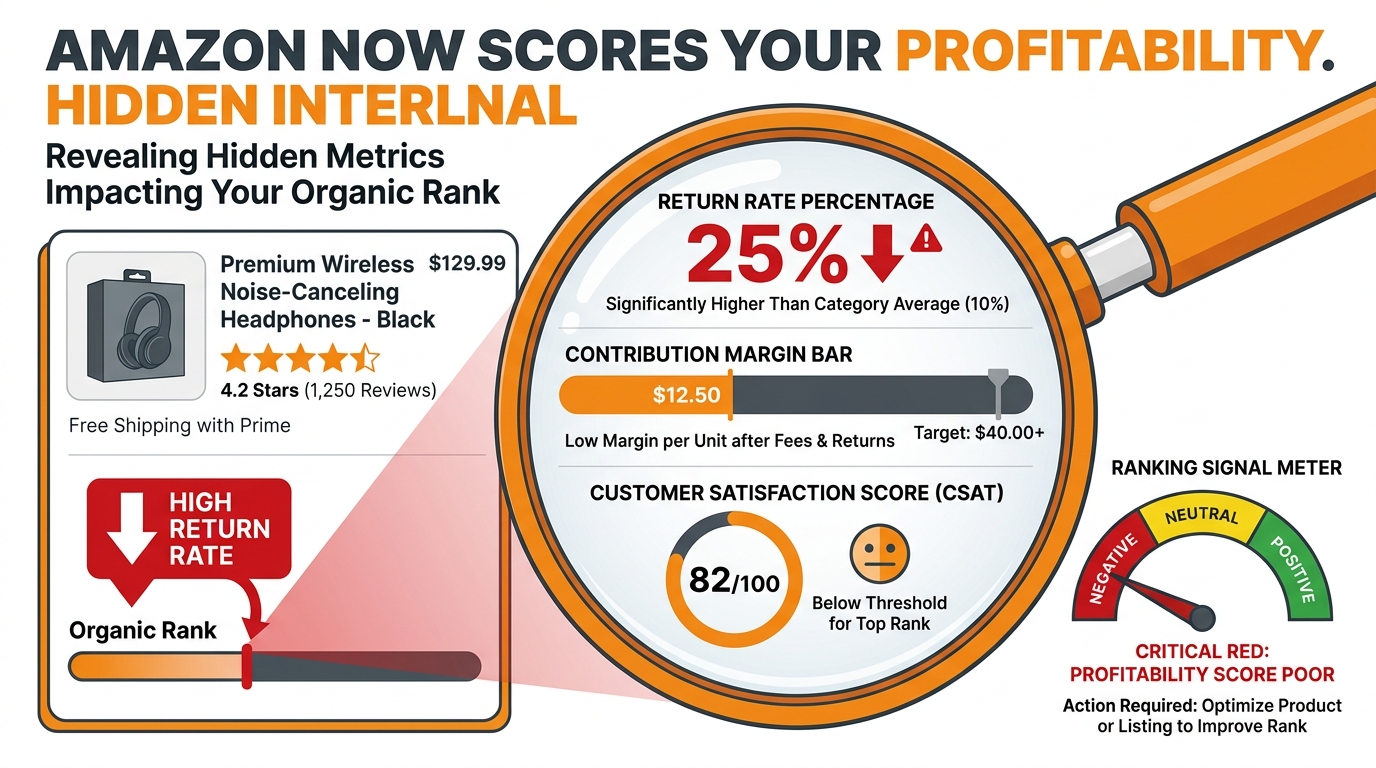
The Profitability Signal: When Amazon Started Caring About Your Margins
One of the most underreported changes in Amazon’s 2026 ranking behavior is the increasing weight placed on what practitioners are calling “profitability signals.” For years, the received wisdom was that Amazon’s algorithm didn’t care about your margin — it cared about sales. Sell more, rank higher. The logic was brutally simple and mostly accurate.
That logic has eroded significantly. Amazon is now surfacing evidence that it factors in contribution margin, return rates, and post-purchase satisfaction in ways that materially affect organic ranking and advertising placement.
Return Rate as a Negative Ranking Signal
The clearest example of this shift is return rate. Historically, a product with a 4.2-star average rating would be considered “healthy” by most seller benchmarks. But in 2026, if that 4.2-star product is also generating a return rate of 15% or higher — particularly in categories like electronics, apparel, or home goods — there are documented cases of organic ranking suppression that cannot be explained by conversion rate or sales velocity alone.
The mechanism makes logical sense from Amazon’s perspective. Returns are expensive. They generate warehouse costs, customer service burden, seller reimbursement friction, and inventory write-offs. A product that 15% of buyers send back represents a real cost that Amazon absorbs whether or not the sale was profitable for the seller. Penalizing high-return products in organic rankings protects Amazon’s own economics while also, in theory, surfacing better products for shoppers.
For sellers, this means the return rate data sitting in your Seller Central account is no longer just an operational metric — it’s potentially a ranking input. Sellers seeing unexplained rank suppression on products with otherwise strong conversion metrics should cross-reference their return rates by ASIN before touching their keyword strategy.
Contribution Margin and Competitive Pricing
Amazon’s 2026 algorithm updates place heavier emphasis on what the platform calls “competitive landed price” — the total price a buyer pays, including shipping, relative to market alternatives. This isn’t new as a concept, but the weight applied to it has increased. Products that sit materially above the competitive price band for their category face a compounding disadvantage: they already convert worse (which hurts A10 signals), and there is growing evidence that Amazon’s merchandising and ranking systems deprioritize them even before conversion data accumulates.
The broader implication is that sellers who compete on price compression alone — slashing margins to boost velocity — face a different kind of risk. Very low-margin products may generate sales volume but can lose ranking priority if they also generate high return rates or negative post-purchase interactions. The algorithm appears to be seeking a middle path: competitive pricing combined with strong post-purchase outcomes, not just the lowest price available.
What This Means Practically
Sellers should treat return rate as a ranking KPI, not just a customer service KPI. Running a monthly audit of return rate by ASIN — segmented by reason code (wrong size, defective, changed mind, misrepresentation) — gives you a diagnostic view of where your listing content may be creating purchase intent mismatches. A product returned frequently because buyers say it “doesn’t match the description” is a COSMO problem as much as it is a returns problem: your content isn’t setting accurate expectations, and the algorithm will eventually penalize you for it on both fronts.
Behavioral Data Is the New Keyword: What Happens After the Click
For most of Amazon’s history, the most important event in a shopper’s journey was the click. Getting someone to choose your product from the search results page was the primary challenge — hence the obsession with main image optimization, price points, and review counts as CTR levers. What happened after the click mattered insofar as it produced a sale, but the granular behavioral data within a product detail page session wasn’t widely understood to feed back into ranking logic.
That understanding is now outdated. In 2026, what happens between the click and the purchase — and even after the purchase — is a first-class ranking signal.
Session Depth and Engagement Time
Amazon can measure how long a shopper spends on a detail page, how far they scroll, whether they read reviews, expand the image gallery, watch embedded video, and ultimately whether they add the product to cart or leave. These engagement signals are now used to distinguish between listings that convert by accident (a shopper’s only option, or a lowest-price desperation purchase) and listings that genuinely satisfy the intent that drove the search.
Listings with high session engagement and strong add-to-cart rates — even when total conversion happens slightly later (for example, through a saved list or a return visit) — appear to accumulate positive behavioral scoring over time. Listings where shoppers bounce quickly back to search results are treated as a relevance failure, regardless of whether keywords match.
Conversion Rate Benchmarks That Matter
Platform-wide data for 2026 puts average Amazon conversion rates at approximately 10–11% across all product types. Well-optimized listings with strong main images, compelling bullet points, and competitive pricing typically land in the 15–20% range. Top-performing listings in some categories hit 30% or higher.
The significance of these benchmarks is not motivational — it’s structural. If your listing’s CVR sits at 7%, you are generating negative behavioral signal with every session Amazon sends you. The algorithm is watching those sessions fail to convert, and it gradually recalibrates your ranking downward, which sends you fewer sessions, which makes CVR improvement even harder. This is the negative feedback loop that explains why slipping rankings often accelerate in one direction: the initial drop causes fewer quality impressions, which causes further conversion decline, which causes further rank suppression.
Post-Purchase Signals: Reviews, Repeat Purchases, and Satisfaction
The behavioral data window doesn’t close at purchase. Review velocity — the rate at which new reviews are accumulating — continues to influence ranking. More importantly, the quality of recent reviews carries disproportionate weight. Amazon’s algorithm does not treat a review from 2021 the same as a review from last week. Recent negative reviews can accelerate ranking suppression far faster than the blunt average star rating would suggest.
Repeat purchase rate is a signal particularly relevant to consumables, subscription-eligible products, and anything that fits a replenishment pattern. Products with strong repeat purchase behavior signal to the algorithm that they’re genuinely satisfying buyers — not just performing well in an initial conversion. This gives subscription-eligible products a structural ranking advantage when they’re enrolled in Subscribe & Save and actively generating recurring orders.
The PPC-Organic Feedback Loop: A Two-Way Street With Rules
The relationship between advertising spend and organic ranking has never been more complex — or more frequently misunderstood. In 2026, sellers are operating with a fundamentally different model than the one that dominated thinking in 2021, when simply running Sponsored Products campaigns was widely treated as an organic rank booster.
The reality is more specific, more conditional, and considerably more punishing when you get it wrong.
How the Feedback Loop Actually Works
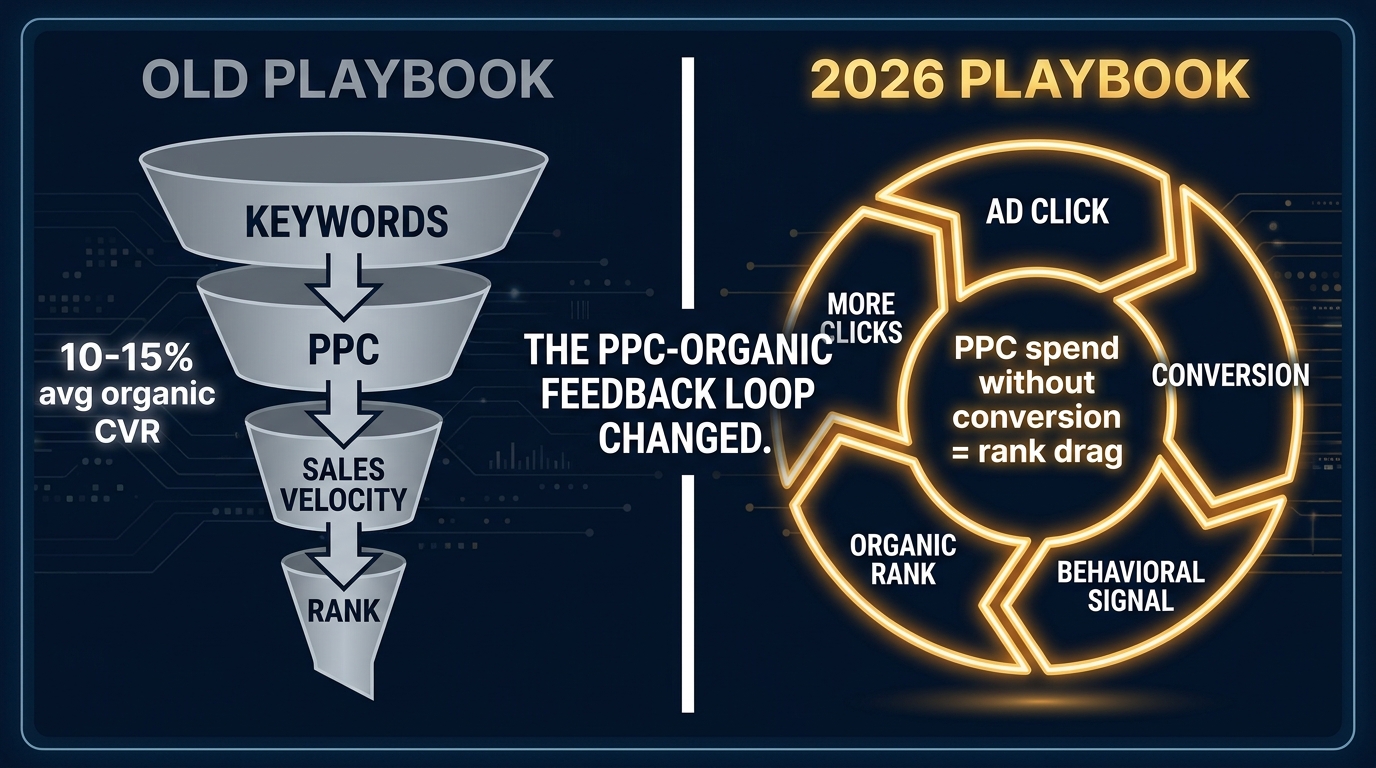
PPC campaigns influence organic ranking through a shared signal: sales velocity and conversion quality. When an ad generates a sale, that sale contributes to the ASIN’s overall sales velocity count, which feeds back into A10’s ranking calculation. This is the halo effect — PPC sales building organic momentum — and it does work, but only under specific conditions.
The critical condition is conversion rate. Ad traffic that clicks but doesn’t convert doesn’t just fail to help — it actively hurts. Sessions generated by advertising that produce no purchase are read by the algorithm as a relevance failure for the keywords that triggered the ad. If your Sponsored Products campaign is spending $300/day on broad match terms that send poorly qualified traffic to a listing that converts at 4%, you are simultaneously burning budget and accumulating negative behavioral signals that drag your organic rank down.
This mechanism — often called “rank drag from unconverted ad traffic” — is one of the least intuitive consequences of the tightened PPC-organic link. Sellers who run unfocused broad match campaigns without monitoring conversion by keyword term are unknowingly participating in a self-sabotage loop. Their organic positions weaken, they compensate with more ad spend, more unqualified traffic piles in, and the cycle continues.
The Right Way to Use PPC for Organic Lift
The sellers generating genuine organic lift from advertising in 2026 are doing so with surgical campaign structures. The pattern that consistently works involves exact match campaigns on high-intent keywords, bid management calibrated to maintain or improve conversion rate (not just ROAS), and regular negative keyword pruning that removes terms generating sessions without purchases.
The metric to watch is not impressions, not even overall ACOS. It’s conversion rate segmented by keyword. A keyword term where your ad converts at 18% is building organic momentum. A keyword where it converts at 3% is eroding it. Separating these — and aggressively culling the latter — protects your organic ranking while still running a viable ad program.
Platform-wide data shows that strong organic listings in 2026 benchmark at 10–15% conversion on organic sessions, with top performers in some categories reaching 20–30%. Maintaining this requires that ad traffic feeding the organic loop is of comparable quality — otherwise the mixed signal from low-converting ad sessions pulls the overall CVR down toward the category mean.
Inventory Reliability as a Ranking Factor (Not Just a Supply Chain Problem)
If you asked most sellers in 2020 which of their business functions had the most impact on search ranking, almost none would have answered “inventory management.” That answer is now at least partially correct, and the mechanism is more direct than most sellers realize.
The Stockout Penalty Is Real and It Compounds
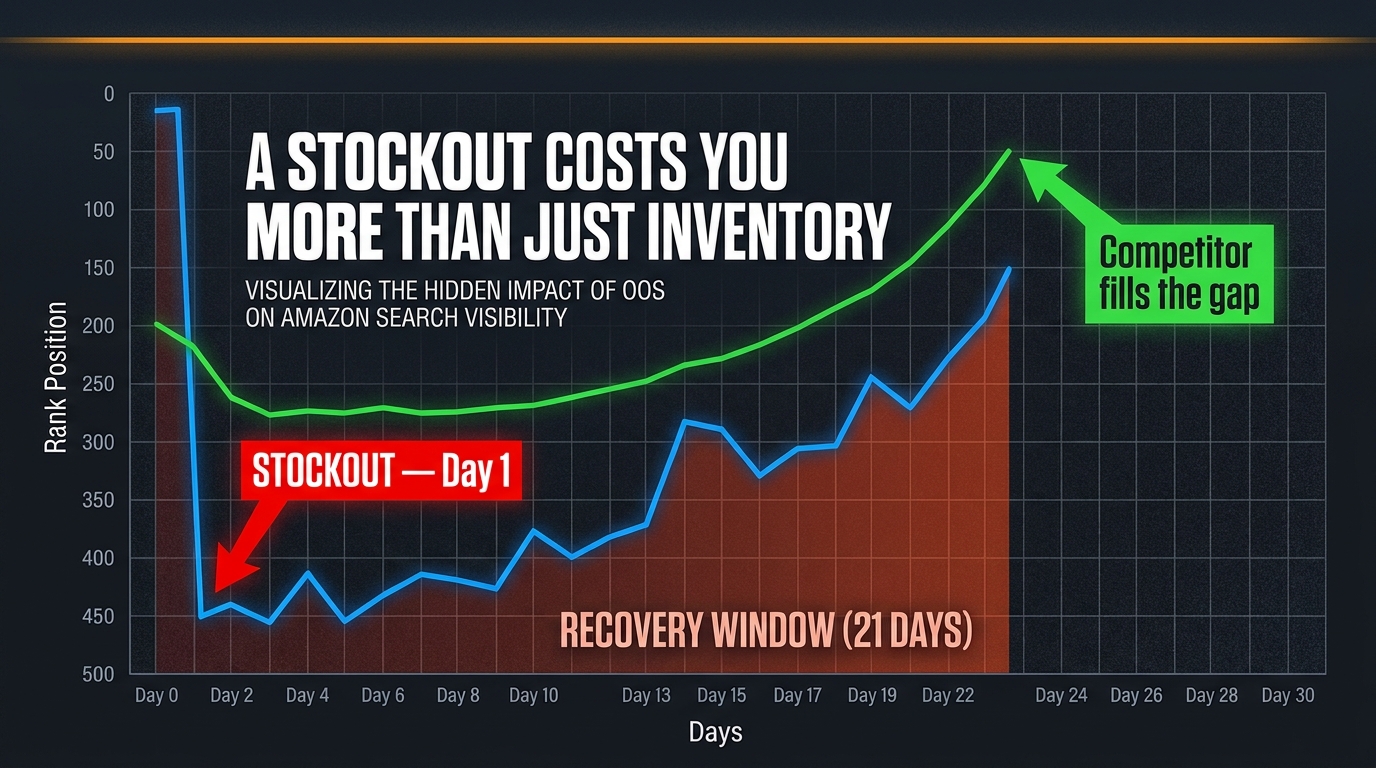
Amazon’s ranking system penalizes stockouts through a compounding mechanism. When a product goes out of stock, it loses its Buy Box, its organic ranking begins dropping within hours, and the sales velocity signal that was sustaining its position immediately decays. Upon replenishment, the ranking doesn’t simply resume where it left off — it has to be rebuilt from a lower starting point, against competitors who continued accumulating velocity signals during the stockout window.
The recovery timeline varies by category and how long the stockout lasted, but seller data consistently shows recovery periods of two to four weeks even for short stockouts (less than seven days). For competitive categories where rankings are closely contested, a two-week gap in velocity accumulation can allow a competitor to permanently leapfrog a previously higher-ranked listing — particularly if the competitor was already on an upward trajectory.
Low-Inventory-Level Fees and Their Ranking Implications
Amazon’s expanded low-inventory-level fee structure — introduced and tightened through 2024 and further refined in 2026 — adds a direct financial penalty for running inventory lean relative to historical daily units shipped. The fee is calculated against your historical days-of-supply, meaning high-velocity products require proportionally more buffer stock to avoid triggering additional charges.
What makes this particularly relevant to ranking is the interaction between the fee trigger and sales velocity. If a high-velocity product starts generating low-inventory fees, sellers often respond by pulling back on advertising to reduce velocity and extend stock coverage. This rational inventory response creates an irrational ranking consequence: intentionally slowing velocity during a stock-constrained period accelerates ranking decay at precisely the moment when the seller can least afford to lose organic position.
The operationally sophisticated response — increasingly common among sellers who have absorbed this lesson — is to build reorder triggers well ahead of the low-inventory threshold rather than reacting to it. This requires either more capital locked in inventory or better demand forecasting (ideally both), but it’s become a competitive prerequisite rather than a nice-to-have. Sellers who can maintain consistent in-stock status across 90-day windows are building a structural advantage that compounds through ranking stability.
FBA vs. FBM Tradeoffs in the Current Environment
The Prime eligibility signal that comes with FBA fulfillment remains a meaningful ranking input in 2026. Listings without Prime eligibility face a structural disadvantage at the A10 layer, where the algorithm weights fulfillment reliability and delivery speed as part of overall “retail readiness.” FBM sellers who can qualify for Seller Fulfilled Prime (SFP) partially offset this disadvantage, but the operational requirements for SFP — 1-day and 2-day delivery with consistently high on-time delivery rates — function as a de facto quality filter that not all sellers can meet.
Backend Keywords in the Age of Semantic Search
Backend keywords are among the most debated elements of Amazon listing optimization, and the debate has become more complicated in 2026 as the distinction between lexical matching and semantic understanding has sharpened. The short answer is that backend keywords still matter — but what you put in them, and how you structure them, needs to be different from what worked in 2022.
The 250-Byte Hard Limit and What It Actually Enforces
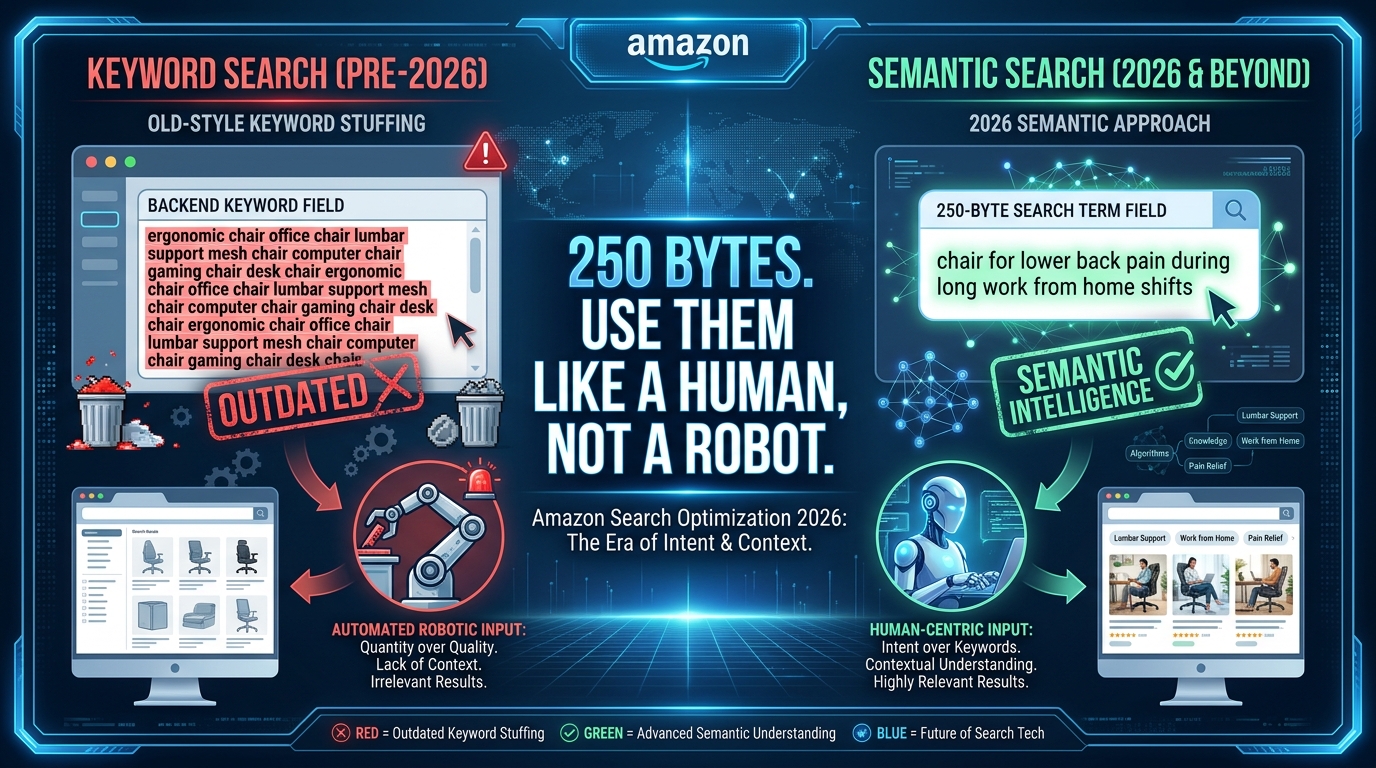
Amazon’s US marketplace Search Terms field carries a hard limit of 250 bytes, not 250 characters — a distinction that matters because multi-byte characters (non-ASCII letters, accented characters, certain special symbols) consume more than one byte each. Listings that exceed this limit see their entire backend Search Terms field effectively ignored or incompletely indexed. The penalty isn’t a warning — the field just stops working properly beyond the byte limit.
This forces prioritization, which is actually useful. You can’t stuff 500 words into 250 bytes. The constraint pushes sellers toward selecting their most strategically valuable terms rather than attempting exhaustive coverage. Given that COSMO and Rufus are now handling a portion of semantic discovery without requiring exact keyword matches, the opportunity cost of spending all 250 bytes on redundant exact-match terms has increased significantly.
Phrase Architecture Over Keyword Lists
The shift toward semantic search changes the optimal structure of backend keywords. Old-school practice was to stack individual words separated by spaces: “ergonomic chair office lumbar mesh adjustable gaming desk.” The intent was to generate the maximum number of possible keyword match combinations from a compact character budget.
In 2026, the evidence points toward a different approach: using short, contextual phrases that more closely resemble how buyers phrase natural language queries. “Chair for lower back pain long work sessions,” “mesh office chair adjustable armrests,” and “gaming chair with lumbar support posture” cover fewer raw keyword combinations — but they index better for the conversational queries that Rufus intercepts, and they provide COSMO with cleaner signals about who the product is for.
This doesn’t mean abandoning lexical coverage entirely. The A9 layer still requires that your listing index for core category keywords — and for most products, the top ten primary keywords should still appear in the title, bullets, or description rather than being relegated to the backend. The backend Search Terms field, in 2026, is best used for secondary coverage: synonyms, use-case-specific phrases, relevant attributes that couldn’t be worked naturally into the front-end content, and the kind of problem-framing language that COSMO rewards.
Subject Matter Fields and the Often-Ignored Indexing Opportunities
Beyond the Search Terms field, Amazon’s backend includes several additional indexing fields — Subject Matter, Intended Use, Target Audience, and others that vary by category — that most sellers leave incomplete or populate lazily. These fields feed the A9 lexical matching and increasingly appear to inform the COSMO intent layer as well. A garden tool listing that specifies “raised bed gardening,” “balcony gardening,” and “container gardening” in the appropriate Intended Use fields surfaces for those queries even without those exact phrases in the main listing content.
A systematic audit of which backend fields are available for your product category — and filling each one deliberately rather than leaving them blank or auto-populated — is one of the quickest wins available to sellers who haven’t already done this work.
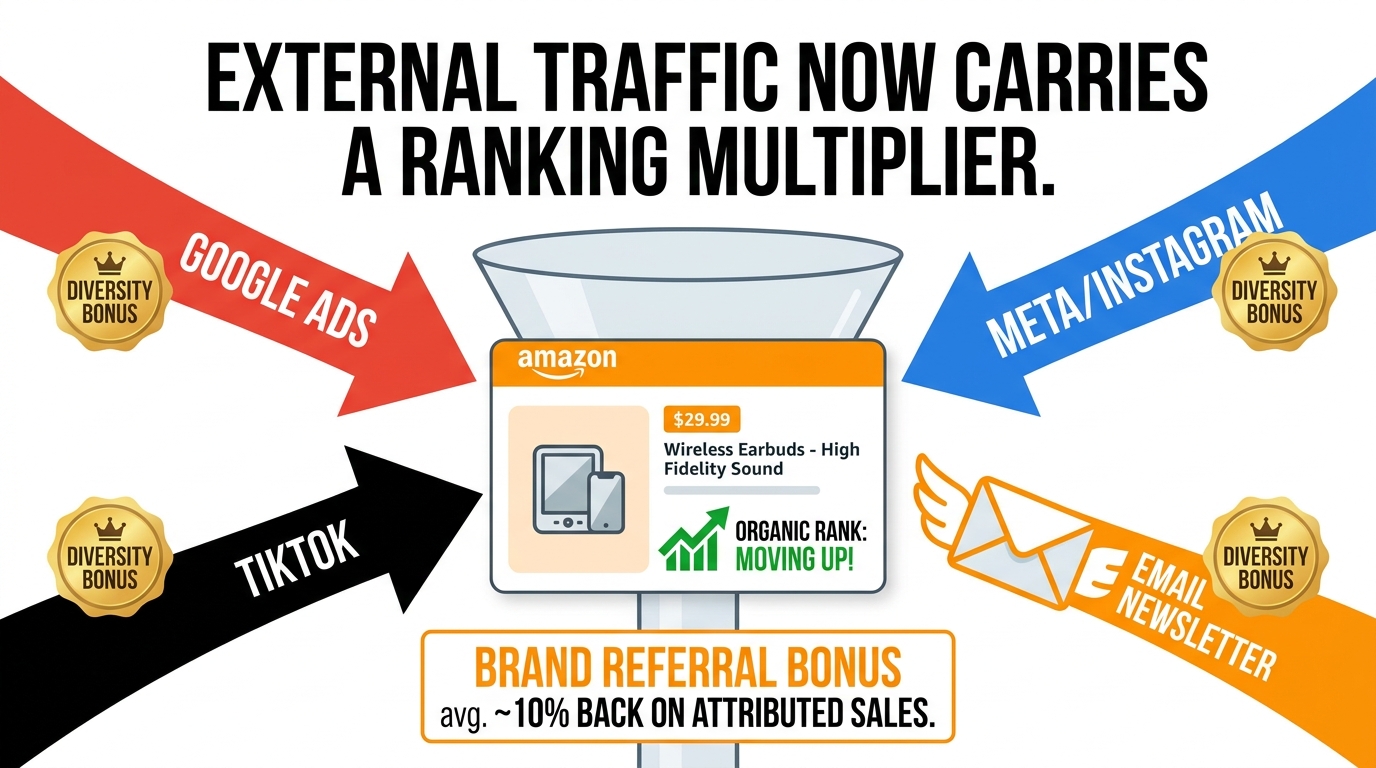
External Traffic, the Brand Referral Bonus, and the Diversity Premium
Amazon’s algorithm has long been suspected of rewarding traffic that arrives from outside the platform — the theory being that a shopper who discovers a product on Google, TikTok, or Pinterest and then searches for it on Amazon represents a stronger demand signal than one who discovers it through on-Amazon browsing. In 2026, this preference has become explicit enough in seller outcomes that it’s no longer theoretical.
Why the Algorithm Values Traffic Diversity
From Amazon’s perspective, an ASIN that generates demand from multiple traffic sources demonstrates product-market fit that extends beyond Amazon’s own discovery ecosystem. This is a signal of organic demand — the kind that doesn’t evaporate when someone turns off their Sponsored Products campaigns. Products with strong external demand signals are treated by the ranking system as more durably relevant, and this durability appears to protect them during periods of on-Amazon competition or temporary ranking volatility.
The practical implication is that building an audience outside Amazon — through content, social media, email marketing, or search advertising on Google and Meta — isn’t just a brand-building exercise. It’s a ranking strategy. The external traffic that converts on Amazon feeds into velocity and behavioral signals that directly influence the A10 layer. When that traffic comes from diverse sources, it provides a richer and more defensible signal than traffic generated solely through on-Amazon PPC.
The Brand Referral Bonus: Economics That Make External Traffic Viable
Amazon’s Brand Referral Bonus program pays enrolled brand-registered sellers an average credit of approximately 10% of sales attributed to external marketing traffic via Amazon Attribution links. This effectively reduces the referral fee on qualifying purchases, improving the unit economics of running Google, Meta, or TikTok campaigns that drive to Amazon listings.
The 10% average is significant because it changes the math on external traffic campaigns that might otherwise look borderline on ROAS alone. A campaign that generates $20,000 in Amazon sales with an average 10% BRB credit effectively recovers $2,000 in referral fees, shifting the effective ROAS threshold at which external campaigns make economic sense. For categories where Amazon’s referral fee is already 8–15% of sale price, this can represent a near-complete offset of that cost on attributed sales.
The ranking benefit is separate from the economic benefit — meaning sellers who are already running external traffic campaigns for brand or demand generation reasons are collecting a ranking dividend they may not be fully accounting for. And sellers who aren’t running any external traffic are operating without this signal entirely, which compounds into a visibility disadvantage over time as competitors build their external traffic flywheel.
Practical Execution for Sellers Without Large Brand Budgets
External traffic doesn’t require a full-scale media budget. Several patterns work at smaller scale. Meta retargeting campaigns targeting audiences similar to recent Amazon purchasers (using Attribution-linked data) tend to have efficient economics because they’re hitting already-warm intent. TikTok organic content that links to Amazon listings via bio links generates attribution-tracked traffic at zero media cost when it lands. Email marketing to an existing customer base is the most cost-efficient channel for generating high-converting external traffic that both earns BRB credits and builds organic ranking signals.
The key operational requirement is Amazon Attribution links. Without tagged links, the traffic is invisible to Amazon’s attribution system — you get neither the ranking signal recognition nor the BRB credit. Setting up Attribution tracking before running any external traffic campaign is non-negotiable for sellers who want to extract the full value of the external traffic signal.
Retail Readiness: The Checklist Amazon Scores Before Everything Else
The phrase “retail readiness” gets thrown around in Amazon seller circles as a vague standard of listing quality. In 2026, it’s more specific than that — and it functions more like a threshold check than a continuous variable. Listings that fail retail readiness criteria don’t just rank lower; they’re treated as fundamentally ineligible for certain promotional placements, algorithm-driven merchandising, and, in some cases, visibility in the Rufus recommendation layer.
What Amazon’s Algorithm Evaluates as Retail Ready
Based on seller-side evidence and Amazon’s own guidance for its Vendor Central and Seller Central programs, retail readiness in 2026 encompasses several distinct criteria that all need to be satisfied simultaneously:
In-stock consistency. The percentage of time an ASIN has been in stock over a rolling 30- and 90-day window. Chronically low in-stock rates flag a listing as an unreliable source of revenue, which suppresses its algorithmic priority regardless of its conversion performance during periods when it is in stock.
Prime eligibility. Either through FBA fulfillment or Seller Fulfilled Prime qualification. Non-Prime listings are filtered out for a significant portion of shoppers who use the “Prime” refinement filter, which on many category pages now defaults to active. Being invisible to Prime-filter users means losing a substantial share of high-intent browsing traffic.
Listing completeness score. Amazon evaluates whether key fields — primary image, additional images (minimum six recommended, seven or more preferred), title (within character limits), bullet points (five populated), description or A+ content, and backend fields — are all fully populated. Incomplete listings fail at the retail readiness layer before any behavioral data is even collected.
Competitive landed price. Whether the total price (including shipping where applicable) is within a reasonable band of comparable products. Amazon’s price competitiveness score is proprietary, but the consequence of being priced materially above the market — especially for commodity or near-commodity categories — is documented as a ranking suppressor.
Account health metrics. Order defect rate, late shipment rate, pre-fulfillment cancellation rate, and policy compliance scores. These are seller-level signals, but they cascade down to ASIN-level ranking. An account with poor health metrics cannot expect individual ASINs to rank well regardless of their individual listing quality.
Why Retail Readiness Is a Better Starting Point Than Keywords
The reason retail readiness deserves this level of attention is that it sets the floor below which no amount of keyword optimization or ad spend can lift a listing. Sellers who jump directly to keyword research and PPC campaigns without first confirming retail readiness across every ASIN in their catalog are building on an unstable foundation. The algorithm will continue to de-prioritize their listings not because of anything wrong with their marketing, but because fundamental eligibility criteria are unmet.
A practical approach is to treat the retail readiness audit as the first step in any listing optimization cycle, not an afterthought. Running through a structured checklist — in-stock rate, Prime status, image count and quality, content completeness, price positioning, account health — before touching keyword strategy or campaign structure will surface quick wins and eliminate fundamental suppression causes that might otherwise be attributed to mysterious algorithm behavior.
Winning Through Volatility: How Operationally Strong Sellers Are Pulling Ahead
The dominant narrative about Amazon’s 2026 search shuffle has focused on what’s being penalized. But there’s a parallel story worth telling: which sellers are actually benefiting from the increased volatility, and why.
The sellers gaining ground during the current algorithm environment share a specific profile. They’re not necessarily the ones with the most SKUs, the biggest advertising budgets, or the highest brand recognition. They’re the ones who have built operational systems capable of maintaining consistent performance signals across multiple ranking dimensions simultaneously — while competitors fail at one or more of them.
The Compounding Advantage of Multi-Signal Consistency
Because Amazon’s 2026 ranking stack evaluates listings across multiple parallel signals — lexical coverage, behavioral performance, inventory reliability, profitability metrics, retail readiness, and now COSMO/Rufus intent alignment — a listing that performs adequately across all dimensions outperforms a listing that excels at one but fails at others.
This is a fundamentally different competitive dynamic than the single-lever optimization that dominated Amazon strategy for most of its history. In the era when keyword rank was the primary output and sales velocity was the primary input, you could win by being very good at one thing. Today’s ranking system is more like a multivariable assessment: weak performance on any one signal can drag down a listing that’s genuinely strong on others.
The sellers pulling ahead have internalized this. They’re running monthly audits that span return rate by ASIN, in-stock rate by ASIN, conversion rate by keyword, PPC conversion efficiency by campaign, and content completeness by listing. They’re catching individual ASIN failures before they cascade into ranking drops, and they’re systematically closing gaps rather than chasing single-metric improvements.
Velocity Management Around Key Events
A specific pattern worth highlighting is how leading sellers manage velocity signals around peak events and inventory constraints. Rather than allowing ranking to decay during stock-limited periods, they use a combination of inventory replenishment triggers (set well ahead of depletion) and intentional bid adjustments to maintain minimum velocity thresholds during supply gaps.
During Prime Day, Q4 peak, and major category-specific events, ranking volatility increases sharply across most categories. Sellers who can maintain in-stock status and sustain ad coverage through these windows accumulate outsized ranking gains because competitors going out of stock during high-traffic periods suffer amplified ranking penalties — their velocity stops precisely when the platform’s traffic volume is highest.
The practical setup involves calculating your safety stock buffer based on forecasted event velocity (often 2–4× normal daily rates) and aligning reorder timing accordingly. This sounds like basic supply chain management, but the percentage of sellers who still go out of stock during Prime Day — one of the most predictable demand spikes on the calendar — suggests it remains a widespread failure point that creates real ranking opportunity for those who avoid it.
Listing Content That Works Across All Three Algorithm Layers
Perhaps the most durable competitive advantage in the current environment is listing content that simultaneously satisfies A9’s lexical requirements, A10’s behavioral expectations, and COSMO/Rufus’s semantic intent reading. These aren’t mutually exclusive — but optimizing for all three at once requires a more deliberate approach than most sellers apply.
A listing optimized for all three layers looks like this: a title that leads with the primary keyword but reads naturally rather than as a keyword string; bullet points that address specific buyer problems (not just features) in language that mirrors how buyers describe their needs; a description or A+ content that functions as a comprehensive, structured answer to “is this product right for me?”; and backend fields that cover secondary terms and use-case phrases that couldn’t be worked into front-end content organically.
The COSMO layer in particular rewards listings that clearly articulate the problem they solve, the context they’re designed for, and the customer they serve. A blender listing that explains in its description why it’s designed for frequent, extended use — and uses phrasing like “won’t overheat during continuous blending sessions” rather than just “powerful motor” — is giving COSMO the structured information it needs to match that listing to buyers searching for exactly that use case in natural language. This kind of content doesn’t just help you rank; it improves conversion rates and reduces returns, creating a virtuous cycle across all the signals that matter.
What to Do in the Next 30 Days: A Prioritized Action Framework
Given the scope of what’s changed in Amazon’s ranking system, it can be difficult to know where to start. Here is a sequenced approach based on the signals with the highest impact-to-effort ratio in the current environment:
Week One: Audit, Don’t Optimize
Before making any changes to listings or campaigns, run a full diagnostic. Pull your return rate by ASIN for the last 90 days. Pull your in-stock rate by ASIN for the last 90 days. Export your campaign data and calculate conversion rate by keyword term, not just by campaign. Note which ASINs are below 10% organic CVR. Flag any listings where return rate exceeds 10% or in-stock rate is below 90%. This data, not intuition, is where the real problems live.
Week Two: Fix the Floor
Address retail readiness failures before anything else. Complete any listing fields that are blank or minimal. Verify that every ASIN has at minimum six images. Check Prime eligibility. Review price positioning against current category competitors. Resolve any account health violations. These fixes affect the eligibility threshold — they’re prerequisite to any ranking improvement work being effective.
Week Three: Refine Advertising Structure
Audit your PPC campaigns for keywords generating sessions with low conversion rates (below 5%). Add these as negatives. Restructure remaining keywords into exact match campaigns separated by performance tier. Set bids on high-converting exact match terms to maintain or build ranking momentum. Pause broad match campaigns that are generating unqualified traffic. Run a conversion rate report by keyword for any auto campaigns and harvest the high-converting terms into manual campaigns.
Week Four: Content and Semantic Upgrade
Rewrite listing content on your highest-priority ASINs with COSMO and Rufus in mind. For each product, answer three questions in the listing text: What specific problem does this solve? In what context is it designed to be used? Who is it not right for? These questions produce content that is simultaneously more honest about product fit (which reduces returns), more resonant with buyers (which improves conversion), and more legible to Amazon’s AI layers (which improves semantic discovery). Update backend Search Terms fields to use natural-language phrases aligned with how your buyers actually describe their needs.
Conclusion: The Shuffle Isn’t Random — It Just Rewards Different Things
The Amazon search shuffle of 2026 has felt chaotic to many sellers because ranking movement has become faster and less predictable than it was two or three years ago. But the chaos is more apparent than real. The volatility is driven by an algorithm that is now more sensitive to performance signals, more sophisticated in its intent reading, and more demanding about operational consistency. That sensitivity cuts both ways: it penalizes weak signals faster, but it also rewards strong signals faster.
The sellers who are experiencing the shuffle as a catastrophe are largely the ones whose rankings were built on fragile single-lever strategies: keyword density alone, raw PPC volume alone, or high sales velocity in a period of low competition. When the scoring weights shifted, those foundations couldn’t hold.
The sellers experiencing the shuffle as an opportunity are the ones who have built across multiple signal dimensions — listing quality, operational reliability, advertising efficiency, content depth, and traffic diversity — simultaneously. They don’t have a perfect score on any single variable. They have a good-enough score across all of them, which in a multi-signal system is more durable than excellence on one.
Understanding what the algorithm actually measures — across all three layers, including profitability signals, behavioral data, and semantic intent — is the prerequisite for competing effectively in this environment. Sellers who still think in terms of “keyword rank” as the primary output are solving the wrong problem. The output that matters now is multi-dimensional performance consistency, and the inputs that drive it span keyword coverage, behavioral conversion, inventory reliability, ad efficiency, content quality, and external demand generation.
The shuffle isn’t random. It just measures things that most sellers haven’t been measuring. Start measuring them, and the ground will feel a great deal less uncertain.