


TikTok Shop’s growth story is well documented. What gets far less attention is the quiet margin compression that has been accelerating on the seller side throughout 2026. Fee structures have shifted. Platform shipping subsidies that sellers once counted on have been wound down. Referral fees have crept upward in several categories. And the all-in cost of acquiring a sale — once you include affiliates, ads, fulfillment, and returns — now regularly surprises sellers who priced their SKUs on simpler math.
The sellers who are actually making money on TikTok Shop in 2026 are not simply those with the most viral content or the highest affiliate commission rates. They are the ones who understand their full cost stack at the SKU level, have built pricing to absorb shipping and tax friction without eroding net margin, and have designed their product and fulfillment mix to survive what the platform actually charges — not what they assume it charges.
This playbook is for the second group. It cuts through the optimistic headline numbers and walks through the real unit economics: the fee layers, the shipping math by fulfillment model, how sales tax marketplace facilitator status works (and what compliance duties it does not remove from sellers), why returns are a bigger margin killer than most spreadsheets account for, and the specific tactical levers — from bundling to creator commission caps to SKU-level margin floors — that defend profitability as the platform matures.
Whether you are an established seller recalibrating after recent policy changes or a brand evaluating whether TikTok Shop margins make sense for your product line, the numbers here are worth running before your next pricing decision.
The Complete TikTok Shop Fee Stack: What You’re Actually Paying in 2026
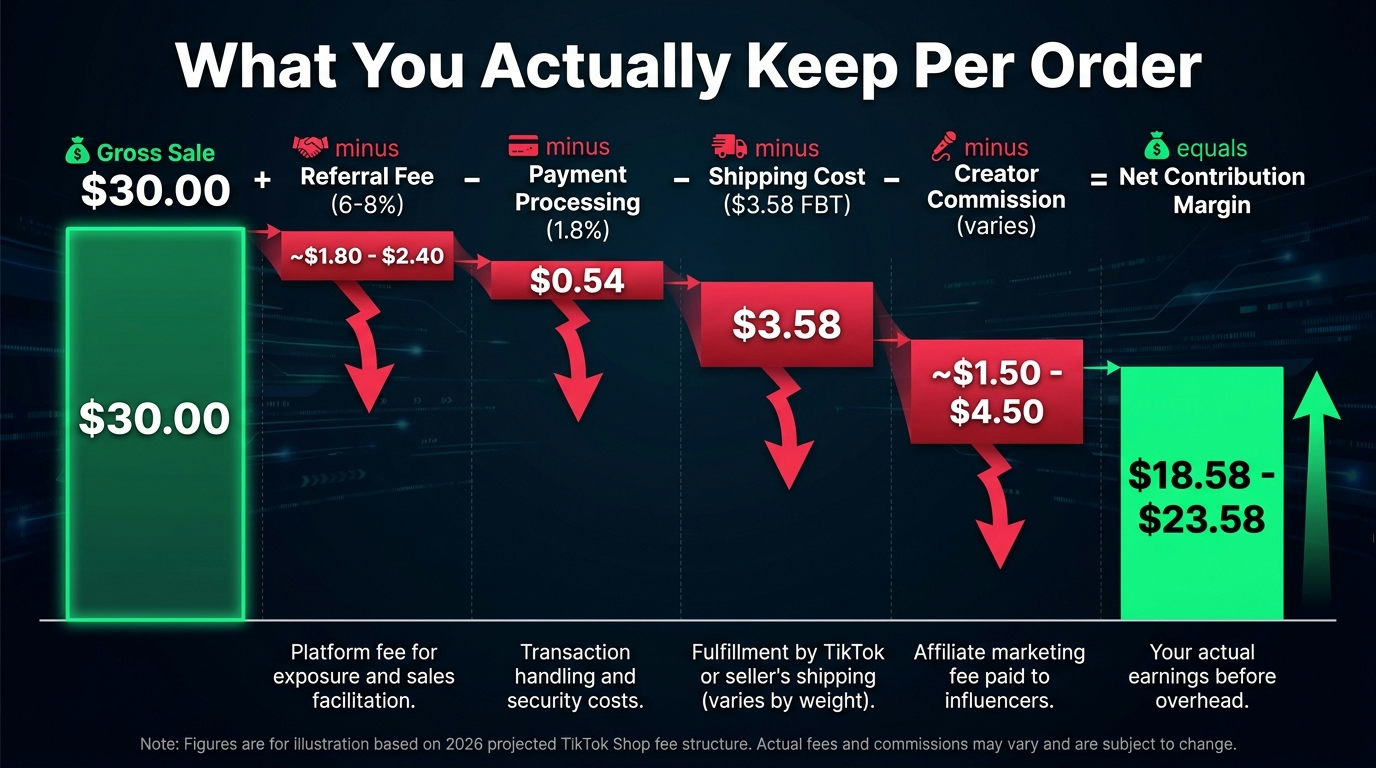
Most sellers who cite their “TikTok Shop fees” quote only the referral rate. That is the wrong starting point. The real fee stack has multiple layers, each of which comes off gross revenue before you reach actual profit — and most of them are non-negotiable on a per-order basis.
Referral Fees
The U.S. referral fee has been 6% for most categories since TikTok Shop launched, with lower rates (around 5%) for selected subcategories like certain jewelry and pre-owned goods. Reports from August 2026 indicate TikTok raised the standard U.S. non-food referral fee to 8% for most categories, though this is still being verified across accounts and categories. New sellers have historically received promotional rates in the 2%–3% range during an introductory period, but these expire.
In practice, assume 6%–8% depending on your category and account tenure. If you priced at 6% and are now sitting in an 8% category, that two-point delta is meaningful — on a $25 item, it is $0.50 per order that was previously available as margin.
Payment Processing Fees
TikTok Shop charges a transaction/payment processing fee on top of the referral rate — typically around 1.8% in the U.S. market. This is not always surfaced prominently in seller center fee summaries, which is why seller-generated margin calculations sometimes run short. The combined referral-plus-processing take rate is therefore 7.8%–9.8% depending on your category, before any shipping, fulfillment, or affiliate cost enters the picture.
Shipping and Fulfillment Fees
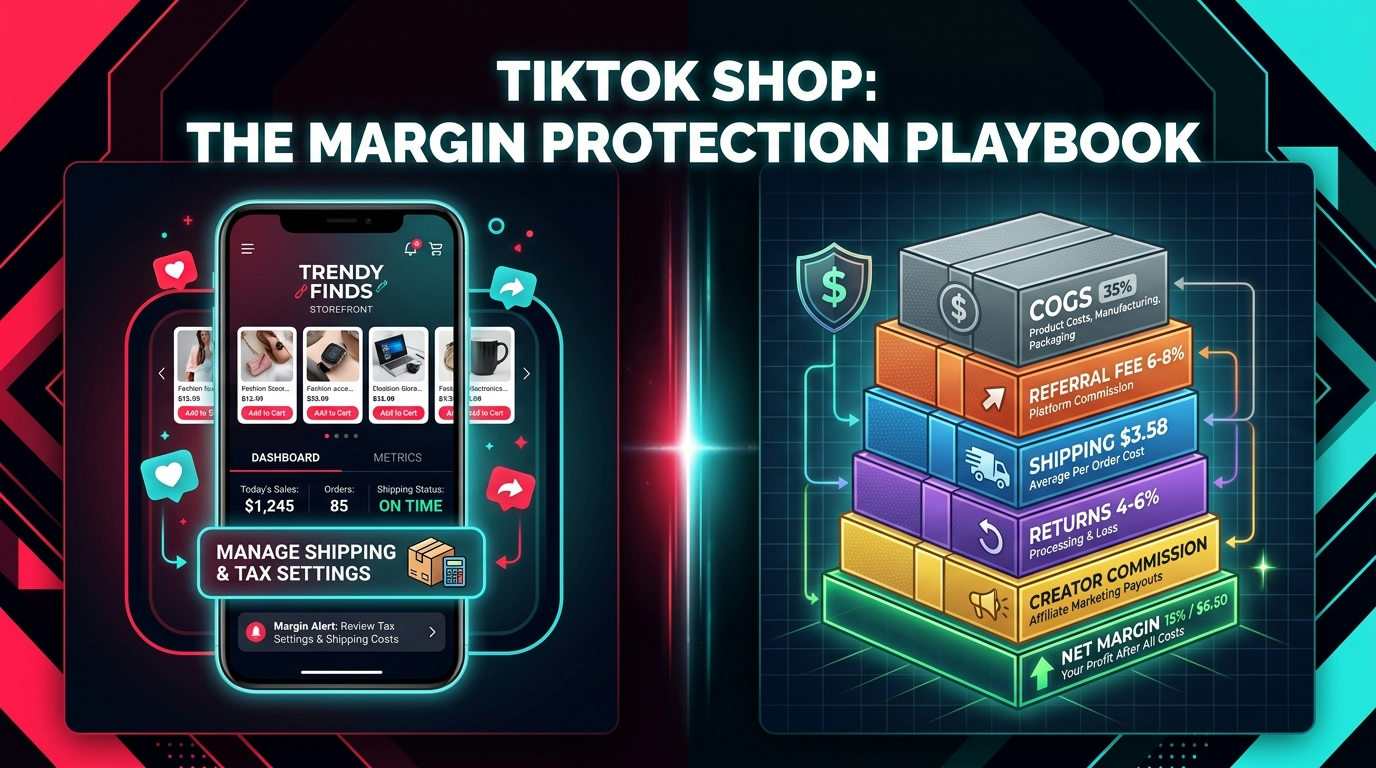
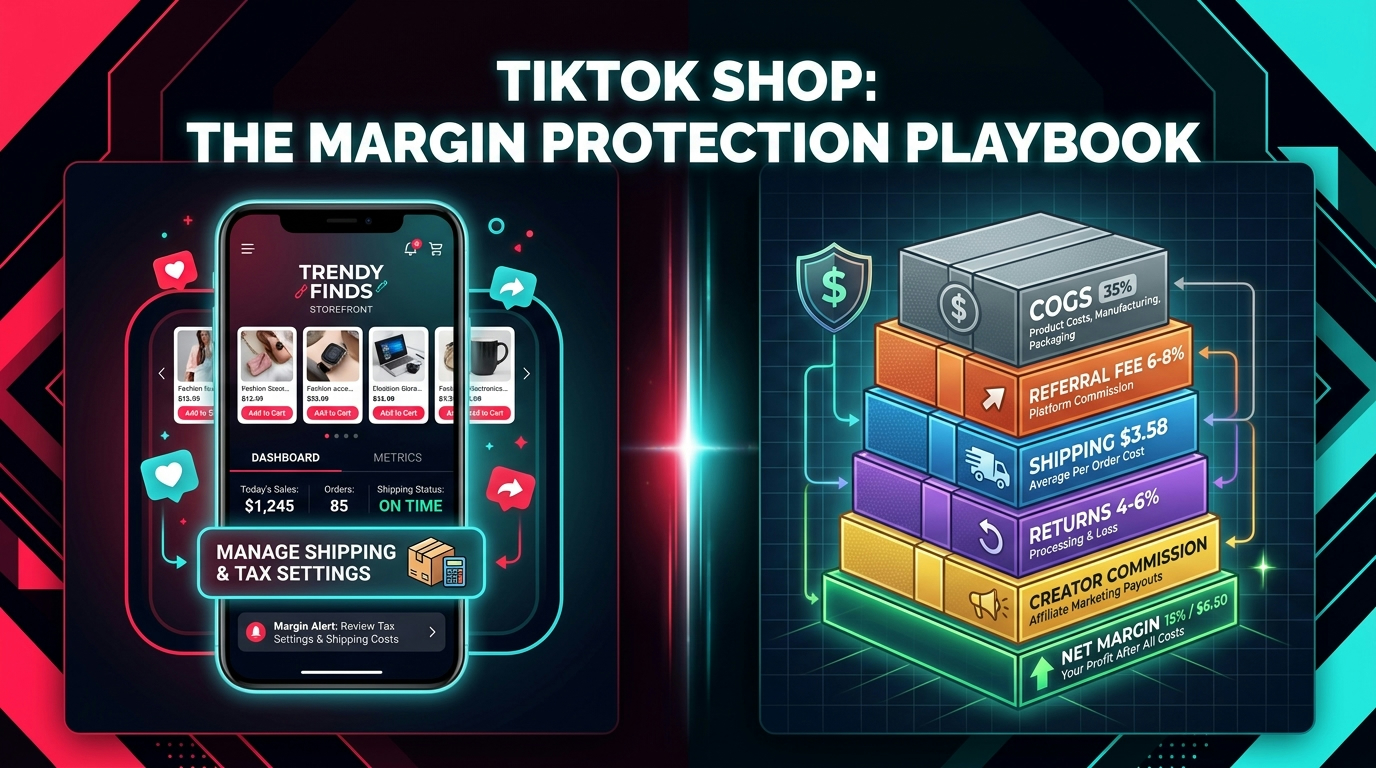
This is where the real variation lives, and it is covered in depth in later sections. The short version: if you use FBT (Fulfilled by TikTok), base fulfillment starts at approximately $3.58 per unit for single-unit orders under 4 lbs, dropping to around $2.86 per unit for multi-unit orders. Seller-fulfilled shipping costs vary by carrier, parcel weight, and zone, but can range from $3–$8+ for standard packages depending on the shipping service.
Creator and Affiliate Commissions
Affiliate commissions on TikTok Shop are seller-set but highly competitive. Category norms in beauty and health typically run 10%–20%. Fashion and lifestyle products often see commissions at 15%–25% to attract top creators. These come off gross sale price, stack on top of referral and processing fees, and compound with shipping cost. A $30 sale with an 8% referral fee, 1.8% processing, $3.58 FBT fulfillment, and a 15% affiliate commission leaves the seller with approximately $11.00–$12.00 before COGS and returns. At a typical 40% COGS, that $30 item has a COGS of $12.00 — putting the operation at or below breakeven without returns factored in.
Ad Spend
Sellers running TikTok Shop Ads (formerly “Spark Ads” or product-level CPAS campaigns) are adding another variable cost layer. Effective CPAs on TikTok Shop ads vary widely, but even a modest $2.00–$4.00 effective CPA per order on a $20 product represents a 10%–20% additional cost against revenue.
The total platform take rate, once all layers are combined, typically lands between 35% and 55% of gross sale price for sellers running affiliates and ads simultaneously. That figure is what should drive pricing decisions — not the referral rate in isolation.
Shipping Tax 101: What TikTok Shop’s Marketplace Facilitator Status Actually Means
One of the most frequently misunderstood aspects of TikTok Shop for U.S. sellers is sales tax. The confusion is understandable: the rules are genuinely complex, and the consequences of getting them wrong range from minor reporting gaps to significant compliance exposure.
The Marketplace Facilitator Baseline
TikTok Shop operates as a marketplace facilitator for U.S. sales tax purposes in all states that have enacted marketplace facilitator laws — which, as of 2026, covers the vast majority of U.S. states. As a marketplace facilitator, TikTok is legally responsible for calculating, collecting, and remitting applicable sales tax at checkout on behalf of sellers transacting through the platform.
This is broadly good news for sellers. It removes the operational burden of managing per-state sales tax collection and remittance for your TikTok Shop channel. The tax appears at checkout, is collected from the buyer, and TikTok handles the remittance. You do not file for these transactions separately in most cases.
What Marketplace Facilitator Status Does Not Cover
Here is where many sellers run into problems. Marketplace facilitator status does not eliminate all seller-side tax obligations. Specifically:
- Nexus monitoring: If your TikTok Shop volume creates economic nexus in a state (typically $100,000 in annual sales or 200 transactions), you may have filing, registration, or reporting obligations in that state even though TikTok is collecting the tax.
- Multi-channel reconciliation: If you also sell on your own DTC website, at events, or through other non-facilitator channels, you are responsible for tax collection and remittance on those sales — and the cross-channel nexus thresholds still apply.
- Gross sales reporting: TikTok’s facilitated tax collection shows up on your 1099-K as gross revenue. You need to reconcile that your reported gross sales align with the tax amounts TikTok remitted on your behalf, or you will face discrepancies in your accounting.
- International sellers: If you are a non-U.S. seller shipping into the U.S. through TikTok Shop, additional import duty and customs obligations exist that marketplace facilitator status does not cover.
Shipping Tax on Seller Fees: The New Wrinkle
A development worth noting for multi-market sellers: TikTok Shop introduced a 6% Sales and Service Tax (SST) on seller shipping fees in Malaysia starting September 7, 2026. TikTok Shop absorbed this cost for orders created between September 1 and September 6, 2026, as a transition window, before passing the fee to sellers. This pattern — platform absorbs a new tax temporarily, then shifts it to sellers — is worth watching as TikTok Shop expands into new markets and tax jurisdictions. Sellers operating in Southeast Asia, the UK, and other international markets where TikTok Shop is active should audit their shipping fee exposure as tax rules continue to evolve per jurisdiction.
The Practical Tax Compliance Checklist
For U.S. sellers, the minimum viable compliance posture in 2026 looks like this: register in your home state, monitor economic nexus thresholds quarterly across all channels, reconcile TikTok’s 1099-K gross figures against your own records, and use a tax compliance tool (Avalara, TaxJar, or similar) to track cross-channel exposure if you sell beyond TikTok Shop. The platform handles the transactional collection — your job is the broader compliance architecture around it.
How the End of CFFS Changed the Shipping Math
For sellers who joined TikTok Shop in 2023 or 2024, there was a meaningful shipping subsidy baked into the platform economics: the Co-Funded Free Shipping (CFFS) program. Under CFFS, TikTok subsidized a portion of seller shipping costs as a conversion incentive, effectively making “free shipping” to buyers cheaper for sellers to absorb.
That subsidy is gone.
What CFFS Looked Like
Under CFFS, U.S. sellers on TikTok Shipping or Seller Shipping received approximately $0.80 per order in shipping subsidy from TikTok. FBT sellers received a $0.75 per-item subsidy toward fulfillment costs. These were not large numbers individually, but across volume — especially for low-AOV categories where shipping as a percentage of sale price is highest — they were meaningful margin contributors.
The May 2025 Cutoff and 2026 Reality
TikTok ended CFFS for U.S. sellers effective May 29, 2025. Sellers on TikTok Shipping and Seller Shipping now cover the full shipping cost for free-shipping offers. FBT sellers pay standard fulfillment fees without the per-item subsidy offset. The net effect entering 2026 is that every “free shipping” order now costs the seller more than it did 12–18 months ago, with no platform contribution to bridge the gap.
There was a brief period of confusion in early 2026 when TikTok initially announced that independent “Seller Shipping” would be discontinued entirely by March 31, 2026, then paused that mandate. As of mid-2026, seller shipping remains available, but the policy has been inconsistently communicated across seller accounts and markets. The safe assumption is that the subsidy era is over and that seller-paid shipping is now the permanent baseline.
The Margin Impact by Price Tier
The CFFS exit has the most severe impact on low-price items. Consider a $12 product: shipping at $4.00 represents 33% of gross revenue. At a 6% referral fee ($0.72), 1.8% processing ($0.22), and a 15% affiliate commission ($1.80), you have already allocated $6.74 before COGS. A $4.00 COGS (33% of price) takes you to $10.74 in total costs on a $12 sale — a $1.26 gross loss per order before returns. The $0.80 CFFS subsidy previously softened this by about 63%. Without it, the math collapses entirely for many low-AOV SKUs. This is a core reason why the TikTok Shop seller community has been aggressively moving toward bundling and higher AOV — the platform economics now require it.
FBT vs. Seller-Fulfilled: The Real Margin Comparison
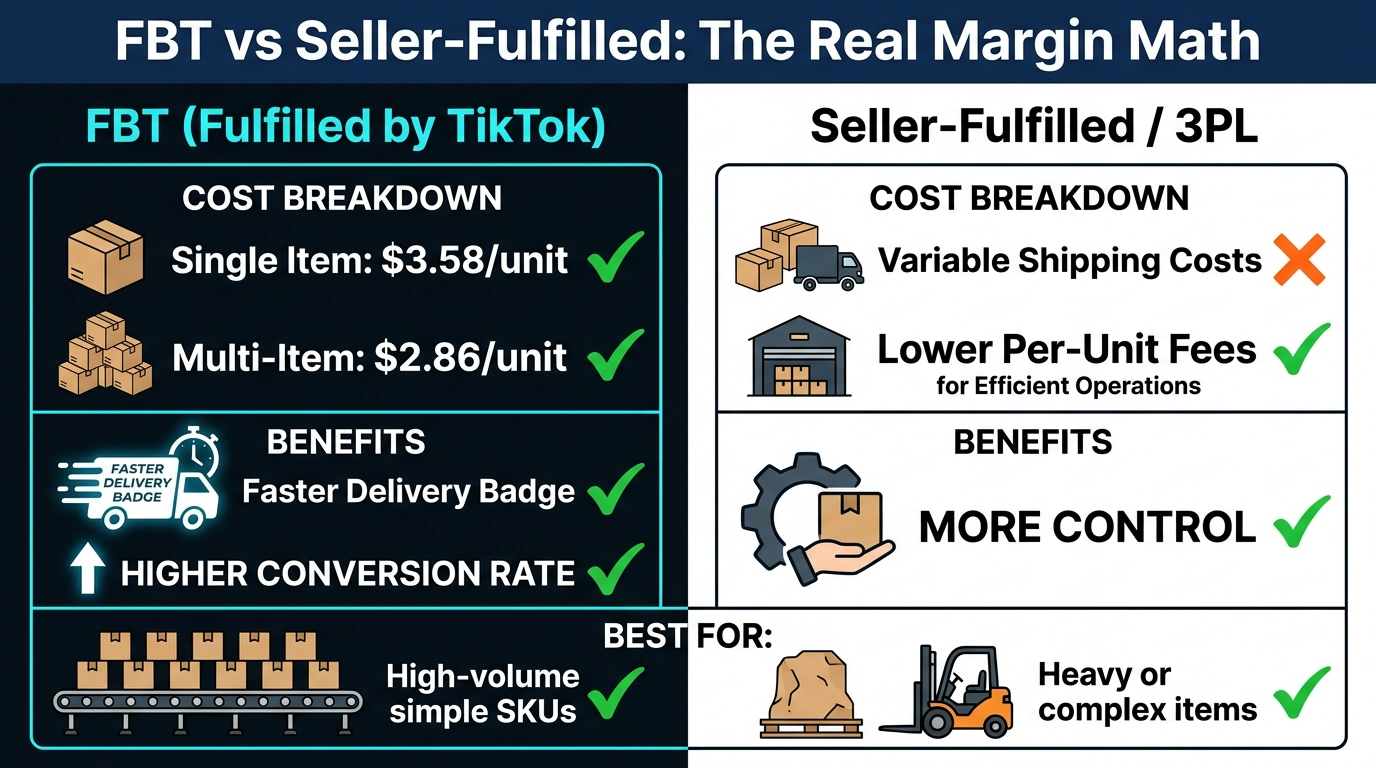
Choosing between FBT (Fulfilled by TikTok) and seller-fulfilled shipping is not a purely operational decision — it is a margin decision. The wrong choice by product type can cost you several percentage points of contribution margin per order, compounding across thousands of units.
FBT Cost Structure in 2026
TikTok’s published 2026 FBT rate card places single-unit fulfillment at approximately $3.58 per unit for light orders (under 4 lbs), dropping to approximately $2.86 per unit for multi-unit orders within the same shipment. TikTok reduced some FBT fees in May 2026 for heavier single-unit items (16–50 lb) while raising rates in certain 5–20 lb multi-unit configurations, so the rate card is not uniformly cheaper or more expensive than 2025 — it is category-specific.
FBT fees cover outbound shipping, which means there is no separate carrier bill for FBT sellers. Storage fees apply if inventory sits beyond thresholds, and return processing fees add cost on failed orders. But the headline appeal of FBT is simplicity: one fee covers pick, pack, and ship.
Seller-Fulfilled (3PL) Cost Structure
A well-run 3PL operation for a small-parcel item in the same weight category as the FBT example above can realistically cost $2.50–$4.00 per order all-in (pick, pack, and shipping). Sellers with high volume who have negotiated carrier rates may land below the FBT floor; sellers at lower volume or with irregular SKU sizes may exceed it.
The key variable is operational efficiency. Seller-fulfilled gives you carrier choice, packaging control, and the ability to use your existing logistics infrastructure — but it also requires managing relationships, tracking returns separately from TikTok’s FBT return pipeline, and absorbing zone-based shipping variability.
The Conversion Offset
FBT is not just a cost line — it affects conversion rate. TikTok Shop surfaces FBT-fulfilled products with faster delivery badges, which data consistently shows improves conversion, especially for impulse-purchase categories. TikTok’s own materials have cited 20%–35% potential per-order cost savings versus certain seller-fulfilled models, though this figure requires scrutiny since it compares against inefficient self-ship setups rather than best-in-class 3PL arrangements.
The honest framing: FBT is likely worth paying the per-unit premium if your product is in a category where delivery speed meaningfully influences purchase decisions (gifts, trending items, time-sensitive consumables). For bulkier, heavier, or slower-selling SKUs where buyers are less time-sensitive, a well-run 3PL often delivers better net margin.
FBT vs. Seller-Fulfilled Decision Framework
- Use FBT when: Items are light and small (<4 lbs), the category is impulse-driven, you lack existing 3PL infrastructure, or your volume is insufficient for strong carrier negotiation.
- Use seller-fulfilled when: Items are heavy or dimensional, you have an existing efficient 3PL at competitive rates, your buyers are less delivery-time-sensitive, or you need packaging customization that FBT does not accommodate.
- Hybrid approach: Some sellers use FBT for top-moving SKUs and self-fulfill slower-moving or heavy items, optimizing fulfillment cost at the SKU level rather than committing to one model across the catalog.
Building Your Margin Floor: The Cost-Stack Pricing Framework
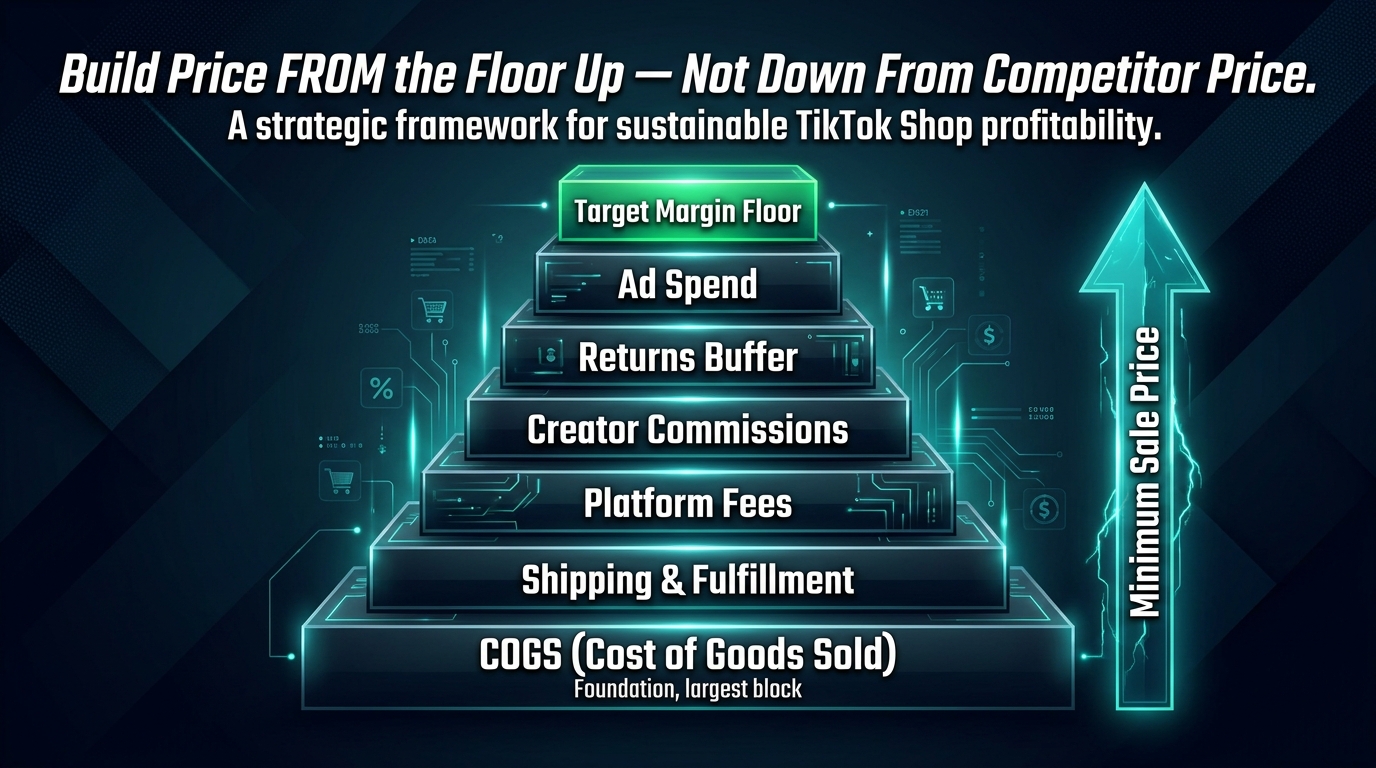
The most common pricing mistake on TikTok Shop is building from competitor price downward: “My competitor sells this for $25, so I should price at $23 to win on price.” That logic ignores the cost stack entirely. The correct approach builds from the floor upward — establishing a minimum viable price based on your actual all-in cost, then assessing whether the market price point is even viable for your margin requirements.
The Full Cost Stack (Per Order)
Here is the complete cost inventory every TikTok Shop seller should be modeling at the SKU level:
- COGS: Product cost including manufacturing, procurement, and inbound shipping to warehouse or FBT facility.
- Outbound shipping/fulfillment: FBT rate or seller-fulfilled per-order shipping cost (carrier + 3PL pick/pack).
- TikTok referral fee: 6%–8% of gross sale price.
- Payment processing: ~1.8% of gross sale price.
- Affiliate/creator commission: Seller-set; typically 10%–25% of gross sale price depending on category.
- Ad spend per order: Effective CPA on TikTok Shop ads, amortized per unit sold.
- Return cost buffer: Expected return rate × (product cost + return shipping + processing). More on this in the next section.
- Storage fees: For FBT, any storage fees above free tier; for 3PL, ongoing warehousing cost.
Once you have summed these costs, the margin floor price is: Total Cost Stack ÷ (1 − Target Net Margin %). If your total cost stack on a SKU is $14.00 and you target a 15% net margin, your minimum viable price is $14.00 ÷ 0.85 = $16.47. Any list price below $16.47 produces less than your target margin before errors and one-off costs.
Margin Floor Enforcement in Practice
The margin floor should be documented at the SKU level and used as a gate in several decisions:
- Coupon and discount limits: Set a maximum coupon depth in TikTok Seller Center that does not push sale price below the margin floor.
- Creator commission caps: For high-commission creators requesting above-catalog rates, calculate whether the incremental volume they deliver justifies the commission given your floor.
- Flash sale and campaign pricing: TikTok Shop’s campaign events (Flash Deals, Campaign Offers) often pressure sellers to discount significantly. Participate only if the discounted price still clears your variable cost floor — even at zero net margin, you are still covering variable costs, which may be acceptable for inventory clearance but should never be a standing pricing strategy.
- Platform fee changes: When TikTok adjusts referral fees (as it did in August 2026 for some categories), revisit SKU-level floors immediately. A 2-point fee increase does not require immediate repricing across the catalog, but it does require auditing which SKUs are newly below floor and either repricing them or retiring them.
TikTok-Specific vs. Cross-Channel Pricing
One of the clearest strategic moves for margin protection in 2026 is maintaining TikTok-specific pricing that is decoupled from your Amazon, Walmart, or DTC pricing. TikTok’s fee structure and fulfillment economics are different from other channels, and attempting to maintain strict cross-channel price parity often means one of two things: you are undercharging on TikTok Shop (eroding margin) or overcharging on other channels (hurting conversion there).
TikTok-exclusive SKUs — bundles, kits, or variant configurations not sold elsewhere — solve this cleanly. When a product is only available on TikTok Shop, there is no cross-channel price to match, and you can price it correctly for the TikTok cost stack without creating price comparison exposure.
AOV Engineering: Bundles, Multi-Packs, and Tiered Offers as Margin Defenders
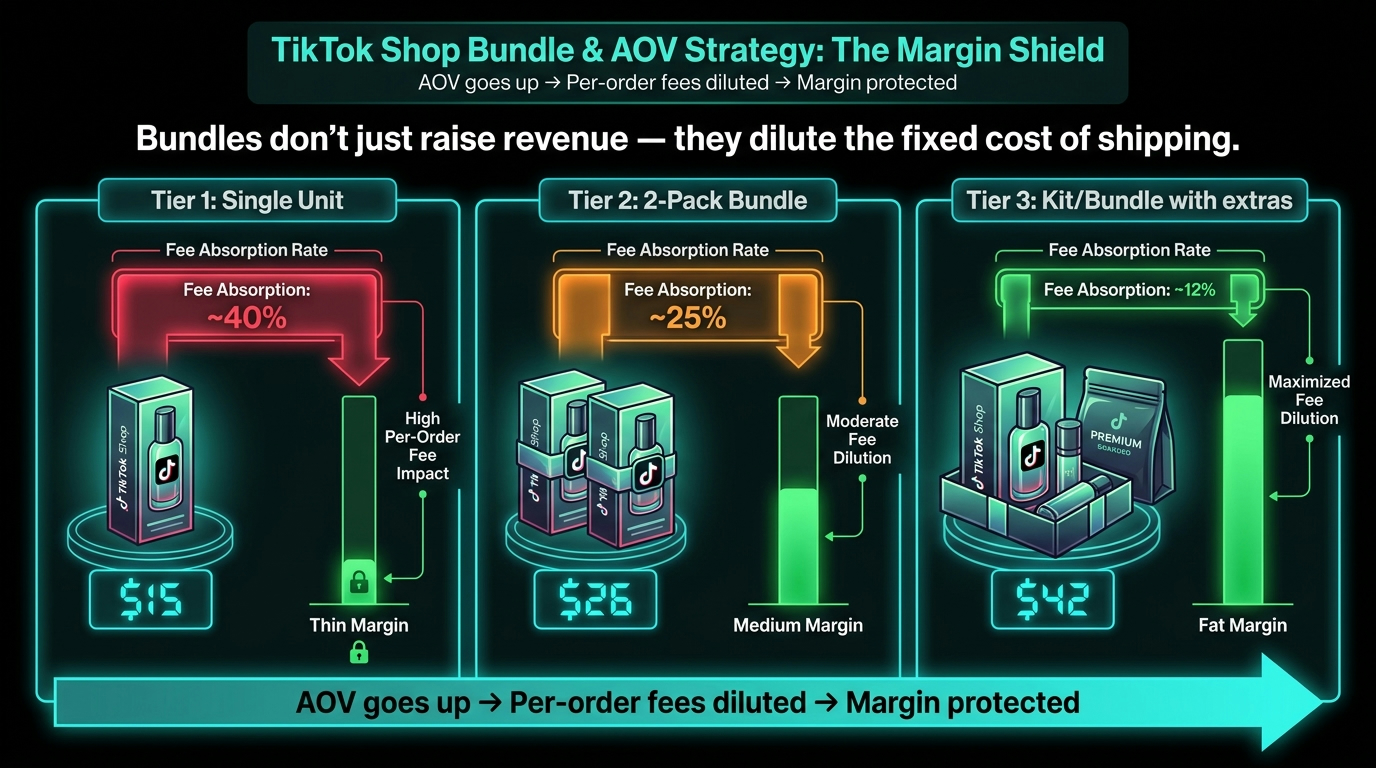
Average Order Value (AOV) is the most powerful margin lever available to TikTok Shop sellers. Here is why: shipping, fulfillment, and a significant portion of per-order fees are either fixed or scale slower than revenue. When you raise AOV, those fixed costs become a smaller percentage of the total, and your effective margin rate improves even if the absolute dollar cost stays the same.
The Fixed-Cost Dilution Math
Consider a $3.58 FBT fulfillment fee. On a $15 order, it represents 23.9% of gross revenue. On a $30 order (a 2-pack of the same item), it represents 11.9%. On a $42 bundle (a kit combining two related SKUs), it drops to 8.5%. The fee did not change — but its effective margin drag halved or better. This is the core principle behind AOV engineering: you are not reducing your costs, you are diluting their proportional impact.
Bundle Architecture for TikTok Shop
Not all bundles work equally on TikTok. The platform is a visual, creator-driven commerce environment, which means bundles need a story — a reason to exist that a creator can communicate in 30–60 seconds of video. The most effective bundle structures for TikTok Shop in 2026 fall into three categories:
- Multi-pack/value bundles: 2-packs or 3-packs of the same item, positioned as a savings offer. Works best for consumables, beauty products, cleaning supplies, and any item with natural reuse cycles. The creator pitch: “Buy two now, save the hassle of reordering.”
- Complementary kits: Two or three related products bundled as a solution. A skincare brand might bundle a cleanser, toner, and moisturizer as a “starter routine kit.” A kitchenware brand might bundle a cutting board with a knife set. The creator pitch is the use-case demonstration, which is native to TikTok’s video format.
- Good-better-best ladders: Offer the core product at the base price, an enhanced version (better formulation, higher quantity) at a mid tier, and a premium kit at the top. This structure works particularly well for brands using both organic affiliate content and paid ads, since you can direct traffic to whichever tier performs best for margin.
Pricing Bundles Without Cannibalizing Singles
A common bundle pricing mistake is making the per-unit math too obvious, which can suppress single-unit sales without proportionally lifting bundle sales. Price the bundle at approximately 10%–15% below what two singles would cost, not at a 50% discount. The buyer perceives value; you preserve margin. If your single unit costs $18 and you build a 2-pack, price the bundle at $30–$32, not $24.
Creator-Led Bundle Positioning
Bundles that affiliates and creators can genuinely build content around outperform bundles that exist only as a catalog entry. When briefing creators on bundle promotion, provide them with specific demonstration angles — “show how both products work together in a single routine” or “demonstrate the quantity advantage.” Creators who understand the bundle rationale create more persuasive content, which drives higher conversion rates and justifies the affiliate commission spend against the higher AOV.
Return Rate Math: The Hidden Margin Killer Most Sellers Ignore
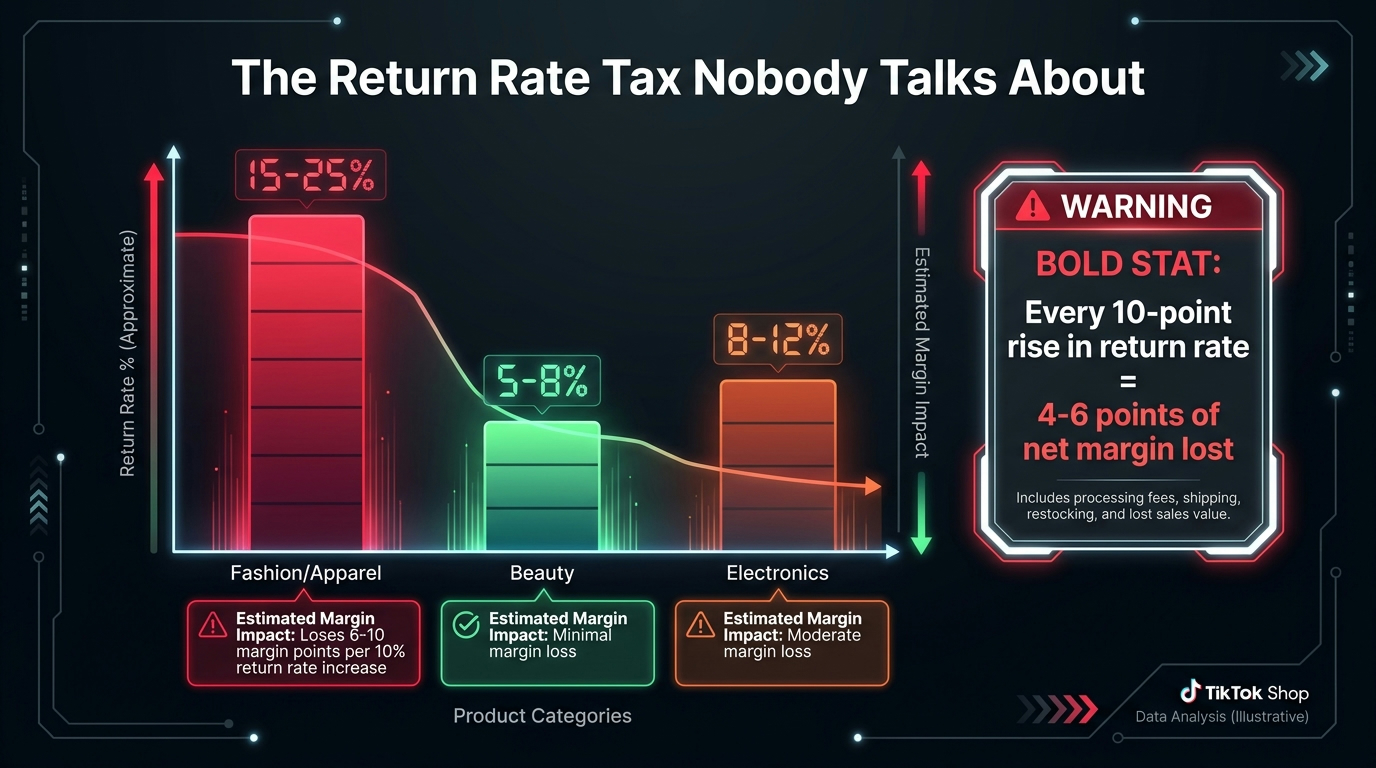
Returns are the expense that most TikTok Shop margin models undercount. The instinct is to note the return rate, apply the refund percentage to revenue, and call it done. The actual cost of a return is significantly higher — and in some categories, returns represent a larger margin drain than platform fees.
The Real Cost of a Return
When a buyer returns a TikTok Shop order, the seller absorbs a chain of costs that goes well beyond the refunded sale price:
- Refunded revenue: The sale price is reversed.
- Non-refunded platform fees: Not all referral and processing fees are returned to sellers on refunded orders — the exact policy depends on TikTok’s current terms, which have been updated in 2026.
- Outbound shipping already spent: Whether you are FBT or seller-fulfilled, the cost of shipping the original order is already incurred and is not recovered on a return.
- Return shipping cost: For buyer-fault returns, TikTok’s 2026 policy updates have increasingly shifted return shipping burden toward sellers, particularly in some markets (a July 2026 UK policy change explicitly added a self-ship fee for returns).
- Product restocking or write-off: Returned items in beauty, food, or opened packaging categories are often unsellable. Even in categories where restocking is possible, the labor and inspection cost applies.
- Creator/affiliate commission loss: If a creator earned commission on a sale that gets returned, the refund mechanics around commission recovery vary and may not fully claw back the affiliate payout.
The aggregate impact is substantial. Industry guidance for 2026 estimates that every 10-point increase in return rate reduces net margin by 4–6 percentage points. For context: fashion and apparel categories on TikTok Shop see return rates between 15% and 25%. Beauty and personal care runs 5%–8%. Electronics and home goods sit in the 8%–12% range.
Return Rate Benchmarks by Category
A fashion seller at a 20% return rate is effectively running 4–6 points of their product margin through a return-cost churn cycle that compounds with volume. A seller at the same gross margin rate but a 5% return rate (e.g., beauty consumables) retains significantly more contribution margin at identical sales volume.
How to Reduce Return Rate Without Reducing Conversion
The naive approach to reducing returns is tightening size charts or adding “all sales final” language — both of which suppress conversion at the same time. The higher-leverage approach is to reduce the information gap that causes returns in the first place:
- Creator content alignment: Returns spike when buyers’ expectations are misaligned with the product. Brief creators to show actual product use, realistic scale/size, and real-world colors. Viral content that overpromises generates returns.
- Precise listing content: Weight, dimensions, materials, and care instructions are not optional. The more precisely a listing describes the product, the less room for post-purchase disappointment.
- Variant-specific content: For products with size or color variants, creator content should feature the specific variant, not just the hero colorway or size. Buyers who receive what was accurately shown return less.
- Post-purchase messaging: TikTok Shop allows seller messaging to buyers. A brief, helpful “how to get the most from your purchase” message shortly after delivery reduces buyer regret and “item doesn’t meet expectations” return reasons.
Pricing Returns Into Your Margin Floor
The most operationally sound approach is to include a return cost buffer in your SKU-level margin floor calculation. For a product in a 10% return-rate category, where each return costs approximately $5–$8 in combined outbound shipping, return shipping, and processing costs on top of the refunded product value, the return buffer to price in per order is: 10% × $7 average return cost = $0.70 per order. For a 20% return-rate category, that rises to $1.40 per order — a cost that must be embedded in the floor price if the margin model is to hold.
SKU-Level Profit Mapping: Which Products Actually Survive TikTok Shop
Not every product in your catalog is equally suited to TikTok Shop’s economics. The platform’s fee structure, shipping costs, and return patterns create a profitability distribution within any seller’s catalog where some SKUs are strong contributors, some are break-even conversion drivers, and some are active margin destroyers. Knowing which is which — at the SKU level, not the category level — is the foundation of a viable TikTok Shop strategy.
The SKU Profit Mapping Process
SKU profit mapping applies the full cost stack analysis to every product in your TikTok Shop catalog. The output is a ranked profit ledger with each SKU’s contribution margin percentage after all costs. This process requires pulling your actual data, not estimates:
- Pull per-SKU COGS from your accounting or inventory system.
- Assign shipping/fulfillment cost per unit (use actual FBT rate card tiers or 3PL per-unit rates).
- Apply referral and processing fees at your category-specific rate.
- Apply the actual affiliate commission rate per SKU (not a blended catalog average — different SKUs attract different creator attention and may carry different commission rates).
- Add your return cost buffer based on historical return rate for that specific product (not the category average if you have SKU-level data).
- Include an ad CPA estimate if the SKU receives paid traffic.
- Subtract from average selling price. The residual is contribution margin per unit.
What to Do with the Mapping Output
Once you have a ranked contribution margin list, four strategic actions follow:
- Protect your top-margin SKUs: These are the products that fund your TikTok Shop operation. Do not subject them to deep campaign discounts without careful modeling. Consider whether these SKUs can be bundled into kits to further amplify their contribution.
- Reprice or restructure break-even SKUs: Products sitting in the 1%–5% contribution margin range are one fee change or return spike from being losses. Either raise their price (create a bundle to justify the price lift), reduce cost (renegotiate with supplier or switch to a lower-cost shipping method), or reduce commission rate by relying more on paid ads for these specific SKUs.
- Audit and retire loss-making SKUs: Products generating negative contribution margin after the full cost stack are draining working capital. Unless there is a specific strategic reason to maintain them (e.g., they drive multi-unit purchases of profitable items), removing them from the TikTok Shop catalog protects overall profitability.
- Design new SKUs to the floor: When developing new products for TikTok Shop, run the SKU profit map before sourcing, not after. If the target retail price cannot sustain the cost stack at your required margin, either redesign the product to hit a lower COGS, price higher, or do not list it on this channel.
The 80/20 Reality of TikTok Shop Catalogs
Across seller reports and third-party analyses in 2026, a consistent pattern emerges: roughly 20% of a typical TikTok Shop catalog generates 80% or more of net margin. The remaining 80% either breaks even (sometimes intentionally, as traffic drivers) or erodes overall profitability. The sellers succeeding at margin protection are those who explicitly manage this distribution — doubling down on the profitable 20% through creator investment, ad spend, and bundle engineering, while disciplining or removing the loss-making tail.
Tax Compliance Without the Headache: Nexus, Reconciliation, and Cross-Channel Duty
With TikTok Shop handling marketplace facilitator tax collection, it is tempting to treat sales tax as a solved problem. In practice, the tax compliance picture for growing TikTok Shop sellers in 2026 has several moving parts that require active management — particularly once volume scales or additional selling channels are involved.
Economic Nexus Thresholds: Still Your Responsibility to Track
Most U.S. states trigger economic nexus at $100,000 in annual sales or 200 transactions. When TikTok Shop processes your sales and remits tax, those sales still count toward your nexus thresholds in each state. A seller doing $150,000 in TikTok Shop sales in California has California nexus, even though TikTok collected and remitted the California sales tax. That nexus creates registration, filing, and reporting obligations that the seller must fulfill independently.
As TikTok Shop seller volumes grow throughout 2026, an increasing number of mid-size sellers are crossing nexus thresholds in states where they had not previously registered. The compliance risk of missing this is meaningful — back taxes, penalties, and interest can accumulate quickly once nexus is established retroactively.
1099-K Gross Revenue vs. Net Revenue Reconciliation
TikTok Shop issues 1099-K forms to U.S. sellers reflecting gross payment volume processed through the platform. This figure includes sales tax that TikTok collected on your behalf. If your accounting system books the 1099-K gross as revenue, it will overstate your actual sales and potentially your tax liability if not reconciled properly.
The reconciliation process: obtain TikTok Shop’s tax remittance reports (available in Seller Center) which show the total sales tax collected and remitted per state per period. Subtract these figures from 1099-K gross revenue to arrive at your actual net product revenue. Report the latter as revenue in your income tax filings; the sales tax component is a pass-through liability, not your income.
Cross-Channel Complexity
Sellers operating TikTok Shop alongside Amazon, DTC, Shopify, wholesale, or retail channels face cumulative nexus exposure across all channels combined, not per-channel in isolation. TikTok’s marketplace facilitator remittance covers only TikTok Shop transactions. Your DTC Shopify store, for instance, requires you to collect and remit sales tax directly in any state where you have nexus created by total multi-channel sales activity.
The practical solution for multi-channel sellers is a centralized tax compliance platform (Avalara, TaxJar, Vertex, or similar) that aggregates transaction data across all channels, monitors nexus thresholds per state, and manages filing calendars. The annual cost of these platforms typically ranges from a few hundred to a few thousand dollars depending on volume — a fraction of potential compliance exposure at scale.
The Creator Commission Trap: Protecting Margin When Affiliates Drive Volume
TikTok Shop’s affiliate and creator ecosystem is one of the platform’s most powerful differentiators. Video-led commerce, where creators authentically demonstrate products and drive buyers directly to checkout, has driven extraordinary conversion rates for many brands. But the commission economics of creator-driven sales deserve careful management — because undisciplined commission structures quietly destroy the margin that volume appears to be generating.
How Commission Stacking Erodes Contribution Margin
The creator commission comes off gross sale price, stacks directly on top of referral fees and processing fees, and is incurred on the total order value including any sales tax (in some configurations). A product with a 6% referral fee, 1.8% processing, and a 20% creator commission has a combined platform take rate of 27.8% before shipping, COGS, or returns. For a $25 product, that is $6.95 gone before the unit leaves the warehouse.
Many sellers set their “base” creator commission rate in Seller Center, then individually negotiate higher rates with specific creators who have large audiences or demonstrated conversion track records. The incremental commission for a top creator — say, 25% vs. a baseline 15% — is another 10% of gross revenue for every unit that creator drives. At volume, this is material. A creator driving 500 units at a $30 AOV with a 25% commission is paid $3,750 in commission vs. $2,250 at 15% — a $1,500 delta per creator campaign that directly reduces your gross margin pool.
Commission Structure Best Practices
The most margin-disciplined TikTok Shop sellers in 2026 approach creator commission like a performance marketing channel: they set commission rates by SKU (not globally), track effective CPA per creator, and adjust based on actual contribution to net margin rather than just revenue volume.
Specific tactics that protect margin without suppressing creator motivation:
- SKU-specific commission tiers: Your highest-margin SKUs can sustain higher creator commissions because there is margin headroom to absorb them. Your break-even SKUs should carry lower commissions or be excluded from creator promotion entirely until they are repriced.
- AOV-based commission structures: Some sellers structure creator commissions as a percentage of sale price only above a minimum order value — incentivizing creators to feature bundles and higher-value configurations rather than entry-level single units.
- Creator performance auditing: Pull creator-level conversion, return rate, and AOV data from TikTok Shop analytics. A creator driving high volume at 30% return rates is generating net negative economics even if their top-line numbers look impressive. Return rates that are materially higher than the product average are a signal of audience-product mismatch or misleading content.
- Commission caps in periods of platform discount pressure: During TikTok Shop campaigns where your product price is reduced, ensure your creator commission agreement does not result in commission being paid at the promotional rate on the full original order value — a configuration error that can result in paying more in commission than you collect in net revenue on discounted orders.
Organic vs. Paid vs. Affiliate: Margin by Acquisition Channel
It is useful to track your blended contribution margin separately by acquisition channel. Sales driven by organic search discovery (no creator or ad cost) typically have the highest contribution margin. Affiliate-driven sales have a creator commission cost but typically lower ad cost. Paid ads have no creator commission but carry a CPA. Comparing contribution margin by channel allows you to allocate inventory and attention toward the channels generating the highest net margin per unit — not just the highest revenue per unit.
Pricing Architecture for a Platform That Never Stops Changing
TikTok Shop’s fee structure, subsidy programs, and policy environment have changed meaningfully every six to twelve months since the platform launched. CFFS ended. Referral fees moved. Return policies evolved. New shipping taxes appeared in some markets. This pace of change is the operating environment, not an anomaly — and it requires a pricing architecture that can adapt without causing chaos across the catalog.
Build in Fee Change Buffers
When setting margin floors, a prudent approach is to build them at the current fee rate plus a 2-point buffer. If referral fees are currently 6%, price as if they are 8%. If they stay at 6%, you carry additional margin. If they move to 8% (as some categories have already experienced), your pricing holds without requiring immediate emergency repricing across the catalog. This buffer approach is particularly important for sellers with longer inventory cycles who cannot reprice immediately when fee structures change.
Quarterly Cost Stack Reviews
Build a quarterly rhythm into your TikTok Shop operations: pull all current fee rates from Seller Center, compare against your margin floor assumptions, identify any SKUs that have drifted below floor due to fee changes or COGS increases, and either reprice or restructure before the gap compounds. This quarterly review prevents the slow drift where individual fee adjustments accumulate over time into a material margin problem that is only discovered during an annual P&L audit.
Channel-Specific Pricing Without Platform Conflict
TikTok Shop’s price monitoring system flags products that are priced significantly higher on TikTok than on other platforms the platform can detect. Maintaining cross-channel price integrity is important — but “integrity” means TikTok should not be priced dramatically higher than other channels, not that it cannot be priced differently. TikTok-exclusive bundles, differentiated SKUs, and value-add configurations are the cleanest way to maintain appropriate pricing for TikTok’s cost structure without violating any cross-channel pricing norms.
The Margin Protection Checklist: Putting It All Together
Margin protection on TikTok Shop in 2026 is not a single tactic — it is a system of interlocking decisions across pricing, fulfillment, product design, creator management, and compliance. The sellers who maintain profitable operations on TikTok Shop as the platform matures are those who treat unit economics as operational infrastructure, not just a finance exercise.
Here is the complete action checklist distilled from everything covered in this playbook:
Pricing and Margin Floor
- Build a full cost stack model at the SKU level: COGS + shipping + referral fee + processing + creator commission + ad CPA + return buffer
- Set and document a minimum viable price (margin floor) per SKU using the formula: Total Cost ÷ (1 − Target Net Margin %)
- Cap coupons and discounts in Seller Center so automated promotions cannot push prices below floor
- Add a 2-point fee buffer above current referral rates to absorb future fee increases without emergency repricing
- Decouple TikTok Shop pricing from Amazon/DTC parity by using TikTok-exclusive bundles and configurations
Shipping and Fulfillment
- Map your SKUs to FBT vs. seller-fulfilled using the decision framework (weight, velocity, buyer time-sensitivity)
- Model FBT rates by actual weight tier using TikTok’s published 2026 rate card — do not assume a flat $3.58 across all items
- For seller-fulfilled SKUs, negotiate carrier rates based on volume projections and compare quarterly against FBT alternatives
- Absorb shipping cost into list price for free-shipping offers — model it as a variable cost, not a surprise expense
Tax Compliance
- Confirm TikTok Shop marketplace facilitator coverage applies to all relevant states where you have buyers
- Track economic nexus thresholds across all selling channels combined, not per platform
- Reconcile 1099-K gross figures against TikTok’s tax remittance reports before filing
- Implement a centralized tax compliance platform if selling across three or more channels
- Monitor TikTok Shop’s shipping fee tax developments in markets where SST/VAT-on-fees rules are evolving
Returns and AOV
- Calculate your actual return cost per SKU (not just the refund rate — include shipping and processing)
- Price a return buffer into margin floors based on historical SKU-level return rates
- Brief creators on accurate product representation; audit creator-sourced orders for above-average return rates
- Design bundles with approximately 10%–15% savings vs. buying singles separately — enough to incentivize without destroying margin
- Track AOV by product tier and prioritize creator and ad spend on your highest-AOV configurations
Creator Commissions
- Set commission rates at the SKU level, not globally — align commission headroom with SKU margin capacity
- Audit creator-level return rates and AOV quarterly; reallocate commission budget toward creators generating net-positive economics
- Monitor commission vs. revenue on discounted orders to prevent paying full commissions on promotional pricing
Conclusion
TikTok Shop remains one of the most dynamic commerce environments available to sellers in 2026. The platform’s reach, creator ecosystem, and shoppable video format continue to drive conversion rates that are difficult to replicate elsewhere. But the days when platform subsidies, low referral fees, and high-margin early-mover advantages smoothed over imprecise unit economics are behind us.
What the current environment demands is operational discipline at the unit level. The margin protection playbook is not complicated in concept — build from costs up, model every fee layer, manage returns proactively, and engineer product and pricing configurations that give the math a chance to work. What makes it difficult is that TikTok Shop’s fee environment keeps moving, creator commission norms keep shifting, and every platform incentive program requires scrutiny before participation.
The sellers who will thrive through 2026 and beyond are not necessarily those with the largest catalogs or the most viral content. They are the ones who know their numbers at the SKU level, have built pricing systems that absorb fee changes without constant crisis repricing, and treat their TikTok Shop channel the way mature commerce operators treat every channel: as a business with specific economics that require specific management.
Run the cost stack on every SKU in your catalog. Set your floors. Build your bundles to the math. And check the numbers again next quarter — because on TikTok Shop, the rules of the game have a habit of changing while you are busy selling.