


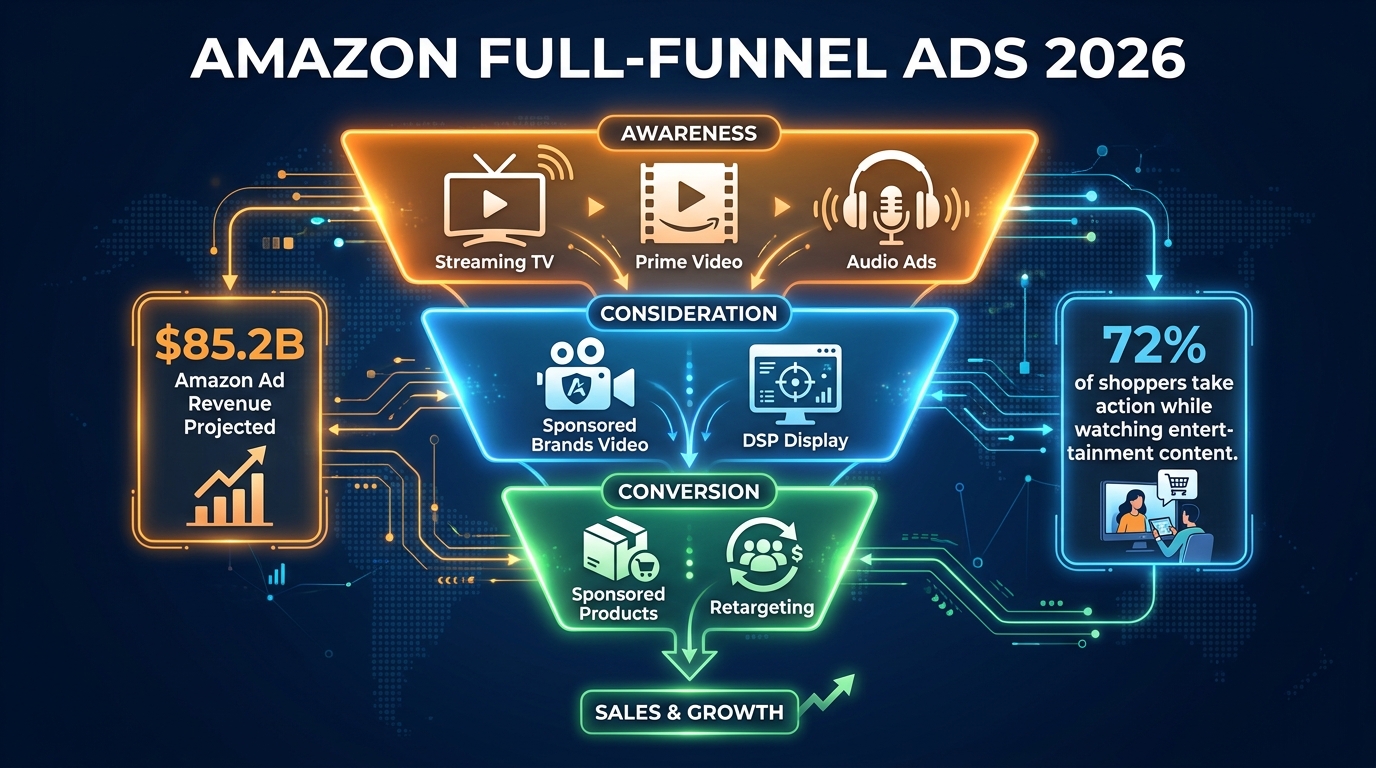
For years, “full-funnel” was a phrase Amazon sellers nodded along to at conferences and then quietly ignored when allocating budget. The math felt simple: Sponsored Products convert. Everything else is overhead. Put the money where the orders are, optimize the ACOS, and repeat.
That logic held — until it didn’t. In 2026, the sellers still running that playbook are watching their cost-per-click climb, their share of voice erode, and their brand equity stagnate. Meanwhile, the brands that started building above the conversion layer two or three years ago are now compounding those returns in ways that pure performance budgets can no longer match.
The good news is that Amazon has spent the last 18 months systematically lowering the barriers to every layer of the funnel. Sponsored TV now runs without a minimum spend. Prime Video advertising gained Dynamic Creative personalization. Amazon Marketing Cloud moved from an enterprise-only tool to something mid-market sellers can actually access and act on. Sponsored Brands Video became the default format in most categories. And a new AI-powered Full-Funnel Campaign type — announced at CES 2026 — now lets sellers build awareness-to-conversion strategy in a single workflow.
This post breaks down each of those updates with specificity: what they actually do, who they’re for, what the real costs and trade-offs look like, and how to sequence them without overextending your budget. The goal isn’t to tell you to spend more on ads. It’s to help you spend more intelligently across the full journey your customers are already taking.
Why the Bottom-of-Funnel-Only Approach Is Now a Growth Ceiling
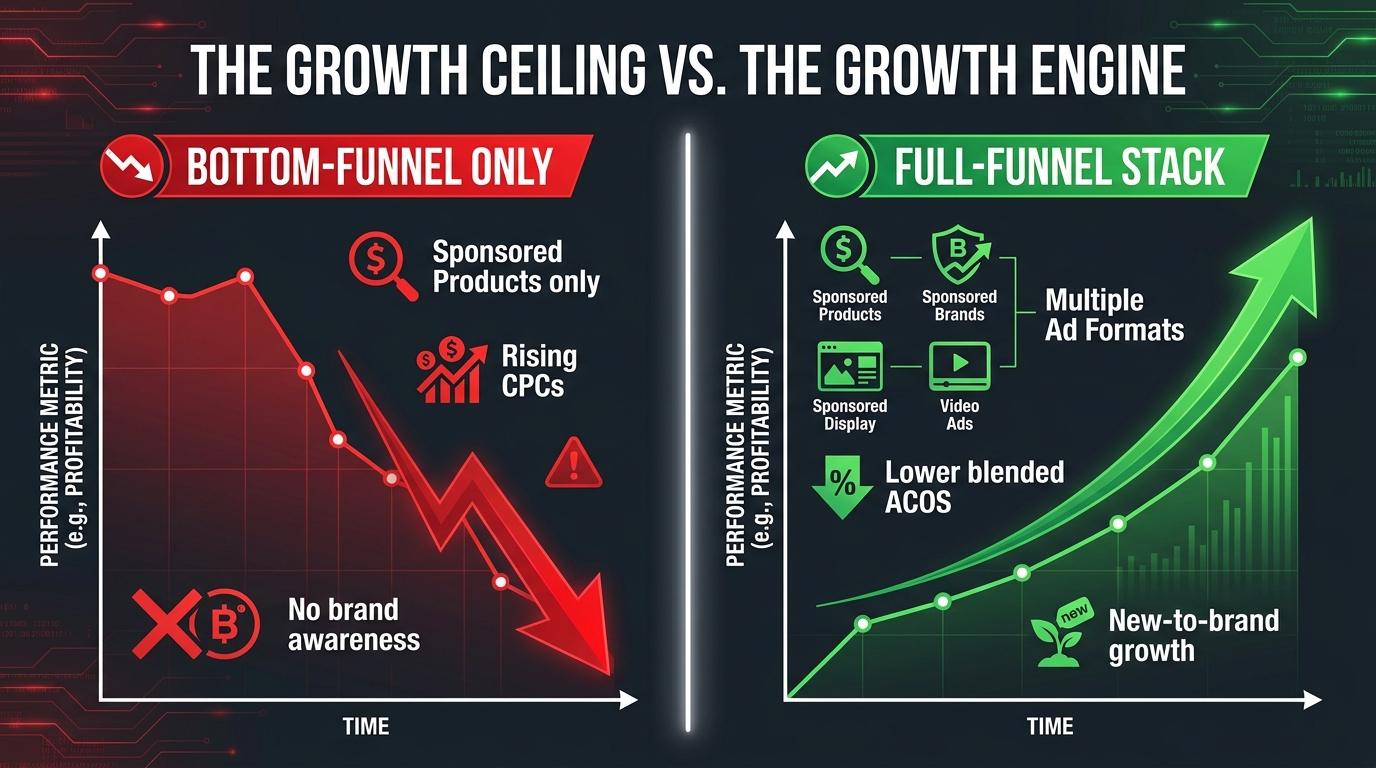
The case for lower-funnel-only advertising was always a short-term one. Sponsored Products deliver measurable ROAS on a known product with existing demand. That’s genuinely useful when you’re launching, proving product-market fit, or in a category with limited competition. The problem is that those conditions rarely persist.
The Compounding CPC Problem
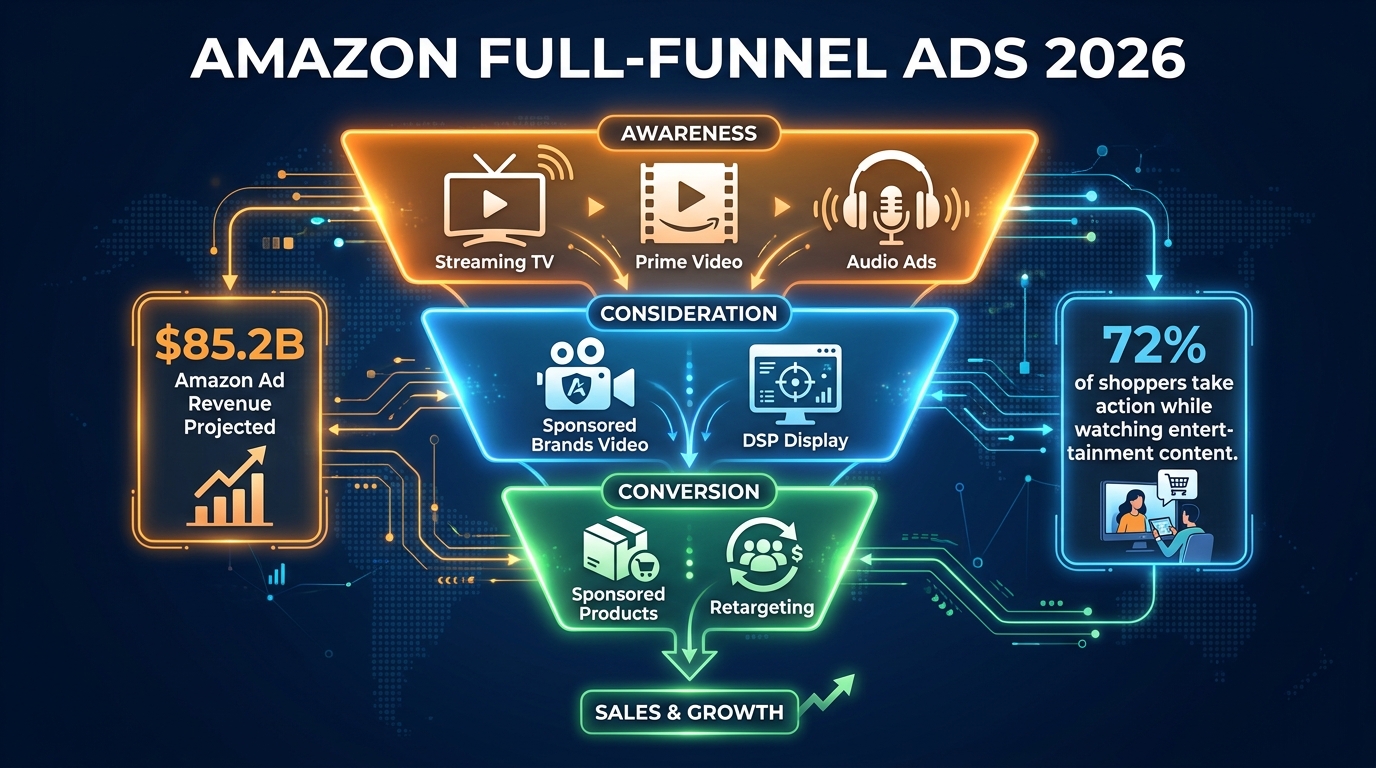
As more sellers enter any given category, auction pressure on high-intent keywords increases. Amazon’s projected ad revenue of $85.2 billion by the end of 2026 — up from $56.2 billion in 2024, according to eMarketer — reflects both more sellers advertising and more advertising dollars chasing the same finite pool of high-intent search placements. When supply is fixed and demand keeps growing, CPCs trend in one direction.
Sellers who operate exclusively at the bottom of the funnel are price-takers in those auctions. They have no brand equity pulling customers toward them before the search happens, no retargeting infrastructure to recover browsing sessions that didn’t convert, and no measurement system to understand the true value of a customer acquired. When margins compress, they have nowhere to go.
New-to-Brand Customers Don’t Fall From the Sky
There’s another compounding effect working against bottom-funnel-only sellers: repeat purchaser economics. A customer who discovers your brand through Sponsored Products at a high CPC and then repurchases organically is profitable. But your ability to generate those customers is capped by how much category-level demand already exists. Sellers with upper-funnel exposure — who reach shoppers before they’ve formed brand preferences — consistently report higher new-to-brand customer rates and longer customer lifetime values.
Amazon’s own research data shows that 72% of consumers take consideration actions — like searching a brand or adding to a wishlist — while engaging with entertainment content. That’s not a statistic about abstract consumer behavior. That’s a description of what your potential customers are doing during Prime Video shows and Twitch streams, and it represents demand that bottom-funnel-only sellers never touch.
The Attribution Blind Spot
Perhaps the most consequential problem with the bottom-funnel-only model is that it generates a specific kind of data blindness. When you measure success only at the conversion event — last click, attributed sale — you systematically undervalue every touchpoint that preceded it. That means upper and mid-funnel activity looks expensive even when it’s doing real work, because the conversion credit goes to the final Sponsored Products click.
Amazon Marketing Cloud was built to close this gap. But sellers who haven’t used it yet are making budget decisions with a systematically incomplete picture — one that will keep pointing them back toward Sponsored Products regardless of what else is actually driving demand.
The Architecture of a Modern Amazon Full-Funnel Stack
Before going format-by-format, it helps to have a shared mental model of what a full-funnel Amazon advertising stack actually looks like structurally. Most of the confusion in this space comes from sellers treating each format as a separate product decision rather than understanding how they connect.
Three Layers, Distinct Jobs
At the top of the funnel, the objective is reach and awareness — getting your brand or product in front of people who don’t yet know you exist. The formats that live here are Sponsored TV, Streaming TV via Amazon DSP, Prime Video advertising, audio ads, and OLV (online video) through DSP inventory. These are CPM-priced, not CPC, and they’re optimized for impressions and brand recall, not immediate conversions.
The middle of the funnel is about consideration — keeping your brand visible and relevant as shoppers move through research. Sponsored Brands Video is the workhorse here, paired with Sponsored Display (particularly video versions) and DSP retargeting audiences. The job at this layer is to appear as a credible option while the shopper is still making up their mind.
At the bottom of the funnel, Sponsored Products remain the foundation — high-intent keyword targeting that captures purchase-ready demand. The 2026 upgrade here isn’t the format itself; it’s the ability to layer AMC-built audience segments onto Sponsored Products campaigns, giving even this conversion-focused format more upstream signal.
The Measurement Layer That Connects All Three
What makes a stack actually a stack — rather than just three separate budgets — is a shared measurement infrastructure. Amazon Marketing Cloud is that layer. It’s the tool that lets you query event-level data across all your Amazon advertising and retail activity to understand how impressions at the top influence conversions at the bottom. Without it, you’re not running a full-funnel strategy. You’re running multiple disconnected campaigns and guessing at how they interact.
More on AMC later in this piece. The point here is structural: the formats are only half the equation. The measurement infrastructure that connects them is what makes the investment defensible.
Sponsored Brands Video — The Mid-Funnel Format That Became the Default
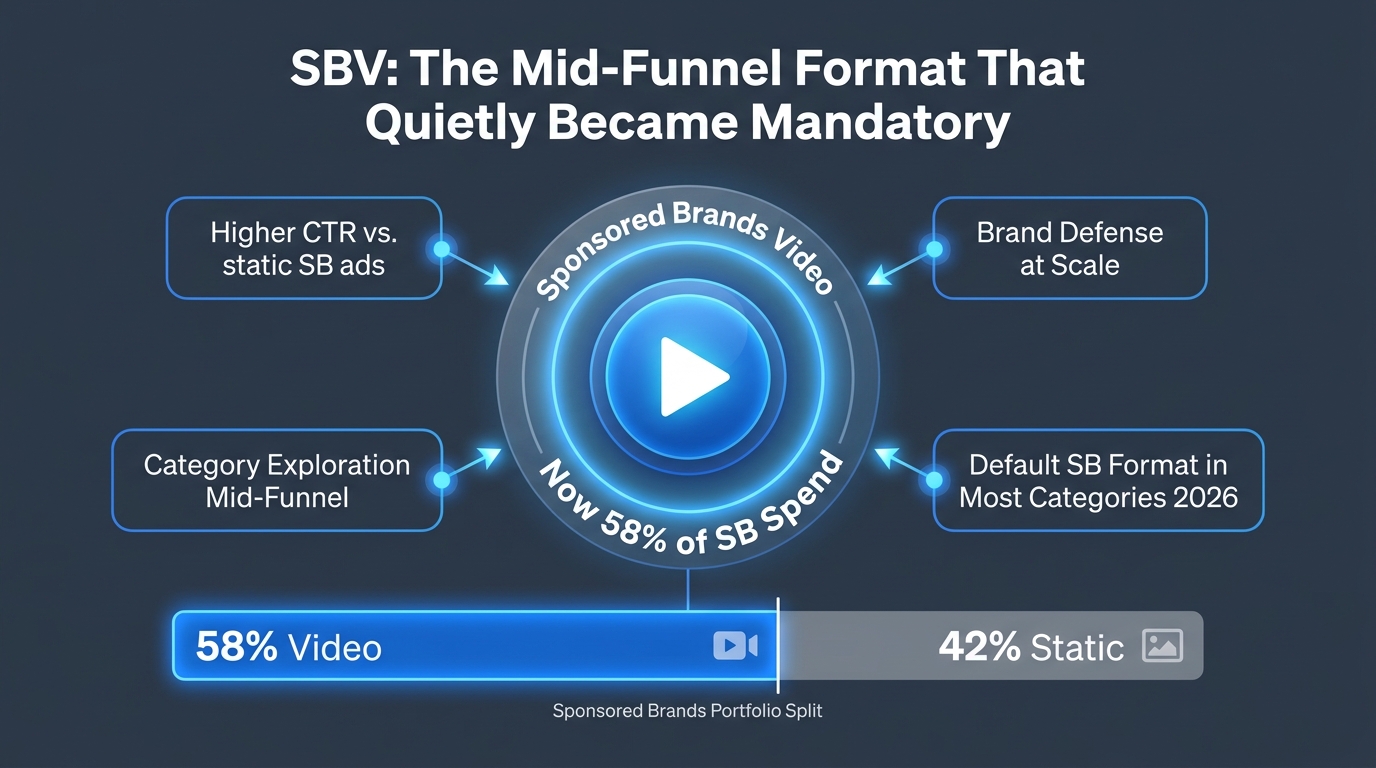
Sponsored Brands Video (SBV) has gone through a quiet but significant status change. According to managed portfolio data from Velocity Sellers published in May 2026, SBV now accounts for approximately 58% of Sponsored Brands spend in their portfolio — and it’s become the default SB format in most categories, not a test format or an add-on.
That shift has operational implications that many sellers haven’t fully absorbed.
Why SBV Outperforms Static in Most Categories
The core reason is attention. In a search results page populated with static product listings and banner ads, a video unit that auto-plays is the only thing that moves. That distinction is increasingly important as product pages grow more competitive and listing differentiation becomes harder to achieve through copy and images alone.
SBV runs in the top-of-search placement on desktop and mobile, which is already the highest-value real estate in sponsored advertising. Adding video to that placement compounds the visual advantage. Sellers consistently report higher clickthrough rates with SBV compared to static Sponsored Brands, particularly in categories where the product benefit isn’t immediately obvious from a still image — home goods, kitchen appliances, personal care, apparel, and tools all fit this profile.
The Brand Defense Use Case
One of the most underappreciated applications of SBV is brand defense on your own brand-name search terms. When someone searches your brand name, your Sponsored Brands unit — video or static — typically takes the top position. A competitor can’t easily push their Sponsored Products above your brand video, which creates a defensive moat that’s genuinely hard to dislodge.
This is especially valuable for sellers who have built meaningful brand search volume through external channels — social, influencer, email — and want to protect that demand inside Amazon’s environment. Every uncontested branded search is a free-ish conversion; a SBV unit at the top of that search locks in the capture.
Category Exploration at Mid-Funnel
SBV is also highly effective in category-level targeting — running against broad category keywords where purchase intent exists but brand preference hasn’t yet formed. A 15–30 second video showing your product’s core benefit to someone searching “stainless steel water bottles” or “home gym equipment” is a consideration touchpoint that static units struggle to match.
The practical setup consideration: SBV requires actual video creative, which is a real production investment. Amazon’s creative builder tools have lowered the floor here — you can generate functional SBV units from product images and a simple voiceover — but the best-performing units involve real footage that shows the product in use. If your creative budget is limited, prioritize video for your highest-volume, highest-margin ASINs first.
Measurement Note on SBV
SBV reports new-to-brand (NTB) metrics natively — you can see new-to-brand orders, NTB sales, and NTB units directly in the campaign manager. This matters because it gives you a way to track whether your mid-funnel investment is actually generating new customer relationships, not just reshuffling existing purchasers. Use this data to build the internal justification for the format before you scale it.
Sponsored TV and Streaming TV Ads — What the “No Minimum” Shift Actually Means
The single biggest structural change in Amazon’s upper-funnel offering over the past 18 months is the removal of the effective minimum spend floor from self-serve Sponsored TV. When Sponsored TV launched, the practical barrier was high — managed-service Streaming TV via Amazon DSP still typically carries $50,000+ minimums. But self-serve Sponsored TV through the Amazon Ads Console now has no enforced minimum for Brand Registry sellers and vendors.
That is a genuinely significant change. It means streaming TV advertising — running your creative on Prime Video, Twitch, Fire TV, and premium connected TV inventory — is now accessible to sellers who are spending $5,000–$15,000 per month on ads, not just the enterprise brands with six-figure media budgets.
What Sponsored TV Actually Buys You
The format runs on connected TV inventory including Prime Video content, Twitch, Fire TV apps, and Amazon’s broader streaming network. Ads appear in-stream — before, during, or after video content — in an environment where viewers are typically leaned back, attentive, and not actively shopping. That’s a fundamentally different mindset than search advertising, which is why the measurement approach and success metrics are also different.
The audience targeting has also improved materially. Sponsored TV now supports lifestyle and in-market audience segments, ASIN-level remarketing (reaching people who viewed or searched your specific products), and lookalike audiences built from your purchaser data. These aren’t generic broadcast placements — they’re connected TV impressions served to audiences with demonstrable commercial intent in your category.
Who Actually Benefits Right Now
Honest context here: the self-serve minimum being removed doesn’t mean small-budget sellers will see meaningful results from $500/month in Sponsored TV. Industry data and agency commentary consistently point to $20,000–$50,000 per month in total Amazon ad spend as the threshold where Sponsored TV starts generating statistically significant attribution signals in AMC. Below that, impression volumes are too low to draw clear conclusions.
The format is most appropriate for sellers with established products, strong conversion-layer performance, and existing brand equity — brands spending $400,000+ in Amazon revenue monthly, who want to defend category share and grow net-new customer acquisition above what Sponsored Products can deliver on its own. For everyone else, the “no minimum” change is a future option to plan toward, not an immediate priority.
Attribution Has Gotten Better
One practical improvement worth noting is the integration between Sponsored TV and Amazon Marketing Cloud. As of 2026, sellers using AMC can now run conversion-lift reporting specifically tied to their Sponsored TV spend — comparing purchase rates among exposed versus unexposed audiences in a privacy-safe clean-room environment. This means upper-funnel CTV spend is now measurable in terms that connect to actual business outcomes, not just reach and frequency metrics.
That’s the capability that makes the format defensible to finance teams. Before AMC lift reporting, “we got X impressions on Prime Video” was a hard sell internally. “Our Prime Video impressions drove a Y% lift in purchase rate among exposed audiences” is a different conversation entirely.
Dynamic TV Creative on Prime Video — Personalization at Impression Time
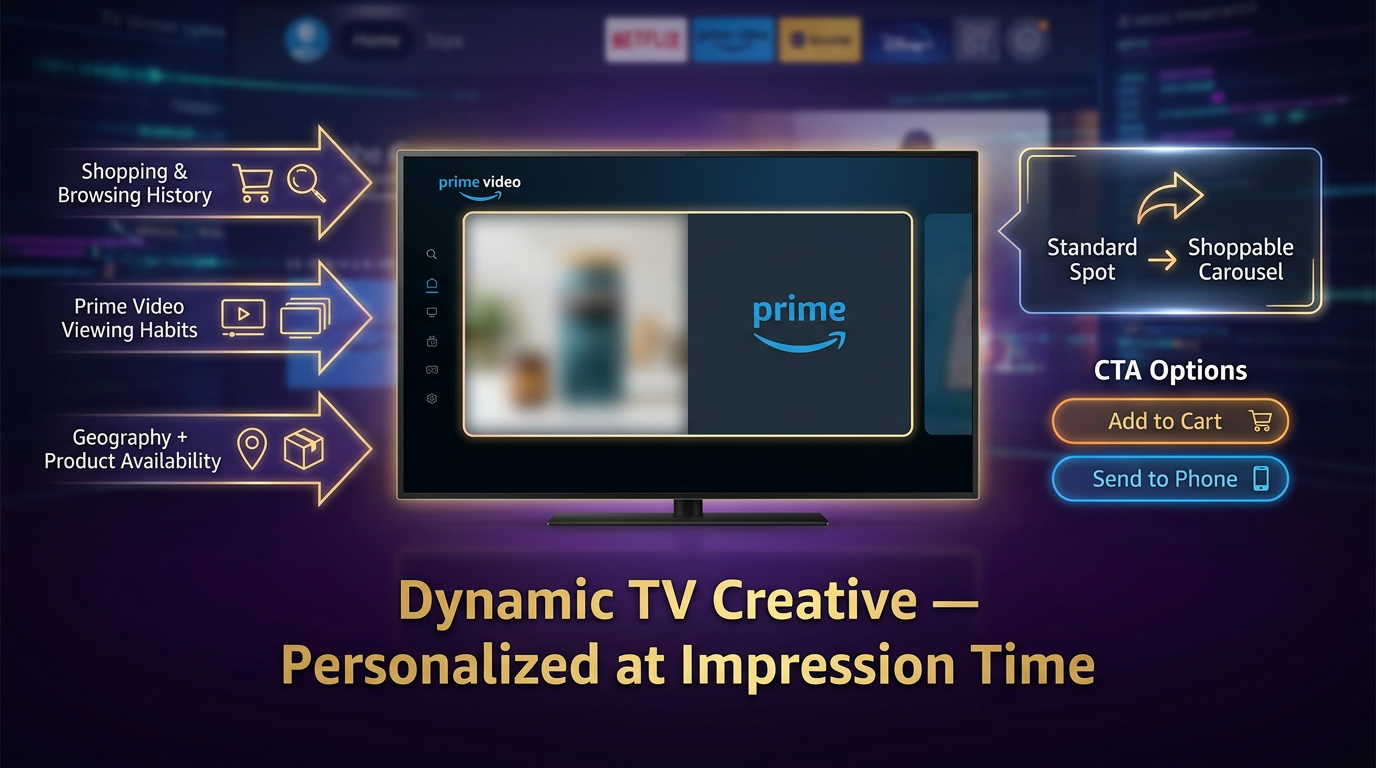
The most technically significant upper-funnel development Amazon announced in 2026 is Dynamic TV Creative — unveiled at Amazon’s Upfront event in May 2026. This is Amazon’s first capability to automatically personalize Interactive Video Ads (IVA) in Prime Video series and films at impression time, using first-party data signals to tailor creative execution for each individual viewer.
How Personalization Works at Scale
The mechanics are worth understanding in some detail because they represent a genuine departure from how TV advertising has historically worked. Traditional TV ads — even in the streaming era — deliver a single creative to an audience segment. You pick your targeting, run your spot, and everyone in that audience sees the same 30 seconds.
Dynamic TV Creative changes that. At the moment an ad impression is served to a Prime Video viewer, the system selects and assembles the creative based on that specific user’s Amazon signals: their shopping and browsing history, their Prime Video viewing behavior, their geographic location, and the availability of the advertised product. A viewer who has recently browsed camping gear might see a different version of your outdoor brand’s ad than a viewer who has no category interaction — different product featured, different CTA, different emphasis.
The system can also dynamically swap the ad format itself — converting a standard video spot into a shoppable carousel — and adapt the call-to-action based on context. “Add to Cart,” “Send to Phone,” and “Save to List” are all CTAs that can be served dynamically depending on what signals the system reads at impression time.
Who Has Access and What It Costs
Dynamic TV Creative is currently available through Amazon DSP for brands running managed Prime Video campaigns. This means it sits behind the managed-service spending threshold — not the self-serve Sponsored TV access point. For sellers at the scale where Prime Video advertising is viable (typically brands with significant category presence and existing DSP relationships), this is a meaningful upgrade from static video creative that represents the standard of the previous generation.
The creative implications are also significant. Dynamic creative requires modular production — video assets built as components that can be mixed and matched by the system, rather than a single end-to-end spot. That’s a different way of thinking about creative development, but it’s one that agencies and in-house teams with any programmatic experience will recognize from display advertising’s evolution over the last decade.
Why This Matters Beyond the Format Itself
The broader significance of Dynamic TV Creative is what it signals about Amazon’s direction. Every signal Amazon collects across shopping, streaming, browsing, and purchase behavior is now being deployed at the creative level, not just the targeting level. The competitive moat Amazon is building isn’t just “we have the audience data” — it’s “we can act on that data at the moment of impression, in the creative itself.” That capability will compound in value as the format matures.
Amazon DSP’s Expansion: CTV, Samsung TV Plus, and Programmatic Scale
Amazon’s 2026 NewFronts announcements made clear that Amazon DSP is no longer positioning itself primarily as a retail media buying platform. It’s making a genuine move into being a broad programmatic CTV and audio buying system — one that happens to have Amazon’s first-party data as its differentiating layer.
The Samsung TV Plus Partnership
The most concrete new inventory announcement is the Samsung TV Plus partnership, which makes Samsung’s free, ad-supported streaming service “fully shoppable” using Amazon’s remote-enabled interactive video ad formats. This integration, launching July 2026, is available through Amazon DSP — meaning sellers running DSP campaigns can now reach Samsung TV Plus viewers with shoppable inventory that carries Amazon purchase attribution.
The significance here is inventory expansion. Amazon’s owned-and-operated streaming inventory — Prime Video, Twitch, Fire TV — is substantial but finite. Accessing Samsung TV Plus opens tens of millions of additional CTV viewers who can be targeted using Amazon’s shopper data and attributed through Amazon’s measurement infrastructure. It’s the same data advantage applied to a meaningfully larger screen inventory.
Programmatic Access to Comcast and Tubi
Amazon DSP is also expanding programmatic access to Comcast’s local and SMB streaming inventory and Tubi integrations as part of its 2026 NewFronts positioning. The pattern is consistent: Amazon is building a programmatic layer that uses its first-party data as the connective tissue between owned streaming inventory and third-party publisher supply.
For sellers, this means DSP campaigns can now achieve meaningful reach at the upper funnel without being constrained to Amazon-owned placements. If your audience watches content on Samsung devices, Tubi, or Comcast streaming properties, you can now reach them with Amazon-attributed campaigns using the same behavioral signals that power your on-Amazon targeting.
Audio Advertising on DSP
Less discussed but worth noting: Amazon DSP’s audio advertising inventory has also expanded in 2026. Audio ads run across Amazon Music’s ad-supported tier, Alexa devices, and now additional third-party audio partners. The format is underutilized by most sellers, which creates a competitive pricing advantage — audio impressions are typically cheaper than video equivalents, and in-ear audio in a non-visual environment generates meaningful brand recall for the right product categories.
Audio works best for brands with strong verbal identity — a clear brand name, a distinctive claim, a memorable tagline — because there’s no visual to compensate. For sellers in commodity categories with undifferentiated packaging, audio ads are a stretch. For sellers with distinctive brand voice and awareness goals, they represent an underpriced upper-funnel option.
Amazon Marketing Cloud — The Measurement Layer Everything Else Depends On
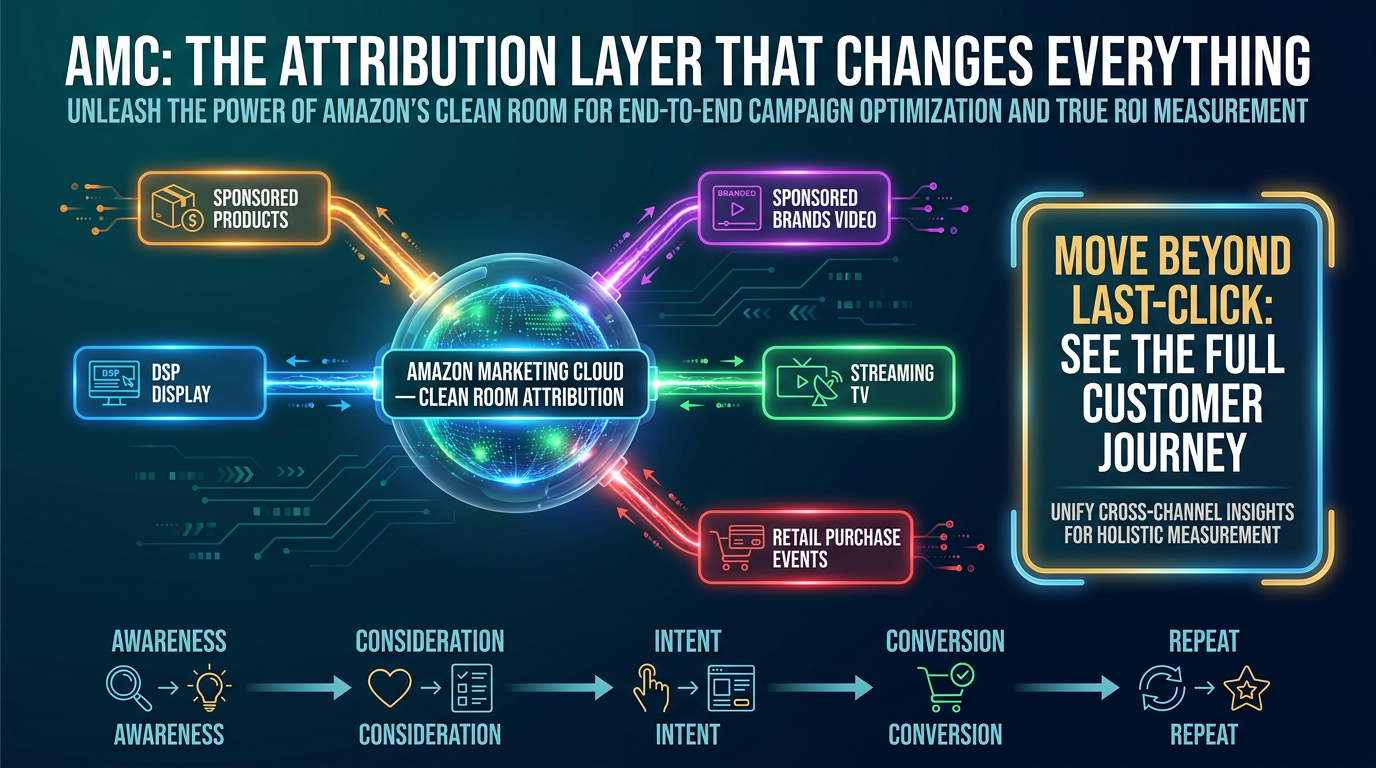
Everything discussed so far — Sponsored TV, Dynamic TV Creative, DSP expansion, SBV growth — only translates into defensible business decisions if you have the measurement infrastructure to understand what’s actually working. Amazon Marketing Cloud is that infrastructure, and in 2026 it’s the tool that separates sellers who are running a genuine full-funnel strategy from sellers who are running multiple campaigns and calling it a funnel.
What AMC Is and Isn’t
AMC is Amazon’s privacy-safe clean room environment — built on AWS Clean Rooms — where event-level advertising and retail data can be queried and analyzed using SQL-based custom analytics. It’s not an ad server. It doesn’t serve ads. What it does is let you connect the dots across your entire Amazon advertising footprint: which Sponsored Products searches overlapped with DSP retargeting exposure, which customers saw a Streaming TV impression before their first organic purchase, how many SBV viewers eventually converted through Sponsored Products 14 days later.
That kind of journey-level analysis is not available in the standard campaign reporting interface. Campaign manager shows you last-click attribution within each format’s reporting window. AMC shows you the actual sequence of touchpoints for actual cohorts of customers — a fundamentally different level of analytical depth.
Audience Building in AMC
Beyond analytics, AMC’s 2026 function extends to audience creation. Sellers can build custom audience segments in AMC based on complex behavioral criteria — for example, “customers who viewed my DSP display ad in the last 60 days but didn’t purchase” or “shoppers who searched my category but have never purchased from my brand” — and then activate those segments in Sponsored Display, DSP, and (in a 2026 update) Sponsored Products campaigns.
This capability moves AMC from a pure measurement tool to an active campaign management input. The audiences you build from clean-room analysis become the targeting inputs for your next wave of advertising — closing a loop between measurement and action that doesn’t exist anywhere else in Amazon’s ecosystem.
How to Access AMC Without a DSP Budget
A common misconception is that AMC requires an Amazon DSP account and significant managed-service spending. That’s not entirely accurate in 2026. AMC’s analytics capabilities are available to sellers running any combination of Sponsored Ads and DSP, and the data can include Sponsored Products, Sponsored Brands, and Sponsored Display event data. You don’t need to be running a full DSP campaign to start querying your Sponsored Ads journey data in AMC.
The practical access route: request AMC access through your Amazon Ads account team, set up the AWS Clean Rooms environment, and connect your Sponsored Ads instance. You’ll need SQL capability or a third-party tool (several agencies and software platforms now offer AMC query libraries and dashboards for sellers without in-house SQL resources). The barrier is real but it’s a skills and tooling barrier, not a budget barrier.
New-to-Brand Metrics as a Full-Funnel KPI
Within AMC and in native campaign reporting, new-to-brand (NTB) metrics deserve more strategic attention than most sellers give them. NTB orders, NTB revenue, and NTB customer rate are available across Sponsored Brands, Sponsored Display, and DSP — and they tell you something that ROAS cannot: whether your advertising is actually growing your customer base or primarily re-converting existing purchasers.
A seller with a high ROAS and a low NTB rate is, in effect, running an expensive loyalty program — paying ad dollars to recapture customers who might have repurchased anyway. A seller with a lower ROAS but a strong NTB rate is building the customer equity that generates future organic revenue. Understanding which situation you’re in is foundational to making coherent full-funnel budget decisions.
Audience Segments in Sponsored Products — The 2026 Targeting Shift Most Sellers Missed
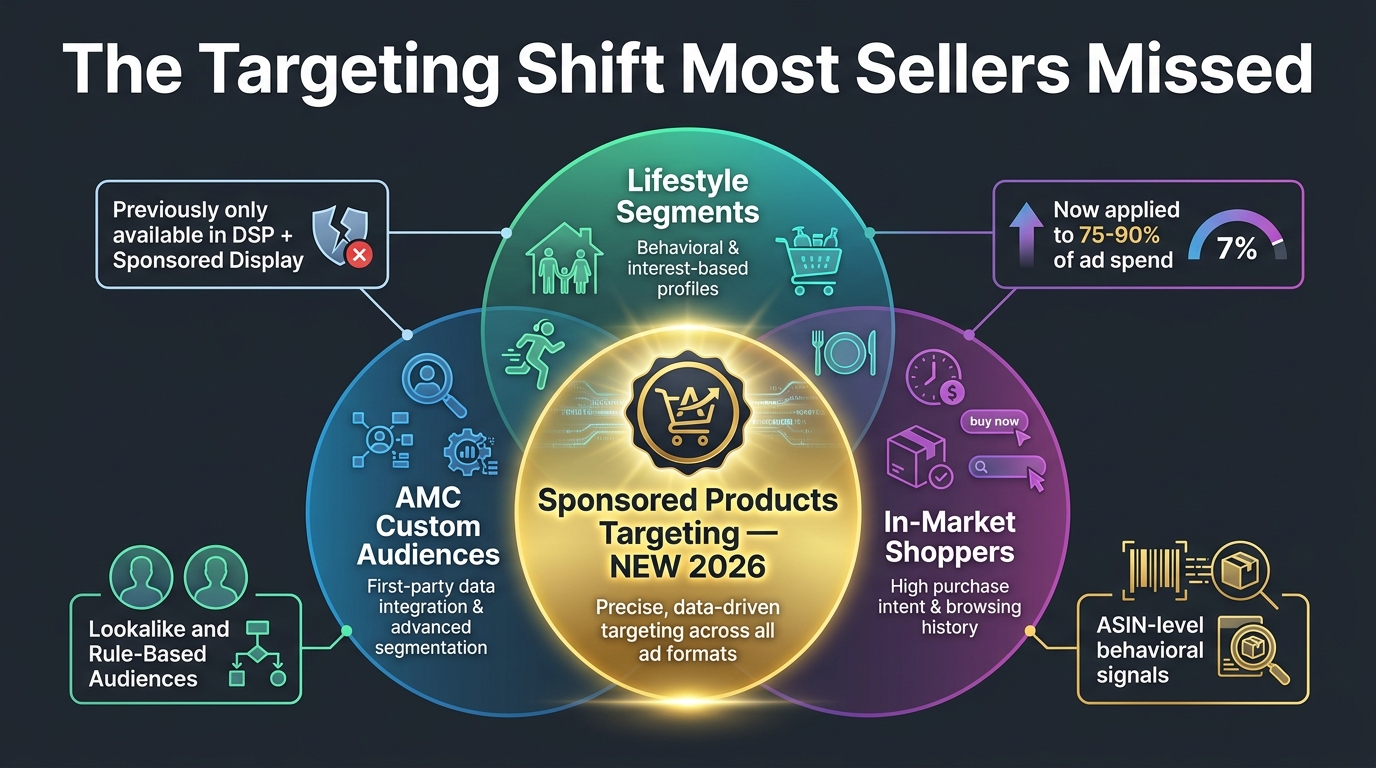
One of the most practically significant updates Amazon made to its ad infrastructure in 2026 received surprisingly little coverage relative to its implications: AMC-built audience segments can now be applied directly to Sponsored Products campaigns. Previously, custom AMC audiences were usable in Sponsored Display and DSP. Bringing them into Sponsored Products — which typically represents 75–90% of a seller’s total ad spend — is a different order of magnitude.
What Changed and Why It Matters
The new capability allows sellers to create audience-qualified versions of their Sponsored Products campaigns. Rather than running keyword-only targeting, you can now layer behavioral signals — in-market categories, lifestyle segments, purchase history overlap, ASIN-level retargeting, and AMC-derived custom audiences — onto SP campaigns as audience modifiers or standalone audience targets.
The practical effect: you can bid differently on the same keyword depending on whether the searcher has already been exposed to your brand (through a Streaming TV impression or a DSP display ad) versus someone encountering it fresh. That kind of bid differentiation, based on funnel position rather than just keyword intent, is meaningful optimization that wasn’t structurally possible before.
In-Market and Lifestyle Segments at Scale
Amazon’s DSP audience library — which includes hundreds of in-market and lifestyle segments built from first-party shopper behavior — can now be accessed within Sponsored Display campaigns and, increasingly, as signals in SP campaign targeting. These segments define cohorts like “shoppers actively browsing home fitness equipment in the last 30 days” or “outdoor lifestyle audience with demonstrated purchase history in camping.”
Using these segments for bid uplift — increasing bids by 20–30% when a searcher qualifies for your in-market audience — captures the efficiency gains of behavioral targeting without completely restructuring your keyword campaign architecture. It’s an incremental adoption path that most sellers can implement without rebuilding their campaigns from scratch.
Lookalike and Rule-Based Audiences
The AMC audience update also brings rule-based and lookalike audience creation to the Sponsored Products environment. Rule-based audiences let you define segments precisely — “customers who purchased my brand more than once in 90 days” or “shoppers who viewed my ASIN but didn’t purchase in 14 days.” Lookalike audiences use Amazon’s signals to find shoppers who behaviorally resemble your existing high-value customers.
For sellers with meaningful purchase history data, lookalikes applied to Sponsored Products represent a customer acquisition targeting layer that simply didn’t exist before. You’re not just targeting keywords. You’re targeting the kinds of people who, based on their Amazon behavior, look like your best customers.
AI Full-Funnel Campaigns — What Amazon’s CES 2026 Launch Actually Does
At CES 2026, Amazon announced what it called AI-powered Full-Funnel Campaigns — a new campaign type designed to collapse the planning complexity of multi-format full-funnel advertising into a single workflow. The concept is that a seller sets a high-level objective (for example: “launch new brand, maximize new-to-brand sales over 90 days”) in natural language, and the system builds an awareness-to-conversion media plan across formats, audiences, and budgets automatically.
What the System Actually Does
Based on available product documentation and CES coverage, the AI Full-Funnel Campaign type automates several decisions that currently require manual coordination across campaign types: the media mix across Sponsored Ads, DSP, Streaming TV, and OLV; audience sequencing logic (who gets served upper-funnel creative first, and when they’re shifted to conversion-focused units); budget pacing across formats based on performance signals; and ongoing optimization as the campaign runs.
The underlying AI draws on Amazon’s first-party data — including category benchmarks, historical performance patterns, and audience signals — to make initial allocation decisions and then adjust them based on in-flight performance. Advertisers can set guardrails (budget caps per format, minimum impression thresholds for awareness) and override recommendations, but the baseline plan is generated without manual setup of each individual campaign.
What It Doesn’t Replace
It’s worth being specific about the limits here. Full-Funnel Campaign automation doesn’t replace creative strategy — you still need to bring the video assets, the product story, and the brand voice. It doesn’t replace measurement discipline — AMC is still the right tool for understanding post-hoc what actually happened and why. And it doesn’t replace the category-level judgment about whether upper-funnel spend makes sense for your specific competitive situation.
What it does replace is much of the mechanical complexity of stitching together separate DSP line items, Sponsored Brands campaigns, and Sponsored TV placements into a coherent sequenced strategy. That’s genuinely useful complexity reduction, particularly for mid-market sellers who have been deterred from full-funnel strategy by setup friction rather than budget constraints.
Early Rollout Considerations
The Full-Funnel Campaign type launched in Q1 2026 with a phased rollout, and as of mid-2026, access is still expanding. Sellers interested in testing it should work through their Amazon Ads account team or agency partner to understand current availability in their geography and category. Early testing is worth the effort — new campaign types at Amazon often carry efficiency advantages while they’re in limited access, before competitive density fills in.
The Budget Conversation: How to Size and Stage a Full-Funnel Investment
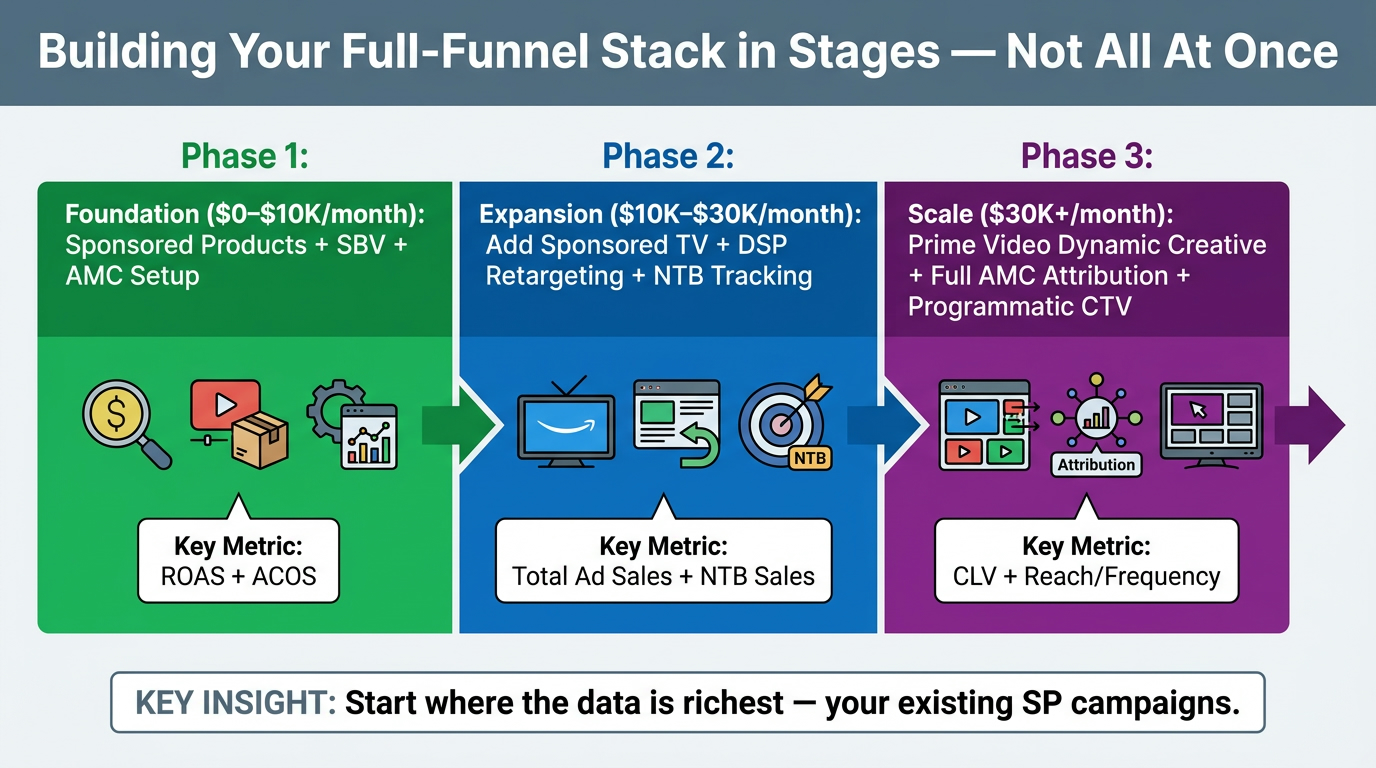
One of the reasons sellers avoid full-funnel advertising isn’t skepticism about the strategy — it’s uncertainty about the numbers. How much do you need to spend to see results? What should the split look like? And how do you justify the spend in the absence of direct ROAS attribution? These are fair questions with concrete answers.
Phase 1: Foundation ($0–$10K/Month Total)
At this spend level, the priority is establishing the measurement infrastructure before adding new formats. The focus should be: Sponsored Products (primary driver of revenue), Sponsored Brands Video (test one campaign on your top ASIN’s highest-volume category keywords), and AMC setup (even without DSP, start querying Sponsored Ads journey data).
The goal in Phase 1 isn’t to see full-funnel results — it’s to build the baseline data that will make Phase 2 decisions more informed. Start collecting NTB metrics from SBV. Build your first custom AMC audience segment. Establish what your current new-to-brand customer rate is. You can’t optimize what you haven’t measured.
Phase 2: Expansion ($10K–$30K/Month Total)
At this scale, the full-funnel stack starts to be viable with meaningful data returns. Add self-serve Sponsored TV at $2,000–$5,000/month — enough to generate impressions in your category and start accumulating AMC attribution data. Expand Sponsored Brands Video coverage to more ASINs and more keyword targets. Add Sponsored Display retargeting to recover consideration-phase shoppers who viewed your product but didn’t purchase.
The measurement priority in Phase 2 is path-to-purchase analysis in AMC: how many purchasers had multiple touchpoints before converting, and what was the typical sequence? This data will tell you whether your upper and mid-funnel spend is actually influencing conversions or just adding cost.
Phase 3: Scale ($30K+/Month Total)
This is the level where Prime Video advertising (including Dynamic TV Creative), full DSP programmatic access, and AMC-driven audience strategies at scale become viable. The managed-service DSP minimums ($50K+) come into play at the higher end of this range. At this scale, you should also be running formal conversion-lift studies through AMC to measure the incremental impact of upper-funnel spend — not just relying on path-to-purchase correlation.
The key discipline at Phase 3 is not letting full-funnel complexity become full-funnel sprawl. More formats and higher spend don’t automatically mean better results. The sellers generating the strongest returns at this level are those with tight creative discipline, clear audience sequencing logic, and rigorous AMC measurement informing ongoing budget allocation.
The Budget Split Question
There’s no universal answer to “what percentage should go to upper vs. lower funnel?” It depends on your category’s competitive intensity, your brand’s current awareness level, and your product stage. But a useful heuristic from agency practitioners in 2026: if you’re spending less than 15% of your total Amazon ad budget above the conversion layer, you’re leaving consideration-phase demand acquisition entirely to chance. The 15% threshold isn’t a magic number — it’s a minimum enough to generate signal and justify measurement attention.
Building the Stack Without Overbuilding It
The full-funnel narrative in Amazon advertising has a real risk of becoming a complexity trap. There are now more formats, more targeting options, more measurement tools, and more AI-generated recommendations than any single seller can fully use simultaneously. The sellers who get the most from full-funnel strategy aren’t the ones running every available format — they’re the ones who build incrementally, measure rigorously, and add complexity only where data justifies it.
Start With the Formats That Have the Clearest Attribution
Sponsored Brands Video is the most natural starting point above Sponsored Products because it has native NTB reporting, relatively straightforward setup, and clear CPC-based pricing that’s familiar to anyone running Sponsored Products. It’s the closest thing to a risk-adjusted entry point for full-funnel expansion — you get mid-funnel presence, measurable new-to-brand impact, and brand defense in one format without needing DSP infrastructure.
From there, Sponsored Display retargeting (for returning shoppers who considered but didn’t convert) is the second logical addition. It’s also CPC-based for most placements, relatively affordable, and addresses a defined problem — cart abandonment and browse abandonment — with measurable attribution against those specific audiences.
Build AMC Discipline Before You Build Upper-Funnel Spend
The most common mistake brands make when expanding into upper-funnel Amazon advertising is spending on Sponsored TV or DSP before they have AMC configured and producing useful data. Upper-funnel spend without AMC attribution is genuinely hard to defend — the numbers in your campaign manager will look inefficient by conventional ROAS standards, and without clean-room data showing the influence on downstream conversions, you’ll be unable to distinguish working spend from wasted spend.
Set up AMC, run it for 60 days against your existing campaigns, and build your baseline new-to-brand metrics and path-to-purchase sequences before committing meaningful budget to Sponsored TV or DSP. That sequence costs you two months of delay but saves you from potentially cutting effective upper-funnel spend based on last-click misattribution.
Creative Discipline Is the Real Constraint
Every upper-funnel format — Sponsored TV, Prime Video, DSP video, OLV — requires video creative. And video creative quality is the single biggest determinant of upper-funnel ad performance that isn’t within Amazon’s optimization control. Amazon’s systems can target the right audiences, sequence touchpoints intelligently, and allocate budgets efficiently. They cannot fix a poorly conceived 30-second spot.
The practical implication: before expanding to video-heavy upper-funnel formats, invest in creative development. This doesn’t mean TV-quality production budgets. It means a clear product benefit communicated in the first three seconds, brand elements that are immediately legible, and a CTA that fits the mindset of a streaming TV viewer (not “buy now” — more like “remember this” or “explore more”). The creative thinking matters as much as the format selection.
Use the AI Full-Funnel Campaign Type as a Learning Tool
Even sellers who ultimately want to manage their full-funnel stack manually can get significant value from running the AI Full-Funnel Campaign type as a short-term learning exercise. Set a defined test budget, let the system build and run a campaign for 60–90 days, and then use AMC to analyze the audience sequencing and format allocation it chose. You’ll learn more about what Amazon’s system considers an optimal full-funnel mix in your category from that exercise than from almost any other research method.
The AI isn’t always right — its allocation decisions are based on general signals, not your specific brand’s equity position or your specific creative’s quality. But the baseline it generates is a useful reference point for your own manual strategy development.
Key Takeaways for Sellers Planning Their 2026 Ad Strategy
Pulling together everything covered in this piece, here are the most actionable conclusions for sellers at different stages of their Amazon advertising maturity.
If You’re Running Primarily Sponsored Products
- Add Sponsored Brands Video immediately — it’s the most accessible mid-funnel format, carries native NTB reporting, and the production barrier is lower than ever with Amazon’s creative builder tools.
- Set up Amazon Marketing Cloud — even without DSP, you can start querying Sponsored Ads journey data. Get the baseline measurement infrastructure in place before you need it.
- Monitor NTB metrics from SBV campaigns — use new-to-brand order rate as your primary success metric, not ROAS. That data will build the case for your next investment.
If You’re Running SBV and Sponsored Display
- Apply AMC audience segments to your Sponsored Products campaigns — the 2026 update enabling AMC audiences in SP is among the highest-impact changes available right now. In-market and lifestyle modifiers on your conversion campaigns are worth testing immediately.
- Pilot self-serve Sponsored TV — the no-minimum access point exists. Even a modest test at $2,000–$3,000/month generates AMC impression data you can analyze. You don’t need to commit to sustained Streaming TV spend to learn from it.
- Run a path-to-purchase AMC query — understand what percentage of your purchasers had multiple ad touchpoints. If the number is surprisingly high, your mid-funnel spend is working harder than your campaign-level ROAS suggests.
If You’re Running a Multi-Format Stack with DSP
- Explore Dynamic TV Creative for Prime Video campaigns — personalized IVA units using Amazon’s first-party signals represent a meaningful upgrade over static creative for brands already in the managed-service DSP tier.
- Evaluate the AI Full-Funnel Campaign type as a test — Amazon’s CES 2026 launch deserves a structured test budget, even if you ultimately prefer manual management. The system’s allocation logic is a useful calibration reference.
- Run formal conversion-lift studies in AMC — at the spend levels where full-funnel investment becomes significant, you need incrementality measurement, not just path-to-purchase correlation. Set up lift studies against your Sponsored TV and DSP budgets.
- Watch the Samsung TV Plus and Tubi inventory expansion — DSP’s NewFronts 2026 partnerships mean new reach at potentially lower CPMs than Amazon-owned inventory. Evaluate these placements as they become available.
The One Principle That Runs Through All of It
Amazon’s full-funnel advertising ecosystem has become genuinely sophisticated — perhaps more sophisticated than the decision-making infrastructure of most of the sellers it’s designed for. The formats are more capable, the targeting is more precise, the measurement is more granular, and the AI orchestration is more powerful than at any previous point. None of that matters if you’re making budget decisions based on last-click ROAS and intuition.
The sellers who will compound the advantages of this ecosystem over the next two to three years are those who treat measurement as the foundation — not as a reporting afterthought — and who build their format investment incrementally, with each stage funded by the insights the previous stage generated. That’s not a fast path. But it’s the one that works.