

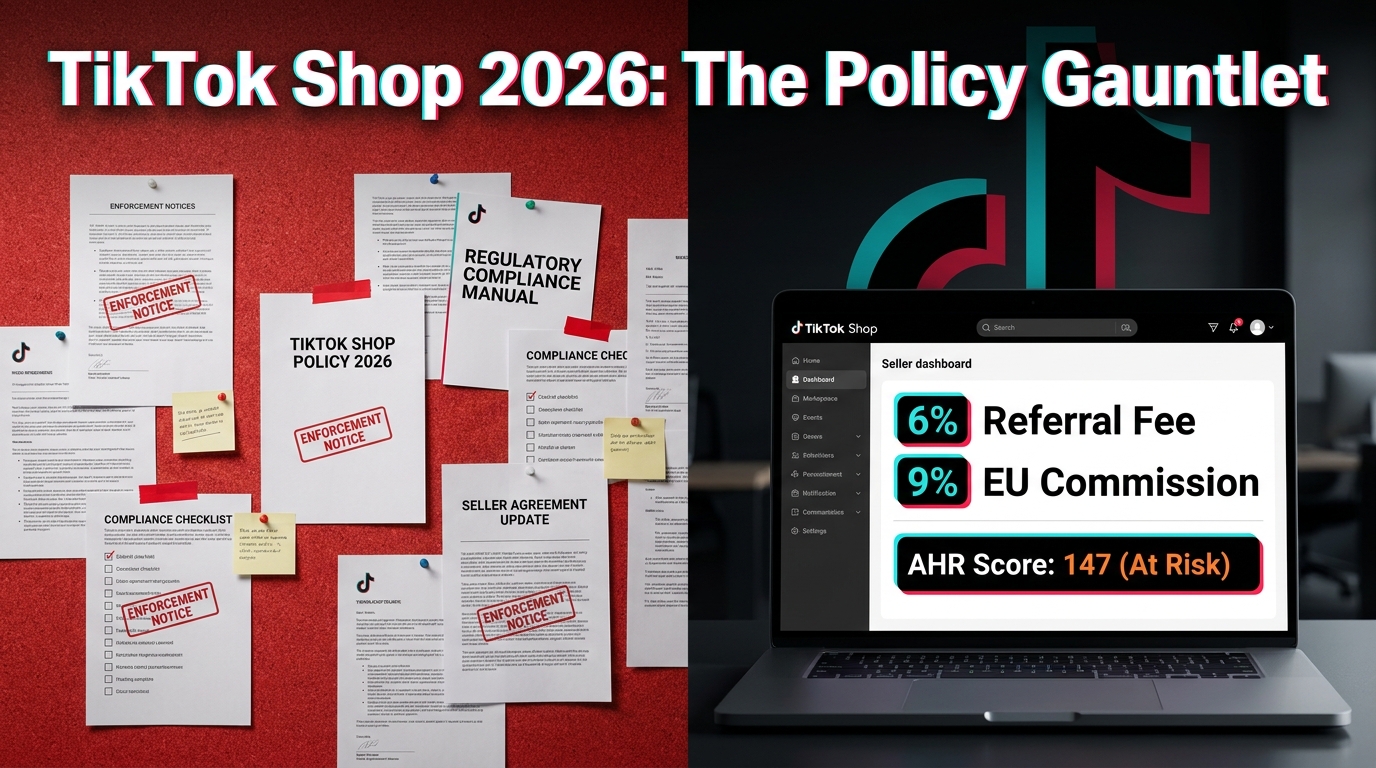

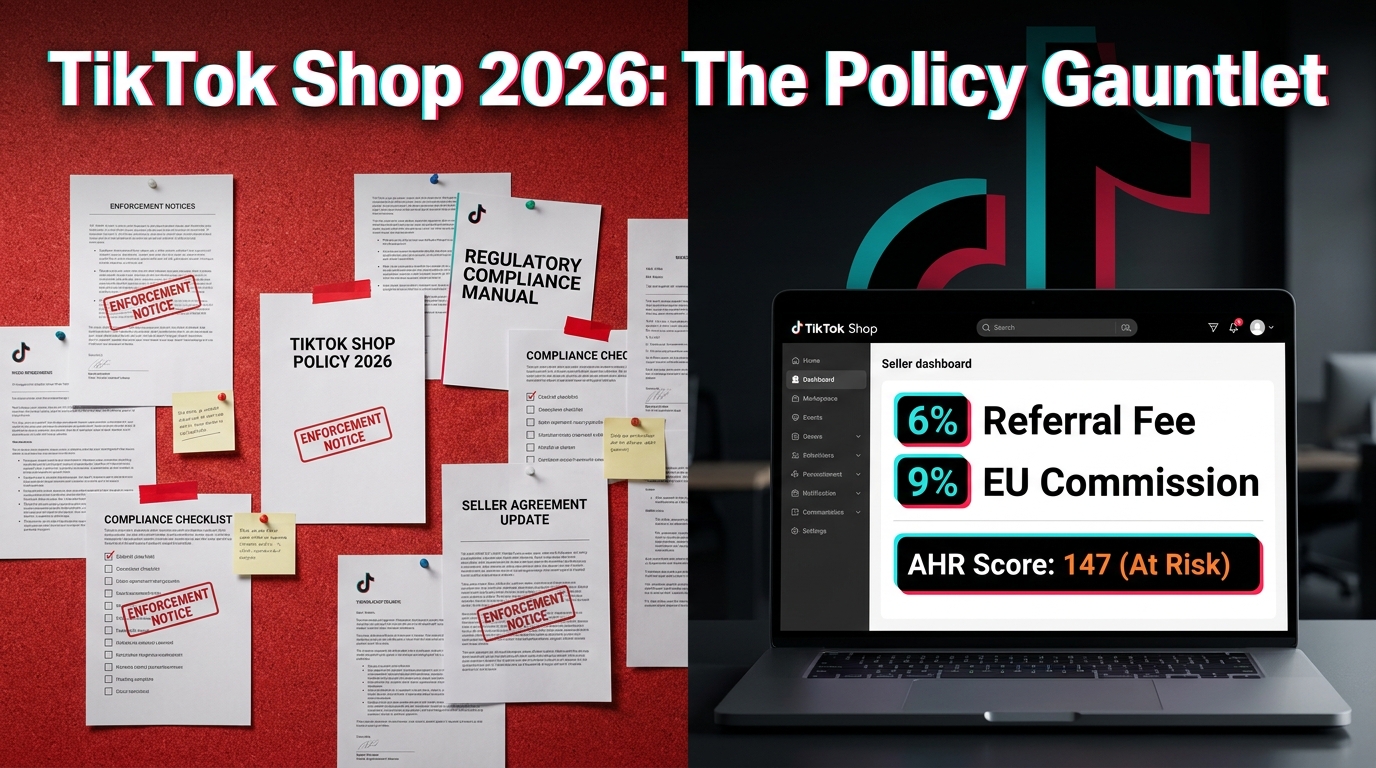
TikTok Shop has never been a platform that holds still. Since its U.S. launch, it has cycled through aggressive fee introductions, sudden policy reversals, compliance crackdowns, and logistics overhauls at a pace that makes Amazon’s annual seller updates look leisurely. And in 2026, the tempo hasn’t slowed — it’s accelerated.
The sellers struggling most right now aren’t the ones who’ve been outcompeted on price or content. They’re the ones who were blindsided. A logistics mandate announced in January, reversed in February. Fee structures quietly shifting by region. An Account Health Rating system that can throttle your listings before you even know there’s a problem. Compliance documentation requirements that effectively lock regulated product categories behind a paperwork wall.
This isn’t a post about TikTok Shop’s algorithm or how to find viral product ideas — those angles have been covered. This is about the operational layer underneath: the policies, the fees, the enforcement systems, and the fulfillment mechanics that determine whether your TikTok Shop business is actually viable in 2026. Understanding these isn’t optional. For sellers in regulated categories, running cross-border operations, or scaling with an affiliate network, it’s the difference between a business that compounds and one that gets deactivated.
What follows is a structured breakdown of every major policy and fee change that matters right now — what actually changed, what TikTok claims versus what sellers are experiencing, and what you need to do operationally to stay on the right side of all of it.
The Full Fee Stack — What TikTok Shop Sellers Are Actually Paying in 2026
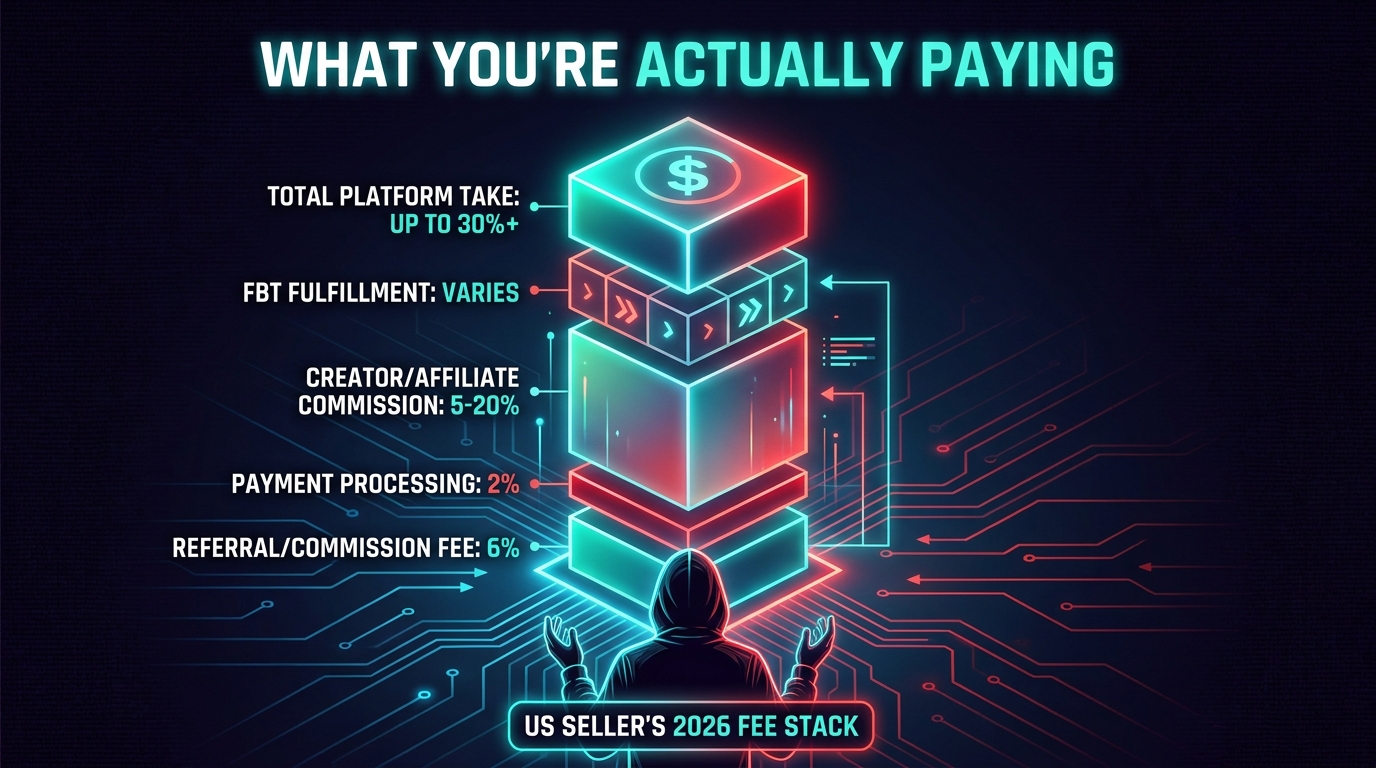
The most common misconception about TikTok Shop’s cost structure is that sellers think in terms of a single fee. They see a 6% referral rate and assume that’s the number. It isn’t. The real platform take-rate is a compounding stack, and every layer deserves attention.
The US Referral Fee Baseline
For most physical goods sold on TikTok Shop in the US market, the baseline referral/commission fee sits at approximately 6% as of mid-2026. This is calculated on the buyer’s payment — which importantly includes any platform-funded discounts or vouchers applied at checkout. That last detail matters: if TikTok runs a platform-wide discount that reduces the price a buyer sees but doesn’t reduce your revenue by the same amount, your effective referral fee percentage can run slightly higher than the stated rate.
For specific categories, the rate varies. Some premium or high-margin categories carry fees closer to 8%. Certain seller-performance tiers also affect where you land in that range. The practical advice is simple: don’t model at a flat 6% without verifying your specific category’s rate in Seller Center.
European Markets: The 9% Reality Check
If you operate in European markets — Germany, Spain, France, Italy, or Ireland — January 8, 2026 marked a significant cost increase. TikTok Shop raised its seller commission from 5% to 9% across these markets. That’s a 4-percentage-point jump that appeared with relatively short notice.
For sellers who had built their EU pricing models around a 5% take-rate, this created an immediate margin problem. The sellers who absorbed it cleanly were those who had built enough headroom into their TikTok-specific pricing from the start, rather than importing their DTC or Amazon prices wholesale. Those who hadn’t faced a hard choice: raise prices and risk conversion loss, absorb the hit and accept thinner margins, or pull EU listings entirely.
Payment Processing: The Layer Nobody Talks About
Layered on top of the referral fee is a payment processing fee, typically running around 2% of the transaction value. This isn’t unique to TikTok Shop — every marketplace has one — but it’s frequently omitted from quick seller cost calculations. If your mental model is “6% referral fee,” your real baseline before any other costs is already closer to 8%.
Creator and Affiliate Commissions: Where the Real Costs Live
TikTok Shop’s commerce model is fundamentally creator-driven. That means most successful sellers are running affiliate programs, paying creators a percentage of sales they generate. Industry guidance in 2026 puts effective affiliate commission ranges anywhere from 5% at the low end to 20%+ for top-performing creators in competitive niches.
This is where the math gets uncomfortable. A seller running a 6% platform referral fee, 2% payment processing, and a 12% average affiliate commission is already at 20% of revenue before accounting for COGS, fulfillment, returns, or any paid advertising. For products with a 35–40% gross margin, that leaves very little room for error.
The Total Platform Take-Rate in Practice
When you add referral fees, payment processing, affiliate commissions, and any Fulfilled by TikTok (FBT) storage and fulfillment costs, total platform costs for a typical TikTok Shop seller in 2026 can range from 20% to 35%+ of gross revenue, depending on product category, creator commission strategy, and fulfillment method.
This is not a reason to avoid TikTok Shop — the platform’s conversion dynamics and discovery engine remain genuinely differentiated. But it is a reason to model carefully, set TikTok-specific pricing, and never assume your margins are healthy just because your GMV numbers look good.
The Shipping Mandate That Wasn’t — And Why Its Reversal Still Has Consequences
The most dramatic policy moment in TikTok Shop’s 2026 calendar so far wasn’t a fee increase or a compliance crackdown. It was the February reversal of a logistics mandate that never fully landed.
What TikTok Had Planned
In early 2026, TikTok Shop communicated to US merchants that “Seller Shipping” — the option for brands to fulfill orders through their own carriers and fulfillment operations — would be phased out. Sellers would be required to migrate to TikTok Shop Logistics Services: specifically, Fulfilled by TikTok (FBT), Upgraded TikTok Shipping, or Collections by TikTok. The timeline given was aggressive: compliance by February 25, 2026, with full migration expected by March 31.
The implications for sellers were significant. FBT and the upgraded shipping options require routing inventory through TikTok’s warehouse network, integrating via API, and ceding a degree of fulfillment control that many brands — particularly those with established 3PL relationships or custom packaging requirements — were not prepared to accept. The cost implications were also real: TikTok’s logistics services carry their own fee structures, and for sellers with tight margins or high-SKU-count catalogs, the transition would have required substantial operational restructuring.
The Reversal: February 17, 2026
Eight days before the compliance deadline, TikTok sent merchants a message that stopped the clock. The email stated: “Seller Shipping remains unchanged, and previously shared deadlines are not going into effect. Please continue operating as usual.” The reversal was reported widely by trade publications including Digiday and Modern Retail, and confirmed by TikTok’s own communications.
The reason, according to industry commentary: significant merchant pushback. Brands threatened to exit the platform rather than absorb the cost and operational complexity of forced FBT adoption. TikTok, still investing heavily in growing its US merchant base, blinked.
Why This Still Matters — Even for Sellers Who Ignored It
The reversal itself was good news. But the episode revealed something more important than the logistics decision: TikTok Shop is willing to impose significant operational changes on short timelines, and it will sometimes reverse them under pressure but isn’t guaranteed to do so.
Sellers who had already begun transitioning to FBT in preparation for the mandate found themselves with split inventory strategies and stranded transition costs. Those who had done nothing suddenly looked prescient. But neither group had made a strategically sound decision — both were reacting to policy rather than anticipating it.
The practical lesson: TikTok Shop’s logistics direction of travel is clearly toward FBT adoption. The mandate was paused, not abandoned. Sellers who haven’t evaluated FBT and whether it makes sense for their specific operation — SKU count, product dimensions, margin profile, volume — are leaving themselves exposed to a future mandate they won’t be able to absorb quickly.
Account Health Rating Decoded — How TikTok’s Point System Can Kill Your Shop
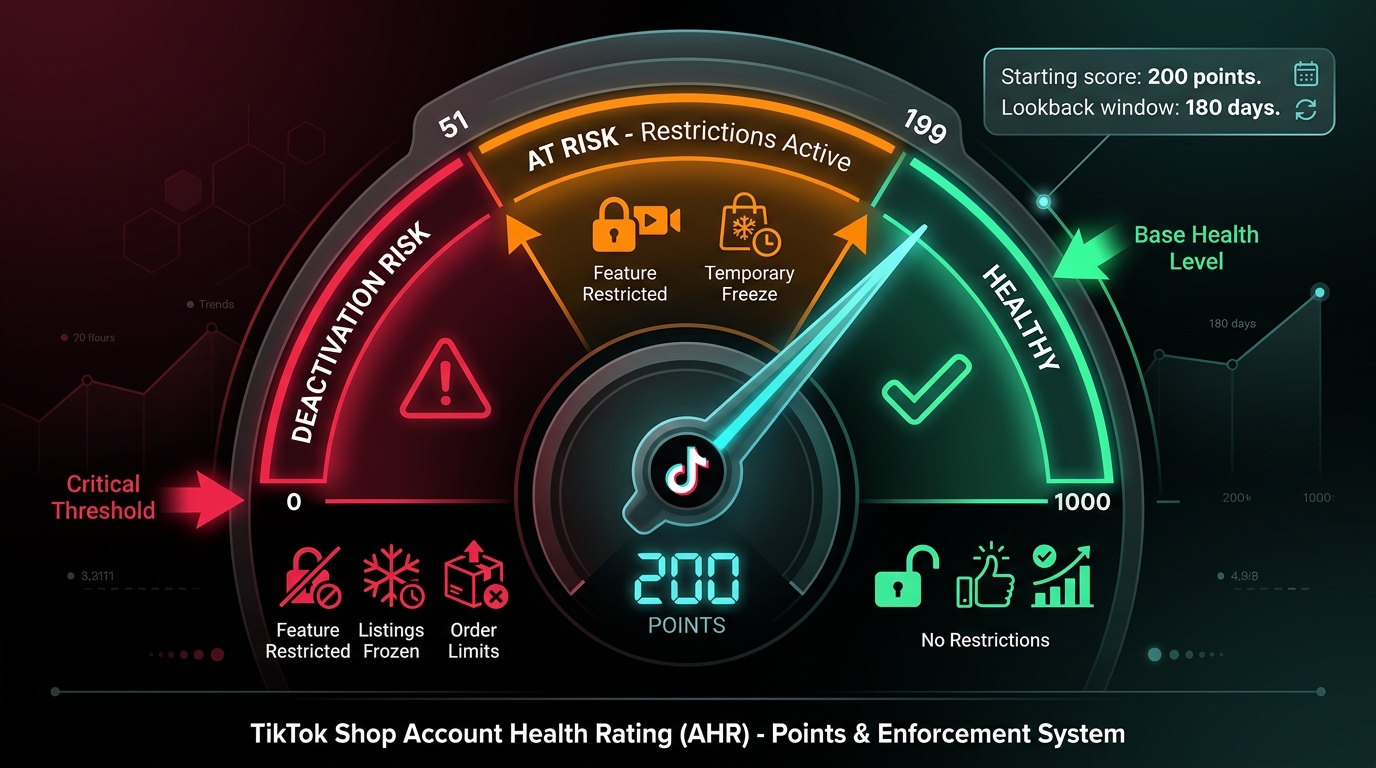
One of the most consequential — and least understood — systems operating in TikTok Shop’s seller environment is the Account Health Rating, or AHR. Understanding how it works isn’t just useful background knowledge. For sellers running any kind of scale operation, it’s essential infrastructure awareness.
The Mechanics: How the Score Works
The AHR is a numerical score that runs from 0 to 1,000 points. Every seller starts at 200 points. The score reflects your shop’s performance and policy compliance over a rolling 180-day lookback window, which means violations can follow you for six months before they age out of the calculation.
The score is color-coded into three operative zones:
- Green (200+ points): Healthy. Your shop operates without AHR-related restrictions.
- Orange (51–199 points): At risk. Enforcement actions are likely already in effect at various sub-thresholds.
- Red (0–50 points): High deactivation risk. Expect severe restrictions or full account deactivation.
TikTok’s enforcement escalates at four key thresholds: 150, 100, 50, and 0 points. Each threshold triggers increasingly severe actions, ranging from feature restrictions at 150 to potential full deactivation at 0.
What Costs You Points
The AHR is deducted by two types of triggers: policy violations and performance failures. Policy violations include listing prohibited products, providing inaccurate product information, failing to respond to compliance documentation requests, and violations identified during LIVE sessions. Performance failures include late shipment rates, order cancellation rates, and customer service deficiencies.
What makes the system particularly tricky is that some violations have immediate, significant point deductions, while others accumulate gradually. A seller who processes hundreds of orders per month might not notice a creeping cancellation rate until they’ve crossed a threshold they can’t quickly recover from.
The Cascade Effect: How AHR Hits Ripple Outward
When a shop is deactivated or hits severe AHR thresholds, the effects don’t stay contained to the seller. TikTok’s 2026 policy updates confirm that associated creator accounts can be blocked when a shop is deactivated. Any creators who have linked their affiliate content to your products may have their own accounts restricted — a consequence that generates obvious friction in your creator relationships and can affect your ability to recruit future affiliates.
Additionally, orders that are in transit when a seller is deactivated can be automatically cancelled, triggering refund obligations and further compounding both the financial damage and the AHR deduction cycle.
How to Actively Manage Your AHR
The sellers who maintain healthy AHR scores treat it as an operational metric, not an afterthought. Practical management approaches include: reviewing Seller Center’s compliance notifications daily rather than weekly, setting internal thresholds for shipment and cancellation rates that leave a buffer before TikTok’s thresholds, maintaining a documentation library for all listed products so compliance requests can be answered immediately rather than triggering the clock on enforcement, and auditing LIVE content for policy compliance before broadcasts rather than relying on post-broadcast review.
Product Compliance Documentation — The New Pre-Listing Burden
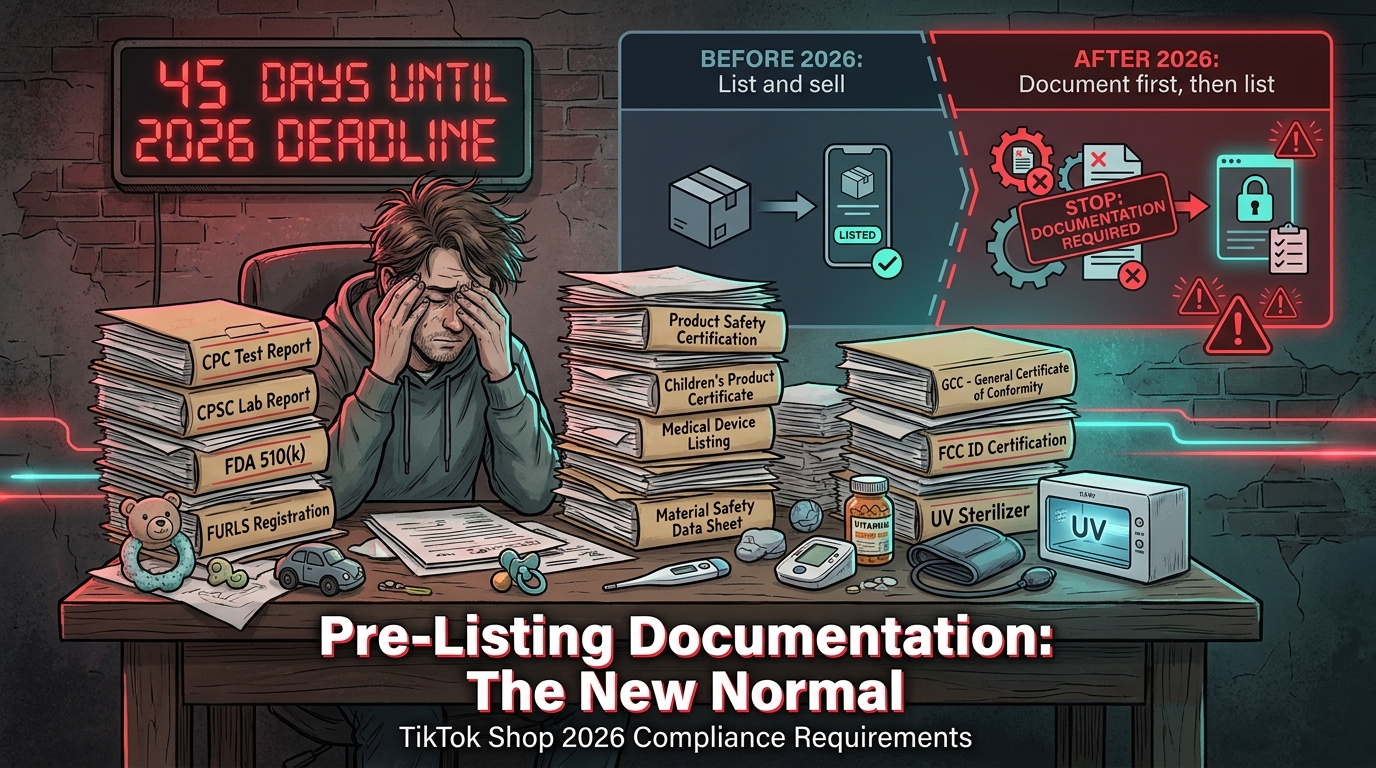
If you sell in baby, children’s, health, or device categories on TikTok Shop, 2026 has materially changed your listing workflow. The platform updated its Product Safety and Compliance Policy on April 20, 2026, and the requirements now extend to listing-level documentation that must be submitted before products go live.
What the April 2026 Policy Update Actually Requires
TikTok’s official policy update establishes a clear framework: sellers and their products must comply with all applicable product safety laws and regulations. That’s not new language. What is new is the enforcement mechanism around documentation requests — and the consequences of slow responses.
When TikTok’s systems flag a product (either proactively or in response to a safety complaint), sellers can be required to submit documentation including:
- Children’s Product Certificates (CPCs) — for products intended for children under 12
- CPSC-accredited laboratory test reports — confirming the product meets federal safety standards
- FDA 510(k) premarket notifications — for certain medical and health devices
- FURLS registration records — for FDA-regulated product categories
- General product safety certifications appropriate to the specific product type
TikTok’s policy states that sellers must respond promptly to documentation requests. Failure to do so can result in enforcement actions — including listing suspension — being imposed before the documentation deadline expires.
The 45-Day Notice Window and What It Really Means
TikTok has communicated that sellers in affected categories receive a 45-day notice period before new documentation requirements become mandatory for existing listings. This sounds generous. In practice, 45 days is tight if you’re sourcing documentation from overseas manufacturers, working with labs for product testing, or dealing with a large catalog of affected SKUs.
The sellers in the best position are those who have already established documentation pipelines: direct relationships with accredited testing labs, clear supplier contracts that specify documentation delivery timelines, and a centralized compliance document library that can produce required files quickly when a listing is flagged.
Sellers who approach compliance documentation reactively — pulling files together only when TikTok asks — are operating on borrowed time. The platform’s enforcement posture in 2026 is significantly stricter than in prior years, and the assumption that documentation requests are rare is no longer safe to make.
Regulated Categories: A Practical Risk Tier Assessment
Not all product categories carry the same compliance documentation risk. A practical way to think about this is by the likely regulatory documentation burden:
- High burden: Children’s toys (ASTM F963, CPSC), children’s clothing (lead/flammability testing), infant products, medical and wellness devices, dietary supplements with structure/function claims.
- Medium burden: Adult health and wellness products, personal care items, electronics with safety considerations, pet food and treats.
- Lower burden: Home décor, fashion accessories, general lifestyle products without regulated claims.
If you sell in high-burden categories without a mature compliance documentation practice, this is the operational area that deserves the most immediate attention in your 2026 TikTok Shop strategy.
Cross-Border Selling Gets Harder — New 2026 Registration Rules
The ability to operate TikTok Shop across US and UK markets from a cross-border seller position — historically a relatively accessible path — has become more restrictive in 2026. The new registration requirements reflect TikTok’s effort to reduce the prevalence of low-quality or short-lived sellers on the platform, and they have real implications for new entrants and established operators alike.
The New Eligibility Requirements
For cross-border sellers targeting US and UK markets, TikTok’s 2026 requirements include:
- Company age minimum: Your business entity must be at least 60 days old at the time of application.
- Business license validity: The license must be valid for at least 90 days from the application date, with no near-expiry registrations accepted.
- Entity type restrictions: Sole proprietors and natural persons (individuals) can no longer register as cross-border sellers for US or UK markets. A registered business entity is required.
- Business stability emphasis: TikTok’s review process explicitly considers “business stability” as an approval criterion, though the specific metrics for this assessment are not publicly detailed.
What This Means for Different Seller Profiles
For established businesses with mature legal structures, these requirements are unlikely to create obstacles. For newer operations or individual sellers who have been operating informally, the entity requirement creates a meaningful barrier that requires either restructuring or waiting periods before platform access is possible.
There’s also a strategic implication worth noting: if you’re planning to launch new TikTok Shop entities for specific brands or product lines, the 60-day company age requirement means you need to establish those entities at least two months before you intend to go live. That’s a planning horizon that many sellers ignore until they’re ready to launch and suddenly encounter a waiting period.
Why TikTok Is Tightening the Gate
The tighter registration requirements are consistent with TikTok’s broader strategic direction for its US and UK markets: reducing platform quality problems driven by low-commitment sellers, improving customer experience by raising the baseline operational standard, and creating a marketplace that brands and consumers take more seriously. From TikTok’s perspective, stricter entry filters are a maturation move. From a seller perspective, they’re a raised cost of doing business that rewards those who’ve already built legitimate structures.
The Creator-Compliance Trap — When Affiliates Create Seller Risk
One of the more nuanced compliance shifts in 2026 is the way TikTok has tightened the relationship between creator behavior and seller account health. The consequences of non-compliant creator content can now flow directly back to the brands those creators represent — a linkage that many sellers haven’t fully internalized.
How Creator Content Affects Your AHR
When a creator promotes your products through TikTok Shop’s affiliate system, their content is associated with your listings. If that content violates TikTok’s policies — by making prohibited health claims, promoting a restricted product, misrepresenting product specifications, or violating LIVE content rules — the enforcement action can affect your shop, not just the creator.
TikTok’s updated 2026 policies also state that creators can face binding limits after bans, and that associated creators can be blocked when a seller’s shop is deactivated. The dependency flows both ways: your account health affects your creators, and their compliance behavior affects your account health.
Creator Binding Limits After Bans
A 2026 policy addition that has received less attention than it deserves: when creators are banned or face significant enforcement actions, TikTok now imposes limits on how they can re-engage with seller partnerships on the platform. For sellers who have built significant revenue through a specific creator relationship, a creator ban can create an immediate revenue gap — not because the product or the brand did anything wrong, but because the creator violated platform policy independently.
Building a Creator Compliance Protocol
The sellers managing this risk most effectively in 2026 are treating creator compliance as part of their onboarding process, not an afterthought. Practical measures include:
- Providing creators with explicit written guidance on what claims can and cannot be made about your products, referenced to TikTok’s specific policy categories.
- Reviewing creator content before it goes live where possible, particularly for health, wellness, or regulated product categories.
- Maintaining written records of the compliance guidance you’ve provided to creators, creating a paper trail that demonstrates good-faith seller behavior in the event of an enforcement dispute.
- Diversifying your creator network so that the loss of any single creator — whether through ban, policy action, or simple disengagement — doesn’t create a material revenue event.
- Monitoring your creator-associated content regularly for policy compliance, not just performance metrics.
The affiliate relationship in TikTok Shop creates real value. But in 2026’s enforcement environment, it also creates real shared risk. Treating creators purely as distribution channels, without managing the compliance dimension, is a liability many sellers are carrying without knowing it.
Fulfillment by TikTok — The Real Numbers Behind the “3-Day Delivery” Push
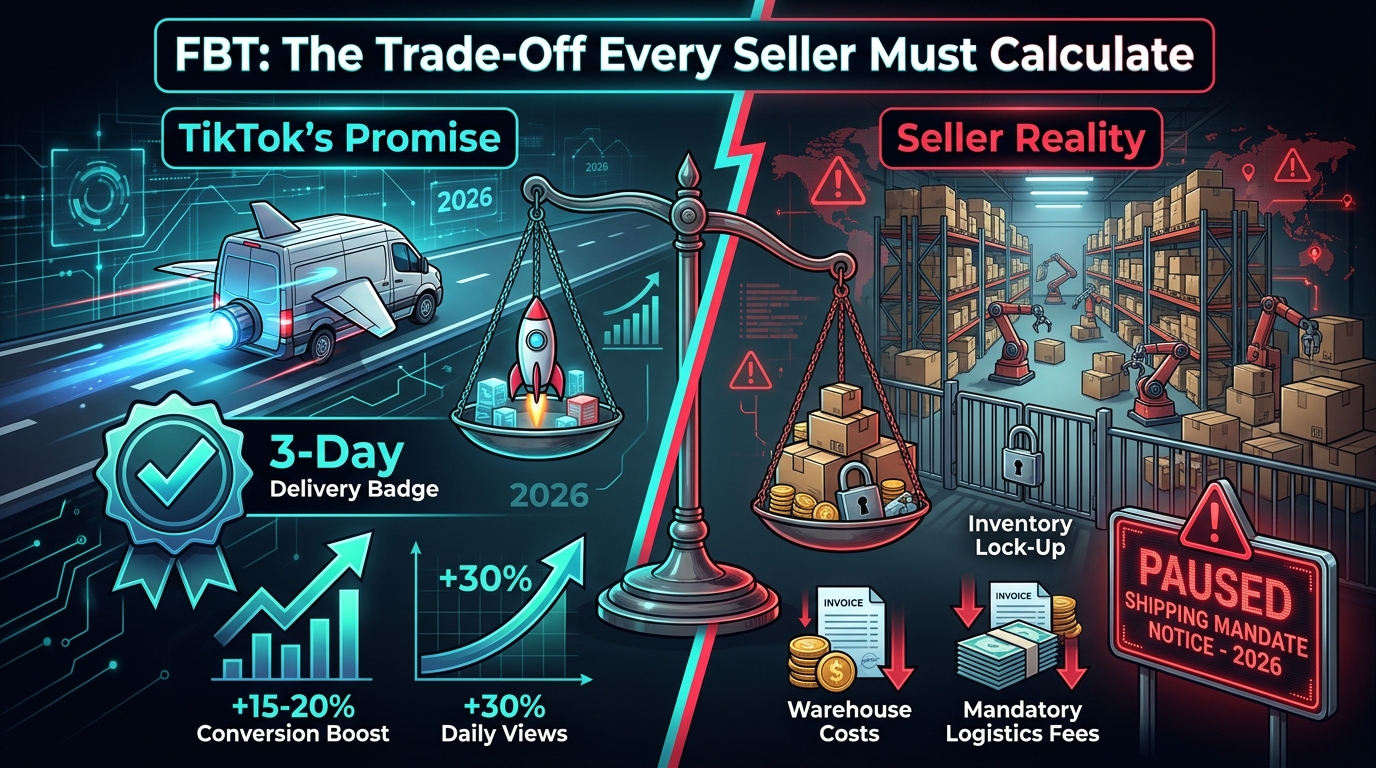
Despite the February reversal of the FBT mandate, TikTok’s push toward its fulfillment program has not stalled. The platform continues to actively promote FBT as a conversion and visibility driver — and the numbers it cites are specific enough to deserve scrutiny.
What TikTok Claims About FBT Performance
TikTok’s official Seller University materials in 2026 make several performance claims about FBT adoption:
- FBT can raise conversion rates by 15–20% compared to non-FBT listings
- Products using FBT see daily views increase by 30%+ through the “3-Day Delivery” badge and associated algorithmic visibility boosts
- 82.7% of FBT orders arrive within 3 days for sellers using FBT on more than 30% of their orders
These figures come from TikTok’s own internal data. They’re worth taking seriously, but they also warrant context: these are aggregate platform metrics, not guaranteed outcomes for any specific seller, product category, or geographic market.
The Real Cost Equation for FBT
The conversion and visibility benefits of FBT are real — but they come with a cost structure that needs to be modeled against your specific margins before you commit inventory. FBT charges include storage fees, pick-and-pack fees, and last-mile shipping costs. These vary by product dimensions, weight, storage duration, and volume.
For products with tight margins — which describes many categories on TikTok Shop where price competition is intense — FBT’s cost burden can offset the conversion benefit. A 15–20% conversion lift is genuinely valuable, but not if the fulfillment cost increases your landed cost per unit by 10–15%. The net math has to work.
Which Seller Profiles Benefit Most from FBT
Based on the structure of FBT’s cost and benefit profile, certain seller types stand to gain the most from adoption:
- High-volume sellers in standard-size, moderate-weight categories — fulfillment efficiency is highest here, and the conversion lift has the most cumulative impact.
- Sellers without established 3PL relationships — FBT provides infrastructure that would otherwise require building or contracting independently.
- Brands prioritizing the “3-Day Delivery” badge as a conversion signal — particularly in categories where fast delivery is a genuine purchase decision factor, like consumables and personal care.
Conversely, FBT is likely a poor fit for sellers with oversized or heavy products (where per-unit fulfillment costs are high), sellers with low and unpredictable volume (where storage fee efficiency breaks down), and sellers with highly customized packaging or post-purchase experiences that require direct fulfillment control.
The Mandate Will Return
The February reversal was driven by merchant pressure, not a change in TikTok’s strategic goals. The platform’s long-term vision is clearly to operate FBT as its primary fulfillment channel — this creates more data, more operational control, and more leverage over the customer experience. Sellers who evaluate FBT now, under current conditions and without a mandate deadline forcing the decision, are in a materially better position than those who wait for the next policy push.
Rebuilding Your Unit Economics After the Fee Changes
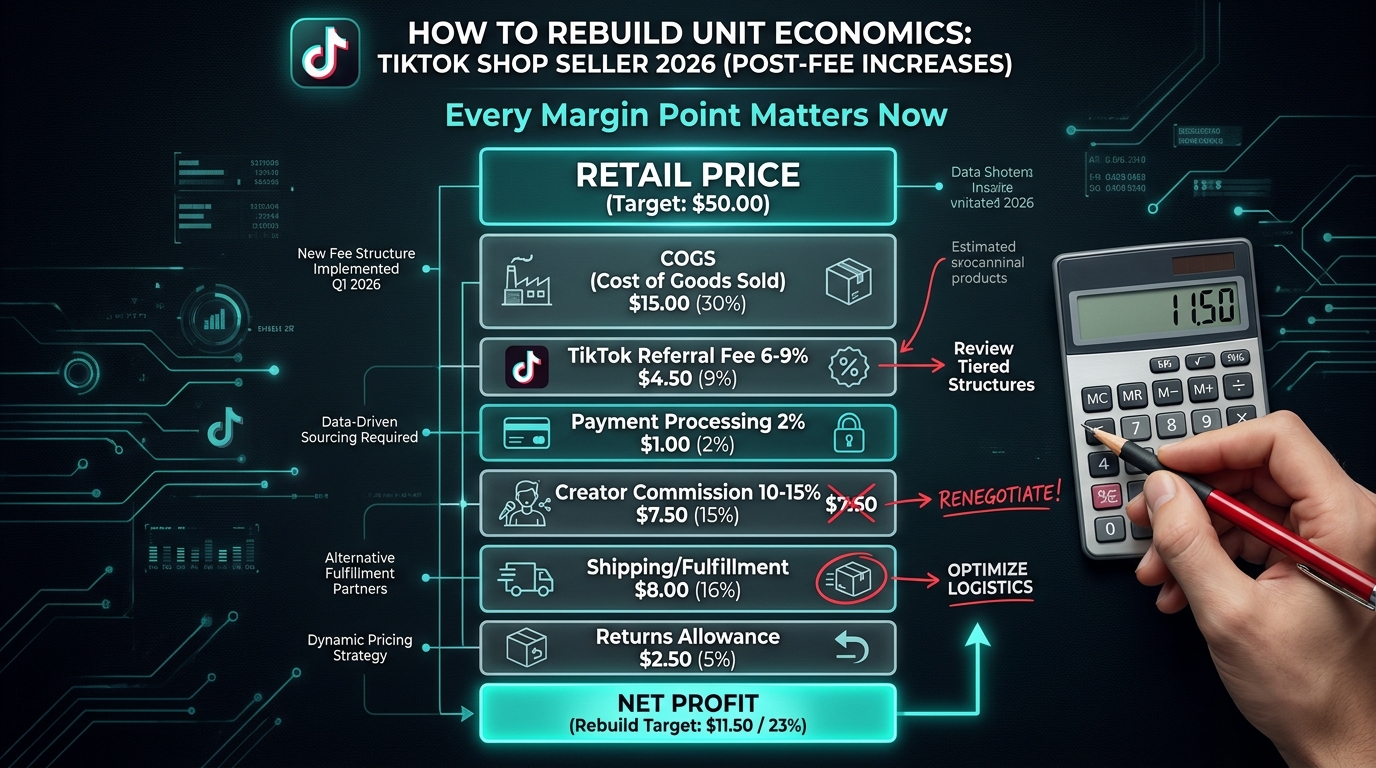
The single most important operational response to TikTok Shop’s 2026 fee environment is a thorough rebuild of your unit economics model. Not the version you use for Amazon. Not your DTC margin sheet. A TikTok-specific model that accounts for every layer of cost the platform’s structure creates.
The Full Unit Economics Worksheet
Start with your retail selling price and work downward through every deduction:
- Cost of goods sold (COGS) — including product cost, inbound shipping, and any quality testing required for compliance documentation.
- TikTok referral/commission fee — 6% for most US categories, 9% for EU markets as of January 2026. Verify your specific category rate.
- Payment processing fee — approximately 2%, though verify current rates in your Seller Center fee schedule.
- Creator/affiliate commissions — model this as a range (5–20%) rather than a fixed number, and set your target based on your category’s competitive affiliate rates.
- Fulfillment costs — whether seller-shipping or FBT, include all handling, packaging, and last-mile costs per unit.
- Return rate allowance — model a realistic category-specific return rate and account for the per-unit cost of processing returns.
- Paid advertising allocation — if you’re running TikTok Shop ads, attribute a per-unit cost based on your average ROAS.
What remains after these deductions is your net margin per unit. If this number is positive but thin (below 15% of revenue), you need to either restructure costs or reprice before scaling. If it’s negative, scaling will accelerate your losses regardless of how impressive your GMV growth looks.
The TikTok-Specific Pricing Strategy
One of the most common margin killers on TikTok Shop is carrying the same retail price that works on Amazon or your DTC website. The cost structures are fundamentally different. Amazon’s FBA fees are significant, but they don’t include a 10–20% creator commission layer on top. Your DTC price might work fine without any creator cost, but TikTok Shop’s discovery engine often requires creator content to generate volume — which means the affiliate commission is a real and recurring cost of customer acquisition.
The right approach is to build your TikTok price from the bottom up: determine your minimum acceptable net margin, add back every cost layer, and let that determine your floor price. If the resulting price isn’t competitive in your category, that’s critical information about whether TikTok Shop is viable for that specific product — better to know before you’ve spent six months building a listing and creator network around a product that can’t be profitable at market prices.
Platform Discounts and the Effective Fee Rate Problem
TikTok Shop runs frequent platform-level promotions, vouchers, and discount events. These are powerful conversion drivers — but they interact with your fee calculation in ways that can obscure the true cost. Because referral fees are calculated on the buyer’s price (including platform-funded discounts), participation in TikTok-funded promotions can reduce your revenue while your fee obligation remains anchored to a higher price point.
Before participating in any platform promotional event, run the numbers on the specific terms. Some TikTok Shop promotions are genuinely accretive — volume increases more than offset the margin compression. Others are primarily beneficial to TikTok’s own conversion metrics rather than your net profitability. The difference is in the details, not the headline promotion.
Building a Policy-Proof Seller Operation: Systems That Absorb the Chaos
The sellers who’ve weathered TikTok Shop’s policy volatility in 2026 most successfully share a common characteristic: they’ve built operational systems that treat policy change as an expected input rather than a crisis event. The platform will continue to change. The question is whether your operation can absorb and adapt to changes without disruption to your sales, your account health, or your creator relationships.
The Policy Monitoring System
TikTok Shop publishes policy updates through several channels: Seller Center notifications, TikTok Shop University posts (including its “Policy Pulse” series), and direct merchant communications for significant changes. Most sellers check these reactively — they notice a change after it’s affected their operation.
A policy-proof operation runs this monitoring proactively: a designated team member checks TikTok Shop University and Seller Center for new policy posts at least weekly. New policies are reviewed and assessed for operational impact before they take effect, not after. A simple spreadsheet tracking policy changes, effective dates, and required operational responses creates institutional memory and ensures nothing falls through the cracks.
The Documentation Library
Build and maintain a centralized product compliance documentation library before you need it. Every product in your TikTok Shop catalog should have a folder containing: the relevant test reports or certifications, supplier documentation, product safety information, and any regulatory filings that apply to its category.
When TikTok requests documentation, you want to be able to respond within 24–48 hours, not 2 weeks while you chase your overseas supplier for files. The sellers who get listings suspended during compliance review cycles are overwhelmingly those who couldn’t produce documentation quickly when asked.
The AHR Early Warning Protocol
Set internal thresholds for your operational metrics that give you a recovery buffer before TikTok’s thresholds trigger enforcement. If TikTok’s late shipment rate threshold is X%, set your internal target at X minus 3%. If your cancellation rate starts climbing, you want to catch and address it when your AHR still has enough buffer to absorb the deductions while you fix the problem.
Review your AHR score and the contributing metrics on a weekly cadence, not monthly. A score that’s trending from 300 to 250 to 200 is telling you something important before you hit the green-to-orange transition. Monthly reviews miss that signal until it’s too late to respond easily.
The Creator Agreement Update
Revise your creator onboarding agreements to include explicit policy compliance requirements aligned with TikTok Shop’s 2026 enforcement areas. Specifically: prohibited claim types for your product category, required disclosure language, content review rights, and the consequences of policy violations including termination of the affiliate relationship. This doesn’t eliminate compliance risk, but it establishes the seller’s good-faith efforts to manage it — which matters in enforcement disputes and appeals.
What to Watch for in the Second Half of 2026
Policy environments don’t pause while sellers build their operations around current rules. Based on the trajectory of TikTok Shop’s policy changes so far in 2026, several developments deserve attention in the months ahead.
The FBT Mandate, Round Two
As discussed, the February reversal of the logistics mandate was a pause, not a cancellation. Watch for TikTok to revisit mandatory FBT adoption — likely with more notice than the initial mandate provided, and possibly with a phased category-specific rollout rather than a platform-wide deadline. Sellers who’ve done the FBT evaluation and have a clear decision (adopt or don’t adopt, and why) will be better positioned than those who haven’t run the numbers.
Fee Increases in Additional Markets
The January 2026 European commission increase from 5% to 9% is unlikely to be the last regional fee adjustment. As TikTok Shop matures in each market and its growth-phase promotional economics give way to sustainability-focused ones, expect commission rates to drift upward in markets where they remain low. Sellers operating in markets where fees are currently below the EU’s 9% should model what their economics look like at higher rates — not because increases are certain, but because being unprepared for them creates real business risk.
Continued Tightening of Product Category Regulations
The April 2026 product safety policy update is consistent with a broader trend: TikTok is building the compliance infrastructure of a mature marketplace that takes regulatory exposure seriously. Expect continued expansion of listing-level documentation requirements into new product categories, higher scrutiny of health and wellness claims, and stricter enforcement of existing policies that may have been applied loosely in prior years.
Voice of Customer as an Affiliate Eligibility Factor
TikTok’s 2026 policy updates have connected affiliate program eligibility to “Voice of Customer” metrics — effectively meaning that creators’ ability to participate in affiliate programs can be affected by the customer feedback and satisfaction data associated with their content. This creates an incentive alignment between creators and seller product quality that didn’t previously exist at the platform enforcement level. Sellers with strong review profiles and customer satisfaction metrics will be more attractive creator partners as this eligibility linkage becomes more prominent.
The Seller Who Survives Is the Seller Who Prepares
The premise of this piece is simple: TikTok Shop’s 2026 policy environment rewards preparation and punishes reaction. The specific changes catalogued here — the fee stack, the AHR system, the product compliance documentation requirements, the logistics mandate and its reversal, the creator compliance linkages — are not isolated events. They’re part of a coherent maturation trajectory that TikTok Shop is following, whether individual sellers are tracking it or not.
The platform isn’t becoming friendlier to casual sellers. The registration requirements are getting tighter. The compliance documentation expectations are expanding. The fee structures are moving upward in markets where they started low. The enforcement systems are becoming more automated and less forgiving of operational sloppiness.
None of this should read as a reason to avoid TikTok Shop. The platform’s commerce opportunity remains genuinely significant — the creator-driven discovery model produces conversion outcomes that most traditional marketplaces can’t replicate, and for the right products with the right creator networks, TikTok Shop can deliver exceptional returns. But accessing those returns requires operating at a level of policy awareness and operational discipline that many sellers haven’t built yet.
Five Immediate Action Steps
If you take nothing else from this breakdown, these five actions will materially reduce your exposure to TikTok Shop’s 2026 policy environment:
- Audit your complete fee stack today. Build a TikTok-specific unit economics model for every active SKU, including referral fees, payment processing, creator commissions, and fulfillment. Know your actual net margin — not your GMV margin.
- Check your Account Health Rating now and set up a weekly review cadence. Understand which metrics are contributing to any deductions and what your buffer is before the next threshold.
- Build your compliance documentation library. Identify every SKU in a regulated category (children’s, health, devices) and ensure you have current, retrievable documentation for each one.
- Review and update your creator agreements to include explicit policy compliance requirements. Your creators’ content compliance is your problem too.
- Evaluate FBT for your top-performing SKUs — not because the mandate is active, but because the mandate will return and having done the analysis in advance is better than being forced into a rushed decision later.
The platform is changing. The sellers who build operations that can absorb those changes — rather than scrambling to react to each one — are the ones who compound on TikTok Shop rather than simply surviving it.