

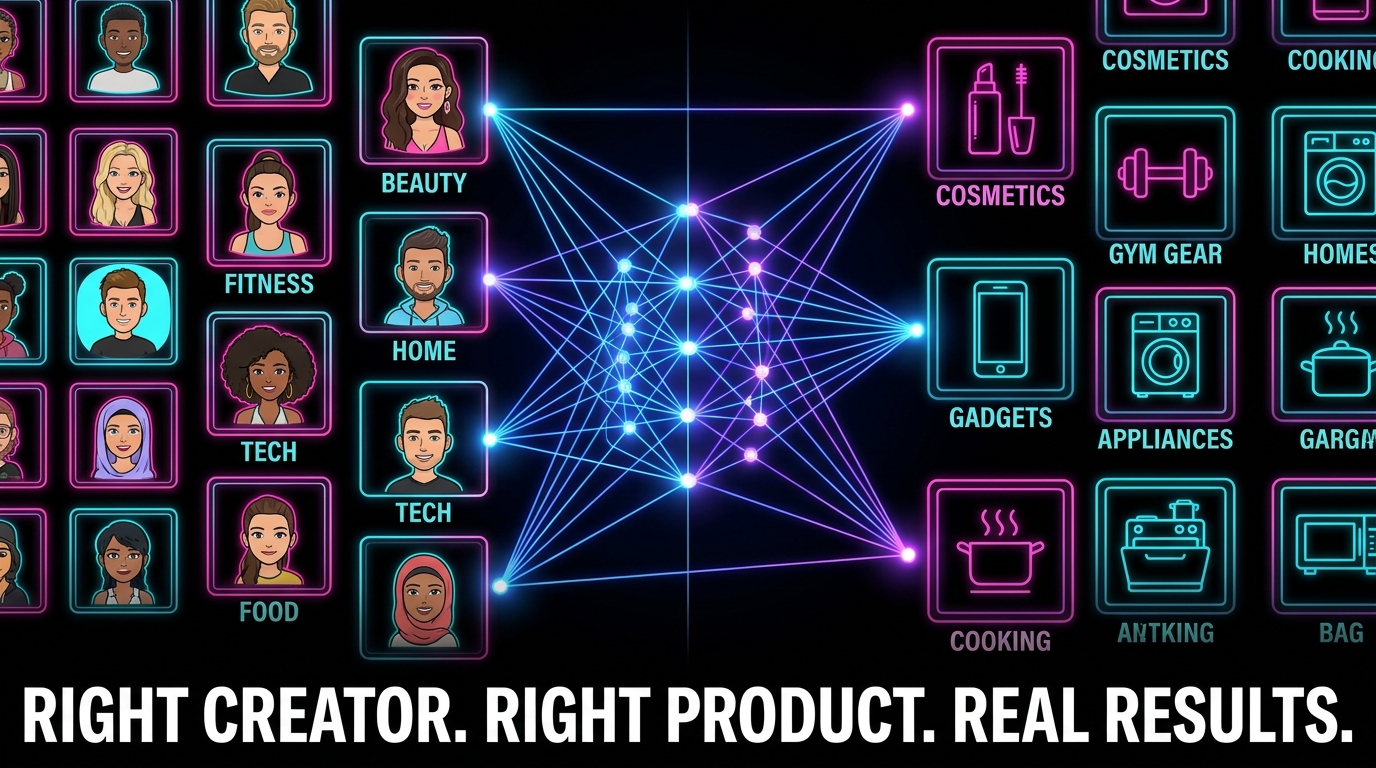

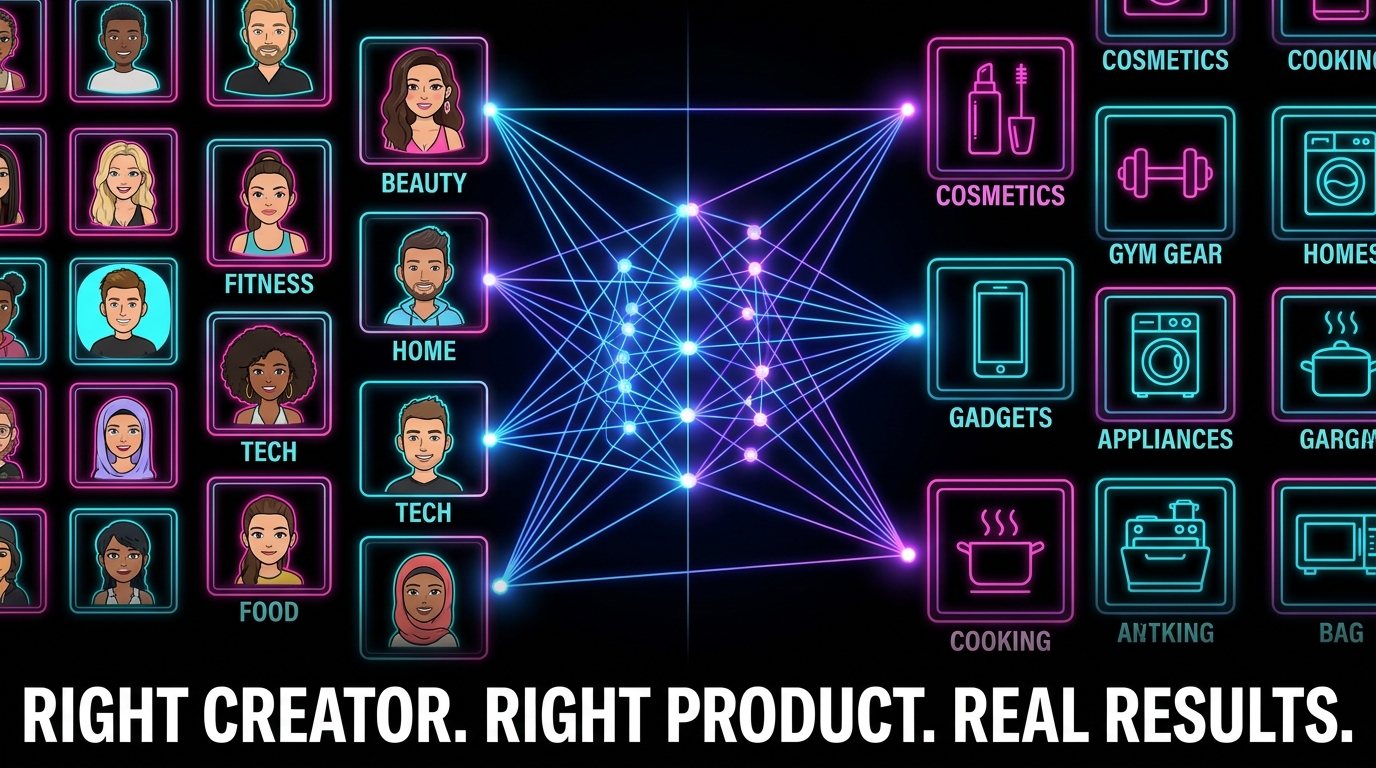
There’s a persistent belief inside TikTok Shop circles that bigger audiences produce bigger sales. Brands chase follower counts. Sellers filter creator lists by total reach. Agencies present decks full of vanity metrics dressed up as strategy. And then the campaigns go live — and the conversions disappoint.
The problem isn’t creator quality. It isn’t the product. It isn’t even the commission structure. The problem is fit — specifically, the absence of a rigorous, data-backed process for matching the right creator to the right product. And in 2026, with TikTok Shop’s global GMV projected to hit $112.2 billion, the gap between brands that get this right and those that don’t is measured not in percentages but in multiples.
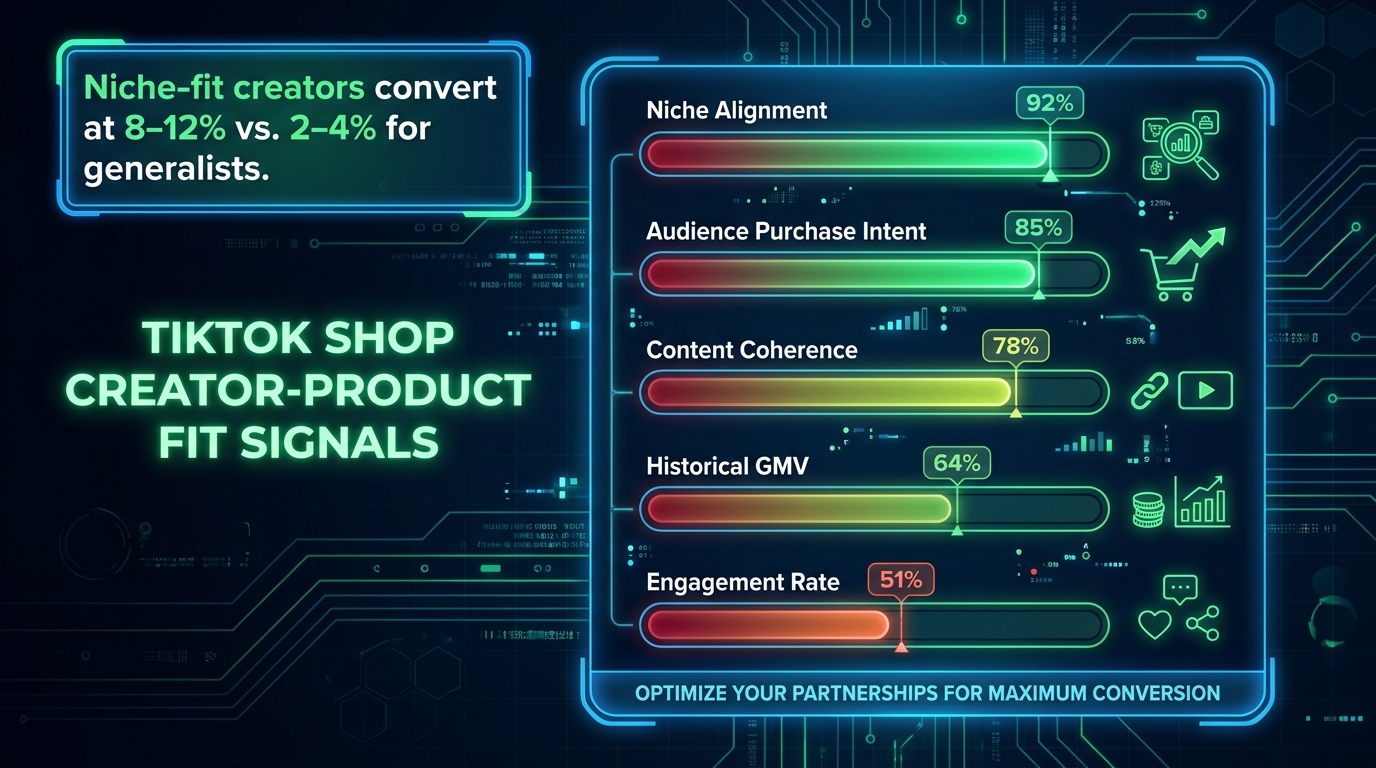
Niche-aligned creators with genuine audience purchase intent convert at 8–12% on TikTok Shop. Mismatched generalists — creators with large, mixed-intent audiences promoting products outside their established content lane — average 2–4%. That’s not a minor performance difference. That’s the difference between a product that builds genuine affiliate momentum and one that bleeds ad budget while collecting lukewarm views.
This article isn’t about the basics of finding creators. It’s about the underlying science of creator-product matching — the signals that matter, the AI tools that surface them, the metrics that predict performance before a single post goes live, and the costly mistakes that happen when brands skip the analysis and trust their instincts instead. Whether you’re a brand running a TikTok Shop affiliate program, an agency managing creator rosters, or a seller trying to figure out which creators are actually worth approaching, what follows is the framework you need.
The “Followers = Sales” Myth — And Why It Still Costs Brands Real Money
The idea that follower count predicts affiliate revenue is intuitive. More eyes, more reach, more sales. It’s the logic that dominated influencer marketing for years, and it still shapes how a lot of brands approach TikTok affiliate outreach in 2026. The data, however, has thoroughly dismantled it.
Consider the performance spread on TikTok Shop. The platform’s creator ecosystem follows a clear power-law distribution: the top 20% of creators drive roughly 80% of total affiliate GMV. But critically, those top performers aren’t uniformly distributed across follower tiers. A creator with 85,000 followers who has built a loyal community of skincare-obsessed buyers will routinely outperform a creator with 2.1 million mixed-niche followers promoting the same serum. The 2M-follower creator has reach. The 85K creator has a buying audience.
Why Reach Without Intent Is a Vanity Metric
The distinction between reach and purchase intent is the core insight that separates brands running effective TikTok affiliate programs from those perpetually chasing scale without results. Reach is the number of people who see your product. Purchase intent is the proportion of those people who are already primed to buy something like it.
A beauty creator who posts skincare routines five days a week has cultivated an audience that regularly makes decisions about skincare products. When they recommend a vitamin C serum, their viewers already have the mental model — they know what good skin looks like, they’ve seen transformation content, and they’re already in the consideration phase. The creator’s recommendation functions as a trusted peer review, not an advertisement.
A lifestyle creator with 2 million followers who posts travel, food, relationship content, and occasional product placements has a fundamentally different audience dynamic. Their followers come for the entertainment. A product mention lands differently — it’s an interruption, not a recommendation from a domain expert.
The Data That Breaks the Follower Myth Open
Nano-creators (1K–10K followers) average engagement rates of 20.64% on TikTok. Micro-creators (10K–100K) deliver roughly 3.86%. Macro-creators (100K–1M+) drop to around 1.21%. The inverse relationship between follower count and engagement rate is well-documented — but brands continue to prioritize the top of the follower range despite consistently lower returns on engagement.
More telling still: creators matched to specific product SKU categories convert at approximately 15% higher rates than generalists in the same follower tier. Niche fit isn’t a soft preference. It’s a measurable performance variable with a quantifiable impact on conversion. The brands that understand this restructure their entire outreach approach around it.
What Creator-Product Fit Actually Means — A Working Definition
The term “creator-product fit” gets used loosely. In practice, it describes a specific alignment between four distinct dimensions: the creator’s content domain, their audience demographics, their historical purchasing behavior signals, and the product’s intrinsic characteristics. When all four align, you get conversions. When they don’t, you get views — and not much else.
The Four Dimensions of Fit
1. Content Domain Alignment. This is the most obvious dimension, but even it is frequently misapplied. A fitness creator promoting protein powder is obvious fit. A fitness creator promoting sleep supplements is still strong fit — both map to the wellness ecosystem their audience inhabits. But a fitness creator promoting kitchen gadgets? Weaker. The content domain needs to overlap with the product’s primary use case and the lifestyle context in which the product makes sense.
2. Audience Demographic Match. Beyond niche, the specific demographic composition of a creator’s audience has to map to the product’s target customer. A skincare brand targeting women aged 25–40 needs to verify that a beauty creator’s audience isn’t predominantly Gen Z teens or male-skewed. AI tools now make this analysis accessible — audience demographic data from third-party platforms can be checked before any outreach begins.
3. Purchase Intent Signals. This is where the analysis gets more sophisticated. Purchase intent isn’t something audiences explicitly declare — it’s inferred from behavioral signals. High add-to-cart rates (above 5%), a pattern of “where to buy” comments on product posts, above-average saves and shares, and strong click-through rates on affiliate links are all indicators that a creator’s audience arrives with buying intent, not just entertainment intent.
4. Product Visual Demonstrability. Products that perform best on TikTok share one common trait: they can tell a compelling story in 15–60 seconds. A clear before/after, a tactile transformation, an unexpected feature reveal — these are the visual hooks that drive impulse purchases. Before matching a creator to a product, the product itself needs to clear the “TikTok-ability” test. If it can’t be demonstrated compellingly in short-form video, no creator match will save it.
Why This Matters More in 2026 Than It Did Two Years Ago
TikTok’s algorithm has become significantly more sophisticated at matching content to buyers. The platform’s “interest graph” — which maps what users actively engage with and purchase — now feeds directly into which creator content gets surfaced to which audiences. This means a well-matched creator-product pairing doesn’t just convert better organically; it also distributes more efficiently. The algorithm amplifies fit. Mismatched content, meanwhile, receives less favorable distribution because the behavioral feedback signals (low saves, short watch time, no click-through) tell the algorithm the content isn’t relevant to the audience it’s reaching.
The Data Signals That Determine Real Match Quality
Matching creators to products with any precision requires moving beyond subjective assessments (“they seem like a good fit”) to quantitative signals that correlate with actual performance. There are six primary data signals that matter — and knowing what each one tells you is the foundation of any serious affiliate matching process.
1. Historical GMV and Revenue Per Follower
A creator’s total GMV generated through TikTok Shop affiliates is the most direct predictor of their capacity to drive sales. But raw GMV numbers can be deceptive — a creator with high GMV might have built it entirely in a product category that’s irrelevant to your brand. The more refined metric is revenue per follower, which normalizes GMV against audience size and reveals the actual commercial efficiency of a creator’s audience relationship.
Top-performing affiliates in the beauty category — TikTok’s largest category at 22.5% of US GMV — generate well above the platform average. The top 1% of TikTok Shop affiliates average $600,000 in annual GMV. Identifying creators who are approaching that tier in your specific category, not just across all categories, is where matching becomes predictive rather than speculative.
2. Engagement Rate and Its Composition
Engagement rate (likes, comments, shares, saves divided by reach) is a standard metric, but its composition matters as much as the total number. High save rates indicate the audience found the content valuable enough to return to — a strong signal for product discovery content. High comment rates, particularly when comments ask about the product, indicate genuine curiosity and buying consideration. High share rates suggest the content is being distributed beyond the original audience, expanding reach organically.
A minimum benchmark of 2.5% engagement rate is widely used as a threshold for TikTok Shop affiliate eligibility, but effective matching typically targets significantly higher rates for niche content. In beauty and wellness — where community trust is a conversion driver — engagement rates of 5–8% are realistic targets for serious affiliate consideration.
3. Posting Frequency and Content Consistency
Affiliate programs need reliable content output. A creator who posts three or more times per week maintains algorithmic momentum on their channel, which means their affiliate content benefits from an already-active distribution pipeline. Creators who post sporadically — even if they have high follower counts — lose algorithmic favor between posts, which reduces the effective reach of any given piece of affiliate content.
Posting frequency also signals professionalism. Creators who maintain consistent output schedules are more likely to deliver on collaboration timelines, which is a practical consideration for brands planning campaign windows around product launches or seasonal events.
4. Category-Specific Conversion History
This is the signal most brands don’t check — and it’s arguably the most predictive. A creator might have strong overall GMV, but if it’s concentrated in electronics and you’re selling skincare, their historical performance is essentially irrelevant to your category. AI-powered analytics platforms can now slice creator performance data by product category, revealing which creators have demonstrated actual conversion ability in your specific market vertical.
Category-specific conversion history captures something that follower count and general engagement never can: whether a creator’s audience has actually bought products like yours before. That behavioral history is the strongest indicator of what will happen when you partner with them.
5. Audience Sentiment in Comments
Comment sentiment analysis — now available through platforms like SFN AI and Kalodata — scans the comment sections of a creator’s product-related posts to assess audience receptivity. Positive, product-curious comments (“Where do I get this?” “Just ordered one!” “Adding to cart rn”) signal an audience primed for affiliate conversion. Generic, entertainment-focused comments (“Lol 😂” “You’re so funny”) signal an entertainment relationship with the creator, not a product-trust relationship.
This distinction is nuanced but important. Creators who drive purchase-intent comments have an audience that has learned to take their product recommendations seriously. That trust has compounding value — it makes every future affiliate collaboration more effective.
6. Niche Concentration vs. Niche Breadth
Highly concentrated niche creators — those who post almost exclusively within a single content category — outperform breadth creators even when follower counts and engagement rates are similar. A creator who posts 90% beauty content has a more commercially predictable audience than one who posts 40% beauty, 30% lifestyle, and 30% food. The beauty-concentrated creator’s audience has self-selected specifically for beauty content and beauty product recommendations. Their audience is already filtered.
TikTok’s Native Matching Tools: What Seller Center Actually Offers
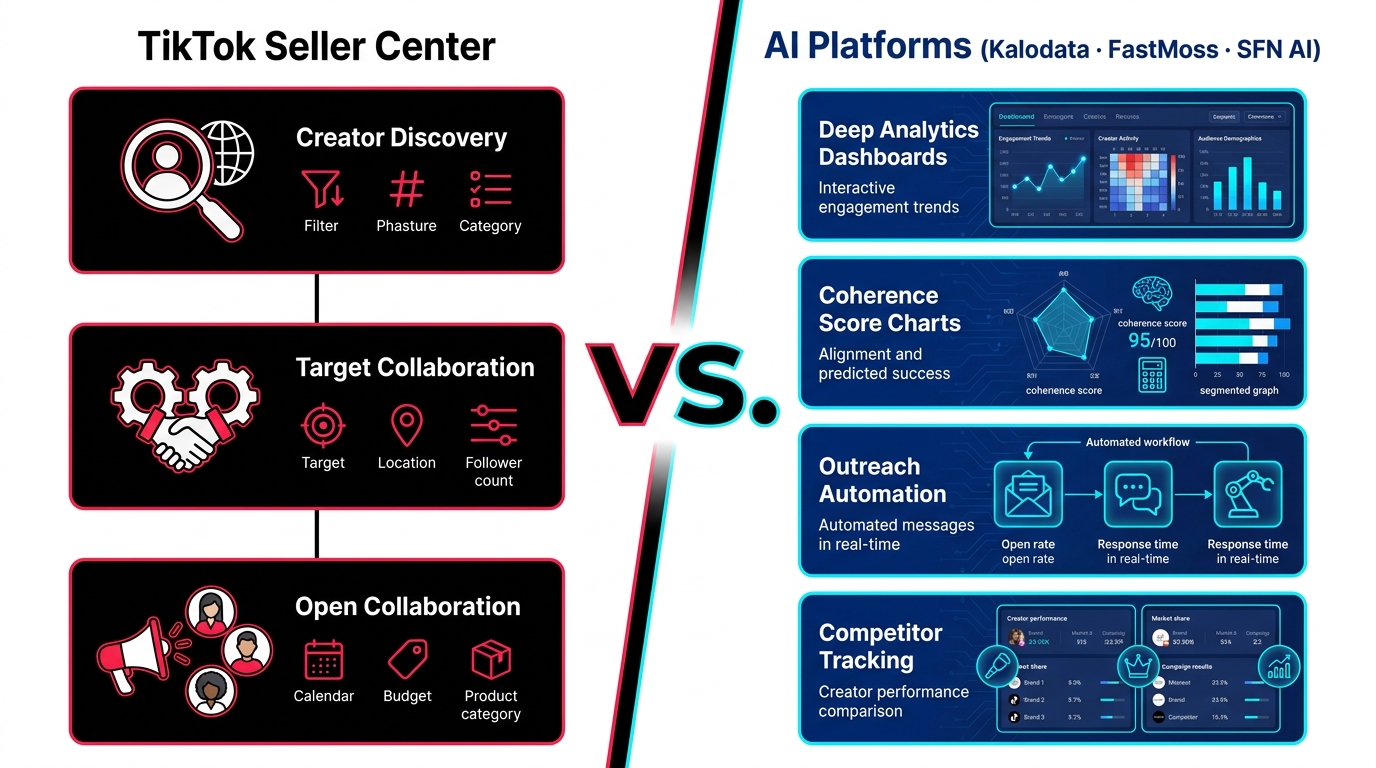
TikTok’s own Seller Center provides a starting point for creator discovery that many brands underuse. It’s not a fully automated AI matching system — TikTok has not publicly disclosed a proprietary algorithmic matching engine — but its native tools provide enough signal to execute effective initial filtering, particularly for brands just building their affiliate programs.
Creator Discovery Tool
The Creator Discovery tool in Seller Center allows brands to search for creators by product category, engagement rate, posting frequency, and affiliate performance history. Within approximately 30 minutes of focused filtering, a brand can build an initial shortlist of creators who meet basic eligibility thresholds: minimum 2.5% engagement, three or more posts per week, and demonstrated activity in the relevant product category.
The tool surfaces each creator’s follower count, recent engagement performance, and category affiliation. It’s a useful first pass, but it doesn’t deliver the deeper analytics — category-specific conversion rates, audience demographic breakdowns, competitor affiliate performance — that serious matching requires. Think of it as the entrance to the process, not the whole process.
Target Collaboration vs. Open Collaboration
TikTok Shop’s affiliate collaboration system operates on two distinct modes, and understanding how they interact is important for any brand building a matched creator program.
Open Collaboration makes your products visible to all TikTok Shop-eligible creators at a set commission rate (typically 15–20%). Any creator can choose to promote your product without specific approval. This drives volume and discovery — you get broad affiliate reach without manual outreach. The downside is obvious: you have no control over creator-product fit. Any creator can pick up your product, regardless of whether their audience is remotely likely to buy it.
Target Collaboration flips the dynamic. You identify specific creators and invite them to promote specific products, with individually negotiated commission rates (anywhere from 1% to 80%), and in some cases, flat fees alongside commission structures. Critically, Target commission rates supersede Open rates for the same product — meaning if you invite a high-priority creator with a 30% commission, they won’t dilute their incentive by accepting your open rate.
The practical implication: use Open Collaboration for discovery and volume; use Target Collaboration for your matched, high-intent partnerships. The best-performing brands operate both simultaneously, using broad open coverage to identify which creators are self-selecting to promote their products (often revealing organic fit they hadn’t anticipated), then moving top performers into targeted, higher-commission relationships.
The Affiliate Marketplace and Product Samples
TikTok’s Affiliate Marketplace allows sellers to offer free product samples to creators who request them. This is an important matching signal that gets overlooked: which creators proactively request your samples? A creator who comes to you, unsolicited, because they genuinely want to try your product, is showing something no algorithm can manufacture — authentic product interest. That intrinsic motivation translates into more genuine content, which the TikTok algorithm rewards with better distribution.
Third-Party AI Platforms: Kalodata, FastMoss, and SFN AI Compared
Native Seller Center tools provide a functional starting point, but brands managing active affiliate programs at any meaningful scale need more analytical depth. Three platforms have emerged as the primary third-party options for AI-assisted creator-product matching on TikTok Shop in 2026.
Kalodata: The Researcher’s Platform
Kalodata has built a strong reputation for deep creator analytics, tracking over 200 million creators and providing granular data on follower counts, engagement rates, video-level performance, and basic sales attribution. Its particular strength is product and competitor research — brands can identify which creators are currently generating the most affiliate GMV for competitor products, which provides direct insight into where category-specific conversion authority already exists.
The platform offers hourly data updates and a mobile app, making it practical for teams who need to monitor creator performance in near-real-time. Pricing starts at $19/month, making it accessible for solo sellers or small teams testing initial affiliate outreach with five to ten creators. Its clean UI and video hover preview feature make research efficient without requiring deep technical knowledge.
The limitation: Kalodata is research-focused rather than operationally oriented. It provides the intelligence for matching decisions, but the outreach workflow itself requires manual execution.
FastMoss: The Operator’s Platform
Where Kalodata excels at analysis, FastMoss excels at action. Its creator discovery features are integrated with contact export workflows, allowing teams to build outreach lists directly from within the platform. It also includes AI tools for content and review analysis, product and ad monitoring, and basic matching recommendations based on category performance.
FastMoss is better suited to agencies or larger brand teams who are running active outreach campaigns at scale — reaching dozens or hundreds of creators per month — and need the operational infrastructure to manage contact workflows alongside performance data. Pricing starts at $39/month, with higher tiers for teams managing larger creator networks.
SFN AI: The Content Intelligence Platform
SFN AI takes a fundamentally different approach from the other two platforms. Rather than focusing primarily on creator discovery and contact management, SFN AI’s core differentiator is content pattern analysis — specifically, its Coherence Scoring system, which evaluates how closely a creator’s content aligns with the patterns that drive high conversion rates in specific product categories. Pricing ranges from a free tier through to $1,997/month for enterprise-level creator intelligence.
For brands who want to understand not just who converts but why they convert — and how to predict future performance based on content quality rather than historical GMV alone — SFN AI’s analytical approach provides a dimension of intelligence the other platforms don’t replicate.
Coherence Scoring: The Metric That Predicts Performance Before a Post Goes Live
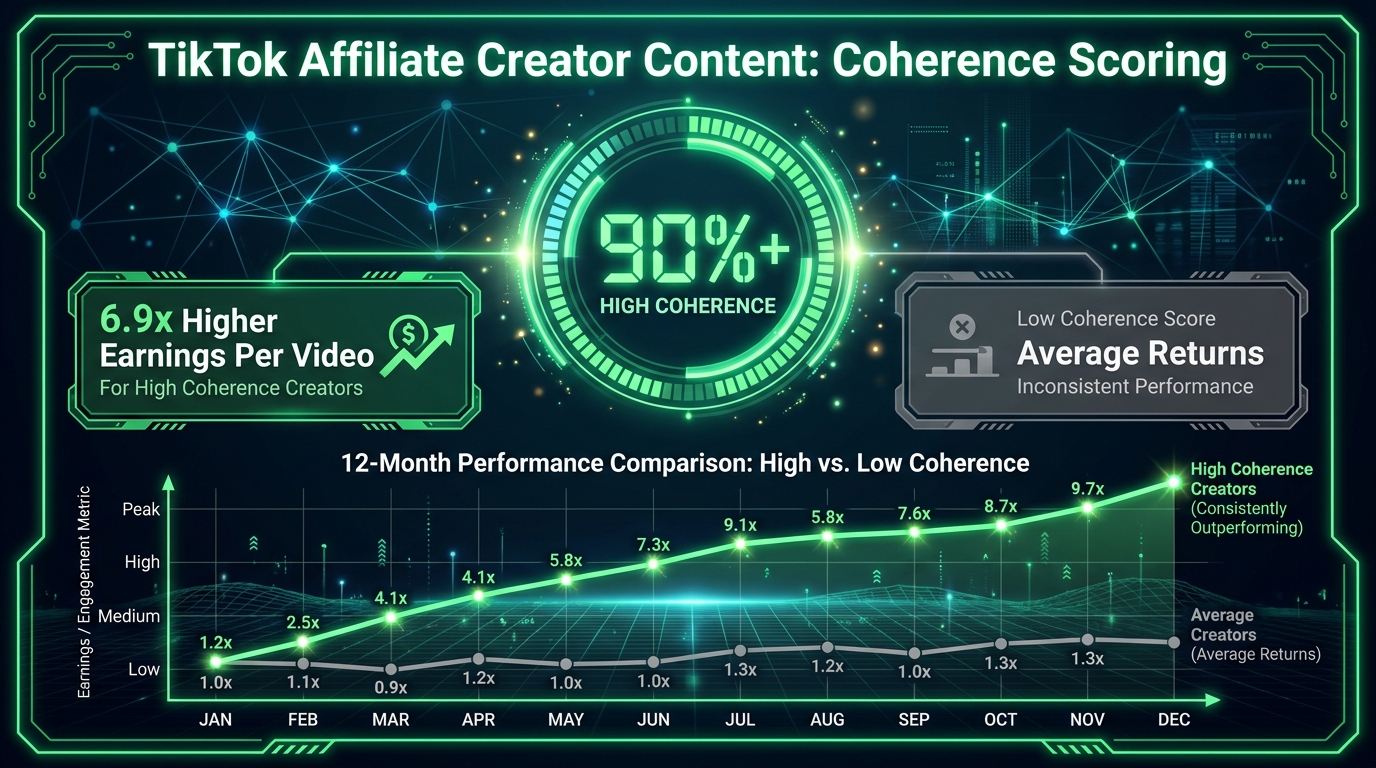
Of all the metrics discussed in creator-product matching, coherence scoring is the most forward-looking — and the most underutilized. Most matching frameworks are retrospective: they look at what a creator has earned in the past and assume similar performance in the future. Coherence scoring tries to answer a different question: given the way this creator constructs their content, how likely are they to generate high conversions on a specific type of product?
How Coherence Scoring Works
SFN AI’s implementation of Coherence Scoring analyzes a creator’s video content against a set of high-conversion patterns identified across the platform’s historical affiliate data. These patterns include structural elements — how quickly the hook is established, how clearly the product benefit is demonstrated, whether there’s a compelling call to action — as well as contextual elements like the emotional tone of the content, the consistency of the creator’s messaging style, and whether the product presentation aligns with the creator’s established content voice.
Creators who score 90% or above on this coherence measure achieve 6.9x higher earnings per video than lower-scoring creators in the same category. That multiplier is significant enough to fundamentally change how brands should think about creator selection. A creator with a 92% coherence score and 50,000 followers can reliably outperform a creator with a 65% coherence score and 500,000 followers when it comes to actual affiliate revenue generated.
What Coherence Scoring Captures That Engagement Metrics Miss
Engagement rates measure audience response to content in general. Coherence scores measure how effectively content is structured to drive a specific commercial outcome. A creator might have excellent engagement because they’re funny, relatable, or emotionally compelling — but if their product presentation is rushed, unclear, or disconnected from their typical content style, it won’t convert. Coherence scoring captures the commercial execution quality that underlies affiliate performance.
This matters particularly for brands entering partnerships with creators who have strong general audiences but limited affiliate experience. Coherence scoring can identify which of those creators have content styles that naturally lend themselves to product integration — and which would require significant coaching before their affiliate content could perform at the level their general metrics suggest.
Applying Coherence Scoring in a Matching Workflow
Practically, coherence scoring works best as a filtering layer applied after initial discovery. The process: use Creator Discovery or FastMoss to build a shortlist of 50–100 creators who meet niche, engagement, and posting frequency thresholds. Then apply coherence scoring analysis to that shortlist to identify the 15–20 who demonstrate not just the right audience, but the right content execution style. Those are the creators worth the investment of samples, Target Collaboration invites, and higher commission rates.
“The brands that get creator matching right in 2026 aren’t the ones with the biggest outreach budgets — they’re the ones who know exactly which signals to prioritize before they spend a single dollar on samples or commissions.”
Micro vs. Macro: How Creator Tier Changes the Matching Equation
One of the most consequential decisions in building a TikTok affiliate creator roster isn’t which specific creators to partner with — it’s which tier of creators to prioritize. The micro vs. macro debate has been ongoing in influencer marketing for years, but TikTok’s affiliate dynamics give it a specific, data-backed answer that most brands still haven’t fully incorporated.
The Case for Micro-Creators in Affiliate Matching
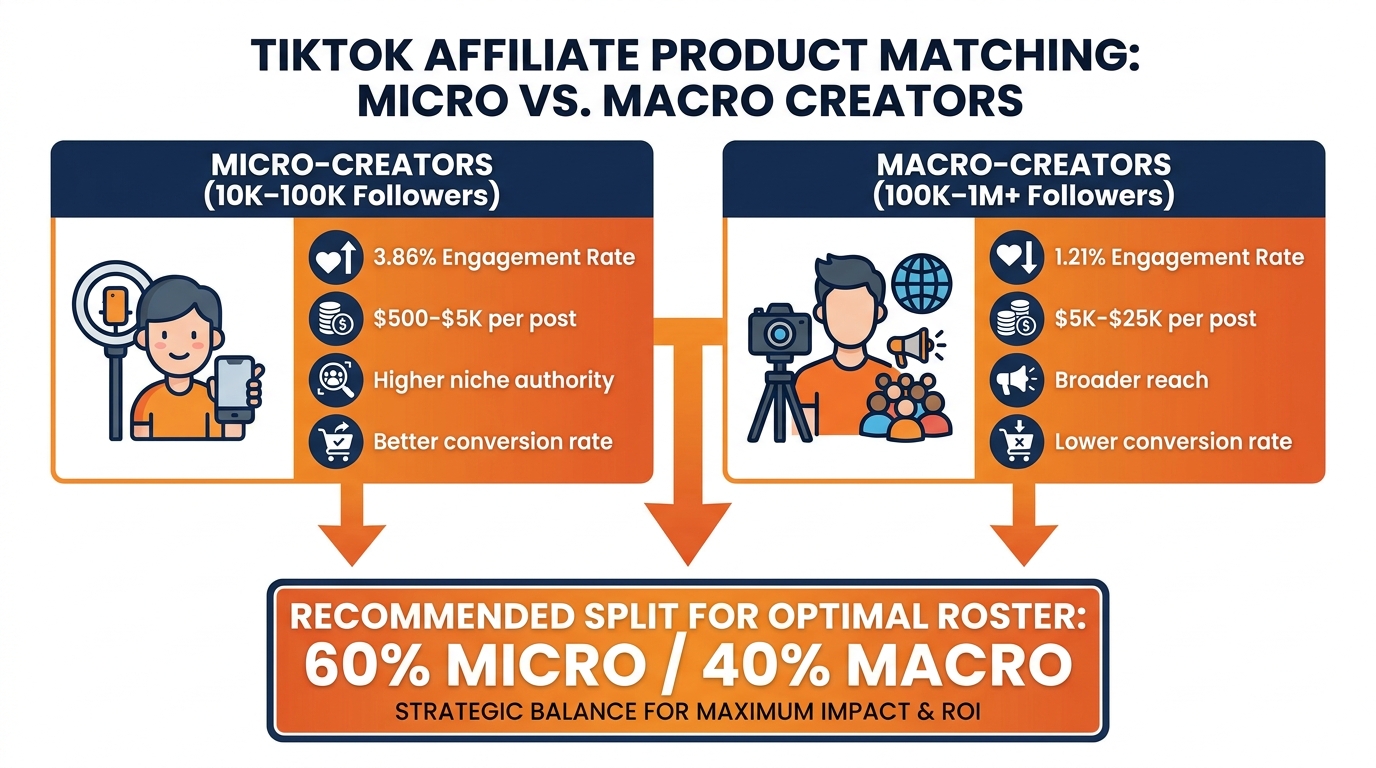
Micro-creators on TikTok — those with roughly 10,000 to 100,000 followers — deliver engagement rates of approximately 3.86% on average. At the nano level (1K–10K), that rate climbs to 20.64%. For context, macro-creators (100K–1M+) average around 1.21%. The engagement gap is dramatic, and it has a direct commercial implication: the audience of a micro-creator is more actively engaged, more responsive to recommendations, and more likely to take action.
Cost is the other side of the equation. Micro-creators typically cost $500–$5,000 per sponsored post, compared to $5,000–$25,000 or more for macro-creators. At 60% lower cost per post with materially higher engagement rates and conversion efficiency, the ROI math on micro-creator partnerships is straightforward — for brands who’ve done the matching work to identify the right micro-creators for their product.
The crucial qualifier: micro-creator efficiency depends entirely on niche specificity. A micro-creator in the exact right niche is extraordinarily valuable. A micro-creator in a tangentially related niche delivers the same weak conversion rates as a mismatched macro-creator, at a fraction of the reach. Micro-creator programs only outperform when matching rigor is high.
Where Macro-Creators Still Belong in the Mix
Macro-creators bring something micro-creators genuinely can’t replicate: rapid reach at scale. For product launches where brand awareness needs to spike quickly, for creating cultural moments around a new product category, or for reaching audiences in geographic markets where micro-creator density is low, macro-creators serve a legitimate strategic function.
The key is deploying macro-creators for reach objectives rather than conversion objectives. Track their impact on brand search volume, on direct traffic to your TikTok Shop, and on the downstream lift they generate for micro-creator content that follows. A macro-creator post that introduces a product to 500,000 people can prime the audience for conversion when they encounter a micro-creator’s more detailed review content a week later.
Building the Optimal Roster Mix
Research and practitioner consensus points toward a 60/40 split as an effective starting structure for TikTok affiliate rosters: 60% micro/mid-tier creators for niche authority and direct conversion, and 40% macro-creators for reach and brand-building. For brands launching new products with limited brand recognition, weighting more heavily toward macro-creators in the initial phase and transitioning toward micro-creator dominance as the product gains traction is a sensible phased approach.
The roster size itself matters. Starting with 10–30 creators — diverse across micro and macro tiers — allows for meaningful performance data collection without overwhelming outreach and management capacity. As performance data accumulates, the roster can be optimized: doubling down on high performers, adjusting commission structures for the top tier, and cycling out low converters systematically.
Building Your Matching Framework: A Systematic Process
Effective creator-product matching isn’t a one-time exercise. It’s a repeatable system — a defined workflow that produces consistent, data-backed decisions rather than gut-feel selections that are difficult to evaluate or improve. Here’s how to build that system.
Step 1: Define Your Product’s Matching Profile
Before you touch a single creator analytics tool, define your product’s ideal matching criteria in explicit terms. Answer these questions: What content category most naturally houses this product? Who is the specific demographic most likely to buy it? What visual demonstration format suits it best (before/after, unboxing, tutorial, testimonial)? Which competitor products are already performing well on TikTok, and which types of creators are promoting them?
That last question is particularly valuable. Competitor affiliate analysis — available through both Kalodata and FastMoss — tells you which creator types have already demonstrated conversion ability for similar products. You’re not guessing at fit; you’re observing it in market data.
Step 2: Initial Discovery and Filter Pass
Use TikTok Seller Center’s Creator Discovery tool or a third-party platform to build an initial longlist. Apply these filters as a baseline: minimum 2.5% engagement rate, three or more posts per week, primary content category matching your product domain, and some affiliate history in the relevant category. This typically produces a longlist of 50–200 creators, depending on how competitive and developed your category is.
Step 3: Deep-Signal Analysis on the Shortlist
Reduce the longlist to a working shortlist of 30–50 creators through deeper analysis. At this stage, pull category-specific conversion data, audience demographic breakdowns, revenue per follower in your category, and comment sentiment patterns. Flag creators who have high niche concentration (90%+ content in the relevant category), above-average category-specific GMV, and positive purchase-intent comment patterns.
Step 4: Coherence Score Assessment
For the final shortlist, assess content coherence — either through SFN AI’s proprietary scoring or by manually evaluating how well each creator’s video structure, hook quality, product integration style, and call-to-action clarity align with what’s known to drive conversions in your category. Prioritize creators scoring in the high-coherence range, and note any who have strong general metrics but lower coherence — they may need content guidance before their affiliate posts will perform.
Step 5: Tiered Outreach and Onboarding
Structure your outreach in tiers. Lead with product sample offers for your highest-priority matches — let the product make the first impression. Follow with Target Collaboration invites for those who engage with the sample positively, with commission structures set at 10–30% for mid-tier creators and potentially higher for proven top performers in your category. Use Open Collaboration running in parallel to catch any self-selecting creators you didn’t identify in your research.
Step 6: Performance Monitoring and Roster Iteration
Define clear performance thresholds before outreach begins. A creator who hasn’t driven meaningful GMV within 60 days of posting isn’t likely to improve without significant intervention. Set automatic review triggers at 30, 60, and 90 days. Move high performers into enhanced commission tiers and deeper partnership structures. Cycle out chronic underperformers. The roster should be a living system, not a static list.
What Creator-Product Mismatches Actually Cost You in 2026
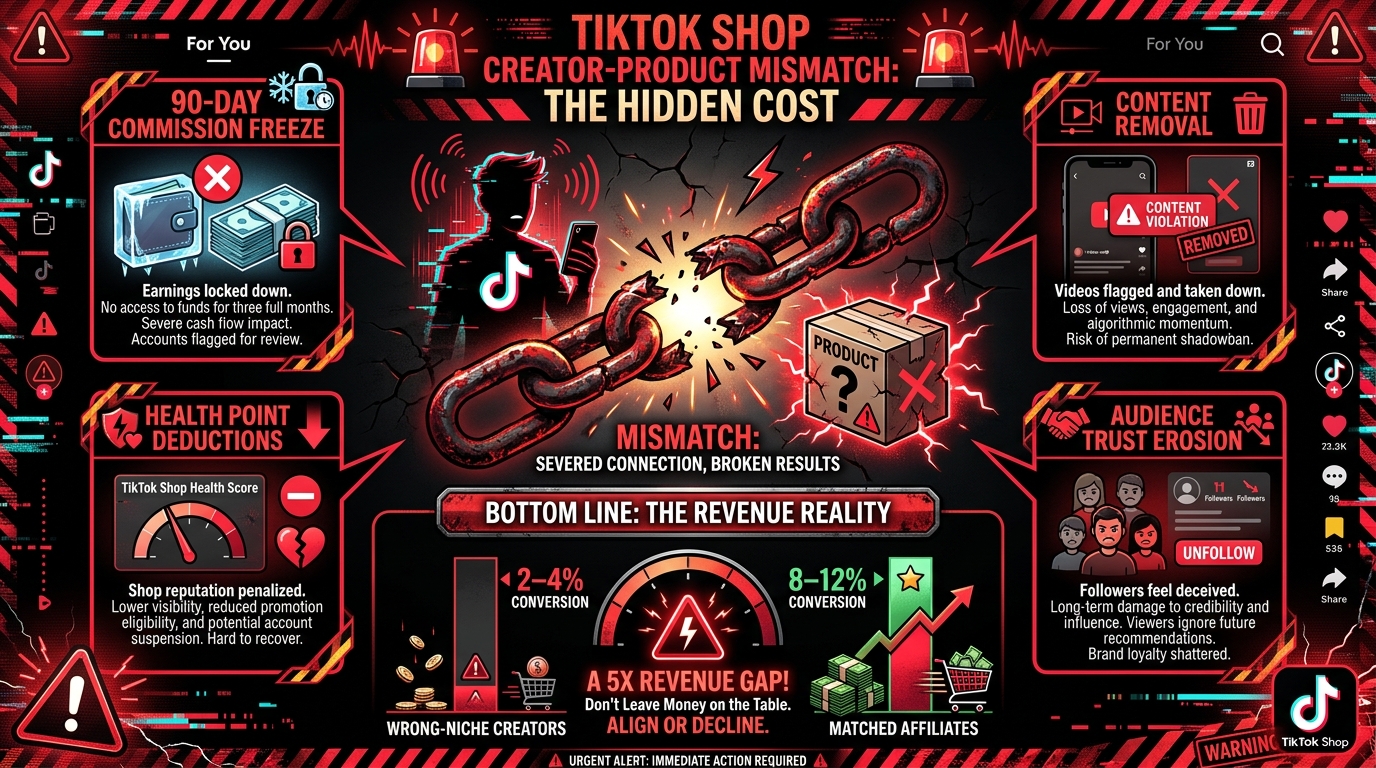
Mismatched creator-product partnerships are not just inefficient — they carry specific, material costs that have become significantly more serious as TikTok has scaled its enforcement infrastructure alongside its GMV growth.
The Conversion Gap
The most direct cost is performance-based. Open Collaboration with random creator self-selection averages a 2–4% conversion rate. Properly matched, niche-aligned Target Collaboration reaches 8–12% in high-fit categories like beauty and wellness. That gap represents real, calculable revenue loss: if you’re running a $100,000 GMV affiliate program on mismatched creators converting at 3%, proper matching that gets you to 9% represents an additional $200,000 in affiliate-driven revenue from the same program investment.
Policy Violations and Commission Penalties
TikTok’s enforcement systems have become substantially more aggressive in 2026, scaling alongside the platform’s GMV growth. Creator-product mismatches — where a creator’s video content doesn’t align with the listed product’s description, visuals, or demonstrated features — trigger specific violation categories with serious commercial consequences.
Creators found in violation of the Inconsistent Product Promotion policy can face 90-day commission freezes. Severe or repeated violations can affect all of a creator’s pending commissions across all their affiliate products, not just the offending one. For brands, this means mismatched partnerships don’t just underperform — they can actively damage your affiliate program’s reputation and creator relationships if enforcement actions erode creator trust in your brand’s product listings.
Health Points and Long-Term Shop Access
TikTok Shop operates a Creator Health Points system that tracks policy compliance. Creators accumulating health point deductions from violations face progressive restrictions — reduced affiliate visibility, temporary suspension from the affiliate program, and in extreme cases, permanent loss of TikTok Shop affiliate access. Brands that repeatedly send products to mismatched creators who then produce policy-violating content are indirectly contributing to the erosion of their creator pool.
Audience Trust Erosion
The most insidious cost of creator-product mismatch is the erosion of audience trust — which compounds over time. When a creator’s audience repeatedly encounters product recommendations that feel incongruent with the creator’s established content identity, they become more skeptical of that creator’s recommendations in general. That skepticism doesn’t respect category boundaries: it bleeds into the creator’s entire commercial relationship with their audience. Well-matched partnerships, by contrast, reinforce creator authority and make future recommendations more credible and effective.
The Future of AI Matching: Where the Technology Is Heading
The creator-product matching tools available in 2026 represent the early stage of a technology arc that has several clear development directions. Understanding where AI matching is heading helps brands make better tool investment decisions today — and design affiliate program architectures that will remain competitive as the technology evolves.
Real-Time Dynamic Matching
Current AI matching systems are largely retrospective — they analyze historical performance data to make predictions about future partnerships. The next development wave is toward real-time dynamic matching: systems that continuously monitor creator performance, audience composition changes, emerging product trends, and competitive activity to update matching recommendations dynamically. A creator whose audience shifts — due to a viral moment that brings in a new demographic, for example — would trigger an automatic re-evaluation of which products they’re suited to promote.
Predictive Content Performance Modeling
Beyond coherence scoring — which evaluates existing content patterns — the emerging capability is predictive content performance modeling: AI systems that simulate how a specific creator’s content style would perform with a specific product, before any content is produced. This involves analyzing the creator’s structural patterns (hook timing, pacing, call-to-action placement) against the product’s category performance data to produce a probability distribution of performance outcomes.
Sentiment-Driven Commission Optimization
Commission structures in TikTok Shop are currently set manually — brands decide what rates to offer, and creators accept or negotiate. AI-driven commission optimization — which uses purchase-intent sentiment data, category conversion benchmarks, and creator-specific performance predictions to dynamically recommend optimal commission rates — is an active development area. The goal is eliminating both overpayment (commissions higher than necessary to secure a partnership) and underpayment (commissions too low to attract the highest-fit creators).
Cross-Platform Fit Analysis
TikTok remains the dominant short-form commerce platform in 2026, but creator audiences don’t exist only on TikTok. Increasingly, AI matching tools are incorporating cross-platform audience analysis — evaluating how a creator’s YouTube, Instagram, and TikTok audiences overlap, and whether purchase-intent signals are consistent across platforms. This matters particularly for brands that run multi-channel affiliate programs, where creator fit on TikTok should ideally complement, not conflict with, their presence on other platforms.
Building Matching Into Your Program Architecture — Not Bolting It On
The brands that achieve genuinely superior affiliate performance in 2026 share a common structural characteristic: they treat creator-product matching as a core program discipline, not an afterthought applied after outreach has already begun. This distinction shows up in how they allocate resources, how they define success metrics, and how they build feedback loops from performance data back into their matching criteria.
Dedicated Matching Intelligence
Effective programs designate explicit responsibility for matching quality. Whether that’s a dedicated role, a defined workflow within a marketing team, or a tool stack with clear ownership, the function of evaluating creator fit before outreach and of learning from performance data after campaigns must be owned by someone. Programs without that ownership default to follower-count-based selection by default — because it’s the easiest thing to measure and the hardest to argue against without data.
Feedback Loop Construction
The most powerful aspect of data-driven matching isn’t what it tells you before a partnership begins — it’s what it tells you after a campaign runs. Did the creators who scored highest on coherence metrics actually outperform? Did the predicted conversion rates materialize? Were there categories or product types where the matching criteria needed recalibration? Building a formal feedback loop — where post-campaign performance data is explicitly compared against pre-campaign predictions and used to refine the matching model — compounds matching quality over time.
Portfolio Thinking Over Individual Partnerships
The most sophisticated brands don’t think about creator matching as a series of individual partnerships — they think in portfolio terms. A well-constructed creator portfolio includes different tiers, different content styles, different audience demographics, and different product focuses, with each creator serving a defined role in the overall program architecture. Some creators build brand awareness at scale. Others drive direct conversion in core SKUs. Others test emerging product lines in niche communities. That portfolio diversification is only possible when matching is systematic enough to identify which creators belong in which role.
Conclusion: Fit Is a Discipline, Not a Guess
The fundamentals of TikTok affiliate marketing have always been simple: find creators whose audiences want to buy what you’re selling, and make it easy for those creators to tell that audience about your product compellingly. But “simple” has never meant “easy to execute.” The explosion of available creator data, the sophistication of AI matching tools, and the stakes involved in a platform generating over $112 billion in annual GMV have raised the bar for what “doing it right” actually requires.
In 2026, creator-product matching is no longer a soft creative judgment. It’s an applied data science problem with measurable inputs, predictable outputs, and quantifiable costs when done poorly. The brands that treat it as such — who build matching frameworks, apply coherence-level analysis, construct tiered portfolios, and iterate based on performance feedback — will consistently outperform those who continue to lead with follower counts and instinct.
The conversion gap between matched and mismatched creator partnerships isn’t narrowing. If anything, as TikTok’s algorithm becomes more sophisticated and its enforcement more rigorous, the advantage of precision matching compounds. Fit isn’t a nice-to-have anymore. It’s the baseline requirement for competitive affiliate performance.
Actionable Takeaways
- Stop filtering by follower count first. Lead with niche alignment, category-specific GMV, and purchase-intent signals. Follower count is a secondary metric at best.
- Run both Open and Target Collaboration simultaneously. Use Open to discover self-selecting organic fits; use Target to invest in your highest-match creators at elevated commission rates.
- Apply coherence scoring to your shortlist. Platforms like SFN AI can identify which creators’ content structures are likely to convert before any partnership spend is committed.
- Build a 60/40 micro-to-macro roster split as a starting point, with micro-creators focused on niche authority and conversion, and macro-creators deployed for reach and brand-building.
- Define performance thresholds before outreach. Know exactly what 30-, 60-, and 90-day performance looks like for a successful partnership, and have an iteration plan ready before you start.
- Treat matching as a feedback loop. Every campaign produces data. Build a formal process for comparing predicted performance against actual outcomes and using the gap to refine your matching criteria.
- Prioritize product TikTok-ability as a pre-matching filter. No creator match can save a product that can’t be demonstrated compellingly in 15–60 seconds. Clear that bar before you build a creator roster around it.