

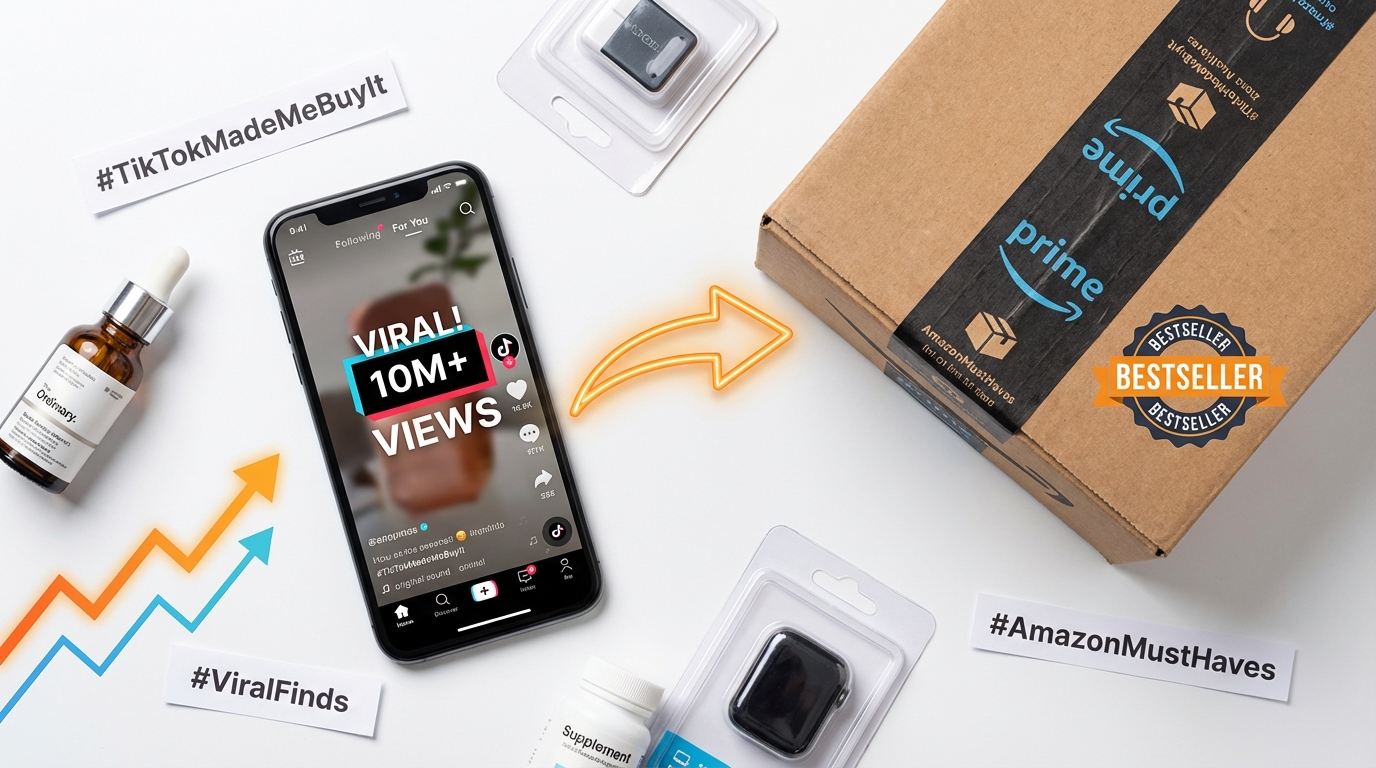

Most Amazon FBA sellers still treat TikTok as a marketing channel — somewhere to post product videos and hope for traffic. That framing is costing them real money.
The sellers quietly winning in 2026 understand something different: TikTok is a demand intelligence system. It tells you what people want before those people have consciously formed a search query on Amazon. It maps shifting consumer psychology in real time. And it gives you a narrow but very real window to source, list, and rank a product before the market catches up.
This is not about chasing viral trends and panic-ordering from Alibaba. It’s about understanding the mechanics of how TikTok trend cycles work, which phases of those cycles produce actionable FBA signals, and how to build a repeatable process that converts social attention into product launches with measurable ROI.
By 2026, TikTok’s US social commerce sales have reached $23.4 billion — up 48% year over year — representing a significant share of the $100.99 billion US social commerce total. Meanwhile, 53% of online shoppers now report discovering products via social media before searching for them anywhere else. Among Gen Z, TikTok has displaced Google as the primary product discovery engine entirely.
That shift has consequences for FBA sellers that go well beyond “post more content.” It changes how demand originates, how quickly it scales, and how long a product opportunity window actually stays open. This post breaks all of that down, with a specific focus on timing, positioning, and the validation steps that separate disciplined product launches from expensive gambles.
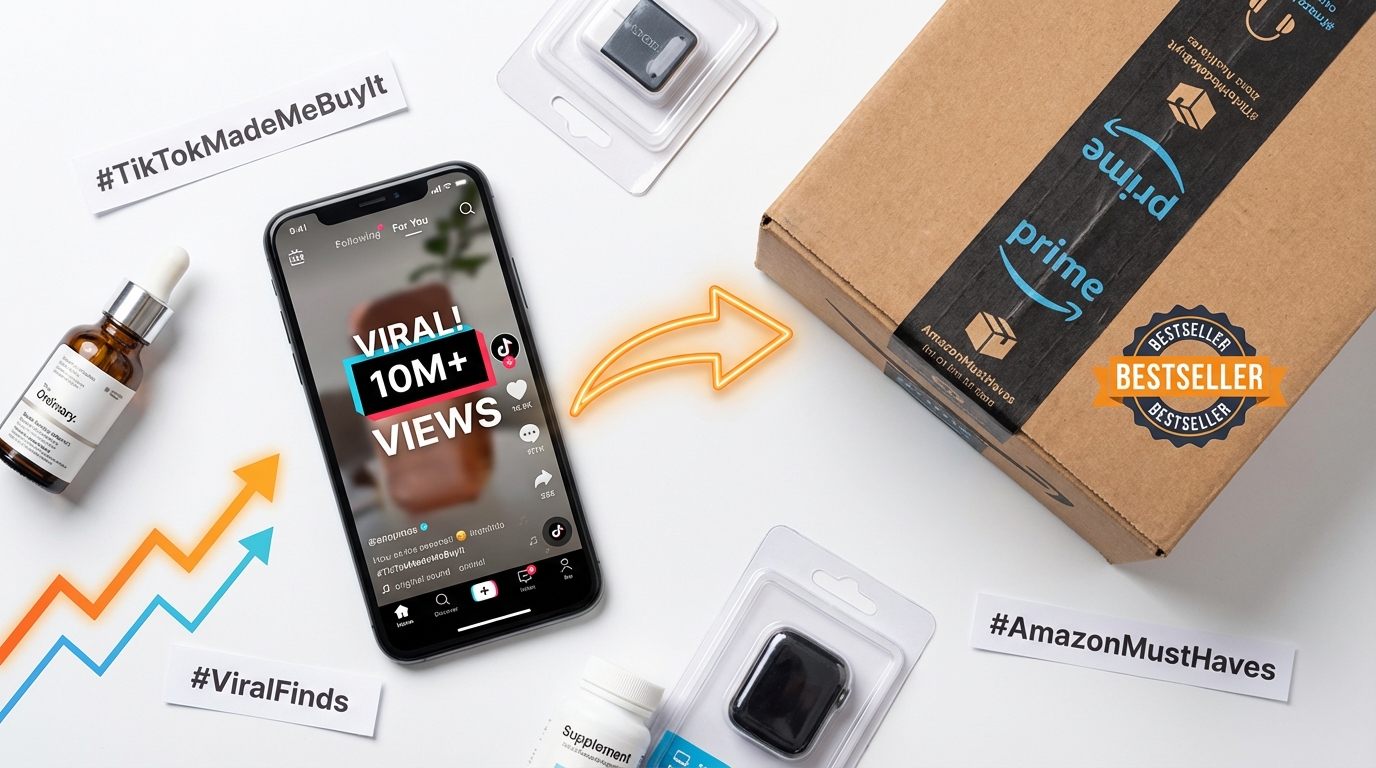
Why TikTok Is Now the Most Reliable FBA Demand Signal — Not Just Another Channel
Traditional FBA product research starts with Amazon. You open a tool like Helium 10 or Jungle Scout, search for keywords with decent volume and manageable competition, and try to find something that fits your margins. The problem with that approach in 2026 is that you’re always looking at lagging data.
Amazon search volume reflects demand that has already formed. By the time a keyword consistently registers 20,000+ monthly searches, the product category has likely already attracted dozens of competitors. You’re not entering an emerging market — you’re entering a saturated one and hoping to out-optimize it.
TikTok operates differently. When a creator posts an organic video demonstrating a product and that video gains 200,000 views with hundreds of comments asking “where can I get this?” or “is this on Amazon?” — that’s pre-search demand. The desire exists. The purchase intent exists. But the search behavior on Amazon hasn’t caught up yet. That’s the gap FBA sellers need to be living in.
The Demand Formation Timeline
Research on TikTok-to-Amazon crossover patterns consistently shows a 4-to-8-week lag between significant TikTok video virality and measurable Amazon search volume increases for the same product or product category. The timeline tends to work like this:
- Week 0–1: A creator posts an organic product demo. Early engagement signals (watch time, saves, shares) indicate above-average interest.
- Week 1–2: The TikTok algorithm amplifies the video. More creators pick up the format or product. Hashtag volume begins climbing.
- Week 2–4: Consumer behavior shifts. Viewers start searching for the product on Amazon. Branded searches and category keywords begin showing increased volume in Amazon’s Search Query Performance (SQP) data.
- Week 4–8: Amazon search volume peaks. Products with existing listings benefit from increased external traffic signals, which improve organic ranking. Sellers who moved early are already indexed and ranking.
- Week 8–12: The category attracts new entrants. Competition rises. The price compression phase begins.
The sellers who win consistently are operating in weeks 2 through 5. That’s the window where demand is real and verified but competition hasn’t yet flooded in. Getting there requires treating TikTok not as a passive feed but as an active research environment — something you’re systematically monitoring and translating into sourcing decisions.
Why Amazon’s Own Data Can’t Give You This Edge
Amazon’s algorithm update in late 2026 has shifted ranking factors increasingly toward shopper intent signals rather than pure sales velocity. This means external traffic — including traffic from TikTok — now carries more weight in organic ranking than it did in previous years. Products that receive genuine external interest from TikTok-driven branded searches gain a compounding advantage: they rank higher, get more organic impressions, and accumulate reviews faster.
Understanding TikTok as a demand signal doesn’t just help you find products. It also gives you a mechanism to accelerate ranking on the products you’ve already launched.
Anatomy of a TikTok Trend Cycle: The Four Phases FBA Sellers Must Map
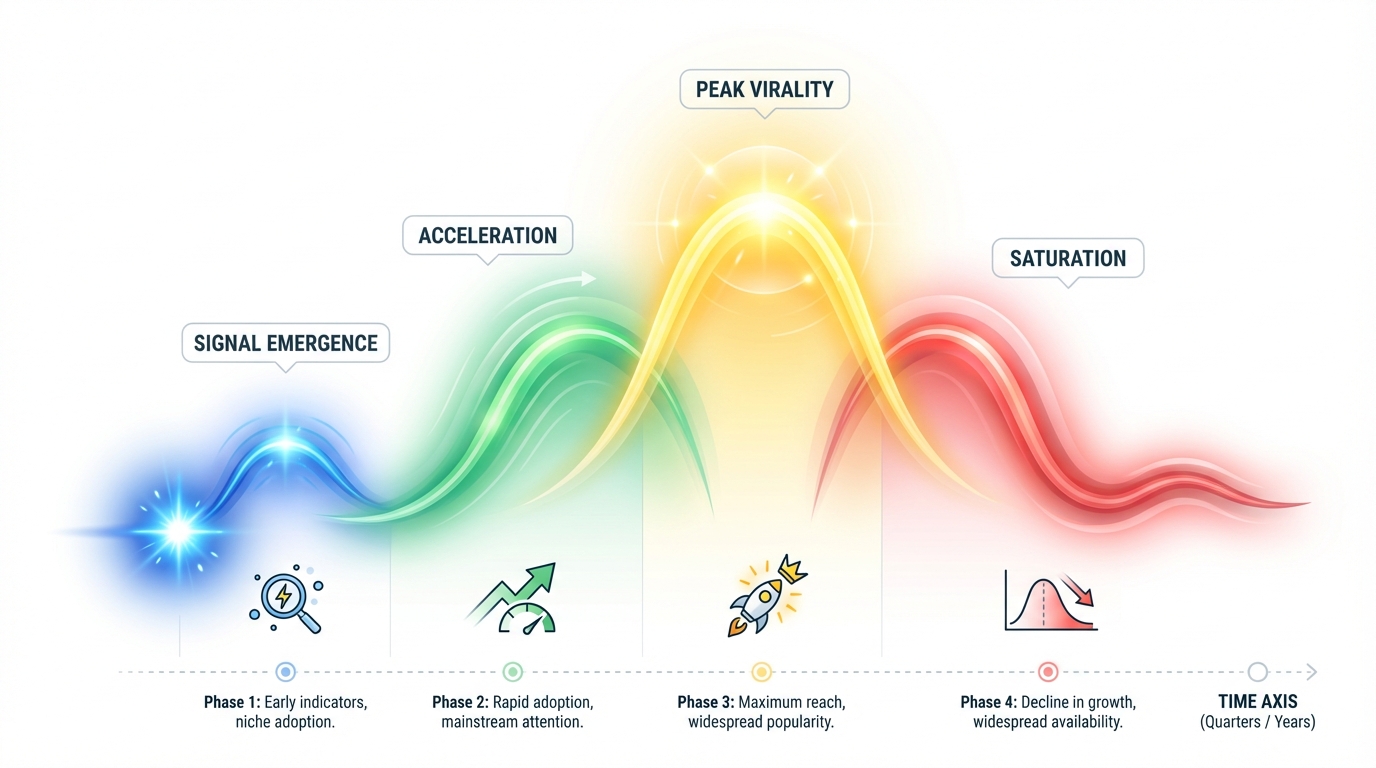
Not all TikTok trends are created equal for FBA purposes. Some spike and disappear within a week. Others represent the early surface of a multi-month category shift that will sustain Amazon sales for a year or more. Distinguishing between them requires understanding the four distinct phases of a TikTok trend cycle.
Phase 1: Signal Emergence
This phase is characterized by a small number of creators — typically under 20 — posting around a specific product, ingredient, technique, or concept. Video view counts are not yet spectacular (often 50,000 to 150,000), but the engagement ratios are unusually high. Saves and shares relative to views are the most important signals here, because they indicate that viewers intend to return to the content — a strong proxy for purchase intent.
Comments are also informative. At the signal emergence phase, you’ll see a mix of curiosity (“what is this?”), validation-seeking (“does this actually work?”), and early desire (“I need this”). The absence of negative comments or skepticism is a positive indicator. For FBA research, this phase represents the highest opportunity and the highest uncertainty — you have the most lead time but the least evidence of sustained demand.
Phase 2: Acceleration
Acceleration begins when the original content format is being replicated. Other creators — often with larger followings — are posting similar videos. The product or concept has a consistent hashtag or set of hashtags that is growing daily. View counts on individual videos have climbed past the 500,000 threshold, and aggregate views across all content in the niche are in the millions.
This is the sweet spot for FBA sellers who already have supplier relationships and fast sourcing pipelines. The demand signal is strong enough to validate, but the Amazon search volume spike hasn’t materialized yet. A seller who places a purchase order in Phase 2 and has inventory landed in 3-4 weeks will typically arrive just as Amazon search is peaking.
Phase 3: Peak Virality
Peak virality is when a product enters mainstream TikTok consciousness. The original hashtag has hundreds of millions of views. Major influencers are covering the product. News articles appear with titles like “TikTok’s latest obsession is…” Amazon search volume has now spiked significantly, and existing listings are seeing dramatic BSR (Best Seller Rank) improvements.
For sellers who aren’t already ranking, Phase 3 is a difficult entry point. You’re competing against sellers who got in earlier and have accumulated reviews and ranking velocity. Phase 3 is also when suppliers raise prices in response to demand spikes. That said, Phase 3 still presents opportunities in adjacent products and bundles — items that serve the same customer need but aren’t experiencing the same level of direct competition.
Phase 4: Saturation
Saturation occurs when the product category has attracted more sellers than the market can support at healthy margins. Review counts are climbing across multiple competing listings. Prices are compressing. PPC costs have risen as everyone bids on the same keywords. For most FBA sellers, Phase 4 is the wrong time to enter — but it can be the right time to exit inventory or shift strategy toward the next cycle.
Understanding where a trend sits in this four-phase model determines every subsequent decision: whether to source, how much inventory to commit, what price point to target, and when to scale down.
TikTok’s 2026 Behavioral Shifts and What They Mean for Product Selection
TikTok’s own research team publishes annual trend forecasts that have become surprisingly useful for FBA product selection — not because they predict specific products, but because they map shifts in consumer psychology that determine which product categories will gain traction.
The 2026 TikTok Next trend report identified three macro behavioral shifts that are actively reshaping what types of products perform on the platform. Understanding these isn’t optional — it’s the difference between sourcing products that align with where consumer attention is moving and sourcing products that fit where it used to be.
Reali-TEA: The Collapse of Polished Aspiration
TikTok’s data shows audiences are actively rejecting fantasy-forward, perfectly produced content in favor of grounded, honest, real-life product experiences. This is what TikTok calls “Reali-TEA” — a cultural shift toward radical honesty, visible imperfection, and product stories that acknowledge trade-offs and real use cases.
For FBA product selection, this has a direct implication: products that solve genuine, specific, relatable problems are dramatically outperforming products positioned purely on aspiration or aesthetics. A skincare product that shows real before-and-after results over 30 days — with the bumpy weeks included — converts better than one that promises a glow with no evidence. A kitchen gadget that a real person demonstrates actually using (including the messy bits) drives more purchase intent than a polished product render.
This means when you’re scanning TikTok for product signals, prioritize content where the creator is solving an obvious, relatable problem rather than just showing off a product. The more mundane and specific the problem — the better. Those products have longevity on Amazon because they serve consistent real-world need, not just social trend appetite.
Curiosity Detours: The Rise of Intentional Discovery
TikTok is observing a major shift away from passive, algorithmic content consumption toward what it calls “Curiosity Detours” — users actively searching TikTok the way they once searched Google, going deep into niche rabbit holes to educate themselves on products, ingredients, techniques, and comparisons.
For FBA sellers, this is significant for two reasons. First, it means TikTok’s search function is increasingly generating high-intent discovery, not just the main feed. Products that show up in TikTok search results for educational queries (“does kojic acid actually work,” “best iron skillet 2026,” “how to fix dry cuticles”) are reaching buyers with formulated intent, not just casual scrollers.
Second, it means niche products with an educational angle have a disproportionate advantage. A supplement with a clear mechanism of action that can be explained in 60 seconds of genuine content is better positioned than a generic wellness product with vague benefits. When evaluating product opportunities, ask: does this product have an interesting “why it works” story that creators can authentically explore? If yes, it has strong Curiosity Detours potential.
Emotional ROI: The New Purchase Justification Framework
TikTok research shows buyers are increasingly running a mental ROI calculation before purchasing — but one that weights emotional value heavily. Shoppers aren’t just asking “is this worth the money?” They’re asking “will this make me feel better about myself, my home, my routine, my relationships?” and using creator content to pre-validate that emotional payoff.
This directly affects which products gain viral traction. Products that deliver an immediate, visible, emotionally satisfying result — a room that looks transformed, a before-after on skin, a solution that removes daily friction — generate the kind of content that drives emotional ROI cycles. For FBA sellers, this means prioritizing products where the transformation is demonstrable, the use case is relatable, and the emotional benefit is specific (not generic “feel good”).
The Crossover Window: How 4–8 Weeks Separates Winners from Late Arrivals
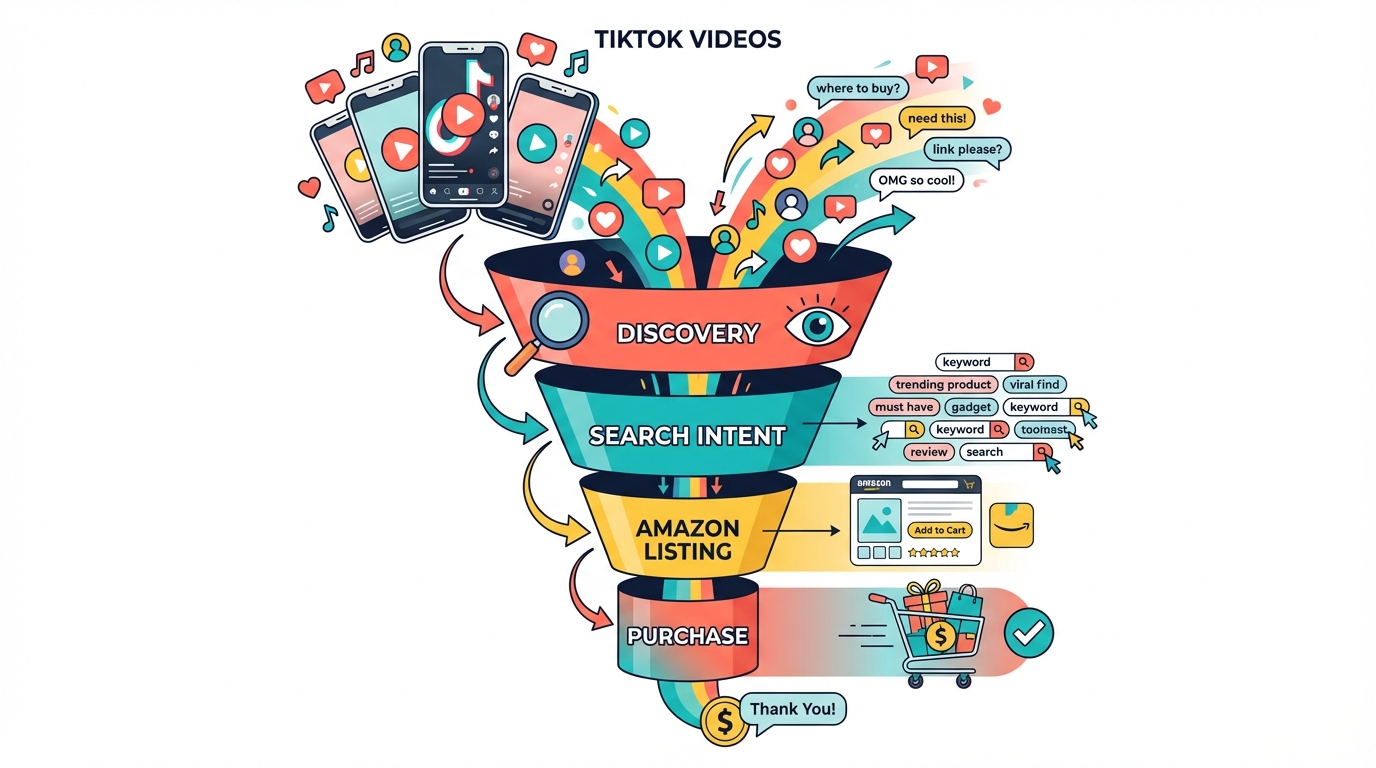
The “crossover window” is the period between when a TikTok trend generates measurable demand signals and when that demand fully materializes as Amazon search volume. It is, functionally, the most important concept in TikTok-to-FBA strategy — and most sellers miss it entirely.
Why the Window Opens
Consumer behavior on TikTok moves faster than consumer behavior on Amazon. When someone sees a product on TikTok and feels purchase intent, they might save the video, add it to a wishlist in their head, mention it to a friend, and then eventually — days or weeks later — search for it on Amazon or Google. This time-lag is structural, not incidental. TikTok accelerates desire; Amazon is where that desire converts to a transaction.
The crossover window also exists because TikTok’s algorithm disseminates content to non-buyers first. The initial audience for a viral video is people who find the content entertaining. The purchase-intent audience comes in the second and third wave, as the video recirculates and reaches people who are actively in the market for that type of product. That delay creates the opportunity.
Calculating Your Lead Time Requirements
To actually exploit the crossover window, you need to know your own supply chain timeline. A FBA seller with an established supplier relationship and air freight capability might be able to get inventory to an Amazon fulfillment center in 3–4 weeks from the moment they place an order. A seller who needs to source a new supplier, produce a new product, and ship by sea is looking at 10–14 weeks minimum.
That means:
- 3–4 week supply chain: You can act on Phase 2 signals and still arrive before peak Amazon demand.
- 6–8 week supply chain: You need to identify signals in Phase 1 and place orders based on emerging (not confirmed) demand.
- 10+ week supply chain: TikTok trend data is genuinely not reliable enough for new product sourcing decisions — focus instead on using TikTok signals to validate your existing catalog or pre-position inventory in categories you’re already operating in.
This is one of the most overlooked realities in TikTok-FBA strategy content. Advice to “find trending products on TikTok” is useless without accounting for your actual operational timelines. The crossover window doesn’t accommodate wishful thinking about how fast you can move.
The Search Query Performance Bridge
Amazon’s Search Query Performance (SQP) tool — available to brand-registered sellers — is the most direct bridge between TikTok trend identification and Amazon demand confirmation. When you spot a product gaining traction on TikTok, check the SQP data for related keywords weekly. A consistent upward trend in impressions, clicks, and search query volume is the confirmation signal that crossover is occurring.
Sellers who track both TikTok trend momentum and SQP data simultaneously get the earliest possible read on when to execute versus when to wait. A product where TikTok engagement is rising but SQP hasn’t moved yet is an “early” opportunity. A product where both are moving up together is a “now” opportunity. A product where SQP is already at peak is a “late” risk.
High-Signal Categories: Where TikTok Trends Convert to Amazon FBA Wins in 2026
Not every TikTok trend translates into a viable FBA opportunity, and not every product category performs equally when trends do cross over. Based on patterns across 2026 data, certain categories show a consistently higher conversion rate from TikTok virality to sustained Amazon sales.
Beauty and Personal Care
This remains the most reliable category for TikTok-to-FBA conversions, and 2026 hasn’t changed that. Beauty is inherently visual, transformation-oriented, and creator-friendly. The Reali-TEA trend (honest before/afters, ingredient transparency, real skin on real people) has made this category even more accessible for smaller FBA brands who don’t have the budget for studio production.
Specific subcategories gaining traction in 2026 include kojic acid formulations, red light therapy devices, salmon DNA serums, and matte-finish setting products. What these share is a clear mechanism, a visible result, and a compelling creator demonstration format. Products with these three characteristics have the strongest TikTok crossover potential regardless of the specific trend cycle.
Health and Wellness / Supplements
The Micro Ingredients case study is one of the most documented examples of TikTok-to-Amazon FBA success available. Their Vitamin D3+K2 supplement went viral via multiple videos exceeding 20 million views each, resulting in 60,000+ units sold on Amazon in a single month — a 4-5x increase over their previous monthly run rate. Their cumulative TikTok Shop GMV reached $111.7 million.
What made this work was the product’s fit with the Curiosity Detours behavioral shift: TikTok users were actively searching for information about D3+K2 combinations, finding educational content, and converting at high rates because the educational content pre-validated the purchase. For FBA sellers, this points toward supplements with a specific, researched mechanism (not vague “immunity support” claims) as a strong opportunity class in 2026.
Home and Kitchen
Home organization, kitchen gadgets, and home aesthetic products (“bedroom glow-up,” “clean girl kitchen,” “cozy apartment essentials”) are strong TikTok performers in part because they deliver immediate visual transformation — exactly the Emotional ROI content TikTok’s algorithm rewards. LED galaxy projectors, specific ceramic cookware designs, and organizational systems have all followed the TikTok-to-FBA pathway successfully in 2026.
The key selection criterion for home products is that the transformation must be demonstrable in a short video format. Products that require significant context or explanation before the visual payoff is apparent struggle in TikTok’s fast-scroll environment.
Tech Accessories and Gadgets
Low-ticket tech accessories ($15–$40) in the consumer electronics adjacency — items like auto-tracking tripods, LED makeup mirrors, smart plugs, and portable charging solutions — perform well because they solve visible problems, photograph interestingly, and have a broad demographic appeal. Mini drones, for instance, tracked 375+ average monthly searches in the December 2025 to January 2026 window following significant TikTok exposure.
The risk in tech accessories is short product lifespan. New models and competing form factors can render a product obsolete quickly. The best approach is to focus on accessories for established tech ecosystems (phone accessories, gaming accessories, streaming setup accessories) rather than standalone gadgets that depend on a single feature for their appeal.
Pet Supplies and Baby Products
Pet and baby content consistently performs on TikTok because of its inherently emotional, shareable nature. Products that appear in this content — treat dispensers, enrichment toys, bath accessories, sleep aids — can see very fast crossover because the audience has high purchase intent by definition. Pet owners and parents are highly motivated buyers who research actively and purchase quickly.
Building Your TikTok Trend Intelligence System
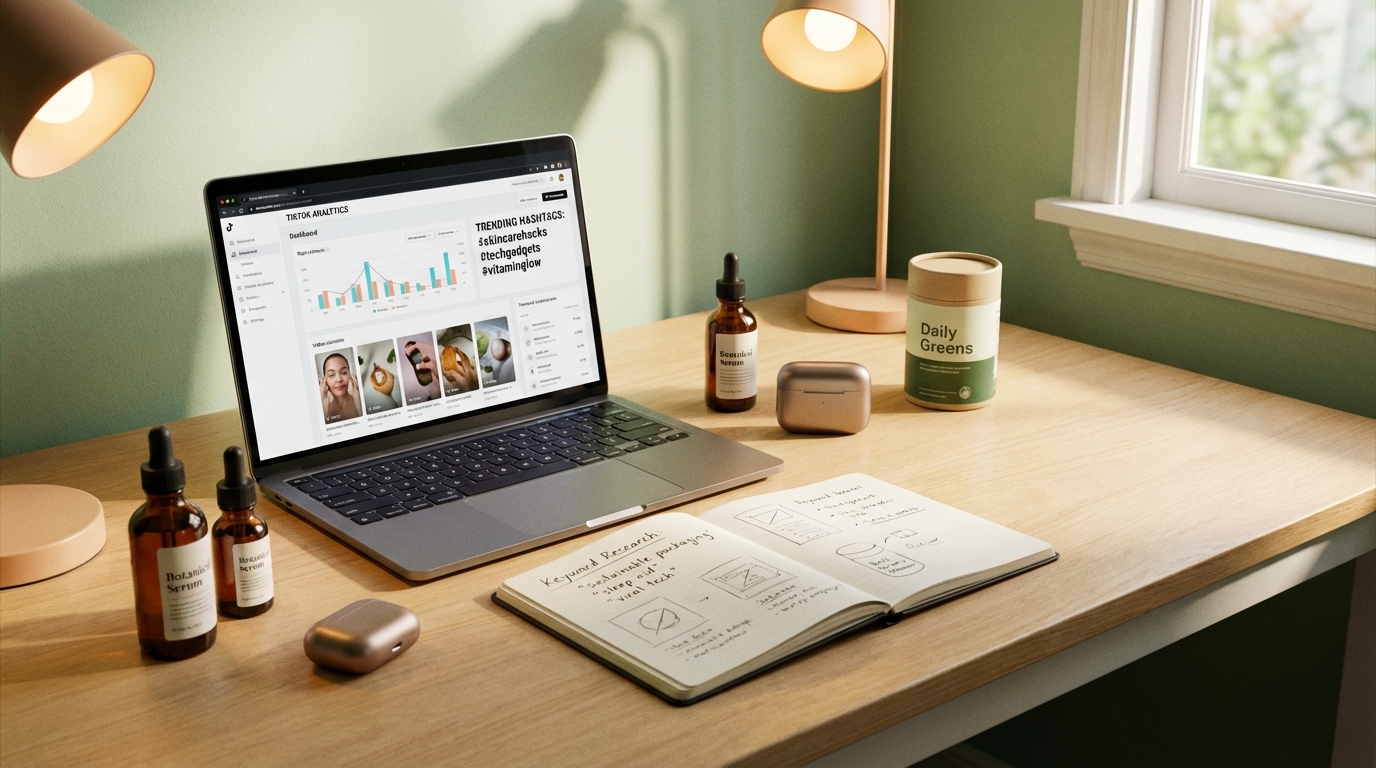
The difference between randomly scrolling TikTok and building a real product intelligence system comes down to structure and consistency. You need deliberate processes for what you’re looking at, what you’re recording, and how you’re escalating signals into sourcing decisions.
Training Your TikTok Feed
TikTok’s For You Page (FYP) is personalized, which means it will only surface product trends relevant to you if you’ve trained it to do so. This requires a deliberate 2–3 week investment of deliberate engagement:
- Identify 3–5 specific product categories you operate or want to enter
- Search for those categories directly and engage with product demo content
- Save videos showing product demonstrations, problem-solution formats, and comparison reviews
- Follow 10–15 micro-creators in each niche who consistently post product content
- Use the TikTok search function to explore category hashtags and adjacent topics
After 2–3 weeks of this deliberate engagement, your FYP will shift to consistently surface relevant product content from your target categories. This becomes your passive monitoring feed — but it should always be supplemented with active tool-based research.
Tool Stack for Systematic TikTok Trend Research
Helium 10’s Hot Videos is the most purpose-built tool for this workflow. It analyzes TikTok content driving Amazon sales, with filtering by product category and time frame. Rather than manually scanning TikTok, it surfaces videos showing anomalous engagement signals and correlates them with Amazon product data. For sellers running large catalogs, this tool dramatically accelerates the identification phase.
TikTok Creative Center (free) provides aggregate trend data on hashtags, sounds, products in TikTok Shop, and creator content themes. It’s useful for confirming whether a trend you’ve spotted has broad reach or is still niche. If a hashtag is already showing 500M+ views, you’re likely in Phase 3 territory. If it’s at 10M–50M, you’re potentially in Phase 1 or 2.
Amazon Brand Analytics + Search Query Performance provides the crossover confirmation. Once you’ve identified a TikTok signal, weekly SQP monitoring tells you when demand has migrated to Amazon search intent. This is your green light for finalizing inventory decisions.
Jungle Scout Opportunity Finder and Product Database round out the validation stack by providing current Amazon market data: search volume, competition levels, estimated revenue for top sellers, and seasonality patterns. These confirm whether the TikTok-identified demand maps to a commercially viable FBA opportunity.
Creating a Signal Log
Maintain a simple weekly log (a spreadsheet works fine) where you record every product or category signal you identify. For each entry, capture:
- Product description and category
- TikTok signals observed (view count range, engagement ratio, comment sentiment, hashtag volume)
- Date first identified
- Estimated trend phase (1–4)
- Amazon keyword equivalents and current SQP status
- Estimated sourcing lead time
- Status: monitor / validate / act
Review this log weekly. Products that are moving from “monitor” to “validate” status are your priority research items. Products that have been in the log for 4+ weeks without Amazon signal confirmation can be archived — the window has likely passed.
Validating Before You Buy: The Amazon SQP and TikTok Signal Stack
Trend identification without rigorous validation is how FBA sellers end up with 500 units of a product that spiked for two weeks on TikTok and then disappeared from the cultural conversation. Validation is the discipline that converts interesting signals into calculated inventory decisions.
The Four-Part Validation Framework
Step 1: Demand Verification. Confirm that the TikTok engagement you’re seeing corresponds to actual purchase intent rather than entertainment engagement. High watch time and shares suggest content performance. Comments specifically asking “where to buy,” “is this on Amazon?”, “what’s the link?” indicate purchase intent. Save-to-view ratios above 5% are a strong indicator that viewers plan to return to the product. Also check Amazon autocomplete — if your target product’s keywords are appearing in Amazon search autocomplete, demand has begun migrating.
Step 2: Competition Assessment. Search Amazon for the product category and examine the current competitive landscape. Look at review counts, listing quality, and pricing distribution. If the top 5 listings all have 2,000+ reviews and strong A+ content, you’re entering a mature market regardless of TikTok virality. If top listings have under 500 reviews with average listing quality, there’s room to compete on product quality and listing optimization.
Step 3: Margin Modeling. Run the full FBA economics before placing any order. Account for:
- Product COGS including freight (air vs. sea materially changes the math for trend-reactive sourcing)
- FBA fulfillment fees (which increased again in 2026 for certain size tiers)
- Referral fees (8–15% depending on category)
- Estimated PPC spend to accelerate initial ranking
- Return rate estimates for the category
- Storage costs if the trend fades faster than your inventory moves
For most product categories, a 30%+ net margin after all costs is the minimum threshold for a trend-reactive launch to make sense. Trend products carry inventory risk that stable, evergreen products don’t — your margin needs to compensate for that risk.
Step 4: Durability Assessment. Not all trends have the same staying power. Assess whether the product addresses a permanent need or a temporary cultural moment. A red light therapy device addresses ongoing skincare desire — durable. A product tied to a specific TikTok sound or meme — fragile. The crossover from trend to sustainable FBA category requires the product to have standalone value that outlasts the initial viral moment.
Positioning Your FBA Listing to Capture TikTok-Driven Traffic

Even when timing is perfect and your inventory lands in Amazon’s fulfillment centers at exactly the right moment, a weak listing can squander the opportunity. TikTok-driven shoppers arrive at Amazon with specific expectations formed by the content they’ve already consumed. Your listing needs to meet those expectations immediately.
Leading with the TikTok Problem, Not the Product Feature
TikTok content that drives purchase intent is almost always problem-centric. A creator shows the problem (dry, cracked heels), demonstrates the product addressing that problem, and shows the result. Your listing title and main image should mirror this framing — not lead with ingredient lists or technical specifications.
When a TikTok viewer lands on your Amazon listing, they’ve already been sold on the concept. Your job is confirmation, not persuasion. The main image should immediately confirm “this is the product that solves that problem.” The title should include the specific problem-solution language that mirrors the TikTok content (without keyword stuffing — the goal is relevance, not density).
Using UGC-Style Images and Video in A+ Content
The Reali-TEA behavioral shift has a direct application to listing optimization. Shoppers arriving from TikTok have been conditioned to trust authentic, real-person content over polished studio photography. Including UGC-style images in your secondary listing images — real people using the product in realistic settings, visible results on real skin or in real spaces — significantly improves conversion rates for TikTok-influenced traffic.
Amazon’s Brand Analytics data from 2026 consistently shows that listings using a mix of studio hero images and UGC-style secondary images outperform all-studio or all-UGC approaches. The hero image establishes credibility; the UGC images build trust.
Targeting TikTok-Specific Search Terms
TikTok users who migrate to Amazon often search using language they encountered on TikTok rather than traditional product terminology. Monitor TikTok comment sections and video descriptions for non-standard product language — colloquial ingredient names, specific technique terminology, creator-coined product descriptions — and incorporate these into your backend keyword strategy.
Phrases like “viral TikTok [product type],” “TikTok made me buy,” and category-specific slang terms that creators use organically can be meaningful backend keywords for products with active TikTok coverage. These terms represent low-competition, high-intent searches that traditional keyword research tools often undercount because they’re too new.
Setting Up External Traffic Funnels
Amazon rewards external traffic with ranking benefits — specifically when that traffic converts at a healthy rate. For TikTok-driven products, consider collaborating with 2–3 micro-creators (10,000–100,000 followers in your niche) to post organic product content pointing to your Amazon listing. Even small amounts of external traffic from genuine creators can accelerate your listing’s organic rank in ways that PPC alone cannot replicate.
Creator partnerships don’t need to be expensive for this purpose. Many micro-creators in niche categories accept product-only partnerships, particularly for products they find genuinely useful. A few authentic organic posts with genuine engagement can produce external traffic signals worth far more in ranking value than their apparent cost.
Case Studies: Real Products That Made the TikTok-to-FBA Journey
Examining documented cases of successful TikTok-to-Amazon crossovers reveals patterns that can inform your own product selection process. These aren’t outliers — they’re illustrations of the mechanics described throughout this post, executed well.
Micro Ingredients: Vitamins and the Curiosity Detours Effect
Micro Ingredients’ ascent is the clearest documented case of TikTok behavioral shift alignment driving FBA results. Their Vitamin D3+K2 product didn’t go viral because it was flashy or aspirational. It went viral because creators made genuinely educational content explaining why the D3+K2 combination mattered — exactly the Curiosity Detours content type that TikTok’s algorithm was actively promoting in 2024–2026.
Individual videos exceeded 20 million views. Amazon units sold in a single month peaked above 60,000 units. Monthly Amazon revenue grew 4–5x year over year following the viral period. Total TikTok Shop GMV reached $111.7 million. The key wasn’t just the virality — it was that the product had genuine educational content potential that kept new videos circulating well beyond the initial peak.
The Book Effect: “Don’t Believe Everything You Think”
This case is interesting because it demonstrates TikTok-to-Amazon crossover in a traditionally non-TikTok-native category. The book reached Amazon bestseller status — including a #7 ranking during peak virality — driven primarily by TikTok creators discussing its core concept. Over 80,000 copies were sold through TikTok Shop channels alone.
What made it work: the core concept was highly shareable in short video format, the emotional payoff (a shift in thinking about anxiety and overthinking) aligned perfectly with the Emotional ROI framework, and every creator who shared it became a credible, authentic endorsement. For FBA sellers, this points to a broader principle: products with a shareable “aha moment” concept — not just a functional feature — have disproportionate TikTok virality potential.
LED Bedroom Projectors: Speed to Market Execution
A category that consistently demonstrates the crossover window effect is LED galaxy projectors for bedroom aesthetic setups. When “bedroom glow-up” content began trending in the 2025 cycle, sellers who identified the trend in Phase 1–2 and placed air freight orders were able to capitalize on the Amazon demand spike. Reports from that cycle indicate 10,000+ orders in a single two-week window for leading sellers.
The product itself has modest intrinsic value — it’s a basic LED projector with color modes. What drove the sales was entirely the TikTok content ecosystem around bedroom aesthetics, and what sustained them was being well-positioned (reviewed, ranked, in stock) when the Amazon search peak arrived. This is pure crossover window execution.
Common Mistakes FBA Sellers Make When Chasing TikTok Trends
The same dynamics that create opportunities on TikTok also create predictable failure modes. Understanding these helps you distinguish disciplined trend-informed sourcing from reactive, expensive mistakes.
Confusing Entertainment Engagement with Purchase Intent
Some TikTok content goes viral because it’s entertaining — not because it sells a product. A video of someone comedically testing a bizarre kitchen gadget might get 5 million views with no purchase intent whatsoever. High view counts alone are not a signal. You need the specific purchase-intent indicators: “where to buy” comments, saves, shares to purchasing-intent friends, and the migration to Amazon search terms in SQP data.
Over-ordering Based on Peak Virality
Trend-reactive sourcing carries inherent inventory risk. Sellers who see 10,000 units selling per week at peak virality and order 6 months of inventory at that rate frequently find themselves with 4 months of stock when demand normalizes. Trend-reactive products should be ordered in smaller, faster-turning quantities with explicit inventory plans for markdown or liquidation if demand fades faster than projected.
Ignoring the Supply Side of Virality
When a TikTok product trend becomes widely recognized, suppliers respond immediately. Product prices from Chinese suppliers can increase 30–50% within weeks of a major viral moment as manufacturers prioritize allocation to larger buyers. Sellers who do their margin modeling before the trend peaks — and secure pricing commitments before suppliers realize what’s happening — have a meaningful cost advantage over those who respond reactively.
Treating Every Category the Same
TikTok trend patterns vary significantly by category. Beauty products can sustain Amazon sales for 12–18 months post-virality because consumer behavior for skincare is habitual and repeat-purchase driven. Tech gadgets may peak and decline within 8–10 weeks. Home décor products tend to follow seasonal patterns even when initially driven by TikTok trends. Applying the same inventory strategy across different category types is a common and expensive mistake.
Skipping the Listing Optimization Step
Even a perfectly timed product launch fails if the listing doesn’t convert. Sellers who rush to get inventory live without optimizing their listing — particularly for TikTok-aligned visual content and UGC-style imagery — frequently see good traffic but poor conversion rates. The listing optimization step is not something to defer. It should happen in parallel with inventory sourcing so that when your FBA shipment checks in, the listing is already ready to convert.
Building a Repeatable TikTok-to-FBA Product Pipeline in 2026
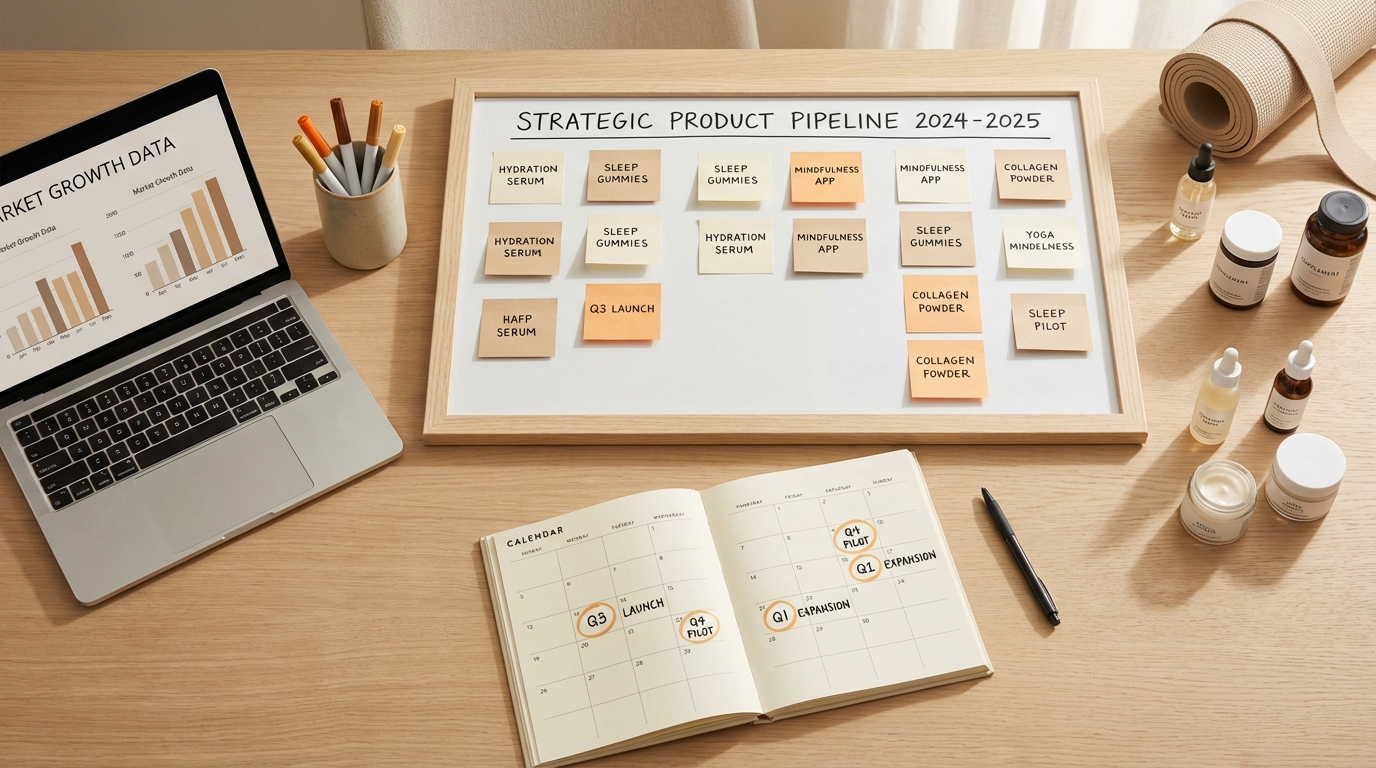
One-time trend wins are nice. A systematic pipeline that consistently identifies, validates, and converts TikTok signals into FBA revenue is a business asset. Building that pipeline requires process, discipline, and a willingness to work systematically even when no single trend is obviously “popping.”
Weekly Rhythm: The 90-Minute Research Block
Effective TikTok-to-FBA intelligence work doesn’t require hours of scrolling daily. It requires a dedicated 90-minute weekly research block with a specific agenda:
- First 20 minutes: Review your TikTok feed across target categories. Log any new signals in your tracking spreadsheet.
- Next 20 minutes: Run your target product categories through Helium 10 Hot Videos and TikTok Creative Center. Note any hashtags crossing the 10M–50M view threshold.
- Next 20 minutes: Check SQP data in Amazon Brand Analytics for products currently in your “monitor” or “validate” pipeline stages. Note any week-over-week search volume movement.
- Final 30 minutes: Update your signal log, advance any products to next stage, run quick margin models on any “act” candidates.
This rhythm keeps your pipeline fresh without requiring you to live on TikTok. Over 4–6 weeks, patterns will emerge — certain micro-creators who reliably surface relevant products before they peak, certain categories where trends move faster or slower, certain product characteristics that consistently correlate with successful crossovers.
Maintaining Category Depth
The sellers who win most consistently at TikTok-to-FBA aren’t generalists chasing whatever is trending. They’re specialists who understand 2–3 categories deeply enough to recognize subtle signals and move quickly when the right product appears. Deep category knowledge helps you assess product quality quickly, identify reliable suppliers faster, and understand the competitive dynamics well enough to price and position accurately.
Category depth also helps you recognize adjacent opportunities that appear as a trend peaks. When a specific supplement ingredient goes viral, the primary product floods with competition — but the delivery format (capsule vs. powder vs. gummy), the dosage variation, or a complementary ingredient combination might represent an adjacent entry with less competition and similar demand. You only see those opportunities if you understand the category well.
Supplier Relationships as a Competitive Advantage
In a trend-reactive sourcing model, having pre-established relationships with reliable suppliers is a genuine competitive advantage. Suppliers who know your order history will prioritize your production runs, offer better pricing on reactive orders, and give you earlier information about supply constraints during demand spikes.
Consider maintaining “on-deck” supplier relationships in your target categories — suppliers you’ve done at least one small sample or test order with, so the vetting process is complete and you can move immediately when a trend signal validates. The sellers who can place a validated order within 48–72 hours of identifying a Phase 2 signal have a structural timing advantage over everyone else in the market.
Knowing When to Stop and Take Profits
A product pipeline isn’t just about entry — it’s about intelligent exit. Monitor your TikTok-sourced products for the Phase 4 saturation signals: rising competitor count, declining BSR despite stable or increasing ad spend, price compression. When these signals appear simultaneously, it’s usually the right time to run down inventory, avoid reordering, and redeploy capital into the next pipeline opportunity.
The goal is not to run every product forever. It’s to extract the margin available during the active demand window and then rotate into the next opportunity. FBA sellers who treat their catalog as a rotating portfolio of trend-informed products — rather than a fixed set of items they’re permanently attached to — tend to maintain stronger margin profiles over time.
Conclusion: From Scrolling to Sourcing — The Mindset Shift That Matters
The core shift this playbook requires isn’t technical — it’s attentional. TikTok is full of product signals, but capturing them requires approaching the platform as a researcher rather than a consumer. It requires training your feed deliberately, building systematic logging processes, connecting what you see on TikTok to what you’re tracking in Amazon data, and moving with the speed that trend windows demand.
The mechanics are learnable. The timing framework is clear. The validation process is structured. What separates sellers who use TikTok as a genuine product intelligence system from those who use it to generate panic-buying decisions is the discipline to follow the process even when a trend looks exciting and the temptation to move too fast is strongest.
In 2026, TikTok’s $23.4 billion in US social commerce sales represents a demand signal that is too significant for any serious FBA seller to ignore. But the way to capitalize on that signal isn’t to sell on TikTok (though that may be part of your broader strategy). It’s to read TikTok accurately, validate on Amazon rigorously, and position your FBA business to be in stock, optimized, and ready to rank in the weeks when TikTok’s influence is pushing buyers toward the search bar.
The window is short. The process that keeps you inside it, consistently, is what makes the difference.
Key Takeaways:
- TikTok creates pre-search demand — a 4–8 week lead time before Amazon search volume spikes
- The four trend phases (Signal Emergence, Acceleration, Peak Virality, Saturation) each require a different FBA response
- TikTok’s 2026 behavioral shifts — Reali-TEA, Curiosity Detours, Emotional ROI — determine which products gain traction and why
- Your supply chain lead time is the limiting factor for how early in the trend cycle you can act
- Validation requires both TikTok engagement signals and Amazon SQP data moving together
- Listing optimization for TikTok-driven traffic means leading with the problem, using UGC-style imagery, and targeting TikTok-native search language
- The best FBA sellers operate a rotating pipeline of trend-informed products across 2–3 deep category specializations