



Most sellers treat TikTok Shop lives like an event. They plan one, run it, watch the numbers, feel good or disappointed, and move on to the next one. That’s not a growth model. That’s a lottery.
The sellers building real, compounding revenue on TikTok Shop in 2026 are not going viral occasionally and hoping it happens again. They are running an engineered system — one where every livestream feeds the next one, where algorithmic signals stack on top of each other, and where the gap between a $500 broadcast and a $25,000 broadcast is not talent. It’s structure.
TikTok Shop’s trailing twelve-month GMV reached $33.1 billion as of Q1 2026, with livestreaming accounting for 41% of that total. Live shopping is converting at 7.4% globally — more than three times the rate of traditional e-commerce — and the average order value from live sessions has climbed to $58, up from $43 just two years ago. These are not flukes. They are the output of a model that rewards sellers who understand how the platform actually distributes live content, how viewers make purchase decisions in real time, and how to build a cadence that accelerates rather than resets with every stream.
This article is not about the basics of going live. It’s about mastering the growth model behind TikTok Shop livestreaming — the mechanics, the architecture, the timing, and the feedback loops that separate sellers whose GMV compounds from those who plateau and wonder why.
The GMV Formula Every Livestreamer Must Internalize
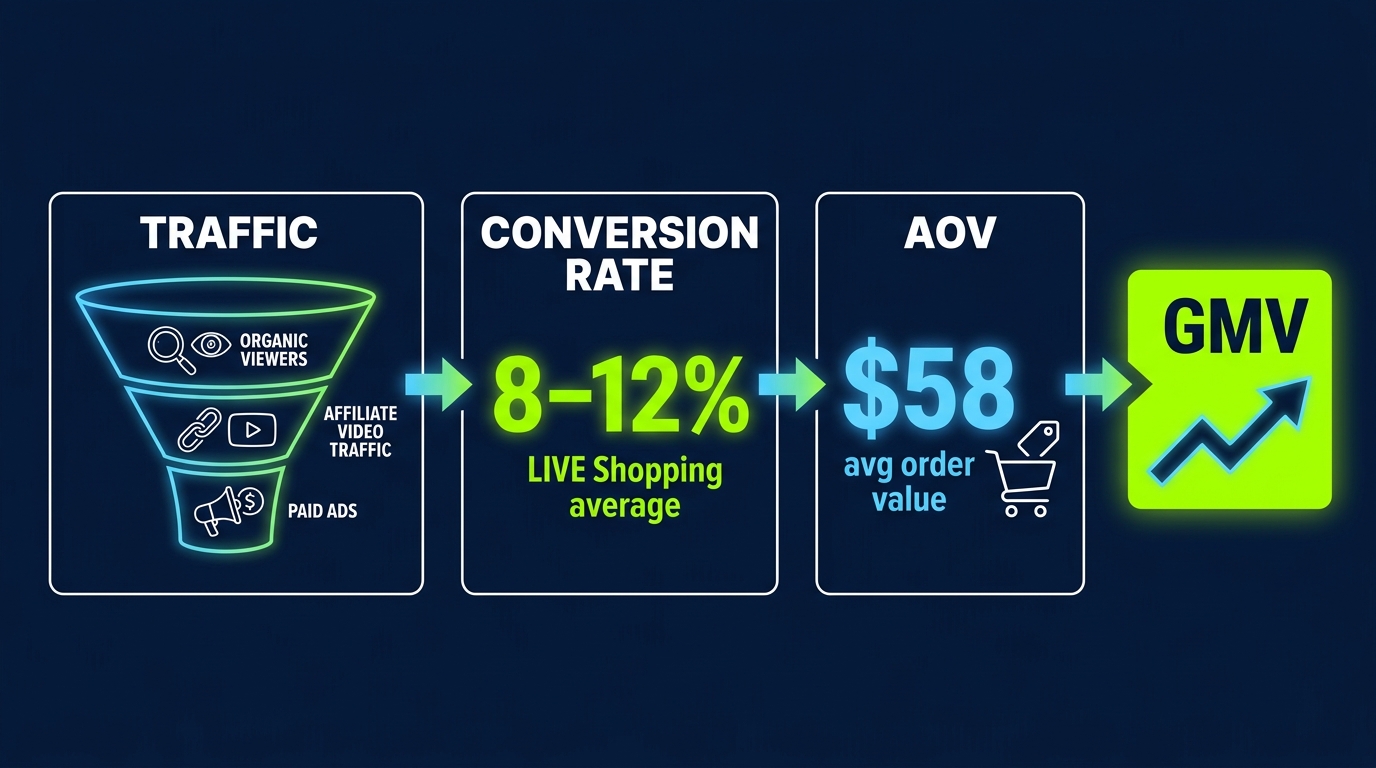
Before diving into tactics, the most important thing you can do is internalise TikTok Shop’s core revenue equation. Every variable that matters in your livestream strategy maps back to one formula:
GMV = Traffic × Conversion Rate × Average Order Value
This seems obvious on the surface, but in practice, most sellers who struggle with LIVE revenue are pulling on the wrong lever. They spend their energy trying to get more viewers (traffic) when their conversion rate is the actual bottleneck. Or they focus obsessively on adding more SKUs when their average order value would jump faster by bundling two existing products.
Traffic: The Three Sources That Feed a Live
During a TikTok Shop livestream, your traffic comes from three fundamentally different places, and they have very different qualities.
Organic algorithmic traffic is viewers the platform pushes to your stream based on its ranking signals. This is the traffic most sellers covet and least understand. It is not freely given — it is earned through behavioral signals from the viewers already in your stream. The algorithm watches what your current viewers do, and if they stay, engage, and buy, it pushes your stream to a wider audience. This is why your first ten viewers matter more than most sellers realize. They are not just customers — they are data points that determine whether TikTok will show your stream to thousands of others.
Affiliate-driven traffic comes from creators who have posted short-form videos linking to your products. When their video gets views, some percentage click through to your active live. This is the highest-intent traffic you can get, because the viewer has already been pre-qualified by a creator they trust. Building a base of affiliate creators who are consistently posting product videos means your LIVE traffic floor rises over time, independent of the algorithm’s mood on any given day.
Paid ad traffic, via Live Shopping Ads (LSA) and GMV Max, places your stream directly in front of defined audiences. This traffic is the most controllable, but also the most expensive. The strategic question is not whether to run paid ads to your LIVE — it’s when. Running LSAs on a stream with a weak conversion rate is like pouring water into a leaking bucket. Fix the conversion rate first, then amplify with paid traffic.
Conversion Rate: The Metric That Determines Your Ceiling
TikTok Shop LIVE sessions benchmark at 8–12% conversion rate for well-structured broadcasts, compared to 2–4% for short-form video and 1.5–3% for the Shop Tab. That gap exists because of the psychology of live commerce: urgency, social proof, real-time persuasion, and the FOMO of watching other viewers buy in the moment.
A conversion rate below 3% during a live session tells you something structural is wrong — your opening hook is not working, your product presentation is unclear, your CTAs are absent or weak, or your viewer cohort is mismatched to your products. A conversion rate above 10% tells you the machine is working and the correct lever to pull is traffic volume.
AOV: The Overlooked Multiplier
Average order value is the most neglected lever in live selling. If your current AOV is $28 and you can push it to $42 through bundle offers presented during the stream, your GMV increases by 50% without acquiring a single additional viewer. Bundle strategies, value-stack reveals, and “add-on” moments built into the script are the fastest way to move this number. The platform’s own data shows that Q1 2026 AOV from live sessions has reached $58 globally — but top-performing streams routinely hit $80–$120 through deliberate bundling architecture.
How TikTok’s LIVE Algorithm Actually Works in 2026
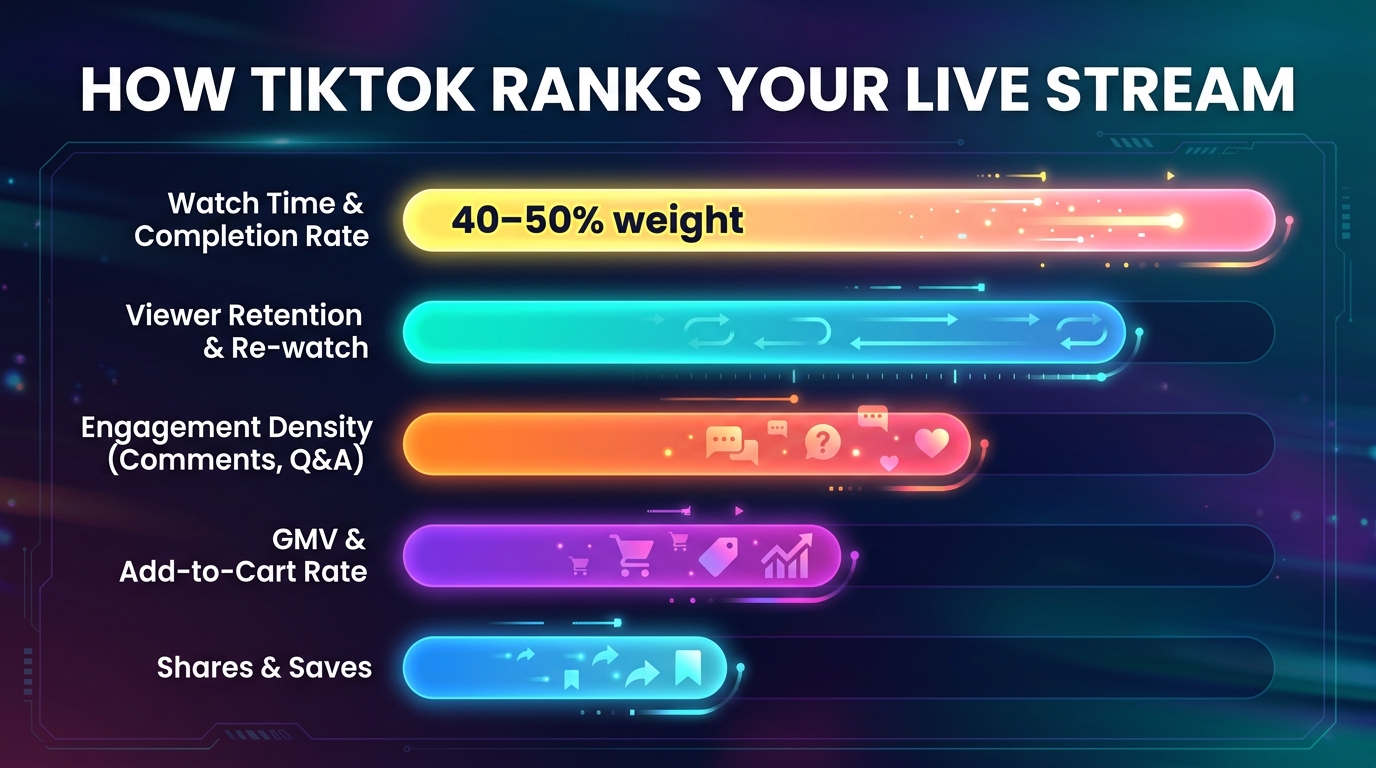
TikTok’s LIVE ranking algorithm in 2026 has shifted significantly from the early days of live shopping. Raw viewer counts no longer drive distribution. The platform has moved to what internal teams describe as “durable attention” scoring — a model that rewards streams where viewers stay, engage meaningfully, and complete purchase actions, not streams that attract passive viewers who bounce within thirty seconds.
The Dominant Signal: Watch Time and Completion Rate
Watch time and completion rate account for approximately 40–50% of the algorithm’s weight for LIVE ranking. Specifically, TikTok tracks two things here: average watch time per viewer (how long the typical viewer stays in your stream), and a threshold completion metric where a 70% completion rate is the benchmark that triggers wider distribution.
What this means practically: a stream with 200 viewers who average 8 minutes each will outperform a stream with 1,000 viewers who average 45 seconds each — every time. The implication for your stream structure is significant. Your job in the first five minutes is not to sell. It is to give viewers enough of a reason to stay. Product teasers (“we’re showing the full demo in ten minutes”), community anchoring (“where are you watching from, drop it in the chat”), and energy management all serve this single purpose.
Engagement Density Over Raw Engagement Volume
TikTok has become increasingly sophisticated about the quality of engagement. Comments like “nice” or emoji spam barely register. The algorithm now weights what it considers “intent signals” — substantive comments, product questions, add-to-cart actions, and share events. A stream with 50 viewers asking real questions about a product generates stronger ranking signals than a stream with 500 viewers posting heart emojis.
This matters enormously for how hosts should interact with their audience. Prompting specific questions (“drop in the comments what problem you’re trying to solve with this”) generates intent signals. Prompting generic engagement (“if you’re excited, drop a fire emoji”) generates noise. Both feel interactive — only one feeds the algorithm what it needs.
GMV as a Ranking Signal
TikTok also incorporates GMV performance directly into LIVE distribution. Streams that generate sales get shown to more people who are likely to buy. This creates a flywheel effect — and also explains why your first sale during a stream is disproportionately important. Getting one viewer to purchase early in a broadcast triggers a ranking uplift that expands your audience pool for the remainder of the session. Experienced hosts deliberately structure their first product presentation around their lowest-friction, highest-conversion SKU precisely to trigger this early GMV signal.
Consistency as a Ranking Modifier
Beyond individual stream performance, TikTok’s algorithm also weights historical reliability. Accounts that stream consistently — same time slots, similar cadence, maintained quality — build an algorithmic track record that gives their new streams a head start. The platform learns your viewer patterns and begins pre-notifying relevant users before you even go live. This is the compounding effect that makes frequency more valuable than any single perfect broadcast.
The Cadence Model: Why Frequency Beats Perfection
The single biggest strategic error in TikTok Shop live selling is optimizing for individual stream performance rather than compounding cadence. Sellers spend weeks preparing one “perfect” livestream instead of running two imperfect ones per week and learning from each.
The data is unambiguous on this. Sellers who stream consistently — defined as at minimum three to four times per week — see cumulative GMV growth that follows a compounding curve rather than a flat line. Here is why.
Each Stream Feeds the Next One
When you go live, TikTok generates a data record for that session — viewer retention curves, engagement density, conversion outcomes, product interaction rates. That record becomes the baseline the algorithm uses to seed distribution for your next live. A stream with mediocre reach but strong retention tells the algorithm: this broadcaster keeps people watching. Next session, TikTok starts you with a slightly larger initial audience pool. The stream after that, slightly larger still.
Sellers who go live once every two weeks break this feedback loop. Each session starts from scratch, without the momentum built by the previous one. Sellers who stream four times a week have four data points per week feeding forward into next week’s distribution. Over eight weeks, that’s not four times more data — it’s compounding data, because each session benefits from the accumulated signal of all the ones before it.
The Frequency Threshold
Industry evidence across TikTok Shop markets points to a practical minimum cadence for meaningful algorithmic traction: at least three live sessions per week, with each session lasting a minimum of 60 minutes. Below this threshold, accounts rarely build consistent organic traffic; above it, they begin to see the algorithmic momentum described above. Chinese-market TikTok sellers who have scaled to significant GMV on Douyin (TikTok’s Chinese equivalent) typically operate with 8+ hours of daily live, often in shifts with multiple hosts. While that scale is not achievable for most US sellers starting out, the directional principle holds: more consistent live time compounds algorithmically.
Scheduling Against Peak Viewer Windows
Frequency is more valuable when it aligns with peak viewing windows. For US-based sellers, the highest-engagement windows are early mornings (6–10 AM EST) and evenings (7–11 PM EST), with Tuesdays through Thursdays showing the strongest performance. Evening windows particularly align with impulse purchase behavior — viewers who are relaxing after work are in a receptive mental state for discovery-based shopping.
The practical scheduling recommendation is to identify two to three recurring time slots that consistently hit viewer windows for your specific audience — then lock them in as permanent calendar items. Consistency of scheduling is itself an algorithmic signal, and viewers who have watched you before will be notified at predictable times, creating a returning audience base that compounds over weeks.
Structuring a High-Converting Livestream: The Looped Host Framework
One of the most misunderstood aspects of live commerce is structural design. A high-converting TikTok Shop stream is not a linear presentation from start to finish. It is a loop — a repeating cycle that resets for new viewers who join mid-stream, while continuing to deepen engagement with those who have been watching for longer.
This looped structure is critical because the average viewer joins a TikTok LIVE not at the beginning but somewhere in the middle. If your best product presentation only happens at minute 12, every viewer who joined at minute 13 missed it. The loop ensures that the core selling moments repeat regularly enough that viewers who arrive at any point in the stream encounter them.
The Core Loop Structure
A well-designed live session for TikTok Shop typically runs in repeating cycles of 15–25 minutes, each containing the same structural elements:
Opening reset (2–3 minutes): Every cycle begins with a brief re-introduction. “Welcome to everyone just joining — I’m [name], and today we’re showing [product category]. We’ve already sold [X] units in the last hour.” This serves two functions: it orients new viewers, and it provides social proof to existing ones.
Warm-up and community moment (3–5 minutes): A brief engagement prompt that generates comments. “Drop in the chat where you’re watching from” or “Tell me: what’s the skin problem you’re most frustrated with right now?” The purpose is algorithmic — generating substantive comment density — and psychological — creating a sense of community before you ask viewers to purchase.
Product demonstration (5–8 minutes per product): The heart of the loop. Show the product being used, not just being described. Demonstrate the before/after, the texture, the fit, the unboxing. Explain the specific problem it solves. Address the most common objection in the category. Every product demo should end with a clear, specific CTA: “Tap the product on the screen right now to add it to your cart — this price is only available while we’re live.”
Bundle/value moment (3–5 minutes): Introduce a bundled offer or a limited-time deal. “If you get both [Product A] and [Product B] right now, that’s [$ amount] off what you’d pay separately.” This is the primary AOV lever within the loop structure. Do not skip it or make it feel like an afterthought — it deserves the same energy as the product demo.
Social proof and urgency close (2–3 minutes): Read out purchases happening in real time. “We just had [username] order — thank you! We’re down to 47 units of [product].” Scarcity and social proof are the two most powerful closing mechanisms in live commerce, and they are most effective when they are real-time and specific.
Host Energy Management
The energy of the host is not a soft skill — it is a direct conversion variable. Research on live commerce consistently shows that streams with high-energy, engaged hosts outperform identical-product streams with flat delivery. This is because viewer retention in a livestream is partly rational (they want the product) and partly emotional (they enjoy the experience of watching). An energetic, informed host gives viewers a reason to stay even between purchase moments — and that dwell time feeds the watch time signals the algorithm needs.
Energy management also means pacing the loop deliberately. Experienced hosts build toward a high-energy peak at the bundle moment, then reset with a calm community moment to give viewers a breathing pattern. Thirty minutes of sustained high-energy performance is exhausting and unnatural — a rhythm of build-and-release keeps both host and viewer engaged for sessions that run one to three hours.
Studio Setup and Production Quality That Actually Moves the Needle
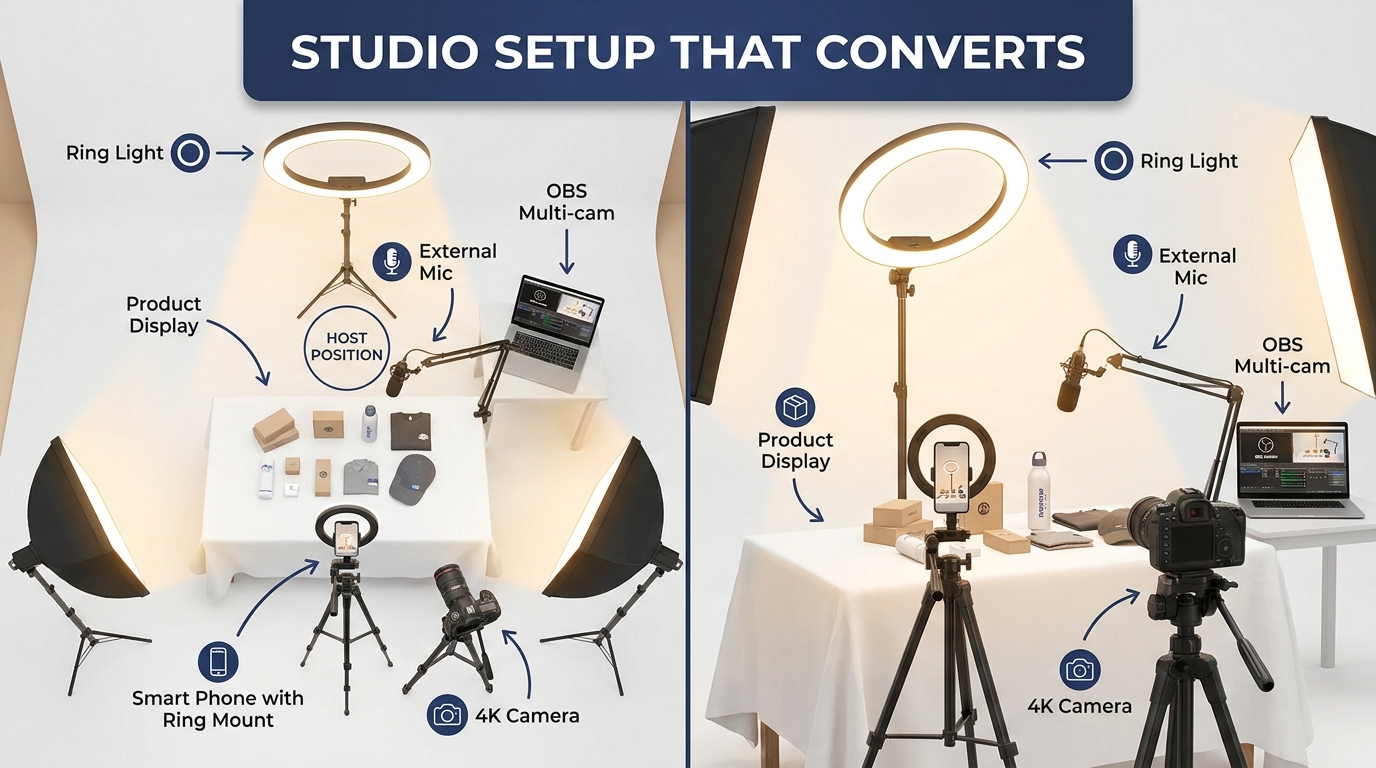
Production quality affects viewer retention, which affects algorithmic ranking, which affects traffic. It is not vanity — it is a conversion variable. But “professional quality” does not mean expensive. It means controlled environment, consistent visual identity, and clear audio. These three things combined will put you ahead of the majority of TikTok Shop live sellers.
Video: The 1080p Threshold
TikTok LIVE Studio supports up to 1080p at 30fps, with a recommended bitrate of 2,500–6,000 kbps. Streams below 720p visibly degrade the product presentation experience, which is particularly damaging for categories where visual detail matters — skincare, fashion, beauty, food. A dedicated external camera (even a mid-range webcam like the Logitech StreamCam or a mirrorless camera connected via capture card) provides significantly sharper image quality than a phone camera.
More important than resolution is frame stability. A shaky, hand-held camera creates a physically uncomfortable viewing experience that drives early drop-off. A fixed tripod setup — even a $30 phone tripod — eliminates this problem entirely.
Lighting: The Highest-ROI Investment in Your Setup
Lighting is, by a wide margin, the single highest-ROI production investment for live sellers. Poorly lit streams make products look unappealing, make hosts look unprofessional, and reduce the trust signals that drive purchase decisions. A basic two-softbox setup or a quality ring light (12-inch, adjustable color temperature from 3000K to 6500K) transforms stream quality at a cost of $60–$150.
The goal is even, diffused light with no harsh shadows on the host’s face or the product display area. Avoid mixing light sources with different color temperatures — it creates an unsettling visual quality that viewers register subconsciously as “off” even if they can’t articulate why.
Audio: The Non-Negotiable
Audio quality is the most frequently overlooked production variable — and the one viewers are most sensitive to. A viewer will tolerate slightly imperfect video, but choppy, echoey, or distorted audio consistently drives abandonment. An external microphone (boom arm-mounted condenser or a lavalier clip-on) costs $40–$80 and eliminates the hollow room sound that built-in device microphones produce.
Noise control matters too. Background noise — HVAC systems, street traffic, other voices — distracts viewers and undermines the sense of a controlled, professional environment. Foam panels or even blankets on walls behind the camera position make a meaningful difference in audio quality.
The Product Display Area
Your product display zone is arguably as important as the host position itself. Viewers need to see products clearly, with enough space around them to understand scale and quality. A dedicated display table with consistent branded backdrop — whether that’s a color wall, product shelf, or simple clean surface — creates a visual anchor that makes your stream feel like a destination rather than an improvised setup. Product placement should be deliberate: anchor products at eye-level, with supporting items arranged in deliberate groupings that suggest natural bundles.
Paid Amplification: When and How to Layer Ads Into Your LIVE
Paid ads and organic live performance are not separate strategies — they are multipliers of each other. The mistake most sellers make is treating them sequentially (first get good at organic, then add ads) or treating them as substitutes (just run ads and skip organic optimization). Neither approach extracts maximum value from the platform.
Live Shopping Ads (LSA): The Direct Traffic Lever
TikTok’s Live Shopping Ads place your active stream directly in the For You Page of targeted users, appearing as a live stream recommendation rather than a traditional ad unit. The minimum budget is $20/day per ad group, with $50/day per campaign recommended for meaningful data collection. CPMs for LSA run approximately $5–$15, with CPCs between $0.30 and $1.50 depending on niche competitiveness.
The critical rule for LSA is this: only run them on streams that are already converting organically. If your organic conversion rate is below 5%, adding paid traffic to that stream generates expensive data about a broken process. If your organic conversion rate is at 8% or above, paid traffic accelerates a working machine. Run LSAs to push quality audience into a proven live environment — not to compensate for a stream that isn’t performing.
GMV Max: The Algorithmic Amplifier
GMV Max is TikTok’s AI-driven shopping ad product that automatically optimizes ad delivery across Video Shopping Ads, Product Shopping Ads, and LIVE distribution to maximize GMV. For sellers who have established baseline performance data (conversion rates, average order values, ROAS baselines), GMV Max offers a powerful hands-off amplification layer. The recommendation is to activate GMV Max only after you have at least 40 conversion events across your Shop — below this threshold, the algorithm lacks enough data to optimize effectively.
ROAS targets for well-structured LIVE operations typically land in the 3x–4.5x range, with top performers seeing 5x+ on focused product categories. Initial targets should be conservative (2.5x–3x) to allow the algorithm’s learning phase to complete — then escalate as the system identifies your strongest converting audience segments.
Spark Ads: The Post-Live Amplification Tool
One of the most underutilized paid strategies in LIVE commerce is post-live Spark Ad amplification. When a live session ends, TikTok generates a replay that can be boosted using Spark Ads. The best moments from your stream — product demos with high engagement, bundle reveals, social proof moments — can be clipped from the replay and run as short-form video ads targeting cold audiences. This extends the revenue tail of a single live session across 24–72 hours post-broadcast. Sellers who deploy this consistently report 200–300% additional GMV in the 24 hours following a strong stream, generated not from the live itself but from amplified replay content.
The Pre-Live and Post-Live Windows Most Sellers Ignore
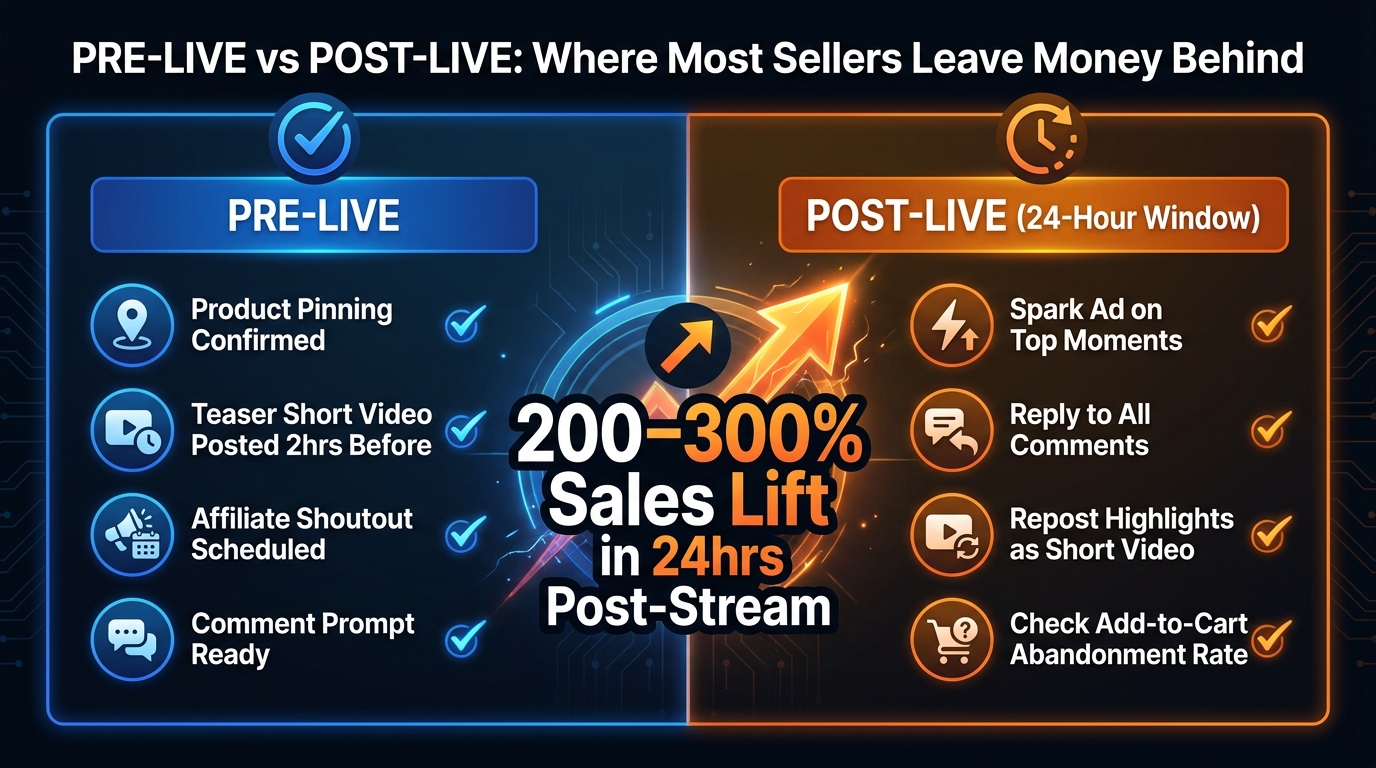
A livestream is not just a live event. It is the apex of a content cycle that begins 24–48 hours before the broadcast and continues for 24–72 hours after it. Sellers who treat their stream as a standalone event are leaving a significant portion of its potential GMV on the table.
The Pre-Live Window: Warming the Audience
The 2–4 hours before a livestream represent a critical warm-up window. Viewers who have been primed by pre-live content convert at significantly higher rates during the broadcast than cold viewers who stumble in from the algorithm.
Effective pre-live activation includes posting a short-form teaser video (30–60 seconds) 2 hours before going live, featuring a product reveal or an exclusive deal available only during the stream. This teaser should link directly to your TikTok Shop and reference the live start time. Affiliate creators who have products from your store should be notified to post within the same window, creating a coordinated content moment that drives cross-platform awareness.
Additionally, ensure all featured products are pinned in the TikTok Shop interface before going live. Viewers who click on a product that isn’t properly set up — missing images, incorrect prices, incomplete descriptions — will abandon the purchase. This is a pre-live operational checklist item that is easily overlooked and consistently costly.
The Post-Live Window: Extracting the Residual Revenue
After your stream ends, TikTok indexes the full replay and the algorithmic signals from your session continue generating traffic for hours. The replay itself is surfaced to users who missed the live but match your audience profile. This creates a meaningful revenue tail — but only if you work it.
Within the first hour post-broadcast, respond to every comment made during the live that includes a product question or purchase intent signal. These viewers are in an active consideration mindset, and a personal response from the seller dramatically increases conversion. Review your TikTok Shop analytics for add-to-cart events that did not convert during the live — these are warm prospects who need a follow-up nudge.
The highest-leverage post-live action is clipping the top 3–5 performing moments from the replay (identified by the engagement spikes in your analytics) and publishing them as individual short-form videos with product links. These clips typically outperform original short-form content in conversion rate because they feature real proof-of-concept: real viewers, real reactions, real purchases happening in the moment.
Building a Host Team vs. Running Founder-Led Live
The host is the most important conversion variable in a TikTok Shop livestream. But at what point should a founder stop hosting their own lives — and how do you build a host team that maintains conversion rates when you are not the one in front of the camera?
The Case for Founder-Led Live (Early Stage)
In the first 60–90 days of TikTok Shop live operations, founder-led streams almost always outperform hired host streams. The reason is product knowledge depth and authentic brand belief. A founder who genuinely understands their product — its development, its edge case uses, its customers’ real experiences — communicates with a specificity and conviction that is very difficult to replicate with a trained host who has been briefed for a few days.
Early-stage streams also function as product research and audience research in addition to sales channels. The questions viewers ask, the objections they raise, the product comparisons they make in the chat — these are data points that sharpen your product positioning, your bundle strategy, and your script framework. A hired host captures sales. A founder captures sales and intelligence.
When to Bring in Dedicated Hosts
The transition point is typically when consistent live streaming (three to five times per week) is generating more revenue than the founder’s time is worth spent hosting. The calculation is simple: if your live sessions generate $3,000 per session and a professional host costs $25–$50 per hour for a 2-hour session, the math works overwhelmingly in favor of a dedicated host. The founder’s time is better spent on supply chain, product development, and scaling the affiliate creator network.
The selection criteria for a live commerce host go beyond charisma. Product knowledge absorption speed, resilience under the pressured unpredictability of live streaming, and the ability to handle difficult questions in the chat without flinching are the skills that separate adequate hosts from high-performing ones. Before any host goes live independently, they should have co-hosted a minimum of five sessions with someone more experienced, have the product script memorized (not read), and be able to demonstrate product features fluently without notes.
Script Architecture for Hired Hosts
When transitioning to hired hosts, the looped script framework becomes a formal operational document. Every product should have a documented demo script covering: the problem statement, the product mechanism of action, the key differentiator from alternatives, the primary objection and its answer, and the call to action. These scripts should not be recited verbatim — they should be the skeleton that hosts flesh out with their own delivery — but they ensure that no critical conversion element is omitted during a busy live session.
Diagnosing a GMV Plateau: Reading What the Data Is Telling You
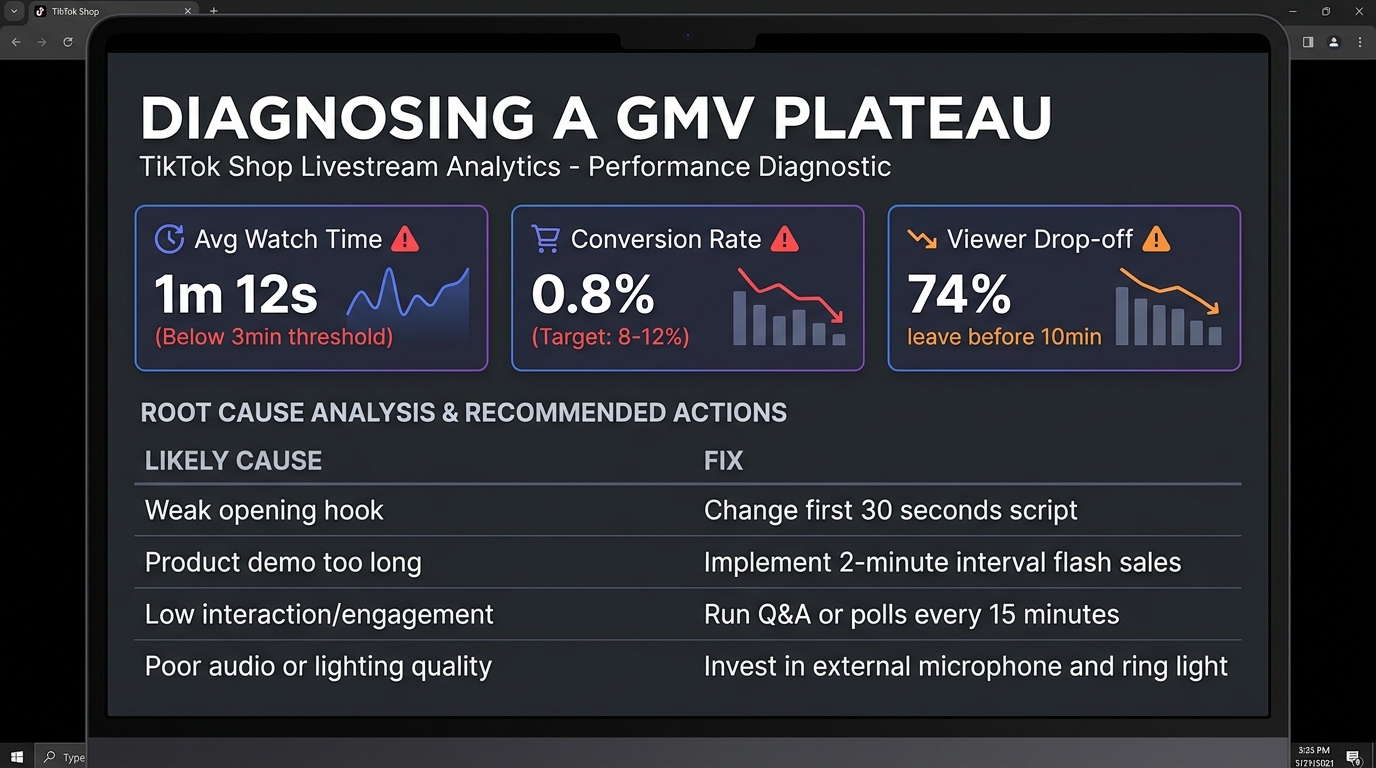
GMV plateaus are not bad luck. They are data. Every plateau has a specific cause, and TikTok Shop’s analytics surface enough information to diagnose it precisely — if you know what to look for.
Plateau Type 1: Traffic Has Stopped Growing
If your per-stream viewer counts have flatlined or declined over three to four weeks, the issue is upstream of the livestream itself. This is typically caused by content fatigue in your short-form video feed (your pre-live teasers and affiliate videos have stopped generating new audience), a drop in affiliate posting frequency, or algorithmic throttle due to a period of inconsistent streaming.
The fix: diversify your traffic inputs. Recruit 5–10 new affiliate creators in your category to introduce new audience pools. Vary your short-form video formats — same products, different angles, different creators, different hooks. Re-establish a strict posting schedule for 14 days to reset the consistency signal with the algorithm.
Plateau Type 2: Traffic Is Fine, But Conversion Is Declining
This is the most common plateau type, and it’s usually caused by one of three things: product fatigue (the same audience has seen the same products multiple times and has either bought or decided not to), weak session structure (the looped framework has become rote and lost energy), or misaligned product-audience fit (the viewers the algorithm is sending do not match the product category being sold).
The fix for product fatigue is simple: introduce new SKUs or new bundles into the live rotation. For session structure fatigue, change the opening hook, introduce a new segment format (a product comparison, a live demo challenge, a viewer Q&A round), or shift the time slot to bring in a different audience cohort. For product-audience misalignment, review your stream analytics to identify where traffic is coming from and whether the audience segments match your product category.
Plateau Type 3: Sales Are Happening, But GMV Isn’t Growing
This plateau happens when transaction volume has stabilized but average order value has stagnated. The unit economics haven’t deteriorated — there are simply no bundles or value-stack moments increasing the per-order revenue. This is an immediate script fix: build deliberate bundle moments into every cycle of the loop, make bundle pricing visibly compelling against single-item pricing, and train the host to upsell naturally rather than as an afterthought.
Key Metrics to Monitor Weekly
Regardless of plateau type, the following metrics should be reviewed after every live session and trended weekly:
- Average watch time per viewer: Target 3+ minutes. Below 2 minutes indicates structural or content problems early in the stream.
- Peak concurrent viewers vs. average concurrent viewers: A large gap indicates viewers are leaving quickly after joining — the hook works but retention doesn’t.
- LIVE conversion rate: Target 8–12%. Below 5% requires script intervention. Below 3% requires complete structural review.
- GMV per thousand viewers (GPM): The single most efficient summary metric for live session health. It normalizes performance across sessions with different traffic volumes.
- Replay views as a percentage of live views: A replay-to-live ratio above 30% indicates strong post-live interest and is a signal to invest in Spark Ads on replays.
The 90-Day Compounding Timeline
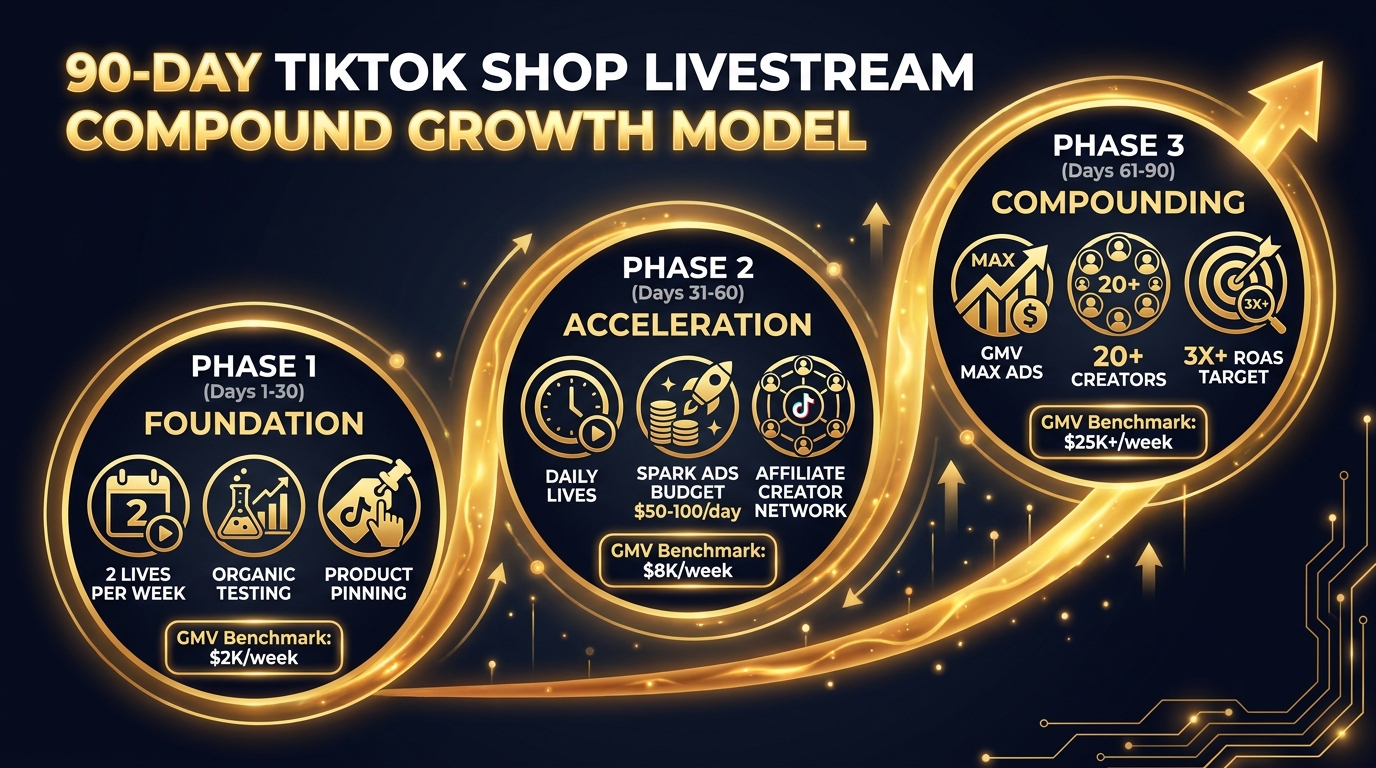
The growth model described throughout this article does not produce results in a single week. It produces compounding results over a deliberate 90-day arc, where each month of consistent execution creates the foundation for the next month’s acceleration. Here is what that timeline looks like in practice.
Days 1–30: Foundation Phase
The first 30 days are not about maximizing GMV. They are about calibrating the machine. The priority is establishing a consistent streaming cadence (minimum 2–3 lives per week), testing product rotation across your catalog to identify your highest-converting SKUs, and learning which products generate the strongest watch-time signals (because viewers keep watching demos of some products longer than others, and that matters algorithmically).
In this phase, avoid paid ads on your LIVE. You don’t yet have enough conversion data to make paid amplification efficient. Focus on organic performance, begin building an affiliate creator network (aim for 10–15 creators posting product videos within this period), and start developing your looped script framework based on what you learn from the first ten sessions.
Realistic GMV expectation in this phase: $1,000–$3,000 per week, with high variance between sessions. The goal is not the number — it’s the data.
Days 31–60: Acceleration Phase
By day 31, you should have enough session data to know your conversion rate baseline, your strongest products, your peak viewer time slots, and the structural elements of your script that generate the most engagement. This phase is about compressing what works and removing what doesn’t.
Increase streaming frequency to daily if possible. Introduce your first paid amplification layer — Spark Ads on your best-performing replay moments at $25–$50/day — and begin testing Live Shopping Ads on your strongest live sessions. Expand your affiliate network to 30–50 creators. Introduce your first formal bundle offers into the live script and measure the AOV impact.
Realistic GMV expectation: $5,000–$12,000 per week, with much less variance session-to-session as the script and cadence mature.
Days 61–90: Compounding Phase
This is where the flywheel becomes self-sustaining. You have algorithmic momentum from weeks of consistent performance data, an affiliate creator network generating independent traffic, and a refined script that converts reliably. The growth lever now is paid amplification at scale: GMV Max ads targeting 3x+ ROAS, Live Shopping Ads running on your top-performing sessions, and potentially a second host or time slot to capture additional viewer windows.
The 90-day model culminates in a state where your livestream operation is no longer dependent on any single broadcast performing exceptionally well. The average performance of your sessions — powered by algorithmic momentum, affiliate traffic, and paid amplification — produces consistent, growing weekly GMV. A single standout session at this stage isn’t a stroke of luck; it’s a multiplier on an already-functioning base.
Realistic GMV expectation: $15,000–$40,000+ per week for sellers in mainstream categories (beauty, fashion, lifestyle, food) with appropriate product margins. These are not guaranteed outcomes — they are the range that consistent execution of this model produces based on the current state of the TikTok Shop platform in 2026.
The Compound Logic: Why Livestream Is TikTok Shop’s Most Durable Growth Channel
Short-form video is TikTok Shop’s largest traffic driver — roughly 60% of US GMV currently flows through shoppable short videos. But live shopping’s 41% share of global GMV is not explained by traffic volume alone. It’s explained by what happens to revenue quality at scale.
Livestream buyers have a 38% repeat purchase rate within 90 days. They have a $58 average order value — the highest of any TikTok Shop traffic source. And the customer acquisition cost via LIVE is estimated to be 47% lower than Google Shopping equivalents for comparable categories. What this means is that a customer acquired through a livestream is more valuable, more loyal, and cheaper to acquire than virtually any other channel currently available to an e-commerce seller.
These economics explain why brands that build sustainable LIVE operations do not treat them as supplementary marketing activities. They treat them as the core of their TikTok Shop business — the revenue engine around which short-form video content, affiliate programs, and paid ads are organized in support.
The broader trajectory reinforces this. Global live commerce sales are projected to exceed $600 billion by end of 2026. TikTok Shop’s own GMV is projected to reach $112 billion globally. The sellers who build fluency with the livestream growth model now are not just winning in 2026 — they are establishing operational capabilities and algorithmic track records that will be extraordinarily difficult for late entrants to replicate.
Conclusion: The Difference Between Running Lives and Running a Livestream Business
The gap between a seller who occasionally goes live and a seller who has built a compounding livestream business comes down to systems, not talent. The algorithm does not reward charisma — it rewards consistent retention, engagement quality, and purchase signals. These are all engineerable.
The GMV formula (Traffic × Conversion Rate × AOV) gives you a diagnostic framework that tells you which lever to pull at any given moment. The looped host structure gives you a repeatable script architecture that converts browsers into buyers across every cycle of a session. The 90-day compounding timeline gives you a growth model that accumulates algorithmic momentum rather than resetting with every broadcast.
The sellers who treat TikTok Shop live as a channel — a system with inputs, feedback loops, and compounding outputs — are the ones building businesses. The sellers who treat it as a content format are the ones posting recaps on social media wondering why the results are so inconsistent.
You now have the model. The execution is the difference.
Key Actionable Takeaways
- Start with your GMV formula. Identify whether your bottleneck is traffic, conversion rate, or AOV before touching anything else. Fix the right variable.
- Commit to a minimum streaming cadence of 3x per week for at least 30 days before evaluating algorithmic performance. Frequency is a prerequisite for compounding.
- Design your stream as a loop, not a line. Structure your session in 15–25 minute cycles so every new viewer encounters the full selling experience regardless of when they join.
- Invest in lighting before any other production upgrade. It is the highest-ROI production decision in live commerce.
- Do not run paid ads on an underperforming live. Wait until organic conversion hits 8%+, then amplify. Paid ads on a broken stream accelerate losses, not growth.
- Treat the 24 hours after a live session as seriously as the live itself. Clip replays, respond to comments, and deploy Spark Ads on top-performing moments.
- Track GPM (GMV per 1,000 viewers) weekly. It is the single most diagnostic number in your live analytics and will tell you more about stream health than any other metric.