


Prime Day has always been a pressure test. But Prime Day 2026 is a different kind of pressure — one that requires a fundamentally different kind of preparation.
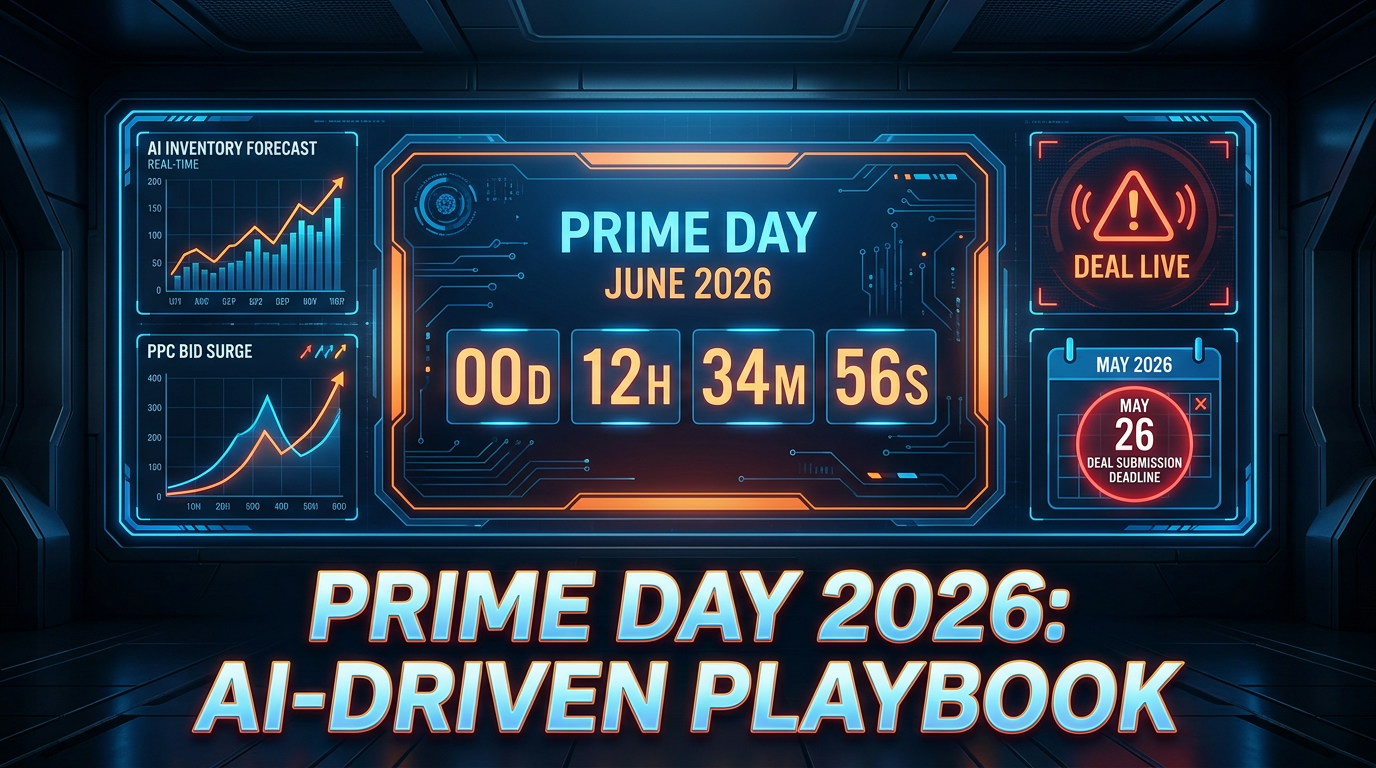
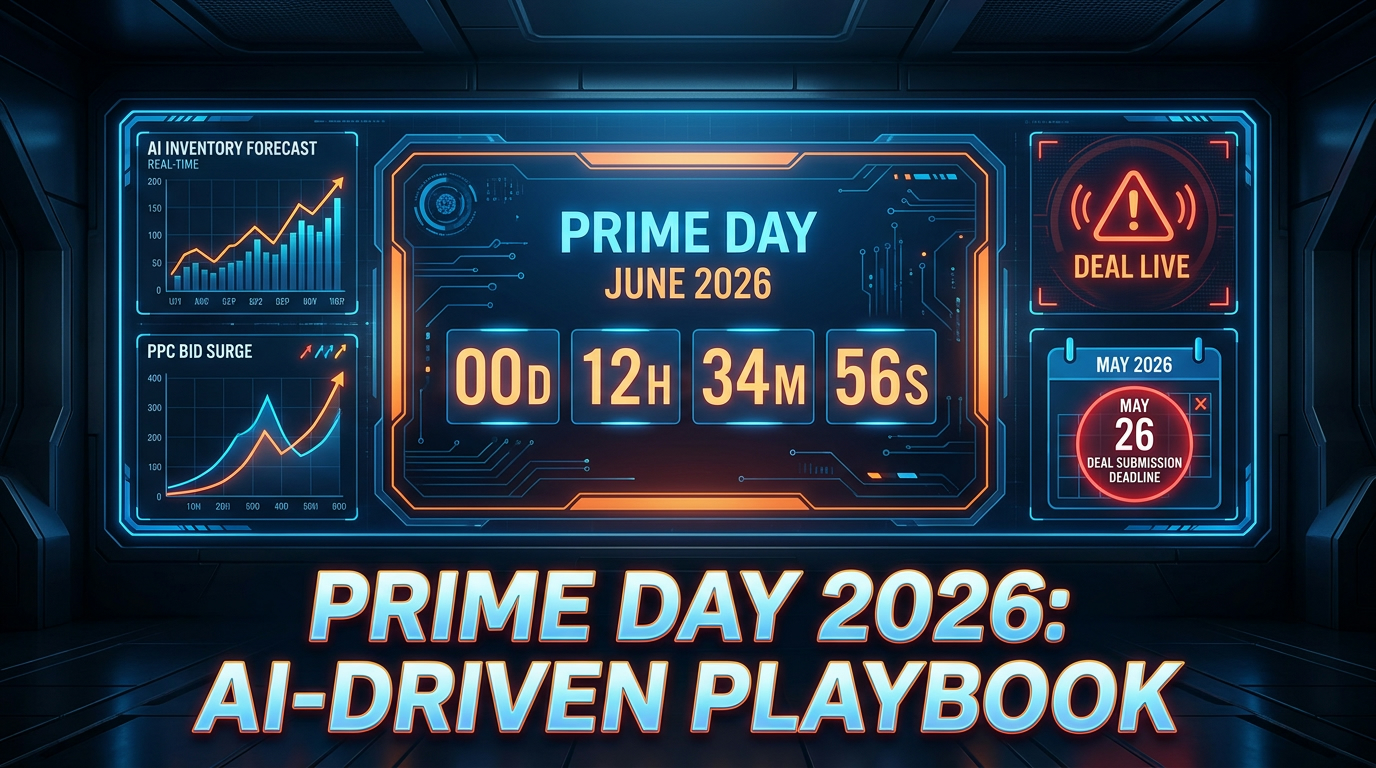
Amazon has officially confirmed that Prime Day 2026 is moving from its traditional mid-July slot to late June, compressing the entire preparation window by approximately three weeks. Deal submission deadlines land around May 26. FBA inventory must arrive by roughly June 5. What used to be a comfortable two-month runway is now a sprint.
At the same time, the competitive landscape inside Prime Day has changed at a structural level. Amazon’s AI shopping assistant — rebranded from Rufus to Alexa for Shopping in May 2026 — now reaches over 250 million customers, actively mediating product discovery, comparison, and purchasing decisions. Roughly 35% of shoppers used AI tools during major sale events in 2025, a figure expected to climb substantially in 2026. The buyer who used to scroll through search results is increasingly asking an AI agent to shortlist products for them.
Meanwhile, Prime Day’s footprint has expanded beyond the event itself. Data from Levanta’s cohort of 390 brands shows that the sales impact now spans a measurable 8-week lead-in period and a post-event halo week where sales remain roughly 57% above baseline. This is no longer a 4-day sprint — it is a multi-week commercial cycle with AI decision-making at its core.
This playbook covers what has actually changed in 2026, how AI tools are reshaping every phase of preparation and live execution, and what the sellers performing above benchmarks are doing differently — from inventory forecasting and listing structure through PPC automation, off-Amazon traffic, and post-event measurement.
The Compressed Timeline: What Moving to June Actually Changes
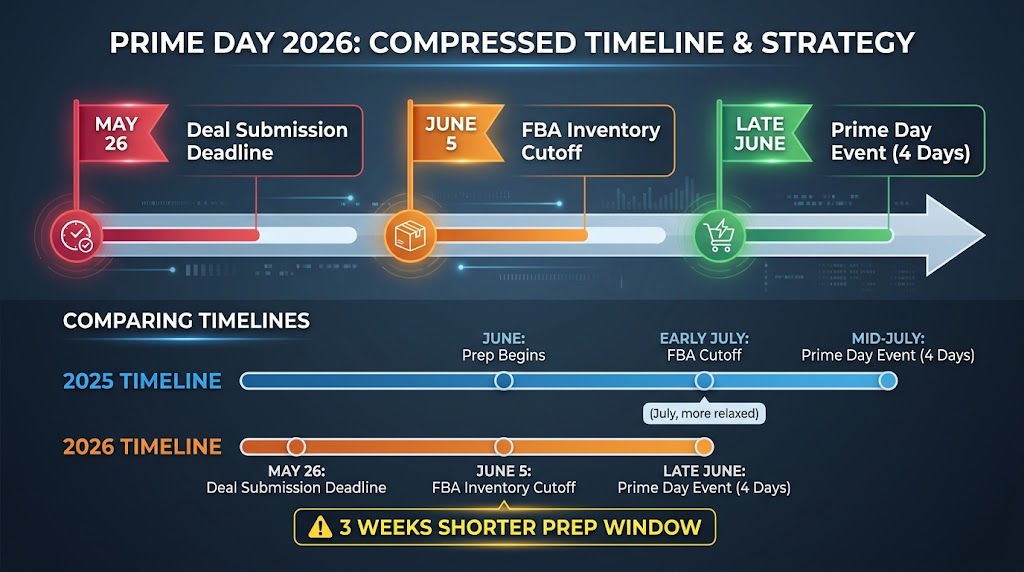
The move from July to June is not simply a calendar change — it reorganizes the entire operational sequence that sellers depend on. Brands that plan around historical Prime Day timelines will find themselves behind before the event even begins.
The Critical Hard Deadlines
Multiple seller-focused guides and Amazon communication to brand partners have crystallized around three anchor dates:
- May 26: Lightning Deal, Best Deal, and Prime Exclusive Discount submission deadline.
- May 27: Amazon Warehousing and Distribution (AWD) inventory cutoff.
- June 5: FBA receiving cutoff for Prime Day inventory to be available at event start.
The implications cascade backwards. If FBA inventory needs to arrive by June 5, purchase orders to suppliers typically need to be placed in early-to-mid April to allow for production, quality control, and freight — especially for overseas suppliers requiring 4-6 week lead times. That means the planning horizon for Prime Day 2026 was effectively Q1 for any seller using overseas sourcing.
What the Compression Breaks
In prior years, sellers had a natural buffer between deal submission and inventory arrival. A seller who submitted their deals in May could still receive FBA inventory in mid-June and be positioned in time. In 2026, those two deadlines are effectively concurrent, meaning any slip on one creates a problem on the other.
The most common failure point will be cash flow timing. Moving inventory procurement three weeks earlier places capital demands in a period when many brands are still recovering from spring promotional spend. Sellers who don’t account for this will either under-stock (capping their Prime Day upside) or miss the FBA cutoff entirely and be forced to run from third-party warehouses at higher cost and lower Prime eligibility.
What Sellers Should Do Right Now
For any brand still reading this before Prime Day, the practical response is to work backwards from June 5 with firm dates rather than approximate targets. Build a Gantt-style calendar in your project management tool with these three deadlines as fixed anchors, then map every dependency backwards: creative assets, pricing approval, PPC campaign setup, inventory production, and freight booking. Each of these feeds into the others, and the compressed window means no step can slip without consequences.
Brands that treat the June timeline as equivalent to the July one will be caught off guard by how quickly the preparation window closes.
AI-Assisted Inventory Forecasting Without a Data Team
Demand forecasting for Prime Day has historically required either expensive software platforms or in-house analytics capability. In 2026, that gap has closed substantially. Large language models — specifically ChatGPT, Claude, and Gemini — can now be paired with standard Seller Central exports to produce actionable SKU-level forecasts without any coding or data science expertise.
The Seller Labs LLM Forecasting Framework
The core workflow documented by Seller Labs involves exporting two standard Seller Central reports: the Sales and Traffic report (with at least 52 weeks of data) and the FBA Inventory report. These CSV files contain everything an LLM needs to identify seasonal patterns, calculate average daily velocity, model event multipliers, and project FBA restock quantities.
The prompt structure that produces reliable output looks roughly like this: supply the model with your trailing 52-week ASIN-level sales data, tell it the event dates and the prior year’s Prime Day actual velocity for each SKU, ask it to calculate a 3x, 4x, and 5x multiplier scenario, then ask it to factor in your current FBA stock levels to produce a reorder quantity recommendation per scenario.
This is not magic — the LLM is doing structured arithmetic and pattern matching that any competent analyst could do manually. What it eliminates is the time cost. A process that might take two days of spreadsheet work compresses into a couple of hours of structured prompting and review.
The PROPAMP Case Study: AI Agent for Multi-Marketplace FBA Planning
A more advanced example comes from PROPAMP’s documented case study of a seller operating across 16 Amazon marketplaces who used an AI agent to build a complete Prime Day restock plan after their supply chain manager left. The AI workflow covered five distinct phases: inventory audit across all ASINs and markets, demand forecast generation using historical data, gap analysis comparing forecasted demand against current stock, shipment plan generation with quantities and destination fulfillment centers, and financial impact modeling to calculate capital requirements per scenario.
The case study illustrates where AI genuinely saves time and reduces error rates compared to manual processes — specifically in the gap analysis and shipment planning phases, which involve reconciling large data tables across multiple variables simultaneously.
The Limits: Where Human Judgment Still Belongs
AI forecasting tools perform well on products with established sales history and predictable Prime Day multipliers. They perform poorly on:
- New launches with fewer than 6-12 months of data, where seasonal multipliers can’t be estimated reliably.
- Products with supply constraints, where forecasting demand above what can be sourced creates false precision.
- Category-specific shifts — for example, if a competitor has had a major product recall or a new entrant launched in your space, an LLM working from historical data won’t know about it unless you explicitly include that context in your prompt.
The practical advice: use AI-generated forecasts as your starting point, then layer in your own market knowledge before submitting purchase orders. The model handles the arithmetic; the seller handles the context.
Optimizing Listings for Alexa for Shopping — Not Just Search
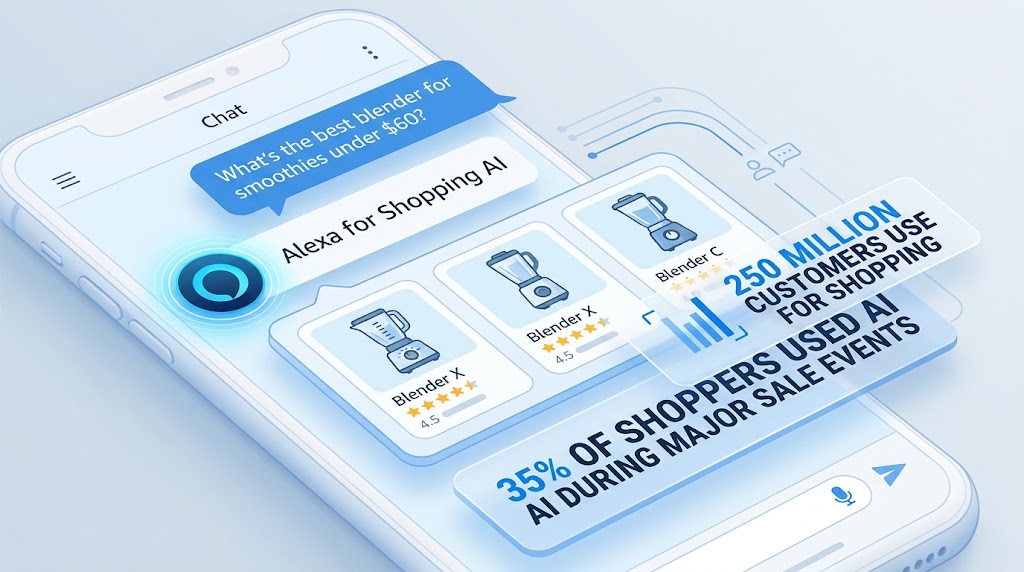
Amazon’s rebranding of Rufus as Alexa for Shopping on May 13, 2026 is not just a nomenclature update — it signals that AI-mediated shopping is now treated by Amazon as a primary browsing mode, not an experimental feature. The agent is embedded directly in the Amazon app’s main search bar, accessible across web, app, and Echo devices, with capabilities including product comparisons, personalized recommendations, price alert setting, and in some cases auto-adding items to cart.
Over 250 million customers have used the assistant, with usage accelerating sharply. For Prime Day specifically, 35% of shoppers used AI tools during the equivalent BFCM event in 2025. Prime Day — with its heavier deal density and comparison-shopping behavior — will likely see higher AI assistant engagement than any other Amazon event.
How Alexa for Shopping Reads Your Listing
The agent doesn’t index listings the way traditional keyword-matching search does. It reads your listing as a document and uses it to answer shopper questions like “What’s the best protein powder for beginners under $40?” or “Is this blender compatible with wide-mouth mason jars?”
This means the specific information architecture of your listing matters more than keyword density. The agent can extract explicit answers to comparison questions, compatibility details, use-case suitability flags, and warranty/return policy clarity. Listings that answer these questions in structured, scannable language surface more favorably in AI-generated shortlists. Listings that don’t contain these answers — even if they rank well for keywords — may not appear in AI-mediated results at all.
Content Changes That Actually Move the Needle
The transition from keyword-stuffed bullets to intent-answering content requires rethinking each bullet point as a direct response to a shopper question. Instead of: “Premium stainless steel construction with BPA-free materials” — consider: “Built from food-grade 18/8 stainless steel with zero BPA-containing parts — safe for hot liquids, dishwasher compatible, and odor-resistant after extended use.”
The second version contains the same product facts but frames them as answers to questions a shopper (or AI agent) would ask. Compatibility, safety, use context, and maintenance requirements are all explicit.
The categories of information that AI shopping agents extract most frequently from listings include:
- Primary use cases and who the product is “best for” — framing around a target user profile, not generic claims.
- Explicit compatibility flags — works with, does not work with, requires X to function.
- Comparison anchors — how this product differs from the standard category approach.
- Quantified claims — “holds up to 64oz” rather than “large capacity.”
- After-purchase considerations — warranty terms, return window clarity, support availability.
The A+ Content and Brand Story Layer
Alexa for Shopping can also draw on A+ content and Brand Story modules when building product summaries. Brand Story modules that articulate who the brand is for and what its product philosophy is give the AI agent additional signal to use when evaluating fit for a given buyer query. This is not hypothetical — Amazon’s documentation confirms that the assistant uses “all available product information” when generating responses.
Before Prime Day, every core ASIN in your deal set should have fully populated A+ content. Not for visual impact alone — but because the text within those modules is indexable by Alexa for Shopping and contributes to how your listing is surfaced in AI-mediated searches.
PPC in the AI Era: Bidding Strategy for Prime Day 2026
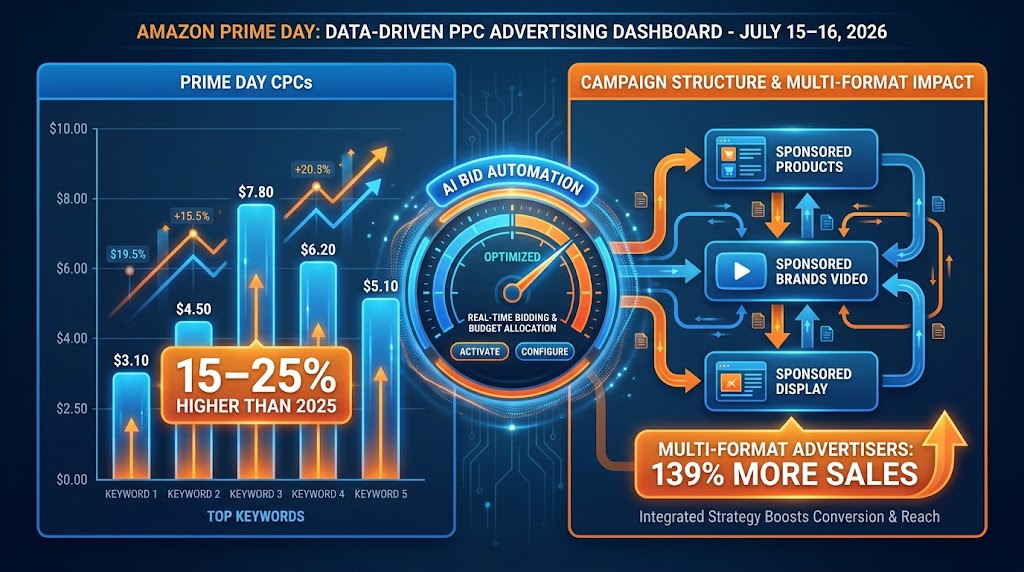
Prime Day PPC has always been expensive. In 2026, it is both more expensive and more consequential. CPCs for top-performing Prime Day keywords are projected to range from $2.50 to $8.00, approximately 15–25% higher than 2025 equivalents. At those CPC levels, the difference between a profitable Prime Day and a loss-making one is often determined not by what campaigns you run, but by how precisely your bids respond to real-time competitive pressure during the event.
The Multi-Format Imperative
One of the most consistent findings from 2025 Prime Day post-mortems is the sales lift associated with running ads across multiple formats simultaneously. Amazon’s own data indicates that multi-format advertisers — those running Sponsored Products, Sponsored Brands, and Sponsored Display concurrently — see approximately 139% more sales than single-format advertisers during the event window.
The mechanism is straightforward: different ad formats capture buyers at different stages of the purchase journey. Sponsored Products convert active searchers. Sponsored Brands Video builds consideration among browsers. Sponsored Display retargets visitors who viewed but didn’t purchase, and conquests competitor ASIN detail pages. Running all three creates a coverage layer that single-format campaigns simply cannot match.
AI-Automated Bidding: What It Can and Can’t Do
Amazon’s own Ads Agent — part of the expanding MCP Server capability — now allows sellers to automate campaign adjustments in near real-time based on live event performance signals. Third-party platforms including Autron have built similar capabilities that adjust bids on a sub-hourly basis during Prime Day based on conversion rate trends, CPC competition, and remaining budget pacing.
What these tools handle well: micro-adjustments to bids across large keyword sets during a high-velocity event when no human could realistically monitor every campaign simultaneously. What they don’t handle well: strategic decisions about which ASINs to prioritize, how to balance deal-supported products against full-price catalog items, and when to cut budgets on underperforming keywords rather than continuing to bid into them.
The optimal approach in 2026 is a layered automation model: set the strategic parameters (target ACoS by ASIN, budget caps by campaign type, priority product designations) before the event, then let AI tools handle the tactical bid adjustments in real time, with human review triggered by exception conditions rather than continuous monitoring.
Campaign Architecture Before the Event
There are four structural setup steps that have an outsized impact on Prime Day PPC performance:
- Separate deal ASINs from full-price ASINs in campaign structure. Deal ASINs should have higher conversion rates and can support higher bids. Mixing them with full-price ASINs in the same campaign dilutes optimization signals.
- Build a dedicated conquest campaign targeting top competitor ASINs. Set this live at least two weeks before Prime Day to collect conversion data before CPCs spike.
- Build a brand defense campaign targeting your own brand terms and ASINs with high bids. Competitor conquest is common during Prime Day — if you’re not defending your own listings, you’re ceding that traffic.
- Set campaign budgets at 3x your average daily spend. Amazon’s algorithm rewards campaigns that don’t run out of budget mid-day. Underfunded campaigns lose position precisely when competition is highest.
The Keyword Harvest Timing
One of the most underused PPC tactics before Prime Day is running broad and auto campaigns in the 6-8 weeks beforehand and harvesting the converting search terms for manual campaign targeting during the event. Traffic volumes and buyer intent patterns shift in the lead-up to Prime Day as shoppers start researching — the keywords converting in this pre-event window are often different from baseline keywords and represent high-intent buyers who will convert at strong rates during the event itself.
The 8-Week Halo: How to Think About Prime Day’s Real Sales Arc
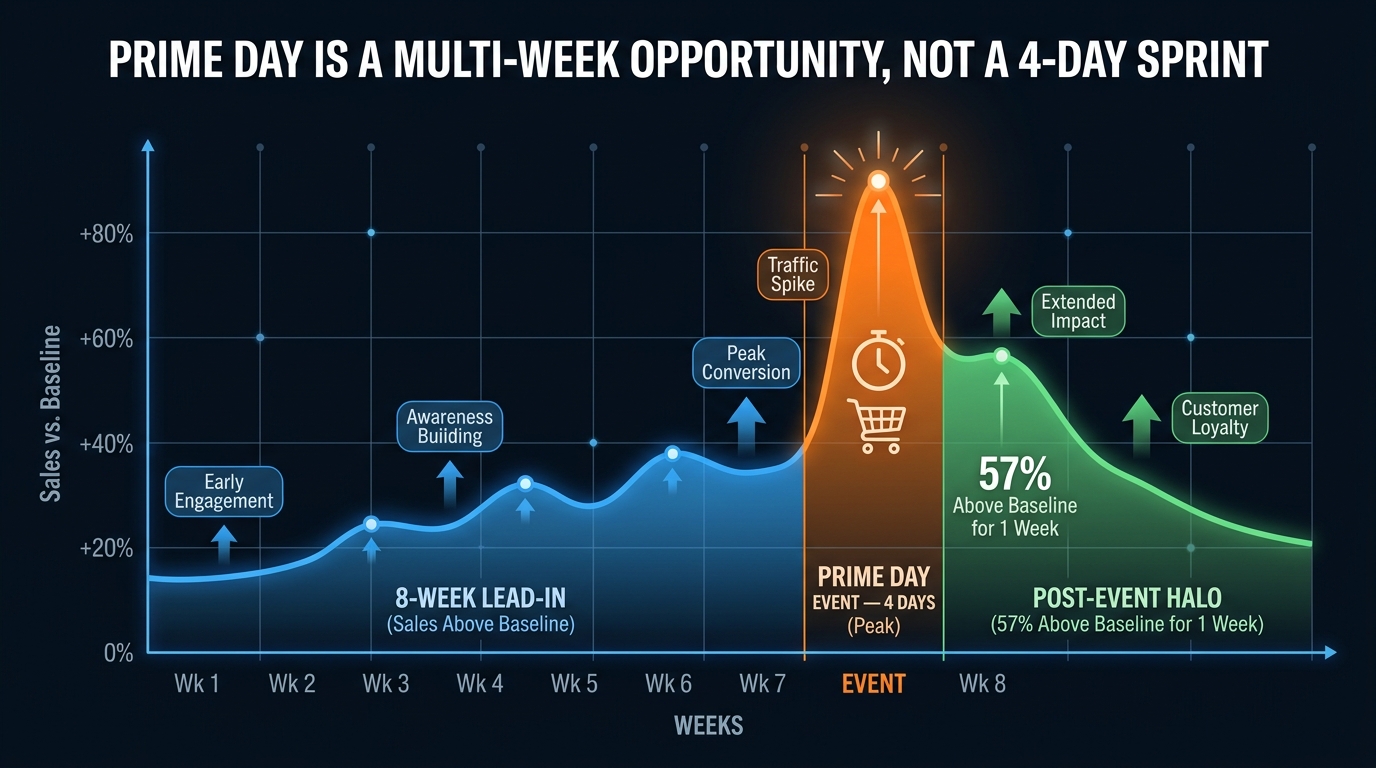
Most sellers still treat Prime Day as a 4-day event. Levanta’s analysis of 390 brands across Prime Day 2025 shows it is actually a multi-week commercial cycle with three distinct phases — each requiring different strategies.
Phase 1: The 8-Week Lead-In
Levanta’s data shows that in 2025, sales for well-prepared brands stayed above baseline throughout the 8 weeks before Prime Day — a meaningful shift from 2024, where the pre-event period showed little elevation. This suggests buyers are increasingly aware of the Prime Day window and are making category-specific decisions earlier, either anchoring to Prime Day deals or front-running them.
For sellers, the lead-in phase is the time to build organic velocity and conversion rate history that Amazon’s algorithm will use to rank products during the event. Running Vine reviews on new ASINs, building Subscribe & Save penetration on consumables, and executing early sponsored keyword campaigns to bank conversion data all compound to produce better organic positioning when traffic peaks.
The lead-in is also the optimal window for awareness advertising. Traffic costs less, competition is lower, and the buyer base in this window is research-oriented rather than purely transaction-oriented. Sponsored Brands video content and off-Amazon social content perform differently in this phase than during the event itself — they’re building familiarity that will drive conversion when the deals go live.
Phase 2: The 4-Day Event
The event itself is now a 4-day format — established in 2025 and confirmed for 2026. This extended format changes the pacing strategy. In a 2-day event, a seller’s goal was maximum exposure on Day 1 with whatever was left managed on Day 2. A 4-day event creates a different problem: managing budget depletion and deal fatigue across a longer arc.
Data from 2025 shows that Day 1 and Day 2 carry the highest concentration of conversion-intent buyers. Days 3 and 4 see slightly lower conversion rates but remain above baseline and attract deal-extenders — buyers who missed the early deals but are still in purchasing mode. The practical implication: Day 1 budget should be highest, Day 2 slightly lower, Days 3-4 more conservative, with saved budget allocated to retargeting audiences who viewed but didn’t purchase earlier in the event.
Phase 3: The Post-Event Halo
Levanta’s data is definitive on this: sales remained 57% above baseline for the full week after Prime Day 2025 before normalizing. This is not noise — it is a consistent halo of residual purchasing intent from buyers who were in the funnel during the event but didn’t complete their purchase, returning visitors checking post-event prices, and buyers who discovered a brand during Prime Day and completed a purchase afterward.
The halo week is where most sellers leave significant revenue behind by cutting ad spend immediately after the event ends. Retargeting campaigns targeting event-period visitors, Sponsored Display targeting recent product page viewers, and email/SMS sequences for Subscribe & Save customers all have strong ROI in this window because the audience is warm and intent is high while competition has dropped sharply.
Off-Amazon Traffic: Making Affiliates and Creators Work for Prime Day
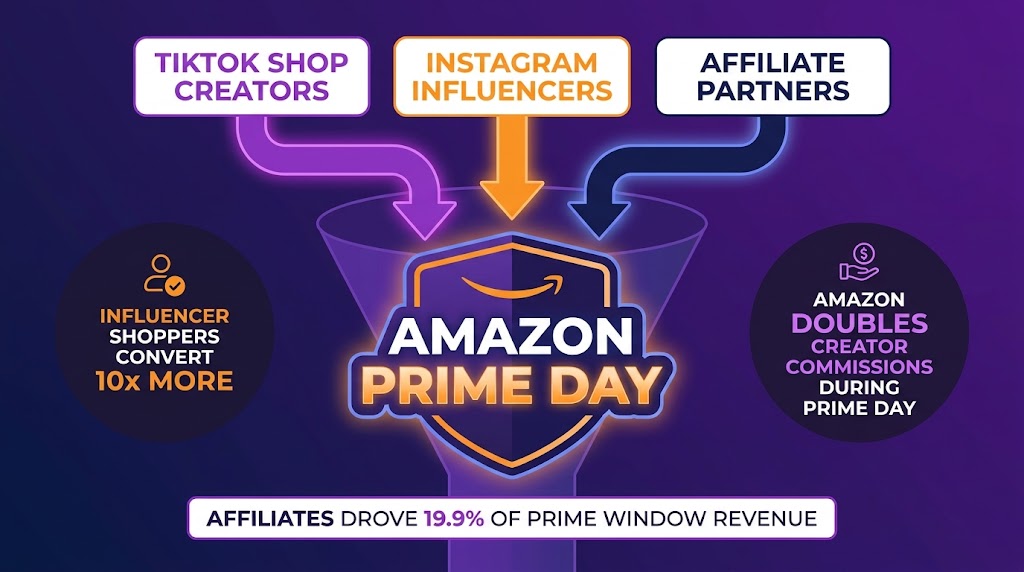
The role of off-Amazon channels in Prime Day performance has grown from a supplementary tactic to a meaningful revenue driver with its own data infrastructure. Adobe Analytics data from Prime Day 2025 shows that affiliates and partner channels accounted for 19.9% of total Prime window revenue, up 15% year-over-year. More importantly, influencer-driven shoppers converted at 10 times the rate of the average social channel visitor — making the quality of the traffic as notable as its volume.
Amazon’s Creator Commission Structure for Prime Day 2026
Amazon has confirmed elevated creator commissions during the Prime Day window, with reports of up to double standard affiliate rates in select categories — with jewelry and power tools receiving the largest boosts. This creates a structural incentive for creators to promote Prime Day deals over competing retail events, and it creates a supply of motivated affiliate traffic that brands with well-structured Amazon Associates relationships can tap directly.
The practical implication for brands: if you have deals approved for Prime Day, reaching out to relevant creators in your category before the event begins — not the week before, but 4-6 weeks out — allows them to build content in advance, schedule it for the event window, and include your product in deal roundups rather than as a last-minute add. Creators working with double commissions will be actively looking for strong products to feature; the brands who approach them early and provide ready-made assets get disproportionate share of that attention.
The Nécessaire Case Study: Off-Amazon Builds On-Amazon
Fospha’s case study on Nécessaire’s Prime Day performance illustrates the compound effect of pre-event social investment. Nécessaire maintained a full-funnel brand presence on TikTok and Meta in the weeks before Prime Day, driving awareness that didn’t convert immediately in social analytics but generated Amazon demand that was only visible when tracking cross-channel attribution. The result: 65% of their Prime Day sales were organic, and performance was 47% above industry benchmarks for comparable brands.
The mechanism is attribution: a buyer sees a TikTok video about a skincare product, searches for it on Amazon during Prime Day when the deal is live, and buys. The TikTok channel gets no credit in last-click attribution, but the purchase was clearly influenced by the off-Amazon exposure. Brands that only look at on-Amazon metrics consistently underinvest in social pre-event because they can’t see its return. Brands that track cross-channel attribution invest in social with confidence.
Structuring TikTok Content for Prime Day
The content structure that performs best in the pre-Prime Day window on TikTok is not deal announcements — those have poor organic reach because they function as advertisements. The formats that build organic reach are:
- Problem-solution demonstrations showing the product solving a specific relatable problem, with a CTA directing viewers to “check the link during Prime Day” — building intent without triggering ad-review suppression.
- Before-and-after formats that show real use outcomes, particularly strong in home, beauty, and fitness categories.
- Comparison content positioning your product against the category standard — this format feeds directly into Alexa for Shopping’s comparison logic and can drive structured search on Amazon after the video airs.
Creator briefs distributed 4-6 weeks before Prime Day should include the deal discount amount, the event dates, a direct Amazon product link, and specific product claims the creator should emphasize — especially the intent-answering framing discussed in the listing optimization section, so on-Amazon and off-Amazon messaging are consistent.
Brand Defense and Competitor Conquesting: The AI-Powered Battlefield
Prime Day concentrates millions of buyers into a short window, which means it also concentrates competitive pressure on every high-performing ASIN. Competitor conquesting — targeting another brand’s ASIN or brand keywords to capture their deal traffic — is standard practice at this event. Every brand is simultaneously defending their own listings and attempting to exploit competitors’ weaknesses.
Defensive Ad Architecture
The defensive layer of Prime Day PPC requires specific campaign types that many sellers neglect:
- Sponsored Products exact match on your own brand terms — at elevated bids to ensure you never lose your own brand keyword to a competitor’s sponsored placement.
- Sponsored Display targeting your own ASIN detail pages — this places your ads on your own product pages, making it significantly harder for competitor ads to appear below your buy box.
- Sponsored Brands campaigns on brand terms with a strong deal creative — the deal price and savings figure in the creative has a strong visual interrupt that helps maintain click-through rate even when competitors are paying to appear alongside.
A key AI tool deployment here is automated brand term monitoring — setting up alerts that flag when competitor ad spend on your brand terms spikes, so you can respond with higher defensive bids in real time rather than discovering the issue post-event in an audit.
Offense: Identifying the Right Targets
Conquest campaigns perform best when they target competitors who are strong in search but weak in conversion rate, review volume, or deal depth. The approach: identify ASINs in your category that rank well but have fewer than 200 reviews, a review rating below 4.2, or no Prime Day deal active. These products will appear prominently in search results but are vulnerable to conversion-rate comparison when a shopper lands on their page and sees your sponsored display ad featuring a better-reviewed, better-priced alternative.
AI tools that analyze competitor listing quality and review sentiment can surface these targets systematically. The manual equivalent — reviewing each competitor ASIN individually — is not practical at scale during event preparation, which is precisely where AI-assisted competitive analysis creates a genuine operational advantage.
Pricing as a Competitive Signal
Alexa for Shopping actively compares prices across products in response to queries. A product that is 10-15% cheaper than a comparable alternative will be surfaced favorably in AI-mediated price comparisons, regardless of how its search ranking compares. This means that Prime Day pricing decisions are no longer just about conversion rate on your own listing — they affect how the AI assistant evaluates your product against every competitor in your category.
Brands that set their Prime Day discount to the minimum required for Lightning Deal eligibility may find they’re losing AI-mediated comparisons to competitors with deeper discounts, even if their organic rank is higher. Running price comparison simulations in the Alexa for Shopping interface — asking it to compare your product against key competitors — gives you a direct view of how an AI agent will present your product before the event begins.
Day-of Execution: Running Prime Day Like a Live Operation
The work done in preparation determines the ceiling of Prime Day performance. The work done on the day determines how close to that ceiling you actually get. Most sellers underestimate how dynamic the event is — deals go live and die faster than expected, CPCs shift hourly, and inventory can run unexpectedly if a single ASIN hits viral attention.
Setting Up Your Monitoring Stack
Effective day-of monitoring requires watching four dashboards simultaneously:
- Seller Central Campaign Manager for real-time spend pacing, impression share, and budget utilization by campaign.
- Deal Central / Promotions dashboard for deal claim rate and deal page views — an early signal of whether a deal is performing or underperforming expected traffic.
- FBA Inventory levels — specifically the “Available” quantity, not just the “Total” quantity. Stock that is in “reserved” status isn’t fulfillable, and Prime Day demand can outpace Amazon’s processing time for incoming transfers.
- Third-party analytics tool (Helium 10, DataHawk, or equivalent) for ranking movement and competitive position across your target keywords in real time.
Pre-Built Decision Trees
The most effective day-of teams operate from pre-built decision trees rather than making ad-hoc judgment calls under pressure. These cover situations like: “If a deal’s claim rate falls below X% in the first two hours, we take this action.” “If a top ASIN’s FBA inventory drops below Y units, we activate this backup fulfillment plan.” “If CPC on this keyword cluster exceeds $Z, we shift budget to these alternative campaigns.”
These decision trees can now be operationalized with AI assistants. Loading your key parameters into a structured prompt that monitors live data and flags exception conditions — rather than asking someone to watch every metric manually — means your team responds to problems rather than hunting for them. This is especially valuable for sellers managing multiple ASINs across multiple deal types simultaneously.
Lightning Deal Optimization in Real Time
Lightning Deals have a fixed window and a fixed discount, but their performance is not fixed — it depends heavily on the time slot and the deal’s position in the Lightning Deals browsing page. Deals running in the first hour after Prime Day begins almost always perform better than deals running in later slots, simply because buyer intent and browsing intensity are highest early. If you have flexibility in how your deals are structured, front-loading the highest-margin or highest-priority ASINs into the earliest available slots is a consistent best practice.
During the event, watch the “claimed percentage” on each Lightning Deal. A deal that reaches 80%+ claimed before the halfway mark indicates strong demand — take note of this ASIN for future event planning and consider whether there’s a follow-on opportunity to run additional promotions on it post-event while demand is still elevated.
Post-Prime Day: Measuring What Actually Mattered
The week after Prime Day is when most brands review their numbers and make decisions about future investment. The quality of that decision-making depends entirely on whether the attribution framework they’re using captures the actual drivers of performance — or tells a partial story that leads to the wrong conclusions.
The Attribution Problem
Last-click attribution is Prime Day’s most persistent measurement flaw. A buyer who discovered your brand through a TikTok creator video, researched it via Alexa for Shopping, and converted after clicking a Sponsored Products ad will appear as a pure PPC conversion. The creator who drove the initial awareness, the listing copy that convinced Alexa for Shopping to surface the product, and the A+ content that built product confidence all disappear from the attribution record.
This matters not just for measuring this Prime Day — it matters for deciding where to invest next cycle. Brands that attribute all Prime Day revenue to PPC tend to increase PPC spend and cut social/content budgets, which reduces their organic and awareness positioning and makes them more dependent on paid traffic over time. The Nécessaire case study — where 65% of Prime Day sales were organic, driven in part by pre-event TikTok investment — is a direct counter-example to that approach.
The Metrics That Tell the Full Story
Beyond total revenue and ACoS, the post-event metrics worth examining closely:
- New-to-brand customer rate — Prime Day is one of the highest new customer acquisition events in the calendar. What percentage of your Prime Day buyers were first-time purchasers? High NTB rate indicates good top-of-funnel reach; low NTB rate means you’re mostly reselling to existing customers.
- Post-event organic rank change — Did your sales velocity during Prime Day move your keyword rankings? Products that sustain higher rankings post-event get a compound benefit from the event investment that goes beyond the 4-day sales window.
- Subscribe & Save conversion rate from Prime Day buyers — For consumable products, the LTV of a Prime Day buyer who converts to Subscribe & Save is dramatically higher than one who doesn’t. Tracking this cohort separately reveals whether your Prime Day investment is producing long-term customers or one-time buyers.
- Review velocity post-event — Prime Day typically drives a review influx 2-3 weeks after the event. Monitoring this cohort’s review sentiment gives you early signal on product quality issues before they accumulate enough to affect star rating.
Building the 2026 Debrief Document
Within 10 days of Prime Day ending, the most valuable exercise is building a structured debrief that captures: what the AI tools did well vs. where they required intervention, which ASINs over- and under-performed relative to forecast and why, which ad formats produced the best ACoS, and what operational bottlenecks emerged during the event. This document becomes the input for next event’s preparation — specifically the forecast models, the campaign architecture templates, and the deal submission calendar.
The compressed 2026 timeline means that next event preparation may begin earlier than expected. Black Friday and Cyber Monday preparation, which previously could start in September, may now overlap with Prime Day halo analysis if Amazon introduces another surprise event in the Q3 window. Building the debrief habit ensures you’re not reconstructing context from memory three months later.
Conclusion: The Prime Day 2026 Mindset Shift
Prime Day 2026 is a test of operational readiness in a compressed window, AI-literacy in a world where 250 million shoppers have an AI assistant mediating their purchase decisions, and strategic discipline in a 4-day event where the temptation to react emotionally to live data is constant.
The sellers who perform best this June will not be the ones with the biggest budgets or the most sophisticated tech stacks. They’ll be the ones who understood that the timeline moved, updated their preparation calendar accordingly, structured their listings to answer questions rather than just match keywords, built multi-format PPC coverage with AI automation handling the micro-adjustments, activated off-Amazon traffic channels early enough for them to compound, and measured the full halo window rather than just the 4-day peak.
The single highest-leverage action for any brand reading this before the deadline: build a backwards calendar from June 5 today, identify where you’re behind, and treat the deal submission deadline of May 26 as a hard constraint that cannot slip. Everything else — listing optimization, PPC structure, affiliate outreach — can be done in parallel. The inventory deadline cannot.
Prime Day 2026 Actionable Checklist:
- ☑ Map your preparation calendar backward from June 5 (FBA cutoff) and May 26 (deal deadline).
- ☑ Export 52-week SKU data and run LLM-assisted demand forecasting for 3x, 4x, and 5x scenarios.
- ☑ Audit all deal ASIN listings for intent-answering bullet structure and full A+ content.
- ☑ Set up Alexa for Shopping queries on your own products — see what an AI agent shows buyers.
- ☑ Build a multi-format campaign structure: Sponsored Products, Sponsored Brands Video, Sponsored Display.
- ☑ Set campaign budgets at 3x daily average; activate brand defense and conquest campaigns.
- ☑ Brief creators and affiliates 4-6 weeks before the event with assets, deal details, and suggested messaging.
- ☑ Build pre-event decision trees for inventory alerts, budget reallocation triggers, and deal underperformance responses.
- ☑ Plan post-event retargeting before the event begins — don’t cut ad spend the moment Prime Day ends.
- ☑ Schedule a post-event debrief within 10 days to capture what your AI tools did well and where they failed.
The window is short. The competition is AI-assisted. The buyers are being guided by agents that read your listings and compare your prices in real time. The sellers who prepare for that specific reality — rather than the Prime Day of three years ago — are the ones who will look at their June numbers and see a material difference.