
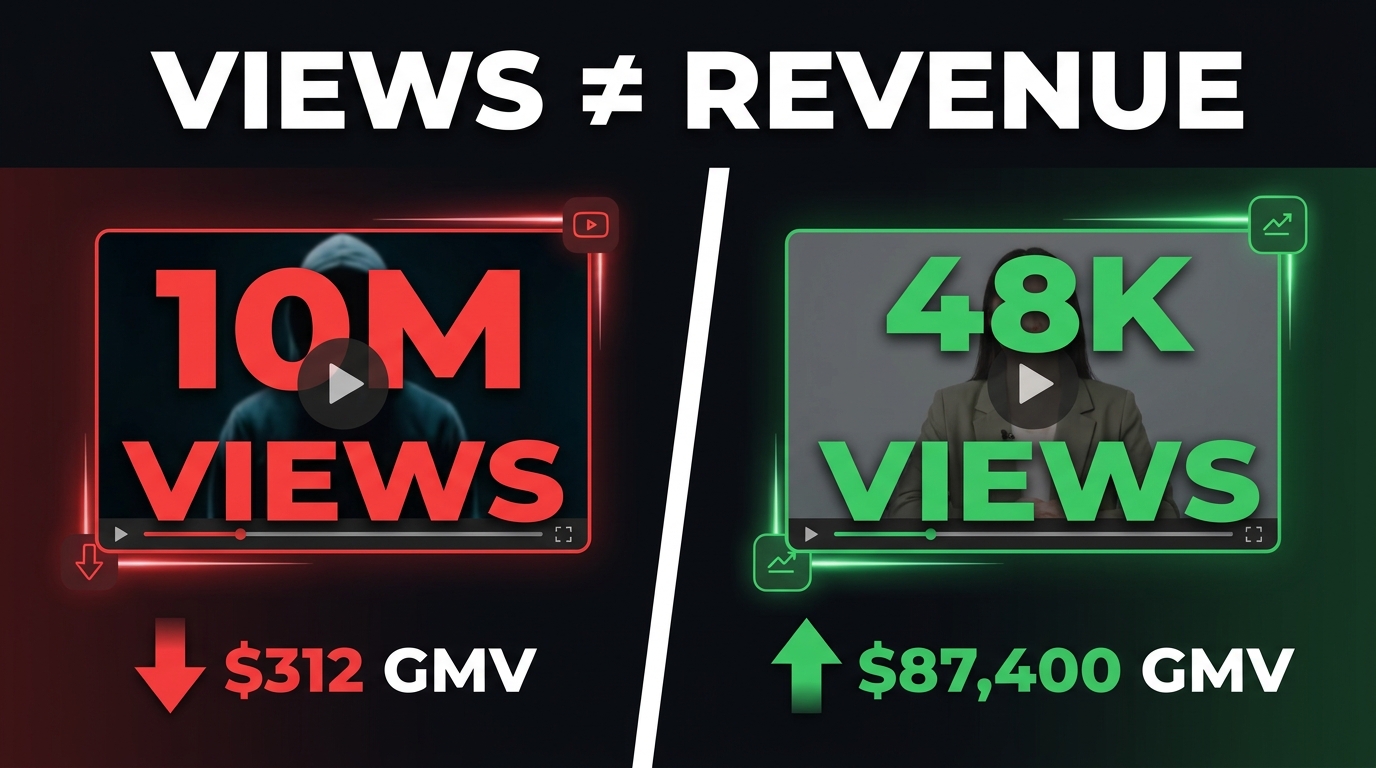

The pitch sounded perfect. A creator with 2.4 million followers, solid engagement, a track record in your niche. The post goes live, clocks 800,000 views in 48 hours, and your social team sends a celebratory Slack. Then the attribution report lands. $1,900 in tracked GMV. A link-click rate of 0.09%. Eighteen promo code uses.
This scenario plays out hundreds of times a day across brands running creator programs in 2026. View counts balloon. Revenue doesn’t follow. And teams are left reverse-engineering why a “viral” collab failed to move the number that actually matters.
The problem isn’t creators. It isn’t even the platforms. It’s the way most brands still select, brief, structure, and measure creator collaborations — frameworks built for awareness campaigns being applied to commerce goals they were never designed for.
In 2026, creator affiliate content accounts for roughly 42% of all U.S. TikTok Shop GMV, making it the platform’s single largest sales channel. The top-performing creator programs are generating eight and nine-figure revenue numbers off audiences that would be considered mid-tier by reach standards. Meanwhile, brands with far larger creator budgets are chasing view counts and wondering why their ROAS is flat.
This post is about what separates the two groups — not philosophically, but mechanically. The creator signals that predict GMV before a post goes live. The content formats that convert 2–4x better. The deal structures that align incentives toward revenue. The attribution frameworks that reveal what’s actually working. And the partnership models that compound results over time instead of resetting to zero with every campaign.
There’s a significant gap between how creator collabs are typically run and how the highest-GMV programs actually operate. That gap is closeable. Here’s how.
The Views-GMV Disconnect Is Structural, Not Accidental
The first thing to understand is that high view counts and high GMV are not just weakly correlated — in many cases, they’re inversely correlated for specific types of creators. The content formats that generate the most views are frequently the worst at driving purchase behavior, and vice versa.
Broad entertainment content, trending audio videos, and aspirational lifestyle posts are optimized for the platform algorithm’s reach mechanics. They generate shares, comments, and saves because they resonate emotionally with a wide audience. That wide audience is, by definition, loosely targeted. Many viewers are genuinely interested in the content but have no purchase intent for the featured product. Some aren’t even the right demographic.
Meanwhile, a creator with 40,000 followers doing a detailed tutorial on exactly the product problem your SKU solves — to an audience that actively searches for solutions in that category — is working with a fundamentally different dynamic. Fewer total viewers, but a far higher percentage with the specific context to convert.
The Platform Algorithm Isn’t Optimizing for Your GMV
Every major platform optimizes its content distribution algorithm for time-on-platform, not for purchase conversion. TikTok, Instagram, and YouTube all reward content that keeps users engaged and scrolling. A product demo that drives people off-platform to complete a purchase is, from the algorithm’s perspective, a negative signal. The platform would rather serve content that keeps users in the app.
This creates a structural tension that most brands never fully reckon with. The content most likely to get pushed to a massive audience is content designed to entertain and hold attention within the platform. The content most likely to drive someone to click a link and complete a purchase disrupts that loop. Getting both simultaneously — wide distribution AND strong purchase conversion — is genuinely rare and almost never a function of follower count or initial view velocity alone.
Vanity Metrics Have a Buyer: It’s the Marketing Team
There’s also an organizational incentive problem. Marketing teams, social media managers, and agency partners are frequently rewarded — consciously or not — for impressive-looking reports. Views, impressions, engagements, and reach are numbers that look good in presentations and justify budget. GMV attribution to a specific creator post is harder to track, often disputed across teams, and less visually compelling in a deck.
This isn’t a character flaw. It’s a measurement infrastructure problem. When the system doesn’t easily surface revenue-level attribution for creator content, teams default to the metrics the system does surface. The result is a persistent organizational bias toward reach-heavy, conversion-weak creator programs — and a recurring quarterly conversation about why the influencer budget “isn’t moving the needle.”
What a High-GMV Creator Actually Looks Like
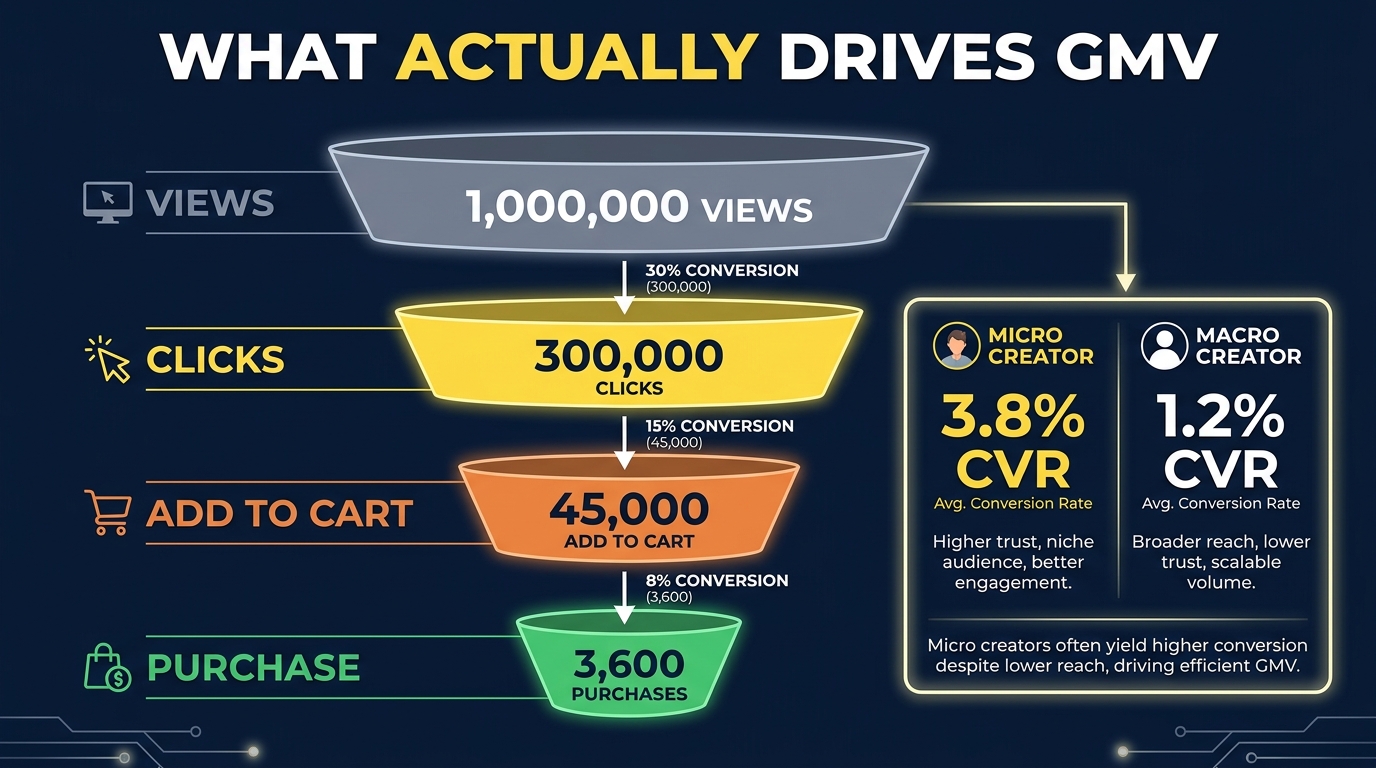
Strip away follower counts, engagement rates, and aesthetic feed quality. What does a creator who actually drives purchases look like in 2026? The data is remarkably consistent across categories and platforms.
Category Authority Over General Appeal
High-GMV creators have earned specific credibility in a defined topic area that aligns with the product being sold. A skincare creator with 90,000 followers who has built an audience around ingredient science, product comparisons, and skin type troubleshooting will outperform a beauty creator with 2 million followers whose content is primarily transformation reveals and aesthetic routines — for a skincare brand trying to drive sales.
The mechanism is trust architecture. The first creator’s audience follows them because they help them make better product decisions. Those followers have actively opted into a relationship where product recommendations are part of the value exchange. The second creator’s audience follows them for entertainment and visual inspiration. Product recommendations are a tolerated interruption, not a core value driver.
Audience Demographics That Match the Buyer Profile
This seems obvious, but it’s routinely missed in creator selection because most brands prioritize platform-level engagement metrics over audience composition data. A creator with strong CPG purchase intent signals in the right age, income, and geographic brackets will drive more GMV than a creator with higher engagement but audience demographics that don’t match the buyer profile.
In 2026, more sophisticated brands are pulling creator audience data through platforms like Creator.co, Grin, or native TikTok Shop affiliate dashboards before making selection decisions. They’re asking for demographic breakdowns, not just follower counts. They’re cross-referencing audience income brackets against their average order value. A $148 skincare kit needs a different creator audience than a $12 supplement.
Prior GMV History in the Same Category
If a creator has previously driven sales of similar products, that track record is the single strongest predictor of future GMV performance. Not engagement rate. Not follower growth. Not content quality scores. Actual, documented sales history in adjacent or identical categories.
This is why brands running structured affiliate programs — particularly on TikTok Shop — increasingly filter creator applications by prior GMV generated on the platform. Creators with a track record of driving purchases in your category have already proven that their audience will buy. You’re not betting on whether that conversion pathway exists. You know it does.
Posting Consistency and Content Cadence
Creators who post consistently — particularly within a recognizable format their audience expects — build a stronger purchase conversion habit than those who post sporadically. The audience learns the content rhythm. They know that when a specific creator shares a product review, it’s worth watching, engaging with, and potentially buying from. That conditioned expectation is a commercial asset that takes time to build and is impossible to replicate with a single sponsored post.
Creator Selection: The Signals That Actually Predict Revenue
Moving from theory to practice, here’s how brands with high-GMV creator programs are operationalizing creator selection in 2026 — and what they’ve stopped looking at.
Signals They’ve Stopped Using
Follower count as a primary filter. Audience size tells you the potential maximum reach. It tells you almost nothing about what percentage of that audience will buy your product. Brands running scaled affiliate programs on TikTok Shop have largely abandoned follower count minimums as a meaningful quality gate.
Overall engagement rate. Engagement rate — likes + comments + shares divided by views or followers — is useful as a fraud signal (very low engagement on a large following suggests fake followers), but it’s a poor predictor of purchase conversion. Saves and profile visits are significantly more predictive than likes and comments, because they signal active interest rather than passive reaction.
Aesthetic fit. Whether a creator’s grid “looks like your brand” is largely irrelevant for GMV. Authenticity in delivery and audience trust matter. Visual alignment with brand guidelines matters much less than whether the creator can make a compelling case for the product in a way their audience finds credible.
Signals That Predict Revenue
Video save rate and profile visit rate. These behavioral signals indicate that viewers are actively engaging with the content beyond passive consumption. Someone saving a video or visiting a creator’s profile after watching a product mention is exhibiting research behavior — the precursor to purchase.
Comment quality and purchase intent language. Qualitative analysis of comment sections reveals purchase intent signals that aggregate metrics miss entirely. Comments like “what’s the link?”, “I just ordered this”, “I’ve been looking for something like this for months” are direct revenue indicators. A creator post with 100,000 views but zero purchase-intent comments is a fundamentally different commercial asset than one with 12,000 views and 40 comments asking where to buy.
Category-specific GMV history. As mentioned above, this is the gold standard. If you’re running on TikTok Shop, the affiliate dashboard shows creator GMV by category. Use it. If you’re running off-platform, ask shortlisted creators for their affiliate conversion rates on comparable products before committing budget.
Audience-to-offer match score. Some brands are now building internal scoring models that cross-reference creator audience demographics against their customer profile. The question isn’t “does this creator have a big audience?” It’s “does this creator’s audience look like our buyer?” The closer the match, the lower the activation energy required to convert a viewer into a customer.
Content Format: Why Demo Beats Lifestyle by a Factor of 2–4x
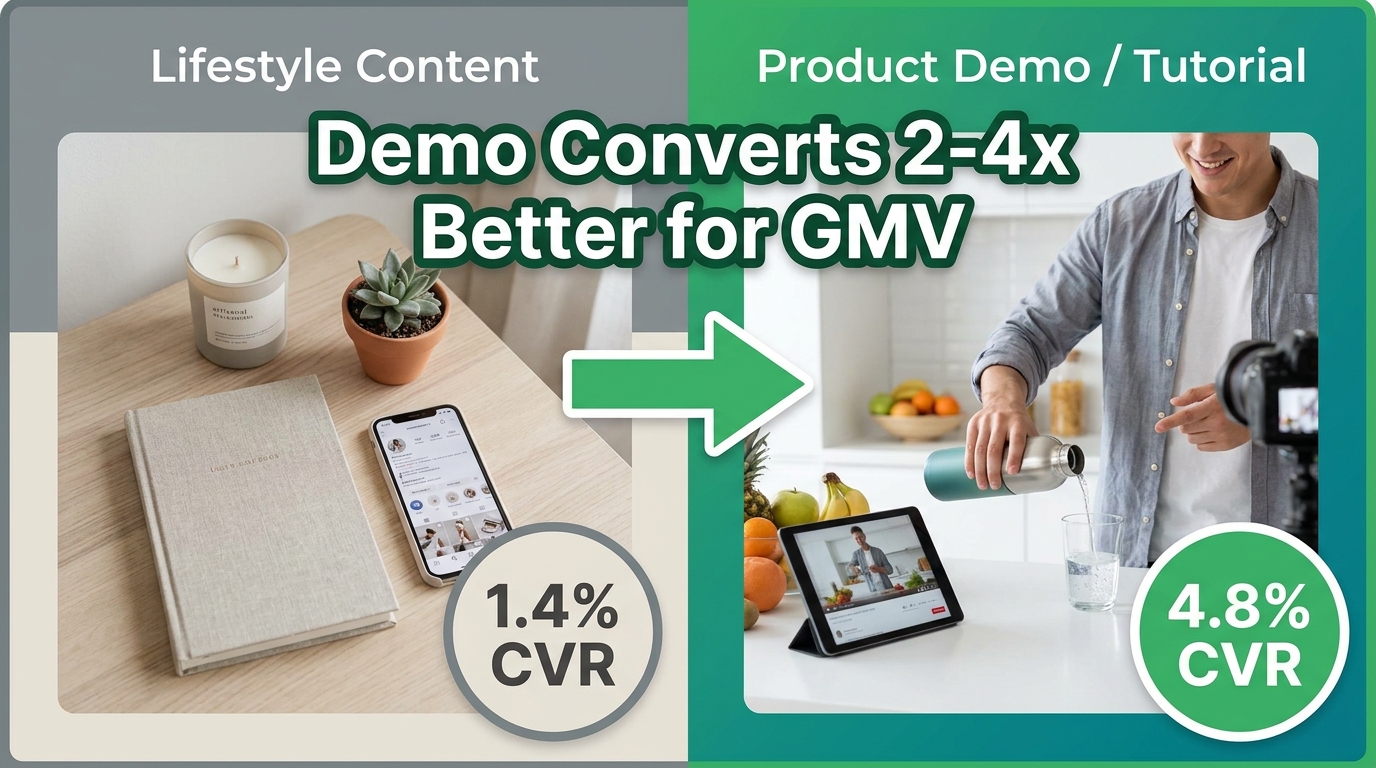
One of the most consistent and under-acted-on findings in creator commerce data is the conversion performance gap between product demo/tutorial content and lifestyle/aesthetic content. Across multiple data sets from 2026, straightforward product demonstrations drive 2–4x higher conversion rates than lifestyle or aesthetic creator content when the objective is purchase.
This finding cuts against the intuitions of most brand marketing teams, who’ve spent years optimizing for beautiful, aspirational, brand-aesthetic content. The logic of “show the product in its ideal context” made sense for TV advertising and catalog photography. In social commerce, it’s the wrong optimization.
Why Demo Content Converts Better
Demo content answers the questions a buyer actually has before purchasing: Does this work? How do I use it? What does it look like in practice? What are the results? It collapses the research phase of the purchase journey into the content itself, reducing the steps between “interested” and “bought.”
Lifestyle content creates desire. It shows the product in an aspirational context, builds brand awareness, and connects the product to an identity or emotional aspiration. This is genuinely valuable for new product categories or building brand equity over time. But for someone actively in market for a solution your product provides, it leaves too much work for them to do. They still need to understand how it works, whether it fits their situation, and why it’s worth the price. Demo content does that work for them.
The Specific Content Structures That Convert
The highest-converting creator content formats in 2026 follow recognizable structural patterns:
- Problem-Solution-Result: The creator identifies a specific problem (“I’ve been struggling with X for months”), introduces the product as the solution, and shows the actual result. This mirrors the exact thought sequence a buyer goes through independently.
- Before/After with specifics: Not abstract transformation, but specific, measurable change. “I’ve been using this for 14 days and here are the actual metrics” performs better than “I look so much better since I started using this.”
- Comparison to alternatives: “I tried three products in this category, here’s what I found.” Creators who position a product against real alternatives they’ve personally tested carry higher credibility than those presenting a single product in isolation.
- Tutorial with embedded product: Content that teaches a skill or technique and naturally incorporates the product as a necessary tool converts better than content structured as an explicit product review. The product becomes functional rather than promotional.
LIVE Shopping: When Format Becomes the Channel
LIVE shopping via creator collabs represents the most concentrated GMV format available in 2026, converting at 5–12% compared to 3–6% for standard shoppable video. The conversion premium comes from several reinforcing factors: real-time social proof (visible viewer count, live comments), urgency mechanics (time-limited offers, limited inventory signals), and the parasocial intensity of a live performance that feels more personal than a recorded video.
LIVE isn’t the right format for every product or creator, but for brands running structured TikTok Shop programs, it should be a standard component of any serious collab framework — not an occasional experiment.
Deal Structure: Moving Beyond the Flat Fee Trap

How a creator collaboration is structured financially determines, in large part, whether both parties are incentivized toward GMV. Flat-fee sponsorships — the dominant model for most of the past decade — create a fundamental incentive misalignment: the creator gets paid regardless of sales performance. Their incentive is to deliver the contracted deliverables (post the content, tag the brand, include the link), not to maximize purchase conversion.
In 2026, this model is losing ground fast. The dominant structure across high-GMV creator programs is now hybrid base + performance pay: a smaller guaranteed fee that covers production effort, combined with a commission on attributable sales — typically 8–15% of GMV generated through the creator’s affiliate link or promo code.
Why Hybrid Deals Work for Both Sides
For brands, the economic logic is simple: you pay more when the creator performs, and less when they don’t. The performance component is self-funding — if the commission is set at a margin-positive rate, every dollar of commission paid represents more revenue generated than it costs. This removes the “did we get value?” question from post-campaign analysis. You got value if the GMV cleared the commission threshold and contributed margin. The math is transparent.
For creators, the hybrid model is also increasingly preferred — particularly for creators who have genuine confidence in their conversion ability. A creator who knows their audience buys things they recommend would rather have a modest base fee plus meaningful commission upside than a flat fee that caps their earnings regardless of how hard the content works. The commission model turns a creator with high conversion capability into a genuine revenue partner.
Tiered Commission Structures That Drive Behavior
The most sophisticated brands are now running tiered commission structures rather than flat commission rates. A typical tiered structure might look like this:
- Base commission: 10% on first $5,000 GMV in the tracking window
- Mid-tier bonus: 13% on GMV between $5,000–$20,000
- Top-tier rate: 15% on GMV above $20,000
Tiers serve two functions: they incentivize creators to keep promoting past the initial post (because higher GMV unlocks better rates), and they reward top-performing creators with materially better economics than mid-tier ones. This creates natural differentiation within a creator program — top converters are retained with better deal terms, which makes them more likely to prioritize your brand over competing offers.
Exclusivity Windows and Right-of-First-Refusal
High-GMV creator programs increasingly include category exclusivity clauses — a creator can’t promote competing products in the same category for a defined period. This matters because a creator who is actively promoting five different products in your category simultaneously dilutes the trust signal that makes any individual recommendation work. When a creator’s audience sees them rotate through every brand in a category on a monthly basis, the recommendation value of any single endorsement erodes.
Category exclusivity windows of 30–90 days are now standard in well-structured brand-creator contracts, particularly for higher-commission programs. Right-of-first-refusal clauses — where the creator must offer the brand the opportunity to match any competing offer before accepting it — are also becoming common for top-performing affiliates.
Product Seeding vs. Paid Collabs: How Smart Brands Use Both
A common false choice in creator program strategy is “seeding or paid?” In 2026, the most effective programs use both — but in a deliberate sequence and with different objectives for each.
What Product Seeding Is Actually Good For
Product seeding — sending product to creators without payment or guaranteed post requirements — performs best as a discovery and qualification mechanism. The post rate for non-paid TikTok seeding programs averages 15–30%, which sounds low until you calculate the economics: if a brand seeds product at $25 cost and 20% post rate, the effective cost per piece of content is $125. For authentic, uncompensated creator reviews, that is a very efficient content acquisition cost.
More importantly, seeding reveals which creators from your pool actually generate purchase behavior when they do post. A creator who posts organically about your product and drives $2,000 in tracked GMV without any agreement or incentive is a significantly higher-priority target for a paid performance deal than one you vetted based on follower count and aesthetic match. Seeding functions as a low-cost audition for your paid creator roster.
The brands getting the most from seeding programs in 2026 are running them at scale — seeding hundreds of micro and nano creators — and using the resulting performance data to identify their top 10–20% performers for structured commission deals. This “seeding funnel” model produces a continuously refreshed roster of proven converters rather than a static list of paid partners.
When Paid Collabs Have a Real Edge
Paid collaborations are the right tool when you need:
- Predictable timing: Product launches, promotional windows, and seasonal campaigns require content to land on a specific schedule. Organic seeding posts are unpredictable in timing.
- Usage rights: If you plan to repurpose creator content in paid ads, you need explicit licensing. Organic seeding content typically can’t be used commercially without a separate agreement.
- Content control: When brand messaging requirements are specific — particular claims, certifications, competitive positioning — paid contracts enforce compliance. Seeding gives creators full creative latitude.
- Guaranteed deliverables: For brand awareness objectives (rather than direct GMV), guaranteed reach and impression floors matter. Paid contracts deliver them.
The hybrid approach — seed broadly to find converters, pay to scale the ones that work — is more efficient than either pure seeding or pure paid deals. It routes budget toward demonstrated performance rather than projected potential.
Attribution: Why You’re Undervaluing Your Best Creators
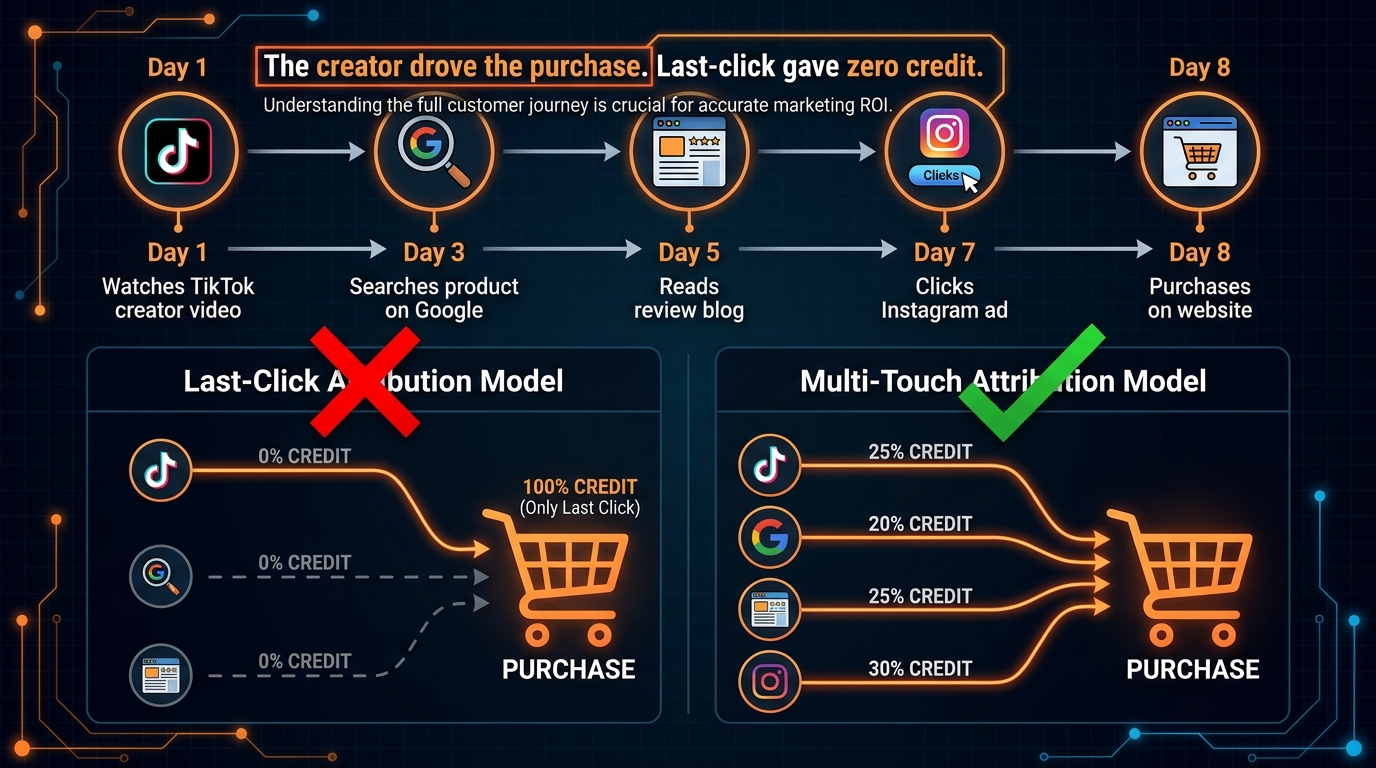
Ask a brand’s e-commerce team how they measure creator collab performance, and the answer is usually some variant of: promo codes tracked in Shopify, affiliate link clicks in the platform dashboard, and maybe a UTM-tagged post-purchase survey. This infrastructure sounds adequate but produces a significant systematic undercount of creator-driven GMV — and that undercount has real consequences for budget allocation decisions.
The Last-Click Trap
The majority of creator-driven purchases don’t happen through a direct link click within the attribution window. A customer watches a creator video on Tuesday, thinks about it, searches the product on Google on Thursday, reads a review blog on Friday, and buys through a Google Shopping result on Saturday. The creator post drove the entire purchase journey, but last-click attribution assigns 100% of the revenue to the Google Shopping click.
This is not a rare edge case. It’s the modal purchase journey for considered purchases above approximately $35. The higher your AOV, the more pronounced this attribution gap becomes, because higher-price purchases involve more deliberation time and more touchpoints before conversion. If your creator program includes products with AOVs above $50, last-click attribution is systematically undervaluing creator contributions — potentially by a factor of 2–3x.
What Multi-Touch Attribution Actually Requires
Moving to multi-touch attribution isn’t as simple as switching a setting in Google Analytics. It requires:
- Consistent UTM tagging across every creator touchpoint — not just the affiliate link, but any content that gets repurposed into paid ads, email, or owned channels
- Post-purchase attribution surveys — “How did you first hear about us?” data that captures awareness touchpoints that digital tracking misses entirely (screenshots shared via DM, verbal recommendations between consumers who saw creator content)
- Extended attribution windows — most affiliate platforms default to 7-day or 30-day windows. For categories with longer consideration cycles, this window should be 60–90 days minimum
- Cross-device matching — customers frequently watch creator content on mobile and purchase on desktop. Without cross-device identity resolution, these are recorded as two unconnected events
Platform-Native Attribution Has Its Own Gaps
TikTok Shop’s native attribution counts purchases made within the platform as creator-attributed when the buyer came through an affiliate link. This is the most accurate single-platform attribution available, which is part of why TikTok Shop’s GMV figures for creators are so much more reliable than off-platform influencer campaign metrics. But it still misses consumers who discover a product through TikTok and buy it on the brand’s Shopify store, Amazon listing, or in physical retail.
The practical implication: brands should treat platform-native TikTok Shop attribution as a floor, not a ceiling, of actual creator GMV contribution. The real number is higher.
The GMV Math on Long-Term vs. One-Off Partnerships
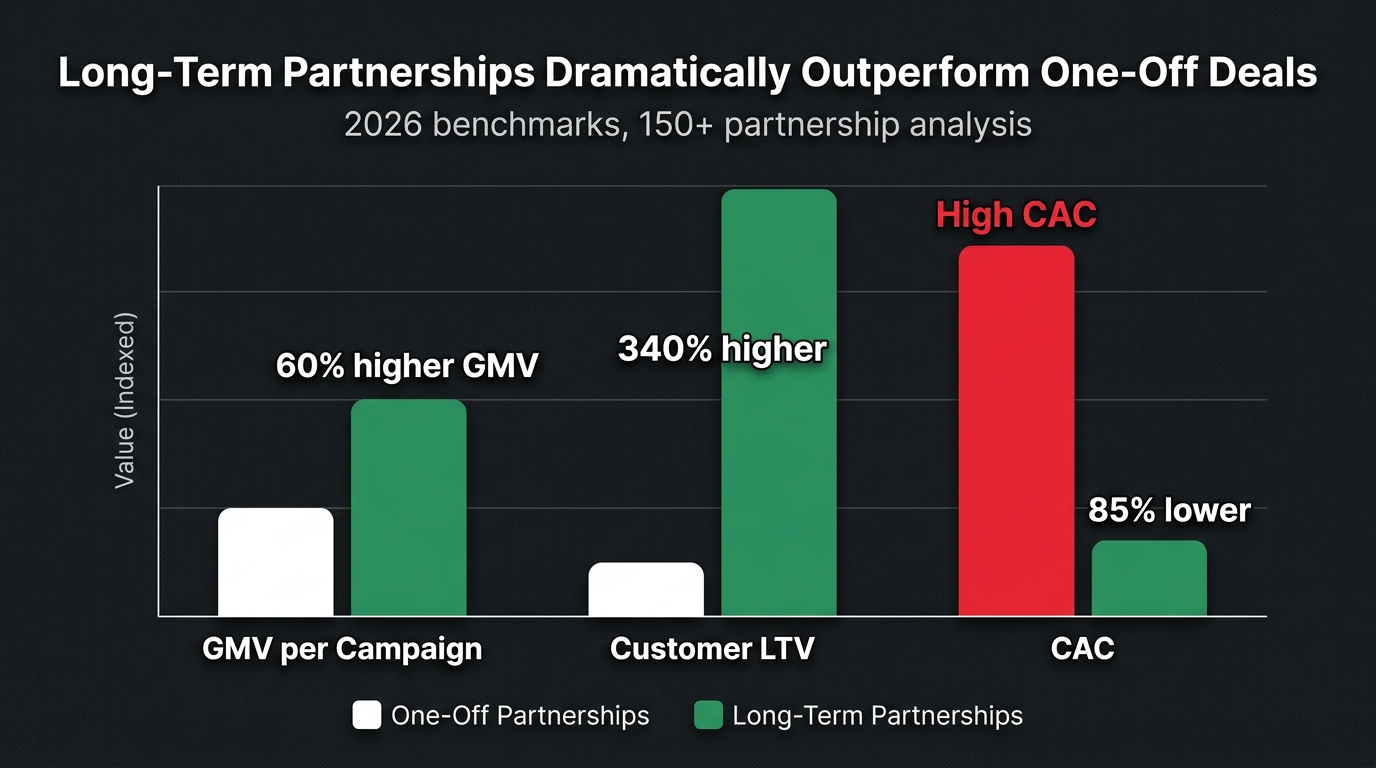
One of the clearest signals in 2026 creator program data is the performance gap between ongoing partnerships and transactional one-off deals. Long-term influencer partnerships are delivering roughly 60% better returns than single, transactional deals according to HubSpot-cited 2026 benchmarks. A 150+ partnership analysis found integrated long-term programs delivering 340% higher customer LTV and 85% lower CAC versus one-off sponsorship models.
Despite this, a major 2026 industry report found that 63% of U.S. creator-brand relationships end after a single collaboration. Most brands are structurally optimized for the model with worse economics.
Why One-Off Deals Underperform
Every new creator relationship starts with a trust deficit from the audience’s perspective. When a creator promotes a brand they’ve never mentioned before, in a clearly paid context, the audience’s credibility filter activates. The purchase conversion rate on a first-time brand mention is always lower than on a repeated one, because the social proof signal of “this creator has used this for months and keeps coming back to it” hasn’t been established yet.
The ROI on a creator relationship typically follows a compound curve: low in the first post, higher in the second, significantly higher by the third and fourth as the creator’s audience builds familiarity with the brand and trust in the endorsement pattern. Brands that exit creator relationships after one post are, in most cases, exiting exactly when they’re about to start seeing meaningful returns.
What Always-On Creator Programs Look Like
The highest-GMV creator programs in 2026 operate on an “always-on” model rather than a campaign-based one. Rather than activating creators for specific promotional windows and going dark between them, these programs maintain a steady drumbeat of creator content across a roster of 15–50 creators, with individual creators posting 1–3 times per month about the brand.
This model produces several compounding advantages:
- Continuous content production at lower average cost per piece than campaign spikes
- Audience desensitization prevention — infrequent mentions feel more authentic than a sudden promotional surge
- Algorithmic distribution benefits — consistent creator activity on TikTok Shop positively influences product page authority and search ranking
- Faster creative iteration — with creators posting regularly, you get continuous data on which content angles, formats, and CTAs perform, enabling faster optimization cycles
The economics work because always-on programs shift the cost structure from high upfront flat fees to ongoing commission-based arrangements. Brands aren’t paying a premium for creator attention they haven’t yet earned. They’re building sustained creator relationships at a cost that scales with the revenue those relationships produce.
Platform-Specific GMV Mechanics: Where and How Revenue Actually Flows
Creator programs that work on one platform don’t automatically translate to another. Each major platform has distinct mechanics that determine how creator content converts to GMV, and understanding those mechanics is table stakes for building an effective multi-platform creator strategy.
TikTok Shop: The Native Commerce Advantage
TikTok Shop’s core GMV advantage is friction reduction. Products can be tagged directly in videos and LIVE sessions, with purchases completed inside the app in three taps. This in-app checkout eliminates the most significant drop-off point in influencer commerce: the step where a viewer has to leave the app, navigate to a website, create an account, and complete a separate checkout flow.
Creator affiliate content accounts for approximately 42% of U.S. TikTok Shop GMV, with top-performing programs achieving conversion rates of 8–12% for targeted creator partnerships. The platform’s affiliate marketplace — where creators can browse available products and brands can invite creators to their programs — creates a self-selecting pool of creators who are already motivated to drive sales rather than just awareness.
The GMV mechanics on TikTok Shop specifically reward:
- High posting frequency (the algorithm favors active affiliate programs)
- LIVE shopping events with proper product showcasing
- Promo code exclusives that create genuine purchase urgency
- Creator content that generates saves and profile visits (behavioral signals the algorithm reads as purchase intent)
Instagram: The Discovery-to-Purchase Pipeline
Instagram’s creator GMV mechanics are more diffuse than TikTok Shop’s because the purchase experience is more fragmented. Shopping tags in Reels and posts direct viewers to a product page, but checkout can happen through Instagram Shopping (limited to certain brands), through a link in bio, or through the brand’s website. Each additional step in that flow costs conversion rate.
Instagram performs best for creator GMV in categories where visual product presentation is high-value — apparel, beauty, home décor, food and beverage — and where the target buyer already has an intent to explore rather than an immediate purchase trigger. Instagram creator collabs work well as a mid-funnel channel that activates purchase intent that gets converted elsewhere, which is why they’re systematically undervalued by last-click attribution.
YouTube: The Long-Tail GMV Engine
YouTube creator collabs have a fundamentally different GMV profile than short-form platforms. Content is longer, attribution windows need to be much longer (60–90 days minimum), and the conversion pathway is typically link in description or promo code during the video.
What YouTube lacks in immediate conversion velocity, it compensates for with longevity. A YouTube product review drives a long tail of GMV for months or years after publication, as the video ranks for search terms related to the product category. This makes YouTube creator collabs particularly valuable for products with long consideration cycles or evergreen search demand — supplements, software, electronics, specialty tools.
Building a Creator Program That Scales GMV Consistently
Everything above can be synthesized into a program architecture. Here’s how the highest-GMV creator programs in 2026 are structured from the ground up.
Phase 1: Build the Baseline Roster Through Seeding
Start by seeding product to 100–300 creators in your category across the follower range of 5,000–500,000. Track which creators post organically and what GMV those organic posts generate. This data costs you product and fulfillment, not cash spend. After 60–90 days, you have a performance-ranked creator list built from actual sales data rather than projected potential.
Identify your top 10–15% performers — the creators who posted without payment and still drove measurable sales. These are your primary recruitment targets for a structured commission program. They’ve already proven they can move your product without incentive. With proper incentive, they’ll move significantly more.
Phase 2: Recruit Top Performers Into a Structured Commission Program
Approach your seeding standouts with a hybrid deal: a modest base payment that covers their content production effort, plus a tiered commission on GMV generated through their affiliate link. Frame it as a partnership, not a transaction. Provide them with a content brief that covers:
- Core product claims and proof points they can test and speak to genuinely
- The specific audience problems the product solves
- Content format guidance (demo-first, not lifestyle-first)
- Talking points that differ from generic brand marketing — specific angles that fit their content style and their audience’s language
Critically: do not over-script. Creators with genuine audience trust have built that trust through authentic communication. A brief that reads like a marketing memo destroys the authenticity signal. Provide the proof points and let them translate into their own voice.
Phase 3: Run Continuous Content Performance Analysis
Across your active creator roster, track performance at the content level — not just the creator level. Which content formats, hooks, product angles, and CTAs are generating the highest conversion rates? This data should feed directly back into your briefs for subsequent content cycles.
Look for patterns across creators. If three different creators independently find that “before/after” structure outperforms “straight review” structure for your product, that’s a structural insight worth systematically incorporating. If one creator’s audience converts much better on a specific price-point bundle than on the hero SKU, that’s a product merchandising insight, not just a creator performance insight.
Phase 4: Allocate Paid Media Behind Creator Content That Performs
The highest-leverage move in most creator programs is allocating paid social spend behind creator content that has already demonstrated organic conversion performance. A creator video with a 4% organic CVR can potentially perform at 5–6% as a paid ad if the audience targeting is right, because you’re now reaching a larger pool of people who match the demographic profile of the viewers who already converted.
This “seed and amplify” model — test creator content organically, identify top performers, scale through paid — compounds returns without requiring creators to continuously produce new content. It also generates usage rights value from creator relationships: the paid promotion licensing needs to be negotiated upfront or structured into the original deal.
The Metrics Framework That Actually Reflects GMV Program Health
Finally, reporting infrastructure. The metrics you track determine what your team optimizes for. If the dashboard shows views and engagement, that’s what gets optimized. Here’s the metrics stack for a GMV-focused creator program:
Primary Revenue Metrics (Weekly Review)
- GMV per creator per month — not views, not impressions. Revenue generated, tracked across all attribution paths
- Conversion rate per creator — GMV divided by estimated unique viewer reach
- Revenue per post — normalizes across different creator audience sizes
- ROAS on paid creator content amplification — for any paid media running behind creator content
Leading Indicators (Monitor Weekly, Act Monthly)
- Video save rate — a leading indicator of purchase intent before a purchase happens
- Profile visit rate post-video — indicates viewers are actively researching the creator (and by extension, their recommendations)
- Link click rate — the first step in the conversion funnel for off-platform purchase paths
- Comment sentiment score — qualitative analysis of purchase-intent language in comment sections
Program Health Metrics (Monthly Review)
- Creator retention rate — what percentage of active creators in your program are still active 90 days later
- GMV concentration — what percentage of total program GMV comes from your top 20% of creators (high concentration is a risk signal)
- New creator pipeline — how many new creators are entering the seeding funnel each month
- Content freshness ratio — what percentage of your active creator content is less than 30 days old
Conclusion: The Shift From Reach Buying to Revenue Building
The creator economy has matured past the point where reach alone justifies investment. In 2026, the brands running the highest-GMV creator programs have all made fundamentally the same realization: creator collaborations are a commerce channel, and they should be evaluated, structured, and optimized like one — not like a PR or brand awareness channel that happens to sometimes generate sales.
That realization changes everything downstream. It changes which creators you select (revenue track record, not follower count). It changes how you structure deals (performance-based alignment, not flat-fee transactions). It changes what content you brief for (demo and tutorial formats, not aesthetic lifestyle content). It changes how you measure success (GMV and conversion rate, not views and engagement). And it changes how you build the program over time (long-term partnerships, not campaign-by-campaign transactions).
None of these changes is technically difficult. The data tools, commission platforms, and attribution infrastructure to run a serious GMV-focused creator program exist and are accessible to brands of almost any size. The barrier is almost entirely organizational — the willingness to measure creators on the metric that actually matters and to build programs that are explicitly designed to maximize it.
The brands that make that shift will continue to find creator collabs to be among the most efficient channels in their commerce stack. The ones that don’t will keep generating impressive view count reports with disappointing revenue line items — and keep wondering why.
Actionable Takeaways
- Pull creator GMV history before selecting anyone — on TikTok Shop, it’s in the affiliate dashboard. For other platforms, ask for category-specific conversion data directly.
- Switch at least half your creator budget to hybrid base + commission deals — 8–12% commission on GMV is self-funding at any positive-margin product.
- Brief for demo and tutorial first, lifestyle last — 2–4x conversion advantage is too large to ignore in the brief structure.
- Extend your attribution window to 60–90 days minimum and implement a post-purchase survey to capture awareness touchpoints your digital tracking misses.
- Seed at scale before you pay at scale — let 100+ creators audition with product before committing significant paid budget to any of them.
- Build your always-on roster from your seeding top performers — the creators who drove sales without payment will drive significantly more with proper commission incentive.
- Run paid media behind your best-performing organic creator content — it’s typically your highest-converting paid social creative and compounds the return on an existing creator investment.