



Something shifted quietly in TikTok Shop’s advertising infrastructure over the past twelve months, and a lot of sellers missed it until it started costing them money. GMV Max — TikTok’s automated, AI-driven campaign format — didn’t just become the recommended way to run Shop ads. By mid-2026, it became the default. In some regions, it is effectively the only format available for Shop advertising.
That’s a significant structural change. It means the old levers — granular audience targeting, manual bidding, siloed campaign types — are largely gone. What’s replaced them is a system that allocates spend across paid video, organic content, affiliate posts, and LIVE shopping simultaneously, optimizing toward one goal: maximizing gross merchandise value at a target ROI you define.
But here’s what most sellers don’t realize: TikTok has also wrapped this ad system in a layered incentive structure. New advertisers can claim up to approximately $6,000 in ad credits. High-potential sellers are auto-enrolled in monthly mission programs worth up to €2,400 in voucher rewards. And disabling GMV Max can literally remove your eligibility for traffic subsidies and campaign participation.
This post isn’t a beginner’s guide to GMV Max. It’s an operator’s breakdown of the practical levers that move the needle inside this system — including how the reward infrastructure actually works, how to set and move your Target ROI without throttling volume, why creative velocity functions as currency in this model, and how to structure your LIVE and product campaigns so they feed each other rather than compete. If you’re already live on TikTok Shop and wondering why GMV Max feels harder to control than it looks, this is the analysis you need.
What GMV Max Actually Is — and What It’s Not
Before pulling any levers, it’s worth being precise about what you’re actually working with. GMV Max is not a bidding strategy layered on top of a traditional TikTok ad campaign. It’s a full campaign architecture that ingests your entire Shop ecosystem — your own paid video ads, your organic shoppable posts, your affiliate creators’ content, and your LIVE streams — and dynamically allocates budget across all of them to find the highest-converting combinations at any given moment.
The primary optimization target is gross merchandise value, not clicks, impressions, or even individual ROAS. TikTok’s system is explicitly trying to maximize total revenue generated through your shop, subject to a ROI floor you set. This is a subtle but important distinction: the algorithm doesn’t care which piece of content or which channel generates a sale as long as the blended economics stay above your threshold.
Product GMV Max vs. LIVE GMV Max
There are two distinct modes within the GMV Max framework. Product GMV Max focuses on driving conversions to product listing pages via shoppable video content and catalog-linked placements. It works best for evergreen products and always-on campaigns where the goal is sustained daily volume. LIVE GMV Max, by contrast, is built around driving traffic to an active livestream — it automatically uses both video-to-LIVE and LIVE-to-LIVE placements, and is designed to spike real-time GMV during broadcast windows.
The distinction matters for campaign structure, budget allocation, and the missions tied to your rewards eligibility. Both modes are governed by the same core ROI logic, but their performance dynamics, learning periods, and content requirements differ meaningfully.
What GMV Max Is Not
GMV Max is not a set-and-forget system. The automation handles placement and bid optimization, but it depends entirely on the inputs you control: your Target ROI setting, the quality and volume of your creative pool, your product catalog’s health, and how consistently you’re running affiliated creator content. Sellers who treat GMV Max as passive often wonder why it plateaus. The answer is almost always one of these input variables starving the algorithm of what it needs to scale.
The Three Reward Tiers: How TikTok’s Incentive Structure Actually Works
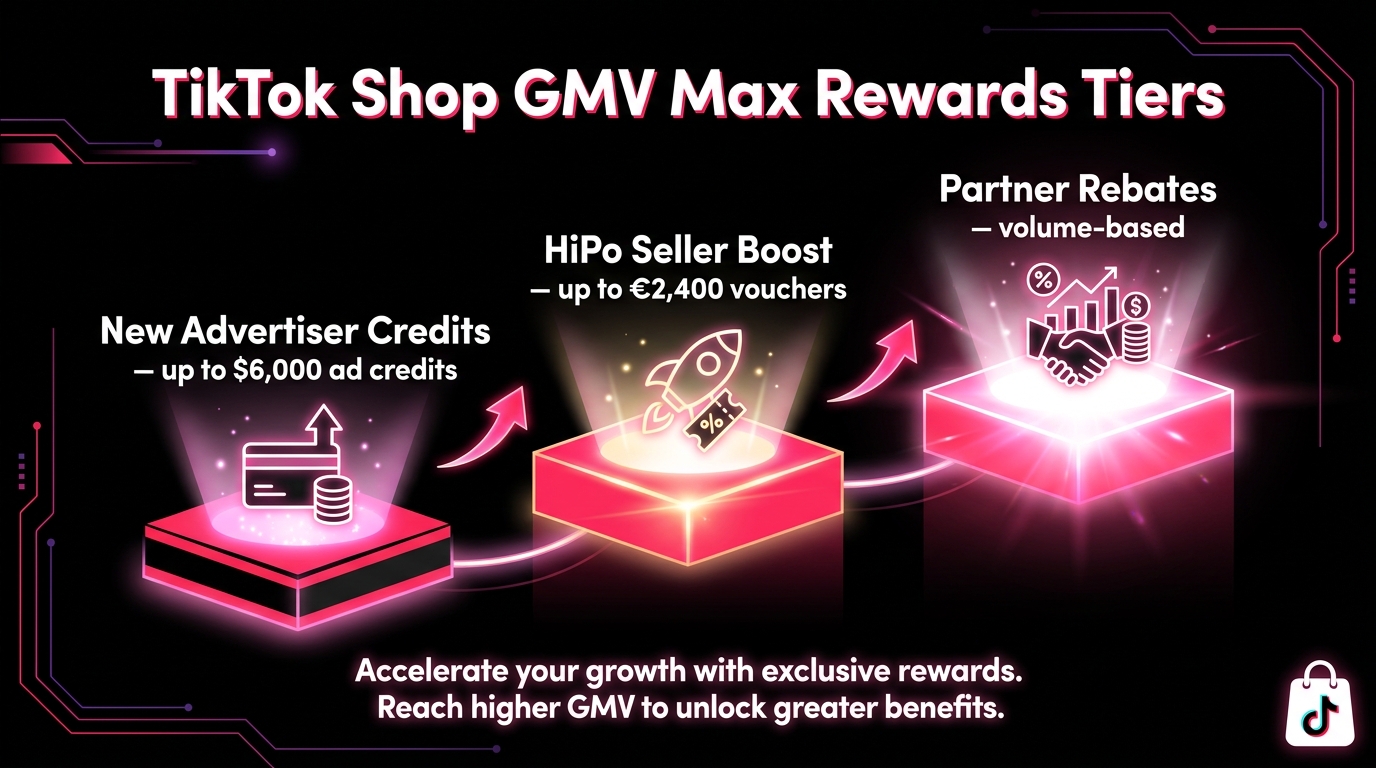
TikTok’s incentive architecture around GMV Max operates in distinct layers, each targeting a different seller profile. Understanding which tier applies to you — and the conditions that govern each — determines how much free performance you can extract from the system before your paid spend even becomes the primary growth driver.
Tier 1: New Advertiser Ad Credits
The entry point for most new TikTok Shop advertisers is TikTok’s new-advertiser acquisition incentive, which issues ad-credit coupons to first-time advertisers tied to GMV Max campaigns. Current reported maximums put these credits at up to approximately $6,000, typically structured as rebate-style credits that are issued after the advertiser spends within a defined promotional window.
The critical eligibility gate here is that these credits are only available to ad accounts with no prior advertising history on TikTok Ads Manager. Shops that are linked to accounts with any previous ad activity may be excluded entirely. Credits are accessible through Seller Center under Marketing → Shop Ads, and in some regions they appear as a banner prompt automatically after your first GMV Max campaign is published.
This means the sequencing matters: if you’ve already run legacy campaign types and then migrate to GMV Max, you may have forfeited the new-advertiser credit tier. For brands setting up new seller accounts specifically to build TikTok Shop presence, this is an argument for ensuring ad account isolation from existing brand accounts during the initial setup phase.
Tier 2: High-Potential (HiPo) Seller Boost Programme
The second tier targets sellers that TikTok’s internal algorithm has classified as High-Potential (HiPo) — accounts demonstrating strong GMV velocity, shop health, and content engagement. Crucially, you cannot apply for this program. Enrollment is automatic, triggered by TikTok’s internal classification criteria, and sellers find out they’re enrolled by seeing missions appear under Growth Opportunities in Seller Center.
The programme runs in monthly cycles. The July 2026 version required sellers to have been onboarded on or before June 28, 2026, to be classified as HiPo at that date. Rewards can reach up to €2,400 in voucher incentives per cycle, distributed across a set of monthly growth missions. These missions include tasks like completing GMV Max ad spend at a defined level, running affiliate sampling campaigns, and maintaining shop health scores above threshold.
Each seller is assigned a growth track based on their GMV level at the start of the month. Completing all missions in your track — not just some — is required to claim the full voucher reward. Partial completion yields no payout in most regional variants of the program. This makes the missions calendar a planning priority, not an afterthought.
Tier 3: Partner Incentives and Traffic Subsidies
The third tier is less formally documented but operationally significant: TikTok actively provides traffic support, co-funded campaign participation rights, and agency-facing rebates to shops that maintain active GMV Max campaigns above certain activity thresholds. The inverse is also documented: sellers who disable GMV Max have reported losing traffic subsidy benefits and becoming ineligible for specific platform-funded promotional campaigns.
This is TikTok’s structural way of making GMV Max participation the cost of admission to platform growth programs. It’s not a penalty for non-participation so much as a wall between the standard seller experience and the accelerated growth track. For any seller who is campaign-eligible but hasn’t enabled GMV Max, the opportunity cost is real and growing.
The Target ROI Lever: Why Most Sellers Set It Wrong
Target ROI is the single most important number you set in a GMV Max campaign, and it functions differently from the ROAS targets most sellers are familiar with from Google Shopping or Meta Advantage+. Understanding the mechanics is essential because getting this wrong doesn’t just hurt performance — it can trap your campaign in a low-volume state that takes weeks to recover from.
How TikTok Defines ROI in This Context
TikTok’s GMV Max uses a specific ROI formula: Gross Revenue ÷ Ad Spend. This is a blended metric that includes organic GMV and affiliate-attributed sales in the numerator alongside paid sales. This matters enormously because it means your reported ROI will almost always look higher than your true incremental paid ROAS. Expert analysis from 2026 suggests applying a correction factor of approximately 2.5x to estimate true incremental ROAS — so a reported 5x ROI on GMV Max may reflect an actual paid ROAS of around 2x.
The implication: if you set your Target ROI based on what you need from paid spend alone, you’ll likely set it too high — and you’ll throttle your campaign’s ability to spend and scale.
The Conservative Start Framework
The strongest current guidance from practitioners and TikTok’s own documentation aligns on a clear framework: start your Target ROI lower than your true profitability threshold, let the campaign learn, and raise it slowly.
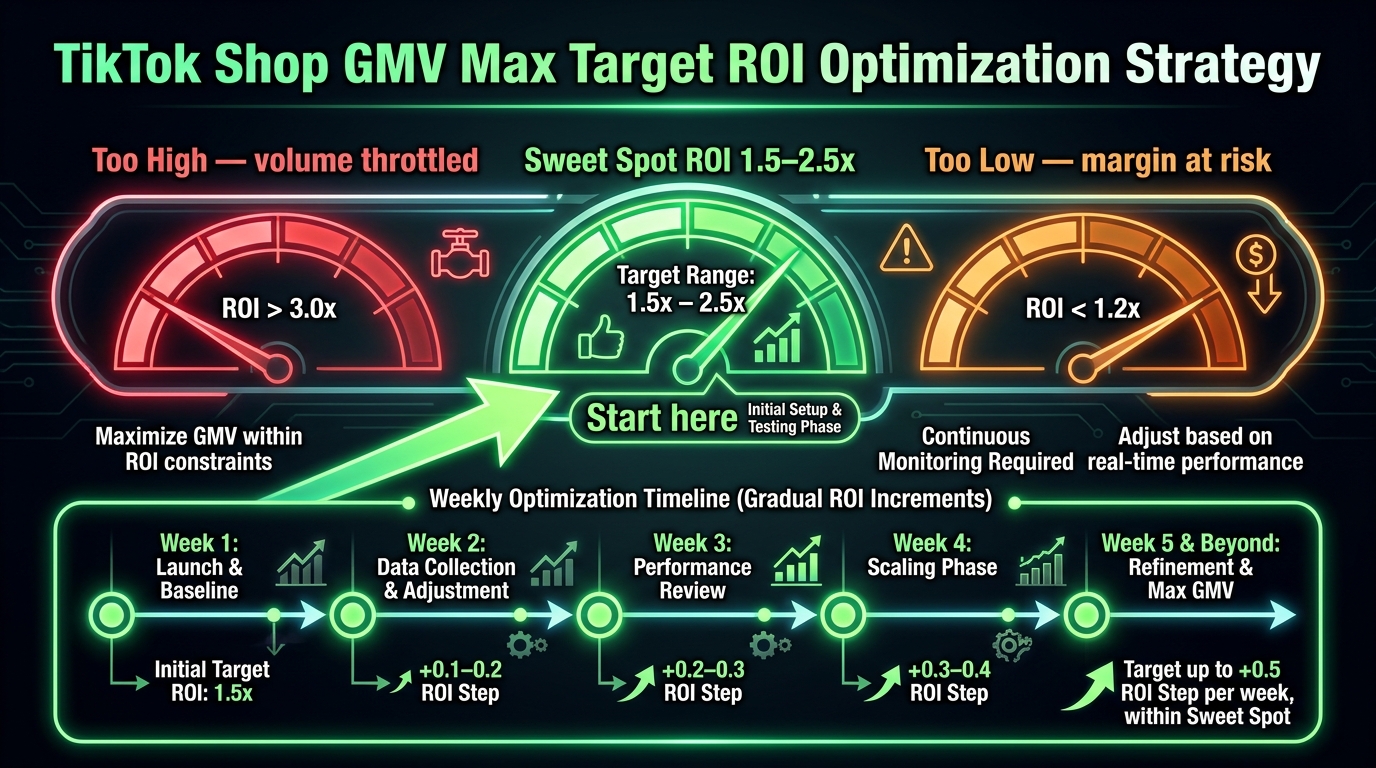
- Starting range: 1.5–2.5x is the most common starting band for new GMV Max campaigns. If TikTok suggests a recommended ROI during campaign setup, starting at or slightly below that recommendation gives the algorithm room to find volume.
- Learning period: Allow 2–4 weeks of runtime before drawing conclusions. GMV Max needs significant purchase signal data to optimize effectively. Campaigns changed or paused during the first two weeks often never fully recover their learning state.
- Adjustment cadence: Move Target ROI in increments of 0.1–0.5 no more than once every 3–7 days. Larger moves or more frequent changes force the system to re-enter a learning phase, burning budget inefficiently.
- Ceiling signal: The highest ROI setting that still maintains stable spend and consistent GMV volume is your practical ceiling. Once you raise Target ROI and spend drops without a corresponding efficiency improvement, you’ve overshot.
Budget and Target ROI as a Paired System
Target ROI doesn’t operate in isolation — it interacts with your daily budget cap. Too high a Target ROI combined with a low budget often results in under-delivery: the algorithm can’t find enough qualifying inventory at that efficiency threshold within your spend limit. Too low a Target ROI with a large budget can spend aggressively but erode margins. The practical approach is to increase budget before increasing Target ROI when you want to scale, rather than raising both simultaneously.
One additional consideration from mid-2026 updates: TikTok has introduced ROI Protection mechanisms in some markets, which pause spend automatically if the campaign falls below a defined ROI floor. This provides a margin safety net but can also interrupt campaigns during early learning phases if the floor is set too aggressively.
Creative Volume as Currency: Why More Content Unlocks More Spend
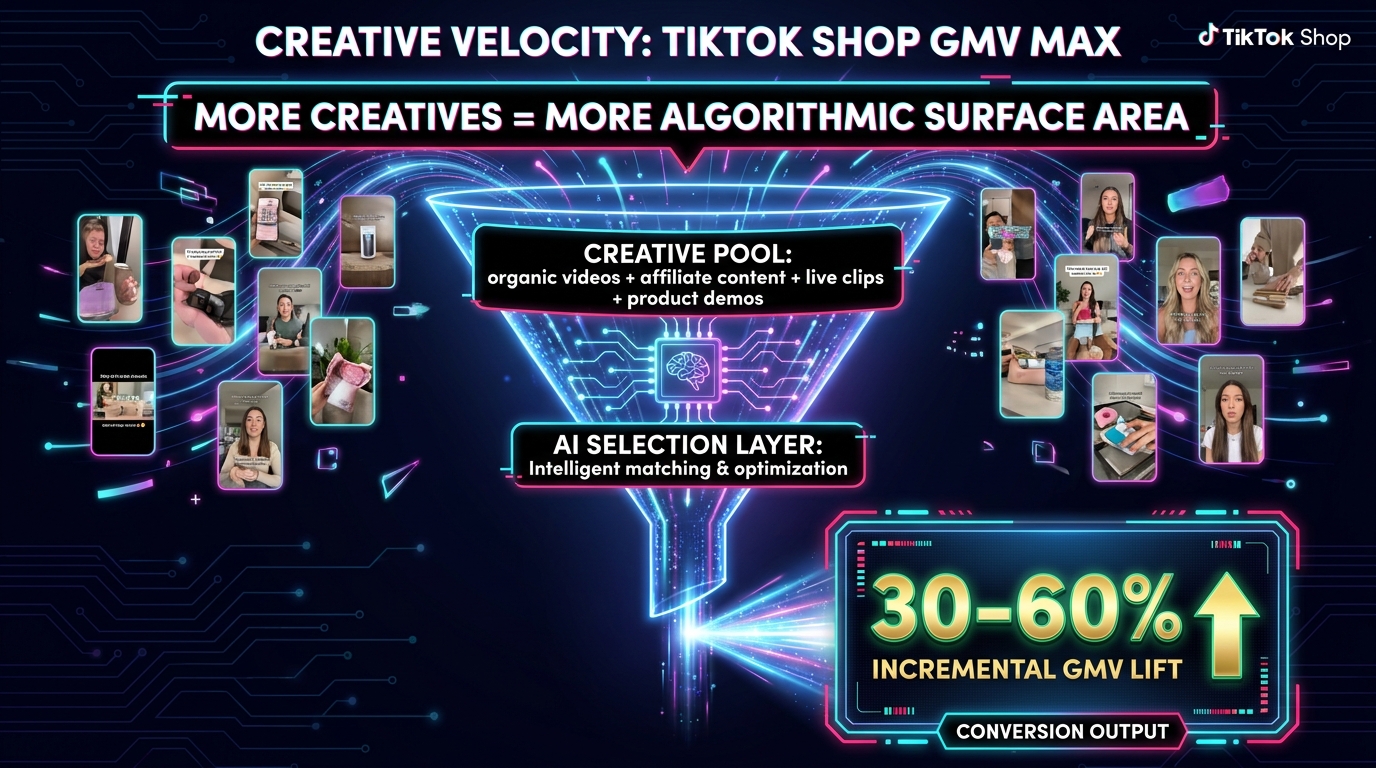
In a traditional ad account, more creative variations are a testing mechanism — you run A/B tests to find the winner and consolidate spend there. In GMV Max, creative volume works differently. It’s not primarily a testing tool; it’s a supply mechanism that expands the algorithm’s surface area for finding the highest-converting combinations at any moment.
This is one of the most fundamental operational shifts in the GMV Max model, and it has direct implications for how you should think about content production budgets and processes.
Why the Algorithm Needs a Deep Creative Pool
GMV Max draws from all content associated with your shop: your own paid video creatives, organic posts tied to product links, Spark Ads-authorized content from organic accounts, and authorized affiliate creator videos. The more eligible content there is in the pool, the more combinations the algorithm can test across different user segments, placements, and time-of-day windows.
A thin creative pool — say, two or three product videos — gives the system very little to work with. It will over-serve the few creatives it has, accelerating fatigue and reducing the diversity of audiences it can reach. A deep pool of 20, 30, or 50+ pieces of content, including affiliate and organic posts, gives the algorithm genuine latitude to optimize. Research and agency playbooks from 2026 consistently point to creative volume as a primary reason why comparable budgets produce meaningfully different GMV outcomes between sellers.
Affiliate Content as Your Cheapest Creative at Scale
The practical implication of this for most sellers is that affiliate creator content should be treated as a creative production strategy, not just a sales channel. When affiliates post about your products and you authorize those posts for GMV Max inclusion via Spark Ads permissions, their organic content becomes part of your paid media pool — at zero additional creative production cost.
This changes the math on affiliate commission rates. Even if an affiliate earns 15–20% commission, the value they deliver isn’t just the direct sale from their organic reach. Their content, once included in GMV Max, can continue generating attributed sales via paid amplification long after the original post, at a marginal cost to you of just the GMV Max ad spend. That dual-value accounting should inform how aggressively you recruit and compensate affiliate creators.
The Bulk Authorization Play
TikTok’s 2026 updates to the affiliate content workflow include mass affiliate authorization tools that let sellers approve multiple creator posts for GMV Max inclusion simultaneously via Seller Center. This was a friction point in earlier versions of the system — manually authorizing each post individually — and its removal makes high-volume affiliate strategies operationally viable even for smaller teams.
A practical content cadence for a well-resourced seller running GMV Max at scale looks something like: 3–5 new brand-produced videos per week, 10–20+ new affiliate posts per week that you authorize for Spark Ads inclusion, and one or more LIVE sessions per week that add LIVE content to the pool. At that velocity, you’re giving the algorithm enough material to continuously refresh its optimization signal.
Catalog Hygiene and Product Mix: The Invisible Lever
Of all the operational variables that influence GMV Max performance, catalog health is probably the least discussed and the most impactful on a per-effort basis. The algorithm can only optimize for products it can surface effectively — and product listings with incomplete data, inconsistent pricing, poor imagery, or sync errors create invisible drag on campaign performance that no amount of ROI adjustment or creative volume will fix.
What Catalog Health Actually Means for GMV Max
Catalog health in this context covers several distinct dimensions:
- Data completeness: Product titles, descriptions, categories, and attributes all need to be fully populated. GMV Max uses this data as part of its audience matching logic — sparse listings give it less to work with.
- Price and inventory sync accuracy: Stale pricing or inventory data causes the algorithm to serve ads for products that can’t fulfill — generating clicks with zero conversion potential, which drives up effective CPA and degrades your ROI signal.
- Image quality: TikTok Shop’s product listing page algorithm is increasingly sensitive to image quality as a conversion signal. Listings with low-resolution or uninformative primary images consistently underperform even when the ad creative driving the click is strong.
- Review volume and rating: GMV Max can’t surface products with poor social proof as efficiently as those with strong reviews. Building review volume — especially in the first 30–60 days of a new listing — directly supports campaign efficiency.
Which Products to Include in GMV Max Campaigns
The general recommendation from TikTok and agency practitioners is to include all eligible products, but to ensure best-sellers are represented with the strongest assets. Broader product inclusion increases total GMV ceiling — the algorithm may find sales on mid-tier products you’d never have prioritized manually. At the same time, high-GMV best-sellers provide the clearest conversion signal for the system to learn from, which accelerates optimization across the wider catalog.
Products with very low velocity or structural problems (poor ratings, high return rates, fulfillment issues) should typically be excluded from GMV Max campaigns until those underlying issues are addressed. Including them creates noise in the algorithm’s learning signal without contributing meaningful GMV.
LIVE GMV Max vs. Product GMV Max: Structuring Your Campaign Split
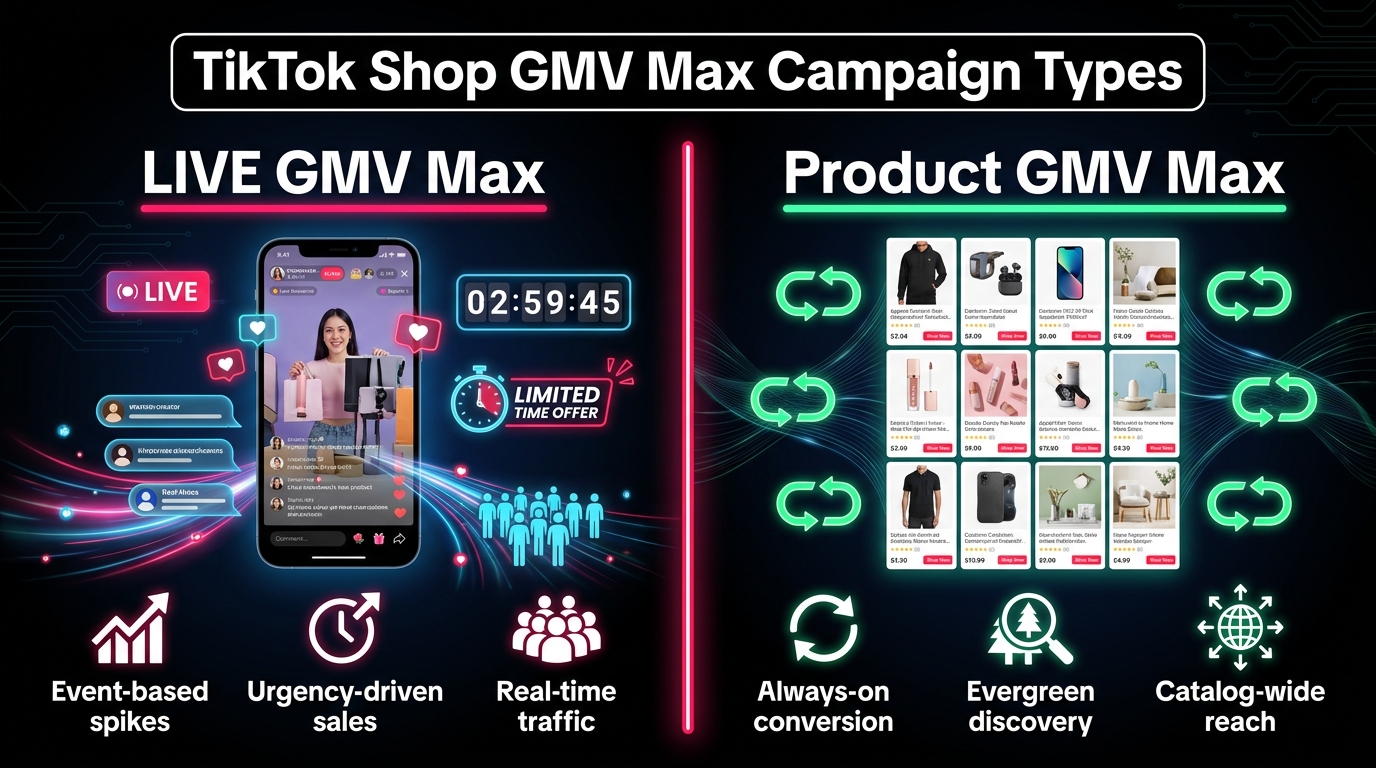
One of the most common structural mistakes in GMV Max setups is trying to handle LIVE and product campaigns within a single campaign — or, conversely, running them as entirely independent silos. The right architecture is a layered model where each serves a distinct function in your GMV funnel, and where the insights from each inform how you run the other.
Product GMV Max: The Always-On Foundation
Product GMV Max is your evergreen layer. It runs continuously, drawing from shoppable video content and your product catalog to drive purchases at a consistent daily clip. Think of it as your baseline: it should be generating reliable GMV seven days a week without requiring live broadcasting capacity or specific scheduled events.
For most sellers, the majority of their GMV Max budget should sit here. This is the campaign type where the Target ROI calibration process matters most, because it runs long enough for the algorithm’s learning signal to accumulate properly. A Product GMV Max campaign that has been running for 60–90 days with stable settings and adequate creative supply is a significantly more efficient asset than one that gets frequently restructured.
LIVE GMV Max: The Spike and Conversion Engine
LIVE GMV Max operates on a fundamentally different cadence — it’s built around your broadcast schedule, not a continuous content feed. When you’re live, LIVE GMV Max drives real-time traffic to your stream, using video-to-LIVE and LIVE-to-LIVE placements to find viewers most likely to convert in the high-urgency, interactive environment of a livestream.
The return profile is different too. Well-executed live shopping events with LIVE GMV Max can generate multiple times the hourly GMV of a comparable product campaign spend, because the interactive format, limited-time offers, and direct creator engagement all compress the purchase decision cycle. But this spike is time-bounded — it starts and stops with the broadcast.
Practical Budget Split Framework
Expert playbooks from 2026 generally recommend weighting budget heavily toward Product GMV Max unless you have a mature, high-frequency LIVE operation (multiple sessions per week with proven host performance). A practical starting split for a seller doing 1–2 livestreams per week might be 70–80% in Product GMV Max as an always-on base, with 20–30% allocated to LIVE GMV Max during live sessions.
As LIVE performance matures and you can validate that your streams are generating above-average conversion rates, shifting budget toward LIVE GMV Max during broadcast windows makes sense. The goal is to avoid over-funding LIVE before the content quality and operational consistency can support it.
Affiliate and Creator Integration: Turning Third-Party Content Into Paid Fuel
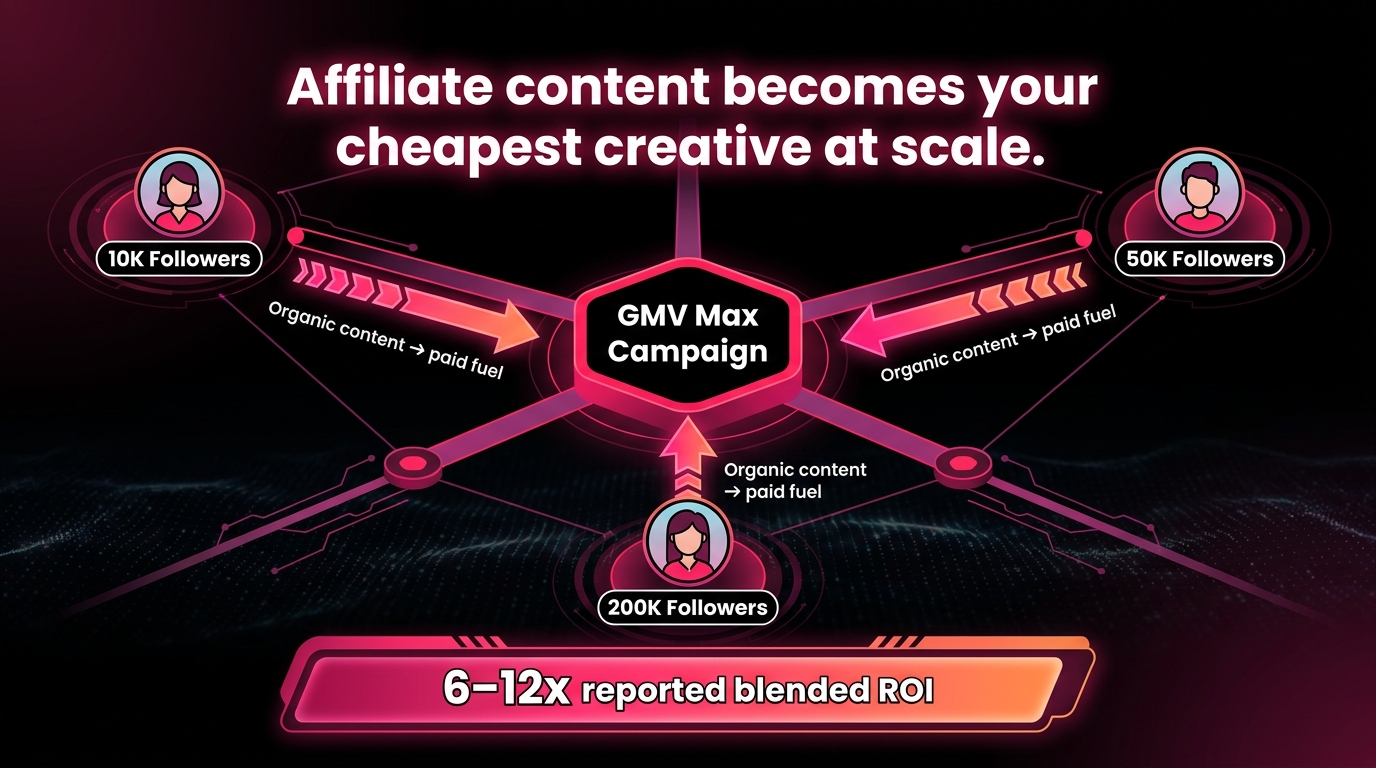
Affiliate and creator integration in the GMV Max era is no longer a separate channel strategy — it’s a core component of ad performance. The most meaningful shift here is that affiliate content, when properly authorized for Spark Ads, doesn’t just drive its own organic sales. It feeds directly into GMV Max’s creative pool and gets amplified algorithmically as paid media.
This dual-function nature of affiliate content is what makes it disproportionately valuable compared to first-party brand content in many categories. Brand-produced videos tend to feel polished but commercial. Creator content from genuine affiliates tends to feel native and trustworthy, and TikTok’s algorithm has consistently rewarded that authenticity with lower CPMs and higher conversion rates for equivalent placements.
How to Structure Your Affiliate Program for GMV Max Compatibility
Running a GMV Max-compatible affiliate program requires attention to a few specific structural elements that many brands overlook:
- Spark Ads authorization at scale: Actively request Spark Ads permissions from your best-performing affiliate creators. Without authorization, their content can’t enter your GMV Max creative pool. Make this part of your standard affiliate onboarding communication.
- Commission rate signaling: Affiliates who see high sell-through rates on a product continue creating content. Setting commission rates competitive enough to attract repeat creators (typically 10–20% depending on category) sustains creative velocity without requiring constant recruiting.
- Product sampling strategy: Seeding product samples to mid-tier creators (10K–200K followers) often generates stronger per-post conversion rates than high-follower celebrity placements, because their audiences are more engaged and niche-specific. This is also frequently a mission requirement in HiPo program tracks.
- Content brief clarity: Affiliates who understand what product angle performs best in your category will produce more usable content for GMV Max inclusion. Providing a brief with your top-performing hooks and product claims reduces the percentage of affiliate content that’s technically authorized but algorithmically weak.
Blended ROI Math for Affiliate-Amplified GMV Max
Case data from well-optimized sellers running affiliate-fed GMV Max campaigns in 2026 shows blended reported ROI in the 6–12x range, though the important caveat is that this includes organic affiliate GMV that would have occurred without any paid amplification. Stripping that out to estimate true incremental ROI from paid spend alone typically brings the figure back toward 2–4x in well-run programs.
Even at the conservative end, a 2–4x true incremental ROAS from paid amplification of creator content compares favorably to most TikTok ad formats and provides the additional benefit of continuously growing a library of social proof content associated with your products.
The Reward Missions Playbook: Structuring Your Month Around GMV Max Tasks
For sellers enrolled in the HiPo Seller Boost Programme — or any mission-based incentive tier — the reward structure doesn’t favor passive participants. Missions are time-bound, require completion of the full task set within your assigned track, and typically offer no partial credit. This means the difference between capturing €2,400 in voucher rewards and zero is often just operational planning, not product quality or budget size.
Reading Your Mission Set in Seller Center
HiPo programme missions live under Growth Opportunities in Seller Center. At the start of each monthly cycle, enrolled sellers should audit their assigned track to understand exactly which mission types apply. Common mission categories include:
- GMV Max ad spend thresholds: Reach a defined spend level on GMV Max campaigns within the month. This is the most direct lever — ensure your campaign budget is adequate to hit the threshold, and don’t pause campaigns mid-month without understanding the spend impact.
- Affiliate sampling completion: Send a specified number of product samples to affiliates, verified through the platform’s sampling workflow. This mission type requires lead time — starting affiliate outreach in the first week of the month gives enough runway for sampling to complete and be tracked.
- Shop health maintenance: Keep shop health scores and product listing quality above minimum thresholds throughout the cycle. This is a passive requirement that becomes a problem if you’ve ignored catalog maintenance.
- Content publication: Some tracks require a minimum number of shoppable videos or authorized creator posts published within the cycle window.
A Month-Planning Template
For sellers entering a new mission cycle, a practical planning approach looks like this:
Day 1–3: Audit Seller Center for mission specifics. Set or confirm GMV Max campaign budgets that will hit the spend threshold with normal daily execution (avoid needing to over-spend in the final days). Initiate affiliate outreach for sampling missions.
Week 1: Launch or refresh creative assets. Authorize any pending affiliate content for Spark Ads. Verify catalog sync and listing quality for all products in active campaigns.
Week 2–3: Monitor mission progress tracker in Seller Center. Adjust GMV Max Target ROI only if campaign performance is clearly outside acceptable range — don’t micro-adjust during a mission cycle where stable spend is required.
Day 26–28: Final audit. If spend or content missions are short of threshold, take corrective action before the cycle closes. Voucher rewards are typically issued automatically within days of cycle completion if all missions are satisfied.
Benchmarks and ROI Math: What Healthy Performance Actually Looks Like
One of the most common sources of confusion in GMV Max is understanding what good performance looks like — especially given the blended nature of the ROI metric. Sellers coming from Meta or Google with pure ROAS expectations often misread GMV Max results in both directions: sometimes thinking they’re performing well when they’re not, and sometimes pulling budget from a healthy campaign because the incremental ROAS appears lower than their target.
The Performance Benchmark Framework for 2026
Based on practitioner data and independent analyses from Q1–Q3 2026, a practical benchmark framework looks like this:
- Healthy blended reported ROI: 3–5x for average sellers, 5–8x for well-optimized accounts. Strong case studies reporting 10x+ blended ROI should be interpreted cautiously — these typically reflect a high organic GMV baseline that would have existed without paid spend.
- Estimated true incremental ROAS: 1.5–3x after applying the organic/affiliate correction factor. A healthy paid-only ROAS of 2x on TikTok Shop compares favorably with platform averages across most categories.
- CPM benchmarks: Product-tagged video ads in the TikTok Shop environment are running at around $4.80 CPM in competitive periods, with click-through rates varying widely by creative quality and category.
- Conversion rate: Average CVR for product-tagged TikTok Shop ads sits near 3.7%, but this is a mean across categories. Beauty, personal care, and impulse-buy categories can run significantly higher; home goods and higher-ticket items typically run lower.
- Incremental GMV lift: Well-run GMV Max campaigns with strong creative pools consistently demonstrate 30–60% incremental GMV compared to organic-only baselines, based on holdout and time-based comparison studies.
The Attribution Reality Check
GMV Max’s blended attribution model is deliberately generous — it attributes sales across a longer window and includes assisted conversions from organic and affiliate touchpoints. This is useful for campaign management but requires adjustment when making cross-channel budget allocation decisions.
The most rigorous way to measure true GMV Max incrementality is through holdout testing: turning off GMV Max for a defined period across a matched cohort and comparing GMV outcomes. TikTok provides incrementality testing tools in Ads Manager for this purpose. For sellers making significant budget decisions based on GMV Max performance, running at least one holdout test annually is a worthwhile investment in measurement clarity.
Common Mistakes That Kill Reward Eligibility and Campaign Learning
Having analyzed the operational mechanics across both the reward programs and the campaign performance system, a handful of mistakes appear repeatedly — patterns that either forfeit incentive eligibility outright or create campaign conditions that make good results structurally impossible.
Mistake 1: Treating Mission Cycles as Passive Benefits
HiPo missions require all tasks in a track to be completed before the deadline. Sellers who complete 3 out of 4 missions — often because the affiliate sampling requirement wasn’t started early enough — receive zero voucher reward. The fix is simple: treat the mission audit as a day-one priority in every cycle, not a check-in at the end of the month.
Mistake 2: Setting Target ROI Based on Pure Paid Economics
Because GMV Max’s reported ROI is blended with organic and affiliate GMV, sellers who calculate their Target ROI based on the margins required from paid spend alone set the bar too high and throttle campaign volume. Starting at 1.5–2.5x and calibrating upward based on observed blended performance is consistently more effective than starting high and trying to force scale.
Mistake 3: Pausing Campaigns During Mission Windows
Pausing a GMV Max campaign — even briefly — interrupts the learning state and reduces accumulated signal quality. During a mission cycle that requires hitting a spend threshold, a pause of two or three days can make the threshold unreachable and force the campaign to re-learn in a compressed timeframe, producing inefficient results. Reduce budgets gradually if spend management is needed; don’t pause.
Mistake 4: Under-Investing in Creative Volume
Running GMV Max with fewer than 5–10 active creative variants is almost always a performance constraint. The algorithm will over-serve the few creatives it has, accelerate fatigue, and lose the audience diversity that comes from a varied content pool. New content needs to enter the pool weekly, not monthly.
Mistake 5: Not Authorizing Affiliate Content for Spark Ads
Every affiliate post that goes un-authorized is creative inventory left off the table. Systematic Spark Ads authorization of affiliate content is one of the highest-leverage activities in the GMV Max model and one of the most commonly skipped. Build authorization requests into your affiliate onboarding and follow-up workflow rather than doing it reactively.
Mistake 6: Ignoring Catalog Hygiene Until Performance Drops
Catalog issues — stale inventory data, missing attributes, poor listing quality — don’t typically cause dramatic sudden drops. They create persistent low-level drag on conversion rates that makes your Target ROI harder to achieve and your campaign less competitive in the auction. A monthly catalog audit is a better practice than waiting for a performance event to prompt investigation.
The Operator’s Mindset for the GMV Max Era
The transition to GMV Max as TikTok Shop’s default ad architecture requires a genuine shift in how sellers think about their role in the advertising system. The traditional ecommerce advertiser skill set — segmenting audiences, writing copy, testing ad formats, managing bids manually — is less relevant here. What matters now is the quality and volume of inputs you provide to an automated optimization system, and how well you manage the incentive infrastructure that sits on top of it.
This is actually a more accessible model for operators who are strong on the product and content side than traditional performance marketing — but it’s a less accessible model for operators who rely on media-buying sophistication to outmaneuver competitors. In GMV Max, the algorithmic playing field is more level than it looks, and the edges come from things the algorithm can’t control: the authenticity of your affiliate relationships, the freshness of your creative pipeline, the discipline of your catalog maintenance, and the strategic awareness to plan your month around reward missions before they expire.
The Five Inputs That Determine GMV Max Outcomes
If there’s a single summary framework that ties all of the above together, it’s this: GMV Max outcomes are a function of five controllable inputs, each of which you manage outside the campaign settings themselves.
- Target ROI calibration: Set conservatively, move slowly, treat as a dynamic floor not a static target.
- Creative pool depth: Maintain 10+ active creatives minimum, refresh weekly, authorize all qualifying affiliate content.
- Catalog integrity: Full data completion, accurate sync, strong reviews, quality imagery on all active listings.
- Affiliate ecosystem velocity: Ongoing creator recruitment, sampling pipeline, and Spark Ads authorization workflow running consistently.
- Mission and reward planning: Monthly audit at cycle start, tasks distributed across the month, spend thresholds tracked weekly.
Get those five right, and the algorithm does the heavy lifting. Miss one, and you’re usually leaving meaningful performance — and real dollars in incentive rewards — on the table.
Looking Ahead: Where GMV Max Is Headed
The trajectory from TikTok’s 2026 updates is clear: GMV Max is not a transitional format. It’s the permanent architecture. Platform investments in ROI Protection mechanisms, bulk affiliate authorization tools, expanded HiPo program coverage, and the consolidation of all Shop Ads into GMV Max collectively signal that TikTok is building its commerce advertising infrastructure around this model for the long term.
For sellers, the implication is that the operational habits you build now — creative cadence, catalog discipline, affiliate integration, mission planning — compound over time. A GMV Max campaign that has been running with high-quality inputs for 90 days is measurably more efficient than one started fresh. Every week of consistent execution builds signal depth that makes the algorithm more accurate and your cost per order more competitive.
The sellers who will dominate TikTok Shop in the next 24 months won’t necessarily be the ones with the largest ad budgets or the most sophisticated bidding strategies. They’ll be the ones who understand that in the GMV Max era, the most important work happens before the campaign settings are ever touched.