
Here is the uncomfortable truth about TikTok Shop Live that most sellers learn the hard way: going live is the easy part. Building a funnel that actually moves people from a casual scroll through to a completed purchase is something else entirely.
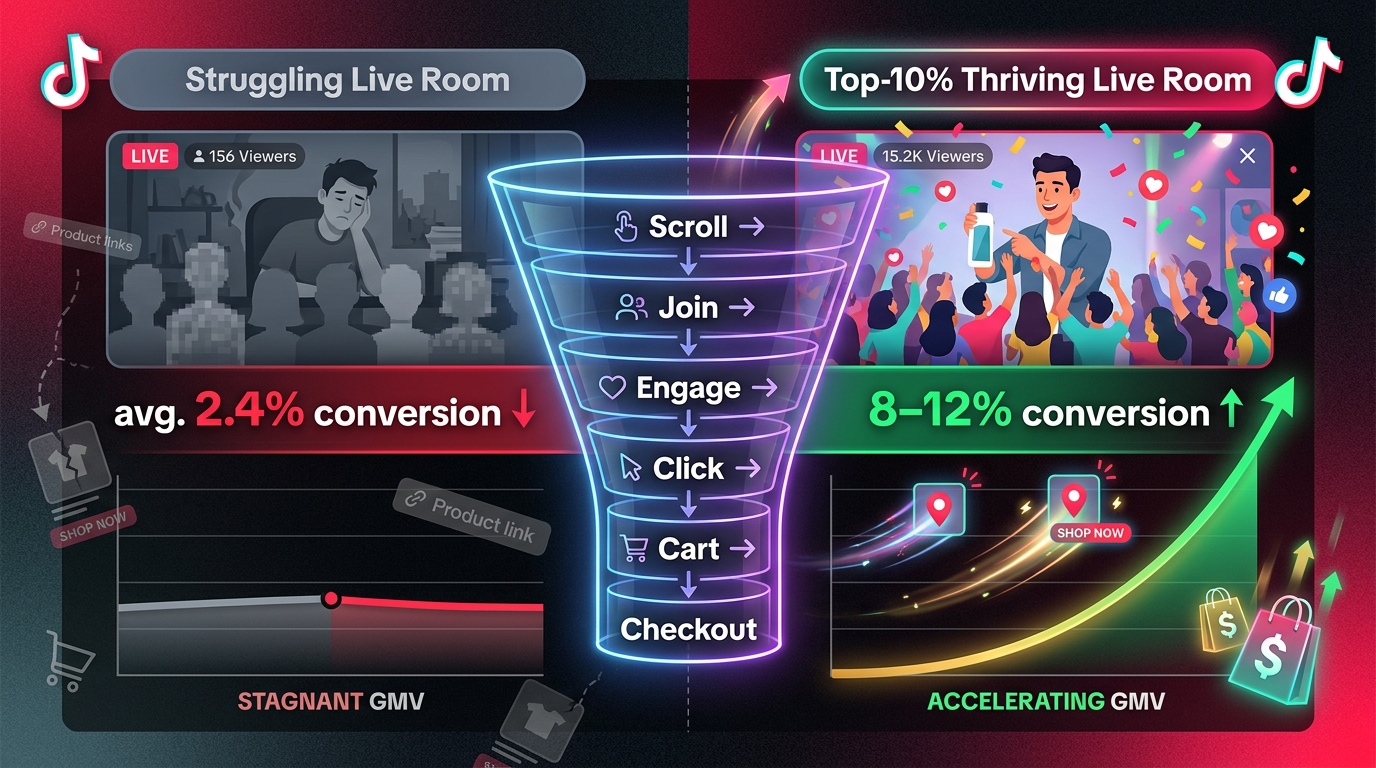
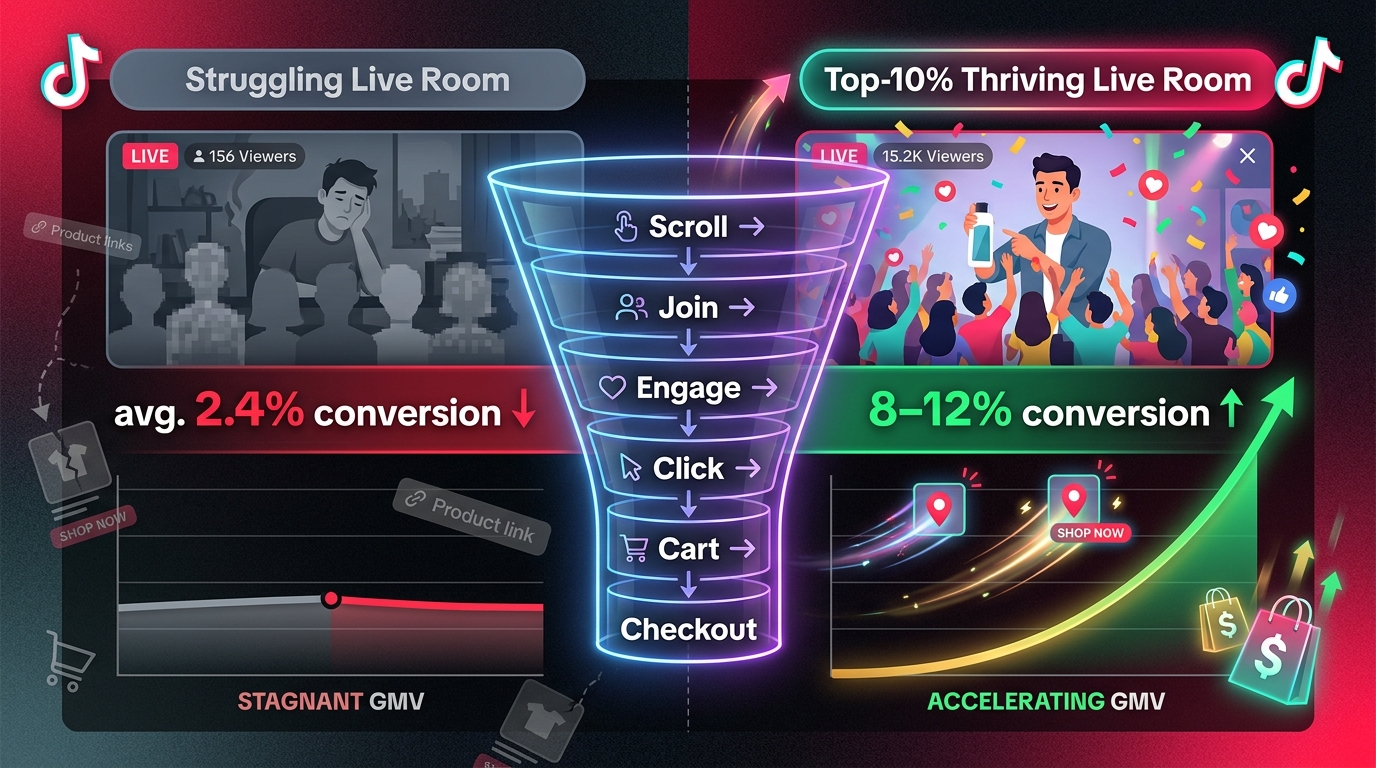
Platform-wide, the average TikTok Shop live stream converts fewer than 2.4% of viewers into buyers. That is not a rough estimate — it is drawn from TikTok’s own internal commerce data. But the top 10% of live rooms consistently hit 8–12% conversion, and peak sessions from structured, high-performance operators regularly exceed that. The gap between these two groups is not luck, equipment, or even product selection. It is funnel architecture.
The sellers who are generating serious, repeatable GMV from TikTok Live are not just “showing up and selling.” They are engineering a deliberate multi-stage journey — from the pre-live content that fills the room, through the loop structure that keeps new viewers engaged, to the pinned product mechanics that trigger the add-to-cart moment, all the way to post-stream retargeting that recaptures the 30–45% of potential buyers who added to cart but never checked out.
This article breaks down every stage of that funnel in granular detail. Not theory — specific mechanics, timing frameworks, and structural decisions that separate the top-converting live rooms from the ones grinding at 300 concurrent viewers and wondering why the algorithm will not push them.
The Invisible Funnel Problem: Why Most Sellers Are Optimizing the Wrong Stage
When most TikTok Shop sellers think about improving their live results, they focus on what is visible: better lighting, a more energetic host, a bigger discount. These things matter at the margins. But the reason the majority of live rooms underperform has almost nothing to do with production quality or price competitiveness.
The real problem is that most sellers treat their live stream as a single event rather than a multi-stage conversion funnel. They open the room, start talking about products, and hope that the algorithm pushes viewers to them. That approach almost never produces consistent results, because it collapses five distinct stages into one undifferentiated activity.
The Five Stages Every Viewer Passes Through
Every purchase that happens in a TikTok Shop live room is the result of a viewer completing five sequential steps:
- Join — They enter the room, either from the FYP, a notification, or a pre-live content touchpoint.
- Engage — They interact with the stream (comment, react, or stay past the 30-second mark) rather than immediately scrolling away.
- Click — They tap a pinned product card to view the product detail page.
- Add to Cart — They add the item to their TikTok Shop cart inside the app.
- Checkout — They complete the purchase, which is the stage where 30–45% of warm carts are abandoned.
Each of these stages has its own drop-off rate, its own optimization levers, and its own relationship to the TikTok commerce algorithm. When you treat all five as one blob called “going live,” you lose the ability to diagnose which stage is failing you.
The sellers doing eight-figure annual GMV through TikTok Live manage each stage separately. They build pre-live systems to control who enters the room. They structure their first 90 seconds to minimize stage-two drop-off. They architect a repeating loop that continuously recaptures the stage-three click from new joiners. And they have post-stream infrastructure to recover stage-five abandoned carts. Most competitors are not doing any of this.
Stage 0 — The Pre-Live Warm-Up: Building a Primed Audience Before You Go Live
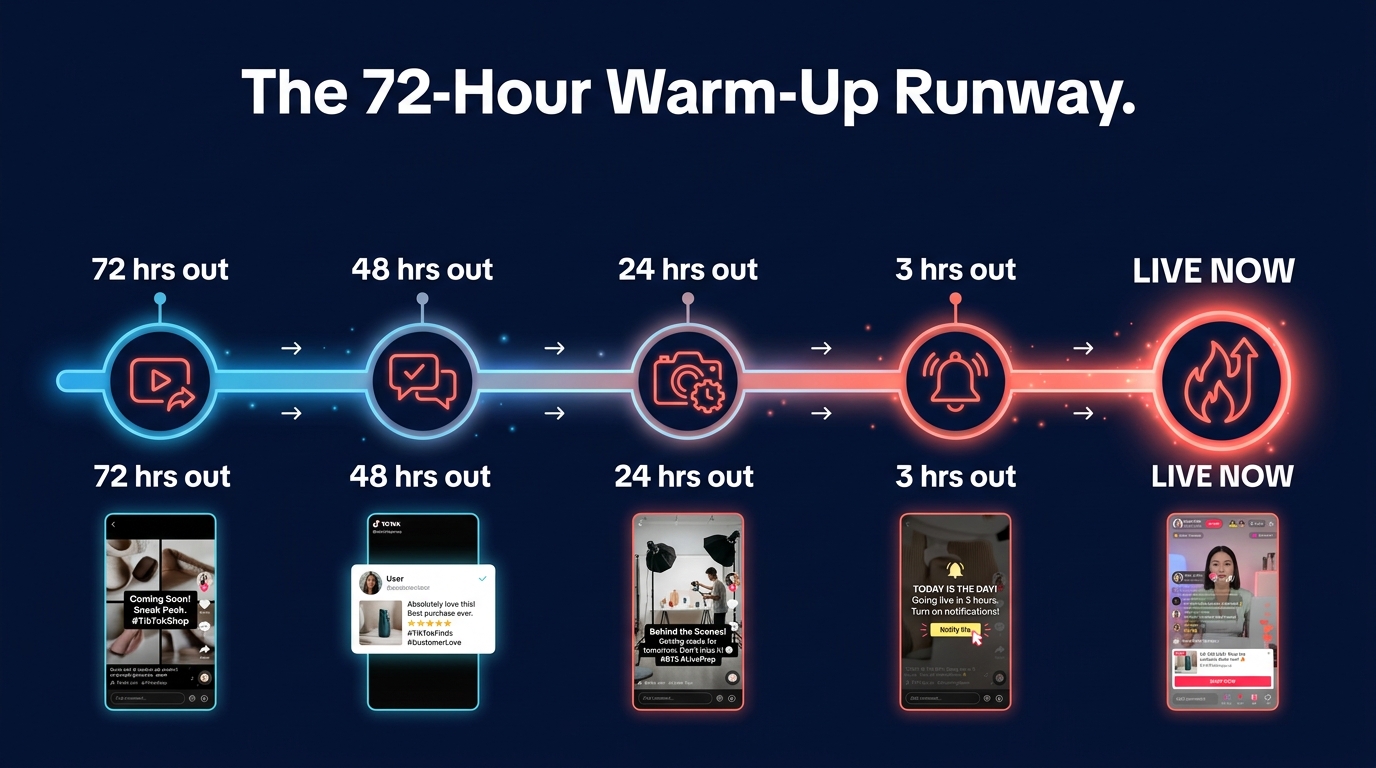
The single most overlooked variable in TikTok Shop live conversion is what happens in the 72 hours before you ever press “Go Live.” High-converting rooms do not fill themselves — they are filled by deliberate pre-live content that creates urgency to attend and primes viewers to buy before the session even begins.
The 72-Hour Content Runway
Top performers run a structured warm-up sequence that typically follows a four-beat pattern. This is not casual pre-promotion. Each piece of content in the sequence serves a specific psychological function in moving a cold follower toward a purchase-ready live attendee.
72 hours out — Teaser content. A short-form video that reveals what is coming without showing everything. This could be an unboxing of new inventory, a “behind the scenes” prep clip, or a product reveal with a deliberate information gap (“I’m not saying the price yet, but it’s going to be the lowest we’ve ever offered it.”). The goal at this stage is to create curiosity and deposit the upcoming live event into the viewer’s awareness.
48 hours out — Social proof content. A post anchored in evidence — customer reviews, before/after demonstrations, or testimonials for the products you plan to feature. This does the credibility work before the live room opens, so that when a viewer arrives in your stream and sees that product pinned, they already have a trust baseline. Conversion psychology research consistently shows that social proof presented before a purchase decision is significantly more effective than social proof presented at the point of sale.
24 hours out — The reminder with a reason. A post that explicitly tells people when you are going live and gives them a concrete reason to show up rather than catch the replay. “Live tomorrow at 7pm — first 20 orders get free shipping” is more effective than “Going live tomorrow!” because it gives the viewer a time-sensitive, quantity-limited reason to prioritize attending. This is where you begin seeding the scarcity and urgency mechanics that will drive conversion in the room itself.
Day-of push (3–6 hours out). A high-energy, final notification-style post using TikTok’s native reminder features where available. This is the post that converts fence-sitters — people who saw the earlier content but had not yet committed to attending. The tone here should be direct and time-anchored: “We’re live in 3 hours. Here’s exactly what we’re selling and the price you’re only getting tonight.” Remove ambiguity about what they are missing.
Why Warm Audiences Convert at a Fundamentally Different Rate
The practical reason this warm-up sequence matters so much is algorithmic, not just psychological. TikTok’s live commerce algorithm heavily weights the engagement velocity of the first few minutes after you go live. If you open your stream to a room full of pre-warmed attendees who immediately comment, react, and interact, the algorithm interprets this as a high-quality, engaging session and begins pushing it to broader audiences.
If you open cold — waiting for organic viewers to trickle in — those first minutes of low engagement signal a low-quality stream to the algorithm, and the distribution penalty can last for the entire session. The warm-up sequence is not just about filling seats. It is about engineering the engagement signal that unlocks broader algorithmic distribution, which in turn fills more seats from cold audiences throughout the session.
Brands running structured pre-live content sequences report starting sessions with 3–5× more concurrent viewers than those going live without pre-promotion. That multiplier compounds through every subsequent funnel stage.
Stage 1 — The First 90 Seconds: Why Your Room Lives or Dies Before You Pin a Product
Once a viewer enters your live room, you have roughly 90 seconds — possibly less — to convert them from a passive observer into an engaged participant. This window determines whether they stay long enough to see a product, and it is where the majority of TikTok Shop live operators lose the most potential buyers without ever realizing it.
The Pattern Interrupt Opening
The default behavior for a viewer who enters a TikTok live room is to assess within seconds whether this is worth their time. Most live rooms fail this assessment immediately because the host opens with logistics: “Hi everyone, thanks for joining, we’re just getting started, waiting for more people to join…” This is the worst possible opening for two reasons.
First, it signals low value immediately. A viewer who just left their FYP to enter your room has given up other content. “Waiting for more people” is essentially communicating that their time is less important than your viewer count. They will leave.
Second, it wastes the only window you have before the algorithm evaluates your engagement velocity. Every second the first 30–60 viewers spend in your room without interacting is a signal to TikTok’s LIVE algorithm that your content is not compelling. That signal is hard to reverse within the same session.
High-converting hosts open with a pattern interrupt — a statement, question, or visual action that demands an immediate response. Common formats include: a provocative product claim that can only be verified by staying (“This product cost us $47 to make and we’re selling it tonight for $19 — I need to explain why before we open orders.”), a direct question that invites comment engagement (“Quick question for everyone in the room — comment ‘yes’ if you’ve ever bought something like this before.”), or an immediately engaging live demonstration that creates visible tension or curiosity.
The Comment Seeding Tactic
One mechanical tactic used consistently by high-performing TikTok live rooms is comment seeding — asking for a specific, easy comment action in the first 30 seconds. “Type ‘1’ if you’re here for the launch deal. Type ‘2’ if this is your first time in our room.” This serves two functions simultaneously: it creates a comment velocity spike that signals engagement to the algorithm, and it gives the host real-time data on audience composition that they can use to personalize the session.
The type of comment does not matter significantly. What matters is the speed at which comments appear in the first 90 seconds. High comment velocity in this window is one of the clearest signals to the TikTok LIVE commerce algorithm that the room deserves broader distribution. Experienced hosts treat the first 90 seconds as almost entirely engineered for this signal, even at the expense of product-selling time.
Stage 2 — The Loop Architecture: How High-Converters Structure Every 8–12 Minutes
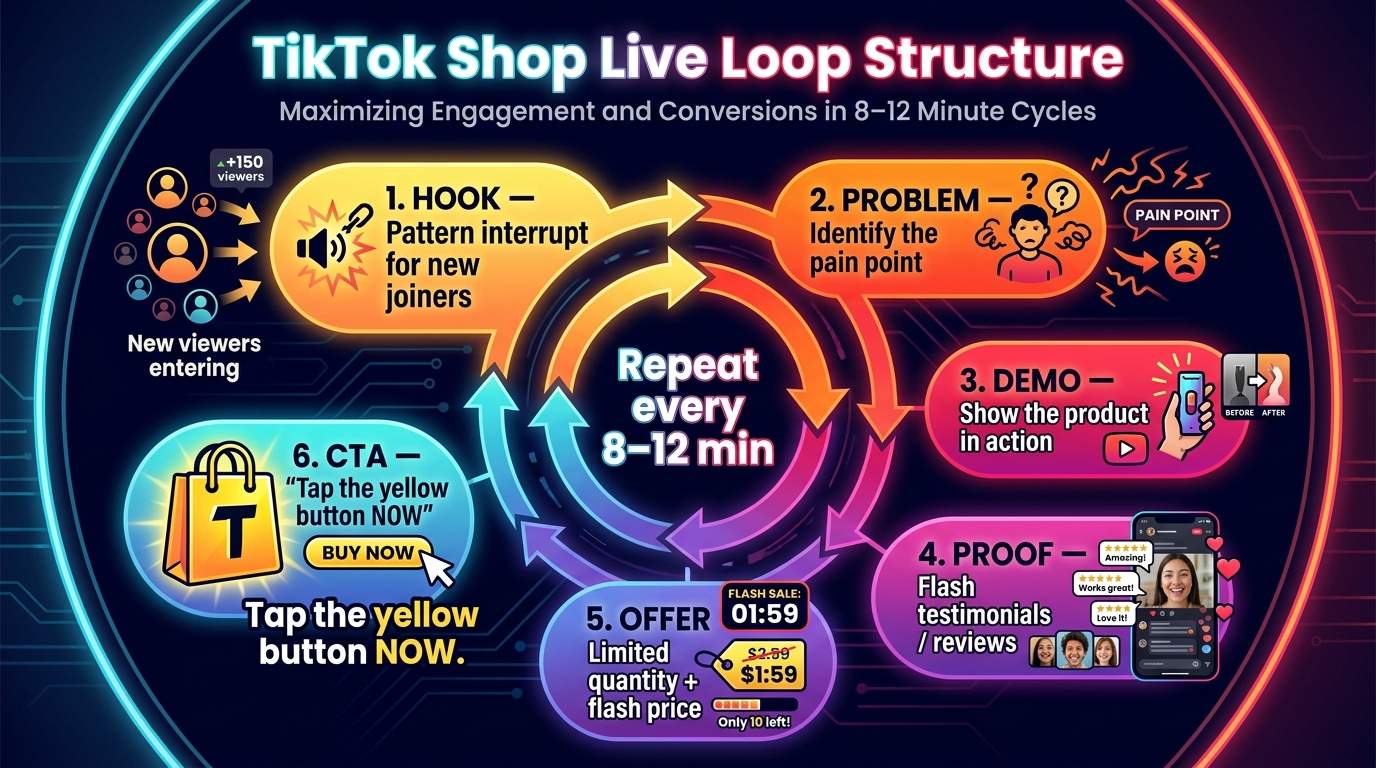
The single biggest structural difference between a high-converting TikTok Shop live and an average one is the loop. Most underperforming hosts run their stream in a roughly linear format — they introduce a product, talk about it for a while, take some questions, move on. The top performers run a tightly engineered loop that resets every 8–12 minutes and is specifically designed to convert every cohort of viewers, including the ones who just joined in the last two minutes.
Why Loops Beat Linear Presentations
The logic behind the loop structure is simple but powerful: TikTok live viewers are not a static audience. They are a constantly rotating pool. At any given moment in a live session, a significant proportion of the viewers in your room have been there for less than five minutes. They have no context for the product you just spent the last ten minutes demonstrating. A linear presentation permanently excludes these viewers from the information they need to make a purchase decision.
The loop structure solves this problem by treating each 8–12 minute cycle as a self-contained conversion unit. Every loop is designed to take a viewer from zero context to purchase intent. That means every loop includes a hook that works for first-time viewers, a compressed problem/benefit demonstration, social proof, an offer, and a clear call to action — in every single cycle.
The Six-Stage Loop Breakdown
Stage 1 — Hook (60–90 seconds). Opens the loop with a statement or visual that interrupts scrolling behavior and is immediately comprehensible to someone who just joined. The hook should communicate the product category and a reason to stay in one sentence. “This is the device that’s helped 4,000 of our customers sleep through the night for the first time in years — let me show you why in the next 30 seconds.”
Stage 2 — Problem Identification (60–90 seconds). Explicitly name the problem the product solves. This is where the host speaks directly to the pain point, using specific, relatable language rather than marketing generalities. The goal is to get a viewer to think “that’s exactly my situation.” Comment prompts (“Comment ‘same’ if you’ve dealt with this”) keep the engagement signal strong through this stage.
Stage 3 — Demo (90–180 seconds). The product demonstration. This is the most product-specific stage, and it should be visual, active, and specific. Abstract claims perform poorly in live selling environments. Concrete demonstrations — before/after, side-by-side comparisons, stress tests, application on camera — consistently outperform descriptive selling. The host should be showing, not just telling.
Stage 4 — Proof (60 seconds). A rapid burst of social proof. Screen-share customer reviews, hold up a printed testimonial, read a comment from a repeat buyer in the room, or flash a before/after transformation. This stage does not need to be long to be effective — three or four specific, believable proof points delivered quickly carry more weight than a lengthy testimonial monologue.
Stage 5 — Offer (60–90 seconds). The explicit, time-bounded offer. This is where the host names the price, the discount versus normal retail, any bundle mechanics, and the specific urgency constraint — whether that is a stock limit, a time countdown, or a session-only pricing guarantee. The offer must be stated clearly and specifically. “It’s normally $49. Tonight in this room, it’s $29. We have 47 units at that price. When they’re gone, they’re gone.”
Stage 6 — CTA and Reset (30–60 seconds). A direct, unambiguous call to action. “Tap the yellow cart button below right now.” The host then transitions directly back to the hook for the next loop, often with a fresh angle or a different product. The reset should feel energetic, not like a re-run — vary the hook language even if the underlying structure is identical.
Managing Loop Fatigue in Long Sessions
For sessions running longer than 90 minutes, pure loop repetition around a single product starts to produce diminishing returns as the audience composition stabilizes. High-performing sellers manage this by rotating through three to five products in a planned sequence, returning to bestsellers in later loops with updated offer mechanics — a reduced stock count, a gift-with-purchase sweetener, or a final-unit urgency claim. The product rotates; the loop structure does not.
Stage 3 — Pinned Products and the Add-to-Cart Moment: Mechanics That Drive the Tap
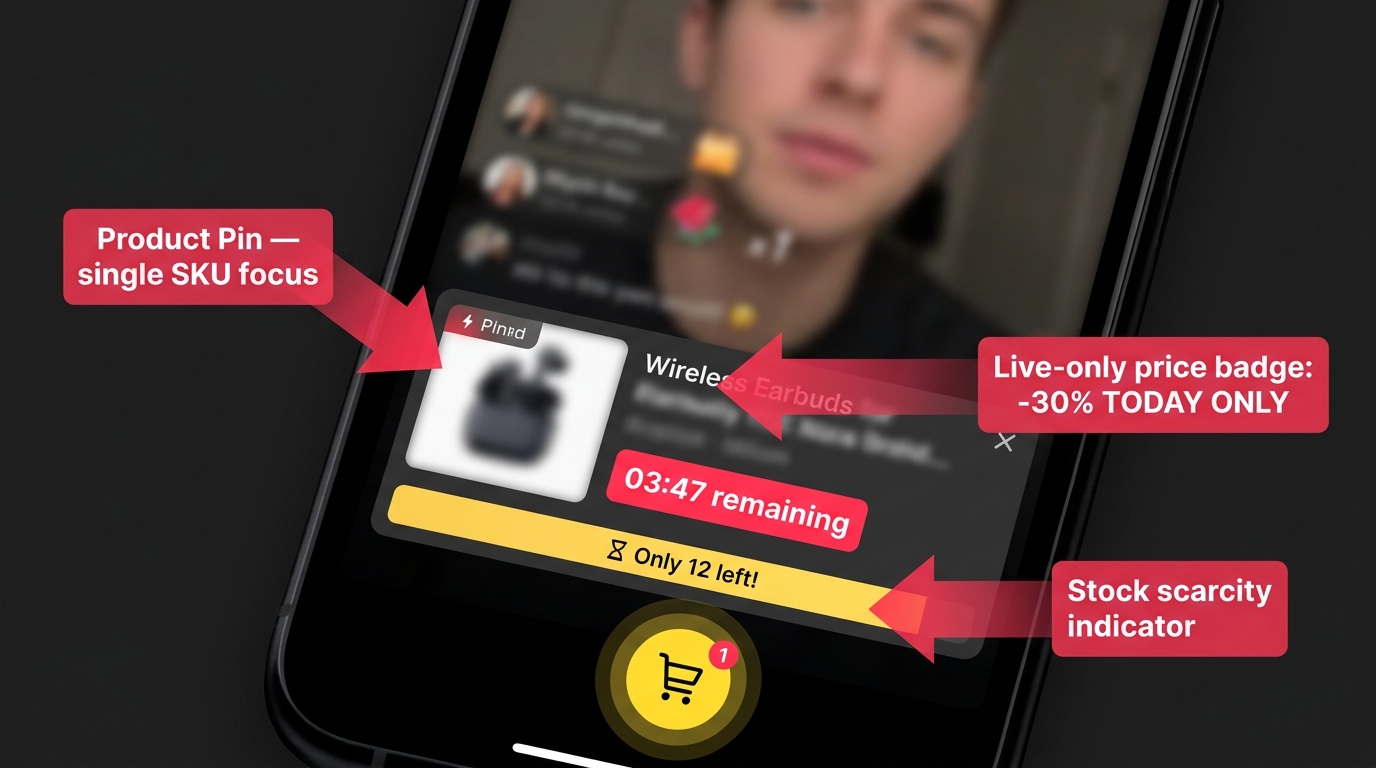
The pinned product card is the physical mechanism through which a viewer’s intent becomes an action. Every tactical decision about which product to pin, when to pin it, how to reference it verbally, and how to structure the offer around it directly determines the proportion of engaged viewers who actually tap through to the product detail page and begin the add-to-cart process.
The One Product at a Time Rule
One of the most common mistakes in TikTok Shop live setups is pinning multiple products simultaneously or rapidly cycling pins without a clear verbal anchor. The research on live shopping behavior consistently points in one direction: a single pinned product focused on the active selling segment produces materially higher click-through rates than multi-product pinning configurations.
The reason is attention. When a viewer sees one product pinned and the host is actively talking about that product, the visual and verbal signals are aligned. The decision architecture is simple: do I want this, or not? When multiple products are pinned simultaneously, the decision becomes: which of these do I want? That added cognitive step introduces friction that measurably reduces conversion at this stage.
Best practice from high-converting operators is to pin only the product currently being sold in the active loop. As the loop transitions to a new product, the pin changes. The host verbally bridges the transition — “We’re moving that one out of the cart and loading up our next drop” — which simultaneously signals the product change, creates mild urgency around the departing offer, and resets viewer attention for the next loop.
Scarcity Mechanics That Actually Work
Scarcity in live selling has a complicated reputation because it is so widely overused and so frequently dishonest. Claiming 500 units are almost gone when your warehouse has 10,000 is the kind of tactic that erodes trust within a viewer community surprisingly quickly — TikTok comments are a real-time reputation system, and skeptical viewers will call it out publicly.
What works in 2026 is specific, verifiable scarcity. This means committing to a genuine quantity at a live-stream price — “We have 60 units at $19, the rest are going back to regular price” — and honoring it visibly. When the 60 units sell, you close the offer and move on. Viewers who saw you honor that boundary will be more prepared to act quickly in the next loop, because the scarcity was real.
Countdown timers are a secondary scarcity tool that pairs with stock limits. Time-bounded offers work best when the countdown is visible on screen (either via a third-party overlay tool or verbally reinforced by the host) and when the deadline is short enough to be genuinely urgent — 10 to 15 minutes — rather than an hour-long window that gives viewers time to wander off and reconsider.
Live-Only Pricing as a Behavioral Anchor
One of the most effective add-to-cart drivers in TikTok Shop live commerce is live-only pricing — a price that is explicitly not available anywhere else on the platform or in your regular shop listings. This serves a specific function in the viewer’s decision psychology: it eliminates the “I’ll just come back and buy it later” exit path that kills so many almost-conversions.
When a viewer knows that the price in the live room is genuinely lower than what they will find if they navigate to the product listing afterward, the decision calculus changes. Delaying costs them money. The live room becomes the optimal time to buy, not just one of many possible times. This structural change to the viewer’s decision environment has a measurable impact on add-to-cart rates that is distinct from and additive to conventional scarcity mechanics.
Stage 4 — Checkout Friction and the 30–45% Drop-Off Zone
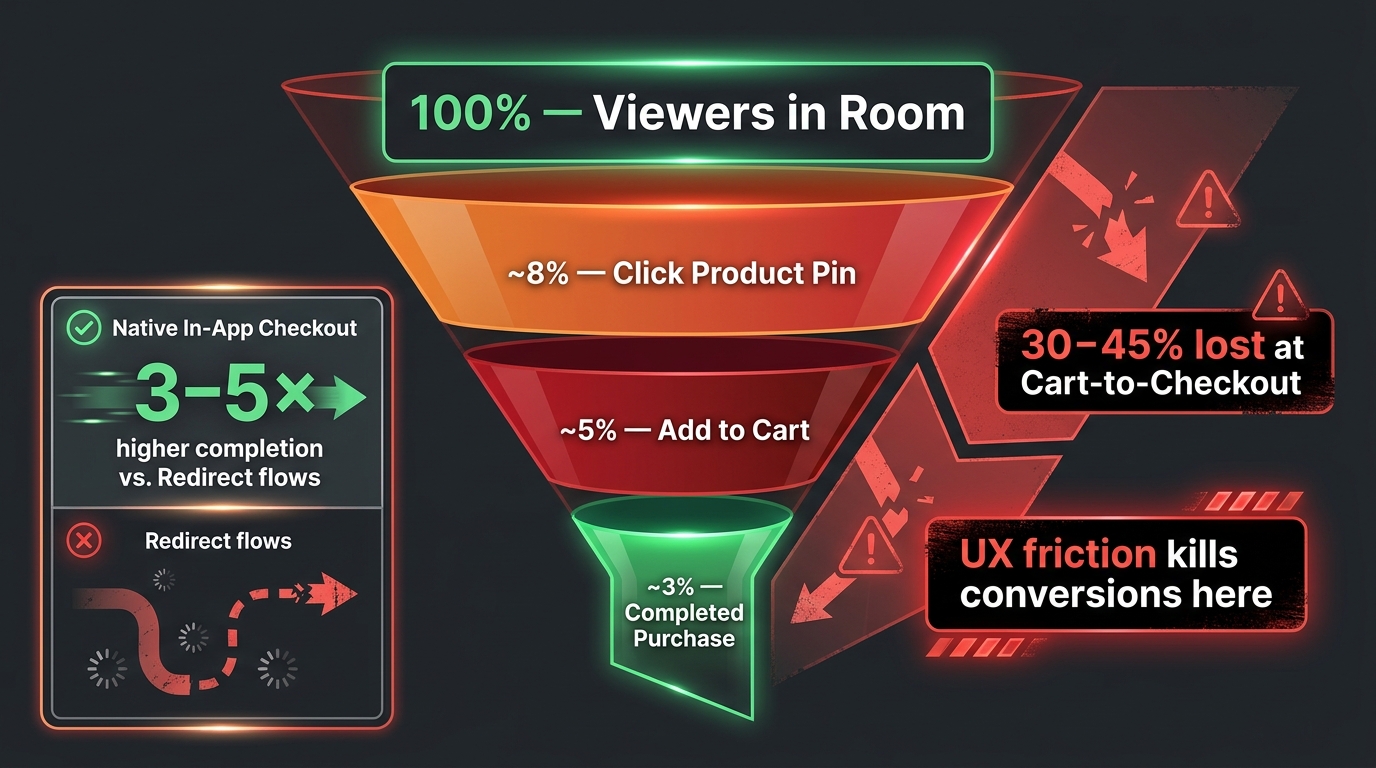
The add-to-cart event is not a purchase. This distinction sounds obvious, but most TikTok Shop live analytics dashboards display add-to-cart as a success metric in ways that obscure the significant leakage that happens between cart and completed order. Industry benchmarks consistently put cart-to-checkout abandonment in TikTok Shop live contexts at 30–45%, and for some unoptimized sellers the figure is considerably worse.
Why In-App Native Checkout Is Not Optional
The most structurally important checkout decision a TikTok Shop seller can make is keeping the entire purchase flow inside TikTok. Native in-app checkout — where the viewer taps the product card, views the product detail page, selects a variant, applies a voucher, and pays without leaving the app — consistently converts at 3–5× the rate of flows that redirect to an external website or Shopify storefront.
The reason is not primarily about payment method convenience, though that plays a role. It is about the psychology of interruption. Every time a user is redirected to an external site, they leave the social context that drove their purchase intent. The live room, with its host, its other buyers, its real-time stock countdown — all of that disappears. What replaces it is a generic e-commerce product page with no urgency context. The purchase motivation that was real and present in the live room has to be rebuilt from scratch, and most of the time, it is not.
TikTok’s native checkout preserves much of the live room’s psychological environment during the purchase flow. The buyer knows they are completing a purchase tied to the session they were just watching. The friction of leaving-and-returning is eliminated. For this reason, fully native TikTok Shop integration — rather than third-party redirect configurations — is a foundational requirement for competitive live conversion rates, not a nice-to-have upgrade.
In-Stream Checkout Recovery Tactics
Even with native checkout, 30–45% of add-to-cart sessions do not convert. Some of these can be recovered while the session is still live. The most effective in-stream recovery tactic is periodic cart reminder calls from the host: “If you’ve got something in your cart, now’s the time to check out — we’re on 23 units remaining and the price changes when we hit zero.” This verbal nudge, directed at viewers who may have added to cart and then continued watching, recaptures a portion of the abandoned cart volume in real time.
A secondary in-stream tactic is voucher deployment. TikTok Shop’s live voucher tools allow hosts to issue time-limited discount codes during the session that apply at checkout. A voucher dropped mid-session — “I’m dropping a code right now, you have three minutes” — creates an urgency event that simultaneously drives new add-to-cart actions and nudges existing cart holders to complete checkout before the voucher expires.
The LIVE Algorithm’s Commerce Signals: What TikTok Is Actually Measuring
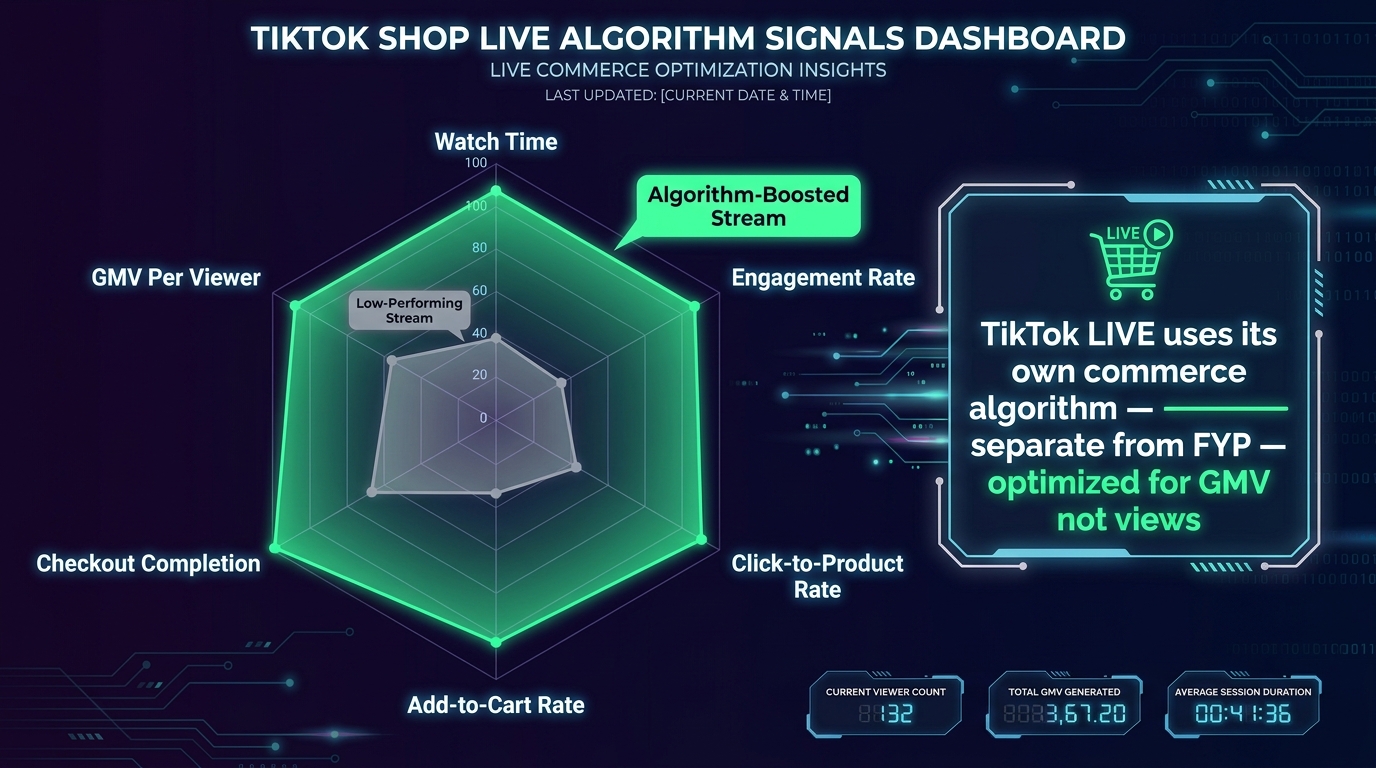
One of the most important structural facts about TikTok Shop live selling is that the LIVE commerce algorithm is a separate system from the FYP algorithm that most creators and marketers are familiar with. It does not optimize for the same signals. Understanding what it actually measures — and what it ignores — is the difference between building content that the algorithm amplifies and building content that leaves distribution on the table.
What the LIVE Commerce Algorithm Rewards
TikTok’s LIVE commerce algorithm is GMV-centric, not engagement-centric. This is a fundamentally different optimization target than the FYP algorithm, which weights watch time, shares, and comments. The LIVE system is specifically designed to identify sessions that are generating purchase intent and completed transactions, and to push those sessions to broader audiences in real time.
The signals it weighs most heavily, based on current platform documentation and operator-level analysis, break into three categories:
Commerce velocity signals. These include click-through rate on pinned products, add-to-cart rate per viewer, checkout completion rate, and GMV per concurrent viewer (GPCV). The GPCV metric is particularly important because it normalizes revenue performance against audience size — a room doing $500 GMV with 50 concurrent viewers (GPCV of $10) gets more algorithmic credit than a room doing $500 GMV with 500 concurrent viewers (GPCV of $1). This is why high-conversion small rooms can out-rank large low-conversion ones in algorithmic distribution.
Retention signals. Average watch time, percentage of viewers who stay longer than two minutes, and viewer re-entry rate (how many people who leave the room return later in the same session). These signals are the LIVE system’s equivalent of the FYP’s watch time weight — they indicate whether the content is compelling enough to hold attention against the alternative of returning to the feed.
Engagement signals. Comment rate, gift rate, and share events. These carry less weight in the LIVE commerce algorithm than in the FYP system, but they are not irrelevant — they contribute to the signal that the room is active and socially alive, which supports broader distribution.
The Follower Count Myth
One of the most persistent misconceptions in TikTok live selling is that follower count is a meaningful predictor of live performance. The data does not support this. TikTok’s LIVE commerce algorithm distributes to audiences based on real-time commerce performance signals, not on the size of the seller’s account. A 10,000-follower account running a high-GPCV, high-retention live room will receive more algorithmic distribution than a 500,000-follower account running a low-converting, high-churn session.
This is actually advantageous for newer sellers, but it also means that established accounts cannot coast on their following. Every live session is evaluated on its own commerce performance from the moment it opens. The warm-up tactics that prime the early engagement velocity matter enormously because they directly determine the algorithmic starting point for each session.
The Halo Effect on Search and Listings
A less-documented but well-observed consequence of strong live performance is what operators call the “search halo” — an improvement in organic search ranking for products within TikTok Shop that follows a successful live session. When a product generates significant click and purchase volume during a live stream, TikTok’s shop search algorithm appears to incorporate that commerce signal into the product’s ranking weight in the subsequent days.
This means a strong live session does not just drive in-session GMV. It also improves the product’s visibility in shop search, creating organic discovery traffic that persists beyond the stream. Sellers who understand this connection structure their live sessions partly as ranking events for their top SKUs, not just as direct-revenue activities.
GMV Max and Paid Amplification: When to Layer Ads Into a Live Funnel
TikTok’s GMV Max format for live streams is one of the most significant advertising tools available to TikTok Shop sellers in 2026, and also one of the most frequently misunderstood. It is not a substitute for a well-structured live funnel — it is an amplifier of one. Understanding the relationship between the organic funnel and paid amplification is essential for getting the economics right.
What GMV Max for LIVE Actually Does
GMV Max for LIVE is TikTok’s fully automated bidding format for live stream amplification. Rather than requiring manual audience targeting or bid management, it uses TikTok’s machine learning to identify and serve your live stream to viewers who are most likely to complete a purchase, automatically adjusting delivery in real time based on the stream’s current conversion performance.
The critical mechanic to understand is that GMV Max for LIVE is not an awareness play. It does not push your stream to the widest possible audience. It pushes your stream to the most commerce-ready audience that TikTok can identify in real time — which means its performance is directly dependent on the quality of the signal it is reading from your stream. If your in-stream conversion rate is high, GMV Max finds more people like your current buyers and delivers them cheaply. If your conversion rate is low, the system cannot identify a targetable buying cohort, and ad delivery becomes expensive and inefficient.
This relationship is why the funnel mechanics described in previous sections are prerequisites to paid amplification, not alternatives to it. Activating GMV Max on a live room with weak loop structure, no urgency mechanics, and slow checkout completion will not produce meaningful ROI. Activating it on a well-optimized room can produce 4–9× campaign ROAS based on case studies from agencies running TikTok Shop live at scale.
Timing the Ad Activation
Experienced TikTok Shop live operators typically do not activate GMV Max at the moment they go live. Instead, they run the first 15–20 minutes organically, using the warm audience from their pre-live content to establish commerce velocity signals. Once the stream shows a strong GPCV and stable add-to-cart flow, they activate paid amplification — essentially telling TikTok’s system: “Here is a room that is converting well. Find more people like these buyers.”
This sequencing allows the algorithm to learn from genuine purchase behavior before it begins spending budget, which produces more targeted delivery and lower effective CPA than activating GMV Max on a cold, unproven room at the session’s start.
LIVE Shopping Ads vs. GMV Max: When to Use Each
GMV Max for LIVE is a full-funnel, hands-off format best suited for established brands with proven live conversion history. For sellers who want more control over audience targeting or are testing new products, TikTok’s LIVE Shopping Ads format allows manual audience and bid management while still directing traffic into the live room rather than a product page. The trade-off is higher management overhead and a steeper optimization curve, but greater ability to run controlled experiments on audience segments.
The current best practice from operators managing live commerce at scale is to run LIVE Shopping Ads during the testing phase of a new product or live format, and transition to GMV Max once the conversion signals are consistent enough for the automated system to work efficiently.
Post-Stream Revenue: Clips, Retargeting, and the Attribution Gap
One of the most significant money-leaving-on-the-table moments in TikTok Shop live commerce is the treatment of the stream’s end as the revenue window’s end. The top-performing sellers know that a well-run live session generates three distinct revenue layers: in-session GMV, immediate post-stream GMV from viewers who were not quite ready during the live, and extended GMV from clips and retargeting that can continue generating sales for days afterward.
The Clip Extraction Strategy
After every live session, high-performing TikTok Shop operators systematically extract short clips from the stream recording — typically 30–90 second segments featuring the most compelling product demonstrations, strongest proof moments, or most visceral urgency closes. These clips are re-edited into short-form content that links directly to the product in TikTok Shop.
The clip strategy serves a dual function. First, it extends the revenue life of the content produced during the live session — a single two-hour stream might yield eight to twelve clips, each capable of independently driving product sales through TikTok’s short-form to Shop path. Second, the best-performing clips become inputs for the next pre-live warm-up sequence, functioning as social proof content for viewers who have not yet attended a live session.
Affiliate creators are increasingly part of this clip ecosystem. By providing affiliates with access to live stream recordings and explicitly encouraging them to create clip-based content linking to Shop products, brands can scale the reach of their live session content far beyond what they could produce internally. Affiliates working from live footage tend to produce content that retains the authenticity and urgency of the live context, which converts better than product-only clips shot in a studio environment.
The Retargeting Window and Attribution Reality
TikTok’s GMV Max for LIVE attributes completed purchases to a live session only if the buyer completes the order while inside the live room. Purchases that happen after the viewer leaves the stream — even if that exit was seconds ago and the purchase intent was entirely generated by the live — are not attributed to the live session’s GMV count under TikTok’s standard attribution model.
This creates a material attribution gap that leads most sellers to undercount their live commerce performance. The actual revenue influence of a live session typically extends 24–72 hours beyond the stream’s end, as viewers who added to cart during the session but did not complete checkout eventually return to complete the purchase — often triggered by standard TikTok abandonment notifications or by encountering a clip-based retargeting ad.
Sophisticated operators account for this by measuring a 72-hour GMV window for each live session rather than relying exclusively on the in-session attribution that TikTok’s native analytics report. Comparing 72-hour post-live GMV for products featured in a session versus baseline GMV periods gives a more accurate picture of a live session’s actual revenue contribution.
Daily vs. Episodic Programming: What the GMV Data Says About Format Choice
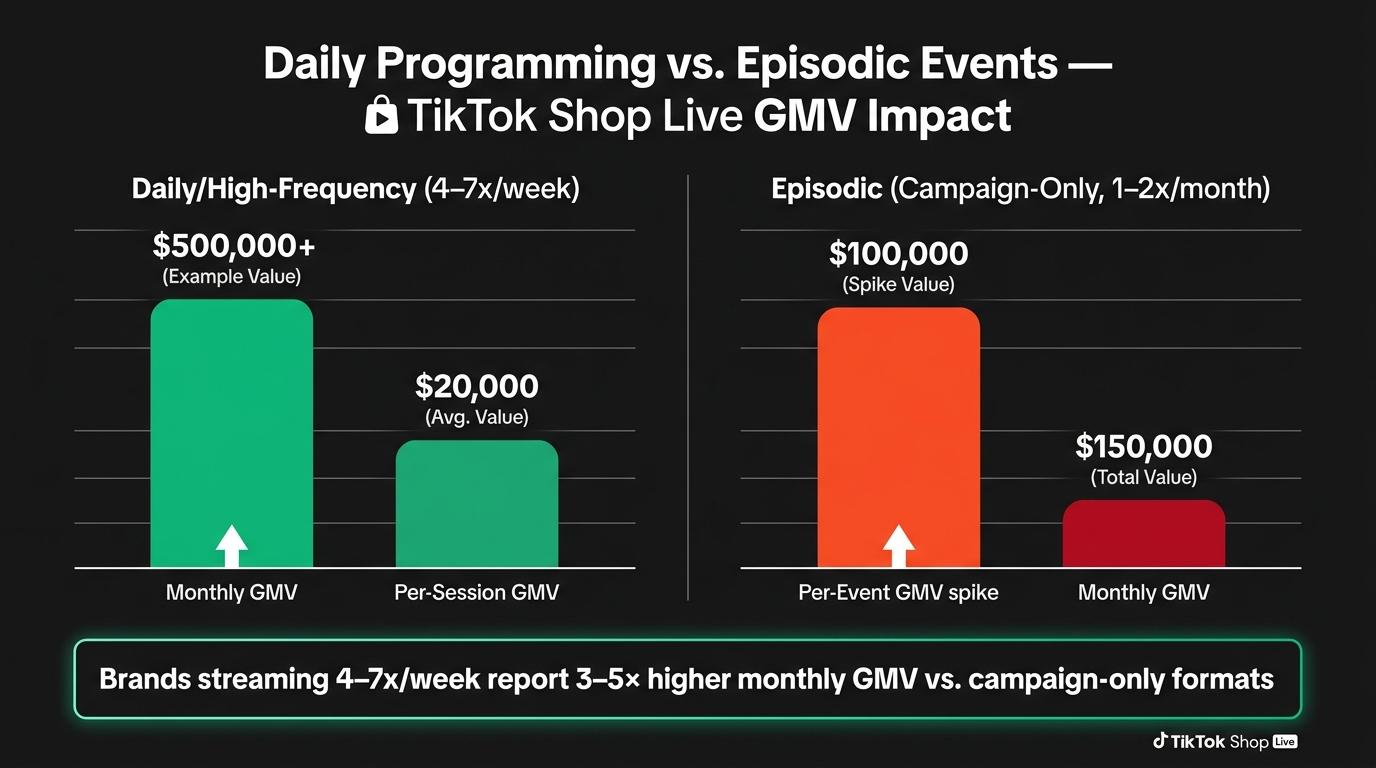
One of the most consequential decisions a brand or seller makes about TikTok Shop live commerce is whether to treat it as a channel — with regular, scheduled programming — or as a campaign tactic deployed for launches and promotional events. The GMV data has become fairly clear on this question, even if the operational implications are demanding.
The Case for High-Frequency Programming
Brands running TikTok Shop live sessions at high frequency — four to seven times per week, with a consistent schedule — report significantly higher cumulative monthly GMV than those using sporadic or campaign-only formats. The delta varies by category and execution quality, but multiple operator-level case studies point toward a 3–5× monthly GMV advantage for consistent, scheduled programming versus campaign-only approaches.
The reasons are structural. The TikTok LIVE commerce algorithm builds a performance history for each account. Accounts that stream consistently give the algorithm more commerce signal data to work with, which means automated delivery (both organic and paid) becomes more precise and efficient over time. There is an algorithmic momentum effect — a seller who has streamed 150 times in the last six months has a rich conversion history that makes GMV Max delivery significantly more efficient than it would be for a seller who has streamed ten times.
Repeat viewers are a second critical variable. Daily or near-daily programming builds a viewer habit — people who know you stream on Tuesday and Thursday nights will plan around it. These habitual viewers convert at rates substantially higher than cold audiences pulled in by algorithmic distribution, because they already have trust context for the brand and product line. The habitual viewer base is effectively a subscription-like customer segment that high-frequency programming creates over time.
The Episodic Case — and Its Ceiling
There is a legitimate use case for episodic, event-style live programming: product launches, seasonal pushes, and major promotional events. A well-planned launch live — with strong pre-live content, exclusive launch pricing, and genuine product news — can generate a per-session GMV spike that far exceeds what a typical daily session produces.
The ceiling of the episodic approach is monthly cumulative GMV. Because it does not build algorithmic momentum or a habitual viewer base, the episodic model is perpetually cold-starting — each event must rebuild audience trust and algorithmic context from scratch. It works for tactical objectives, but it does not compound the way a daily programming model does.
The practical resolution for most brands that have the production capacity is a hybrid model: a regular daily or near-daily programming schedule that maintains algorithmic momentum and a habitual viewer base, punctuated by higher-production episodic launch events that leverage the established audience as a conversion base. The episodic events convert better when they happen on top of an established programming cadence because the habitual audience arrives already primed to buy.
The Production Minimum for Sustainable Daily Streaming
The operational objection to daily live programming is real: it requires a minimum production infrastructure that many small sellers cannot easily assemble. The genuine minimum for sustainable daily TikTok Shop live selling is a dedicated host (whether founder, employee, or contracted creator), basic but consistent lighting, a reliable internet connection, and a pre-planned product and script structure for each session. The streaming software and multi-camera setups that larger brands use are not prerequisites — they are scale-up investments made after the basic format has been proven.
Many of the highest-GMV TikTok Shop live rooms operate from founder-run, minimally produced setups because host authenticity and product knowledge frequently outperform polished production when it comes to the specific trust mechanics that drive live commerce conversion. Starting with what you have, consistently, beats waiting to invest in a production infrastructure you may not need.
Putting the Funnel Together: A Practical Checklist for Each Stage
The funnel architecture described across these sections is not sequential in the way a traditional marketing funnel is — it is layered and simultaneous. Here is a practical consolidation of the key decisions at each stage:
Pre-Live (72 hours before)
- Post a teaser clip with a deliberate information gap — reveal the product without revealing the price.
- Post a social proof clip or image (testimonials, before/after, reviews) for the featured products 48 hours before.
- Post an explicit time-and-reason reminder 24 hours before. Give a concrete incentive to attend live versus watching a clip later.
- Push a day-of notification post 3–6 hours before the session. Make the offer specific, time-anchored, and easy to calendar.
Session Opening (first 90 seconds)
- Open with a pattern interrupt, not a logistics announcement.
- Prompt an immediate, easy comment action to generate engagement velocity.
- State the session’s value proposition within the first 60 seconds. Viewers need a reason to stay.
In-Session Loop (every 8–12 minutes)
- Pin only the currently active product. Change the pin when you change the product segment.
- Run each loop through all six stages: Hook → Problem → Demo → Proof → Offer → CTA.
- Use specific, verifiable scarcity. Honor the limits you state publicly.
- Deploy a voucher mid-session to create an urgency spike and recover stalled add-to-cart holders.
Checkout Recovery (in-stream)
- Keep all purchase flows fully native inside TikTok. No external redirects.
- Include periodic verbal cart reminders — “If it’s in your cart, finish checking out before we hit zero units.”
- Use live vouchers with explicit expiry to create checkout urgency.
Post-Stream
- Extract 8–12 short clips from the session recording within 24 hours.
- Publish the strongest clips as standalone short-form content linking to Shop products.
- Share recording access with affiliates who can create independent clip-based content.
- Measure 72-hour post-live GMV, not just in-session attribution.
- Use post-stream data (which products had highest click rates, which loops had most cart actions) to plan the next session’s product order and script.
The Compound Effect: Why This System Pays More Per Session Over Time
The most important characteristic of the funnel architecture described here is that it compounds. Each session feeds the next one. Strong in-session commerce signals improve algorithmic distribution for future sessions. The clip content generated after each stream feeds the pre-live warm-up sequence for subsequent streams. The habitual viewer base built through consistent programming means each new session opens with a higher baseline of purchase-ready attendees than the last.
This compounding dynamic is why the gap between average TikTok Shop live sellers and top performers widens over time rather than narrowing. The top 10% are not just executing better individual sessions — they are operating a system that becomes more efficient with each iteration. The 2.4% average conversion seller runs a better session, gets slightly better results, and resets. The 8–12% conversion seller runs a better session, generates better algorithmic data, builds more habitual viewers, and makes the next session easier to convert at even higher rates.
The practical entry point to this system is not the most sophisticated stage — it is the most consistent one. Pick a schedule, commit to the pre-live warm-up sequence, structure your first 90 seconds deliberately, and run the six-stage loop. Measure add-to-cart rates, checkout completion, and 72-hour post-stream GMV. Use that data to iterate. The operational sophistication of your GMV Max campaigns and clip retargeting system can follow as the baseline conversion performance is established. Start with the funnel. The amplification tools work better when there is something worth amplifying.