




There is a number that almost every affiliate program report leads with. It’s usually the biggest number on the page, often decorated with an upward arrow, and it is the single most misleading figure in performance marketing. That number is Gross Merchandise Value — GMV.
GMV tells you the total value of orders attributed to your affiliate channel. It does not tell you whether your business kept any of that money. It doesn’t account for commissions paid out, platform fees, returns, fraudulent orders, coupon-driven margin erosion, the salary of the person managing the program, or the cost of serving customers acquired at a loss. By the time you subtract those figures from the headline GMV number, many affiliate programs reveal themselves to be far less profitable — or in some cases, actively unprofitable — than the dashboard implies.
This is the profit gap in affiliate management: the yawning distance between the revenue your program appears to drive and the margin your business actually retains. In 2026, with affiliate marketing spending in the US alone expected to hit $13.2 billion and continue climbing, brands that manage programs by GMV alone are essentially flying blind at scale. The bigger the program, the bigger the gap.
This article is about closing that gap. We’ll go deep on what GMV hides, why certain partner types actively drain margin, how to measure true profitability at the partner level, how to restructure commissions to reward value instead of volume, and how to build the operational cadence that keeps a program profitable over time — not just impressive-looking on a quarterly slide.
What GMV Actually Hides: The Full Cost Stack of an Affiliate Program
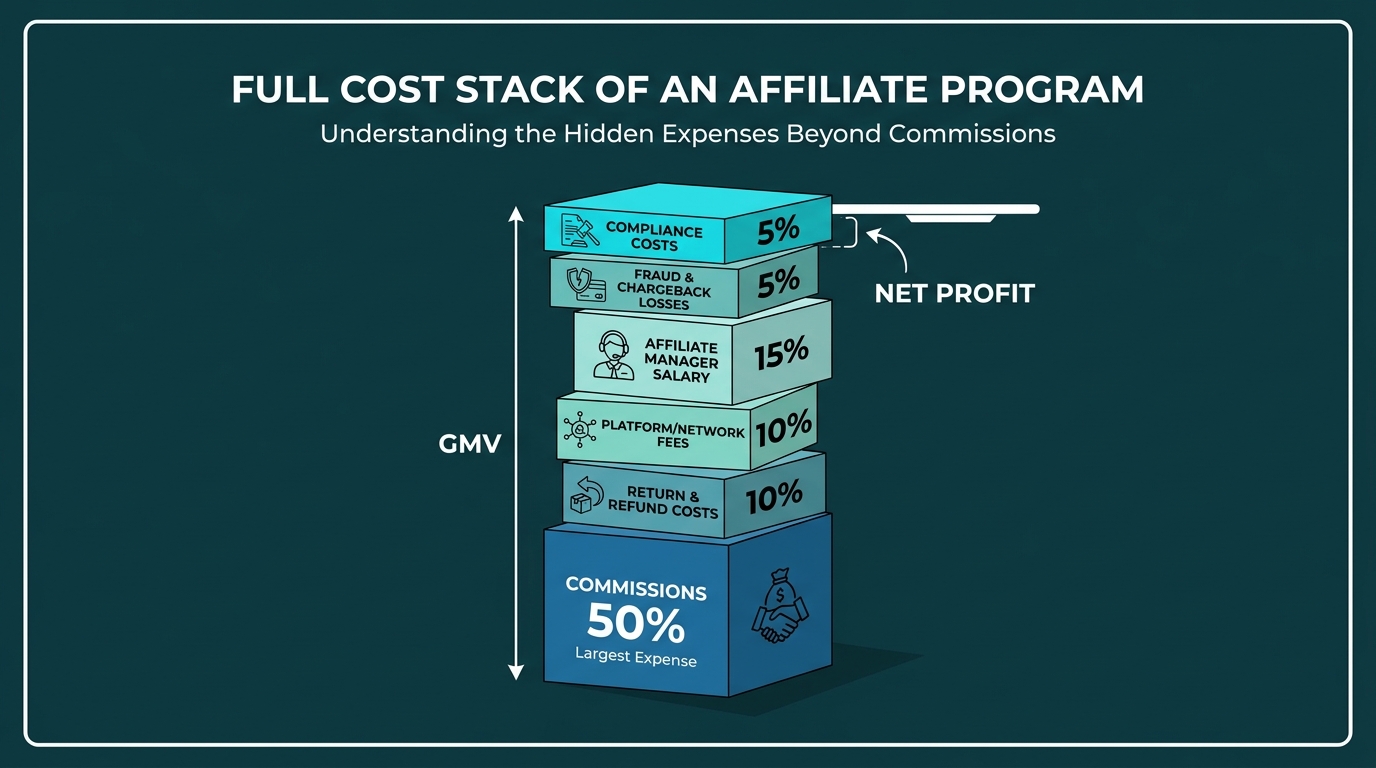
Gross Merchandise Value is a top-line metric. Like revenue on an income statement, it shows you what came in before a single dollar of cost is subtracted. The problem is that affiliate programs generate costs at nearly every step of the value chain, and most of those costs are invisible when you’re staring at a GMV figure.
The Commission Layer
The most obvious cost is the commission itself. Affiliate commission rates vary widely — from 2–5% for low-margin consumer electronics to 30–70% for digital products — but the commission rate alone doesn’t tell you much. What matters is the commission expressed as a percentage of your gross profit margin, not your revenue. A 10% commission on a product with a 25% gross margin is actually consuming 40% of your gross profit on that sale. Before that product ships, nearly half the profit is already gone.
This distinction is almost never reflected in GMV-based reporting. An affiliate manager celebrating a $500,000 GMV month may have generated $50,000 in commissions on products that only yielded $125,000 in gross profit — meaning the program consumed 40% of gross profit before a single other cost was considered.
Returns, Refunds, and Chargebacks
Product returns are a structural feature of e-commerce, but they interact with affiliate programs in a particularly damaging way. Many affiliate platforms have lagged commission reversal processes, which means returns are often not deducted from affiliate payouts in a timely — or accurate — manner. In high-return categories like apparel, footwear, or consumer electronics, return rates can run 15–30%. When those returns occur after commissions have been paid, the cost is absorbed entirely by the brand.
Chargebacks compound the problem. Global chargeback costs in e-commerce reached $33.8 billion in 2025 and are projected to climb to $41.7 billion by 2028. Affiliate-driven traffic is disproportionately exposed to chargeback risk when certain partner types — particularly coupon and incentive sites — attract deal-seekers with higher fraud rates and lower purchase intent. Each chargeback costs not just the sale value but also a $20–$100 dispute processing fee, plus the risk of higher payment processor rates if dispute ratios exceed thresholds.
Platform and Network Fees
Running an affiliate program through a managed network typically adds 20–30% on top of commissions paid — meaning a $50,000 commission payout actually costs $60,000–$65,000 when network override fees are included. Some brands run programs through multiple networks simultaneously, multiplying these overrides. These fees are often buried in a “platform costs” line rather than attributed directly to the affiliate channel, making the true cost of affiliate-driven revenue even harder to see.
Management Overhead
Affiliate programs don’t run themselves. Between partner recruitment, activation, compliance monitoring, creative updates, fraud review, and payout processing, an active program with 200+ partners typically requires at least one dedicated full-time equivalent — often more. That labor cost is almost never factored into GMV-based performance reporting. If you’re paying a program manager $75,000 annually and attributing their time entirely to an affiliate program that “generates” $1.2M in GMV, you’re already spending 6.25% of GMV before the first commission is paid.
Discount and Coupon Cost Absorption
When affiliates promote your products through coupon codes or cashback offers, those discounts come directly out of your margin. A 15% promotional code pushed by a coupon aggregator doesn’t reduce the affiliate’s commission — it reduces your net revenue. If an order has a 10% commission rate and a 15% coupon attached, you’re paying 25% of the sale value in combined costs before accounting for COGS, shipping, or any other expense. In categories with already thin margins, this combination can render the sale unprofitable even before it ships.
When all these layers are stacked — commissions, returns, chargebacks, network fees, management cost, and discount absorption — many affiliate programs running at apparent GMV health are operating at net margins of 5–8% or less. Some are negative. GMV will never show you this. Net margin analysis will.
The Cannibalization Problem: When Affiliates “Drive” Sales That Were Already Yours
Of all the ways that GMV-based reporting distorts affiliate program performance, the cannibalization problem is the most insidious. It doesn’t just inflate the numbers — it actively incentivizes behavior that hurts your business, while rewarding partners for doing so.
What Cannibalization Actually Means
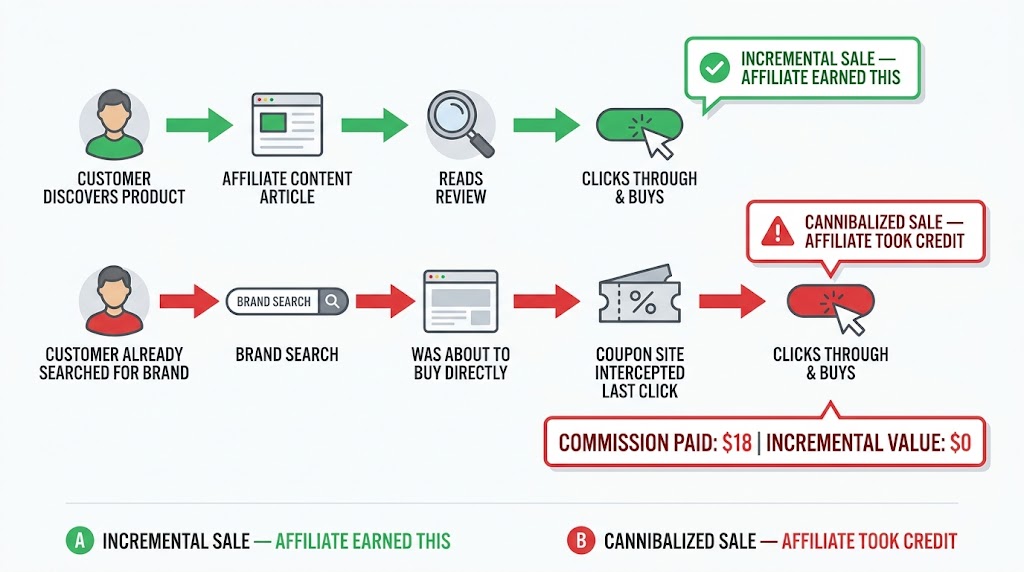
Commission cannibalization occurs when an affiliate earns a commission on a sale that would have happened anyway, without any influence from that affiliate. The customer had already decided to buy. They searched your brand name directly, had your website open in another tab, or were moments away from completing a purchase through your direct channel — when a coupon site, cashback browser extension, or branded-keyword bidder intercepted the transaction at the last second and claimed last-click credit.
The sale gets attributed to the affiliate. The commission gets paid. The brand gets nothing it wouldn’t have gotten without the affiliate program. And because GMV counts this as a program win, the behavior gets reinforced.
Branded Keyword Bidding
One of the most common cannibalization vectors is branded keyword bidding, where affiliates purchase paid search ads targeting your brand name. A customer searching “YourBrand promo code” or even just “YourBrand buy” clicks an affiliate ad, lands on a coupon page or review site, gets routed to your store, and the affiliate collects a commission. Studies suggest affiliates cause up to 75% of ad hijacking incidents on branded terms, driving up your own cost-per-click in paid search while collecting commissions on organic demand they did nothing to create.
Most affiliate program terms of service prohibit this. In practice, without active monitoring, it happens constantly — and the financial damage is compounded because you’re often paying higher CPCs on your own branded terms as a result.
Extension-Based Last-Click Capture
Cashback browser extensions like Honey, Rakuten, or Capital One Shopping have grown into significant affiliate traffic sources. These extensions activate when a user is already on a checkout page — meaning they have virtually zero influence on the purchase decision. Their entire model is built on capturing last-click attribution from transactions that are already committed. For brands, this means paying commissions on sales that would have occurred through a direct, zero-commission channel.
The incremental value of these partners is, by definition, close to zero for already-intent customers. Yet under last-click attribution models, they appear to be among the highest-converting affiliates in the program.
Measuring True Incrementality
The solution to cannibalization is incrementality testing — measuring not what an affiliate is attributed for, but what they caused. Holdout testing, geo-based market comparisons, and matched cohort analysis can all be used to determine what percentage of affiliate-attributed sales would have occurred anyway without that affiliate’s involvement.
Research from the Marketing Science Institute found that brands without incrementality testing waste an average of 23% of their marketing spend on non-incremental activities. For affiliate programs, the figure can be higher, particularly for programs with heavy coupon or cashback partner representation. A 73% majority of marketing leaders in 2026 now classify incrementality measurement as essential — up sharply from 41% in 2023. The adoption curve has accelerated precisely because brands discovered how much money they were paying out for sales they already owned.
The 10/70 Problem: Why Most Affiliate Partner Rosters Are Structured Backwards
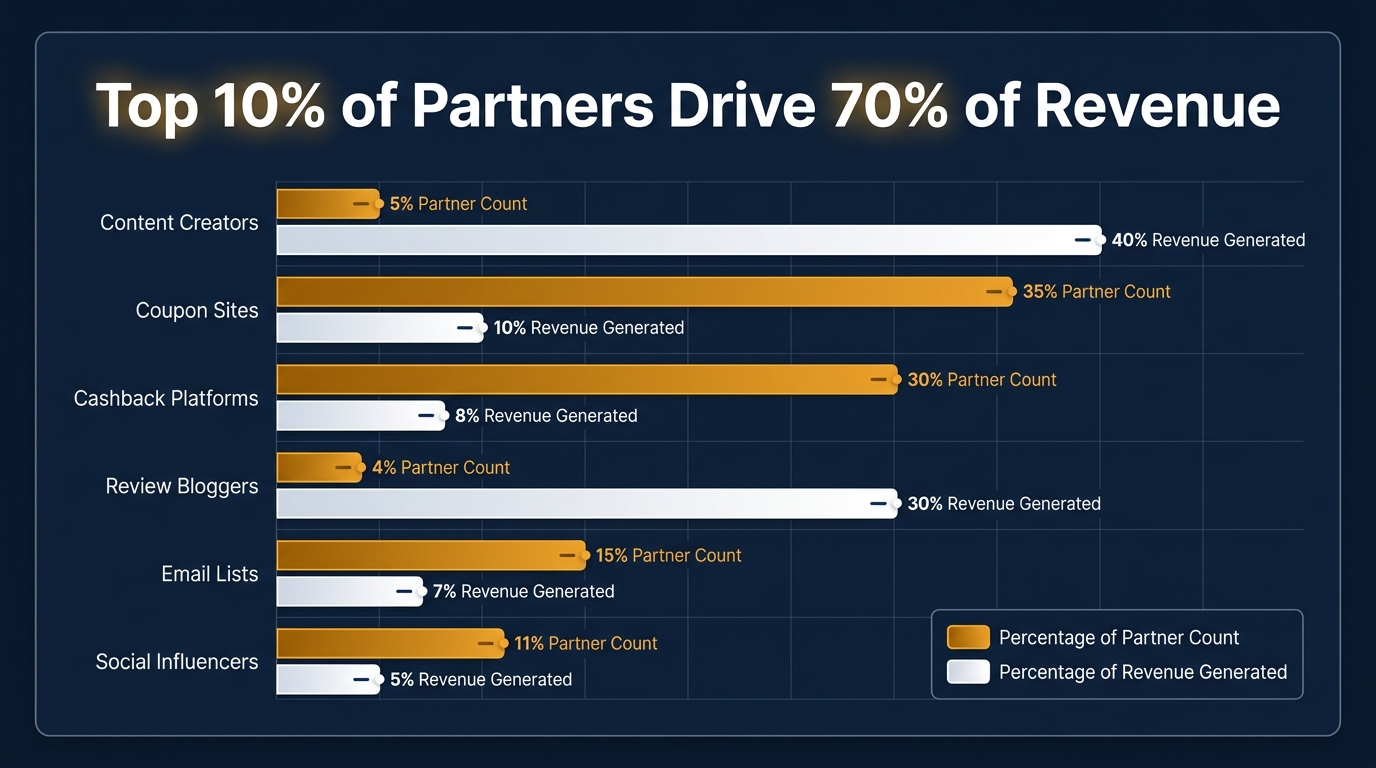
A well-known pattern in affiliate program data is that the top 10% of partners generate approximately 70% of total revenue. What’s less frequently discussed is that this ratio gets dramatically more extreme when you swap revenue for profit.
Some affiliates generate revenue. Fewer generate profitable revenue. And a meaningful portion of the partner roster in a typical program are generating revenue at negative margin contribution — commissions paid, discounts absorbed, returns processed, with customers acquired who cost more to serve than they generated.
The Five Partner Archetypes and Their Profit Profiles
Understanding profit contribution requires segmenting your partner roster by type, not just by revenue volume. The five most common affiliate archetypes have very different margin profiles:
Content and editorial affiliates — bloggers, review sites, comparison platforms, and niche publishers — drive the most genuinely incremental traffic. These partners introduce customers to your brand through research and discovery content. The customer wasn’t already searching for you; they found you through a recommendation. Conversion rates are often lower, but new-to-brand rates are high, return rates are lower than average, and the customers tend to have above-average lifetime value. These partners deserve higher commission rates relative to their attributed volume, because their incrementality score justifies it.
Influencer and social affiliates — creators on YouTube, Instagram, TikTok, and podcast platforms — also drive high incremental value when properly managed. Their audiences are often discovery-mode, not purchase-mode, which means attribution models consistently undercount their influence while overcounting the coupon sites that catch the customer later. A content creator who drives product awareness deserves credit for that customer even if a cashback extension gets the last click.
Email and loyalty publishers drive strong conversion rates and tend to attract brand-loyal customers with reasonable lifetime value. These partners add moderate incremental value; their audiences are already purchase-inclined, but the affiliate touch genuinely influences product selection within a purchase session. They perform best on limited-time offers and exclusive access, not permanent discount codes.
Coupon and deal aggregators are the most common source of GMV inflation with low profit contribution. These partners drive heavy traffic around promotional periods, accumulate last-click attribution, and promote primarily through discount codes that compress your margins. Their customers have the highest return rates and lowest LTV in most programs. Removing or deprioritizing coupon affiliates typically has little impact on actual incrementally-driven revenue while significantly improving program profitability.
Cashback and rewards platforms represent the extreme end of the cannibalization spectrum. Their core model is intercepting existing purchase intent, not generating new interest. For categories with very long purchase consideration cycles — mattresses, luxury goods, insurance — they can add some marginal value. For fast-moving consumer goods or repeat purchase categories, they typically generate zero incremental lift while capturing last-click commissions on every transaction.
Building a Partner Profit Contribution Score
A Partner Profit Contribution Score (PPCS) incorporates multiple data points beyond GMV to rank partners by actual value delivered. Key inputs include: new-to-brand customer rate (what percentage of referred customers are first-time buyers?), average order value, 90-day return rate, 6-month customer LTV, commission rate relative to gross margin, and estimated incrementality based on attribution analysis. Partners scoring high on PPCS get premium commission tiers, early access to new products, and co-marketing opportunities. Partners scoring low get flat rates or, in extreme cases, deactivation.
The Last-Click Attribution Trap and Why Incrementality Changes Everything
Attribution is the accounting system of marketing. Like any accounting system, its outputs are only as accurate as its underlying assumptions. Last-click attribution — still the dominant model in affiliate marketing — assumes that the final touchpoint before a purchase deserves 100% of the credit for that purchase. This is a useful simplification for operational purposes. It is a disastrous premise for profit management.
How Last-Click Systematically Distorts Affiliate ROI
Consider a customer who discovers a brand through a YouTube creator’s review, then searches for the product on Google and reads a comparison blog, then visits the brand’s site directly but doesn’t purchase, then receives a retargeting ad, and finally checks out through a cashback extension. Under last-click attribution, 100% of the value of that sale is credited to the cashback extension. The YouTube creator, the comparison blog, the retargeting campaign — all receive zero attribution.
This systematically over-rewards bottom-of-funnel interception and under-rewards top-of-funnel discovery. The affiliates who actually build brand demand get paid less; the ones who intercept existing demand get paid more. Over time, this creates a gravitational pull toward coupon and cashback partner growth and away from content and creator partner investment — precisely the opposite of what a profit-focused program should want.
Research shows that last-click attribution overstates affiliate channel value by 20–40% compared to multi-touch or incrementality-adjusted models. Brands that have run holdout tests on their affiliate programs have discovered that a significant share of attributed affiliate revenue — often 30–50% — would have converted through direct or organic channels anyway.
Practical Incrementality Testing for Mid-Size Programs
Full randomized control trials require scale and technical infrastructure that not every brand can deploy. But there are more accessible approaches that can meaningfully improve your measurement:
Geo-based holdout tests involve temporarily pausing affiliate promotion in specific geographic markets while keeping it active in comparable markets, then measuring the difference in direct and organic conversion rates. This requires reasonable geographic balance in your customer base but can be implemented without pixel-level tracking infrastructure.
Partner-level pause testing involves temporarily deactivating specific affiliate partners — particularly coupon or cashback sites — and monitoring total program revenue. If total revenue doesn’t decline meaningfully when a partner is paused, that partner’s attributed GMV was largely cannibalized. This test is uncomfortable for affiliate managers whose performance is measured in GMV, which is exactly why most never run it.
New-to-brand rate analysis is the simplest proxy for incrementality. If an affiliate’s referred customers show 80%+ new-to-brand rates, they’re almost certainly driving incremental traffic. If their referred customers show 20–30% new-to-brand rates, the majority of their attributed sales were existing customers who would have purchased anyway. First-party data from your CRM or customer database makes this analysis tractable without running a controlled experiment.
Coupon and Cashback Partners: The Honest Assessment
Coupon and cashback affiliates occupy an uncomfortable position in the affiliate marketing discourse. Some brands defend them as a conversion optimization tool that helps close hesitant buyers. Others treat them as structural margin drains to be minimized. Both positions contain a measure of truth, and the right answer depends heavily on context.
When Coupon Partners Actually Add Value
Coupon partners can genuinely increase conversion rates among price-sensitive customers who were interested but hesitating. For high-consideration, high-price products — where the purchase deliberation window is days or weeks, not seconds — a timely discount can shift a “maybe” to a “yes” in a way that has real incremental value. For new customer acquisition campaigns where the cost of a discount is offset by the lifetime value of the acquired customer, coupon partners can be a legitimate acquisition tool.
The key condition is that the discount must be the deciding factor — not a reward for a decision already made. The problem is that current attribution technology cannot reliably distinguish these two scenarios at scale, which means brands often overpay for the former while intending to fund the latter.
The Systematic Margin Drain Problem
Coupon aggregators and cashback sites collectively capture an estimated 22% of affiliate budgets while predominantly driving discount-led sales on existing purchase intent. Margin erosion from promo code abuse — unauthorized code sharing, reseller exploitation, and code stacking — is estimated to cost e-commerce brands 15–25% of affected transaction margins. Brands that have implemented single-use codes and purchase verification have reduced code abuse by up to 80%, with minimal impact on conversion rates — suggesting much of the volume was fraudulent or non-incremental to begin with.
The structural challenge is that coupon partners are optimized for last-click attribution capture. They build SEO content around “[brand name] promo code” searches specifically to intercept buyers who are already in checkout. Their model is explicitly designed to be in the right place at the right time — not to generate the right intent. Paying them the same commission rate as a content creator who invested months building an audience that discovered your brand organically is a fundamental misalignment of incentives and compensation.
A Practical Framework for Coupon Partner Management
Rather than eliminating coupon partners entirely — which can generate friction with affiliate networks and lose some marginal conversion value — the more defensible approach is differential commission management. Coupon and cashback partners should receive lower base commission rates (reflecting their lower incrementality), with strict code management policies (single-use or time-limited codes, never permanent), and explicit contractual prohibitions on branded keyword bidding. Holdout testing should be run on the top five coupon partners at least annually to verify incremental contribution before renewing or renegotiating terms.
Building a Profit-First Metrics Dashboard
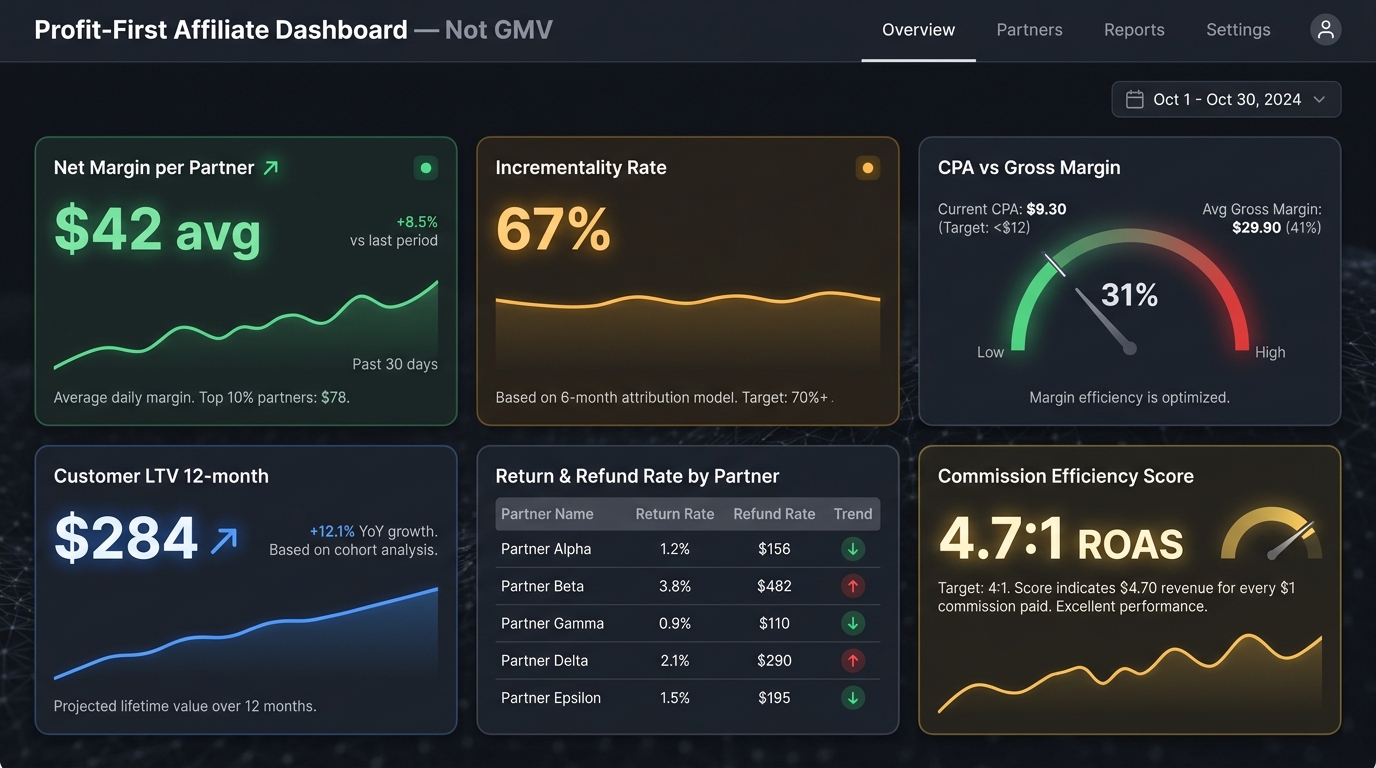
Shifting from GMV-based to profit-first affiliate management requires building a different set of measurement tools. The metrics that matter are not more complex than GMV — they’re just more honest. Here is the dashboard framework that profit-focused affiliate managers actually use.
Net Margin Per Partner
This is the foundational metric. For each affiliate partner, calculate: (Gross revenue attributed) minus (commissions paid) minus (returns and refunds from attributed orders) minus (discount/coupon cost from attributed orders) minus (proportional platform fees) = Net Margin. Express this as both an absolute dollar figure and a percentage of attributed revenue. Partners with sub-10% net margins need intervention. Partners with negative net margins need deactivation or significant commission restructuring.
Running this calculation requires connecting your affiliate platform data to your e-commerce order management system, ideally through an automated integration. This is more technically demanding than reading a GMV report, but it is the difference between running a business and running a number.
CPA Relative to Gross Profit Margin
Cost Per Acquisition (CPA) is a more familiar metric than net margin per partner, but it’s often calculated incorrectly. CPA is typically expressed as (commissions paid ÷ number of orders), which tells you the average commission cost per sale. The more useful figure is CPA expressed as a percentage of gross profit margin — because that tells you how much of your profit is being consumed by the cost of acquiring each sale through the affiliate channel.
The benchmark to target is CPA at 20–40% of gross profit margin. Below 20% and you may be under-investing in affiliate relationships relative to the value they’re generating. Above 40% and the channel is consuming too much margin to be sustainable at scale. Above gross profit margin entirely and the channel is loss-generating on a per-order basis. Different product categories will have different thresholds depending on margin structure and customer lifetime value, but this ratio should be tracked for every significant affiliate partner.
Customer Lifetime Value by Partner Source
LTV is the metric that most directly connects affiliate acquisition to long-term business health. An affiliate who refers customers with a 12-month LTV of $350 is genuinely more valuable than one who refers customers at the same CPA but with a 12-month LTV of $140 — even if their GMV numbers look identical in month one.
LTV tracking requires patient data collection — you need at least 6–12 months of cohort behavior data before partner-level LTV figures become reliable. But the investment is substantial. Brands that have restructured commission rates based on LTV data have typically seen program ROI increase by 30–50% without increasing total commission spend, simply by shifting budget toward partners whose customers have demonstrably better long-term retention and repeat purchase rates.
Return Rate by Partner and Product
Return rate is a leading indicator of customer quality and purchase intent quality. High return rates from a specific affiliate’s traffic suggest one of several problems: the affiliate’s audience is poorly matched to the product, the affiliate is overpromising product attributes in their content, or the affiliate is incentivizing speculative purchases through deep discounts. Partners with return rates more than 2x your blended average warrant investigation and potentially differentiated commission treatment — some programs specifically hold back commission payment until the return window closes.
New-to-Brand Rate
This is the simplest proxy metric for incrementality and one of the most actionable. New-to-brand rate measures what percentage of an affiliate’s referred customers are purchasing from your brand for the first time. High rates (60%+) indicate genuine customer acquisition. Low rates (under 30%) indicate the affiliate is primarily serving existing customers — and you’re paying commission on the loyalty you already earned.
Commission Efficiency Score (ROAS)
Return on Affiliate Spend (ROAS) is calculated as total net revenue generated divided by total program costs (commissions + platform fees + management overhead). Top-performing programs hit 5:1 ROAS or better on a net margin basis. Industry data suggests the median affiliate program runs around 2.1:1 ROAS, with professionally managed programs averaging closer to 4.7:1. The difference between those two figures, at scale, is the business case for profit-first management.
Tiered Commission Design That Protects Margin Without Killing Performance
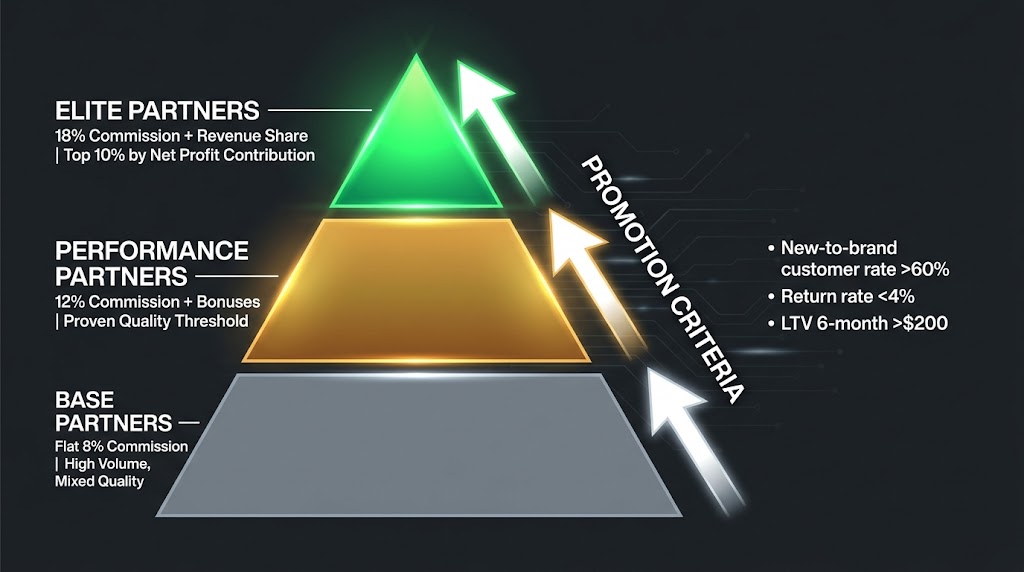
Once you have profit data at the partner level, the natural next step is differentiating what you pay based on what partners actually deliver. Tiered commission structures accomplish this while also creating a powerful incentive system that motivates partners to improve their performance metrics — not just their volume.
Why Flat Commissions Subsidize Low-Value Traffic
Flat commission rates — where every partner earns the same percentage regardless of customer quality, return rate, or incrementality — are essentially a subsidy from your high-performing content affiliates to your low-performing coupon partners. The content creator who drives first-time buyers with above-average LTV earns the same rate as the coupon site that intercepts existing buyers and strips margin through discount codes. This is economically irrational, but it’s how the majority of affiliate programs are still structured.
Flat rates persist because they’re easy to explain and easy to administer. Tiered rates require measurement capability and partner communication work that many affiliate managers are not resourced to do. This is a legitimate operational constraint, not an excuse — but it is solvable, and the financial return on solving it is high.
A Three-Tier Commission Architecture
A practical tiered structure for most e-commerce brands involves three tiers, differentiated by both partner type and measured performance:
Base tier: Standard partners who have not yet demonstrated above-average profitability metrics. Base commission rates should be set at the floor where the math works — typically 60–70% of your blended CPA target relative to gross margin. New partners start here regardless of audience size.
Performance tier: Partners who have demonstrated above-average new-to-brand rates, below-average return rates, and LTV at or above program median over a minimum 90-day measurement window. Performance tier earns 1.3–1.5x base commission, plus eligibility for periodic performance bonuses tied to quarterly targets.
Elite tier: Partners in the top decile of profit contribution scores, with verified incrementality and consistently strong customer quality metrics. Elite partners earn 1.8–2x base commission plus access to exclusive promotions, co-marketing budgets, and in some cases revenue share arrangements on long-term customer value rather than one-time purchase attribution.
Promotion and Demotion Criteria
The tier structure only works if movement between tiers is based on measured performance rather than relationships, volume, or inertia. Promotion from base to performance tier should require: new-to-brand rate above 55%, 90-day return rate below 1.5x program average, minimum 60-day measurement period, and CPA within target range. Demotion from performance tier should trigger automatically if return rates spike above 2x program average, new-to-brand rate drops below 40%, or fraud indicators are detected.
Publishing these criteria transparently to your partner community — not just enforcing them internally — creates alignment. Partners who understand that higher commission tiers are earned through customer quality, not just volume, will self-select the audiences and content approaches that produce better customers. That’s the goal: not just measuring quality, but incentivizing it.
Special Commission Rules for Coupon and Cashback Partners
Coupon and cashback partners should typically be excluded from standard performance tier advancement, even if their raw volume metrics look strong. Instead, create a separate sub-category with permanently differentiated rates (typically 40–60% of content affiliate base rates), strict code management rules, and annual incrementality testing requirements. This prevents these partners from earning premium commissions through volume that doesn’t represent incremental value, while keeping them available as a managed conversion optimization tool where genuinely warranted.
Conducting a Profitability Audit of Your Affiliate Program
Before implementing any of the changes described above, you need an honest baseline. A profitability audit gives you the data to prioritize, a benchmark to measure improvement against, and — frequently — some uncomfortable revelations about where program economics currently stand.
Step 1: Reconstruct True Cost Per Partner
Pull the last 12 months of data for every active partner (defined as having generated at least one attributed sale). For each partner, gather: total attributed GMV, total commissions paid, total returns and refunds on attributed orders, total discount cost from codes used on attributed orders, and estimated platform fee allocation. Calculate net revenue and net margin for each. This exercise alone typically produces significant surprises — a small number of partners will emerge as genuinely profitable, a larger group will show marginal economics, and some will show negative net contribution.
Step 2: Run the New-to-Brand Rate Analysis
Match attributed orders against your customer database to calculate the new-to-brand rate for each partner. Any partner with a new-to-brand rate below 35% over 12 months should be flagged for incrementality review. Partners with rates below 25% — especially coupon or cashback sites — are almost certainly generating primarily cannibalized revenue and should be evaluated for commission reduction or deactivation.
Step 3: Assess Return and LTV Patterns
Segment attributed customers by source affiliate and calculate 90-day and 6-month LTV cohorts. High-commission partners with below-average LTV are costing more than they’re generating over a realistic customer lifecycle. This data is the most powerful argument for commission restructuring, because it translates directly into forward-looking revenue projections, not just historical cost analysis.
Step 4: Identify Fraud and Compliance Gaps
Review the top 20 partners by attributed GMV for branded keyword violations, suspicious click-to-conversion patterns (sub-5-second conversions typically indicate browser extension or script-based attribution capture), and coupon code distribution outside approved channels. Industry data suggests that active fraud monitoring in affiliate programs reduces fraudulent commission payouts by up to 90% in programs that previously had no enforcement. The ROI on fraud detection tooling is typically realized within one quarter.
Step 5: Model the Impact of Proposed Changes
Before restructuring commissions or deactivating partners, model the projected impact on GMV, net margin, and total program cost. This is important because stakeholders conditioned to track GMV will see a decline in the headline number when low-quality partners are removed or downgraded — even though profit improves. Having the modeled projections prepared in advance turns what looks like a “worse” program into a measurable business improvement.
Operationalizing Profit-First Management: Tools, Cadence, and Team
Building a profit-first affiliate management system is as much an organizational challenge as a technical one. The measurement frameworks and commission structures described above require data integration, clear accountability, and a review cadence that keeps the program honest over time.
The Technology Stack
Most affiliate management platforms — Impact, ShareASale, CJ Affiliate, PartnerStack, and others — are designed to report GMV and commissions. None of them natively produce net margin per partner analysis, because that requires connecting affiliate attribution data to your order management system, return data, and customer database. Building this connection is the foundational technical requirement for profit-first management.
For mid-size brands, the most practical approach is to export affiliate attribution data to a shared data warehouse (Snowflake, BigQuery, or Redshift are common) and run partner-level profitability calculations in a BI tool like Looker, Tableau, or even a well-structured Google Sheets model. This doesn’t require sophisticated data engineering — it requires connecting three data sources: affiliate platform, order management, and CRM. Once connected, the calculations themselves are straightforward.
Incrementality testing requires additional tooling — platforms like Northbeam, Triple Whale, or Rockerbox offer affiliate-specific attribution analysis that goes beyond last-click. For brands without budget for dedicated attribution platforms, running periodic partner-level pause tests (described earlier) is a free and reasonably effective substitute.
The Review Cadence
Profit-first affiliate management requires a structured review calendar that looks different from GMV-based reporting:
Weekly: Fraud and compliance monitoring. Flag anomalous click-to-conversion patterns, review any new coupon code appearances outside approved channels, monitor branded keyword violations. This can be largely automated with monitoring tools.
Monthly: Partner performance scoring. Update net margin, new-to-brand rate, and return rate metrics for all active partners. Flag partners approaching tier demotion thresholds. Review commission payout reconciliation against returns processed.
Quarterly: Program-level profitability review. Calculate total program ROAS, benchmark against targets, review top 20 and bottom 20 partners by profit contribution, and make tier adjustment decisions. This is the meeting where commission restructuring decisions get made and partner deactivation decisions get reviewed.
Annually: Full program audit as described above, plus incrementality testing on highest-spend partners, LTV cohort analysis for customers acquired in the prior 12 months, and strategic review of partner mix relative to program goals.
Team Structure and Accountability
One of the most underappreciated drivers of GMV-centric thinking in affiliate programs is how affiliate managers are typically evaluated. If the affiliate manager’s performance review is based on program GMV growth, they will rationally prioritize GMV growth — including by expanding coupon and cashback partnerships that inflate the number while draining the margin. Changing the measurement of the program requires changing the measurement of the people who run it.
Affiliate managers should be evaluated on program net margin contribution, incrementality rate, new-to-brand customer acquisition, and ROAS — not GMV. This structural change often encounters resistance from managers who have built large partner rosters and don’t want those rosters evaluated on profitability criteria. That resistance is itself diagnostic: it indicates the program has accumulated partners whose value is in their volume, not their margin contribution.
For brands without in-house affiliate expertise, the case for working with a specialist affiliate agency is stronger than ever — but only if the agency is also held to profit-first metrics. Agencies paid a percentage of GMV managed have the same misaligned incentive problem as in-house managers paid on GMV. Agency contracts should specify performance fees tied to net margin improvement and incremental customer acquisition, not volume managed.
What Healthy Affiliate Program Economics Actually Look Like
Given the complexity of profit-first measurement, it helps to have concrete benchmarks for what a well-run program actually produces. These figures draw from aggregated industry data and represent achievable targets for programs actively managed against profitability criteria:
- Program ROAS (net basis): 4:1 to 6:1 for professionally managed programs; 2:1 to 3:1 for adequately managed programs; below 2:1 signals structural problems.
- Commission as % of gross margin: Target 20–35%. Above 45% indicates either margins are too thin for the category or commission rates are miscalibrated.
- New-to-brand customer rate: Program average should be above 50%. Below 40% suggests the program is primarily serving existing customer retention rather than acquisition.
- Return rate vs. site average: Affiliate-acquired orders should not have return rates more than 1.3x the site-wide average. Higher ratios indicate low-quality traffic from specific partners.
- Incrementality rate: This is program-specific and depends heavily on partner mix, but programs with clean partner ecosystems typically show 65–80% incremental rates. Programs with heavy coupon/cashback concentration may show rates below 50%.
- Content affiliate revenue share: At minimum 40% of program GMV should come from content, editorial, or creator affiliates — not deal or cashback sites. Healthy programs run 60–70% content-driven.
These benchmarks are targets, not guarantees. Programs starting from a GMV-centric baseline will typically see these metrics improve over 6–18 months as commission structures are adjusted, low-quality partners are removed or downgraded, and recruitment shifts toward higher-quality content and creator partners.
Conclusion: The Program That Looks Smaller but Is Worth More
Shifting from GMV-based to profit-first affiliate management will almost always produce a program that looks smaller on the headline metrics — at least initially. GMV will decline as coupon and cashback partners generate less attributed volume. Partner count may shrink as low-quality affiliates are deactivated. The program manager may face questions from leadership who have been conditioned to see rising GMV as a proxy for program health.
The business underneath those numbers, however, will be healthier. Net margin from the affiliate channel will be higher. Customer quality will improve, driving better LTV cohorts across the business. Return processing costs will decline. Fraud-related commission payouts will drop. The ratio of commission spend to genuine incremental revenue will improve. And the program will be positioned to grow sustainably, rather than growing by inflating a metric that doesn’t connect to profit.
The affiliate marketing industry generated over $17 billion globally in 2026, with US brands spending $13.2 billion to run their programs. The question is not whether affiliate marketing works — it demonstrably does, with well-run programs generating $4–6 in net return for every $1 spent. The question is whether your program is one of the well-run ones, or whether it’s generating impressive GMV reports while quietly consuming margin that never shows up on the dashboard.
Running that question to ground — with real data, at the partner level — is the work of profit-first affiliate management. It’s less comfortable than celebrating a GMV milestone. It’s considerably more valuable.
Actionable Takeaways
- Calculate net margin per partner today. Pull 12 months of data and subtract commissions, returns, and discount costs from attributed revenue. You will find surprises.
- Run a new-to-brand rate analysis on your top 20 partners by GMV. Any partner below 35% new-to-brand rate should be evaluated for incrementality before their next commission payment.
- Pause your top cashback partner for 30 days and monitor total program revenue. If it doesn’t move, the partner’s attributed GMV was largely cannibalized.
- Design and publish a tiered commission structure with explicit, measurable promotion criteria tied to customer quality metrics, not volume.
- Change how you evaluate your affiliate manager. If they’re measured on GMV, they’ll optimize for GMV. Tie performance reviews to net margin contribution and incrementality rate instead.
- Set a minimum ROAS floor of 3:1 on a net margin basis as a program-level KPI. Investigate any partner consistently below this threshold.
- Implement return-rate holdbacks on commission payments — withhold a portion of commissions until the return window closes on attributed orders. This aligns affiliate incentives with actual customer quality.