
For most of TikTok Shop’s existence, the platform’s pitch to sellers was essentially: Come in cheap, grow fast. Commission fees were kept artificially low — a deliberate land-grab strategy designed to undercut Amazon and draw brands away from more expensive platforms. Then, on January 8, 2026, TikTok Shop quietly flipped the switch in five European markets, raising seller commissions from 5% to 9%. No fanfare. No apology. Just a policy update buried in a help article.
That move — unremarkable on its surface — is actually a signal of something far more important: TikTok Shop’s growth phase is ending, and its monetization phase is beginning. The implications ripple far beyond European sellers. They touch every creator building an affiliate income on the platform, every brand calculating whether TikTok Shop margins still make sense, and every marketer watching where social commerce is headed in the next three years.
This piece does not rehash how to set up a TikTok Shop or how to build a following. Instead, it takes a hard look at the commission economics — the EU fee hike, the effective-rate problem most affiliates don’t understand, the brutal power law that determines who actually earns money, the tier structures that can take a creator from 10% to 50%, and what it all means for both sides of the transaction. Whether you’re a creator, a brand manager, or both, the numbers here will change how you think about TikTok Shop in 2026.
The EU Commission Hike That Signals a Platform-Wide Shift
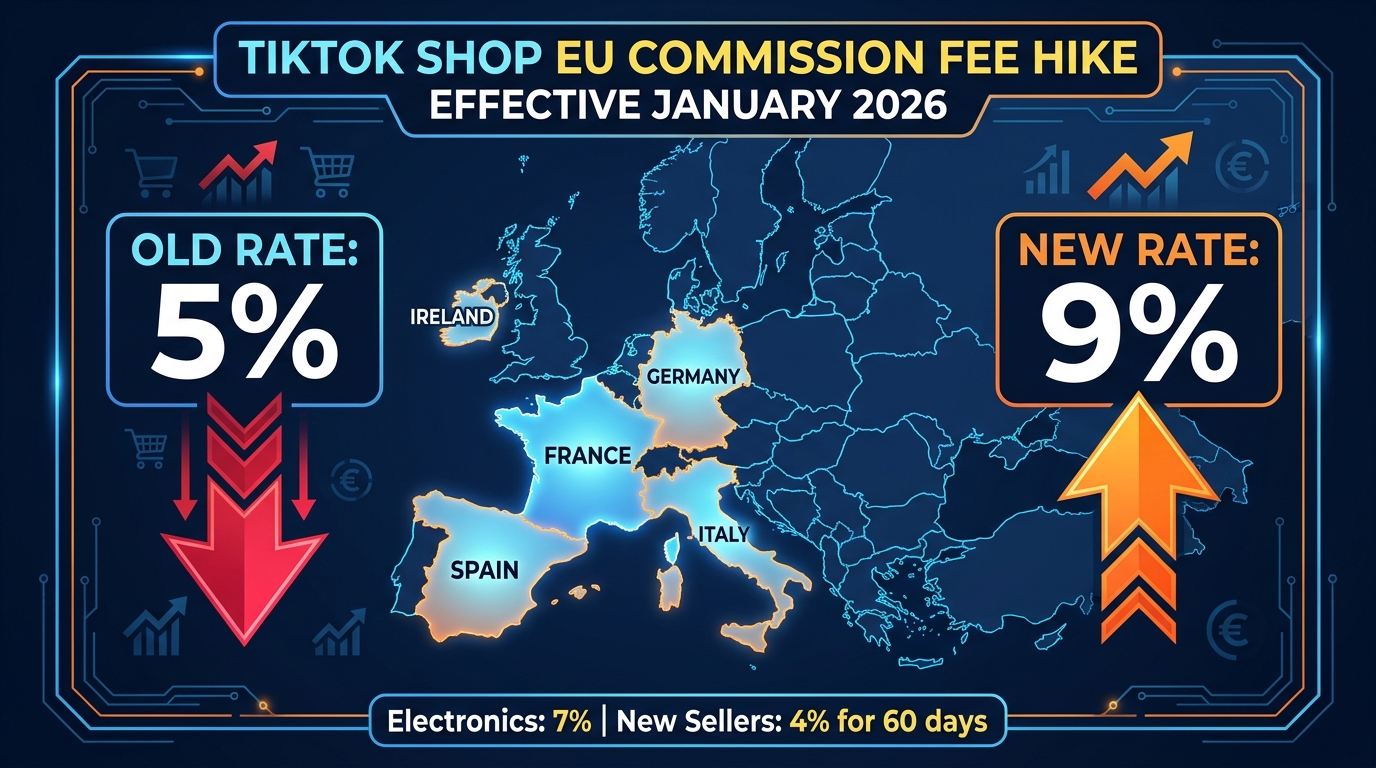
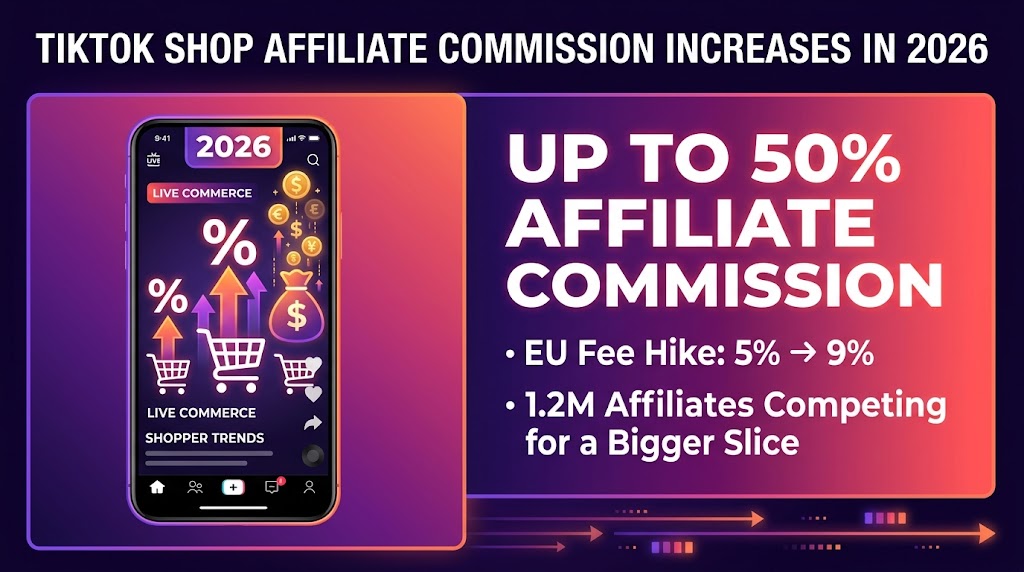
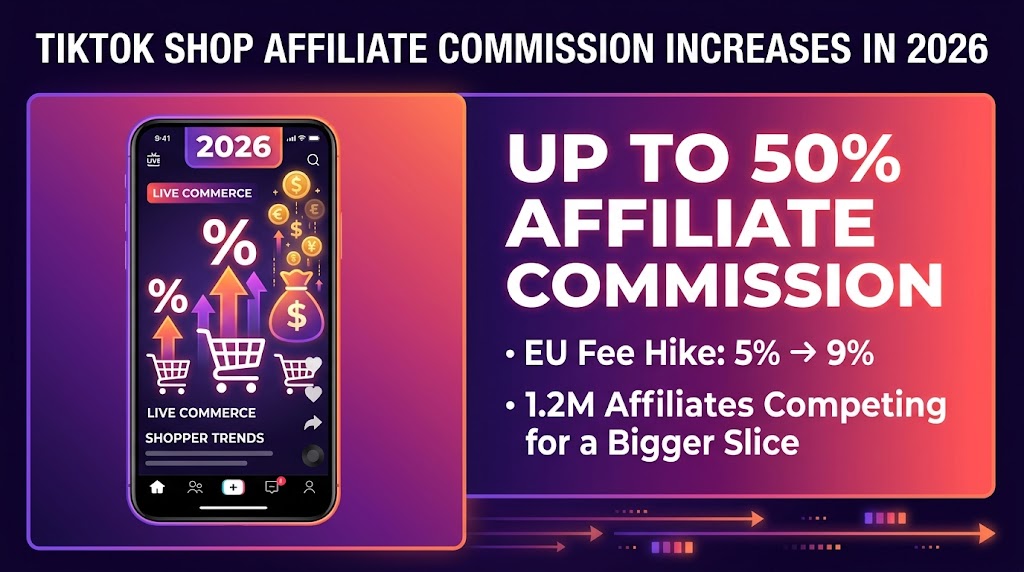
The numbers are straightforward: effective January 8, 2026, TikTok Shop raised its seller commission fee from 5% to 9% across five European markets — Germany, Spain, France, Italy, and Ireland. Electronics products received a slightly reduced rate of 7%. Brand-new sellers who list five or more unique products within their first 15 days in these markets qualify for a discounted 4% rate for the first 60 days, a soft landing designed to keep new inventory flowing onto the platform.
The 80% fee increase (4 percentage points on a 5% base) is not trivial. On a €100 fashion order, the seller now pays €8.55 at 9% rather than €4.75 at 5% — nearly double the platform cut on the same transaction. Stacked on top of affiliate commissions, ad spend, and fulfillment costs, this kind of increase compresses margins that were already thin.
Why This Wasn’t a Surprise to Anyone Watching
TikTok Shop ran the same playbook in the UK. British sellers enjoyed the same 5% introductory rate until mid-2024, when TikTok raised fees to 9% as UK GMV grew rapidly — reportedly up 50% year-over-year on Black Friday 2024 alone. The EU hike follows that same pattern almost precisely. TikTok establishes a market, subsidizes seller participation with below-market fees, achieves critical mass, then gradually normalizes pricing to a sustainable level.
This is not predatory pricing — it’s a classic network effects strategy. A platform with thin margins during growth can afford fee increases once buyers and sellers are sufficiently locked into its ecosystem. At $66 billion in global GMV for 2025, with projections of $112.2 billion for 2026, TikTok Shop has crossed the threshold where it no longer needs to subsidize participation to attract it.
What This Means Beyond Europe
The US has not seen a comparable platform fee hike as of mid-2026. US sellers currently face a baseline referral fee of approximately 6%, with additional payment processing fees. But the EU trajectory is a clear preview. The introductory-rate era in the US will end. Any seller or creator building a business model on TikTok Shop’s current US fee structure should factor in a future where that 6% becomes 8% or 9% — the same trajectory UK and EU markets followed.
For affiliates specifically, the seller-side fee increase has a second-order effect: when brands see their platform costs rise, the first lever many pull is affiliate commission rates. Sellers who were offering 15–18% to creators may start trimming back to 12–13% to offset higher platform fees. Understanding this dynamic — and how to position yourself so you’re not the first creator whose rate gets cut — is one of the more practical skills an affiliate can develop in 2026.
Nominal vs. Effective: The Commission Rate Most Affiliates Are Getting Wrong
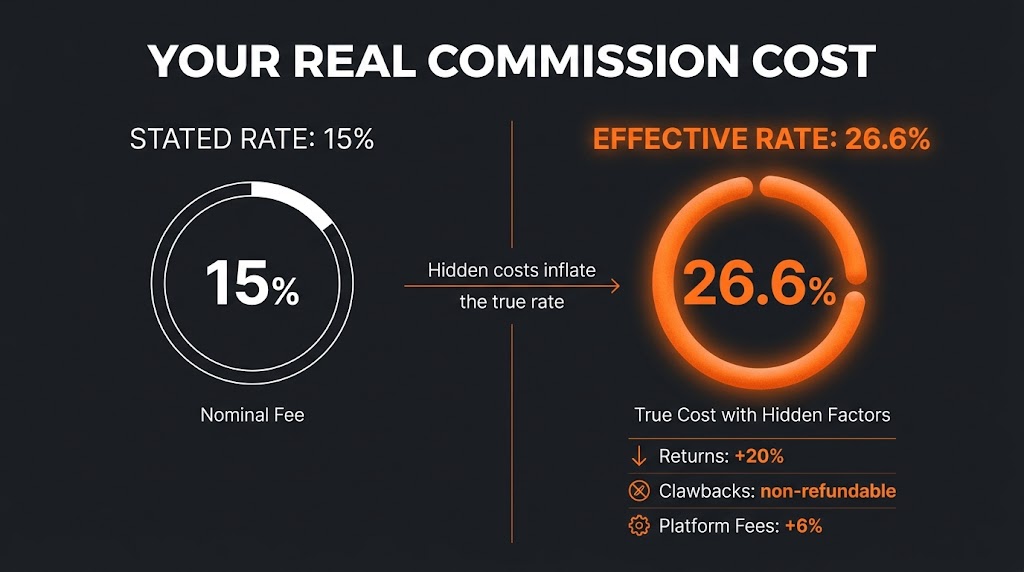
Here is a number that stops most brands in their tracks when they first see it: a stated affiliate commission of 15% can translate to an effective cost of 26.6% of net revenue once return rates and clawback mechanics are factored in. This is not a hypothetical — it’s a documented reality for categories with above-average return rates, particularly fashion and lifestyle products.
To understand why, you need to understand how TikTok Shop’s commission settlement actually works.
The 15-Day Clawback Window
When a customer makes a purchase through an affiliate’s content, the commission is not paid instantly. There is a settlement window tied to delivery confirmation. If a return occurs before the 15-day post-delivery threshold, the pending commission is canceled and returns to the seller’s balance. So far, so fair.
The problem begins after that 15-day window closes. Once a commission has been paid out to the creator, it becomes permanently non-recoverable — even if the customer returns the product the next day. The seller refunds the customer out of pocket, pays a refund administration fee (20% of the original referral fee, capped at $5 per SKU), and absorbs the already-paid affiliate commission as a sunk cost.
Running the Real Math
The formula for effective commission rate is straightforward: stated commission ÷ (1 − return rate). At a 10% return rate, a 15% commission becomes 16.7% effective. At a 20% return rate — entirely normal for fashion and apparel — it climbs to 18.75%. For categories where returns can hit 25–30%, the effective rate on a nominal 20% commission exceeds 26–29%.
And that’s before layering in platform referral fees (6% in the US, 9% in EU5 markets), fulfillment costs, and any ad spend used to amplify that affiliate content. When all costs are stacked, many mid-market brands selling through TikTok Shop affiliates find their true cost of sale running between 35% and 55% of revenue — before accounting for the product itself.
What Affiliates Should Take From This
For creators, this might seem like a brand problem. And in most cases, it is — it’s the seller who eats the unrecovered commission costs, not the affiliate. But there is an indirect implication: brands that don’t model their effective costs accurately tend to offer commissions that feel generous initially, then get slashed as reality catches up. The affiliate who promoted that brand for three months at 18% suddenly finds their rate dropped to 12% with 30 days’ notice.
Understanding effective commission rates gives creators two advantages. First, it lets you evaluate how sustainable a brand’s commission offer actually is — if they’re offering 25% in a high-return category, that’s almost certainly not sustainable long-term and worth treating with caution. Second, it gives you negotiation leverage: brands that don’t understand their true cost are easy to educate, and a creator who walks in with a clear model of how their content reduces returns (through better education, higher-intent audiences, lower impulse-buy rates) has a compelling case for a higher rate.
The Power Law That 80% of TikTok Shop Affiliates Don’t Want to Acknowledge
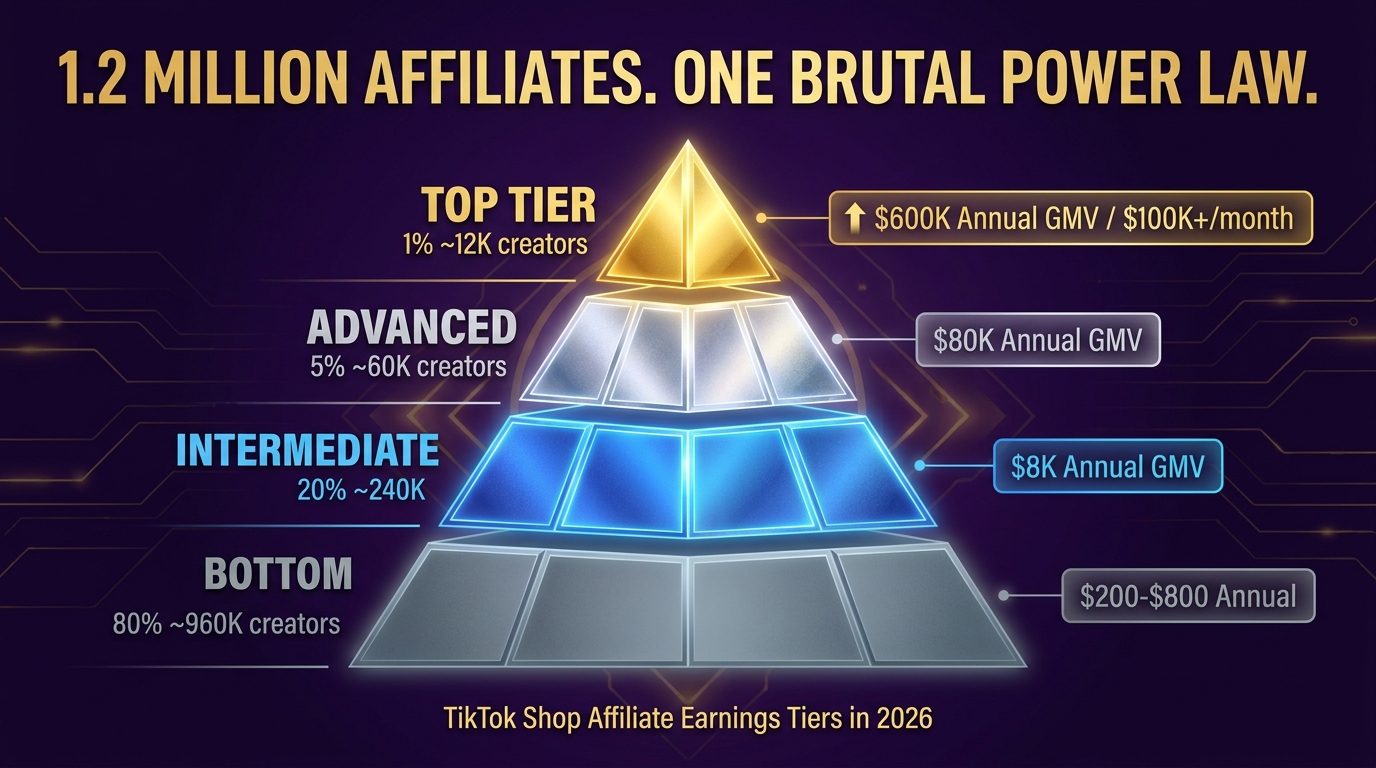
There are approximately 1.2 million creators participating in TikTok Shop’s affiliate program in 2026. That is a large number. But the earnings distribution across those 1.2 million creators is one of the starkest power laws in the creator economy today.
The top 1% — roughly 12,000 creators — average $600,000 in annual GMV per creator. At a 20% commission, that translates to approximately $120,000 in annual earnings from TikTok Shop affiliates alone. Some top performers report $100,000 in a single month. One documented case saw $216,000 in GMV generated in seven days through a combination of video content and live selling.
The Earnings Reality by Tier
The next 5% — approximately 60,000 creators — average $80,000 in annual GMV, yielding perhaps $12,000–$20,000 in commissions depending on their rates. The next 20% of creators average around $8,000 in annual GMV — enough for a side income, but not a full-time business by itself. And the bottom 80% — roughly 960,000 creators — generate between $200 and $800 in annual GMV. At a 13% commission, that’s $26 to $104 per year. Nearly nothing.
This distribution is not accidental or unfair — it mirrors the structure of virtually every creator platform and affiliate network. TikTok Shop is not unusual in having a power law earnings distribution. What is unusual is how compressed the timeline is. Unlike YouTube, where back-catalog content generates earnings for years, TikTok’s algorithmic feed deprioritizes older content rapidly. Your ability to consistently generate GMV depends on consistently generating new content that lands.
What Moves a Creator Up the Distribution
Research on top-performing affiliates consistently surfaces the same patterns. High-earning creators are not necessarily the most followed — they’re the most commercially specific. They choose products with deliberate criteria: high commission rates, moderate return rates, strong video demonstrability, and brand recognition that reduces buyer friction at checkout.
They also diversify content formats aggressively. Pure video posts are the entry point. But live selling — TikTok LIVE with product showcases — generates dramatically higher conversion rates because of real-time social proof, scarcity cues, and the ability to answer objections instantly. The creators earning $100,000+ per month almost universally combine both: pre-recorded content for algorithmic reach, live sessions for conversion depth.
The power law also means that the path from the bottom 80% to the top 20% is not gradual — it tends to involve a step-change event, usually a video that goes viral or a live session that catches a high-engagement wave. Knowing this, the strategic move for intermediate affiliates is to optimize for that step-change moment: be in position (with quality products selected, a clean storefront, a reliable posting cadence) so that when a piece of content breaks through, the conversion infrastructure is ready.
How the Tier System Works — And How to Actually Climb It
TikTok Shop’s affiliate commission structure is not a flat rate. It operates on a tiered model with two primary modes — Open Collaboration and Targeted Collaboration — plus informal VIP arrangements at the top end. Understanding how to navigate from the lowest to the highest tier is the single most direct path to materially higher earnings without needing to grow your follower count.
Open Collaboration: The Starting Point
Open Collaboration is the default mode for most affiliates. Sellers list their products in the affiliate marketplace with a set commission rate — typically between 10% and 15% — and any qualifying creator can pick up those products and begin promoting them. There is no direct relationship between creator and seller; it’s essentially a self-serve affiliate network within TikTok’s ecosystem.
The advantages are accessibility and volume. You can start promoting products the same day you join. The disadvantages are rates and competition. The 10–15% you earn in Open Collaboration is the floor, not the ceiling, and you’re competing with thousands of other creators for attention on the same products.
Targeted Collaboration: Where Rates Start Climbing
In Targeted Collaboration, sellers proactively invite specific creators to promote their products at negotiated rates. This is where commission rates break above the baseline — typically 15–25% for Tier 1 targeted arrangements, scaling to 30–40% for established performers with verified sales records. Sellers choose targeted creators based on niche alignment, engagement rates, historical GMV, and audience demographics.
The path into Targeted Collaboration is essentially a proof-of-concept exercise. You generate meaningful sales through Open Collaboration, establishing a track record of GMV that brands can verify inside TikTok’s creator analytics dashboard. Brands actively scan that data for emerging affiliates in their category — someone who drove $15,000 in GMV on a competitor’s product over the past 30 days is a very attractive invite target.
VIP and Custom Arrangements: The 25–50% Range
At the top of the tier system are custom arrangements that fall outside the standard Open/Targeted framework. These are negotiated directly between high-volume creators (typically those with documented six-figure monthly GMV) and brands. Commission rates in this range — 25% to 50% — are most common in health and wellness, premium beauty, and high-margin lifestyle products where the seller can absorb a larger affiliate cut while maintaining profitability.
For context, a 50% commission rate on a $40 skincare product means the creator earns $20 per sale. If a single live session drives 500 sales, that’s a $10,000 payout from one 90-minute broadcast. This is why the revenue potential at the top of TikTok Shop’s affiliate program genuinely cannot be compared to traditional affiliate platforms — the economics are structurally different.
The Platform Discontinued the “Shop Plan” — What That Means
TikTok Shop quietly discontinued its standalone “Shop Plan” in late 2025, consolidating affiliate access into the Open/Targeted framework. This simplification removed one pathway that some creators had been using as a workaround to access certain products. The practical implication is that the Open/Targeted tier distinction is now more defined, which makes the strategic path to Targeted Collaboration clearer but also more deliberate — you can no longer access preferred rates through structural workarounds.
Category Intelligence: Where the Commission Rates Actually Live
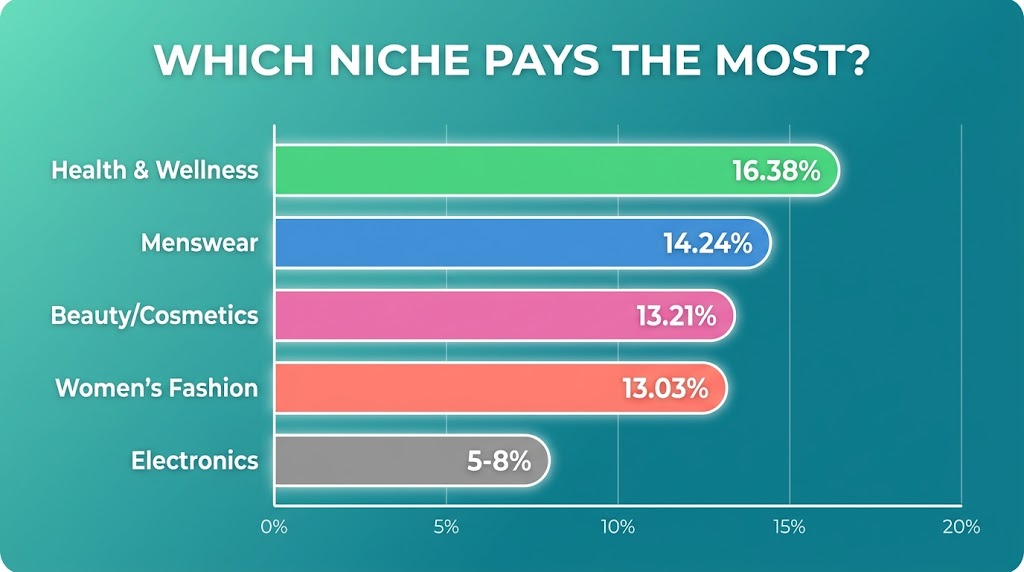
Not all commission rates are created equal across TikTok Shop’s product catalog. The category you operate in has a larger impact on your average commission than almost any other single factor. Here’s what the data shows for 2026, across the platform’s most active categories.
Health and Wellness: The Highest-Commission Category
Health and wellness products lead all TikTok Shop categories with an average commission rate of 16.38%, with a range spanning 12% to 25% depending on the seller and the creator tier. This is not coincidental. Health and wellness products — supplements, fitness equipment, personal care, sleep aids, weight management — tend to have higher margins, repeat purchase potential, and a strong emotional purchase driver that performs well in video content.
The combination of high commission rates and demonstrable products (before/after transformations, unboxing and testing, routine integration) makes health and wellness a priority category for serious affiliates. The 25% ceiling within this category for targeted arrangements represents some of the highest reliable rates on the platform outside of rare VIP negotiations.
Beauty and Cosmetics: High Volume, Reliable Rates
Beauty averages 13.21% in Open Collaboration, with targeted arrangements regularly reaching 20–25% for established beauty creators. The category is TikTok Shop’s largest by GMV share, accounting for approximately 22.5% of all platform transactions. That volume creates a different kind of opportunity: even at 13%, driving sales in a category where millions of buyers are already primed and searching creates a high-volume flywheel that compounds over time.
The challenge in beauty is competition. It is TikTok Shop’s most crowded affiliate niche, and standing out requires either a distinctive aesthetic angle, deep product expertise, or a genuinely engaged community that trusts your recommendations. Creators who treat beauty affiliate content as a transactional catalog run quickly into audience fatigue. Those who build genuine authority in a beauty sub-niche — sustainable ingredients, K-beauty, dermatologist-approved routines — consistently outperform the category average.
Fashion: Decent Rates, High Return Risk
Women’s fashion averages 13.03% and menswear lands at 14.24% — competitive rates by any standard. But fashion affiliates face the platform’s highest return rates, which inflates the effective cost for sellers and, as discussed earlier, can make those rates less sustainable. Fashion affiliates who build audiences with strong fit guidance, detailed sizing content, and real-body try-ons (rather than aspirational styling only) tend to see lower return rates among their referred buyers — a genuine value proposition to offer brands during commission negotiations.
Electronics: The Low-Commission Category You Should Approach Carefully
Electronics commissions sit at 5–8% in Open Collaboration, reflecting thin seller margins rather than platform policy. Electronics is also the category that received the preferential 7% rate in the EU commission hike (versus 9% for other categories), specifically because TikTok Shop recognizes the margin pressure. For affiliates considering electronics, the economics rarely pencil out at scale unless you’re promoting high-ticket items where a 6% commission on an $800 purchase still produces meaningful earnings per conversion.
TikTok Shop vs Amazon Associates vs YouTube Shopping: The Commission Showdown
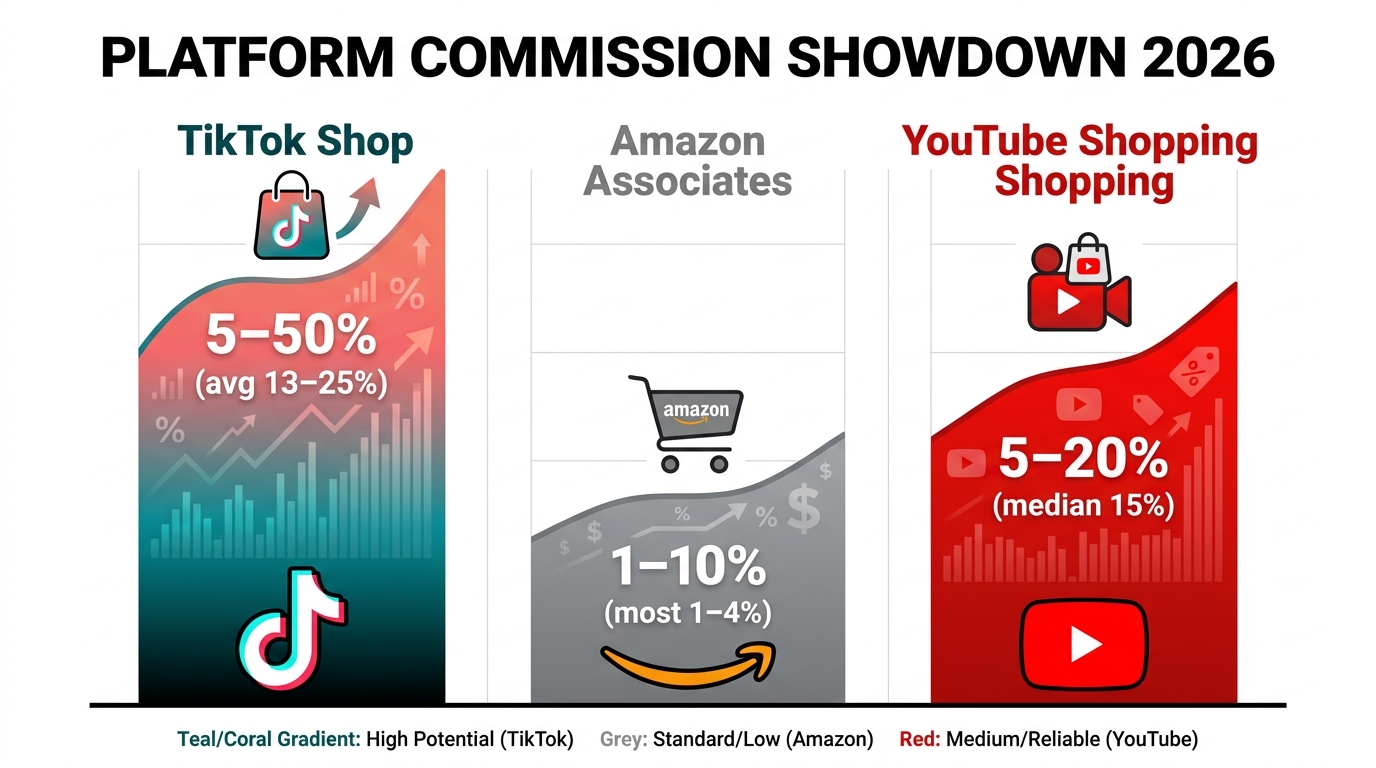
Most creators who monetize through content are not exclusively TikTok Shop affiliates. They operate across multiple platforms, and understanding how TikTok Shop’s commission structure compares to the alternatives is essential context for making smart allocation decisions about where to focus your content and promotional energy.
Amazon Associates: The Established Baseline
Amazon Associates remains the most widely used affiliate program in the world. Its commission rates are set by Amazon — not sellers — and they range from 1% to 10% depending on category. Most categories pay 1–4%, with luxury beauty topping out at 10%. The program’s advantages are reach (essentially any product sold on Amazon is promotable), trust (buyer conversion rates are high because of Prime delivery and return guarantees), and passive earning potential through links in long-form content like YouTube descriptions or blog posts.
The disadvantage is obvious: you will never earn 25% on a supplement you recommend through Amazon Associates. The fixed, category-wide rate structure eliminates negotiation entirely and caps earning potential at a level that makes it a supplemental income source rather than a primary one for most creators.
YouTube Shopping: The Middle Ground
YouTube Shopping’s Affiliate Hub, launched and expanded through 2025–2026, offers a median commission rate of approximately 15%, with a range of 5–20% depending on the brand and product. Entry requirements are lower than expected — 500 subscribers qualifies a channel to participate. The back-catalog monetization capability is YouTube Shopping’s strongest differentiator: an old review video can continue generating affiliate commissions years after publication as new viewers find it through search.
YouTube Shopping rates are negotiated through the Affiliate Hub rather than set by the platform, which creates some flexibility — but the structure is less dynamic than TikTok Shop’s targeted collaboration system, and the real-time conversion intensity of TikTok’s live selling feature has no equivalent on YouTube.
Where TikTok Shop Wins — and Where It Doesn’t
TikTok Shop’s rate ceiling of 50% (for VIP arrangements in high-margin categories) is not matched by any major affiliate platform at scale. The average Open Collaboration rate of 13% is already higher than all but the best Amazon Associates categories. And TikTok’s reported 4.7% average conversion rate on purchase-intent content outperforms Amazon’s 2–3% and significantly outperforms most social commerce alternatives.
Where TikTok Shop struggles in comparison is in passive income durability. Amazon Associates and YouTube Shopping both benefit from search-driven, long-tail discovery — a link or a video can earn commissions for years. TikTok’s feed algorithm rapidly ages out most content, meaning you’re in a constant content production cycle to maintain earnings momentum. For creators who can sustain that cadence, the rate differential makes TikTok Shop the most lucrative affiliate option available. For creators who prefer lower-maintenance, evergreen monetization, Amazon or YouTube Shopping may be better suited.
The Multi-Platform Reality
The most sophisticated creators in 2026 don’t choose between these platforms — they use TikTok as the discovery and conversion layer, YouTube as the trust-building and evergreen layer, and Amazon Associates as the catch-all fallback for any product that doesn’t have a better affiliate option. This layered approach extracts value from each platform’s strengths while reducing dependency on any single one.
The 30-Day Commission Protection Rule: A Creator’s Most Underused Safeguard
One of the more creator-friendly features in TikTok Shop’s current policy structure is the 30-day commission protection rule — and it’s genuinely underutilized because most affiliates don’t know it exists or don’t understand what it protects them from.
How It Works
If a seller lowers the affiliate commission rate on a product you’re actively promoting, TikTok Shop’s policy requires the seller to provide 30 days’ advance notice before the reduction takes effect. During those 30 days, you continue earning your original, higher rate on any sales you generate. Only after the notice period expires does the new, lower rate apply to your commissions.
The inverse is also true, and it benefits creators: if a seller increases their commission rate, that increase applies immediately to your next sale — no waiting period. The asymmetry is intentional and creator-protective.
Why This Matters in a Fee Hike Environment
In a context where platform-side fee increases are putting pressure on seller margins — as we’ve seen with the EU’s 5%-to-9% hike — the 30-day rule is more valuable than it might appear. Sellers who absorb a platform fee hike without adjusting their business model will eventually pass some of that cost to affiliates by cutting commission rates. The 30-day protection gives you a window to either accept the new rate, pivot to competing products, or use the upcoming reduction as leverage in a negotiation to maintain your current rate in exchange for guaranteed volume commitments.
If you’re a creator earning meaningfully from a particular product and you receive notice of a commission reduction, don’t treat it passively. Reach out to the seller directly, armed with your GMV data, your conversion rate, and a proposal. Many sellers would rather keep a proven affiliate at a slightly lower rate reduction than lose them entirely. The 30-day window creates the conditions for that conversation.
Understanding the Shop Ads Commission Carve-Out
There is one important exception to be aware of: when sellers run Shop Ads, the affiliate commissions on those ad-boosted sales are subject to different minimum rate calculations — specifically, a minimum rate equal to one-third of the standard affiliate commission for that product. This carve-out can reduce your effective earnings on ad-amplified traffic significantly. If a seller starts running Shop Ads on a product you’ve been promoting at 18%, the commissions on sales driven by those ads may fall as low as 6%. Understanding this mechanic prevents surprises when reviewing your commission dashboards.
What Brands Must Model Before Setting Affiliate Rates
From the brand side, setting an affiliate commission rate on TikTok Shop is not simply a marketing decision — it’s a financial modeling exercise that, when done wrong, either makes you uncompetitive in the creator marketplace or erodes your margins to unsustainable levels. The commission hike era makes this modeling more urgent.
The Full Cost Stack
A brand entering TikTok Shop’s affiliate program in 2026 in the US should model their cost stack before setting rates. Starting from 100% of revenue:
- Platform referral fee: ~6% (US), or up to 9% in EU5 markets
- Payment processing: 1–4% depending on method
- Fulfillment and shipping: Variable, but typically 8–15% for standard products
- Returns and refund administration: Category-dependent, but model at 10–20%
- Affiliate commission: Your decision — typically 10–20% for Open Collaboration
- Content amplification and Shop Ads: Optional, but typically 5–10% of revenue for brands running ad support
Before accounting for COGS, a brand running a mid-range commission of 15% with normal return rates can expect 45–55% of gross revenue consumed by platform, fulfillment, affiliate, and return costs. That leaves 45–55% of revenue to cover product cost and generate margin — which is workable for high-gross-margin products (beauty, supplements, accessories) but extremely tight for commodity goods.
Setting Rates Strategically, Not Arbitrarily
The brands that attract high-quality affiliates don’t always offer the highest rates — they offer the most stable and credible rates. A brand that offers 18% today and cuts to 12% in three months because they didn’t model their costs correctly will lose affiliate trust permanently. TikTok Shop’s creator community is relatively small at the top tier; reputation travels fast.
The best practice is to model your true cost stack (including effective commission rates with realistic return assumptions), set an affiliate rate you can sustain, then use targeted collaboration invitations to attract the creators who can drive the GMV volume that makes that rate economically efficient. Volume and velocity matter as much as margin percentage in a platform selling environment.
How the Fee Hike Changes the Calculation for EU Sellers
For sellers in Germany, Spain, France, Italy, and Ireland, the January 2026 fee hike requires an immediate remodel. Adding 4 percentage points to your platform cost means either finding 4 points of margin elsewhere (product pricing, affiliate rate trimming, operational efficiency) or accepting a leaner margin profile as the cost of maintaining TikTok Shop as a sales channel.
The new EU seller incentive — 4% for the first 60 days with 5+ unique products — applies only to brands new to those specific markets, not to established sellers. Existing EU sellers received no transitional relief, which is why the hike generated significant pushback in European e-commerce communities in January 2026.
The Affiliate Opportunity Inside the Commission Hike Era
It might seem counterintuitive that rising platform fees and seller cost pressures create opportunity for affiliates. But the economics actually do support a real opportunity — if you understand which side of the dynamic to be on.
When Seller Margins Compress, Performance Affiliates Become More Valuable
When a brand’s margin profile tightens due to platform fee increases, they become more selective about where their marketing spend goes. A creator who can demonstrate a verified conversion rate and documented GMV history is suddenly more valuable than generic ad spend. Brands that might previously have allocated budget evenly across ad campaigns and affiliate commissions now concentrate their affiliate budget on creators who demonstrably perform.
This is the key insight: in a constrained-margin environment, the top 20% of affiliates (by conversion performance) don’t become less attractive to brands — they become more attractive, because brands can no longer afford to fund the bottom 80% at the same rates. Commission budgets concentrate upward. If you’re in the top tier, this is a tailwind. If you’re in the bottom tier, this is a warning sign.
Diversifying Into High-Commission Categories Before Competition Concentrates
Health and wellness at 16.38% average commission is not a secret — it’s published data. But the category remains underexplored relative to its GMV potential compared to beauty, which has attracted far more creator attention. Affiliates who build niche authority in health and wellness sub-categories — longevity supplements, gut health, sleep optimization, functional fitness equipment — are entering a category where commission rates are higher, competition is comparatively lower, and the product demonstrability in video format is strong.
The window to build authority in these niches before competition normalizes rates is finite. As TikTok Shop continues scaling (the $112.2 billion GMV projection for 2026 suggests substantial continued growth), more creators will identify the commission differentials across categories and self-select into health and wellness, which will compress rates over time. The advantage goes to those who establish audience trust and seller relationships now.
Live Selling as the Real Commission Multiplier
The single most underutilized tool in a mid-tier affiliate’s arsenal in 2026 is TikTok LIVE. Most creators in the $5,000–$15,000 monthly GMV range are generating the majority of that through pre-recorded video posts. But the conversion rates in live selling — powered by real-time social proof, limited-time offers, and direct Q&A — consistently outperform recorded content by a factor of 3–5x on a per-viewer basis.
Live selling also opens a different class of brand relationship. Brands looking for live shopping collaborators tend to offer higher commission rates and more direct partnership structures than standard open affiliate arrangements. A creator who can consistently run well-produced, high-converting live sessions for a brand’s product line is essentially a hybrid between an affiliate and a commissioned salesperson — and the compensation reflects that.
The skill floor for effective live selling is non-trivial. It requires comfort with real-time speaking, product knowledge depth, the ability to handle objections on camera, and the technical setup (lighting, audio, stable connection) to maintain quality over 60–90 minute sessions. But the earnings potential at the top of this format — the $216,000-in-seven-days examples documented on the platform — justifies treating it as a genuine skill worth investing in.
How to Build a Sustainable Affiliate Business When the Rules Keep Changing
The commission hike era has a predictable structural pattern: platforms find a market, subsidize growth, achieve scale, then normalize fees. TikTok Shop is following this pattern with near-identical steps to the UK, and the UK with near-identical steps to Amazon Marketplace itself, which ran promotional fee structures to attract sellers in its early years before gradually raising its take rate to the 15–30% range it maintains today.
This pattern has a clear implication for any creator or brand trying to build durable income through TikTok Shop: your business model must be designed to survive fee normalization, not just to exploit the current rate environment.
Treat Commission Rates as Variables, Not Constants
Every affiliate income model should be stress-tested against a commission rate 20–30% lower than current. If your financial logic breaks at that reduction — if you can only make the economics work at today’s exact rates — you’re exposed. The creators who thrive through rate cycles are those who have built audience relationships that are valuable regardless of which products they’re promoting. When one product’s commission drops, they pivot to another. Their audience follows the content, not the product.
Build the Seller Relationship, Not Just the Product Link
The most durable affiliate income on TikTok Shop comes not from the open marketplace but from direct seller relationships. Creators who have invested in building genuine brand partnerships — where the seller knows their name, respects their conversion data, and communicates with them directly — are far less likely to see their rate cut without warning. Those relationships don’t develop overnight, but they are the real asset on this platform, far more durable than any single viral video.
Diversify Platform Exposure Intentionally
A creator whose entire affiliate income flows through TikTok Shop is one platform policy change away from a significant disruption. Amazon Associates and YouTube Shopping are not as lucrative, but they are resilient in different ways — Amazon through search permanence, YouTube through back-catalog longevity. A portfolio of affiliate income streams that includes TikTok Shop for earning intensity and Amazon/YouTube for durability is structurally more robust than any single-platform approach.
The ongoing geopolitical uncertainty around TikTok’s US operations — a factor that has not gone away entirely — makes this diversification even more prudent. The platform has survived prior legal challenges, but a creator with 100% TikTok dependency is taking a concentration risk that is easily reduced.
Conclusion: The Commission Era Rewards Sophistication, Not Just Hustle
TikTok Shop’s commission hikes — the EU’s January 2026 move from 5% to 9%, the effective rate inflation from clawback mechanics, the accelerating divergence between top-tier and bottom-tier affiliate earnings — are not bad news for creators who understand what they mean. They are a market maturation signal that rewards the same thing market maturations always reward: sophistication over simple execution.
The creator who treats TikTok Shop affiliate income as a pure volume exercise — post more, link more, earn more — will increasingly find that approach squeezed as brands become more selective with commission budgets. The creator who understands effective rates, negotiates targeted collaborations with documented GMV, operates in high-commission categories, and builds direct seller relationships will find that the same fee environment that pressures brands actually concentrates earning opportunity at the top of the creator distribution.
Key Takeaways for Affiliates
- Know your effective rate, not just your stated rate. With 20% returns, a 15% commission becomes 18.75% effective — understand who bears that cost and how it affects the sustainability of any brand’s offer.
- Health and wellness at 16.38% average commission is the highest-paying accessible category on the platform. It remains underexplored relative to beauty and deserves serious consideration.
- The 30-day protection rule is a negotiation window, not just a waiting period. Use commission rate cut notices as an opportunity to make a case for your value.
- Live selling is the highest-conversion-rate format available. If you’re not building live selling competency, you’re leaving the most lucrative format on the table.
- Diversify platform exposure before you need to. TikTok Shop is the most lucrative affiliate platform by rate — not by stability or longevity.
Key Takeaways for Brands
- Model effective commission rates, not stated rates. A 15% stated commission in a high-return category may cost you 20%+ in actual dollars once clawback losses are absorbed.
- EU sellers should remodel immediately. The 4-point fee increase in Germany, Spain, France, Italy, and Ireland is not a temporary measure — it’s the new permanent baseline.
- Concentrated affiliate relationships outperform broad open marketplace strategies. A smaller number of proven affiliates at carefully modeled rates generates better ROI than a large cohort of low-performers.
- Commission rate stability is a brand reputation signal. In a top-creator community where everyone knows everyone’s rates, arbitrary cuts are expensive to your future recruiting efforts.
The commission hike era is not a reason to leave TikTok Shop. At $112.2 billion in projected 2026 GMV, the platform is too large and too commercially powerful to abandon over fee adjustments that remain competitive against traditional retail and other social commerce channels. But it is a reason to go in with open eyes, accurate models, and a strategy that doesn’t depend on today’s rates being tomorrow’s rates.
The affiliates and brands that thrive on TikTok Shop in 2026 and beyond will not be those who found the biggest commission numbers on a rate sheet. They’ll be those who understood the full economics — and built for them.