

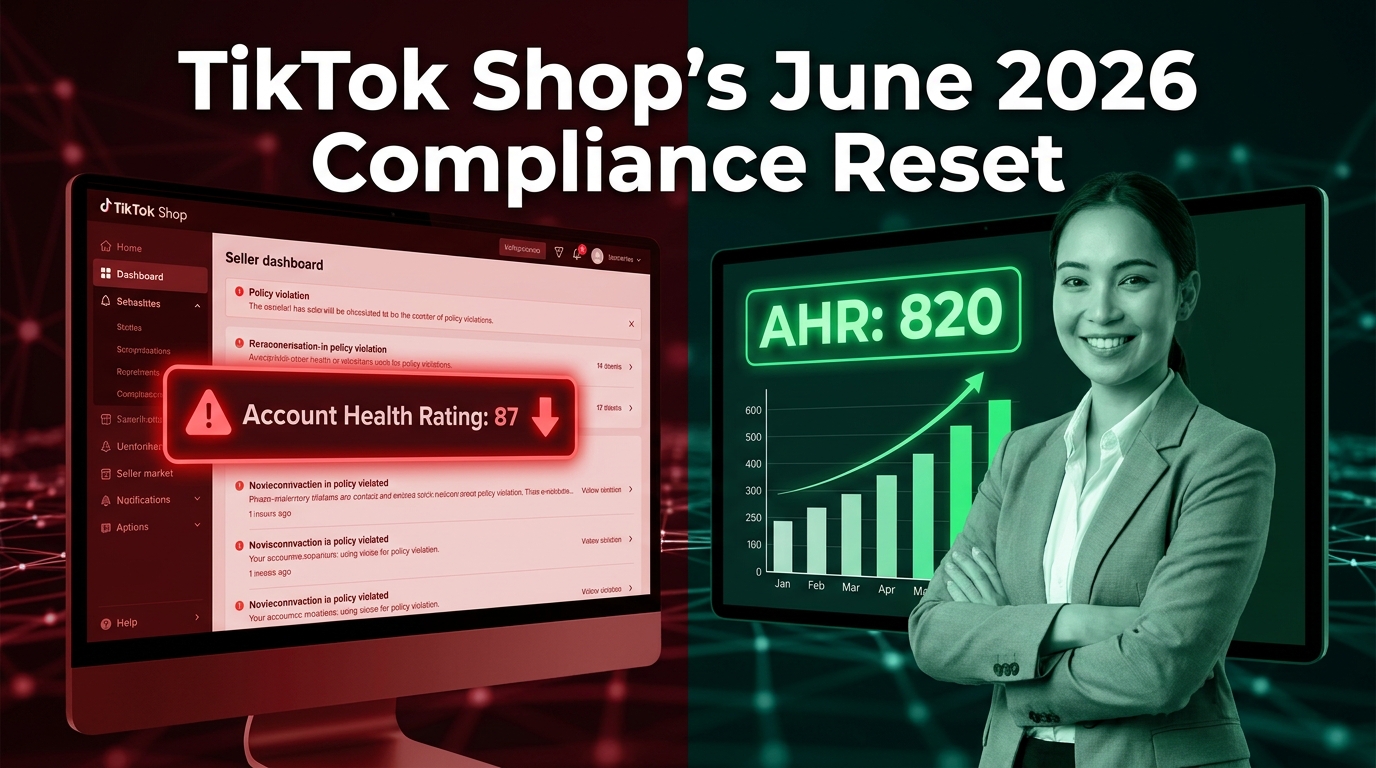

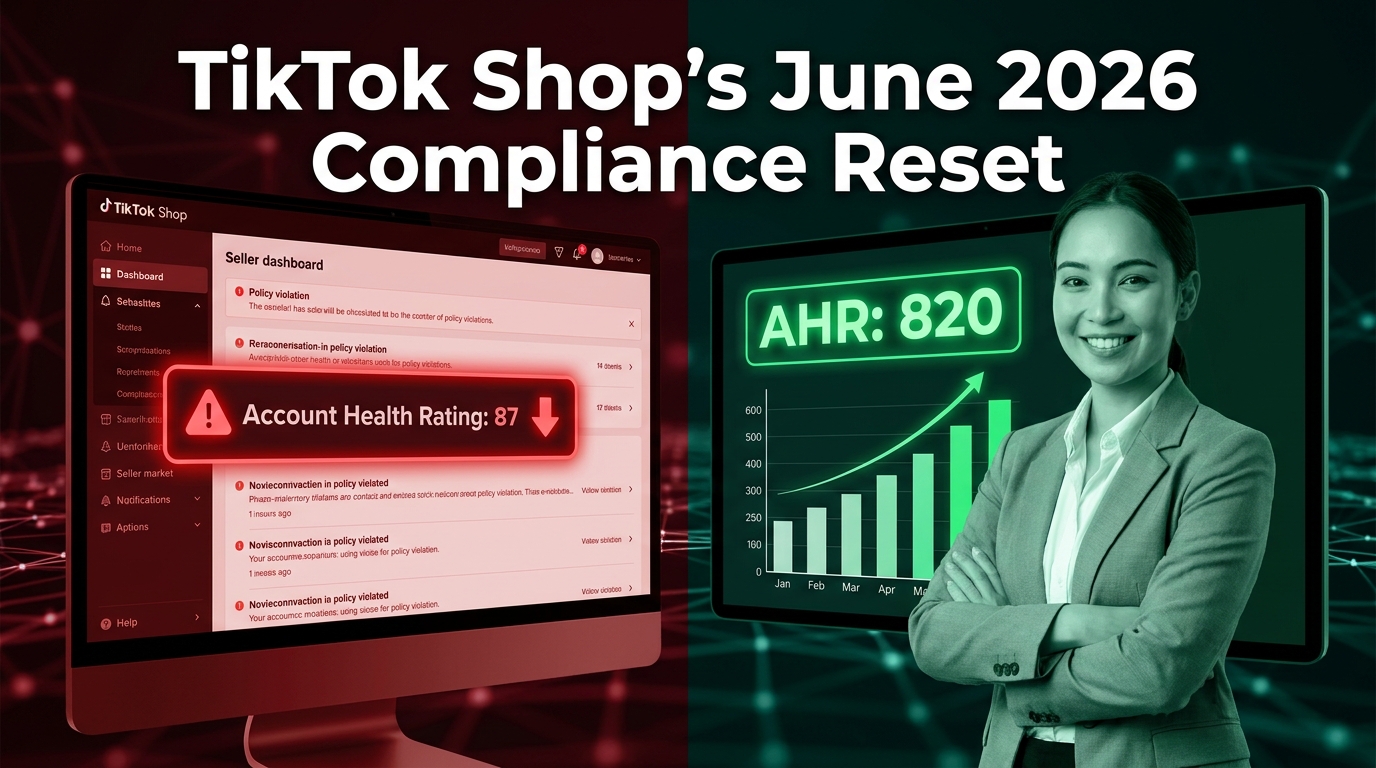
Every major commerce platform eventually reaches an inflection point where growth takes a back seat to governance. For TikTok Shop, that inflection point arrived in June 2026 — and unlike the gradual tightening most sellers had grown accustomed to, this one came with hard deadlines, automated penalties, and consequences that can freeze your entire operation.
The seller community’s initial reaction was to call it a crackdown. That framing isn’t wrong, but it’s incomplete. What happened in May and June 2026 was less a one-time enforcement blitz and more a structural reset of the rules by which TikTok Shop decides who gets to sell — and who gets visibility, payment, and continued access. Understanding the difference matters, because a crackdown eventually passes. A structural reset becomes the new baseline.
The platform now runs on a quantified compliance score called the Account Health Rating. Its new Product Listing Policy (effective June 2) and updated Content Policy (effective May 22) created new violation triggers that most sellers had never encountered. A US Live Shopping pause tied to an FTC compliance audit added regulatory pressure on top of platform-level enforcement. And a revised payment settlement framework quietly changed how long your money stays in TikTok’s custody.
Taken together, these changes represent the most significant operational shift TikTok Shop has made since launching in the US. This article breaks down exactly what changed, what it costs sellers in real terms, and — critically — which operators are positioned to gain market share precisely because the new rules are difficult to navigate.
Two Dates That Changed How TikTok Shop Operates
Most of the coverage around TikTok Shop’s mid-2026 changes has treated them as a single event. In practice, the changes rolled out across two distinct policy dates, each targeting a different layer of seller operations.
May 22, 2026: The Content Policy Revision
TikTok’s revised Content Policy, which applies across the platform and has specific implications for Shop sellers, took effect on May 22, 2026. The update tightened rules on several categories of promotional content: misleading claims, gambling-adjacent promotions, manipulative promotional behavior, and spam or fraud-linked tactics.
For Shop sellers, the most operationally significant change was in enforcement speed. The previous policy created a review queue that gave sellers some buffer time between a violation flagged and action taken. The May 22 revision shortened that window considerably for severe violations, enabling faster content removal, listing demotion, and in repeated cases, account-level restrictions without the warning period sellers had previously relied on.
The practical implication is that sellers can no longer treat the review queue as a grace period. A listing that triggers a health-claim flag under the new policy can be pulled before a seller is even aware a review was initiated. For high-volume sellers running dozens of active listings simultaneously, the risk of a single non-compliant product description cascading into broader account restrictions became substantially real after May 22.
June 2, 2026: The Product Listing Policy
The second major trigger date was June 2, 2026, when TikTok Shop introduced a comprehensive new Product Listing Policy. This document governs how products can be described, categorized, and presented — not just what can be sold. The distinction matters: sellers in fully permitted product categories can still violate the Listing Policy based purely on how they wrote their copy or structured their content.
The June 2 policy tightened requirements across four main areas. First, listing accuracy: product titles, main images, and descriptions must accurately represent what is being sold, with no exaggeration of function, benefit, or composition. Second, category placement: products must be listed in their correct taxonomy category, and deliberate miscategorization to avoid restricted-category scrutiny is now treated as a policy violation in its own right. Third, documentation compliance: sellers in regulated categories — health, baby, food, electronics, and devices — must have verifiable safety and compliance documentation attached to listings, not just available on request. Fourth, claim substantiation: any health, performance, or efficacy claim in a listing must be substantiated by evidence the seller can produce on demand.
Together, the May 22 and June 2 changes created a compliance surface that is significantly larger than what existed before. A seller could be fully compliant on paper with the old rules and immediately non-compliant under the new ones without changing a single product.
The Account Health Rating Decoded: What Your Score Actually Means
Replacing the old Violation Points system was always part of TikTok Shop’s mid-2026 plan. What caught many sellers off guard was the speed of the transition and the mechanical reality of how the new system actually works. The Account Health Rating began rolling out globally on June 15, 2026, with full coverage taking effect July 1.
The 0–1,000 Scale and Why It’s Misleading at First Glance
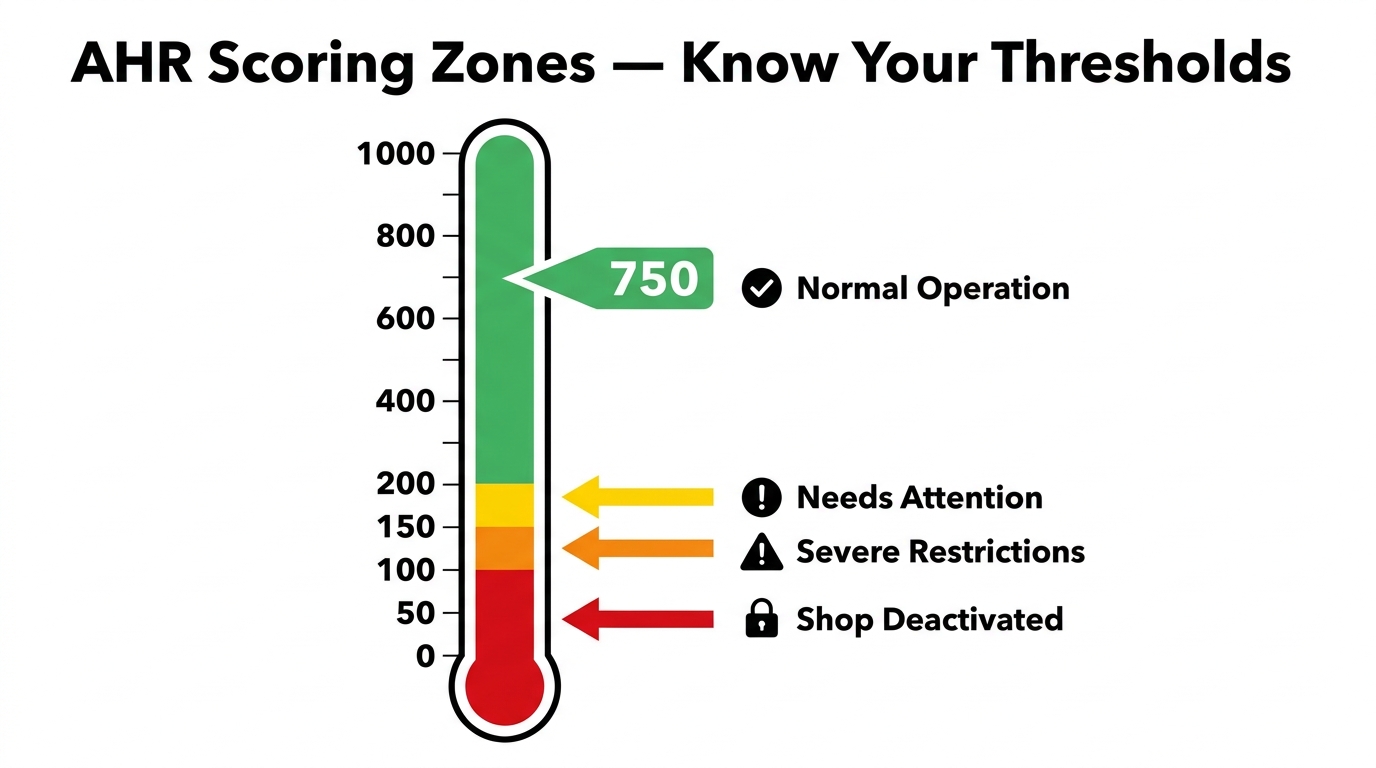
The AHR runs from 0 to 1,000 points. All sellers, new and established, start at 200 points. That starting point is not a coincidence: the system is deliberately designed so that a seller entering the platform is already operating within the “needs attention” zone relative to the full scale. You are not starting from a position of safety; you are starting from a position where a handful of violations can push you into restriction territory without a long history of bad behavior to explain the drop.
The four enforcement thresholds that matter are 150, 100, 50, and 0. These are not just numerical markers — each one triggers a distinct and escalating set of consequences.
- 200–1,000 points: Normal operation. Listings are active, ads run, payouts process on standard timelines. Sellers in this zone see no enforcement action from the AHR alone, though individual listing violations can still occur independently.
- 151–199 points: The warning zone. The seller dashboard shows an alert. No features are suspended yet, but TikTok begins increased monitoring of account activity and listings. Many sellers in this zone report their ads becoming less efficient, though TikTok has not officially confirmed reduced ad delivery as a direct AHR consequence.
- 100–150 points: Milestone one. Listing restrictions begin. Sellers may lose the ability to publish new listings or run promotional campaigns. The milestone review process activates, requiring the seller to complete a policy quiz before restrictions can be lifted.
- 50–99 points: Milestone two. Feature suspension deepens. Ad accounts may be paused, and live shopping permissions are typically restricted. Sellers at this level face payout holds that extend beyond the standard settlement period.
- 1–49 points: Critical zone. The account is operating under near-full suspension conditions. New orders may be blocked, existing inventory access restricted, and the seller must engage with TikTok’s compliance team to continue.
- 0 points: Shop deactivation. At zero, TikTok Shop deactivates the account. Funds in settlement may be subject to extended holds, and the path to reinstatement is not guaranteed.
The Rolling 180-Day Window
The AHR is calculated on a rolling 180-day window, which is both a feature and a risk. On the positive side, it means that violations don’t permanently define your account — old deductions age out over time. On the negative side, it means the system has memory. A seller who had a difficult Q4 2025 and is still working through fulfillment violations from that period will be carrying those deductions into their June 2026 AHR calculation. There is no clean-slate moment; the system inherits your history.
Critically, you cannot appeal the AHR score itself. You can only appeal the underlying violations that caused deductions. If an appeal succeeds and the violation is overturned, the associated points are restored. If it fails, those deductions remain in the calculation for the full 180 days from the date of the original violation.
What Causes Point Deductions
The AHR is a composite score that draws on multiple operational inputs. The main deduction drivers in the 2026 system include: late dispatch rate, invalid or inaccurate tracking numbers, seller-fault order cancellations, poor on-time delivery rate, product policy violations (including listing inaccuracies and prohibited content), and customer service failures such as unresolved disputes or excessive return-denial rates. Each category carries a different point weight, with product policy violations typically triggering higher deductions than operational metrics like dispatch timing.
Product Listing Policy: The Specific Rules Catching Sellers Off Guard
The June 2 Listing Policy is generating a disproportionate share of seller violations, largely because its scope goes well beyond what most sellers think of as “listing compliance.” This isn’t just about removing banned items. It’s about how every active listing is constructed.
The Accuracy Standard Has Changed
Under previous policy, accuracy was interpreted loosely: as long as a product broadly matched its description, listings were generally safe. The June 2 policy sets a tighter standard. Product titles must not contain claims that cannot be substantiated. Main images must accurately represent the product as sold — not an idealized version, not a generic category image. Bullet points and descriptions cannot make comparative performance claims without supporting evidence.
This is particularly challenging for sellers who rely on manufacturer-supplied listing content. Many wholesale and white-label sellers simply use the copy provided by their supplier. Under the new policy, that copy is the seller’s responsibility regardless of its origin. If the manufacturer wrote a description that includes unsubstantiated weight-loss benefits, and the seller published it unchanged, the seller bears the violation — not the manufacturer.
Category Compliance as a New Violation Type
One of the most significant additions in the June 2 policy is the explicit treatment of deliberate miscategorization as a standalone violation. Previously, a product listed in the wrong category was corrected editorially — moved to the right category or removed from search. Now, if TikTok determines that a product was deliberately miscategorized to avoid category-specific documentation requirements, it treats this as a deceptive practice and assigns AHR deductions accordingly.
This is a meaningful change for sellers in regulated categories. Health products listed under “general wellness” to avoid supplement documentation requirements, or baby items listed under “accessories” to sidestep safety certification requirements, now carry penalty risk rather than just a correction.
Documentation Requirements Are Now Enforceable at Listing Level
For products in regulated categories — health, food, baby and infant, electronics, and certain beauty subcategories — the June 2 policy makes documentation a listing-level requirement rather than an account-level one. This means TikTok can request compliance documentation for any individual listing, not just during account review. Listings in regulated categories that cannot produce documentation on demand can be taken down immediately rather than being given a grace period to compile records.
Sellers who operate in multiple regulated categories and have handled documentation reactively — compiling it when asked — face the most immediate exposure. The operational shift required is to treat documentation as a precondition of listing, not a response to enforcement.
The Health Claims Time Bomb: Why 31% of Violations Come From One Category
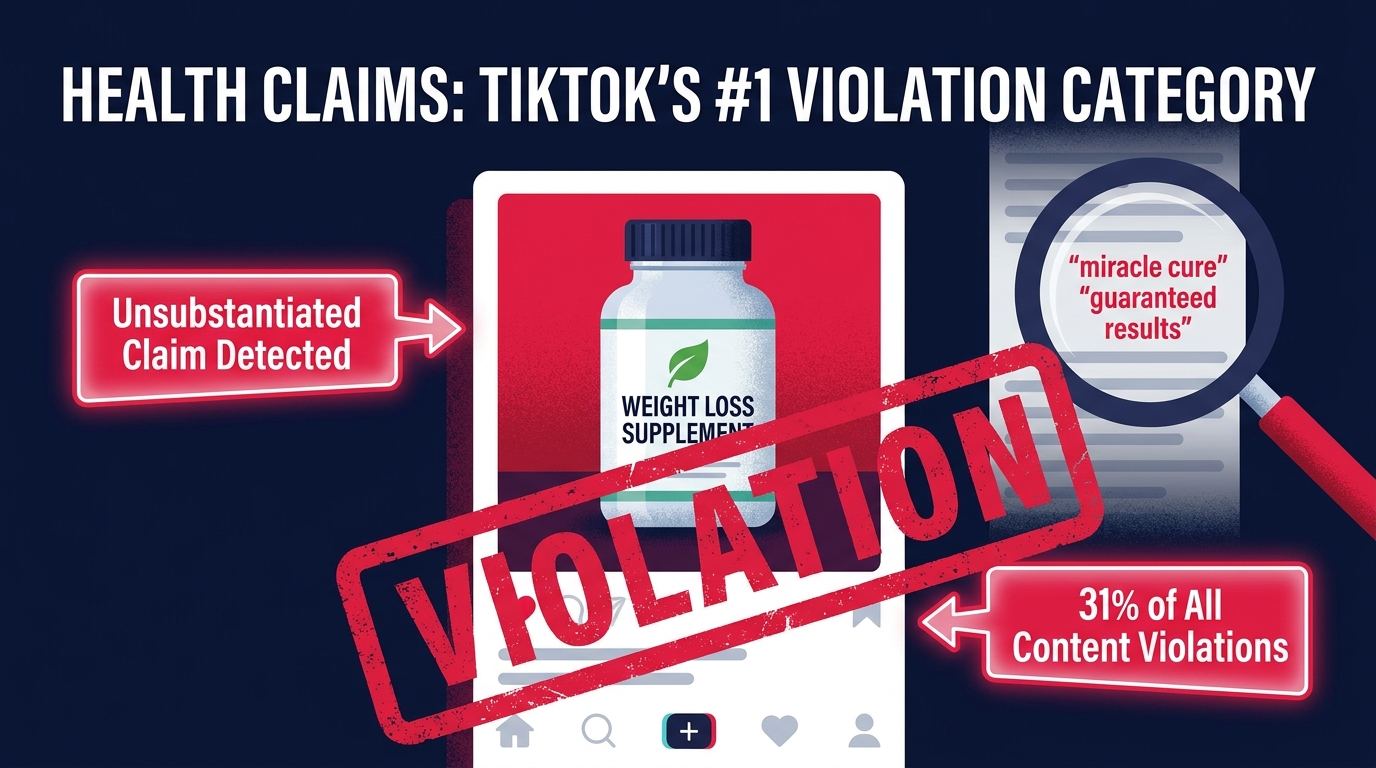
The single most revealing statistic in TikTok Shop’s Q1 2026 transparency data is this: unsubstantiated health claims account for approximately 31% of all active content violations on the platform. That’s not 31% of violations in the health and wellness category. That’s 31% of every content violation across every category on TikTok Shop globally.
The number reflects something structural rather than accidental. Health and wellness is TikTok Shop’s highest-GMV category in the US, driven by supplement brands, skincare products, functional foods, and weight-management products that are inherently difficult to market without making efficacy claims. The problem is that the claims that drive conversion — “reduces inflammation,” “supports weight loss,” “clinically proven to boost energy” — are exactly the ones that TikTok’s automated monitoring system flags for review.
What Counts as an Unsubstantiated Claim
TikTok’s definition of an unsubstantiated health claim under the May 22 Content Policy and June 2 Listing Policy is deliberately broad. A claim is unsubstantiated if it cannot be supported by: peer-reviewed scientific studies, third-party clinical testing conducted by accredited laboratories, government regulatory approvals (FDA, relevant national equivalents), or verified customer testimonials that accurately represent typical results rather than exceptional outcomes.
Several claim types that were previously tolerated in listing copy are now explicitly caught by the automated monitoring system. “Supports healthy [function]” statements without qualifying context are flagged. Before-and-after imagery that implies dramatic results is flagged. Testimonials that use specific numerical claims (“I lost 15 pounds in 30 days”) without statistical qualification are flagged. Even relative claims — “the most effective supplement for X” — trigger review if the seller cannot produce competitive testing data.
The Automated Detection Problem
The reason this is a structural problem rather than a compliance one is that TikTok’s automated system is designed for precision, not nuance. It reads text-based claims across listing titles, descriptions, bullet points, and video captions. It cross-references identified claims against a database of substantiation requirements. When a potential violation is detected, the listing is flagged and a review is initiated — often before the seller is aware.
This creates a specific trap for sellers who use AI-generated listing copy. Large-language model outputs tend to produce benefit-heavy, conversion-optimized descriptions that routinely make the kinds of efficacy claims the system flags. Sellers who have integrated AI copywriting into their listing workflow without a human compliance review step are generating violations at a higher rate than those using manually written, review-checked copy.
The Cascade Risk
What makes health claims violations particularly dangerous under the AHR system is their cascade potential. A single listing violation triggers a point deduction. If the seller has multiple listings with similar claim language — which is common when using supplier copy or templatized descriptions across a product line — the system can flag multiple listings in a single review sweep. Each flagged listing triggers its own deduction. A seller who discovers their health claims are problematic may find their AHR has already dropped across a large portion of their catalog by the time they receive their first notification.
The correct response is not to wait for flags. It is to audit every health-adjacent listing proactively, identify claim language that cannot be substantiated with documentation on hand, and rewrite before automated review reaches it.
Live Shopping in the Crosshairs: The US Pause and What It Means Beyond the Pause
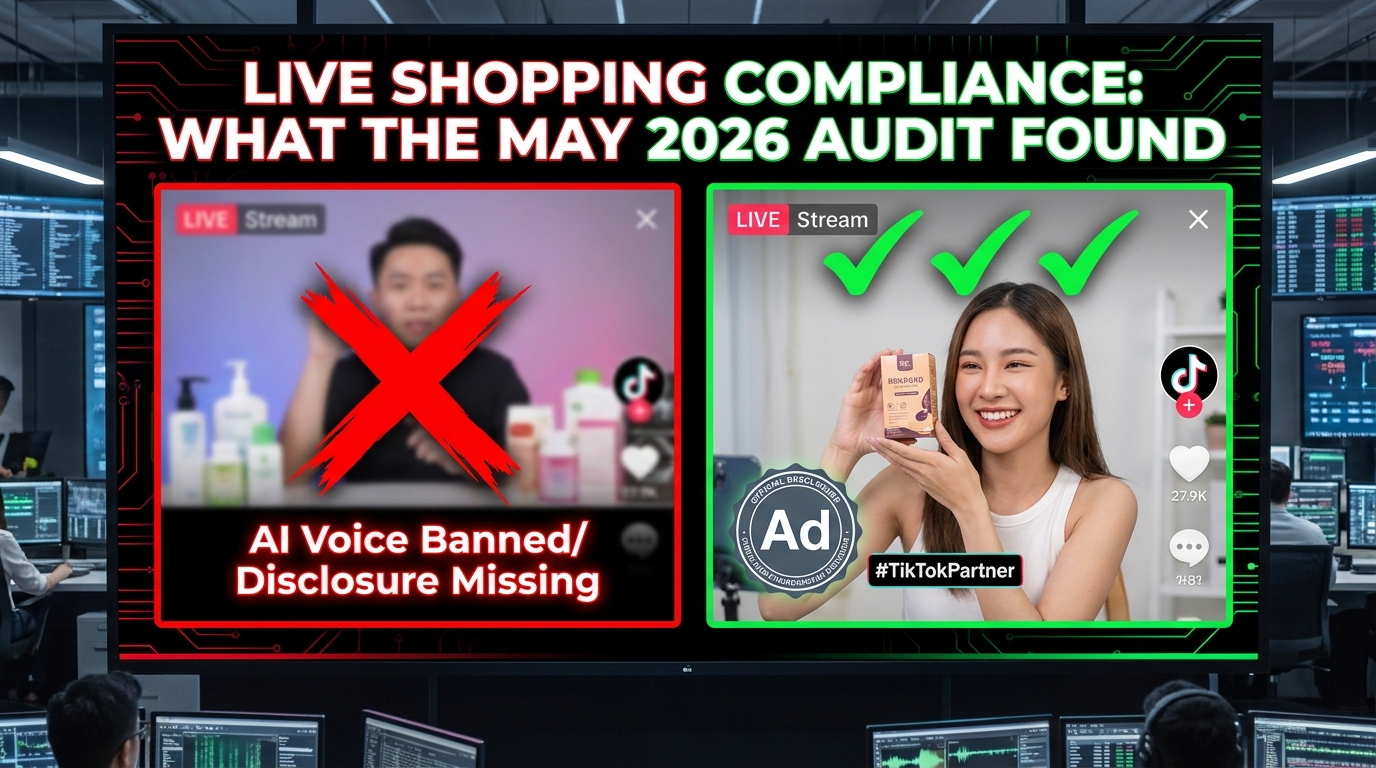
The most disruptive single event in TikTok Shop’s mid-2026 period for US sellers was not the June 2 Listing Policy. It was the announcement on May 9, 2026 of a 60-day compliance review pause for US TikTok Live Shopping, triggered by an FTC pilot enforcement audit. For sellers and creators who had built their primary revenue channel around live commerce, the impact was immediate and significant.
What the FTC Audit Actually Found
The compliance audit, which sampled approximately 1,200 US live streams conducted in early 2026, identified systematic problems across four areas. First, disclosure inadequacy: an estimated 67% of sampled streams had affiliate compensation disclosures that failed the conspicuousness standard — they were too small, appeared too briefly, or were placed in areas of the screen where they would not be noticed by a typical viewer. Second, health claim concentration: approximately 340 of the 1,200 sampled streams contained elevated health or beauty efficacy claims that could not be substantiated under FTC guidelines. Third, consumer complaint volume: state attorney general offices had referred approximately 4,800 consumer complaints related to TikTok Shop live purchases made between January and April 2026, predominantly in health and beauty categories. Fourth, refund and return failures: a subset of complaints involved sellers refusing returns or blocking refund requests in ways that violated TikTok Shop’s own buyer protection policies.
The 60-day pause was not a ban on live shopping. It was a structured compliance review during which TikTok audited active live shopping accounts and required creators and sellers to complete enhanced verification and disclosure training before resuming. The practical effect for sellers mid-audit was a forced halt in live commerce revenue with no guaranteed timeline for restoration.
The Ongoing Rule Changes for Live Shopping
Beyond the pause, TikTok Shop has implemented durable rule changes for live commerce that apply regardless of audit status.
The AI voice and pre-recorded content ban is now strictly enforced. Live shopping streams must feature human, real-time presenters. AI-generated voices, pre-recorded narration loops, and synthetic presenter formats are prohibited. This rule was partially in place before June 2026, but enforcement was inconsistent. Post-audit, monitoring of live streams for AI-generated content is automated and consequences are immediate: stream termination, followed by AHR deduction.
Disclosure requirements have been tightened to match FTC conspicuousness standards. The #Ad or paid partnership disclosure must appear as a persistent on-screen element throughout the livestream for affiliate-compensated content, not just during the opening segment or as a text caption below the stream.
Live commerce violations now feed directly into AHR scoring. Previously, live shopping penalties operated somewhat independently of the broader account health system. Under the June 2026 framework, violations incurred during livestreams count against the seller’s AHR score with the same weight as listing violations. A creator or seller who runs multiple livestreams with disclosure failures is accumulating AHR deductions across each session.
The Strategic Implication for Live Commerce Sellers
For sellers who used live shopping as their primary revenue channel, the 60-day pause and subsequent rule changes require a strategic recalibration. The live commerce format is not going away — TikTok Shop is too committed to it as a differentiating format — but the operational requirements for compliant live selling are now materially higher than they were in 2025.
Sellers who operated informal, spontaneous live streams with loosely managed disclosure practices need to treat live shopping like a produced broadcast: scripted disclosure sequences, claim-reviewed product talking points, real-time compliance checklists, and post-session review of recorded streams for violations before publishing as video-on-demand content.
Logistics Enforcement: The Dispatch and Tracking Rules That Are Quietly Killing AHR Scores
While the content and listing policy changes have received the most seller attention, logistics violations are a quieter and equally significant source of AHR damage. Fulfillment metrics are continuously monitored, they accumulate without requiring a review or appeal process, and they can drag an AHR score downward steadily without any single dramatic event.
The Late Dispatch Rate Threshold
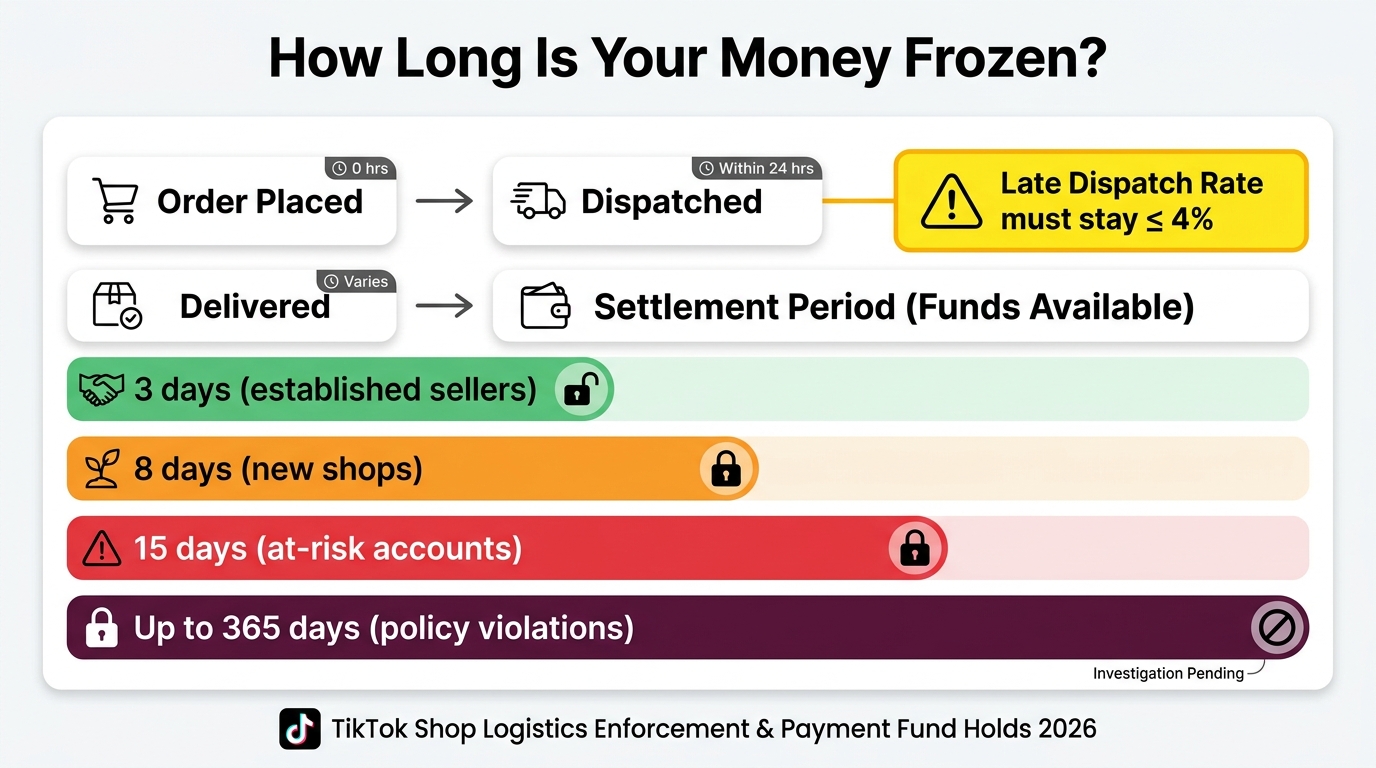
TikTok Shop’s current recommended Late Dispatch Rate (LDR) threshold is 4% or below. Late Dispatch is defined as any order where the carrier has not scanned the shipment within the required dispatch window after order confirmation — typically 24 to 48 hours depending on the seller’s selected shipping option and the buyer’s location.
A 4% LDR sounds manageable in theory. In practice, for sellers managing high-volume periods, fulfillment disruptions, or 3PL handoff delays, staying under 4% requires active management rather than passive monitoring. A single weekend backlog event — a carrier delay, a warehouse staffing issue, a peak-volume spike — can push LDR above threshold for that measurement period and trigger AHR deductions that compound over the 180-day rolling window.
The enforcement is also not symmetric. TikTok counts a shipment as late based on carrier scan data, not seller-submitted information. If a seller hands off a package within the window but the carrier doesn’t scan it until the following day, the dispatch is recorded as late in TikTok’s system. Sellers using TikTok’s own logistics services — Fulfilled by TikTok (FBT), TikTok Shipping, or Upgraded TikTok Shipping — are partially insulated from this problem because TikTok controls the scan data. Sellers using independent shipping labels carry the full risk of carrier scan timing.
Tracking Accuracy as an Active Enforcement Area
One of the explicit enforcement priorities in TikTok Shop’s mid-2026 logistics documentation is tracking abuse: cases where tracking numbers are entered but do not correspond to actual shipment activity. This is an issue that predates 2026 but has been given specific policy treatment in the June framework.
The patterns TikTok is monitoring for include: tracking numbers that are never scanned after upload, tracking numbers that show movement for one order but are reused across multiple shipments, and tracking numbers from carriers that do not service the buyer’s delivery region. Each of these patterns can trigger an automated review, and in cases where manipulation appears intentional, TikTok can escalate directly to account restriction rather than working through the standard AHR deduction process.
The Logistics Mandate Reversal and Its Implications
Earlier in 2026, TikTok had announced plans to mandate TikTok-managed logistics for all US sellers, effectively eliminating the seller-shipping option. That mandate was paused in February 2026, and as of the June policy updates, seller shipping remains technically available in the US. However, the enforcement asymmetry described above — where TikTok-managed logistics protects sellers from carrier-scan timing issues that penalize independent shippers — means the practical incentive to migrate toward TikTok’s logistics infrastructure has increased even without a formal mandate.
Sellers evaluating their logistics strategy should weigh the AHR risk differential carefully. The incremental cost of using TikTok’s logistics network may be lower than the cumulative AHR cost of periodic dispatch-rate violations under independent shipping.
Payment Settlement Changes: Understanding the Full Spectrum of Fund Hold Timelines
One of the least-discussed but most operationally significant changes in TikTok Shop’s June 2026 framework is the updated payment settlement structure. This is not a single change but a tiered system where your cash-flow timeline is directly tied to your compliance status.
The Standard Settlement Tiers
As of June 9, 2026, TikTok Shop updated its settlement framework to a four-tier structure based on seller status and risk classification. The settlement clock starts at carrier-confirmed delivery, not at order placement.
- 1 day: The fastest tier, available to established sellers with strong AHR scores and clean performance histories. Currently limited to sellers who have passed through TikTok Shop’s performance review process and maintain AHR scores well above the warning threshold.
- 3 days: Standard for established sellers who have passed the New Shop Adjustment Period — typically the first 90 days of operation — and maintain clean operational metrics.
- 8 days: The default for sellers who have not yet passed the New Shop Adjustment Period. New shops operate on 8-day settlement for all orders regardless of performance during the adjustment period.
- 15 days: Applied to accounts flagged for elevated risk, recent policy violations, or at-risk AHR scores. Sellers who have experienced recent listing removals, live shopping violations, or tracking flags typically find themselves on 15-day settlement without a formal notification.
When Settlement Becomes Extended: The 45–365 Day Range
The four-tier standard structure is only part of the picture. When accounts are flagged for serious violations, enter the milestone restriction zones of the AHR system, or are placed under security review, settlement holds can extend far beyond the standard tiers. The documented range in current policy and practice runs from 45 days to 365 days.
A 45-day hold is common for accounts that have crossed the 150-point AHR threshold and triggered milestone restrictions. A 90-day hold tends to accompany accounts under formal compliance review. Extended holds of 180+ days are documented in cases where TikTok is investigating potential fraud, systematic tracking abuse, or coordinated violation patterns. At the maximum end of the range, a full-year hold is applied in cases that escalate to legal or regulatory review.
For a seller with significant inventory on hand and regular operating expenses, even a 45-day hold can create serious cash-flow problems. The practical risk management implication is that sellers should not run TikTok Shop as their only revenue channel or plan cash flow based on TikTok’s settlement periods as a funding mechanism for ongoing operations.
Reserve Holds and Their Interaction with Settlement
Separate from the settlement period, TikTok Shop maintains reserve holds — a percentage of seller earnings held back as a financial buffer against returns, chargebacks, and dispute outcomes. These reserves are standard in commerce platforms, but they interact with the settlement timeline in a way that can extend the effective time-to-cash for sellers in risk zones. A seller on 15-day settlement with a 15% reserve hold is effectively operating on a longer cash cycle than either number alone would suggest.
The AHR Recovery Playbook: Climbing Back from a Damaged Score
For sellers who have already seen AHR deductions from the June transition period, the path to recovery is navigable but not fast. TikTok’s system is designed to restore trust through demonstrated behavior change, not through paperwork. Understanding the recovery mechanics is essential for sellers currently in warning or restriction zones.
What Actually Moves the Score
Four levers drive AHR recovery in the current system. None of them are immediate; all of them require sustained operational change.
Successful appeals are the fastest lever. If a violation is overturned on appeal — meaning TikTok’s review team determines that the original flag was incorrect or that the seller’s evidence of compliance is sufficient — the associated point deduction is reversed. This is the only lever that produces an immediate score improvement. The key to successful appeals is specificity: a successful appeal does not argue that the policy is too strict; it demonstrates, with documentation, that the specific violation flagged was incorrect. Screenshots of compliance documentation, supplier certifications, and original listing copy with timestamp data are all useful evidence.
Clean order volume gradually increases the score over time. High order volumes with low defect rates, on-time dispatch, and no customer service escalations contribute positive signals to the AHR calculation. The more orders a seller completes without violations, the faster old deductions are diluted in the rolling 180-day calculation. This means that high-volume sellers recover faster than low-volume ones simply by virtue of having more positive data points entering the system.
Policy quizzes are required at specific AHR milestones — typically at 150 and 100 points — and must be completed before milestone restrictions can be lifted. These are not complex assessments; they test seller knowledge of the specific policy areas where violations occurred. Sellers who fail the quiz can retake it, but cannot have milestone restrictions lifted until they pass. Completing these promptly matters because milestone restrictions typically include listing and advertising limitations that directly affect revenue.
Deduction aging is the passive lever. Violations that are more than 180 days old roll out of the calculation window naturally. This is not a strategy — it’s a floor below which recovery doesn’t fall — but it means that sellers who maintain clean operations for six months will eventually see their scores recover even without appeals, assuming no new violations occur.
The Timeline Sellers Are Actually Experiencing
Based on reported seller experiences and expert guidance from the Q2 2026 period, the realistic recovery timeline for a seller who drops into the 100–150 AHR range and takes immediate corrective action is 60 to 90 days to return to a score above 200. For sellers who dropped below 100 and triggered deeper milestone restrictions, the recovery timeline with active appeals and volume-based remediation is typically 90 to 120 days. Recovery from near-zero or deactivation territory, if it is achievable at all, requires direct engagement with TikTok’s compliance team and does not have a reliable published timeline.
Common Recovery Mistakes
Several recovery mistakes consistently extend timelines unnecessarily. The first is continuing to list new products in the same categories where violations occurred before resolving the underlying compliance gap. New violations accelerate while old ones are still aging, making net recovery slower. The second is submitting appeals without documentation — TikTok’s review team denies appeals that don’t include concrete evidence at a high rate, and failed appeals don’t restore points but do consume the appeal window. The third is reducing order volume to avoid risk during the recovery period: since clean volume is a recovery lever, pulling back on sales also slows AHR recovery.
Who Wins When the Rules Get Harder: The Compliance Dividend
The June 2026 compliance reset is disruptive, costly, and — for operators who built their TikTok Shop businesses on gray-area practices — potentially fatal to their current model. But the same set of changes that are causing disruption for non-compliant sellers is creating measurable opportunity for sellers who have built clean, documented, compliance-ready operations.
The Market Share Dynamics of a Compliance Shakeout
TikTok Shop’s US GMV was tracking at approximately $30 billion annualized heading into mid-2026, representing around 140% year-over-year growth. That demand does not disappear when enforcement tightens — it shifts. Consumers who were purchasing in health, beauty, and electronics categories from sellers who are now facing restrictions or deactivations will continue to purchase. The question is which sellers they find when they search.
Within TikTok Shop’s search and discovery algorithm, AHR score is an increasingly direct input into listing visibility. Sellers with healthy AHR scores maintain full listing visibility and ad delivery capacity. Sellers in restriction zones see their listings demoted in search results and their ad campaigns throttled. When large sellers in a category face enforcement action, their category positions open up. Compliant sellers who maintain full visibility capture that displaced demand.
This is the compliance dividend: the market-share gain that accrues to well-run operations when the platform forces out lower-quality competitors. It is not a guaranteed outcome, and it requires being positioned to capture demand rather than simply avoiding violations. But in categories where health claims violations are driving significant enforcement action — which based on the 31% violation share means virtually every high-GMV category on the platform — the opportunity is real and actively playing out.
What Compliance-First Operations Actually Look Like
The sellers benefiting most from the June 2026 changes share a common operational profile. They treat compliance as a product requirement rather than a legal hurdle — documentation is compiled and verified before a listing goes live, not assembled in response to a violation notice. Their live shopping content is scripted, reviewed, and archived. Their logistics infrastructure prioritizes on-time scan rates over cost-per-shipment. And their AHR monitoring is a daily operational metric, not a quarterly review.
Several brand-led operations have specifically reported using the June crackdown period to expand their affiliate network, knowing that creator capacity was becoming available as lower-quality sellers reduced their live shopping activity during the audit period. Compliant brands with pre-approved claim libraries and documented product substantiation packages became attractive partners for creators who wanted to maintain their commerce permissions — creating a talent market shift that directly benefited brands who had invested in compliance infrastructure.
The Category Opportunity in Health and Wellness
Given that health and wellness is both TikTok Shop’s highest-GMV category and the source of the most concentrated violation activity, it is also the category where the compliance dividend is likely to be largest. Sellers with substantiated claims, third-party testing documentation, and clean listing copy are now operating with significantly less competition for top-of-search visibility in a category that is actively purging non-compliant listings.
The barrier to capturing this opportunity is not regulatory creativity. It is documentation and operational discipline. Brands that can produce a substantiation package for every efficacy claim in their listings — peer-reviewed studies, lab testing results, regulatory clearances — and integrate that documentation into their listing workflow are positioned to gain meaningful share in the category’s most competitive segments.
Operating in Post-Crackdown TikTok Shop: A Practical Framework
The June 2026 compliance reset changes what it takes to run a sustainable TikTok Shop operation. The platform has moved from a growth-first environment, where speed and volume mattered more than precision, to a compliance-first one, where the quality of your operational processes determines whether you stay visible, stay paid, and stay live.
The Six Operational Priorities for 2026 and Beyond
1. Treat AHR monitoring as a daily operational metric. AHR score is now as operationally critical as ROAS or inventory turn. It should be reviewed daily, with threshold alerts set at 300 points — giving a substantial buffer before approaching the 200 warning zone — so there is time to investigate and correct before consequences activate.
2. Build a proactive claim substantiation library. Every product category requires a substantiation package: what you can claim, what evidence supports each claim, and where that evidence is stored. This library should be built before listings go live, not after a violation flag. For sellers using AI-generated copy, add a mandatory human compliance review step before any draft is published.
3. Audit all existing listings against the June 2 Listing Policy. Do not wait for enforcement to identify problems. Work through the catalog systematically: title accuracy, category accuracy, documentation status, and claim language. Prioritize health-adjacent listings and any listings in regulated categories where documentation requirements are now enforceable at listing level.
4. Structure live shopping as a produced, compliance-reviewed format. Treat every livestream as a broadcast that could be reviewed by an FTC auditor. Maintain a compliant disclosure sequence, use pre-approved product talking points, avoid extemporaneous health or efficacy claims, and archive every stream. Conduct a post-session review of recorded streams before publishing as VOD content.
5. Evaluate logistics infrastructure against AHR risk. Calculate your historical Late Dispatch Rate and compare it against the 4% threshold. If you are consistently close to or above threshold, evaluate whether migrating to TikTok’s managed logistics network — Fulfilled by TikTok or TikTok Shipping — reduces your AHR risk enough to justify the cost differential. The carrier-scan timing protection may be worth more than the price difference.
6. Diversify revenue to reduce settlement period exposure. TikTok Shop’s payment settlement framework ties your cash flow to your compliance status. A fund hold triggered by an enforcement action can create operational cash-flow problems if TikTok Shop is your primary revenue source. Maintaining active selling channels on other platforms — Amazon, Shopify, or other social commerce platforms — provides cash-flow resilience against settlement period changes and ensures that an enforcement event on TikTok does not threaten your entire operation.
The Longer View
What TikTok Shop is building through its June 2026 compliance framework is a platform that functions more like Amazon’s seller ecosystem than the loose, growth-first environment of its early years. Amazon’s compliance requirements — account health metrics, listing accuracy standards, documentation obligations, logistics performance thresholds — are now mirrored almost precisely in TikTok Shop’s post-June framework.
This comparison is instructive for sellers who have operated on Amazon. The sellers who have consistently thrived on Amazon are not the ones who got ahead of enforcement by finding policy gaps; they are the ones who built operations that could sustain arbitrary rule-tightening without structural disruption. The same pattern is now playing out on TikTok Shop, three to four years into the platform’s serious commerce phase.
TikTok Shop’s $30 billion US GMV trajectory is not being derailed by compliance enforcement. It is being filtered: a platform-wide selection mechanism that concentrates future GMV growth among sellers who can meet the compliance bar. The question for every TikTok Shop seller in 2026 is not whether to comply — that choice has already been made for you. The question is whether your operation is positioned to capture the opportunity that opens up when your competitors can’t.
Key Takeaways
- Two policy dates, not one: The May 22 Content Policy and June 2 Product Listing Policy are distinct documents with different scopes. Review both against your specific catalog and content formats.
- The AHR starting point is 200: New sellers are already within reach of the first restriction threshold before their first violation. Treat the AHR as something that needs active maintenance from day one, not a fire to fight later.
- Health claims are the highest-risk violation area: With 31% of all content violations in this category, no seller in a health-adjacent niche can afford to have unreviewed claim language in live listings or video content.
- Live shopping now requires broadcast-grade compliance: The FTC audit findings are now encoded in TikTok’s enforcement framework. Disclosure, claim review, and content archiving are no longer optional.
- Logistics violations accumulate silently: Late dispatch rate and invalid tracking are AHR inputs that don’t require a review process — they deduct automatically. Monitor fulfillment metrics against AHR thresholds, not just against operational targets.
- Settlement holds are tiered to compliance status: Your cash-flow planning should account for the possibility of extended settlement holds if your AHR drops into restriction territory. The 15-day standard tier can become 45–90+ days without a dramatic escalation event.
- Recovery is a 60–120 day process: There is no quick reset. Build a disciplined appeal strategy, maintain clean order volume throughout, and complete milestone quizzes promptly to unlock restrictions as quickly as the system allows.
- The compliance shakeout creates real market share opportunity: Sellers who maintain clean operations through the June enforcement period are positioned to capture visibility and affiliate relationships that displaced competitors leave behind.