





On June 12, 2026, TikTok Shop quietly deployed an internal ranking update called Coral. There was no blog post, no seller announcement, no webinar from TikTok’s commerce team. Most sellers didn’t know anything had changed until their affiliate-driven GMV started sliding and their brand-owned videos started performing differently. By the time the data made it into dashboards, the rules of the game had fundamentally shifted.
Coral is not a minor tweak to an existing system. It is a structural re-architecture of how TikTok Shop decides which products get seen, by whom, and when. The update moved the platform’s ranking logic away from the entertainment-first signals that governed the For You Page — views, watch time, likes, shares — and toward a commerce-first scoring stack built on product clicks, add-to-cart events, completed purchases, and operational performance metrics.
The consequences have been significant. Brands running heavy affiliate programs reported double-digit GMV declines within weeks of the rollout. Sellers who had been posting native, high-conversion video content from their own accounts saw organic reach increase noticeably. The algorithm wasn’t rewarding content that entertained — it was rewarding content that sold.
This post breaks down how Coral actually works at an architectural level: the ranking pipeline it runs, the signals it weights, the Account Health scoring system that gates your reach, and the strategic changes sellers need to make to compete under its logic. Whether you’re a DTC brand, a marketplace reseller, or a category manager overseeing a portfolio of SKUs, understanding Coral is now a prerequisite for operating on TikTok Shop in 2026.
What Coral Actually Is — and What It Isn’t
Before getting into mechanics, it’s worth being precise about scope. Coral is not a replacement for TikTok’s core For You Page algorithm. The main feed still runs on its standard large-scale recommendation engine — the same one that surfaces dance trends, cooking videos, and comedy content. Coral is specifically an update to the commerce layer of TikTok’s recommendation infrastructure: the system that decides which products appear in the Shop tab, which listings surface in search results, which videos get attached to shoppable product cards, and how organic video distribution is weighted when a video is linked to a product.
This distinction matters because it changes what you optimize for. Sellers who have treated TikTok as a pure content platform — chasing views and follower counts as proxies for sales — have been working against Coral since day one.
The Core Philosophy Change
Before Coral, TikTok Shop’s discovery engine was largely inherited from the For You Page’s entertainment model, with commerce signals layered on top. Viral content could pull enormous product reach even if the underlying listing had mediocre conversion rates. An affiliate creator with 2 million followers could flood a product with traffic regardless of how well that product was actually managed.
Coral inverts this logic. Under the new system, commerce performance metrics are the primary ranking inputs. Content and creator reach become amplifiers of an underlying commercial signal — not the signal itself. A product that converts at 4% with strong add-to-cart rates and a clean fulfillment record will outrank a product that goes viral but converts at 0.8% and has a delayed shipping complaint rate.
When Coral Launched and What Triggered It
The June 12, 2026 rollout date aligns with a broader strategic pivot TikTok has been executing throughout 2026: repositioning TikTok Shop as a genuine marketplace competitor to Amazon and Shopify rather than an entertainment-to-commerce bridge. The platform had seen enough evidence that affiliate-driven virality was creating an unreliable GMV base — one where sales spiked around creator posts and then fell off entirely — and that brands relying on this model were not building durable businesses on the platform.
Coral was TikTok’s answer to that structural problem. By rewiring discovery around commerce signals and seller operational health, the algorithm now selects for sellers who treat TikTok Shop as a long-term business channel, not a short-term viral arbitrage play.
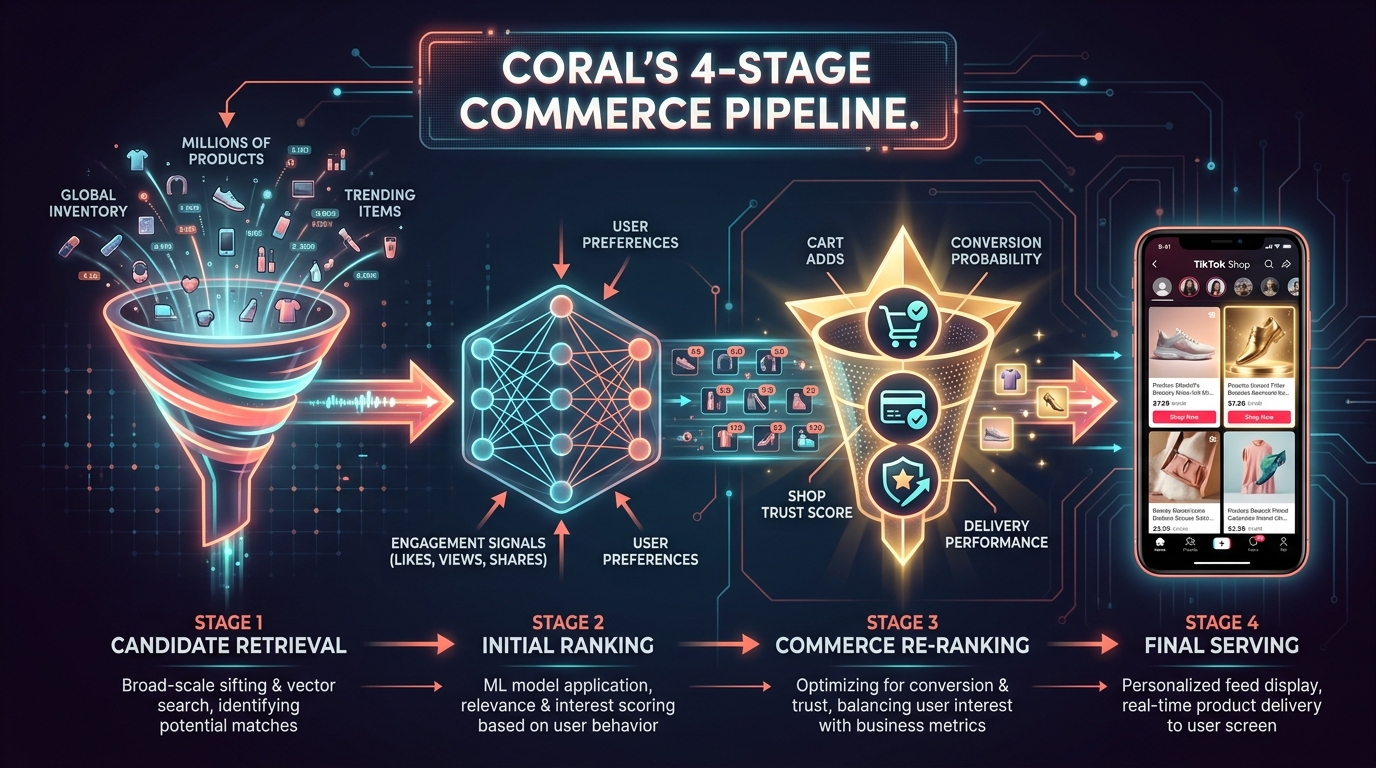
The Architecture Under the Hood: Coral’s Multi-Stage Ranking Pipeline
TikTok’s recommendation infrastructure — including the Shop layer — runs on a well-established large-scale machine learning pattern: a multi-stage pipeline that starts by pulling millions of candidate items and progressively narrows them down using increasingly expensive ranking models. Coral did not rebuild this architecture from scratch. Instead, it significantly reweighted the scoring function at each stage to favor commerce-specific signals over entertainment-specific ones.
Stage 1: Candidate Retrieval
The first stage casts a wide net. Using embedding-based nearest-neighbor search, the system identifies thousands of potentially relevant products from TikTok Shop’s full catalog based on a user’s contextual signals: search query (if present), browsing history, previous purchase behavior, and demographic profile. At this stage, keyword relevance between the user’s intent and the product’s metadata is a significant filter — which is why product title optimization has become so important under Coral.
Items that don’t make it through candidate retrieval will never be ranked at all. This makes metadata quality a prerequisite, not a secondary concern. If your product title doesn’t contain the search terms your target buyers are using, you’re eliminated before the competition even begins.
Stage 2: Initial Ranking
The second stage applies a broad ranking model that incorporates traditional engagement signals — predicted click-through rate, watch time patterns for linked video content, and some social proof signals like review volume. This is where the pre-Coral system spent most of its decision-making weight. Under the old regime, a product linked to a highly-watched video could carry significant ranking momentum from Stage 2 through to final serving.
Under Coral, Stage 2 outputs are treated as a preliminary filter rather than a definitive ranking. Products that score well on pure engagement still pass through cleanly, but they must now survive a substantially heavier commerce re-ranking layer before reaching users.
Stage 3: Commerce Re-Ranking
This is the stage Coral fundamentally changed, and where the new competitive dynamics play out. The commerce re-ranking layer applies a set of signals that did not carry meaningful weight before June 2026:
- Conversion rate: The percentage of product page views that result in a purchase. This is now considered one of the strongest individual signals in Coral’s ranking logic.
- Add-to-cart rate: A leading indicator of purchase intent, weighted separately from final conversions.
- Sales velocity: The rate at which a product is generating GMV over recent time windows (typically 7-day and 30-day rolling averages).
- Price competitiveness: TikTok Shop now checks whether your listed price is competitive against the same product available elsewhere, including on Amazon. Significant price disadvantages can suppress ranking.
- Shop health score: A composite operational metric (discussed in detail later) that functions as a multiplier or penalty on all other signals.
- Content source weighting: Under Coral, videos posted directly from the brand/seller account carry higher distribution weight than affiliate creator videos, even controlling for engagement metrics.
Stage 4: Final Serving and Real-Time Feedback
The final stage assembles the ranked product set for serving and begins a real-time feedback loop. Every interaction a user has with a served product — whether they tap, add to cart, purchase, return, or scroll past — feeds back into the model as a training signal. This creates a compounding dynamic: products that perform well in early serving windows accumulate positive signal that improves their future ranking position. Products that get served but underperform (high impressions, low clicks) can actually see their ranking decline, even if their underlying metrics were previously strong.
The practical implication is that impressions with no commercial action are not neutral. They are mildly negative. Sellers who have historically prioritized reach over conversion quality are now being penalized for it.
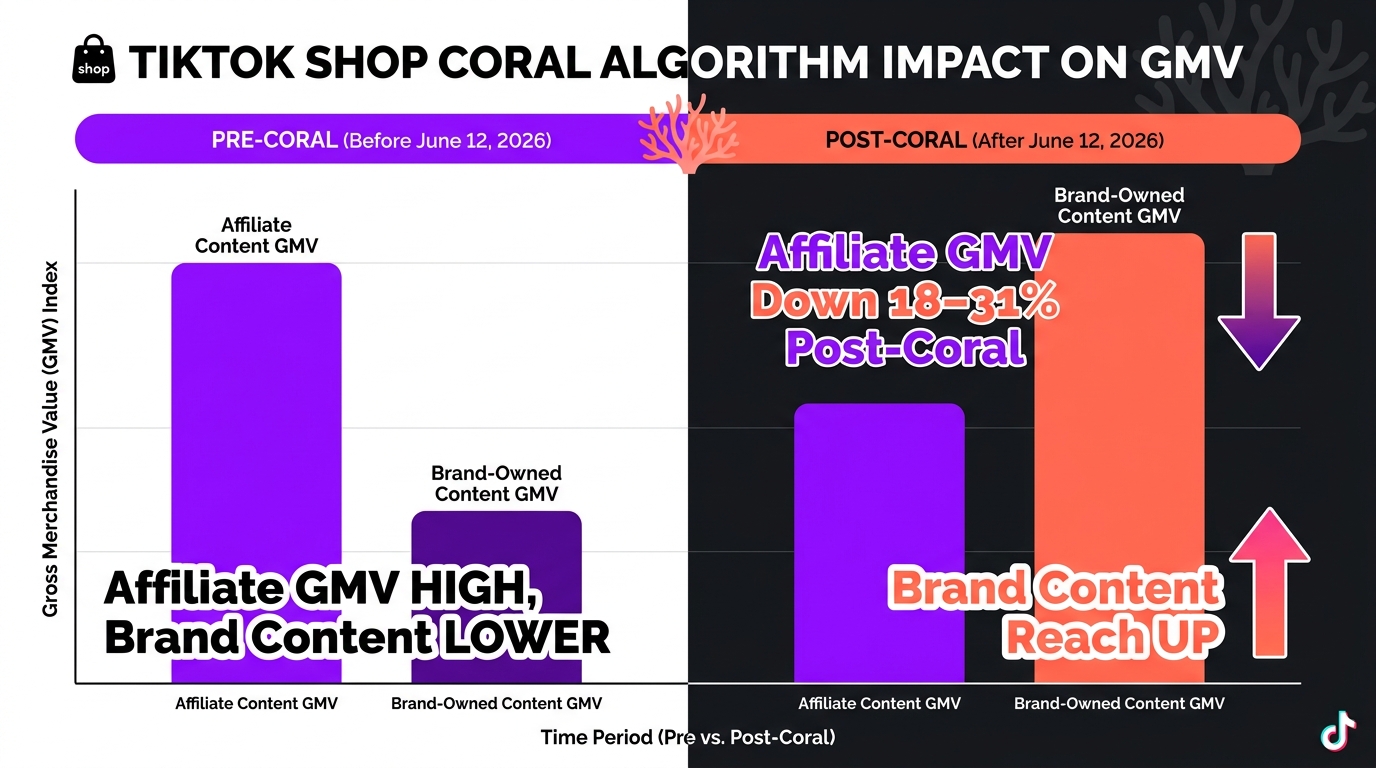
Brand-Owned Content vs. Affiliate Traffic: What the GMV Data Actually Shows
The most immediately felt consequence of Coral’s deployment has been the redistribution of GMV between affiliate-driven and brand-owned content channels. For brands that built their TikTok Shop presence almost entirely through creator affiliate programs, the post-June 12 data has been uncomfortable reading.
The Affiliate GMV Decline
Multiple analyses from the weeks following Coral’s launch put affiliate-sourced GMV declines at roughly 18 to 31 percent for brands operating with heavy affiliate dependency. The mechanism is straightforward: Coral’s content source weighting now systematically downweights affiliate video content in the commerce re-ranking stage, even when that content generates strong engagement. An affiliate creator’s video might still accumulate views and comments, but its ability to translate those signals into product ranking improvement has been significantly reduced.
This doesn’t mean affiliates are worthless under Coral. It means they are no longer sufficient as a primary distribution strategy. Brands that used affiliates as a substitute for owned media — because creator content was easier to produce at scale — are now discovering that TikTok’s algorithm has stopped subsidizing that shortcut.
What Brand-Owned Content Does Differently
Under Coral, a video posted from the brand’s verified seller account carries a compound advantage over the same video posted by a third-party affiliate. The brand account’s content generates commerce signals that feed directly back into the product’s Shop ranking. It builds the seller’s account authority score. It reinforces the verified storefront’s trust rating. And it gives the brand control over the product link, the pricing signal, and the fulfillment path — all of which feed into the broader shop health metrics that Coral uses as a baseline multiplier.
Affiliate content, by contrast, generates engagement signals on the creator’s account rather than the brand’s. Those signals contribute to the creator’s distribution but not to the brand’s shop authority. The GMV that flows through affiliate links still counts as revenue, but it contributes less to the product’s organic ranking momentum under Coral than equivalent GMV generated through the brand’s own content.
The Right Role for Affiliates Now
The strategic implication is not to abandon affiliates — it’s to restructure their role. In a Coral-era TikTok Shop operation, affiliates serve best as supplemental reach amplifiers for products that already have strong organic ranking foundations built through brand content. Running affiliates into a product that hasn’t established its own commercial signal base is less effective than it was pre-June 2026. But running affiliates into a product with an established conversion record, good AHR, and a verified storefront still generates meaningful incremental GMV.
The sequence matters: build the brand signal first, then use affiliates to amplify proven products rather than to discover whether a product will sell.
The Account Health Rating: Your Invisible Gatekeeper to Reach
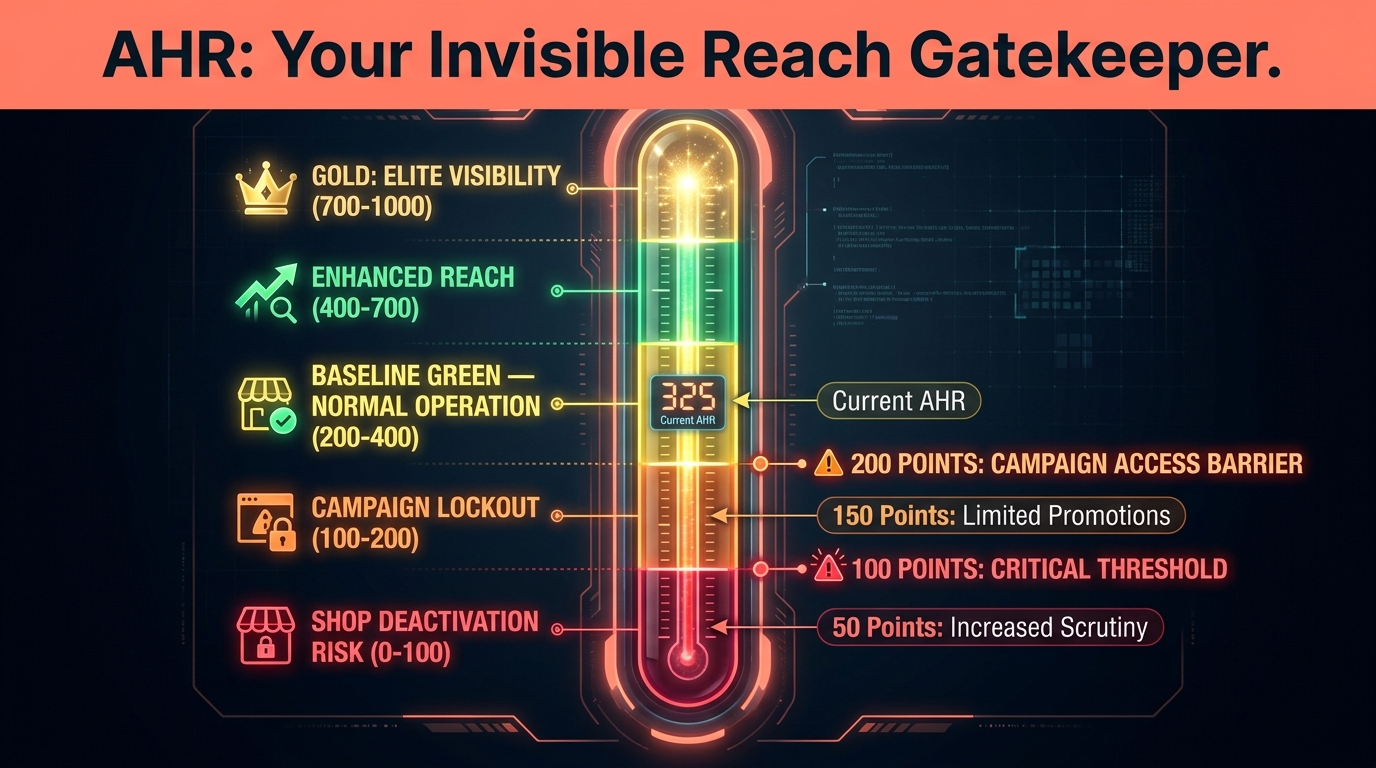
Perhaps the most underappreciated structural element of Coral’s ranking logic is the Account Health Rating (AHR) — a 0-to-1,000 point score that functions as a prerequisite multiplier on everything else in the ranking system. Your conversion rate, your content quality, your keyword optimization — none of it reaches full effectiveness if your AHR is suppressed. The AHR gates not just organic reach, but also campaign eligibility, affiliate access, and ultimately whether your shop remains live at all.
How the AHR Is Calculated
TikTok Shop replaced its previous violation-point system with the AHR framework on July 1, 2026, shortly after Coral’s launch. The new system operates on a 0-to-1,000 scale. Most sellers start at 200 points — the Green baseline — and their score moves up or down based on a rolling performance window, typically 180 days for the overall account score.
The inputs that move the AHR score include:
- Policy compliance: Violations of TikTok Shop’s product policies, content policies, and seller conduct rules each carry point deductions scaled by severity.
- Fulfillment performance: Shipping speed, order cancellation rate, and on-time delivery rate all feed into the AHR. Consistently shipping within 72 hours is associated with positive score movement; extended fulfillment windows or frequent cancellations push it down.
- Customer service metrics: Response time to buyer inquiries, dispute resolution rates, and refund handling speed.
- Product listing quality: Flagged or removed listings, counterfeit complaints, and inaccurate product descriptions all generate negative AHR signals.
- Return and complaint rates: A high rate of “not as described” returns or buyer complaints creates a sustained downward pressure on the score.
What the Threshold Numbers Mean
The AHR system has four critical enforcement thresholds:
- 150 points: The first major warning level. Sellers at or below 150 points face listing freezes for new products and reduced organic distribution across existing listings.
- 100 points: Campaign lockout threshold. Paid advertising capabilities — including GMV Max — are suspended, removing the ability to use paid signals to compensate for reduced organic reach.
- 50 points: Severe restriction level. The majority of the shop’s product visibility is algorithmically suppressed.
- 0 points: Permanent shop deactivation.
Critically, these thresholds create a compounding problem. Falling below 100 points removes access to GMV Max ads — which are one of the primary ways to generate the commerce signals that would help rebuild rank. The penalty structure is designed so that a shop in operational distress loses the tools it would need to recover. Maintaining a healthy AHR score is not just a compliance exercise — it is fundamental infrastructure for being able to compete at all.
AHR as a Coral Algorithm Multiplier
Within the Coral ranking pipeline, the AHR functions as a baseline signal that modifies how the system weights all of a seller’s other inputs. A product from a shop with a high AHR score sees its conversion rate and content performance signals amplified. The same product from a shop with a degraded AHR sees those signals discounted. This means that two sellers with identical conversion metrics and content quality can see materially different organic reach outcomes based solely on their operational health scores.
The message is clear: Coral is not just an algorithm for content — it’s a comprehensive operating standard. Sellers who treat TikTok Shop as a serious business channel and maintain clean operational metrics across fulfillment, customer service, and compliance will have a structural reach advantage over those who don’t.
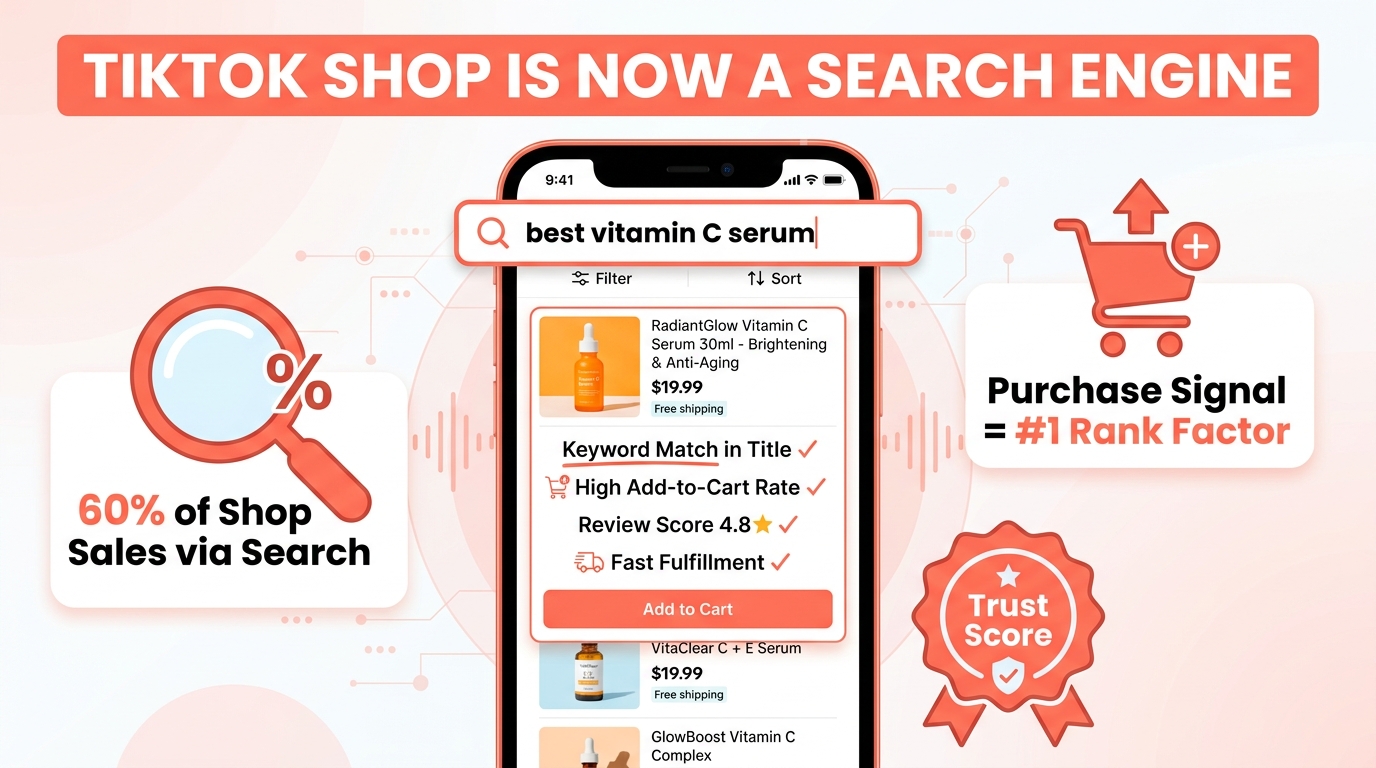
The Search-First Paradigm: Why TikTok Shop Is Becoming a Marketplace Engine
One of the clearest patterns in post-Coral TikTok Shop data is the growing dominance of the Search tab as a revenue-generating surface. Before 2026, most TikTok Shop sales were attributed to For You Page discovery — a user would encounter a product through a video, and the sale was driven by that contextual moment. Search was a secondary channel used primarily by buyers who already knew what they wanted.
Under Coral, that balance is shifting sharply. Depending on the category, the Search and Shop tabs are now estimated to account for a majority of TikTok Shop conversions — in some verticals, the share driven by active search queries is approaching 60 percent. TikTok is, in effect, evolving toward a marketplace model where intent-driven discovery matters as much as or more than algorithm-driven discovery.
Why This Shift Is Happening
The structural reason is Coral’s prioritization of shopping intent signals. When a user actively types a query into TikTok Shop’s search bar, they have demonstrated explicit purchase intent — one of the highest-value signals the system can capture. Coral’s ranking model treats these intent signals as premium inputs and surfaces products that match both the keyword and the commerce performance profile described above.
This is a fundamentally different dynamic from FYP distribution, where the algorithm is trying to predict what a user might want based on behavioral patterns. In search, the user has told the algorithm exactly what they want. Products that have strong keyword alignment and proven conversion rates in that intent context will consistently rank above products that only satisfy one of those conditions.
What This Means for Product Discovery Strategy
Sellers who have built their TikTok Shop strategy entirely around FYP virality — posting content and hoping the algorithm surfaces it to the right audience — are now competing against a discovery surface they haven’t optimized for. The Search tab doesn’t reward entertainment quality or follower counts. It rewards product metadata relevance, commercial performance, and store trust signals.
For many sellers, this represents a significant strategic pivot: from thinking like a content creator to thinking like a marketplace operator. The skills and systems that drive Search tab performance — keyword research, title optimization, listing quality, pricing competitiveness — are much closer to Amazon SEO tradecraft than to social media marketing.
Product Listing SEO in the Coral Era: Title Density, Keywords, and Conversion Architecture
With search driving an increasing share of TikTok Shop revenue and Coral placing heavy weight on listing-level performance signals, product listing optimization has become one of the highest-leverage activities a TikTok Shop seller can undertake. The changes required under Coral are specific and measurable.
Product Title Optimization
The product title is the most heavily weighted metadata field in Coral’s candidate retrieval stage. Titles that contain exact-match keywords for high-intent search queries are significantly more likely to make it through initial candidate filtering. The practical framework for Coral-era titles follows a structure many Amazon sellers will recognize:
[Primary Keyword] + [Key Feature/Benefit] + [Secondary Keyword] + [Product Type] + [Size/Quantity/Variant if relevant]
Under Coral, title keyword density matters — but keyword stuffing that reads unnaturally still generates negative signals through low CTR (users who see an unreadable title don’t click). The goal is maximum keyword coverage within a naturally readable title, targeting the specific phrases your buyers type into TikTok’s search bar rather than generic category terms.
Keyword Research for TikTok Search
TikTok’s search autocomplete is now one of the most reliable sources of high-intent keyword data for TikTok Shop sellers. Typing a product category into the search bar and recording every autocomplete suggestion gives you a direct map of what buyers in your category are actually searching for. The TikTok Creative Center’s keyword tool provides additional search volume data for shopping-related terms — and unlike traditional SEO tools, it reflects TikTok-specific search behavior rather than Google patterns.
Critically, TikTok search queries tend to be more colloquial and benefit-oriented than Google searches. Buyers search for “glow skin serum under $30” rather than “vitamin C face serum.” Sellers who align their title and description language with how TikTok users actually phrase their shopping intent will consistently outperform those who write product titles in formal product-description language.
Conversion Architecture: From Listing to Purchase
Coral’s emphasis on conversion rate means that every element of the product listing page is now a ranking factor — not just search position. Listings with high-quality main images (sharp, context-appropriate, professionally shot), strong social proof signals (4.5+ star ratings with volume), and complete product descriptions see meaningfully better conversion rates, which feeds directly back into higher commerce scores in the re-ranking stage.
Key conversion architecture elements under Coral include:
- Main image quality: The first image in a product listing drives a significant portion of click-through rate from search results. Under Coral, low CTR from search impressions is a negative signal that suppresses future ranking.
- Review velocity and recency: A product with 200 reviews accumulated over the past 30 days ranks better than one with 500 reviews accumulated over two years. Recent social proof signals freshness and active buyer engagement.
- Price competitiveness flagging: TikTok Shop now audits prices against external platforms. Listings where TikTok Shop’s price is measurably higher than the same product’s Amazon price can be downweighted in Coral’s ranking. Ensuring price parity — or positioning TikTok Shop prices as competitive — has become a direct ranking consideration.
- Inventory availability: Products that frequently go out of stock lose ranking momentum during the stockout period and do not fully recover it automatically upon restock. Consistent inventory management is, under Coral, also a ranking practice.
GMV Max and Coral: How the Ads System Feeds the Organic Algorithm
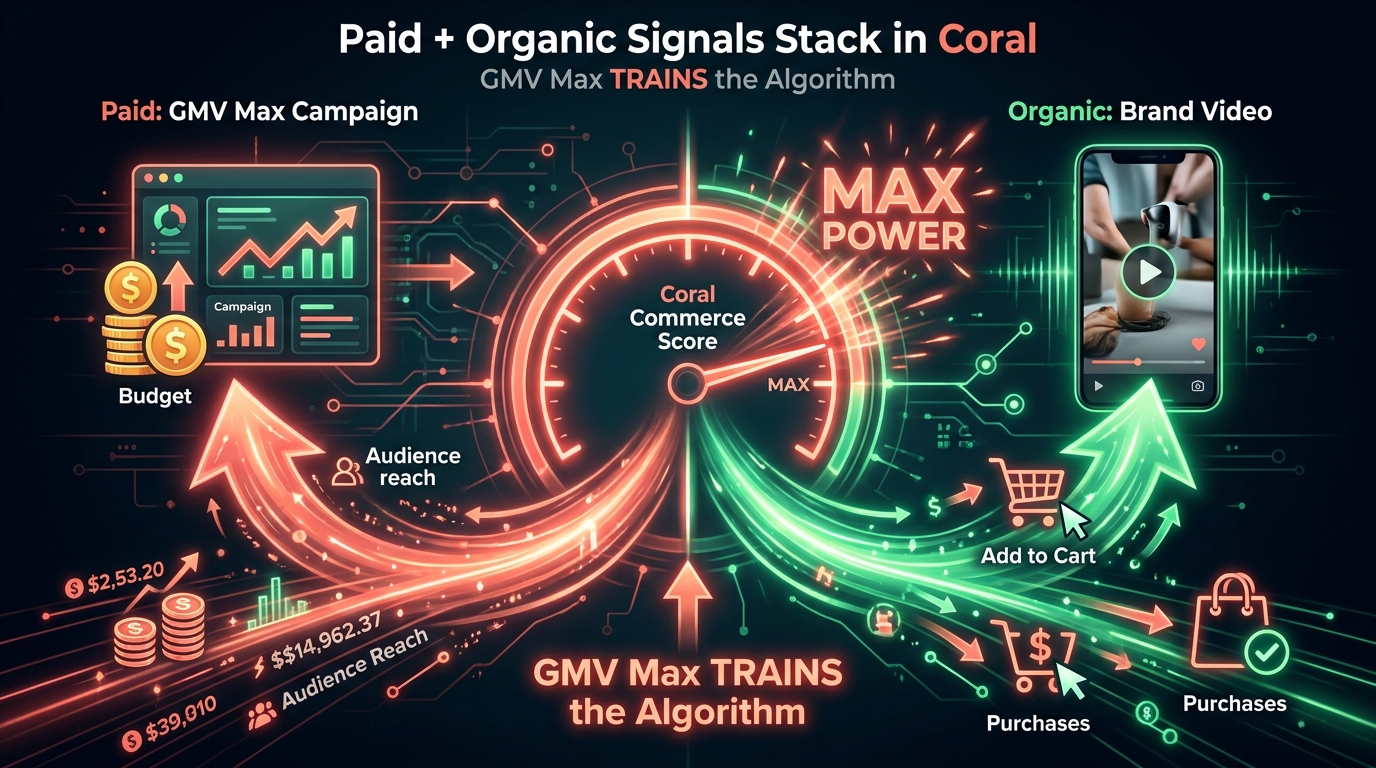
TikTok Shop’s GMV Max campaign type — which automatically optimizes ad spend toward total gross merchandise value rather than toward a specific conversion action — has become the de facto ad system for TikTok Shop sellers in 2026. Under Coral, the relationship between GMV Max campaigns and organic ranking has become more direct and more consequential than most sellers realize.
How GMV Max Works With Coral’s Signals
GMV Max campaigns function by feeding TikTok’s ad system all eligible video assets (both brand-owned organic videos and specifically uploaded ad creatives) and then using machine learning to allocate budget across assets and audiences in ways that maximize GMV output. What makes this particularly relevant under Coral is that the commerce signals generated by paid GMV Max activity feed into the same ranking model that governs organic distribution.
In practical terms, a product that generates strong click-through and conversion metrics through a GMV Max campaign accumulates positive commerce signals in Coral’s model — signals that then improve that product’s organic ranking position. The paid and organic channels are not isolated systems. They share a common feedback loop through Coral’s commerce re-ranking layer.
The “Algorithm Training” Effect
Experienced TikTok Shop operators describe GMV Max as a way to “train the algorithm” on what good performance looks like for a product. When a GMV Max campaign generates a strong conversion signal from a defined audience segment, Coral’s model updates its understanding of which users are high-conversion targets for that product. This updated understanding then shapes organic distribution — the algorithm begins serving the product to users who match the high-converting profile identified by the paid campaign.
This is why GMV Max budget allocation strategy matters under Coral in ways that go beyond immediate ROAS. An underfunded GMV Max campaign that generates only a handful of conversions per day will train Coral’s model on too small a sample to produce meaningful organic reach improvements. The threshold for meaningful signal generation appears to require consistent daily conversion volume — most practitioners suggest aiming for at least 20-50 daily conversions through GMV Max before expecting material organic ranking lift.
Creative Quality as a Dual-Function Input
Under Coral, the video creative assets used in GMV Max campaigns serve two distinct functions simultaneously. They generate paid commerce signals that train the algorithm, and they demonstrate to Coral’s ranking model that the seller is producing brand-owned, native content — which receives the content source weighting advantage described earlier.
This means that a GMV Max campaign running brand-owned videos performs better than one running only static product images or recycled affiliate content, not just because video generates higher engagement but because the brand-ownership signal within the content source weighting layer amplifies the campaign’s ranking contribution. Sellers who invest in producing quality short-form native video specifically for GMV Max are getting a compound benefit: better paid conversion rates and stronger organic reach effects.
Live Commerce Signals: Why Live Shopping Is Coral’s Most Rewarded Format
Among all content formats on TikTok Shop, live commerce sessions generate the densest concentration of commerce signals per unit of time. A well-executed live shopping broadcast produces simultaneous streams of product page clicks, add-to-cart events, completed purchases, real-time audience interaction, and session watch time — all feeding into Coral’s ranking model in real time. This density of commerce signal generation is why live commerce has become one of the most strategically valuable activities a TikTok Shop brand can run under the Coral framework.
What Coral Sees During a Live Session
When a brand runs a live shopping session, Coral’s model is monitoring several concurrent signals:
- Product pin engagement: Every time a viewer taps a pinned product during a live, it registers as a product page interaction — a commerce signal that feeds directly into that product’s ranking score.
- Live-to-purchase conversion rate: The percentage of live viewers who complete a purchase during the session. High live conversion rates are strong positive signals for both the specific products featured and the overall shop health score.
- Concurrent viewer growth: The rate at which a live session grows its concurrent audience signals content quality and engagement — which Coral factors into the live session’s distribution amplification.
- Average watch time: Viewers who stay through extended product segments generate stronger engagement signals than those who drop off during the first minute.
- Post-live purchase attribution: TikTok Shop tracks purchases made within a window after a live session ends, attributing them to the session’s product interactions. These delayed conversions also feed back into product commerce scores.
Building a Live Commerce Strategy Under Coral
For Coral optimization purposes, live commerce is most effective when treated as a deliberate ranking event rather than a standalone sales channel. The highest-impact approach is to concentrate live commerce sessions around the specific products you want to build ranking momentum for, running sessions with sufficient frequency and duration to accumulate meaningful commerce signal volume.
Sellers seeing the best results with this approach typically run live sessions at least three to four times per week, with each session featuring a core set of products and using time-limited offers (flash sales, live-exclusive discounts) to drive conversion density. The discount depth matters less than the conversion rate — a 10% live discount that drives 80 purchases generates better Coral signals than a 40% discount that drives 20 purchases at higher cart abandonment.
Brands in categories with high repurchase rates — beauty, supplements, home consumables — are particularly well-suited to using live commerce as a Coral ranking engine, because the category itself generates naturally high conversion rates from intent-matched audiences.
Storefront Trust Score: The Operational Metrics That Gate Your Visibility
Beyond the AHR’s compliance and policy metrics, Coral incorporates a broader set of storefront trust signals that function as quality filters in its ranking pipeline. These are less about penalties and more about competitive differentiation — the difference between a shop that Coral treats as a verified, reliable seller and one it treats as an unvalidated new entry.
Verification and Credentialing
TikTok Shop’s verified seller badge — issued to shops that have met minimum sales thresholds, submitted business documentation, and completed TikTok’s identity verification process — now functions as a baseline trust signal in Coral’s ranking model. Verified shops receive a structural boost in the commerce re-ranking stage that unverified shops do not. For any brand serious about competing on TikTok Shop, completing the verification process is no longer optional — it is a ranking prerequisite.
Review Volume and Quality
Coral weights the volume and recency of product reviews as a trust indicator. A product with 50 recent reviews averaging 4.6 stars will consistently outrank a technically equivalent product with 5 reviews at 4.8 stars. The system treats review density as a signal of buyer confidence and product reliability, and it discounts both very new products (insufficient proof of reliability) and products whose review activity has gone cold (suggesting declining relevance or quality issues).
Under Coral, actively soliciting post-purchase reviews through TikTok Shop’s native review request features has become a strategic priority — not just for social proof but for the direct ranking benefit of maintaining active review velocity. The platform’s review mechanics are integrated into the algorithm’s quality assessment of both the product and the shop.
Fulfillment Speed as a Ranking Signal
Coral’s emphasis on sub-72-hour fulfillment is one of its most operationally demanding requirements for smaller sellers. The algorithm has documented positive weighting for shops that consistently ship within 48-72 hours of order placement. Shops with average fulfillment windows above 96 hours see sustained negative pressure in their operational health scores, which feeds through into reduced Coral ranking amplification.
For sellers using third-party fulfillment centers or FBA-style services, ensuring that inventory pre-positioned for TikTok Shop orders can be picked, packed, and handed to a carrier within the required window is a genuine operational constraint. Sellers whose supply chains cannot consistently hit sub-72-hour fulfillment targets should be aware that this constraint has a direct and measurable cost in organic reach under Coral.
Adapting Your Strategy to Coral: A 90-Day Operational Playbook
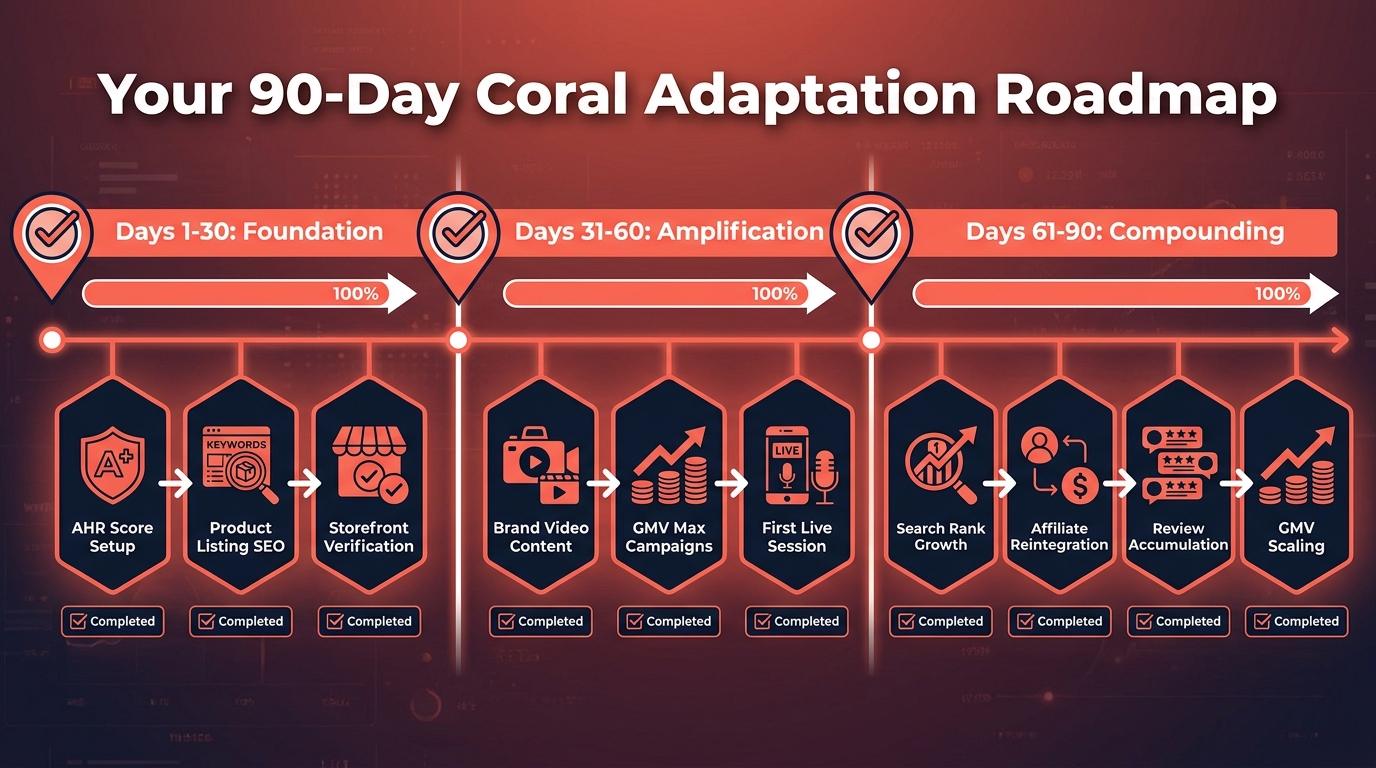
The Coral algorithm did not gradually evolve — it was deployed as a structural change on a specific date. That means sellers operating under pre-Coral assumptions are not just slightly off-strategy; they are running plays that the algorithm now actively discounts. A systematic 90-day adaptation program is the most practical way to realign operations with Coral’s logic.
Days 1–30: Audit, Repair, and Foundation
The first month should be dedicated entirely to understanding your current position within Coral’s scoring system and fixing the inputs that are actively suppressing your rank.
Audit your AHR score and identify the specific input categories dragging it down. If policy violations are the primary driver, address them systematically — each category of violation has a defined resolution path within TikTok Seller Center. If fulfillment speed is the issue, identify the supply chain or logistics bottleneck and establish a plan to reduce average fulfillment time below the 72-hour threshold.
Audit your product listings against Coral’s listing quality criteria. For each of your top 10 products by GMV potential: rewrite titles to include primary and secondary search keywords in a natural, readable format; ensure main images are high-resolution and accurately represent the product; confirm that review request sequences are active; and verify pricing parity against Amazon equivalents where applicable.
Complete storefront verification if you haven’t already. The visibility difference between verified and unverified shops under Coral is material enough that this should be treated as an urgent priority rather than an optional administrative task.
Days 31–60: Content Infrastructure and Initial Commerce Signals
With the foundation clean, the second month is about beginning to build the content and commerce signal base that Coral rewards.
Launch brand-owned video content from the seller account for your priority products. The goal in this phase is not virality — it is the accumulation of commerce signals. Post product-focused videos with integrated shopping links at a consistent frequency (aim for 3-5 posts per week per product initially). Monitor product click-through rates and add-to-cart rates rather than view counts — these are the metrics Coral is actually measuring.
Activate GMV Max campaigns for your top-priority products, with budgets set to generate at least 20-50 daily conversions. Use your best-performing organic brand videos as the primary creative assets. Monitor the paid-to-organic correlation: are products with active GMV Max campaigns showing improved organic impression rates? This feedback loop typically becomes visible within 10-14 days of campaign activation.
Run your first live commerce sessions. Start with two sessions per week, each 60-90 minutes, focused on your best-converting products. Track the commerce signals generated per session (product pins clicked, live conversions, post-live attribution window purchases) and use this data to refine the session structure.
Days 61–90: Compound, Measure, and Reintegrate
The third month is where Coral’s compounding dynamics begin to work in your favor — if the first two months were executed correctly.
Review search ranking position for your target keywords. Products that had strong AHR scores, clean listings, and consistent brand content and GMV Max activity should be showing measurable ranking improvement in the Shop tab search results. If a product is not showing rank improvement despite clean fundamentals, investigate whether its conversion rate is competitive — Coral will not rank a product well in search if equivalent products in the category have significantly better conversion rates, regardless of content quality.
Reintegrate affiliate collaborations strategically. Now that you have organic rank foundations established, affiliate content serves as an amplifier rather than a primary driver. Structure affiliate collaborations around your proven top-converting products, with clear UTM tracking to distinguish affiliate-sourced GMV from organic GMV. Monitor whether affiliate activity is increasing your product’s overall commerce signal volume without diluting the brand-owned content weighting advantage.
Establish a weekly operational review cadence that tracks AHR score, product-level conversion rates, live session commerce signal totals, and GMV Max organic halo effect. These four metrics, reviewed weekly, give you a complete view of how your operation is performing across every layer of Coral’s ranking system.
The Compound Loop: Why Coral Rewards Systems, Not Campaigns
The most important strategic insight about Coral is one that doesn’t appear in any individual section of its ranking logic but emerges from understanding how all its components interact. Coral is not designed to reward individual campaigns, viral moments, or short-term execution spikes. It is designed to reward the continuous operation of a commerce system where every component generates signals that strengthen every other component.
A brand that maintains a high AHR score (operational excellence) while posting consistent brand-owned content (content quality and source weighting) while running GMV Max campaigns with strong creative (paid signal generation) while executing regular live commerce sessions (commerce signal density) while maintaining keyword-optimized listings with fresh reviews (search and conversion optimization) is not just doing five good things. It is running a system where each element amplifies all the others.
The AHR’s clean operational record means GMV Max campaigns reach broader audiences. The GMV Max campaigns generate commerce signals that improve organic product ranking. The improved organic ranking generates more search impressions for keyword-optimized listings. The high-quality listings convert those search impressions into purchases, generating more commerce signals. The live sessions produce dense conversion events that accelerate the signal accumulation cycle. And all of this feeds back into a stronger AHR, which further amplifies the reach of every subsequent action.
Brands that understand Coral as an operating system — rather than as a ranking formula to game — are the ones building compounding GMV trajectories on TikTok Shop in the second half of 2026. Those still treating it as a social media platform to get lucky on are finding that the algorithm has stopped cooperating.
What Coral Means for TikTok Shop’s Competitive Landscape
Zooming out to the category level, Coral is accelerating a consolidation dynamic that was already underway in several TikTok Shop verticals. Because Coral so heavily rewards commerce performance history, verified trust signals, and operational consistency, well-established sellers with clean records and strong conversion data are compounding their ranking advantages faster than new entrants can build them.
In categories like beauty, supplements, and home goods — where TikTok Shop has deep buyer adoption — the top 10-20 sellers by AHR quality and commerce signal volume are progressively capturing a larger share of the organic search surface. Newer sellers or those with degraded AHR scores face a structural headwind: they need to generate commerce signals to improve ranking, but they need better ranking to generate commerce signals. The entry path is narrower than it was before June 12, 2026.
Where the Opportunity Still Sits
The competitive consolidation also creates visible opportunity in categories and subcategories that have not yet developed a dominant set of well-optimized shops. Niches within broader categories — specific beauty concerns, specific home use cases, specific health segments — often have weaker incumbent competition and fewer sellers with sophisticated Coral optimization in place. A seller entering one of these subcategories with a clean AHR baseline, optimized product listings, and consistent brand content can build meaningful search ranking in 60-90 days simply because the competitive field hasn’t applied Coral’s logic systematically.
The window for this kind of subcategory entry advantage is not unlimited. As awareness of Coral’s mechanics spreads, more sophisticated operators will bring the full operational stack to more niches. The sellers who move early — who treat Coral as a competitive variable to master rather than a platform change to adapt to eventually — will lock in ranking positions that are significantly harder to dislodge once established.
Conclusion: Coral as the New Standard for TikTok Shop Seriousness
TikTok Shop’s Coral algorithm represents something more significant than a platform update. It represents TikTok’s deliberate statement about what kind of commerce ecosystem it wants to build. The message embedded in Coral’s architecture is unambiguous: the platform wants verified, operationally reliable brands producing genuine commerce signals through owned content and consistent fulfillment. It does not want to be a viral discovery lottery for whoever happens to partner with the right affiliate creator on the right week.
For sellers who were already operating like serious commerce businesses — with clean operational metrics, consistent content strategies, and a long-term view of the platform — Coral mostly codified what was already best practice and amplified the rewards for doing it right. For sellers who had been riding affiliate-driven virality without building the underlying commercial infrastructure, June 12, 2026 was a structural reset.
The practical takeaways from Coral’s architecture are consistent across every section of this analysis:
- Your AHR score is the foundation. Nothing else in the ranking system reaches full effectiveness if your operational health is suppressed. Fix it first.
- Brand-owned content from your verified seller account carries structural ranking advantages that affiliate content cannot replicate under Coral. Build a content operation, not just a content budget.
- Search is now a primary discovery surface. Treat product listing optimization — titles, keywords, images, review velocity — as a core commerce competency, not a cleanup task.
- GMV Max and organic ranking are not separate strategies. They share a common signal loop through Coral. Underfund GMV Max and you’re also undertreating your organic growth.
- Live commerce generates the densest commerce signal volume of any format. Sellers not running regular live sessions are leaving one of Coral’s most rewarded inputs on the table.
- The compound loop rewards systems over campaigns. Coral is won over months of consistent operational excellence, not weeks of viral moments.
TikTok Shop is a serious commerce platform now, and Coral is the mechanism through which it enforces that seriousness. The sellers who internalize that shift — and build the operational systems to compete within it — will find that the algorithm is an exceptionally powerful growth engine once you’re aligned with it rather than working against it.