


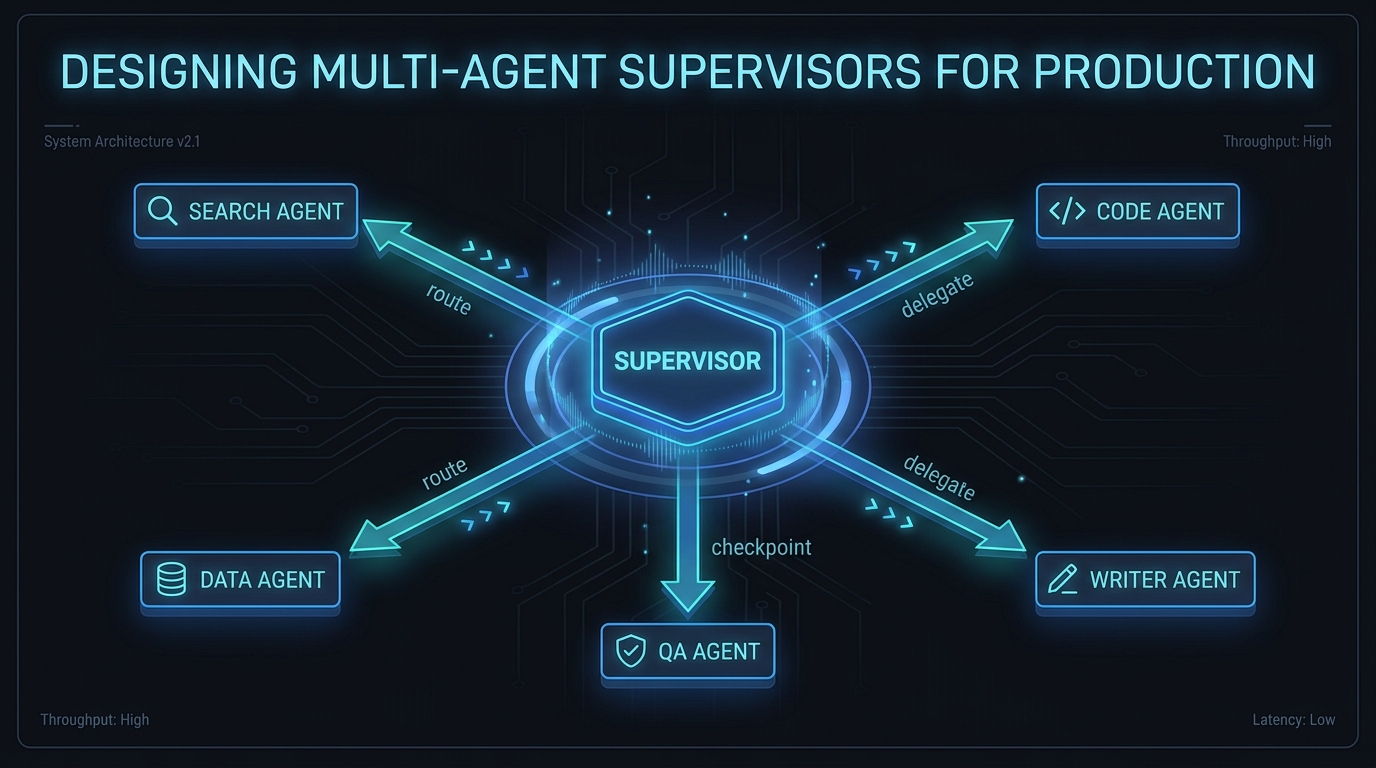

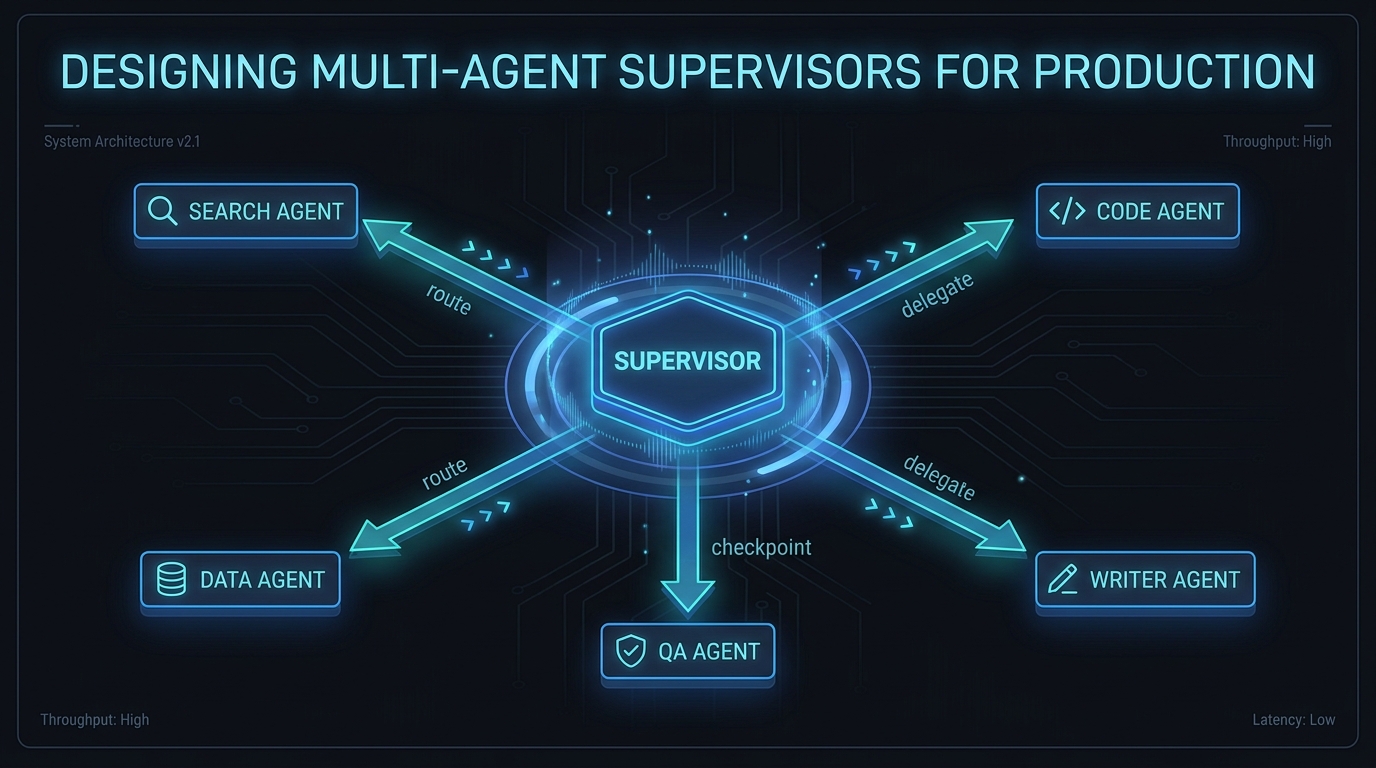
Every engineering team building production AI systems eventually lands on the same design. One orchestrating agent sits at the center. It receives the task, decides which specialist agents to call, collects their outputs, and synthesizes a result. This is the supervisor pattern — and in 2026, it has become the near-universal default for multi-agent production deployments.
Around 62% of production multi-agent teams now use some form of supervisor-worker topology, according to recent enterprise surveys. Vendor guidance from Anthropic, OpenAI, Google, and the LangGraph ecosystem all converge on the same recommendation. When you need coordination, auditability, and reliable handoffs, a central supervisor is the go-to starting point.
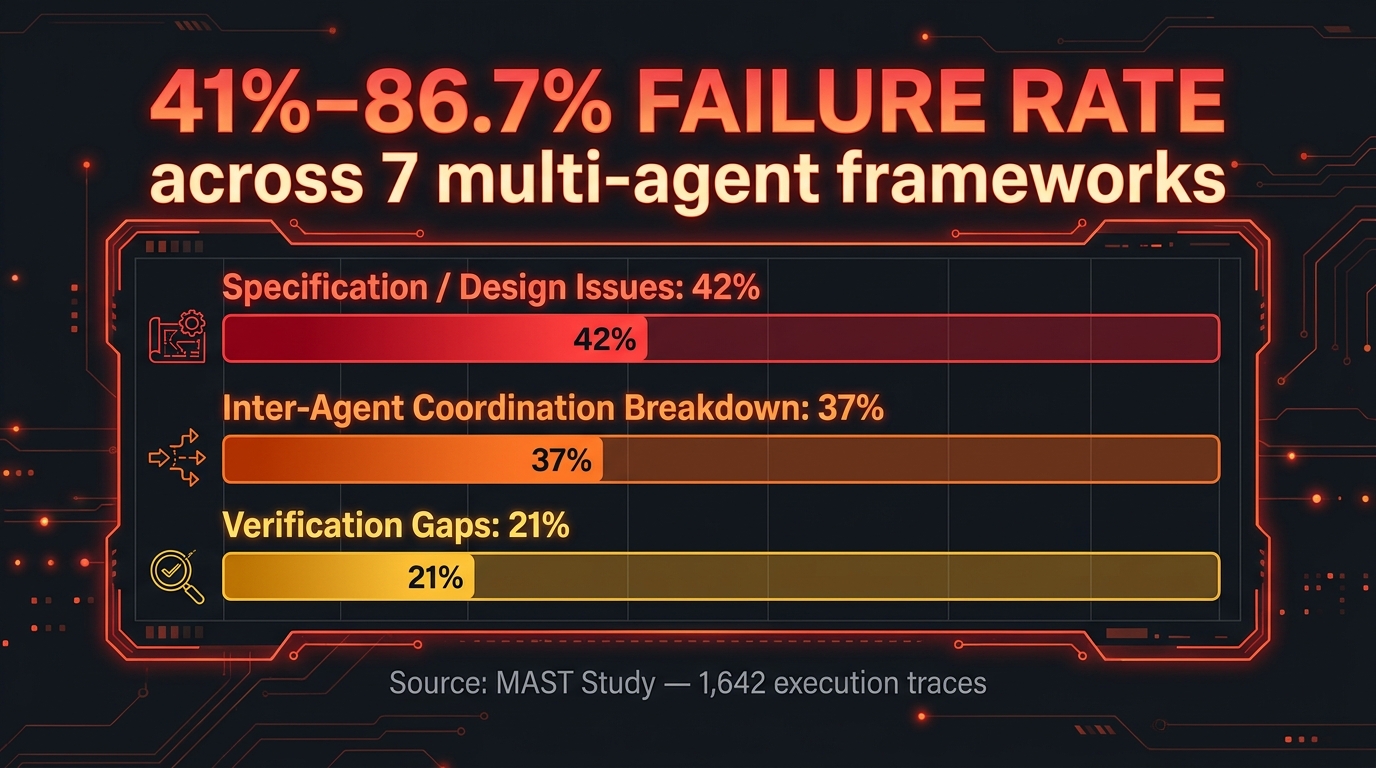
The problem is that this convergence has created a false sense of security. Teams adopt the supervisor pattern because it sounds controlled — one agent routing everything — and then discover that “controlled” and “production-ready” are not the same thing at all. The MAST study, which analyzed over 1,600 execution traces across seven open-source multi-agent frameworks, found failure rates ranging from 41% to 86.7%. The dominant cause wasn’t model quality. It was system design and inter-agent coordination — exactly the things the supervisor pattern is supposed to fix.
This post is not a tutorial for getting a supervisor running locally. It’s an engineering examination of what happens when supervisor architectures hit real production load — where the design decisions break down, what they cost you operationally, and how to build multi-agent systems that hold under pressure. Every section covers a failure mode that teams are actually hitting in 2026, and the architectural responses that are working.
Understanding the Supervisor’s Actual Job — And Why Most Teams Get It Wrong
Before examining failure modes, it’s worth being precise about what a supervisor agent is and isn’t supposed to do. The confusion here is responsible for a significant fraction of production problems.
The supervisor’s job is narrow: receive a task, choose which agent should handle it next (or determine that the task is complete), and pass the appropriate context. That’s it. The supervisor routes. It does not execute. It does not hold domain knowledge. It does not perform the specialist work of any of its workers.
The Over-Engineered Supervisor Problem
In practice, teams almost always over-build the supervisor. They give it tools it doesn’t need. They write prompts that ask it to reason deeply about the task rather than just route it. They load it with the full history of every sub-agent’s output so it can “understand the full picture.” Each of these additions feels reasonable in isolation. Together, they turn the supervisor into a general-purpose agent wearing an orchestration label — and that creates a cascade of downstream problems.
When the supervisor tries to be a specialist, its routing decisions become contaminated by partial expertise. It starts second-guessing worker outputs. It attempts remediation rather than escalation. The prompt gets long, the context window fills, and routing accuracy degrades exactly as complexity increases — the opposite of what you need in production.
The most consistent expert recommendation across vendor guidance, framework documentation, and practitioner postmortems is the same: keep the supervisor minimal. Its output should be constrained to one of a small set of typed routing choices — the name of the next agent to call, or a terminal signal meaning “done.” Nothing else. One popular framework implementation describes this as the supervisor choosing between a Literal-typed set of worker names or FINISH, validated at the boundary, with no ability to emit free-form text routing instructions.
What “Minimal” Looks Like in Practice
A production-grade supervisor prompt is remarkably short. It names the available workers, describes what each handles in one sentence, and instructs the model to output only the next agent to call. The routing logic is explicit and exhaustive: every possible input category maps to a worker, there is a defined fallback, and there is a hard termination condition. The supervisor does not summarize prior agent outputs. It does not evaluate the quality of worker results. It does not hold a running critique of the task’s progress. Those functions belong elsewhere in the system, in dedicated evaluation nodes or human review gates.
This is harder to build than it sounds, because the instinct when something goes wrong is to “make the supervisor smarter.” That instinct is almost always wrong. When a supervisor misroutes a task, the fix is usually a clearer worker description or a tighter routing schema — not more reasoning capability in the supervisor itself.
The MAST Findings: What 1,600+ Execution Traces Say About How These Systems Actually Fail
The MAST study is the most comprehensive empirical look at multi-agent system failures published to date. Its findings are sobering, and they deserve careful reading by any team shipping these systems.
Across seven open-source multi-agent frameworks and over 1,600 analyzed execution traces, the study found failure rates ranging from 41% to 86.7%. The variation between frameworks is significant — some orchestration approaches are substantially more reliable than others — but even the best performers fail nearly half the time under production-representative conditions.
The Three Failure Categories
The study categorized failure causes into three buckets, and the distribution is instructive:
- Specification and system-design issues (~42%): The agents weren’t given adequate instructions, the task decomposition was ambiguous, or the system design created impossible situations — like routing loops with no exit condition or workers with overlapping, underspecified responsibilities.
- Inter-agent coordination breakdown (~37%): Agents were adequately specified individually but failed when interacting. Handoffs dropped context. Workers produced outputs the supervisor couldn’t parse. State written by one agent was overwritten or misread by another. The coordination infrastructure itself was the failure point.
- Verification gaps (~21%): The system lacked mechanisms to catch incorrect or incomplete outputs before passing them downstream. A worker returned a malformed result, no validation caught it, and the error propagated through several subsequent steps before causing a visible failure — making root cause analysis significantly harder.
What This Means for Your Architecture Decisions
The core lesson from the MAST data is that the vast majority of multi-agent failures are engineering problems, not model problems. Upgrading your base model does not fix a routing loop caused by ambiguous worker descriptions. A more capable LLM doesn’t automatically validate handoff payloads or detect when a worker’s output is missing a required field.
This reframes the supervisor design problem fundamentally. The question isn’t primarily “which model should run my supervisor?” It’s “how do I build a system where specification errors are caught before deployment, coordination contracts are enforced at runtime, and verification happens at every handoff?” That’s a software engineering question, and it deserves software engineering answers — typed schemas, boundary validation, contract testing, and observability instrumentation — not just model selection and prompt iteration.
The 36.9% coordination failure rate also highlights why inter-agent interfaces deserve the same engineering rigor as external APIs. The contract between your supervisor and each worker — what goes in, what comes out, what constitutes a valid response — should be explicitly defined, programmatically validated, and treated as a first-class concern in your system design.
The Single Point of Failure Trap — and the Supervisor Tree That Replaces It
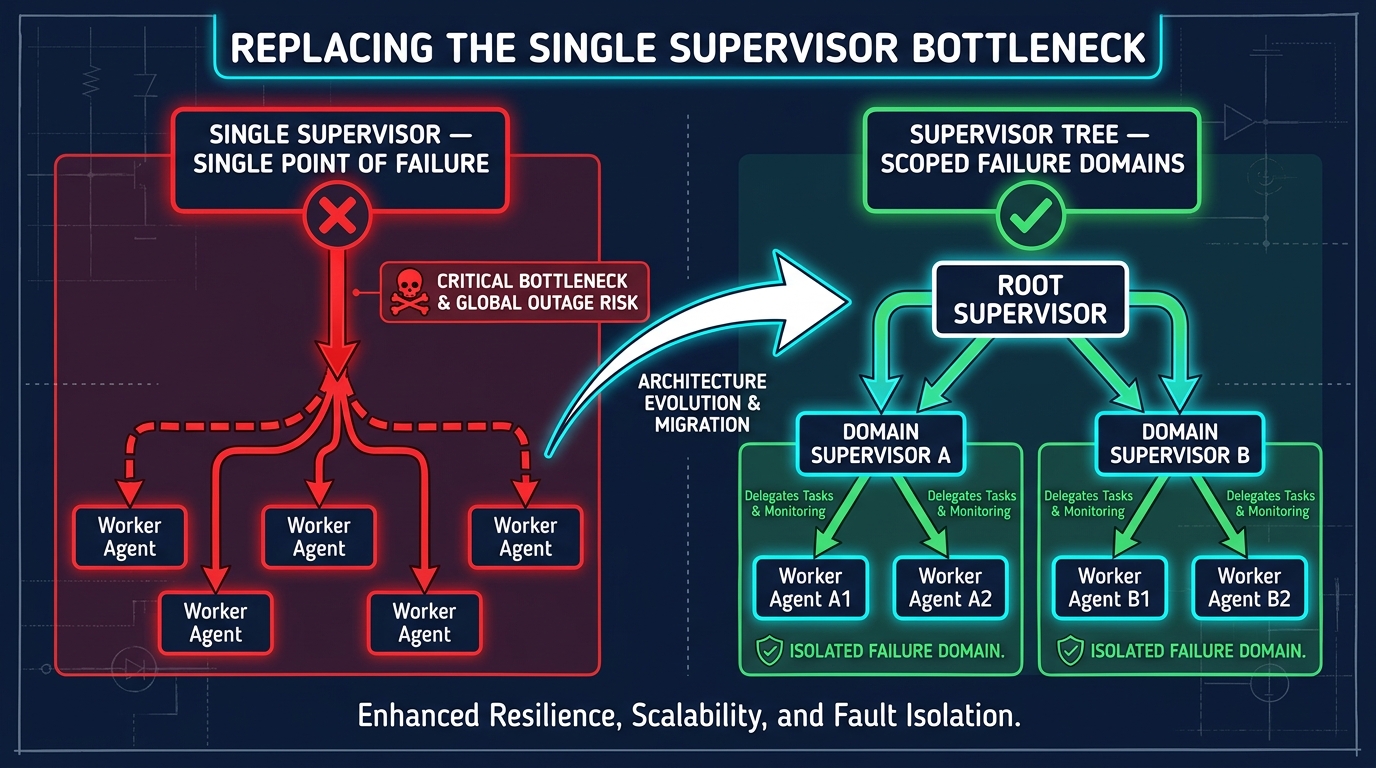
The supervisor pattern’s greatest structural weakness is also its most obvious: if the supervisor fails, nothing else can proceed. Every workflow in the system stops. Every pending task is orphaned. If the supervisor stalls — due to a context window overflow, a model timeout, a routing loop, or a hardware failure — you have a system-wide outage, not a partial degradation.
This is not a theoretical concern. Production postmortems from engineering teams repeatedly identify supervisor stalls as the cause of complete workflow failures. The supervisor holds the routing logic, the shared state, and the decision authority. When it’s gone, there’s nothing to delegate to workers, and nothing to synthesize their outputs. The whole system is a single thread that runs through a single component.
From One Supervisor to a Supervisor Tree
The most effective architectural response is to eliminate the “one global supervisor” design entirely and replace it with a tree of scoped supervisors. Instead of one orchestrator managing every agent in the system, you build domain-specific supervisors that each manage a defined subset of workers, with a root supervisor coordinating between domains rather than directly between individual agents.
The practical benefits are significant. When one domain supervisor fails or stalls, only the workflows within that domain are affected. Other domains continue operating. The root supervisor can detect the failure, route to a fallback, or surface a human escalation — but it doesn’t need to restart from scratch. The failure domain is bounded.
This pattern also resolves the routing bottleneck problem. A single supervisor routing dozens of agent types becomes a performance constraint as task volume grows. Each additional worker increases the complexity of the routing decision, the length of the routing prompt, and the probability of a misrouting. A tree of scoped supervisors distributes this load horizontally — each supervisor manages fewer agents and makes simpler, more reliable routing decisions.
Hot Standby and Queue-Based Decoupling
For teams that need higher availability from a centralized supervisor — particularly in regulated workflows where a specific routing logic must be maintained — hot standby supervisors are the operational complement to tree structures. Two supervisor instances run in parallel, with the standby watching health signals from the primary. When the primary goes silent or exceeds a timeout threshold, the standby takes over from the last durable checkpoint.
Queue-based decoupling adds another layer of resilience. Rather than the supervisor directly invoking workers via synchronous function calls, tasks are placed onto a durable queue. Workers pull from the queue independently. The supervisor’s failure doesn’t drop in-flight tasks — they remain on the queue until a recovered supervisor can process them. This architectural shift also naturally enables horizontal scaling: multiple worker instances can pull from the same queue without any supervisor-side change.
The combination of supervisor trees, hot standbys, and queue-based decoupling is what “resilient supervisor architecture” actually looks like in production. It’s substantially more complex than a single coordinator-worker setup, and that complexity needs to be justified by the scale and criticality of your workflows. For lower-stakes systems, a single supervisor with aggressive timeouts and circuit breakers is often sufficient. The tree architecture earns its overhead when system-wide outages are genuinely unacceptable.
State Management: From Typed Schemas to Durable Checkpoints
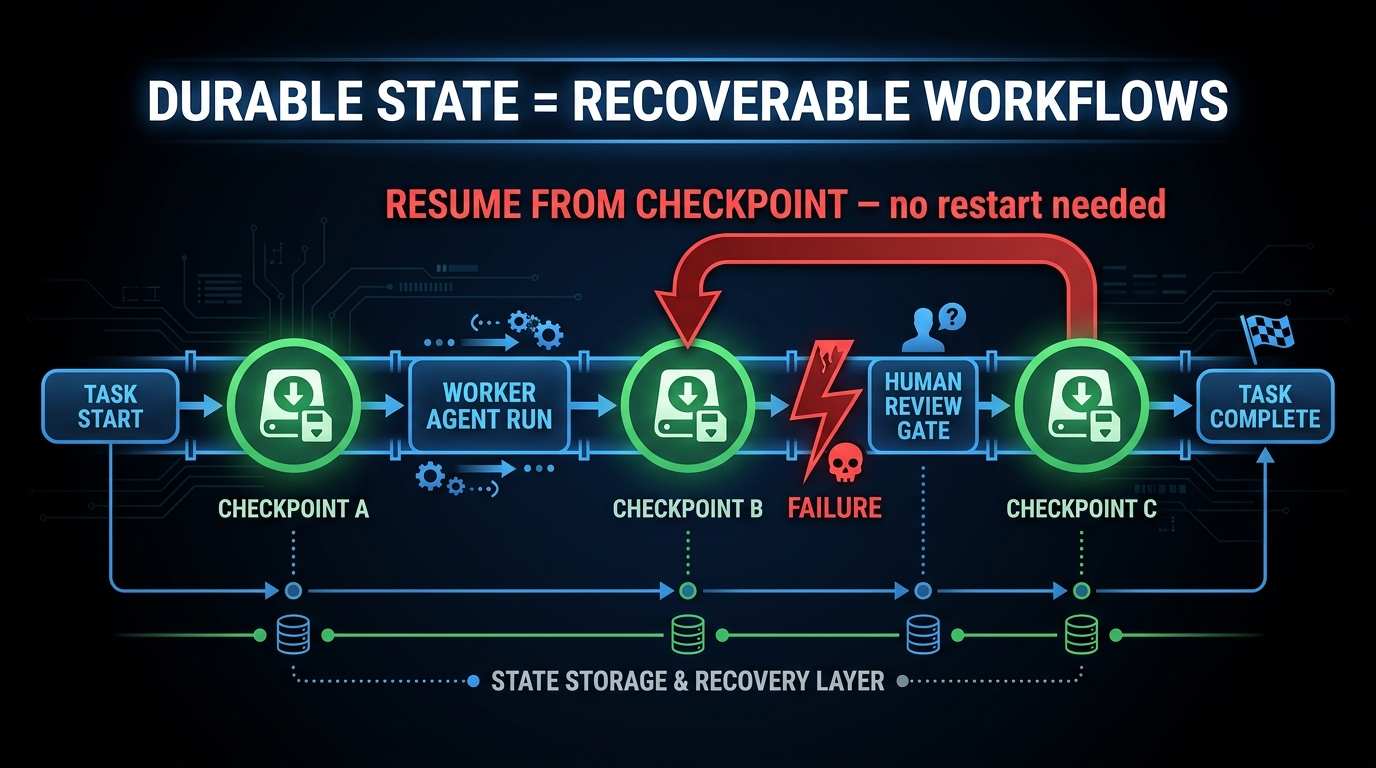
State management is where the gap between a demo and a production system is most visible. In a demo, state lives in memory. The workflow runs start to finish. If it fails, you restart it. That’s fine when you’re testing. It’s unacceptable when your workflow takes 20 minutes, involves 12 agent calls, consumes significant API tokens, and fails at step 11 due to a transient network error.
Production multi-agent supervisors need state that is typed, validated, serializable, and durable. These aren’t optional refinements — they’re the minimum conditions for a system you can operate reliably.
Typed State as a Foundation
The foundation is a typed state schema. Every field that flows through your supervisor-worker system should have an explicit type, and that type should be enforced at agent boundaries. In Python-based frameworks, this typically means TypedDict or Pydantic models with Literal-typed routing fields. The routing field that controls which agent runs next shouldn’t accept arbitrary strings — it should accept exactly the set of valid agent names, validated against the schema before execution continues.
This single change eliminates an entire category of failure. Without typed routing, your supervisor can hallucinate an agent name that doesn’t exist, and the system either crashes with a confusing error or silently routes to a fallback in a way that’s hard to debug. With typed routing, that failure is caught immediately at the schema boundary, with a clear error message that identifies exactly where the routing broke down.
The same principle applies to worker outputs. Every worker should return a structured, typed response. The supervisor shouldn’t need to parse natural language from a worker to determine whether the task succeeded. There should be a status field, a result payload, and an error field — all typed, all required, all validated before the supervisor processes the response.
Durable Checkpointing at Logical Boundaries
Beyond typing, production systems need checkpoints. A checkpoint is a serialized snapshot of the full system state, written to durable storage at defined points in the workflow. When a failure occurs, the system resumes from the last checkpoint rather than restarting from scratch.
The key word is “durable.” In-memory checkpoints don’t survive process restarts. SQLite-backed checkpoints don’t survive container failures. Production systems need checkpoints in genuinely persistent stores — Postgres, Redis, or a managed equivalent — with the checkpoint writes happening synchronously at logical boundaries, not asynchronously in the background.
Logical boundaries for checkpointing typically include: after the supervisor routes to a worker (before the worker runs), after a worker completes (before the next routing decision), and before any external side effect — writing to a database, sending an email, calling an external API. This last point is critical for idempotency: if the system restarts after a side effect but before the checkpoint, you may execute the side effect twice. Checkpointing before side effects, combined with idempotency keys, prevents duplicate execution.
Per-Agent State Namespacing
In systems with multiple concurrent workers — especially when workflows fan out to parallel sub-agents — state namespacing prevents workers from inadvertently overwriting each other’s data. Each worker should have its own keyed namespace within the shared state, so a write from the code agent doesn’t collide with a write from the data agent. This is straightforward to implement in framework-aware state systems but easy to overlook when building custom orchestration on top of a basic message queue.
Tool Scoping and Blast Radius: The Least-Privilege Principle for Agent Workers
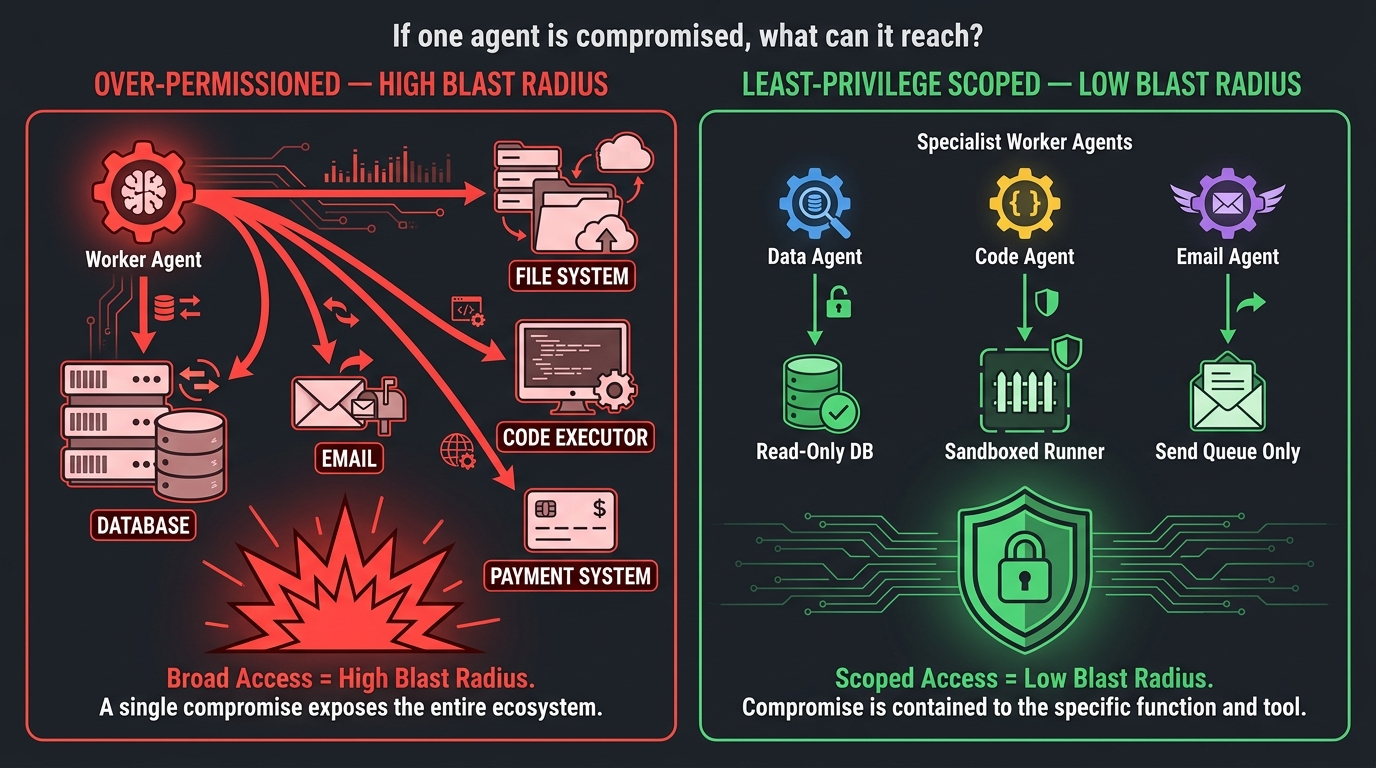
Every worker agent in your system can reach certain tools, data stores, and downstream services. The set of things a misbehaving or compromised agent can affect — its blast radius — is determined entirely by what you gave it access to. This is the least-privilege principle applied to agent design, and it’s one of the most consequential architectural decisions you’ll make.
The temptation in early system design is to give workers broad tool access. It’s simpler to maintain one universal tool registry than to curate per-agent tool sets. It’s faster to add a tool globally than to decide which agent really needs it. And in development, when all the agents are trusted and well-behaved, broad access doesn’t cause visible problems.
In production, the effective blast radius of your system is determined by your weakest permission boundary. Not your average boundary — your weakest one.
Designing Narrow Tool Sets Per Worker
The practical alternative is to define tool sets at worker specification time, not at system initialization time. Each worker gets exactly the tools required to perform its defined function — and nothing else. A data retrieval worker gets read-only database access. A code execution worker gets a sandboxed runtime with no network access and no file system access outside a defined scratch directory. An email worker gets a send queue interface, not direct SMTP access, and definitely not access to the email archive or contact database.
This narrowing has compounding benefits beyond security. Narrow tool sets make worker behavior more predictable. When a worker has 20 tools available, the model has 20 options to reason through on every step. When it has 3 tools, reasoning is faster, more reliable, and easier to evaluate. Tool selection becomes the bottleneck in a lot of agentic workflows, and reducing option space meaningfully improves both accuracy and latency.
Sandboxing as Infrastructure
Beyond logical tool scoping, production systems increasingly treat worker isolation as a physical infrastructure concern. Code execution workers run in fresh containers with no persistence between calls. Workers that access external APIs do so through a proxy that enforces rate limits, logs all calls, and can be disabled without touching the agent itself. Credential injection happens at execution time from a secrets manager, not by embedding credentials in agent prompts or environment variables that all agents share.
This level of isolation is overhead. It adds latency, operational complexity, and infrastructure cost. The question is what you’re comparing that cost against. A single worker with overly broad access that misbehaves in production — whether due to a bad routing decision, a prompt injection attack, or a model error — can corrupt data, trigger unintended external calls, or exhaust rate limits across all your workflows. The cost of proper sandboxing is predictable and bounded. The cost of a blast radius failure is neither.
The Supervisor’s Role in Tool Governance
The supervisor can play a gating role in tool governance beyond just routing. For high-impact actions — writes to production databases, external API calls that incur cost, operations that are difficult to reverse — the supervisor can require explicit confirmation before dispatching the relevant worker. This is distinct from human-in-the-loop review and operates at the agent-to-agent level: the supervisor holds the authority to approve or deny certain actions based on context, rather than delegating that authority entirely to the worker.
Implementing this well means defining a taxonomy of action risk levels. Low-risk actions (read queries, information retrieval, draft generation) are delegated without gate. Medium-risk actions (writes to non-production stores, external calls with low cost) require supervisor-level confirmation based on task context. High-risk actions (production writes, expensive external calls, irreversible operations) trigger human escalation. This taxonomy needs to be explicit in your system design — defaulting to “agents figure it out” is how you end up with an agent that emails your entire customer list during a test run.
Context Window Saturation: The Silent Production Killer
Context window saturation is one of the least-discussed multi-agent failure modes, and one of the most costly. It doesn’t cause a dramatic crash. It causes gradual, hard-to-attribute degradation — routing decisions that were correct at task step 3 become unreliable at step 12, as the growing weight of accumulated history crowds out the current task context.
Research suggests routing accuracy begins to degrade noticeably after 8–12 sub-agent round trips, as prior messages, tool outputs, and intermediate reasoning consume an increasing fraction of the available context window. The supervisor starts making decisions based on stale or incomplete representations of the current state. Workers receive truncated context that omits earlier constraints. The system produces outputs that technically ran to completion but answered a subtly different question than the one that was asked.
The 60–80% Threshold Rule
The practical guidance that has emerged from production experience is to treat context window capacity as a resource with a proactive threshold, not a hard limit that triggers failure when exceeded. Most practitioners now set intervention triggers at 60–80% of capacity — well before truncation occurs — so that compaction or handoff happens while there’s still enough space to do it cleanly.
Context compaction means summarizing the accumulated history into a compact representation before continuing. Rather than keeping the full transcript of every agent call, tool output, and intermediate result, the supervisor (or a dedicated compaction node) produces a structured summary: what the original task was, what has been completed, what the current state is, and what remains to be done. The compressed representation replaces the full history, freeing context budget for the next set of operations.
External Memory as the Structural Solution
Compaction is a mitigation. The structural solution is external memory — moving information out of the context window into a persistent, queryable store, and retrieving only what’s relevant for the current step. This is architecturally similar to RAG for knowledge retrieval, but applied to workflow state: rather than carrying the entire task history in context, workers retrieve the specific prior outputs they need using structured lookups.
External memory requires more upfront design work. You need to define what information gets stored, how it’s keyed, and what retrieval patterns each worker needs. You need to handle consistency — a worker’s retrieval should always see the state as of the last completed checkpoint, not a partially-written intermediate state. But for long-running workflows with many steps and multiple parallel sub-agents, external memory is the only approach that scales cleanly without degrading routing reliability as task complexity grows.
Keeping the Supervisor Context Slim by Design
A practical architectural pattern that reduces saturation pressure: route worker outputs to a separate synthesis node rather than back through the supervisor. The supervisor sees only the routing-relevant signal from each worker (“task complete,” “task failed,” “needs escalation”), not the full output. Full outputs go to a synthesis layer or directly to subsequent workers via the shared state. The supervisor’s context stays trim because it never accumulates the detailed results of work it delegated — it just coordinates the sequence.
Human-in-the-Loop as First-Class Production Infrastructure
The phrase “human-in-the-loop” has been in AI discussions for years, but its treatment has usually been afterthought-level: a flag you could set, a webhook you could wire up, something you added when compliance asked for it. The shift happening in production supervisor systems in 2026 is different: human review is being designed as first-class infrastructure, with the same engineering rigor as any other system component.
The distinction matters because an afterthought human gate is brittle. It blocks the workflow indefinitely when a reviewer is unavailable. It doesn’t know what context to surface to the reviewer. It doesn’t handle timeout gracefully. It can’t route to an alternate reviewer or escalate after a defined wait period. Teams that treat human review as an edge case build systems that work in demos and fail when reviewers go on vacation.
Pause and Resume as Workflow Primitives
Production-grade human-in-the-loop architecture treats pause and resume as first-class workflow primitives, not exception paths. The supervisor encounters a decision point that requires human input — a high-risk tool call, a routing ambiguity, a compliance approval, a budget threshold — and instead of either proceeding autonomously or failing, it writes the current state to a checkpoint and transitions to a waiting state.
The waiting state is durable. The workflow can remain paused for minutes, hours, or days. When the reviewer approves, rejects, or provides input, the workflow resumes from the checkpoint with the human’s decision incorporated into the state. No work is lost. No context needs to be reconstructed.
This requires the checkpoint infrastructure described earlier — durable storage, per-workflow state namespacing, and idempotent step design. It also requires a review interface: a UI or API that surfaces the relevant context to the reviewer, accepts structured input, and writes the decision back to the checkpoint store in a way the supervisor can consume on resume.
Configurable Autonomy Levels
Not all workflows need the same human oversight level, and hardcoding a single review requirement is inflexible. Production systems are increasingly implementing configurable autonomy tiers. Low-autonomy workflows require human approval at every significant step — appropriate for compliance-sensitive operations or early-stage deployments where trust in the system is still being established. Medium-autonomy workflows run autonomously within defined parameters, with human escalation triggered by confidence signals below a threshold or by specific action types. Full-autonomy workflows run end-to-end without review, reserved for well-tested, low-stakes, fully reversible operations.
The tier a given workflow runs at should be explicit in its configuration, logged in every execution trace, and adjustable without code changes. As a workflow accumulates a track record of reliable operation, its autonomy tier can be raised. If a new failure mode is discovered, it can be lowered immediately. This configurability makes autonomous operation an earned capability rather than a permanent default — a significant shift from early agentic deployments that treated autonomy as the goal rather than the risk.
Observability That Actually Spans Multi-Agent Handoffs
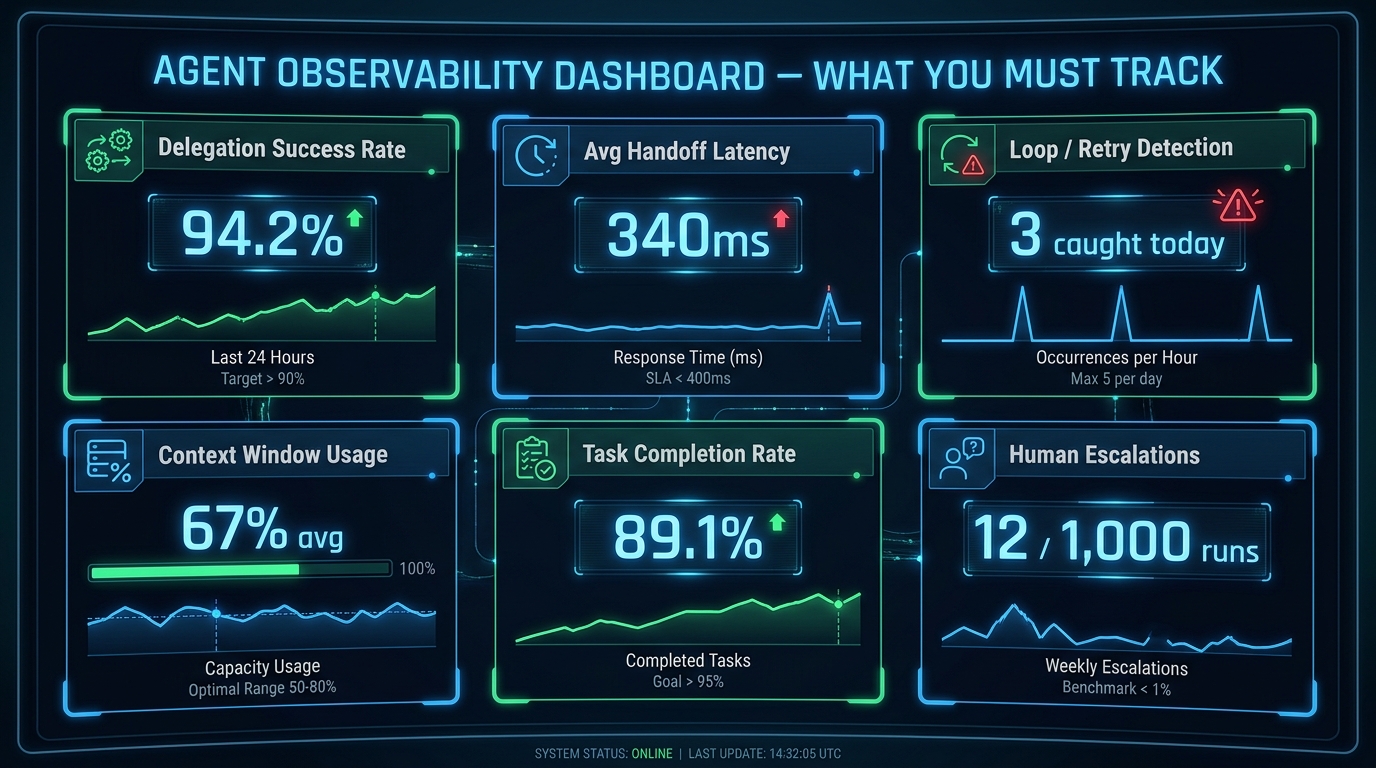
Classic application monitoring captures what you need to know about a single-process system: latency, error rates, resource usage, and uptime. Multi-agent systems break this model completely. The failure that matters — a routing loop between two workers, a context handoff that drops a constraint, a worker that returns a valid-looking but semantically wrong result — doesn’t show up in any of those metrics. The system looks healthy while producing bad outputs.
The move in 2026 has been toward agent-native observability: tracing infrastructure that understands the structure of multi-agent systems and can reconstruct the full delegation tree from a single request ID. This is built on OpenTelemetry GenAI conventions, which are becoming the dominant vendor-neutral standard for instrumenting LLM and agent calls.
Tracing the Full Delegation Tree
The minimum viable trace for a multi-agent workflow captures every node in the delegation chain: the initial request to the supervisor, the supervisor’s routing decision and its inputs, the full input and output of each worker invocation, any tool calls made within worker executions (with arguments and return values), handoff payloads between agents, and the final synthesized output. Every span in this tree is linked by a common trace ID and a parent-child relationship that makes the execution sequence visually reconstructable.
This level of tracing enables root cause analysis that is otherwise nearly impossible. When a workflow produces a wrong result, you need to answer: which agent made the first bad decision? What information did it have available? Did the supervisor route correctly? Did the worker’s output get passed to the next agent intact? Trace-level visibility answers all of these questions without requiring you to reproduce the failure in a development environment.
The Metrics That Actually Matter for Supervisors
Beyond tracing individual executions, production supervisor systems need aggregated metrics that surface systemic problems. The key indicators worth tracking fall into several categories:
- Delegation quality: What percentage of routing decisions result in the correct worker being invoked on the first try? Routing F1 — precision and recall of worker selection — is the leading indicator of supervisor health.
- Handoff success rate per edge: For each supervisor-to-worker and worker-to-worker connection in your graph, what fraction of handoffs pass validation and complete successfully? Low rates on a specific edge identify exactly where coordination contracts are failing.
- Loop and retry detection: How many times does a given task invoke the same worker before completing? A loop counter that regularly exceeds 2–3 on any worker indicates a routing or task decomposition problem.
- Context window utilization: Average and P99 context usage at each routing decision point. Rising P99 values indicate workflows that will eventually hit saturation, giving you time to add compaction before it becomes a failure mode.
- Task completion rate by workflow type: Not just “did the workflow finish” but “did it finish correctly” — which requires evaluation, not just execution monitoring.
- Human escalation rate: What fraction of workflows trigger a human review gate? A rising escalation rate for a workflow that previously ran autonomously is an early warning signal for model drift or changing input distribution.
Evaluation as a Production Component
The newest layer in production agent observability is evaluation integrated directly into the live system, not just run offline. This means attaching task-specific scorers — automated judges that evaluate whether a completed workflow produced a correct, complete, and appropriately formatted result — to every workflow execution. Aggregate scorer results feed back into the metrics system, providing the semantic quality signal that pure execution metrics miss.
LLM-as-judge evaluation, where a separate model reviews the output of completed workflows against defined criteria, is the most common implementation. The accuracy of this approach varies by task type, and the evaluation model must be different from the one running the workflow to avoid self-serving bias. Well-designed evaluation pipelines sample a subset of live executions, route interesting cases (low-confidence scores, novel failure patterns) to human review, and aggregate results into dashboards that track quality trends over time — not just point-in-time failures.
Hierarchical vs. Flat Swarm: Choosing the Right Topology
The supervisor pattern is not the only multi-agent topology available, and part of designing these systems well is knowing when a different approach fits better. The main alternative in production use is the flat swarm — a peer-to-peer topology where agents communicate directly with each other, without a centralized coordinator routing all decisions.
The hierarchy versus swarm choice is not a philosophical debate. It’s an engineering decision with concrete tradeoffs that depend on your specific workflow characteristics.
Where Hierarchy Wins
Hierarchical supervisor architectures are the right choice when your workflow has these properties:
- Multi-step tasks with clear handoff boundaries. Sequential pipelines where the output of one phase becomes the input of the next are natural fits for supervisor coordination. The supervisor maintains the sequence without requiring agents to negotiate handoffs directly.
- Compliance and auditability requirements. Every routing decision made by a supervisor is logged with its inputs and outputs. Auditors can trace exactly who decided what and when. Flat swarms, where agents negotiate directly, are significantly harder to audit because there’s no single decision log.
- Mixed risk levels across tasks. When some actions in a workflow need explicit human approval and others don’t, the supervisor provides a natural gate. Swarm systems struggle with centralized risk controls because there’s no central authority to apply them.
- Debugging and iteration speed. Hierarchical systems are much easier to instrument and debug because execution flow is explicit. When something goes wrong, you look at the supervisor’s routing decisions. In a flat swarm, emergent behavior makes root cause analysis significantly harder.
Where Flat Swarm Wins
Flat swarm architectures outperform hierarchical ones in a specific set of conditions:
- Highly parallel, independent tasks. When work can be distributed to many agents simultaneously and there’s no meaningful sequential dependency, a swarm avoids the latency overhead of routing every task through a central coordinator.
- Exploratory or creative workflows. Tasks where the optimal path through the problem space isn’t known in advance — research tasks, generative exploration, hypothesis generation — benefit from flexible peer-to-peer discovery rather than a supervisor’s rigid routing schema.
- Token efficiency at high parallelism. Each routing decision through a supervisor costs tokens. At high task volume with many parallel agents, eliminating the coordinator can meaningfully reduce inference cost.
The practical recommendation from production engineering experience is to default to hierarchical supervisor designs for enterprise workflows and reserve swarm patterns for specific use cases where the latency, parallelism, or exploration benefits clearly outweigh the loss of auditability and control. Many teams run mixed topologies: a supervisor coordinates the high-level workflow, while specific sub-tasks are handled by small swarm-style agent groups operating within a defined scope before returning results to the supervisor.
What Production-Ready Actually Looks Like: A Pre-Ship Checklist
The difference between a multi-agent supervisor that works in a notebook and one that holds in production comes down to a set of engineering commitments that are easy to defer and costly to retrofit. Here is a practical checklist of the minimum requirements for a supervisor system that’s genuinely ready to ship.
State and Schema
- Every state field has an explicit type and is defined in a shared schema accessible to all agents.
- Routing fields use
Literal-typed enumerations, not arbitrary strings. - Worker output schemas are validated at the boundary before the supervisor processes them.
- All state objects are serializable to a durable format (JSON, Pydantic models) without information loss.
- Per-agent state namespacing prevents concurrent write collisions.
Reliability Infrastructure
- Checkpoints are written to durable storage (Postgres or equivalent) at every logical workflow boundary.
- All side effects are wrapped in idempotency keys to prevent duplicate execution on retry.
- The supervisor has hard loop guards — a maximum iteration count after which it fails closed rather than looping indefinitely.
- All LLM and tool calls have explicit timeouts and retry logic with exponential backoff.
- Circuit breakers prevent cascade failures when a downstream service or API is unhealthy.
Tool and Permission Controls
- Each worker has a documented, minimal tool set defined at specification time.
- Credentials are injected at execution time from a secrets manager — not embedded in prompts or shared environment variables.
- High-impact actions (production writes, expensive external calls) require explicit confirmation before execution.
- Workers execute in isolated environments — containers, sandboxed runtimes, or equivalent isolation mechanisms.
Observability and Evaluation
- Every workflow execution produces a complete trace spanning all agent invocations, with linked spans and a shared trace ID.
- Delegation quality, handoff success rates, and loop counters are tracked as aggregated metrics.
- Context window utilization is monitored with an alert threshold at 70% of capacity.
- Automated evaluation runs on a sample of completed workflows to catch semantic quality degradation.
- Human escalation paths are defined, tested, and monitored for response time SLAs.
Human-in-the-Loop
- Review gates are explicitly defined in the workflow specification, not added as exception handling.
- Paused workflows persist durably and resume correctly from the last checkpoint.
- Autonomy tiers are configurable without code changes.
- Review interface surfaces structured context, not raw agent logs, to reviewers.
The Seam, Not the System: A Different Way to Think About What You’re Building
There’s a framing error that affects a lot of multi-agent supervisor design: treating the supervisor as the system. Teams invest enormous effort in the supervisor’s reasoning, its prompt engineering, its model selection, and its coordination logic — and treat the workers, the state infrastructure, the tool permissions, and the observability layer as supporting cast.
The more accurate framing is that the supervisor is the seam between all the things that actually do the work. Workers do work. State infrastructure preserves it. Observability exposes it. The supervisor is the connective tissue that holds the sequence together. Its quality is measured by how invisible it is — how rarely its routing failures surface, how cleanly its state transitions preserve context, how reliably its escalations reach the right human at the right time.
The best production supervisor systems are genuinely boring to operate. They have dashboards with metrics that stay green. They have escalation queues that fill and empty predictably. They have incident postmortems that are short because failures are caught early, localized by the tree structure, and resolved from a checkpoint without system-wide restart. They produce audit logs that compliance teams can read without engineering interpretation.
The Engineering Path from Here
The MAST study’s 41–86% failure rate figure is not a permanent ceiling — it’s a description of where the ecosystem is today, before the engineering practices in this post have been widely adopted. Systems that implement typed state, scoped tool permissions, durable checkpointing, proactive context management, and agent-native observability have measurably better reliability than those that don’t.
The gap between a supervisor that routes correctly in a controlled test and one that operates reliably in production is an engineering gap, not a model gap. It gets closed through the same disciplines that make any complex distributed system reliable: explicit contracts, defensive boundaries, durable state, comprehensive instrumentation, and operational procedures that don’t assume things will go right.
Multi-agent supervisor design is a young discipline. The patterns in this post represent the current leading edge of production practice, not settled convention. They will evolve as more systems ship, more failure modes are documented, and the engineering community accumulates the operational experience to know what actually holds under real conditions. The teams best positioned to contribute to that evolution — and to benefit from it — are the ones treating these systems as serious engineering problems from the start, not wiring together agents and hoping for the best.
The supervisor isn’t what makes multi-agent systems powerful. The engineering discipline around it is.
Key Takeaways
- Keep supervisors minimal: their job is routing, not reasoning. One typed output, one decision per step.
- The MAST study shows the majority of multi-agent failures are engineering problems — fix your system design before your model.
- Replace single global supervisors with scoped supervisor trees to contain failures and remove throughput bottlenecks.
- Checkpoint state durably at every logical boundary. In-memory state isn’t production state.
- Define blast radius before you define tool access. Scope workers to the minimum required permissions.
- Set context window intervention thresholds at 60–80% capacity — not at overflow.
- Treat human-in-the-loop as first-class workflow infrastructure, with durable pause/resume and configurable autonomy tiers.
- Instrument delegation quality, handoff success rates, and context utilization as primary observability metrics — not just latency and error rates.