





Somewhere in the last 18 months, Amazon’s search engine stopped being a keyword machine and started becoming something closer to a shopping intelligence system. The sellers who noticed early are winning. Most others are still optimizing for an algorithm that no longer fully exists.
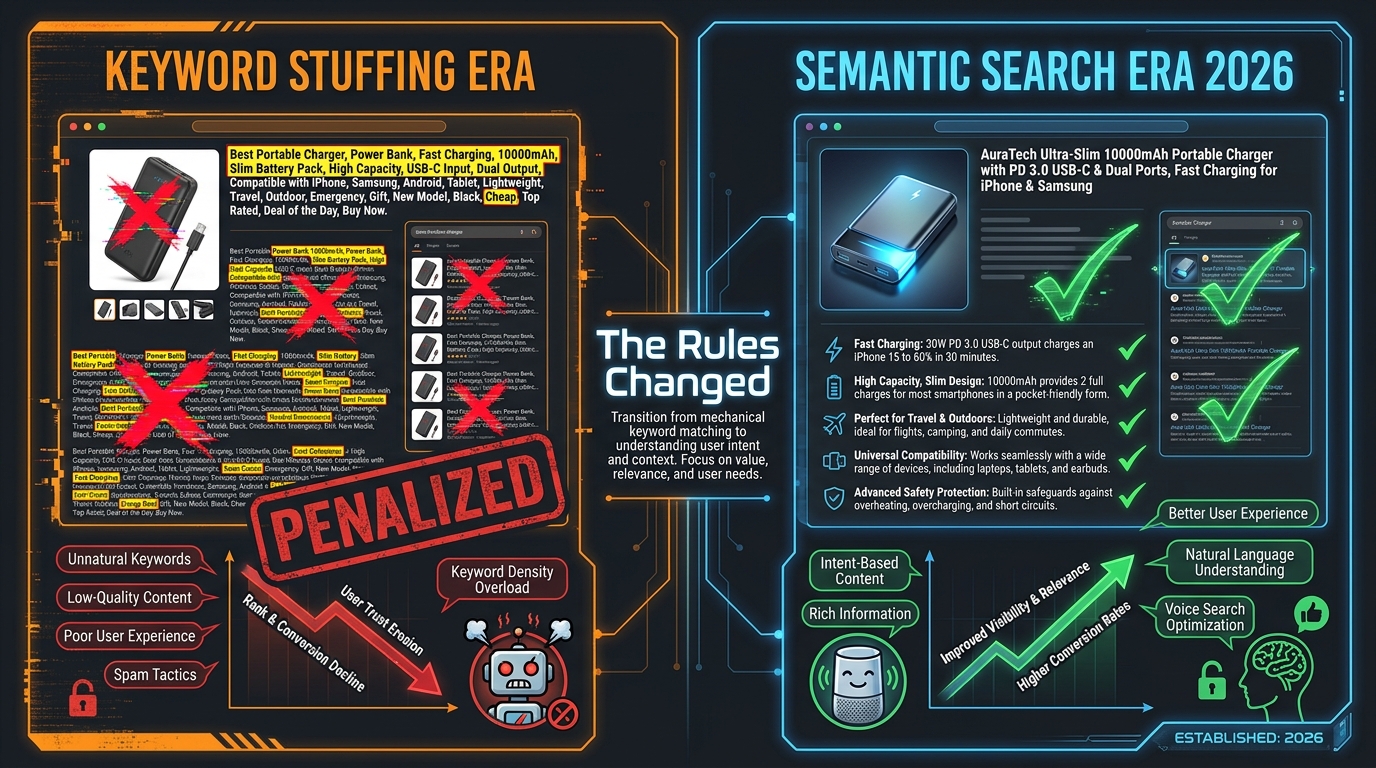
The old playbook was straightforward: research high-volume keywords, pack them into your title and bullets, index for as many terms as possible, and let traffic do the rest. That playbook didn’t fail overnight — it eroded. Slowly at first, then all at once. Today, in mid-2026, Amazon operates a three-layer AI search stack that evaluates your listing the way a smart shopper would: not just for what it says, but for what it means, what problem it solves, and whether it’s the right answer to a specific buyer’s intent.
The three layers are A10 (the traditional keyword-and-performance algorithm), COSMO (a commonsense knowledge graph that maps semantic relationships between products, use cases, and buyer intent), and Alexa for Shopping (the generative AI assistant that replaced Rufus in May 2026 and now sits directly inside Amazon’s search interface). Each layer reads your listing differently. Each one can help you — or hurt you — depending on how your content is structured.
This post is not a general overview of Amazon SEO. It’s a specific, technical walkthrough of how each AI layer in Amazon’s search stack reads your listing, where most sellers are losing ranking they don’t even realize they’ve lost, and what a genuinely AI-optimized listing looks like from the ground up — not just in title and keywords, but in product attributes, Q&A, A+ content, and the first-party data signals Amazon gives you for free.
If you’ve read everything about the A10 algorithm and still feel like your rankings are plateauing, the answer is probably not more keywords. It’s a fundamentally different way of thinking about what a product listing is actually for.
The Three-Layer Search Stack: How Amazon’s AI Actually Works
Most sellers treat Amazon’s search algorithm as a single system — one ranking engine that takes keywords in and spits rankings out. That model was already oversimplified two years ago. In 2026, it’s almost completely wrong. Amazon’s search now operates across three distinct AI systems that run in parallel, each reading your listing for different signals and surfacing you in different discovery contexts.
Layer 1: A10 — The Foundation
A10 is the evolution of Amazon’s original keyword-matching algorithm. It remains the backbone of traditional search — the engine that processes what a shopper typed and matches it to indexed listings. But A10 is no longer just about keyword presence. It now weights behavioral signals heavily: conversion rate, click-through rate, sales velocity, and seller authority all feed into A10’s ranking decisions alongside keyword relevance.
According to 2026 practitioner data, A10 distributes ranking weight roughly as follows: sales velocity accounts for approximately 35-40% of ranking influence, conversion rate carries significant weight as an independent signal, seller authority (including account health and review volume) contributes meaningfully, and keyword relevance — while still necessary — is no longer the primary differentiator it once was. You can have perfect keyword coverage and rank below a competitor who has fewer exact matches but dramatically better conversion data.
The practical implication: A10 still needs keywords to index your listing. But it uses behavioral proof — the evidence that shoppers actually choose your product when they see it — as the tiebreaker. A listing that A10 can both find and confirm works performs better than one it can only find.
Layer 2: COSMO — The Semantic Intelligence Layer
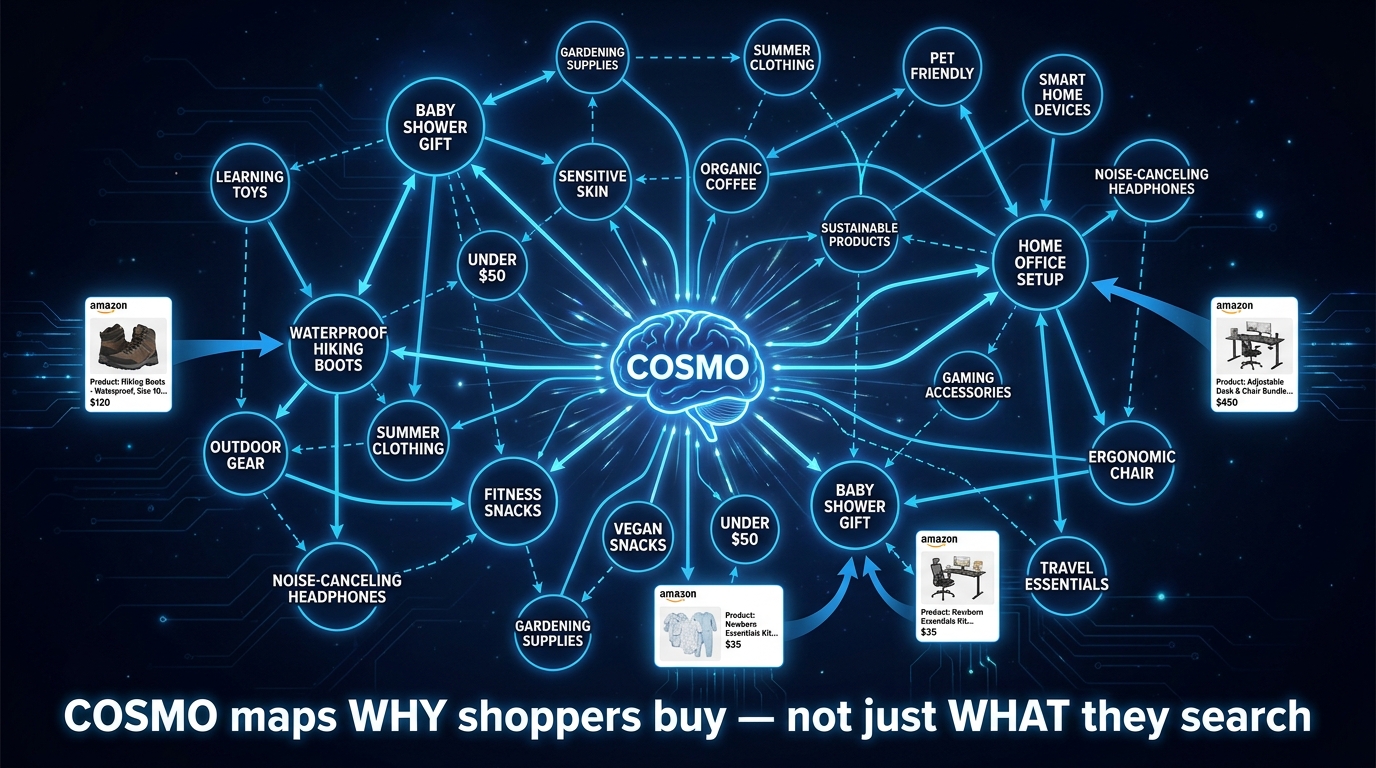
COSMO is Amazon’s commonsense knowledge graph, and it’s the layer that most sellers don’t know about and don’t optimize for. Unlike A10, COSMO doesn’t read keywords. It reads meaning — specifically, the relationships between products, buyer contexts, use cases, and the reasons people actually purchase things.
COSMO was built not from listing text, but from Amazon’s own behavioral data: the patterns of what people searched before buying, what they bought together, what categories they browsed, and what language appeared in reviews from satisfied customers. The result is a massive map of why people buy products — not what they call them. COSMO connects “waterproof bluetooth speaker” to a mental model of “camping trip entertainment”, “pool party”, and “gift for college student.” It connects “collagen peptide powder” to “post-workout recovery”, “joint pain”, and “skin health over 40.”
When your listing clearly communicates the use case, the buyer type, and the problem it solves — in natural, human language — COSMO can map you accurately to those intent clusters. When your listing is a keyword wall, COSMO either can’t map you confidently or maps you to the wrong intent clusters, which means you show up in front of the wrong shoppers at the wrong moment.
Layer 3: Alexa for Shopping — The Conversational Discovery Surface
On May 13, 2026, Amazon officially retired the Rufus shopping chatbot and folded its technology into Alexa for Shopping — now accessible via a cursive “A” icon embedded directly in the Amazon search bar on both desktop and mobile. This is no longer a sidebar feature. It’s integrated into the primary search experience.
Alexa for Shopping operates as a generative AI assistant that interprets shopper questions, queries the product catalog for answers, and surfaces specific listings with explanatory context. When a shopper asks “what’s the best protein powder for women over 50 who don’t want a chalky texture?”, Alexa for Shopping doesn’t return a keyword-matched SERP. It reads product listings, reviews, Q&A sections, and A+ content to construct an answer, then recommends specific products with explanations drawn directly from your listing content.
Listings that contain clear, conversational, question-answering content get cited. Listings that only have keyword-dense bullets often don’t — even if they rank on page one for traditional searches.
Why Traditional Keyword SEO Is Quietly Losing Ground
Let’s be precise here: traditional keyword SEO isn’t dead on Amazon. Your listing still needs to be indexed for the right terms. A10 still processes keywords. Backend Search Terms still exist and still contribute to indexing. Anyone telling you keywords are irrelevant is wrong.
But there’s a meaningful difference between keywords being necessary and keywords being sufficient. In 2024, a well-researched keyword list was most of the job. In 2026, it’s less than half of it.
The Backend Keywords Shift
Amazon’s own behavior has signaled this change at the infrastructure level. The company has begun removing or de-emphasizing the generic backend keyword field in some US product category templates — particularly in categories where structured product attributes provide sufficient semantic data for Amazon’s AI systems to understand what the product is and who it’s for. This doesn’t mean you can ignore Search Terms where they still exist. It means Amazon is telling you, through its own product template architecture, that structured attribute data is becoming more valuable than hidden keyword lists.
There’s also a practical ceiling problem with keyword-first strategies. A10 has a 250-byte Search Terms limit. Once you’ve filled that with your highest-priority terms, you’ve maxed out that channel. The only way to expand your semantic footprint further — to reach more intent clusters, more use cases, more buyer types — is through the visible content of your listing: title, bullets, A+ content, Q&A, and product attributes.
Keyword Density vs. Semantic Depth
Here’s the distinction that matters most in practice: keyword density is about how many times a term appears in your listing. Semantic depth is about how many distinct buyer contexts, use cases, and intent clusters your listing speaks to.
A listing with 15 repetitions of “stainless steel water bottle” has high keyword density for that phrase but shallow semantic depth. A listing that mentions “hiking hydration”, “office desk use”, “leak-proof for gym bags”, “BPA-free for kids’ sports practice”, and “keeps drinks cold for 24 hours” has strong semantic depth — it speaks to four or five distinct buyer intents that COSMO can map, and it provides answers that Alexa for Shopping can cite when a shopper asks a use-case-specific question.
COSMO reads for semantic depth. Alexa for Shopping cites semantic depth. And here’s the feedback loop that makes this so important: listings with higher semantic relevance to a buyer’s specific intent tend to convert better, which feeds A10’s behavioral signals, which improves organic ranking, which brings more qualified traffic, which improves conversion further. The three layers reinforce each other — but only if your listing is built for all three simultaneously.
How COSMO’s Knowledge Graph Actually Reads Your Listing
COSMO is perhaps the most consequential and least understood component of Amazon’s current search architecture. Understanding how it works — and what it looks for — changes how you should approach every piece of content on your product detail page.
What COSMO Was Built From
COSMO is not a traditional keyword index or a product taxonomy database. It was constructed from years of Amazon shopping behavior data: search-to-purchase chains, co-purchase patterns, browsing paths, review language from verified buyers, and the semantic relationships that emerged naturally from how real shoppers navigate the marketplace.
The result is a graph — a network of nodes and relationships — that connects abstract purchase intentions to product types, and product types to specific attributes and use cases. When a shopper searches “gift for 70-year-old dad who likes gardening,” COSMO doesn’t try to keyword-match that phrase against listing text. It traverses its graph to find what product types are consistently purchased in “gift for elderly parent” contexts, what attributes those products typically have (easy grip, lightweight, large print instructions, etc.), and which listings match that profile.
Your listing contributes to COSMO’s mapping of you in two ways: first, through the behavioral data accumulated over time from shoppers who found and purchased your product; and second, through the actual content of your listing, which COSMO parses to understand your product’s purpose, audience, and context.
What COSMO Looks For in Listing Content
COSMO is particularly attentive to several content signals that most keyword-focused optimization ignores:
Explicit buyer identification. Language that directly names who the product is for (“designed for first-time campers,” “ideal for home bakers,” “built for remote workers”) helps COSMO map your product to audience-based intent clusters. Generic language like “suitable for all users” provides almost no COSMO signal.
Use-case specificity. Listing a product as being useful “at the gym, at the office, on camping trips, and during commutes” is more valuable to COSMO than claiming it’s “versatile for any occasion.” Specific contexts map to specific intent clusters. Vague descriptions map to no cluster reliably.
Problem-solution framing. COSMO understands products partly through the problems they solve. Copy that articulates the problem first (“if your protein powder always leaves a chalky aftertaste…”) and then presents the product as the solution creates a semantic chain that COSMO can traverse when a shopper’s query includes that same problem context.
Natural language over keyword language. Keyword-first writing produces phrases like “water bottle stainless steel insulated BPA-free 32oz.” Natural language writing produces phrases like “keeps your coffee hot for 12 hours and your water ice-cold through a full workday.” COSMO processes natural language better because that’s what most of Amazon’s behavioral training data looks like — it came from how real shoppers search and review, not how sellers write keyword lists.
The Attribution Window Problem
One critical nuance: COSMO’s behavioral data takes time to accumulate. For new products or new ASINs, COSMO has little behavioral signal to work with, so it relies more heavily on your listing content for initial categorization. This means the content quality at launch matters more for new products than it does for established ones. A poorly written launch listing doesn’t just underperform in week one — it gets miscategorized by COSMO, draws lower-quality traffic, accumulates weaker behavioral signals, and becomes progressively harder to correct. Getting the semantic structure of your listing right from day one is not a luxury; it’s a compounding competitive advantage.
Alexa for Shopping: What Replaced Rufus — and Why It Matters More
The May 2026 rebranding from Rufus to Alexa for Shopping wasn’t a cosmetic name change. It represented a significant expansion of AI-assisted discovery within Amazon’s core search experience. Understanding what changed — and what it demands from your listing — is now a baseline requirement for competitive sellers.
The Architecture of Conversational Discovery
Alexa for Shopping is positioned as a generative AI shopping assistant that operates above the traditional A10 search layer. When a shopper uses it, they’re not submitting a keyword query and receiving a ranked list. They’re having a conversation. They might ask: “What’s a good noise-canceling headphone for someone who’s on video calls all day and has a smaller head?” Alexa for Shopping reads that query, identifies the intent parameters (noise cancellation, video call suitability, physical fit), and generates a recommendation response that cites specific products — drawing language from those products’ listings, Q&A sections, review highlights, and A+ content.
The products that get cited are not necessarily the ones with the highest A10 keyword rankings. They’re the ones whose content most clearly answers the shopper’s specific question. A mid-ranked listing with a detailed Q&A section specifically addressing fit comfort and video call audio performance may get cited by Alexa for Shopping over a #1-ranked competitor whose listing doesn’t address those specific attributes.
How Alexa for Shopping Sources Its Answers
Alexa for Shopping draws from a specific content hierarchy when constructing its recommendations. Understanding this hierarchy tells you exactly where to invest your optimization effort for maximum AI-surface visibility:
- Product title and bullet points — scanned for primary features, key differentiators, and explicit use cases.
- Q&A section — treated as a direct FAQ that Alexa for Shopping can cite verbatim when a shopper asks a matching question.
- A+ content — read for supplementary context, use-case imagery descriptions, and comparison information.
- Customer reviews — mined for authentic language about product performance in specific use contexts.
- Product attributes — used to filter and match against the structured parameters the shopper expressed.
The implication is direct: listings that were built purely for keyword indexing — with thin bullets, sparse Q&A, no A+ content, and minimal structured attributes — are effectively invisible to Alexa for Shopping’s recommendation layer, regardless of their A10 keyword ranking. You can rank #2 for your main keyword and still never appear in an AI-driven recommendation because your content doesn’t contain what the AI needs to cite.
The Personalization Layer
Alexa for Shopping also incorporates purchase history, browsing behavior, and stated preferences into its recommendations. This means the same query from two different shoppers may yield different recommended products based on their individual Amazon profiles. For sellers, this creates a new dimension of optimization: the more clearly your listing defines its specific buyer persona and use case, the more accurately Amazon’s personalization engine can match you to the shoppers whose behavioral profiles align with your product’s intent context.
The Search Query Performance Report: Your Free First-Party AI Data Asset
Most sellers know the Search Query Performance Report (SQPR) exists. Far fewer use it in a systematic, ongoing way. In 2026, that gap represents a significant missed opportunity — because the SQPR is essentially a real-time readout of how Amazon’s AI search system is routing shopper intent toward (and away from) your product.
What the SQPR Actually Shows
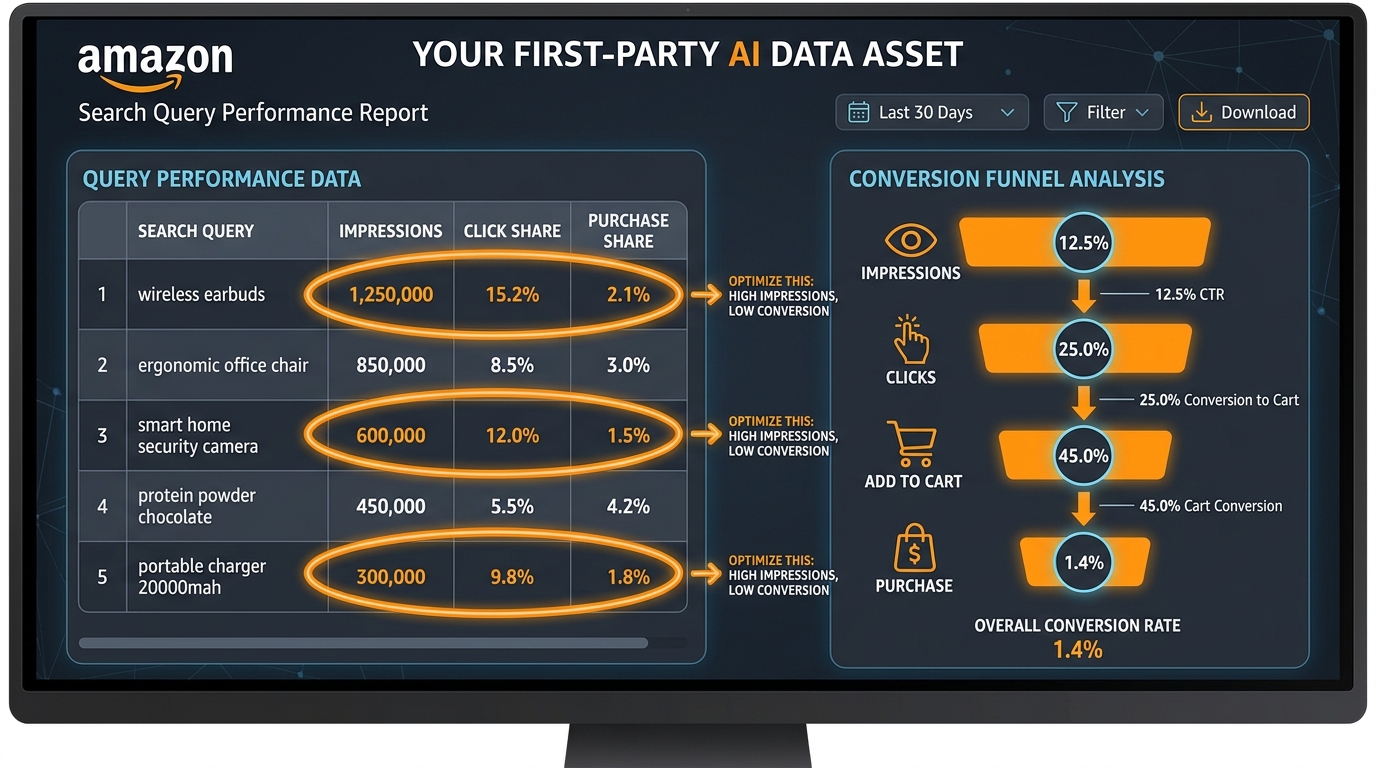
Available in Brand Analytics within Seller Central, the SQPR provides keyword-level funnel data for registered brands. For each search query associated with your brand or ASIN, you get:
- Total search volume — how many times that query was searched in the selected period.
- Impressions and impression share — how often your product appeared in results for that query, and what percentage of total impressions you captured.
- Click share — what percentage of clicks on that query went to your listing.
- Add-to-cart rate and purchase share — the downstream conversion funnel from search to transaction.
This data is not just historical reporting. It’s a diagnostic tool for identifying exactly where your listing is losing buyers in the AI-powered discovery funnel.
Reading the SQPR for AI Optimization Opportunities
The most actionable pattern to look for in the SQPR is the impression-to-purchase gap: queries where your impression share is reasonably strong (meaning Amazon’s AI is finding and surfacing you) but your click share or purchase share is disproportionately low (meaning shoppers are seeing you and choosing not to engage).
This gap is not a keyword problem. If Amazon is already surfacing you for the query, you have sufficient keyword coverage. The problem is content quality — your title, primary image, or price-point combination is failing to convert the impression into a click, or your listing content is failing to convert the click into a purchase. The SQPR tells you which queries to fix, and your listing content is how you fix them.
The second pattern to look for is high-volume queries with zero or near-zero impression share. These represent intent clusters that Amazon’s AI has not connected to your product — either because your listing lacks the semantic content that would let COSMO map you to that use case, or because your product type taxonomy doesn’t place you in the relevant category for that query. These gaps often represent the most significant organic growth opportunities on the platform, and they’re almost always solved through content and attribute optimization rather than keyword additions.
Using SQPR Data in a Weekly Cadence
Leading Amazon brands have adopted a weekly SQPR review cadence — pulling the prior 7-day data, flagging impression-to-purchase gaps, and rotating optimization attention across their highest-priority ASINs accordingly. This cadence allows you to catch ranking erosion early, before it compounds. It also allows you to identify emerging queries — new search terms that are gaining volume — and update your listing content to capture them before competitors do.
A practical note on timing: after making listing content changes, allow a 10-14 day stabilization window before evaluating the impact in SQPR data. Amazon’s AI systems don’t re-index and re-evaluate listings instantaneously. Changes to bullet points or A+ content may take up to two weeks to propagate through COSMO’s knowledge graph and reflect in search behavior data.
Title Architecture for Semantic Search: A Different Way to Build the Most Important Field
Your product title is the single content field that carries weight across all three layers of Amazon’s AI search stack simultaneously. A10 uses it for keyword indexing. COSMO parses it for semantic intent. Alexa for Shopping reads it as the primary product description when constructing recommendation responses. Getting title architecture right for 2026’s search environment is therefore the highest-leverage content decision you make for any listing.
What the Old Title Formula Gets Wrong
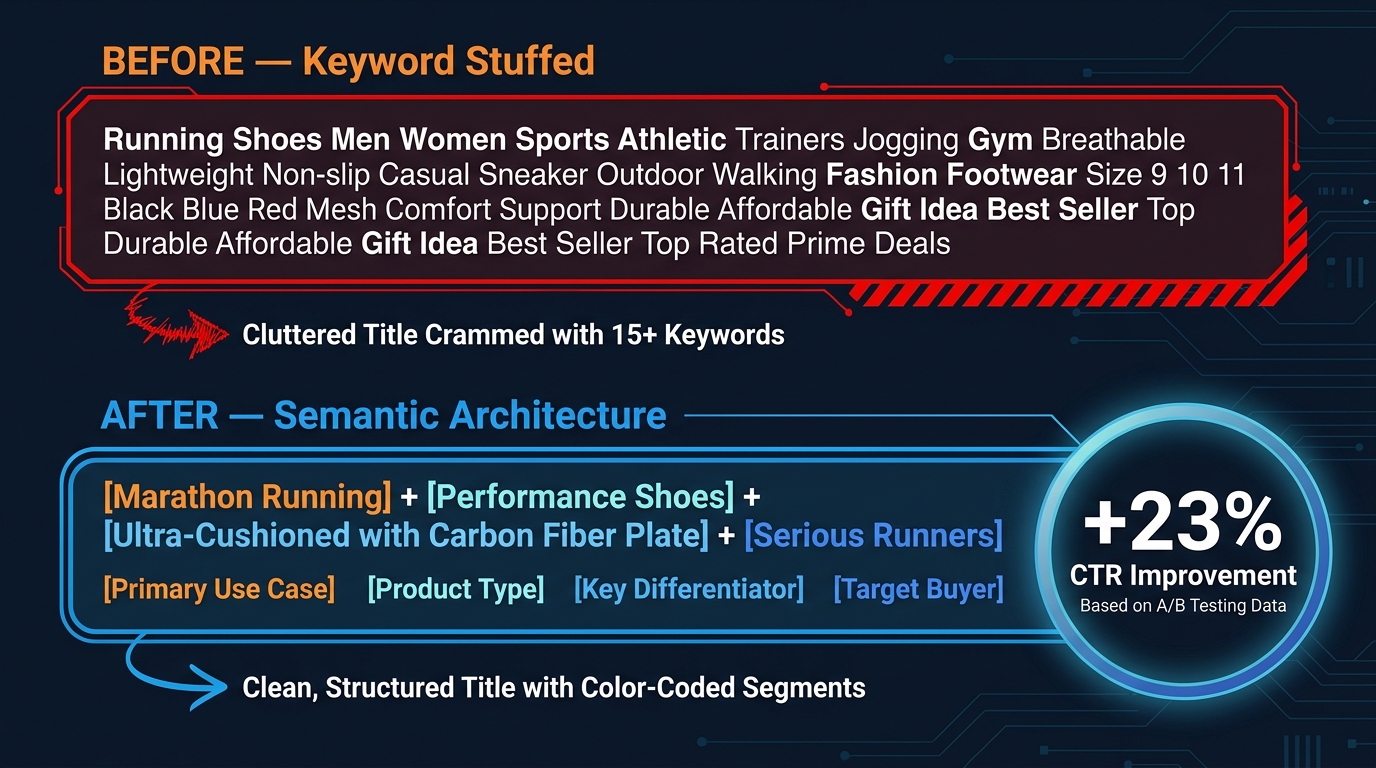
The legacy Amazon title formula looked something like this: [Brand] + [Primary Keyword] + [Secondary Keyword] + [Feature] + [Size/Variant] + [More Keywords]. This formula was optimized for one thing: keyword indexing. It packed as many search terms as possible into the title character limit. The result was titles that read like spreadsheets — functional for bots, incomprehensible to humans, and increasingly poor performers in an AI-mediated search environment.
Here’s the specific problem: Alexa for Shopping quotes your title when recommending your product. A title like “Stainless Steel Water Bottle 32oz Vacuum Insulated BPA Free Leak Proof Sports Water Bottles” doesn’t make a compelling recommendation. It reads like a feature checklist, not a reason to buy. Alexa for Shopping will cite it, but the citation won’t persuade.
A Semantic Title Architecture for 2026
A more effective structure for 2026’s search environment prioritizes intent and natural language while still preserving keyword coverage:
[Primary Use Case or Problem Solved] + [Product Type] + [Key Differentiator] + [Relevant Spec or Variant]
Applied in practice: instead of “Protein Powder Whey Isolate 25g Protein Chocolate Flavor 5lb Bag Low Carb Keto Friendly,” a semantically structured title might read: “Post-Workout Protein Powder for Muscle Recovery — Whey Isolate, 25g Protein, Chocolate, 5lb.”
The difference: the first version leads with what the product is. The second leads with what the product does and who it’s for. Both contain the same primary keywords. But the second version gives COSMO a clear use-case entry point, gives Alexa for Shopping a citable description that actually explains value, and gives shoppers on mobile (where truncation cuts most titles after 80 characters) the most important buying signal — purpose — before the character limit kicks in.
The Mobile Truncation Priority Rule
With a significant and growing share of Amazon purchases happening on mobile, and mobile titles typically truncated to 80-100 characters in search results, the first 70-80 characters of your title carry disproportionate weight on everything that happens before a shopper clicks through. If those characters are occupied by a brand name and three keyword variants, you’ve spent your mobile real estate on indexing signals rather than click-through motivation.
The rule of thumb: lead your title with the most compelling buyer-relevant claim you can make in 70 characters. Follow with keywords and specs. Both A10 and COSMO process the full title, so you’re not sacrificing indexing coverage by leading with intent. You’re simply giving shoppers a reason to click before they run out of characters to read.
Bullets, A+ Content, and Q&A as Stacked AI Knowledge Layers
Below the title, your listing contains three content zones that most sellers treat as independent elements — each optimized separately, rarely designed to work together. For Amazon’s AI search stack in 2026, this is a strategic mistake. These three zones function best as a stacked knowledge system, where each layer addresses a different discovery and conversion context.
Bullet Points: The Intent Bridge
Bullet points are read by all three AI layers, but they serve COSMO and Alexa for Shopping most distinctly. The keyword-first approach to bullets produces content like: “✓ Stainless Steel Water Bottle — Made from premium 18/8 food grade stainless steel.” The semantic approach produces: “✓ Stays Cold 24 Hours Through a Full Day at the Office or on the Trail — Double-wall vacuum insulation that actually works, whether you’re at a standing desk or three miles into a hike.”
The semantic version covers the same product attributes but adds four distinct use-case signals that COSMO can map: “full day,” “office,” “trail,” and “hike.” It also provides Alexa for Shopping with a direct answer to the conversational query “what water bottle stays cold the longest for hiking?” The keyword version provides no such answer.
An effective 2026 bullet structure leads each point with the benefit in context, follows with the feature that delivers it, and ends with a specific use case or buyer scenario. Five bullets structured this way gives COSMO at least five distinct intent-mapping entry points, Alexa for Shopping five potential citable phrases for recommendation responses, and human shoppers five concrete reasons to convert.
A+ Content: No Longer Just Brand Decoration
A+ Content has historically been treated as a brand equity play — brand story, lifestyle imagery, comparison charts — that improves conversion by making the listing look more premium. That’s still true. But in 2026, Amazon’s AI systems read A+ content as an additional knowledge layer that supplements the semantic data in bullets and title.
Amazon’s AI can parse the text content within A+ modules. This means your comparison tables, use-case narrative sections, and feature deep-dives are not just visual conversion tools — they’re AI-readable content that expands COSMO’s understanding of your product and gives Alexa for Shopping additional material to draw from when constructing recommendation responses.
Practically, this means A+ content should be written with the same semantic intentionality as bullets and titles — not just to look good, but to communicate use cases, buyer contexts, and differentiating benefits in natural language that AI systems can parse and cite. A+ comparison modules that clearly articulate why your product is better for a specific use case than a generic alternative give COSMO and Alexa for Shopping structured comparative data they can use in disambiguation (“which of these two products is right for me?”) queries.
Q&A: The Underestimated AI Surface
The Q&A section is probably the single most underoptimized content zone on most Amazon listings, and it’s also one of the highest-leverage opportunities in the AI search era. Here’s why: Alexa for Shopping explicitly draws from Q&A sections when constructing answers to conversational shopper queries. When a shopper asks Alexa for Shopping a specific question about your product type, Amazon’s AI looks for a pre-existing answer in your Q&A section. If one exists, it may cite it directly. If not, it draws from less specific content elsewhere on the page — or surfaces a competitor whose Q&A does have the answer.
The optimization approach is systematic. Mine your reviews for the questions and objections that appear most frequently from buyers. Check your current Q&A section for unanswered or poorly answered questions. Then proactively add questions and authoritative answers that cover:
- The most common purchase-decision questions in your category (sizing, compatibility, materials)
- The specific use-case or scenario questions your target buyer would ask before buying
- Comparison questions (“how does this compare to [general product type]?”)
- Objection-handling questions (“is this suitable for someone with [specific constraint]?”)
Write answers in clear, natural, first-person language — the kind of language a knowledgeable sales associate would use. Avoid keyword stuffing in Q&A answers. The goal is readability and specificity, not indexing. Alexa for Shopping will cite your answers in the language they’re written. Make sure that language is persuasive and accurate.
Conversion Rate Is the Dominant Ranking Signal — and Most Sellers Still Treat It as an Output
Across all three layers of Amazon’s AI search stack, conversion rate functions as the most powerful single signal for sustained organic ranking. A10 uses it as a performance weight. COSMO interprets high conversion as confirmation that a product is accurately mapped to its intent clusters. Alexa for Shopping factors it into recommendation confidence. And unlike keyword rankings — which can be gamed temporarily — conversion rate is an honest signal. Amazon’s AI knows this, which is why it’s weighted so heavily.
The Conversion Rate Benchmarks That Matter
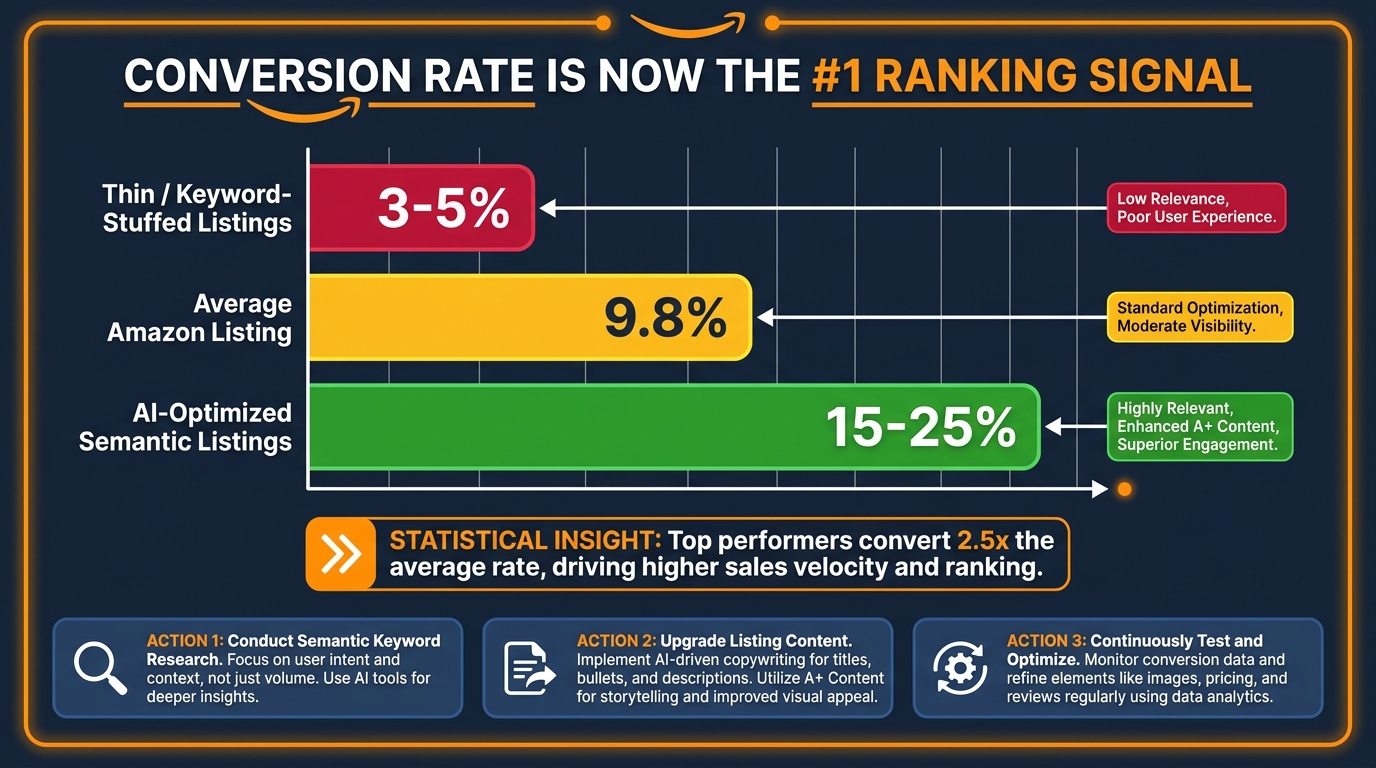
Amazon’s marketplace average conversion rate in 2026 sits at approximately 9.8% across categories — meaning that for every 100 shopper sessions on an average listing, roughly 10 result in a purchase. Top-performing, highly optimized listings in competitive categories achieve conversion rates of 15-25%. At the lower end, thin or keyword-stuffed listings with poor content quality frequently convert at 3-5%.
That spread — from 3% to 25% — represents an 8x difference in how effectively a listing turns traffic into revenue. Given that A10 weights conversion rate heavily in its ranking algorithm, a listing converting at 20% will, over time, outrank a competitor converting at 5% even if the lower-converting listing has superior keyword coverage. The traffic advantage compounds: higher ranking → more impressions → more data → A10 confirms the ranking → further ranking stability.
Conversion Rate as a Listing Quality Proxy
The critical reframe for 2026 is treating conversion rate not as an output to be monitored, but as a diagnostic tool that tells you precisely where your listing is failing buyers. If you have strong impressions and good click-through but low conversion, the problem is on the product detail page itself — something in your content, pricing, reviews, or in-stock status is breaking the purchase decision.
If you have strong click-through from search results but poor conversion, your primary image and title are attracting the right shoppers but your detail page content isn’t closing them. If you have low click-through from impressions, the problem is upstream — your thumbnail image, title beginning, and star rating are failing to motivate clicks from the search results page.
Each of these failure patterns has a specific content fix. Low detail-page conversion often signals missing use-case specificity in bullets, inadequate social proof (volume or recency of reviews), unanswered objections in Q&A, or insufficient visual coverage of key product features in the image stack. Identifying the specific stage where conversion breaks — and fixing it there — is far more effective than making undifferentiated improvements across the whole listing.
The Review Quality Dimension
Conversion rate doesn’t exist in isolation from reviews. Amazon’s AI systems — particularly Alexa for Shopping — factor review quality, recency, and specificity into recommendation confidence. A listing with 500 reviews averaging 4.7 stars from the past 90 days signals very different AI quality weighting than a listing with 500 reviews averaging 4.7 stars from three years ago.
Review recency matters because Amazon’s AI interprets fresh reviews as evidence that the product is currently performing as described. Stale review profiles — particularly for products that have been updated or improved — can suppress AI recommendation confidence even when the underlying star rating looks strong. This is why encouraging post-purchase reviews from recent buyers is an ongoing operational task, not a one-time launch push.
Product Attributes and Taxonomy: The Structural Data Amazon Wants More Of
Product attributes — the structured data fields in Seller Central that define your product’s category, sub-category, size, color, material, compatibility, and dozens of other specifications — have always existed in Amazon’s listing infrastructure. What’s changed in 2026 is how heavily Amazon’s AI systems rely on them. As keyword fields are de-emphasized and Amazon’s AI search moves toward vector-based semantic matching, product type taxonomy and structured attribute data become the primary scaffolding on which COSMO builds its understanding of your product.
Why Attribute Completeness Is Now a Ranking Input
Amazon’s AI systems use product attributes as structured filtering data when shoppers apply search filters, navigate category hierarchies, or ask Alexa for Shopping to narrow recommendations by a specific constraint (“show me only ones that come in under $40” or “I need something compatible with a Samsung Galaxy S25”). If your attribute fields are incomplete, your product gets filtered out of queries that it should answer — invisible not because of poor keyword coverage, but because of missing structural data.
More significantly, COSMO uses product type taxonomy — the product category classification you select during listing creation — as a foundational mapping signal. If your product is miscategorized or placed in a generic catch-all category because a more specific one wasn’t selected, COSMO’s ability to connect you to the right intent clusters is structurally compromised from the outset.
Conducting an Attribute Gap Audit
Most established listings on Amazon were created when attribute requirements were less extensive. Returning to Seller Central and reviewing the attribute template for your current product type often reveals dozens of fields that weren’t filled in at creation — because they either didn’t exist in the original template or were left optional and therefore skipped.
A methodical attribute audit process:
- Open the listing’s Edit page in Seller Central and navigate to the “Product Details” and “More Details” tabs.
- Count every blank or incomplete attribute field — not just the required ones.
- Cross-reference against competitor listings in the same sub-category (viewable via the product’s category breadcrumb) to identify which attributes competitors are filling in that you are not.
- Prioritize filling in any attributes that correspond to common shopper filters in your category (size, material, color family, compatibility, age range, product use).
- Verify that your product type taxonomy is as specific as Amazon allows — “18-oz Vacuum-Insulated Stainless Water Bottle” rather than “Water Bottle” or “Sports Equipment.”
Sellers who have conducted systematic attribute gap audits and completed previously empty fields have reported measurable improvements in organic impression share within 2-4 weeks — not because they added keywords, but because they made their product structurally visible to queries it was previously being filtered out of.
The Variation Structure Consideration
For products sold in multiple variants (size, color, style), variation structure is also a taxonomy decision with AI ranking implications. A well-structured variation family shares performance signals — reviews, sales velocity, conversion data — across the parent ASIN, which collectively strengthens A10’s confidence in the product’s quality signals. Poorly structured variations (separate child ASINs that aren’t properly linked, or variation families with too many low-performing variants diluting the overall signal) can suppress organic ranking for your best-performing configurations.
What an AI-Optimized Listing Audit Actually Looks Like in Practice
It’s one thing to understand the principles. It’s another to have a repeatable process for applying them systematically across a catalog. Here is what a practical AI-era listing audit covers — not a theoretical checklist, but the specific questions and diagnostic steps that reveal where a listing is losing ground in Amazon’s three-layer AI search environment.
Step 1: Intent Alignment Check
Start with the question: What is the primary purchase intent this product satisfies? Then read your current title and first two bullet points. Can you identify that intent within the first 80 characters of the title? Does the first bullet point name a specific use case or buyer scenario, or does it just describe a feature?
If a neutral reader couldn’t identify the product’s primary buyer and primary use case from the title and first bullet alone, COSMO will struggle to map you accurately to the right intent clusters. Rewrite until the intent is unmistakable in the first content shoppers encounter.
Step 2: Alexa for Shopping Readiness Check
Ask yourself: what are the five most likely conversational questions a shopper would ask Alexa for Shopping about a product in my category? Then search for those questions in your product’s Q&A section. If fewer than three of the five questions have clear, complete, accurate answers in Q&A, your listing is underperforming in AI-mediated discovery.
Add the missing answers. Write them in first-person, natural language. Keep each answer to 2-4 sentences — specific enough to be useful, short enough to be scannable when cited.
Step 3: SQPR Gap Analysis
Pull the last 30 days of Search Query Performance Report data for your target ASIN. Identify the top 10 queries by volume and check your impression share, click share, and purchase share for each. Flag any query where impression share is below 10% — those are intent clusters COSMO isn’t mapping you to. Flag any query where purchase share is less than half your click share — those are content-quality failures on the detail page.
Prioritize your optimization effort by volume × gap severity. The highest-volume queries with the largest impression share deficits are your biggest organic ranking opportunities. Address them first — through semantic content additions in bullets or A+ that speak explicitly to those use cases, or through attribute corrections that place you in the right category filters for those queries.
Step 4: A+ Content AI-Readiness Review
Open your A+ content manager. Read the text content in each module — specifically, the written descriptions under images and in comparison charts. Ask: if Amazon’s AI were reading this to construct a recommendation, would it find clear, specific, attributable information about what makes this product right for a specific buyer? Or does it only find brand storytelling and vague benefit language?
Revision priority: rewrite any A+ module text that consists primarily of brand voice without functional product information. Add a use-case comparison module if you don’t have one. Ensure your comparison table distinguishes your product from alternatives in terms that match actual shopper decision criteria — not just spec sheets.
Step 5: Attribute Completeness Score
Count the total available attribute fields for your product type. Count the number filled in. If you’re below 75% completion, you have structural visibility gaps. Review every blank field and determine whether it’s genuinely not applicable (sometimes it isn’t) or was simply left blank for convenience. Fill everything that applies. Then verify that your product type taxonomy reflects the most specific classification available for your product — this single change has moved listings from category page 5 to category page 1 for sellers who corrected a misclassification.
Putting It Together: The Compounding Logic of AI-Era Listing Optimization
The most important thing to understand about Amazon’s AI search stack in 2026 is that its components don’t operate independently — they reinforce each other in a compounding feedback loop that rewards comprehensive, semantically rich listings and progressively disadvantages thin, keyword-first ones.
Here’s the loop: a listing with strong semantic depth gets accurately mapped by COSMO to relevant intent clusters. Accurate mapping brings qualified, high-intent traffic. Qualified traffic converts better, generating strong conversion rate and sales velocity signals. Strong conversion rate signals cause A10 to rank the listing higher. Higher ranking generates more impressions. More impressions from qualified shoppers — combined with excellent Q&A and A+ content — results in more Alexa for Shopping citations. More AI-driven citations bring additional qualified traffic from conversational discovery. More conversions reinforce COSMO’s confidence in the intent mapping. The ranking stabilizes and grows.
Conversely: a listing with keyword-first structure, incomplete attributes, thin Q&A, and no A+ content gets weakly mapped by COSMO. Weak mapping brings mixed-intent traffic. Mixed-intent traffic converts poorly. Poor conversion signals suppress A10 ranking. Lower ranking reduces impression volume. Reduced impressions compound the weak behavioral data. COSMO’s confidence in the listing drops further. Alexa for Shopping doesn’t cite it in recommendation responses. The ranking erodes.
Both loops operate on the same logic — they just run in opposite directions depending on listing quality. And the gap between them widens over time, because behavioral data compounds. A listing that’s been accumulating strong conversion signals for six months has a growing AI advantage over a competitor that launches an equally well-optimized listing today. The feedback loop doesn’t reset every time the algorithm updates. It carries historical evidence forward.
This is why listing optimization in the AI era isn’t a one-time project. It’s an ongoing practice — monthly SQPR reviews, quarterly attribute audits, continuous Q&A management, iterative A+ content refinement. Not because Amazon keeps changing the rules, but because the rules are now self-reinforcing. The sellers who treat their listings as living documents, responsive to AI signal data and evolving buyer language, are the ones whose compounding loop runs upward. The sellers who set and forget are the ones who don’t notice the erosion until it’s already deep.
Conclusion: The Listing Is Now a Knowledge Document — Optimize It That Way
Amazon’s product listing has evolved from a keyword inventory to a knowledge document. The three-layer AI search stack — A10 for performance signals, COSMO for semantic mapping, Alexa for Shopping for conversational discovery — evaluates your listing not just for what keywords it contains, but for what it communicates, who it’s for, what problems it solves, and whether the evidence of its performance supports the content’s claims.
That’s a fundamentally different optimization challenge than keyword research and backend term packing. It requires thinking about your buyer’s intent at a more granular level: not just what they search for, but why they search for it, what questions they need answered before buying, and what specific language resonates with them in the context of their particular use case.
The sellers who win in this environment are the ones who understand that every field in their listing — title, bullets, attributes, Q&A, A+ content — is now feeding a different component of an interconnected AI system. Optimizing one field in isolation is less effective than designing the whole listing as a coherent, semantically layered answer to a buyer’s intent.
Here are the most actionable takeaways from everything covered in this post:
- Audit for semantic depth, not just keyword coverage. Check whether your title, bullets, and A+ content speak to specific use cases, buyer types, and problems solved — not just product features and specifications.
- Build Q&A proactively. Don’t wait for shoppers to ask questions. Seed your Q&A section with the five to ten most common purchase-decision questions in your category, with clear, natural-language answers that Alexa for Shopping can cite.
- Run weekly SQPR reviews. Use the impression-to-purchase gap as your primary diagnostic for where your listing is losing AI-search-driven traffic and conversion.
- Complete your product attributes. Every blank attribute field is a potential filter match you’re missing. Aim for 75%+ completion on all attribute templates for your product type.
- Treat A+ content as AI-readable knowledge, not just brand creative. Write module text with use-case specificity that COSMO can parse and Alexa for Shopping can cite.
- Prioritize title intent over title keyword density. Lead with the buyer’s use case or primary benefit in the first 70-80 characters, and let keyword coverage follow.
- Track conversion rate as a diagnostic input, not just an output metric. Identify at which stage of the funnel (impression → click → add-to-cart → purchase) your listing is breaking, and target your optimization effort at that specific stage.
Amazon’s AI search stack will continue to evolve. The specific mechanics of COSMO, A10, and Alexa for Shopping will shift. But the underlying principle — that AI systems reward listings which accurately and comprehensively represent their product’s value to the right buyer — is unlikely to reverse. The sellers who internalize that principle and build their listing strategy around it are building on stable ground.