




There’s a version of TikTok Shop that most sellers built their entire business around: a creator posts a video, a product gets tagged, the For You Page does the heavy lifting, and sales roll in. That model still works — but it’s no longer the whole game, and in 2026, it’s not even the biggest part of it.
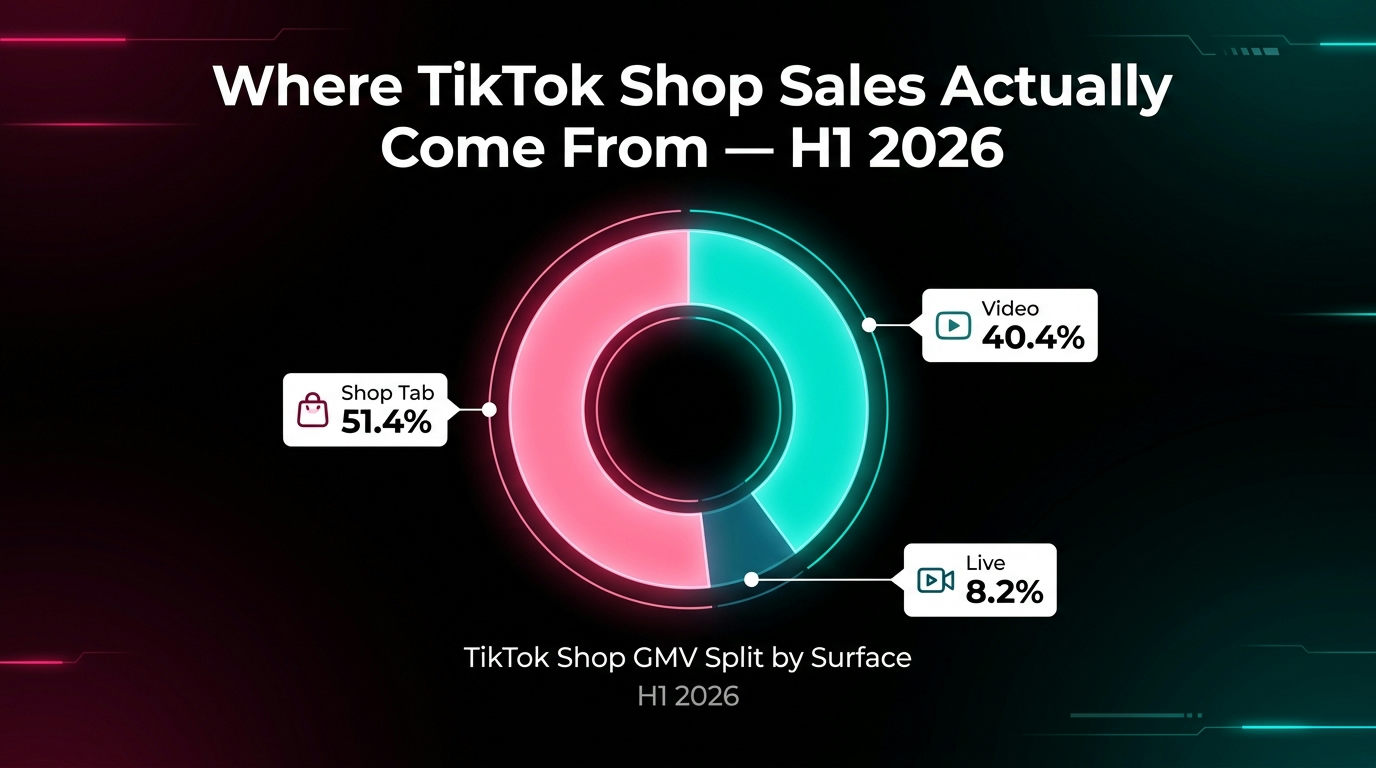
In the first half of 2026, the TikTok Shop tab — the dedicated browse-and-search surface inside the app — surpassed video-linked sales to account for 51.4% of attributed U.S. GMV. Video came in at 40.4%. Live at 8.2%. For the first time, the majority of TikTok Shop revenue isn’t coming from viral content — it’s coming from people who opened a search bar and typed what they wanted.
That’s a fundamental shift. And it means TikTok Shop now has to be treated like a search engine, not just a content platform. The sellers who understand that and optimize accordingly will capture a disproportionate share of a market that grew to $50.3 billion in global GMV in H1 2026 — up 92% year on year.
This guide is not a repeat of the basics. It’s a structured, signal-by-signal breakdown of how TikTok Shop’s search ranking actually works in 2026: what drives visibility, how to build a listing that earns its position, how your seller health scores affect your reach, and how to run a repeatable process that compounds over time. Whether you’re a brand, a reseller, or an agency managing multiple shops, this is the roadmap for the search era.
Why the Search Tab Is Now the Biggest Sales Surface on TikTok Shop
To understand why search ranking matters so much right now, you need to understand the structural shift that happened in TikTok’s commerce ecosystem over the past 18 months.
The Platform’s Own Behaviour Changed
In 2024 and early 2025, most TikTok Shop GMV flowed through creator-linked content. A video went viral, a product got tagged, shoppers impulse-bought. The FYP (For You Page) was the engine. But TikTok spent much of 2025 investing heavily in its dedicated Shop tab — improving the search experience, expanding product categories, and surfacing browse-friendly recommendations more prominently within the app.
That investment paid off. By H1 2026, the Shop tab’s share of U.S. GMV had overtaken video-linked sales for the first time. This isn’t a marginal shift — it’s a reversal of the platform’s entire sales structure. And it maps to a broader behavioural change in how people, particularly younger consumers, approach product discovery.
Gen Z Treats TikTok Like a Search Engine Already
TikTok search queries grew 174% year on year heading into 2026. Separately, research indicates that 67% of Gen Z users already use TikTok as a search engine, and 41% of Gen Z shoppers search on social platforms before going anywhere else. TikTok isn’t replacing Google for everything — but for product research, trend discovery, and purchase decisions in certain categories (beauty, fashion, home, fitness, food), it’s become the default starting point for a generation with significant buying power.
What that means for sellers is stark: if your product doesn’t appear in search results for the terms your target buyer actually uses, you don’t exist for that buyer. Viral reach might introduce your brand — but search is where the purchase intent is concentrated, and it’s where the conversion rates are highest.
Search Traffic Converts Differently
The reason the Search tab’s GMV dominance is so commercially significant is that search-driven shoppers are fundamentally different from scroll-based discovery shoppers. Someone who has typed “insulated water bottle 40oz” into TikTok Shop is expressing active buying intent. They’re not discovering a need — they already have one. Industry data consistently shows that search-driven purchases on TikTok Shop convert at approximately 2x the rate of FYP organic traffic, with in-app search and Shop tab conversion benchmarks sitting in the 5–8% range compared to broader platform averages of 3.2–4.7%.
Higher intent means higher conversion. Higher conversion means better commerce signals. Better commerce signals improve ranking. It’s a reinforcing cycle — but only for sellers who show up in search results in the first place.
How TikTok Shop’s Search Algorithm Actually Works
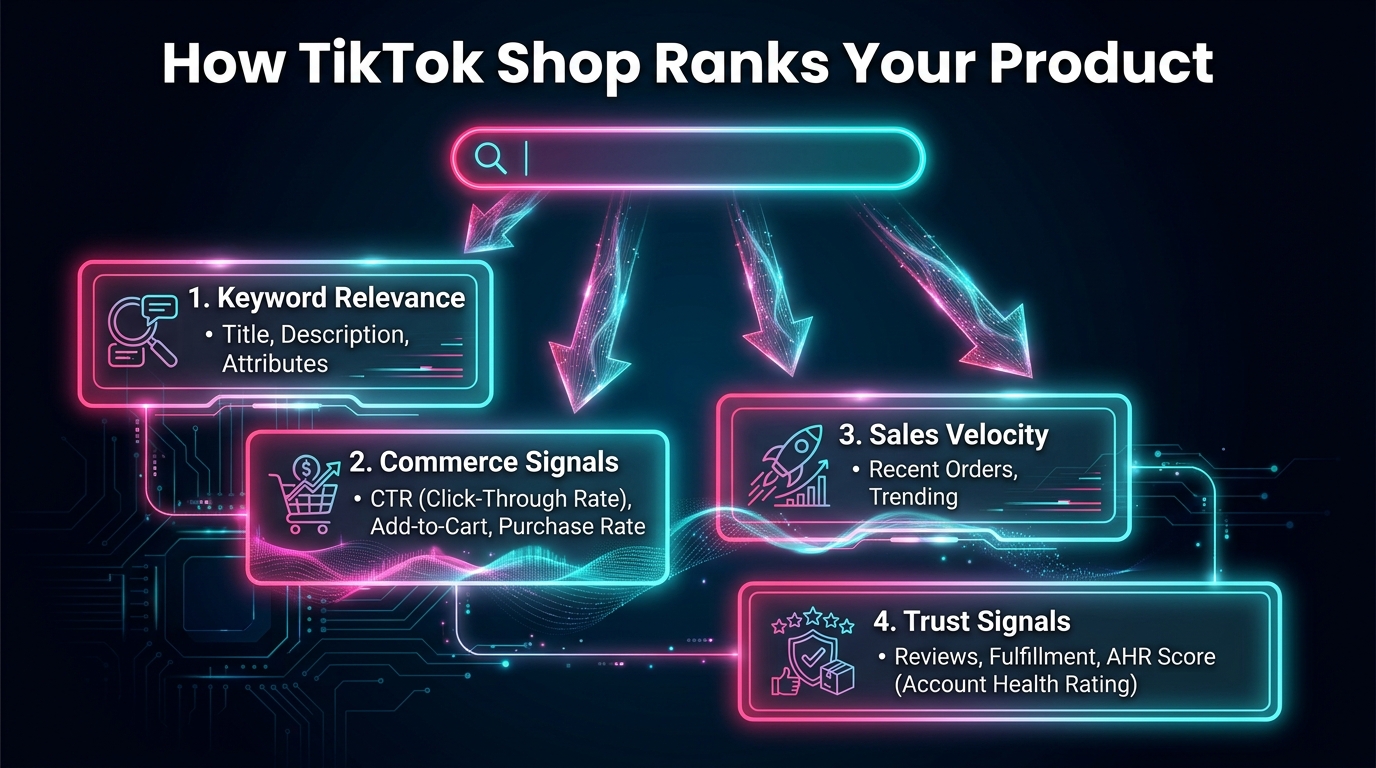
TikTok doesn’t publish a ranking manifesto. What we know about its search algorithm comes from Seller Center documentation, observed seller outcomes, and pattern analysis from practitioners and agencies who work with high-volume shops. The consensus across those sources points to a four-layer ranking model.
Layer 1: Keyword Relevance
The first and most foundational ranking signal is keyword relevance — how well the text content of your listing matches the query a shopper typed. TikTok evaluates this across several fields simultaneously:
- Product title — the highest-weighted text field. If your primary keyword doesn’t appear here, you’re at an immediate disadvantage.
- Product description — where supporting and secondary keywords reinforce the listing’s topical relevance.
- Category and attribute fields — structured data that helps TikTok correctly classify your product and match it to filtered searches.
- Video captions — indexed alongside the product listing for content-linked products.
- On-screen text (OCR) — TikTok uses optical character recognition to read and index text displayed on video frames.
- Spoken audio (ASR) — automatic speech recognition transcribes what’s said in the video, which TikTok uses as a relevance signal for product-linked content.
The practical implication is that keyword relevance isn’t a single box to tick — it’s a layered signal that spans your static listing data and any video content you associate with that product. More on the video layer in a dedicated section below.
Layer 2: Commerce Performance Signals
Once TikTok determines relevance, it ranks competing products by their commerce performance: how well a listing converts shoppers who see it into buyers. The key metrics here are:
- Search click-through rate (CTR) — the percentage of impressions where a shopper clicks your listing from results.
- Add-to-cart rate — the percentage of product page visitors who add your item to their cart.
- Purchase conversion rate — the percentage of product page visitors who complete a purchase.
- Product page dwell time — how long shoppers spend on your listing before deciding, which signals genuine interest.
This is where the search era fundamentally differs from the FYP era: engagement metrics like video likes, shares, and comments are secondary. Commerce actions are primary. TikTok is increasingly rewarding listings that actually close — not just listings attached to content that people find entertaining.
Layer 3: Sales Velocity and Recency
TikTok’s search algorithm weights recent sales velocity heavily. A product that sold 500 units last month carries more weight in today’s rankings than a product that sold 5,000 units six months ago but has gone quiet. This makes intuitive sense from TikTok’s perspective: they want to surface products that are actively resonating with shoppers right now, not products that had a viral moment and coasted on it.
What this means practically is that maintaining a steady cadence of sales, or engineering short-term velocity spikes through promotions and affiliate activity, can materially lift search rankings. The algorithm treats recent momentum as a quality signal.
Layer 4: Trust and Seller Health Signals
The final layer involves trust signals that tell TikTok whether your shop delivers a reliable customer experience. Review quality and volume, fulfillment rate, return rate, and seller response time all feed into how TikTok perceives your shop’s trustworthiness. In 2026, these trust signals are formalized into two key health scores — the Shop Performance Score (SPS) and the newly launched Account Health Rating (AHR) — both of which function as ranking modifiers. We cover those in detail later in this guide.
Keyword Research That Actually Works: Mining TikTok’s Own Data
Most sellers approach keyword research for TikTok Shop the same way they’d approach it for Amazon or Google: they use third-party tools, guess at search volume, and import keyword lists that may or may not reflect what TikTok shoppers actually type. That’s a significant missed opportunity, because TikTok provides native search intelligence that’s far more accurate for this platform than any external tool.
Start with Seller Center’s Search Insights Tool
The most underused tool in TikTok Seller Center is Search Insights, found under Marketing → Search Insights. This is TikTok’s own keyword intelligence dashboard, built directly on search data from within the app. It gives you:
- Hot Keywords — high-volume terms with strong search demand right now.
- Trending Keywords — terms whose search volume is rising rapidly, often ahead of broader market awareness.
- Low Competition Keywords — terms with meaningful demand but relatively few well-optimized listings competing for them.
- Category Rankings — a view of which shops and products are ranking for key terms in your category, allowing direct competitive benchmarking.
This tool should be the first stop in any keyword research workflow for TikTok Shop, not a secondary validation step. The data here reflects real shopper search behaviour on the platform — it’s not modeled or estimated from external signals.
Use TikTok Autocomplete as Free Keyword Research
TikTok’s search autocomplete is a goldmine for understanding buyer language. Open the TikTok app (not Seller Center), tap the search bar, and start typing your product’s core term. The autocomplete suggestions that appear are ranked by actual search frequency within the platform. They reveal the exact phrases people are using — which often differ substantially from how sellers describe their own products.
For example, a seller might list a product as a “portable blender” while TikTok shoppers are searching for “mini smoothie maker for travel” or “USB blender bottle gym.” Those autocomplete phrases are your keyword opportunities. They reflect buyer language — the vocabulary of intent — and matching your listing to that language is one of the fastest ways to improve relevance scoring.
Understand Intent Categories: Purchase vs. Discovery vs. Problem
Not all search terms on TikTok Shop carry equal buying intent, and understanding the difference helps you prioritise which keywords to target in which listing fields.
Purchase-intent keywords are the most commercially valuable: “[product type] + use case” or “[product type] + audience” (e.g., “gym resistance bands women”). These should lead your product title and appear in the first 150 characters of your caption.
Discovery-intent keywords are broader and more exploratory (e.g., “workout accessories”, “kitchen organisation”). These are useful in descriptions and attributes but shouldn’t dominate your title if you’re targeting buyers rather than browsers.
Problem-intent keywords frame a need rather than a product (e.g., “stop hair breakage”, “under eye puffiness fix”). These are high-performing in video hooks and captions for content-linked products, where speaking to the problem before naming the solution drives both engagement and purchase intent.
Map One Primary Keyword Per Listing, Then Build Outward
A common mistake is trying to target too many keywords in a single listing, which dilutes relevance signals and confuses the algorithm about what the product actually is. The cleanest strategy is: one primary keyword per listing (your highest-intent, highest-volume term), supported by three to five secondary keywords distributed across the title tail, description, and attributes. This gives TikTok a clear, strong relevance signal for the core term while also building breadth for secondary queries.
Building the Perfect Product Listing: Title, Description, and Attributes Done Right
Your product listing is the static foundation of your search presence on TikTok Shop. Unlike videos, which can be refreshed and A/B tested, your core listing data — title, description, category, attributes — is the persistent signal that TikTok uses to classify and rank your product. Getting it right matters enormously.
Crafting Your Product Title: The Highest-Leverage Field in the Entire Listing
The product title is the single most important text field in your TikTok Shop listing. It carries more keyword weight than any other field, and it’s the first thing both TikTok’s algorithm and human shoppers evaluate when your product appears in search results.
The anatomy of a strong TikTok Shop title follows a consistent pattern:
- Primary keyword first — put your highest-intent search term as early in the title as possible. TikTok indexes the beginning of the title more heavily, and search results truncate at roughly 70-80 characters, meaning the start of your title is all that shoppers see before clicking.
- Key product specifications — size, capacity, material, quantity, or other specifics that shoppers typically include in their searches (e.g., “40oz”, “stainless steel”, “Pack of 3”).
- Use case or audience — a second-layer qualifier that helps TikTok match your listing to more specific queries (e.g., “for gym”, “women’s”, “kids’ room”, “travel size”).
- Differentiating attribute or variant — colour, style, or feature that distinguishes this SKU from others (e.g., “Matte Black”, “Leak-Proof Lid”).
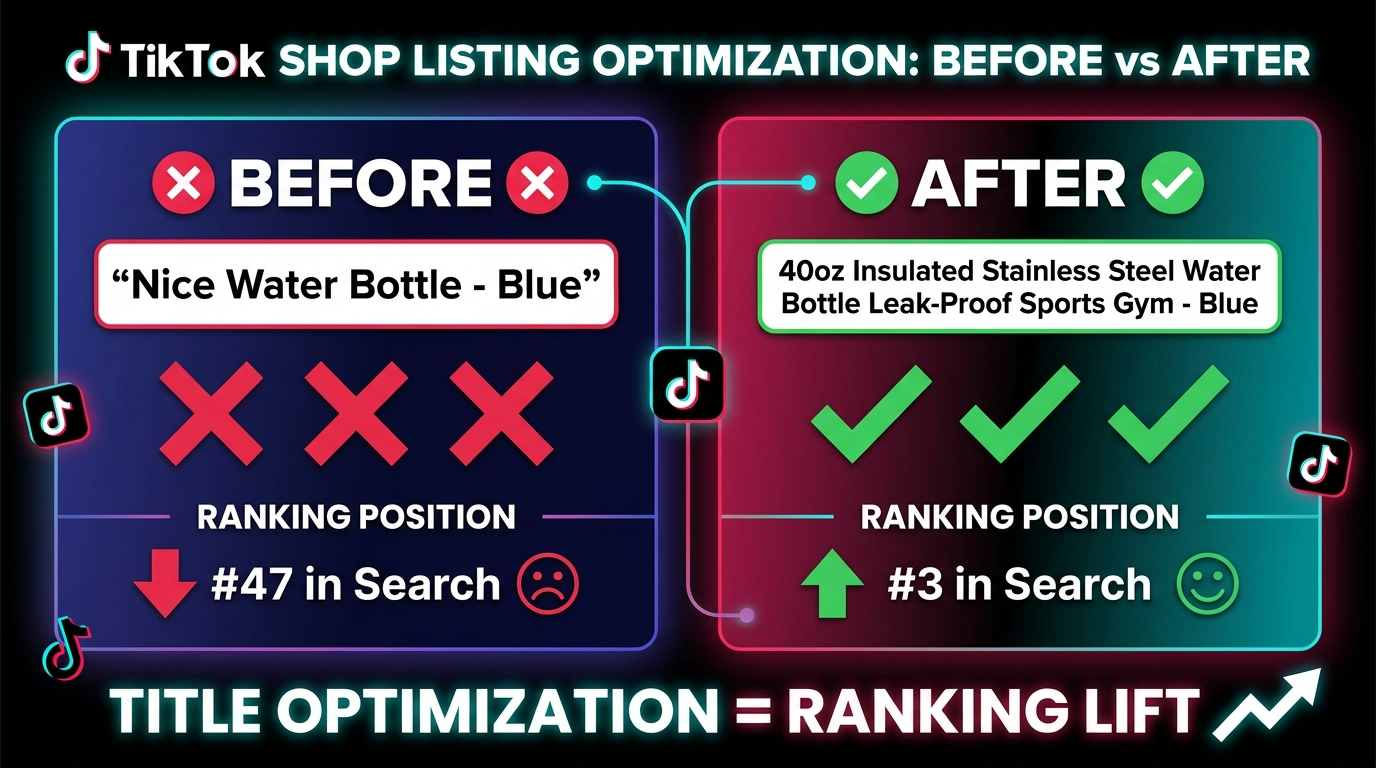
A weak title: “Water Bottle – Blue”
A strong title: “40oz Insulated Stainless Steel Water Bottle Leak-Proof Sports Gym – Matte Blue”
The difference isn’t aesthetic — it’s informational density and keyword surface area. The optimised title matches more query variants, provides more relevant signals to the algorithm, and gives the shopper more reason to click through.
Writing Descriptions That Work for Both Algorithm and Human
The product description serves a dual purpose: it reinforces keyword relevance for the algorithm, and it answers the shopper’s remaining questions before they add to cart. Descriptions that do one at the expense of the other tend to underperform.
Structurally, your description should open with a keyword-rich sentence that restates the core product proposition (mirroring the title’s keyword signal), then move into benefit-driven bullet points that answer the questions shoppers typically have at this stage of the purchase journey: What problem does it solve? What makes it better? Who is it for? What’s included?
Avoid keyword stuffing in the description. TikTok’s algorithm is sophisticated enough to distinguish between naturally integrated keywords and forced repetition — and more importantly, buyers notice. A description that reads like a keyword list creates distrust and suppresses conversion, which hurts commerce signals and ultimately your ranking.
The Attribute Layer: Where Most Sellers Leave Ranking Points on the Table
Product attributes in TikTok Seller Center are the structured data fields (colour, size, material, target audience, brand, etc.) that help TikTok classify your product and match it to filtered searches. They are widely under-completed by sellers, which is a significant opportunity for anyone willing to fill them in properly.
When a shopper uses the filter panel in TikTok Shop search — filtering by colour, price range, rating, or category-specific attributes — products with complete attribute data are eligible for those filtered results. Products with incomplete attributes are invisible to them. This means attribute completion is a direct visibility multiplier, not a cosmetic listing improvement.
The practical rule: complete every available attribute field, even ones that seem optional. If TikTok gives you a field, fill it — accurately. Mismatched attributes (claiming a product is red when it’s orange, for instance) generate returns and negative reviews that hurt your trust signals. Accuracy and completeness together are the goal.
Category Selection: Getting the Foundation Right
Category selection determines which search contexts your product is eligible to appear in, which competitive benchmarks your seller health metrics are compared against (more on that shortly), and which attribute fields appear for you to complete. Misclassifying a product — even accidentally — can cut off significant ranking potential.
Navigate TikTok Seller Center’s category tree to the most specific sub-category that accurately describes your product. If you’re selling a protein shaker bottle, “Sports & Outdoors → Fitness Equipment → Gym Accessories” is better than the generic “Sports & Outdoors.” Greater specificity means less competition for that slot and stronger relevance matching for category-specific searches.
The Multi-Layer Content Strategy: Video, Captions, Audio, and On-Screen Text as Ranking Signals
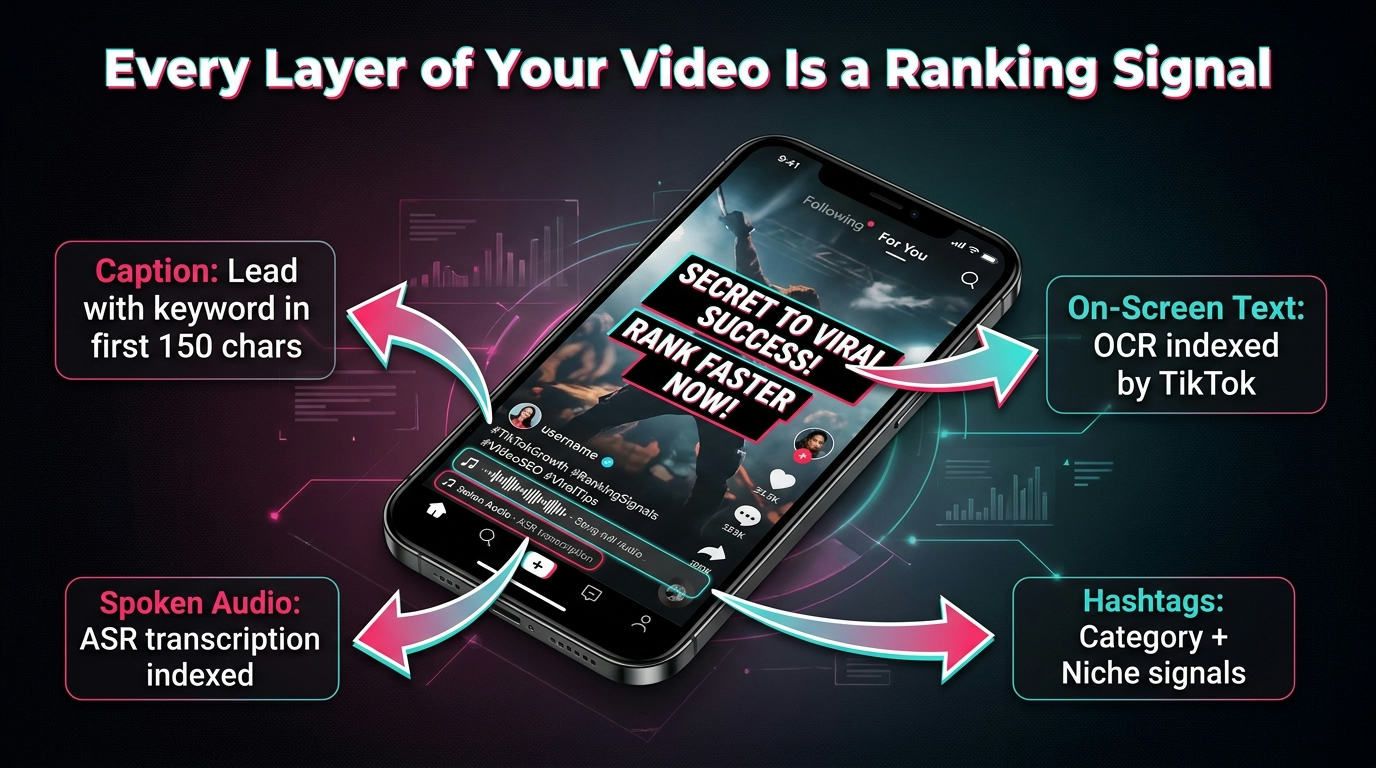
One of the things that makes TikTok Shop’s search system genuinely different from Amazon or a traditional e-commerce search engine is the role of video content in ranking. TikTok doesn’t just index listing data — it reads the video content associated with your product across multiple input streams simultaneously. This creates both additional ranking opportunities and additional complexity for sellers to manage.
How TikTok Reads Your Video
TikTok runs several AI-driven processes on every video uploaded to the platform:
- OCR (Optical Character Recognition) — reads and indexes any text that appears on screen, including text overlays, on-screen graphics, and product packaging visible in the frame.
- ASR (Automatic Speech Recognition) — transcribes spoken audio and indexes the transcript as keyword-relevant content alongside the listing.
- Caption indexing — the written caption is treated as a structured text signal, with the first 150 characters weighted most heavily (since that’s what’s visible before the “see more” truncation).
- Hashtag classification — hashtags function as categorical and topical signals, helping TikTok understand what product category, use case, and audience the video is relevant to.
What this means is that when a video is linked to a TikTok Shop product, the algorithm is evaluating a composite relevance signal that includes listing text and video metadata. A listing with a strong title but a video that says nothing keyword-relevant is weaker than a listing where every video layer reinforces the same primary keyword.
The Keyword Layering Strategy for Video Content
Given how TikTok reads video, the highest-ROI approach is a strategy called keyword layering: deliberately placing your primary product keyword in multiple video layers so that TikTok receives the same relevance signal from several independent sources.
In practice, this means:
- Open the caption with the primary keyword in the first sentence (before the “see more” cut-off).
- Include the primary keyword in the first 5-10 seconds of spoken audio — saying the product name or category clearly and naturally in the hook or first line of narration.
- Place the primary keyword in on-screen text in the first 3 seconds of the video, ideally as part of the hook or product introduction overlay.
- Use 3-5 hashtags that include one broad category hashtag (#SkinCare, #HomeOrganization), one more specific product hashtag (#InsulatedBottle, #GymAccessories), and one or two trending community hashtags relevant to the niche.
This approach doesn’t require changing what you say in the video or making the content feel unnatural. Most product-focused TikTok videos naturally introduce the product by name early — it’s just a matter of being deliberate about doing it in the first few seconds and ensuring it’s present in text form as well.
Publishing Volume and Topical Authority
TikTok’s algorithm appears to reward topical concentration. A shop that publishes three to five videos all coherently linked to the same product category and keyword cluster builds stronger relevance signals than a shop that publishes the same number of videos across loosely related topics. This mirrors the topical authority model familiar from content SEO on traditional websites — TikTok seems to assess whether a shop is a credible authority in a given product space, not just whether a single video is relevant to a single query.
The practical implication: rather than creating one product video and hoping it ranks, build a small cluster of related videos around the same product, each approaching the keyword from a slightly different angle (demo video, comparison, problem-solution, user FAQ, before-and-after). Each video strengthens the relevance signal for the product listing as a whole.
Commerce Signals That Move the Needle: CTR, Add-to-Cart, and Purchase Velocity
Understanding that TikTok weights commerce signals heavily is one thing. Knowing how to actively improve those signals is another. This section focuses on the practical levers sellers can pull to lift each of the key commerce metrics that feed directly into search ranking.
Improving Search Click-Through Rate
Your CTR from search results is determined before a shopper ever lands on your product page. It depends entirely on what they see in the results list: your lead product image, your title, your price, and your review rating. Of these, the lead image is almost certainly the most powerful driver of click behaviour — it’s the largest visual element and the first thing the eye goes to in a grid or list format.
TikTok Seller Center recommends a minimum of five high-resolution images, but the lead image — the one visible in search results — deserves separate treatment. It should show the product clearly against a clean background, present it at the most recognisable angle, and ideally communicate the core use case or benefit through a brief text overlay (which TikTok is more permissive of than platforms like Amazon). A/B test lead images when possible, using Seller Center analytics to track which version drives stronger CTR.
Optimising Product Page Conversion
Once a shopper clicks through from search, your product page needs to convert intent into action. The key conversion levers on a TikTok Shop product page are:
- Price positioning — TikTok Shop shoppers are typically value-sensitive. If comparable products in your category are priced lower, your conversion rate will suffer regardless of listing quality. Competitive pricing is a prerequisite, not a differentiator.
- Review count and rating — a high rating (4.5+ stars) with meaningful review volume is one of the strongest conversion drivers on the product page. New products with no reviews are at a structural disadvantage; prioritising early review generation (through post-purchase follow-up flows and compliant incentive programs) is a legitimate and important part of launch strategy.
- Product images and video — showing the product in context (in use, on a person, in a setting) dramatically outperforms plain white-background images for conversion. This is a social commerce platform; lifestyle imagery matches user expectations and reduces purchase hesitation.
- Fulfillment signals — TikTok displays estimated delivery dates on product pages, and faster delivery consistently correlates with higher conversion. Sellers using TikTok’s fulfillment infrastructure or domestic warehousing have a conversion advantage over those shipping from overseas with long lead times.
Manufacturing Early Velocity for New Listings
New product listings face a cold-start problem: they have no commerce history, which makes it harder for TikTok’s algorithm to rank them against established listings with proven conversion records. The most effective way to break through this is to engineer early sales velocity through deliberate tactics:
- Promotional pricing at launch — a time-limited launch discount drives initial purchases and generates the first wave of commerce signals.
- Affiliate seeding — sending free product to TikTok Shop-connected affiliates (nano and micro creators in your niche) to generate early linked video content and affiliate-driven purchases creates both content relevance signals and purchase velocity simultaneously.
- Shop Ads for initial visibility — using TikTok’s Search Ads within Seller Center to buy visibility for your target keywords during the first few weeks generates impression and click data that the organic algorithm can then build on.
The goal in the launch window is not profitability — it’s signal generation. A product that earns strong early commerce signals (even at discounted margins) will rank higher organically faster, which is the more valuable long-term outcome.
Seller Health, AHR, and Shop Performance Score: The Trust Layer Nobody Talks About
Most TikTok Shop ranking discussions focus on listings and content. Far fewer address the trust and compliance layer that sits beneath all of it — the seller health systems that determine whether TikTok’s algorithm trusts your shop enough to give it full search visibility in the first place.
Understanding Account Health Rating (AHR)
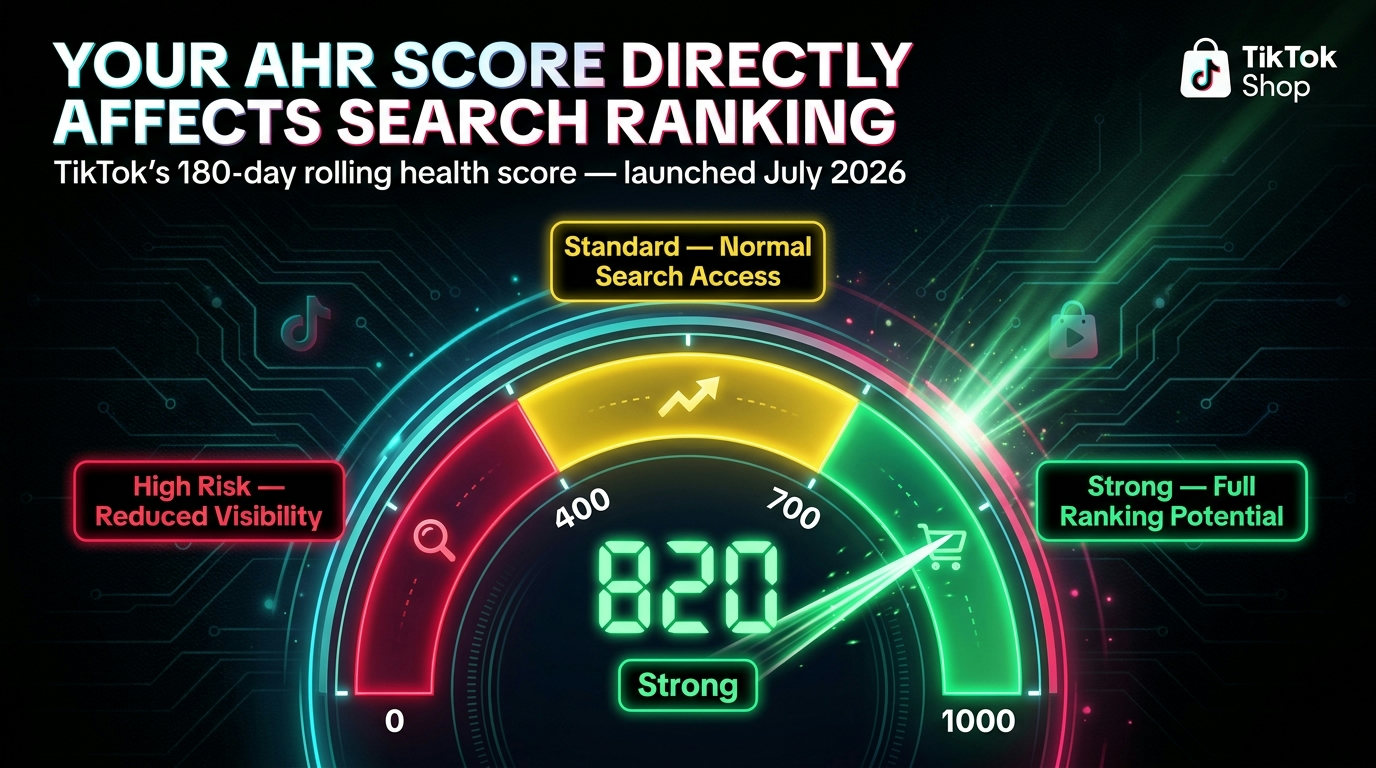
In July 2026, TikTok replaced its previous violation-points system with the Account Health Rating (AHR) — a 0-to-1,000 score calculated on a rolling 180-day window. The AHR evaluates your account across compliance, listing quality, customer service, and after-sales performance. It functions as a macro-level trust modifier on your ranking potential: shops with strong AHR scores can compete on full search visibility, while shops with degraded AHR face algorithmic suppression regardless of how well their individual listings are optimized.
The shift from violation points to a continuous 0–1,000 score is significant because it removes the cliff-edge nature of the old system (where sellers would skate close to a violation threshold) and replaces it with a gradient. Every operational decision — how quickly you respond to customer messages, how accurately your listings describe your products, how reliably you dispatch orders — continuously affects your AHR. It’s not a compliance metric you check quarterly; it’s a live ranking modifier.
Shop Performance Score (SPS) and What Drives It
The Shop Performance Score (SPS) is a more commerce-focused health metric that factors directly into search visibility and, separately, into access to platform tools like Affiliate Marketing campaigns. The SPS is built from several sub-metrics, the most impactful being:
- On-Time Delivery Rate — the percentage of orders dispatched and delivered within the committed timeframe. TikTok evaluates this on a rolling 30-to-60-day window, so recent fulfillment performance matters more than historical averages.
- Seller-Fault Cancellation Rate — orders cancelled because the seller was out of stock, failed to dispatch, or made an error. High seller-fault cancellations are a strong negative signal.
- Negative Review Rate — the percentage of reviews with 1-2 star ratings. Critically, in 2026 this metric is benchmarked within your product category, not against a flat platform-wide threshold. This means a negative review rate that would be acceptable in a low-competition category might be harmful in a category where the average seller has very few negative reviews.
- Response Rate and Speed — how quickly and consistently you respond to customer messages and after-sales queries.
Why Fulfillment Quality Is a Search Ranking Issue, Not Just a Customer Service Issue
The connection between fulfillment and search ranking isn’t intuitive, but it’s real. TikTok’s rationale is straightforward: the platform’s reputation as a commerce destination depends on shoppers having good experiences. If a seller’s fulfillment is unreliable, TikTok doesn’t want that seller ranking prominently in search results and delivering poor experiences to shoppers who find them there. Suppressing those sellers from high-visibility positions is both a quality control mechanism and a customer experience protection strategy.
The practical implication: seller health isn’t a back-office concern to manage separately from growth. It’s a prerequisite for ranking. Sellers who invest in faster dispatch, better stock management, and responsive customer service are not just reducing operational friction — they’re actively protecting and building their search ranking potential.
Search Insights in Seller Center: The Native Tool Most Sellers Ignore
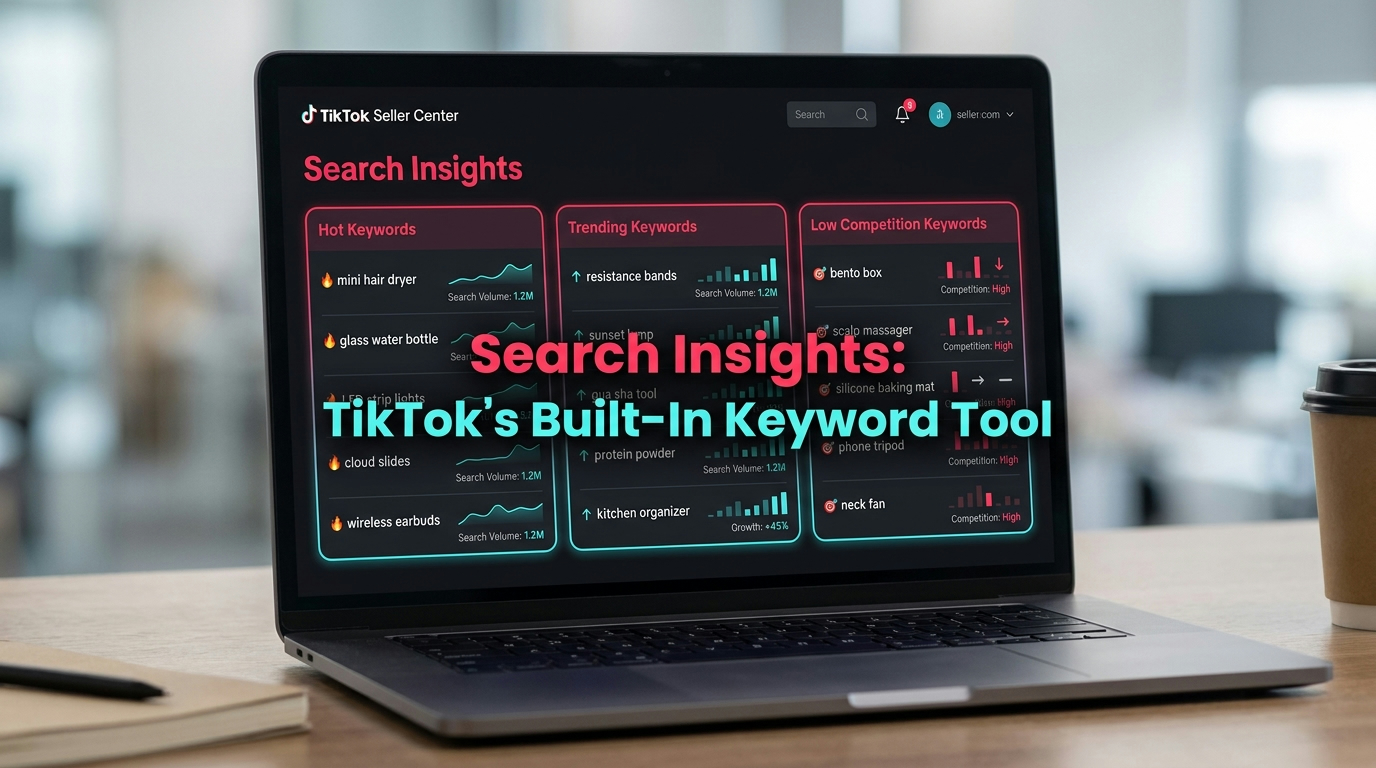
TikTok provides sellers with a native analytics and keyword intelligence suite that most sellers either don’t know exists or use only superficially. Getting serious about TikTok Shop search ranking means using these tools as a core part of your operational workflow, not an occasional curiosity.
Search Insights: Your Keyword Intelligence Hub
As mentioned in the keyword research section, Search Insights (Seller Center → Marketing → Search Insights) is the primary keyword intelligence tool. But beyond simply finding keywords, it enables competitive benchmarking that most sellers overlook.
Within Search Insights, you can view the top-ranking shops and products for any keyword in your category. This lets you analyse exactly how your category leaders are structuring their titles, which attributes they’ve completed, and what their pricing and review profiles look like. You’re not guessing at best practice — you’re reading it directly from the platform’s data about who is winning.
A structured Search Insights workflow might look like this: identify the 10 keywords most relevant to your core products, check your current ranking position for each, analyse the top 3 ranking products for each term, and identify the listing differences between your products and the leaders. Those gaps — in title structure, attribute completeness, pricing, or review volume — become your optimisation roadmap.
Shop Tab and Search Analytics: Measuring What’s Working
Seller Center’s Shop Tab & Search Analytics section (Analytics → Shop Tab & Search) provides performance data specifically for the search and browse surfaces — separate from your overall shop analytics. Key metrics available here include:
- Search GMV — the total revenue attributable to search-led purchases.
- Search Impressions — how many times your products appeared in search results.
- Search CTR — the click-through rate from search impressions to product page visits.
- Search Conversion Rate — the percentage of search-driven clicks that resulted in purchases.
- Search Orders — the raw count of orders generated through search.
These metrics allow you to diagnose exactly where in the search funnel you’re losing potential customers. High impressions but low CTR suggests a lead image or title problem. High CTR but low conversion rate suggests a product page problem — pricing, reviews, images, or description. Low impressions suggest a keyword relevance problem. Each bottleneck has a different fix, and the Search Analytics data tells you which bottleneck is actually the issue for your shop.
Post-View Search Data: An Underutilised Signal
One particularly useful piece of intelligence available in Search Insights is post-view search data — the searches that TikTok users perform after watching content related to your product category. This tells you what questions and follow-up queries your content is triggering, which can inform both your video strategy and your listing keyword expansion. If you’re selling a skincare product and post-view data shows a high volume of searches for “how to use” or “before and after” variations, that’s a signal to create content that directly answers those queries and links back to your product.
Common Ranking Mistakes and How to Fix Them
After understanding what TikTok Shop’s search algorithm rewards, it’s equally important to understand what tanks ranking. These are the most consistently observed mistakes among sellers who struggle to rank despite having good products.
Mistake 1: Generic Titles That Prioritise Branding Over Keywords
Many sellers — particularly brands with established recognition on other platforms — lead their TikTok Shop titles with brand names or internal product names rather than category keywords. “GlowLab Vitamin C Boost Serum” ranks for brand searches, but most TikTok Shop shoppers in the skincare category aren’t searching for “GlowLab” — they’re searching for “vitamin c serum dark spots” or “brightening face serum.” The brand name belongs in the listing, but not at the front of the title if it’s consuming space that could be used for the primary keyword.
Mistake 2: Identical Titles Across Multiple SKUs
Sellers who list product variants (sizes, colours, styles) as separate listings often copy-paste the same title across all of them. This creates competing listings that fragment your relevance signals and can result in TikTok’s algorithm treating them as duplicates. Each SKU that’s listed separately should have a title that includes the variant-specific keyword (the colour, size, or format a shopper might specifically search for) in addition to the core product keywords.
Mistake 3: Launching Without a Review Strategy
New listings with zero reviews are at a structural conversion disadvantage, which means they generate weak commerce signals, which means they don’t rank. Sellers who launch products without a plan to generate early reviews create a catch-22: they need ranking to get reviews, but they need reviews to rank. Breaking this cycle requires a proactive approach — post-purchase messaging sequences, compliant early reviewer programs, or seeding product to existing customers or affiliate partners who can generate authentic early feedback.
Mistake 4: Treating Videos as Independent Assets
Sellers often create TikTok videos with the goal of going viral, then tag a product almost as an afterthought. In the search era, product videos need to be built around the same keyword and intent logic as the listing. A video that doesn’t reinforce the listing’s keywords in caption, audio, and on-screen text is a missed ranking opportunity — and in a search-dominated landscape, that means it’s also a missed revenue opportunity.
Mistake 5: Ignoring Health Score Degradation Until It’s a Crisis
Seller health scores don’t collapse overnight — they degrade gradually through accumulated small failures: slow response times, a few late dispatches, a handful of negative reviews that aren’t addressed. Sellers who check their AHR and SPS only when they notice a visibility drop are always reacting to a problem that’s already compounded. Monitoring these scores weekly and addressing any declining sub-metric immediately prevents the kind of ranking suppression that can take months to recover from.
Building a Repeatable Search Ranking Workflow for 2026
Everything covered so far is most valuable when it’s organised into a systematic, repeatable process rather than a one-time optimisation sprint. Search ranking on TikTok Shop is not a set-and-forget exercise — it requires ongoing management, because the competitive landscape shifts, keyword trends evolve, and commerce signal benchmarks change as more sellers enter the space.
The Weekly Minimum: Monitoring and Responding
At the absolute minimum, a weekly search ranking workflow should include:
- Checking Search Analytics for impression, CTR, and conversion trends across key listings.
- Reviewing AHR and SPS scores and any flagged sub-metrics in Seller Center.
- Monitoring review trends — specifically the negative review rate and whether there are any common complaint themes that suggest a listing or product issue.
- Checking search ranking position for 5-10 priority keywords using Search Insights.
This doesn’t need to be a multi-hour exercise. A disciplined 30-minute weekly review creates the awareness needed to catch problems early and identify opportunities before competitors do.
The Monthly Deeper Dive: Keyword and Competitive Review
Once a month, expand the review to include:
- A full keyword audit using Search Insights — checking whether the “trending” and “low competition” keyword lists have surfaced new opportunities that weren’t there last month.
- A competitive benchmarking session — reviewing the top 3-5 ranking products for your priority keywords to see whether new listings have overtaken your position and what they’re doing differently.
- A title and attribute audit — checking all active listings for accuracy, completeness, and keyword alignment against current search data.
- A video content review — assessing whether your current library of product-linked videos is reinforcing your priority keywords in caption, audio, and on-screen text, and identifying gaps to fill.
The Quarterly Strategic Reset: Catalogue and Category Review
Every quarter, zoom out to the catalogue level:
- Which products are generating search GMV? Which aren’t?
- Are there rising keyword categories (visible in Search Insights trending data) that represent product opportunity — adjacent SKUs or product extensions that the market is searching for but that you don’t currently offer?
- Are there listings that are cannibalising each other (competing for the same keywords with diluted signals) that should be consolidated or restructured?
- Has your category’s competitive landscape shifted enough that your pricing or review benchmarks need to be reassessed?
This quarterly review is where strategic decisions get made — which products to invest in ranking for, which to let compete at a lower tier, and where to direct new content and promotional resources for the next 90 days.
Integrating Search into Your Affiliate and Content Strategy
One of the most powerful leverage points for search ranking is aligning your affiliate content strategy with your search keyword priorities. Rather than letting affiliates choose what to say about your products, brief them on your target keywords and the specific phrases you want spoken and shown on screen. Affiliates who include your target keyword in their caption’s first 150 characters, in their first 10 seconds of audio, and in their on-screen text overlay are generating keyword-relevant video content at scale — and each affiliated video adds another relevance signal layer to your product listing’s authority.
This requires slightly more sophisticated affiliate management than a generic briefing (“just show how to use the product”) — but the ranking impact of having 20 affiliate videos all reinforcing the same keyword signals is substantially greater than having 20 affiliate videos that each approach the product differently and contribute no coherent keyword signal to the listing.
The Sellers Who Win Search Will Win TikTok Shop
The narrative around TikTok Shop has always centred on virality — the magical moment when a product video lands on the right For You Pages and sells out overnight. That still happens, and it still matters. But the market has matured. The majority of TikTok Shop GMV is now generated not by lucky algorithmic moments but by deliberate, search-driven purchase behaviour from shoppers who entered the platform already knowing what they wanted.
That maturation is good news for sellers who are willing to do the work. Viral success is largely unpredictable. Search ranking is earned through skill, consistency, and systematic optimisation. It compounds over time. A product that reaches the first page of results for a high-intent keyword keeps generating sales every day — not because a video happened to resonate, but because the underlying relevance and commerce signals are strong enough to maintain that position.
The Core Principles to Carry Forward
If you take nothing else from this guide, these are the operating principles that matter most in TikTok Shop’s search era:
- Search is where intent lives. The shopping tab now drives the majority of U.S. GMV because it’s where people go when they already know what they want. Ranking there is the highest-value position in TikTok Shop commerce.
- Keyword relevance is the foundation. Everything else — commerce signals, trust signals, content strategy — builds on top of a listing that TikTok correctly understands and correctly matches to relevant queries. Get the title, description, and attributes right before optimizing anything else.
- Commerce signals are the differentiator. Relevance determines whether you appear in results. Commerce performance determines where you appear. Investing in CTR (better images), conversion (better price, reviews, page experience), and sales velocity (launch promotions, affiliate seeding) is investing directly in ranking.
- Seller health is a ranking prerequisite. A high AHR and strong SPS are not just compliance checkboxes — they are the permissions structure that allows your listing optimisation to have full effect. Without them, even a technically excellent listing can be algorithmically suppressed.
- TikTok’s own tools are underused. Search Insights and Shop Tab & Search Analytics give you the data to diagnose ranking problems, identify keyword opportunities, and benchmark against category leaders — all using platform-native intelligence that is more accurate than any third-party tool for this specific search environment.
TikTok Shop’s search era rewards sellers who treat it like the intent-driven commerce channel it has become, not the content-first discovery channel it used to be. The sellers who make that mental shift — and build the operational systems to back it up — are the ones who will own the top of the results page, and the revenue that comes with it.